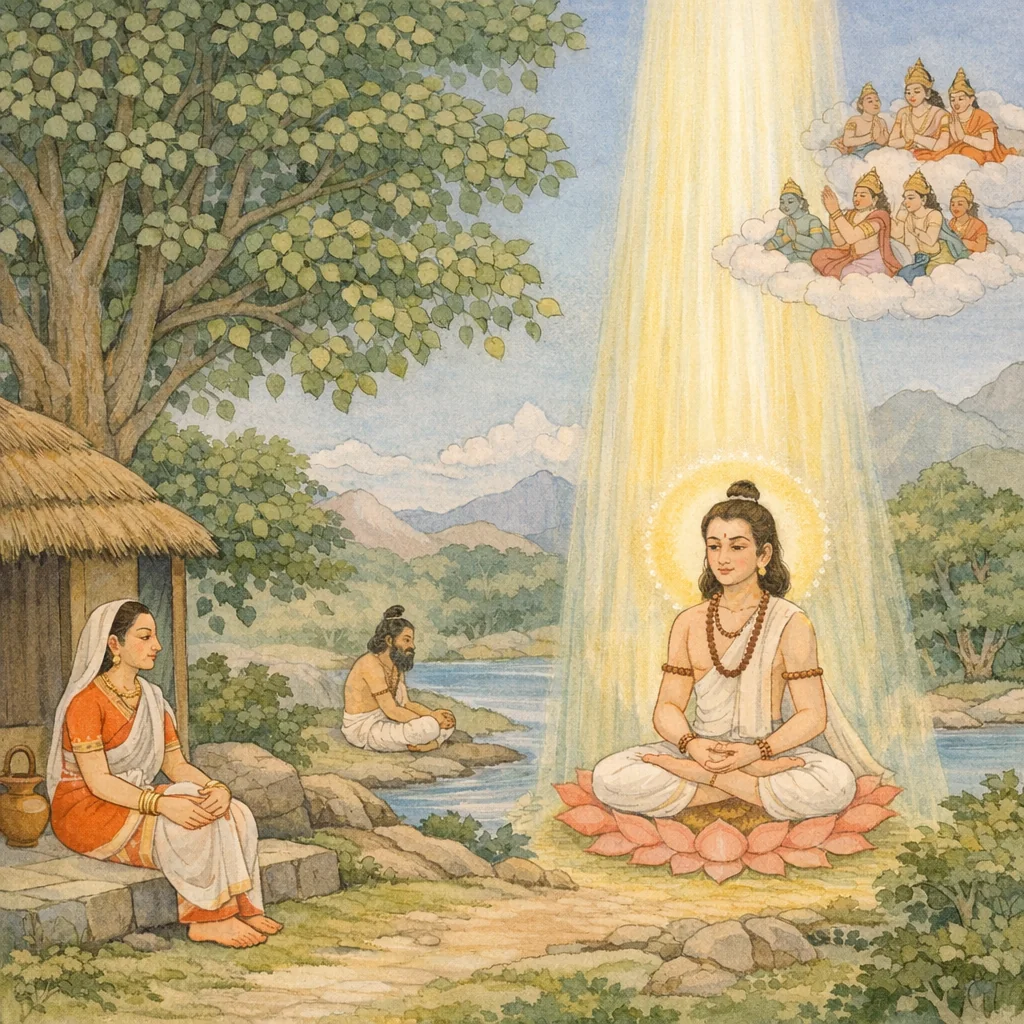
पिप्पलादावतारकथनम् (Account of the Pippalāda Avatāra)
Adhyāya 24 unfolds as a layered dialogue that validates a Shaiva avatāra account through successive speakers. Nandīśvara introduces it as a bhakti-enhancing narrative: the supreme incarnation Pippalāda, a manifestation of Maheśa. The chapter places this descent within a sage-lineage and earlier cosmic tensions: Dadhīci, portrayed as a powerful Mahāśaiva with a remembered history of conflict—including victory over Viṣṇu in battle with Kṣuva—becomes caught in divine reactions mediated by a curse (śāpa). Suvarcā, Dadhīci’s exemplary pativratā wife, is identified as the one who curses the devas, establishing the moral and ritual logic by which celestial order is corrected. From this ground Śiva manifests in Suvarcā as the radiant Pippalāda, showing avatāra as compassionate intervention rather than mere mythic spectacle. The frame then shifts as Sūta reports Sanatkumāra’s reverent inquiry to Nandīśvara, requesting details of the deva-curse and the auspicious “Pippalāda-carita.” Esoterically, the chapter affirms the Purāṇic principle that tapas, chastity/vow, and devotion have real cosmological effects, and that Śiva’s descent resolves imbalances born of divine or semi-divine conflict.
Shlokas
Verse 1
नन्दीश्वर उवाच । पिप्पलादाख्यपरममवतारं महेशितुः । शृणु प्राज्ञ महाप्रीत्या भक्तिवर्धनमुत्तमम्
Nandīśvara said: O wise one, listen with great joy to the supreme incarnation of Maheśa known as Pippalāda—an excellent account that increases devotion.
Verse 2
यः पुरा गदितो विप्रो दधीचिर्मुनिसत्तमः । महाशैवस्सुप्रतापी च्यावनिर्भृगुवंशजः
He who was spoken of earlier—the brāhmaṇa sage Dadhīci, foremost among seers—was a great devotee of Śiva, mighty in spiritual splendor, and born in the lineage of Bhṛgu through Cyavana.
Verse 3
क्षुवेण सह संग्रामे येन विष्णुः पराजितः । सनिर्जरोऽथ संशप्तो महेश्वरसहायिना
In the battle fought together with Kṣu, by him Viṣṇu was defeated; then, though accompanied by the immortals, he was subdued by the aid of Maheśvara (Śiva).
Verse 4
तस्य पत्नी महाभागा सुवर्चा नामनामतः । महापतिव्रता साध्वी यया शप्ता दिवौकसः
His wife was a lady of great fortune, famed by the name Suvarcā. A saintly woman of supreme chastity, steadfast in the vow of wifely fidelity, she it was who even cursed the dwellers of heaven.
Verse 5
तस्मात्तस्यां महादेवो नानालीलाविशारदः । प्रादुर्बभूव तेजस्वी पिप्पलादेति नामतः
Therefore, within her, Mahādeva—skilled in countless divine līlās—manifested in a radiant form, bearing the name Pippalāda.
Verse 6
सूत उवाच । इत्याकर्ण्य मुनिश्रेष्ठो नन्दीश्वरवचोऽद्भुतम् । सनत्कुमारः प्रोवाच नतस्कन्धः कृताञ्जलिः
Sūta said: Having thus heard the wondrous words of Nandīśvara, Sanatkumāra—the foremost of sages—bowed in reverence, joined his palms, and spoke.
Verse 7
सनत्कुमार उवाच । नन्दीश्वर महाप्राज्ञ साक्षाद्रुद्रस्वरूपधृक् । धन्यस्त्वं सद्गुरुस्तात श्रावितेयं कथाद्भुता
Sanatkumāra said: O Nandīśvara, greatly wise one, you who bear the very form of Rudra Himself—blessed are you, dear child, the true Sadguru, for you have caused this wondrous sacred account to be heard.
Verse 8
क्षुवेण सह संग्रामे श्रुतो विष्णुपुरा जयः । ब्रह्मणा मे पुरा तात तच्छापश्च शिलादज
O dear one born of Śilāda, in the battle fought together with Kṣu, I heard of the victory of Viṣṇu’s city. Long ago, dear child, I too received that curse from Brahmā.
Verse 9
अधुना श्रोतुमिच्छामि देवशापं सुवर्चया । दत्तं पश्चात्पिप्पलादचरितं मङ्गलायनम्
Now I wish to hear of the divine curse pronounced by Suvarcā; and thereafter, the auspicious life-account of Pippalāda, a source of blessings.
Verse 10
सूत उवाच । इति श्रुत्वाथ शैलादिर्विधिपुत्रवचश्शुभम् । प्रत्युवाच प्रसन्नात्मा स्मृत्वा शिवपदाम्बुजम्
Sūta said: Hearing those auspicious words spoken by the son of Brahmā, Śailādi, his heart made serene, remembered the lotus-feet of Lord Śiva and then replied.
Verse 11
नन्दीश्वर उवाच । एकदा निर्जरास्सर्वे वासवाद्या मुनीश्वर । वृत्रासुरसहायैश्च दैत्यैरासन्पराजिताः
Nandīśvara said: O best of sages, once all the gods—led by Vāsava (Indra)—were defeated by the daityas who were aided by the demon Vṛtrāsura.
Verse 12
स्वानि स्वानि वरास्त्रा णि दधीचस्याश्रमेऽखिलाः । निक्षिप्य सहसा सद्योऽभवन्देवाः पराजिताः
All the gods, casting down their own excellent celestial weapons in the hermitage of Dadhīci, were at once immediately defeated.
Verse 13
तदा सर्वे सुरास्सेन्द्रा वध्यमानास्तथर्षयः । ब्रह्मलोकगताश्शीघ्रं प्रोचुः स्वं व्यसनं च तत्
Then all the gods—together with Indra—and the sages, being assailed and slain, swiftly went to Brahmaloka and told Brahmā of their own calamity in full.
Verse 14
तच्छ्रुत्वा देववचनं ब्रह्मा लोकपितामहः । सर्वं शशंस तत्त्वेन त्वष्टुश्चैव चिकीर्षितम्
Hearing the words of the gods, Brahmā—the grandsire of the worlds—truthfully explained everything in accordance with reality, including what Tvaṣṭṛ intended to carry out.
Verse 15
भवद्वधार्थं जनितस्त्वष्ट्रायं तपसा सुराः । वृत्रो नाम महातेजाः सर्वदैत्याधिपो महान्
To accomplish your destruction, the gods, through austerity, caused Tvaṣṭṛ to beget a being—Vṛtra by name—of mighty splendor, a great lord over all the daityas.
Verse 16
अथ प्रयत्नः क्रियतां भवेदस्य वधो यथा । तत्रोपायं शृणु प्राज्ञ धर्महेतोर्वदामि ते
“Now, let an earnest effort be made so that his slaying may come to pass. Hear the means for that, O wise one; I shall tell it to you for the sake of dharma.”
Verse 17
महामुनिर्दधीचिर्यस्स तपस्वी जितेन्द्रियः । लेभे शिवं समाराध्य वज्रास्थित्ववरम्पुरा
That great sage Dadhīci—an austere one who had conquered his senses—formerly attained a boon from Lord Śiva by devotedly propitiating Him: the adamantine firmness of his bones, like a thunderbolt.
Verse 18
तस्यास्थीन्येव याचध्वं स दास्यति न संशय । निर्माय तैर्दण्डवज्रं वृत्रं जहि न संशयः
“Ask him only for his bones—he will surely give them, without doubt. Fashion from those bones a thunderbolt-like staff, and with it slay Vṛtra; of this there is no doubt.”
Verse 19
नन्दीश्वर उवाच । तच्छ्रुत्वा ब्रह्मवचनं शक्रो गुरुसमन्वितः । आगच्छत्सामरः सद्यो दधीच्याश्रममुत्तमम्
Nandīśvara said: Hearing Brahmā’s words, Śakra (Indra), accompanied by his preceptor, immediately came—together with the gods—to the excellent hermitage of Dadhīci.
Verse 20
दृष्ट्वा तत्र मुनिं शक्रः सुवर्चान्वितमादरात् । ननाम साञ्जलिर्नम्रः सगुरुः सामरश्च तम्
Seeing the sage there, radiant with spiritual splendor, Indra (Śakra) approached with reverence. With palms joined and a humble bearing, he bowed down to him—together with his preceptor and the assembled gods.
Verse 21
तदभिप्रायमाज्ञाय स मुनिर्बुधसत्तमः । स्वपत्नीं प्रेषयामास सुवर्चां स्वाश्रमान्तरम्
Understanding that intention, the sage—foremost among the wise—sent his wife Suvarcā into the inner precincts of his own hermitage.
Verse 22
ततस्स देवराजश्च सामरः स्वार्थसाधकः । अर्थशास्त्रपरो भूत्वा मुनीशं वाक्यमब्रवीत्
Then the king of the gods—together with the hosts of devas—intent on securing his own objective, and adopting a policy guided by statecraft, spoke these words to the great sage.
Verse 23
शक्र उवाच । त्वष्ट्रा विप्रकृताः सर्वे वयन्देवास्तथर्षयः । शरण्यं त्वां महाशैवं दातारं शरणं गताः
Śakra (Indra) said: “All of us—both the Devas and the Ṛṣis—have been wronged by Tvaṣṭṛ. Therefore we have come for refuge to You, O Mahāśiva, the Great Auspicious One, the true Protector and the supreme Giver; for You alone are the Refuge of all.”
Verse 24
स्वास्थीनि देहि नो विप्र महावज्रमयानि हि । अस्थ्ना ते स्वपविं कृत्वा हनिष्यामि सुरद्रुहम्
“O Brāhmaṇa-sage, give us your own bones, for they are truly of the nature of a great thunderbolt (vajra). Fashioning from your bones a vajra-weapon of my own making, I shall strike down the enemy of the gods.”
Verse 25
इत्युक्तस्तेन स मुनिः परोपकरणे रतः । ध्यात्वा शिवं स्वनाथं हि विससर्ज कलेवरम्
Thus instructed by him, that sage—ever devoted to the welfare of others—meditated upon Śiva, his own supreme Lord and refuge, and then consciously cast off his body.
Verse 26
ब्रह्मलोकं गतस्सद्यस्स मुनिर्ध्वस्तबन्धनः । पुष्पवृष्टिरभूत्तत्र सर्वे विस्मयमागताः
Freed at once from all bondage, that sage immediately attained Brahmaloka. There, a rain of flowers fell, and everyone present was filled with wonder.
Verse 27
अथ गां सुरभिं शक्र आहूयाशु ह्यलेहयत् । अस्त्रनिर्मितये त्वाष्ट्रं निदि देश तदस्थिभिः
Then Śakra (Indra) quickly summoned Surabhī, the divine cow, and had her lick those remains. With those very bones he then instructed Tvaṣṭṛ to fashion a weapon, so that the divine missile might be forged.
Verse 28
विश्वकर्मा तदाज्ञप्तश्चक्लृपेऽस्त्राणि कृत्स्नशः । तदस्थिभिर्वज्रमयस्सुदृढैश्शिववर्चसा
Commanded by him, Viśvakarmā fashioned, in their entirety, all the weapons—making them adamantine and exceedingly firm from those very bones, empowered by Śiva’s radiant potency.
Verse 29
वंशोद्भवं वज्रं शरो ब्रह्मशिरस्तथा । अन्यास्थिभिर्बहूनि स्वपराण्यस्त्राणि निर्ममे
From the bone that arose from the bamboo, he fashioned the Vajra (thunderbolt), the arrow, and also the Brahmaśiras weapon; and with other bones he likewise created many other supreme weapons for himself and for others.
Verse 30
तमिन्द्रो वज्रमुद्यम्य वर्द्धितः शिववर्चसा । वृत्रमभ्यद्रवत्क्रुद्धो मुने रुद्र इवान्तकम्
O sage, Indra—his prowess intensified by the radiance of Śiva—raised up the Vajra and, in wrath, charged straight at Vṛtra, just as Rudra rushes upon Death itself.
Verse 31
ततः शक्रस्सुसन्नद्धस्तेन वज्रेण स द्रुतम् । उच्चकर्त शिरो वार्त्रं गिरिशृंगमिवौजसा
Then Śakra (Indra), fully armed, swiftly struck with that Vajra and, by sheer force, cut off Vṛtra’s head—like cleaving a mountain-peak.
Verse 32
तदा समुत्सवस्तात बभूव त्रिदिवौकसाम् । तुष्टुवुर्निर्जराश्शक्रम्पेतुः कुसुमवृष्टयः
Then, dear one, a great celebration arose among the dwellers of heaven. The deathless gods praised Śakra (Indra), and showers of flowers fell from the sky.
Verse 33
इति ते कथितन्तात प्रसंगाच्चरि तन्त्विदम् । पिप्पलादावतारम्भे शृणु शम्भोर्महादरात्
Thus, dear one, I have told you this account incidentally, in due sequence. Now, at the beginning of the narration of Pippalāda’s incarnation, listen with great reverence to the glorious account of Śambhu (Lord Śiva).
Verse 34
सुवर्चा सा मुनेः पत्नी दधीचस्य महात्मनः । ययौ स्वमाश्रमाभ्यन्तस्तदाज्ञप्ता पतिव्रता
Suvarcā, the devoted wife of the great-souled sage Dadhīci, obeying his command, went within their own hermitage—steadfast in her vow of wifely fidelity (pativratā).
Verse 35
आगत्य तत्र सा दृष्ट्वा न पतिं स्वन्तपस्विनी । गृहकार्यं च सा कृत्वाखिलम्पतिनिदेशतः
When she arrived there, that virtuous lady, practiced in austerity, did not see her husband. Yet, in keeping with his instructions, she carried out all the household duties in full.
Verse 36
आजगाम पुनस्तत्र पश्यन्ती बह्वशोभनम् । देवांश्च तान्मुनिश्रेष्ठ सुवर्चा विस्मिताभवत्
She came there again, beholding many wondrous sights. And on seeing those gods, O best of sages, Suvarcā was filled with amazement.
Verse 37
ज्ञात्वा च तत्सर्वमिदं सुराणां कृत्यं तदानीञ्च चुकोप साध्वी । ददौ तदा शापमतीव रुष्टा तेषां सुवर्चा ऋषिवर्यभार्या
Having understood the entire deed of the gods, that virtuous lady at once grew enraged. Then Suvarcā—the wife of the foremost sage—uttered a curse upon them, being exceedingly wrathful.
Verse 38
सुवर्चोवाच । अहो सुरा द्रुष्टतराश्च सर्वे स्वकार्यदक्षा ह्यबुधाश्च लुब्धाः । तस्माच्च सर्वे पशवो भवन्तु सेन्द्राश्च मेऽद्यप्रभृतीत्युवाच
Suvarcā said: “Alas! All these gods have become exceedingly deceitful—clever in securing their own ends, yet foolish and greedy. Therefore, from this very day, let them all become beasts, Indra included!”
Verse 39
एवं शापन्ददौ तेषां सुराणां सः तपस्विनी । सशक्राणां च सर्वेषां सुवर्चा मुनिकामिनी
Thus the ascetic lady Suvarcā, beloved of the sage, pronounced a curse upon those gods—all of them, including Indra.
Verse 40
अनुगन्तुम्पतेर्लोकमथेच्छत्सा पतिव्रता । चितां चक्र समेधोभिः सुपवित्रैर्मनस्विनी
Wishing then to follow her husband to his world, that devoted and faithful wife—steadfast in mind—prepared a funeral pyre with well-sanctified sacrificial sticks.
Verse 41
ततो नभोगिरा प्राह सुवर्चान्ताम्मुनिप्रियाम् । आश्वासयन्ती गिरिशप्रेरिता सुखदायिनी
Then Nabho-girā spoke to Suvarcāntā, beloved of the sages; prompted by Girīśa (Lord Śiva), she consoled her and became a bestower of comfort.
Verse 42
आकाशवाण्युवाच । साहसं न कुरु प्राज्ञे शृणु मे परमं वचः । मुनितेजस्त्वदुदरे तदुत्पादय यत्नतः
The celestial voice said: “O wise one, do not act rashly. Hear my highest counsel: the radiant spiritual power of the sage is within your womb—strive carefully to bring it forth.”
Verse 43
ततः स्वाभीष्टचरणन्देवि कर्तुन्त्वमर्हसि । सगर्भा न दहेद्गात्रमिति ब्रह्मनिदेशनम्
Thereafter, O Goddess, you may do what is dear to you. Yet this is Brahmā’s instruction: a pregnant woman should not burn her body.
Verse 44
नन्दीश्वर उवाच । इत्युक्त्वा सा नभोवाणी विरराम मुनीश्वर । तां श्रुत्वा सा मुनेः पत्नी विस्मिताभूत्क्षणं च सा
Nandīśvara said: Having spoken thus, that celestial voice fell silent, O best of sages. Hearing it, the sage’s wife became astonished for a moment.
Verse 45
सुवर्चा सा महासाध्वी पतिलोकमभीप्सती । उपविश्याश्मना भूयः सोदरं विददार ह
That illustrious Suvarcā—most virtuous and steadfast—longing to attain her husband’s realm, sat down and once again tore open her own belly with a stone.
Verse 46
निर्गतो जठरात्तस्या गर्भो मुनिवरस्य सः । महादिव्यतनुर्दीप्तो भासयंश्च दिशोदश
From her womb emerged the embryo of that supreme sage—radiant, bearing a greatly divine body, and shining forth so as to illumine the ten directions.
Verse 47
साक्षाद्रुद्रावतारोऽसौ दधीच वरतेजसः । प्रादुर्भूतस्स्वयन्तात स्वलीलाकरणे क्षमः
He was indeed a direct incarnation of Rudra—Dadhīca, endowed with excellent spiritual splendour. Manifesting of his own accord, he was fully capable of enacting the Lord’s divine play.
Verse 48
तन्दृष्ट्वा स्वसुतन्दिव्यं स्वरूपम्मुनिकामिनी । सुवर्चाज्ञाय मनसा साक्षाद्रुद्रावतारकम्
Seeing her own son in that divine form, Suvarcā—the beloved wife of the sage—recognized within her heart that he was, in truth, a direct incarnation of Rudra.
Verse 49
प्रहृष्टाभून्महासाध्वी प्रणम्याशु नुनाव सा । स्वहृदि स्थापयामास तत्स्वरूपम्मुनीश्वर
O lord of sages, the great virtuous lady became filled with joy. Having quickly bowed in reverence, she began to hymn that Lord, and she established that very form within her own heart.
Verse 50
सुवर्चा तनयं तं च प्रहस्य विमलेक्षणा । जननी प्राह सुप्रीत्या पतिलोकमभीप्सती
Then Suvarcā, the clear-eyed mother, smiled at her son and, filled with deep affection, spoke—longing to attain the realm of her husband.
Verse 51
सुवर्चोवाच । हे तात परमेशान चिरन्तिष्ठास्य सन्निधौ । अश्वत्थस्य महाभाग सर्वेषां सुखदो भवेः
Suvarcā said: “O dear one, O Parameśāna, remain here for a long time in the presence of this sacred aśvattha tree. O greatly fortunate One, become the giver of happiness to all.”
Verse 52
मामाज्ञापय सुप्रीत्या पतिलोकाय चाधुना । तत्रस्थाहं च पतिना त्वां ध्याये रुद्ररूपिणम्
Command me now with gracious love to go to the world of my husband. There, abiding with my lord, I shall meditate upon you—O One who is the very form of Rudra.
Verse 54
एवन्दधीचपत्नी सा पतिना संगता मुने । शिवलोकं समासाद्य सिषेवे शङ्करम्मुदा
Thus, O sage, Dadhīci’s wife—reunited with her husband—attained Śiva’s realm, and there she joyfully served Lord Śaṅkara.
Verse 55
एतस्मिन्नन्तरे देवास्सेन्द्राश्च मुनिभिस्सह । तत्राजग्मुस्त्वरा तात आहूता इव हर्षिताः
Meanwhile, O dear one, the gods—along with Indra and accompanied by the sages—hurriedly arrived there, joyful, as though they had been summoned.
Verse 56
हरिर्ब्रह्मा च सुप्रीत्यावतीर्णं शंकरं भुवि । सुवर्चायां दधीचाद्वा ययतुस्स्वगणैस्सह
Then Hari (Viṣṇu) and Brahmā, filled with joy, went—along with their own retinues—to Śaṅkara who had descended upon the earth, to Suvarcā, to the abode of the sage Dadhīca.
Verse 57
तत्र दृष्ट्वावतीर्णन्तं मुनिपुत्रत्वमागतम् । रुद्रं सर्वे प्रणेमुश्च तुष्टुवुर्बद्धपाणयः
There, seeing Rudra descended and having come to take birth as a sage’s son, all of them bowed down to Him and, with hands joined in reverence, praised Him.
Verse 58
तदोत्सवो महानासीद्देवानां मुनिसत्तम । नेदुर्दुन्दुभयस्तत्र नर्तक्यो ननृतुर्मुदा
O best of sages, that celebration of the gods was truly magnificent. There the kettledrums resounded, and the heavenly dancers danced joyfully.
Verse 59
जगुर्गन्धर्वपुत्राश्च किन्नरा वाद्यवादकाः । वादयामासुरमराः पुष्प वृष्टिं च चक्रिरे
The sons of the Gandharvas sang, and the Kinnaras—skilled musicians—played their instruments. The immortal gods also caused the music to resound, and they showered a rain of flowers in celebration.
Verse 60
पिप्पलस्य शर्वपितुर्विलसन्तं सुतं च तम् । संस्कृत्य विधिवत्सर्वे विष्ण्वाद्यास्तुष्टुवुः पुनः
Then all the gods—Viṣṇu and the others—having duly performed the proper rites for that radiant son of Pippala, the offspring of Śarva (Śiva), praised him again with reverence.
Verse 61
पिप्पलादेति तन्नाम चक्रे ब्रह्मा प्रसन्नधीः । प्रसन्नो भव देवेश इत्यूचे हरिणा सुरैः
With a delighted mind, Brahmā bestowed upon him the name “Pippalāda.” Then Hari (Viṣṇu), together with the gods, addressed the Lord of the Devas (Śiva), saying, “O Deveśa, be gracious—be pleased.”
Verse 62
इत्युक्त्वा तमनुज्ञाय ब्रह्मा विष्णुस्सुरास्तथा । स्वंस्वं धाम ययुस्सर्वे विधाय च महोत्सवम्
Having spoken thus and taking leave with permission, Brahmā, Viṣṇu, and the gods too—after duly celebrating a great festival—each departed to his own abode.
Verse 63
अथ रुद्रः पिप्पलादोऽश्वत्थमूले महाप्रभुः । तताप सुचिरं कालं लोकानां हितकाम्यया
Then Rudra—Pippalāda, the Great Lord—performed austere tapas at the root of the sacred aśvattha tree for a very long time, desiring the welfare of all the worlds.
Verse 64
इत्थं सुतपतस्तस्य पिप्पलादस्य सम्मुखे । महाकालो व्यतीयाय लोकचर्यानुसारिणः
Thus, in the very presence of that Pippalāda—while Sutapā continued in his observances—great Time (Mahākāla) passed on, following the customary course of the world.
Verse 93
नन्दीश्वर उवाच । इत्येवं सा बभाषेऽथ सुवर्चा तनयम्प्रति । पतिमन्वगमत्साध्वी परमेण समाधिना
Nandīśvara said: Having spoken thus to her son, the virtuous Suvarcā—absorbed in the highest samādhi—followed her husband, entering the state of union beyond worldly attachment.
Frequently Asked Questions
It presents the narrative premise for Śiva’s manifestation as Pippalāda: the Mahāśaiva sage Dadhīci and his wife Suvarcā become pivotal through conflict-history and a deva-directed curse, culminating in Śiva’s avatāra as a restorative intervention.
The chapter uses śāpa (curse), pativratā power, and avatāra-birth as symbolic operators for Purāṇic causality: disciplined vow and devotion are not merely ethical ideals but mechanisms that reshape cosmic order, with Śiva’s descent representing anugraha that re-harmonizes disrupted dharma.
Śiva is highlighted in the avatāra-form named Pippalāda, described as a radiant manifestation arising in Suvarcā; the emphasis is on Maheśvara’s capacity to enter embodied history to protect devotees and recalibrate divine relations.