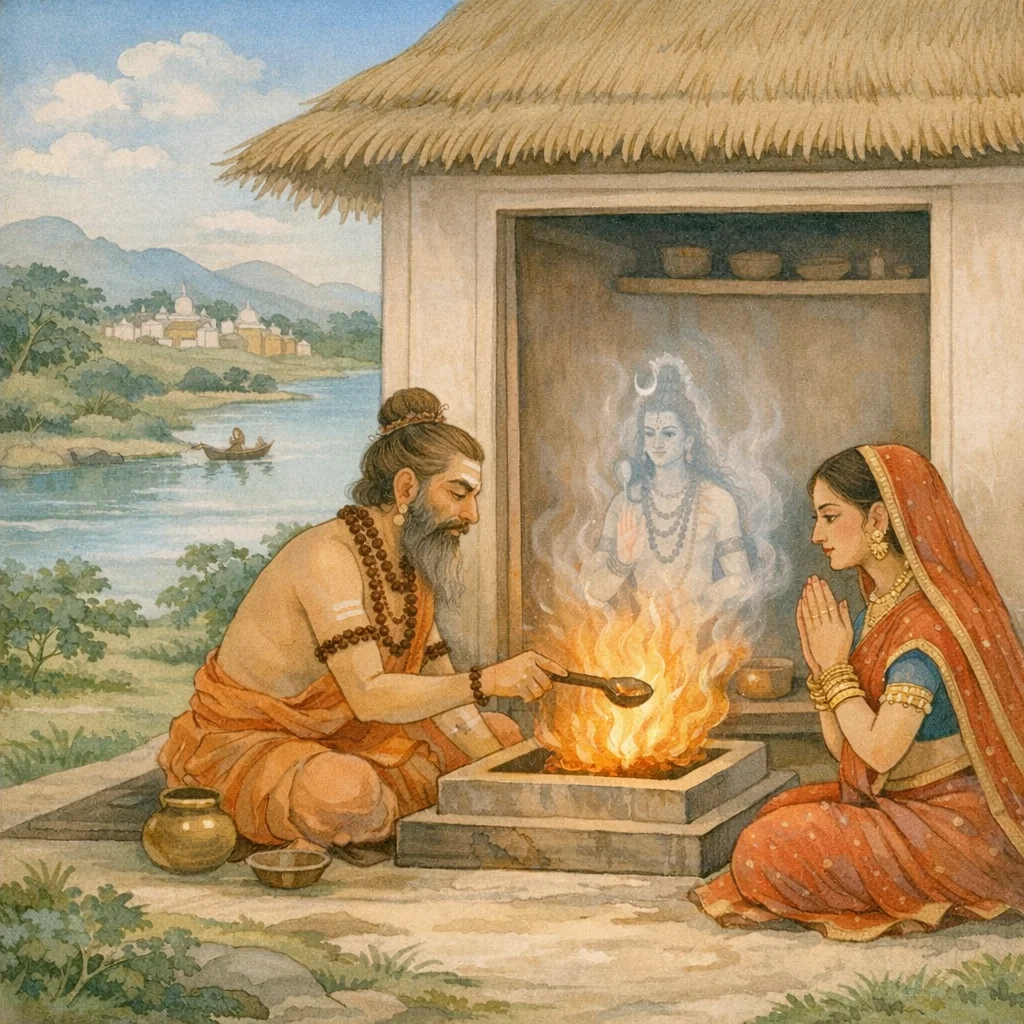
Viśvānara-Gṛhapati Upākhyāna — Śivasya Agni-gṛhe Avatāraḥ (The Account of Viśvānara Gṛhapati and Śiva’s Descent into the House of Fire)
Adhyāya 13 is framed as Nandīśvara’s instruction to a brahmasuta (a Brahmin-born interlocutor) and introduces a didactic upākhyāna about Viśvānara, titled Gṛhapati and linked with lordship in Agniloka. The opening portrays him as an exemplary householder-sage on the Narmadā’s bank at Narmapura, of Śāṇḍilya-gotra, steadfast in brahmacarya-āśrama discipline, learned in śāstra, and skilled in both Śaiva and worldly conduct. The chapter then teaches gṛhastha ethics: attendance to the sacred fire (agni), pañcayajña, ṣaṭkarman, and the threefold duty to devas, pitṛs, and guests. The narrative turns when his wife Śuciṣmatī says their household enjoyments are fulfilled “by your grace” and asks what is proper for householders—opening the way for Śiva’s compassionate anugraha, His descent into the sphere of domestic fire and duty. Esoterically, agni is read in a Śaiva key as the meeting-place of disciplined action and devotion, where Śiva may be encountered not only in ascetic withdrawal but within regulated worldly life.
Shlokas
Verse 1
नन्दीश्वर उवाच । शृणु ब्रह्मसुत प्रीत्या चरितं शशिमौलिनः । सोऽवतीर्णो यथा प्रीत्या विश्वानरगृहे शिवः
Nandīśvara said: “O son of Brahmā, listen with glad devotion to the sacred account of the Moon-crested Lord. Hear how Śiva, out of sheer grace and delight, descended and manifested in the house of Viśvānara.”
Verse 2
नाम्ना गृहपतिः सोऽभूदग्निलोकपतिर्मुने । अग्निरूपस्तेजसश्च सर्व्वात्मा परमः प्रभुः
O sage, he became known by the name Gṛhapati, the lord of the world of Fire. He is of the very form of Agni and of radiant splendor—indeed the indwelling Self of all beings, the Supreme Lord.
Verse 3
नर्मदायास्तटे रम्ये पुरे नर्मपुरे पुरा । पुरारिभक्तः पुण्यात्मा भवद्विश्वानरो मुनिः
Formerly, on the beautiful bank of the Narmadā, in the city called Narmapur, there lived a holy-souled sage named Viśvānara—your own earlier incarnation—who was a devoted worshipper of the Enemy of the Three Cities, Lord Śiva.
Verse 4
ब्रह्मचर्य्याश्रमे निष्ठो ब्रह्मयज्ञरतस्सदा । शाण्डिल्यगोत्रः शुचिमान्ब्रह्मतेजो निधिर्व्वशी
He was firmly established in the brahmacarya-āśrama, ever devoted to the brahma-yajña—Vedic study and sacred recitation. Of the Śāṇḍilya lineage, he was pure in conduct, a treasury of brahmic radiance, and master of his senses.
Verse 5
विज्ञाताखिलशास्त्रार्थस्सदाचाररतस्सदा । शैवाचारप्रवीणोऽति लौकिकाचारविद्वरः
He had mastered the purport of all the śāstras and was ever devoted to sadācāra, righteous conduct. He was exceedingly proficient in the disciplines of Śaiva observance, and foremost among those who know proper worldly conduct.
Verse 6
चित्ते विचार्य्य गृहिणीगुणान्विश्वानरः शुभान् । उदुवाह विधानेन स्वोचितां कालकन्यकाम्
After reflecting in his mind on the auspicious virtues befitting a householder, Viśvānara duly married Kālakanyā—she who was suited to him—according to proper rite.
Verse 7
अग्निशुश्रूषणरतः पञ्चयज्ञपरायणः । षट्कर्मनिरतो नित्यं देवपित्रतिथिप्रियः
He was devoted to the attentive service of the sacred fire, steadfast in the performance of the five great sacrifices, ever engaged in the six prescribed duties, and pleasing to the gods, the ancestors, and honored guests.
Verse 8
एवम्बहुतिथे काले गते तस्याग्रजन्मनः । भार्य्या शुचिष्मती नाम भर्तारम्प्राह सुव्रता
After many days had passed in the life of that first-born one, his virtuous wife—named Śuciṣmatī—spoke to her husband.
Verse 9
नाथ भोगा मया सर्वे भुक्ता वै त्वत्प्रसादतः । स्त्रीणां समुचिता ये स्युस्त्वां समेत्य मुदावहाः
O Lord, by Your grace I have indeed tasted every enjoyment. Yet the joys proper to a woman become truly happiness-giving only upon attaining You.
Verse 10
एवम्मे प्रार्थितन्नाथ चिराय हृदि संस्थितम् । गृहस्थानां समुचितं त्वमेतद्दातुमर्हसि
O Lord, this is the prayer I have long held within my heart, and now I humbly utter it. You are worthy to grant it—teach and bestow what is truly fitting for householders.
Verse 11
विश्वानर उवाच । किमदेयं हि सुश्रोणि तव प्रियहितैषिणी । तत्प्रार्थय महाभागे प्रयच्छाम्यविलम्बितम्
Viśvānara said: “O fair-hipped lady, what is there that cannot be given to you, since I seek what is dear and beneficial to you? Therefore, O noble one, ask for it—I shall grant it without delay.”
Verse 12
महेशितुः प्रसादेन मम किञ्चिन्न दुर्लभम् । इहामुत्र च कल्याणि सर्वकल्याणकारिणः
By the grace of Maheshvara, nothing whatsoever is difficult for me to attain. O auspicious one, He—the source of all blessings—grants welfare both here in this world and hereafter.
Verse 13
नन्दीश्वर उवाच । इत्याकर्ण्य वचः पत्युस्तस्य सा पतिदेवता । उवाच हृष्यद्वदना करौ बद्ध्वा विनीतिका
Nandīśvara said: Hearing thus the words of her husband, that devoted wife—her face radiant with joy—spoke with humility, joining her hands in reverent submission.
Verse 14
शुचिष्मत्युवाच । वरयोग्यास्मि चेन्नाथ यदि देयो वरो मम । महेशसदृशम्पुत्रन्देहि नान्यं वरं वृणे
Śuciṣmatī said: “O Lord, if I am worthy of a boon, and if a boon is to be granted to me, then grant me a son equal to Maheśa (Śiva). I choose no other boon.”
Verse 15
नन्दीश्वर उवाच । इति तस्या वचः श्रुत्वा ब्राह्मणस्स शुचिव्रतः । क्षणं समाधिमाधाय हृद्येतत्समचिन्तयत्
Nandīśvara said: Hearing her words, that brāhmaṇa—steadfast in pure vows—entered into samādhi for a moment, and within his heart reflected deeply on this matter.
Verse 16
अहो किं मे तया तन्व्या प्रार्थितं ह्यतिदुर्लभम् । मनोरथपथाद्दूरमस्तु वा स हि सर्व्वकृत्
“Alas—what has that slender one asked of me? Is it something exceedingly hard to obtain? Let it be far beyond the path of ordinary desire, for He is the Doer of all (Śiva), able to accomplish everything.”
Verse 17
तेनैवास्या मुखे स्थित्वा वाक्स्वरूपेण शम्भुना । व्याहृतं कोऽन्यथा कर्त्तुमु त्सहेत भवेदिदम्
Shambhu Himself, abiding in her very mouth as the form of speech, uttered it. Who could possibly have the power to make this otherwise or speak it differently?
Verse 18
नन्दीश्वर उवाच । इति सञ्चिंत्य स मुनिर्विश्वानर उदारधीः । ततः प्रोवाच ताम्पत्नीमेकपत्नीव्रते स्थितः
Nandīśvara said: Having thus reflected, that sage Viśvānara, noble in understanding, then spoke to his wife—he who was established in the vow of fidelity to one spouse.
Verse 19
नन्दीश्वर उवाच । इत्थमाश्वास्य ताम्पत्नीञ्जगाम तपसे मुनिः । यत्र विश्वेश्वरः साक्षात्काशीनाथोऽधि तिष्ठति
Nandīśvara said: “Thus, having consoled his wife, the sage departed for austerities—to that place where Viśveśvara Himself, the Lord of Kāśī, directly abides.”
Verse 20
प्राप्य वाराणसीं तूर्णं दृष्ट्वा ताम्मणिकर्णिकाम् । तत्याज तापत्रितयमपि जन्मशतार्जितम्
Having swiftly reached Vārāṇasī and beholding that Maṇikarṇikā, he cast off even the threefold afflictions—accumulated through hundreds of births—by the grace inherent in that sacred Śaiva tīrtha.
Verse 21
दृष्ट्वा सर्वाणि लिंगानि विश्वेशप्रमुखानि च । स्नात्वा सर्वेषु कुण्डेषु वापीकूपसरस्सु च
Having beheld all the sacred Liṅgas—beginning with Viśveśa—and having bathed in every holy tank, stepwell, well, and lake, the devotee is ritually purified and becomes fit for Śiva’s grace-filled worship.
Verse 22
नत्वा विनायकान्सर्वान्गौरीं शर्वां प्रणम्य च । सम्पूज्य कालराजञ्च भैरवम्पापभक्षणम्
Having bowed to all the Vināyakas, and having also saluted Gaurī and Śarva (Śiva), he duly worshipped Kālarāja—the Lord of Time and Death—and Bhairava, the devourer of sins.
Verse 23
दण्डनायकमुख्यांश्च गणान्स्तुत्वा प्रयत्नतः । आदिकेशवमुख्यांश्च केशवम्परितोष्य च
Having diligently praised the gaṇas—beginning with Dandanāyaka and the foremost among them—and having also gratified Keśava (Viṣṇu), beginning with Ādi-Keśava, he proceeded further in devotion.
Verse 24
लोकार्कमुखसूर्यांश्च प्रणम्य स पुनःपुनः । कृत्वा च पिण्डदानानि सर्वतीर्थेष्वतन्द्रितः
He repeatedly bowed in reverence to the Sun—the very face of the worlds—and, ever diligent, performed the offering of piṇḍas at all the sacred tīrthas.
Verse 25
सहस्रभोजनाद्यैश्च मुनीन्विप्रान्प्रतर्प्य च । महापूजोपचारैश्च लिंगान्यभ्यर्च्य भक्तितः
Having fully satisfied sages and brāhmaṇas with abundant feasts and the like, and then, with devotion, worshipping the Śiva-liṅgas through the grand offerings and services of formal pūjā—(one gains great spiritual merit).
Verse 26
असकृच्चिन्तयामास किं लिंगं क्षिप्रसिद्धिदम् । यत्र निश्चलतामेति तपस्तनयकाम्यया
Again and again he reflected: “Which form of the Śiva-liṅga grants swift attainment—by worship of which may one gain unwavering steadiness in tapas, desiring a son through austerity?”
Verse 27
क्षणं विचार्य्य स मुनिरिति विश्वानरस्सुधीः । क्षिप्रम्पुत्रप्रदं लिंगं वीरेशम्प्रशशंस ह
After reflecting for a moment, the wise sage Viśvānara praised Vīreśa, declaring: “This Liṅga bestows a son swiftly.”
Verse 28
असंख्यातास्सहस्राणि सिद्धाः सिद्धिं गतास्ततः । सिद्धलिंगमिति ख्यातन्तस्माद्वीरेश्वरम्परम्
There, countless thousands of Siddhas, perfected beings, attained the supreme accomplishment. Therefore that holy emblem became renowned as the Siddha-liṅga; and for that very reason it is celebrated as the transcendent Vīreśvara.
Verse 29
वीरेश्वरम्महालिंगमब्दमभ्यर्च्य भक्तितः । आयुर्मनोरथं सर्वं पुत्रादिकमनेकशः
Worshipping with devotion the great Liṅga known as Vīreśvara for a full year, one attains long life, the fulfillment of all cherished aims, and manifold blessings such as sons and other prosperities.
Verse 30
अहमप्यत्र वीरेशं समाराध्य त्रिकालताः । आशु पुत्रमवाप्स्यामि यथाभिलषितं स्त्रिया
I too shall worship Vīreśa here at the three sacred times of day. Very soon I will obtain a son—just as a woman may desire.
Verse 31
नन्दीश्वर उवाच । इति कृत्वा मतिन्धीरो विप्रो विश्वानरः कृती । चन्द्रकूपजले स्नात्वा जग्राह नियमं व्रती
Nandīśvara said: Having done thus, the resolute-minded brāhmaṇa Viśvānara—capable and accomplished—bathed in the waters of Candrakūpa and, as a vowed devotee, undertook the prescribed religious observance (niyama).
Verse 32
एकाहारोऽभवन्मासं मासं नक्ताशनोऽभवत् । अयाचिताशनो मासम्मासन्त्यक्ताशनः पुनः
For one month he lived on a single meal a day; for another month he ate only at night. For a month he subsisted only on food received unasked, and then for yet another month he again renounced food altogether.
Verse 33
पयोव्रतोऽभवन्मासम्मासम्मासं शाक फलाशनः । मासम्मुष्टितिलाहारो मासं पानीयभोजनः
For one month he kept the vow of milk alone; the next month he lived on vegetables and fruits. For another month he subsisted on a handful of sesame seeds, and for a further month he took only water as his nourishment.
Verse 34
पञ्चगव्याशनो मासम्मासञ्चान्द्रायणव्रती । मासं कुशाग्रजलभुग्मासं श्वसनभक्षणः
For one month he lived on Pañcagavya, the five sacred products of the cow; for another month he observed the Cāndrāyaṇa vow. For one month he subsisted on water taken with the tips of kuśa grass; and for one month he lived only on the air he breathed.
Verse 35
एवमब्दमितं कालन्तताप स तपोऽद्भुतम् । त्रिकालमर्चयद्भक्त्या वीरेशं लिङ्गमुत्तमम्
Thus, over a measured span of years, he performed wondrous austerities; and with devotion, at the three sacred times each day, he worshipped the excellent Vīreśa Liṅga—Śiva manifest in a gracious, worshipful form.
Verse 36
अथ त्रयोदशे मासि स्नात्वा त्रिपथगाम्भसि । प्रत्यूष एव वीरेशं यावदायाति स द्विजः
Then, in the thirteenth month, having bathed in the waters of the Tripathagā—the Gaṅgā who flows through the three worlds—that twice-born Brahmin came at daybreak to Vīreśa (Lord Śiva) and remained there until he attained the Lord’s presence.
Verse 37
तावद्विलोकयाञ्चक्रे मध्ये लिंगन्तपोधनः । विभूतिभूषणम्बालमष्टवर्षाकृतिं शिशुम्
Then the ascetic, intent upon the Liṅga, looked and beheld in the very midst a child—an innocent boy of the appearance of eight years—adorned with sacred ash (vibhūti) as his ornament.
Verse 38
आकर्णायतनेत्रञ्च सुरक्तदशनच्छदम् । चारुपिंगजटामौलि न्नग्नप्रहसिताननम्
His eyes were stretched wide to the ears; his lips and teeth shone a vivid red. With a beautiful tawny crown of matted locks, his face—bare and unobstructed—glittered with a broad, radiant smile.
Verse 39
शैशवोचितनेपथ्यधारिणञ्चितिधारिणम् । पठन्तं श्रुतिसूक्तानि हसन्तं च स्वलीलया
They beheld Him wearing adornments suited to childhood, bearing the sacred topknot, reciting the hymns of the Vedas as taught in Śruti, and laughing playfully in His own divine līlā.
Verse 40
तमालोक्य मुदम्प्राप्य रोमकञ्चुकितो मुनिः । प्रोच्चचार हृदालापान्नमोस्त्विति पुनः पुनः
Beholding Him, the sage was filled with joy; his body thrilled with horripilation. From the depths of his heart he repeatedly uttered, “Namah to You—homage, again and again.”
Verse 41
अभिलाषप्रदैः पद्यैरष्टभिर्बालरूपिणम् । तुष्टाव परमानन्दं शंभुं विश्वानरः कृती
With eight desire-fulfilling verses, the accomplished Viśvānara praised Śambhu—Paramānanda Himself—who had assumed the form of a divine child.
Verse 42
विश्वानर उवाच । एकम्ब्रह्मैवाद्वितीयं समस्तं सत्यंसत्यं नेह नानास्ति किञ्चित् । एको रुद्रो न द्वितीयोऽवतस्थे तस्मादेकन्त्वाम्प्रपद्ये महेशम्
Viśvānara said: “All this is verily the one Brahman, without a second—truth, truth indeed; here there is not the least plurality. Rudra alone stands, with no second. Therefore, O Maheśa, I take refuge in You as the One.”
Verse 43
कर्ता हर्त्ता त्वं हि सर्वस्य शम्भो नानारूपेष्वेकरूपोऽप्यरूपः । यद्वत्प्रत्यग्धर्म एकोऽप्यनेकस्तस्मान्नान्यन्त्वां विनेशम्प्रपद्ये
O Śambhu, You alone are the creator and the withdrawer of all. Though You appear in many forms, in truth You are One, and yet beyond every form. As the one indwelling principle (the inner Self) is spoken of as many through its functions, so too You are one in essence. Therefore, apart from You, O Lord, I seek no other refuge.
Verse 44
रज्जो सर्पश्शुक्तिकायां च रौप्यं नैरः पूरस्तन्मृगाख्ये मरीचौ । यद्यत्सद्वद्विष्वगेव प्रपञ्चो यस्मिञ्ज्ञाते तम्प्रपद्ये महेशम्
Just as a rope is mistaken for a serpent, mother-of-pearl for silver, a mirage for water, and a city in the sky for something real, so too this entire manifold world appears everywhere as though it were truly real. Him—Maheśa, Mahādeva—by whose true knowledge this delusion is understood and dissolved, in Him I take refuge.
Verse 45
तोये शैत्यं दाहकत्वं च वह्नौ तापो भानौ शीतभानौ प्रसादः । पुष्पे गन्धो दुग्धमध्येऽपि सर्पिर्यत्तच्छंभो त्वं ततस्त्वाम्प्रपद्ये
Coolness in water, the power to burn in fire, heat in the sun, soothing grace in the moon; fragrance in a flower, and ghee hidden within milk—whatever that inner essence is, O Śambhu, that is You. Therefore, I take refuge in You.
Verse 46
शब्दं गृह्णास्यश्रवास्त्वं हि जिघ्रस्यप्राणस्त्वं त्र्यंघ्रिरायासि दूरात् । त्र्यक्षः पश्येस्त्वं रसज्ञोऽप्यजिह्वः कस्त्वां सम्यग्वेत्त्यतस्त्वाम्प्रपद्ये
You apprehend sound though You are without ears; You smell though You are without breath; with three feet You come from afar. With three eyes You see; though without a tongue, You yet know taste. Who can truly know You in full? Therefore I take refuge in You.
Verse 47
नो वेद त्वामीश साक्षाद्धि वेदो नो वा विष्णुर्नो विधाताखिलस्य । नो योगीन्द्रानेन्द्रमुख्याश्च देवा भक्तो वेदस्त्वामतस्त्वाम्प्रपद्ये
O Lord, even the Veda does not directly know You; nor does Viṣṇu, nor Brahmā the creator of all. Nor do the greatest yogins, nor Indra and the foremost gods comprehend You. Therefore, since You are known only through devotion, I take refuge in You.
Verse 48
नो ते गोत्रं नो सजन्मापि नाशो नो वा रूपं नैव शीलन्न देशः । इत्थम्भूतोऽपीश्वरस्त्वं त्रिलोक्यास्सर्वान्कामान्पूरयेस्त्वं भजे त्वाम्
You have no lineage and no fixed birth; for You there is no destruction. You have no limiting form, no worldly character, and no confined abode. Though thus beyond all attributes, You are the Lord of the three worlds, fulfilling all desires; therefore I worship You.
Verse 49
त्वत्तस्सर्वं त्वं हि सर्वं स्मरारे त्वं गौरीशस्त्वं च नग्नोऽतिशान्तः । त्वं वै वृद्धस्त्वं युवा त्वं च बालस्तत्त्वं यत्किं नान्यतस्त्वां नतोऽहम्
From You all things arise; indeed, You are all, O foe of Smara (Kāma). You are the Lord of Gaurī, and You are the unclad One, supremely tranquil. You are the aged, the youth, and the child; whatever reality (tattva) there is, it is You alone. There is none other; therefore I bow to You.
Verse 50
नन्दीश्वर उवाच । स्तुत्वेति विप्रो निपपात भूमौ संबद्धपाणिर्भवतीह यावत् । तावत्स बालोऽरिबलवृद्धवृद्धः प्रोवाच भूदेवमतीव हृष्टः
Nandīśvara said: When the brāhmaṇa, with palms joined, fell upon the earth saying, “I shall praise (Him),” at that very moment the boy—mature beyond measure and strengthened with irresistible power—spoke to the brāhmaṇa, exceedingly delighted.
Verse 51
बाल उवाच । विश्वानर मुनिश्रेष्ठ भूदेवाहं त्वयाद्य वै । तोषितस्सुप्रसन्नात्मा वृणीष्व वरमुत्तमम्
Bāla said: “O Viśvānara, best of sages! Today indeed I am a Bhūdeva for you. Pleased, with a wholly gracious heart, I am satisfied—choose the highest boon.”
Verse 52
तत उत्थाय हृष्टात्मा सुनिर्विश्वानरः कृती । प्रत्यब्रवीन्मुनिश्रेष्ठः शंकरम्बालरूपिणम्
Then, rising with a delighted heart, the accomplished sage Sunirviśvānara replied to Śaṅkara, who had assumed the form of a child.
Verse 53
विश्वानर उवाच । महेश्वर किमज्ञातं सर्वज्ञस्य तव प्रभो । सर्वान्तरात्मा भगवाच्छर्वस्सर्व्वप्रदो भवान्
Viśvānara said: “O Maheśvara, O Lord—what could ever be unknown to You, the omniscient? You are the indwelling Self within all. O Blessed Śarva, You are the giver of everything.”
Verse 54
याच्ञाम्प्रति नियुक्तम्मां किं ब्रूषे दैन्यकारिणीम् । इति ज्ञात्वा महेशान यथेच्छसि तथा कुरु
“Having appointed me to the act of supplication, why do You speak to me in a way that makes me feel wretched? O Maheśāna, knowing this, do as You wish.”
Verse 55
नन्दीश्वर उवाच । इति श्रुत्वा वचस्तस्य देवो विश्वानरस्य हि । शुचिश्शुचिव्रतस्याथ शुचिस्मित्वाब्रवीच्छिशुः
Nandīśvara said: Having thus heard the words of the god Viśvānara—who was pure and steadfast in sacred observances—the pure child then smiled gently and spoke.
Verse 56
त्वया शुचे शुचिष्मत्यां योऽभिलाषः कृतो हृदि । अचिरेणैव कालेन स भविष्यत्यसंशयम्
O pure one—O radiant, virtuous lady—whatever heartfelt desire you have formed within, that will indeed be fulfilled in a short time, without doubt.
Verse 57
तव पुत्रत्वमेष्यामि शुचिष्मत्यां महामते । ख्यातो गृहपतिर्नाम्ना शुचिस्सर्व्वामरप्रियः
O great-minded one, I shall become your son through Śuciṣmatī. I shall be renowned by the name Gṛhapati—Śuci, beloved of all the devas.
Verse 58
अभिलाषाष्टकं पुण्यं स्तोत्रमेतत्त्वयेरितम् । अब्दत्रिकालपठनात्कामदं शिवसन्निधौ
This holy and meritorious hymn, the ‘Abhilāṣāṣṭaka’, has been proclaimed by you. If it is recited at the three times of day for a full year, then in the very presence and grace of Lord Śiva it becomes a bestower of the desired aims.
Verse 59
एतत्स्तोत्रप्रपठनं पुत्रपौत्रधनप्रदम् । सर्व्वशान्तिकरश्चापि सर्व्वापत्तिविनाशनम्
The recitation of this hymn bestows sons, grandsons, and wealth. It also brings complete peace and destroys every kind of calamity.
Verse 60
स्वर्गापवर्गसम्पत्तिकारकन्नात्र संशयः । सर्व्वस्तोत्रसमं ह्येतत्सर्व्वकामप्रदं सदा
This hymn is assuredly the bestower of the attainments of heaven and liberation—there is no doubt of it. Indeed, it is equal to all other hymns, and it always grants every desired aim.
Verse 61
प्रातरुत्थाय सुस्नातो लिंगमभ्यर्च्य शाम्भवम् । वर्षं जपन्निदं स्तोत्रमपुत्रः पुत्रवान्भवेत्
Rising early in the morning, having bathed well, and worshipping the Śāmbhava Liṅga, if a man without a son repeats this hymn for a full year, he becomes blessed with a son.
Verse 62
अभिलाषाष्टकमिदन्न देयं यस्य कस्यचित् । गोपनीयं प्रयत्नेन महावन्ध्याप्रसूतिकृत्
This ‘Abhilāṣāṣṭaka’ should not be given to just anyone. It must be guarded with sincere effort, for it is said to bring forth results even where there is great barrenness—bestowing the power of fruition where fruition seems impossible.
Verse 63
स्त्रिया वा पुरुषेणापि नियमाल्लिंगसन्निधौ । अब्दजप्तमिदं स्तोत्रम्पुत्रदन्नात्र संशयः
Whether by a woman or by a man—performed with disciplined observance in the presence of the Śiva-liṅga—this hymn, when recited for a full year, bestows a son; of this there is no doubt.
Verse 64
नन्दीश्वर उवाच । इत्युक्त्वान्तर्दधे शम्भुर्बालरूपः सतां गतिः । सोऽपि विश्वानरो विप्रो हृष्टात्मा स्वगृहं ययौ
Nandīśvara said: Having spoken thus, Śambhu—who had assumed the form of a boy, the supreme refuge and goal of the virtuous—then vanished from sight. And that brāhmaṇa Viśvānara too, his heart filled with joy, returned to his own home.
Frequently Asked Questions
Nandīśvara narrates how Śiva (Śaśimauli) descends (avatīrṇa) into the context of Viśvānara Gṛhapati—an agni-centered exemplary householder—thereby arguing that Śiva’s grace is accessible through disciplined domestic ritual life, not only through renunciation.
Agni functions as a double symbol: the external sacrificial fire maintained by the gṛhastha and the internal fire of purity/discipline that "cooks" karma into spiritual readiness. The title Gṛhapati further sacralizes the household as a legitimate altar-space where Śiva can be encountered through ācāra.
Śiva is highlighted as Śaśimauli (the moon-crested Lord) and as sarvātmā paramaḥ prabhuḥ in theological description; the chapter’s emphasis is less on a named avatāra-form and more on Śiva’s anugraha manifesting through the agni-centered household setting.