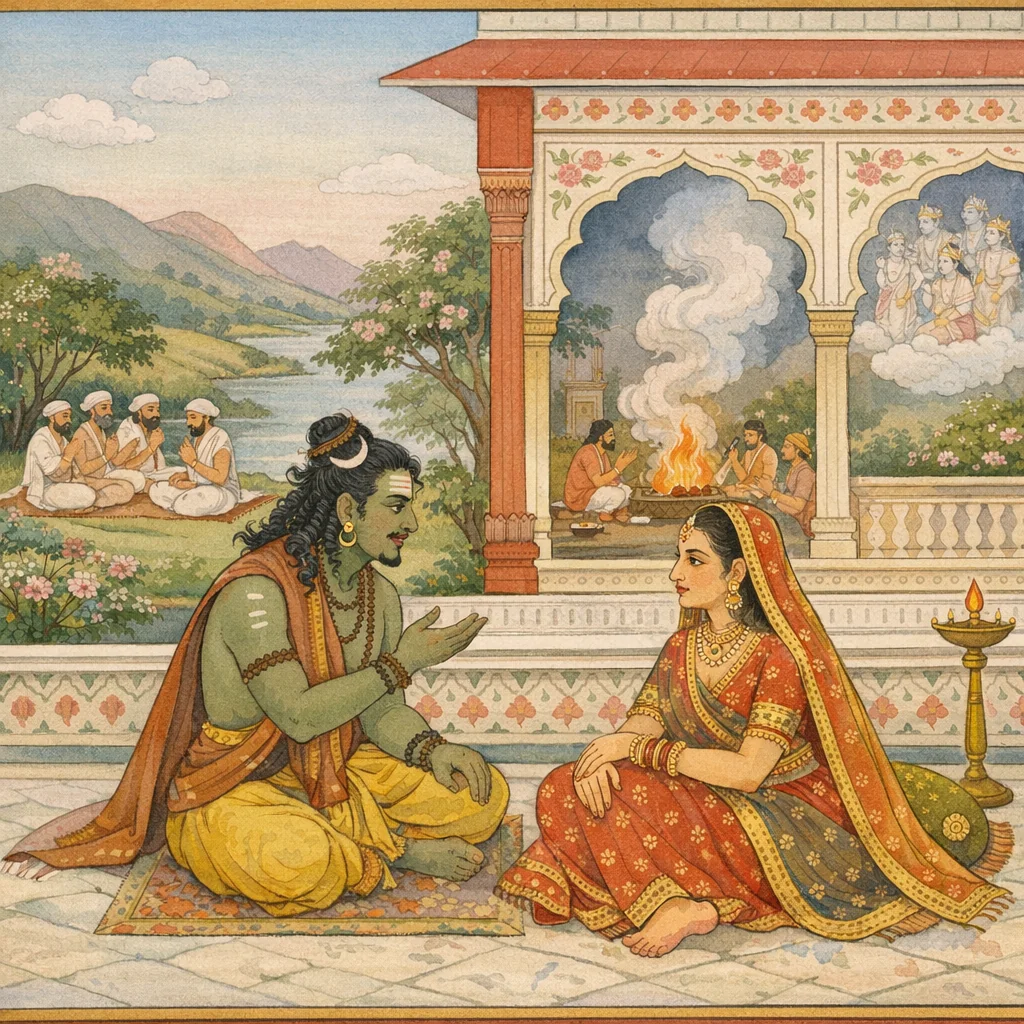
दुन्दुभिनिर्ह्रादनिर्णयः / Dundubhinirhrāda’s Stratagem: Targeting the Brāhmaṇas
Sanatkumāra recounts to Vyāsa the episode of the asura Duṃdubhinirhrāda (a kinsman of Prahlāda). After Viṣṇu slays Hiraṇyākṣa, Diti is overwhelmed with grief. Duṃdubhinirhrāda consoles her and, as a māyā-wielding daitya-rāja, considers how the devas may be conquered. He examines what sustains them—what they “eat,” “bear,” and “depend upon”—and concludes that deva-power is not self-born but is nourished by sacrificial rites (kratu/yajña). Since rites arise from the Vedas, and the Vedas rest upon brāhmaṇas, brāhmaṇas are presented as the crucial support of the deva order. Acting on this logic, Duṃdubhinirhrāda repeatedly seeks to kill brāhmaṇas to sever Vedic transmission and undermine ritual efficacy, thereby cutting the devas’ foundation. The chapter establishes the causal chain brāhmaṇa→Veda→yajña→deva-bala and strongly condemns violence against sacred custodians.
Shlokas
Verse 1
सनत्कुमार उवाच । शृणु व्यास प्रवक्ष्यामि चरितं शशिमौलिनः । यथा दुंदुभिनिर्ह्रादमवधीद्दितिजं हरः
Sanatkumāra said: “Listen, O Vyāsa; I shall recount the sacred exploits of the Moon-crested Lord—how Hara slew the Diti-born demon named Duṃdubhi-nirhrāda.”
Verse 2
हिरण्याक्षे हते दैत्ये दितिपुत्रे महाबले । विष्णुदेवेन कालेन प्राप दुखं पहद्दितिः
When the mighty Daitya Hiraṇyākṣa, Diti’s son, was slain in due course by Lord Viṣṇu, Diti’s heart was struck and she fell into deep sorrow.
Verse 3
दैत्यो दुंदुभिनिर्ह्रादो दुष्टः प्रह्लादमातुलः । सांत्वयामास तां वाग्भिर्दुःखितां देवदुःखदः
That wicked Daitya, Duṃdubhinirhrāda—Prahlāda’s maternal uncle, a tormentor of the gods—sought to console her who was grief-stricken, using persuasive words.
Verse 4
अथ दैत्यस्स मायावी दितिमाश्वास्य दैत्यराट् । देवाः कथं सुजेयाः स्युरित्युपायमर्चितयत्
Then the cunning king of the Daityas comforted Diti and began to devise a stratagem, thinking, “How may the Devas be conquered with ease?”
Verse 5
देवैश्च घातितो वीरो हिरण्याक्षो महासुरः । विष्णुना च सह भ्रात्रा सच्छलैर्देत्यवैरिभिः
That valiant great Asura Hiraṇyākṣa was slain by the Devas—by Viṣṇu as well, together with his brother—through strategic means, as enemies of the Daityas.
Verse 6
किंबलाश्च किमाहारा किमाधारा हि निर्जराः । मया कथं सुजेयास्स्युरित्युपायमचिंतयत्
He pondered over a means, thinking: “What is their strength? What is their sustenance? On what do these deathless beings rely? And by what method can they be conquered by me with certainty?”
Verse 7
विचार्य बहुशो दैत्यस्तत्त्वं विज्ञाय निश्चितम् । अवश्यमग्रजन्मानो हेतवोऽत्र विचारतः
Having reflected again and again, the Daitya came to a firm conclusion after discerning the true principle: upon careful consideration, the causes here are inevitably rooted in those who were born earlier—the foremost elders.
Verse 8
ब्राह्मणान्हंतुमसकृदन्वधावत वै ततः । दैत्यो दुन्दुभिनिर्ह्रादो देववैरी महाखलः
Then that wicked Daitya—Dundubhi, whose roar was like a war-drum and who was an enemy of the gods—again and again rushed forward, intent on slaying the Brāhmaṇas.
Verse 9
यतः क्रतुभुजो देवाः क्रतवो वेदसंभवाः । ते वेदा ब्राह्मणाधारास्ततो देवबलं द्विजाः
For the gods are sustained by the offerings of sacrifice, and sacrifices arise from the Vedas. The Vedas, in turn, rest upon the Brāhmaṇas; therefore, O twice-born ones, the very strength of the gods depends upon the Brāhmaṇas.
Verse 10
निश्चितं ब्राह्मणाधारास्सर्वे वेदास्सवासवाः । गीर्वाणा ब्राह्मणबला नात्र कार्या विचारणा
It is firmly established that all the Vedas, along with Indra and the other gods, rest upon the support of the Brāhmaṇas. Even the celestial beings derive their strength from the power of the Brāhmaṇas—there is no need for doubt or further deliberation here.
Verse 11
ब्राह्मणा यदि नष्टास्स्युर्वेदा नष्टास्ततस्त्वयम् । अतस्तेषु प्रणष्टेषु विनष्टाः सततं सुराः
If the Brāhmaṇas are destroyed, then the Vedas are destroyed—and with that, you too are undone. Therefore, when they perish, the gods are inevitably ruined as well.
Verse 12
यज्ञेषु नाशं गच्छत्सु हताहारास्ततस्सुराः । निर्बलास्सुखजय्याः स्युर्निर्जितेषु सुरेष्वथ
As the sacrificial rites were being brought to ruin, the gods were thereby deprived of their sustenance. Becoming feeble and easily conquerable, the devas were then overcome in battle.
Verse 13
अहमेव भविष्यामि मान्यस्त्रिजगतीपतिः । अहरिष्यामि देवा नामक्षयास्सर्वसंपदः
“I alone shall become the honored lord of the three worlds. I will seize from the gods all their inexhaustible prosperities.”
Verse 14
निर्वेक्ष्यामि सुखान्येव राज्ये निहतकंटके । इति निश्चित्य दुर्बुद्धिः पुनश्चिंतितवान्खलः
“Now I shall indeed enjoy pleasures in a kingdom whose thorns (enemies and obstacles) have been cut down.” Having decided thus, that wicked man of perverted understanding began to ponder again.
Verse 15
द्विजाः क्व संति भूयांसो ब्रह्मतेजोतिबृंहिता । श्रुत्यध्यनसंपन्नास्तपोबलसमन्विताः
Where indeed are those many twice-born sages—strengthened by the radiance of sacred knowledge—accomplished in the study of the Vedas and endowed with the power born of austerity?
Verse 16
भूयसां ब्राह्मणानां तु स्थानं वाराणसी खलु । तामादावुपसंहृत्य यायां तीर्थांतरं ततः
Indeed, Vārāṇasī (Kāśī) is the foremost abode of the great multitude of Brāhmaṇas. Having first gathered there and duly completed one’s observances, one should then proceed to other sacred tīrthas.
Verse 17
यत्र यत्र हि तीर्थेषु यत्र यत्राश्रमेषु च । संति सर्वेऽग्रजन्मानस्ते मयाद्यास्समंततः
Wherever there are sacred tīrthas, and wherever there are āśramas, all those venerable ones of foremost birth are present there—surrounded on every side by me, the Primordial One.
Verse 18
इति दुंदुभिनिर्ह्रादो मतिं कृत्वा कुलोचिताम् । प्राप्यापि काशीं दुर्वृत्तो मायावी न्यवधीद्द्विजान्
Thus Duṃdubhinirhrāda—having resolved upon a course befitting his lineage—reached Kāśī; yet that wicked, deceitful one, deluded by māyā, slew the brāhmaṇa sages.
Verse 19
समित्कुशान्समादातुं यत्र यांति द्विजोत्तमाः । अरण्ये तत्र तान्सर्वान्स भक्षयति दुर्मतिः
Wherever the excellent brāhmaṇas go into the forest to gather sacred fuel-sticks and kuśa grass, that evil-minded one goes there and devours them all.
Verse 20
यथा कोऽपि न वेत्त्येवं तथाऽच्छन्नोऽभवत्पुनः । वने वनेचरो भूत्वा यादोरूपो जलाशये
So that no one might recognize him at all, he again became concealed. In the forest he lived like a forest-dweller, and in the waters he assumed the form of a fish-like aquatic being.
Verse 21
अदृश्यरूपी मायावी देवानामप्यगोचरः । दिवा ध्यानपरस्तिष्ठेन्मुनिवन्मुनिमध्यगः
He, whose form is unseen and who wields wondrous māyā, remains beyond the reach even of the gods. By day he abides wholly absorbed in meditation, dwelling like a sage in the midst of sages.
Verse 22
प्रवेशमुटजानां च निर्गमं हि विलोकयन् । यामिन्यां व्याघ्ररूपेणाभक्षयद्ब्राह्मणान्बहून्
Watching the comings and goings at the sages’ forest-huts, in the night he assumed the form of a tiger and devoured many brāhmaṇas.
Verse 23
निश्शंकम्भक्षयत्येवं न त्यजत्यपि कीकशम् । इत्थं निपातितास्तेन विप्रा दुष्टेन भूरिशः
Thus, without the least fear, he kept devouring them and did not even discard the bones. In this way, many brāhmaṇas were struck down in great numbers by that wicked one.
Verse 24
एकदा शिवरात्रौ तु भक्तस्त्वेको निजोटजे । सपर्यां देवदेवस्य कृत्वा ध्यानस्थितोऽभवत्
Once, on the sacred night of Śivarātri, a lone devotee in his own hut worshipped the God of gods, Lord Śiva; and when that service was complete, he became established in meditation.
Verse 25
स च दुंदुभिनिर्ह्रादो दैत्येन्द्रो बलदर्पितः । व्याघ्ररूपं समास्थाय तमादातुं मतिं दधे
And that Daitya-king Duṃdubhinirhrāda, intoxicated with the pride of his strength, assumed the form of a tiger and resolved in his mind to seize him.
Verse 26
तं भक्तं ध्यानमापन्नं दृढचित्तं शिवेक्षणे । कृतास्त्रमन्त्रविन्यासं तं क्रांतुमशकन्न सः
But he could not overpower that devotee—absorbed in meditation, steadfast in mind, with his gaze fixed upon Śiva—who had already arranged and empowered his weapon-mantras in proper formation.
Verse 27
अथ सर्वं गतश्शम्भुर्ज्ञात्वा तस्याशयं हरः । दैत्यस्य दुष्टरूपस्य वधाय विदधे धियम्
Then Śambhu, who knows all that has occurred, understood the demon’s inner intent; and Hara, to end that wicked-formed daitya, resolved upon the means for his destruction.
Verse 28
यावदादित्सति व्याघ्रस्तावदाविरभूद्धरः । जगद्रक्षामणिस्त्र्यक्षो भक्तरक्षणदक्षधीः
Just as the tiger was about to strike, Hara at once manifested there—He, the three-eyed Lord, the jewel of protection for the whole world, whose resolve is supremely skilled in safeguarding His devotees.
Verse 29
रुद्रमायांतमालोक्य तद्भक्तार्चितलिंगतः । दैत्यस्तेनैव रूपेण ववृधे भूधरोपमः
Seeing Rudra’s wondrous power manifested from that Liṅga worshipped by His devotees, the Daitya assumed that very form and grew vast, like a mountain.
Verse 30
सावज्ञमथ सर्वज्ञं यावत्पश्यति दानवः । तावदायातमादाय कक्षायंत्रे न्यपीडयत्
Then, while the demon still looked with contempt upon the All-knowing One, he suddenly seized the one who had come near and crushed him in a restraining contrivance fastened at the armpit.
Verse 31
पंचास्यस्त्वथ पंचास्यं मुष्ट्या मूर्द्धन्यताडयत । भक्तवत्सलनामासौ वज्रादपि कठोरया
Then Pañcāsya struck Pañcāsya upon the crown of the head with his fist—he who is renowned as “Bhaktavatsala,” tender to devotees—yet whose blow was harder than even a thunderbolt.
Verse 32
स तेन मुष्टिघातेन कक्षानिष्पेषणेन च । अत्यार्तमारटद्व्याघ्रो रोदसीं पूरयन्मृतः
Struck by that crushing blow of the fist, his flanks smashed, the tiger cried out in extreme agony—filling earth and heaven with its roar—and then died.
Verse 33
तेन नादेन महता संप्रवेपितमानसाः । तपोधनास्समाजग्मुर्निशि शब्दानुसारतः
Shaken in mind by that mighty reverberation, the ascetics rich in austerity assembled in the night, following the sound as their guide.
Verse 34
अत्रेश्वरं समालोक्य कक्षीकृतमृगेश्वरम् । तुष्टुवुः प्रणतास्सर्वे शर्वं जयजयाक्षरैः
Beholding Atreśvara—Lord Śarva—who had held the lord of beasts close to His side, all of them bowed down and praised Śiva with repeated cries of “Victory! Victory!”
Verse 35
ब्राह्मणा ऊचुः । परित्राताः परित्राताः प्रत्यूहाद्दारुणादितः । अनुग्रहं कुरुष्वेश तिष्ठात्रैव जगद्गुरो
The brāhmaṇas said: “We have been saved—saved indeed—from this dreadful calamity. O Lord, show us Your grace; remain here itself, O World-Teacher.”
Verse 36
अनेनैव स्वरूपेण व्याघ्रेश इति नामतः । कुरु रक्षां महादेव ज्येष्ठस्थानस्य सर्वदा
O Mahādeva, abiding in this very form and bearing the name “Vyāghreśa,” please ever protect this sacred Jyeṣṭha-sthāna.
Verse 37
अन्येभ्यो ह्युपसर्गेभ्यो रक्ष नस्तीर्थवासिनः । दुष्टानष्टास्य गौरीश भक्तेभ्यो देहि चाभयम्
O Lord of Gaurī (Gaurīśa), protect us—the dwellers at this sacred tīrtha—from all other calamities and afflictions. O Eight-faced Lord, subdue the wicked and grant fearlessness (abhaya) to Your devotees.
Verse 38
सनत्कुमार उवाच । इत्याकर्ण्य वचस्तेषां भक्तानां चन्द्रशेखरः । तथेत्युक्त्वा पुनः प्राह स भक्तान्भक्तवत्सलः
Sanatkumāra said: Hearing the words of those devotees, Candraśekhara (Lord Śiva), ever tender toward His bhaktas, replied, “So be it,” and then spoke again to them.
Verse 39
महेश्वर उवाच । यो मामनेन रूपेण द्रक्ष्यति श्रद्धयात्र वै । तस्योपसर्गसंधानं पातयिष्याम्यसंशयम्
Maheśvara said: “Whoever, here, beholds Me in this very form with sincere faith—upon him I shall surely cast down and destroy the onslaught of afflictions and obstacles, without doubt.”
Verse 40
मच्चरित्रमिदं श्रुत्वा स्मृत्वा लिंगमिदं हृदि । संग्रामे प्रविशन्मर्त्यो जयमाप्नोत्यसंशयम्
Having heard this account of Mine, and holding this very Liṅga in the heart through remembrance, a mortal who enters the battlefield attains victory—without doubt.
Verse 41
एतस्मिन्नंतरे देवास्समाजग्मुस्सवासवाः । जयेति शब्दं कुर्वंतो महोत्सवपुरस्सरम्
Meanwhile, all the Devas, together with Indra, assembled there, raising the cry of “Victory!” and advancing as though at the head of a great festive celebration.
Verse 42
प्रणम्य शंकरं प्रेम्णा सर्वे सांजलयस्सुराः । नतस्कंधाः सुवाग्भिस्ते तुष्टुवुर्भक्तवत्सलम्
Having bowed to Śaṅkara with loving devotion, all the gods, with palms joined and shoulders bent in reverence, praised Him with noble words—Him who is ever affectionate to His devotees.
Verse 43
देवा ऊचुः । जय शंकर देवेश प्रणतार्तिहर प्रभो । एतद्दुंदुभिनिर्ह्रादवधात्त्राता वयं सुराः
The Devas said: “Victory to you, Śaṅkara—Lord of the gods, O Master who removes the suffering of those who bow to you. From this terrifying, thunderous roar of the war-drum, protect us—we, the gods, seek your refuge.”
Verse 44
सदा रक्षा प्रकर्तव्या भक्तानां भक्तवत्सल । वध्याः खलाश्च देवेश त्वया सर्वेश्वर प्रभो
O Lord ever affectionate to Your devotees, You must always protect the devotees. And, O Lord of the gods—O Supreme Lord—by You the wicked too are to be slain.
Verse 45
इत्याकर्ण्य वचस्तेषां सुराणां परमेश्वरः । तथेत्युक्त्वा प्रसन्नात्मा तस्मिंल्लिंगे लयं ययौ
Hearing those words of the gods, the Supreme Lord (Parameśvara) said, “So be it.” With a serene and gracious heart, He entered into absorption—merging into that very Liṅga.
Verse 46
सविस्मयास्ततो देवास्स्वंस्वं धाम ययुर्मुदा । तेऽपि विप्रा महाहर्षात्पुनर्याता यथागतम्
Then the gods, filled with wonder, departed joyfully to their respective abodes. Those brāhmaṇa sages too, overwhelmed with great delight, returned again the very way they had come.
Verse 47
इदं चरित्रं परम व्याघ्रेश्वरसमुद्भवम् । शृणुयाच्छ्रावयेद्वापि पठेद्वा पाठयेत्तथा
This supreme sacred account, arisen from the glory of Vyāghreśvara, should be listened to, caused to be heard (recited to others), read, or likewise caused to be read.
Verse 48
सर्वान्कामानवाप्नोति नरस्स्वमनसेसितान् । परत्र लभते मोक्षं सर्वदुःखविवर्जितः
That person attains all the desired aims cherished in the mind; and in the hereafter he obtains moksha—liberation—becoming completely free from every sorrow.
Verse 49
इदमाख्यानमतुलं शिवलीला मृताक्षरम् । स्वर्ग्यं यशस्यमायुष्यं पुत्रपौत्रप्रवर्द्धनम्
This incomparable sacred narrative of Śiva’s divine līlā is imperishable in its very syllables. It bestows heavenly merit, fame, longevity, and the increase of sons and grandsons.
Verse 50
परं भक्तिप्रदं धन्यं शिवप्रीतिकरं शिवम् । परमज्ञानदं रम्यं विकारहरणं परम्
Supreme is the auspicious Lord Śiva—bestower of the highest devotion, truly blessed, and the very cause of Śiva’s delight. He grants the highest knowledge, is wondrously beautiful, and is the supreme remover of all inner distortions and impurities.
Verse 58
इति श्रीशिवमहापुराणे द्वि रुद्रसंहितायां पञ्च युद्धखण्डे दुंदुभिनिर्ह्राददैत्यवधवर्णनं नामाष्टपञ्चाशत्तमोऽध्यायः
Thus, in the Śrī Śiva Mahāpurāṇa—within the second section, the Rudra-saṃhitā, in the fifth division called the Yuddha-khaṇḍa—ends the fifty-eighth chapter entitled “The description of the slaying of the demon Duṃdubhi-nirhrāda.”
Frequently Asked Questions
After Viṣṇu kills Hiraṇyākṣa, Diti grieves; Duṃdubhinirhrāda consoles her and formulates a plan to defeat the devas by targeting brāhmaṇas, the perceived foundation of Vedic rites and deva strength.
The chapter encodes a dependency chain—brāhmaṇa → Veda → yajña → deva-bala—presenting ritual integrity and sacred knowledge transmission as the hidden infrastructure of cosmic stability.
It highlights asuric māyā as strategic intellect and institutional sabotage, contrasted with the dharmic premise that divine power is mediated through Vedic order and its human custodians.