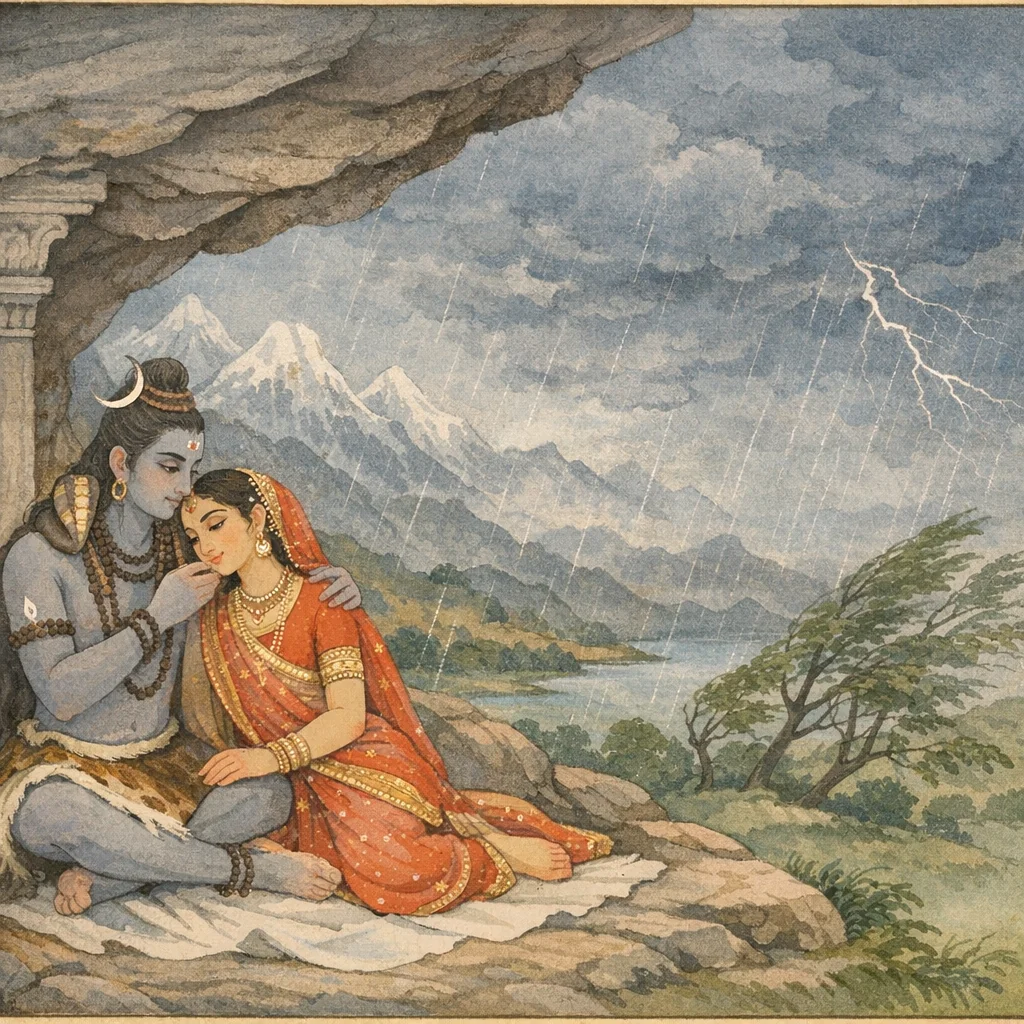
घनागमवर्णनम् / Description of the Monsoon’s Onset (Satī’s Address to Śiva)
Adhyāya 22 is cast as a dialogue: Brahmā’s narration leads into Satī’s direct address to Śiva. It opens with the seasonal turning—jaladāgama/ghanāgama, the arrival of rain-clouds and the onset of the monsoon—used as a literary and theological device to deepen the emotional and symbolic mood. Satī, speaking with intimate devotional epithets, asks Śiva to listen attentively. A vivid monsoon description follows: multicolored cloud-masses, fierce winds, thunder and lightning, the sun and moon obscured, day seeming like night, and the unsettling sweep of clouds covering the world. Trees appear to “dance” in the wind; the sky becomes a stage of fear and yearning, externalizing viraha (separation and longing) and inner agitation. Within the wider Satīkhaṇḍa, this storm-portrait serves as an omen-like prelude and a tone-setting interlude, showing how the cosmic rhythm of seasons (ṛtu) echoes relational and dharmic tensions around Kailāsa and Satī’s impending concerns.
Shlokas
Verse 1
ब्रह्मोवाच । कदाचिदथ दक्षस्य तनया जलदागमे । कैलासक्ष्माभृतः प्राह प्रस्थस्थं वृषभध्वजम्
Brahmā said: Once, at the onset of the rainy season, Dakṣa’s daughter Satī spoke to the Bull-bannered Lord (Śiva), who was preparing to set out from Kailāsa, the mountain that bears the earth.
Verse 2
सत्युवाच । देव देव महादेव शंभो मत्प्राणवल्लभ । शृणु मे वचनं नाथ श्रुत्वा तत्कुरु मानद
Satī said: “O God of gods, Mahādeva, Śambhu—beloved of my very life—listen to my words, O Lord. Having heard them, do what is proper, O bestower of honor.”
Verse 3
घनागमोयं संप्राप्तः कालः परमदुस्सहः । अनेकवर्णमेघौघास्संगीतांबरदिक्चयाः
Then the season of dense clouds arrived—a time exceedingly hard to endure. Multicoloured masses of clouds gathered, and the quarters of the sky were filled with a resonant, music-like rumbling.
Verse 4
विवांति वाता हृदयं हारयंतीत वेगिनः । कदंबरजसा धौताः पाथोबिन्दुविकर्षणाः
The winds blew with excessive force, as though stealing away the heart itself. Swept along with the dust of kadamba blossoms, they dragged and scattered the drops of water—signs of disturbance and ill-omen on the path.
Verse 5
मेघानां गर्जितैरुच्चैर्धारासारं विमुंचताम् । विद्युत्पताकिनां तीव्रः क्षुब्धं स्यात्कस्य नो मनः
With the clouds thundering aloud and releasing torrents of rain, and with fierce lightning flashing like banners in the sky—whose mind would not be shaken and disturbed?
Verse 6
न सूर्यो दृश्यते नापि मेघच्छन्नो निशापतिः । दिवापि रात्रिवद्भाति विरहि व्यसनाकरः
Neither is the sun seen, nor the lord of night, the moon, for he is veiled by clouds. Even the day appears like night—for one tormented by separation, sorrow itself becomes an unceasing source of affliction.
Verse 7
मेघानैकत्र तिष्ठंतो ध्वनन्त पवनेरिताः । पतंत इव लोकानां दृश्यंते मूर्ध्नि शंकर
Clouds, gathered in one place and roaring as they were driven by the wind, were seen above Śaṅkara’s head—appearing as though they might fall upon the worlds.
Verse 8
वाताहता महावृक्षा नर्तंत इव चांबरे । दृश्यंते हर भीरूणां त्रासदाः कामुकेप्सिता
Struck by the wind, the great trees seemed as if they were dancing in the sky; and to timid hearts there appeared terrifying sights—yet such as wanton men, driven by lust, would desire.
Verse 9
स्निग्धनीलांजनस्याशु सदिवौघस्य पृष्ठतः । बलाकराजी वात्युच्चैर्यमुनापृष्ठफेनवत्
Behind the swiftly moving mass of clouds—dark, glossy, and blue like collyrium—there appeared a line of cranes, driven high by the wind, resembling the foam that rides upon the back of the Yamunā.
Verse 10
क्षपाक्षयेषवलयं दृश्यते कालिकागता । अंबुधाविव संदीप्तपावको वडवामुखः
As the night waned, Kālikā appeared, seen encircled by the hosts of the Lord of the Night (Śiva). Within the ocean she blazed like the mare-faced fire (Vaḍavāmukha)—a fierce, kindled flame hidden in the waters.
Verse 11
प्रारोहंतीह सस्यानि मंदिरं प्राङ्गणेष्वपि । किमन्यत्र विरूपाक्ष सस्यौद्भूतिं वदाम्यहम्
“Here the crops are sprouting—even in the courtyards of the houses. What more need I say, O Virūpākṣa? I am describing the very arising and flourishing of vegetation.”
Verse 12
श्यामलै राजतैरक्तैर्विशदोयं हिमाचलः । मंदराश्रयमेघौघः पत्रैर्दुग्धांबुधिर्यथा
This Himālaya shines in splendor, adorned with dark, silvery-white, and ruddy hues. The cloud-masses resting upon the Mandāra trees appear like the Ocean of Milk, its waves crowned with foam.
Verse 13
असमश्रीश्च कुटिलं भेजे यस्याथ किंशुकान् । उच्चावचान् कलौ लक्ष्मीर्गन्ता संत्यज्य सज्जनान्
In the age of Kali, Lakṣmī—Prosperity—is fickle: she turns toward the crooked and the unworthy, and she forsakes the good. Without true discernment she goes to all kinds of people, high and low alike.
Verse 14
मंदारस्तन पीलूनां शब्देन हृषिता मुहुः । केकायंते प्रतिवने सततं पृष्ठसूचकम्
Delighted again and again by the calls of the mandāra-stana and pīlū birds, the peacocks in every grove cried out without cease, as though ever pointing to what lay behind—hinting at what was yet to come.
Verse 15
मेघोत्सुकानां मधुरश्चातकानां मनोहरः । धारासारशरैस्तापं पेतुः प्रतिपथोद्गतम्
Delightful to the sweet-voiced cātaka birds longing for rainclouds, the downpour—like a shower of arrows—drank away the heat that had risen along the path.
Verse 16
मेघानां पश्य मद्देहे दुर्नयं करकोत्करैः । ये छादयंत्यनुगते मयूरांश्चातकांस्तथा
Behold—within my very body the clouds have turned adverse, hurling masses of hail. They spread out and cover even the peacocks and the cātaka birds that follow after the rain; thus an ill-omened course now stands revealed.
Verse 17
शिखसारंगयोर्दृष्ट्वा मित्रादपि पराभवम् । हर्षं गच्छंति गिरिशं विदूरमपि मानसम्
Seeing that even a friendly ally had been humbled by Śikhā and Sāraṅga, they were filled with joy; and Lord Giriśa (Śiva)—though outwardly far away—was also delighted in His heart.
Verse 18
एतस्मिन्विषमे काले नीलं काकाश्चकोरकाः । कुर्वंति त्वां विना गेहान् कथं शांतिमवाप्स्यसि
In this cruel and troubled time, even blue-hued crows and chakora birds make their homes without you. How, then, will you ever attain peace of heart apart from you?
Verse 19
महतीवाद्य नो भीतिर्मा मेघोत्था पिनाकधृक् । यतस्व यस्माद्वासाय माचिरं वचनान्मम
Let there be no fear at the loud rumbling; and let not the thunder born of the clouds frighten you, O bearer of the Pināka. Strive, therefore, to make a dwelling—do not delay in acting upon my words.
Verse 20
कैलासे वा हिमाद्रौ वा महाकाश्यामथ क्षितौ । तत्रोपयोग्यं संवासं कुरु त्वं वृषभध्वज
“Whether on Kailāsa, or on the Himālaya, or at great Kāśī, or elsewhere upon the earth—there you should establish a suitable dwelling and reside, O Vṛṣabhadhvaja (He whose banner bears the bull).”
Verse 21
ब्रह्मोवाच । एवमुक्तस्तया शंभुर्दाक्षायण्या तथाऽसकृत । संजहास च शीर्षस्थचन्द्ररश्मिस्मितालयम्
Brahmā said: Thus addressed again and again by Dakṣa’s daughter, Śambhu smiled—His face becoming a dwelling-place of gentle laughter, as though illumined by the soothing rays of the moon upon His head.
Verse 22
इति श्रीशिवमहापुराणे द्वितीयायां रुद्रसंहितायां द्वितीये सतीखंडे शिवाशिवविहारवर्णनं नाम द्वाविंशोऽध्यायः
Thus, in the Śrī Śiva Mahāpurāṇa, in the Second Saṃhitā known as the Rudra-saṃhitā, within the second section called the Satī-khaṇḍa, ends the twenty-second chapter entitled “The Description of the Divine Pastimes of Śiva and Satī.”
Verse 23
ईश्वरः उवाच । यत्र प्रीत्यै मया कार्यो वासस्तव मनोहरे । मेघास्तत्र न गंतारः कदाचिदपि मत्प्रिये
Īśvara said: “O enchanting one, in that place where I shall lovingly arrange your dwelling for my delight, no clouds will ever go there at any time, O my beloved.”
Verse 24
मेघा नितंबपर्यंतं संचरंति महीभृतः । सदा प्रालेयसानोस्तु वर्षास्वपि मनोहरे
Clouds drift only up to the mountain’s lower slopes, while the snow-clad peaks remain ever delightful—even in the rainy season.
Verse 25
कैलासस्य तथा देवि पादगाः प्रायशो घनाः । संचरंति न गच्छंति तत ऊर्द्ध्वं कदाचन
O Goddess, around Kailāsa the streams are generally dense and abundant; they flow and move about, yet they never go beyond that place upward at any time.
Verse 26
सुमेरोर्वा गिरेरूर्द्ध्वं न गच्छंति बलाहकाः । जम्बूमूलं समासाद्य पुष्करावर्तकादयः
The rain-bearing clouds do not rise above Mount Sumeru. Reaching the region at the root of the Jambū tree, they—such as Puṣkara and Āvartaka—move and circulate there.
Verse 27
इत्युक्तेषु गिरीन्द्रेषु यस्योपरि भवेद्धि ते । मनोरुचिर्निवासाय तमाचक्ष्व द्रुतं हि मे
When these lordly mountains have thus been spoken of, quickly tell me this: upon which one does your mind most delight to dwell as a residence?
Verse 28
स्वेच्छाविहारैस्तव कौतुकानि सुवर्णपक्षानिलवृन्दवृन्दैः । शब्दोत्तरंगैर्मधुरस्वनैस्तैर्मुदोपगेयानि गिरौ हिमोत्थे
On Himavat’s mountain, your playful delights—born of free wandering—are joyfully sung by flocks of golden-winged birds and companies of breezes, whose sweet calls rise and fall like waves of sound.
Verse 29
सिद्धाङ्गनास्ते रचितासना भुवमिच्छंति चैवोपहृतं सकौतुकम् । स्वेच्छाविहारे मणिकुट्टिमे गिरौ कुर्वन्ति चेष्यंति फलादिदानकैः
Those accomplished celestial maidens (siddha-women), having arranged their seats, joyfully desire the earth-offering that has been brought with wonder. On that jeweled-paved mountain, moving about at will, they perform their rites and are pleased through gifts such as fruits and other offerings.
Verse 30
फणीन्द्रकन्या गिरिकन्यकाश्च या नागकन्याश्च तुरंगमुख्याः । सर्वास्तु तास्ते सततं सहायतां समाचरिष्यंत्यनुमोदविभ्रमैः
The daughters of the serpent-lord, the maidens of the mountains, the Nāga-maidens, and the foremost swift-steeds—all of them will continually render you assistance, rejoicing in your command and moving about in joyful readiness.
Verse 31
रूपं तदेवमतुलं वदनं सुचारु दृष्ट्वांगना निजवपुर्निजकांतिसह्यम् । हेला निजे वपुषि रूपगणेषु नित्यं कर्तार इत्यनिमिषेक्षणचारुरूपाः
Beholding that incomparable form and the exceedingly beautiful face, the maiden saw her own body and radiance as no match for it. With playful disregard for her own appearance and for all other forms, she fixed her unblinking gaze on that supremely beautiful Form, holding Him alone to be the true Creator.
Verse 32
या मेनका पर्वतराज जाया रूपैर्गुणैः ख्यातवती त्रिलोके । सा चापि ते तत्र मनोनुमोदं नित्यं करिष्यत्यनुनाथनाद्यैः
That Menakā—wife of the king of mountains—renowned throughout the three worlds for her beauty and virtues, will also, there, continually secure your inner approval and well-being through devoted service and respectful attendance.
Verse 33
पुरं हि वर्गैर्गिंरिराजवंद्यैः प्रीतिं विचिन्वद्भिरुदाररूपा । शिक्षा सदा ते खलु शोचितापि कार्याऽन्वहं प्रीतियुता गुणाद्यैः
“In the city, among the noble groups—revered even by the lord of mountains—seek goodwill with a generous disposition. Even if you feel distressed, you should always carry out your duties day by day with affection, supported by virtues and proper conduct.”
Verse 34
विचित्रैः कोकिलालापमोदैः कुंजगणावृतम् । सदा वसंतप्रभवं गंतुमिच्छसि किं प्रिये
Beloved, do you wish to go to that grove, ever born of spring—encircled by clusters of bowers and made delightful by the varied, sweet calls of the cuckoos?
Verse 35
नानाबहुजलापूर्णसरश्शीत समावृतम् । पद्मिनीशतशोयुक्तमचलेन्द्रं हिमालयम्
Himālaya, the king of mountains, was encircled by cool lakes brimming with abundant waters of many kinds, and adorned with hundreds of lotus-ponds.
Verse 36
सर्वकामप्रदैर्वृक्षैश्शाद्वलैः कल्पसंज्ञकैः । सक्षणं पश्य कुसुमान्यथाश्वकरि गोव्रजे
Look at once—here are the flowers in this cow-pen, as though brought by horse and elephant; this place is filled with wish-fulfilling trees and with verdant lawns known as “kalpa”.
Verse 37
प्रशांतश्वापदगणं मुनिभिर्यतिभिर्वृतम् । देवालयं महामाये नानामृगगणैर्युतम्
O Mahāmāyā, it was a divine sanctuary where even the packs of wild beasts had grown calm, surrounded by sages and ascetics, and filled with herds of many kinds of animals.
Verse 38
स्फटिक स्वर्णवप्राद्यै राजतैश्च विराजितम् । मानसादिसरोरंगैरभितः परिशोभितम्
It shone, adorned with embankments and the like fashioned of crystal and gold, and also resplendent with silver; and on every side it was beautifully graced by the lakes and waterscapes beginning with Mānasarovara.
Verse 39
हिरण्मयै रत्ननालैः पंकजैर्मुकुलैर्वृतम् । शिशुमारैस्तथासंख्यैः कच्छपैर्मकरैः करैः
It was encircled by lotuses with golden radiance and jewel-like stalks, thick with buds; and it was filled with countless aquatic beings—dolphin-like creatures, tortoises, makaras, and elephants moving in the waters.
Verse 40
निषेवितं मंजुलैश्च तथा नीलोत्पलादिभिः । देवेशि तस्मान्मुक्तैश्च सर्वगंधैश्च कुंकुमैः
O Devēśī, consort of the Lord of the Devas, it was duly adorned and reverently offered with charming blossoms, with blue lotuses and the like, and further with pearls, with all kinds of fragrant substances, and with kunkuma (saffron).
Verse 41
लसद्गंधजलैः शुभ्रैरापूर्णैः स्वच्छकांतिभिः । शाद्वलैस्तरुणैस्तुंगैस्तीरस्थैरुपशोभितम्
It was beautified by bright, fragrant waters—pure, brimming full, and shining with a clear radiance—and adorned with fresh, lofty green lawns and young grasses growing along the banks.
Verse 42
नृत्यद्भिरिव शाखोटैर्वर्जयंतं स्वसंभवम् । कामदेवैस्सारसैश्च मत्तचक्रांगशोभितैः
As if the branches themselves were dancing, they seemed to ward off their own young shoots; and the scene was adorned by love-stirring birds—cranes and the like—together with intoxicated cakravāka birds, resplendent in their beauty.
Verse 43
मधुराराविभिर्मोदकारिभिर्भ्रमरादिभिः । शब्दायमानं च मुदा कामोद्दीपनकारकम्
It resounded with the sweet humming of bees and other creatures—delight-giving sounds that, in joyful abundance, stirred and intensified the awakening of desire.
Verse 44
वासवस्य कुबेरस्य यमस्य वरुणस्य च । अग्नेः कोणपराजस्य मारुतस्य परस्य च
(It concerns) Indra, Kubera, Yama, and Varuṇa; and also Agni, Koṇaparāja, Māruta, and Para.
Verse 45
पुरीभिश्शोभिशिखरं मेरोरुच्चैस्सुरालयम् । रंभाशचीमेनकादिरंभोरुगणसेवितम्
High upon Mount Meru stands the radiant city of the gods, its summit splendid with many resplendent palaces. It is attended by celestial ladies—Rambhā, Śacī, Menakā and others—and is served by hosts of enchanting apsarās.
Verse 46
किं त्वमिच्छसि सर्वेषां पर्वतानां हि भूभृताम् । सारभूते महारम्ये संविहर्तुं महागिरौ
What do you desire—to sport and wander upon that great mountain which, among all the earth-bearing peaks, is the very essence and supremely delightful?
Verse 47
तत्र देवी सखियुता साप्सरोगणमंडिता । नित्यं करिष्यति शची तव योग्यां सहायताम्
There, the goddess Śacī—accompanied by her companions and adorned by hosts of Apsarases—will continually render to you the fitting help that is worthy of you.
Verse 48
अथवा मम कैलासे पर्वतेंद्रे सदाश्रये । स्थानमिच्छसि वित्तेशपुरीपरिविराजिते
Or else, if you desire a dwelling in my Kailāsa—the king of mountains, the eternal refuge—resplendent with the glorious city of the Lord of Wealth (Kubera).
Verse 49
गंगाजलौघप्रयते पूर्णचन्द्रसमप्रभे । दरीषु सानुषु सदा ब्रह्मकन्याभ्युदीरिते
It resembles the surging flood of Gaṅgā’s waters and shines with the splendour of the full moon. Ever celebrated by Brahmā’s maiden-daughters, it is found in the valleys and upon the mountain-slopes.
Verse 50
नानामृगगणैर्युक्ते पद्माकरशतावृते । सर्वैर्गुणैश्च सद्वस्तुसुमेरोरपि सुंदरि
O beautiful one, it was filled with herds of many kinds of animals and surrounded by hundreds of lotus-lakes; endowed with every excellence, it was more splendid even than the noble Mount Sumeru.
Verse 51
स्थानेष्वेतेषु यत्रापि तवांतःकरणे स्पृहा । तं द्रुतं मे समाचक्ष्व वासकर्तास्मि तत्र ते
“Among these sacred places, whichever one your inmost heart truly longs for—tell me at once; for there, for your sake, I shall make my dwelling.”
Verse 52
ब्रह्मोवाच । इतीरिते शंकरेण तदा दाक्षायणी शनैः । इदमाह महादेवं लक्षणं स्वप्रकाशनम्
Brahmā said: When Śaṅkara had spoken thus, Dākṣāyaṇī (Satī), gently and slowly, spoke these words to Mahādeva—revealing the sign (lakṣaṇa) that shines by its own light.
Verse 53
सत्युवाच । हिमाद्रावेव वसितुमहमिच्छे त्वया सह । न चिरात्कुरु संवासं तस्मिन्नेव महागिरौ
Satī said: “I wish to dwell on Himādri itself together with you. Without delay, arrange our residence on that very great mountain.”
Verse 54
ब्रह्मोवाच । अथ तद्वाक्यमाकर्ण्य हरः परममोहितः । हिमाद्रिशिखरं तुंगं दाक्षायण्या समं ययौ
Brahmā said: Hearing those words, Hara (Lord Śiva) became utterly bewildered; and together with Dākṣāyaṇī (Satī), he went to the lofty peak of Himādri.
Verse 55
सिद्धांगनागणयुतमगम्यं चैव पक्षिभिः । अगमच्छिखरं रम्यं सरसीवनराजितम्
She reached a lovely mountain-peak, graced by lakes and flourishing groves—attended by hosts of Siddha maidens, and so exalted that even birds could not easily approach it.
Verse 56
विचित्ररूपैः कमलैः शिखरं रत्नकर्बुरम् । बालार्कसदृशं शंभुराससाद सतीसखः
Accompanied by Satī, Śambhu reached that summit—adorned with lotuses of many wondrous forms and variegated with jewels—radiant like the newly risen sun.
Verse 57
स्फटिकाभ्रमये तस्मिन् शादवलद्रुमराजिते । विचित्रपुष्पावलिभिस्सरसोभिश्च संयुते
There, in that realm clear as crystal and bright as a shining cloud—adorned with fresh green lawns and splendid trees—the place was further graced with rows of wondrous blossoms and joined with lovely lakes.
Verse 58
प्रफुल्लतरुशाखाग्रं गुंजद्भ्रमरसेवितम् । पंकेरुहैः प्रफुल्लैश्च नीलोत्पलचयैस्तथा
The tips of the trees’ branches were in full bloom, visited by humming bees; and it was adorned with blossoming lotuses and clusters of blue water-lilies as well.
Verse 59
शोभितं चक्रवाकाद्यैः कादंबैर्हंसशंकुभिः । प्रमत्तसारसैः क्रौंचैर्नीलस्कंधैश्च शब्दितैः
That place was beautified by flocks of cakravāka and other birds—by kādamba birds and ranks of swans; and it resounded with the calls of exuberant sārasas (cranes), krauñcas, and blue‑necked birds.
Verse 60
पुंस्कोकिलानां निनदैर्मधुरैर्गणसेवितैः । तुरंगवदनैस्सिद्धैरप्सरोभिश्च गुह्यकैः
It resounded with the sweet calls of male cuckoos, and was attended by Śiva’s gaṇas—along with accomplished Siddhas, Apsarās, and the secretive Guhyakas, some even bearing horse-like faces.
Verse 61
विद्याधरीभिर्देवीभिः किन्नरीभिर्विहारितम् । पुरंध्रीभिः पार्वतीभिः कन्याभिरभिसंगतम्
She was joyfully attended and entertained by Vidyādharī maidens, divine goddesses, and Kinnarī celestial women; she was also surrounded on all sides by noble ladies, Parvatī-like attendants, and youthful maidens.
Verse 62
विपंचीतांत्रिकामत्तमृदंगपटहस्वनैः । नृत्यद्भिरप्सरोभिश्च कौतुकोत्थैश्च शोभितम्
It was splendidly adorned with the sounds of the vīṇā and other stringed instruments, with the ecstatic resonance of mṛdaṅgas and paṭaha-drums, and beautified by dancing apsarās and by many delightful festivities born of joyous wonder.
Verse 63
देविकाभिर्दीर्घिकाभिर्गंधिभिस्सुसमावृतम् । प्रफुल्लकुसुमैर्नित्यं सकुंजैरुपशोभितम्
It was beautifully enclosed by fragrant ponds and lotus-lakes, ever adorned with fully blossomed flowers and charming groves.
Verse 64
शैलराजपुराभ्यर्णे शिखरे वृषभध्वजः । सह सत्या चिरं रेमे एवंभूतेषु शोभनम्
Near the city of the Lord of Mountains, on a lofty peak, Vṛṣabhadhvaja (Śiva, whose banner bears the bull) sported for a long time with Satī; thus, all things appeared auspicious and beautiful.
Verse 65
तस्मिन्स्वर्गसमे स्थाने दिव्यमानेन शंकरः । दशवर्षसहस्राणि रेमे सत्या समं मुदा
In that place, equal to heaven, Śaṅkara—radiant with divine splendor—dwelt in joyous delight, sporting with Satī for ten thousand years.
Verse 66
स कदाचित्ततस्स्थानादन्यद्याति स्थलं हरः । कदाचिन्मेरुशिखरं देवी देववृतं सदा
At times Hara (Śiva) leaves that abode and goes to another place. At times, O Devī, He ascends the summit of Mount Meru, ever surrounded by the gods.
Verse 67
द्वीपान्नाना तथोद्यानवनानि वसुधातलम् । गत्वागत्वा पुनस्तत्राभ्येत्य रेमे सतीसुखम्
Wandering again and again across many islands and over the face of the earth—through gardens and forests—Satī returned there repeatedly and delighted in her own joy and contentment.
Verse 68
न जज्ञे स दिवा रात्रौ न ब्रह्मणि तपस्समम् । सत्यां हि मनसा शंभुः प्रीतिमेव चकार ह
Neither by day nor by night did any equal in austerity arise—even among Brahmā. For Śambhu, holding Satī in His heart, felt only love and delight.
Verse 69
एवं महादेवमुखं सत्यपश्यत्स्म सर्वदा । महादेवोऽपि सर्वत्र सदाद्राक्षीत्सतीमुखम्
Thus Satī always kept gazing upon the face of Mahādeva; and Mahādeva too, wherever He was, continually beheld the face of Satī.
Verse 70
एवमन्योन्यसंसर्गादनुरागमहीरुहम् । वर्द्धयामासतुः कालीशिवौ भावांबुसेचनैः
Thus, through their mutual closeness, Kālī and Śiva nurtured the great tree of loving devotion, watering it with the life-giving stream of their inner spiritual sentiments.
Frequently Asked Questions
The chapter presents a Kailāsa-set dialogue context: Brahmā narrates and Satī addresses Śiva during the onset of the monsoon, using the storm’s arrival as the immediate narrative occasion rather than a single ritual event.
The monsoon functions as an outer mirror of inner states—viraha, agitation, and anticipatory tension—showing how cosmic processes (ṛtu and atmospheric upheaval) can signify shifts in dharma, relationship, and impending narrative conflict.
Thunderous cloud-masses, violent winds, lightning, obscuration of sun and moon, day resembling night, and wind-driven trees and clouds—depicted as overwhelming, fear-inducing, and psychologically stirring phenomena.