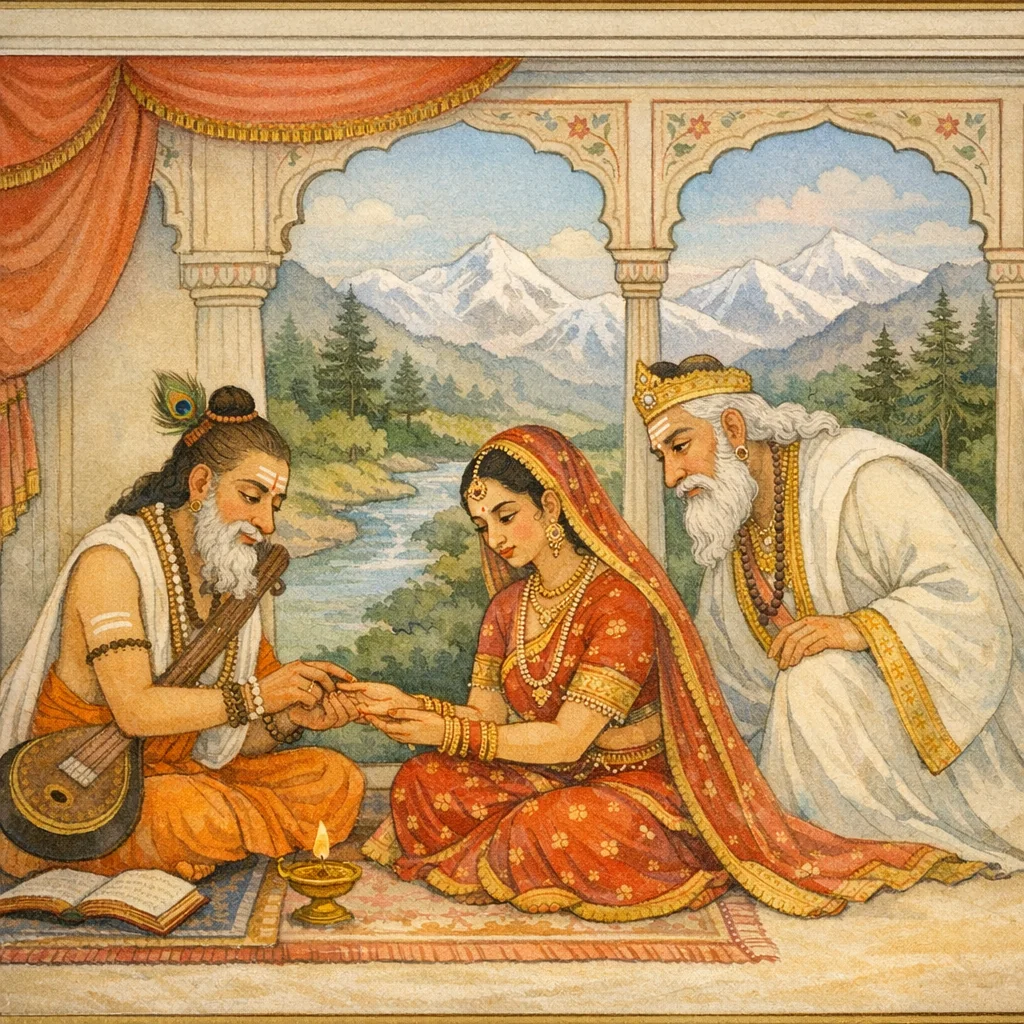
नारद–हिमालयसंवादवर्णनम् (Nārada and Himālaya: Discourse on Pārvatī’s Signs and Destiny)
Adhyāya 8 is a framed dialogue recounted by Brahmā: at Śiva’s prompting, Nārada—a śivajñānī and knower of Śiva’s līlā—arrives at Himālaya’s abode. Himālaya welcomes him with ritual honor and places his daughter Pārvatī at the sage’s feet, showing reverence and seeking an authoritative judgment. He requests a “jātaka”-style assessment of her qualities and faults (guṇa–doṣa) and, above all, the identity and fortune of her future husband, presenting marriage as a dharmic, providential institution rather than a mere social arrangement. Nārada examines her bodily signs (lakṣaṇa), with special attention to the hand, and gives an auspicious prognosis: she is exceptionally endowed, like the waxing moon, called “ādya kalā” and “sarvalakṣaṇaśālinī,” bringing joy and fame to her parents and happiness to her husband. The chapter thus serves as a narrative hinge, publicly confirming Pārvatī’s eminence and setting expectation for her destined union in harmony with Śiva’s cosmic intent.
Shlokas
Verse 1
ब्रह्मोवाच । एकदा तु शिवज्ञानी शिवलीलाविदांवरः । हिमाचलगृहं प्रीत्यागमस्त्वं शिवप्रेरितः
Brahmā said: Once, a knower of Śiva—foremost among those who understand Śiva’s divine līlā—went with joy to the house of Himācala, prompted by Śiva Himself.
Verse 2
दृष्ट्वा मुने गिरीशस्त्वां नत्वानर्च स नारद । आहूय च स्वतनयां त्वदङ्घ्र्योस्तामपातयत्
O sage, seeing you, Girīśa (Lord Śiva) bowed to you and duly honored you, O Nārada. Then, calling his own daughter, he made her bow down at your feet.
Verse 3
पुनर्नत्वा मुनीश त्वामुवाच हिमभूधरः । साञ्जलिः स्वविधिं मत्वा बहुसन्नतमस्तकः
Having bowed again to you, O lord of sages, Himabhūdhara (the Lord of the Himalayas) spoke. With hands joined in reverence, understanding the proper decorum, and with his head repeatedly bent in humility, he addressed you.
Verse 4
हिमालय उवाच । हे मुने नारद ज्ञानिन्ब्रह्मपुत्रवर प्रभो । सर्वज्ञस्त्वं सकरुणः परोपकरणे रतः
Himālaya said: “O sage Nārada—knower of truth, illustrious lord, best among Brahmā’s sons—you are omniscient and compassionate, ever devoted to the welfare of others.”
Verse 5
मत्सुताजातकं ब्रूहि गुणदोषसमुद्भवम् । कस्य प्रिया भाग्यवती भविष्यति सुता मम
Tell me the horoscope and destined course of my daughter—what virtues and faults will arise in her. Whose beloved, and most fortunate, will my daughter become?
Verse 6
ब्रह्मोवाच । इत्युक्तो मुनिवर्य त्वं गिरीशेन हिमाद्रिणा । विलोक्य कालिकाहस्तं सर्वांगं च विशेषतः
Brahmā said: “O best of sages, thus addressed by Girīśa (Lord Śiva) upon Himādri, you then looked closely—especially—at the hand of Kālikā, and at her entire body.”
Verse 7
अवोचस्त्वं गिरिं तात कौतुकी वाग्विशारद्ः । ज्ञानी विदितवृत्तान्तो नारदः प्रीतमानसः
Then you, O dear father, spoke to the Mountain (Himālaya). Nārada—curious, eloquent, wise, fully informed of the whole affair, and glad at heart—addressed him.
Verse 8
इति श्रीशिवमहा पुराणे द्वितीयायां रुद्रसंहितायां तृतीये पार्वतीखंडे नारदहिमालयसंवादवर्णनं नामाष्टमोऽध्यायः
Thus ends the Eighth Chapter, called “The Description of the Dialogue between Nārada and Himālaya,” in the third section, the Pārvatī-khaṇḍa, of the second book, the Rudra-saṃhitā, of the holy Śiva Mahāpurāṇa.
Verse 9
स्वपतेस्सुखदात्यन्तं पित्रोः कीर्तिविवर्द्धिनी । महासाध्वी च सर्वासु महानन्दकरी सदा
She bestows abundant happiness upon her husband and ever increases the fame of her parents. Among all women she is truly a great chaste and virtuous one, and she continually becomes a cause of great joy.
Verse 10
सुलक्षणानि सर्वाणि त्वत्सुतायाः करे गिरे । एका विलक्षणा रेखा तत्फलं शृणु तत्त्वतः
O mountain-king, all auspicious marks are present on your daughter’s hand. Yet there is one extraordinary line—hear from me its true import and the fruit it signifies.
Verse 11
योगी नग्नोऽगुणोऽकामी मातृतातविवर्जितः । अमानोऽशिववेषश्च पतिरस्याः किलेदृशः
“He is a yogin—naked, beyond the guṇas, free from desire, and without mother or father. He seeks no honor and wears an inauspicious-looking guise. Is such a one truly to be her husband?”
Verse 12
ब्रह्मोवाच । इत्याकर्ण्य वचस्ते हि सत्यं मत्त्वा च दम्पती । मेना हिमाचलश्चापि दुःखितौ तौ बभूवतुः
Brahmā said: Hearing those words, and taking them to be true, the couple—Menā and Himācala as well—became sorrowful.
Verse 13
शिवाकर्ण्यवचस्ते हि तादृशं जगदम्बिका । लक्षणैस्तं शिवं मत्त्वा जहर्षाति मुने हृदि
Having heard those words of Śivā, the Mother of the universe became just so; and, recognizing by the signs that He indeed was Śiva, she rejoiced within her heart, O sage.
Verse 14
न मृषा नारदवचस्त्विति संचिन्त्य सा शिवा । स्नेहं शिवपदद्वन्द्वे चकाराति हृदा तदा
Reflecting, “Nārada’s words are not false,” that blessed Devī then, with all her heart, fixed an intense, loving devotion upon the pair of Śiva’s feet.
Verse 15
उवाच दुःखितः शैलस्त्वान्तदा हृदि नारद । कमुपायं मुने कुर्यामतिदुःखमभूदिति
Then the Mountain (Himālaya), deeply afflicted at heart, spoke to you, O Nārada: “What means should I adopt, O sage? For overwhelming sorrow has come upon me.”
Verse 16
तच्छुत्वा त्वं मुने प्रात्थ महाकौतुककारकः । हिमाचलं शुभैर्वाक्यैर्हर्षयन्वाग्विशारदः
Hearing that, O sage, you spoke—stirring great wonder—and, being skilled in speech, you delighted Himācala (Himālaya) with auspicious words.
Verse 17
नारद उवाच । स्नेहाच्छृणु गिरे वाक्यं मम सत्यं मृषा न हि । कररेखा ब्रह्मलिपिर्न मृषा भवति धुवम्
Narada said: “O Mountain (Himālaya), listen with affection to my words—what I say is true, not false. The lines on the hand, the divine inscription of Brahmā (destiny), do not become untrue—certainly.”
Verse 18
तादृशोऽस्याः पतिः शैल भविष्यति न संशयः । तत्रोपायं शृणु प्रीत्या यं कृत्वा लप्स्यसे सुखम्
O Mountain (Himālaya), there is no doubt that a husband of that very kind will indeed be hers. Now listen with affection to the means for it—by performing it, you will attain happiness.
Verse 19
तादृशोऽस्ति वरः शम्भुलीलारूपधरः प्रभुः । कुलक्षणानि सर्वाणि तत्र तुल्यानि सद्गुणैः
Such a boon indeed exists: the Supreme Lord, Śambhu, who assumes forms for His divine play. In Him, all the marks of noble lineage are present—equaled and fulfilled by His true virtues.
Verse 20
प्रभौ दोषो न दुःखाय दुःखदोऽत्यप्रभौ हि सः । रविपावकगंगानां तत्र ज्ञेया निदर्शना
A fault found in one who is truly mighty does not bring suffering; but that very fault becomes a giver of suffering in one who is not mighty. In this, the Sun, Fire, and the Gaṅgā are to be understood as the illustrative examples.
Verse 21
तस्माच्छिवाय कन्या स्वां शिवां देहि विवेकतः । शिवस्सर्वेश्वरस्सेव्योऽविकारी प्रभुरव्ययः
Therefore, with clear discernment, give your auspicious daughter in marriage to Śiva. Śiva is the Lord of all; He alone is to be worshipped—unchanging, the supreme Master, and imperishable.
Verse 22
शीघ्रप्रसादः स शिवस्तां ग्रहीष्यत्यसंशयम् । तपःसाध्यो विशेषेण यदि कुर्याच्छिवा तपः
That Śiva, who is swiftly pleased, will accept her without doubt—especially because He is attained through tapas, if Śivā (Pārvatī) undertakes austerity.
Verse 23
सर्वथा सुसमर्थो हि स शिवस्सकलेश्वरः । कुलिपेरपि विध्वंसी ब्रह्माधीनस्त्वकप्रदः
Indeed, Śiva is in every way fully capable—the Lord of all embodied existence. He is the destroyer even of Kulipera, yet He remains under Brahmā’s ordinance as the bestower of the fruit of actions.
Verse 24
ब्रह्मोवाच । इत्युक्त्वा त्वं पुनस्तात कौतुकी ब्रह्मविन्मुने । शैलराजमवोचो हि हर्षयन्वचनैश्शुभैः
Brahmā said: Having spoken thus, O dear one—O sage who knows Brahman—again you, filled with eager curiosity, addressed the Lord of the Mountains (Himālaya), delighting him with auspicious words.
Verse 25
भाविनी दयिता शम्भोस्सानुकूला सदा हरे । महासाध्वी सुव्रता च पित्रोस्सुखविवर्द्धिनी
She is Bhāvinī—ever becoming auspicious; the beloved of Śambhu; always gracious and favorable to Hari. She is a great chaste and holy lady, firm in noble vows, and an increaser of the happiness of her parents.
Verse 26
शम्भोश्चित्तं वशे चैषा करिष्यति तपस्विनी । स चाप्येनामृते योषां न ह्यन्यामुद्वहिष्यति
This ascetic maiden will surely bring Śambhu’s mind under her sway through her penance; and Śiva too—apart from her—will not accept any other woman as his wife.
Verse 27
एतयोस्सदृशं प्रेम न कस्याप्येव तादृशम् । भूतं वा भविता वापि नाधुना च प्रवर्तते
Love like theirs is found in no one at all—such a love has not existed in the past, will not arise in the future, and is not seen even now. From this unparalleled bhakti and mutual grace, the union of Pati (Śiva) and Śakti (Pārvatī) is revealed as the supreme model of sacred devotion.
Verse 28
अनयोस्सुरकार्य्याणि कर्तव्यानि मृतानि च । यानि यानि नगश्रेष्ठ जीवितानि पुनः पुनः
O best of mountains, by the power of these two, the tasks of the gods that had failed shall be accomplished; and whatever beings had died are brought back to life again and again.
Verse 29
अनया कन्यया तेऽद्रे अर्धनारीश्वरो हरः । भविष्यति तथा हर्षदिनयोर्मिलितम्पुनः
O Himālaya, through this maiden, Hara (Śiva) will become Ardhanārīśvara. Thus, in days of joy, the two will be united once again.
Verse 30
शरीरार्धं हरस्यैषा हरिष्यति सुता तव । तपः प्रभावात्संतोष्य महेशं सकलेश्वरम्
This daughter of yours shall take half the body of Hara (Śiva). By the power of her austerities (tapas), she will please Mahēśa, the Lord of all.
Verse 31
स्वर्णगौरी सुवर्णाभा तपसा तोष्य तं हरम् । विद्युद्गौरतमा चेयं तव पुत्री भविष्यति
Golden Gaurī, radiant like pure gold, will please Lord Hara through austerity; and this one—most fair like lightning—will become your daughter.
Verse 32
गौरीति नाम्ना कन्या तु ख्यातिमेषा गमिष्यति । सर्वदेवगणैः पूज्या हरिब्रह्मादिभिस्तथा
This maiden will become renowned by the name “Gaurī.” She will be worshipped by all the hosts of gods—by Hari (Viṣṇu), by Brahmā, and by the other deities as well.
Verse 33
नान्यस्मै त्वमिमां दातुमिहार्हसि नगोत्तम । इदं चोपांशु देवानां न प्रकाश्यं कदाचन
O best of mountains, you are not fit to give this maiden here to anyone else. And this is a secret of the gods, to be conveyed in confidence—never to be disclosed openly at any time.
Verse 34
ब्रह्मोवाच । इति तस्य वचः श्रुत्वा देवर्षे तव नारद । उवाच हिमवान्वाक्यं मुने त्वाम्वाग्विशारदः
Brahmā said: “O divine seer Nārada, after hearing his words, Himavān—skilled in speech—addressed you, O sage, with a fitting reply.”
Verse 35
हिमालय उवाचा । हे मुने नारद प्राज्ञ विज्ञप्तिं कांचिदेव हि । करोमि तां शृणु प्रीत्या तस्त्वं प्रमुदमावह
Himālaya said: “O sage Nārada, O wise one, I have indeed a certain petition to submit. Please hear it with goodwill; and thereafter, bring me gladness (by granting counsel and guidance).”
Verse 36
श्रूयते त्यक्तसंगस्स महादेवो यतात्मवान् । तपश्चरति सन्नित्यं देवानामप्यगोचरः
It is heard that Mahādeva—self-restrained and free from all attachment—ever performs austerity; He remains beyond the reach even of the gods.
Verse 37
स कथं ध्यान मार्गस्थः परब्रह्मार्पितं मनः । भ्रंशयिष्यति देवर्षे तत्र मे संशयो महान्
O divine sage, how could one established on the path of meditation cause the mind offered to the Supreme Brahman (Śiva) to slip away? On this point, my doubt is great.
Verse 38
अक्षरं परमं ब्रह्म प्रदीपकलिकोपमम् । सदाशिवाख्यं स्वं रूपं निर्विकारमजापरम्
He is the Imperishable, the Supreme Brahman—like the steady flame of a lamp. That is His own essential form, known as Sadāśiva: changeless, unborn, and unsurpassed.
Verse 39
निर्गुणं सगुणं तच्च निर्विशेषं निरीहकम् । अतः पश्यति सर्वत्र न तु बाह्यं निरीक्षते
That Reality (Śiva) is both without attributes and with attributes; it is undifferentiated and actionless. Therefore, the true knower beholds Him everywhere and does not look outward for Him as something external.
Verse 40
इति स श्रूयते नित्यं किंनराणां मुखान्मुने । इहागतानां सुप्रीत्या किन्तन्मिथ्या वचो धुवम्
“O sage, this is ever heard from the mouths of the Kiṃnaras. But for those who have come here with sincere goodwill, how could that statement possibly be false? Indeed, the word is surely true.”
Verse 41
विशेषतः श्रूयते स साक्षान्नाम्ना तथा हरः । समयं कृतवान्पूर्व्वं तन्मया गदितं शृणु
He is especially renowned—indeed, the very Lord Hara Himself is heard of by that name. Formerly He established a sacred agreement; listen now to that, as I shall relate it.
Verse 42
न त्वामृतेऽन्यां वरये दाक्षायणि प्रिये सती । भार्यार्थं न ग्रहीष्यामि सत्यमेतद्ब्रवीमि ते
O beloved Satī, dear daughter of Dakṣa—apart from you I shall choose no other. I will not accept anyone else as my wife. This I declare to you as the truth.
Verse 43
इति सत्यासमं तेन पुरैव समयः कृतः । तस्यां मृतायां स कथं स्वयमन्यां ग्रहीष्यति
Thus, long ago he had made a solemn pledge, equal in truth to Satī herself. If she has died, how could he, of his own accord, accept another woman in marriage?
Verse 44
ब्रह्मोवाच । इत्युक्त्वा स गिरिस्तूष्णीमास तस्य पुरस्तव । तदाकर्ण्याथ देवर्षे त्वं प्रावोचस्सुतत्त्वतः
Brahmā said: Having spoken thus, that lord of mountains became silent before you. Hearing that, O divine sage, you then replied, speaking in accordance with the highest truth.
Verse 45
नारद उवाच । न वै कार्या त्वया चिंता गिरिराज महामते । एषा तव सुता काली दक्षजा ह्यभवत्पुरा
Narada said: “O Himālaya, king of mountains, mighty in mind, do not give way to anxiety. This very daughter of yours, Kāli, was once born before as Dakṣa’s daughter (Satī).”
Verse 46
सतीनामाभवत्तस्यास्सर्वमंगलदं सदा । सती सा वै दक्षकन्या भूत्वा रुद्रप्रियाभवत
Her name became “Satī,” ever bestowing all auspiciousness. Indeed, that Satī—born as the daughter of Dakṣa—became beloved of Rudra.
Verse 47
पितुर्यज्ञे तथा प्राप्यानादरं शंकरस्य च । तं दृष्ट्वा कोपमाधायात्याक्षीद्देहं च सा सती
Having reached her father’s sacrificial rite and seeing the dishonour shown to Śaṅkara, Satī, inflamed with righteous wrath, renounced that very body.
Verse 48
पुनस्सैव समुत्पन्ना तव गेहेऽम्बिका शिवा । पार्वती हरपत्नीयं भविष्यति न संशयः
That very Ambikā—Śivā herself—has been born again in your house. She will become Pārvatī, the destined consort of Hara (Lord Śiva); of this there is no doubt.
Verse 49
एतत्सर्वं विस्तरात्त्वं प्रोक्तवान्भूभृते मुने । पूर्वरूपं चरित्रं च पार्वत्याः प्रीतिवर्धनम्
O sage, you have narrated all this in full detail to the king—both the former manifestation and the sacred life-account of Pārvatī, which increases her joy (and devotion).
Verse 50
तं सर्वं पूर्ववृत्तान्यं काल्या मुनिमुखाद्गिरिः । श्रुत्वा सपुत्रदारः स तदा निःसंशयोऽभवत्
Hearing from the sage’s mouth, through Kālī, the full account of the former events, that lord of the mountain—together with his sons and wife—became free from doubt at that time.
Verse 51
ततः काली कथां श्रुत्वा नारदस्य मुखात्तदा । लज्जयाधोमुखी भूत्वा स्मितविस्तारितानना
Then Kālī, hearing that account from the mouth of Nārada, became downcast out of modesty; and with a gentle smile her face brightened and opened out.
Verse 52
करेण तां तु संस्पृश्य श्रुत्वा तच्चरितं गिरिः । मूर्ध्नि शश्वत्तथाघ्राय स्वास नान्ते न्यवेशयत्
Then Giri (Himālaya), having gently touched her with his hand and having heard the account of her conduct, repeatedly smelled her head in affection and seated her at the end of his own seat.
Verse 53
ततस्त्वं तां पुनर्दृष्ट्वाऽवोचस्तत्र स्थितां मुने । हर्षयन् गिरिराजं च मेनकान्तनयैः सह
Then, O sage, seeing her again as she stood there, you spoke to her—gladdening Girirāja (Himālaya) as well, together with Menakā’s daughters.
Verse 54
सिंहासनन्तु किन्त्वस्याश्शैलराज भवेदतः । शम्भोरूरौ सदैतस्या आसनं तु भविष्यति
O King of Mountains, though she indeed has a lion-throne, her true seat shall be upon Śambhu’s thigh; there, eternally, will her resting-place be.
Verse 55
हरोरूर्वासनम्प्राप्य तनया तव सन्ततम् । न यत्र कस्याचिदृष्टिर्मानसं वा गमिष्यति
Having attained a seat upon Hara’s thigh, your daughter will remain there continually—where neither anyone’s glance, nor even another being’s mind, can reach.
Verse 56
ब्रह्मोवाच । इति वचनमुदारं नारद त्वं गिरीशं त्रिदिवमगम उक्त्वा तत्क्षणादेवप्रीत्या । गिरिपतिरपि चित्ते चारुसंमोदयुक्तस्स्वगृहमगमदेवं सर्वसंपत्समृद्धम्
Brahmā said: “O Nārada, having spoken these noble words, you at once—moved by joy—went to Girīśa in the celestial realm. And Giripati too, his heart filled with delightful gladness, returned to his own divine abode, overflowing with every prosperity.”
Frequently Asked Questions
Nārada’s divinely prompted visit to Himālaya, followed by Himālaya’s request for his daughter’s jātaka-style assessment and Nārada’s declaration of her extraordinary auspicious signs and destined fortune.
It ritualizes recognition of Śakti’s destined role: the body’s auspicious marks function as a readable index of cosmic intention, aligning social rites (marriage inquiry) with metaphysical teleology (Śiva–Śakti reunion).
She is characterized as “sarvalakṣaṇaśālinī” (marked by all auspicious signs), likened to the moon’s growth, described as an “ādya kalā,” and praised as a source of joy, fame, and welfare for family and spouse.