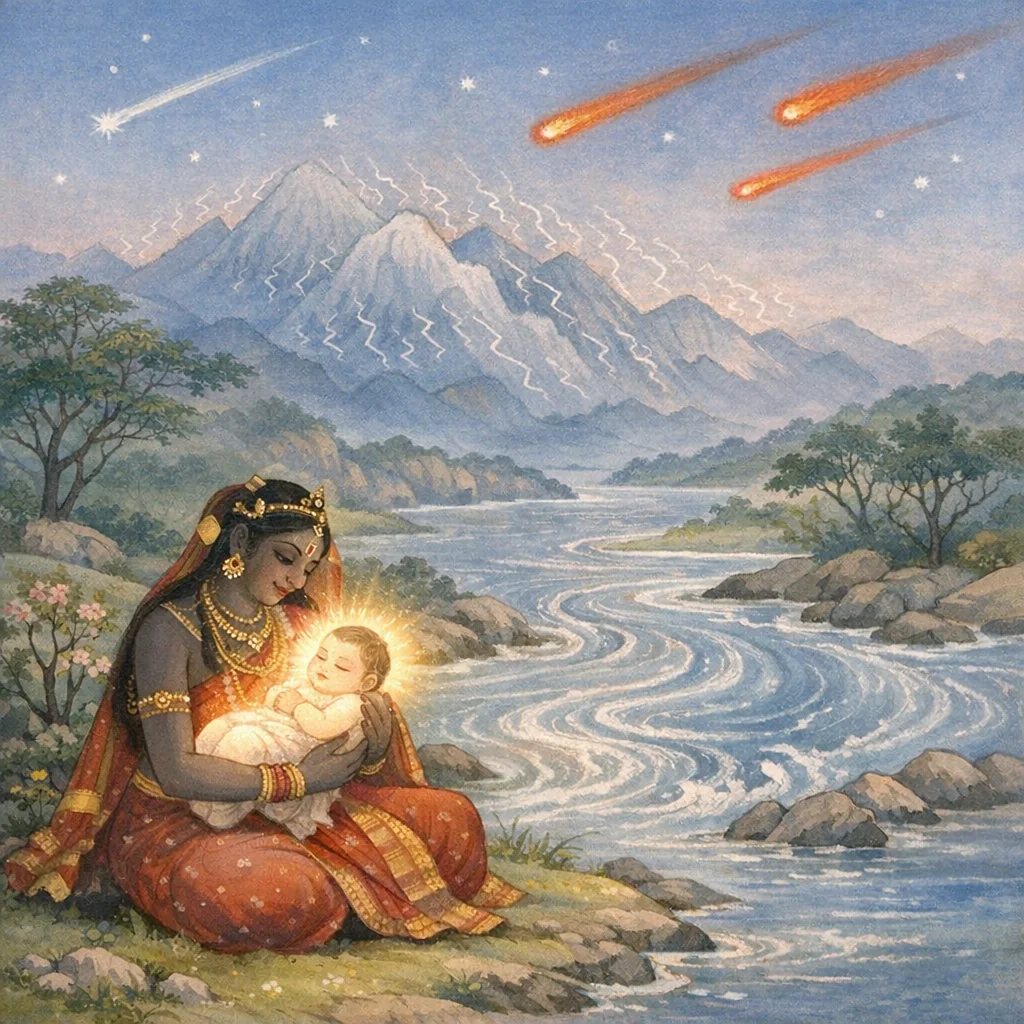
वराङ्ग्याः सुतजन्म-उत्पातवर्णनम् | Birth of Varāṅgī’s Son and the Description of Portents (Utpātas)
Adhyāya 15 is narrated by Brahmā: Varāṅgī conceives and, at full term, gives birth to a son of immense body and blazing tejas, as though illuminating the ten directions. At once the universe responds with distressing utpātas—ominous portents that signal fear and disorder. The chapter classifies these signs across the three cosmic zones—heaven, earth, and the intermediate realm—as indicators of impending misfortune. It describes meteors and thunderbolts with terrifying sounds, sorrow-bringing comets, earthquakes and trembling mountains, directions aflame, rivers and especially oceans churning, violent winds raising banners of dust and uprooting great trees, repeated solar halos as marks of great dread and loss of well-being, cavernous mountain detonations like chariot-roars, and inauspicious cries in villages—jackals, owls, and grotesque howlings—along with imagery of mouths emitting fire. Through this catalog of utpātas, the extraordinary birth is framed as a cosmic event whose gravity may disturb the order of the worlds.
Shlokas
Verse 1
ब्रह्मोवाच । अथ सा गर्भमाधत्त वरांगी तत्पुरादरात् । स ववर्द्धाभ्यंतरे हि बहुवर्षैः सुतेजसा
Brahmā said: “Then that fair-limbed lady conceived, out of reverence for that sacred city. Indeed, the child within her grew for many years, sustained by its own radiant spiritual potency.”
Verse 2
ततः सा समये पूर्णे वरांगी सुषुवे सुतम् । महाकायं महावीर्यं प्रज्वलंतं दिशो दश
Then, when the full time had come, that noble-limbed lady gave birth to a son—of vast body and immense valor—radiant as blazing fire, illuminating the ten directions.
Verse 3
तदैव च महोत्पाता बभूवुर्दुःखहेतवः । जायमाने सुते तस्मिन्वरांग्यात्सुखदुःखदे
Just then, great ominous portents arose—harbingers of sorrow. For when that son was being born to the fair-limbed lady, he became the cause of both joy and grief.
Verse 4
दिवि भुव्यंतरिक्षे च सर्वलोकभयंकराः । अनर्थसूचकास्तात त्रिविधास्तान्ब्रवीम्यहम्
“In heaven, on earth, and in the mid-region (the atmosphere) there arise fearsome signs that terrify all beings. O dear one, those omens that foretell impending calamity are of three kinds—I shall now describe them.”
Verse 5
सोल्काश्चाशनयः पेतुर्महाशब्दा भयंकराः । उदयं चक्रुरुत्कृष्टाः केतवो दुःखदायकाः
Meteors and lightning bolts fell, giving rise to dreadful, thunderous roars; and ominous comets rose high in the sky—portents that brought sorrow.
Verse 6
चचाल वसुधा साद्रिर्जज्वलुस्सकला दिशः । चुक्षुभुस्सरितस्सर्वाः सागराश्च विशेषतः
The earth shook together with its mountains; all the directions blazed as though aflame. Every river was thrown into turbulence, and the oceans—most of all—heaved in violent agitation.
Verse 7
हूत्करानीरयन्धीरान्खरस्पर्शो मरुद्ववौ । उन्मूलयन्महावृक्षान्वात्यानीकोरजोध्वजः
A harsh wind began to blow, raising terrifying howls and striking with rough force. Like a host of whirlwinds bearing a banner of dust, it uprooted great trees—portending the turbulent powers that gather when destiny turns toward Śiva’s divine purpose.
Verse 8
सराह्वोस्सूर्य्यविध्वोस्तु मुहुः परिधयोऽभवन् । महाभयस्य विप्रेन्द्र सूचकास्सुखहारकः
O best of Brahmins, again and again halos appeared around the sun, as though it were struck and dimmed—portents that signal great fear and steal away all peace.
Verse 9
महीध्रविवरेभ्यश्च निर्घाता भयसूचकाः । रथनिर्ह्रादतुल्याश्च जज्ञिरेऽवसरे ततः
Then, at that very moment, terrifying thunderous crashes—portents of fear—arose from the clefts of the mountains, resounding like the rumbling roar of chariots.
Verse 10
सृगालोलूकटंकारैर्वमन्त्यो मुखतोऽनलम् । अंतर्ग्रामेषु विकटं प्रणेदुरशिवाश्शिवाः
With the harsh cries of jackals and owls, as though spewing fire from their mouths, the fearsome she-jackals—inauspicious omens—howled terribly within the villages, foretelling disorder and misfortune.
Verse 11
यतस्ततो ग्रामसिंहा उन्नमय्य शिरोधराम् । संगीतवद्रोदनवद्व्यमुचन्विविधान्रवान्
Then the “lions of the village,” the foremost among the villagers, lifted their heads high and sent forth many kinds of cries—at times like music, and at times like wailing.
Verse 12
खार्काररभसा मत्ताः सुरैर्घ्नंतो रसांखराः । वरूथशस्तदा तात पर्यधावन्नितस्ततः
Maddened by the clamor and tumult, the rasāṅkharas—struck down by the gods—then, O dear one, ran here and there in scattered bands, fleeing in all directions.
Verse 13
खगा उदपतन्नीडाद्रासभत्रस्तमानसः । क्रोशंतो व्यग्रचित्ताश्च स्थितमापुर्न कुत्रचित्
The birds, their minds terrified by the donkey’s braying, sprang up from their nests. Crying out and with hearts thrown into agitation, they could find no place anywhere to settle and rest.
Verse 14
शकृन्मूत्रमकार्षुश्च गोष्ठेऽरण्ये भयाकुलः । बभ्रमुः स्थितिमापुर्नो पशवस्ताडिता इव
Overcome by fear, they voided stool and urine—whether in the cowshed or in the forest. They wandered about and could not regain composure, like cattle that have been beaten.
Verse 15
इति श्रीशिवमहापुराणे द्वितीयायां रुद्रसंहितायां तृतीये पार्वतीखण्डे तारकासुरतपोराज्यवर्णनंनाम पंचदशोऽध्यायः
Thus ends the fifteenth chapter, entitled “The Description of Tārakāsura’s Austerities and Reign,” in the Śrī Śiva Mahāpurāṇa—within the Second (Rudra) Saṃhitā, in the Third section known as the Pārvatī Khaṇḍa.
Verse 16
व्यरुदन्प्रतिमास्तत्र देवानामुत्पतिष्णवः । विनाऽनिलं द्रुमाः पेतुर्ग्रहयुद्धं बभूव खे
There, the images of the gods seemed to weep, and the celestial beings became wildly agitated. Even without any wind, trees fell down, and in the sky a battle among the planets arose.
Verse 17
इत्यादिका बहूत्पाता जज्ञिरे मुनिसत्तम । अज्ञानिनो जनास्तत्र मेनिरे विश्वसंप्लवम्
Thus, O best of sages, many such ominous portents arose. There, the ignorant people imagined that the cosmic dissolution—the end of the world—had come.
Verse 18
अथ प्रजापतिर्नामाकरोत्तस्यासुरस्य वै । तारकेति विचार्यैव कश्यपो हि महौजसः
Then Prajāpati, the mighty Kaśyapa, after due deliberation, bestowed a name upon that asura—he called him “Tāraka.”
Verse 19
महावीरस्य सहसा व्यज्यमानात्मपौरुषः । ववृधेत्यश्मसारेण कायेनाद्रिपतिर्यथा
Then, as the great hero’s innate valor suddenly manifested, he seemed to grow immensely—his body becoming hard and unyielding like solid stone—just as the Lord of the Mountain is by nature.
Verse 20
अथो स तारको दैत्यो महाबलपराक्रमः । तपः कर्तुं जनन्याश्चाज्ञां ययाचे महामनाः
Then that demon Tāraka—of mighty strength and heroic prowess, noble in resolve—sought his mother’s permission to undertake austerities (tapas), desiring the power gained through disciplined penance.
Verse 21
प्राप्ताज्ञः स महामायी मायिनामपि मोहकः । सर्वदेवजयं कर्तुं तपोर्थं मन आदधे
Having obtained permission, that great wielder of Māyā—one who could even delude other illusionists—resolved in his mind to undertake austerities, intending thereby to conquer all the gods.
Verse 22
मधोर्वनमुपागम्य गुर्वाज्ञाप्रतिपालकः । विधिमुद्दिश्य विधिवत्तपस्तेपे सुदारुणम्
Having gone to Madhuvana, faithfully obeying the command of the guru, he undertook a most severe austerity, performed in full accordance with the prescribed rites, keeping the divine ordinance in view.
Verse 23
ऊर्द्ध्वबाहुश्चैकपादो रविं पश्यन्स चक्षुषा । शतवर्षं तपश्चक्रे दृढचित्तो दृढव्रतः
With arms raised upward and standing on a single foot, fixing his gaze upon the sun, he performed austerities for a hundred years—steadfast in mind and firm in his vow.
Verse 24
अंगुष्ठेन भुवं स्पृष्ट्वा शत वर्षं च तादृशः । तेपे तपो दृढात्मा स तारकोऽसुरराट्प्रभुः
Touching the earth with his thumb and remaining in that very posture for a hundred years, the firm-minded Tāraka—lord and king among the asuras—performed intense austerity (tapas).
Verse 25
शतवर्षं जलं प्राश्नञ्च्छतवर्षं च वायुभुक् । शतवर्ष जले तिष्ठञ्च्छतं च स्थंडिलेऽतपत्
For a hundred years she subsisted on water alone; for another hundred years she lived on air alone. For a hundred years she stood immersed in water, and for yet another hundred she performed austerities upon the bare ground.
Verse 26
शतवर्षं तथा चाग्नौ शतवर्षमधोमुखः । शतवर्षं तु हस्तस्य तलेन च भुवं स्थित
For a hundred years he remained in fire; for a hundred years he stayed inverted (head-down); and for a hundred years he stood upon the earth supported only by the palm of his hand—thus performing severe austerities.
Verse 27
शतवर्षं तु वृक्षस्य शाखामालब्य वै मुने । पादाभ्यां शुचिधूमं हि पिबंश्चाधोमुखस्तथा
“O sage, for a hundred years, clinging to the branch of a tree, he remained inverted, drinking only pure smoke through his feet.”
Verse 28
एवं कष्टतरं तेपे सुतपस्स तु दैत्यराट् । काममुद्दिश्य विधिवच्छृण्वतामपि दुस्सहम्
Thus the king of the Daityas performed austerities of the most severe kind—undertaken with a view to Kāma (the Lord of Desire). The penance was performed according to prescribed rule, yet it was unbearable even to those who merely heard of it.
Verse 29
तत्रैवं तपतस्तस्य महत्तेजो विनिस्सृतम् । शिरसस्सर्वंसंसर्पि महोपद्रवकृन्मुने
There, as he performed austerities in that manner, a mighty radiance burst forth from him. Spreading everywhere from his head, it became the cause of great disturbance, O sage.
Verse 30
तेनैव देवलोकास्ते दग्धप्राया बभूविरे । अभितो दुःखमापन्नास्सर्वे देवर्षयो मुने
By that very fiery power, those heavenly realms were almost reduced to ashes. On all sides, all the divine seers, O sage, were seized by distress.
Verse 31
इंद्रश्च भयमापेदे ऽधिकं देवेश्वरस्तदा । तपस्यत्यद्य कश्चिद्वै मत्पदं धर्षयिष्यति
Then Indra, the lord of the gods, was seized with even greater fear: “Today, surely, someone is performing austerities and will attempt to assail my station.”
Verse 32
अकांडे चैव ब्रह्माण्डं संहरिष्यत्ययं प्रभु । इति संशयमापन्ना निश्चयं नोपलेभिरे
They were seized by doubt, thinking, “Will this Lord suddenly dissolve the entire Brahmāṇḍa—the cosmic egg, the universe—without any cause?” Thus falling into uncertainty, they could not arrive at any firm conclusion.
Verse 33
ततस्सर्वे सुसंमन्त्र्य मिथस्ते निर्जरर्षयः । मल्लोकमगमन्भीता दीना मां समुपस्थिताः
Then all those divine sages, after consulting among themselves, came to my realm—fearful and dejected—and approached me for refuge.
Verse 34
मां प्रणम्य सुसंस्तूय सर्वे ते क्लिष्टचेतसः । कृतस्वंजलयो मह्यं वृत्तं सर्वं न्यवेदयन्
After bowing down to me and praising me well, all of them—whose minds were distressed—joined their hands in reverence and reported to me the entire account of what had happened.
Verse 35
अहं सर्वं सुनिश्चित्य कारणं तस्य सद्धिया । वरं दातुं गतस्तत्र यत्र तप्यति सोऽसुरः
Having clearly ascertained everything with sound discernment—the true cause behind his undertaking—I went to that very place to grant a boon, where that asura was performing austerities.
Verse 36
अवोचं वचनं तं वै वरं ब्रूहीत्यहं मुने । तपस्तप्तं त्वया तीव्रं नादेयं विद्यते तव
I spoke these words to him: “O sage, ask for a boon. The fierce austerity you have performed cannot go unrewarded; for you, there is nothing that should be withheld.”
Verse 37
इत्येवं मद्वचः श्रुत्वा तारकस्स महासुरः । मां प्रणम्य सुसंस्तूय वरं वव्रेऽतिदारुणम्
Having thus heard my words, Tāraka—the mighty asura—bowed to me, praised me well, and then chose a boon of exceedingly dreadful consequence.
Verse 38
तारक उवाच । त्वयि प्रसन्ने वरदे किमसाध्यं भवेन्मम । अतो याचे वरं त्वत्तः शृणु तन्मे पितामह
Tāraka said: “When you are pleased, O giver of boons, what could remain unattainable for me? Therefore I ask a boon from you—hear this request of mine, O Grandfather (Brahmā).”
Verse 39
यदि प्रसन्नो देवेश यदि देयो वरो मम । देयं वरद्वयं मह्यं कृपां कृत्वा ममोपरि
“If you, O Lord of the gods, are pleased—if you are willing to grant me a boon—then, showing compassion toward me, please bestow upon me these two boons.”
Verse 40
त्वया च निर्मिते लोके सकलेऽस्मिन्महाप्रभो । मत्तुल्यो बलवान्नूनं न भवेत्कोऽपि वै पुमान्
O Great Lord, in this entire world created by You, surely there is no man at all who could be as powerful as I am.
Verse 41
शिववीर्यसमुत्पन्नः पुत्रस्सेनापतिर्यदा । भूत्वा शस्त्रं क्षिपेन्मह्यं तदा मे मरणं भवेत्
When the son born of Śiva’s divine potency becomes the commander of the hosts, if he should take up a weapon and hurl it at me—then, for me, death would come to pass.
Verse 42
इत्युक्तोऽथ तदा तेन दैत्येनाहं मुनीश्वर । वरं च तादृशं दत्त्वा स्वलोकमगमं द्रुतम्
Thus addressed by that demon, O lord among sages, I then granted him such a boon; and having bestowed it, I quickly departed to my own realm.
Verse 43
दैत्योऽपि स वरं लब्ध्वा मनसेप्सितमुत्तमम् । सुप्रसन्नोतरो भूत्वा शोणिताख्यपुरं गतः
That Daitya too, having obtained the excellent boon he had long desired in his mind, became greatly delighted and, with a fully satisfied heart, went to the city known as Śoṇitākhya.
Verse 44
अभिषिक्तस्तदा राज्ये त्रैलोक्यस्यासुरैस्सह । शुक्रेण दैत्यगुरुणाज्ञया मे स महासुरः
Then that great Asura, together with the hosts of demons, was consecrated to the sovereignty over the three worlds—by the command of Śukra, the preceptor of the Daityas, as instructed to me.
Verse 45
ततस्तु स महादैत्योऽभवस्त्रैलोक्यनायकः । स्वाज्ञां प्रवर्तयामास पीडयन्सचराचरम्
Then that mighty demon became the ruler over the three worlds. Enforcing his own command, he oppressed all beings—both the moving and the unmoving—throughout creation.
Verse 46
राज्यं चकार विधिवस्त्रिलोकस्य स तारकः । प्रजाश्च पालयामास पीडयन्निर्जरादिकान्
Tāraka then ruled the three worlds in due form, and he maintained the subjects—while at the same time tormenting the Devas and other celestial beings.
Verse 47
ततस्स तारको दैत्यस्तेषां रत्नान्युपाददे । इंद्रादिलोकपालानां स्वतो दत्तानि तद्भयात्
Then Tāraka, the asura, seized their jewels—those very treasures that the guardians of the worlds, beginning with Indra, had themselves surrendered out of fear of him.
Verse 48
इंद्रेणैरावतस्तस्य भयात्तस्मै समर्पितः । कुबेरेण तदा दत्ता निधयो नवसंख्यका
Out of fear of him, Indra surrendered his elephant Airāvata to him; and at that time Kubera also granted him the nine treasures.
Verse 49
वरुणेन हयाः शुभ्रा ऋषिभिः कामकृत्तथा । सूर्येणोच्चैश्श्रवा दिव्यो भयात्तस्मै समर्पितः
Varuṇa offered him radiant white horses; the sages likewise bestowed a wish-fulfilling gift. And Sūrya, out of fear, presented to him the divine Uccaiḥśravā.
Verse 50
यत्र यत्र शुभं वस्तु दृष्टं तेनासुरेण हि । तत्तद्गृहीतं तरसा निस्सारस्त्रिभवोऽभवत्
Wherever that asura saw any auspicious or valuable thing, he would swiftly seize it; thus the three worlds were left drained—bereft of prosperity and essence.
Verse 51
समुद्राश्च तथा रत्नान्यदुस्तस्मै भयान्मुने । अकृष्टपच्यासीत्पृथ्वी प्रजाः कामदुघाः खिलाः
O sage, out of fear the oceans and the precious jewels offered themselves to him. The earth yielded food without being ploughed, and all beings everywhere became wish-fulfilling, granting whatever was desired.
Verse 52
सूर्यश्च तपते तद्वत्तद्दुःखं न यथा भवेत् । चंद्रस्तु प्रभया दृश्यो वायुस्सर्वानुकूलवान्
The sun indeed blazes, yet its heat is rightly measured so it does not become a cause of suffering. The moon is seen by its gentle radiance, and the wind is favorable and agreeable to all.
Verse 53
देवानां चैव यद्द्रव्यं पितॄणां च परस्य च । तत्सर्वं समुपादत्तमसुरेण दुरात्मना
Whatever wealth belonged to the Devas, to the Pitṛs, and to others as well—all of it was forcibly seized by that wicked-souled Asura.
Verse 54
वशीकृत्य स लोकांस्त्रीन्स्वयमिंद्रो बभूव ह । अद्वितीयः प्रभुश्चासीद्राज्यं चक्रेऽद्भुतं वशी
Having brought the three worlds under his control, he himself became Indra indeed. Unrivalled and sovereign, that masterful one established a wondrous rule.
Verse 55
निस्सार्य सकलान्देवान्दैत्यानस्थापयत्ततः । स्वयं नियोजयामास देवयोनिस्स्वकर्मणि
Having driven out all the Devas, he then installed the Daityas in their places; and that one—born of the divine lineage—personally assigned each being to his own proper duty.
Verse 56
अथ तद्बाधिता देवास्सर्वे शक्रपुरोगमाः । मुने मां शरणं जग्मुरनाथा अतिविह्वलाः
Then, afflicted by his oppression, all the gods—led by Śakra (Indra)—came to me, O sage, seeking refuge, helpless and greatly distressed.
Frequently Asked Questions
Varāṅgī conceives and gives birth to a powerful, radiant son; the narrative immediately frames the birth through widespread ominous portents across heaven, earth, and the mid-region.
They function as interpretive signs that translate an extraordinary birth into a cosmic-level event, indicating imbalance, impending fear, or major transformation in loka-order rather than being mere atmospheric description.
Meteors and thunderbolts with dreadful sounds, comets, earthquakes and trembling mountains, churning rivers and oceans, violent dust-laden winds uprooting trees, solar halos/rings, cavern-like detonations, and inauspicious animal/village cries (jackals, owls, etc.).