Śiva-jñāna and the Non-dual Vision of a Śiva-maya Universe (शिवज्ञानम्—सर्वं शिवमयम्)
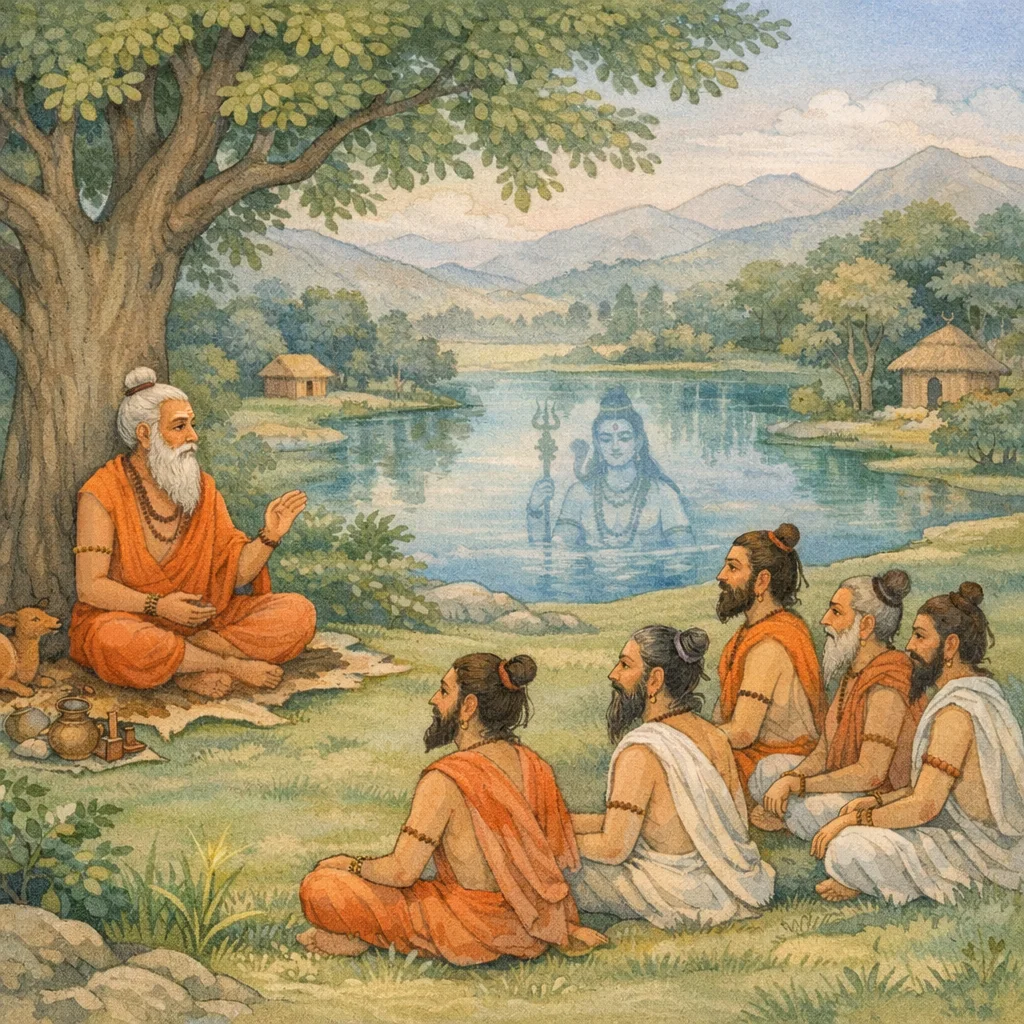
Adhyāya 43 presents Sūta’s instruction to the assembled ṛṣis, explicitly called “mahā-guhya” (highly esoteric) and aimed at revealing the very nature of liberation (mukti-svarūpa). It frames the teaching within an authoritative learned assembly—linked with Nārada, the Kumāras, Vyāsa, and Kapila—so that Śiva-jñāna appears as a tested doctrinal conclusion, not private conjecture. The central thesis is a complete Śiva-maya ontology: from Brahmā down to the smallest blade of grass, whatever is perceived is Śiva; therefore the wise should know Śiva as the all-in-all. Apparent plurality is explained through analogies of mixture and reflection: like light reflected in water, Śiva seems to have “entered” the world, yet remains unentered, unattached and unstained (nirlipta), and of the nature of consciousness (cit-svarūpa). Philosophical disputes are traced to mental differentiation (mati-bheda) and ignorance (ajñāna), while noting that Vedāntins express the culminating view as advaita (non-duality). Overall, the chapter serves as a compact metaphysical primer that rereads cosmology, perception, and doctrinal diversity through the lens of non-dual Śaiva theism.
Shlokas
Verse 1
सूत उवाच । श्रूयतामृषयः सर्वे शिवज्ञानं यथा श्रुतम् । कथयामि महागुह्यं पर मुक्तिस्वरूपकम्
Sūta said: “O sages, listen, all of you. I shall relate the knowledge of Śiva exactly as I have heard it—this great secret, supreme in nature, whose very essence is liberation (mokṣa).”
Verse 2
कनारदकुमाराणां व्यासस्य कपिलस्य च । एतेषां च समाजे तैर्निश्चित्य समुदाहृतम्
In the assembly of these—Nārada and the Kumāras, as well as Vyāsa and Kapila—after due deliberation, it was decisively determined and then proclaimed.
Verse 3
इति ज्ञानं सदा ज्ञेयं सर्वं शिवमयं जगत् । शिवः सर्वमयो ज्ञेयस्सर्वज्ञेन विपश्चिता
Thus this knowledge should always be known: the entire universe is pervaded by Śiva. Śiva, who is present as all, is to be realized by the wise seer who knows the truth of all.
Verse 4
यथैकं च सुवर्णादि मिलितं रजतादिना
Just as gold and the like, when alloyed with silver and other metals, appear as a single blended substance.
Verse 5
यदेच्छा तस्य जायेत तदा च क्रियते त्विदम् । सर्वं स एव जानाति तं न जानाति कश्चन
Whatever arises as His will—then indeed this whole manifestation comes to be. He alone knows everything; but no one truly knows Him in His full reality.
Verse 6
रचयित्वा स्वयं तच्च प्रविश्य दूरतः स्थितः । न तत्र च प्रविष्टोसौ निर्लिप्तश्चित्स्वरूपवान्
Having Himself fashioned that form and, as it were, entered into it, He yet remained standing far apart. Indeed, He did not truly enter it at all—for He is the stainless One whose very nature is pure Consciousness.
Verse 7
यथा च ज्योतिषश्चैव जलादौ प्रतिबिंबता । वस्तुतो न प्रवेशो वै तथैव च शिवः स्वयम्
Just as light appears as a reflection in water and the like—though in truth it does not actually enter into them—so too does Shiva Himself: though seeming present everywhere, in essence He remains untouched and unentered.
Verse 8
वस्तुतस्तु स्वयं सर्वं क्रमो हि भासते शुभः । अज्ञानं च मतेर्भेदो नास्त्यन्यच्च द्वयम्पुनः
In truth, the whole of reality is self-established; the auspicious order of things shines forth of itself. What appears as ignorance and the diversity of opinions is not, in fact, anything else—again, it is only an imagined duality.
Verse 9
दर्शनेषु च सर्वेषु मतिभेदः प्रदर्श्यते । परं वेदान्तिनो नित्यमद्वैतं प्रतिचक्षते
Among all philosophical systems, differences of opinion are indeed displayed; yet the Vedāntins constantly proclaim the supreme reality to be non-dual (advaita).
Verse 10
स्वस्याप्यंशस्य जीवांशो ह्यविद्यामोहितो वशः । अन्योऽहमिति जानाति तया मुक्तो भवेच्छिवः
Even the embodied soul, a living portion of His own portion, comes under the sway of delusion born of ignorance and thinks, “I am other (separate).” By that discriminative understanding, one is liberated and attains Śiva.
Verse 11
सर्वं व्याप्य शिवः साक्षाद् व्यापकः सर्वजन्तुषु । चेतनाचेतनेशोपि सर्वत्र शंकरस्स्वयम्
Shiva Himself, directly and truly, pervades all. He is the all-pervading Presence within every being; as Lord of both the conscious and the unconscious, Shankara alone exists everywhere as the very Self.
Verse 12
उपायं यः करोत्यस्य दर्शनार्थं विचक्षणः । वेदान्तमार्गमाश्रित्य तद्दर्शनफलं लभेत्
The discerning seeker who undertakes the proper means to behold Him—taking refuge in the path of Vedānta—attains the true fruit that arises from that divine vision.
Verse 13
यथाग्निर्व्यापकश्चैव काष्ठेकाष्ठे च तिष्ठति । यो वै मंथति तत्काष्ठं स वै पश्यत्यसंशयम्
Just as fire is all-pervading yet lies hidden within every piece of wood, so too the Lord abides within all. But the one who churns that wood—who undertakes disciplined practice—surely beholds Him, without doubt.
Verse 14
भक्त्यादिसाधनानीह यः करोति विचक्षणः । स वै पश्यत्यवश्यं हि तं शिवं नात्र संशयः
Here, the discerning person who undertakes the spiritual disciplines beginning with devotion surely comes to behold that Lord Śiva—of this there is no doubt.
Verse 15
शिवःशिवःशिवश्चैव नान्यदस्तीति किंचन । भ्रान्त्या नानास्वरूपो हि भासते शङ्करस्सदा
All is Śiva—Śiva alone; there exists nothing whatsoever apart from Him. Yet, through delusion, Śaṅkara ever appears as though He bore many diverse forms.
Verse 16
यथा समुद्रो मृच्चैव सुवर्णमथवा पुनः । उपाधितो हि नानात्वं लभते शंकरस्तथा
Just as the ocean—or clay, or gold—when conditioned by upādhis (limiting adjuncts) seems to assume many forms, so too does Śaṅkara, through such upādhis, appear to attain diversity.
Verse 17
कार्यकारणयोर्भेदो वस्तुतो न प्रवर्तते । केवलं भ्रान्तिबुद्ध्यैव तदाभावे स नश्यति
In truth, the difference between effect and cause does not actually operate. It exists only through deluded understanding; when that delusion is absent, the notion of difference disappears.
Verse 18
तदा बीजात्प्ररोहश्च नानात्वं हि प्रकाशयेत् । अन्ते च बीजमेव स्यात्तत्प्ररोहश्च नश्यति
Then, from the seed a sprout arises and indeed displays manifoldness; but in the end only the seed remains, while that sprout perishes.
Verse 19
ज्ञानी च बीजमेव स्यात्प्ररोहो विकृतीर्मता । तन्निवृत्तौ पुनर्ज्ञानी नात्र कार्या विचारणा
The knower (jñānī) is indeed like a seed, while the sprout is regarded as the manifested modification (vikṛti). When that sprout-like manifestation subsides, the knower alone remains again—about this there is no need for further deliberation.
Verse 20
सर्वं शिवः शिवं सर्वं नास्ति भेदश्च कश्चन । कथं च विविधं पश्यत्येकत्वं च कथं पुनः
All is Śiva, and Śiva is all; there is no difference whatsoever. How, then, can one perceive multiplicity—and how again can one truly know the oneness of Reality?
Verse 21
यथैकं चैव सूर्याख्यं ज्योतिर्नानाविधं जनैः । जलादौ च विशेषेण दृश्यते तत्तथैव सः
Just as the one light called the Sun is perceived by people in many ways—especially as varied reflections in water and the like—so too He (Śiva), though one, is seen in diverse forms and appearances.
Verse 22
सर्वत्र व्यापकश्चैव स्पर्शत्वं न विबध्यते । तथैव व्यापको देवो बध्यते न क्वचित्स वै
That which is all-pervading is never obstructed by contact. In the same way, the all-pervading Lord (Śiva) is not bound anywhere at all.
Verse 23
साहंकारस्तथा जीवस्तन्मुक्तः शंकरः स्वयम् । जीवस्तुच्छः कर्मभोगो निर्लिप्तः शंकरो महान्
The individual soul (jīva) is bound up with ego (ahaṅkāra); but the One who is free from that bondage is Śaṅkara Himself. The jīva is petty, compelled to undergo the fruits of karma, whereas the great Śaṅkara remains untouched by karma and ever transcendent.
Verse 24
अल्पमूल्यं प्रजायेत तथा जीवोऽप्यहंयुतः
If a thing is obtained for a paltry price, its value is regarded as small; likewise, the jīva too—when yoked to egoism, the sense of “I”—becomes diminished in spiritual worth.
Verse 25
यथैव हि सुर्वणादि क्षारादेः शोधितं शुभम् । पूर्ववन्मूल्यतां याति तथा जीवोऽपि संस्कृतेः
Just as gold and the like, when purified by alkalis and other refining agents, becomes auspicious and regains its former value, so too the jīva, when refined by saṃskāra—sacred discipline and consecrating practices—attains its true worth again.
Verse 26
प्रथमं सद्गुरुं प्राप्य भक्तिभाव समन्वितः । शिवबुद्ध्या करोत्युच्चैः पूजनं स्मरणादिकम्
First, having attained a true Guru and being filled with the mood of devotion, he performs—holding the awareness that the Guru is Shiva Himself—lofty acts of worship, remembrance, and related disciplines.
Verse 27
तद्बुध्या देहतो याति सर्वपापादिको मलः । तदाऽज्ञानं च नश्येत ज्ञानवाञ्जायते यदा
By that awakened understanding, the impurity consisting of all sins and related defilements departs from the body. When that happens, ignorance is destroyed, and the seeker becomes established as one endowed with true spiritual knowledge.
Verse 28
तदाहंकारनिर्मुक्तो जीवो निर्मलबुद्धिमान् । शङ्करस्य प्रसादेन प्रयाति शङ्करताम्पुनः
Then the jīva, freed from egoism and endowed with a stainless understanding, by the grace of Śaṅkara, attains once again the state of Śaṅkara—union with the Lord’s auspicious nature.
Verse 29
यथाऽऽदर्शस्वरूपे च स्वीयरूपं प्रदृश्यते । तथा सर्वत्रगं शम्भु पश्यतीति सुनिश्चितम्
Just as one’s own form is seen in a mirror, so it is certain that Śambhu—who pervades everywhere—may be beheld as present in all places and in all things.
Verse 30
जीवन्मुक्तस्य एवासौ देहः शीर्ण शिवे मिलेत् । प्रारब्धवशगो देहस्तद्भिन्नो ज्ञानवान् मतः
For one liberated while still living, that very body—when it becomes worn out—merges in Śiva. The body moves under the force of prārabdha (already-begun karma), yet the knower is held to be distinct from it.
Verse 31
शुभं लब्ध्वा न हृष्येत कुप्येल्लब्ध्वाऽशुभं न हि । द्वंद्वेषु समता यस्य ज्ञानवानुच्यते हि सः
Having obtained what is auspicious, one should not exult; and having met with what is inauspicious, one should not become angry. He whose mind remains even amid the pairs of opposites is indeed called a man of true knowledge.
Verse 32
आत्मयोगेन तत्त्वानामथवा च विवेकतः । यथा शरीरतो यायाच्छरीरं मुक्तिमिच्छतः
Through the yoga of the Self—or else through discriminative discernment of the principles (tattvas)—let the seeker who longs for liberation cause the self to depart from identification with the body, as though separating from the body itself.
Verse 33
सदाशिवो विलीयेत मुक्तो विरहमेव च । ज्ञानमूलन्तथाध्यात्म्यं तस्य भक्तिश्शिवस्य च
The liberated one dissolves into Sadāśiva, and separation from Him alone comes to an end. For him, spiritual wisdom is rooted in inner realization, and in devotion (bhakti) to Lord Śiva.
Verse 34
भक्तेश्च प्रेम संप्रोक्तं प्रेम्णश्च श्रवणन्तथा । श्रवणाच्चापि सत्संगस्सत्संगाच्च गुरुर्बुधः
From devotion, love is said to arise; and from love, sacred hearing is born. From hearing comes holy company, and from holy company the wise Guru is attained.
Verse 35
सम्पन्ने च तथा ज्ञाने मुक्तो भवति निश्चितम् । इति चेज्ज्ञानवान्यो वै शंभुमेव सदा भजेत्
When true knowledge is fully attained, liberation is assured—this is certain. Therefore, whoever is truly wise should always worship Śambhu alone.
Verse 36
अनन्यया च भक्त्या वै युक्तः शम्भुं भजेत्पुनः । अन्ते च मुक्तिमायाति नात्र कार्या विचारणा
Endowed with exclusive devotion, one should worship Śambhu alone. In the end, one surely attains liberation—about this there is no need for doubt or further deliberation.
Verse 37
अतोऽधिको न देवोऽस्ति मुक्तिप्राप्त्यै च शंकरात् । शरणं प्राप्य यश्चैव संसाराद्विनिवर्तते
Therefore, for attaining liberation, there is no deity higher than Śaṅkara. Whoever takes refuge in Him indeed turns back from saṃsāra, the cycle of worldly bondage.
Verse 38
इति मे विविधं वाक्यमृषीणां च समागतैः । निश्चित्य कथितं विप्रा धिया धार्यं प्रयत्नतः
“Thus have I spoken these varied words, after deliberating together with the assembled sages. O brāhmaṇas, hold this firmly in your understanding with earnest effort.”
Verse 39
प्रथमं विष्णवे दत्तं शंभुना लिंगसन्मुखे । विष्णुना ब्रह्मणे दत्तं ब्रह्मणा सनकादिषु
First, Śambhu bestowed it upon Viṣṇu in the very presence of the sacred Liṅga. Viṣṇu then gave it to Brahmā, and Brahmā passed it on to Sanaka and the other sages.
Verse 40
नारदाय ततः प्रोक्तं तज्ज्ञानं सनकादिभिः । व्यासाय नारदेनोक्तं तेन मह्यं कृपालुना
Thereafter, that sacred knowledge was taught to Nārada by Sanaka and the other sages. Nārada then taught it to Vyāsa, and that compassionate Vyāsa has taught it to me.
Verse 41
मया चैव भवद्भ्यश्च भवद्भिर्लोकहेतवे । स्थापनीयं प्रयत्नेन शिवप्राप्तिकरं च तत्
“By me, and also by you all—for the welfare of the world—this must be established with earnest effort; for that act becomes a means to attain Lord Śiva.”
Verse 42
इति वश्च समाख्यातं यत्पृष्टोऽहं मुनीश्वराः । गोपनीयं प्रयत्नेन किमन्यच्छ्रोतुमिच्छथ
Thus, O lordly sages, I have fully explained to you what you asked of me. This teaching is to be safeguarded with great care; what else do you wish to hear?
Verse 43
इति श्रीशिवमहापुराणे चतुर्विंशतिसाहस्र्यां वैयासिक्यां संहितायां तदन्तर्गतायां चतुर्थ्यां कोटिरुद्रसंहितायां ज्ञाननिरूपणं नाम त्रिचत्वारिंशोऽध्यायः
Thus, in the Śrī Śiva Mahāpurāṇa—within the twenty‑four‑thousand‑verse compendium transmitted by Vyāsa—this concludes the forty‑third chapter of the Fourth section, the Koṭirudra Saṃhitā, entitled “Jñānanirūpaṇa” (The Exposition of Spiritual Knowledge).
Verse 44
ऋषय ऊचुः । व्यासशिष्य नमस्तेऽस्तु धन्यस्त्वं शैवसत्तमः । श्रावितं नः परं वस्तु शैवं ज्ञानमनुत्तमम्
The sages said: “O disciple of Vyāsa, salutations to you. Blessed are you, O best among the devotees of Śiva. You have caused us to hear the supreme Reality—Śaiva knowledge, unsurpassed.”
Verse 45
अस्माकं चेतसो भ्रान्तिर्गता हि कृपया तव । सन्तुष्टाश्शिवसज्ज्ञानं प्राप्य त्वत्तो विमुक्तिदम्
By your compassion, the delusion of our minds has indeed been dispelled. We are satisfied, having received from you the true knowledge of Śiva—bestower of liberation.
Verse 46
सूत उवाच । नास्तिकाय न वक्तव्यमश्रद्धाय शठाय च । अभक्ताय महेशस्य न चाशुश्रुषवे द्विजाः
Sūta said: O twice-born sages, this should not be taught to an atheist, nor to one without faith, nor to a deceitful person; nor to one who is not devoted to Maheśa, and not to one who is unwilling to listen and serve with reverence.
Verse 47
इतिहासपुराणानि वेदाच्छास्त्राणि चासकृत् । विचार्य्योद्धृत्य तत्सारं मह्यं व्यासेन भाषितम्
After repeatedly examining the Itihāsas and Purāṇas, as well as the Vedas and the Śāstras, Vyāsa, through discernment, drew forth their very essence and taught that essential truth to me.
Verse 48
एतच्छ्रुत्वा ह्येकवारं भवेत्पापं हि भस्मसात् । अभक्तो भक्तिमाप्नोति भक्तस्य भक्तिवर्द्धनम्
On hearing this even once, sin is truly reduced to ashes. One who is not a devotee attains devotion, and for a devotee it becomes an increase of devotion.
Verse 49
पुनश्श्रुते च सद्भक्तिर्मुक्तिस्स्याच्च श्रुते पुनः । तस्मात्पुनःपुनश्श्राव्यं भुक्तिमुक्तिफलेप्सुभिः
By hearing it again, true devotion arises; and by hearing it again, liberation is attained. Therefore, those who seek the fruits of worldly enjoyment and final release should have it heard repeatedly, again and again.
Verse 50
आवृत्तयः पंच कार्याः समुद्दिश्य फलं परम् । तत्प्राप्नोति न सन्देहो व्यासस्य वचनं त्विदम्
Having performed five repetitions (āvṛttis) with the prescribed observances, one attains the supreme fruit—of this there is no doubt. This indeed is the declaration of Vyāsa.
Verse 51
न दुर्लभं हि तस्यैव येनेदं श्रुतमुत्तमम् । पंचकृत्वस्तदावृत्त्या लभ्यते शिवदर्शनम्
Indeed, for one who has heard this supreme teaching, Shiva is not difficult to attain. By repeating it five times, one gains the blessed darśana—the sacred vision—of Lord Shiva.
Verse 52
पुरातनाश्च राजानो विप्रा वैश्याश्च सत्तमाः । इदं श्रुत्वा पंचकृत्वो धिया सिद्धिं परां गताः
The kings of old, and the best among the brāhmaṇas and vaiśyas as well—having heard this five times—through steadfast understanding attained the supreme perfection, siddhi.
Verse 53
श्रोष्यत्यद्यापि यश्चेदं मानवो भक्तितत्परः । विज्ञानं शिवसंज्ञं वै भुक्तिं मुक्तिं लभेच्च सः
Even today, any person who listens to this with steadfast devotion attains the true knowledge called “Shiva” (vijñāna) and thereby gains both bhukti (worldly fulfillment) and mukti (liberation).
Verse 54
व्यास उवाच । इति तद्वचनं श्रुत्वा परमानन्दमागताः । समानर्चुश्च ते भूतं नानावस्तुभिरादरात
Vyāsa said: Hearing those words, they were filled with supreme bliss. Then, with reverence, they all worshipped that divine Being with many kinds of offerings.
Verse 55
नमस्कारैः स्तवैश्चैव स्वस्तिवाचनपूर्वकम् । आशीर्भिर्वर्द्धयामासुः संतुष्टाश्छिन्नसंशयाः
Satisfied and freed from all doubt, they honored him with prostrations and hymns; and, beginning with auspicious benedictions, they further blessed and exalted him with words of blessing.
Verse 56
परस्परं च संतुष्टाः सूतस्ते च सुबुद्धयः । शंभुं देवं परं मत्वा नमंति स्म भजंति च
Pleased with one another, those wise sages (and Sūta) regarded Śambhu as the Supreme Deity; they bowed to Him and continued to worship Him with devotion.
Verse 57
एतच्छिवसुविज्ञानं शिवस्यातिप्रियं महत् । भुक्तिमुक्तिप्रदं दिव्यं शिवभक्तिविवर्द्धनम्
This sacred and excellent knowledge of Śiva is exceedingly dear to Lord Śiva and truly great. It bestows both worldly enjoyment and liberation; it is divine and it increases devotion to Śiva.
Verse 58
इयं हि संहिता पुण्या कोटिरुद्राह्वया परा । चतुर्थी शिव पुराणस्य कथिता मे मुदावहा
Indeed, this Saṃhitā is holy and supreme, known as the Koṭirudra. It is the fourth section of the Śiva Purāṇa, and it has been spoken by me, bringing joy to the hearers.
Verse 59
एतां यः शृणुयाद्भक्त्या श्रावयेद्वा समाहितः । स भुक्त्वेहाखिलान्भोगानंते परगतिं लभेत्
Whoever hears this with devotion, or, with a collected mind, causes it to be heard by others—having enjoyed all worldly delights here, in the end he attains the supreme state, the highest liberation.
Frequently Asked Questions
It argues for a comprehensive Śiva-maya ontology: whatever is seen in the entire cosmos is, in essence, Śiva; liberation is tied to recognizing this truth as Śiva-jñāna rather than treating Śiva as merely one entity among others.
They distinguish appearance from ontology: Śiva may seem to "enter" the world as its inner presence, but like a reflection in water, the appearance does not imply literal involvement; Śiva remains cit-svarūpa and nirlipta—present without being bound or modified.
Rather than a named iconographic form (e.g., a particular mūrti), the chapter foregrounds Śiva’s metaphysical "form": all-pervasive (sarvamaya), consciousness-natured (cit-svarūpa), and unattached (nirlipta), presented as the basis for non-dual (advaita) realization.