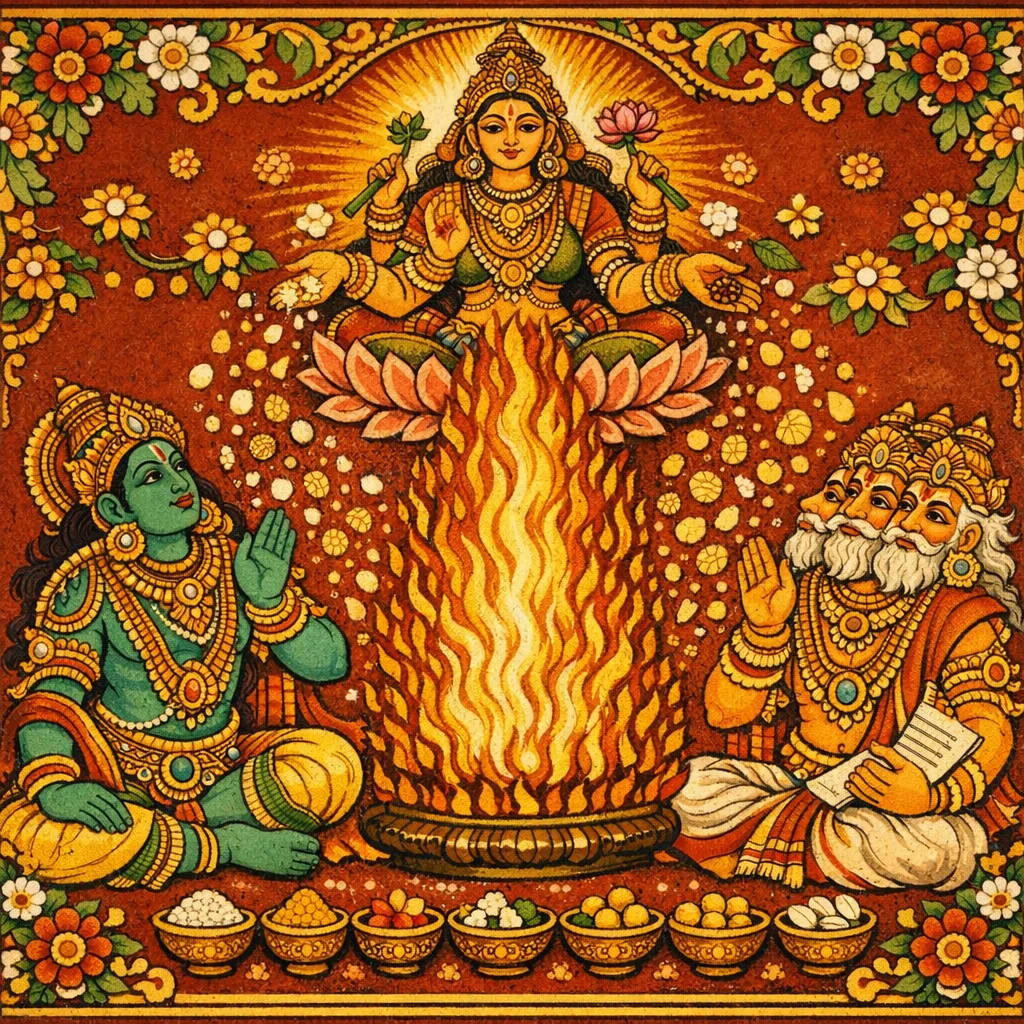
Adhyaya 60: Saubhagya-Śayana Vow: Lalitā/Gaurī–Śiva Worship, Saubhāgya-Aṣṭaka Offerings, and Bed Donation
सौभाग्यशयनव्रतविधानम् (ललितागौरी-शिवार्चन-सौभाग्याष्टकदानसहितम्)
Speaker: Lord Matsya, Vaivasvata Manu
Matsya introduces a new observance called Saubhāgya-Śayana. He begins with an origin account: saubhāgya concentrates in Viṣṇu during a cosmic burning; amid a Brahmā–Viṣṇu rivalry a fearsome liṅga-fire appears, saubhāgya is released, and on earth it becomes divisible into eight prosperity-bestowing substances. Dakṣa’s share produces Satī, praised as Lalitā/Trailokyasundarī and wed to Śiva. Manu asks how to worship the World-Mother, and Matsya gives a stepwise vrata-vidhi centered on springtime Śukla Tṛtīyā: sesame bath; Śiva–Gaurī worship with pañcagavya and scented water; detailed limb/part invocations (nyāsa-like); installation and offering of the Saubhāgya-aṣṭaka; night prāśana of the sanctified substance; dawn purification and honoring a brāhmaṇa couple; and the annual/month-wise regimen. The vow ends with śayana-dāna (bed donation) and related gifts, with fruits stated for men and women alike.
Key Concepts
Shlokas in Adhyaya 60
Verse 1
*मत्स्य उवाच तथैवान्यत्प्रवक्ष्यामि सर्वकामफलप्रदम् सौभाग्यशयनं नाम यत्पुराणविदो विदुः //
Matsya said: “In the same manner, I shall now explain another observance that bestows the fruits of all desired aims—known to the knowers of the Purāṇas as ‘Saubhāgya-Śayana’ (the Bed of Auspicious Fortune).”
Verse 2
पुरा दग्धेषु लोकेषु भूर्भुवःस्वर्महादिषु सौभाग्यं सर्वभूतानाम् एकस्थमभवत्तदा वैकुण्ठं स्वर्गमासाद्य विष्णोर् वक्षःस्थलस्थितम् //
Formerly, when the worlds—Bhūḥ, Bhuvaḥ, Svaḥ, Mahas and the rest—were burnt up, the good fortune of all beings gathered into a single abode. Reaching Vaikuṇṭha, the heavenly realm, it came to rest upon Viṣṇu’s chest.
Verse 3
ततः कालेन महता पुनः सर्गविधौ नृप अहंकारावृते लोके प्रधानपुरुषान्विते //
Then, after a long lapse of time, O King, when the process of creation (sarga) began again—within the world veiled by ahaṃkāra (ego) and constituted of Pradhāna (primordial Nature) together with Puruṣa (Conscious Spirit)—the unfolding of creation proceeded further.
Verse 4
स्पर्धायां च प्रवृत्तायां कमलासनकृष्णयोः लिङ्गाकारा समुद्भूता वह्नेर्ज्वालातिभीषणा तयाभितप्तस्य हरेर् वक्षसस्तद्विनिःसृतम् //
When rivalry arose between the Lotus-seated One (Brahmā) and Kṛṣṇa (Viṣṇu), a terrifying blaze of fire appeared in the form of a liṅga. Scorched by it, that splendour-energy issued forth from Hari’s chest.
Verse 5
वक्षःस्थलं समाश्रित्य विष्णोः सौभाग्यमास्थितम् रसरूपं ततो यावत् प्राप्नोति वसुधातलम् //
Resting upon Viṣṇu’s chest, his auspicious fortune is established; from there it assumes the form of rasa, the vital essence, and extends downward until it reaches the surface of the earth.
Verse 6
उत्क्षिप्तमन्तरिक्षे तद् ब्रह्मपुत्रेण धीमता दक्षेण पीतमात्रं तद् रूपलावण्यकारकम् //
When it was flung into the mid-sky, the wise Dakṣa—Brahmā’s son—by merely drinking it obtained that which brings forth beauty and charm of form.
Verse 7
बलं तेजो महज्जातं दक्षस्य परमेष्ठिनः शेषं यदपतद्भूमाव् अष्टधा समजायत //
The great might and splendor that arose from Dakṣa, the exalted Prajāpati—its remaining portion, when it fell upon the earth, became divided into eight parts.
Verse 8
ततो जनानां संजाताः सप्त सौभाग्यदायिकाः इक्षवो रसराजाश्च निष्पावाजाजिधान्यकम् //
Thereupon, for the benefit of humankind, seven fortune-bestowing food crops came into being—sugarcane, the king of juices (the finest sap), together with niṣpāva (a kind of bean), barley, and other grains.
Verse 9
विकारवच्च गोक्षीरं कुसुम्भं कुङ्कुमं तथा लवणं चाष्टमं तद्वत् सौभाग्याष्टकमुच्यते //
Likewise, (one should take) curd and cow’s milk, safflower and saffron; and salt as the eighth—thus is the “Eightfold Auspicious Set” (Saubhāgya-aṣṭaka) spoken of.
Verse 10
पीतं यद्ब्रह्मपुत्रेण योगज्ञानविदा पुनः दुहिता साभवत्तस्य या सतीत्यभिधीयते //
That which was once imbibed by the Brahmā-born sage, a knower of yogic wisdom—later, from him, there arose a daughter who is spoken of by the name Satī.
Verse 11
लोकानतीत्य लालित्याल् ललिता तेन चोच्यते त्रैलोक्यसुन्दरीम् एनाम् उपयेमे पिनाकधृक् //
Surpassing all the worlds in grace, she is therefore called “Lalitā”. This Trailokyasundarī—“the Beauty of the three worlds”—was taken in marriage by the bearer of the Pināka bow (Śiva).
Verse 12
या देवी सौभाग्यमयी भुक्तिमुक्तिफलप्रदा तामाराध्य पुमान्भक्त्या नारी वा किं न विन्दति //
That Goddess, filled with auspicious fortune, grants the fruits of both worldly enjoyment and liberation. When one worships her with devotion—man or woman—what is it that they do not obtain?
Verse 13
*मनुरुवाच कथमाराधनं तस्या जगद्धात्र्या जनार्दन तद्विधानं जगन्नाथ तत्सर्वं च वदस्व मे //
Manu said: “O Janārdana, how is that World-Mother to be worshipped? O Lord of the universe, tell me the prescribed procedure for it—tell me all of it.”
Verse 14
*मत्स्य उवाच वसन्तमासमासाद्य तृतीयायां जनप्रिय शुक्लपक्षस्य पूर्वाह्णे तिलैः स्नानं समाचरेत् //
Matsya said: “O beloved one, when the spring month arrives, on the third lunar day (tṛtīyā) of the bright fortnight, in the forenoon one should duly perform a bath using sesame (tilā).”
Verse 15
तस्मिन्नहनि सा देवी किल विश्वात्मना सती पाणिग्रहणकैर् मन्त्रैर् उदूढा वरवर्णिनी //
On that very day, that noble lady—virtuous and illustrious—was duly taken in marriage by the Lord who is the Soul of all, through the mantras prescribed for the rite of taking the bride’s hand (pāṇigrahaṇa); thus was the fair-complexioned one wedded.
Verse 16
तया सहैव देवेशं तृतीयायाम् अथार्चयेत् फलैर्नानाविधैर्धूपैर् दीपनैवेद्यसंयुतैः //
Then, together with her, one should worship the Lord of the gods at the third watch, offering various fruits, diverse kinds of incense, lamps, and food-offerings (naivedya).
Verse 17
प्रतिमां पञ्चगव्येन तथा गन्धोदकेन तु स्नापयित्वार्चयेद् गौरीम् इन्दुशेखरसंयुताम् //
Having bathed the image with pañcagavya and also with scented water, one should then worship Gaurī, who is united with the moon-crested Lord (Śiva).
Verse 18
नमो ऽस्तु पाटलायै तु पादौ देव्याः शिवस्य तु शिवायेति च संकीर्य जयायै गुल्फयोर् द्वयोः //
“Namo’stu Pāṭalāyai”—thus one should designate the Goddess’s feet; and, uttering “Śiva” and “Śivā,” one should assign the names accordingly; and for both ankles (gulphas) one should assign “Jayā.”
Verse 19
त्रिगुणायेति रुद्राय भवान्यै जङ्घयोर्युगम् शिवां रुद्रेश्वरायै च विजयायेति जानुनी संकीर्त्य हरिकेशाय तथोरू वरदे नमः //
Uttering “Triguṇa” for Rudra and “Bhavānī” for the pair of shanks, and reciting “Śivā” and “Rudreśvarā” over the knees as “Vijayā,” one should likewise invoke “Harikeśa” upon the thighs, offering salutations to the boon-giving Goddess.
Verse 20
ईशायै च कीटं देव्याः शंकरायेति शंकरम् कुक्षिद्वयं च कोटव्यै शूलिने शूलपाणये //
For Īśā one should place the syllable “kīṭa”; for the Goddess invoke “Śaṅkarāya,” and for Śaṅkara invoke “Śaṅkaram.” On the two sides of the belly/flanks one should place “koṭavyai”; and for the Trident-bearer invoke “śūline” and “śūlapāṇaye”.
Verse 21
मङ्गलायै नमस्तुभ्यम् उदरं चाभिपूजयेत् सर्वात्मने नमो रुद्रम् ईशान्यै च कुचद्वयम् //
“Salutations to You, O Maṅgalā (the Auspicious One)”—thus one should reverently worship the abdomen. “Homage to Rudra, the Soul of all”—and to Īśānī (the Divine Consort), the pair of breasts.
Verse 22
शिवं वेदात्मने तद्वद् रुद्राण्यै कण्ठमर्चयेत् त्रिपुरघ्नाय विश्वेशम् अनन्तायै करद्वयम् //
One should worship Śiva as the very soul of the Vedas; likewise, one should worship Rudrāṇī at the throat. Then one should worship Viśveśa as Tripuraghna, and Anantā at the two hands.
Verse 23
त्रिलोचनाय च हरं बाहू कालानलप्रिये सौभाग्यभवनायेति भूषणानि सदार्चयेत् स्वाहास्वधायै च मुखम् ईश्वरायेति शूलिनम् //
One should worship Hara’s arms with the mantra “To the Three-eyed One (trilocanāya),” and worship the beloved of Kāla and Anala with “O Kālānalapriye.” With “O abode of good fortune (saubhāgya-bhavanāya),” one should always offer ornaments. With “To Svāhā and Svadhā (svāhā-svadhāyai),” one should worship His face; and with “To the Lord (īśvarāya),” the Trident-bearing One (śūlin).
Verse 24
अशोकमधुवासिन्यै पूज्यावोष्ठौ च भूतिदौ स्थाणवे तु हरं तद्वद् धास्यं चन्द्रमुखप्रिये //
To the goddess who dwells amid aśoka and madhūka blossoms, one should offer the venerable lips that bestow prosperity. Likewise, to Sthāṇu (Śiva) one should offer “Hara,” the remover of evil; and to the beloved moon-faced one, a smile.
Verse 25
नमो ऽर्धनारीशहरम् असिताङ्गीति नासिकाम् नम उग्राय लोकेशं ललितेति पुनर्भ्रुवौ //
Salutations to the Lord who is Ardhanārīśvara and Hara. With the mantra “Asitāṅgī,” one should worship the nose; and again, with “Ugrā, Lord of the worlds (Lokeśa),” and with “Lalitā,” one should worship the eyebrows.
Verse 26
शर्वाय पुरहन्तारं वासव्यै तु तथालकान् नमः श्रीकण्ठनाथायै शिवकेशांस्ततो ऽर्चयेत् भीमोग्रसमरूपिण्यै शिरः सर्वात्मने नमः //
One should offer salutations to Śarva, the Destroyer of the Tripura-forts, and likewise to Vāsavī. Then, with the mantra “Namaḥ,” one should worship Śrīkaṇṭhanāthā—the consort of Śrīkaṇṭha (Śiva)—invoking her as “Śiva-keśā,” she whose hair is like Śiva’s. To the Goddess of terrifying, fierce, battle-like form one should bow the head; and to Sarvātman, the All-Self, one should offer reverence.
Verse 27
शिवमभ्यर्च्य विधिवत् सौभाग्याष्टकमग्रतः स्थापयेद्धृतनिष्पावकुसुम्भक्षीरजीरकम् //
Having worshipped Śiva in the prescribed manner, one should place the Saubhāgya-aṣṭaka in front and set out as offerings ghee, niṣpāva beans, kusumbha (safflower), milk, and cumin.
Verse 28
रसराजं च लवणं कुस्तुम्बुरु तथाष्टकम् दत्तं सौभाग्यमित्यस्मात् सौभाग्याष्टकमित्यतः //
Because eight items—such as rasarāja, salt, and kustumburu (coriander), among others—are given for the attainment of good fortune, it is therefore called the Saubhāgya-aṣṭaka, the “Eightfold Gift of Auspicious Fortune”.
Verse 29
एवं निवेद्य तत्सर्वम् अग्रतः शिवयोः पुनः रात्रौ शृङ्गोदकं प्राश्य तद्वद्भूमावरिंदम //
Having thus offered all of that again in the presence of Śiva and the Goddess, at night one should sip the sanctified śṛṅgodaka (water kept/poured in a horn-vessel), and in the same manner perform the rite upon the ground—O subduer of enemies.
Verse 30
पुनः प्रभाते तु तथा कृतस्नानजपः शुचिः संपूज्य द्विजदाम्पत्यं वस्त्रमाल्यविभूषणैः //
Then again, at daybreak, having likewise bathed and completed his japa recitations, remaining pure, he should duly honor the Brahmin couple (dvija-dāmpatya) with garments, garlands, and ornaments.
Verse 31
सौभाग्याष्टकसंयुक्तं सुवर्णचरणद्वयम् प्रीयतामत्र ललिता ब्राह्मणाय निवेदयेत् //
One should offer to a Brāhmaṇa a pair of golden feet, together with the “Saubhāgya-aṣṭaka” (the eightfold set of auspicious blessings), praying: “May Lalitā be pleased here.”
Verse 32
एवं संवत्सरं यावत् तृतीयायां सदा मनो कर्तव्यं विधिवद्भक्त्या सर्वसौभाग्यमीप्सुभिः //
Thus, for the span of a year, those who seek complete auspicious fortune should continually fix their mind on the observance of the Tritīyā, performing it with proper procedure and devoted faith.
Verse 33
प्राशने दानमन्त्रे च विशेषो ऽयं निबोध मे शृङ्गोदकं चैत्रमासे वैशाखे गोमयं पुनः //
Learn from me this particular rule concerning prāśana (ritual consumption) and the mantras recited at the time of giving: in the month of Caitra one should use water taken from a cow’s horn (śṛṅgodaka), and in Vaiśākha one should use cow-dung (gomaya) as the prescribed purifying substance.
Verse 34
ज्येष्ठे मन्दारकुसुमं बिल्वपत्त्रं शुचौ स्मृतम् श्रावणे दधि संप्राश्यं नभस्ये च कुशोदकम् //
In the month of Jyeṣṭha, one should offer mandāra flowers; in Śuci (Āṣāḍha), bilva leaves are prescribed. In Śrāvaṇa one should partake of curd (dadhi), and in Nabhasya (Bhādrapada) one should use water sanctified with kuśa grass (kuśodaka).
Verse 35
क्षीरमाश्वयुजे मासि कार्त्तिके पृषदाज्यकम् मार्गे मासे तु गोमूत्रं पौषे संप्राशयेद्घृतम् //
In the month of Āśvayuja one should take milk; in Kārttika, pṛṣadājya (a preparation of curd and ghee); in Mārgaśīrṣa, cow’s urine; and in Pauṣa one should partake of clarified butter (ghee, ghṛta).
Verse 36
माघे कृष्णतिलांस्तद्वत् पञ्चगव्यं च फाल्गुने ललिता विजया भद्रा भवानी कुमुदा शिवा //
In the month of Māgha, one should offer or give black sesame in the same manner; and in Phālguna, pañcagavya (the five cow-products) as well. She is to be invoked and praised as Lalitā, Vijayā, Bhadrā, Bhavānī, Kumudā, and Śivā.
Verse 37
वासुदेवी तथा गौरी मङ्गला कमला सती उमा च दानकाले तु प्रीयतामिति कीर्तयेत् //
At the time of making a gift (dāna), one should recite: “May Vāsudevī, and also Gaurī, Maṅgalā, Kamalā, Satī, and Umā be pleased.”
Verse 38
मल्लिकाशोककमलं कदम्बोत्पलमालतीः कुब्जकं करवीरं च बाणमम्लानकुङ्कुमम् //
Mallikā jasmine, aśoka blossoms, lotus (kamala), kadamba, water-lily (utpala), mālatī jasmine, kubjaka, karavīra (oleander), bāṇa-flowers, and ever-fresh kuṅkuma (saffron)—these are regarded as auspicious floral offerings.
Verse 39
सिन्धुवारं च सर्वेषु मासेषु क्रमशः स्मृतम् जपाकुसुम्भकुसुमं मालती शतपत्त्रिका //
For all the months, in due order, the following are remembered as appropriate offerings: sindhuvāra, the japā flower (hibiscus), the kusumbha blossom (safflower), mālatī jasmine, and the hundred-petalled flower (śatapatrikā).
Verse 40
यथालाभं प्रशस्तानि करवीरं च सर्वदा एवं संवत्सरं यावद् उपोष्य विधिवन्नरः //
Using whatever pure offerings are available, and especially offering karavīra-flowers at all times, a man who properly observes the fast (upoṣa) in this manner for a full year (saṃvatsara) acts according to the prescribed rule.
Verse 41
स्त्री भक्ता वा कुमारी वा शिवमभ्यर्च्य भक्तितः व्रतान्ते शयनं दद्यात् सर्वोपस्करसंयुतम् //
Whether she is a devoted woman or an unmarried maiden, having worshipped Śiva with devotion, at the conclusion of the vow she should donate a bed furnished with all necessary accessories.
Verse 42
उमामहेश्वरं हैमं वृषभं च गवा सह स्थापयित्वाथ शयने ब्राह्मणाय निवेदयेत् //
Having set up a golden image of Umā and Maheśvara, and also a bull together with a cow, one should then offer them—along with a bed—to a brāhmaṇa.
Verse 43
अन्यान्यपि यथाशक्ति मिथुनान्यम्बरादिभिः धान्यालंकारगोदानैर् अभ्यर्चेद्धनसंचयैः वित्तशाठ्येन रहितः पूजयेद्गतविस्मयः //
He should also, according to his ability, honor the worthy recipients with other gifts—such as pairs of garments and the like—through offerings of grain, ornaments, and gifts of cows, using the wealth he has accumulated; free from deceit about his means, he should worship calmly and sincerely, without vanity.
Verse 44
एवं करोति यः सम्यक् सौभाग्यशयनव्रतम् सर्वान्कामानवाप्नोति पदमत्यन्तमश्नुते फलस्यैकस्य त्यागेन व्रतमेतत्समाचरेत् //
Whoever duly performs in this manner the Saubhāgya-Śayana vow attains all desired aims and reaches the supreme state. By relinquishing a single fruit (as an offering/renunciation), one should properly undertake this vow.
Verse 45
य इच्छन्कीर्तिमाप्नोति प्रतिमासं नराधिप सौभाग्यारोग्यरूपायुर् वस्त्रालंकारभूषणैः न वियुक्तो भवेद्राजन् नवार्बुदशतत्रयम् //
O king, one who seeks to attain lasting fame should, month after month, make gifts of garments, ornaments, and jewelry; thereby, O ruler, he is not deprived of good fortune, health, beauty, and longevity throughout a span of nine hundred million years.
Verse 46
यस्तु द्वादश वर्षाणि सौभाग्यशयनव्रतम् करोति सप्त चाष्टौ वा श्रीकण्ठभवने ऽमरैः पूज्यमानो वसेत्सम्यग् यावत्कल्पायुतत्रयम् //
Whoever performs the Saubhāgya-Śayana vow for twelve years—whether for seven or for eight (years)—will dwell rightly in the abode of Śrīkaṇṭha (Śiva), honored by the immortals (the gods), for three myriads of kalpas.
Verse 47
नारी वा कुरुते वापि कुमारी वा नरेश्वर सापि तत्फलमाप्नोति देव्यनुग्रहलालिता //
O lord of men, whether it is a woman or even an unmarried maiden who performs this observance, she too attains that very fruit—cherished by the Goddess’s grace.
Verse 48
शृणुयादपि यश्चैव प्रदद्यादथवा मतिम् सो ऽपि विद्याधरो भूत्वा स्वर्गलोके चिरं वसेत् //
Whoever listens to this teaching as well, and whoever gives support or gifts, or even offers counsel—he too becomes a Vidyādhara and dwells for a long time in the heavenly world.
Verse 49
इदमिह मदनेन पूर्वमिष्टं शतधनुषा कृतवीर्यसूनुना च कृतमथ वरुणेन नन्दिना वा किम् उ जननाथ ततो यदुद्भवः स्यात् //
This account here was earlier desired/approved by Madana, and it was also brought about by Śatadhanu, the son of Kṛtavīrya; or else it was done by Varuṇa, or by Nandin. O Lord of beings, from whom, then, would the origin of this line truly arise?
Frequently Asked Questions
Adhyaya 60 teaches the Saubhāgya-Śayana vrata: a Śiva–Gaurī/Lalitā-centered observance performed especially on the bright-fortnight Tṛtīyā in spring, combining purification (tila-snāna), detailed worship (including pañcagavya bathing of the image and nyāsa-like limb invocations), offering and gifting of the Saubhāgya-aṣṭaka (eight prosperity items), and concluding with śayana-dāna (donation of a fully furnished bed). The chapter emphasizes that devotion to the Goddess brings both worldly prosperity (saubhāgya, beauty, health, fame) and spiritual attainment (supreme state/abode of Śiva).
This chapter is primarily Dharma/Upāsanā (vrata-vidhi, pūjā procedure, prāśana rules, and dāna). It also includes a Puranic cosmogonic-etiological narrative (how saubhāgya emerges and becomes eightfold on earth) and a genealogical/theogonic note (Dakṣa’s share leading to Satī, praised as Lalitā/Trailokyasundarī, married to Śiva). Vāstu/temple architecture is not the focus in Adhyaya 60.