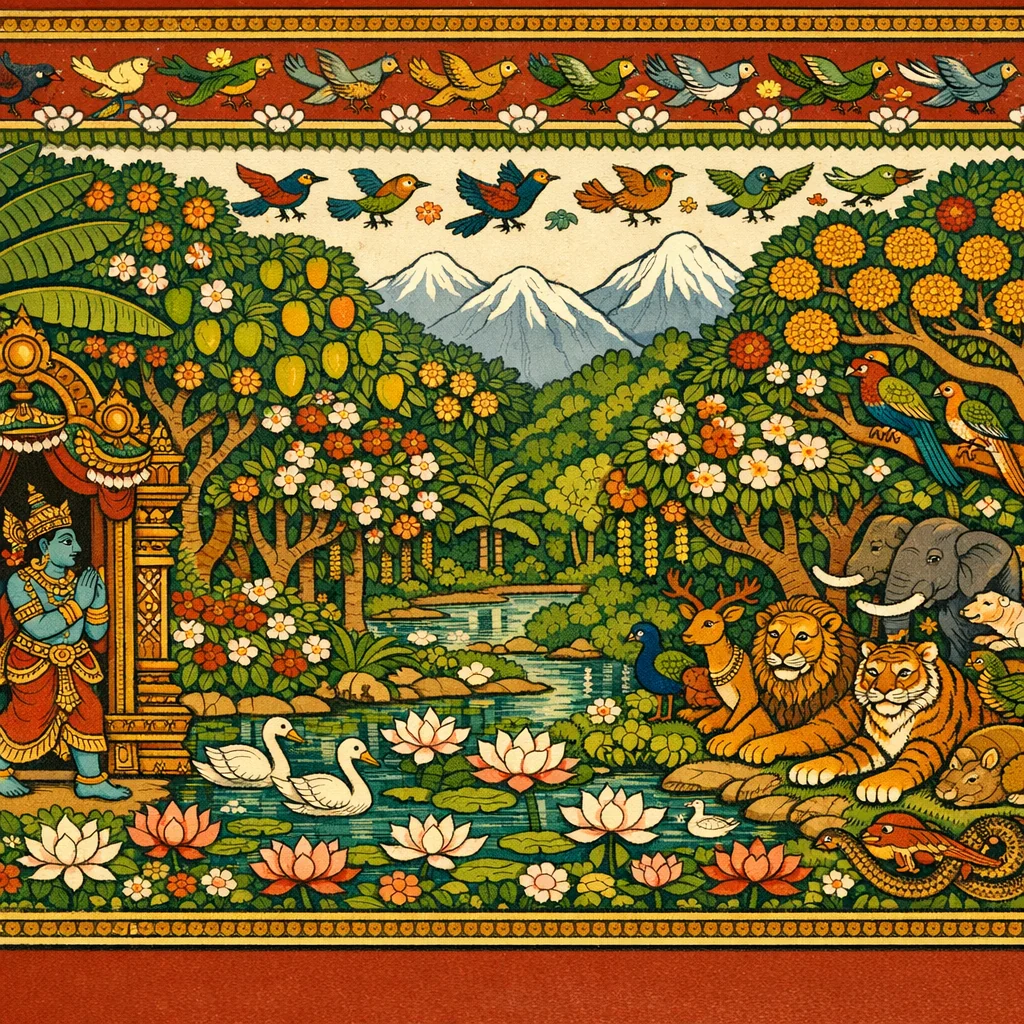
Adhyaya 118: Description of Atri’s Hermitage: Sacred Grove Planning, Flora–Fauna Catalogues, and the Non‑Violent Tapovana
अत्र्याश्रमवर्णनम्
Speaker: Sūta (narrator), King Purūravas (experiencer/subject of narration)
Sūta relates that Purūravas, through daiva-yoga and the grace of the God of gods, reaches an inaccessible yet enchanting mountain region near the source of the Airāvatī. The scene is unfolded in long catalogues of trees, flowers, creepers, fruits, grains, herbs, perfumes, and aquatic plants, along with pavilions, seats, festoons, toranas, and carefully arranged waterworks. The king beholds divine lakes and pure rivers, caves made serviceable, and climatic marvels—snow-free tracts and peaks of perpetual snow or hail. He also sees plentiful birds and beasts living without mutual hostility. Sūta explains this harmony as the fruit of Atri’s former presence: by the sage’s blessing beings are radiant and non-injuring, and even flesh-eaters subsist on milk and fruits. The chapter ends with Purūravas gazing upon the beautiful, fatigue-removing hermitage, adorned by Atri with hundreds of auspicious flowers.
Key Concepts
Shlokas in Adhyaya 118
Verse 1
*सूत उवाच तस्यैव पर्वतेन्द्रस्य प्रदेशं सुमनोरमम् अगम्यं मानुषैर् अन्यैर् दैवयोगाद् उपागतः //
Sūta said: By the providential working of fate, he came to a most delightful region of that very lord of mountains—one that was inaccessible to other human beings.
Verse 2
ऐरावती सरिच्छ्रेष्ठा यस्माद्देशाद्विनिर्गता मेघश्यामं च तं देशं द्रुमखण्डैरनेकशः //
From the region whence the excellent river Airāvatī issues forth, that land is said to be cloud-dark in hue, and in many places it is covered with groves and clusters of trees.
Verse 3
शालैस्तालैस्तमालैश्च कर्णिकारैः सशामलैः न्यग्रोधैश्च तथाश्वत्थैः शिरीषैः शिंशपद्रुमैः //
It was filled with śāla trees, palms, and tamālas; with karṇikāras and śyāmalas; and also with nyagrodhas (banyans) and aśvatthas, with śirīṣas and śiṃśapā trees.
Verse 4
श्लेष्मातकैर् आमलकैर् हरीतकविभीतकैः भूर्जैः समुञ्जकैर् बाणैर् वृक्षैः सप्तच्छदद्रुमैः //
With śleṣmātaka trees, āmalaka, harītaka and vibhītaka; with bhūrja (birch), samuñjaka and bāṇa trees, and with saptacchada (the seven-leaved) trees—thus should the place be furnished and arranged.
Verse 5
महानिम्बैस्तथा निम्बैर् निर्गुण्डीभिर्हरिद्रुमैः देवदारुमहावृक्षैस् तथा कालेयकद्रुमैः //
“The sacred precinct should be planted with great neem trees and neem, with nirguṇḍī shrubs and haridruma (yellow-wood), with lofty deodāra cedars, and likewise with kāleyaka trees.”
Verse 6
पद्मकैश्चन्दनैर्बिल्वैः कपित्थै रक्तचन्दनैः माताम्ररिष्टकाक्षोटैर् अब्दकैश्च तथार्जुनैः //
With padmaka wood, sandalwood, bilva, kapittha, red sandalwood, mātā-āmra, ariṣṭa, ākṣoṭa (walnut), abda (a suitable timber), and likewise arjuna—these are prescribed and commended.
Verse 7
हस्तिकर्णैः सुमनसैः कोविदारैः सुपुष्पितैः प्राचीनामलकैश्चापि धनकैः समराटकैः //
With hastikarṇa trees, fragrant sumanas blossoms, and kovidāra trees abundant in bloom; also with long-established āmalaka trees, together with dhanaka and samarāṭaka trees.
Verse 8
खर्जूरैर्नारिकेलैश्च प्रियालाम्रातकेङ्गुदैः तन्तुमालैर् धवैर्भव्यैः काश्मीरीपर्णिभिस्तथा //
With date-palms (kharjūra) and coconut trees (nārikelā); with priyāla, mango (āmra), āṭaka and iṅguda; with tantumāla, dhava, and the auspicious bhavya trees; and likewise with the kāśmīrī-parṇin trees as well.
Verse 9
जातीफलैः पूगफलैः कट्फलैलावलीफलैः मन्दारैः कोविदारैश्च किंशुकैः कुसुमांशुकैः //
With jātīphala (nutmeg), pūga (areca-nut), kaṭphala and elāvalī (cardamom) fruits; and with mandāra blossoms, kovidāra flowers, kiṃśuka blooms, and delicate “flower-garments” (petal-like offerings), the rite and its place should be adorned and reverently furnished.
Verse 10
यवासैः शमिपर्णासैर् वेतसैर् अम्बुवेतसैः रक्तातिरङ्गनारङ्गैर् हिङ्गुभिः सप्रियङ्गुभिः //
With yavāsa grass, śamī leaves, reeds (vetasa) and water-reeds (ambuvetasa); with red dye-stuffs and orange-hued substances; and with hiṅgu (asafoetida) together with fragrant priyaṅgu—these are to be employed as prescribed.
Verse 11
रक्ताशोकैस् तथाशोकैर् आकल्लैर् अविचारकैः मुचुकुन्दैस्तथा कुन्दैर् आटरूषपरूषकैः //
With red aśoka trees (raktāśoka) and also aśokas; with ākalla and avicāraka plants; with mucukunda and likewise kunda; and with āṭarūṣa and parūṣaka as well—the place should be planted and filled with these.
Verse 12
किरातैः किङ्किरातैश्च केतकैः श्वेतकेतकैः शोभाञ्जनैर् अञ्जनैश्च सुकलिङ्गनिकोटकैः //
—with kirāta and kiṅkirāta trees; with ketaka and white ketaka; with śobhāñjana and añjana; and with the excellent kaliṅga and nikoṭaka varieties.
Verse 13
सुवर्णचारुवसनैर् द्रुमश्रेष्ठैस् तथासनैः मन्मथस्य शराकारैः सहकारैर्मनोरमैः //
With excellent trees draped in lovely, golden-hued foliage, and with seats (āsana) arranged there, the place is adorned with delightful mango trees (sahakāra) shaped like Kāma’s arrows.
Verse 14
पीतयूथिकया चैव श्वेतयूथिकया तथा जात्या चम्पकजात्या च तुम्बरैश्चाप्यतुम्बरैः //
—with yellow yūthikā (jasmine) as well as white yūthikā; with jāti (jasmine) and campaka-jāti (champaka-like jasmine); and also with tumbara flowers and atumbara flowers.
Verse 15
मोचैर्लोचैस्तु लकुचैस् तिलपुष्पकुशेशयैः तथा सुपुष्पावरणैश् चव्यकैः कामिवल्लभैः //
With plantain blossoms (moca), with locā (a fragrant plant), with lakuca fruits, with sesame-flowers and lotus-blooms; likewise with well-flowering āvaraṇa-plants, with cavya, and with creepers dear to lovers—one should adorn/offer according to the prescribed rite.
Verse 16
पुष्पाङ्कुरैश्च बकुलैः पारिभद्रहरिद्रकैः धाराकदम्बैः कुटजैः कदम्बैर् गिरिकुटजैः //
It should be adorned with flowering shoots, bakula trees, pārijāta (pāribhadra) and turmeric plants; with dhārā-kadamba, kuṭaja, kadamba, and the mountain-kuṭaja as well.
Verse 17
आदित्यमुस्तकैः कुम्भैः कुङ्कुमैः कामवल्लभैः कट्फलैर्बदरैर्नीपैर् दीपैरिव महोज्ज्वलैः //
With pots (kumbhas) set out for worship, together with fragrant adityamustaka, kuṅkuma (saffron), the beloved kāmavallabhā plant, kaṭphala, badara (jujube), and nīpa blossoms, the rite shone brilliantly, as though lit by great lamps.
Verse 18
रक्तैः पालीवनैः श्वेतैर् दाडिमैश्चम्पकद्रुमैः बन्धूकैश्च सुबन्धूकैः कुञ्जकानां तु जातिभिः //
And the enclosures or groves should be planted with red and white pālīvana trees, with pomegranates and champaka trees, with bandhūka and subandhūka flowers, and with various kinds suited to forming kuñja-groves—leafy bowers and shaded arbors.
Verse 19
कुसुमैः पाटलाभिश्च मल्लिकाकरवीरकैः कुरबकैर् हिमवरैर् जम्बूभिर् नृपजम्बुभिः //
With blossoms—pāṭalā flowers, jasmine (mallikā) and karavīra (oleander), kurabaka blooms, the fragrant himavara flowers—and with jambu fruits, including the choice ‘royal’ jambu—the sacred place should be adorned and furnished for worship.
Verse 20
बीजपूरैः सकर्पूरैर् गुरुभिश्चागुरुद्रुमैः बिम्बैश्च प्रतिबिम्बैश्च संतानकवितानकैः //
(The garden or pleasure-grove) should be adorned with bījapūra (citron) trees, camphor-bearing plants (karpūra), the heavy-fragrant guru (resin/wood) and aguru (agarwood) trees, with bimba creepers and their paired pratibimba companions, and with saṃtānaka plants and spreading vitānaka bowers like leafy canopies.
Verse 21
तथा गुग्गुलवृक्षैश्च हिन्तालधवलेक्षुभिः तृणशून्यैः करवीरैर् अशोकैश् चक्रमर्दनैः //
Likewise, the area should be planted with guggulu trees, hintāla palms, and pale sugarcane; and—keeping the ground free of wild grass—with karavīra (oleander), aśoka, and cakramardana plants.
Verse 22
पीलुभिर्धातकीभिश्च चिरिबिल्वैः समाकुलैः तिन्तिडीकैस्तथा लोध्रैर् विडङ्गैः क्षीरिकाद्रुमैः //
It should be densely filled with pīlu trees and dhātakī plants, with ciri-bilva trees in abundance; likewise with tamarind, lodhra trees, viḍaṅga, and milk-yielding trees (kṣīrikā-druma).
Verse 23
अश्मन्तकैस्तथा कालैर् जम्बीरैः श्वैतकद्रुमैः भल्लातकैरिन्द्रयवैर् वल्गुजैः सिद्धिसाधकैः //
—with aśmantaka trees, and likewise with kāla trees; with jambīra (citron/lemon), with the white kadru trees (śvaitaka-druma); with bhallātaka (marking-nut), indrayava, and valguja—plants regarded as “accomplishers of success” (siddhi).
Verse 24
नागकेसरवृक्षैश्च सुकेसरमनोहरैः करमर्दैः कासमर्दैर् अरिष्टकवरिष्टकैः रुद्राक्षैर्द्राक्षसम्भूतैः सप्ताह्वैः पुत्रजीवकैः //
And (one should plant) nāgakesara trees—lovely with their fine, attractive stamens—along with karamarda, kāsamarda, ariṣṭaka and variṣṭaka; also rudrākṣa, grape-vines, saptāhvā, and putrajīvaka.
Verse 25
कङ्कोलकैर्लवङ्गैश्च त्वग्द्रुमैः पारिजातकैः प्रतानैः पिप्पलीनां च नागवल्यश्च भागशः //
Using kankola berries, cloves, cinnamon bark (tvak), pārijāta blossoms, clusters of long pepper (pippalī), and betel leaves (nāgavalī)—each taken in due proportion, part by part.
Verse 26
मरीचस्य तथा गुल्मैर् नवमल्लिकया तथा मृद्वीकामण्डपैर्मुख्यैर् अतिमुक्तकमण्डपैः //
And likewise (the garden should be adorned) with marīca plants and clustered shrubs, with fresh jasmine (navamallikā) as well—especially with pavilions over grapevines, and with pavilions covered in atimuktaka creepers.
Verse 27
त्रपुषैर्नर्तिकानां च प्रतानैः सफलैः शुभैः कूष्माण्डानां प्रतानैश्च अलाबूनां तथा क्वचित् //
And in some places, auspicious festoons should be made—using trapuṣa gourds, the nartikā variety, and other fine fruit-bearing creepers; likewise with festoons of kūṣmāṇḍa (ash-gourd) and of alābū (bottle-gourd).
Verse 28
चिर्भिटस्य प्रतानैश्च पटोलीकारवेल्लकैः कर्कोटकीवितानैश्च वार्ताकैर् बृहतीफलैः //
With the spreading vines of cirbhiṭa (cucumber), with paṭolī and kāravellaka (bitter gourd), with the canopy-like creepers of karkoṭakī, and with vārtāka (eggplant) bearing the fruits of bṛhatī (a large brinjal variety), the bower/trellis should be furnished.
Verse 29
तथा क्षीरकशाकेन कालशाकेन चाप्यथ शिम्बीधान्यैस्तथा धान्यैः सर्वैर्निरवशेषतः //
Likewise, with kṣīraka greens and with kālaśāka as well; and with legumes and with all kinds of grains—without leaving anything out.
Verse 30
औषधीभिर्विचित्राभिर् दीप्यमानाभिरेव च आयुष्याभिर्यशस्याभिर् बल्याभिश्च नराधिप //
O king, let it be adorned with diverse medicinal herbs—radiant in their growth—those that bestow longevity, bring fame, and strengthen vitality.
Verse 31
जरामृत्युभयघीभिः क्षुद्भयघ्नीभिरेव च सौभाग्यजननीभिश्च कुत्स्नाभिश्चाप्यनेकशः //
With (rites or formulas) that ward off the fear of old age and death, with those that destroy the fear of hunger as well, with those that generate good fortune, and with many others of every kind.
Verse 32
तत्र वेणुलताभिश्च तथा कीचकवेणुभिः काशैः शशाङ्ककाशैश्च शरगुल्मैस्तथैव च //
There, the tract was overgrown with bamboo-creepers and with thick bamboos known as kīcaka; with kāśa grasses, with moon-white kāśa, and likewise with clumps of reed-bushes.
Verse 33
कुशगुल्मैस्तथा रम्यैर् गुल्मैश्चेक्षोर् मनोरमैः कार्पासजातिवर्गेण दुर्लभेन शुभेन च //
And (the place) should be adorned with lovely clumps of kuśa grass, with delightful shrubs, with pleasing thickets of sugarcane, and also with rare and auspicious varieties of cotton plants.
Verse 34
तथा च कदलीखण्डैर् मनोहारिभिरुत्तमैः तथा मरकतप्रख्यैः प्रदेशैः शाद्वलान्वितैः //
And likewise, with excellent, enchanting groves of banana plants; and with tracts of land that gleam like emeralds, carpeted with fresh green turf.
Verse 35
इरापुंष्पसमायुक्तैः कुङ्कमस्य च भागशः तगरातिविषामांसीग्रन्थिकैस्तु सुरागदैः //
Combined with irā-flowers, and with measured portions of saffron, along with tagara, ativīṣā, māṃsī, and granthika—these become excellent ingredients for producing a fine perfume (fragrant compound).
Verse 36
सुवर्णपुष्पैश्च तथा भूमिपुष्पैस्तथापरैः जम्बीरकैर्भूस्तृणकैः सरसैः सशुकैस्तथा //
Likewise, (the rite should be performed) with golden flowers, with earth-born flowers and other varieties too; with citron fruits (jambīraka), with sacred grasses and ground-herbs, and also with fresh, juicy greens together with tender shoots.
Verse 37
शङ्गवेराजमोदाभिः कुबेरकप्रियालकैः जलजैश्च तथा वणैर् नानावर्णैः सुगन्धिभिः //
With śaṅgavera (dry ginger) and ajamodā (ajwain), with kuberaka and the beloved priyālaka trees, and also with plants born of the waters; and with groves and flowering growths of many colors, rich in fragrance.
Verse 38
उदयादित्यसंकाशैः सूर्यचन्द्रनिभैस्तथा तपनीयसवर्णैश्च अतसीपुष्पसंनिभैः //
They are radiant like the rising sun, like the sun and the moon; of the hue of refined gold, and resembling the blossom of the atāsī (flax) flower.
Verse 39
शूकपत्त्रनिभैश्चान्यैः स्थलपत्त्रैश्च भागशः पञ्चवर्णैः समाकीर्णैर् बहुवर्णैस्तथैव च //
And in other portions, with leaf-like motifs resembling ears of grain, and with ground-leaf designs divided section by section—intermixed with five colors, and likewise rendered in many colors.
Verse 40
द्रष्टुर्दृष्ट्या हितमुदैः कुमुदैश्चन्द्रसंनिभैः तथा वह्निशिखाकारैर् गजवक्त्रोत्पलैः शुभैः //
With a gaze that brings welfare and gladness to the beholder—eyes like white kumuda lotuses resembling the moon—auspicious; and with forms like tongues of flame, like blessed utpala lotus-blooms shaped as an elephant’s face.
Verse 41
नीलोत्पलैः सकह्लारैर् गुञ्जातककसेरुकैः शृङ्गाटकमृणालैश्च करटै राजतोत्पलैः //
With blue lotuses nīlotpala, together with white kahlāra lotuses; with guñjā-like aquatic plants and the fragrant kaseru; and also with water-chestnuts, lotus-stalks, karaṭa plants, and shining silver-white lotuses—the pond should be adorned.
Verse 42
जलजैः स्थलजैर्मूलैः फलैः पुष्पैर्विशेषतः विविधैश्चैव नीवारैर् मुनिभोज्यैर्नराधिप //
O king, one should subsist on roots that grow in water and on land, on fruits, and especially on flowers, and also on various kinds of wild grains (nīvāra) fit for sages (munis) to eat.
Verse 43
न तद्धान्यं न तत्सस्यं न तच्छाकं न तत्फलम् न तन्मूलं न तत्कन्दं न तत्पुष्पं नराधिप //
O king, that is not to be regarded as grain, nor as a crop; not as a vegetable, nor as a fruit; not as a root, nor as a tuber, nor as a flower.
Verse 44
नागलोकोद्भवं दिव्यं नरलोकभवं च यत् अनूपोत्थं वनोत्थं च तत्र यन्नास्ति पार्थिवः //
Whatever is of divine origin, whatever arises from the Nāga-world, whatever is produced in the human world, and whatever is born of marshlands or forests—among these, O king, one should distinguish that which is not ‘earth-born’ (i.e., not a terrestrial/mineral product).
Verse 45
सदा पुष्पफलं सर्वम् अजर्यम् ऋतुयोगतः मद्रेश्वरः स ददृशे तपसा ह्यतियोगतः //
There, all flowers and fruits are ever-present—endowed according to the seasons, yet unwithering. And the Lord of Madra (Madreśvara) was beheld, for through tapas (austerity) he had attained supreme yogic power.
Verse 46
ददृशे च तथा तत्र नानारूपान् पतत्रिणः मयूरान् शतपत्त्रांश्च कलविङ्कांश्च कोकिलान् //
And there, he likewise beheld birds of many kinds and forms—peacocks (mayūra), śatapattras, kalaviṅkas, and cuckoos (kokilā).
Verse 47
तथा कादम्बकान्हंसान् कोयष्टीन् खञ्जरीटकान् कुररान्कालकूटांश्च खट्वाङ्गान् लुब्धकांस् तथा //
Likewise, one should recognize the kādambaka-ducks, the swans, the koyaṣṭi birds, the khañjarīṭaka (wagtails), the kurara (ospreys), the dark kālakūṭa birds, as well as the khaṭvāṅga birds, and also those called “lubdhaka” (bearing the name “hunter”).
Verse 48
गोक्ष्वेडकांस्तथा कुम्भान् धार्तराष्ट्राञ्शुकान्बकान् घातुकांश्चक्रवाकांश्च कटुकान्टिट्टिभान् भटान् //
Likewise, one should recognize the gokṣveḍakas and the kumbhas; the dhārtarāṣṭras, the parrots, and the baka-cranes; the ghātukas and the cakravākas; the kaṭukas, the ṭiṭṭibhas, and the bhaṭas.
Verse 49
पुत्रप्रियान् लोहपृष्ठान् गोचर्मगिरिवर्तकान् पारावतांश्च कमलान् सारिका जीवजीवकान् //
“One should depict/arrange” the putrapriyā birds, the ‘iron-backed’ (lohapiṣṭha) creatures, the auspicious forms called gocarma and girivartaka, as well as pigeons, lotuses, the sārika (myna) birds, and the jīvajīvaka birds.
Verse 50
लाववर्तकवार्ताकान् रक्तवर्त्मप्रभद्रकान् ताम्रचूडान्स्वर्णचूडान् कुक्कुटान् काष्ठकुक्कुटान् //
“One may offer/include” quails (lāva) and partridges (vartaka), and other fowl—those with red markings and the prabhadraka breed; those with copper crests and golden crests; as well as domestic cocks and even the so‑called kāṣṭhakukkuṭa, ‘woodland cocks’.
Verse 51
कपिञ्जलान्कलविङ्कांस् तथा कुङ्कुमचूडकान् भृङ्गराजान् सीरपादान् भूलिङ्गान् डिण्डिमान् नवान् //
“One should include/recognize” the kapiñjala birds, the kalaviṅka birds, and also the kuṅkuma‑crested birds; likewise the bhṛṅgarājas, the sīrapādas, the bhūliṅgas, and the ḍiṇḍima birds, said to be ever-new.
Verse 52
मञ्जुलीतकदात्यूहान् भारद्वाजांस्तथा चषान् एतांश्चान्यांश्च सुबहून् पक्षिसंघान्मनोहरान् //
“(He described) the charming lītaka-birds and the dātyūhas, the bhāradvājas, and also the caṣas—these and many other delightful flocks of birds.”
Verse 53
श्वापदान्विविधाकारान् मृगांश्चैव महामृगान् व्याघ्रान्केसरिणः सिंहान् द्वीपिनः शरभान्वृकान् //
“(He created/manifested) beasts of prey of many forms—deer and great wild animals as well—tigers, maned lions, lions, leopards, śarabhas, and wolves.”
Verse 54
ऋक्षांस्तरक्षूंश्च बहून् गोलाङ्गूलान् सवानरान् शशलोमान् सकादम्बान् मार्जारान् वायुवेगिनः //
“(He created/produced) many bears and hyenas, long-tailed creatures together with monkeys, hare-furred animals along with flocks of waterfowl, and cats—swift as the wind.”
Verse 55
मूषकान्नकुलान् कावान् सिंहान् द्रुममनोहरान् तथा मत्तांश्च मातंगान् महिषान् गवयान् वृषान् चमरान् सृमरांश्चैव तथा गौरखरानपि //
“(One should depict) rats, mongooses, crows, lions, and delightful trees; also rutting elephants, buffaloes, wild oxen (gavaya), bulls, yaks (camara), deer (sṛmara), and likewise white donkeys as well.”
Verse 56
उरभ्रांश्च तथा मेषान् सारङ्गानथ कूकुरान् नीलांश्चैव महानालान् करालान्मृगमातृकान् //
“(He should note/encounter) urabhra-deer and rams, then sāraṅga antelopes and wild dogs; and also the ‘blue’ (dark-hued) kinds, the long-muzzled (varieties), the fierce ones, and the does (female deer).”}]}
Verse 57
सदंष्ट्रारामसरभान् क्रौञ्चाकारकशम्बरान् करालान्कृतमालांश्च कालपुच्छांश्च तोरणान् //
(One should fashion) archways and ornamental elements as: fierce fanged figures, pleasing śarabha motifs, deer shaped like the krauñca-bird, grim gaping faces, garland-work designs, and also archways bearing “black-tail” features (dark-tufted/black-ended).
Verse 58
दंष्ट्रान्खड्गान्वराहांश्च तुरंगान्खरगर्दभान् एतान् अद्विष्टान्मद्रेशो विरुद्धांश्च परस्परम् //
Boars with prominent tusks, rhinoceroses, boars again, horses, and asses and mules—these should be kept free from mutual hostility; for the lord (king/householder) should not maintain creatures antagonistic to one another.
Verse 59
अविरुद्धान्वने दृष्ट्वा विस्मयं परमं ययौ तच्चाश्रमपदं पुण्यं बभूवात्रेः पुरा नृपम् //
Seeing in the forest creatures living without hostility, he was filled with the greatest wonder. O King, that holy spot was in former times the sacred hermitage-settlement (āśrama) of Atri.
Verse 60
तत्प्रसादात्प्रभायुक्तं स्थावरैर्जङ्गमैस्तथा हिंसन्ति हि न चान्योन्यं हिंसकास्तु परस्परम् //
By his grace, all beings are endowed with radiant power; thus the immobile and the mobile do not injure one another—rather, only the violent harm each other.
Verse 61
क्रव्यादाः प्राणिनस्तत्र सर्वे क्षीरफलाशनाः निर्मितास्तत्र चात्यर्थम् अत्रिणा सुमहात्मना //
There, all flesh-eating creatures were fashioned as eaters of milk and fruits—created in that manner, and in great measure, by the great-souled sage Atri.
Verse 62
शैलानितम्बदेशेषु न्यवसच्च स्वयं नृपः पयः क्षरन्ति ते दिव्यम् अमृतस्वादुकण्टकम् //
Along the mountain-slopes the king himself took up residence. From those places there issues a divine, milk-like water, nectarous in taste like amṛta—sweet, yet with a faintly pungent after-note.
Verse 63
क्वचिद्राजन्महिष्यश्च क्वचिदाजाश्च सर्वशः शिलाः क्षीरेण सम्पूर्णा दध्ना चान्यत्र वा बहिः //
In some places royal buffalo-cows are seen, and elsewhere goats are found on every side. In some places stones are found filled with milk, and elsewhere they are outwardly smeared or coated with curd (dadhi).
Verse 64
संपश्यन्परमां प्रीतिम् अवाप वसुधाधिपः सरांसि तत्र दिव्यानि नद्यश्च विमलोदकाः //
Beholding these, the lord of the earth attained supreme delight; for there were divine lakes there, and rivers whose waters were perfectly pure.
Verse 65
प्रणालिकानि चोष्णानि शीतलानि च भागशः कन्दराणि च शैलस्य सुसेव्यानि पदे पदे //
There should be water-channels—some warm and some cool—arranged in due proportion; and the mountain’s caves and grottoes should be made pleasant and serviceable at every step along the paths.
Verse 66
हिमपातो न तत्रास्ति समन्तात्पञ्चयोजनम् उपत्यका सुशैलस्य शिखरस्य न विद्यते //
In that region there is no snowfall, extending all around for five yojanas; and at the summit of that excellent mountain there is no valley at all.
Verse 67
तत्रास्ति राजञ्छिखरं पर्वतेन्द्रस्य पाण्डुरम् हिमपातं घना यत्र कुर्वन्ति सहिताः सदा //
There, O King, stands a pale-white summit of the lord of mountains, where dense clouds, gathered together, continually bring about snowfall.
Verse 68
तत्रास्ति चापरं शृङ्गं यत्र तोयघना घनाः नित्यमेवाभिवर्षन्ति शिलाभिः शिखरं वरम् //
There, too, is another peak where dense, water-laden clouds continually pour down, so that the excellent summit is perpetually showered with hailstones.
Verse 69
तदाश्रमं मनोहारि यत्र कामधरा धरा सुरमुख्योपयोगित्वाच् छाखिनां सफलाः फलाः //
That hermitage was enchanting: there the very earth was like a wish-fulfilling support, and because it served even the foremost of the gods, the trees bore fruit in abundance.
Verse 70
सदोपगीतभ्रमरसुरस्त्रीसेवितं परम् सर्वपापक्षयकरं शैलस्येव प्रहारकम् //
Supreme indeed is that place (or observance), ever filled with the humming of bees and attended by celestial maidens; it brings about the destruction of all sins, striking them down like a blow upon a rock.
Verse 71
वानरैः क्रीडमानैश्च देशाद्देशान्नराधिप हिमपुञ्जाः कृतास्तत्र चन्द्रबिम्बसमप्रभाः //
O King, as the monkeys sported from place to place there, they made heaps of snow, gleaming with a radiance like the orb of the moon.
Verse 72
तदाश्रमं समन्ताच्च हिमसंरुद्धकन्दरैः शैलवाटैः परिवृतम् अगम्यं मनुजैः सदा //
That hermitage was enclosed on every side by mountain ramparts, whose caves and ravines were blocked with snow, and thus it was ever inaccessible to human beings.
Verse 73
पूर्वाराधितभावो ऽसौ महाराजः पुरूरवाः तदाश्रमपदं प्राप्तो देवदेवप्रसादतः //
Thus King Purūravas, his disposition already shaped by prior worship, reached that hermitage-abode through the gracious favor of the God of gods.
Verse 74
तदाश्रमं श्रमशमनं मनोहरं मनोहरैः कुसुमशतैरलंकृतम् कृतं स्वयं रुचिरमथात्रिणा शुभं शुभावहं च हि ददृशे स मद्रराट् //
Then the king of Madra beheld that hermitage—charming and a remover of fatigue—adorned with hundreds of lovely flowers, beautifully arranged by Sage Atri himself, auspicious and truly bestowing auspiciousness.
Frequently Asked Questions
The chapter teaches how a truly sanctified place (rishi-āśrama/tapovana) is formed through right arrangement of nature and sacred utilities—trees, flowers, vines, water systems, and offerings—culminating in an ecology of peace. It emphasizes tapas-prabhāva: Sage Atri’s austerity generates a field where beings become non-hostile and even predators adopt milk-and-fruit diets, showing that dharma can transform both environment and behavior.
This adhyaya is primarily Vastu-adjacent and dharma-centered rather than genealogical. Vastu appears as garden/precinct planning (planting schemes, mandapas over vines, toranas, festoons, seats, warm/cool water channels, serviceable caves). Dharma appears as ahimsa and ksetra-mahatmya—Atri’s tapas creating a non-violent, sin-destroying hermitage environment witnessed by King Purūravas.
Read Matsya Purana in the Vedapath app
Scan the QR code to open this directly in the app, with audio, word-by-word meanings, and more.