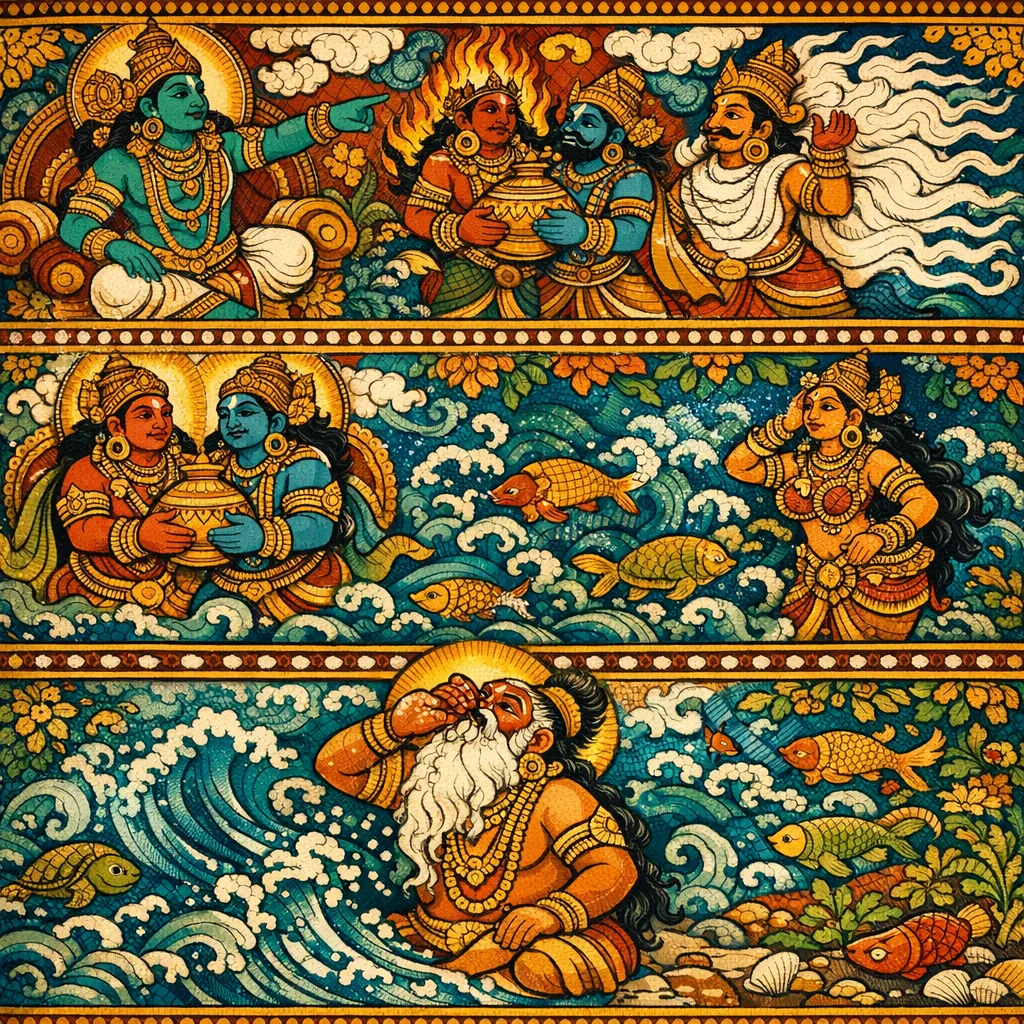
Adhyaya 61: Agastya’s Origin, the Drying of the Ocean, and the Rite of Offering Arghya to Agastya
अगस्त्यजन्म-समुद्रशोषण-प्रकरणम् तथा अर्घ्यप्रदानविधिः
Speaker: Nārada, Maheśvara (Īśvara / Śiva)
Adhyāya 61 unfolds as a Nārada–Maheśvara saṃvāda that moves from cosmology into ethics, mythic genealogy, and a practical ritual manual. Nārada begins by naming the seven divine worlds and asks how sovereignty, beauty, longevity, fortune, and abundant Lakṣmī may be obtained. Maheśvara narrates how Indra orders Fire and Wind to dry the ocean to destroy Dānava enemies hiding in Varuṇa’s abode; Fire and Wind object on dharmic grounds, citing massive loss of aquatic life. Indra’s wrath frames a key teaching: conflicts between artha (strategic necessity) and dharma (non-harm), leading to a curse that causes Fire and Wind to incarnate jointly as Agastya (Kumbhayoni). The chapter then explains Agastya’s jar-birth through Mitra–Varuṇa and Urvaśī, and links Vasiṣṭha’s re-manifestation to the same vessel. Finally, it prescribes an Agastya-arghya rite—purification, white attire, kumbha setup, donations, mantras—and promises graded loka-attainments culminating in Brahman for lifelong observance, ending with a strong phala-śruti for recitation and teaching.
Key Concepts
Shlokas in Adhyaya 61
Verse 1
*नारद उवाच भूर्लोको ऽथ भुवर्लोकः स्वर्लोको ऽथ महर्जनः तपः सत्यं च सप्तैते देवलोकाः प्रकीर्तिताः //
Nārada said: Bhūrloka, then Bhuvarloka, Svarloka, and Maharjana; Tapoloka and Satyaloka—these seven are declared to be the divine worlds.
Verse 2
पर्यायेण तु सर्वेषाम् आधिपत्यं कथं भवेत् इह लोके शुभं रूपम् आयुः सौभाग्यमेव च लक्ष्मीश्च विपुला नाथ कथं स्यात्पुरसूदन //
How, in due order, can sovereignty come to all? And in this world, O Lord—O slayer of cities—how may one obtain auspicious beauty, long life, good fortune, and abundant Lakṣmī (prosperity)?
Verse 3
*महेश्वर उवाच पुरा हुताशनः सार्धं मारुतेन महीतले आदिष्टः पुरुहूतेन विनाशाय सुरद्विषाम् //
Maheśvara said: Formerly, Hutāśana (Fire), together with Māruta (Wind), was commanded on the earth by Puruhūta (Indra) for the destruction of the enemies of the gods.
Verse 4
निर्दग्धेषु ततस्तेन दानवेषु सहस्रशः तारकः कमलाक्षश्च कालदंष्ट्रः परावसुः विरोचनश्च संग्रामाद् अपलायंस्तपोधन //
Then, when thousands of Dānavas had been burned by him, Tāraka, Kamalākṣa, Kāladaṃṣṭra, Parāvasu, and Virocana fled from the battlefield—O ascetic sage.
Verse 5
अम्भः सामुद्रमाविश्य संनिवेशमकुर्वत अशक्या इति ते ऽप्यग्निमारुताभ्यामुपेक्षिताः //
Entering the oceanic waters, they attempted to establish a secure station; but deeming it impossible, even they were left unattended—beyond the aid of fire and wind.
Verse 6
ततः प्रभृति ते देवान् मनुष्यान्सह जङ्गमान् संपीड्य च मुनीन्सर्वान् प्रविशन्ति पुनर्जलम् //
From that time onward, they—pressing and overwhelming the gods, human beings, and all moving creatures, and also all the sages—enter again into the waters.
Verse 7
एवं वर्षसहस्राणि वीराः पञ्च च सप्त च जलदुर्गबलाद्ब्रह्मन् पीडयन्ति जगत्त्रयम् //
Thus, for thousands of years, those twelve mighty warriors—O Brahman—by the strength of their water-fortress kept afflicting the three worlds.
Verse 8
ततः परमथो वह्निमारुतावमराधिपः आदिदेश चिरादम्बुनिधिरेष विशोष्यताम् //
Then, thereafter, the lord of the gods commanded Fire and Wind: “In due course, let this ocean—this reservoir of waters—be dried up.”
Verse 9
यस्मादस्मद्द्विषामेष शरणं वरुणालयः तस्माद्भवद्भ्यामद्यैव क्षयमेष प्रणीयताम् //
Since this one—an enemy of ours—has taken refuge in Varuṇa’s abode (the ocean), therefore let him be led by you both, this very day, to his destruction.
Verse 10
तावूचतुस्ततः शक्रम् उभौ शम्बरसूदनम् अधर्म एष देवेन्द्र सागरस्य विनाशनम् //
Then both of them spoke to Śakra (Indra), the slayer of Śambara: “O lord of the gods, this is adharma—an act that brings about the destruction of the ocean.”
Verse 11
यस्माज्जीवनिकायस्य महतः संक्षयो भवेत् तस्मान्न पापमद्यावां करवाव पुरंदर //
Since this would cause a great destruction of living beings, therefore, O Purandara, let us not commit this sin.
Verse 12
अस्य योजनमात्रे ऽपि जीवकोटिशतानि च निवसन्ति सुरश्रेष्ठ स कथं नाशमर्हति //
O best of the gods, even within a space of only one yojana, hundreds of crores of living beings dwell; how, then, could it deserve destruction?
Verse 13
एवमुक्तः सुरेन्द्रस्तु कोपात् संरक्तलोचनः उवाचेदं वचो रोषान् निर्दहन्निव पावकम् //
Thus addressed, Indra, lord of the gods, his eyes reddened with anger, spoke these words in wrath—burning, as it were, like fire.
Verse 14
न धर्माधर्मसंयोगं प्राप्नुवन्त्यमराः क्वचित् भवतोस्तु विशेषेण माहात्म्यं चाधितिष्ठतोः //
The immortals never, at any time, come into contact with a mixture of dharma and adharma. But you two—most especially—stand established in true greatness and sacred eminence (māhātmya).
Verse 15
मदाज्ञालङ्घनं यस्मान् मारुतेन समं त्वया मुनिव्रतमहिंसादि परिगृह्य त्वया कृतम् धर्मार्थशास्त्ररहितं शत्रुं प्रति विभावसो //
Since, together with Māruta (the Wind), you have transgressed my command—having assumed the sage’s vow of non-violence and the like—you have acted toward the enemy, O Vibhāvasu (Fire), in a manner devoid of the guidance of dharma and artha-śāstra (polity).
Verse 16
तस्मादेकेन वपुषा मुनिरूपेण मानुषे मारुतेन समं लोके तव जन्म भविष्यति //
Therefore, taking a single bodily form—appearing as a sage in the human world—your birth in this world will occur together with Māruta.
Verse 17
यदा च मानुषत्वे ऽपि त्वयागस्त्येन शोषितः भविष्यत्युदधिर्वह्ने तदा देवत्वमाप्स्यसि //
And when—even while you remain in human form—the ocean, O Fire, is dried up by you through Agastya, then you will attain divinity.
Verse 18
इतीन्द्रशापात्पतितौ तत्क्षणात्तौ महीतले अवाप्तावेकदेहेन कुम्भाज्जन्म तपोधन //
Thus, by Indra’s curse, the two fell at that very moment upon the earth, and—having attained a single embodied form—were born from a pot, O ascetic treasure.
Verse 19
मित्रावरुणयोर्वीर्याद् वसिष्ठस्यानुजो ऽभवत् अगस्त्य इत्युग्रतपाः संबभूव पुनर्मुनिः //
From the virile potency of Mitra and Varuṇa there arose a younger brother of Vasiṣṭha; that sage, renowned for fierce austerities, was born again as the muni called Agastya.
Verse 20
*नारद उवाच सम्भूतः स कथं भ्राता वसिष्ठस्याभवन्मुनिः कथं च मित्रावरुणौ पितरावस्य तौ स्मृतौ जन्म कुम्भादगस्त्यस्य कथं स्यात्पुरसूदन //
Nārada said: “How did that sage come into being, and how did he become the brother of Vasiṣṭha? Why are Mitra and Varuṇa remembered as his two fathers? And how did Agastya’s birth take place from a jar, O Pura-sūdana, slayer of the demon-city?”
Verse 21
*ईश्वर उवाच पुरा पुराणपुरुषः कदाचिद्गन्धमादने भूत्वा धर्मसुतो विष्णुश् चचार विपुलं तपः //
Īśvara said: Long ago, the Primeval Person (Purāṇapuruṣa) once, upon Gandhamādana mountain, became known as Dharma’s son; and as Viṣṇu he undertook abundant austerities.
Verse 22
तपसा तस्य भीतेन विघ्नार्थं प्रेषितावुभौ शक्रेण माधवानङ्गाव् अप्सरोगणसंयुतौ //
Frightened by his austerity, Śakra (Indra) dispatched the two—Mādhava and Anaṅga—together with a troop of Apsarases, in order to create an obstacle to his penance.
Verse 23
यदा न गीतवाद्येन नाङ्गरागादिना हरिः न काममाधवाभ्यां च विषयान्प्रति चुक्षुभे //
When Hari was no longer stirred toward sense-objects by song and instrumental music, nor by perfumes and bodily adornments, nor even by Kāma and Mādhava—the delights of love and spring—then the pull of enjoyment ceased to agitate him.
Verse 24
तदा काममधुस्त्रीणां विषादम् अगमद्गणः संक्षोभाय ततस्तेषां स्वोरुदेशान्नराग्रजः नारीमुत्पादयामास त्रैलोक्यजनमोहिनीम् //
Then the host of those women—intoxicated with desire and sweetness—fell into dejection. To stir and unsettle them, Nara’s elder brother brought forth, from his own thigh-region, a woman who bewilders the beings of the three worlds.
Verse 25
संक्षुब्धास्तु तया देवास् तौ तु देववरावुभौ अप्सरोभिः समक्षं हि देवानामब्रवीद्धरिः //
Stirred into agitation by her, the gods became unsettled; and in the very presence of the Apsarases, Hari spoke to the gods about those two—both foremost among the deities.
Verse 26
अप्सरा इति सामान्या देवानामब्रवीद्धरिः उर्वशीति च नाम्नेयं लोके ख्यातिं गमिष्यति //
Hari said to the gods: “In general she is called an apsaras; and by the name Urvaśī, this one will attain fame in the world.”
Verse 27
ततः कामयमानेन मित्रेणाहूय सोर्वशी उक्ता मां रमयस्वेति बाढम् इत्यब्रवीत्तु सा //
Then, summoned by her desireful companion, Urvaśī was addressed: “Delight me.” She replied, “So be it.”
Verse 28
गच्छन्ती चाम्बरं तद्वत् स्तोकमिन्दीवरेक्षणा वरुणेन धृता पश्चाद् वरुणं नाभ्यनन्दत //
As she was going toward the sky in the same manner, that lotus-eyed maiden rose only a little; then, being held back by Varuṇa, she did not thereafter accept or approve of Varuṇa.
Verse 29
मित्रेणाहं वृता पूर्वम् अद्य भार्या न ते विभो उवाच वरुणश्चित्तं मयि संन्यस्य गम्यताम् //
She said, “Formerly I was chosen by you as a companion; today I am not your wife, O mighty one.” Thus spoke Varuṇa: “Entrust your mind to me and depart.”
Verse 30
गतायां बाढमित्युक्त्वा मित्रः शापमदात्तदा तस्यै मानुषलोके त्वं गच्छ सोमसुतात्मजम् //
When she had departed, Mitra said, “So be it,” and then pronounced a curse: “For her sake, you shall go to the human world and become the son of Soma.”
Verse 31
भजस्वेति यतो वेश्या धर्म एष त्वया कृतः जलकुम्भे ततो वीर्यं मित्रेण वरुणेन च प्रक्षिप्तमथ संजातौ द्वावेव मुनिसत्तमौ //
Because the courtesan said, “Consort (with me),” and because you acted in accordance with that dharma, the semen of Mitra and Varuṇa was cast into a water-jar; from it were born two most excellent sages.
Verse 32
निमिर्नाम सह स्त्रीभिः पुरा द्यूतमदीव्यत तत्रान्तरे ऽभ्याजगाम वसिष्ठो ब्रह्मसम्भवः //
Once, a king named Nimi was playing at dice together with women. In the meantime, Vasiṣṭha—born of Brahmā—arrived there.
Verse 33
तस्य पूजामकुर्वन्तं शशाप स मुनिर्नृपम् विदेहस्त्वं भवस्वेति ततस्तेनाप्यसौ मुनिः //
When the king did not perform his worship, that sage cursed him, saying, “You shall become Videha (one without a body).” Thereupon, that sage too was, in turn, affected by him.
Verse 34
अन्योन्यशापाच्च तयोर् विगते इव चेतसी जग्मतुः शापनाशाय ब्रह्माणं जगतः पतिम् //
Because of their mutual curse, it was as though their minds had lost all clarity; and so the two of them went to Brahmā—the Lord of the world—in order to have the curse undone.
Verse 35
अथ ब्रह्मण आदेशाल् लोचनेष्ववसन्निमिः निमेषाः स्युश्च लोकानां तद्विश्रामाय नारद //
Then, by Brahmā’s command, Nimi settled in the eyes; and the blinking of the eyelids came to be among living beings, O Nārada, for their repose.
Verse 36
वसिष्ठो ऽप्यभवत्तस्मिञ् जलकुम्भे च पूर्ववत् ततः श्वेतश्चतुर्बाहुः साक्षसूत्रकमण्डलुः अगस्त्य इति शान्तात्मा बभूव ऋषिसत्तमः //
And Vasiṣṭha too came to be in that water-jar, just as before. Then there manifested a fair-complexioned, four-armed one, bearing the sacred thread and the ascetic’s water-pot; serene in spirit, he became the foremost of sages, known as Agastya.
Verse 37
मलयस्यैकदेशे तु वैखानसविधानतः सभार्यः संवृतो विप्रैस् तपश्चक्रे सुदुश्चरम् //
In a certain part of the Malaya region, in accordance with the Vaikhānasa discipline, he—together with his wife and surrounded by Brahmin sages—performed austerities (tapas) exceedingly difficult to undertake.
Verse 38
ततः कालेन महता तारकाद् अतिपीडितम् जगद्वीक्ष्य स कोपेन पीतवान्वरुणालयम् //
Then, after a long time, seeing the world grievously tormented by Tāraka, he—angered—drank up Varuṇa’s abode, the realm of waters, the ocean.
Verse 39
ततो ऽस्य वरदाः सर्वे बभूवुः शंकरादयः ब्रह्मा विष्णुश्च भगवान् वरदानाय जग्मतुः वरं वृणीष्व भद्रं ते यदभीष्टं च वै मुने //
Then all of them—Śaṅkara and the others—stood ready to grant him boons; and the blessed Brahmā and Lord Viṣṇu approached to bestow a boon, saying: “Choose a boon—may it be well with you—whatever you desire, O sage.”
Verse 40
*अगस्त्य उवाच यावद्ब्रह्मसहस्राणां पञ्चविंशतिकोटयः वैमानिको भविष्यामि दक्षिणाचलवर्त्मनि //
Agastya said: “For as long as twenty-five crores of thousands of Brahmā-ages endure, I shall remain a vaimānika—one who journeys in a celestial vimāna—upon the path of Dakṣiṇācala.”
Verse 41
मद्विमानोदये कुर्याद् यः कश्चित्पूजनं मम स सप्तलोकाधिपतिः पर्यायेण भविष्यति //
Whoever performs worship of me at the time when my divine vimāna rises shall, in due course, become a sovereign lord over the seven worlds.
Verse 42
*ईश्वर उवाच एवमस्त्विति ते ऽप्युक्त्वा जग्मुर्देवा यथागतम् तस्मादर्घः प्रदातव्यो ह्य् अगस्त्यस्य सदा बुधैः //
Īśvara said: “So be it.” Having thus spoken, those gods departed just as they had come. Therefore, the wise should always offer arghya (a respectful water-offering) to Sage Agastya.
Verse 43
*नारद उवाच कथमर्घप्रदानं तु कर्तव्यं तस्य वै विभो विधानं यदगस्त्यस्य पूजने तद्वदस्व मे //
Nārada said: “O Lord, how indeed is the offering of arghya to be performed? Please tell me the proper procedure for it, as it is done in the worship of Agastya.”
Verse 44
*ईश्वर उवाच प्रत्यूषसमये विद्वान् कुर्यादस्योदये निशि स्नानं शुक्लतिलैस्तद्वच् छुक्लमाल्याम्बरो गृही //
Īśvara said: “At the pre-dawn hour, the wise person should perform a bath; likewise, at its rising (dawn), even if it is still night. He should bathe using white sesame seeds; and in the same manner, the householder should wear white garments and a white garland.”
Verse 45
स्थापयेदव्रणं कुम्भं माल्यवस्त्रविभूषितम् पञ्चरत्नसमायुक्तं घृतपात्रसमन्वितम् नानाभक्ष्यफलैर्युक्तं ताम्रपात्रसमन्वितम् //
One should set up an unblemished water-pot (kumbha), adorned with garlands and cloth, furnished with the five precious gems, accompanied by a vessel of ghee, supplied with various foods and fruits, and provided with a copper vessel as well.
Verse 46
अङ्गुष्ठमात्रं पुरुषं तथैव सौवर्णम् अत्यायतबाहुदण्डम् चतुर्मुखं कुम्भमुखे निधाय धान्यानि सप्ताम्बरसंयुतानि //
One should fashion a golden Puruṣa, thumb-sized, with arms elongated like staffs; and, making it four-faced, place it at the mouth of the ritual pot (kumbha). Along with it, one should include grains, together with seven cloths.
Verse 47
सकांस्यपात्राक्षतशुक्तियुक्तं मन्त्रेण दद्याद्द्विजपुंगवाय उत्क्षिप्य लम्बोदरदीर्घबाहुम् अनन्यचेता यमदिङ्मुखः सन् //
With a mantra, one should present to an excellent brāhmaṇa a bronze vessel furnished with unbroken grains of rice and a conch-shell; lifting up in reverence the one with a pendulous belly and long arms, he should do so with undistracted mind, facing the direction of Yama (the south).
Verse 48
श्वेतां च दद्याद्यदि शक्तिरस्ति रौप्यैः खुरैर् हेममुखीं सवत्साम् धेनुं नरः क्षीरवतीं प्रणम्य सवत्सघण्टाभरणां द्विजाय //
If he has the means, a man should also donate a white cow—its hooves plated with silver and its face adorned with gold—together with its calf. Bowing in reverence, he should give to a brāhmaṇa a milk-yielding cow, furnished with a bell and ornaments, along with its calf.
Verse 49
आ सप्तरात्रोदयम् एतदस्य दातव्यमेतत्सकलं नरेण यावत्समाः सप्त दशाथवा स्युर् अथोर्ध्वमप्यत्र वदन्ति केचित् //
Up to the completion of seven nights, a man should give all of this as prescribed—continuing for seven years, or for ten years; and some authorities even speak of continuing beyond that.
Verse 50
काशपुष्पप्रतीकाश वह्निमारुतसम्भव मित्रावरुणयोः पुत्र कुम्भयोने नमो ऽस्तु ते //
O one radiant like the blossoming kāśa-flower, born of fire and wind; O son of Mitra and Varuṇa, O Kumbhayoni (born of the pot)—salutations to you.
Verse 51
विन्ध्यवृद्धिक्षयकर मेघतोयविषापह रत्नवल्लभ देवेश लङ्कावासिन्नमो ऽस्तु ते //
O Lord who can cause the Vindhya to wax or wane, remover of the poison in rain-water, beloved of jewels, Lord of the gods, Dweller in Laṅkā—salutations be to You.
Verse 52
वातापी भक्षितो येन समुद्रः शोषितः पुरा लोपामुद्रापतिः श्रीमान् यो ऽसौ तस्मै नमो नमः //
Salutations again and again to that illustrious one—the husband of Lopāmudrā—by whom Vātāpi was devoured, and by whom the ocean was once dried up.
Verse 53
राजपुत्रि महाभागे ऋषिपत्नि वरानने लोपामुद्रे नमस्तुभ्यम् अर्घो मे प्रतिगृह्यताम् प्रत्यब्दं तु फलत्यागम् एवं कुर्वन्न सीदति //
O princess, most fortunate one—O sage’s wife with a beautiful face—O Lopāmudrā, salutations to you. Please accept this arghya-offering of mine. One who, year after year, renounces (offers away) the fruits (of his gains) in this manner does not fall into distress.
Verse 54
होमं कृत्वा ततः पश्चाद् वर्जयेन्मानवः फलम् अनेन विधिना यस्तु पुमानर्घ्यं निवेदयेत् //
Having performed the fire-offering (homa), thereafter a man should refrain from seeking the fruit (of the rite). But whoever offers arghya according to this prescribed method—
Verse 55
इमं लोकं स चाप्नोति रूपारोग्यसमन्वितः द्वितीयेन भुवर्लोकं स्वर्गलोकं ततः परम् //
Endowed with beauty and freedom from disease, he attains this world; by the second (merit) he reaches the Bhuvar-loka, and thereafter the Svarga-loka, and then the world beyond that (still higher).
Verse 56
सप्तैव लोकानाप्नोति सप्तार्घान् यः प्रयच्छति यावदायुश्च यः कुर्यात् परं ब्रह्माधिगच्छति //
He who offers arghya seven times attains the seven worlds; and he who performs it throughout his lifespan ultimately reaches the Supreme Brahman.
Verse 57
इह पठति शृणोति वा य एतद् युगलमुनिप्रभवार्घ्यसम्प्रदानम् मतिमपि च ददाति सो ऽपि विष्णोर् भवनगतः परिपूज्यते ऽमरौघैः //
Whoever in this world recites, or even merely hears, this account of the proper offering of arghya that arose from the Yuga(la) sages—and who also imparts it as instruction—he too, having reached the abode of Viṣṇu, is honored and worshipped by multitudes of gods.
Frequently Asked Questions
Adhyāya 61 teaches that true prosperity and sovereignty are linked to dharmic conduct and disciplined ritual life. Through the Indra–Agni–Vāyu episode it highlights the tension between artha (strategic action against enemies) and dharma (non-harm and protection of life), showing consequences for disregarding righteous counsel. It then prescribes a concrete remedy-path: worship of Ṛṣi Agastya via arghya, dāna, and niṣkāma homa, promising health, beauty, ascent through higher lokas, and ultimately Brahman-realization for lifelong observance.
This chapter is primarily Dharma and Genealogy with cosmology and ritual: (1) Sapta-loka cosmology; (2) Dharma–adharma reasoning about drying the ocean and mass harm to beings; (3) Puranic genealogy explaining Agastya as Mitra–Varuṇa’s son and Vasiṣṭha’s brother, including Urvaśī’s role and jar-birth; and (4) ritual procedure (Agastya-arghya-vidhi) with donation rules and phala-śruti. Vāstu/architecture is not a main focus in Adhyāya 61.