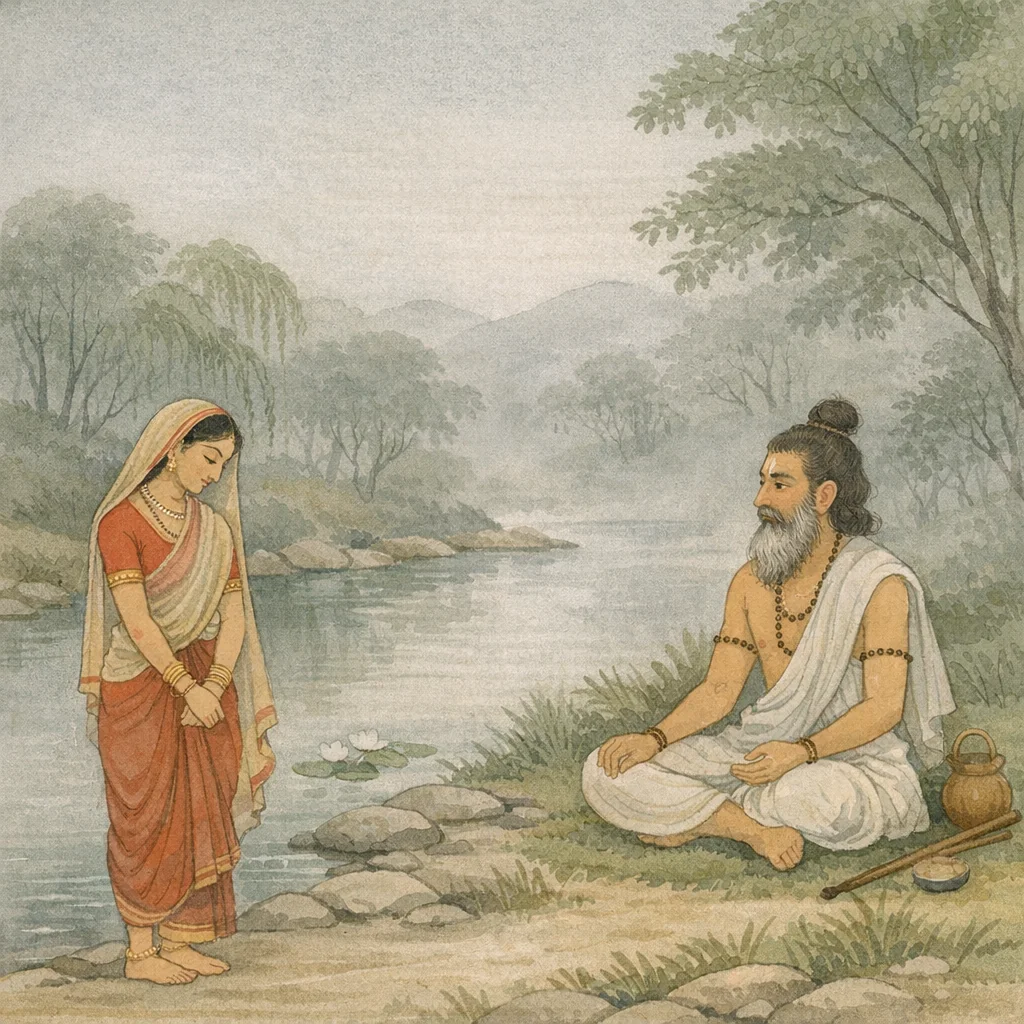
Adhyaya 63
Duḥṣantasya Vana-praveśaḥ (King Duḥṣanta’s Entry into the Forest Hunt)
Upa-parva: Duḥṣanta–Śakuntalā Upākhyāna (Ādi Parva episode)
Vaiśaṃpāyana narrates Duḥṣanta’s departure on a hunt with extensive cavalry and elephants, surrounded by armed warriors bearing swords, spears, clubs, maces, and lances. The movement is marked by martial acoustics—lion-roars of soldiers, conches and drums, chariot-wheel resonance, elephant trumpeting, and the mixed sounds of neighing and shouted signals—creating a public spectacle of royal force. Women positioned on palace rooftops observe and praise the king as an enemy-subduing, Indra-like figure, showering flowers as a sign of approval and auspiciousness. Praised by Brahmins and followed by townspeople for a distance, Duḥṣanta proceeds in a bird-like (Suparṇa-comparable) chariot, filling earth and sky with sound. He reaches a forest described as Nandana-like yet harsh: uneven, rocky, expansive, waterless, and uninhabited, populated by formidable animal groups. The king and his retinue range through it, hunting diverse game; he kills tigers and other animals with arrows at distance and with sword at close range, also employing spear and mace techniques. The forest’s fauna scatter; thirsty, exhausted animals collapse near a dry riverbed, while some are consumed by hungry predators and forest-dwellers who kindle fire and cook meat. Wounded, panicked elephants trample many men. The chapter closes with an image of the forest “covered” by the king’s force like a storm-cloud with a shower of arrows, its large beasts felled—an emphatic portrayal of kṣātra dominance within a liminal wilderness setting.
Chapter Arc: पौरवनन्दन राजा उपरिचर वसु—इन्द्र के उपदेश से रमणीय चेदिदेश का राज्य ग्रहण कर—धर्म-प्रतिष्ठा और राजधर्म की नई रीति का प्रवर्तन करता है। → राजा वसु का वैराग्य-प्रवृत्त आश्रम-वास और तपोनिधि-से जीवन देखकर शक्रपुरोग देवगण भी उसे उपासना देने आते हैं; वहीं से राजसत्ता, तपस्या और देव-आज्ञा के बीच सूक्ष्म तनाव उभरता है। आगे कथा सत्यवती तक मुड़ती है—उसके जीवन में लोक-लज्जा, देह-गन्ध और भविष्य के महापुरुषों की छाया एक साथ घिरने लगती है। → सत्यवती महर्षि से वर मांगती है—‘गात्रसौगन्ध्यमुत्तमम्’—और उसे मनोवांछित वरदान मिलता है; कुहरे/माया-रचना से परिवेश अन्धकार-सा हो उठता है और तपस्विनी कन्या विस्मित व लज्जित होती है, मानो भाग्य स्वयं उसके चारों ओर आवरण बुन रहा हो। → वरदान के फलस्वरूप सत्यवती ‘योजनगन्धा’ नाम से प्रसिद्ध होती है; उसके जीवन में नारीत्व के समागमोचित गुणों का उदय होता है और वंश-परम्परा की धारा (व्यासादि प्रमुख पात्रों की भूमिका) के लिए भूमि तैयार हो जाती है। साथ ही राजा वसु द्वारा आरम्भ की गई राज-रीति—श्रेष्ठ राजाओं द्वारा यष्टि-प्रवेश की परम्परा—स्थापित होकर ‘तबसे आजतक’ चलती बताई जाती है। → कथा आगे कुरुवंश के महाविग्रह की ओर संकेत करती है—अपरिमेय राजाओं की सेनाएँ जुटेंगी, जिनके नाम भी असंख्य हैं—और श्रोताओं को आने वाले महासमर की विराटता का पूर्वाभास देकर छोड़ देती है।
Shlokas
Verse 1
(दाक्षिणात्य अधिक पाठके ११३ श्लोक मिलाकर कुल ६४ ३ “लोक हैं) जा >> हु नाग त्रेषष्टितमोड्ध्याय: राजा उपरिचरका चरित्र तथा सत्यवती, व्यासादि प्रमुख पात्रोंकी संक्षिप्त जन्न्मकथा वैशम्पायन उवाच राजोपरिचरो नाम धर्मनित्यो महीपति: । बभूव मृगयां गन्तुं सदा किल धृतव्रत:,वैशम्पायनजी कहते हैं--जनमेजय! पहले उपरिचर नामसे प्रसिद्ध एक राजा हो गये हैं, जो नित्य-निरन्तर धर्ममें ही लगे रहते थे। साथ ही सदा हिंसक पशुओंके शिकारके लिये वनमें जानेका उनका नियम था
Vaiśampāyana said: There was a king known as Uparicara, a ruler steadfastly devoted to dharma. Yet it was also his fixed practice, it is said, to go regularly to the hunt. The verse introduces a morally charged portrait: a king committed to righteousness while maintaining a vow-like attachment to hunting, setting the stage for reflection on royal duty, restraint, and the ethics of violence.
Verse 2
स चेदिविषयं रम्यं वसु: पौरवनन्दन: । इन्द्रोपदेशाज्जग्राह रमणीयं महीपति:,पौरवनन्दन राजा उपरिचर वसुने इन्द्रके कहनेसे अत्यन्त रमणीय चेदिदेशका राज्य स्वीकार किया था
Vaiśampāyana said: Vasu, the delight of the Paurava line, accepted the charming realm of Cedi—an exceedingly pleasant kingdom—acting upon Indra’s counsel. The passage frames his accession not as mere conquest or ambition, but as a kingship undertaken under divine instruction, implying a ruler’s duty to govern in alignment with higher guidance and the welfare of the land.
Verse 3
तमाश्रमे न्यस्तशस्त्र निवसन्तं तपोनिधिम् । देवा: शक्रपुरोगा वै राजानमुपतस्थिरे,एक समयकी बात है, राजा वसु अस्त्र-शस्त्रोंका त्याग करके आश्रममें निवास करने लगे। उन्होंने बड़ा भारी तप किया, जिससे वे तपोनिधि माने जाने लगे। उस समय इन्द्र आदि देवता यह सोचकर कि यह राजा तपसयाके द्वारा इन्द्रपद प्राप्त करना चाहता है, उनके समीप गये। देवताओंने राजाको प्रत्यक्ष दर्शन देकर उन्हें शान्तिपूर्वक समझाया और तपस्यासे निवृत्त कर दिया
Vaiśaṃpāyana said: In that hermitage, the king—having laid aside his weapons and living as an ascetic, a veritable treasure-house of austerity—was approached by the gods, led by Śakra (Indra). Sensing the moral tension between worldly power and spiritual striving, the gods came to dissuade him from pursuing sovereignty through tapas and to restore balance in the cosmic order.
Verse 4
इन्द्रत्वमहों राजायं तपसेत्यनुचिन्त्य वै । त॑ सान्त्वेन नृपं साक्षात् तपस: संन्यवर्तयन्,एक समयकी बात है, राजा वसु अस्त्र-शस्त्रोंका त्याग करके आश्रममें निवास करने लगे। उन्होंने बड़ा भारी तप किया, जिससे वे तपोनिधि माने जाने लगे। उस समय इन्द्र आदि देवता यह सोचकर कि यह राजा तपसयाके द्वारा इन्द्रपद प्राप्त करना चाहता है, उनके समीप गये। देवताओंने राजाको प्रत्यक्ष दर्शन देकर उन्हें शान्तिपूर्वक समझाया और तपस्यासे निवृत्त कर दिया
Vaiśampāyana said: “Thinking, ‘Ah! This king seeks Indra’s sovereignty through austerity,’ the gods approached him in person and, by gentle persuasion, turned the ruler back from his severe penance.”
Verse 5
देवा ऊचु: न संकीर्येत धर्मो5यं पृथिव्यां पृथिवीपते । त्वया हि धर्मो विधृतः कृत्स्नं धारयते जगत्,देवता बोले--पृथ्वीपते! तुम्हें ऐसी चेष्टा रखनी चाहिये जिससे इस भूमिपर वर्णसंकरता न फैलने पावे (तुम्हारे न रहनेसे अराजकता फैलनेका भय है, जिससे प्रजा स्वधर्ममें स्थित नहीं रह सकेगी। अतः तुम्हें तपस्या न करके इस वसुधाका संरक्षण करना चाहिये)। राजन! तुम्हारे द्वारा सुरक्षित धर्म ही सम्पूर्ण जगत्को धारण कर रहा है
The gods said: “O lord of the earth, see that this dharma is not thrown into confusion upon the earth. For dharma, upheld by you, sustains the whole world.”
Verse 6
इन्द्र वाच लोके धर्म पालय त्वं नित्ययुक्तः समाहित: । धर्मयुक्तस्ततो लोकान् पुण्यान् प्राप्स्यसि शाश्वतान्,इन्द्रने कहा--राजन्! तुम इस लोकमें सदा सावधान और प्रयत्नशील रहकर धर्मका पालन करो। धर्मयुक्त रहनेपर तुम सनातन पुण्यलोकोंको प्राप्त कर सकोगे
Indra said: “In this world, uphold dharma—ever disciplined and composed. When you remain aligned with dharma, you will attain the eternal, meritorious realms.”
Verse 7
दिविष्ठस्य भुविष्ठस्त्वं सखाभूतो मम प्रिय: । रम्य: पृथिव्यां यो देशस्तमावस नराधिप,यद्यपि मैं स्वर्गमें रहता हूँ और तुम भूमिपर; तथापि आजसे तुम मेरे प्रिय सखा हो गये। नरेश्वर! इस पृथ्वीपर जो सबसे सुन्दर एवं रमणीय देश हो, उसीमें तुम निवास करो
Vaiśampāyana said: “Though I dwell in heaven and you upon the earth, from this day you have become my beloved friend. O king of men, dwell in that region of the earth which is most beautiful and delightful.”
Verse 8
पशव्यश्रैव पुण्यश्च प्रभूतधनधान्यवान् । स्वारक्ष्यश्चैव सौम्यश्न भोग्यैर्भूमिगुणैर्युत:
Vaiśampāyana said: He was rich in cattle and also virtuous; he possessed abundant wealth and grain. He was capable of protecting his own realm, gentle in disposition, and endowed with the land’s enjoyments and natural excellences—resources fit to be rightly used and safeguarded.
Verse 9
अर्थवानेष देशो हि धनरत्नादिभिय्युत: । वसुपूर्णा च वसुधा वस चेदिषु चेदिप
Vaiśaṃpāyana said: “This is indeed a prosperous region, endowed with wealth, jewels, and the like. The very earth here is filled with riches; thus, O king of Cedi, dwell among the Cedis.”
Verse 10
धर्मशीला जनपदा: सुसंतोषाश्न साधव: । न च मिथ्याप्रलापो>त्र स्वैरेष्वपि कुतोडन्यथा
Vaiśampāyana said: “The people of that land were devoted to dharma—contented and virtuous. In that country there was no false or frivolous speech; even in matters left to one’s own choice, how could there be any deviation from what is right?”
Verse 11
न च पित्रा विभज्यन्ते पुत्रा गुरुहिते रता: । युज्जते धुरि नो गाश्न कृशान् संधुक्षयन्ति च
Vaiśampāyana said: “Sons devoted to their teacher’s welfare are not to be set apart or treated differently even by their father. Such sons are fit to be yoked to the yoke-pole for work; they do not shrink from hardship, and they even kindle the fire—ready to serve in whatever task is required.”
Verse 12
सर्वे वर्णा: स्वधर्मस्था: सदा चेदिषु मानद । न ते>स्त्यविदितं किंचित् त्रिषु लोकेषु यद् भवेत्
Vaiśampāyana said: “O bestower of honor, when all the social orders remain steadily established in their own duties, there is nothing anywhere in the three worlds that can remain unknown to you.”
Verse 13
इस समय चेदिदेश पशुओंके लिये हितकर, पुण्यजनक, प्रचुर धन-धान्यसे सम्पन्न, स्वर्गके समान सुखद होनेके कारण रक्षणीय, सौम्य तथा भोग्य पदार्थों और भूमिसम्बन्धी उत्तम गुणोंसे युक्त है। यह देश अनेक पदार्थोंसे युक्त और धन-रत्न आदिसे सम्पन्न है। यहाँकी वसुधा वास्तवमें वसु (धन-सम्पत्ति)-से भरी-पूरी है। अतः तुम चेदिदेशके पालक होकर उसीमें निवास करो। यहाँके जनपद धर्मशील, संतोषी और साधु हैं। यहाँ हास- परिहासमें भी कोई झूठ नहीं बोलता, फिर अन्य अवसरोंपर तो बोल ही कैसे सकता है। पुत्र सदा गुरुजनोंके हितमें लगे रहते हैं, पिता अपने जीते-जी उनका बाँटवारा नहीं करते। यहाँके लोग बैलोंको भार ढोनेमें नहीं लगाते और दीनों एवं अनाथोंका पोषण करते हैं। मानद! चेदिदेशमें सब वर्णोंके लोग सदा अपने-अपने धर्ममें स्थित रहते हैं। तीनों लोकोंमें जो कोई घटना होगी, वह सब यहाँ रहते हुए भी तुमसे छिपी न रहेगी--तुम सर्वज्ञ बने रहोगे || ८-- १२ || देवोपभोग्यं दिव्यं त्वामाकाशे स्फाटिक॑ महत् । आकाशांगं त्वां मद्दत्तं विमानमुपपत्स्यते,जो देवताओंके उपभोगमें आने योग्य है, ऐसा स्फटिक मणिका बना हुआ एक दिव्य, आकाशचारी एवं विशाल विमान मैंने तुम्हें भेंट किया है। वह आकाशमें तुम्हारी सेवाके लिये सदा उपस्थित रहेगा
Vaiśampāyana said: “I have presented to you a vast, crystal-like, divine aerial chariot—fit for the enjoyment of the gods. This sky-moving vimāna, bestowed by me, will remain in the heavens and be ever at hand for your service.”
Verse 14
त्वमेकः सर्वमर्त्येषु विमानवरमास्थित: । चरिष्यस्युपरिस्थो हि देवो विग्रहवानिव,सम्पूर्ण मनुष्योंमें एक तुम्हीं इस श्रेष्ठ विमानपर बैठकर मूर्तिमान् देवताकी भाँति सबके ऊपर-ऊपर विचरोगे
Vaiśampāyana said: “Among all mortals, you alone—seated upon this most excellent aerial car—will move about above everyone, like a god who has taken on a visible form.”
Verse 15
ददामि ते वैजयन्तीं मालामम्लानपंकजाम् । धारयिष्यति संग्रामे या त्वां शस्त्रैरविक्षतम्,मैं तुम्हें यह वैजयन्ती माला देता हूँ, जिसमें पिरोये हुए कमल कभी कुम्हलाते नहीं हैं। इसे धारण कर लेनेपर यह माला संग्राममें तुम्हें अस्त्र-शस्त्रोंक आधातसे बचायेगी
“I give you this Vaijayantī garland, woven of lotus blossoms that never wither. Wear it in battle, and it will keep you unscathed by weapons.”
Verse 16
लक्षणं चैतदेवेह भविता ते नराधिप । इन्द्रमालेति विख्यातं धन्यमप्रतिमं महत्,नरेश्वर! यह माला ही इन्द्रमालाके नामसे विख्यात होकर इस जगत्में तुम्हारी पहचान करानेके लिये परम धन्य एवं अनुपम चिह्न होगी
Vaiśampāyana said: “This very thing will here serve as your distinguishing mark, O king. Renowned as the ‘Indramālā,’ this great, incomparable, and auspicious garland will become the sign by which you are recognized in the world.”
Verse 17
यष्टिं च वैणवीं तस्मै ददौ वृत्रनिषूदन: । इष्टप्रदानमुद्दिश्य शिष्टानां प्रतिपालिनीम्,ऐसा कहकर वृत्रासुरका नाश करनेवाले इन्द्रने राजाको प्रेमोपहारस्वरूप बाँसकी एक छड़ी दी, जो शिष्ट पुरुषोंकी रक्षा करनेवाली थी
Vaiśampāyana said: Indra, the slayer of Vṛtra, gave him a bamboo staff as a token of affectionate favor, intending it as a boon—an emblem meant to uphold and protect the righteous and well-disciplined.
Verse 18
तस्या: शक्रस्य पूजार्थ भूमौ भूमिपतिस्तदा । प्रवेशं कारयामास गते संवत्सरे तदा,तदनन्तर एक वर्ष बीतनेपर भूपाल वसुने इन्द्रकी पूजाके लिये उस छड़ीको भूमिमें गाड़ दिया
Then, when a year had passed, King Vasu, the lord of the land, had it set into the earth as an installation, intending it for the worship of Śakra (Indra).
Verse 19
ततः प्रभृति चाद्यापि यष्टे: क्षितिपसत्तमै: । प्रवेश: क्रियते राजन् यथा तेन प्रवर्तित:,राजन्! तबसे लेकर आजतक श्रेष्ठ राजाओंद्वारा छड़ी धरतीमें गाड़ी जाती है। वसुने जो प्रथा चला दी, वह अबतक चली आती है
“From that time onward, even to this day, O King, the foremost rulers perform the rite of planting a staff into the earth—just as it was instituted by him. Thus the custom set in motion by that king continued as an established royal practice.”
Verse 20
अपरेद्युस्ततस्तस्या: क्रियते<त्युच्छूयो नृपैः । अलंकृताया: पिटकैर्गन्धमाल्यैश्न भूषणै:,दूसरे दिन अर्थात् नवीन संवत्सरके प्रथम दिन प्रति-पदाको वह छड़ी वहाँसे निकालकर बहुत ऊँचे स्थानमें रखी जाती है; फिर कपड़ेकी पेटी, चन्दन, माला और आभूषणोंसे उसको सजाया जाता है। उसमें विधिपूर्वक फूलोंके हार और सूत लपेटे जाते हैं। तत्पश्चात् उसी छड़ीपर देवेश्वर भगवान् इन्द्रका हंसरूपसे पूजन किया जाता है
Vaiśaṃpāyana said: On the following day, the kings raise that staff to a very lofty place. It is then adorned with a cloth-case, perfumes, garlands, and ornaments—an act of public reverence that marks the rite as a disciplined, communal observance rather than mere display.
Verse 21
माल्यदामपरिक्षिप्ता विधिवत् क्रियतेडपि च । भगवान् पूज्यते चात्र हंसरूपेण चेश्वर:,दूसरे दिन अर्थात् नवीन संवत्सरके प्रथम दिन प्रति-पदाको वह छड़ी वहाँसे निकालकर बहुत ऊँचे स्थानमें रखी जाती है; फिर कपड़ेकी पेटी, चन्दन, माला और आभूषणोंसे उसको सजाया जाता है। उसमें विधिपूर्वक फूलोंके हार और सूत लपेटे जाते हैं। तत्पश्चात् उसी छड़ीपर देवेश्वर भगवान् इन्द्रका हंसरूपसे पूजन किया जाता है
Vaiśaṃpāyana said: The staff is duly adorned, wrapped with garlands and floral strings, and the prescribed rites are performed. There, the Lord—Indra, ruler of the gods—is worshipped in the form of a haṃsa (swan), marking reverence and auspicious order at the turning of the year.
Verse 22
स्वयमेव गृहीतेन वसो: प्रीत्या महात्मन: । सतां पूजां महेन्द्रस्तु दृष्टवा देव: कृतां शुभाम्,इन्द्रने महात्मा वसुके प्रेमवश स्वयं हंसका रूप धारण करके वह पूजा ग्रहण की। नृपश्रेष्ठ वसुके द्वारा की हुई उस शुभ पूजाको देखकर प्रभावशाली भगवान् महेन्द्र प्रसन्न हो गये और इस प्रकार बोले--“चेदिदेशके अधिपति उपरिचर वसु जिस प्रकार मेरी पूजा करते हैं, उसी तरह जो मनुष्य तथा राजा मेरी पूजा करेंगे और मेरे इस उत्सवको रचायेंगे, उनको और उनके समूचे राष्ट्रको लक्ष्मी एवं विजयकी प्राप्ति होगी
Vaiśaṃpāyana said: Pleased by the noble Vasu’s devotion, the god Mahendra himself accepted the offering with his own hands. Seeing the auspicious worship performed in the manner of the righteous, Indra was delighted—affirming that sincere, properly conducted reverence offered by a king brings prosperity and victory not only to the worshipper but to the whole realm, for public piety strengthens both moral order and royal fortune.
Verse 23
वसुना राजमुख्येन प्रीतिमानब्रवीत् प्रभु: । ये पूजयिष्यन्ति नरा राजानश्न महं मम,इन्द्रने महात्मा वसुके प्रेमवश स्वयं हंसका रूप धारण करके वह पूजा ग्रहण की। नृपश्रेष्ठ वसुके द्वारा की हुई उस शुभ पूजाको देखकर प्रभावशाली भगवान् महेन्द्र प्रसन्न हो गये और इस प्रकार बोले--“चेदिदेशके अधिपति उपरिचर वसु जिस प्रकार मेरी पूजा करते हैं, उसी तरह जो मनुष्य तथा राजा मेरी पूजा करेंगे और मेरे इस उत्सवको रचायेंगे, उनको और उनके समूचे राष्ट्रको लक्ष्मी एवं विजयकी प्राप्ति होगी
Vaiśaṃpāyana said: Pleased by the devotion of the foremost king Vasu, the Lord spoke: “Just as Uparicara Vasu, the ruler of Cedi, worships me, so too whatever men and kings worship me and establish this festival in my honor—upon them and upon their entire realm will come prosperity and victory.”
Verse 24
कारयिष्यन्ति च मुदा यथा चेदिपतिर्नुटप: । तेषां श्रीरविजयश्रैव सराष्ट्राणां भविष्यति,इन्द्रने महात्मा वसुके प्रेमवश स्वयं हंसका रूप धारण करके वह पूजा ग्रहण की। नृपश्रेष्ठ वसुके द्वारा की हुई उस शुभ पूजाको देखकर प्रभावशाली भगवान् महेन्द्र प्रसन्न हो गये और इस प्रकार बोले--“चेदिदेशके अधिपति उपरिचर वसु जिस प्रकार मेरी पूजा करते हैं, उसी तरह जो मनुष्य तथा राजा मेरी पूजा करेंगे और मेरे इस उत्सवको रचायेंगे, उनको और उनके समूचे राष्ट्रको लक्ष्मी एवं विजयकी प्राप्ति होगी
Vaiśaṃpāyana said: “Just as the lord of Cedi, the king (Uparicara Vasu), joyfully arranges this worship, so too those men and kings who, with gladness, perform such worship and institute this festival will obtain prosperity and victory—along with the well-being of their entire realm.”
Verse 25
तथा स्फीतो जनपदो मुदितश्च भविष्यति | एवं महात्मना तेन महेन्द्रेण नराधिप,“इतना ही नहीं, उनका सारा जनपद ही उत्तरोत्तर उन्नतिशील और प्रसन्न होगा।' राजन! इस प्रकार महात्मा महेन्द्रने, जिन्हें मघवा भी कहते हैं, प्रेमपूर्वक महाराज वसुका भलीभाँति सत्कार किया। जो मनुष्य भूमि तथा रत्न आदिका दान करते हुए सदा देवराज इन्द्रका उत्सव रचायेंगे, वे इन्द्रोत्सवद्वारा इन्द्रका वरदान पाकर उसी उत्तम गतिको पा जायँगे, जिसे भूमिदान आदिके पुण्योंसे युक्त मानव प्राप्त करते हैं
“Thus the realm will grow ever more prosperous, and the people will be joyful. In this manner, O king, that great-souled Mahendra (Indra) was duly honored with affection.”
Verse 26
वसु: प्रीत्या मघवता महाराजो5भिसत्कृत: । उत्सवं कारयिष्यन्ति सदा शक्रस्य ये नरा:,“इतना ही नहीं, उनका सारा जनपद ही उत्तरोत्तर उन्नतिशील और प्रसन्न होगा।' राजन! इस प्रकार महात्मा महेन्द्रने, जिन्हें मघवा भी कहते हैं, प्रेमपूर्वक महाराज वसुका भलीभाँति सत्कार किया। जो मनुष्य भूमि तथा रत्न आदिका दान करते हुए सदा देवराज इन्द्रका उत्सव रचायेंगे, वे इन्द्रोत्सवद्वारा इन्द्रका वरदान पाकर उसी उत्तम गतिको पा जायँगे, जिसे भूमिदान आदिके पुण्योंसे युक्त मानव प्राप्त करते हैं
Vaiśampāyana said: King Vasu was warmly honored with affection by Maghavat (Indra). Those men who continually arrange the festival of Śakra (Indra) will, through that Indra-festival, receive Indra’s boon and attain the same excellent destiny that is won by people endowed with the merit of gifts such as land and jewels.
Verse 27
भूमिरत्नादिभिदनिस्तथा पूज्या भवन्ति ते । वरदानमहायज्ञैस्तथा शक्रोत्सवेन च,“इतना ही नहीं, उनका सारा जनपद ही उत्तरोत्तर उन्नतिशील और प्रसन्न होगा।' राजन! इस प्रकार महात्मा महेन्द्रने, जिन्हें मघवा भी कहते हैं, प्रेमपूर्वक महाराज वसुका भलीभाँति सत्कार किया। जो मनुष्य भूमि तथा रत्न आदिका दान करते हुए सदा देवराज इन्द्रका उत्सव रचायेंगे, वे इन्द्रोत्सवद्वारा इन्द्रका वरदान पाकर उसी उत्तम गतिको पा जायँगे, जिसे भूमिदान आदिके पुण्योंसे युक्त मानव प्राप्त करते हैं
Vaiśampāyana said: Through gifts such as land and jewels, people become worthy of honor and reverence; likewise through bestowing boons, performing great sacrifices, and by celebrating the festival of Śakra (Indra).
Verse 28
सम्पूजितो मघवता वसुश्नैदी श्वरो नृप: । पालयामास धर्मेण चेदिस्थ: पृथिवीमिमाम्,इन्द्रके द्वारा उपर्युक्त रूपसे सम्मानित चेदिराज वसुने चेदिदेशमें ही रहकर इस पृथ्वीका धर्मपूर्वक पालन किया
Honoured with due reverence by Maghavat (Indra), the king—lord of the Vasus and of the Śnaidi lineage—remained in the land of Cedi and governed this very earth in accordance with dharma, upholding righteous order through just rule.
Verse 29
इन्द्रप्रीत्या चेदिपतिश्नकारेन्द्रमहं वसु: । पुत्राश्नास्य महावीर्या: पज्चासन्नमितौजस:,इन्द्रकी प्रसन्नताके लिये चेदिराज वसु प्रतिवर्ष इन्द्रोत्तव मनाया करते थे। उनके अनन्त बलशाली महापराक्रमी पाँच पुत्र थे
Vaiśampāyana said: To please Indra, Vasu, the king of Cedi, used to celebrate the Indra-festival every year at Nakāra. He had five sons, all great heroes and of immeasurable strength.
Verse 30
नानाराज्येषु च सुतान् स सम्राडभ्यषेचयत् । महारथो मागधानां विश्रुतो यो बृहद्रथ:,सम्राट् वसुने विभिन्न राज्योंपर अपने पुत्रोंको अभिषिक्त कर दिया। उनमें महारथी बृहद्रथ मगध देशका विख्यात राजा हुआ
Vaiśampāyana said: That sovereign consecrated his sons as rulers in various kingdoms. Among them, the famed Bṛhadratha, a great chariot-warrior, became the celebrated king of the Magadhas.
Verse 31
प्रत्यग्रह: कुशाम्बश्व यमाहुर्मणिवाहनम् । मावेल्लश्न यदुश्चैव राजन्यश्वापराजित:,दूसरे पुत्रका नाम प्रत्यग्रह था, तीसरा कुशाम्ब था, जिसे मणिवाहन भी कहते हैं। चौथा मावेलल था। पाँचवाँ राजकुमार यदु था, जो युद्धमें किसीसे पराजित नहीं होता था
Vaiśampāyana said: “The second son was named Pratyagraha. The third was Kuśāmba, also known as Maṇivāhana. The fourth was Māvella. The fifth prince was Yadu, a kṣatriya who was never defeated in battle.”
Verse 32
एते तस्य सुता राजनू् राजर्षेर्भूरितेजस: । न््यवासयन् नामभ्रि: स्वैस्ते देशांश्ष पुराणि च,राजा जनमेजय! महातेजस्वी राजर्षि वसुके इन पुत्रोंने अपने-अपने नामसे देश और नगर बसाये
Vaiśampāyana said: “O King Janamejaya, these were the sons of that mighty, radiant royal sage. Each of them established settlements—regions and cities—bearing his own name.”
Verse 33
वासवा: पड्च राजानः पृथग्वंशाश्व शाश्वता: | वसन्तमिन्द्रप्रासादे आकाशे स्फाटिके च तम्,पाँचों वसुपुत्र भिन्न-भिन्न देशोंके राजा थे और उन्होंने पृथक्ू-पृथक् अपनी सनातन वंशपरम्परा चलायी। चेदिराज वसु इन्द्रके दिये हुए स्फटिक मणिमय विमानमें रहते हुए आकाशमें ही निवास करते थे। उस समय उन महात्मा नरेशकी सेवामें गन्धर्व और अप्सराएँ उपस्थित होती थीं। सदा ऊपर-ही-ऊपर चलनेके कारण उनका नाम “राजा उपरिचर' के रूपमें विख्यात हो गया
Vaiśaṃpāyana said: The five kings known as the Vasus belonged to distinct lineages, each maintaining its own ancient dynastic tradition. Among them, King Vasu of Cedi dwelt aloft in the sky, residing in a crystal-like aerial palace granted by Indra. Attended by Gandharvas and Apsarases, he became renowned as Uparicara—“the one who moves above”—for he continually traveled and lived in the upper regions.
Verse 34
उपतस्थुर्महात्मानं गन्धर्वाप्सरसो नृपम् । राजोपरिचरेत्येवं नाम तस्याथ विश्रुतम्,पाँचों वसुपुत्र भिन्न-भिन्न देशोंके राजा थे और उन्होंने पृथक्ू-पृथक् अपनी सनातन वंशपरम्परा चलायी। चेदिराज वसु इन्द्रके दिये हुए स्फटिक मणिमय विमानमें रहते हुए आकाशमें ही निवास करते थे। उस समय उन महात्मा नरेशकी सेवामें गन्धर्व और अप्सराएँ उपस्थित होती थीं। सदा ऊपर-ही-ऊपर चलनेके कारण उनका नाम “राजा उपरिचर' के रूपमें विख्यात हो गया
Vaiśampāyana said: Gandharvas and Apsarases came to attend upon that great-souled king. Thereafter he became renowned by the name “Rājopacara,” for he was ever served and honored in elevated, celestial fashion—moving above the earth and living aloft by divine favor.
Verse 35
पुरोपवाहिनीं तस्य नदीं शुक्तिमतीं गिरि: । अरौत्सीच्चेतनायुक्त: कामात् कोलाहल: किल,उनकी राजधानीके समीप शुक्तिमती नदी बहती थी। एक समय कोलाहल नामक सचेतन पर्वतने कामवश उस दिव्यरूपधारिणी नदीको रोक लिया
Vaiśampāyana said: Near his capital flowed the river Śuktimatī. It is said that once the mountain named Kolāhala—endowed with consciousness—out of desire obstructed that river, which had assumed a wondrous, divine form.
Verse 36
गिरिं कोलाहलं तं तु पदा वसुरताडयत् । निश्षक्राम ततस्तेन प्रहारविवरेण सा,उसके रोकनेसे नदीकी धारा रुक गयी। यह देख उपरिचर वसुने कोलाहल पर्वतपर अपने पैरसे प्रहार किया। प्रहार करते ही पर्वतमें दरार पड़ गयी, जिससे निकलकर वह नदी पहलेके समान बहने लगी
Vaiśampāyana said: When the river’s current had been obstructed, Uparicara Vasu struck the Kolāhala mountain with his foot. At that blow a fissure opened in the mountain, and through that cleft the river burst forth and flowed again as before.
Verse 37
तस्यां नद्यामजनयन्मिथुनं पर्वत: स्वयम् । तस्माद् विमोक्षणात् प्रीता नदी राज्ञे न््यवेदयत्,पर्वतने उस नदीके गर्भसे एक पुत्र और एक कन्या, जुड़वीं संतान उत्पन्न की थी। उसके अवरोधसे मुक्त करनेके कारण प्रसन्न हुई नदीने राजा उपरिचरको अपनी दोनों संतानें समर्पित कर दीं
Vaiśampāyana said: In that river, the mountain himself begot a pair of twins. Pleased because she had been released from obstruction, the river presented those two children to King Uparicara.
Verse 38
यः पुमानभवत् तत्र तं स राजर्षिसत्तम: | वसुर्वसुप्रदश्चक्रे सेनापतिमरिन्दम:,उनमें जो पुरुष था, उसे शत्रुओंका दमन करनेवाले धनदाता राजर्षिप्रवर वसुने अपना सेनापति बना लिया
Vaiśampāyana said: Among them, the one who was a man—him the foremost royal sage, Vasu, famed as a giver of wealth and a subduer of foes, appointed as his commander of the army.
Verse 39
चकार पत्नीं कन्यां तु तथा तां गिरिकां नृपः । वसो: पत्नी तु गिरिका कामकालं न्यवेदयत्,और जो कन्या थी उसे राजाने अपनी पत्नी बना लिया। उसका नाम था गिरिका। बुद्धिमानोंमें श्रेष्ठ जनममेजय! एक दिन ऋतुकालको प्राप्त हो स्नानके पश्चात् शुद्ध हुई वसुपत्नी गिरिकाने पुत्र उत्पन्न होने योग्य समयमें राजासे समागमकी इच्छा प्रकट की। उसी दिन पितरोंने राजाओंमें श्रेष्ठ वसुपर प्रसन्न हो उन्हें आज्ञा दी--'तुम हिंसक पशुओंका वध करो।' तब राजा पितरोंकी आज्ञाका उल्लंघन न करके कामनावश साक्षात् दूसरी लक्ष्मीके समान अत्यन्त रूप और सौन्दर्यके वैभवसे सम्पन्न गिरिकाका ही चिन्तन करते हुए हिंसक पशुओंको मारनेके लिये वनमें गये
Vaiśampāyana said: The king took that maiden as his wife; she was named Girikā. In due season, after bathing and becoming ritually pure, Girikā—the wife of Vasu—made known to the king her desire for union at the proper time for begetting a son. But on that very day the Pitṛs, pleased with Vasu, commanded him: “Slay the fierce beasts.” Not wishing to transgress the command of the ancestors, the king went to the forest to kill the dangerous animals—yet, driven by desire, his mind remained fixed on Girikā, radiant in beauty like a second Lakṣmī.
Verse 40
ऋतुकालमनुप्राप्ता सनाता पुंसवने शुचि: । तदह: पितरश्वैनमूचुर्जहि मृगानिति,और जो कन्या थी उसे राजाने अपनी पत्नी बना लिया। उसका नाम था गिरिका। बुद्धिमानोंमें श्रेष्ठ जनममेजय! एक दिन ऋतुकालको प्राप्त हो स्नानके पश्चात् शुद्ध हुई वसुपत्नी गिरिकाने पुत्र उत्पन्न होने योग्य समयमें राजासे समागमकी इच्छा प्रकट की। उसी दिन पितरोंने राजाओंमें श्रेष्ठ वसुपर प्रसन्न हो उन्हें आज्ञा दी--'तुम हिंसक पशुओंका वध करो।' तब राजा पितरोंकी आज्ञाका उल्लंघन न करके कामनावश साक्षात् दूसरी लक्ष्मीके समान अत्यन्त रूप और सौन्दर्यके वैभवसे सम्पन्न गिरिकाका ही चिन्तन करते हुए हिंसक पशुओंको मारनेके लिये वनमें गये
Vaiśaṃpāyana said: When the season fit for conception had come, and she had bathed and become pure for the rite connected with begetting a son, on that very day the Pitṛs addressed him: “Slay the wild beasts.” Thus the epic sets conjugal duty at the proper time against obedience to ancestral command; the king, not transgressing the Pitṛs’ injunction, went to the forest to hunt, even as his mind remained fixed on Girikā.
Verse 41
त॑ राजसत्तमं प्रीतास्तदा मतिमतां वर | स पितृणां नियोगं तमनतिक्रम्य पार्थिव:,और जो कन्या थी उसे राजाने अपनी पत्नी बना लिया। उसका नाम था गिरिका। बुद्धिमानोंमें श्रेष्ठ जनममेजय! एक दिन ऋतुकालको प्राप्त हो स्नानके पश्चात् शुद्ध हुई वसुपत्नी गिरिकाने पुत्र उत्पन्न होने योग्य समयमें राजासे समागमकी इच्छा प्रकट की। उसी दिन पितरोंने राजाओंमें श्रेष्ठ वसुपर प्रसन्न हो उन्हें आज्ञा दी--'तुम हिंसक पशुओंका वध करो।' तब राजा पितरोंकी आज्ञाका उल्लंघन न करके कामनावश साक्षात् दूसरी लक्ष्मीके समान अत्यन्त रूप और सौन्दर्यके वैभवसे सम्पन्न गिरिकाका ही चिन्तन करते हुए हिंसक पशुओंको मारनेके लिये वनमें गये
Vaiśaṃpāyana said: O best of the wise, at that time the Pitṛs were pleased with that foremost of kings. The earthly ruler, not transgressing the command laid upon him by the Pitṛs, went to the forest to slay dangerous beasts; yet, driven by desire, his mind remained fixed on Girikā—his queen, radiant in beauty like a second Lakṣmī—who, having become pure after bathing in her season, had expressed her wish to unite with him at the proper time for conception. Thus the king is shown torn between conjugal longing and obedience to ancestral injunction, choosing not to violate the Pitṛs’ order even while inwardly yearning for his wife.
Verse 42
चकार मृगयां कामी गिरिकामेव संस्मरन् | अतीवरूपसम्पन्नां साक्षाच्छियमिवापराम्,और जो कन्या थी उसे राजाने अपनी पत्नी बना लिया। उसका नाम था गिरिका। बुद्धिमानोंमें श्रेष्ठ जनममेजय! एक दिन ऋतुकालको प्राप्त हो स्नानके पश्चात् शुद्ध हुई वसुपत्नी गिरिकाने पुत्र उत्पन्न होने योग्य समयमें राजासे समागमकी इच्छा प्रकट की। उसी दिन पितरोंने राजाओंमें श्रेष्ठ वसुपर प्रसन्न हो उन्हें आज्ञा दी--'तुम हिंसक पशुओंका वध करो।' तब राजा पितरोंकी आज्ञाका उल्लंघन न करके कामनावश साक्षात् दूसरी लक्ष्मीके समान अत्यन्त रूप और सौन्दर्यके वैभवसे सम्पन्न गिरिकाका ही चिन्तन करते हुए हिंसक पशुओंको मारनेके लिये वनमें गये
Vaiśaṃpāyana said: Driven by desire, the king went out on a hunt, keeping Girikā constantly in his mind—she who was endowed with extraordinary beauty, like a second Lakṣmī in visible form. Yet he did so without transgressing the command of the Pitṛs, who had enjoined him to slay fierce beasts; thus his personal longing and his obligation to ancestral authority pulled him in opposite directions as he entered the forest to kill dangerous animals.
Verse 43
अशोकैश्नम्पकैश्वूतैरनेकैरतिमुक्तकै: । पुन्नागै: कर्णिकारैश्व वकुलैर्दिव्यपाटलै:,राजाका वह वन देवताओंके चैत्ररथ नामक वनके समान शोभा पा रहा था। वसन्तका समय था; अशोक, चम्पा, आम, अतिमुक्तक (माधवीलता), पुन्नाग (नागकेसर), कनेर, मौलसिरी, दिव्य पाटल, पाटल, नारियल, चन्दन तथा अर्जुन--से स्वादिष्ट फलोंसे युक्त, रमणीय तथा पवित्र महावृक्ष उस वनकी शोभा बढ़ा रहे थे। कोकिलाओंके कल-कूजनसे समस्त वन गूँज उठा था। चारों ओर मतवाले भौंरे कल-कल नाद कर रहे थे
Vaiśaṃpāyana said: The king’s forest shone like the divine Caitraratha grove of the gods. It was springtime, and the woodland was adorned with many blossoming trees and creepers—ashoka, campaka, mango, abundant atimuktaka vines, punnāga, karṇikāra, vakula, and heavenly pāṭala—making the place delightful, pure, and auspicious in its atmosphere. The scene evokes a moral contrast typical of the epic: royal power and worldly life are framed against a vision of sacred, divine order, where nature’s harmony reflects prosperity and right governance.
Verse 44
पाटलैनरिकेलैश्व चन्दनैश्नार्जुनैस्तथा । एतै रम्यैर्महावक्षै: पुण्यै: स्वादुफलैर्युतम्,राजाका वह वन देवताओंके चैत्ररथ नामक वनके समान शोभा पा रहा था। वसन्तका समय था; अशोक, चम्पा, आम, अतिमुक्तक (माधवीलता), पुन्नाग (नागकेसर), कनेर, मौलसिरी, दिव्य पाटल, पाटल, नारियल, चन्दन तथा अर्जुन--से स्वादिष्ट फलोंसे युक्त, रमणीय तथा पवित्र महावृक्ष उस वनकी शोभा बढ़ा रहे थे। कोकिलाओंके कल-कूजनसे समस्त वन गूँज उठा था। चारों ओर मतवाले भौंरे कल-कल नाद कर रहे थे
Vaiśaṃpāyana said: The forest—adorned with pāṭala trees, coconut palms, sandalwood, and arjuna trees—was filled with delightful, lofty, and auspicious great trees bearing sweet fruits. In the spring season it shone like the divine Caitraratha grove of the gods, resounding with the cuckoos’ calls and the humming of intoxicated bees, presenting a vision of natural order and sacred beauty that frames the royal setting as harmonious and blessed.
Verse 45
कोकिलाकुलसंनादं मत्तभ्रमरनादितम् । वसन्तकाले तत् तस्य वन चैत्ररथोपमम्,राजाका वह वन देवताओंके चैत्ररथ नामक वनके समान शोभा पा रहा था। वसन्तका समय था; अशोक, चम्पा, आम, अतिमुक्तक (माधवीलता), पुन्नाग (नागकेसर), कनेर, मौलसिरी, दिव्य पाटल, पाटल, नारियल, चन्दन तथा अर्जुन--से स्वादिष्ट फलोंसे युक्त, रमणीय तथा पवित्र महावृक्ष उस वनकी शोभा बढ़ा रहे थे। कोकिलाओंके कल-कूजनसे समस्त वन गूँज उठा था। चारों ओर मतवाले भौंरे कल-कल नाद कर रहे थे
Vaiśampāyana said: In the spring season, that forest of his appeared like the famed Caitraratha grove—resounding with the chorus of flocks of cuckoos and filled with the humming of intoxicated bees. The scene marks an auspicious, life-affirming beauty in the epic’s flow, where nature’s harmony stands as a quiet ethical contrast to the human conflicts that will later intensify.
Verse 46
मन्मथाभिपरीतात्मा नापश्यद् गिरिकां तदा । अपश्यन् कामसंतप्तश्नरमाणो यदृच्छया,यह उद्दीपन-सामग्री पाकर राजाका हृदय कामवेदनासे पीड़ित हो उठा। उस समय उन्हें अपनी रानी गिरिकाका दर्शन नहीं हुआ। उसे न देखकर कामाग्निसे संतप्त हो वे इच्छानुसार इधर-उधर घूमने लगे
Vaiśampāyana said: With his mind overpowered by Manmatha, the god of love, the king did not see Girikā at that time. Not seeing her, and scorched by desire, he wandered about as chance led him.
Verse 47
पुष्पसंछन्नशाखाग्रं पललवैरुपशोभितम् । अशोकं स्तबकैश्छन्न॑ं रमणीयमपश्यत,घूमते-घूमते उन्होंने एक रमणीय अशोकका वृक्ष देखा, जो पल्लवोंसे सुशोभित और पुष्पके गुच्छोंसे आच्छादित था। उसकी शाखाओंके अग्रभाग फूलोंसे ढके हुए थे
Vaiśampāyana said: As they wandered on, they saw a delightful aśoka tree—its branch-tips covered with blossoms, beautified by fresh shoots, and thickly veiled in clusters of flowers—an image of auspiciousness and calm amid their journey.
Verse 48
अधस्तात् तस्य छायायां सुखासीनो नराधिप: । मधुगन्धैश्न संयुक्त पुष्पगन्धथमनोहरम्,राजा उसी वृक्षके नीचे उसकी छायामें सुखपूर्वक बैठ गये। वह वृक्ष मकरन्द और सुगन्धसे भरा था। फूलोंकी गन्धसे वह बरबस मनको मोह लेता था
Vaiśampāyana said: Beneath that tree, in its shade, the king sat down at ease. The place was suffused with the sweet scent of honey and the fragrance of blossoms—so alluring that it irresistibly drew the mind.
Verse 49
वायुना प्रेर्यमाणस्तु धूम्राय मुदमन्वगात् । तस्य रेत: प्रचस्कन्द चरतो गहने वने,उस समय कामोददीपक वायुसे प्रेरित हो राजाके मनमें रतिके लिये स्त्रीविषयक प्रीति उत्पन्न हुई। इस प्रकार वनमें विचरनेवाले राजा उपरिचरका वीर्य स्खलित हो गया
Vaiśampāyana said: Stirred by the wind that kindled desire, the king’s mind turned toward sensual delight. As he wandered in a dense forest, his semen was involuntarily discharged—an incident that sets in motion the extraordinary circumstances of conception and lineage.
Verse 50
स्कन्नमात्रं च तद् रेतो वृक्षपत्रेण भूमिप: । प्रतिजग्राह मिथ्या मे न पतेद् रेत इत्युत,उसके स्खलित होते ही राजाने यह सोचकर कि मेरा वीर्य व्यर्थ न जाय, उसे वृक्षके पत्तेपर उठा लिया
Vaiśampāyana said: As soon as that semen was discharged, the king quickly caught it upon a leaf of a tree, thinking, “Let my seed not fall in vain.”
Verse 51
इदं मिथ्या परिस्कन्नं रेतो मे न भवेदिति । ऋतुश्न तस्या: पत्न्या मे न मोघः स्यादिति प्रभु:,उन्होंने विचार किया, “मेरा यह स्खलित वीर्य व्यर्थ न हो, साथ ही मेरी पत्नी गिरिकाका ऋतुकाल भी व्यर्थ न जाय” इस प्रकार बारम्बार विचारकर राजाओंमें श्रेष्ठ वसुने उस वीर्यको अमोघ बनानेका ही निश्चय किया
He thought, “Let this seed that has been spilled not become futile; and let not the fertile season of my wife Girikā be wasted.”
Verse 52
संचिन्त्यैवं तदा राजा विचार्य च पुन: पुनः । अमोघत्वं च विज्ञाय रेतसो राजसत्तम:,उन्होंने विचार किया, “मेरा यह स्खलित वीर्य व्यर्थ न हो, साथ ही मेरी पत्नी गिरिकाका ऋतुकाल भी व्यर्थ न जाय” इस प्रकार बारम्बार विचारकर राजाओंमें श्रेष्ठ वसुने उस वीर्यको अमोघ बनानेका ही निश्चय किया
Vaiśampāyana said: Having reflected in this way, the king deliberated again and again. Realizing that the fallen seed need not be futile, that best of kings resolved to make it effective—so that neither his emitted virility nor his wife Girikā’s fertile season would be wasted.
Verse 53
शुक्रप्रस्थापने काल॑ महिष्या: प्रसमीक्ष्य वै अभिमन्त्रयाथ तच्छुक्रमारात् तिष्ठन्तमाशुगम्,तदनन्तर रानीके पास अपना वीर्य भेजनेका उपयुक्त अवसर देख उन्होंने उस वीर्यको पुत्रोत्पत्तिकारक मन्त्रोंद्वारा अभिमन्त्रित किया। राजा वसु धर्म और अर्थके सूक्ष्मतत्त्वको जाननेवाले थे। उन्होंने अपने विमानके समीप ही बैठे हुए शीघ्रगामी श्येन पक्षी (बाज)-के पास जाकर कहा--'सौम्य! तुम मेरा प्रिय करनेके लिये यह वीर्य मेरे घर ले जाओ और महारानी गिरिकाको शीघ्र दे दो; क्योंकि आज ही उनका ऋतुकाल है।” बाज वह वीर्य लेकर बड़े वेगके साथ तुरंत वहाँसे उड़ गया
Vaiśampāyana said: Observing that the queen had reached the proper time for conception, the king had his semen consecrated with mantras intended to bring about offspring. King Vasu, who understood the subtle principles of dharma and artha, then approached a swift hawk near his aerial car and said, “Gentle one, carry this seed to my home and quickly deliver it to Queen Girikā, for today is her fertile season.” Taking the seed, the hawk immediately flew off at great speed.
Verse 54
सूक्ष्मधर्मार्थतत्त्वज्ञो गत्वा श्येनं ततोडब्रवीत् । मत्प्रियार्थमिदं सौम्य शुक्रे मम गृहं नय,तदनन्तर रानीके पास अपना वीर्य भेजनेका उपयुक्त अवसर देख उन्होंने उस वीर्यको पुत्रोत्पत्तिकारक मन्त्रोंद्वारा अभिमन्त्रित किया। राजा वसु धर्म और अर्थके सूक्ष्मतत्त्वको जाननेवाले थे। उन्होंने अपने विमानके समीप ही बैठे हुए शीघ्रगामी श्येन पक्षी (बाज)-के पास जाकर कहा--'सौम्य! तुम मेरा प्रिय करनेके लिये यह वीर्य मेरे घर ले जाओ और महारानी गिरिकाको शीघ्र दे दो; क्योंकि आज ही उनका ऋतुकाल है।” बाज वह वीर्य लेकर बड़े वेगके साथ तुरंत वहाँसे उड़ गया
Vaiśampāyana said: Knowing the subtle principles of dharma and artha, the king went to the swift hawk and said, “Gentle one, to do what is dear to me, carry this semen to my house.”
Verse 55
गिरिकाया: प्रयच्छाशु तस्या हागर्तवमद्य वै । गृहीत्वा तत् तदा श्येनस्तूर्णमुत्पत्य वेगवान्,तदनन्तर रानीके पास अपना वीर्य भेजनेका उपयुक्त अवसर देख उन्होंने उस वीर्यको पुत्रोत्पत्तिकारक मन्त्रोंद्वारा अभिमन्त्रित किया। राजा वसु धर्म और अर्थके सूक्ष्मतत्त्वको जाननेवाले थे। उन्होंने अपने विमानके समीप ही बैठे हुए शीघ्रगामी श्येन पक्षी (बाज)-के पास जाकर कहा--'सौम्य! तुम मेरा प्रिय करनेके लिये यह वीर्य मेरे घर ले जाओ और महारानी गिरिकाको शीघ्र दे दो; क्योंकि आज ही उनका ऋतुकाल है।” बाज वह वीर्य लेकर बड़े वेगके साथ तुरंत वहाँसे उड़ गया
Vaiśampāyana said: “Quickly deliver it to Girikā; for today indeed is her proper season.” Having taken that (seed), the swift and powerful hawk at once rose up and flew off in haste. In the surrounding narrative, King Vasu—discerning the subtle principles of dharma and artha—entrusts his semen, consecrated with mantras for begetting a son, to the hawk so it may be brought to Queen Girikā at the right time, showing the epic’s concern with timely duty, lineage, and desire regulated within dharma.
Verse 56
जवं परममास्थाय प्रदुद्राव विहंगम: । तमपश्यदथायान्तं श्येनं श्येनस्तथापर:,वह आकाशबचारी पक्षी सर्वोत्तम वेगका आश्रय ले उड़ा जा रहा था, इतनेहीमें एक दूसरे बाजने उसे आते देखा
Vaiśampāyana said: Having gathered the utmost speed, the bird darted away through the sky. Just then another hawk saw that hawk approaching.
Verse 57
अभ्यद्रवच्च तं सद्यो दृष्टवैवामिषशड्कया । तुण्डयुद्धमथाकाशे तावुभौ सम्प्रचक्रतु:,उस बाजको देखते ही उसके पास मांस होनेकी आशंकासे दूसरा बाज तत्काल उसपर टूट पड़ा। फिर वे दोनों पक्षी आकाशमें एक-दूसरेको चोंचोंसे मारते हुए युद्ध करने लगे
Vaiśampāyana said: Seeing him and suspecting that he carried flesh, the other hawk at once swooped down upon him. Then, in the open sky, the two birds began a beak-to-beak combat, striking each other as they fought.
Verse 58
युध्यतोरपतदू रेतस्तच्चापि यमुनाम्भसि । तत्राद्विकेति विख्याता ब्रह्मशापाद् वराप्सरा:,उन दोनोंके युद्ध करते समय वह वीर्य यमुनाजीके जलमें गिर पड़ा। अद्रिका नामसे विख्यात एक सुन्दरी अप्सरा ब्रह्माजीके शापसे मछली होकर वहीं यमुनाजीके जलमें रहती थी। बाजके पंजेसे छूटकर गिरे हुए वसुसम्बन्धी उस वीर्यको मत्स्यरूपधारिणी अद्विकाने वेगपूर्वक आकर निगल लिया। भरतश्रेष्ठ! तत्पश्चात् दसवाँ मास आनेपर मत्स्यजीवी मल्लाहोंने उस मछलीको जालमें बाँध लिया और उसके उदरको चीरकर एक कन्या और एक पुरुष निकाला
Vaiśampāyana said: As the two fought, the semen fell, and it dropped into the waters of the Yamunā. There, a noble apsaras named Adrikā—made to live in the Yamunā as a fish due to Brahmā’s curse—was present. In the unfolding of fate, she would later swallow that fallen seed, and in due course the fishermen would cut open the fish and find a girl and a boy. The passage frames extraordinary birth as the consequence of conflict, curse, and destiny, reminding the listener that actions and conditions (even unintended ones) can generate far-reaching results.
Verse 59
मीनभावमनुप्राप्ता बभूव यमुनाचरी । श्येनपादपरि भ्रष्ट तद् वीर्यमथ वासवम्,उन दोनोंके युद्ध करते समय वह वीर्य यमुनाजीके जलमें गिर पड़ा। अद्रिका नामसे विख्यात एक सुन्दरी अप्सरा ब्रह्माजीके शापसे मछली होकर वहीं यमुनाजीके जलमें रहती थी। बाजके पंजेसे छूटकर गिरे हुए वसुसम्बन्धी उस वीर्यको मत्स्यरूपधारिणी अद्विकाने वेगपूर्वक आकर निगल लिया। भरतश्रेष्ठ! तत्पश्चात् दसवाँ मास आनेपर मत्स्यजीवी मल्लाहोंने उस मछलीको जालमें बाँध लिया और उसके उदरको चीरकर एक कन्या और एक पुरुष निकाला
Vaiśampāyana said: The Apsaras who dwelt in the Yamunā, having been cursed, had assumed the state of a fish. At that time, a potent seed—dropped from the talons of a hawk—fell into the waters of the Yamunā. The fish-form Adrikā swiftly came and swallowed that fallen potency. In due course, when the tenth month arrived, fishermen caught that fish in their net; splitting open its belly, they drew out a girl and a boy. The episode frames birth and lineage as shaped not only by personal intent but also by fate, divine agency, and the moral consequences of prior acts (such as a curse), while still moving toward the larger dharmic unfolding of the Kuru narrative.
Verse 60
जग्राह तरसोपेत्य साद्रिका मत्स्यरूपिणी । कदाचिदपि मत्सीं तां बबन्धुर्मत्स्यजीविन:,उन दोनोंके युद्ध करते समय वह वीर्य यमुनाजीके जलमें गिर पड़ा। अद्रिका नामसे विख्यात एक सुन्दरी अप्सरा ब्रह्माजीके शापसे मछली होकर वहीं यमुनाजीके जलमें रहती थी। बाजके पंजेसे छूटकर गिरे हुए वसुसम्बन्धी उस वीर्यको मत्स्यरूपधारिणी अद्विकाने वेगपूर्वक आकर निगल लिया। भरतश्रेष्ठ! तत्पश्चात् दसवाँ मास आनेपर मत्स्यजीवी मल्लाहोंने उस मछलीको जालमें बाँध लिया और उसके उदरको चीरकर एक कन्या और एक पुरुष निकाला
Vaiśampāyana said: The fish-form Adrikā swiftly rushed forward and seized it. Later, fishermen who lived by catching fish netted and bound that fish; and when they cut open its belly, they found a girl and a boy within—thus the strange consequence of desire and fate unfolded in the waters of the Yamunā.
Verse 61
मासे च दशमे प्राप्तेतदा भरतसत्तम । उज्जहुरुदरात् तस्याः स्त्री पुमांसं च मानुषम्,उन दोनोंके युद्ध करते समय वह वीर्य यमुनाजीके जलमें गिर पड़ा। अद्रिका नामसे विख्यात एक सुन्दरी अप्सरा ब्रह्माजीके शापसे मछली होकर वहीं यमुनाजीके जलमें रहती थी। बाजके पंजेसे छूटकर गिरे हुए वसुसम्बन्धी उस वीर्यको मत्स्यरूपधारिणी अद्विकाने वेगपूर्वक आकर निगल लिया। भरतश्रेष्ठ! तत्पश्चात् दसवाँ मास आनेपर मत्स्यजीवी मल्लाहोंने उस मछलीको जालमें बाँध लिया और उसके उदरको चीरकर एक कन्या और एक पुरुष निकाला
Vaiśampāyana said: “O best of the Bharatas, when the tenth month had arrived, the fisherfolk caught that fish in their net. Cutting open its belly, they brought forth two human children—a girl and a boy.”
Verse 62
आश्चर्यभूतं तद् गत्वा राज्ञेडथ प्रत्यवेदयन् काये मत्स्या इमौ राजन् सम्भूतौ मानुषाविति,यह आश्चर्यजनक घटना देखकर मछेरोंने राजाके पास जाकर निवेदन किया --“महाराज! मछलीके पेटसे ये दो मनुष्य बालक उत्पन्न हुए हैं!
Vaiśampāyana said: Having witnessed that astonishing occurrence, the fishermen went to the king and reported, “O King, from the body (belly) of a fish these two human children have come into being.”
Verse 63
तयो: पुमांसं जग्राह राजोपरिचरस्तदा । स मत्स्यो नाम राजासीदू धार्मिक: सत्यसंगर:,मछेरोंकी बात सुनकर राजा उपरिचरने उस समय उन दोनों बालकोंमेंसे जो पुरुष था, उसे स्वयं ग्रहण कर लिया। वही मत्स्य नामक धर्मात्मा एवं सत्यप्रतिज्ञ राजा हुआ इति श्रीमहाभारते आदिपर्वणि अंशावतरणपर्वणि व्यासुद्ुत्पत्तौ त्रिषष्टितमो5 ध्याय: इस प्रकार श्रीमह्याभारत आदिपव॑के अन्तर्गत अंशावतरणपर्वमें व्यास आदिकी उत्पत्तिये सम्बन्ध रखनेवाला तिरसठवाँ अध्याय पूरा हुआ
Then King Uparicara took for himself the male child of the two. That boy later became the king named Matsya—righteous in conduct and steadfast in his pledge to truth.
Verse 64
साप्सरा मुक्तशापा च क्षणेन समपद्यत । या पुरोक्ता भगवता तिर्यग्योनिगता शुभा
Vaiśampāyana said: In an instant she became an Apsaras again, released from the curse—the auspicious one who had earlier been spoken of by the Blessed Lord as having fallen into an animal womb.
Verse 65
मानुषौ जनयित्वा त्वं शापमोक्षमवाप्स्यसि । ततः सा जनयित्वा तौ विशस्ता मत्स्यघातिना
Vaiśampāyana said: “After you beget two human sons, you will obtain release from the curse. Then she, having given birth to those two, was slain by the killer of fish.”
Verse 66
संत्यज्य मत्स्यरूपं सा दिव्यं रूपमवाप्य च । सिद्धर्षिचारणपथं जगामाथ वराप्सरा:
Vaiśaṃpāyana said: Abandoning her form as a fish, she assumed a radiant, divine form; then that excellent Apsaras departed along the path frequented by Siddhas, Ṛṣis, and Cāraṇas—returning to the higher celestial spheres.
Verse 67
इधर वह शुभलक्षणा अप्सरा अद्विका क्षणभरमें शापमुक्त हो गयी। भगवान् ब्रह्माजीने पहले ही उससे कह दिया था कि 'तिर्यगू-योनिमें पड़ी हुई तुम दो मानव-संतानोंको जन्म देकर शापसे छूट जाओगी।” अतः मछली मारनेवाले मललाहने जब उसे काटा तो वह मानव-बालकोंको जन्म देकर मछलीका रूप छोड़ दिव्य रूपको प्राप्त हो गयी। इस प्रकार वह सुन्दरी अप्सरा सिद्ध महर्षि और चारणोंके पथसे स्वर्गलोकमें चली गयी || ६४-- ६६ || सा कन्या दुहिता तस्या मत्स्या मत्स्यसगन्धिनी । राज्ञा दत्ता च दाशाय कन्येयं ते भवत्विति,उन जुड़वी संतानोंमें जो कन्या थी, मछलीकी पुत्री होनेसे उसके शरीरसे मछलीकी गन्ध आती थी। अतः राजाने उसे मल्लाहको सौंप दिया और कहा--“यह तेरी पुत्री होकर रहे!
Vaiśampāyana said: At that moment the auspicious apsaras Advikā was freed from her curse. Lord Brahmā had already told her, “Having fallen into an animal womb, you will be released from the curse after giving birth to two human children.” Therefore, when the fisherman (mallāha) cut open the fish, she brought forth two human infants; abandoning the fish-form, she regained her divine form. Thus that beautiful apsaras, traveling by the path of the Siddhas, great seers, and Cāraṇas, went to the heavenly world. Of the twin offspring, the girl—being the fish’s daughter—carried the smell of fish upon her body; so the king entrusted her to the fisherman, saying, “Let this girl be your daughter.”
Verse 68
रूपसत्त्वसमायुक्ता सर्वे: समुदिता गुणै: । सा तु सत्यवती नाम मत्स्यघात्यभिसंश्रयात्,वह रूप और सत्त्व (सत्य)-से संयुक्त तथा समस्त सदगुणोंसे सम्पन्न होनेके कारण 'सत्यवती” नामसे प्रसिद्ध हुई। मछेरोंके आश्रयमें रहनेके कारण वह पवित्र मुसकानवाली कन्या कुछ कालतक मत्स्यगन्धा नामसे ही विख्यात रही। वह पिताकी सेवाके लिये यमुनाजीके जलमें नाव चलाया करती थी। एक दिन तीर्थयात्राके उद्देश्स्से सब ओर विचरनेवाले महर्षि पराशरने उसे देखा। वह अतिशय रूप-सौन्दर्यसे सुशोभित थी। सिद्धोंके हृदयमें भी उसे पानेकी अभिलाषा जाग उठती थी
Vaiśaṃpāyana said: Endowed with beauty and inner virtue, and enriched with every good quality, she came to be known as Satyavatī. Yet because she lived under the protection of the fisherfolk, she was also spoken of as Matsyagandhā. Serving her father, she would ferry a boat across the waters of the Yamunā. Once, as the sage Parāśara wandered on pilgrimage, he saw her—radiant with extraordinary beauty, such that even perfected beings felt desire to attain her.
Verse 69
आसीत् सा मत्स्यगन्धैव कंचित् काल शुचिस्मिता । शुश्रूषार्थ पितुर्नावं वाहयन्तीं जले च ताम्,वह रूप और सत्त्व (सत्य)-से संयुक्त तथा समस्त सदगुणोंसे सम्पन्न होनेके कारण 'सत्यवती” नामसे प्रसिद्ध हुई। मछेरोंके आश्रयमें रहनेके कारण वह पवित्र मुसकानवाली कन्या कुछ कालतक मत्स्यगन्धा नामसे ही विख्यात रही। वह पिताकी सेवाके लिये यमुनाजीके जलमें नाव चलाया करती थी। एक दिन तीर्थयात्राके उद्देश्स्से सब ओर विचरनेवाले महर्षि पराशरने उसे देखा। वह अतिशय रूप-सौन्दर्यसे सुशोभित थी। सिद्धोंके हृदयमें भी उसे पानेकी अभिलाषा जाग उठती थी
Vaiśampāyana said: For some time that maiden, known as Matsyagandhā, remained famed by that very name; gentle and pure in her smile, she would ferry a boat upon the river’s waters in order to serve her father. (In the larger narrative, her later renown as Satyavatī arises from her truthfulness and excellence of character, even while her early life is marked by humble service among fisherfolk.)
Verse 70
तीर्थयात्रां परिक्रामन्नपश्यद् वै पराशर: । अतीवरूपसम्पन्नां सिद्धानामपि काड्क्षिताम्,वह रूप और सत्त्व (सत्य)-से संयुक्त तथा समस्त सदगुणोंसे सम्पन्न होनेके कारण 'सत्यवती” नामसे प्रसिद्ध हुई। मछेरोंके आश्रयमें रहनेके कारण वह पवित्र मुसकानवाली कन्या कुछ कालतक मत्स्यगन्धा नामसे ही विख्यात रही। वह पिताकी सेवाके लिये यमुनाजीके जलमें नाव चलाया करती थी। एक दिन तीर्थयात्राके उद्देश्स्से सब ओर विचरनेवाले महर्षि पराशरने उसे देखा। वह अतिशय रूप-सौन्दर्यसे सुशोभित थी। सिद्धोंके हृदयमें भी उसे पानेकी अभिलाषा जाग उठती थी
Vaiśampāyana said: As the sage Parāśara wandered on pilgrimage from one sacred ford to another, he beheld a young maiden of extraordinary beauty—so alluring that even the Siddhas, perfected beings, would yearn to possess her. The tale thus reveals how potent the pull of the senses can be even amid spiritual attainment, and it sets the stage for a moral tension between ascetic restraint and desire.
Verse 71
दृष्टवैव स च तां धीमांश्नकमे चारुहासिनीम् । दिव्यां तां वासवीं कन्यां रम्भोरुं मुनिपुड़व:,उसकी हँसी बड़ी मोहक थी, उसकी जाँघें कदलीकी-सी शोभा धारण करती थीं। उस दिव्य वसुकुमारीको देखकर परम बुद्धिमान् मुनिवर पराशरने उसके साथ समागमकी इच्छा प्रकट की
Vaiśampāyana said: The moment the eminent sage beheld her—dark-hued, with an enchanting smile, and thighs likened to the plantain—he recognized in her a radiant maiden of celestial lineage. Struck by her beauty, the supremely intelligent seer Parāśara voiced his desire to unite with her.
Verse 72
संगमं मम कल्याणि कुरुष्वेत्यभ्यभाषत । साब्रवीत् पश्य भगवन् पारावारे स्थितानूषीन्,और कहा--'कल्याणी! मेरे साथ संगम करो।” वह बोली--“भगवन्! देखिये, नदीके आर-पार दोनों तटोंपर बहुत-से ऋषि खड़े हैं
Vaiśaṃpāyana said: He addressed her, “Auspicious lady, unite with me.” She replied, “Revered sir, look—on both banks of the river, on this side and the far side, many sages are standing.”
Verse 73
आवयोर्दष्टयोरेभि: कथं तु स्थात् समागम: । एवं तयोक्तो भगवान् नीहारमसूजत् प्रभु:,“और हम दोनोंको देख रहे हैं। ऐसी दशामें हमारा समागम कैसे हो सकता है?” उसके ऐसा कहनेपर शक्तिशाली भगवान् पराशरने कुहरेकी सृष्टि की
“When we are being watched by these people, how could our meeting be possible?” she said. Thus addressed, the mighty sage Parāśara—master of spiritual power—created a veil of mist, removing the obstacle of public scrutiny.
Verse 74
येन देश: स सर्वस्तु तमोभूत इवाभवत् । दृष्टवा सृष्ट तु नीहारं ततस्तं परमर्षिणा
Vaiśaṃpāyana said: As a result, the whole region seemed as though it had been plunged into darkness. Then, seeing the mist produced by the great sage, they understood the cause of that sudden gloom.
Verse 75
सत्यवत्युवाच विद्धि मां भगवन् कनन््यां सदा पितृवशानुगाम्,सत्यवतीने कहा--भगवन्! आपको मालूम होना चाहिये कि मैं सदा अपने पिताके अधीन रहनेवाली कुमारी कन्या हूँ
Satyavatī said: “O venerable sir, know this of me: I am an unmarried maiden, ever living in obedience to my father’s authority.”
Verse 76
त्वत्संयोगाच्च दुष्येत कन््याभावो ममानघ । कन्यात्वे दूषिते वापि कथं शक्ष्ये द्विजोत्तम,निष्पाप महर्ष!! आपके संयोगसे मेरा कनन््याभाव (कुमारीपन) दूषित हो जायगा। द्विजश्रेष्ठ) कन्याभाव दूषित हो जानेपर मैं कैसे अपने घर जा सकती हूँ। बुद्धिमान् मुनी श्वर! अपने कन्यापनके कलंकित हो जानेपर मैं जीवित रहना नहीं चाहती। भगवन्! इस बातपर भलीभाँति विचार करके जो उचित जान पड़े, वह कीजिये
She said: “O sinless one, by union with you my maiden state would be tainted. If my maidenhood is thus compromised, how could I return home, O best of the twice-born? If the mark of lost maidenhood falls upon me, I do not wish to live on. Lord, reflect well on this and do what you judge to be right.”
Verse 77
गृहं गन्तुमृषे चाहं धीमन् न स्थातुमुत्सहे । एतत् संचिन्त्य भगवन् विधत्स्व यदनन्तरम्,निष्पाप महर्ष!! आपके संयोगसे मेरा कनन््याभाव (कुमारीपन) दूषित हो जायगा। द्विजश्रेष्ठ) कन्याभाव दूषित हो जानेपर मैं कैसे अपने घर जा सकती हूँ। बुद्धिमान् मुनी श्वर! अपने कन्यापनके कलंकित हो जानेपर मैं जीवित रहना नहीं चाहती। भगवन्! इस बातपर भलीभाँति विचार करके जो उचित जान पड़े, वह कीजिये
She said: “O sage, I cannot go back to my home, nor do I have the courage to remain here. O venerable one, reflect well on this and then decide what should be done next.”
Verse 78
एवमुक्तवतीं तां तु प्रीतिमानृषिसत्तम: । उवाच मत्प्रियं कृत्वा कन्यैव त्वं भविष्यसि,सत्यवतीके ऐसा कहनेपर मुनिश्रेष्ठ पराशर प्रसन्न होकर बोले--“भीरु! मेरा प्रिय कार्य करके भी तुम कन्या ही रहोगी। भामिनि! तुम जो चाहो, वह मुझसे वर माँग लो। शुचिस्मिते! आजसे पहले कभी भी मेरा अनुग्रह व्यर्थ नहीं गया है”
Vaiśampāyana said: When she had spoken thus, the foremost of sages, filled with affection, addressed her: “Even after doing what is dear to me, you shall remain a maiden.”
Verse 79
वृणीष्व च वरं भीरु यं त्वमिच्छसि भामिनि | वृथा हि न प्रसादो मे भूतपूर्व: शुचिस्मिते,सत्यवतीके ऐसा कहनेपर मुनिश्रेष्ठ पराशर प्रसन्न होकर बोले--“भीरु! मेरा प्रिय कार्य करके भी तुम कन्या ही रहोगी। भामिनि! तुम जो चाहो, वह मुझसे वर माँग लो। शुचिस्मिते! आजसे पहले कभी भी मेरा अनुग्रह व्यर्थ नहीं गया है”
Vaiśampāyana said: “Choose a boon, timid one—whatever you desire, O passionate lady. For my favor has never, in the past, proved fruitless, O you of pure smile.”
Verse 80
एवमुक्ता वरं वव्रे गात्रसौगन्ध्यमुत्तमम् । स चास्यै भगवान् प्रादान्मनस:काडूक्षितं भुवि,महर्षिके ऐसा कहनेपर सत्यवतीने अपने शरीरमें उत्तम सुमन होनेका वरदान माँगा। भगवान् पराशरने इस भूतलपर उसे वह मनोवांछित वर दे दिया
Vaiśampāyana said: Thus addressed, she chose as her boon the finest fragrance for her body. And the revered sage granted her, upon this earth, the very gift her heart desired—an exquisite bodily perfume.
Verse 81
ततो लब्धवरा प्रीता स्त्रीभावगुण भूषिता । जगाम सह संसर्गमृषिणाद्भधुतकर्मणा,तस्या योजनगन्धेति ततो नामापरं स्मृतम् । तदनन्तर वरदान पाकर प्रसन्न हुई सत्यवती नारीपनके समागमोचित गुण (सद्यः ऋतुस्नान आदि)-से विभूषित हो गयी और उसने अद्धुतकर्मा महर्षि पराशरके साथ समागम किया। उसके शरीरसे उत्तम गन्ध फैलनेके कारण पृथ्वीपर उसका गन्धवती नाम विख्यात हो गया। इस पृथ्वीपर एक योजन दूरके मनुष्य भी उसकी दिव्य सुगन्धका अनुभव करते थे। इस कारण उसका दूसरा नाम योजनगन्धा हो गया
Then Satyavatī, delighted at having obtained the boon and adorned with the qualities befitting a woman’s state, entered into union with the wondrously powerful sage. Because a fine fragrance spread from her body, she became renowned on earth by another name—Yojanagandhā, “she whose scent reaches a yojana.”
Verse 82
तेन गन्धवतीत्येवं नामास्या: प्रथितं भुवि | तस्यास्तु योजनाद् गन्धमाजिध्रन्त नरा भुवि
Vaiśampāyana said: Thus, because of that, her name became renowned on earth as ‘Gandhavatī’—the Fragrant One. Indeed, people on earth could smell her fragrance even from a distance of a yojana.
Verse 83
इति सत्यवती हृष्टा लब्ध्वा वरमनुत्तमम्,इस प्रकार परम उत्तम वर पाकर हर्षोल्लाससे भरी हुई सत्यवतीने महर्षि पराशरका संयोग प्राप्त किया और तत्काल ही एक शिशुको जन्म दिया। यमुनाके द्वीपमें अत्यन्त शक्तिशाली पराशरनन्दन व्यास प्रकट हुए
Vaiśaṃpāyana said: Thus Satyavatī, delighted at having obtained an unsurpassed boon, came into union with the great seer Parāśara and at once gave birth to a child. On an island in the Yamunā there appeared the mighty Vyāsa, the son of Parāśara.
Verse 84
पराशरेण संयुक्ता सद्यो गर्भ सुषाव सा । जज्ञे च यमुनाद्वीपे पाराशर्य: स वीर्यवान्,इस प्रकार परम उत्तम वर पाकर हर्षोल्लाससे भरी हुई सत्यवतीने महर्षि पराशरका संयोग प्राप्त किया और तत्काल ही एक शिशुको जन्म दिया। यमुनाके द्वीपमें अत्यन्त शक्तिशाली पराशरनन्दन व्यास प्रकट हुए
Vaiśampāyana said: United with the sage Parāśara, she at once conceived and immediately gave birth. On an island in the Yamunā there was born the mighty son of Parāśara—Pārāśarya (Vyāsa).
Verse 85
स मातरमनुज्ञाप्य तपस्येव मनो दधे | स्मृतो<5हं दर्शयिष्यामि कृत्येष्विति च सोडब्रवीत्,उन्होंने मातासे यह कहा--“आवश्यकता पड़नेपर तुम मेरा स्मरण करना। मैं अवश्य दर्शन दूँगा।/ इतना कहकर माताकी आज्ञा ले व्यासजीने तपस्यामें ही मन लगाया
Having obtained his mother’s permission, he fixed his mind solely on ascetic practice (tapas). He also said to her, “When a need arises, remember me; I will surely appear to you.” Thus, after taking leave of his mother, Vyāsa devoted himself to tapas.
Verse 86
एवं द्वैपायनो जज्ञे सत्यवत्यां पराशरात् | न्यस्तो द्वीपे स यद् बालस्तस्माद् द्वैपायन: स्मृत:,इस प्रकार महर्षि पराशरद्वारा सत्यवतीके गर्भसे द्वैपायन व्यासजीका जन्म हुआ। वे बाल्यावस्थामें ही यमुनाके द्वीपमें छोड़ दिये गये, इसलिये “द्वैपायन' नामसे प्रसिद्ध हुए
Vaiśampāyana said: Thus Dvaipāyana (Vyāsa) was born from Satyavatī through the sage Parāśara. And because, while still a child, he was left on an island, he came to be remembered by the name “Dvaipāyana” (the island-born).
Verse 87
(ततः सत्यवती हृष्टा जगाम स्वं निवेशनम् । तस्यास्त्वायोजनाद् गन्धमाजिध्रन्ति नरा भुवि ।। दाशराजस्तु तद्गन्धमाजिप्रन् प्रीतिमावहत् ।) तदनन्तर सत्यवती प्रसन्नतापूर्वक अपने घरपर गयी। उस दिनसे भूमण्डलके मनुष्य एक योजन दूरसे ही उसकी दिव्य गन्धका अनुभव करने लगे। उसका पिता दाशराज भी उसकी गन्ध सूँघकर बहुत प्रसन्न हुआ। दाश उवाच (त्वामाहुर्मत्स्यगन्धेति कथं बाले सुगन्धता । अपास्य मत्स्यगन्धत्वं केन दत्ता सुगन्धता ।।) दाशराजने पूछा--बेटी! तेरे शरीरसे मछलीकी-सी दुर्गन्ध आनेके कारण लोग तुझे “मत्स्यगन्धा" कहा करते थे, फिर तुझमें यह सुगन्ध कहाँसे आ गयी? किसने यह मछलीकी दुर्गन््ध दूर कर तेरे शरीरको सुगन्ध प्रदान की है? सत्यवत्युवाच (शक्ति: पुत्रो महाप्राज्ञ: पराशर इति स्मृत: ।। नावं वाहयमानाया मम दृष्टवा सुगर्हितम् । अपास्य मत्स्यगन्धत्वं योजनाद् गन्धतां ददौ ।। ऋषे: प्रसाद दृष्टवा तु जना: प्रीतिमुपागमन् ।) सत्यवती बोली--पिताजी! महर्षि शक्तिके पुत्र महाज्ञानी पराशर हैं, (वे यमुनाजीके तटपर आये थे; उस समय) मैं नाव खे रही थी। उन्होंने मेरी दुर्गग्धताकी ओर लक्ष्य करके मुझपर कृपा की और मेरे शरीरसे मछलीकी गन्ध दूर करके ऐसी सुगन्ध दे दी, जो एक योजन दूरतक अपना प्रभाव रखती है। महर्षिका यह कृपाप्रसाद देखकर सब लोग बड़े प्रसन्न हुए। पादापसारिणं धर्म स तु विद्वान युगे युगे । आयु: शक्ति च मर्त्यानां युगावस्थामवेक्ष्य च,विद्वान् द्वैपायनजीने देखा कि प्रत्येक युगमें धर्मका एक-एक पाद लुप्त होता जा रहा है। मनुष्योंकी आयु और शक्ति क्षीण हो चली है और युगकी ऐसी दुरवस्था हो गयी है। यह सब देख-सुनकर उन्होंने वेद और ब्राह्मणोंपर अनुग्रह करनेकी इच्छासे वेदोंका व्यास (विस्तार) किया। इसलिये वे व्यास नामसे विख्यात हुए
Then Satyavatī, delighted, returned to her home. From that day onward, people on earth could perceive her divine fragrance from as far as a yojana away. Her father, the fisherman-king Dāśarāja, too, smelled that fragrance and was filled with joy. Dāśarāja said: “My child, people used to call you ‘Matsyagandhā’ because of a fish-like odor. How have you now become fragrant? Who removed that fish-smell and bestowed this perfume upon you?” Satyavatī replied: “The great sage Parāśara, renowned as the wise son of Śakti, saw me while I was ferrying the boat. Noting my offensive odor, he showed compassion: he removed the fish-smell and granted me a fragrance that carries for a yojana. Seeing the sage’s gracious favor, people became pleased.”
Verse 88
ब्रह्मणो ब्राह्मणानां च तथानुग्रहकाड्क्षया । विव्यास वेदान् यस्मात् स तस्माद् व्यास इति स्मृत:,विद्वान् द्वैपायनजीने देखा कि प्रत्येक युगमें धर्मका एक-एक पाद लुप्त होता जा रहा है। मनुष्योंकी आयु और शक्ति क्षीण हो चली है और युगकी ऐसी दुरवस्था हो गयी है। यह सब देख-सुनकर उन्होंने वेद और ब्राह्मणोंपर अनुग्रह करनेकी इच्छासे वेदोंका व्यास (विस्तार) किया। इसलिये वे व्यास नामसे विख्यात हुए
Desiring to show favor to Brahmā and to the Brahmins, he arranged and expanded the Vedas. Because he “divided/expanded” (viyāsa) the Vedas, he is therefore remembered by the name Vyāsa.
Verse 89
वेदानध्यापयामास महाभारतपज्चमान् | सुमन्तुं जैमिनिं पैलं शुकं चैव स्वमात्मजम्,सर्वश्रेष्ठ वरदायक भगवान् व्यासने चारों वेदों तथा पाँचवें वेद महाभारतका अध्ययन सुमन्तु, जैमिनि, पैल, अपने पुत्र शुकदेव तथा मुझ वैशम्पायनको कराया। फिर उन सबने पृथक्-पृथक् महाभारतकी संहिताएँ प्रकाशित की
The blessed Lord Vyāsa, supreme among sages and a giver of boons, taught the four Vedas and also the Mahābhārata, regarded as the “fifth Veda”, to Sumantu, Jaimini, Paila, his own son Śuka, and to me, Vaiśampāyana. Thereafter, each of them, in their own way, brought forth and propagated distinct recensions of the Mahābhārata.
Verse 90
प्रभुर्वरिष्ठो वरदो वैशम्पायनमेव च । संहितास्तै: पृथक्त्वेन भारतस्य प्रकाशिता:,सर्वश्रेष्ठ वरदायक भगवान् व्यासने चारों वेदों तथा पाँचवें वेद महाभारतका अध्ययन सुमन्तु, जैमिनि, पैल, अपने पुत्र शुकदेव तथा मुझ वैशम्पायनको कराया। फिर उन सबने पृथक्-पृथक् महाभारतकी संहिताएँ प्रकाशित की
Dāśa said: “That supreme lord, the most excellent and the bestower of boons—Vyāsa—taught the study of the four Vedas and also the fifth Veda, the Mahābhārata, to Sumantu, Jaimini, Paila, his own son Śukadeva, and to me, Vaiśampāyana. Thereafter, each of them, separately, made known and promulgated distinct recensions (saṁhitās) of the Mahābhārata.”
Verse 91
तथा भीष्म: शान्तनवो गड़ायाममितद्युति: | वसुवीर्यात् समभवन्महावीर्यो महायशा:,अमिततेजस्वी शान्तनुनन्दन भीष्म आठवें वसुके अंशसे तथा गंगाजीके गर्भसे उत्पन्न हुए। वे महान् पराक्रमी और अत्यन्त यशस्वी थे
Daśa said: Thus Bhīṣma, the radiant son of Śāntanu, was born of Gaṅgā, through the potency of the Vasu. He became a man of great valor and far-reaching fame—an embodiment of strength and renown, destined to uphold the royal line through steadfast duty.
Verse 92
वेदार्थविच्च भगवानृषिर्विप्रो महायशा: । शूले प्रोत: पुराणर्षिरचौरश्लनौरशड्कया,पूर्वकालकी बात है वेदार्थोंके ज्ञाता, महान् यशस्वी, पुरातन मुनि, ब्रह्मर्षि भगवान् अणीमाण्डव्य चोर न होते हुए भी चोरके संदेहसे शूलीपर चढ़ा दिये गये। परलोकमें जानेपर उन महायशस्वी महर्षिने पहले धर्मको बुलाकर इस प्रकार कहा--
Dāśa said: “This is an ancient account. There was a venerable, illustrious Brahmarṣi—Aṇīmāṇḍavya—learned in the meaning of the Vedas, a great sage and a brāhmaṇa. Though he was no thief, he was impaled on a stake merely on suspicion of theft. After he departed to the other world, that renowned great seer first summoned Dharma and spoke to him in this manner.”
Verse 93
अणीमाण्डव्य इत्येवं विख्यात: स महायशा: । स धर्ममाहूय पुरा महर्षिरिदमुक्तवान्,पूर्वकालकी बात है वेदार्थोंके ज्ञाता, महान् यशस्वी, पुरातन मुनि, ब्रह्मर्षि भगवान् अणीमाण्डव्य चोर न होते हुए भी चोरके संदेहसे शूलीपर चढ़ा दिये गये। परलोकमें जानेपर उन महायशस्वी महर्षिने पहले धर्मको बुलाकर इस प्रकार कहा--
“He was renowned by the name Aṇīmāṇḍavya, a great and illustrious sage. In ancient times, that seer summoned Dharma and spoke these words.”
Verse 94
इषीकया मया बाल्याद् विद्धा होका शकुन्तिका । तत् किल्बिषं स्मरे धर्म नान्यत् पापमहं स्मरे,'धर्मराज! पहले कभी मैंने बाल्यावस्थाके कारण सींकसे एक चिड़ियेके बच्चेको छेद दिया था। वही एक पाप मुझे याद आ रहा है। अपने दूसरे किसी पापका मुझे स्मरण नहीं है
Dāśa said: “O Dharma (righteous king), in my childhood, out of childish heedlessness, I once pierced a young bird with a reed. That is the single wrongdoing I now recall; I remember no other sin of mine.”
Verse 95
तन्मे सहस्रममितं कस्मान्नेहाजयत् तपः । गरीयान् ब्राह्णवध: सर्वभूतवधाद् यत:,“मैंने अगणित सहस्रगुना तप किया है। फिर उस तपने मेरे छोटे-से पापको क्यों नहीं नष्ट कर दिया। ब्राह्मणका वध समस्त प्राणियोंके वधसे बड़ा है
I have performed austerities a thousandfold, beyond measure. Why, then, has that penance not conquered and destroyed this small sin of mine? For the killing of a brāhmaṇa is heavier—more grievous—than the killing of all other living beings.
Verse 96
तस्मात् त्वं किल्बिषी धर्म शूद्रयोनौ जनिष्यसि । तेन शापेन धर्मोडपि शूद्रयोनावजायत,(तुमने मुझे शूलीपर चढ़वाकर वही पाप किया है) इसलिये तुम पापी हो। अतः पृथ्वीपर शूद्रकी योनिमें तुम्हें जन्म लेना पड़ेगा।/ अणीमाण्डव्यके उस शापसे धर्म भी शूद्रकी योनिमें उत्पन्न हुए
Therefore, O Dharma, you are indeed tainted with sin; you shall be born in a Śūdra womb. By that very curse, Dharma too came to be born in a Śūdra womb—because you caused me to be impaled and thereby committed the same wrongdoing.
Verse 97
विद्वान् विदुररूपेण धार्मी तनुरकिल्बिषी । संजयो मुनिकल्पस्तु जज्ञे सूतो गवल्गणात्,पापरहित विद्वान् विदुरके रूपमें धर्मराजका शरीर ही प्रकट हुआ था। उसी समय गवल्गणसे संजय नामक सूतका जन्म हुआ, जो मुनियोंके समान ज्ञानी और धर्मात्मा थे
Dāśa said: The righteous, sinless embodiment of Dharma himself manifested in the form of the wise Vidura. At that same time, from Gavalgaṇa was born Saṃjaya, a sūta endowed with insight and virtue, comparable to the sages.
Verse 98
सूर्याच्च कुन्तिकन्याया जज्ञे कर्णो महाबल: । सहजं कवचं बिश्रत् कुण्डलो द्योतितानन:,राजा कुन्तिभोजकी कन्या कुन्तीके गर्भसे सूर्यके अंशसे महाबली कर्णकी उत्पत्ति हुई। वह बालक जन्मके साथ ही कवचधारी था। उसका मुख शरीरके साथ ही उत्पन्न हुए कुण्डलकी प्रभासे प्रकाशित होता था
Daśa said: From the Sun and from Kuntī, the maiden, was born Karṇa, a man of great strength. He came into the world already bearing a natural armor, and his face shone with the radiance of the earrings born with him—marking him as divinely endowed even at birth.
Verse 99
अनुग्रहार्थ लोकानां विष्णुलोकनमस्कृत: । वसुदेवात् तु देवक्यां प्रादुर्भूतोी महायशा:,उन्हीं दिनों विश्ववन्दित महायशस्वी भगवान् विष्णु जगत्के जीवोंपर अनुग्रह करनेके लिये वसुदेवजीके द्वारा देवकीके गर्भसे प्रकट हुए
To show grace to living beings, the widely revered Lord Viṣṇu—honoured even in the realm of Viṣṇu—manifested with great renown, taking birth through Vasudeva in Devakī’s womb. The narrative frames this descent as a compassionate intervention for the welfare of the world, grounding divine action in protection of dharma and relief of suffering.
Verse 100
अनादिनिधनो देव: स कर्ता जगत: प्रभु: । अव्यक्तमक्षरं ब्रह्म प्रधानं त्रिगुणात्मकम्,वे भगवान् आदि-अन्तसे रहित, द्युतिमान, सम्पूर्ण जगतके कर्ता तथा प्रभु हैं। उन्हींको अव्यक्त अक्षर (अविनाशी) ब्रह्म और त्रिगुणमय प्रधान कहते हैं
Dāśa said: That radiant Lord is without beginning or end; He is the maker and sovereign of the entire world. He is spoken of as the Unmanifest, the Imperishable Brahman, and as Pradhāna—the primordial principle constituted of the three guṇas.
Verse 101
आत्मानमव्ययं चैव प्रकृतिं प्रभवं प्रभुम् । पुरुष विश्वकर्माणं सत्त्वयोगं ध्रुवाक्षरम्,आत्मा, अव्यय, प्रकृति (उपादान), प्रभव (उत्पत्ति-कारण), प्रभु (अधिष्ठाता), पुरुष (अन्तर्यामी), विश्वकर्मा, सत्त्वगुणसे प्राप्त होने योग्य तथा प्रणवाक्षर भी वे ही हैं; उन्हींको अनन्त, अचल, देव, हंस, नारायण, प्रभु, धाता, अजन्मा, अव्यक्त, पर, अव्यय, कैवल्य, निर्मुण, विश्वरूप, अनादि, जन्मरहित और अविकारी कहा गया है। वे सर्वव्यापी, परम पुरुष परमात्मा, सबके कर्ता और सम्पूर्ण भूतोंके पितामह हैं
Dāśa said: “He is the Self, imperishable; He is also Prakṛti, the source and the sovereign Lord. He is the inner Person, the universal Maker, attainable through the discipline of purity (sattva), and the steadfast, undecaying syllable. Thus He is spoken of by many names—endless and unmoving, divine, the Haṃsa, Nārāyaṇa, the Lord, the Sustainer, unborn and unmanifest, supreme and changeless, absolute and beyond the guṇas, of universal form, beginningless, birthless, and unaltering. Pervading all, He is the Supreme Person, the Supreme Self—the doer of all and the grandsire of all beings.”
Verse 102
अनन्तमचलं देवं हंसं नारायणं प्रभुम् । धातारमजमव्यक्तं यमाहु: परमव्ययम्,आत्मा, अव्यय, प्रकृति (उपादान), प्रभव (उत्पत्ति-कारण), प्रभु (अधिष्ठाता), पुरुष (अन्तर्यामी), विश्वकर्मा, सत्त्वगुणसे प्राप्त होने योग्य तथा प्रणवाक्षर भी वे ही हैं; उन्हींको अनन्त, अचल, देव, हंस, नारायण, प्रभु, धाता, अजन्मा, अव्यक्त, पर, अव्यय, कैवल्य, निर्मुण, विश्वरूप, अनादि, जन्मरहित और अविकारी कहा गया है। वे सर्वव्यापी, परम पुरुष परमात्मा, सबके कर्ता और सम्पूर्ण भूतोंके पितामह हैं
Dāśa said: “They call Him the Infinite and Unmoving—God, the Swan-like Pure One, Nārāyaṇa, the Lord; the Sustainer, the Unborn, the Unmanifest, the Supreme, the Imperishable. He is the inner Self and changeless Reality, the material cause (prakṛti) and the source of origination, the sovereign ruler, the indwelling Person, and the cosmic artisan. Attainable through the quality of sattva and signified by the sacred syllable Oṁ, He is praised as endless, steadfast, beginningless, birthless, unaltered, all-pervading—the Supreme Person, the Supreme Self—doer of all and the grandsire of all beings.”
Verse 103
कैवल्यं निर्गुणं विश्वमनादिमजमव्ययम् | पुरुष: स विभु: कर्ता सर्वभूतपितामह:,आत्मा, अव्यय, प्रकृति (उपादान), प्रभव (उत्पत्ति-कारण), प्रभु (अधिष्ठाता), पुरुष (अन्तर्यामी), विश्वकर्मा, सत्त्वगुणसे प्राप्त होने योग्य तथा प्रणवाक्षर भी वे ही हैं; उन्हींको अनन्त, अचल, देव, हंस, नारायण, प्रभु, धाता, अजन्मा, अव्यक्त, पर, अव्यय, कैवल्य, निर्मुण, विश्वरूप, अनादि, जन्मरहित और अविकारी कहा गया है। वे सर्वव्यापी, परम पुरुष परमात्मा, सबके कर्ता और सम्पूर्ण भूतोंके पितामह हैं
Dāśa said: “That Supreme Reality is absolute aloneness (kaivalya), beyond the guṇas, the all-encompassing universe itself—beginningless, unborn, and imperishable. He is the Puruṣa: all-pervading, sovereign, the doer and ordainer, the inner Self, and the great grandsire of all beings. He is also spoken of by many sacred names and epithets—such as the source and material basis of creation, the presiding Lord, the cosmic artisan, attainable through the quality of sattva, and even as the syllable Oṁ—thus indicating that the one Supreme is approached and praised through diverse descriptions.”
Verse 104
धर्मसंवर्धनार्थाय प्रजज्ञेडन्धकवृष्णिषु । अस्त्रज्ञौ तु महावीर्यों सर्वशास्त्रविशारदौ,उन्होंने ही धर्मकी वृद्धिके लिये अन्धक और वृष्णिकुलमें बलराम और श्रीकृष्णरूपमें अवतार लिया था। वे दोनों भाई सम्पूर्ण अस्त्र-शस्त्रोंके ज्ञाता, महापराक्रमी और समस्त शास्त्रोंके ज्ञानमें परम प्रवीण थे
Daśa said: For the sake of increasing and upholding dharma, they were born among the Andhakas and Vṛṣṇis. Those two brothers—mighty in valor, masters of weapons, and deeply learned in all branches of sacred and practical knowledge—appeared there as Balarāma and Śrī Kṛṣṇa.
Verse 105
सात्यकि: कृतवर्मा च नारायणमनुव्रतौ । सत्यकाद् हृदिकाच्चैव जज्ञाते<स्त्रविशारदौ,सत्यकसे सात्यकि और हृदिकसे कृतवर्माका जन्म हुआ था। वे दोनों अस्त्रविद्यामें अत्यन्त निपुण और भगवान् श्रीकृष्णके अनुगामी थे
Dāśa said: Sātyaki and Kṛtavarmā—both steadfast followers of Nārāyaṇa—were born respectively from Satyaka and from Hṛdika. Each was highly accomplished in the science of weapons, and their prowess is framed here as being aligned with devotion and disciplined allegiance rather than mere martial skill.
Verse 106
भरद्वाजस्य च स्कन्न॑ द्रोण्यां शुक्रमवर्धत । महर्षेरुग्रतपसस्तस्माद् द्रोणो व्यजायत,एक समय उग्रतपस्वी महर्षि भरद्वाजका वीर्य किसी द्रोणी (पर्वतकी गुफा)-में स्खलित होकर धीरे-धीरे पुष्ट होने लगा। उसीसे द्रोणका जन्म हुआ
Daśa said: The semen of the great sage Bharadvāja—an ascetic of fierce austerities—fell into a droṇī (a trough-like vessel or hollow) and there it gradually grew and matured. From that very seed, Droṇa was born. The episode underscores the Mahābhārata’s recurring theme that extraordinary births can arise from ascetic power and unusual circumstances, foreshadowing Droṇa’s destined role in the moral and martial struggles to come.
Verse 107
गौतमान्मिथुनं जज्ञे शरस्तम्बाच्छरद्वत: | अश्वत्थाम्नश्न॒ जननी कृपश्चैव महाबल:,किसी समय गौतमगोत्रीय शरद्वानका वीर्य सरकंडेके समूहपर गिरा और दो भागोंमें बँट गया। उसीसे एक कन्या और एक पुत्रका जन्म हुआ। कन्याका नाम कृपी था, जो अश्वत्थामाकी जननी हुई। पुत्र महाबली कृपके नामसे विख्यात हुआ
Daśa said: From the Gautama-lineage sage Śaradvat, a pair of children was born from a clump of reeds. His seed had fallen upon the reed-thicket and, dividing into two, produced a girl and a boy. The girl was named Kṛpī—later the mother of Aśvatthāmā—and the boy became famed as the mighty Kṛpa. The account underscores how extraordinary births and unforeseen circumstances can still lead to figures who play decisive roles in the moral and martial history of the Bhāratas.
Verse 108
अभश्रृत्थामा ततो जज्ञे द्रोणादेव महाबल: । तथैव धृष्टद्युम्नोडपि साक्षादग्निसमद्युति:,तदनन्तर द्रोणाचार्यसे महाबली अश्वत्थामाका जन्म हुआ। इसी प्रकार यज्ञकर्मका अनुष्ठान होते समय प्रज्वलित अग्निसे धृष्टद्युम्नका प्रादुर्भाव हुआ, जो साक्षात् अग्निदेवके समान तेजस्वी था। पराक्रमी वीर धृष्टद्युम्न द्रोणाचार्यका विनाश करनेके लिये धनुष लेकर प्रकट हुआ था
Daśa said: Thereafter the mighty Aśvatthāmā was born from Droṇa. In the same way, during the performance of the sacrificial rite, Dhṛṣṭadyumna manifested from the blazing fire itself, radiant like Agni in person. That valiant hero emerged bearing a bow, destined for the destruction of Droṇācārya—an episode that foreshadows how ritual power and martial fate intertwine, raising grave ethical tensions about vengeance, duty, and the costs of war.
Verse 109
वैताने कर्मणि तत: पावकात् समजायत । वीरो द्रोणविनाशाय धनुरादाय वीर्यवान्,तदनन्तर द्रोणाचार्यसे महाबली अश्वत्थामाका जन्म हुआ। इसी प्रकार यज्ञकर्मका अनुष्ठान होते समय प्रज्वलित अग्निसे धृष्टद्युम्नका प्रादुर्भाव हुआ, जो साक्षात् अग्निदेवके समान तेजस्वी था। पराक्रमी वीर धृष्टद्युम्न द्रोणाचार्यका विनाश करनेके लिये धनुष लेकर प्रकट हुआ था
Daśa said: Then, during the solemn Vedic sacrificial rite, from the blazing fire there arose a mighty hero. Taking up a bow, powerful in valor, he manifested for the destruction of Droṇa—an event that frames the sacrificial fire not only as a source of sanctity but also as the womb of an instrument of destined retribution within the coming war.
Verse 110
तत्रैव वेद्यां कृष्णापि जज्ञे तेजस्विनी शुभा । विभ्राजमाना वपुषा बिश्रती रूपमुत्तमम्,उसी यज्ञकी वेदीसे शुभस्वरूपा तेजस्विनी द्रौपदी उत्पन्न हुई, जो परम उत्तम रूप धारण करके अपने सुन्दर शरीरसे अत्यन्त शोभा पा रही थी
There, upon the sacrificial altar itself, Kṛṣṇā (Draupadī) was born—auspicious and radiant. Shining with the splendor of her body, she appeared bearing a beauty beyond compare.
Verse 111
प्रह्मदशिष्यो नग्नजित् सुबलश्चाभवत् ततः । तस्य प्रजा धर्महन्त्री जज्ञे देवप्रकोपनात्,प्रहादका शिष्य नग्नजित् राजा सुबलके रूपमें प्रकट हुआ। देवताओंके कोपसे उसकी संतति (शकुनि) धर्मका नाश करनेवाली हुई। गान्धारराज सुबलका पुत्र शकुनि एवं सौबल नामसे विख्यात हुआ तथा उनकी पुत्री गान्धारी दुर्योधनकी माता थी। ये दोनों भाई-बहिन अर्थशास्त्रके ज्ञानमें निपुण थे
Dāśa said: “Thereafter, Nagnajit appeared as a disciple in the line of Brahmadaśa, and then Subala was born. But, through the anger of the gods, Subala’s offspring came to be one that would destroy dharma.”
Verse 112
गान्धारराजपुत्रो 5 भूच्छकुनि: सौबलस्तथा । दुर्योधनस्य जननी जज्ञातेडर्थविशारदौ,प्रहादका शिष्य नग्नजित् राजा सुबलके रूपमें प्रकट हुआ। देवताओंके कोपसे उसकी संतति (शकुनि) धर्मका नाश करनेवाली हुई। गान्धारराज सुबलका पुत्र शकुनि एवं सौबल नामसे विख्यात हुआ तथा उनकी पुत्री गान्धारी दुर्योधनकी माता थी। ये दोनों भाई-बहिन अर्थशास्त्रके ज्ञानमें निपुण थे
Dāśa said: “From the king of Gāndhāra was born Śakuni—also known as Saubala. And his sister Gāndhārī became the mother of Duryodhana. Both were renowned for their sharp mastery of statecraft and the calculations of artha.”
Verse 113
कृष्णद्वैपायनाज्जज्ञे धृतराष्ट्रो जनेश्वर: । क्षेत्रे विचित्रवीर्यस्य पाण्डुश्वैव महाबल:,राजा विचित्रवीर्यकी क्षेत्रभूता अम्बिका और अम्बालिकाके गर्भसे कृष्णद्वैपायन व्यासद्वारा राजा धृतराष्ट्र और महाबली पाण्डुका जन्म हुआ। द्वैपायन व्याससे ही शूद्रजातीय स्त्रीके गर्भसे विदुरजीका भी जन्म हुआ था। वे धर्म और अर्थके ज्ञानमें निपुण, बुद्धिमान, मेधावी और निष्पाप थे। पाण्डुसे दो स्त्रियोंके द्वारा पृथक्-पृथक् पाँच पुत्र उत्पन्न हुए, जो सब-के-सब देवताओंके समान थे। उन सबमें बड़े युधिष्ठिर थे। वे उत्तम गुणोंमें भी सबसे बढ़-चढ़कर थे
Dāśa said: “From Kṛṣṇa-Dvaipāyana (Vyāsa) was born Dhṛtarāṣṭra, lord among men; and in the ‘field’ (wife) of King Vicitravīrya, Pāṇḍu too was born, mighty in strength.”
Verse 114
धर्मार्थकुशलो धीमान् मेधावी धूतकल्मष: । विदुर: शूद्रयोनौ तु जज्ञे द्रैपायनादपि,राजा विचित्रवीर्यकी क्षेत्रभूता अम्बिका और अम्बालिकाके गर्भसे कृष्णद्वैपायन व्यासद्वारा राजा धृतराष्ट्र और महाबली पाण्डुका जन्म हुआ। द्वैपायन व्याससे ही शूद्रजातीय स्त्रीके गर्भसे विदुरजीका भी जन्म हुआ था। वे धर्म और अर्थके ज्ञानमें निपुण, बुद्धिमान, मेधावी और निष्पाप थे। पाण्डुसे दो स्त्रियोंके द्वारा पृथक्-पृथक् पाँच पुत्र उत्पन्न हुए, जो सब-के-सब देवताओंके समान थे। उन सबमें बड़े युधिष्ठिर थे। वे उत्तम गुणोंमें भी सबसे बढ़-चढ़कर थे
Dāśa said: “Vidura—skilled in the knowledge of dharma and artha, wise, highly intelligent, and free from sin—was born from a Śūdra woman, and he too was begotten by Dvaipāyana (Vyāsa).”
Verse 115
पाण्डोस्तु जज्ञिरे पज्च पुत्रा देवसमा: पृथक् । द्वयो: स्त्रियोर्गुणज्येष्ठस्तेषामासीद् युधिष्ठिर:,राजा विचित्रवीर्यकी क्षेत्रभूता अम्बिका और अम्बालिकाके गर्भसे कृष्णद्वैपायन व्यासद्वारा राजा धृतराष्ट्र और महाबली पाण्डुका जन्म हुआ। द्वैपायन व्याससे ही शूद्रजातीय स्त्रीके गर्भसे विदुरजीका भी जन्म हुआ था। वे धर्म और अर्थके ज्ञानमें निपुण, बुद्धिमान, मेधावी और निष्पाप थे। पाण्डुसे दो स्त्रियोंके द्वारा पृथक्-पृथक् पाँच पुत्र उत्पन्न हुए, जो सब-के-सब देवताओंके समान थे। उन सबमें बड़े युधिष्ठिर थे। वे उत्तम गुणोंमें भी सबसे बढ़-चढ़कर थे
Daśa said: From Pāṇḍu were born five sons, each separately begotten and godlike in stature. Among the sons born of his two wives, Yudhiṣṭhira was the eldest and the foremost in excellence of character—preeminent in the virtues that uphold dharma and righteous rule.
Verse 116
धर्माद् युधिष्ठिरो जज्ञे मारुताच्च वृकोदर: । इन्द्रादू धनंजय: श्रीमान् सर्वशस्त्रभृतां वर:,युधिष्ठिर धर्मसे, भीमसेन वायुदेवतासे, सम्पूर्ण शस्त्रधारियोंमें श्रेष्ठ श्रीमान् अर्जुन इन्द्रदेवसे तथा सुन्दर रूपवाले नकुल और सहदेव अभश्विनीकुमारोंसे उत्पन्न हुए थे। वे जुड़वें पैदा हुए थे। नकुल और सहदेव सदा गुरुजनोंकी सेवामें तत्पर रहते थे
The fisherman said: “From Dharma was born Yudhiṣṭhira; from Māruta (the Wind-god) was born Vṛkodara (Bhīma); and from Indra was born the illustrious Dhanañjaya (Arjuna), the foremost among all bearers of weapons.” In this account, the Pāṇḍavas’ origins are framed as divine endowments: Yudhiṣṭhira embodies righteousness, Bhīma the force of vital wind and strength, and Arjuna the kingly prowess and martial excellence associated with Indra—establishing their ethical and heroic capacities as rooted in cosmic order.
Verse 117
जज्ञाते रूपसम्पन्नावश्चिभ्यां च यमावपि । नकुल: सहदेवश्व गुरुशुश्रूषणे रतो,युधिष्ठिर धर्मसे, भीमसेन वायुदेवतासे, सम्पूर्ण शस्त्रधारियोंमें श्रेष्ठ श्रीमान् अर्जुन इन्द्रदेवसे तथा सुन्दर रूपवाले नकुल और सहदेव अभश्विनीकुमारोंसे उत्पन्न हुए थे। वे जुड़वें पैदा हुए थे। नकुल और सहदेव सदा गुरुजनोंकी सेवामें तत्पर रहते थे
Dāśa said: “And the twin brothers, handsome in form, were born of the Aśvin gods. Nakula and Sahadeva—ever devoted to serving their elders and teachers—were thus the twins.”
Verse 118
तथा पुत्रशतं जज्ञे धृतराष्ट्रस्य धीमत: । दुर्योधनप्रभूतयो युयुत्सु: करणस्तथा,परम बुद्धिमान् राजा धृतराष्ट्रके दुर्योधन आदि सौ पुत्र हुए। इनके अतिरिक्त युयुत्सु भी उन्हींका पुत्र था। वह वैश्यजातीय मातासे उत्पन्न होनेके कारण “करण-” कहलाता था
Daśa said: Thus the wise king Dhṛtarāṣṭra begot a hundred sons, headed by Duryodhana; and he also had Yuyutsu, called Karaṇa as well. The passage underscores the expansion of the Kuru line through Dhṛtarāṣṭra’s offspring, while also noting Yuyutsu’s distinct maternal origin—an ethical marker that later bears on questions of loyalty, legitimacy, and dharma within the family conflict.
Verse 119
ततो दुःशासनश्वैव दुःसहश्लापि भारत | दुर्मर्षणो विकर्णश्व॒ चित्रसेनो विविंशति:,भरतवंशी जनमेजय! धृतराष्ट्रके पुत्रोंमें दुर्योधन, दुःशासन, दुःसह, दुर्मर्षण, विकर्ण, चित्रसेन, विविंशति, जय, सत्यव्रत, पुरुमित्र तथा वैश्यापुत्र युयुत्सु--ये ग्यारह महारथी थे
Daśa said: “Then (were named) Duḥśāsana, and also Duḥsaha, O Bhārata; Durmarṣaṇa, Vikarna, Citraseṇa, and Viviṁśati.” In context, this is part of the cataloguing of Dhṛtarāṣṭra’s sons—an enumeration that foreshadows how kinship and ambition will harden into factional power, setting the stage for later ethical collapse and conflict.
Verse 120
जय: सत्यव्रतश्नैव पुरुमित्रश्न भारत । वैश्यापुत्रो युयुत्सुश्नव एकादश महारथा:,भरतवंशी जनमेजय! धृतराष्ट्रके पुत्रोंमें दुर्योधन, दुःशासन, दुःसह, दुर्मर्षण, विकर्ण, चित्रसेन, विविंशति, जय, सत्यव्रत, पुरुमित्र तथा वैश्यापुत्र युयुत्सु--ये ग्यारह महारथी थे
Dāśa said: “O Bhārata, these were the eleven great chariot-warriors among Dhṛtarāṣṭra’s sons and allies—Duryodhana, Duḥśāsana, Duḥsaha, Durmarṣaṇa, Vikarṇa, Citraseṇa, Viviṁśati, Jaya, Satyavrata, Purumitra, and Yuyutsu, the son of a Vaiśyā woman.”
Verse 121
अभिमन्यु: सुभद्रायामर्जुनादभ्यजायत । स्वस्त्रीयो वासुदेवस्य पौत्र: पाण्डोर्महात्मन:,अर्जुनद्वारा सुभद्राके गर्भसे अभिमन्युका जन्म हुआ। वह महात्मा पाण्डुका पौत्र और भगवान् श्रीकृष्णका भानजा था
Dāśa said: “Abhimanyu was born to Subhadrā by Arjuna. He was the sister’s son of Vāsudeva (Kṛṣṇa) and the grandson of the great-souled Pāṇḍu.”
Verse 122
पाण्डवेभ्यो हि पाज्चाल्यां द्रौपद्यां पच जज्ञिरे । कुमारा रूपसम्पन्ना: सर्वशास्त्रविशारदा:,पाण्डवोंद्वारा द्रौपदीके गर्भसे पाँच पुत्र उत्पन्न हुए थे, जो बड़े ही सुन्दर और सब शास्त्रोंमें निपुण थे
Dāśa said: “From the Pāṇḍavas, in Draupadī of Pāñcāla, five sons were born—princes of striking beauty, accomplished in form and character, and well-versed in all branches of sacred and worldly learning.”
Verse 123
प्रतिविन्ध्यो युधिष्ठिरात् सुतसोमो वृकोदरात् । अर्जुनाच्छुतकीर्तिस्तु शतानीकस्तु नाकुलि:,युधिष्ठिरसे प्रतिविन्ध्य, भीमसेनसे सुतसोम, अर्जुनसे श्रुतकीर्ति, नकुलसे शतानीक तथा सहदेवसे प्रतापी श्रुतसेनका जन्म हुआ था। भीमसेनके द्वारा हिडिम्बासे वनमें घटोत्कच नामक पुत्र उत्पन्न हुआ
Dāśa said: “From Yudhiṣṭhira was born Prativindhya; from Vṛkodara (Bhīma) was born Sutasoma; from Arjuna was born Śrutakīrti; and from Nakula was born Śatānīka. (In the same lineage-account, Sahadeva’s son is named Śrutasena.)”
Verse 124
तथैव सहदेवाच्च श्रुतसेन: प्रतापवान् | हिडिम्बायां च भीमेन वने जज्ञे घटोत्कच:,युधिष्ठिरसे प्रतिविन्ध्य, भीमसेनसे सुतसोम, अर्जुनसे श्रुतकीर्ति, नकुलसे शतानीक तथा सहदेवसे प्रतापी श्रुतसेनका जन्म हुआ था। भीमसेनके द्वारा हिडिम्बासे वनमें घटोत्कच नामक पुत्र उत्पन्न हुआ
Dāśa said: “Likewise, from Sahadeva was born the valiant Śrutasena. And in the forest, Bhīma begot upon Hiḍimbā a son named Ghaṭotkaca.”
Verse 125
शिखण्डी द्रुपदाज्जज्ञे कन्या पुत्रत्वमागता । यां यक्ष: पुरुषं चक्रे स्थूण: प्रियचिकीर्षया,राजा ट्रपदसे शिखण्डी नामकी एक कन्या हुई, जो आगे चलकर पुत्ररूपमें परिणत हो गयी। स्थूणाकर्ण नामक यक्षने उसका प्रिय करनेकी इच्छासे उसे पुरुष बना दिया था
Dāśa said: From Drupada was born Śikhaṇḍī as a daughter, who later came to be regarded as a son. A yakṣa named Sthūṇa, wishing to do her a kindness, transformed her into a man. The episode shows how destiny and extraordinary powers can reshape social identity, setting the conditions for later moral and martial consequences.
Verse 126
कुरूणां विग्रहे तस्मिन् समागच्छन् बहून् यथा । राज्ञां शतसहस्राणि योत्स्यमानानि संयुगे,कौरवोंके उस महासमरमें युद्ध करनेके लिये राजाओंके कई लाख योद्धा आये थे। दस हजार वर्षोतक गिनती की जाय तो भी उन असंख्य योद्धाओंके नाम पूर्णतः नहीं बताये जा सकते। यहाँ कुछ मुख्य-मुख्य राजाओंके नाम बताये गये हैं, जिनके चरित्रोंसे इस महाभारत-कथाका विस्तार हुआ है
Dāśa said: In that conflict involving the Kurus, there assembled—just as one might imagine—countless forces: hundreds of thousands of kings, all intent on fighting in battle. The passage underscores the overwhelming scale of the war and hints at the moral weight of a struggle that draws innumerable rulers into violence, setting the stage for the later naming of principal figures whose deeds drive the epic’s unfolding.
Verse 127
तेषामपरिमेयानां नामथेयानि सर्वश: । न शकक््यानि समाख्यातुं वर्षाणामयुतैरपि । एते तु कीर्तिता मुख्या यैराख्यानमिदं ततम्,कौरवोंके उस महासमरमें युद्ध करनेके लिये राजाओंके कई लाख योद्धा आये थे। दस हजार वर्षोतक गिनती की जाय तो भी उन असंख्य योद्धाओंके नाम पूर्णतः नहीं बताये जा सकते। यहाँ कुछ मुख्य-मुख्य राजाओंके नाम बताये गये हैं, जिनके चरित्रोंसे इस महाभारत-कथाका विस्तार हुआ है
“The names of those innumerable (kings and warriors) cannot be fully recounted in every detail—even if one were to spend tens of thousands of years. Therefore, only the principal ones are mentioned here, for it is through their deeds and stories that this great narrative has been spread out and made complete.”
Verse 743
विस्मिता साभवत् कन्या व्रीडिता च तपस्विनी । जिससे वहाँका सारा प्रदेश अन्धकारसे आच्छादित-सा हो गया। महर्षिद्वारा कुहरेकी सृष्टि देखकर वह तपस्विनी कन्या आश्वर्यचकित एवं लज्जित हो गयी
Vaiśaṃpāyana said: The maiden, a young ascetic, became astonished and also felt shy. Seeing the sage’s creation of a dense mist that seemed to cloak the whole region in darkness, she stood amazed and modestly abashed—an episode that underscores the power of tapas and the ethical weight of restraint and decorum in encounters between ascetics.
Verse 826
तस्या योजनगन्धेति ततो नामापरं स्मृतम् । तदनन्तर वरदान पाकर प्रसन्न हुई सत्यवती नारीपनके समागमोचित गुण (सद्यः ऋतुस्नान आदि)-से विभूषित हो गयी और उसने अद्धुतकर्मा महर्षि पराशरके साथ समागम किया। उसके शरीरसे उत्तम गन्ध फैलनेके कारण पृथ्वीपर उसका गन्धवती नाम विख्यात हो गया। इस पृथ्वीपर एक योजन दूरके मनुष्य भी उसकी दिव्य सुगन्धका अनुभव करते थे। इस कारण उसका दूसरा नाम योजनगन्धा हो गया
Vaiśampāyana said: Thereafter she came to be remembered by another name—Yojanagandhā, “she whose fragrance reaches a yojana.” Having received the boon and being adorned with the qualities befitting union (such as immediate ritual bathing and the like), Satyavatī united with the wondrous-acting sage Parāśara. Because an excellent fragrance spread from her body, she became famed on earth as Gandhavatī; even people a yojana away could experience her divine scent. Hence her second name, Yojanagandhā.
Frequently Asked Questions
The chapter foregrounds an implicit dharma tension: the king’s duty to demonstrate protection and strength through the hunt versus the collateral disruption and suffering depicted in the wilderness ecosystem and among attendants.
Sovereignty is portrayed as performative and accountable: royal authority is sustained through visible discipline, coordinated force, and public endorsement, yet it operates within environments where power produces cascading consequences.
No explicit phalaśruti appears in this passage; its function is primarily narrative and thematic—establishing Duḥṣanta’s stature and the forest as a liminal arena that prepares for subsequent lineage-defining events.