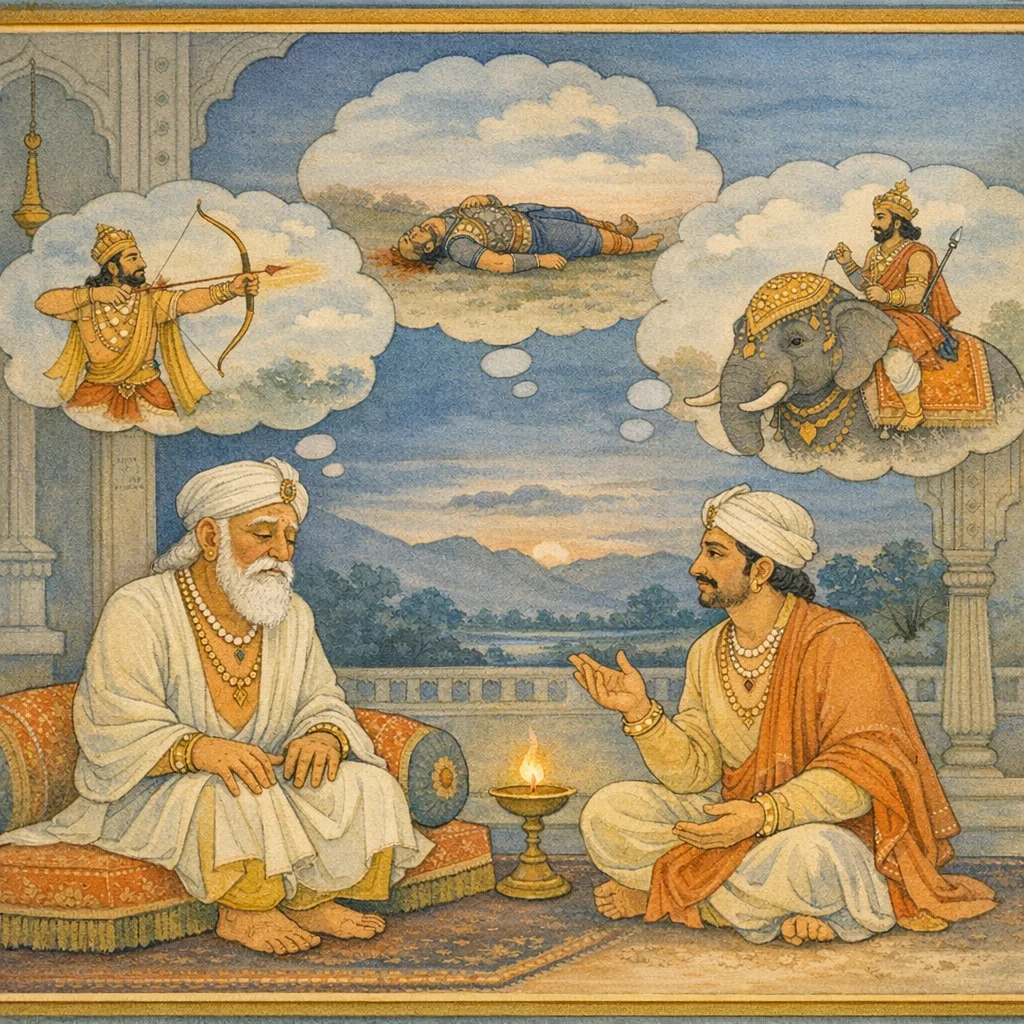
Adhyaya 2
धृतराष्ट्रविलापः — Dhṛtarāṣṭra’s Lament and Inquiry (Śalya-parva, Adhyāya 2)
Upa-parva: Dhṛtarāṣṭra-śoka-vilāpa (Lament of Dhṛtarāṣṭra) — contextual unit within Śalya-parva
Vaiśaṃpāyana reports that after the women are dismissed, Dhṛtarāṣṭra—overwhelmed by escalating grief—laments repeatedly, describing physical signs of distress and the psychological rupture caused by hearing of his sons’ deaths. He addresses Duryodhana as if present, articulating dependency, loss of protection, and the collapse of royal continuity. He then catalogues numerous allied kings and notable fighters who fought “for his sake” and were slain, using the refrain “kim anyad bhāgadheyataḥ” to interpret the devastation as destiny’s allotment. The king recalls Vidura’s earlier warning that Duryodhana’s wrongdoing would destroy the polity, acknowledging his own failure of discernment. Shifting from lament to structured inquiry, he questions Saṃjaya about battlefield command after Karṇa’s fall, the formation’s leadership, the protection of Śalya’s flanks, the death of Śalya and Duryodhana, the fate of the Pāñcālas and Draupadī’s sons, and which warriors survived. The chapter thus combines grief rhetoric, moral retrospection, and historiographic demand for an exact account.
Chapter Arc: स्त्रियों के विदा हो जाने पर अंधे धृतराष्ट्र धुएँ-सी भारी साँस छोड़ते, बार-बार हाथ झटकते हुए स्मृतियों के ज्वार में डूब जाते हैं और सूत संजय से युद्ध-वृत्तांत का कठोर सत्य फिर पूछ बैठते हैं। → धृतराष्ट्र एक-एक कर अपने पक्ष के नाश का कारण टटोलते हैं—क्यों इतने-इतने भूमिपाल साथ होकर भी उनके पुत्र ‘भूमौ प्राकृतः कणूपो यथा’ की तरह पड़े रहे; वे भगदत्त, जयद्रथ, कर्ण जैसे महावीरों के पतन को ‘किमन्यद् भागधेयतः’ कहकर भाग्य और अपराध के बीच झूलते हुए याद करते हैं। → विलाप का शिखर तब आता है जब धृतराष्ट्र स्वीकार करते हैं कि कर्ण भी सबके देखते-देखते किरीटधारी अर्जुन के हाथों मारा गया, और साथ ही विदुर-वाक्य की भविष्यवाणी उनके भीतर वज्र की तरह गूँजती है—‘दुर्योधनापराधेन प्रजेयं विनशिष्यति’। → धृतराष्ट्र अंततः अपने शोक को ‘भाग्य’ के आवरण में ढँकने का प्रयास करते हैं—इतने वीरों के बीच प्रयत्नपूर्वक लड़ते हुए भी पुत्रों का मारा जाना उन्हें नियति-प्रेरित प्रतीत होता है; संजय के प्रति उनकी जिज्ञासा अब केवल विवरण नहीं, आत्म-दंड बन जाती है। → धृतराष्ट्र आगे के युद्ध-वृत्तांत और शेष बचे योद्धाओं की दशा सुनने को व्याकुल रहते हैं—कौन बचेगा, कौन गिरेगा, और यह विनाश कहाँ थमेगा।
Shlokas
Verse 1
इस प्रकार श्रीमहाभारत शल्यपर्वमें धृतराष्ट्रका मोहविषयक पहला अध्याय पूरा हुआ,शीसल्-ताआ5 >> हु भ्रिध्रर्राध्य द्वितीयो<्ध्याय: राजा धृतराष्ट्रका विलाप करना और संजयसे युद्धका वृत्तान्त पूछना वैशम्पायन उवाच विसृष्टास्वथ नारीषु धृतराष्ट्रो3म्बिकासुत: । विललाप महाराज दु:खाद्ू दुःखान्तरं गत: वैशम्पायनजी कहते हैं--महाराज! स्त्रियोंक बिदा हो जानेपर अम्बिकानन्दन राजा धृतराष्ट्र एक दुःखसे दूसरे दुःखमें पड़कर गरम-गरम उच्छवास लेते और बारंबार दोनों हाथ हिलाते हुए विलाप करने लगे और बड़ी देरतक चिन्तामग्न रहकर इस प्रकार बोले
Vaiśampāyana said: When the women had been dismissed, Dhṛtarāṣṭra—the son of Ambikā—overwhelmed by grief and passing from one sorrow into another, began to lament. In this moment the blind king’s anguish deepens into helpless mourning, setting the ethical tone of consequence and accountability after the devastation of war.
Verse 2
सथूममिव नि:श्वस्य करौ धुन्वन् पुनः पुनः । विचिन्त्य च महाराज वचन चेदमब्रवीत्,वैशम्पायनजी कहते हैं--महाराज! स्त्रियोंक बिदा हो जानेपर अम्बिकानन्दन राजा धृतराष्ट्र एक दुःखसे दूसरे दुःखमें पड़कर गरम-गरम उच्छवास लेते और बारंबार दोनों हाथ हिलाते हुए विलाप करने लगे और बड़ी देरतक चिन्तामग्न रहकर इस प्रकार बोले इति श्रीमहाभारते शल्यपर्वणि धृतराष्ट्रविलापे द्वितीयोडध्याय:
Vaiśampāyana said: “O King! After the women had departed, Dhṛtarāṣṭra, the son of Ambikā, overwhelmed by one sorrow after another, breathed out hot sighs as if smoking, repeatedly shaking both his hands in grief. Then, after brooding for a long time, he spoke these words.”
Verse 3
धघतयाट्र उवाच अहो बत महददु:खं यदहं पाण्डवान् रणे । क्षेमिणश्षाव्ययांश्वैव त्वत्त: सूत शुणोमि वै,धृतराष्ट्रने कहा--सूत! मेरे लिये महान् दुःखकी बात है कि मैं तुम्हारे मुखसे रणभूमिमें पाण्डवोंको सकुशल और विनाशरहित सुन रहा हूँ
Dhṛtarāṣṭra said: “Alas—this is a great sorrow for me: that I hear from you, O Sūta, that the Pāṇḍavas on the battlefield are safe and unbroken. Their welfare, which ought to be a cause for relief, becomes for me a torment—revealing how attachment to one’s own side can eclipse impartial righteousness even in the face of kinship.”
Verse 4
वज्रसारमयं नून॑ हृदयं सुदृढं मम । यच्छुत्वा निहतानू पुत्रान् दीर्यते न सहस्रधा,निश्चय ही मेरा यह सुदृढ़ हृदय वज्रके सारतत्त्वका बना हुआ है; क्योंकि अपने पुत्रोंको मारा गया सुनकर भी इसके सहसोरं टुकड़े नहीं हो जाते हैं
Dhṛtarāṣṭra said: “Surely my heart is made of the very essence of adamant and is exceedingly hard; for even after hearing that my sons have been slain, it does not split into a thousand pieces.” In this lament, the blind king recognizes the unnatural firmness of his own emotions—an ethical self-indictment that hints at long-standing attachment and moral numbness amid the catastrophe of war.
Verse 5
चिन्तयित्वा वयस्तेषां बालक्रीडां च संजय । हतान् पुत्रानशेषेण दीर्यते मे भृूशं मन:,संजय! मैं उनकी अवस्था और बाल-क्रीड़ाका चिन्तन करके जब उन सबके मारे जानेकी बात सोचता हूँ, तब मेरा हृदय अत्यन्त विदीर्ण होने लगता है
Sañjaya, when I reflect on their tender ages and their childhood games, and then think that all my sons have been slain without exception, my heart is torn apart with overwhelming grief.
Verse 6
अनेत्रत्वाद् यदेतेषां न मे रूपनिदर्शनम् । पुत्रस्नेहकृता प्रीतिर्नित्यमेतेषु धारिता,यद्यपि नेत्रहीन होनेके कारण मैंने उनका रूप कभी नहीं देखा था, तथापि इन सबके प्रति पुत्रस्नेह-जनित प्रेमका भाव सदा ही रखा है
Dhṛtarāṣṭra said: “Because I am blind, I have never had the sight of their forms. Yet, moved by a father’s affection, I have always borne a constant love for them.”
Verse 7
बालभावमत्तिक्रम्य यौवनस्थांश्व तानहम् मध्यप्राप्तांस्तथा श्र॒ुत्वा हृष्ट आसं तदानघ,निष्पाप संजय! जब मैं यह सुनता था कि मेरे बच्चे बाल्यावस्थाको लाँधकर युवावस्थामें प्रविष्ट हुए हैं और धीरे-धीरे मध्य अवस्थातक पहुँच गये हैं, तब हर्षसे फ़ूल उठता था
Verse 8
तानद्य निहतान् श्रुत्वा हतैश्वर्यानू हतौजस: । न लभेयं क्वचिच्छान्तिं पुत्राधिभिरभिप्लुत:,आज उन्हीं पुत्रोंको ऐश्वर्य और बलसे हीन एवं मारा गया सुनकर उनकी चिन्तासे व्यथित हो कहीं भी शान्ति नहीं पा रहा हूँ
Having heard that those sons have today been slain—stripped of their sovereignty and their strength—I, overwhelmed by anguish for my children, can find peace nowhere at all.
Verse 9
एह्ीहि पुत्र राजेन्द्र ममानाथस्य साम्प्रतम् । त्वया हीनो महाबाहो कां नु यास्याम्यहं गतिम्,(इतना कहकर राजा धृतराष्ट्र इस प्रकार विलाप करने लगे--) बेटा! राजाधिराज! इस समय मुझ अनाथके पास आओ, आओ । महाबाहो! तुम्हारे बिना न जाने मैं किस दशाको पहुँच जाऊँगा?
Dhṛtarāṣṭra said: “Come, come, my son—O lord of kings—come to me now, for I am without refuge. O mighty-armed one, bereft of you, to what state, indeed, shall I be reduced?”
Verse 10
कथं त्वं पृथिवीपालांस्त्यक्त्वा तात समागतान् | शेषे विनिहतो भूमौ प्राकृत: कुनूपो यथा,तात! तुम यहाँ पधारे हुए समस्त भूमिपालोंको छोड़कर किसी नीच और दुष्ट राजाके समान मारे जाकर पृथ्वीपर कैसे सो रहे हो?
Dhṛtarāṣṭra said: “My son, how is it that, abandoning the assembled kings of the earth, you now lie here on the ground—struck down—like some ordinary, contemptible wretch? How have you come to such a fall?”
Verse 11
गतिर्भूत्वा महाराज ज्ञातीनां सुहृदां तथा । अन्धं वृद्ध च मां वीर विहाय क्व नु यास्यसि,वीर महाराज! तुम भाई-बन्धुओं और सुहृदोंके आश्रय होकर भी मुझ अंधे और बूढ़ेको छोड़कर कहाँ चले जा रहे हो?
Dhṛtarāṣṭra said: “O great king, O hero—after having become the refuge and support of your kinsmen and well-wishers, where are you going now, leaving me behind—blind and aged?”
Verse 12
सा कृपा सा च ते प्रीति: क्व सा राजन् सुमानिता । कथं विनिहतः पार्थ: संयुगेष्वपराजित:,राजन! तुम्हारी वह कृपा, वह प्रीति और दूसरोंको सम्मान देनेकी वह वृत्ति कहाँ चली गयी? तुम तो किसीसे परास्त होनेवाले नहीं थे; फिर कुन्तीके पुत्रोंके द्वारा युद्धमें कैसे मारे गये?
Verse 13
को नु मामुत्थितं वीर तात तातेति वक्ष्यति । महाराजेति सततं लोकनाथेति चासकृत्,वीर! अब मेरे उठनेपर मुझे सदा तात, महाराज और लोकनाथ आदि बारंबार कहकर कौन पुकारेगा?
“O hero, when I rise, who will now call out to me again and again—‘Father, father,’ and continually address me as ‘Great King’ and ‘Lord of the people’?”
Verse 14
परिष्वज्य च मां कण्ठे स्नेहेन क्लिन्नलोचन: । अनुशाधीति कौरव्य तत् साधु वद मे वच:,कुरुनन्दन! तुम पहले स्नेहसे नेत्रोंमें आँसू भरकर मेरे गलेसे लग जाते और कहते 'पिताजी! मुझे कर्तव्यका उपदेश दीजिये”, वही सुन्दर बात फिर मुझसे कहो
With eyes wet from affection, you would first embrace me around the neck and say, “O Kauravya, instruct me in my duty.” Now, O delight of the Kurus, speak to me again those same noble words—those words that uphold what is right.
Verse 15
ननु नामाहमश्रौषं वचन तव पुत्रक । भूयसी मम पृथ्वीयं यथा पार्थस्य नो तथा,बेटा! मैंने तुम्हारे मुँठउले यह बात सुनी थी कि “मेरे अधिकारमें बहुत बड़ी पृथ्वी है। इतना विशाल भूभाग दुन्तीपुत्र युधिष्ठिरके अधिकारमें कभी नहीं रहा
Dhṛtarāṣṭra said: “My son, I did indeed hear this statement of yours—that the earth under my control is far greater, and that such a vast realm was never under the authority of Pārtha (Yudhiṣṭhira).” In context, the line exposes the moral blindness born of possessiveness and pride: measuring legitimacy by sheer extent of territory rather than by rightful conduct and dharma.
Verse 16
भगदत्त: कृप: शल्य आवन्त्यो5थ जयद्रथ: । भूरिश्रवा: सोमदत्तो महाराजश्न बाह्विक:
Dhṛtarāṣṭra said: “Bhagadatta, Kṛpa, Śalya, the king of Avanti, and Jayadratha; Bhūriśravas, Somadatta, and also the great king Bāhlika.” In this passage, the blind king enumerates prominent Kaurava-aligned warriors—an act that underscores the moral weight of leadership in war: naming the mighty is also acknowledging the grave responsibility and the impending cost of their choices on the battlefield.
Verse 17
अश्रवत्थामा च भोजश्न मागधश्न महाबल: । बृहद्धलश्न क्राथश्व शकुनिश्चापि सौबल:
Dhṛtarāṣṭra said: “Aśvatthāmā, Bhoja, the mighty Māgadha, Bṛhadbala, Krātha, and also Śakuni, the son of Subala—these (warriors) were present/arrayed.” The verse functions as a roll-call of notable combatants, underscoring how the war draws in powerful figures whose choices and alliances carry grave ethical consequences amid the collapse of restraint in battle.
Verse 18
म्लेच्छाक्ष शतसाहसत्रा: शकाश्न यवनै: सह । सुदक्षिणश्न काम्बोजस्त्रिगर्ताधिपतिस्तथा
Dhṛtarāṣṭra said: “There were hundreds of thousands of Mlecchas; and the Śakas together with the Yavanas; also the Kāmbojas of the southern region, and likewise the lord of the Trigartas.” The verse underscores the vast, multi-ethnic mustering of forces in the war, highlighting how the conflict draws in many frontier peoples and rulers, intensifying the scale and moral weight of the battle’s devastation.
Verse 19
भीष्म: पितामहश्नैव भारद्वाजो5थ गौतम: । श्रुतायुश्चायुतायुश्च शतायुश्चापि वीर्यवान्
Dhṛtarāṣṭra said: “Bhīṣma, the grandsire, and also Bhāradvāja and Gautama; and Śrutāyu, Ayutāyu, and the mighty Śatāyu as well.” (Here the speaker enumerates renowned elders and warriors, invoking their names to mark the gravity of the war and the stature of those involved.)
Verse 20
जलसन्धो<थार्ष्यशृज्जी राक्षसश्वाप्पलायुध: । अलनम्बुषो महाबाहु: सुबाहुश्च महारथ:
Dhṛtarāṣṭra said: “Jalasandha; and Ārṣyaśṛṅgī; the Rākṣasa Alāyudha as well; Alanambuṣa of mighty arms; and Subāhu, a great chariot-warrior—these too were present among the combatants.” The verse functions as a roll-call of formidable fighters, underscoring how the war draws in powerful beings (including rākṣasas) and intensifies the moral weight of the conflict through sheer scale and ferocity.
Verse 21
एते चान्ये च बहवो राजानो राजसत्तम । मदर्थमुद्यता: सर्वे प्राणांस्त्यक्त्वा धनानि च
“And these, along with many other kings, O best of kings, have all risen up for my sake—ready to abandon even their lives and their wealth.”
Verse 22
“नृपश्रेष्ठल भगदत्त, कृपाचार्य, शल्य, अवन्तीके राजकुमार, जयद्रथ, भूरिश्रवा, सोमदत्त, महाराज बाह्लिक, अश्व॒त्थामा, कृतवर्मा, महाबली मगधनरेश बृहद्वल, क्राथ, सुबलपुत्र शकुनि, लाखों म्लेच्छ, यवन एवं शक, काम्बोजराज सुदक्षिण, त्रिगर्तराज सुशर्मा, पितामह भीष्म, भरद्वाजनन्दन द्रोणाचार्य, गौतमगोत्रीय कृपाचार्य, श्रुतायु, अयुतायु, पराक्रमी शतायु, जलसन्ध, ऋष्यशंगपुत्र राक्षत अलायुध, महाबाहु अलम्बुष और महारथी सुबाहु--ये तथा और भी बहुत-से नरेश मेरे लिये प्राणों और धनका मोह छोड़कर सब-के- सब युद्धके लिये उद्यत हैं ।। तेषां मध्ये स्थितो युद्धे भ्रातृभि: परिवारित: । योधयिष्याम्यहं पार्थान् पज्चालांश्वैव सर्वश:,“इन सबके बीचमें रहकर भाइयोंसे घिरा हुआ मैं रणभूमिमें पाण्डवों और पांचालोंके साथ युद्ध करूँगा
Dhṛtarāṣṭra said: “Foremost among kings—Bhagadatta; Kṛpa; Śalya; the prince of Avanti; Jayadratha; Bhūriśravas; Somadatta; King Bāhlika; Aśvatthāmā; Kṛtavarmā; the mighty Magadhan ruler Bṛhadbala; Krātha; Śakuni, son of Subala; countless Mlecchas, Yavanas, and Śakas; Sudakṣiṇa, king of Kāmboja; Suśarmā, king of the Trigartas; grandsire Bhīṣma; Droṇa, son of Bharadvāja; Kṛpa of Gautama’s lineage; Śrutāyu, Ayutāyu, and the valiant Śatāyu; Jalasandha; the rākṣasa Alāyudha, son of Ṛṣyaśṛṅga; the strong-armed Alambuṣa; and the great charioteer Subāhu—these, and many other kings besides, have cast aside attachment to life and wealth for my sake and stand ready for war. Standing amid them on the battlefield, surrounded by my brothers, I shall fight the sons of Pāṇḍu and the Pāñcālas in every way.” Ethically, the verse underscores the tragic inversion of dharma in war: loyalty to a person (“for my sake”) becomes the motive that overrides self-preservation and material attachment, intensifying the moral burden of the conflict and Dhṛtarāṣṭra’s complicity through dependence on others’ sacrifice.
Verse 23
चेदींश्व नृपशार्दूल द्रौपदेयांश्व॒ संयुगे । सात्यकिं कुन्तिभोजं च राक्षसं च घटोत्कचम्,'राजसिंह! मैं युद्धस्थलमें चेदियों, द्रौपदीकुमारों, सात्यकि, कुन्तिभोज तथा राक्षस घटोत्कचका भी सामना करूँगा
Dhṛtarāṣṭra said: “O tiger among kings, on the battlefield I shall also confront the Cedis, the sons of Draupadī, Sātyaki, Kuntibhoja, and the rākṣasa Ghaṭotkaca.” The statement underscores the speaker’s grim resolve to face even renowned allies and formidable warriors, reflecting the escalating moral and strategic stakes of the war.
Verse 24
एको5प्येषां महाराज समर्थ: संनिवारणे । समरे पाण्डवेयानां संक्रुद्धो ह्भिधावताम्
Dhṛtarāṣṭra said: “O great king, even a single one among them is capable of holding back the Pāṇḍava warriors in battle—especially when he is enraged and they come charging straight on.”
Verse 25
अथवा सर्व एवैते पाण्डवस्यानुयायिभि:
Or else, all of these men are followers and supporters of the Pāṇḍava—those who stand behind him in allegiance. The line underscores how, in war, loyalties and affiliations define who is counted as friend or foe, and how collective responsibility gathers around a leader’s cause.
Verse 26
कर्ण एको मया सार्ध निहनिष्यति पाण्डवान्
Dhṛtarāṣṭra declares with confidence that Karṇa, fighting alongside him, will single-handedly destroy the Pāṇḍavas—an utterance shaped by attachment and hope amid the moral darkness of war.
Verse 27
यश्न तेषां प्रणेता वै वासुदेवोी महाबल:
For them, the true leader is Vāsudeva—mighty in strength—whose guidance directs their course. The statement underscores that power in war is not merely physical force but also rightful leadership and discerning counsel.
Verse 28
तस्याथ वदतः सूत बहुशो मम संनिधौ
Then, O Sūta, as he spoke, repeatedly in my very presence, his words were uttered again and again—emphasizing what was to be remembered and acted upon in the unfolding crisis.
Verse 29
शक्तितो हानुपश्यामि निहतान् पाण्डवान् रणे । सूत! मेरे निकट दुर्योधन जब इस तरहकी बहुत-सी बातें कहने लगा तो मैं यह समझ बैठा कि “हमारी शक्तिसे समस्त पाण्डव रणभूमिमें मारे जायँगे” || २८ $ ।। तेषां मध्ये स्थिता यत्र हन्यन्ते मम पुत्रका:
Dhṛtarāṣṭra said: “I foresee, by the force at our command, the Pāṇḍavas lying slain in battle. O Sūta, when Duryodhana came near me and spoke many such words, I was led to believe: ‘By our power all the Pāṇḍavas will be killed on the battlefield.’ Yet it is there, in the midst of them, that my own sons are being struck down.”
Verse 30
भीष्मश्न निहतो यत्र लोकनाथ: प्रतापवान्,निहतः पाण्डवै: संख्ये किमन्यद् भागधेयत: । जैसे सिंह सियारसे लड़कर मारा जाय, उसी प्रकार जहाँ लोकरक्षक प्रतापी वीर भीष्म शिखण्डीसे भिड़कर वधको प्राप्त हुए, जहाँ सम्पूर्ण शस्त्रास्त्रोंकी विद्याके पारंगत विद्वान् ब्राह्मण द्रोणाचार्य पाण्डवोंद्वारा युद्धस्थलमें मार डाले गये, वहाँ भाग्यके सिवा दूसरा क्या कारण हो सकता है?
Dhṛtarāṣṭra said: “In that very war where the mighty Bhīṣma—protector of the people and a hero of great prowess—was slain, and where other great champions were also struck down by the Pāṇḍavas in battle, what cause can there be other than destiny? When even such guardians and masters of warfare fall, human effort and strategy seem overruled by the allotment of fate.”
Verse 31
शिखण्डिनं समासाद्य मृगेन्द्र इव जम्बुकम् । द्रोणश्न ब्राह्मणो यत्र सर्वशस्त्रास्त्रपारग:
Dhṛtarāṣṭra said: “Closing in upon Śikhaṇḍin as a lion-king would upon a jackal, there stood Droṇa—the Brahmin—fully accomplished in every weapon and missile.” The verse underscores the stark moral tension of war: a teacher-priestly figure, bound by learning and restraint, is nevertheless drawn into violent confrontation, where prowess and duty collide with the ethical weight of whom one chooses to strike.
Verse 32
कर्णश्र निहत: संख्ये दिव्यास्त्रज्ञो महाबल:,जहाँ दिव्यास्त्रोंका ज्ञान रखनेवाला महाबली कर्ण युद्धमें मारा गया, जहाँ समरांगणमें भूरिश्रवा, सोमदत्त तथा महाराज बाह्लिकका संहार हो गया, वहाँ भाग्यके सिवा दूसरा क्या कारण बताया जा सकता है?
Dhṛtarāṣṭra said: When Karṇa—mighty in strength and master of celestial weapons—was slain in battle; when, on that same field of war, Bhūriśravas, Somadatta, and King Bāhlika were destroyed—what cause can be named there other than fate? The scale of these reversals suggests a moral bewilderment: even prowess, lineage, and sacred martial knowledge could not secure victory, leaving the speaker to attribute the outcome to destiny rather than human agency.
Verse 33
भूरिश्रवा हतो यत्र सोमदत्तश्न संयुगे । बाह्विकश्न महाराज: किमन्यद् भागधेयत:,जहाँ दिव्यास्त्रोंका ज्ञान रखनेवाला महाबली कर्ण युद्धमें मारा गया, जहाँ समरांगणमें भूरिश्रवा, सोमदत्त तथा महाराज बाह्लिकका संहार हो गया, वहाँ भाग्यके सिवा दूसरा क्या कारण बताया जा सकता है?
Where the mighty Karṇa—master of divine weapons—was slain in battle, where on the field of war Bhūriśravā, Somadatta, and King Bāhlīka were also destroyed—what cause other than destiny can be asserted there, O great king? The speaker frames these catastrophic reversals as evidence that human prowess and learning are ultimately overruled by allotted fate in the moral chaos of war.
Verse 34
भगदत्तो हतो यत्र गजयुद्धविशारद: । जयद्रथश्न निहत: किमन्यद् भागधेयत:,जहाँ गजयुद्धविशारद राजा भगदत्त मारे गये और सिंधुराज जयद्रथका वध हो गया, वहाँ भाग्यके सिवा दूसरा क्या कारण हो सकता है?
Where Bhagadatta—renowned for mastery in elephant-warfare—was slain, and where Jayadratha, the king of Sindhu, was also killed, what cause can there be other than destiny? The speaker frames these great reversals of war as the working of fate rather than mere human effort.
Verse 35
सुदक्षिणो हतो यत्र जलसन्धश्न पौरव: । श्रुतायुश्नायुतायुश्न॒ किमन््यद् भागधेयत:,जहाँ काम्बोजराज सुदक्षिण, पौरव, जलसन्ध, श्रुतायु और अयुतायु मार डाले गये, वहाँ भाग्यके सिवा और क्या कारण हो सकता है?
Where Sudakṣiṇa of Kāmboja, the Paurava Jalasaṃdha, and the warriors Śrutāyu and Ayutāyu were slain—what other cause can there be except destiny? The speaker frames the shocking reversals of battle not as mere failure of valor, but as the overpowering working of fate that can overturn even the strong.
Verse 36
महाबलस्तथा पाण्ड्य: सर्वशस्त्रभृतां वर: । निहत: पाण्डवै: संख्ये किमन्यद् भागधेयत:,जहाँ सम्पूर्ण शस्त्रधारियोंमें श्रेष्ठ महाबली पाण्ड्यनरेश युद्धमें पाण्डवोंके हाथसे मारे गये, वहाँ भाग्यके सिवा और क्या कारण है?
The mighty king of the Pāṇḍyas—foremost among all who bear arms—was slain by the Pāṇḍavas in the press of battle. What cause can there be other than destiny? The speaker frames the outcome not as a failure of valor or skill, but as the overpowering decree of fate that governs even the best of warriors.
Verse 37
बृहद्धलो हतो यत्र मागधश्न महाबल: । उग्रायुधश्न विक्रान्त: प्रतिमानं धनुष्मताम्,जहाँ बृहद्वल, महाबली मगधनरेश, धनुर्धरोंके आदर्श एवं पराक्रमी उग्रायुध, अवन्तीके राजकुमार, त्रिगर्तनरेश सुशर्मा तथा सम्पूर्ण संशप्तक योद्धा मार डाले गये, वहाँ भाग्यके सिवा दूसरा क्या कारण हो सकता है?
Dhṛtarāṣṭra said: “Where Bṛhaddhala was slain, and the mighty king of Magadha too; where Ugrāyudha—valiant and a model among archers—was also struck down, along with Suśarmā of the Trigartas and the entire band of the Saṃśaptaka warriors—what cause can there be other than fate?”
Verse 38
आवलन्त्यो निहतो यत्र त्रैगर्तक्ष जनाधिप: । संशप्तकाश्न निहता: किमन्यद् भागधेयत:ः,जहाँ बृहद्वल, महाबली मगधनरेश, धनुर्धरोंके आदर्श एवं पराक्रमी उग्रायुध, अवन्तीके राजकुमार, त्रिगर्तनरेश सुशर्मा तथा सम्पूर्ण संशप्तक योद्धा मार डाले गये, वहाँ भाग्यके सिवा दूसरा क्या कारण हो सकता है?
Where Avalantya has been slain, where the lord of the Trigartas has fallen, and where the Samsaptaka warriors too have been killed—what other cause can there be except destiny? The speaker reads the overwhelming destruction of renowned fighters as proof that human prowess and planning are ultimately overruled by fate.
Verse 39
अलम्बुषो महाशूरो राक्षसश्वाप्यलायुध: । आर्ष्यशूड्ग्शवि निहत: किमन्यद् भागधेयत:,जहाँ शूरवीर अलम्बुष और ऋष्यशुंगपुत्र राक्षस अलायुध मारे गये, वहाँ भाग्यके सिवा और क्या कारण बताया जा सकता है?
“The mighty hero Alambuṣa, and the rākṣasa Alāyudha as well—Ārṣyaśṛṅga’s son—have been slain. What other cause can be stated for this except destiny?”
Verse 40
नारायणा हता यत्र गोपाला युद्धदुर्मदा: । म्लेच्छाश्व बहुसाहस्रा: किमन्यद् भागधेयत:,जहाँ नारायण नामवाले रणदुर्मद ग्वाले और कई हजार म्लेच्छ योद्धा मौतके घाट उतार दिये गये, वहाँ भाग्यके सिवा और कया कहा जा सकता है?
Where the battle-maddened cowherds bearing the name Nārāyaṇa were slain, and where many thousands of Mleccha horsemen too were brought down—what else can be said except that it was destiny’s allotment? The speaker frames the outcome as the overpowering force of fate, tempering moral judgment amid the chaos of war.
Verse 41
शकुनि: सौबलो यत्र कैतव्यश्व॒ महाबल: । निहत: सबलो वीर: किमन्यद् भागधेयत:,जहाँ सुबलपुत्र महाबली शकुनि और उस जुआरीका पुत्र वीर उलूक दोनों ही सेनासहित मार डाले गये, वहाँ भाग्यके सिवा दूसरा क्या कारण हो सकता है?
Dhṛtarāṣṭra said: “When the mighty Śakuni, son of Subala, and the valiant Ulūka—son of that gambler—have been slain along with their forces, what cause can there be other than destiny?”
Verse 42
एते चान्ये च बहव: कृतास्त्रा युद्धदुर्मदा: । राजानो राजतपूुत्रा श्न शूरा: परिघबाहव:
Dhṛtarāṣṭra said: “And there are many others as well—kings and princes—fully trained in the use of weapons, intoxicated with the pride of battle, heroic men whose arms are like iron clubs.”
Verse 43
यत्र शूरा महेष्वासा: कृतास्त्रा युद्धदुर्मदा:,निहता: समरे सर्वे किमन्यद् भागधेयत: । सूत संजय! जहाँ समरभूमिमें नाना देशोंसे आये हुए देवराज इन्द्रके समान पराक्रमी बहुत-से शूरवीर महाथनुर्धर, अस्त्रवेत्ता एवं युद्धदुर्मद क्षत्रिय सारे-के-सारे मार डाले गये, वहाँ भाग्यके अतिरिक्त दूसरा क्या कारण हो सकता है?
Dhṛtarāṣṭra said: “Where, on the battlefield, all those heroes—mighty bowmen, fully trained in weapons, and intoxicated with the pride of war—have been slain, what cause can there be other than destiny itself?”
Verse 44
बहवो निहता: सूत महेन्द्रसमविक्रमा: । नानादेशसमावृत्ता: क्षत्रिया यत्र संजय
Dhṛtarāṣṭra said: “O Sūta, many kṣatriyas—equal in prowess to Indra—have been slain there, O Sañjaya, warriors who had gathered from many different lands.”
Verse 45
पुत्राश्न॒ मे विनिहता: पौत्राश्नैव महाबला:
Dhṛtarāṣṭra said: “My sons have been slain, and my grandsons too—those of great might.” In this lament, the blind king confronts the moral and emotional wreckage of the war: the ruin of his lineage brought about by attachment, partiality, and the failure to restrain adharma in time.
Verse 46
वयस्या भ्रातरश्वैव किमन्यद् भागधेयत: । हाय! मेरे महाबली पुत्र, पौत्र, मित्र और भाई-बन्धु सभी मार डाले गये, इसे दुर्भाग्यके सिवा और क्या कहूँ? ।। भागधेयसमायुक्तो ध्रुवमुत्पद्यते नर:
Dhṛtarāṣṭra said: “Friends and brothers—what else is there to call this but fate? Alas! All my mighty sons, grandsons, friends, and kinsmen have been slain. What can I name it, if not sheer misfortune? A man, bound to his allotted destiny, surely comes to such an end.”
Verse 47
अहं वियुक्तस्तैर्भाग्ये: पुत्रैश्नैवेह संजय,कथमसद्य भविष्यामि वृद्ध: शत्रुवशं गत: । संजय! मैं उन शुभकारक भाग्योंसे वंचित हूँ और पुत्रोंसे भी हीन हूँ। आज इस वृद्धावस्थामें शत्रुके वशमें पड़कर न जाने मेरी कैसी दशा होगी?
Dhṛtarāṣṭra said: “O Sañjaya, I am bereft here of those auspicious fortunes, and I am deprived of my sons as well. Now, in my old age, having fallen under the control of my enemies, what wretched condition will I come to?”
Verse 48
।। नान्यदत्र परं मन्ये वनवासादूृते प्रभो
O lord, in this matter I see no higher course than accepting exile to the forest; it is the supreme path here, preserving what is right and avoiding a greater wrong.
Verse 49
सो<हं वनं गमिष्यामि निर्बन्धुर्ज्ञातिसंक्षये । न हि मेडन्यद् भवेच्छेयो वनाभ्युपगमादृते
“I will go to the forest—bereft of kinsmen, for my relatives have been destroyed. For me, there is no better course than withdrawing to the forest; apart from taking refuge in forest-life, I see no true good.”
Verse 50
इमामवस्थां प्राप्तस्य लूनपक्षस्य संजय । सामर्थ्यशाली संजय! मेरे लिये वनवासके सिवा और कोई कार्य श्रेष्ठ नहीं जान पड़ता। अब कुट॒म्बीजनोंका विनाश हो जानेपर बन्धु-बान्धवोंसे रहित हो मैं वनमें ही चला जाऊँगा। संजय! पंख कटे हुए पक्षीकी भाँति इस अवस्थाको पहुँचे हुए मेरे लिये वनवास स्वीकार करनेके सिवा दूसरा कोई श्रेयस्कर कार्य नहीं है ।। दुर्योधनो हतो यत्र शल्यश्न निहतो युधि,एकेन समरे येन हतं पुत्रशतं मम | जब दुर्योधन मारा गया, शल्यका युद्धमें संहार हो गया तथा दुःशासन, विविंशति और महाबली विकर्ण भी मार डाले गये, तब मैं उस भीमसेनका उच्चस्वरसे कहा गया वचन कैसे सुनूँगा, जिसने अकेले ही समरांगणमें मेरे सौ पुत्रोंका वध कर डाला है
Dhṛtarāṣṭra said: “Sañjaya, having fallen into this condition—like a bird whose wings have been cut—I see no better course for myself than withdrawal to the forest. Now that my household has been destroyed and I am bereft of kinsmen and allies, I shall go to the forest alone. For one who has reached such a state, forest-dwelling alone seems truly salutary. Where Duryodhana has been slain, where Śalya has fallen in battle, and where my hundred sons have been killed by a single warrior in the fight—how shall I endure to hear the loud words of Bhīmasena in such a world?”
Verse 51
दुःशासनो विविंशश्व विकर्णश्र महाबल: । कथं हि भीमसेनस्य श्रोष्ये5हं शब्दमुत्तमम्
Dhṛtarāṣṭra said: “Duḥśāsana, Viviṁśa, and mighty Vikarṇa—how shall I now hear the exalted words spoken of Bhīmasena?” The king’s question carries the weight of dread and moral consequence: he anticipates news of Bhīma’s decisive actions in war, and the mention of his own sons underscores the tragic cost of adharma that has ripened into inevitable retribution.
Verse 52
असकृद्धदतस्तस्य दुर्योधनवधेन च
Dhṛtarāṣṭra said: “Repeatedly, because of that—and also because of the slaying of Duryodhana—my mind is struck again and again by grief and agitation.”
Verse 53
दुःखशोकाभिसंतप्तो न श्रोष्ये परुषा गिर: । दुर्योधनके वधसे दुःख और शोकसे संतप्त हुआ मैं बारंबार बोलनेवाले भीमसेनकी कठोर बातें नहीं सुन सकूँगा ।। ५२ ई ।। वैशम्पायन उवाच एवं वृद्धश्न संतप्त: पार्थिवो हतबान्धव:
Overwhelmed by grief and sorrow, he declares that he cannot bear to hear Bhīmasena’s harsh, repeated words. Vaiśampāyana continues: thus the king—aged and deeply afflicted, his kinsmen slain—remains consumed by anguish, as the war’s cruelty turns speech itself into a further wound.
Verse 54
मुहुर्मुहुर्मुह्मान: पुत्राधिभिरभिप्लुत: । विलप्य सुचिरं काल धृतराष्ट्रोडम्बिकासुत:
Vaiśampāyana said: Over and over again, Dhṛtarāṣṭra—Ambikā’s son—fell into bewilderment, overwhelmed by grief for his sons. He lamented for a long time, his mind repeatedly sinking under the weight of attachment and loss in the aftermath of the war.
Verse 55
दीर्घमुष्णं स नि:श्वस्य चिन्तयित्वा पराभवम् | दुःखेन महता राजन् संतप्तो भरतर्षभ:ः
Vaiśampāyana said: Having heaved a long, hot sigh and reflected on his defeat, the bull among the Bharatas—burning inwardly with great sorrow—was deeply distressed, O king. The verse highlights the moral weight of failure in war: defeat is not merely tactical loss, but an inner reckoning that scorches the mind with remorse, fear, and the consequences of one’s choices.
Verse 56
पुनर्गावल्गर्णिं सूतं पर्यपृच्छद् यथातथम् । वैशम्पायनजी कहते हैं--राजन्! इस प्रकार पुत्रोंकी चिन्तामें डूबकर बारंबार मूर्च्छित होनेवाले, संतप्त एवं बूढ़े भरतश्रेष्ठ राजा अम्बिकानन्दन धृतराष्ट्र जिनके बन्धु-बान्धव मार डाले गये थे, दीर्घकालतक विलाप करके गरम साँस खींचते और अपने पराभवकी बात सोचते हुए महान् दुःखसे संतप्त हो उठे तथा गवल्गणपुत्र संजयसे पुनः युद्धका यथावत् समाचार पूछने लगे || ५३--५५ $ ।। धृतराष्ट्र रवाच भीष्मद्रोणौ हतीौ श्रुत्वा सूतपुत्रं च घातितम्
Vaiśampāyana said: Then again he questioned the charioteer Sañjaya, son of Gāvalgaṇa, asking him to relate the events exactly as they had occurred. In the wake of ruin and grief, the king’s insistence on an accurate account underscores the moral weight of war’s consequences and the human need to confront truth even when it deepens sorrow.
Verse 57
यं य॑ सेनाप्रणेतारं युधि कुर्वन्ति मामका:
Vaiśampāyana said: “Whomever my own side appoints as the commander of the army in battle …”
Verse 58
रणमूर्थ्नि हतो भीष्म: पश्यतां व: किरीटिना
Vaiśampāyana said: “On the very forefront of the battlefield, Bhīṣma was struck down by the diademed warrior (Arjuna), before your very eyes.” The line underscores the stark moral shock of war: even the most venerable and righteous elder can fall when dharma is entangled in conflicting loyalties and the necessities of battle.
Verse 59
एवमेव हत: कर्ण: सूतपुत्र: प्रतापवान्
Vaiśampāyana said: “In just this manner, Karṇa—the valiant son of a charioteer—was slain.” The line underscores the stark finality of war: even renowned prowess and heroic reputation cannot avert the ordained outcome once the tide of battle and fate turns.
Verse 60
पूर्वमेवाहमुक्तो वै विदुरेण महात्मना
Vaiśampāyana said: “Earlier indeed I had been instructed by the great-souled Vidura.”
Verse 61
केचिन्न सम्यक् पश्यन्ति मूढा: सम्यगवेक्ष्य च । तदिदं मम मूढस्य तथाभूतं वच: सम तत्,संसारमें कुछ मूढ़ मनुष्य ऐसे होते हैं, जो अच्छी तरह देखकर भी नहीं देख पाते। मैं भी वैसा ही मूढ़ हूँ। मेरे लिये वह वचन वैसा ही हुआ (मैं उसे सुनकर भी न सुन सका)
Vaiśampāyana said: Some deluded people do not truly see, even after looking carefully. I too am such a fool; for me, that counsel became as though it were nothing—heard, yet not taken in—so I failed to grasp its meaning and act upon it.
Verse 62
यदब्रवीत् स धर्मात्मा विदुरो दीर्घदर्शिवान् | तत्तथा समनुप्राप्तं वचनं सत्यवादिन:,दूरदर्शी धर्मात्मा विदुरने पहले जो कुछ कहा था, वह सब उसी रूपमें सामने आया है। सत्यवादी महात्माका वचन सत्य होकर ही रहा
Vaiśampāyana said: Whatever the righteous and far-seeing Vidura had spoken earlier has now come to pass exactly so. The word of that truth-speaking great soul has proved true in reality.
Verse 63
दैवोपहतचित्तेन यन्मया न कृतं पुरा । अनयस्य फल तस्य ब्रूहि गावल्गणे पुन:,संजय! पहले दैवसे मेरी बुद्धि मारी गयी थी; इसलिये मैंने जो विदुरजीकी बात नहीं मानी, मेरे उस अन्यायका फल जैसे-जैसे प्रकट हुआ है, उसका वर्णन करो
Vaishampayana said: “O Gāvalgaṇa, Sañjaya—when my mind was once struck down by fate, I failed to do what should have been done. Tell me again: what fruit of that injustice has unfolded, step by step?”
Verse 64
को वा मुखमनीकानामासीत् कर्णे निपातिते । अर्जुन वासुदेवं च को वा प्रत्युद्ययौ रथी,कर्णके मारे जानेपर सेनाके मुखस्थानपर खड़ा होनेवाला कौन था? कौन रथी अर्जुन और श्रीकृष्णका सामना करनेके लिये आगे बढ़ा?
Vaiśampāyana said: “When Karṇa had been struck down, who then stood at the forefront of the Kaurava battle-array? And what chariot-warrior advanced to confront Arjuna and Vāsudeva (Kṛṣṇa)?”
Verse 65
केडरक्षन् दक्षिणं चक्र मद्रराजस्य संयुगे । वाम॑ च योद्धुकामस्य के वा वीरस्य पृष्ठत:,युद्धस्थलमें जूझनेकी इच्छावाले मद्रराज शल्यके दाहिने या बायें पहियेकी रक्षा किन लोगोंने की? अथवा उस वीर सेनापतिके पृष्ठ-रक्षक कौन थे?
Vaiśaṃpāyana said: “In the thick of battle, who guarded the right wheel of the king of Madra, Śalya, and who guarded the left, as he was eager to fight? And who were appointed as the rear-guards of that heroic commander?”
Verse 66
कथं च व: समेतानां मद्रराजो महारथ: । निहतः पाण्डवै: संख्ये पुत्रो वा मम संजय,संजय! तुम सब लोगोंके एक साथ रहते हुए भी महारथी मद्रराज शल्य अथवा मेरा पुत्र दुर्योधन दोनों ही तुम्हारे सामने पाण्डवोंके हाथसे कैसे मारे गये?
Vaiśampāyana said: “Sañjaya, how was it that, even while all of you were assembled together, the great chariot-warrior Śalya, king of Madra—or else my son (Duryodhana)—was slain by the Pāṇḍavas in the thick of battle? How did such a defeat occur before your very eyes?”
Verse 67
ब्रृहि सर्व यथातत्त्वं भरतानां महाक्षयम् । यथा च निहत: संख्ये पुत्रो दुर्योधनो मम,तुम भरतवंशियोंके इस महान् विनाशका सारा वृत्तान्त यथार्थ रूपसे बताओ। साथ ही यह भी कहो कि युद्धस्थलमें मेरा पुत्र दुर्योधन किस प्रकार मारा गया?
Vaiśampāyana said: “Tell me everything exactly as it truly happened about the great destruction of the Bharatas. And also explain how, in the thick of battle, my son Duryodhana was slain.”
Verse 68
पज्चालाश्च यथा सर्वे निहता: सपदानुगा: । धृष्टद्युम्न: शिखण्डी च द्रौपद्या: पजच चात्मजा:,समस्त पांचाल-सैनिक अपने सेवकोंसहित कैसे मारे गये? धृष्टद्युम्न, शिखण्डी तथा द्रौपदीके पाँचों पुत्रोंका वध किस प्रकार हुआ?
Vaiśampāyana said: “In what manner were all the Pāñcālas slain, together with their attendants and followers? And how were Dhṛṣṭadyumna and Śikhaṇḍin killed, as well as the five sons of Draupadī?”
Verse 69
पाण्डवाश्व यथा मुक्तास्तथो भौ माधवीौ युधि । कृपश्च कृतवर्मा च भारद्वाजस्य चात्मज:,पाँचों पाण्डव, दोनों मधुवंशी वीर श्रीकृष्ण और सात्यकि, कृपाचार्य, कृतवर्मा और अश्वत्थामा--ये युद्धस्थलसे किस प्रकार जीवित बच गये?
Vaiśampāyana said: “How did the five Pāṇḍavas escape alive from the battlefield? And how did the two Mādhava heroes—Kṛṣṇa and Sātyaki—survive in the midst of war? And how did Kṛpa, Kṛtavarmā, and the son of Bhāradvāja (Aśvatthāmā) also come away alive?” The question frames the aftermath of catastrophic violence, drawing attention to the moral and narrative problem of survival amid adharma-driven slaughter and the workings of fate, strategy, and divine protection.
Verse 70
यद् यथा यादृशं चैव युद्ध वृत्तं च साम्प्रतम् । अखिल श्रोतुमिच्छामि कुशलो हासि संजय,संजय! जो युद्धका वृत्तान्त जिस प्रकार और जैसे संघटित हुआ हो, वह सब इस समय मैं सुनना चाहता हूँ। तुम वह सब बतानेमें कुशल हो
Vaiśampāyana said: “Sañjaya, I wish to hear in full—exactly how it happened and in what manner—the account of the battle as it stands at present. You are skilled in recounting it; therefore, tell me everything.”
Verse 243
कि पुन: सहिता वीरा: कृतवैराश्न पाण्डवै: । “महाराज! मेरे इन सहयोगियोंमेंसे एक-एक वीर भी समरांगणमें कुपित होकर मुझपर आक्रमण करनेवाले समस्त पाण्डवोंको रोकनेमें समर्थ हैं। फिर यदि पाण्डवोंके साथ वैर रखनेवाले ये सारे वीर एक साथ होकर युद्ध करें तब क्या नहीं कर सकते
Verse 256
योत्स्यन्ते सह राजेन्द्र हनिष्यन्ति च तान् मृथे । 'राजेन्द्र! अथवा ये सभी योद्धा पाण्डुपुत्र युधिष्ठिरके अनुयायियोंके साथ युद्ध करेंगे और उन सबको रणभूमिमें मार गिरायेंगे
O king, they will fight together, and in the battle they will slay them on the field—an assertion of imminent, collective violence framed as counsel to a ruler, reflecting the grim ethical atmosphere of the war where victory is spoken of in terms of killing the opposing side.
Verse 263
ततो नृपतयो वीरा: स्थास्यन्ति मम शासने । “अकेला कर्ण ही मेरे साथ रहकर समस्त पाण्डवोंको मार डालेगा। फिर सारे वीर नरेश मेरी आज्ञाके अधीन हो जायँगे
Then the valiant kings will stand obedient to my command. (Thus he imagines:) ‘Karna alone, remaining by my side, will slay all the Pāṇḍavas; thereafter all the heroic rulers will come under my authority.’
Verse 273
न स संनहाते राजन्निति मामब्रवीद् वच: । “राजन! पाण्डवोंके जो नेता हैं, वे महाबली वसुदेवनन्दन श्रीकृष्ण युद्धके लिये कवच नहीं धारण करेंगे।” ऐसी बात दुर्योधन मुझसे कहता था
He said to me, “O King, he will not put on armor.” Duryodhana kept telling me this: “O King, the mighty leader of the Pāṇḍavas—Śrī Kṛṣṇa, the son of Vasudeva—will not don a cuirass for battle.” The remark carries a calculated confidence: Duryodhana treats Kṛṣṇa’s chosen restraint as a tactical weakness, revealing how pride can misread voluntary self-limitation and moral resolve in war.
Verse 313
निहतः पाण्डवै: संख्ये किमन्यद् भागधेयत: । जैसे सिंह सियारसे लड़कर मारा जाय, उसी प्रकार जहाँ लोकरक्षक प्रतापी वीर भीष्म शिखण्डीसे भिड़कर वधको प्राप्त हुए, जहाँ सम्पूर्ण शस्त्रास्त्रोंकी विद्याके पारंगत विद्वान् ब्राह्मण द्रोणाचार्य पाण्डवोंद्वारा युद्धस्थलमें मार डाले गये, वहाँ भाग्यके सिवा दूसरा क्या कारण हो सकता है?
Dhṛtarāṣṭra said: “When my warriors have been slain by the Pāṇḍavas in battle, what cause can there be other than destiny? Just as a lion might be killed after fighting a jackal, so too, in that war, the world-protecting, mighty hero Bhīṣma met his death after engaging with Śikhaṇḍin. And there, Drona— a learned Brāhmaṇa, fully accomplished in every science of weapons and missiles—was also killed by the Pāṇḍavas on the battlefield. In such a case, what other explanation can there be beyond fate?”
Verse 423
निहता बहवो यत्र किमन्यद् भागधेयतः । ये तथा और भी बहुत-से अस्त्रवेत्ता, रणदुर्मद, शूरवीर और परिघ-जैसी भुजाओंवाले राजा एवं राजकुमार अधिक संख्यामें मार डाले गये, वहाँ भाग्यके सिवा और क्या कारण बताया जाय?
Dhṛtarāṣṭra said: “Where so many have been slain, what cause can be pointed to other than destiny? When numerous masters of weapons—battle-maddened, heroic kings and princes with arms like iron clubs—have been cut down in great numbers, what explanation remains except the allotment of fate?”
Verse 446
निहता: समरे सर्वे किमन्यद् भागधेयत: । सूत संजय! जहाँ समरभूमिमें नाना देशोंसे आये हुए देवराज इन्द्रके समान पराक्रमी बहुत-से शूरवीर महाथनुर्धर, अस्त्रवेत्ता एवं युद्धदुर्मद क्षत्रिय सारे-के-सारे मार डाले गये, वहाँ भाग्यके अतिरिक्त दूसरा क्या कारण हो सकता है?
Verse 463
यस्तु भाग्यसमायुक्त: स शुभं प्राप्तुयान्नर: । निश्चय ही मनुष्य अपना-अपना भाग्य लेकर उत्पन्न होता है, जो सौभाग्यसे सम्पन्न होता है, उसे ही शुभ फलकी प्राप्ति होती है
The man who is endowed with good fortune alone attains what is auspicious. For it is held as certain that each person is born bearing his own allotment of destiny; only one enriched by favorable fortune comes to obtain auspicious results.
Verse 513
एकेन समरे येन हतं पुत्रशतं मम | जब दुर्योधन मारा गया, शल्यका युद्धमें संहार हो गया तथा दुःशासन, विविंशति और महाबली विकर्ण भी मार डाले गये, तब मैं उस भीमसेनका उच्चस्वरसे कहा गया वचन कैसे सुनूँगा, जिसने अकेले ही समरांगणमें मेरे सौ पुत्रोंका वध कर डाला है
Dhṛtarāṣṭra said: “How shall I bear to hear the loud words spoken then by Bhīmasena—he who, single-handed in battle, has slain my hundred sons? When Duryodhana has been killed, when Śalya has been destroyed in combat, and when Duḥśāsana, Vivimśati, and the mighty Vikarna too have been struck down, how can I endure the triumphant cry of the very man who has emptied my lineage?”
Verse 563
सेनापतिं प्रणेतारं किमकुर्वत मामका: । धृतराष्ट्रने कहा--संजय! भीष्म और द्रोणाचार्यके वधका तथा युद्ध-संचालक सेनापति सूतपुत्र कर्णके विनाशका समाचार सुनकर मेरे पुत्रोंने क्या किया?
Vaiśampāyana said: “What did my own kinsmen—the sons of Dhṛtarāṣṭra—do after hearing the report that Bhīṣma and Droṇācārya had been slain, and that Karṇa, the charioteer’s son who served as commander and director of the war, had been destroyed?”
Verse 576
अचिरेणैव कालेन तं त॑ निधघ्नन्ति पाण्डवा: | मेरे पुत्र युद्धस्थलमें जिस-जिस वीरको अपना सेनापति बनाते थे, पाण्डव उस-उसको थोड़े ही समयमें मार गिराते थे
Vaiśampāyana said: In a very short time, the Pāṇḍavas would strike down each and every warrior whom my sons appointed as their commander on the battlefield. The narration underscores the relentless momentum of fate in war: leadership without righteousness and sound counsel cannot withstand disciplined valor and dharmic resolve.
Verse 583
एवमेव हतो द्रोण: सर्वेषामेव पश्यताम । युद्धके मुहानेपर तुमलोगोंके देखते-देखते भीष्मजी किरीटधारी अर्जुनके हाथसे मारे गये। इसी प्रकार द्रोणाचार्यका भी तुम सब लोगोंके सामने ही संहार हो गया
Vaiśampāyana said: “Just so was Droṇa slain—before the very eyes of all. As Bhīṣma fell in battle while everyone watched, so too did Droṇācārya meet his destruction openly in the sight of the assembled warriors.”
Verse 593
स राजकानां सर्वेषां पश्यतां व: किरीटिना । इसी तरह प्रतापी सूतपुत्र कर्ण भी राजाओंसहित तुम सब लोगोंके देखते-देखते किरीटधारी अर्जुनके हाथसे मारा गया
Vaiśampāyana said: In full view of all the kings—and before the eyes of all of you—the mighty Karṇa, the valiant son of a charioteer, was likewise slain by the diadem-bearing Arjuna. The narration underscores the public, witnessed nature of the deed: in war, even the greatest fall before fate and the consequences of their chosen alliances and actions.
Verse 606
दुर्योधनापराधेन प्रजेयं विनशिष्यति । महात्मा विदुरने मुझसे पहले ही कहा था कि *दुर्योधनके अपराधसे इस प्रजाका विनाश हो जायगा”
Vaiśampāyana said: “Because of Duryodhana’s wrongdoing, this people will be destroyed. The great-souled Vidura had already warned me beforehand that Duryodhana’s offense would bring ruin upon the realm.”
Verse 2936
व्यायच्छमाना: समरे किमन्यद् भागधेयत: । जब ऐसे वीरोंके बीचमें रहकर भी प्रयत्नपूर्वक लड़नेवाले मेरे पुत्र समरांगणमें मार डाले गये, तब इसे भाग्यके सिवा और क्या कहा जा सकता है?
Dhṛtarāṣṭra said: “Striving with all their might in battle—what else could it be but destiny? For even while they stood amid such heroes and fought with deliberate effort, my sons were slain on the field of war. What can this be called, if not fate?”
Frequently Asked Questions
Dhṛtarāṣṭra confronts the dilemma of responsibility: whether the catastrophe should be attributed primarily to destiny (bhāgadheya/daiva) or to culpable choices—especially partiality toward Duryodhana and the neglect of ethical counsel.
The chapter models retrospective ethical audit: grief is not only emotional loss but also an interpretive moment forcing recognition that governance without discernment, restraint, and receptivity to wise counsel produces predictable harm.
No explicit phalaśruti appears in this adhyāya; its meta-function is historiographic and ethical—linking narrative reportage (Saṃjaya’s account) to a broader framework of accountability and the consequences of adharma.