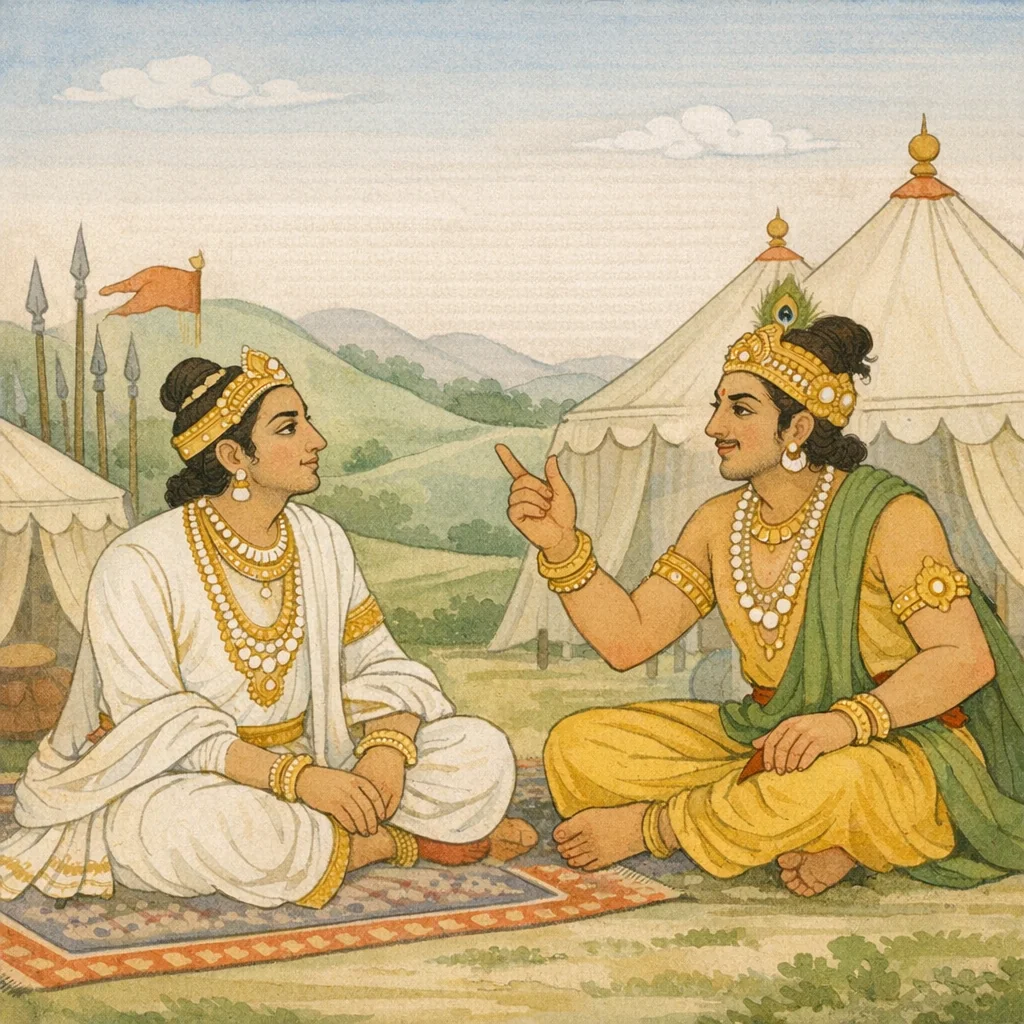
Adhyaya 113
Adhyāya 113: Karṇa–Bhīma Śaravarṣa and the Battlefield Aftermath (कर्णभीमशरवर्षः)
Upa-parva: Karṇa–Bhīma Vimarda (Episode: Karṇa and Bhīma’s strategic engagement)
Dhṛtarāṣṭra addresses Saṃjaya with personal distress, acknowledging a prior mental posture of resignation yet asking what response remains appropriate and requesting a precise account of the warriors’ losses. Saṃjaya then narrates a fierce engagement between Karṇa and Bhīma: both unleash dense volleys likened to rainclouds. Bhīma’s named arrows strike Karṇa; Karṇa’s counter-volley saturates Bhīma. The surrounding Kaurava forces experience agitation and disarray as missiles fall in all directions; troops retreat in confusion, some interpreting the calamity as a divinely induced delusion. The narration expands into a panoramic depiction of the field: fallen elephants, horses, men; broken chariots and equipment; scattered weapons (arrows, spears, swords, axes, clubs) and ornaments (armlets, earrings, garlands), producing an image of the earth “adorned” in a grim, ironic sense. Observers among celestial and semi-divine beings are said to marvel at the superhuman intensity of the combat. The chapter closes by emphasizing the exceptional devastation produced by Karṇa and Bhīma’s clash and the resulting severe turmoil in the wider battle zone.
Chapter Arc: संजय धृतराष्ट्र को सुनाते हैं—धर्मराज युधिष्ठिर के प्रेमपूर्ण, पर भीतर से आशंकित वचन सुनकर शिनिपुत्र सात्यकि उठ खड़ा होता है; वह अर्जुन की सुरक्षा और युद्ध-नीति पर राजा की चिंता को सीधे संबोधित करता है। → सात्यकि युधिष्ठिर के कथन को ‘न्याययुक्त, चित्र और फाल्गुनार्थे यशस्कर’ कहकर स्वीकारता है, पर साथ ही संकेत देता है कि ऐसे संकट-काल में राजा को उसे भी पार्थ के समान ही समझकर आदेश देना चाहिए। वह युद्धभूमि की व्यापकता का चित्र खींचता है—देव, असुर, मनुष्य, राक्षस, किन्नर, महोरग, स्थावर-जंगम तक अर्जुन के संग्राम में ‘नालं’ (असमर्थ) हैं—अर्थात अर्जुन की क्षमता पर संदेह व्यर्थ है। फिर भी वह आत्मसंरक्षण और अर्जुन तक पहुँचने/सहायता भेजने की व्यावहारिकता पर विचार कर, स्वयं-बुद्धि से उचित गमन/व्यवस्था का प्रस्ताव रखता है। → सात्यकि निर्णायक स्वर में भरोसा दिलाता है कि अर्जुन की रक्षा हेतु पर्याप्त रक्षक-समूह ‘समाहित’ हैं—केकय राजकुमार, घटोत्कच, विराट, द्रुपद, शिखण्डी, धृष्टकेतु, कुन्तिभोज आदि—और वह यह भी उद्घोष करता है कि द्रोणाचार्य और कृतवर्मा सेना सहित भी उसे दबा नहीं सकेंगे; साथ ही धृष्टद्युम्न का स्मरण होता है—अग्नि से प्रकट वह योद्धा, द्रोण-वध के लिए सुसज्जित, जैसे नियति का शस्त्र। → संवाद का निष्कर्ष युधिष्ठिर की आशंका को शमन करना है—अर्जुन के विषय में भय त्यागो; जहाँ सत्यपराक्रमी, महाधनुर्धर श्रीकृष्ण (अच्युत) साथ हैं, वहाँ कर्म की ‘व्याप्ति’ (विघ्न) नहीं। सात्यकि की वाणी राजा को नीति, धैर्य और भरोसे की ओर लौटाती है। → द्रोण-वध की दिशा में धृष्टद्युम्न का ‘अग्निज’ विधान और सात्यकि की सक्रिय भूमिका संकेत देती है कि अगला घटनाक्रम द्रोण के विरुद्ध निर्णायक चालों की ओर मुड़ेगा।
Shlokas
Verse 1
(दाक्षिणात्य अधिक पाठके २ श्लोक मिलाकर कुल १०५ श्लोक हैं) निफमशा (0) अमन न एकादरशाधिकशततमोड< ध्याय: सात्यकि और युधिष्ठिरका संवाद संजय उवाच प्रीतियुक्ते च हृद्यं च मधुराक्षरमेव च । कालयुक्तं च चित्र च न्याय्यं यच्चापि भाषितुम्,संजय कहते हैं--राजन्! धर्मराजका वह वचन प्रेमपूर्ण, मनको प्रिय लगनेवाला, मधुर अक्षरोंसे युक्त, सामयिक, विचित्र, कहनेयोग्य तथा न््यायसंगत था। भरतश्रेष्ठ! उसे सुनकर शिनिप्रवर सात्यकिने युधिष्ठिरको इस प्रकार उत्तर दिया--
Sanjaya said: O King, the words spoken by Dharmarāja were filled with affection, pleasing to the heart, composed of sweet syllables, timely, striking in expression, worthy to be spoken, and grounded in justice. Hearing them, Sātyaki—foremost among the Śinis—replied to Yudhiṣṭhira in this manner.
Verse 2
धर्मराजस्य तद् वाक््यं निशम्य शिनिपुज्भव: । सात्यकिर्भरतश्रेष्ठ प्रत्युवाच युधिष्ठिरम्,संजय कहते हैं--राजन्! धर्मराजका वह वचन प्रेमपूर्ण, मनको प्रिय लगनेवाला, मधुर अक्षरोंसे युक्त, सामयिक, विचित्र, कहनेयोग्य तथा न््यायसंगत था। भरतश्रेष्ठ! उसे सुनकर शिनिप्रवर सात्यकिने युधिष्ठिरको इस प्रकार उत्तर दिया--
Sanjaya said: O king, having heard that statement of Dharmaraja (Yudhishthira)—a speech marked by affection, pleasing to the mind, sweet in expression, timely, striking, fit to be spoken, and grounded in justice—Satyaki, the foremost of the Shinis, replied to Yudhishthira in this manner, O best of the Bharatas.
Verse 3
श्रुत॑ ते गदतो वाक््यं सर्वमेतन्मयाच्युत । न्याययुक्त च चित्र च फाल्गुनार्थे यशस्करम्,“अपनी मर्यादासे कभी च्युत न होनेवाले नरेश! आपने अर्जुनकी सहायताके लिये जो- जो बातें कही हैं, वह सब मैंने सुन लीं। आपका कथन अद्भुत, न््यायसंगत और यशकी वृद्धि करनेवाला है
Verse 4
एवंविधे तथा काले मादृशं प्रेक्ष्य सम्मतम् । वक्तुम्हसि राजेन्द्र यथा पार्थ तथैव माम्,राजेन्द्र! ऐसे समयमें मेरे-जैसे प्रिय व्यक्तिको देखकर आप जैसी बात कह सकते हैं, वैसी ही कही है। आप अर्जुनसे जो कुछ कह सकते हैं, वही आपने मुझसे भी कहा है
Sañjaya said: “At such a time as this, seeing one who is dear and trusted like me before you, O best of kings, you have spoken to me exactly as you would speak to Pārtha (Arjuna). Whatever you could say to Arjuna, you have said the same to me as well.”
Verse 5
न मे धनंजयस्यार्थे प्राणा रक्ष्या: कथंचन । त्वत्प्रयुक्तः पुनरहं कि न कुर्या महाहवे,“महाराज! अर्जुनके हितके लिये मुझे किसी प्रकार भी अपने प्राणोंकी रक्षाकी चिन्ता नहीं करनी है; फिर आपका आदेश मिलनेपर मैं इस महायुद्धमें क्या नहीं कर सकता हूँ?
Sañjaya said: “For the sake of Dhanañjaya (Arjuna), I have no concern whatsoever for preserving my own life. And once I am set in motion by your command, O King, what could I not accomplish in this great battle?”
Verse 6
लोकत्रयं योधयेयं सदेवासुरमानुषम् । त्वत्प्रयुक्तो नरेन्द्रेह किमुतैतत् सुदुर्बलम्,“नरेन्द्र! आपकी आज्ञा हो तो देवताओं, असुरों तथा मनुष्योंसहित तीनों लोकोंके साथ मैं युद्ध कर सकता हूँ। फिर यहाँ इस अत्यन्त दुर्बल कौरवी सेनाका सामना करना कौन बड़ी बात है?
Verse 7
सुयोधनबल त्वद्य योधयिष्ये समन्तत: । विजेष्ये च रणे राजन् सत्यमेतद् ब्रवीमि ते,“राजन! मैं रणक्षेत्रमें आज चारों ओर घूमकर दुर्योधनकी सेनाके साथ युद्ध करूँगा और उसपर विजय पाऊँगा; यह मैं आपसे सच्ची बात कहता हूँ
Sanjaya said: “O King, today I shall range all around and engage in battle against the forces of Suyodhana (Duryodhana). I shall also win in this fight—this is the truth I declare to you.” The statement conveys a warrior’s vow of action and confidence, framed as a truthful assurance to the ruler amid the moral pressure and uncertainty of war.
Verse 8
कुशल्यहं कुशलिनं समासाद्य धनंजयम् | हते जयद्रथे राजन् पुनरेष्यामि तेडन्तिकम्,“राजन! मैं कुशलपूर्वक रहकर सकुशल अर्जुनके पास पहुँच जाऊँगा और जयद्रथके मारे जानेपर उनके साथ ही आपके पास लौट आऊँगा
Sañjaya said: “O King, I shall keep myself safe and, meeting Dhanañjaya (Arjuna) in good condition, I will return again to your presence—once Jayadratha has been slain.” In this tense moment of war, Sañjaya frames his duty as truthful reporting and loyal return, while tying his own movement to the moral and strategic turning point of Jayadratha’s death.
Verse 9
अवश्यं तु मया सर्व विज्ञाप्यस्त्वं नराधिप । वासुदेवस्य यद् वाक््यं फाल्गुनस्थ च धीमत:,'परंतु नरेश्वर! भगवान् श्रीकृष्ण तथा बुद्धिमान् अर्जुनने युद्धके लिये जाते समय मुझसे जो कुछ कहा था, वह सब आपको सूचित कर देना मेरे लिये अत्यन्त आवश्यक है
Sanjaya said: O king, it is imperative that I report everything to you—especially the words spoken by Vāsudeva (Kṛṣṇa) and by the wise Phālguna (Arjuna). Their counsel, given in the context of war, carries moral weight and must be faithfully conveyed to the ruler who bears responsibility for the realm’s fate.
Verse 10
दृढं त्वभिपरीतो5हमर्जुनेन पुनः पुन: । मध्ये सर्वस्य सैन्यस्थ वासुदेवस्य शृण्वत:
Sañjaya said: “Arjuna has again and again surrounded and pressed me hard. This has happened while I stood in the very midst of the entire army, with Vāsudeva listening.”
Verse 11
“अर्जुनने सारी सेनाके बीचमें भगवान् श्रीकृष्णके सुनते हुए मुझे बारंबार कहकर दृढ़तापूर्वक बाँध लिया है ।। अद्य माधव राजानमप्रमत्तोडनुपालय । आर्या युद्धे मतिं कृत्वा यावद्धन्मि जयद्रथम्,“उन्होंने कहा था--'माधव! आज मैं जबतक जयद्रथका वध करता हूँ, तबतक युद्धमें तुम श्रेष्ठ बुद्धिका आश्रय लेकर पूरी सावधानीके साथ राजा युधिष्ठिरकी रक्षा करो
Sanjaya said: In the very midst of the entire army, with the Blessed Śrī Kṛṣṇa listening, Arjuna repeatedly addressed me and bound me firmly to his resolve. He had said: “Mādhava, today, until I strike down Jayadratha, you must, with unwavering vigilance and the best judgment in war, protect the king Yudhiṣṭhira.”
Verse 12
त्वयि चाहं महाबाहो प्रद्युम्ने वा महारथे । नृपं निक्षिप्य गच्छेयं निरपेक्षो जयद्रथम्,“महाबाहो! मैं तुमपर अथवा महारथी प्रद्युम्मपर ही भरोसा करके राजाको धरोहरकी भाँति सौंपकर निरपेक्षभावसे जयद्रथके पास जा सकता हूँ
Sañjaya said: “O mighty-armed one, relying on you—or on Pradyumna, the great chariot-warrior—I could entrust the king to your care as one deposits a precious charge, and then, free from further concern, go forth to confront Jayadratha.”
Verse 13
जानीषे हि रणे द्रोणं रभसं श्रेष्ठमम्मतम् । प्रतिज्ञा चापि ते नित्यं श्रुता द्रोणस्य माधव,“माधव! तुम जानते ही हो कि रणक्षेत्रमें श्रेष्ठ पुरुषोंद्वारा सम्मानित आचार्य द्रोण कितने वेगशाली हैं। उन्होंने जो प्रतिज्ञा कर रखी है, उसे भी तुम प्रतिदिन सुनते ही होगे
Verse 14
ग्रहणे धर्मराजस्य भारद्वाजोडपि गृध्यति । शक्तश्नापि रणे द्रोणो निग्रहीतुं युधिष्चिरम्,“'ट्रोणाचार्य भी धर्मराजको बंदी बनाना चाहते हैं और वे समरांगणमें राजा युधिष्ठिरको कैद करनेमें समर्थ भी हैं
Sañjaya said: “Even Bhāradvāja’s son (Droṇa) is eager to seize Dharmarāja. In battle, Droṇa is indeed capable of overpowering and capturing Yudhiṣṭhira.”
Verse 15
एवं त्वयि समाधाय धर्मराजं नरोत्तमम् | अहमद्य गमिष्यामि सैन्धवस्य वधाय हि,'ऐसी अवस्थामें नरश्रेष्ठ धर्मराज युधिष्ठिरकी रक्षाका सारा भार तुमपर ही रखकर आज मैं सिन्धुराजके वधके लिये जाऊँगा
“Having thus entrusted to you the protection of Dharmarāja Yudhiṣṭhira, the best of men, I shall go today—indeed, for the slaying of Saindhava.”
Verse 16
जयद्रथं च हत्वाहं द्रुतमेष्यामि माधव । धर्मराजं न चेद् द्रोणो निगृह्लीयाद् रणे बलात्,“माधव! यदि द्रोणाचार्य रणक्षेत्रमें धर्मरमाजको बलपूर्वक बंदी न बना सकें तो मैं जयद्रथका वध करके शीघ्र ही लौट आऊँगा
Sañjaya said: “O Mādhava, having slain Jayadratha, I shall return swiftly—provided Droṇa does not, by sheer force in battle, seize and take captive Dharmarāja.” The statement frames Arjuna’s vow within the moral tension of war: the urgent pursuit of a single culpable foe is set against the grave ethical and strategic catastrophe of Yudhiṣṭhira’s capture, which would imperil the very cause of dharma the Pāṇḍavas claim to uphold.
Verse 17
निगृहीते नरश्रेष्ठे भारद्वाजेन माधव । सैन्धवस्य वधो न स्थान्ममाप्रीतिस्तथा भवेत्,“मधुवंशी वीर! यदि द्रोणाचार्यने नरश्रेष्ठ युधिष्ठिरको कैद कर लिया तो सिन्धुराजका वध नहीं हो सकेगा और मुझे भी महान् दुःख होगा
Sañjaya said: “O Mādhava, if the foremost of men (Yudhiṣṭhira) is seized by Bhāradvāja (Droṇa), then the slaying of Saindhava (Jayadratha) will not be possible—and in that event, great anguish will be mine as well.”
Verse 18
एवंगते नरश्रेष्ठे पाण्डवे सत्यवादिनि । अस्माकं गमनं व्यक्त वन॑ प्रति भवेत् पुन:,“यदि सत्यवादी नरश्रेष्ठ पाण्डुकुमार युधिष्ठिर इस प्रकार बंदी बनाये गये तो निश्चय ही हमें पुन: वनमें जाना पड़ेगा
Sañjaya said: “If matters come to such a pass that the best of men among the Pāṇḍavas—Yudhiṣṭhira, famed for truthfulness—has been taken captive, then it is certain that we shall have to go back again to the forest.”
Verse 19
सो<5यं मम जयो व्यक्त व्यर्थ एव भविष्यति । यदि द्रोणो रणे क्रुद्धों निगृह्लीयाद् युधिष्ठिरम्,“यदि द्रोणाचार्य रणक्षेत्रमें कुपित होकर युधिष्ठिरको कैद कर लेंगे तो मेरी यह विजय अवश्य ही व्यर्थ हो जायगी
Sañjaya said: “This victory of mine will plainly become futile, if Droṇa, enraged on the battlefield, were to seize and take Yudhiṣṭhira captive.”
Verse 20
स त्वमद्य महाबाहो प्रियार्थ मम माधव । जयार्थ च यशो<र्थ च रक्ष राजानमाहवे,“महाबाहु माधव! इसलिये तुम आज मेरा प्रिय करने, मुझे विजय दिलाने और मेरे यशकी वृद्धि करनेके लिये युद्धस्थलमें राजा युधिष्ठिरकी रक्षा करो”
Sañjaya said: “Therefore, O mighty-armed Mādhava, today—out of regard for me, for the sake of victory, and for the increase of your renown—protect the king Yudhiṣṭhira on the battlefield.” The appeal frames protection of the righteous king as both a strategic necessity in war and a moral duty, binding personal loyalty with the larger cause of dharma.
Verse 21
स भवान् मयि निक्षेपो निक्षिप्त: सव्यसाचिना । भारद्वाजाद भयं नित्यं मन्यमानेन वै प्रभो,'प्रभो! इस प्रकार द्रोणाचार्यसे निरन्तर भय मानते हुए सव्यसाची अर्जुनने आपको मेरे पास धरोहरके रूपमें रख छोड़ा है
Sañjaya said: O lord, Arjuna the ambidextrous has entrusted you to me as a deposit—doing so because he constantly fears Bhāradvāja’s son (Droṇa). The line underscores the moral weight of guardianship in war: even amid violence, one is bound by the ethics of trust and protection when another places a person in one’s care.
Verse 22
तस्यापि च महाबाहो नित्यं पश्यामि संयुगे | नान्यं हि प्रतियोद्धारं रौक्मिणेयादृते प्रभो,“महाबाहो! प्रभो! मैं प्रतिदिन युद्धस्थलमें रुक्मिणी-नन्दन प्रद्युम्मके सिवा दूसरे किसी वीरको ऐसा नहीं देखता जो द्रोणाचार्यके सामने खड़ा होकर उनसे युद्ध कर सके
Sañjaya said: “O mighty-armed one, in the thick of battle I repeatedly observe this: apart from Rukmiṇī’s son, Pradyumna, I see no other warrior who can truly stand before Droṇācārya as a counter-combatant. Such is Droṇa’s overwhelming force that only exceptional valor can meet him face to face.”
Verse 23
मां चापि मन्यते युद्धे भारद्वाजस्य धीमतः । सो<हं सम्भावनां चैतामाचार्यवचनं च तत्
Sañjaya said: “Even me, the wise son of Bhāradvāja counts as significant in this war. Therefore I accept both this honor shown to me and those words of the teacher—recognizing that esteem in battle is not merely personal pride, but a responsibility placed upon one by a revered authority.”
Verse 24
आचार्यो लघुहस्तत्वादभेद्यकवचावृत:
Sañjaya said: The Ācārya, by virtue of his swift and light-handed skill, was covered in impenetrable armor—thus proving difficult to pierce in battle, a reminder that mastery and preparedness can make even a single warrior a near-unassailable force amid the moral chaos of war.
Verse 25
यदि कार्ष्णिर्धनुष्पाणिरिह स्यान्मकरध्वज:
Sañjaya said: “If Kārṣṇi—bow in hand—were here, bearing the banner marked with the makara, then the course of this battle would not be the same.” The line conveys a moral undercurrent common in the war narrative: the presence of a righteous, capable protector can restrain injustice and alter outcomes, while his absence leaves space for calamity to unfold.
Verse 26
कुरु त्वमात्मनो गुप्तिं कस्ते गोप्ता गते मयि
Sañjaya said: “Do you yourself take care to safeguard your own life and well-being; for when I am gone, who will remain to protect you?”
Verse 27
मा च ते भयमपद्यास्तु राजन्नर्जुनसम्भवम्
Sañjaya said: “O King, do not let fear arise in you on account of Arjuna (and what proceeds from him).”
Verse 28
ये च सौवीरका योधास्तथा सैन्धवपौरवा:
Sanjaya said: “And those warriors of the Sauvīra country, as well as the Saindhavas and the Pauravas…” (He continues listing the allied contingents present in the battle, emphasizing the breadth of forces drawn into the conflict.)
Verse 29
उदीच्या दाक्षिणात्याशक्षु ये चान्येडपि महारथा: । ये च कर्णमुखा राजन् रथोदारा: प्रकीर्तिता:
Sañjaya said: “O King, the great chariot-warriors from the northern and southern regions—and others besides—those foremost among whom is Karṇa, all renowned as noble and eminent masters of the chariot, have been duly spoken of.”
Verse 30
एतेड<र्जुनस्य क्रुद्धस्प कलां ना्हन्ति षोडशीम् । 'राजन्! जो सौवीर, सिन्धु तथा पुरुदेशके योद्धा हैं, जो उत्तर और दक्षिणके निवासी एवं अन्य महारथी हैं तथा जो कर्ण आदि श्रेष्ठ रथी बताये गये हैं वे कुपित हुए अर्जुनकी सोलहवीं कलाके बराबर भी नहीं हैं ।। उद्युक्ता पृथिवी सर्वा ससुरासुरमानुषा,“नरेश्वर! देवता, असुर, मनुष्य, राक्षस, किन्नर तथा महान् सर्पगणोंसहित यह समूची पृथ्वी और सभी स्थावर-जंगम प्राणी युद्धके लिये उद्यत हो जायँ तो भी सब मिलकर भी युद्धस्थलमें अर्जुनका सामना नहीं कर सकते हैं
Sanjaya said: O King, the warriors of Sauvīra, Sindhu, and Purudeśa—those from the northern and southern regions, and other great chariot-fighters, even those famed as foremost among charioteers such as Karṇa—do not amount to even a sixteenth part of Arjuna when he is enraged. Even if the whole earth, together with gods, demons, and humans—along with rākṣasas, kinnaras, and mighty serpents, and all beings moving and unmoving—were to rise up for battle, still, united, they would not be able to face Arjuna on the battlefield. Ethically, the passage underscores how a single warrior’s disciplined prowess, when inflamed by righteous wrath, can eclipse mere numbers—hinting that power without dharmic restraint becomes overwhelming and fearsome.
Verse 31
सराक्षसगणा राजन् सकिन्नरमहोरगा । जड़मा: स्थावरा: सर्वे नाल॑ पार्थस्य संयुगे,“नरेश्वर! देवता, असुर, मनुष्य, राक्षस, किन्नर तथा महान् सर्पगणोंसहित यह समूची पृथ्वी और सभी स्थावर-जंगम प्राणी युद्धके लिये उद्यत हो जायँ तो भी सब मिलकर भी युद्धस्थलमें अर्जुनका सामना नहीं कर सकते हैं
Sanjaya said: O King, even if all beings—together with hosts of Rākṣasas, along with Kinnaras and the mighty serpent-races—indeed all that move and all that are immobile—were to rise up for battle, they still would not be sufficient to face Pārtha (Arjuna) on the field of war. The statement underscores Arjuna’s overwhelming prowess and the moral pressure of the war: power, when aligned with a righteous cause and disciplined skill, becomes unassailable even by vast coalitions.
Verse 32
एवं ज्ञात्वा महाराज व्येतु ते भीर्धनंजये । यत्र वीरौ महेष्वासौ कृष्णौ सत्यपराक्रमौ
Sañjaya said: “Knowing this, O great king, let your fear concerning Dhanañjaya be dispelled; for where the two Kṛṣṇas—those heroic, mighty archers whose valor is proven true—are present, there is no cause for despair.”
Verse 33
दैवं कृतास्त्रतां योगममर्षमपि चाहवे
Sañjaya said: “In that battle, there was a fateful convergence—mastery of weapon-craft, disciplined strategic union, and even fierce, unyielding wrath—each seeming to arise under the pressure of destiny.”
Verse 34
मयि चापि सहाये ते गच्छमानेड<र्जुनं प्रति
Sañjaya said: “And when you were setting out toward Arjuna, with me also as your attendant and helper…”
Verse 35
आचार्यो हि भृशं राजन् निग्रहे तव गृध्यति
Sañjaya said: O King, the Teacher is intensely eager to bring you under restraint—he is keen to curb your course and hold you back from what he deems harmful or improper.
Verse 36
कुरुष्वाद्यात्मनो गुप्तिं कस्ते गोप्ता गते मयि
Sañjaya said: “Make your own protection today; when I am gone, who will be your protector?”
Verse 37
न हाहं त्वां महाराज अनिक्षिप्य महाहवे
Sañjaya said: “O great king, I will not—indeed I will not—leave you behind in this mighty battle.”
Verse 38
एतद्विचार्य बहुशो बुद्धया बुद्धिमतां वर,“बुद्धिमानोंमें श्रेष्ठ महाराज! अपनी बुद्धिसे इस विषयमें बहुत सोच-विचार करके आपको जो परम मंगलकारक कृत्य जान पड़े, उसके लिये मुझे आज्ञा दें!
Sañjaya said: “Having reflected on this again and again with your own discernment, O best among the wise—O great king—command me today toward whatever course of action you judge to be supremely auspicious and beneficial.”
Verse 39
दृष्टवा श्रेय: परं बुद्धया ततो राजन् प्रशाधि माम्,“बुद्धिमानोंमें श्रेष्ठ महाराज! अपनी बुद्धिसे इस विषयमें बहुत सोच-विचार करके आपको जो परम मंगलकारक कृत्य जान पड़े, उसके लिये मुझे आज्ञा दें!
Sañjaya said: “Having discerned with your intellect what is supremely beneficial, then, O King, command me. After deep reflection, whatever course you judge to be the highest good—grant me your instruction for that.”
Verse 40
युधिछिर उवाच एवमेतन्महाबाहो यथा वदसि माधव । नतुमे शुद्धयते भाव: श्वेताश्वं प्रति मारिष
Yudhiṣṭhira said: “So it is indeed, O mighty-armed one, just as you say, O Mādhava. Yet my inner feeling does not become purified, O venerable one, with regard to Śvetāśva.”
Verse 41
युधिष्ठिर बोले--महाबाहु माधव! तुम जैसा कहते हो, वही ठीक है। आर्य! श्वेतवाहन द्रोणाचार्यकी ओरसे मेरा हृदय शुद्ध (निश्चिन्त) नहीं हो रहा है ।। करिष्ये परमं यत्नमात्मनो रक्षणे हाहम् | गच्छ त्वं समनुज्ञातो यत्र यातो धनंजय:,मैं अपनी रक्षाके लिये महान् प्रयत्न करूँगा। तुम मेरी आज्ञासे वहीं जाओ, जहाँ अर्जुन गया है
Yudhiṣṭhira said: “Mighty-armed Mādhava, what you say is indeed right. Yet, noble one, my heart does not become clear or free from anxiety on account of Droṇa, the white-charioted teacher. I will exert the utmost effort for my own protection. Go now with my permission to the place where Dhanañjaya (Arjuna) has gone.”
Verse 42
आत्मसंरक्षणं संख्ये गमन॑ चार्जुनं प्रति । विचार्यतत् स्वयं बुद्धया गमनं तत्र रोचय
Yudhiṣṭhira said: “Consider, with your own discernment, what course best serves self-preservation in this battle—and also the course of going toward Arjuna. Having reflected, choose the going that seems right there.”
Verse 43
मुझे युद्धमें अपनी रक्षा करनी चाहिये या अर्जुनके पास तुम्हें भेजना चाहिये। इन दोनों बातोंपर तुम स्वयं ही अपनी बुद्धिसे विचार करके वहाँ जाना ही पसंद करो ।। स त्वमातिष्ठ यानाय यत्र यातो धनंजय: । ममापि रक्षणं भीम: करिष्यति महाबल:,अतः जहाँ अर्जुन गया है वहाँ जानेके लिये तुम तैयार हो जाओ। महाबली भीमसेन मेरी भी रक्षा कर लेंगे
Yudhiṣṭhira said: “I must consider with my own judgment whether I should secure my own safety in this battle, or send you to Arjuna. Reflecting on these two courses, choose what you deem best and go there. Therefore, prepare to depart to the place where Dhanañjaya (Arjuna) has gone; the mighty Bhīma will also protect me.”
Verse 44
पार्षतश्न ससोदर्य: पार्थिवाश्व महाबला: । द्रौपदेयाश्व मां तात रक्षिष्यन्ति न संशय:,तात! भाइयोंसहित धृष्टद्युम्न, महाबली भूपालगण तथा द्रौपदीके पाँचों पुत्र मेरी रक्षा कर लेंगे; इसमें संशय नहीं है
Yudhiṣṭhira said: “O dear one, Dhṛṣṭadyumna of the Pārṣata line, together with his brothers, the mighty kings, and the five sons of Draupadī will surely protect me. Of this there is no doubt.”
Verse 45
केकया भ्रातर: पज्च राक्षसक्ष घटोत्कच: । विराटो द्रुपदश्चैव शिखण्डी च महारथ:,एते समाहितास्तात रक्षिष्यन्ति न संशय: । तात! पाँच भाई केकयराजकुमार, राक्षस घटोत्कच, विराट, ट्रपद, महारथी शिखण्डी, धृष्टकेतु, बलवान् मामा कुन्तिभोज (पुरुजित), नकुल, सहदेव, पांचाल तथा सूंजय-वीरगण --ये सभी सावधान होकर निःसंदेह मेरी रक्षा करेंगे
Yudhiṣṭhira said: “The five brothers of Kekaya, and the rākṣasa Ghaṭotkaca; Virāṭa and Drupada as well; and the great chariot-warrior Śikhaṇḍin—these, fully alert, dear one, will surely protect (me). There is no doubt.” In the ethical frame of the epic, Yudhiṣṭhira’s words reflect responsible kingship under crisis: he does not rely on mere hope, but on disciplined, pledged protectors, affirming solidarity and duty (rakṣaṇa-dharma) amid the chaos of war.
Verse 46
धृष्टकेतुश्न बलवान् कुन्तिभोजश्न मातुल: । नकुल: सहदेवश्न पञ्चाला: सृज्जयास्तथा
Yudhiṣṭhira said: “Dhṛṣṭaketu, the mighty Kuntibhoja—our maternal uncle—Nakula and Sahadeva, and also the Pañcālas and the Sṛñjayas.” In the midst of war, he enumerates allied leaders and clans, affirming the strength and solidarity of those bound by kinship and righteous commitment to the Pāṇḍava cause.
Verse 47
न द्रोण: सह सैन्येन कृतवर्मा च संयुगे
Yudhiṣṭhira said: “Neither Droṇa, even with his army, nor Kṛtavarmā in the thick of battle…” (The utterance conveys a tense moral and strategic assessment: even renowned warriors and their forces are being weighed against the unfolding calamity of war, where prowess alone cannot guarantee a righteous or favorable outcome.)
Verse 48
धृष्टय्युम्नश्व॒ समरे द्रोणं क़ुद्धं परंतप:
Yudhiṣṭhira said: “And Dhṛṣṭadyumna, O scorcher of foes, confronted Droṇa in the thick of battle when the preceptor had become inflamed with wrath.”
Verse 49
वारयिष्यति विक्रम्य वेलेव मकरालयम् । शत्रुओंको संताप देनेवाला धृष्टद्युम्न समरांगणमें कुपित हुए द्रोणाचार्यको पराक्रम करके रोक लेगा। ठीक वैसे ही, जैसे तटकी भूमि समुद्रको आगे बढ़नेसे रोक देती है ।। ४८ ई | यत्र स्थास्यति संग्रामे पार्षत: परवीरहा
Yudhiṣṭhira said: “Advancing with valor, Dhṛṣṭadyumna—who brings burning distress to the enemy—will check the enraged Droṇācārya on the battlefield. Just as the shore’s firm land restrains the sea from surging forward, so will he hold Droṇa back wherever he takes his stand in the fight, that slayer of hostile heroes, the son of Pṛṣata.”
Verse 50
द्रोणो न सैन्यं बलवत् क्रामेत् तत्र कथंचन । जहाँ शत्रुवीरोंका संहार करनेवाला द्रुपदकुमार संग्रामभूमिमें खड़ा होगा, वहाँ मेरी प्रबल सेनापर द्रोणाचार्य किसी तरह आक्रमण नहीं कर सकते ।। एष द्रोणविनाशाय समुत्पन्नो हुताशनात्
Yudhiṣṭhira said: “Droṇa cannot, in any manner, advance forcefully against the army at that place. For where the son of Drupada—who brings about the destruction of enemy heroes—stands upon the battlefield, there Droṇācārya cannot possibly launch an assault upon my mighty host. This one has arisen from the sacrificial fire for the very destruction of Droṇa.”
Verse 51
विश्रब्धं गच्छ शैनेय मा कार्षीमयि सम्भ्रमम् धृष्टय्युम्नो रणे क्रुद्धं द्रोणमावारयिष्यति,अतः शिनिनन्दन! तुम निश्चिन्त होकर जाओ। मेरे लिये संदेह मत करो। धृष्टद्युम्न रणक्षेत्रमें कुपित हुए द्रोणाचार्यको सर्वथा रोक देगा
Yudhiṣṭhira said: “Go without fear, O son of Śini. Do not be anxious on my account. Dhṛṣṭadyumna, enraged in battle, will hold Droṇa back completely.” In the midst of war’s urgency, Yudhiṣṭhira steadies his ally with reassurance and assigns responsibility with confidence, emphasizing disciplined action over panic.
Verse 110
इस प्रकार श्रीमह्ाभारत द्रोणपर्वके अन्तर्गत जयद्रथवधपर्वमें युधिष्िरवाक्यविषयक एक सौ दसवाँ अध्याय पूरा हुआ
Thus, in the Śrī Mahābhārata, within the Droṇa Parva, the one-hundred-and-tenth chapter—centered on Yudhiṣṭhira’s words—concludes in the Jayadratha-slaying section. The colophon marks a formal close to this unit of narration, situating Yudhiṣṭhira’s speech within the ethical pressures of war and the larger arc leading to Jayadratha’s death.
Verse 111
इति श्रीमहा भारते द्रोणपर्वणि जयद्रथवधपर्वणि युधिष्ठिरसात्यकिवाक्ये एकादशाधिकशततमो<ध्याय:
Thus, in the revered Mahābhārata, within the Droṇa Parva, in the section concerning the slaying of Jayadratha, concludes the one-hundred-and-eleventh chapter, known as the dialogue between Yudhiṣṭhira and Sātyaki.
Verse 233
पृष्ठतो नोत्सहे कर्तु त्वां वा त्यक्तुं महीपते । “अर्जुन मुझे भी बुद्धिमान् द्रोणाचार्यका सामना करनेमें समर्थ योद्धा मानते हैं। महीपते! मैं अपने आचार्यकी इस सम्भावनाको तथा उनके उस आदेशको न तो पीछे ढकेल सकता हूँ और न आपको ही त्याग सकता हूँ
Sañjaya said: O king, I cannot bring myself to strike from behind, nor can I abandon you. Bound by duty and loyalty, I cannot cast aside either the moral restraint against a dishonourable act or my obligation to stand by my sovereign in this war.
Verse 243
उपलभ्य रणे क्रीडेदू यथा शकुनिना शिशु: । 'ट्रोणाचार्य अभेद्य कवचसे सुरक्षित हैं। वे शीघ्रतापूर्वक हाथ चलानेके कारण रणक्षेत्रमें अपने विपक्षीको पाकर उसी प्रकार क्रीड़ा करते हैं, जैसे कोई बालक पक्षीके साथ खेल रहा हो
Sañjaya said: Protected by impenetrable armour, Droṇācārya—swift of hand—finds his opponent on the battlefield and plays with him as in sport, like a little child playing with a bird. The line underscores the terrifying imbalance of power: war becomes ‘play’ for the invulnerable, while for others it is mortal peril, raising a stark ethical contrast between martial prowess and the suffering it inflicts.
Verse 256
तस्मै त्वां विसूजेयं वै स त्वां रक्षेद् यथार्जुन: । “यदि कामदेवके अवतार श्रीकृष्णकुमार प्रद्युम्न यहाँ हाथमें धनुष लेकर खड़े होते तो उन्हें मैं आपको सौंप देता। वे अर्जुनके समान ही आपकी रक्षा कर सकते थे
Sañjaya said: “Indeed, I would entrust you to him, so that he might protect you just as Arjuna does.” The line underscores a wartime ethic of safeguarding a valued person by placing them under the protection of a proven guardian, measuring reliability by Arjuna’s exemplary standard.
Verse 263
यः प्रतीयाद् रणे द्रोणं यावद् गच्छामि पाण्डवम् | “आप पहले अपनी रक्षाकी व्यवस्था कीजिये। मेरे चले जानेपर कौन आपका संरक्षण करनेवाला है, जो रणक्षेत्रमें तबतक द्रोणाचार्यका सामना करता रहे जबतक कि मैं अर्जुनके पास जाता (और लौटता) हूँ
Sañjaya said: “Who will stand against Droṇa in the battle for as long as I go to the Pāṇḍava (Arjuna) and return? First, you must arrange for your own protection; once I depart, who will be there to safeguard you?”
Verse 276
नस जातु महाबाहुर्भारमुद्यम्य सीदति | “महाराज! आज आपके मनमें अर्जुनके लिये भय नहीं होना चाहिये। वे महाबाहु किसी कार्यभारको उठा लेनेपर कभी शिथिल नहीं होते हैं
Sañjaya said: “O King, you should not let fear for Arjuna arise in your mind today. That mighty-armed hero, once he has taken up a burden of action, never falters or sinks under it.”
Verse 336
कृतज्ञतां दयां चैव भ्रातुस्त्वमनुचिन्तय । “आपके भाई अर्जुनमें जो दैवीशक्ति, अस्त्रविद्याकी निपुणता, योग, युद्धस्थलमें अमर्ष, कृतज्ञता और दया आदि सदगुण हैं उनका आप बारंबार चिन्तन कीजिये
Sanjaya said: “Reflect again and again on your brother’s virtues—his gratitude and his compassion.” In the midst of war, the verse urges remembrance of ethical qualities in one’s own kin, implying that true strength is not only martial skill but also moral character.
Verse 343
द्रोणे चित्रास्त्रतां संख्ये राज॑स्त्वमनुचिन्तय । “राजन! मैं आपका सहायक रहा हूँ, यदि मैं भी अर्जुनके पास चला जाता हूँ तो युद्धमें द्रोणाचार्य जिन विचित्र अस्त्रोंका प्रयोग करेंगे उनपर भी आप अच्छी तरह विचार कर लीजिये
Sanjaya said: “O King, in this battle you should carefully reflect upon Drona and his mastery of wondrous weapons—upon the extraordinary missiles he will employ in the fight.”
Verse 356
प्रतिज्ञामात्मनो रक्षन् सत्यां कर्तु च भारत | “भरतवंशी नरेश! द्रोणाचार्य आपको कैद करनेकी बड़ी इच्छा रखते हैं। वे अपनी प्रतिज्ञाकी रक्षा करते हुए उसे सत्य कर दिखाना चाहते हैं
Sanjaya said: “O Bharata, intent on safeguarding his own vow and making it come true, Dronacharya is strongly determined to take you captive. He seeks to uphold his pledged word and prove it true in the midst of this war.”
Verse 363
यस्याहं प्रत्ययात् पार्थ गच्छेयं फाल्गुनं प्रति । “अब आप अपनी रक्षाका प्रबन्ध कीजिये। पार्थ! मेरे चले जानेपर कौन आपका रक्षक होगा, जिसपर विश्वास करके मैं अर्जुनके पास चला जाऊँ
Sañjaya said: “O Pārtha, relying on whom could I depart and go to Phālguna (Arjuna)? Make arrangements for your own protection—when I have gone, who will be your protector, in whom I may place my trust as I proceed to Arjuna?”
Verse 376
क्वचिद् यास्यामि कौरव्य सत्यमेतद् ब्रवीमि ते | “महाराज! कुरुनन्दन! मैं आपको इस महासमरमें किसी वीरके संरक्षणमें रखे बिना कहीं नहीं जाऊँगा; यह मैं आपसे सच्ची बात कहता हूँ
Sañjaya said: “O Kauravya, I tell you the truth: I will not go anywhere at any time.” In the ethical atmosphere of the war-narrative, this is a pledge of steadfastness—an assurance of unwavering presence and loyalty in the midst of peril and uncertainty.
Verse 463
एते समाहितास्तात रक्षिष्यन्ति न संशय: । तात! पाँच भाई केकयराजकुमार, राक्षस घटोत्कच, विराट, ट्रपद, महारथी शिखण्डी, धृष्टकेतु, बलवान् मामा कुन्तिभोज (पुरुजित), नकुल, सहदेव, पांचाल तथा सूंजय-वीरगण --ये सभी सावधान होकर निःसंदेह मेरी रक्षा करेंगे
Yudhiṣṭhira said: “These men, alert and composed, will protect me—of this there is no doubt. The five Kaikeya princes, the rākṣasa Ghaṭotkaca, Virāṭa, Drupada, the great chariot-warrior Śikhaṇḍin, Dhṛṣṭaketu, my powerful maternal uncle Kuntibhoja (Purujit), Nakula and Sahadeva, along with the Pāñcālas and the band of heroic fighters—each of them, vigilant, will surely stand as my guard.”
Verse 476
समासादयितु शक्तो न च मां धर्षयिष्यति । सेनासहित द्रोणाचार्य तथा कृतवर्मा--ये युद्धस्थलमें मेरे पास नहीं पहुँच सकते और न मुझे परास्त ही कर सकेंगे
Yudhiṣṭhira declares with firm resolve that even Droṇācārya, though supported by his army, and Kṛtavarmā as well, are not capable of closing in upon him on the battlefield, nor can they overpower him. The statement functions as a moral-psychological stance in war: confidence is asserted not as mere pride, but as a necessary steadiness of mind amid a dharma-conflicted struggle.
Verse 503
कवची स शरी खड्गी धन्वी च वरभूषण: । यह धृष्टद्युम्न, द्रोणाचार्यका नाश करनेके लिये कवच, धनुष, बाण, खड्ग और श्रेष्ठ आभूषणोंके साथ अग्निसे प्रकट हुआ है
Yudhiṣṭhira said: “He appeared from the fire, clad in armor, bearing arrows, sword, and bow, adorned with excellent ornaments—manifested for the purpose of bringing about the destruction of Droṇācārya, through Dhṛṣṭadyumna.”
Verse 3236
न तत्र कर्मणो व्यापत् कथज्चिदपि विद्यते । “महाराज! ऐसा जानकर अर्जुनके विषयमें आपका भय दूर हो जाना चाहिये। जहाँ सत्यपराक्रमी और महाथनुर्धर वीर श्रीकृष्ण एवं अर्जुन विद्यमान हैं वहाँ किसी प्रकार भी कार्यमें व्याघात नहीं हो सकता
Sañjaya said: “In that place, no obstruction to the undertaking can arise in any way. O King, knowing this, your fear concerning Arjuna should subside; for where Śrī Kṛṣṇa and Arjuna—truthful in valor and mighty bowmen—are present, no work can be thwarted.”
Frequently Asked Questions
Dhṛtarāṣṭra confronts the dilemma of agency after catastrophe: whether resignation is sufficient or whether a ruler must still seek actionable understanding and responsibility even when outcomes appear irreversible.
The chapter illustrates that intense individual action can generate disproportionate collective consequences; ethically, it cautions that decisions and vows made under strong emotion may propagate harm beyond their intended targets.
No explicit phalaśruti is stated; the meta-commentary operates indirectly through Saṃjaya’s witness-style narration and the motif of astonishment, positioning the episode as a case study in how war magnifies both prowess and suffering.