Adhyaya 222
Jarītā–Śārṅgā-saṃvāda: Ākhu-haraṇa and the Approach of Agni (आखुहरणं अग्न्यागमनश्च)
Upa-parva: Khāṇḍava-dāha (Mandapāla–Śārṅgā Episode)
This chapter presents a dialogue between Jarītā and the Śārṅgā chicks in the Khāṇḍava setting. The chicks report a perceived threat: a hawk has seized a mouse from the burrow’s vicinity, and they fear that further dangers may follow; uncertainty itself is described as more lethal than a known danger. Jarītā replies with corrective counsel, asserting that a death feared through suspicion can feel worse than a death known with certainty, and advises them to act according to propriety. She then provides eyewitness testimony: she saw the hawk seize the mouse near the burrow, followed the hawk in flight, and even uttered a benediction as it carried away what she frames as a hostile presence. After the hawk consumes the prey, she returns and instructs the chicks to re-enter the burrow confidently, emphasizing that the mouse was removed without doubt. The chicks remain skeptical, warning against false reassurance when knowledge is confused and questioning why she bears responsibility for them. They propose an alternative: they will enter the fire to attain auspicious realms, and if fire does not burn them, she may return. The narrator (Vaiśaṃpāyana) closes this unit by describing Śārṅgī leaving the chicks in Khāṇḍava to seek a safe place away from Agni, after which the blazing fire approaches the location of Mandapāla’s offspring.
Chapter Arc: खाण्डववन के समीप खड़े विश्वविख्यात वीर अर्जुन और वासुदेव के सामने एक अतिभोजी ब्राह्मण भिक्षा माँगता है—पर उसकी ‘तृप्ति’ साधारण अन्न से नहीं, किसी असाध्य कर्म से होने वाली है। → ब्राह्मण अपने असली अभिप्राय को खोलता है: वह पावक (अग्निदेव) है और खाण्डववन को अपना ‘अन्न’ मानकर दग्ध करना चाहता है। पर पूर्व प्रयासों में इन्द्र ने वर्षा से अग्नि को बार-बार शांत किया; अतः अग्नि को ऐसे सहायक चाहिए जो अस्त्रविद्या से इन्द्र-प्रतिरोध कर सकें। अर्जुन-कृष्ण के सामने प्रश्न खड़ा होता है—क्या वे देवताओं के विरुद्ध खड़े होकर एक वन-दाह में सहायक बनें? → अग्निदेव स्पष्ट प्रतिज्ञा करता है कि वह ‘दाव’ रूप से खाण्डव को भस्म करेगा और अर्जुन-कृष्ण से उसी हेतु सहायता माँगता है; यह क्षण देव-मानव संधि को निर्णायक बनाता है—अग्नि का आग्रह, इन्द्र का संभावित विरोध, और दोनों वीरों की स्वीकृति/प्रतिबद्धता की दहलीज़। → अग्नि सान्त्वना-प्रार्थना के साथ अपना कार्यार्थ निवेदन दृढ़ करता है और सहायता की शर्तें/आवश्यकता स्पष्ट करता है—यह अध्याय ‘याचना’ और ‘उद्देश्य-प्रकटीकरण’ को पूर्ण कर अगले अध्याय के वास्तविक दाह-प्रसंग की भूमि तैयार करता है। → खाण्डववन के जलते ही वहाँ के निवासी अग्नि को बुझाने का परम प्रयत्न करेंगे और इन्द्र का प्रतिरोध अवश्य उठेगा—अब प्रश्न यह है कि अर्जुन-कृष्ण किस प्रकार अग्नि के दाह को अजेय बनाएँगे?
Shlokas
Verse 1
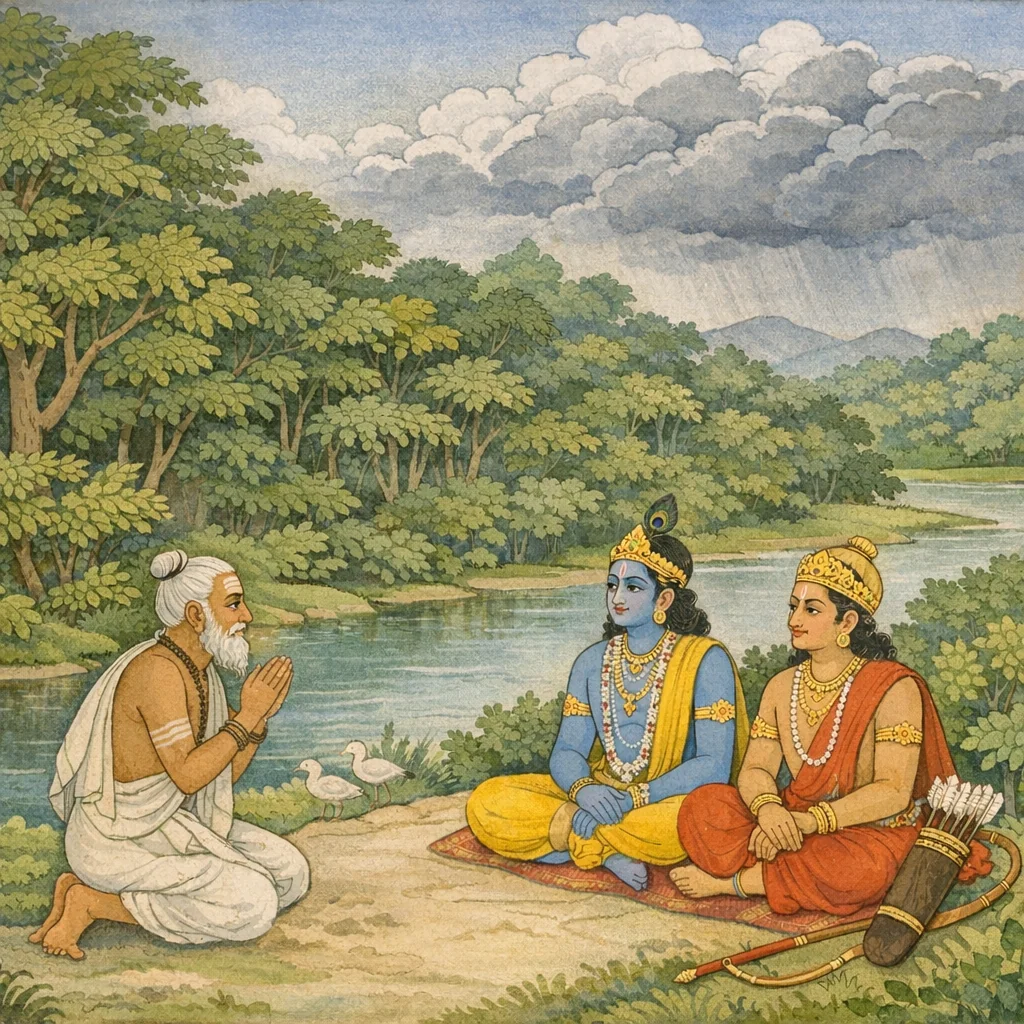
हि 770 08 (0) हि. 7 मी 7 द्वाविशर्त्याधेकद्विशततमो< ध्याय: अग्निदेवका खाण्डववनको जलानेके लिये श्रीकृष्ण और अर्जुनसे सहायताकी याचना करना, अग्निदेव उस वनको क्यों जलाना चाहते थे, इसे बतानेके प्रसंगमें राजा श्वेतकिकी कथा वैशम्पायन उवाच सोडब्रवीदर्जुनं चैव वासुदेवं च सात्वतम् । लोकप्रवीरौ तिष्ठन्तौ खाण्डवस्य समीपत:
Vaiśampāyana said: He spoke to Arjuna and to Vāsudeva, the Sātvata—those two heroes renowned among men—who were standing near the Khāṇḍava forest. The scene sets the moral and narrative frame for a request that will test the proper use of strength and alliance: great power is about to be enlisted for a destructive act, and the epic invites reflection on intention, necessity, and the consequences of aiding another’s purpose.
Verse 2
ब्राह्मणो बहुभोक्तास्मि भुड्जेडपरिमितं सदा । भिक्षे वार्ष्णेयपार्थो वामेकां तृप्तिं प्रयच्छतम्,“मैं अधिक भोजन करनेवाला एक ब्राह्मण हूँ और सदा अपरिमित अन्न भोजन करता हूँ। वीर श्रीकृष्ण और अर्जुन! आज मैं आप दोनोंसे भिक्षा माँगता हूँ। आपलोग एक बार पूर्ण भोजन कराकर मुझे तृप्ति प्रदान कीजिये”
Vaiśampāyana said: “I am a brāhmaṇa of great appetite; I always consume food without measure. O Vārṣṇeya (Kṛṣṇa) and Pārtha (Arjuna), today I beg alms from you both—grant me a single full satisfaction by feeding me to contentment.” The request frames hospitality and generosity as a test of dharma, where the worth of giving is measured not by ease but by the sincerity to fulfill a guest’s need.
Verse 3
वैशम्पायनजी कहते हैं-जनमेजय! उन ब्राह्मण-देवताने अर्जुन और सात्वतवंशी भगवान् वासुदेवसे, जो विश्वविख्यात वीर थे और खाण्डववनके समीप खड़े हुए थे, कहा --,एवमुक्तौ तमब्रूतां ततस्तौ कृष्णपाण्डवौ । केनान्नेन भवांस्तृप्येत् तस्यान्नस्य यतावहे उनके ऐसा कहनेपर श्रीकृष्ण और अर्जुन बोले--'ब्रह्मन! बताइये, आप किस अन्नसे तृप्त होंगे? हम दोनों उसीके लिये प्रयत्न करेंगे”
Vaiśampāyana said: “O Janamejaya, that Brahmin of divine power addressed Arjuna and Vāsudeva Kṛṣṇa—world-renowned heroes standing near the Khāṇḍava forest. When he had spoken thus, Kṛṣṇa and the Pāṇḍava replied: ‘O Brahmin, by what food would you be satisfied? We shall strive to procure that very food for you.’”
Verse 4
एवमुक्त: स भगवाननब्रवीत् तायुभौ ततः । भाषमाणौ तदा वीरौ किमन्नं क्रियतामिति,जब वे दोनों वीर “आपके लिये किस अन्नकी व्यवस्था की जाय?” इसी बातको बार- बार दुहराने लगे, तब उनके ऐसा कहनेपर भगवान् अग्निदेव उन दोनोंसे इस प्रकार बोले
Thus addressed, the blessed Lord (Agni) then spoke to those two. As the two heroes kept repeating, “What food should be prepared for you?”, the divine Fire-god replied to them in this manner—shifting the scene from mere hospitality to a purposeful, dharma-guided request.
Verse 5
ब्राह्मण उवाच नाहमन्न बुभुक्षे वै पावकं॑ मां निबोधतम् | यदन्नमनुरूपं मे तद् युवां सम्प्रयच्छतम्,ब्राह्मणदेवताने कहा--वीरो! मुझे अन्नकी भूख नहीं है, आपलोग मुझे अग्नि समझें। जो अन्न मेरे अनुरूप हो, वही आप दोनों मुझे दें
The Brahmin said: “I do not, in truth, hunger for ordinary food. Know me as Fire itself. Therefore, you two should offer me only that ‘food’ which is fitting for my nature.”
Verse 6
इदमिन्द्र: सदा दावं खाण्डवं परिरक्षति । न च शवक्नोम्यहं दग्धुं रक्ष्यमाणं महात्मना,इन्द्र सदा इस खाण्डववनकी रक्षा करते हैं। उन महामनासे सुरक्षित होनेके कारण मैं इसे जला नहीं पाता
The Brahmin said: “Indra constantly protects this Khāṇḍava forest from being consumed by fire. And since it is guarded by that great-souled one, I am unable to burn it.” The statement highlights the moral tension between a destructive act (burning the forest) and the superior power and resolve that stands as its protector.
Verse 7
वसत्यत्र सखा तस्य तक्षक: पन्नग: सदा । सगणस्तत्कृते दावं परिरक्षति वज्ञभूत्,इस वनमें इन्द्रका सखा तक्षक नाग अपने परिवारसहित सदा निवास करता है। उसीके लिये वज्रधारी इन्द्र सदा इसकी रक्षा करते हैं
The brāhmaṇa said: “Here dwells Takṣaka, the serpent—ever the ally of Indra—together with his retinue. For his sake, Indra, the wielder of the thunderbolt, continually protects this forest-fire (as a safeguard), keeping it under his control.”
Verse 8
तत्र भूतान्यनेकानि रक्षतेडस्य प्रसड्भतः । तं॑ दिथक्षुर्न शकनोमि दग्धुं शक्रस्य तेजसा,उस तक्षक नागके प्रसंगसे ही यहाँ रहनेवाले और भी अनेक जीवोंकी वे रक्षा करते हैं, इसलिये इन्द्रके प्रभावसे मैं इस वनको जला नहीं पाता। परंतु मैं सदा ही इसे जलानेकी इच्छा रखता हूँ
Verse 9
स मां प्रज्वलितं दृष्टवा मेघाम्भोभि: प्रवर्षति । ततो दग्धुं न शकनोमि दिशधक्षुर्दावमीप्सितम्,मुझे प्रज्वलित देखकर वे मेघोंद्वारा जलकी वर्षा करने लगते हैं, यही कारण है कि जलानेकी इच्छा रखते हुए भी मैं इस खाण्डववनको दग्ध करनेमें सफल नहीं हो पाता
Seeing me blazing, the clouds pour down rain in torrents. Therefore, even though I desire to set the forest-fire loose in all directions and burn (this Khāṇḍava), I am unable to consume it by fire.
Verse 10
स युवाभ्यां सहायाभ्यामस्त्रविदभ्यां समागत: । दहेयं खाण्डवं दावमेतदन्नं वृतं मया,आप दोनों अस्त्रविद्याके पूरे जानकार हैं, अतः मैं इसी उद्देश्स्से आपके पास आया हूँ कि आप दोनोंकी सहायतासे इस खाण्डववनको जला सकूँ। मैं इसी अन्नकी भिक्षा माँगता हूँ
The brāhmaṇa said: “I have come to you two, who are my helpers and masters of weapon-lore. With your assistance I wish to burn the Khāṇḍava forest. This is the ‘food’ I seek and have chosen.”
Verse 11
युवां हुदकधारास्ता भूतानि च समन्तत: । उत्तमास्त्रविदौ सम्यक् सर्वतो वारयिष्यथ:,आप दोनों उत्तम अस्त्रोंके ज्ञाता हैं, अतः जब मैं इस वनको जलाने लगूँ, उस समय आपलोग ऊपरसे बरसती हुई जलकी धाराओं तथा इस वनसे निकलकर चारों ओर भागनेवाले प्राणियोंको रोकियेगा
Verse 12
जनमेजय उवाच किमर्थ भगवानग्नि: खाण्डवं दग्धुमिच्छति । रक्ष्यमाणं महेन्द्रेण नानासत््वसमायुतम्,जनमेजयने पूछा--ब्रह्मन! भगवान् अग्निदेव देवराज इन्द्रके द्वारा सुरक्षित और अनेक प्रकारके जीव-जन्तुओंसे भरे हुए खाण्डववनको किसलिये जलाना चाहते थे?
Janamejaya said: “For what reason does the divine Fire-god, Agni, wish to burn the Khāṇḍava forest—though it is protected by great Indra and filled with living beings of many kinds?”
Verse 13
न होतत् कारणं ब्रह्मन्नल्पं सम्प्रतिभाति मे । यद् ददाह सुसंक्रुद्ध: खाण्डवं हव्यवाहन:,विप्रवर! मुझे इसका कोई साधारण कारण नहीं जान पड़ता, जिसके लिये कुपित होकर हव्यवाहन अग्निने समूचे खाण्डववनको भस्म कर दिया
Janamejaya said: “O Brahman, no small or ordinary cause occurs to me for this—that Havyavāhana (Agni), inflamed with fierce anger, burned the entire Khāṇḍava forest to ashes.”
Verse 14
एतदू विस्तरशो ब्रह्माछ्छोतुमिच्छामि तत्त्वत: । खाण्डवस्य पुरा दाहो यथा समभवन्मुने,ब्रह्मन! मुने! पूर्वकालमें खाण्डववनका दाह जिस प्रकार हुआ, वह सब विस्तारके साथ मैं ठीक-ठीक सुनना चाहता हूँ
Janamejaya said: “O Brahmin sage, I wish to hear this in full detail and in accordance with the truth—how, in former times, the burning of the Khāṇḍava forest came to pass.”
Verse 15
वैशम्पायन उवाच शृणु मे ब्रुवतो राजन् सर्वमेतद् यथातथम् । यन्निमित्तं ददाहाग्नि: खाण्डवं पृथिवीपते,वैशम्पायनजीने कहा--महाराज जनमेजय! अग्निदेवने जिस कारण खाण्डववनको जलाया, वह सब वृत्तान्त मैं यथावत् बतलाता हूँ, सुनो
Vaiśampāyana said: O King, listen as I speak—everything just as it truly happened. I shall relate, O lord of the earth, the very cause for which Agni burned the Khāṇḍava forest.
Verse 16
हन्त ते कथयिष्यामि पौराणीमृषिसंस्तुताम् । कथामिमां नरश्रेष्ठ खाण्डवस्य विनाशिनीम्,नरश्रेष्ठ खाण्डववनके विनाशसे सम्बन्ध रखनेवाली यह प्राचीन कथा महर्षियोंद्वारा प्रस्तुत की गयी है। उसीको मैं तुमसे कहूँगा
Vaiśampāyana said: “Come, I shall tell you this ancient tale, praised by the seers—this account, O best of men, that concerns the destruction of the Khāṇḍava forest.”
Verse 17
पौराण: श्रूयते राजन् राजा हरिहयोपम: । श्वेतकिर्नाम विख्यातों बलविक्रमसंयुत:,राजन! सुना जाता है, प्राचीनकालमें इन्द्रके समान बल और पराक्रमसे सम्पन्न श्वेतकि नामके एक राजा थे
Vaiśampāyana said: “O King, it is heard from ancient tradition that there once lived a renowned ruler named Śvetaki, endowed with strength and valor, and comparable to the Harihayas.”
Verse 18
यज्वा दानपतिर्धीमान् यथा नान्यो<स्ति कश्नन । ईजे च स महायजै: क्रतुभिश्चाप्तदक्षिणै:,उस समय उनके-जैसा यज्ञ करनेवाला, दाता और बुद्धिमान् दूसरा कोई नहीं था। उन्होंने पर्याप्त दक्षिणावाले अनेक बड़े-बड़े यज्ञोंका अनुष्ठान किया था
Vaiśampāyana said: He was a sacrificer, a lord of generosity, and a man of discernment—so much so that none other was his equal. He had duly performed many great sacrifices, rites and solemn ceremonies, each completed with the proper and ample gifts (dakṣiṇā) to the officiants, embodying the ethical ideal that wealth finds its highest worth in righteous giving and sacred duty.
Verse 19
तस्य नान्याभवद् बुद्धिर्दिवसे दिवसे नूप | सत्रे क्रियासमारम्भे दानेषु विविधेषु च,राजन! प्रतिदिन उनके मनमें यज्ञ और दानके सिवा दूसरा कोई विचार ही नहीं उठता था। वे यज्ञकर्मोके आरम्भ और नाना प्रकारके दानोंमें ही लगे रहते थे
Vaiśampāyana said: Day after day, O king, his mind entertained no other thought. He remained absorbed in the commencement and performance of sacrificial sessions and in the giving of gifts of many kinds—his life oriented steadily toward ritual duty and generosity.
Verse 20
ऋच्विग्भि: सहितो धीमानेवमीजे स भूमिप: । ततस्तु ऋत्विजश्चलास्य धूमव्याकुललोचना:,इस प्रकार वे बुद्धिमान नरेश ऋत्विजोंके साथ यज्ञ किया करते थे। यज्ञ करते-करते उनके ऋत्विजोंकी आँखें धूएँसे व्याकुल हो उठीं
Vaiśaṃpāyana said: Thus the wise king performed sacrifices in the company of the ṛtviks. But as the rites went on, the officiating priests—faces unsteady and eyes distressed—became troubled by the thick sacrificial smoke. The passage underscores the king’s sustained commitment to Vedic duty, while also hinting at the physical strain borne by those who uphold ritual order.
Verse 21
कालेन महता खिन्नास्तत्यजुस्ते नराधिपम् | ततः प्रचोदयामास ऋत्विजस्तान् महीपति:,सत्र॑ समापयामास ऋत्विग्भिरपरै: सह । दीर्घकालतक आहुति देते-देते वे सभी खिन्न हो गये थे। इसलिये राजाको छोड़कर चले गये। तब राजाने उन ऋत्विजोंको पुनः यज्ञके लिये प्रेरित किया। परंतु जिनके नेत्र दुखने लगे थे, वे ऋत्विज उनके यज्ञमें नहीं आये। तब राजाने उनकी अनुमति लेकर दूसरे ब्राह्गोंको ऋत्विज बनाया और उन्हींके साथ अपने चालू किये हुए यज्ञको पूरा किया
Vaiśampāyana said: Worn out by the passage of a long time, those priests abandoned the king. Thereupon the ruler urged them again to continue the sacrifice; but the officiants, their eyes and bodies strained by the prolonged rite, did not return to his ritual. With their consent, the king appointed other brāhmaṇas as priests and, together with them, brought the ongoing satra-sacrifice to its completion. The episode underscores a practical ethic within dharma: a vow and public rite should be fulfilled, yet human limits are acknowledged, and continuity is maintained through proper authorization and qualified substitutes rather than coercion.
Verse 22
चक्षुविकलतां प्राप्ता न प्रपेदुश्च ते क्रतुम् । ततस्तेषामनुमते तदू विप्रैस्तु नराधिप:
Vaiśampāyana said: Though they had become afflicted with loss of sight, they did not abandon the sacrificial rite. Then, with their consent, O king, the Brahmins proceeded to carry out that rite accordingly.
Verse 23
तस्यैवं वर्तमानस्य कदाचित् कालपर्यये,इस प्रकार यज्ञपरायण राजाके मनमें किसी समय यह संकल्प उठा कि मैं सौ वर्षोतक चालू रहनेवाला एक सत्र प्रारम्भ करूँ; परंतु उन महामनाको वह यज्ञ आरम्य करनेके लिये ऋत्विज ही नहीं मिले
Vaiśampāyana said: While he was thus engaged in his customary course of life, at a certain turn of time a resolve arose in the king’s mind: “I shall begin a satra-sacrifice that continues for a full hundred years.” Yet, despite his zeal for sacrifice, he could not find the requisite ṛtvij priests to commence that great rite—showing that even a righteous intention must be supported by proper means, qualified persons, and due procedure.
Verse 24
सत्रमाहर्तुकामस्य संवत्सरशतं किल । ऋषत्विजो नाभ्यपद्यन्त समाहर्तु महात्मन:,इस प्रकार यज्ञपरायण राजाके मनमें किसी समय यह संकल्प उठा कि मैं सौ वर्षोतक चालू रहनेवाला एक सत्र प्रारम्भ करूँ; परंतु उन महामनाको वह यज्ञ आरम्य करनेके लिये ऋत्विज ही नहीं मिले
Vaiśampāyana said: It is said that when that great-souled king desired to institute a satra-sacrifice lasting a hundred years, the seer-priests (ṛtvijas) did not consent to undertake and commence the performance for him. The episode underscores that even a ruler’s grand vow requires the willing participation of qualified ritual experts and the ethical legitimacy that secures their assent.
Verse 25
स च राजाकरोद् यत्नं महान्तं ससुह्ृज्जन: । प्रणिपातेन सान्त्वेन दानेन च महायशा:,उन महायशस्वी नरेशने अपने सुहृदोंको साथ लेकर इस कार्यके लिये बहुत बड़ा प्रयत्न किया। पैरोंपर पड़कर, सान्त्वनापूर्ण वचन कहकर और इच्छानुसार दान देकर बार-बार निरालस्यभावसे ऋत्विजोंको मनाया, उनसे यज्ञ करानेके लिये अनुनय-विनय की; परंतु उन्होंने अमिततेजस्वी नरेशके मनोरथको सफल नहीं किया
That illustrious king, accompanied by his circle of well-wishers, exerted great effort for this undertaking. With humble prostrations, conciliatory words, and gifts given as desired, he repeatedly sought to win over the officiating priests and to persuade them to conduct the sacrifice; yet they did not fulfill the purpose of the mighty king. The passage highlights a moral tension: even sincere effort, humility, and generosity do not compel others to act against their judgment or dharma.
Verse 26
ऋत्विजो5नुनयामास भूयो भूयस्त्वतन्द्रित: । ते चास्य तमभिप्रायं न चक्कुरमितौजस:,उन महायशस्वी नरेशने अपने सुहृदोंको साथ लेकर इस कार्यके लिये बहुत बड़ा प्रयत्न किया। पैरोंपर पड़कर, सान्त्वनापूर्ण वचन कहकर और इच्छानुसार दान देकर बार-बार निरालस्यभावसे ऋत्विजोंको मनाया, उनसे यज्ञ करानेके लिये अनुनय-विनय की; परंतु उन्होंने अमिततेजस्वी नरेशके मनोरथको सफल नहीं किया
Vaiśaṃpāyana said: The king, tireless in effort, repeatedly sought to win over the officiating priests. Again and again he pleaded with them—falling at their feet, speaking conciliatory words, and offering gifts as desired—urging them to conduct the sacrifice. Yet those priests did not bring to fulfillment the intention of that mighty, radiant ruler, and his resolve remained unaccomplished.
Verse 27
स चाश्रमस्थान् राजर्षिस्तानुवाच रुषान्वित: । यद्यहं पतितो विप्रा: शुश्रूषायां न च स्थित:,तब उन राजर्षिने कुछ कुपित होकर आश्रमवासी महर्षियोंसे कहा--'ब्राह्मणो! यदि मैं पतित होऊँ और आपलोगोंकी शुश्रूषासे मुँह मोड़ता होऊँ तो निन्दित होनेके कारण आप सभी ब्राह्मणोंके द्वारा शीघ्र ही त्याग देनेयोग्य हूँ, अन्यथा नहीं; अत: यज्ञ करानेके लिये मेरी इस बढ़ी हुई श्रद्धामें आपलोगोंको बाधा नहीं डालनी चाहिये
And he, filled with anger, addressed those royal sages dwelling in the hermitage: “O brāhmaṇas, if I have truly fallen—if I do not remain steadfast in service and reverence toward you—then, being blameworthy, I deserve to be quickly abandoned by you all. But if that is not the case, you should not obstruct my heightened faith and resolve to have this sacrifice performed.”
Verse 28
आशा त्याज्यो5स्मि युष्माभिव्रहद्वाणैश्न जुगुप्सित: । तन्नार्ह थ क्रतुश्रद्धां व्याघातयितुमद्य ताम्,तब उन राजर्षिने कुछ कुपित होकर आश्रमवासी महर्षियोंसे कहा--'ब्राह्मणो! यदि मैं पतित होऊँ और आपलोगोंकी शुश्रूषासे मुँह मोड़ता होऊँ तो निन्दित होनेके कारण आप सभी ब्राह्मणोंके द्वारा शीघ्र ही त्याग देनेयोग्य हूँ, अन्यथा नहीं; अत: यज्ञ करानेके लिये मेरी इस बढ़ी हुई श्रद्धामें आपलोगोंको बाधा नहीं डालनी चाहिये
Vaiśampāyana said: “O brāhmaṇas, if I were to become fallen and turn away from serving you, then—being blameworthy—I would indeed deserve to be quickly abandoned by you all. But if that is not the case, then you ought not to obstruct today this heightened faith of mine in the sacrificial rite.”
Verse 29
अस्थाने वा परित्यागं कर्तु मे द्विजसत्तमा: | प्रपन्न एव वो विप्रा: प्रसाद कर्तुमरह थ,“विप्रवरो! इस प्रकार बिना किसी अपराधके मेरा परित्याग करना आपलोगोंके लिये कदापि उचित नहीं है। मैं आपकी शरणमें हूँ। आपलोग कृपापूर्वक मुझपर प्रसन्न होइये
Vaiśampāyana said: “O best of twice-born ones, it is not right for you to abandon me without due cause. I have come to you for refuge; therefore, O brāhmaṇas, you ought to show me favor and be gracious toward me.”
Verse 30
सान्त्वदानादिभिर्वाक्यैस्तत्त्वत: कार्यवत्तया । प्रसादयित्वा वक्ष्यामि यन्न: कार्य द्विजोत्तमा:,'श्रेष्ठ द्विजगण! मैं कार्यार्थी होनेके कारण सान्त्वना देकर दान आदि देनेकी बात कहकर यथार्थ वचनोंद्वारा आपलोगोंको प्रसन्न करके आपकी सेवामें अपना कार्य निवेदन कर रहा हूँ
With words of conciliation and with offers such as gifts, and with truthful speech suited to the purpose at hand, I shall first win your goodwill and then state what we need, O best of twice-born sages.
Verse 31
अथतवाहं परित्यक्तो भवद्धिर्देषकारणात् | ऋत्विजो<न्यान् गमिष्यामि याजनार्थ द्विजोत्तमा:,'द्विजोत्तमो! यदि आपलोगोंने द्वेषवश मुझे त्याग दिया तो मैं यह यज्ञ करानेके लिये दूसरे ऋत्विजोंके पास जाऊँगा'
“If, out of enmity, you have cast me off, then for the sake of having this sacrifice duly performed I shall go to other officiating priests, O best of twice-born.”
Verse 32
एतावदुक्त्वा वचन॑ विरराम स पार्थिव: । यदा न शेकू राजानं याजनार्थ परंतप,इतना कहकर राजा चुप हो गये। परंतप जनमेजय! जब वे ऋत्विज राजाका यज्ञ करानेके लिये उद्यत न हो सके, तब वे रुष्ट होकर उन नृपश्रेष्ठसे बोले--“भूपालशिरोमणे! आपके यज्ञकर्म तो निरन्तर चलते रहते हैं
Verse 33
ततस्ते याजकाः क्रुद्धास्तमूचुर्नूपसत्तमम् । तव कमण्यजसंर वै वर्तन्ते पार्थिवोत्तम,इतना कहकर राजा चुप हो गये। परंतप जनमेजय! जब वे ऋत्विज राजाका यज्ञ करानेके लिये उद्यत न हो सके, तब वे रुष्ट होकर उन नृपश्रेष्ठसे बोले--“भूपालशिरोमणे! आपके यज्ञकर्म तो निरन्तर चलते रहते हैं
Then those officiating priests, angered, addressed that best of kings: “O foremost among rulers, your sacrificial rites continue without interruption.” In the narrative context, the priests’ frustration signals a breakdown of cooperation between king and ritual specialists—an ethical tension where royal zeal for continual sacrifice meets the practical and moral limits of those tasked with conducting it.
Verse 34
ततो वयं परिश्रान्ता: सततं कर्मवाहिन: । श्रमादस्मात् परिश्रान्तान् स त्वं नस्त्यक्तुमहसि,“अत: सदा कर्ममें लगे रहनेके कारण हमलोग थक गये हैं, पहलेके परिश्रमसे हमारा कष्ट बढ़ गया है। ऐसी दशामें बुद्धिमोहित होनेके कारण उतावले होकर आप चाहें तो हमारा त्याग कर सकते हैं। निष्पाप नरेश! आप तो भगवान् रुद्रके ही समीप जाइये। अब वे ही आपका यज्ञ करायेंगे”
Then we, continually bearing the burden of ritual duties, have become exhausted. Worn down by this toil and already fatigued, you ought not abandon us. The statement underscores the ethical claim of dependents upon their patron: those who have labored in service appeal to the ruler’s dharma of protection and steadfastness, especially in the context of sacrificial obligations and the strain they impose.
Verse 35
बुद्धिमोहं समास्थाय त्वरासम्भावितोडनघ । गच्छ रुद्र सकाशं त्वं स हि त्वां याजयिष्यति,“अत: सदा कर्ममें लगे रहनेके कारण हमलोग थक गये हैं, पहलेके परिश्रमसे हमारा कष्ट बढ़ गया है। ऐसी दशामें बुद्धिमोहित होनेके कारण उतावले होकर आप चाहें तो हमारा त्याग कर सकते हैं। निष्पाप नरेश! आप तो भगवान् रुद्रके ही समीप जाइये। अब वे ही आपका यज्ञ करायेंगे”
Vaiśampāyana said: “Overcome by confusion of judgment and driven by rash haste, O blameless one, you may even choose to abandon us. Go instead to Lord Rudra’s presence; for he indeed will have your sacrifice performed.”
Verse 36
साधिक्षेपं वच: श्रुत्वा संक्रुद्धः श्वेतकिर्न॒प: । कैलासं पर्वतं गत्वा तप उग्र॑ समास्थित:,ब्राह्मणोंका यह आक्षेपयुक्त वचन सुनकर राजा श्वेतकिको बड़ा क्रोध हुआ। वे कैलास पर्वतपर जाकर उग्र तपस्यामें लग गये
Hearing the Brahmin’s words, laden with reproach, King Śvetaki became inflamed with anger. He went to Mount Kailāsa and undertook a fierce austerity, intent on gaining power and vindication through tapas.
Verse 37
आराधयन् महादेवं नियत: संशितब्रतः । उपवासपरो राजन् दीर्घकालमतिष्ठत,राजन! तीक्ष्ण व्रतका पालन करनेवाले राजा श्वेतकि मन-इन्द्रियोंके संयमपूर्वक महादेवजीकी आराधना करते हुए बहुत दिनोंतक निराहार खड़े रहे
Vaiśampāyana said: O King, steadfast and firm in his austere vow, he worshipped Mahādeva with disciplined mind and senses; devoted to fasting, he stood without food for a long time. The verse highlights the ethic of self-restraint and sustained devotion as a means of seeking divine grace.
Verse 38
कदाचिद् द्वादशे काले कदाचिदपि षोडशे । आहारमकरोदू राजा मूलानि च फलानि च,वे कभी बारहवें दिन और कभी सोलहवें दिन फल-मूलका आहार कर लेते थे
Vaiśampāyana said: At times, on the twelfth day, and at times even on the sixteenth, the king would take food—subsisting only on roots and fruits. The verse highlights the king’s severe self-restraint and endurance, suggesting an ascetic discipline undertaken for a higher purpose rather than for mere hardship.
Verse 39
ऊर्ध्वबाहुस्त्वनिमिषस्तिष्ठन् स्थाणुरिवाचल: । षण्मासानभवद् राजा श्वेतकि: सुसमाहितः,दोनों बाहें ऊपर उठाकर एकटक देखते हुए राजा श्वेतकि एकाग्रचित हो छ: महीनोंतक टहूँठकी तरह अविचल भावसे खड़े रहे
Vaiśampāyana said: With both arms raised aloft and his gaze unblinking, King Śvetaki stood motionless like a tree-stump, firm as a mountain. Thus, for six months he remained, wholly collected in mind—an image of unwavering resolve and disciplined self-restraint.
Verse 40
त॑ तथा नृपशार्दूलं तप्यमानं महत् तप: । शंकर: परमप्रीत्या दर्शयामास भारत,भारत! उन नृपश्रेष्ठको इस प्रकार भारी तपस्या करते देख भगवान् शंकरने अत्यन्त प्रसन्न होकर उन्हें दर्शन दिया
Seeing that tiger among kings engaged in such intense austerity, Lord Śaṅkara, greatly pleased, granted him his divine appearance—O Bhārata.
Verse 41
उवाच चैनं भगवान् स्निग्धगम्भीरया गिरा । प्रीतो5स्मि नरशार्दूल तपसा ते परंतप,और स्नेहपूर्वक गम्भीर वाणीमें भगवानने उनसे कहा--'परंतप! नरश्रेष्ठ! मैं तुम्हारी तपस्यासे बहुत प्रसन्न हूँ
Vaiśampāyana said: Then the Blessed Lord addressed him in a voice both affectionate and profound: “O scorcher of foes, O tiger among men—your austerities have pleased me greatly.”
Verse 42
वरं वृणीष्व भद्रं ते यं त्वमिच्छसि पार्थिव । एतच्छुत्वा तु वचन रुद्रस्यामिततेजस:
Vaiśampāyana said: “Choose a boon—may it be auspicious for you—whatever you desire, O king. Having heard these words of Rudra, whose splendor is immeasurable…,”
Verse 43
यदि मे भगवान् प्रीत: सर्वलोकनमस्कृत:,उवाच भगवान् प्रीतः स्मितपूर्वमिदं वच: । “देवदेवेश! सुरेश्वर! यदि मेरे ऊपर आप सर्वलोक-वन्दित भगवान् प्रसन्न हुए हैं तो स्वयं चलकर मेरा यज्ञ करायें।" राजाकी कही हुई यह बात सुनकर भगवान् शिव प्रसन्न होकर मुसकराते हुए बोले--
Verse 44
स्वयं मां देवदेवेश याजयस्व सुरेश्वर । एतच्छुत्वा तु वचन राज्ञा तेन प्रभाषितम्
The king said, “O Lord of the gods, O ruler of the celestials—perform the sacrifice for me yourself.” Hearing these words spoken by that king, Vaiśaṁpāyana continues the narration, marking the king’s act of reverent submission and his desire to place the rite under the highest divine authority rather than mere human agency.
Verse 45
नास्माकमेष विषयो वर्तते याजनं प्रति,“राजन! यज्ञ कराना हमारा काम नहीं है; परंतु तुमने यही वर माँगनेके लिये भारी तपस्या की है, अतः परंतप नरेश! मैं एक शर्तपर तुम्हारा यज्ञ कराऊँगा'
Vaiśampāyana said: “O King, conducting sacrifices is not within our proper sphere of duty. Yet you have undertaken severe austerities precisely to obtain this boon. Therefore, O scorcher of foes, O lord of men, I will have your sacrifice performed—but only on one condition.”
Verse 46
त्वया च सुमहत् तप्तं तपो राजन् वरार्थिना । याजयिष्यामि राजंस्त्वां समयेन परंतप,“राजन! यज्ञ कराना हमारा काम नहीं है; परंतु तुमने यही वर माँगनेके लिये भारी तपस्या की है, अतः परंतप नरेश! मैं एक शर्तपर तुम्हारा यज्ञ कराऊँगा'
Vaiśampāyana said: “O King, you have undertaken a very great austerity, seeking a boon. Although conducting sacrifices is not ordinarily my vocation, because you performed such severe penance for this very request, I will have your royal sacrifice performed—yet only on a stipulated condition, O scorcher of foes.”
Verse 47
रुद्र उ्वाच समा द्वादश राजेन्द्र ब्रह्मचारी समाहित: । सतत त्वाज्यधाराभिय॑दि तर्पयसेडनलम्
Rudra said: “O king, if for twelve full years you remain a disciplined brahmacārin, steady and collected in mind, and if you continually satisfy the sacred fire with streams of clarified butter, then (that vow and worship will bear its intended fruit).”
Verse 48
एवमुक्तश्च रुद्रेण श्वेतकिर्मनुजाधिप:,भगवान् रुद्रके ऐसा कहनेपर राजा श्वेतकिने शूलयाणि शिवकी आज्ञाके अनुसार सारा कार्य सम्पन्न किया। बारहवाँ वर्ष पूर्ण होनेपर भगवान् महेश्वर पुन: आये
Vaiśampāyana said: Thus instructed by Rudra, King Śvetaki, lord of men, carried out the entire undertaking in accordance with the command of the blessed Śiva. When the twelfth year was completed, the great Lord Maheśvara came again.
Verse 49
तथा चकार तत् सर्व यथोक्त शूलपाणिना । पूर्णे तु द्वादशे वर्षे पुनरायान्महेश्वर:,भगवान् रुद्रके ऐसा कहनेपर राजा श्वेतकिने शूलयाणि शिवकी आज्ञाके अनुसार सारा कार्य सम्पन्न किया। बारहवाँ वर्ष पूर्ण होनेपर भगवान् महेश्वर पुन: आये
Vaiśampāyana said: The king carried out everything exactly as it had been instructed by Śūlapāṇi (Śiva). When the twelve-year period was completed, Lord Maheśvara returned again—underscoring the ethical force of steadfast obedience to a divine injunction and the fruition of disciplined, long-term observance.
Verse 50
दृष्टवैव च स राजानं शंकरो लोकभावन: । उवाच परमप्रीत: श्वेतकिं नृपसत्तमम्,सम्पूर्ण लोकोंकी उत्पत्ति करनेवाले भगवान् शंकर नृपश्रेष्ठ श्वेतकिको देखते ही अत्यन्त प्रसन्न होकर बोले--
As soon as Śaṅkara—the beneficent sustainer of the worlds—caught sight of that king, he was filled with great joy and addressed Śvetaki, the foremost among rulers. The moment underscores how divine grace responds to a worthy seeker and sets a reverent tone for the counsel or boon that is to follow.
Verse 51
तोषितो5हं नृपश्रेष्ठ त्वयेहाद्यंन कर्मणा । याजन ब्राह्मणानां तु विधिदृष्टं परंतप,'भूपालशिरोमणे! तुमने इस वेदविहित कर्मके द्वारा मुझे पूर्ण संतुष्ट किया है, परंतु परंतप! शास्त्रीय विधिके अनुसार यज्ञ करानेका अधिकार ब्राह्मणोंको ही है
Vaiśampāyana said: “O best of kings, I am fully pleased today by this deed of yours. Yet, O scorcher of foes, according to the rule seen in the śāstras, the right to officiate and conduct sacrifices belongs to Brāhmaṇas.”
Verse 52
अतोऊहं त्वां स्वयं नाद्य याजयामि परंतप । ममांशस्तु क्षितितले महाभागो द्विजोत्तम:,“अतः परंतप! मैं स्वयं तुम्हारा यज्ञ नहीं कराऊँगा। पृथ्वीपर मेरे ही अंशभूत एक महाभाग श्रेष्ठ द्विज हैं
Therefore, O scorcher of foes, I will not myself officiate your sacrifice today. Yet upon the earth there is a most fortunate, foremost of Brahmins—one who is, as it were, a portion of myself—who can undertake it. The statement underscores restraint and propriety: the speaker declines direct performance while directing the seeker toward a worthy and spiritually connected officiant, preserving the right order of ritual authority.
Verse 53
दुर्वासा इति विख्यात: स हि त्वां याजयिष्यति । मन्नियोगान्महातेजा: सम्भारा: सम्मश्रियन्तु ते,वे दुर्वासा नामसे विख्यात हैं। महातेजस्वी दुर्वासा मेरी आज्ञासे तुम्हारा यज्ञ करायेंगे; तुम सामग्री जुटाओ”
Vaiśampāyana said: “He is renowned by the name Durvāsā. It is he who will officiate your sacrifice. By my instruction, that mighty and radiant sage will conduct your rite; therefore, let the requisite sacrificial materials be gathered and made ready for you.”
Verse 54
एतच्छुत्वा तु वचन रुद्रेण समुदाह्मतम् । स्वपुरं पुनरागम्य सम्भारान् पुनरार्जयत्,भगवान् रुद्रका कहा हुआ यह वचन सुनकर राजा पुनः अपने नगरमें आये और यज्ञसामग्री जुटाने लगे
Hearing these words solemnly spoken by Rudra, the king returned again to his own city and began once more to gather the requisites for the sacrifice—resolute to proceed in accordance with the divine instruction.
Verse 55
ततः सम्भृतसम्भारो भूयो रुद्रमुपागमत् । सम्भूता मम सम्भारा: सर्वोपकरणानि च,तदनन्तर सामग्री जुटाकर वे पुनः भगवान् रुद्रके पास गये और बोले--“महादेव! आपकी कृपासे मेरी यज्ञसामग्री तथा अन्य सभी आवश्यक उपकरण जुट गये। अब कल मुझे यज्ञकी दीक्षा मिल जानी चाहिये।” महामना राजाका यह कथन सुनकर भगवान् रुद्रने दुर्वासाको बुलाया और कहा--'द्विजश्रेष्ठ! ये महाभाग राजा श्वैतकि हैं। विप्रेन्द्र! मेरी आज्ञासे तुम इन भूमिपालका यज्ञ कराओ।” यह सुनकर महर्षिने 'बहुत अच्छा” कहकर उनकी आज्ञा स्वीकार कर ली
Then, having gathered all the required provisions, he went once again to Rudra. He said, “My preparations are now complete—my sacrificial materials and all necessary implements have been obtained. Now, tomorrow I should receive the consecratory initiation for the sacrifice.” Hearing the king’s words, the great-minded Lord Rudra summoned Durvāsā and commanded, “O best of twice-born ones, this is the illustrious king Śvaitaki. By my order, conduct this ruler’s sacrifice.” The sage replied, “So be it,” and accepted the command. The passage highlights the ethical ideal that ritual action should proceed only when properly prepared and under rightful guidance, with humility toward divine and priestly authority.
Verse 56
त्वत्प्रसादान्महादेव श्वो मे दीक्षा भवेदिति । एतच्छुत्वा तु वचन तस्य राज्ञों महात्मन:,तदनन्तर सामग्री जुटाकर वे पुनः भगवान् रुद्रके पास गये और बोले--“महादेव! आपकी कृपासे मेरी यज्ञसामग्री तथा अन्य सभी आवश्यक उपकरण जुट गये। अब कल मुझे यज्ञकी दीक्षा मिल जानी चाहिये।” महामना राजाका यह कथन सुनकर भगवान् रुद्रने दुर्वासाको बुलाया और कहा--'द्विजश्रेष्ठ! ये महाभाग राजा श्वैतकि हैं। विप्रेन्द्र! मेरी आज्ञासे तुम इन भूमिपालका यज्ञ कराओ।” यह सुनकर महर्षिने 'बहुत अच्छा” कहकर उनकी आज्ञा स्वीकार कर ली
The king said, “O Mahādeva, by your grace my sacrificial requisites have been obtained; may I receive the consecratory initiation for the rite tomorrow.” Hearing these words of that great-souled ruler, Lord Rudra then summoned Durvāsā and commanded: “O best of twice-born, this is the fortunate king Śvetaki. By my order, conduct this king’s sacrifice.” The sage assented, saying, “So be it,” and accepted the command. The passage highlights the ethical ideal that sacred undertakings proceed through proper preparation, rightful authorization, and the cooperation of qualified officiants under divine sanction.
Verse 57
दुर्वाससं समाहूय रुद्रो वचनमत्रवीत् । एष राजा महाभाग: श्वेतकिद्धिजसत्तम,तदनन्तर सामग्री जुटाकर वे पुनः भगवान् रुद्रके पास गये और बोले--“महादेव! आपकी कृपासे मेरी यज्ञसामग्री तथा अन्य सभी आवश्यक उपकरण जुट गये। अब कल मुझे यज्ञकी दीक्षा मिल जानी चाहिये।” महामना राजाका यह कथन सुनकर भगवान् रुद्रने दुर्वासाको बुलाया और कहा--'द्विजश्रेष्ठ! ये महाभाग राजा श्वैतकि हैं। विप्रेन्द्र! मेरी आज्ञासे तुम इन भूमिपालका यज्ञ कराओ।” यह सुनकर महर्षिने 'बहुत अच्छा” कहकर उनकी आज्ञा स्वीकार कर ली
Vaiśaṃpāyana said: Having summoned Durvāsas, Rudra spoke these words: “O best of twice-born sages, this is the fortunate king Śvetaki. By my command, conduct this ruler’s sacrifice.” Hearing this, the great seer accepted the order, saying, “So be it.” The episode underscores that even royal ambition must proceed through proper ritual authority and divine sanction, with learned Brahmins serving as responsible guides rather than mere functionaries.
Verse 58
एनं याजय विप्रेन्द्र मन्नियोगेन भूमिपम् | बाढमित्येव वचन रुद्रं त्वृषिस्वाच ह,तदनन्तर सामग्री जुटाकर वे पुनः भगवान् रुद्रके पास गये और बोले--“महादेव! आपकी कृपासे मेरी यज्ञसामग्री तथा अन्य सभी आवश्यक उपकरण जुट गये। अब कल मुझे यज्ञकी दीक्षा मिल जानी चाहिये।” महामना राजाका यह कथन सुनकर भगवान् रुद्रने दुर्वासाको बुलाया और कहा--'द्विजश्रेष्ठ! ये महाभाग राजा श्वैतकि हैं। विप्रेन्द्र! मेरी आज्ञासे तुम इन भूमिपालका यज्ञ कराओ।” यह सुनकर महर्षिने 'बहुत अच्छा” कहकर उनकी आज्ञा स्वीकार कर ली
Vaiśampāyana said: “O best of brahmins, perform the sacrifice for this king, by my command.” The sage replied to Rudra, “So be it,” thereby accepting the divine injunction. In the narrative frame, the king’s wish to be duly initiated into sacrifice is fulfilled not by force or wealth alone, but through proper authorization, priestly agency, and obedience to a higher order—an ethical reminder that ritual power must proceed through dharma: right command, right officiant, and right consent.
Verse 59
ततः सत्र॑ समभवत् तस्य राज्ञो महात्मन: । यथाविधि यथाकाल यथोक्तं बहुदक्षिणम्,तदनन्तर यथासमय विधिपूर्वक उन महामना नरेशका यज्ञ आरम्भ हुआ। शास्त्रमें जैसा बताया गया है, उसी ढंगसे सब कार्य हुआ। उस यज्ञमें बहुत-सी दक्षिणा दी गयी
Vaiśampāyana said: Thereafter, that great-souled king commenced a sacrificial session (satra). It was carried out exactly as the scriptures prescribe—at the proper time and in the proper manner—and it was marked by abundant gifts given as sacrificial fees (dakṣiṇā).
Verse 60
तस्मिन् परिसमाप्ते तु राज्ञ: सत्रे महात्मन: । दुर्वाससाभ्यनुज्ञाता विप्रतस्थु: सम याजका:,उन महामना नरेशका वह यज्ञ पूरा होनेपर उसमें जो महातेजस्वी सदस्य और ऋत्विज दीक्षित हुए थे, वे सब दुर्वासाजीकी आज्ञा ले अपने-अपने स्थानको चले गये। राजन! वे महान् सौभाग्यशाली नरेश भी वेदोंके पारंगत महाभाग ब्राह्मणोंद्वारा सम्मानित हो उस समय अपनी राजधानीमें गये। उस समय वन्दीजनोंने उनका यश गाया और पुरवासियोंने अभिनन्दन किया
When the great king’s sacrificial session had concluded, the officiating priests and fellow-sacrificers, having received the permission of Durvāsas, departed for their respective places. The fortunate monarch too, honored by learned Brāhmaṇas well-versed in the Vedas, returned to his capital; bards sang of his fame and the citizens welcomed him with acclaim.
Verse 61
ये तत्र दीक्षिता: सर्वे सदस्याश्ष महौजस: । सो5पि राजन् महाभागः: स्वपुरं प्राविशत् तदा,उन महामना नरेशका वह यज्ञ पूरा होनेपर उसमें जो महातेजस्वी सदस्य और ऋत्विज दीक्षित हुए थे, वे सब दुर्वासाजीकी आज्ञा ले अपने-अपने स्थानको चले गये। राजन! वे महान् सौभाग्यशाली नरेश भी वेदोंके पारंगत महाभाग ब्राह्मणोंद्वारा सम्मानित हो उस समय अपनी राजधानीमें गये। उस समय वन्दीजनोंने उनका यश गाया और पुरवासियोंने अभिनन्दन किया
Vaiśampāyana said: All those mighty participants and officiants who had been consecrated there, having completed their ritual duties, took leave and departed to their respective places. And that fortunate king too, O ruler, honored by eminent Brāhmaṇas learned in the Vedas, entered his own capital at that time; bards sang of his fame and the townspeople welcomed him with acclaim. The passage underscores the ethical ideal of a ruler who completes sacred obligations, honors learned priests, and returns to civic life with public accountability and praise grounded in dharma.
Verse 62
पूज्यमानो महाभागैत्रल्निणैवेंदपारगै: । वन्दिशभि: स्तूयमानश्च नागरैश्वाभिनन्दित:,उन महामना नरेशका वह यज्ञ पूरा होनेपर उसमें जो महातेजस्वी सदस्य और ऋत्विज दीक्षित हुए थे, वे सब दुर्वासाजीकी आज्ञा ले अपने-अपने स्थानको चले गये। राजन! वे महान् सौभाग्यशाली नरेश भी वेदोंके पारंगत महाभाग ब्राह्मणोंद्वारा सम्मानित हो उस समय अपनी राजधानीमें गये। उस समय वन्दीजनोंने उनका यश गाया और पुरवासियोंने अभिनन्दन किया
Vaiśampāyana said: Honoured by the fortunate Brahmins who had mastered the Vedas, praised by bards, and welcomed by the citizens, the noble king returned to his capital after the sacrifice was completed. The passage highlights the ethical ideal that righteous kingship is affirmed not merely by power, but by the approval of learned Brahmins, public acclaim, and the orderly conclusion of sacred rites.
Verse 63
एवंवृत्त: स राजर्षि: श्वेतकिर्न॒पसत्तम: । कालेन महता चापि ययौ स्वर्गमभिष्ठत:,नृपश्रेष्ठ राजर्षि श्वेतकिका आचार-व्यवहार ऐसा ही था। वे दीर्घकालके पश्चात् अपने यज्ञके सम्पूर्ण सदस्यों तथा ऋत्विजोंसहित देवताओंसे प्रशंसित हो स्वर्गलोकमें गये। उनके यज्ञमें अग्निने लगातार बारह वर्षोतक घृतपान किया था
Vaiśampāyana said: Thus lived that royal sage Śvetaki, the best of kings. After a long span of time, he departed for heaven, praised by the gods, having fulfilled his desired end. The verse underscores the ethical idea that steadfast adherence to proper conduct and the faithful completion of sacrificial duty, when aligned with dharma, culminate in honored attainment of the heavenly goal.
Verse 64
ऋषच्विग्भि: सहित: सर्वे: सदस्यैश्ष समन्वित:ः । तस्य सत्रे पपौ वह्नलि्विद्धादिश वत्सरान्,नृपश्रेष्ठ राजर्षि श्वेतकिका आचार-व्यवहार ऐसा ही था। वे दीर्घकालके पश्चात् अपने यज्ञके सम्पूर्ण सदस्यों तथा ऋत्विजोंसहित देवताओंसे प्रशंसित हो स्वर्गलोकमें गये। उनके यज्ञमें अग्निने लगातार बारह वर्षोतक घृतपान किया था
Vaiśampāyana said: Accompanied by all the officiating priests and joined by the full assembly of ritual participants, that king—best among rulers—conducted a great sacrificial session. In that rite the sacred fire continuously drank the clarified butter for twelve years. After a long time, praised by the gods and surrounded by his priests and fellow participants, he departed to the heavenly world. The passage underscores the ideal of steadfast ritual discipline and the belief that sustained, properly ordered sacrificial conduct leads to divine approval and exalted destiny.
Verse 65
सतत चाज्यधाराभिरैकात्म्ये तत्र कर्मणि । हविषा च ततो वद्िः परां तृप्तिमगच्छत,उस द्वितीय यज्ञमें निरन्तर घीकी अविच्छिन्न धाराओंसे अग्निदेवको बड़ी तृप्ति प्राप्त हुई
Vaiśampāyana said: In that second sacrifice, as the rite proceeded in perfect unity and unbroken continuity, streams of clarified butter were poured incessantly; and by those oblations the Fire-god attained the highest satisfaction. The narrative underscores that disciplined cooperation and faithful offering within a yajña are themselves a form of dharma, bringing the intended sacred result.
Verse 66
न चैच्छत् पुनरादातुं हविरन्यस्य कस्यचित् | पाण्डुवर्णो विवर्णश्व॒ न यथावत् प्रकाशते,अब उन्हें फिर दूसरे किसीका हविष्य ग्रहण करनेकी इच्छा नहीं रही। उनका रंग सफेद हो गया, कान्ति फीकी पड़ गयी तथा वे पहलेकी भाँति प्रकाशित नहीं होते थे
And he no longer wished to accept again the sacrificial offering belonging to anyone else. His complexion turned pale; his radiance faded, and he did not shine as before—signaling an inner decline brought on by a breach of proper restraint and the moral weight of what had occurred.
Verse 67
ततो भगवतो वहनेविंकार: समजायत । तेजसा विप्रहीणश्च ग्लानिश्वैन॑ समाविशत्,तब भगवान् अग्निदेवके उदरमें विकार हो गया। वे तेजसे हीन हो ग्लानिको प्राप्त होने लगे
Vaiśampāyana said: Thereupon a disorder arose in the Fire-god himself. Deprived of his radiance, he was overcome by exhaustion and decline—signaling that even a cosmic power, when burdened beyond measure, may falter and require restoration through rightful means.
Verse 68
स लक्षयित्वा चात्मानं तेजोहीनं हुताशन: । जगाम सदन पुण्यं ब्रह्यणो लोकपूजितम्,अपनेको तेजसे हीन देख अग्निदेव ब्रह्माजीके लोकपूजित पुण्यधाममें गये
Seeing himself bereft of his former radiance, Agni (the Fire-god) went to the sacred abode of Brahmā, a realm revered by all the worlds—seeking restoration and right order after a decline in his own power.
Verse 69
तत्र ब्रह्माणमासीनमिदं वचनमत्रवीत् । भगवन् परमा प्रीति: कृत्वा मे श्वेतकेतुना,वहाँ बैठे हुए ब्रह्माजीसे वे यह वचन बोले--“भगवन्! राजा श्वेतकिने अपने यज्ञमें मुझे परम संतुष्ट कर दिया
Vaiśampāyana said: There, seeing Brahmā seated, he addressed him with these words: “O Blessed Lord, King Śvetaketu has brought me the highest satisfaction by what he has done (in his sacrifice).” The line underscores the ethical ideal that sincere, properly offered sacrificial service—performed with reverence and right intent—wins divine approval and becomes a measure of a ruler’s merit.
Verse 70
अरुचिश्लाभवत् तीव्रा तां न शक्नोम्यपोहितुम् । तेजसा विप्रहीणो5स्मि बलेन च जगत्पते
Vaiśampāyana said: “That fierce affliction—like the loss of one’s radiance— I am unable to drive away. I am bereft of spiritual splendor and also of strength, O Lord of the world.”
Verse 71
एतच्छुत्वा हुतवहाद् भगवान् सर्वलोककृत्,अग्निदेवकी यह बात सुनकर सम्पूर्ण जगतके स्रष्टा भगवान् ब्रह्माजी हव्यवाहन अग्निसे हँसते हुए-से इस प्रकार बोले--“महाभाग! तुमने बारह वर्षोतक वसुधाराकी आहुतिके रूपमें प्राप्त हुई घृतधाराका उपभोग किया है। इसीलिये तुम्हें ग्लानि प्राप्त हुई है। हव्यवाहन! तेजसे हीन होनेके कारण तुम्हें सहसा अपने मनमें ग्लानि नहीं आने देनी चाहिये। वहने! तुम फिर पूर्ववत् स्वस्थ हो जाओगे। मैं समय पाकर तुम्हारी अरुचि नष्ट कर दूँगा
Vaiśaṃpāyana said: Hearing this, the blessed Brahmā, creator of all worlds, spoke to Agni, the bearer of oblations, with a smile as it were: “Fortunate one, for twelve years you have consumed the streams of ghee that came to you as offerings in the Vasudhārā rite; therefore this weariness has arisen in you. O Havyavāhana, being diminished in radiance, you should not suddenly let dejection take hold in your mind. O Vahni, you will become well again as before. When the proper time comes, I shall remove your aversion.”
Verse 72
हव्यवाहमिदं वाक्यमुवाच प्रहसन्निव । त्वया द्वादश वर्षाणि वसोर्धाराहुतं हवि:,अग्निदेवकी यह बात सुनकर सम्पूर्ण जगतके स्रष्टा भगवान् ब्रह्माजी हव्यवाहन अग्निसे हँसते हुए-से इस प्रकार बोले--“महाभाग! तुमने बारह वर्षोतक वसुधाराकी आहुतिके रूपमें प्राप्त हुई घृतधाराका उपभोग किया है। इसीलिये तुम्हें ग्लानि प्राप्त हुई है। हव्यवाहन! तेजसे हीन होनेके कारण तुम्हें सहसा अपने मनमें ग्लानि नहीं आने देनी चाहिये। वहने! तुम फिर पूर्ववत् स्वस्थ हो जाओगे। मैं समय पाकर तुम्हारी अरुचि नष्ट कर दूँगा
Vaiśampāyana said: Havyavāhana (Agni) spoke these words, as if smiling: “For twelve years you have consumed the oblation offered in a continuous stream of ghee (vasudhārā). Therefore this sense of weariness has come upon you. O Havyavāhana, since your brilliance is diminished, you should not suddenly allow dejection to take hold in your mind. You will again become well as before; when the proper time comes, I shall remove your aversion.”
Verse 73
उपयुक्त महाभाग तेन त्वां ग्लानिराविशत् । तेजसा विप्रहीणत्वात् सहसा हव्यवाहन,अग्निदेवकी यह बात सुनकर सम्पूर्ण जगतके स्रष्टा भगवान् ब्रह्माजी हव्यवाहन अग्निसे हँसते हुए-से इस प्रकार बोले--“महाभाग! तुमने बारह वर्षोतक वसुधाराकी आहुतिके रूपमें प्राप्त हुई घृतधाराका उपभोग किया है। इसीलिये तुम्हें ग्लानि प्राप्त हुई है। हव्यवाहन! तेजसे हीन होनेके कारण तुम्हें सहसा अपने मनमें ग्लानि नहीं आने देनी चाहिये। वहने! तुम फिर पूर्ववत् स्वस्थ हो जाओगे। मैं समय पाकर तुम्हारी अरुचि नष्ट कर दूँगा
Vaiśampāyana said: “O noble one, because you have consumed that (offering), a sudden weariness has entered you. O Havyavāhana (Fire), since you have become deprived of your radiance, you should not at once allow despondency to take hold of your mind.”
Verse 74
मा गमस्त्वं यथा वहने प्रकृतिस्थो भविष्यसि । अरूुचिं नाशयिष्ये5हं समयं प्रतिपद्य ते,अग्निदेवकी यह बात सुनकर सम्पूर्ण जगतके स्रष्टा भगवान् ब्रह्माजी हव्यवाहन अग्निसे हँसते हुए-से इस प्रकार बोले--“महाभाग! तुमने बारह वर्षोतक वसुधाराकी आहुतिके रूपमें प्राप्त हुई घृतधाराका उपभोग किया है। इसीलिये तुम्हें ग्लानि प्राप्त हुई है। हव्यवाहन! तेजसे हीन होनेके कारण तुम्हें सहसा अपने मनमें ग्लानि नहीं आने देनी चाहिये। वहने! तुम फिर पूर्ववत् स्वस्थ हो जाओगे। मैं समय पाकर तुम्हारी अरुचि नष्ट कर दूँगा
Vaiśampāyana said: “Do not lose heart, O Vahni (Agni). You will return to your natural state. At the proper time I shall remove your aversion and restore your appetite.” In context, Brahmā explains that Agni’s present disgust and weakness arise from an imbalanced, prolonged intake of ghee-offerings; therefore Agni should not sink into self-reproach but remain steady until the cosmic order provides the right moment for his restoration.
Verse 75
पुरा देवनियोगेन यत् त्वया भस्मसात् कृतम् | आलयं देवशत्रूणां सुघोरं खाण्डवं वनम्,'पूर्वकालमें देवताओंके आदेशसे तुमने दैत्योंक जिस अत्यन्त घोर निवासस्थान खाण्डववनको जलाया था, वहाँ इस समय सब प्रकारके जीव-जन्तु आकर निवास करते हैं। विभावसो! उन्हींके मेदसे तृप्त होकर तुम स्वस्थ हो सकोगे
Vaiśampāyana said: “Formerly, acting under the command of the gods, you reduced to ashes that exceedingly dreadful Khāṇḍava forest—the dwelling-place of the enemies of the gods. Now, all kinds of creatures have come to live there; O Vibhāvasu, by feeding upon their fat you will be satisfied and regain your strength.”
Verse 76
तत्र सर्वाणि सत्त्वानि निवसन्ति विभावसो । तेषां त्वं मेदसा तृप्त: प्रकृतिस्थो भविष्यसि,'पूर्वकालमें देवताओंके आदेशसे तुमने दैत्योंक जिस अत्यन्त घोर निवासस्थान खाण्डववनको जलाया था, वहाँ इस समय सब प्रकारके जीव-जन्तु आकर निवास करते हैं। विभावसो! उन्हींके मेदसे तृप्त होकर तुम स्वस्थ हो सकोगे
There, O Vibhāvasu (Agni), all kinds of living beings now dwell. By being satiated with their fat, you will regain your natural steadiness and strength. (The speaker recalls that Khāṇḍava forest—once burned by Agni at the gods’ command as a dreadful abode of the Daityas—has again become a habitat for creatures, and suggests it as the means for Agni’s restoration.)
Verse 77
गच्छ शीघ्र प्रदग्धुं त्वं ततो मोक्ष्यसि किल्बिषात् | एतच्छुत्वा तु वचन परमेष्ठिमुखाच्च्युतम्,“उस वनको जलानेके लिये तुम शीघ्र ही जाओ। तभी इस ग्लानिसे छुटकारा पा सकोगे।' परमेष्ठी ब्रह्माजीके मुखसे निकली हुई यह बात सुनकर अग्निदेव बड़े वेगसे वहाँ दौड़े गये। खाण्डववनमें पहुँचकर उत्तम बलका आश्रय ले वायुका सहारा पाकर कुपित अग्निदेव सहसा प्रज्वलित हो उठे
Vaiśaṃpāyana said: “Go quickly and burn it; only then will you be released from your sin.” Hearing these words that had issued from the mouth of Parameṣṭhin (Brahmā), Agni rushed there with great speed. Reaching the Khāṇḍava forest, relying on excellent strength and supported by the wind, the enraged Fire-god suddenly blazed forth. The passage frames a stern ethical logic: a divinely commanded act is presented as a means of expiation, even when it entails destructive force.
Verse 78
उत्तमं जवमास्थाय प्रदुद्राव हुताशन: । आगम्य खाण्डवं दावमुत्तमं वीर्यमास्थित: । सहसा प्राज्वलच्चाग्नि: क्रुद्धो वायुसमीरित:,“उस वनको जलानेके लिये तुम शीघ्र ही जाओ। तभी इस ग्लानिसे छुटकारा पा सकोगे।' परमेष्ठी ब्रह्माजीके मुखसे निकली हुई यह बात सुनकर अग्निदेव बड़े वेगसे वहाँ दौड़े गये। खाण्डववनमें पहुँचकर उत्तम बलका आश्रय ले वायुका सहारा पाकर कुपित अग्निदेव सहसा प्रज्वलित हो उठे
Vaiśampāyana said: Assuming the highest speed, Hutāśana (Agni) rushed forth. Reaching the Khāṇḍava forest-conflagration, he took up supreme power; and, fanned by the wind, the enraged Fire suddenly blazed up. The episode underscores how a divine mandate, when joined with force and favorable conditions, becomes irresistible—yet it also hints at the moral tension of destructive power unleashed upon a living forest.
Verse 79
प्रदीप्तं खाण्डवं दृष्ट्वा ये स्युस्तत्र निवासिन: । परम॑ यत्नमातिष्ठन् पावकस्य प्रशान्तये,खाण्डववनको जलते देख वहाँ रहनेवाले प्राणियोंने उस आगको बुझानेके लिये बड़ा यत्न किया
Vaiśampāyana said: Seeing the Khāṇḍava forest ablaze, the beings who dwelt there exerted the utmost effort to quell the fire. The scene underscores a natural ethic of self-preservation and communal responsibility: when destruction arises, even diverse inhabitants unite in urgent action to restore safety and order.
Verse 80
करैस्तु करिण: शीघ्रं जलमादाय सत्वरा: । सिषिचु: पावकं क्रुद्धा: शतशो5थ सहस्रश:,सैकड़ों और हजारोंकी संख्यामें हाथी अपनी सूँड़ोंमें जल लेकर शीघ्रतापूर्वक दौड़े आते और क्रोधपूर्वक उतावलीके साथ आगपर उस जलको उड़ेल दिया करते थे
Then the elephants, swiftly drawing water with their trunks, hurried forward; in anger and great agitation they poured it out upon the fire—by the hundreds and by the thousands—striving to quench the blaze. The scene underscores a collective, urgent response to danger, where strength is turned toward protection rather than destruction.
Verse 81
बहुशीर्षास्ततो नागा: शिरोभिर्जलसंततिम् । मुमुचु: पावकाभ्याशे सत्वरा: क्रोधमूर्च्छिता:,अनेक सिरवाले नाग भी क्रोधसे मूर्च्छित हो अपने मस्तकोंद्वारा अग्निके समीप शीघ्रतापूर्वक जलकी धारा बरसाने लगे
Then the many-headed serpents, maddened by anger, swiftly poured continuous streams of water from their hoods close to the fire—an urgent, wrath-driven attempt to counter the blaze and protect their own.
Verse 82
तथैवान्यानि सत्त्वानि नानाप्रहरणोद्यमै: । विलयं पावकं शीघ्रमनयन् भरतर्षभ,भरतश्रेष्ठ! इसी प्रकार दूसरे-दूसरे जीवोंने भी अनेक प्रकारके प्रहारों (धूल झोंकने आदि) तथा उद्यमों (जल छिड़कने आदि)-के द्वारा शीघ्रतापूर्वक उस आगको बुझा दिया
Vaiśampāyana said: “In the same way, other living beings too—by various acts of striking and exertion—quickly brought that fire to extinction, O bull among the Bharatas.” The passage highlights collective, practical effort in restraining a destructive force, suggesting an ethic of shared responsibility when danger threatens the common good.
Verse 83
अनेन तु प्रकारेण भूयो भूयश्व प्रज्वलन् | सप्तकृत्व: प्रशमित: खाण्डवे हव्यवाहन:,इस तरह खाण्डववनमें अग्निने बार-बार प्रज्वलित होकर सात बार उसे जलानेका प्रयास किया; परंतु प्रतिबार वहाँके निवासियोंने उन्हें बुझा दिया
In this very manner, the Fire-god (Havyavāhana) flared up again and again in the Khāṇḍava forest. Yet, seven times he was subdued—each time the forest-dwellers there managed to extinguish him. The episode underscores how even a powerful force can be repeatedly checked when opposing conditions and protectors stand united, setting the stage for the later moral tensions around destruction, survival, and rightful purpose.
Verse 222
इति श्रीमहाभारते आदिपर्वणि खाण्डवदाहपर्वणि अग्निपरा भवे द्वाविंशत्यधिकद्धिशततमो<ध्याय:
Thus, in the Śrī Mahābhārata, within the Ādi Parva, in the section concerning the burning of the Khāṇḍava forest, ends the two-hundred-and-twenty-second chapter, known in this context as the episode relating to Agni. This closing colophon signals the completion of a narrative unit, marking the text’s careful organization and the transition to what follows.
Verse 226
सत्र॑ समापयामास ऋत्विग्भिरपरै: सह । दीर्घकालतक आहुति देते-देते वे सभी खिन्न हो गये थे। इसलिये राजाको छोड़कर चले गये। तब राजाने उन ऋत्विजोंको पुनः यज्ञके लिये प्रेरित किया। परंतु जिनके नेत्र दुखने लगे थे, वे ऋत्विज उनके यज्ञमें नहीं आये। तब राजाने उनकी अनुमति लेकर दूसरे ब्राह्गोंको ऋत्विज बनाया और उन्हींके साथ अपने चालू किये हुए यज्ञको पूरा किया
Vaiśaṃpāyana said: The king brought his sacrificial session to completion with other officiating priests. For a long time they had been continually offering oblations, and all of them became exhausted; therefore they left the king and departed. The king then urged those priests again to continue the sacrifice, but the priests whose eyes had begun to ache did not return to his rite. Taking their consent, the king appointed other Brahmins as priests and, together with them, completed the sacrifice that had already been set in motion. Ethically, the passage highlights the balance between perseverance in vowed ritual duty and humane recognition of the limits of the officiants, resolved through consent and proper substitution rather than coercion.
Verse 426
प्रणिपत्य महात्मानं राजर्षि: प्रत्यभाषत । 'भूपाल! तुम्हारा कल्याण हो। तुम जैसा चाहते हो, वैसा वर माँग लो।” अमिततेजस्वी रुद्रका यह वचन सुनकर राजर्षि श्वेतकिने परमात्मा शिवके चरणोंमें प्रणाम किया और इस प्रकार कहा--
Having bowed down to the great-souled one, the royal sage addressed him: “O protector of the earth, may welfare be yours. Ask for a boon exactly as you desire.” Hearing these words, the radiant Rudrakā—before the royal sage Śvetaki—paid reverence at the feet of the Supreme Lord Śiva and spoke as follows. The passage foregrounds the ethic of humility before spiritual authority and the disciplined use of power through rightly sought boons.
Verse 443
उवाच भगवान् प्रीतः स्मितपूर्वमिदं वच: । “देवदेवेश! सुरेश्वर! यदि मेरे ऊपर आप सर्वलोक-वन्दित भगवान् प्रसन्न हुए हैं तो स्वयं चलकर मेरा यज्ञ करायें।" राजाकी कही हुई यह बात सुनकर भगवान् शिव प्रसन्न होकर मुसकराते हुए बोले--
Vaiśaṃpāyana said: Pleased, the Blessed Lord spoke these words with a gentle smile. The king said, “O Lord of gods, O sovereign of the celestials! If you—the God revered by all worlds—are truly gracious toward me, then come in person and have my sacrifice performed.” Hearing the king’s request, Lord Śiva, delighted, replied with a smile—thus the narrative turns on devotion expressed as humble petition and the ethical ideal of honoring sacred rites through divine sanction.
Verse 473
काम प्रार्थयसे यं त्वं मत्त: प्राप्स्यसि तं नृप । रुद्र बोले-राजेन्द्र! यदि तुम एकाग्रचित्त हो ब्रह्मचर्यका पालन करते हुए बारह वर्षोतक घृतकी निरन्तर अविच्छिन्न धाराद्वारा अग्निदेवको तृप्त करो तो मुझसे जिस कामनाके लिये प्रार्थना कर रहे हो, उसे पाओगे
Vaiśampāyana said: “O king, the boon you seek—you shall obtain it from me.” Rudra said: “O best of kings, if with a one-pointed mind you observe brahmacarya and, for twelve years, continuously satisfy the Fire-god with an unbroken stream of ghee, then you will attain the desire for which you are praying to me.”
Verse 703
इच्छेय त्वत्प्रसादेन स्वात्मन: प्रकृतिं स्थिराम् । परंतु मुझे अत्यन्त अरुचि हो गयी है, जिसे मैं किसी प्रकार दूर नहीं कर पाता। जगत्पते! उस अरुचिके कारण मैं तेज और बलसे हीन होता जा रहा हूँ। अतः मैं चाहता हूँ कि आपकी कृपासे मैं स्वस्थ हो जाऊँ; मेरी स्वाभाविक स्थिति सुदृढ़ बनी रहे”
Vaiśampāyana said: “By your gracious favor I wish to regain my own steady, natural condition. Yet a deep distaste has arisen in me, and I cannot drive it away by any means. O Lord of the world, because of that aversion my vigor and strength are ebbing. Therefore I seek that, through your compassion, I may become whole again and that my innate state may remain firm.”
Verse 2291
इस प्रकार श्रीमहाभारत आदिपव॑के अन्तर्गत खाण्डवदाहपर्वमें ब्राह्मणरूपी अग्निदेवके आगमनसे सम्बन्ध रखनेवाला दो सौ इक्कीसवाँ अध्याय पूरा हुआ
Thus, in the Śrī Mahābhārata’s Ādi Parva, within the Khāṇḍava-burning section, the two-hundred-and-twenty-first chapter—connected with the arrival of Agni, who had come in the guise of a brāhmaṇa—comes to its close. The narration marks a formal transition, highlighting how divine purpose can enter human affairs through disguise and testing, and how events of great consequence are framed within orderly, accountable storytelling.
Frequently Asked Questions
Whether protective counsel should be accepted on authority alone: the chicks demand certainty before re-entering the burrow, while Jarītā argues that verified observation (she saw the hawk remove the mouse) warrants decisive action despite residual anxiety.
The chapter privileges decision-making proportional to evidence: suspicion amplifies fear, but credible witnessing can restore agency; ethical speech is framed as responsible reassurance grounded in what one has actually seen.
No explicit phalaśruti occurs here; the meta-function is narrative—demonstrating how testimony, doubt, and duty operate under imminent danger within the larger Khāṇḍava-dāha sequence.