Adhyaya 6
Śakaṭa-bhañjana, Naming by Garga, Dāmodara and Yamala-arjuna, and the Move to Vṛndāvana
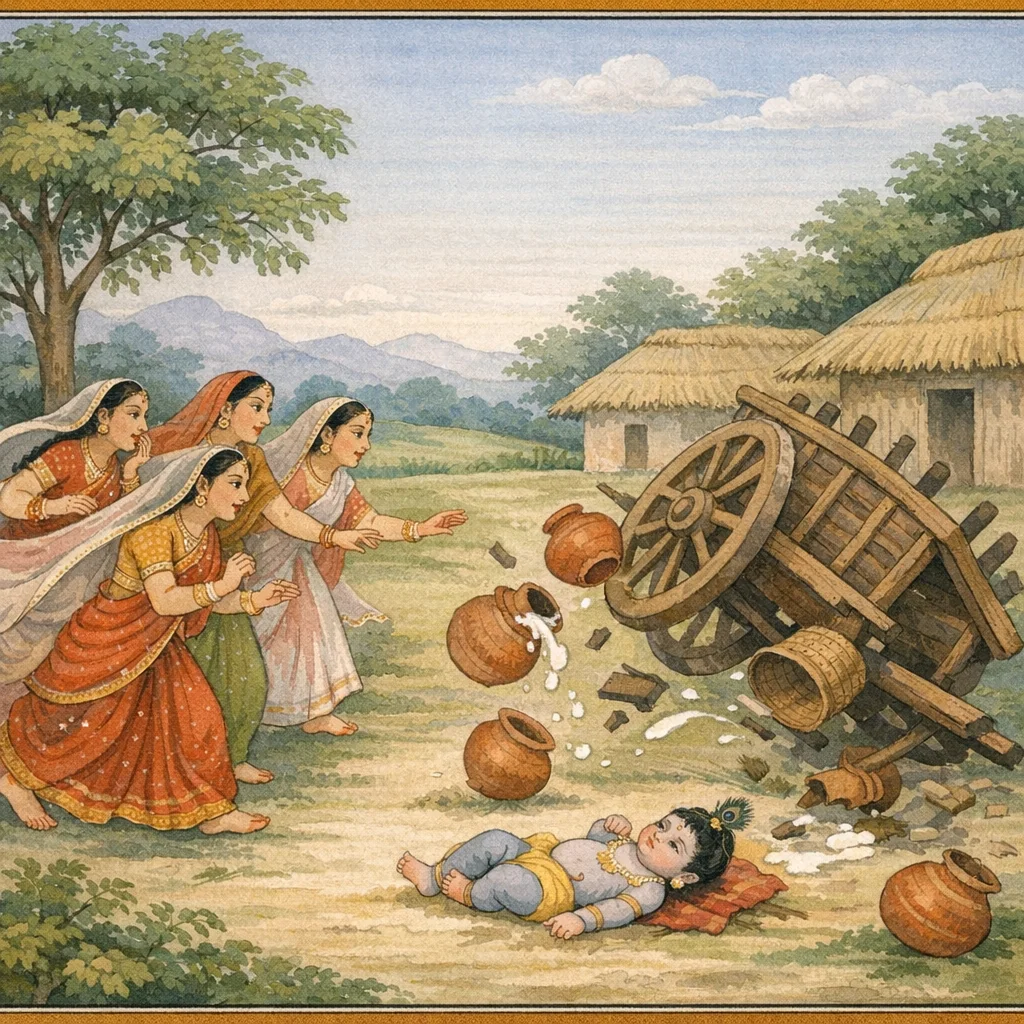
Parāśara tells Maitreya that infant Kṛṣṇa, lying beneath a cart and crying for milk, kicks upward; the cart overturns and the vessels shatter. The people of Vraja rush in, and children and gopīs testify it was the baby’s foot. Yaśodā performs worship to restore auspiciousness. Secretly, sage Garga—sent by Vasudeva—conducts rites and names the boys: the elder Rāma and the younger Kṛṣṇa. As they grow, their playful mischief increases; Yaśodā binds Kṛṣṇa to a mortar, and the bound Lord drags it between the twin Arjuna trees, breaking them—thus he is famed as Dāmodara. Alarmed by repeated “omens” (Pūtanā’s fall, the cart incident, and trees falling without cause), the elders decide to relocate to Vṛndāvana. By Kṛṣṇa’s auspicious contemplation, fresh grass springs up even in the hot season, and the settlement is arranged in a half-moon. The chapter closes with pastoral līlā, seasonal imagery, and didactic similes, as Kṛṣṇa and Rāma appear as calf-herds—guardians of the world in the guise of children.
Shlokas
Verse 1
कदाचिच् छकटस्याधः शयानो मधुसूदनः चिक्षेप चरणाव् ऊर्ध्वं स्तन्यार्थी प्ररुरोद च
Once, Madhusūdana, in the guise of an infant, lay beneath a cart; longing for his mother’s milk, he cried and in that very moment flung his little feet upward.
Verse 2
तस्य पादप्रहारेण शकटं परिवर्तितम् विध्वस्तकुम्भभाण्डं तद् विपरीतं पपात च
By the mere strike of his foot, the cart was overturned; its pots and vessels were shattered, and the whole contrivance fell upside down.
Verse 3
ततो हाहाकृतः सर्वो गोपगोपीजनो द्विज आजगामाथ ददृशे बालम् उत्तानशायिनम्
Then, O twice-born one, all the cowherds and cowherd-women, crying out in alarm, rushed there; and they beheld the child lying on his back, face upward.
Verse 4
गोपाः केनेति केनेदं शकटं परिवर्तितम् तत्रैव बालकाः प्रोचुर् बालेनानेन पातितम्
The cowherds cried, “By whom—by whom has this cart been overturned?” Right there, the children replied, “It was knocked down by this very boy.”
Verse 5
रुदता दृष्टम् अस्माभिः पादविक्षेपताडितम् शकटं परिवृत्तं वै नैतद् अन्यस्य चेष्टितम्
We ourselves saw it: while the child was crying, the cart was struck merely by the flinging movement of his little feet—and at once the cart overturned. This could not have been the doing of anyone else.
Verse 6
ततः पुनर् अतीवासन् गोपा विस्मितचेतसः नन्दगोपो ऽपि जग्राह बालम् अत्यन्तविस्मितः
Then once again the cowherds stood utterly astonished, their minds seized by wonder; and Nanda the cowherd too, profoundly amazed, took the child into his arms.
Verse 7
यशोदा शकटारूढभग्नभाण्डकपालिकाः शकटं चार्चयाम् आस दधिपुष्पफलाक्षतैः
Yaśodā, gathering up the shattered pots and their broken shards that had been on the cart, proceeded to worship that very cart with curds, flowers, fruits, and unbroken grains.
Verse 8
गर्गश् च गोकुले तत्र वसुदेवप्रचोदितः प्रच्छन्न एव गोपानां संस्कारान् अकरोत् तयोः
There in Gokula, the sage Garga—urged by Vasudeva—performed, in secrecy from the cowherds, the consecratory rites for those two boys.
Verse 9
ज्येष्ठं च रामम् इत्य् आह कृष्णं चैव तथापरम् गर्गो मतिमतां श्रेष्ठो नाम कुर्वन् महामतिः
Then the great sage Garga—foremost among the wise, and of profound understanding—while bestowing names, declared the elder child to be “Rāma,” and likewise named the younger one “Kṛṣṇa.”
Verse 10
स्वल्पेनैव हि कालेन रिङ्गिणौ तौ तदा व्रजे घृष्टजानुकरौ विप्र बभूवतुर् उभाव् अपि
In but a short time, O brāhmaṇa, those two in Vraja became swift little crawlers; and as they moved about, both of them had their knees rubbed raw from crawling on the ground.
Verse 11
करीषभस्मदिग्धाङ्गौ भ्रममाणाव् इतस् ततः न निवारयितुं सेहे यशोदा न च रोहिणी
With limbs smeared in cow-dung and ash, the two boys wandered here and there; and neither Yaśodā nor Rohiṇī was able to restrain them.
Verse 12
गोवाटमध्ये क्रीडन्तौ वत्सवाटगतौ पुनः तदहर्जातगोवत्सपुच्छाकर्षणतत्परौ
Sporting in the cow-pen, they would again wander into the calves’ enclosure; and there, intent on mischief, they busied themselves in tugging at the tails of the newborn calves of that very day.
Verse 13
यदा यशोदा तौ बालाव् एकस्थानचराव् उभौ शशाक नो वारयितुं क्रीडन्ताव् अतिचञ्चलौ
Whenever Yaśodā tried to keep those two boys—both roaming together in the same place—from their play, she could not restrain them at all; for as they played, they were exceedingly restless and swift in their mischief.
Verse 14
दाम्ना बद्ध्वा तदा मध्ये निबबन्ध उलूखले कृष्णम् अक्लिष्टकर्माणम् आह चेदम् अमर्षिता
Then, taking a rope, she bound Kṛṣṇa—He whose deeds are effortless and unwearied—and fastened Him in the middle to the mortar; and, still burning with indignation, she spoke these words.
Verse 15
यदि शक्नोषि गच्छ त्वम् अतिचञ्चलचेष्टित इत्य् उक्त्वा च निजं कर्म सा चकार कुटुम्बिनी
“If you are able, then go,” she said—rebuking him as one of excessively restless behavior; and having spoken thus, the housewife returned to her own allotted duties and carried on with her work.
Verse 16
व्यग्रायाम् अथ तस्यां स कर्षमाण उलूखलम् यमलार्जुनमध्येन जगाम कमलेक्षणः
Then, while she was distracted, the lotus-eyed Lord—dragging the heavy mortar behind Him—went straight between the twin Yamala-arjuna trees.
Verse 17
कर्षता वृक्षयोर् मध्ये तिर्यग्गतम् उलूखलम् भग्नाव् उत्तुङ्गशाखाग्रौ तेन तौ यमलार्जुनौ
As He dragged the mortar along, it slipped sideways between the two trees; and by that very force the lofty crown-branches were shattered—so those twin Yamala-arjuna trees were broken down.
Verse 18
ततः कटकटाशब्दसमाकर्णनकातरः आजगाम व्रजजनो ददृशे च महाद्रुमौ
Then, alarmed on hearing the harsh cracking sound, the people of Vraja hurried to the spot—and there they beheld the two great trees.
Verse 19
भग्नस्कन्धौ निपतितौ भग्नशाखौ महीतले नवोद्गताल्पदन्तांशुसितहासं च बालकम् तयोर् मध्यगतं बद्धं दाम्ना गाढं तथोदरे
Both trunks lay shattered, and their broken branches had crashed upon the earth. And there, between them, was a little child—smiling with a bright, milk-white laugh, his newly sprouting teeth gleaming like rays—yet bound fast with a rope, tightly tied about his belly.
Verse 20
ततश् च दामोदरतां स ययौ दामबन्धनात्
And then, because He was bound with a rope around His waist, He came to be known by the name “Dāmodara”—the Supreme Lord accepting, through loving devotion, even the mark of bondage.
Verse 21
गोपवृद्धास् ततः सर्वे नन्दगोपपुरोगमाः मन्त्रयाम् आसुर् उद्विग्ना महोत्पातातिभीरवः
Then all the elder cowherds—led by Nanda, chief among the gopas—sat down in anxious counsel, their hearts shaken with fear at the great and dreadful omens.
Verse 22
स्थानेनेह न नः कार्यं व्रजामो ऽन्यन् महावनम् उत्पाता बहवो ह्य् अत्र दृश्यन्ते नाशहेतवः
This place is of no use to us now; let us depart to another great forest. For here many ominous portents are seen—signs that foretell ruin.
Verse 23
पूतनाया विनाशश् च शकटस्य विपर्ययः विना वातादिदोषेण द्रुमयोः पतनं तथा
There was the destruction of Pūtanā, the overturning of the cart, and likewise the falling of the twin trees—events that occurred not from any fault of wind or other natural causes.
Verse 24
वृन्दावनम् इतः स्थानात् तस्माद् गच्छाम मा चिरम् यावद् भौममहोत्पातदोषो नाभिभवेद् व्रजम्
Therefore let us not delay—let us go from this place to Vṛndāvana at once, before the baleful taint of some great earthly portent overwhelms Vraja.
Verse 25
इति कृत्वा मतिं सर्वे गमने ते व्रजौकसः ऊचुः स्वं स्वं कुलं शीघ्रं गम्यतां मा विलम्ब्यताम्
Having thus resolved upon departure, all the dwellers of Vraja said: “Let each return at once to his own clan and household—go quickly; do not delay.”
Verse 26
ततः क्षणेन प्रययुः शकटैर् गोधनैस् तथा यूथशो वत्सपालांश् च कालयन्तो व्रजौकसः
Then, in a moment, the people of Vraja set out with their wagons and their wealth of cattle; and, gathering the calf-herds in groups, they called them and gave directions, setting the pastoral order of the settlement as they went.
Verse 27
द्रव्यावयवनिर्धूतं क्षणमात्रेण तत् तदा काकभाससमाकीर्णं व्रजस्थानम् अभूद् द्विज
In that very moment, O twice-born, the goods and belongings were shaken loose and scattered; and the settlement of Vraja became filled on every side with crows and vultures, as though a dark omen had descended.
Verse 28
वृन्दावनं भगवता कृष्णेनाक्लिष्टकर्मणा शुभेन मनसा ध्यातं गवां वृद्धिम् अभीप्सता
Bhagavān Krishna—whose deeds are effortless and untroubled—contemplated the forest of Vṛndāvana with an auspicious, benevolent mind, desiring the increase and well-being of the cows.
Verse 29
ततस् तत्रातिरूक्षे ऽपि घर्मकाले द्विजोत्तम प्रावृट्काल इवोद्भूतं नवशष्पं समन्ततः
Then, O best of Brahmins, though it was the scorching season and the land was exceedingly parched, fresh young grass sprang up everywhere, as if the monsoon rains had suddenly arrived.
Verse 30
स समावासितः सर्वो व्रजो वृन्दावने ततः शकटीवाटपर्यन्तश् चन्द्रार्धाकारसंस्थितिः
Thereafter he settled the entire cowherd community in Vṛndāvana; and the encampment, extending as far as the place of the carts, was arranged in the form of a half-moon.
Verse 31
वत्सपालौ च संवृत्तौ रामदामोदरौ ततः एकस्थानस्थितौ गोष्ठे चेरतुर् बाललीलया
Thereafter, Rāma and Dāmodara became guardians of the calves; staying together in one place within the cowherd settlement, they wandered in sacred boyhood play.
Verse 32
बर्हिपत्रकृतापीडौ वन्यपुष्पावतंसकौ गोपवेणुकृतातोद्यौ पत्रवाद्यकृतस्वनौ
Crowned with peacock-feather plumes and adorned with wild forest flowers, they played the cowherds’ flutes and filled the air with music from instruments made of leaves.
Verse 33
काकपक्षधरौ बालौ कुमाराव् इव पावकी हसन्तौ च रमन्तौ च चेरतुस् तन् महावनम्
Two young boys, their hair dressed in the crow’s-wing style, wandered that vast forest like a pair of youthful fire-born princes—laughing and delighting as they played.
Verse 34
क्वचिद् धसन्ताव् अन्योन्यं क्रीडमानौ तथापरैः गोपपुत्रैः समं वत्सांश् चारयन्तौ विचेरतुः
At times, laughing together and playing with one another, the two wandered about; and with other cowherd boys they grazed the calves, roaming freely through the pastoral land.
Verse 35
कालेन गच्छता तौ तु सप्तवर्षौ महाव्रजे सर्वस्य जगतः पालौ वत्सपालौ बभूवतुः
As time moved onward, dwelling in great Vraja, those two spent seven years as guardians of the whole world, though outwardly they appeared as simple keepers of the calves.
Verse 36
प्रावृट्कालस् ततो ऽतीव मेघौघस्थगिताम्बरः बभूव वारिधाराभिर् ऐक्यं कुर्वन् दिशाम् इव
Then came the season of rains—so fierce that the sky was hidden by surging masses of clouds; and by its unbroken streams of water it seemed to fuse the quarters into one, erasing their separateness.
Verse 37
प्ररूढनवशष्पाढ्या शक्रगोपास्तृता मही तदा मारकतेवासीत् पद्मरागविभूषिता
Then the earth, rich with freshly sprouted tender grass and carpeted with śakragopas, appeared like an emerald—adorned, as it were, with rubies.
Verse 38
ऊहुर् उन्मार्गवाहीनि निम्नगाम्भांसि सर्वतः मनांसि दुर्विनीतानां प्राप्य लक्ष्मीं नवाम् इव
As waters that flow downward are driven in every direction into wayward channels, so too the minds of the undisciplined—upon gaining new prosperity—are scattered and led astray.
Verse 39
न रेजे ऽन्तरितश् चन्द्रो निर्मलो मलिनैर् घनैः सद्वाक्यवादो मूर्खाणां प्रगल्भाभिर् इवोक्तिभिः
The stainless moon does not shine when it is veiled by foul, dark clouds; so too, among fools, true and noble speech finds no radiance, as though smothered by their brazen utterances.
Verse 40
निर्गुणेनापि चापेन शक्रस्य गगने पदम् अवाप्यताविवेकस्य नृपस्येव परिग्रहे
Even with a bow that lacks all excellence, he would still contrive to win a foothold in Indra’s very sky—so too does a king bereft of discernment press onward in the grasping of possessions.
Verse 41
मेघपृष्ठे बलाकानां रराज विमला ततिः दुर्वृत्ते वृत्तचेष्टेव कुलीनस्यातिशोभना
Against the dark back of the clouds, a spotless line of cranes shone forth—so does noble conduct, radiant and unmistakable, appear even amid the ill‑mannered, as virtue itself set like an ornament.
Verse 42
न बबन्धाम्बरे स्थैर्यं विद्युद् अत्यन्तचञ्चला मैत्रीव प्रवरे पुंसि दुर्जनेन प्रयोजिता
Lightning, restless beyond measure, never binds itself to steadiness in the sky; so too the friendship a wicked man offers a noble soul—flickering for a moment, then vanishing without faith or firmness.
Verse 43
मार्गा बभूवुर् अस्पष्टा नवशष्पचयावृताः अर्थान्तरम् अनुप्राप्ताः प्रजडानाम् इवोक्तयः
The paths of right conduct grew indistinct, as though overgrown with thick clumps of fresh grass; and words, too, slipped into other meanings—like the talk of the dull‑witted—so that truth could no longer be clearly known.
Verse 44
उन्मत्तशिखिसारङ्गे तस्मिन् काले महावने कृष्णरामौ मुदा युक्तौ गोपालैश् चेरतुः सह
At that time, in the great forest—alive with peacocks in rapture and deer roaming freely—Kṛṣṇa and Rāma (Balarāma), filled with joy, wandered together in the company of the cowherd boys.
Verse 45
क्वचिद् गोभिः समं रम्यं गेयतानरताव् उभौ चेरतुः क्वचिद् अत्यर्थं शीतवृक्षतलाश्रयौ
At times the two wandered delightfully with the cattle, absorbed in song and dance; at other times, seeking deep refreshment, they rested beneath the shade at the base of cool, sheltering trees.
Verse 46
क्वचित् कदम्बस्रक्चित्रौ मयूरस्रग्धरौ क्वचित् विचित्रौ क्वचिद् आसातां विविधैर् गिरिधातुभिः
At times the two were beautifully adorned with garlands of kadamba blossoms; at times they wore wreaths of peacock feathers; and at other moments their forms shone in ever-new patterns, decorated with many-colored mineral pigments from the hills—revealing, through playful variety, a beauty that never repeats itself.
Verse 47
पर्णशय्यासु संसुप्तौ क्वचिन् निद्रान्तरैषिणौ क्वचिद् गर्जति जीमूते हाहाकाररवादृतौ
They lay asleep upon beds of leaves; at times they would startle, seeking another snatch of sleep. At times the clouds thundered, and they were shaken awake by the clamour of cries—“hā hā!”—rising all around.
Verse 48
गायताम् अन्यगोपानां प्रशंसापरमौ क्वचित् मयूरकेकानुगतौ गोपवेणुप्रवादकौ
At times, while other cowherds sang, the two were foremost in praise; at times, keeping pace with the peacock’s call, those two cowherds played upon the flute—moving in harmony with the music of the forest itself.
Verse 49
इति नानाविधैर् भावैर् उत्तमप्रीतिसंयुतौ क्रीडन्तौ तौ वने तस्मिञ् चेरतुस् तुष्टमानसौ
Thus, bound together by the finest mutual affection and stirred by many changing moods of delight, the two of them sported in that forest—wandering there with hearts wholly satisfied.
Verse 51
गोपैः समानैः सहितौ क्रीडन्ताव् अमराव् इव
Accompanied by cowherd boys of their own age, the two of them played about—appearing like a pair of immortals moving among mortals.
Frequently Asked Questions
It encodes bhakti-siddhānta: the Supreme Lord, though Jagat-kāraṇa, accepts ‘bondage’ (dāma) around the belly (udara) through a devotee’s love—showing that prema, not force, can ‘bind’ Bhagavān.
To protect the children from Kaṃsa’s surveillance and to preserve the avatāra’s hiddenness (rahasya) while still completing saṃskāra—uniting social dharma with divine strategy.
Kṛṣṇa’s auspicious intention is shown as causally efficacious in nature itself (fresh grass arising out of season), implying the Lord’s immanent governance of ecology and prosperity while remaining personally present among devotees.