Adhyaya 10
शरद्वर्णनं, योगोपमा, तथा गोवर्धन-यज्ञप्रवर्तनम्
Parāśara tells Maitreya that as Rāma and Keśava sport in Vraja, the shift from rains to autumn becomes a lesson in yoga and vairāgya: fish trapped in shallow ponds are like householders bound by mamatā; clouds pour out and depart like the wise who leave attachment; water and sky grow clear like the mind purified by yoga and by knowing all-pervading Viṣṇu. Autumn is likened to pratyāhāra withdrawing the senses, and the cycle of filling and emptying to prāṇāyāma. The tale then turns to Indra’s impending move against Vraja. Kṛṣṇa questions the Śakra worship; Nanda explains Indra’s role in rain and the reciprocity of sustenance. Kṛṣṇa redirects devotion through vārttā (agriculture–trade–cattle-rearing) and svadharma: Vraja depends on cows and mountains, so Govardhana and the cows should be honored. The people perform the Govardhana-yajña, feed brāhmaṇas, circumambulate the hill with cows, and Kṛṣṇa manifests as the mountain to accept offerings and grant boons.
Shlokas
Verse 1
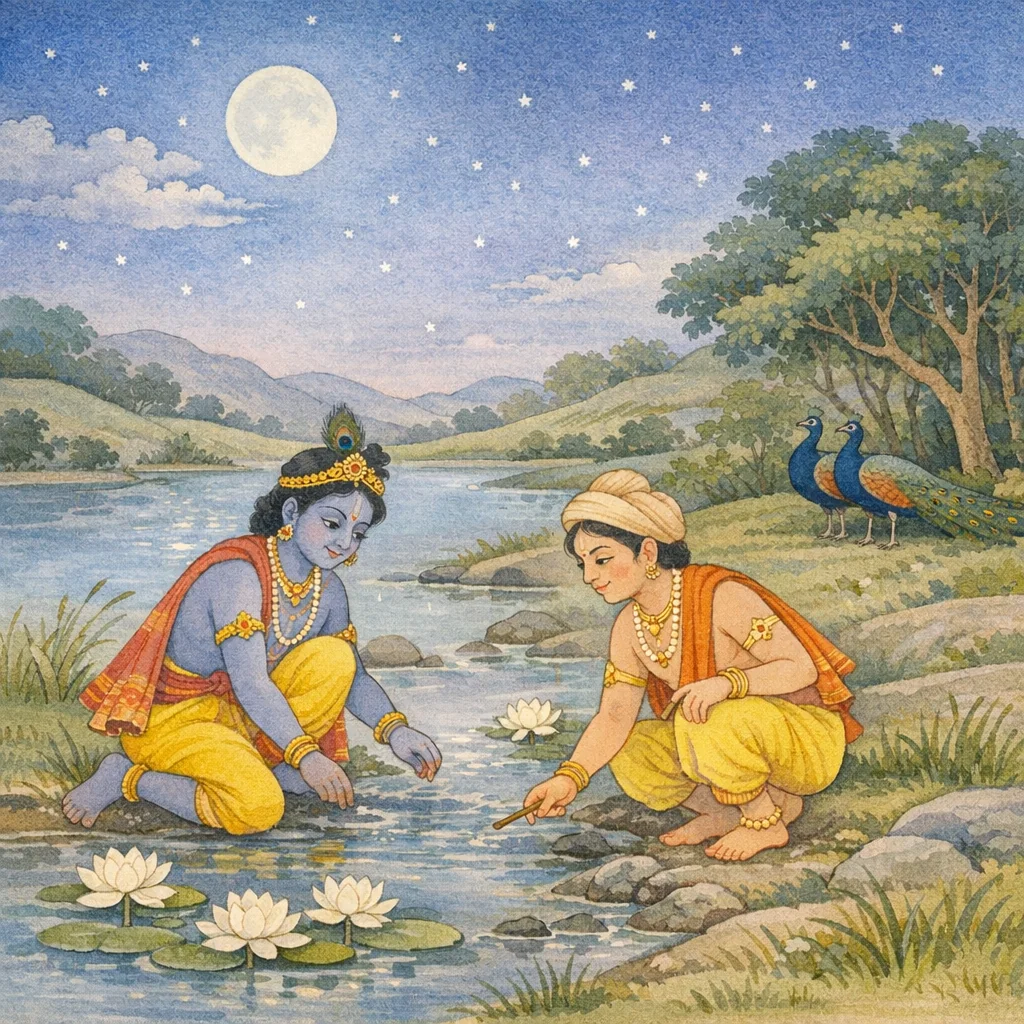
तयोर् विहरतोर् एवं रामकेशवयोर् व्रजे प्रावृड् _व्यतीता विकसत्सरोजा चाभवच् छरत्
Thus, as Rāma and Keśava sported together in Vraja, the rainy season passed away; and autumn arrived—its lotus-blooms opening—like a gentle revealing of order after the turbulence of clouds.
Verse 2
अवापुस् तापम् अत्यर्थं शफर्यः पल्वलोदके पुत्रक्षेत्रादिसक्तेन ममत्वेन यथा गृही
In the shallow water of a little pond the fish fell into intense suffering; so too a householder, clinging to son, field, and the rest, bound by the possessive sense of “mine,” comes to anguish.
Verse 3
मयूरा मौनिनस् तस्थुः परित्यक्तमदा वने असारतां परिज्ञाय संसारस्येव योगिनः
The peacocks stood silent in the forest, their pride cast away—having understood the hollowness of worldly life, like yogins who discern the futility of saṃsāra.
Verse 4
उत्सृज्य जलसर्वस्वं विमलाः सितमूर्तयः तत्यजुश् चाम्बरं मेघा गृहं विज्ञानिनो यथा
Having released all the water they held, the clouds—pure, white-bodied, and cleansed—then abandoned the sky, just as the wise, possessing true discernment, depart from the house of worldly attachment.
Verse 5
शरत्सूर्यांशुतप्तानि ययुः शोषं सरांसि च बह्वालम्बिममत्वेन हृदयानीव देहिनाम्
Scorched by the autumn sun’s rays, the lakes and pools were dried up—like the hearts of embodied beings, which wither when they cling to many supports through possessive attachment.
Verse 6
कुमुदैः शरदम्भांसि योग्यतालक्षणं ययुः अवबोधैर् मनांसीव संबन्धम् अमलात्मनाम्
By the blooming white lotuses, the autumnal waters attained the very mark of fitness and clarity; so too, by the rise of true understanding, minds enter into pure communion with the stainless-souled.
Verse 7
तारकाविमले व्योम्नि रराजाखण्डमण्डलः चन्द्रश् चरमदेहात्मा योगी साधुकुले यथा
In the stainless, star-strewn sky, the Moon shone as a flawless, unbroken orb—like a perfected yogin, established in the final body, radiant among the company of the virtuous.
Verse 8
शनकैः शनकैस् तीरं तत्यजुश् च जलाशयाः ममत्वं क्षेत्रपुत्रादिरूढम् उच्चैर् यथा बुधाः
Just as lakes and reservoirs little by little forsake their banks, so the wise gradually cast off the loudly-rooted sense of “mine”—possessiveness fastened upon field, child, and the rest.
Verse 9
पूर्वत्यक्तैः सरोऽम्भोभिर् हंसा योगं पुनर् ययुः क्लेशैः कुयोगिनो ऽशेषैर् अन्तरायहता इव
As swans return again to the yogic path by resorting to the waters of lakes once abandoned, so misguided practitioners—struck down by obstacles and afflicted by every torment—turn back once more toward discipline, as though compelled by suffering itself.
Verse 10
निभृतो ऽभवद् अत्यर्थं समुद्रः स्तिमितोदकः क्रमावाप्तमहायोगो निश्चलात्मा यथा यतिः
The ocean grew profoundly hushed, its waters stilled and motionless—like a great yogin who, having gradually attained the highest Yoga, abides with an unwavering, steady self, as does a disciplined ascetic.
Verse 11
सर्वत्रातिप्रसन्नानि सलिलानि तदाभवन् ज्ञाते सर्वगते विष्णौ मनांसीव सुमेधसाम्
Then, everywhere, the waters became exceedingly clear and tranquil—when Vishnu, the all-pervading One, was truly known—just as the minds of the wise grow serene upon realization of the Supreme.
Verse 12
बभूव विमलं व्योम शरदाध्वस्ततोयदम् योगाग्निदग्धक्लेशौघं योगिनाम् इव मानसम्
The sky became spotless—like the autumn heavens when the rain-clouds are driven away—resembling the mind of yogins, whose heaps of affliction are burned up by the fire of Yoga.
Verse 13
सूर्यांशुजनितं तापं निन्ये तारापतिः शमम् अहंकारोद्भवं दुःखं विवेकः सुमहान् इव
As the Lord of the stars (the Moon) draws the heat born of the Sun’s rays into calm, so does mighty discernment lead into quietude the sorrow that arises from egoism.
Verse 14
नभसो ऽब्दान् भुवः पङ्कं कालुष्यं चाम्भसः शरत् इन्द्रियाणीन्द्रियार्थेभ्यः प्रत्याहार इवाहरत्
Autumn (Śarat) drew away the clouds from the sky, the mire from the earth, and the turbidity from the waters—just as pratyāhāra withdraws the senses from their objects, restoring clarity within.
Verse 15
प्राणायाम इवाम्भोभिः सरसां कृतपूरकैः अभ्यस्यते ऽनुदिवसं रेचकाकुम्भकादिभिः
As prāṇāyāma is practiced day after day through inhalation, exhalation, retention, and the rest, so the lakes’ waters, filled again and again, continually move in their own rhythmic cycle.
Verse 16
विमलाम्बरनक्षत्रे काले चाभ्यागते व्रजम् ददर्शेन्द्रमहारम्भाय्(अ) (उ)द्यतांस् तान् व्रजौकसः
When the time arrived under the asterism Vimālāmbara, the people of Vraja beheld that Indra’s mighty undertaking was being set in motion against them—an onrush poised to fall upon the cowherd settlement.
Verse 17
कृष्णस् तान् उत्सुकान् दृष्ट्वा गोपान् उत्सवलालसान् कौतूहलाद् इदं वाक्यं प्राह वृद्धान् महामतिः
Seeing the cowherds, eager and yearning for the festival, the great-souled Śrī Kṛṣṇa, with playful curiosity, spoke these words to the elders.
Verse 18
को ऽयं शक्रमहो नाम येन वो हर्ष आगतः प्राह तं नन्दगोपश् च पृच्छन्तम् अतिसादरम्
“Who is this one called ‘Śakra-maha’, by whom you have become so joyful?”—thus Nanda the cowherd spoke with great courtesy to the earnest inquirer.
Verse 19
मेघानां पयसां चेशो देवराजः शतक्रतुः तेन संचोदिता मेघा वर्षन्त्य् अम्बुमयं रसम्
Indra—the king of the gods, famed as Śatakratu—rules over clouds and waters; urged by him, the clouds pour down their watery essence as rain.
Verse 20
तद् वृष्टिजनितं सस्यं वयम् अन्ये च देहिनः वर्तयामोपभुञ्जानास् तर्पयामश् च देवताः
From that rain grain is born; by consuming it, we and all embodied beings are sustained, and by it we also nourish and satisfy the gods.
Verse 21
क्षीरवत्य इमा गावो वत्सवत्यश् च निर्वृताः तेन संवर्धितैः सस्यैस् तुष्टाः पुष्टा भवन्ति वै
These cows, rich in milk and rejoicing with their calves, become serene; and by the harvests nourished thereby, they are truly satisfied and well-fed.
Verse 22
नासस्या नातृणा भूमिर् न बुभुक्षार्दितो जनः दृश्यते यत्र दृश्यन्ते वृष्टिमन्तो बलाहकाः
In that land the earth is never without grain, never without grasses; nor are people seen tormented by hunger—for there, rain-laden clouds are ever to be seen.
Verse 23
भौमम् एतत् पयो दुग्धं गोभिः सूर्यस्य वारिदः पर्जन्यः सर्वलोकस्य भवाय भुवि वर्षति
This earthly milk—nourishment like milk—is drawn forth by the Sun’s rays as though by cows; and the rain-bearing cloud, as Parjanya, pours it upon the earth for the welfare of all the worlds.
Verse 24
तस्मात् प्रावृषि राजानः सर्वे शक्रं मुदा युताः महैः सुरेशम् अर्चन्ति वयम् अन्ये च मानवाः
Therefore, when the rainy season arrives, all kings—filled with gladness—worship Śakra (Indra), lord of the gods, with great ceremonies; and so do we, and other people as well.
Verse 25
नन्दगोपस्य वचनं श्रुत्वेत्थं शक्रपूजने कोपाय त्रिदशेन्द्रस्य प्राह दामोदरस् तदा
Hearing Nanda Gopa speak thus about the worship of Śakra (Indra), Dāmodara then spoke, foreseeing that the lord of the gods would be provoked to anger.
Verse 26
न वयं कृषिकर्तारो वाणिज्याजीविनो न च गावो ऽस्मद्दैवतं तात वयं वनचरा यतः
We are not tillers of the soil, nor do we live by trade. Dear father, cows are not our chosen divinity either—because by our very way of life we are dwellers of the forest.
Verse 27
आन्वीक्षिकी त्रयी वार्ता दण्डनीतिस् तथापरा विद्याचतुष्टयं चैतद् वार्ताम् अत्र शृणुष्व मे
Inquiry into first principles, the triple Veda, vārtā (the science of livelihood), and daṇḍanīti (the science of governance and punishment)—these four together are proclaimed as the complete body of knowledge. Now, in this context, hear from me the teaching concerning vārtā.
Verse 28
कृषिर् वणिज्या तद्वच् च तृतीयं पशुपालनम् विद्या ह्य् एका महाभाग वार्ता वृत्तित्रयाश्रया
Agriculture, trade, and thirdly the tending of cattle—these three are the livelihoods called vārtā. Yet, O noble one, it is a single discipline, for vārtā-knowledge rests upon these three modes of subsistence.
Verse 29
कर्षकाणां कृषिर् वृत्तिः पण्यं विपणिजीविनाम् अस्माकं गौः परा वृत्तिर् वार्ताभेदैर् इयं त्रिभिः
For cultivators, agriculture is their livelihood; for those who live by trade, commerce is their sustenance. But for us, the cow is the highest support of life—for this whole sphere of vārtā is understood as threefold in its divisions.
Verse 30
विद्यया यो यया युक्तस् तस्य सा दैवतं महत् सैव पूज्यार्चनीया च सैव तस्योपकारिका
Whatever knowledge a person is truly endowed with—for that person, that very knowledge is a great divinity. It alone is worthy of reverent worship and devoted honoring, and it alone becomes the benefactress that supports and uplifts them.
Verse 31
यो ऽन्यस्याः फलम् अश्नन् वै पूजयत्य् अपरां नरः इह च प्रेत्य चैवासौ तात नाप्नोति शोभनम्
But the man who partakes of the fruit of one woman, yet offers honor and worship to another—dear one—attains nothing auspicious, neither in this world nor after death.
Verse 32
कृष्यन्ताः प्रथिताः सीमाः सीमान्तं च पुनर् वनम् वनान्ता गिरयः सर्वे ते चास्माकं परा गतिः
The lands made famous by tilling, brought beneath the plough—these are our boundary-marks; beyond the border, the forest rises again. And at the forest’s farthest edge stand the mountains: for us, those mountains are the final limit, the utmost reach of our course.
Verse 33
न द्वारबन्धावरणा न गृहक्षेत्रिणस् तथा सुखिनस् त्व् अखिले लोके यथा वै चक्रचारिणः
Those shut in by barred doors and bolted gates are not truly at ease; nor are householders bound to house and field. In all the world, none are so untroubled and content as those who “move with the wheel”—the sovereigns whose royal cakra turns unobstructed.
Verse 34
श्रूयन्ते गिरयश् चामी वने ऽस्मिन् कामरूपिणः तत् तद् रूपं समास्थाय रमन्ते स्वेषु सानुषु
It is heard, O Maitreya, that in this very forest there are mountains that can assume whatever form they desire. Taking on this or that chosen shape, they delight upon their own slopes.
Verse 35
यदा चैते ऽपराध्यन्ते तेषां ये काननौकसः तदा सिंहादिरूपैस् तान् घातयन्ति महीधराः
And whenever those forest-dwellers commit transgression, the mountain-lords assume the forms of lions and the like, and strike the offenders down.
Verse 36
गिरियज्ञस् त्व् अयं तस्माद् गोयज्ञश् च प्रवर्त्यताम् किम् अस्माकं महेन्द्रेण गावः शैलाश् च देवताः
“Therefore let this be a sacrifice to the mountain, and let the worship of the cows be set in motion as well. What need have we of Mahendra (Indra)? For cows and mountains themselves are our divinities.”
Verse 37
मन्त्रयज्ञपरा विप्राः सीरयज्ञाश् च कर्षकाः गिरिगोयज्ञशीलाश् च वयम् अद्रिवनाश्रयाः
The brāhmaṇas are devoted to yajña through sacred mantras; the farmers perform the ‘plough-yajña’ by their tilling; and we, dwelling in mountains and forests, are inclined to offerings for hills and cattle.
Verse 38
तस्माद् गोवर्धनः शैलो भवद्भिर् विविधार्हणैः अर्च्यतां पूज्यतां मेध्यं पशुं हत्वा विधानतः
Therefore, honor Govardhana mountain with offerings of many kinds; worship and revere it; and, according to rule, ritually offer a pure and fit animal as ordained.
Verse 39
सर्वघोषस्य संदोहो गृह्यतां मा विचार्यताम् भोज्यन्तां तेन वै विप्रास् तथा ये चाभिवाञ्छकाः
Gather the entire store of provisions of the whole settlement—do not deliberate or hesitate. With it, duly feed the brāhmaṇas, and also all who come seeking aid.
Verse 40
समर्चिते कृते होमे भोजितेषु द्विजातिषु शरत्पुष्पकृतापीडाः परिगच्छन्तु गोगणाः
When the worship is duly performed, the homa completed, and the dvija guests fed, then let the herds of cows be respectfully sent forth, adorned with garlands of autumn flowers.
Verse 41
एतन् मम मतं गोपाः संप्रीत्या क्रियते यदि ततः कृता भवेत् प्रीतिर् गवाम् अद्रेस् तथा मम
This is my considered view, O cowherds: if it is carried out with glad devotion, then goodwill will be secured—cattle will be content, the mountain will be pleased, and I too will be pleased.
Verse 42
इति तस्य वचः श्रुत्वा नन्दाद्यास् ते व्रजौकसः प्रीत्युत्फुल्लमुखा विप्र साधु साध्व् इत्य् अथाब्रुवन्
Hearing his words, Nanda and the other dwellers of Vraja shone with joy; O Brahmana, their faces blossoming with gladness, they cried, “Well spoken! Well spoken!”
Verse 43
शोभनं ते मतं वत्स यद् एतद् भवतोदितम् तत् करिष्यामहे सर्वं गिरियज्ञः प्रवर्त्यताम्
“Excellent is your counsel, dear child—what you have proposed. We shall do all accordingly; let the sacrifice to Mount Govardhana be set in motion.”
Verse 44
तथा च कृतवन्तस् ते गिरियज्ञं व्रजौकसः दधिपायसमांसाद्यैर् ददुः शैलबलिं ततः
Thus the dwellers of Vraja performed the sacrifice to the Mountain; then, with curds, sweet rice, meats, and other offerings, they presented a bali—sacred oblations—to the hill.
Verse 45
द्विजांश् च भोजयाम् आसुः शतशो ऽथ सहस्रशः
And they fed the twice-born—first by the hundreds, and then by the thousands.
Verse 46
गावः शैलं ततश् चक्रुर् अर्चितास् ताः प्रदक्षिणम् ऋषभाश् चापि नर्दन्तः सतोया जलदा इव
Then the cows, thus honoured, circumambulated the mountain in pradakṣiṇa; and the bulls too, bellowing loudly, seemed like rain-laden clouds.
Verse 47
गिरिमूर्धनि कृष्णो ऽपि शैलो ऽहम् इति मूर्तिमान् बुभुजे ऽन्नं बहु तदा गोपवर्याहृतं द्विज
O twice-born sage, upon the mountain’s summit Śrī Kṛṣṇa too assumed a manifest form, declaring, “I am the mountain,” and then accepted and consumed in abundance the food brought by the foremost of the cowherds.
Verse 48
तेनैव कृष्णो रूपेण गोपैः सह गिरेः शिरः अधिरुह्यार्चयाम् आस द्वितीयाम् आत्मनस् तनुम्
Then Śrī Kṛṣṇa, in that very form, ascended the mountain’s summit together with the cowherds, and there performed worship, as though adoring a second embodiment of His own Self.
Verse 49
अन्तर्धानं गते तस्मिन् गोपा लब्ध्वा ततो वरान् कृत्वा गिरिमहं गोष्ठं निजम् अभ्याययुः पुनः
When He vanished from their sight, the cowherds—having obtained boons—took that great mountain as their refuge and returned once more to their own settlement.
Frequently Asked Questions
Parāśara maps autumnal clarity to mental purification: the clearing sky and waters resemble a yogin’s mind freed by yoga-agni; autumn’s removal of turbidity parallels pratyāhāra; and recurring filling/emptying is likened to prāṇāyāma’s pūraka–recaka–kumbhaka.
Kṛṣṇa redirects ritual from a universalized deva-dependence to worship aligned with Vraja’s svadharma and livelihood (vārttā), asserting that one should honor the sustaining principle actually supporting one’s life—here, Govardhana and cows—while recognizing the Supreme Lord as the true governor behind all.
The narrative illustrates that the Supreme can accept worship through any chosen form (icchā-rūpa) and that the object of sacrifice is ultimately grounded in Him, reinforcing Viṣṇu’s sovereignty over ritual efficacy.