Adhyaya 4
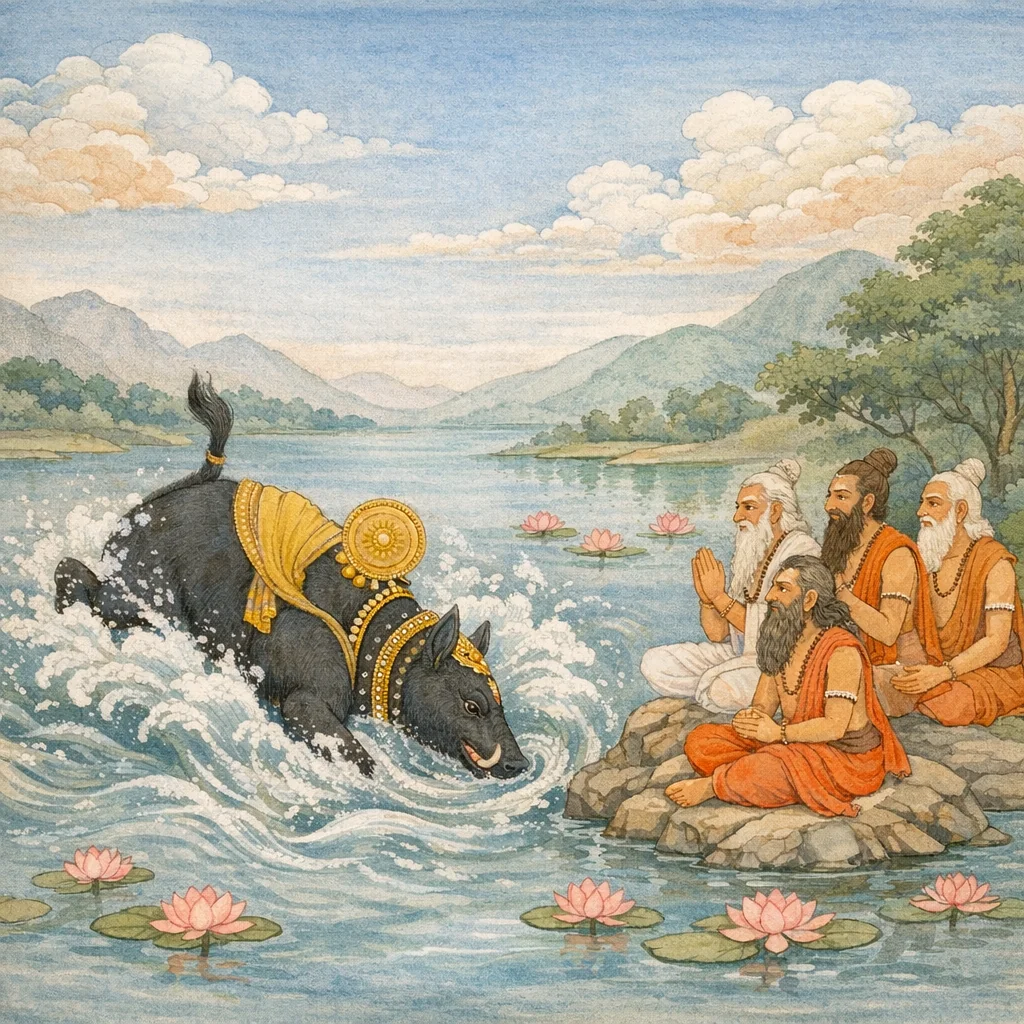
वाराहावतारः (भूम्युद्धारः) — Varāha, the Raising of the Earth and the Recommencement of Creation
Maitreya asks Parāśara how Brahmā, imbued with Nārāyaṇa’s essence, creates at the dawn of a kalpa. Parāśara relates that after dissolution Brahmā awakens, beholds an empty world, and realizes the inconceivable Supreme Lord Nārāyaṇa as the universe’s source and end, explaining “Nārāyaṇa” as He whose abode (ayana) is in the primordial waters (nārā). Finding Earth submerged, the Lord assumes the Varāha form—continuing the earlier Matsya and Kūrma manifestations—with a body constituted of Veda and yajña, praised by Siddhas and sages. Earth and the hymn-voices extol Him as creator, protector, and dissolver; as the manifest and unmanifest; as Time itself; and as the indispensable object of worship through Vāsudeva-bhakti for mokṣa. Varāha raises Earth upon His tusk, restores her stability, recreates mountains and the seven dvīpas, and re-establishes the worlds. Then Hari, taking Brahmā-form under rajas, initiates manifest creation as the efficient cause (nimitta), with Pradhāna as the material basis, while all reality remains pervaded by Him.
Shlokas
Verse 1
ब्रह्मा नारायणाख्यो ऽसौ कल्पादौ भगवान् यथा ससर्ज सर्वभूतानि तद् आचक्ष्व महामुने
O great sage, describe to me how, at the dawn of the kalpa, that Blessed Lord—Brahmā, who bears the name Nārāyaṇa—brought forth all beings into manifestation.
Verse 2
प्रजाः ससर्ज भगवान् ब्रह्मा नारायणात्मकः प्रजापतिपतिर् देवो यथा तन् मे निशामय
Listen as it truly happened: the Blessed Lord Brahmā—whose very essence is Nārāyaṇa—brought forth the beings. That divine Lord, sovereign of the Prajāpatis, began the work of creation.
Verse 3
अतीतकल्पावसाने निशासुप्तोत्थितः प्रभुः सत्त्वोद्रिक्तस् तथा ब्रह्मा शून्यं लोकम् अवैक्षत
When the former kalpa ended, the Lord Brahmā rose from sleep in the night of dissolution; suffused with sattva, he gazed upon the world and found it empty.
Verse 4
नारायणः परो ऽचिन्त्यः परेषाम् अपि स प्रभुः ब्रह्मस्वरूपी भगवान् अनादिः सर्वसंभवः
Nārāyaṇa is the Supreme, beyond thought; even among the highest beings, He alone is Lord. He is Bhagavān, of Brahman-nature, beginningless, the source from whom all arise.
Verse 5
इमं चोदाहरन्त्य् अत्र श्लोकं नारायणं प्रति ब्रह्मस्वरूपिणं देवं जगतः प्रभवाप्ययम्
And here they recite this verse in praise of Nārāyaṇa—of that God of Brahman-nature, who is the universe’s arising and also its passing away.
Verse 6
आपो नारा इति प्रोक्ता आपो वै नरसूनवः अयनं तस्य ताः पूर्वं तेन नारायणः स्मृतः
The waters are called ‘nārā’, for the waters are truly the offspring of Nara. In ancient times they were His resting-place (ayana); therefore He is remembered as Nārāyaṇa, whose abode is the primordial waters.
Verse 7
तोयान्तः स महीं ज्ञात्वा जगत्य् एकार्णवे प्रभुः अनुमानात् तदुद्धारं कर्तुकामः प्रजापतिः
Knowing that the Earth had sunk beneath the waters, and seeing the whole world become a single ocean, the Lord Prajāpati resolved—by inference discerning her whereabouts—to raise her up again.
Verse 8
अकरोत् स तनूम् अन्यां कल्पादिषु यथा पुरा मत्स्यकूर्मादिकां तद्वद् वाराहं वपुर् आस्थितः
Just as in earlier kalpas He assumed other embodied forms—Fish, Tortoise, and the rest—so now too He took upon Himself the divine body of the Boar, Varāha.
Verse 9
वेदयज्ञमयं रूपम् अशेषजगतः स्थितौ स्थितः स्थिरात्मा सर्वात्मा परमात्मा प्रजापतिः
His form is woven of the Veda and of sacrifice; as the very ground of the whole universe’s continuance He abides unmoved—steadfast Self, Self of all, Supreme Self, Prajāpati.
Verse 10
जनलोकगतैः सिद्धैः सनकाद्यैर् अभिष्टुतः प्रविवेश तदा तोयम् आत्माधारो धराधरः
Praised by the siddhas dwelling in Janaloka—Sanaka and the rest—He then entered the waters: the Bearer of the Earth, Himself the ground of all support.
Verse 11
निरीक्ष्य तं तदा देवी पातालतलम् आगतम् तुष्टाव प्रणता भूत्वा भक्तिनम्रा वसुंधरा
Then the Goddess Earth, seeing Him arrived upon the plane of Pātāla, bowed down in reverence and—humbled by devotion—praised Him.
Verse 12
नमस् ते सर्वभूताय तुभ्यं शङ्खगदाधर माम् उद्धरास्माद् अद्य त्वं त्वत्तो ऽहं पूर्वम् उत्थिता
Salutations to You, the indwelling Lord of all beings, O bearer of conch and mace. Rescue me from this state today; for in the beginning I arose from You alone.
Verse 13
त्वयाहम् उद्धृता पूर्वं त्वन्मयाहं जनार्दन तथान्यानि च भूतानि गगनादीन्य् अशेषतः
O Janārdana, it was You who once raised me up and brought me forth; I am pervaded by You and made of You. So too are all other beings—without exception—including the sky and all the rest.
Verse 14
नमस् ते परमात्मात्मन् पुरुषात्मन् नमो ऽस्तु ते प्रधानव्यक्तभूताय कालभूताय ते नमः
Salutations to You, O Ātman of the Supreme Ātman, O Ātman of the Cosmic Person. Homage to You. Salutations to You who have become Pradhāna and the manifest world; salutations to You who have become Time itself.
Verse 15
त्वं कर्ता सर्वभूतानां त्वं पाता त्वं विनाशकृत् सर्गादिषु प्रभो ब्रह्मविष्णुरुद्रात्मरूपधृक्
You are the maker of all beings; You are their protector; You are the agent of dissolution. O Lord, in creation and the other cosmic functions, You assume the inner form of Brahmā, Viṣṇu, and Rudra.
Verse 16
संभक्षयित्वा सकलं जगत्य् एकार्णवीकृते शेषे त्वम् एव गोविन्द चिन्त्यमानो मनीषिभिः
Having withdrawn and consumed the entire universe, when all becomes a single ocean, then You alone—Govinda—remain as the Remainder, contemplated by the wise as the one Supreme Reality.
Verse 17
भवतो यत् परं रूपं तन् न जानाति कश्चन अवतारेषु यद् रूपं तद् अर्चन्ति दिवौकसः
No one truly knows Your transcendent, supreme form. The gods worship the form You assume in Your avatāras—those manifested appearances in Your descents.
Verse 18
त्वाम् आराध्य परं ब्रह्म याता मुक्तिं मुमुक्षवः वासुदेवम् अनाराध्य को मोक्षं समवाप्स्यति
O Supreme Brahman, by worshipping You the seekers of liberation have attained release; but without worshipping Vāsudeva, who could ever obtain mokṣa?
Verse 19
यत् किंचिन् मनसा ग्राह्यं यद् ग्राह्यं चक्षुरादिभिः बुद्ध्या च यत् परिच्छेद्यं तद् रूपम् अखिलं तव
Whatever the mind can apprehend, whatever the eye and the other senses can grasp, and whatever the intellect can delimit and determine—all of that, in its entirety, is Your form.
Verse 20
त्वन्मयाहं त्वदाधारा त्वत्सृष्टा त्वाम् उपाश्रिता माधवीम् इति लोको ऽयम् अभिधत्ते ततो हि माम्
I am pervaded by You; I rest upon You. Brought forth by You, I take refuge in You alone. Therefore the world calls me “Mādhavī,” for I belong to Mādhava (Viṣṇu) and am known through Him.
Verse 21
जयाखिलज्ञानमय जय स्थूलमयाव्यय जयानन्त जयाव्यक्त जय व्यक्तमय प्रभो परापरात्मन् विश्वात्मञ् जय यज्ञपते ऽनघ
Victory to You, the very essence of all knowledge; victory to You who pervade even the gross, yet never decay. Victory to the Infinite; victory to the Unmanifest; victory to You, the Manifest as well. O Lord—Supreme and immanent Self, Soul of the universe—victory to You, O blameless Master of sacrifice.
Verse 22
त्वं यज्ञस् त्वं वषट्कारस् त्वम् ओंकारस् त्वम् अग्नयः त्वं वेदास् त्वं तदङ्गानि त्वं यज्ञपुरुषो हरे
You are the sacrifice itself; You are the sacred cry of vaṣaṭ; You are the syllable Oṃ, and You are the fires. You are the Vedas and their limbs as well. O Hari, You are the very Person of Sacrifice (Yajña-Puruṣa).
Verse 23
सूर्यादयो ग्रहास् तारा नक्षत्राण्य् अखिलानि च मूर्तामूर्तम् अदृश्यं च दृश्यं च पुरुषोत्तम
O Puruṣottama, the Sun and the other planets, the stars and all the constellations—formed and formless, seen and unseen—are truly encompassed in You and established in You.
Verse 24
यच् चोक्तं यच् च नैवोक्तं मयात्र परमेश्वर तत् सर्वं त्वं नमस् तुभ्यं भूयो भूयो नमो नमः
O Supreme Lord, whatever I have spoken here—and whatever I have not spoken—may all of it be offered to You alone. Salutations to You; again and again, reverence—salutation upon salutation.
Verse 25
एवं संस्तूयमानस् तु पृथिव्या पृथिवीधरः सामस्वरध्वनिः श्रीमाञ् जगर्ज परिघर्घरम्
Thus praised by the Earth, the glorious Upholder of the Earth—whose voice resounded like the chant of the Sāman hymns—uttered a deep, rolling roar, thunderous and reverberant.
Verse 26
ततः समुत्क्षिप्य धरां स्वदंष्ट्रया महावराहः स्फुटपद्मलोचनः रसातलाद् उत्पलपत्रसंनिभः समुत्थितो नील इवाचलो महान्
Then the Great Boar—whose eyes were clear as fully opened lotuses—lifted up the Earth upon His own tusk. Rising from Rasātala, dark-hued like the petal of a blue lotus, He emerged like a vast blue mountain upheaving from the depths.
Verse 27
उत्तिष्ठता तेन मुखानिलाहतं तत्संप्लवाम्भो जनलोकसंश्रयान् सनन्दनादीन् अपकल्मषान् मुनीन् चकार भूयो ऽपि पवित्रतास्पदम्
As He rose, the flood-waters—struck and driven by the wind of His breath—again became a source of sanctity; for they touched the stainless sages beginning with Sanandana, who abide in Janaloka, and thus those waters were made holy once more.
Verse 28
प्रयान्ति तोयानि खुराग्रविक्षते रसातले ऽधः कृतशब्दसंततम् श्वासानिलार्ताः परितः प्रयान्ति सिद्धा जने ये नियतं वसन्ति
Struck by the sharp tips of hooves, the waters rush downward into Rasātala, raising an unbroken rumbling roar. Troubled by that wind of breath and the ceaseless sound, the Siddhas who dwell eternally in Siddha-loka move about on every side.
Verse 29
उत्तिष्ठतस् तस्य जलार्द्रकुक्षेर् महावराहस्य महीं विगृह्य विधुन्वतो वेदमयं शरीरं रोमान्तरस्था मुनयः स्तुवन्ति
As the great Boar, his belly still wet with the waters, rose up bearing the Earth and shook his body—himself the very substance of the Vedas—the sages who dwelt within the pores of his skin praised Him with hymns.
Verse 30
तं तुष्टुवुस् तोषपरीतचेतसो लोके जने ये निवसन्ति योगिनः सनन्दनाद्या नतिनम्रकन्धरा धराधरं धीरतरोद्धतेक्षणम्
Then the yogins who dwell among the worlds—Sanandana and the others—praised Him with minds suffused with gladness. With their necks bowed low in reverence, they extolled that steadfast, earth-bearing Lord, whose gaze is firm and undaunted.
Verse 31
जयेश्वराणां परमेश केशव प्रभो गदाशङ्खधरासिचक्रधृक् प्रसूतिनाशस्थितिहेतुर् ईश्वरस् त्वम् एव नान्यत् परमं च यत् पदम्
Victory to You—the Lord of all lords, the Supreme Master, O Keśava, sovereign Protector who bears the mace, conch, sword, and discus. You alone are Īśvara, the cause of creation, dissolution, and preservation; besides You there is nothing else. You are the highest, ultimate abode.
Verse 32
पादेषु वेदास् तव यूपदंष्ट्र दन्तेषु यज्ञाश् चितयश् च वक्त्रे हुताशजिह्वो ऽसि तनूरुहाणि दर्भाः प्रभो यज्ञपुमांस् त्वम् एव
In Your feet abide the Vedas; Your fangs are the sacrificial posts. In Your teeth are the rites of yajña, and in Your mouth the altar-fires and the piled sacrificial hearths. You are the tongue of Agni who bears the oblation; the hairs upon Your body are darbha-grass. O Lord, You alone are the Yajña-Puruṣa, the living Person of sacrifice.
Verse 33
विलोचने रात्र्यहनी महात्मन् सर्वास्पदं ब्रह्म परं शिरस् ते सूक्तान्य् अशेषाणि सटाकलापो घ्राणं समस्तानि हवींषि देव
O great-souled Lord, your two eyes are night and day. Your head is the Supreme Brahman, the highest refuge of all. The entire mass of your matted locks is all the Vedic hymns without remainder; your nostrils are all sacrificial oblations—O God, in you the whole order of worship and time is gathered and upheld.
Verse 34
स्रुक्तुण्ड सामस्वरधीरनाद प्राग्वंशकायाखिलसत्रसंधे पूर्तेष्टधर्मश्रवणो ऽसि देव सनातनात्मन् भगवन् प्रसीद
O Lord whose very form is the sacrificial ladle, whose depth resounds with the solemn chant of the Sāman; O ancient one, embodied as the sacred Vedic metre, the very junction and culmination of all sacrificial sessions—You are the hearer and witness of the dharma of offerings and rites. O God, O Eternal Self, O Blessed Bhagavān—be gracious; be pleased.
Verse 35
पदक्रमाक्रान्तम् अनन्तम् आदि स्थितं त्वम् एवाक्षर विश्वमूर्ते विश्वस्य विद्मः परमेश्वरो ऽसि प्रसीद नाथो ऽसि चराचरस्य
You alone are that Imperishable One—endless, primeval, and abiding—who pervades all by measured stride, O you whose very form is the universe. We know you as the Supreme Lord of all creation. Be gracious: you are the master and refuge of everything moving and unmoving.
Verse 36
दंष्ट्राग्रविन्यस्तम् अशेषम् एतद् भूमण्डलं नाथ विभाव्यते ते विगाहतः पद्मवनं विलग्नं सरोजिनीपत्रम् इवोढपङ्कम्
O Lord, this entire circle of the earth is beheld as resting upon the very tip of Your tusk—like a lotus-leaf that, after plunging through a lotus-grove, comes up with a little mud clinging to it.
Verse 37
द्यावापृथिव्योर् अतुलप्रभाव यद् अन्तरं तद् वपुषा तवैव व्याप्तं जगद् व्याप्तिसमर्थदीप्ते हिताय विश्वस्य विभो भव त्वम्
O One of immeasurable majesty! The vast interval that lies between heaven and earth is filled by Your very form alone. You pervade the entire universe—O radiant Lord, whose splendor is capable of all-pervasion—be present as the benefactor of the world, O all-powerful Sovereign.
Verse 38
परमार्थस् त्वम् एवैको नान्यो ऽस्ति जगतः पते तवैष महिमा येन व्याप्तम् एतच् चराचरम्
O Lord of the universe, You alone are the Supreme Reality; there is none other. Such is Your majesty: by it this entire world, the moving and the unmoving, is pervaded.
Verse 39
यद् एतद् दृश्यते मूर्तम् एतज् ज्ञानात्मनस् तव भ्रान्तिज्ञानेन पश्यन्ति जगद्रूपम् अयोगिनः
What is seen here as formed and tangible is in truth of You, whose very essence is pure knowledge. Yet those not established in yoga, through deluded understanding, behold it as the world itself, taking appearance for reality.
Verse 40
ज्ञानस्वरूपम् अखिलं जगद् एतद् अबुद्धयः अर्थस्वरूपं पश्यन्तो भ्राम्यन्ते मोहसंप्लवे
This entire universe is in truth of the very nature of consciousness; yet the unwise, seeing it as mere objects, wander in the flood of delusion.
Verse 41
ये तु ज्ञानविदः शुद्धचेतसस् ते ऽखिलं जगत् ज्ञानात्मकं प्रपश्यन्ति त्वद्रूपं परमेश्वर
But those who truly know, whose minds are purified, behold this entire universe as consciousness itself and recognize it as Your very form, O Supreme Lord.
Verse 42
प्रसीद सर्वसर्वात्मन् भवाय जगताम् इमाम् उद्धरोर्वीम् अमेयात्मञ् शं नो देह्य् अब्जलोचन
Be gracious, O Self of all, the inner Self of everyone. For the welfare of these worlds, uplift and sustain this Earth. O immeasurable Spirit, lotus-eyed Lord, grant us auspiciousness and peace.
Verse 43
सत्त्वोद्रिक्तो ऽसि भगवन् गोविन्द पृथिवीम् इमाम् समुद्धर भवायेश शं नो देह्य् अब्जलोचन
O Blessed Lord Govinda, You shine with the predominance of sattva. Lift up this Earth; O Sovereign, become our well-being; O lotus-eyed One, grant us auspiciousness.
Verse 44
सर्गप्रवृत्तिर् भवतो जगताम् उपकारिणी भवत्व् एषा नमस् ते ऽस्तु शं नो देह्य् अब्जलोचन
May this impulse of creation that proceeds from You be truly beneficent to all worlds. Salutations to You. O lotus-eyed Lord, grant us auspiciousness and well-being.
Verse 45
एवं संस्तूयमानस् तु परमात्मा महीधरः उज्जहार क्षितिं क्षिप्रं न्यस्तवांश् च महार्णवे
Thus praised, the Supreme Self—Mahīdhara, the Bearer of the Earth—swiftly lifted up the Earth and set her down again upon the great ocean.
Verse 46
तस्योपरि जलौघस्य महती नौर् इव स्थिता विततत्वात् तु देहस्य न मही याति संप्लवम्
Upon that vast surge of waters, the great Earth abides like a mighty ship afloat. And because His body is immeasurably expansive, the Earth does not sink into the deluge; she is upheld and does not pass into inundation.
Verse 47
ततः क्षितिं समां कृत्वा पृथिव्यां सो ऽचिनोद् गिरीन् यथाविभागं भगवान् अनादिः सर्वसंभवः
Then, having made the face of the earth even and well-set, He arranged the mountains upon the world according to their proper divisions—He, the Blessed Lord, beginningless and the source from whom all beings arise.
Verse 48
प्राक्सर्गदग्धान् अखिलान् पर्वतान् पृथिवीतले अमोघेन प्रभावेन ससर्जामोघवाञ्छितः
Then, upon the face of the earth, he re-created all the mountains scorched in the former cycle; by his unfailing power, the One whose will is never fruitless brought them forth again exactly as intended.
Verse 49
भूविभागं ततः कृत्वा सप्तद्वीपं यथातथम् भूराद्यांश् चतुरो लोकान् पूर्ववत् समकल्पयत्
Then, having apportioned the earth—establishing the seven island-continents in their proper order—he also reconstituted, as before, the four worlds beginning with Bhūḥ, restoring the cosmos to its ordained pattern.
Verse 50
ब्रह्मरूपधरो देवस् ततो ऽसौ रजसा वृतः चकार सृष्टिं भगवांश् चतुर्वक्त्रधरो हरिः
Then that God—Hari—assuming the very form of Brahmā and being enveloped by rajas, set creation in motion; the Blessed Lord, bearing four faces, brought forth the manifested world.
Verse 51
निमित्तमात्रम् एवासौ सृज्यानां सर्गकर्मणि प्रधानकारणीभूता यतो वै सृज्यशक्तयः
In the act of creation for all that is to be brought forth, He is indeed only the instrumental cause; for the powers by which beings are produced arise from Pradhāna, which stands as the primary material cause.
Verse 52
निमित्तमात्रं मुक्त्वैकं नान्यत् किंचिद् अपेक्ष्यते नीयते तपतां श्रेष्ठ स्वशक्त्या वस्तु वस्तुताम्
Apart from the One—who is only the instrumental occasion—nothing else whatsoever is required. O best of ascetics, by His own power a thing is led into its very ‘thingness,’ into the state of being what it truly is.
Frequently Asked Questions
Because ‘nārā’ denotes the primordial waters, and ‘ayana’ means abode/resting-place; He is remembered as Nārāyaṇa as the One whose abode is the waters at the cosmic beginning.
It asserts Viṣṇu as yajña-puruṣa: the Vedas, rites, and cosmic order are not external to Him but grounded in His being, so creation and restoration are expressions of His sovereignty and pervasion.
Hari, assuming Brahmā-form, acts as the instrumental cause (nimitta-mātra), while Pradhāna is presented as the material basis from which manifesting powers arise—yet the chapter simultaneously insists that all that is grasped by mind and senses is ‘His form,’ preserving Viṣṇu’s all-pervasion.