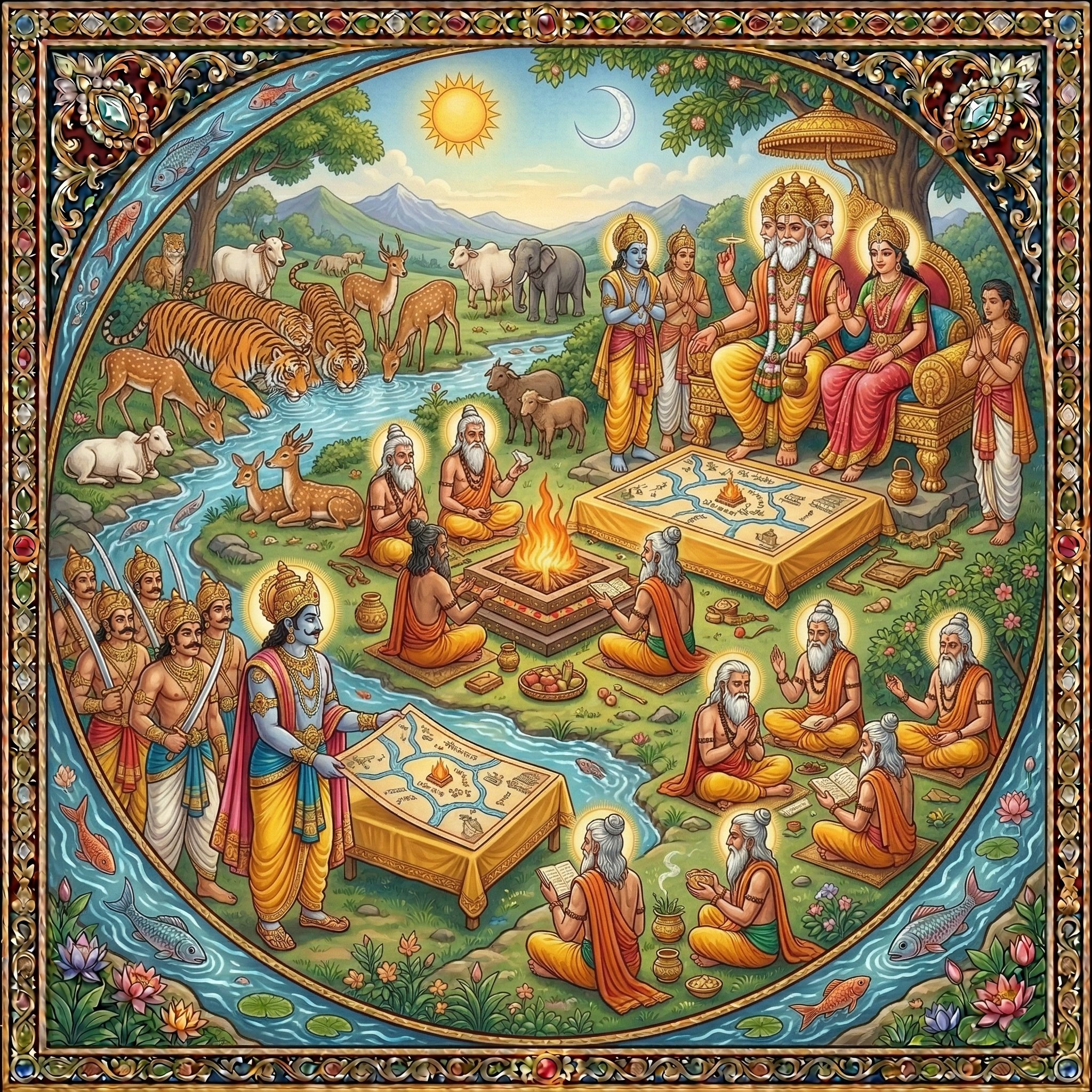
Dharmaranya Khanda
Dharmaranya Mahatmya
This section is anchored in the sacred landscape associated with Vārāṇasī (Kāśī) and the named forest-region Dharmāraṇya. It presents the area as a densely sacralized tīrtha-field served by major deities (Brahmā, Viṣṇu, Maheśa), directional guardians, divine mothers, and celestial beings, thereby situating local topography within pan-Indic cosmological governance. The narrative also encodes a social-religious ecology: communities of learned brāhmaṇas, ritual performance, śrāddha offerings, and merit-transfer doctrines are tied to the place’s identity.
Adhyayas in Dharmaranya Mahatmya
40 chapters to explore.
Adhyaya 1
धर्मारण्यकथाप्रस्तावः (Prologue to the Dharmāraṇya Narrative)
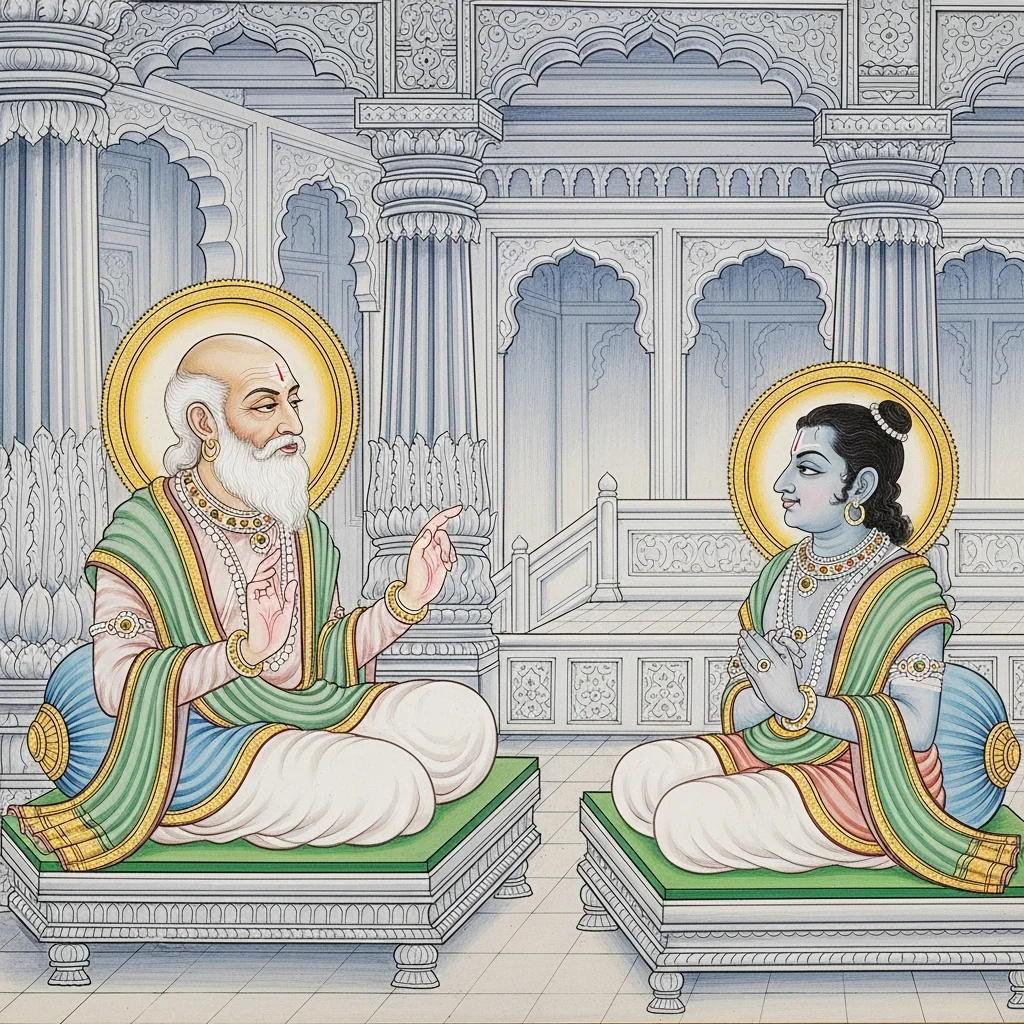
Chapter 1 sets the Purāṇic recital frame at Naimiṣa-kṣetra: Śaunaka and other sages welcome Sūta (Lomaharṣaṇa) and request a purifying account that can dissolve long-accumulated sin. Sūta begins with formal invocations and declares his intent to proclaim, by divine grace, the supreme fruit of the tīrthas. A second narrative layer is then introduced: Dharma (Yama/Dharmarāja) visits Brahmā’s assembly and beholds a cosmically inclusive sabhā filled with gods, sages, the Vedas, and personified principles. There Vyāsa relates the “Dharmāraṇya-kathā,” praised as pious, expansive, and fruitful for dharma-artha-kāma-mokṣa. Returning to Saṃyaminī, Dharma receives Nārada, who is astonished to see Yama gentle and joyful. Yama explains that hearing the Dharmāraṇya-kathā brought this transformation and that it possesses powerful purificatory efficacy, rhetorically said to free even from severe sins. The chapter closes by noting Nārada’s onward journey to the human realm (Yudhiṣṭhira’s court) and by outlining the coming discourse on origins, protection, chronology, prior events, future outcomes, and the status of tīrthas—serving as a structured prologue to the section’s sacred-geographical and ethical teaching.
Adhyaya 2
Dharmāraṇya-Māhātmya: Vārāṇasī’s Sacred Forest, Merit of Death, and Ancestral Rites
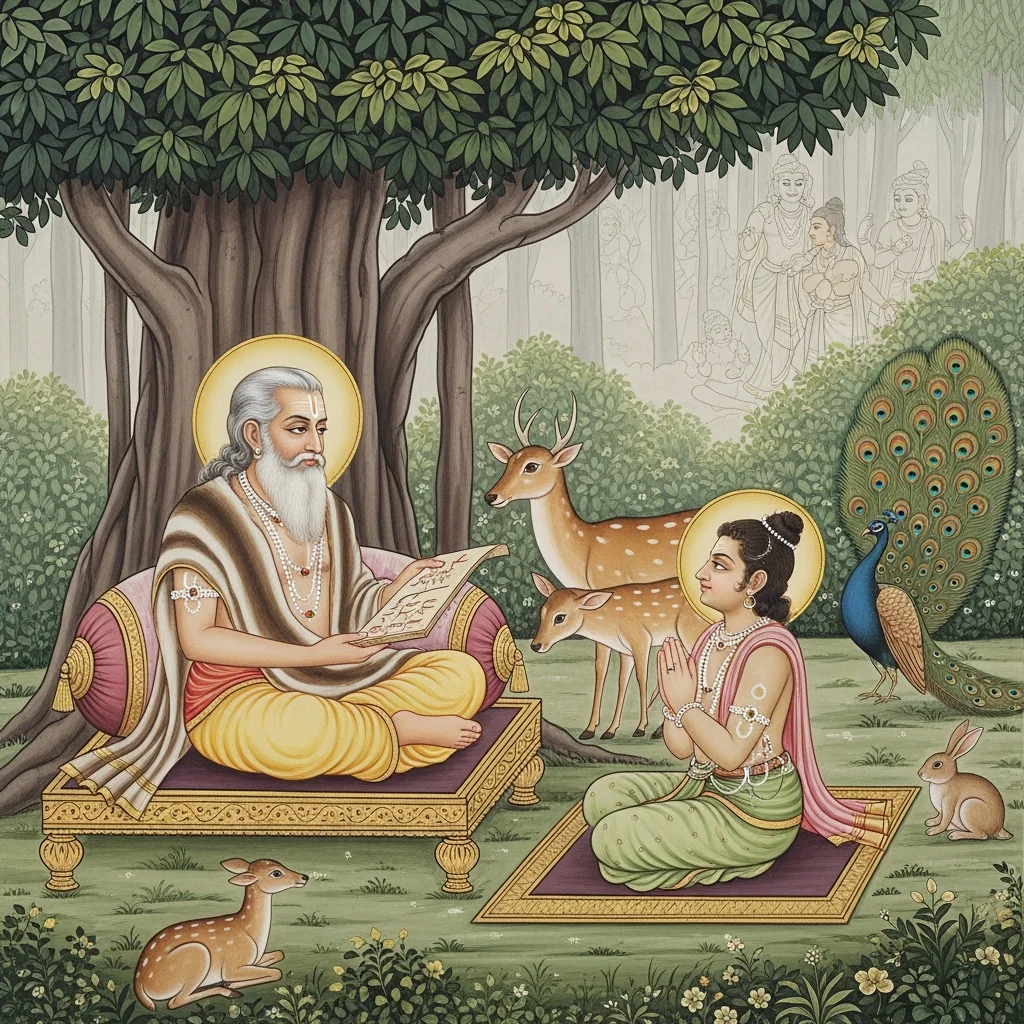
This chapter begins with Vyāsa’s ornate praise of Kāśī (Vārāṇasī) and introduces Dharmāraṇya as the foremost sacred forest within that holy landscape. Its sanctity is affirmed by naming the divine and semi-divine attendants—Brahmā, Viṣṇu, Maheśa, Indra, the lokapālas/dikpālas, the mātṛs, śiva-śaktis, gandharvas, and apsarases—portraying the site as perpetually worshipped and ritually charged. The narration then turns to liberation: beings, from insects and animals upward, who meet death there are promised steady release and passage to Viṣṇuloka, expressed in phalaśruti-like enumerations of merit. A ritual-ethical teaching follows, declaring that offering piṇḍa with yava and vrīhi grains, sesame, ghee, bilva leaves, dūrvā grass, jaggery, and water effectively rescues ancestral lines, specified through generational and lineage counts. Dharmāraṇya’s harmonious ecology—trees, creepers, birds, and fearlessness even among natural adversaries—is depicted as a moral vision of a dharmic environment. The presence of brāhmaṇas endowed with both curse and grace, and learned brāhmaṇa communities devoted to Vedic study and observance, is also noted. The chapter closes with Yudhiṣṭhira’s questions about origins: when and why Dharmāraṇya was established, why it is a tīrtha on earth, and how the brāhmaṇa settlements (including the figure of eighteen thousand) came to be, preparing the next explanation.
Adhyaya 3
Dharmarāja’s Tapas in Dharmāraṇya and the Devas’ Attempted Distraction (धर्मारण्ये धर्मराजतपः–देवव्याकुलता–अप्सरःप्रेषणम्)
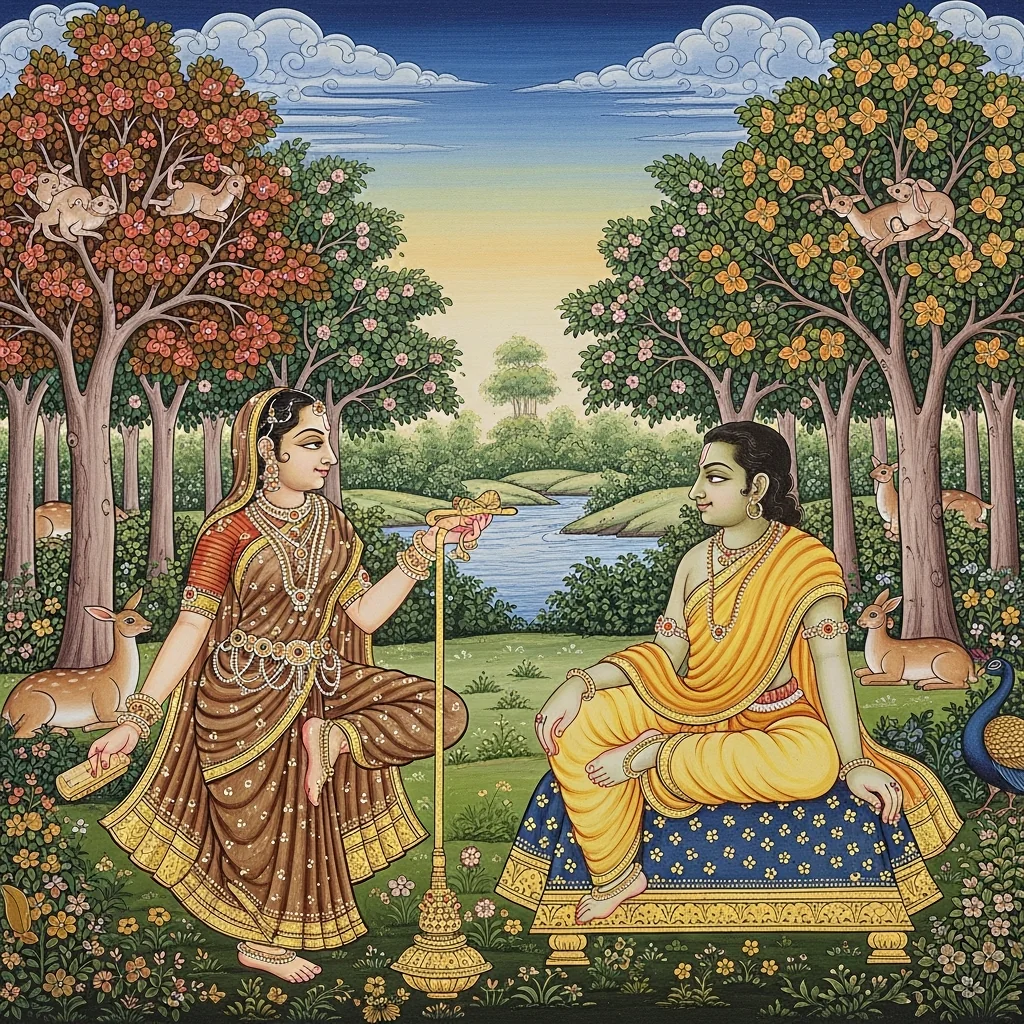
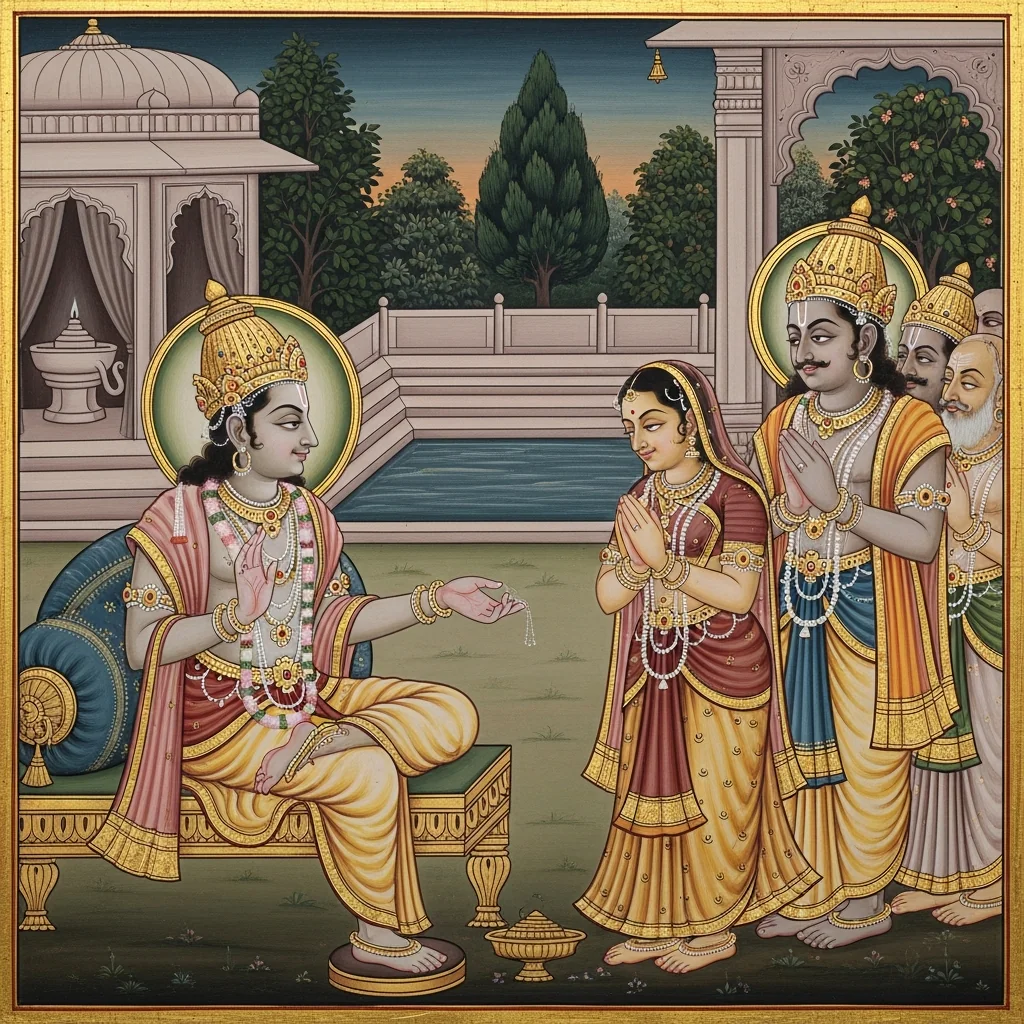
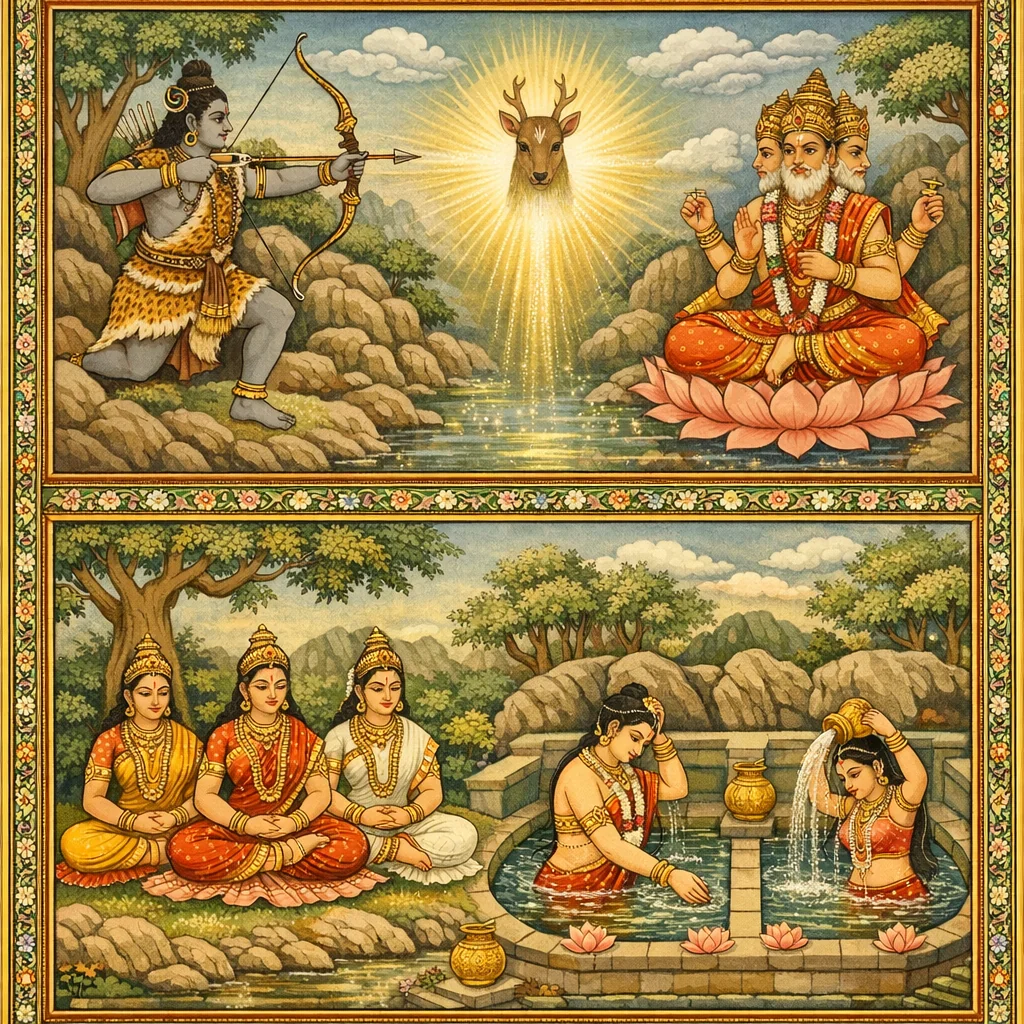
Vyāsa introduces a purāṇic account whose very hearing is said to purify. In the Tretā-yuga, Dharmarāja (later identified as Yudhiṣṭhira) performs extraordinarily severe tapas in Dharmāraṇya for an immense span: his body wasted, unmoving, life sustained by the barest breath—an image of extreme self-mastery. The devas, alarmed by the power generated through such austerity and fearing for Indra’s sovereignty, approach Śiva on Kailāsa. Brahmā leads an extended stuti, praising Śiva as both transcendent and immanent—beyond definition, the inner light of yogins, the ground of the guṇas, and the cosmic body from which the world-process unfolds. Śiva reassures them that Dharmarāja is no threat, yet Indra remains inwardly unsettled and convenes counsel. Bṛhaspati advises that the devas cannot counter tapas directly and proposes sending apsarases. Indra orders them to Dharmāraṇya to distract the ascetic through music, dance, and alluring gestures. The forest and āśrama are then described in luxuriant detail—flowers, birdsong, harmonious animals—setting the stage for an ethical test. The apsaras Vardhanī performs with vīṇā, rhythm, and dance, and Dharmarāja’s mind is momentarily disturbed. Yudhiṣṭhira asks how such agitation can arise in one grounded in dharma; Vyāsa warns that reckless acts lead to downfall, and that sexual temptation is a powerful delusion that can erode austerity, charity, compassion, self-restraint, study, purity, and modesty unless one remains vigilant.
Adhyaya 4
Dharmāraṇya Māhātmya: Varddhanī–Dharma Dialogue, Śiva’s Boons, and the Institution of Dharmavāpī
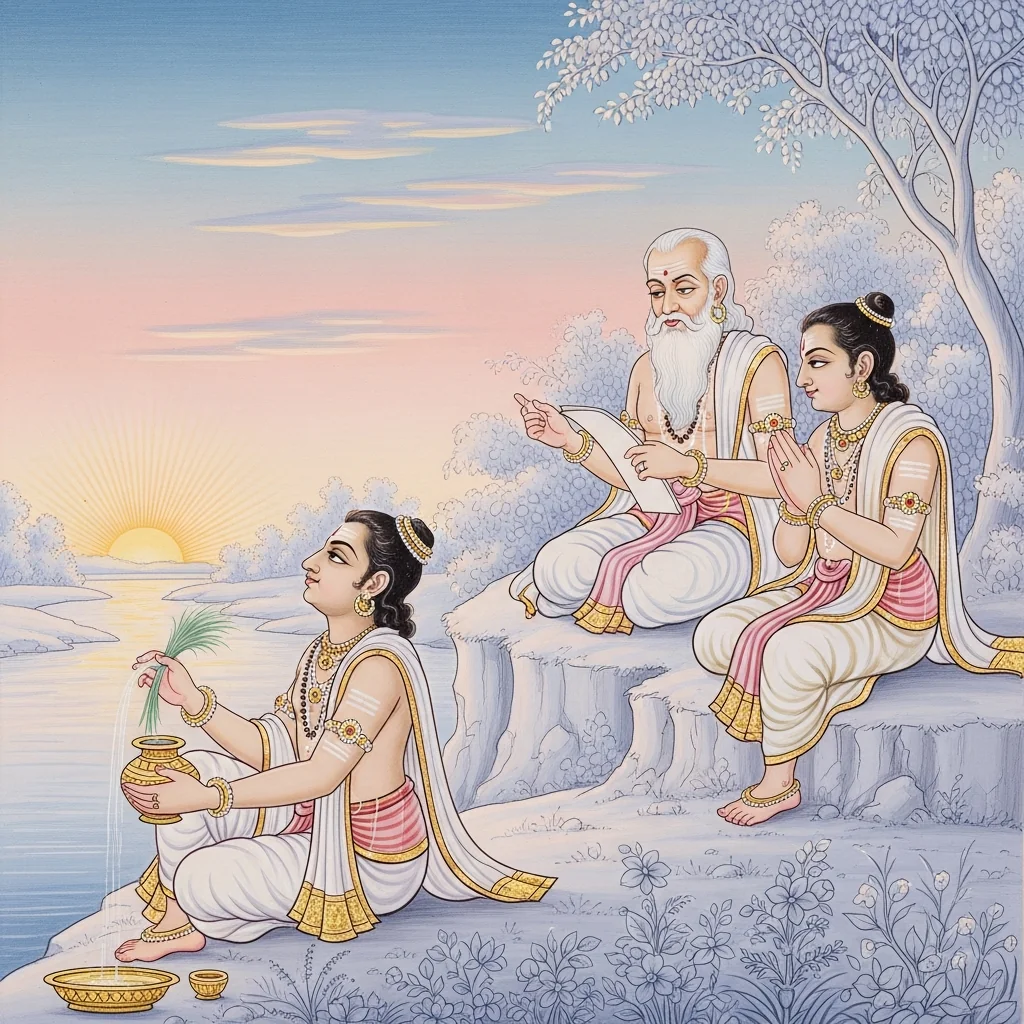
This adhyāya unfolds a multi-voiced theological reflection on tapas (austerity), divine anxiety, and the sanctification of place. Vyāsa introduces the episode as a fear-dispelling narrative, clarifying Dharma/Yama’s dharmic intent so that dread of Yama’s messengers is removed. In the forest, Dharma/Yama meets the apsaras Varddhanī, questions her identity, and offers boons; she confesses she was sent because Indra feared Dharma’s tapas might unsettle the cosmic order. Pleased by her truthfulness and devotion, Dharma grants her stability in Indra’s realm and establishes a tīrtha in her name, prescribing observances such as a five-night practice and declaring inexhaustible merit for offerings and recitation there. Dharma then undertakes extreme tapas, prompting the gods to seek Śiva’s intervention. Śiva arrives, praises the austerity, and offers boons; Dharma asks that the region be renowned across the three worlds as Dharmāraṇya and that a liberation-bestowing tīrtha be founded for all beings, including non-human life. Śiva confirms the name, promises a liṅga presence (Viśveśvara/Mahāliṅga), and the chapter expands into ritual guidance: the power of remembering and worshiping Dharmeśvara, the institution of Dharmavāpī, bathing and tarpaṇa formulas for Yama, claims of healing and protection from afflictions, śrāddha timings (amāvāsyā, saṅkrānti, eclipses, etc.), comparative tīrtha hierarchy, and a concluding phalaśruti promising great merit and auspicious ascent after death.
Adhyaya 5
सदाचार-शौच-सन्ध्या-विधि (Ethical Conduct, Purity, and Sandhyā Procedure)
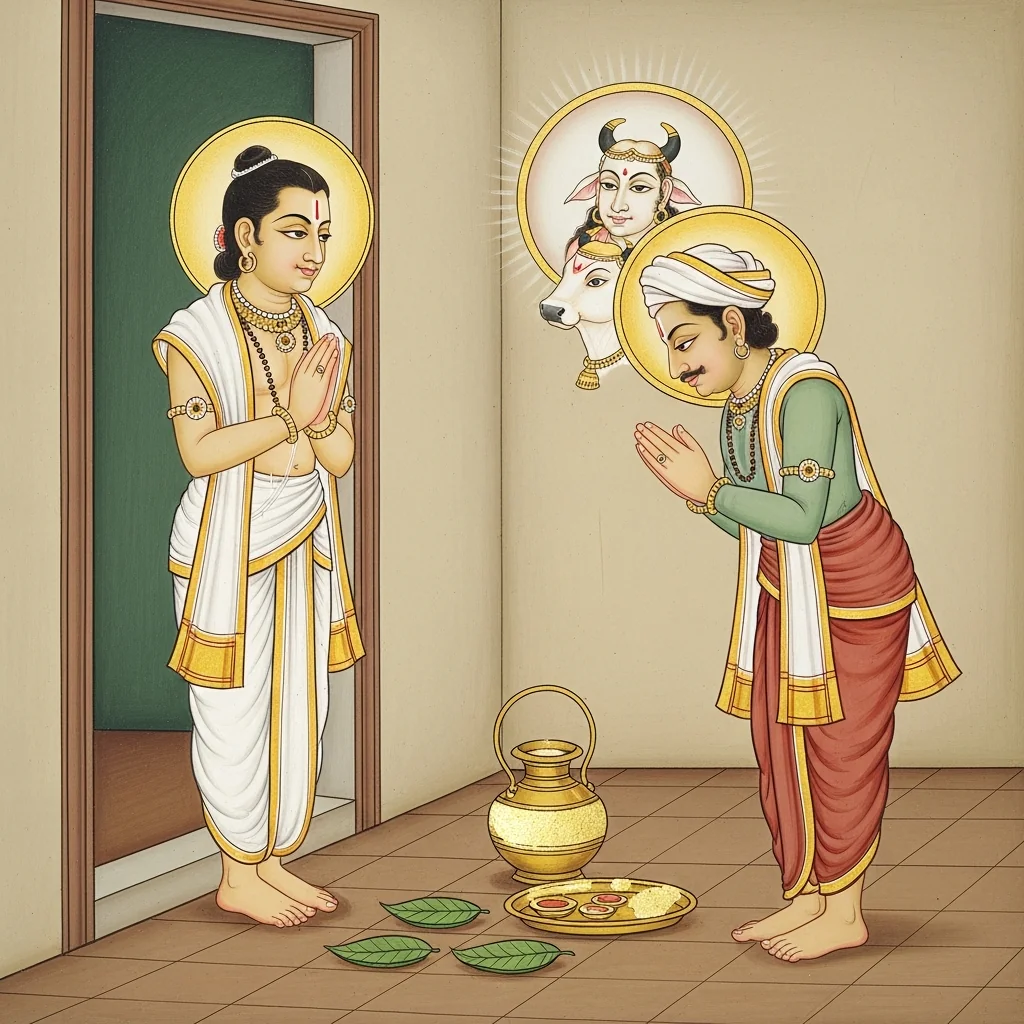
Chapter 5 unfolds as a didactic dialogue: Yudhiṣṭhira asks Vyāsa to explain sadācāra (good conduct) as the root of dharma and prosperity. Vyāsa sets forth a graded hierarchy of beings and excellences, culminating in the supremacy of Brāhmaṇa learning and brahma-tatparatā—an inward orientation toward Brahman. Sadācāra is defined as a dharma-root marked by freedom from hatred and attachment, while misconduct is said to bring social reproach, illness, and a shortened lifespan. The chapter then prescribes practical discipline: cultivating yama and niyama (truthfulness, non-violence, restraint, purity, study, fasting), conquering the inner enemies (kāma, krodha, moha, lobha, mātsarya), and accumulating dharma step by step. It stresses that one is born alone and dies alone, and that dharma alone accompanies the person beyond death. In its latter half it gives detailed guidance for daily observance: remembrance at brahma-muhūrta, regulated elimination away from habitation, cleansing rules with earth and water, standards of ācamana, restrictions on tooth-cleaning days, the merit of morning bathing, and a structured sandhyā practice—prāṇāyāma, aghamarṣaṇa, Gāyatrī-japa, offering arghya to Sūrya, followed by tārpaṇa and household rites. It concludes by presenting this as a steady nitya-dharma routine for the disciplined dvija.
Adhyaya 6
गृहस्थधर्म-उपदेशः (Householder Dharma: pañcayajña, hospitality, and conduct codes)
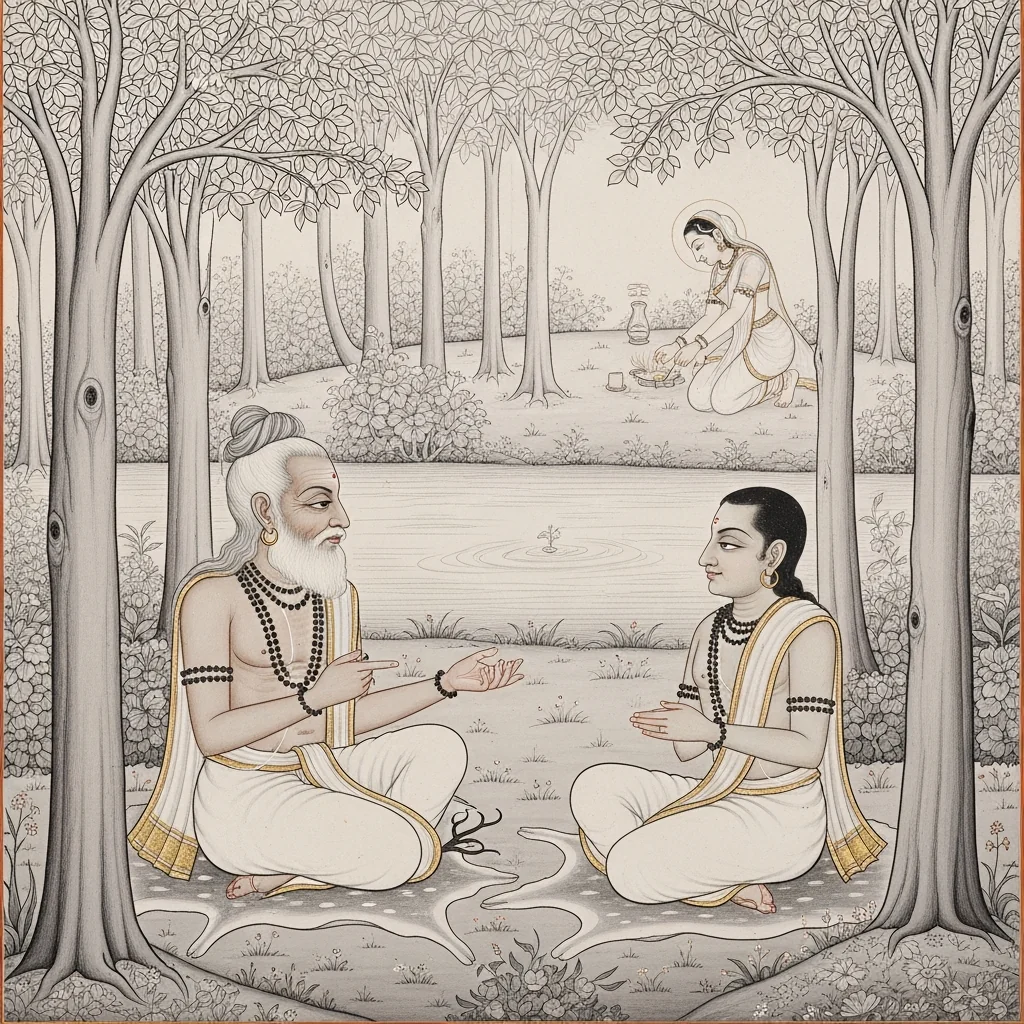
This chapter gives a technical instruction on gṛhastha-ācāra (householder discipline). Vyāsa establishes the householder as the sustaining base of society and the ritual economy: devas, pitṛs (ancestors), sages, humans, and even other creatures depend upon the gṛhastha’s support. A key metaphor describes the “Veda-cow” (trayi-mayī dhenu) with four ‘teats’—svāhā, svadhā, vaṣaṭ, hanta—signifying offerings to devas, ancestors, sages/ritual order, and human dependents, thus binding daily Vedic recitation to the duty of nourishment and care. The discourse then lays out daily observances in sequence: purification, tarpana, worship, bali offerings to beings, and formal atithi-satkāra (hospitality). “Atithi” is defined especially as a Brahmin guest, to be received without intrusion, honored, and fed. The dialogue shifts to Yudhiṣṭhira’s question on the eight forms of marriage (brāhma, daiva, ārṣa, prājāpatya, asura, gāndharva, rākṣasa, paiśāca), ranking them ethically and warning against bride-price as commodification. It further codifies pañcayajña (brahma-, pitṛ-, deva-, bhūta-, nṛ-yajña), condemns neglect of vaiśvadeva and hospitality, and lists extensive rules on purity, restraint, anadhyāya (study prohibitions), speech ethics, reverence for elders, and dāna-phala (the fruits of giving). It concludes that these are śruti-smṛti-aligned norms for residents of Dharmāraṇya.
Adhyaya 7
धर्मवापी-श्राद्धमाहात्म्यं तथा पतिव्रताधर्म-नियमाः (Dharma-vāpī Śrāddha Māhātmya and the Ethical Guidelines of Pativratā-dharma)
This adhyāya weaves tīrtha-based ritual teaching together with household ethics in a dialogic frame. Vyāsa first proclaims the special potency of performing pitṛ-tarpaṇa and offering piṇḍas upon reaching the dharma-linked water-site, Dharmavāpī: the ancestors gain enduring satisfaction, and the merit extends even to departed beings in diverse post-mortem conditions. The discourse then portrays Kali-yuga as an age of moral volatility—greed, hostility, slander, and social discord—yet affirms that purification remains attainable through disciplined conduct: purity of speech, mind, and body; non-harm; restraint; reverence for parents; generosity; and dharma-knowledge. When Śaunaka asks for the lakṣaṇas of pativratā women, Sūta replies with a detailed normative catalogue: self-restraint, prioritizing the husband’s welfare, avoiding compromising situations, regulated speech and demeanor, and ritualized domestic piety. The chapter adds consequential warnings through imagery of unfavorable rebirth for transgression, and concludes by reiterating the praise of dharma-field śrāddha and dāna: even modest offerings made with devotion protect the lineage, while wealth gained unethically and used for śrāddha is treated as problematic. It ends by reaffirming Dharmāraṇya as ever wish-fulfilling, liberation-oriented for yogins, and success-conferring for accomplished beings.
Adhyaya 8
Dharmāraṇya-Prastāva: Deva-samāgama and Sṛṣṭi-Kathā (धर्मारण्यप्रस्तावः—देवसमागमः सृष्टिकथा च)
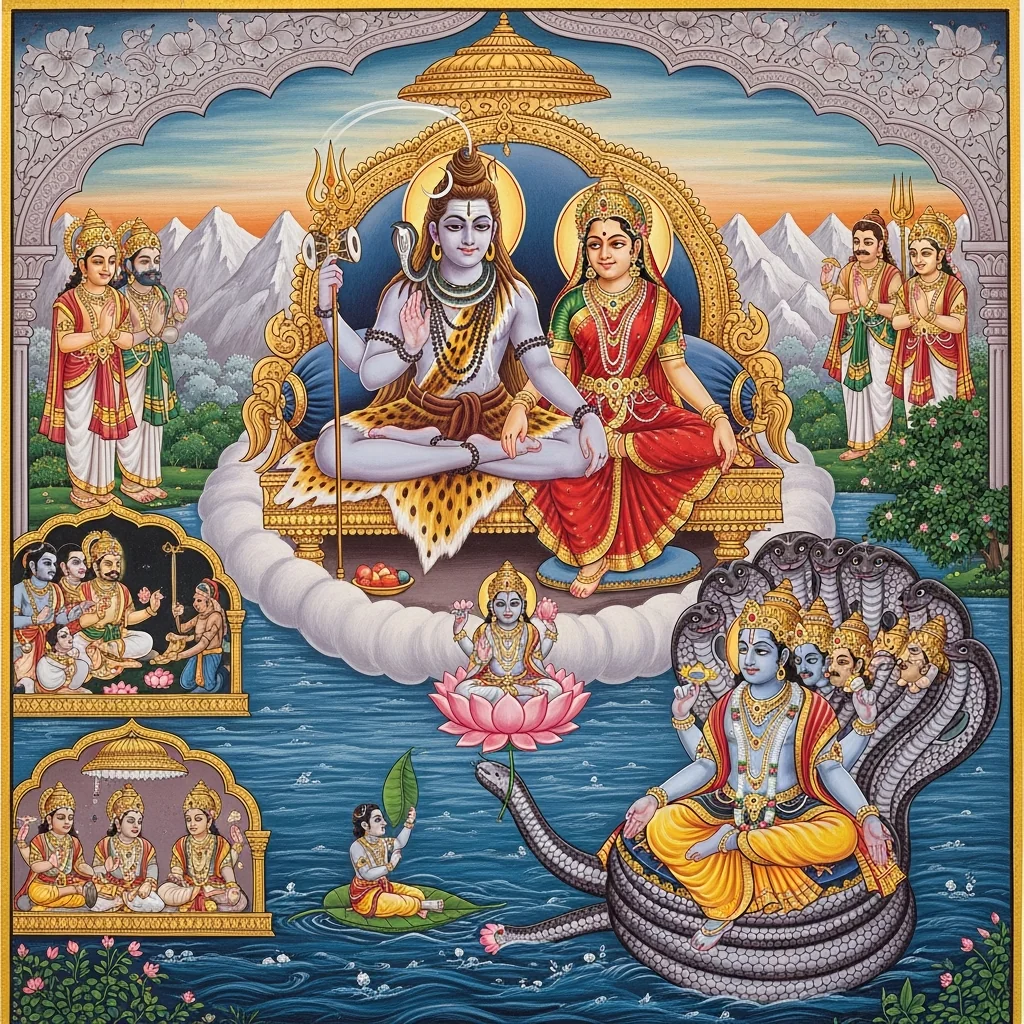
Chapter 8 begins with Yudhiṣṭhira asking Vyāsa to continue, showing how the account of Dharmāraṇya sustains curiosity and deepens devotion. Vyāsa introduces the episode as a Skanda Purāṇa narrative first spoken by Sthāṇu (Śiva) to Skanda, praised for granting the merit of many tīrthas and for removing obstacles. The scene shifts to Kailāsa, where Śiva is portrayed in iconic form—five-faced, ten-armed, three-eyed, bearing the trident, with kapāla and khaṭvāṅga—attended by gaṇas and lauded by sages and celestial musicians. Skanda reports that gods and exalted divinities wait at Śiva’s gate for audience; as Śiva rises to depart, Skanda asks the urgent purpose. Śiva declares his intent to go to Dharmāraṇya with the gods and then delivers a cosmogonic teaching: primordial brahman during pralaya, the emergence of the great substance, Viṣṇu’s play upon the waters, the banyan and the child-form reclining on a leaf, Brahmā’s birth from the navel-lotus, and the command to create the cosmic sphere with its realms and beings (including the classification of yonis). The narrative continues with genealogical ordering—Brahmā’s mind-born sons, Kaśyapa and his wives, the Ādityas, and the derivation of “Dharmāraṇya” from Dharma’s role—followed by a grand assembly of gods, siddhas, gandharvas, nāgas, planets, and others. It culminates in Brahmā’s approach to Vaikuṇṭha and his formal praise of Viṣṇu, who appears in iconic form, linking cosmogony, sacred geography, and divine counsel.
Adhyaya 9
धर्मारण्ये देवसमागमः तथा ऋष्याश्रमस्थापनम् (Divine Assembly in Dharmāraṇya and the Establishment of Ṛṣi-Āśramas)
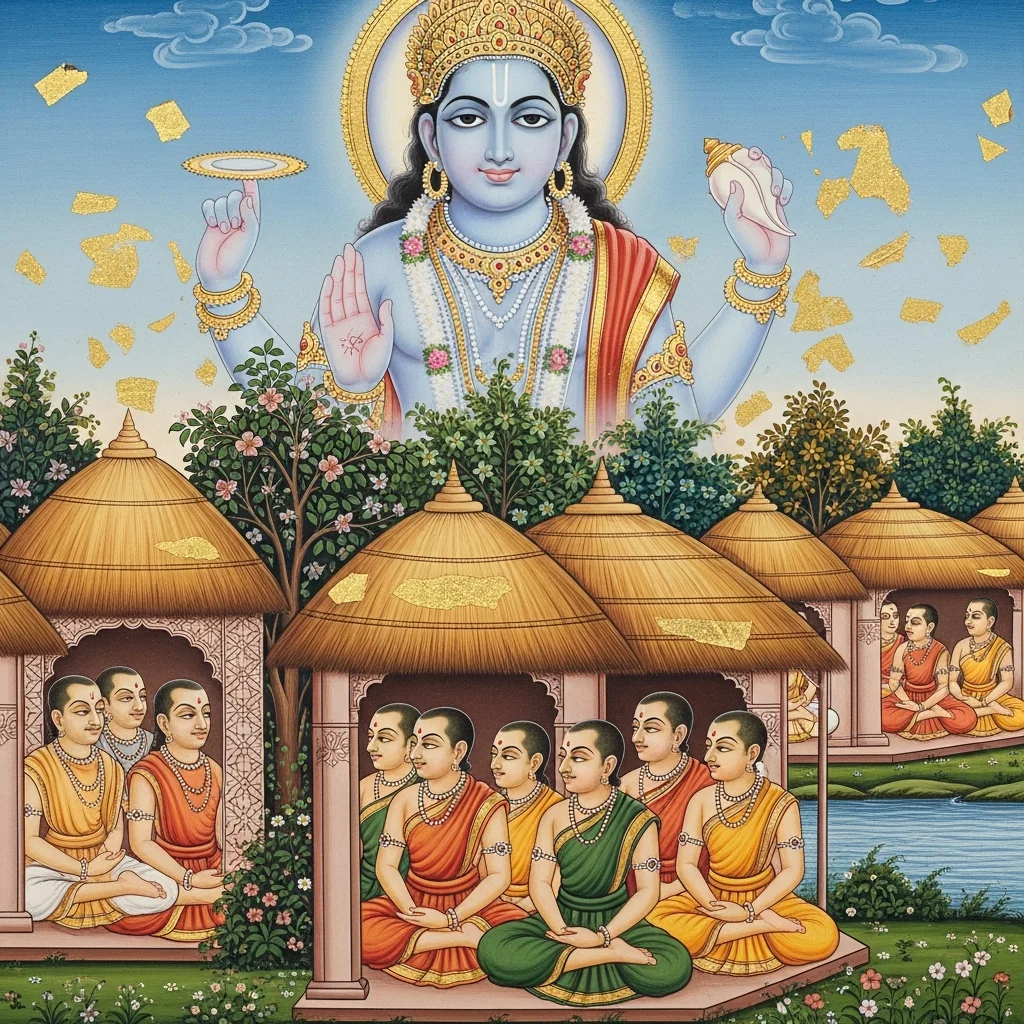
Chapter 9 unfolds as a narrated chain of dialogues. Vyāsa introduces a meritorious account in which Viṣṇu asks why Brahmā and the devas have arrived; Brahmā replies that there is no fear in the three worlds and that their purpose is to behold an ancient tīrtha established in dharma. Viṣṇu agrees and swiftly journeys on Garuḍa, with the devas accompanying him. In Dharmāraṇya, Dharmarāja (Yama) receives the divine party with formal hospitality and individualized pūjā. He praises Viṣṇu, declaring that the kṣetra’s tīrtha-status arises from divine grace and from proper worship that truly satisfies the deity. When Viṣṇu offers a boon, Yama requests that many ṛṣi-āśramas be founded in this supremely meritorious forest, so the tīrtha will not be harassed and the land will continually resound with Vedic recitation and yajñas. Viṣṇu assumes a vast form and, with divine assistance, installs numerous learned brāhmaṇa-ṛṣis—set forth through extensive gotra and pravara catalogues—together with their lineages and fitting locations. The narrative then turns to Yudhiṣṭhira’s inquiry into the origins, names, and places of these established groups, continuing with detailed listings. Later verses also allude to divine feminine names and to Brahmā’s summoning of Kāmadhenu, underscoring the sustaining of sacred order through providential support.
Adhyaya 10
Kāmadhenū’s Creation of Attendants and the Regulation of Saṃskāras in Dharmāraṇya (कामधेन्वनुचर-निर्माण तथा संस्कारानुशासन)
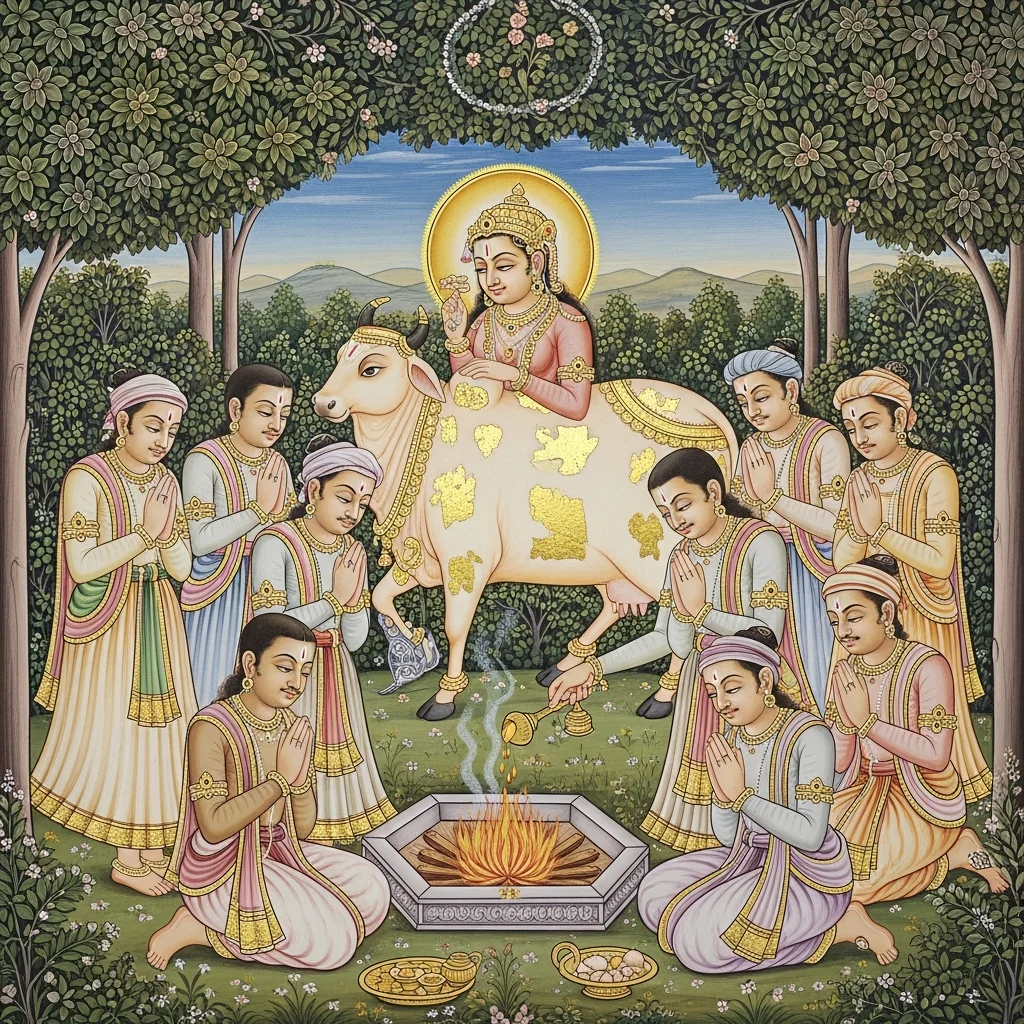
Vyāsa recounts to Yudhiṣṭhira an episode in Dharmāraṇya that establishes a service-based order for ritual life. At Brahmā’s prompting, Kāmadhenū is invoked and asked to provide attendants, allotted in pairs to each ritual specialist; thus arises a large, disciplined community bearing sacred marks such as śikhā and yajñopavīta, learned in śāstra and steadfast in right conduct. The deities then lay down a rule of governance: daily ritual materials (samidh, flowers, kuśa, and the like) must be supplied, and major saṃskāras—nāmakaraṇa, annaprāśana, cūḍākaraṇa/tonsure, upanayana, and related observances—are to be performed only with the attendants’ permission. Disregarding this authorization is said to bring recurring afflictions and loss of social standing. The chapter praises Kāmadhenū as a composite sacred locus containing many divine presences and tīrthas. When Yudhiṣṭhira asks about marriage and progeny among the attendants, Vyāsa tells of obtaining Gandharva brides: Śiva’s envoy requests daughters from Viśvāvasu; refusal leads to Śiva’s mobilization, and the Gandharva king yields the maidens. The attendants offer ājya-bhāga in Vedic fashion, and a customary precedent is noted for Gandharva-style marriages. The close depicts a stable Dharmāraṇya settlement where japa and yajña continue, materially supported by the attendants and their women through domestic and ritual service—an enduring model of place-rooted dharma.
Adhyaya 11
Lolajihva-vadhaḥ and the Naming of Satya Mandira (लोलजिह्ववधः सत्यमन्दिरनामकरणं च)
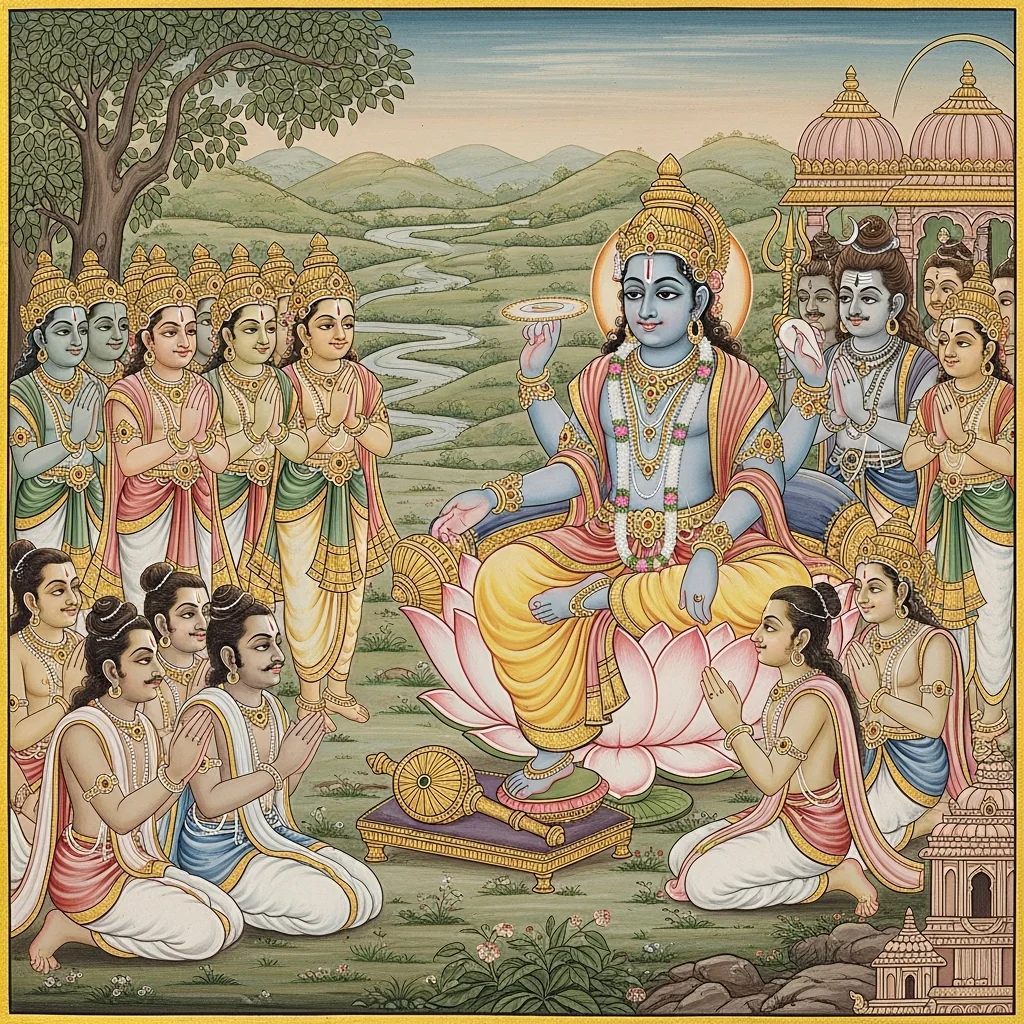
The chapter unfolds as a dialogue between Vyāsa and Yudhiṣṭhira. Yudhiṣṭhira asks to hear more, saying the “nectar” of Vyāsa’s words never satisfies him. Vyāsa then describes a late-age calamity: the rākṣasa lord Lolajihva rises, terrifies the three worlds, comes to Dharmāraṇya, conquers the regions, and burns a beautiful sanctified settlement, driving its resident brāhmins into flight. To protect the brāhmins and destroy the rākṣasa, a vast host of goddesses manifests, led by Śrīmātā, bearing many divine weapons—triśūla, śaṅkha-cakra-gadā, pāśa-aṅkuśa, khaḍga, paraśu, and more. Lolajihva’s roar shakes the directions and the seas; Indra (Vāsava) sends Nalakūbara to reconnoiter, and the battle is reported back. Indra informs Viṣṇu, who descends (here said to come from Satyaloka), releases the Sudarśana, and renders Lolajihva powerless; amid the goddesses’ assault the rākṣasa is slain. Devas and gandharvas praise Viṣṇu; he inquires after the displaced brāhmins, who are found and reassured that Vāsudeva’s cakra has destroyed the foe. The brāhmins return with their families and resume tapas, yajña, and study. The restored settlement receives its etiological name: in Kṛta Yuga it is Dharmāraṇya, while in Tretā it becomes renowned as Satya Mandira. The chapter closes by affirming the continuity of dharma through divine protection and communal restoration.
Adhyaya 12
गणेशोत्पत्तिः एवं धर्मारण्ये प्रतिष्ठा (Gaṇeśa’s Origin and Installation in Dharmāraṇya)
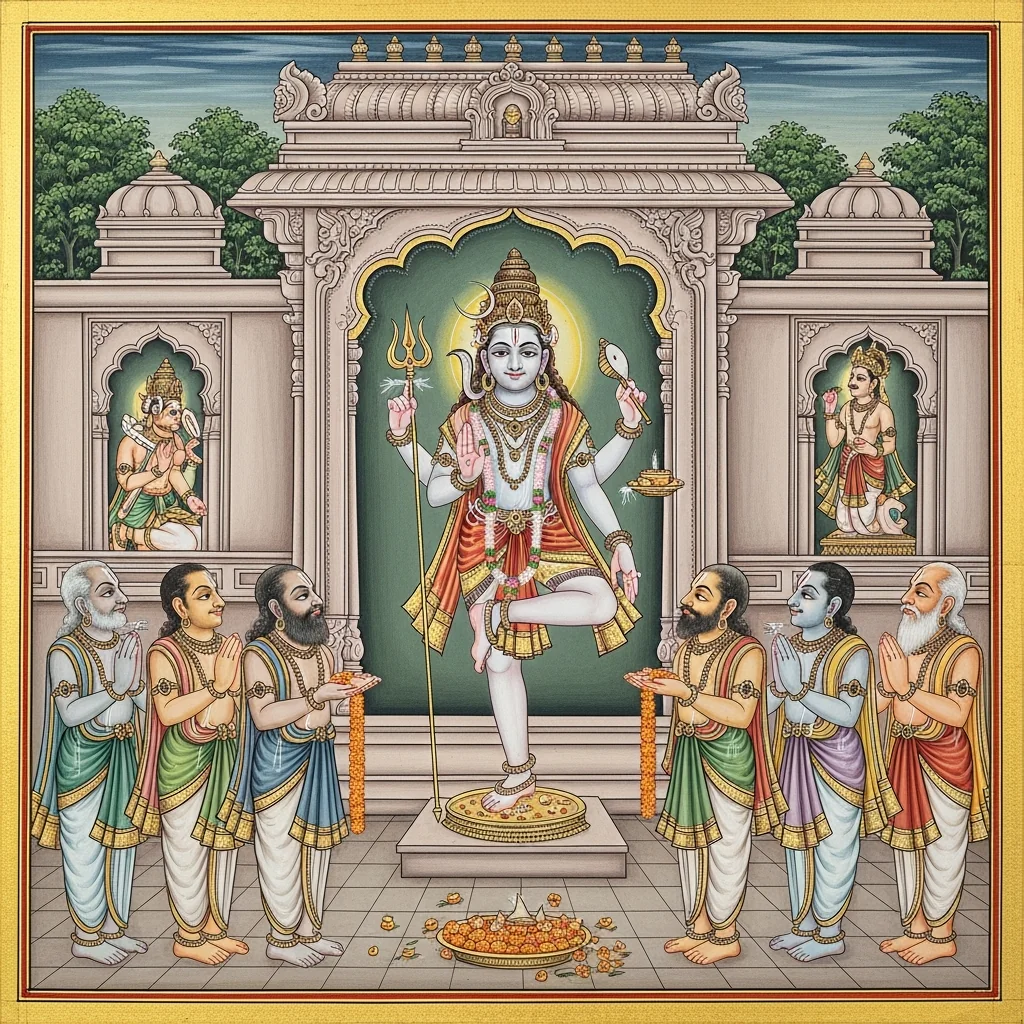
Vyāsa tells Yudhiṣṭhira of a settlement called “Satyamandira” being ritually sacralized for protection. Its precinct is laid out with a banner-adorned enclosure wall (prākāra), a central pedestal (pīṭha) set within a Brahmin-associated space, and four purified gateways (pratolī). Directional guardians are installed—Dharmēśvara in the east, Gaṇanāyaka (Gaṇeśa) in the south, Bhānu (the Sun) in the west, and Svayambhū in the north—forming a sacred map of safeguarding. The chapter then recounts Gaṇeśa’s origin: Pārvatī fashions a child from the substance of her bodily cleansing, gives him life, and appoints him as door-guardian. When Mahādeva is barred, a battle ensues and the child is beheaded; to soothe Pārvatī’s grief, Mahādeva restores him with an elephant head (gaja-śiras) and names him Gajānana. Praised by devas and sages, Gaṇeśa grants a boon to dwell in Dharmāraṇya as an eternal protector of religious practitioners, householders, and merchant communities—removing obstacles, bestowing welfare, and receiving first worship in weddings, festivals, and sacrifices.
Adhyaya 13
रविक्षेत्रे संज्ञातपः, अश्विनौ-उत्पत्तिः, रविकुण्ड-माहात्म्यं च (Saṃjñā’s austerity in Ravikṣetra, the birth of the Aśvins, and the Māhātmya of Ravikuṇḍa)
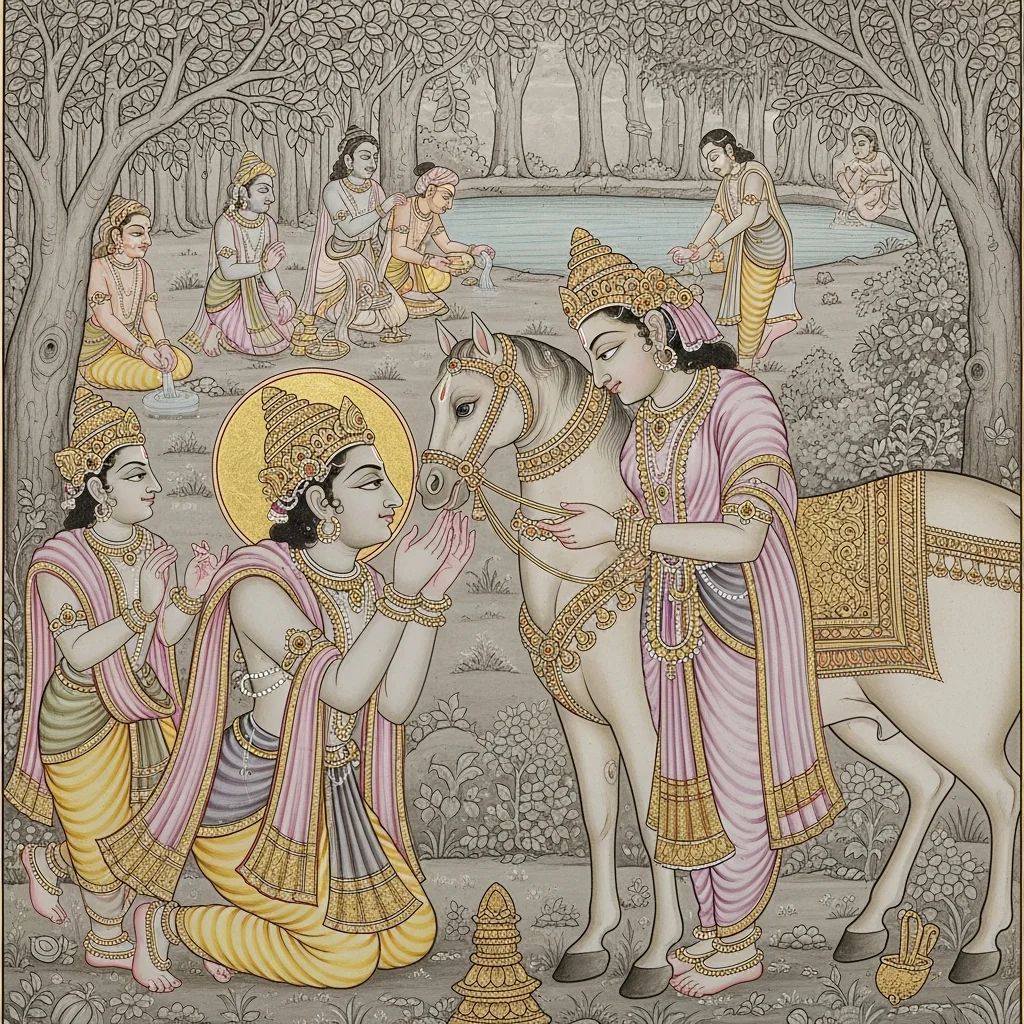
This chapter unfolds as a dialogue in which Yudhiṣṭhira asks Vyāsa to explain the origin of the Aśvin twins and the manifestation of the Sun’s presence upon the earth. Vyāsa recounts the Saṃjñā–Sūrya episode: unable to endure Sūrya’s blazing radiance, Saṃjñā departs after installing Chāyā as her substitute, instructing her to uphold proper household conduct and to conceal the substitution. From the ensuing marital strain and its consequences arise Yama and Yamunā; later, a conflict involving Yama leads to the disclosure of Chāyā’s true identity. Sūrya then seeks Saṃjñā and finds her performing severe tapas in Dharmāraṇya in the form of a mare (vaḍavā). Through a distinctive union motif in the narrative, associated with the nasal region, the divine twins Nāsatya and Dasra—the Aśvinau—are born. The text then anchors the myth in sacred geography: Ravikuṇḍa(s) manifest, and a detailed phalaśruti proclaims the merits of bathing, offerings, ancestral rites, and worship of Bakulārka, promising purification, health, protection, prosperity, and enhanced ritual fruit. Special emphasis is placed on observances at Saptamī, Sundays, eclipses, saṅkrānti, vyatīpāta, and vaidhṛti.
Adhyaya 14
Hayagrīva-hetu-nirūpaṇa (The Causal Account of Viṣṇu as Hayagrīva) | हयग्रीवहेतुनिरूपणम्
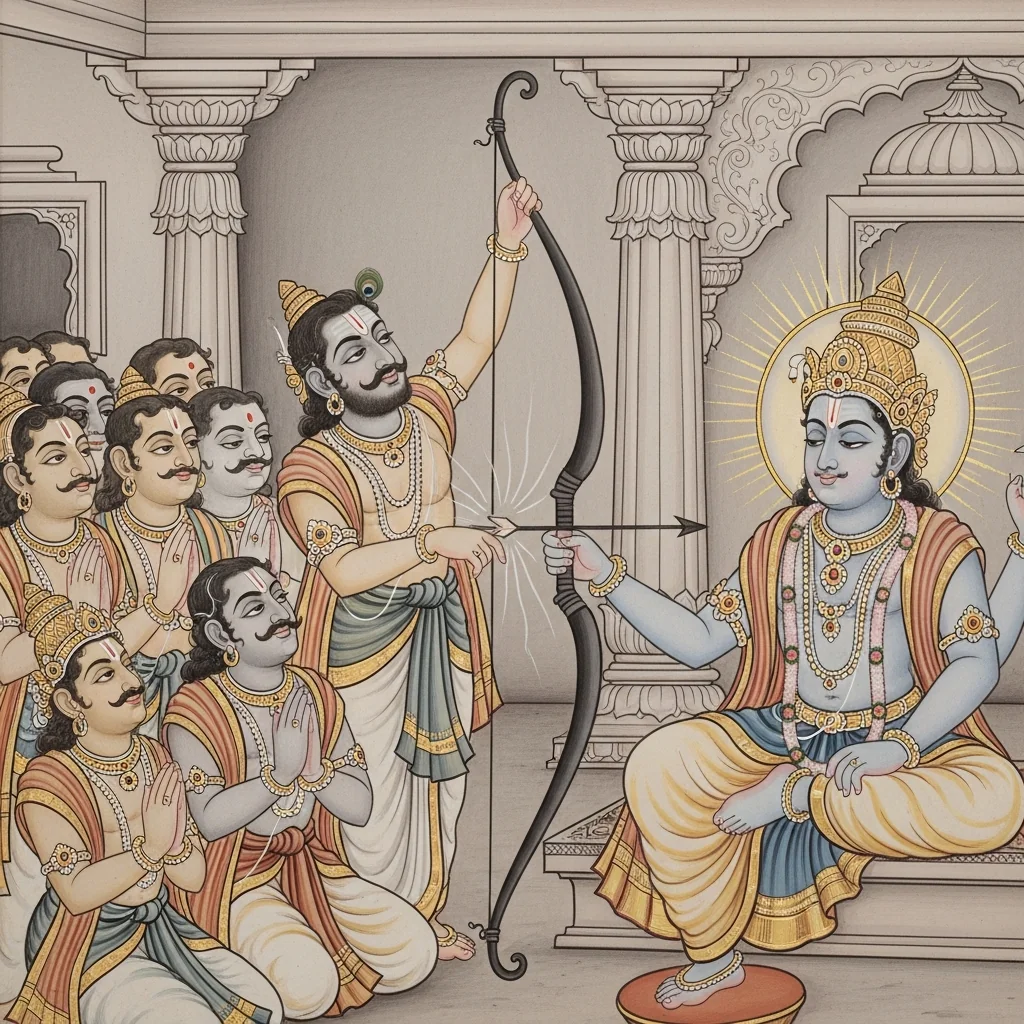
This chapter unfolds as a multi-voiced theological inquiry. Yudhiṣṭhira asks for a sequential account of when and how Viṣṇu performed tapas in Dharmāraṇya. The narrative then turns to Skanda questioning Īśvara (Rudra/Śiva): why the all-pervading Lord—beyond the three guṇas and yet creator, preserver, and destroyer—assumed an aśva-mukha (horse-headed) form, explicitly identified as Hayagrīva/Kṛṣṇa. A long catalogue of divine deeds follows, rehearsing the familiar avatāra works for restoring dharma: Varāha lifting the earth, Narasiṃha protecting Prahlāda, Vāmana’s cosmic strides, Paraśurāma’s destruction of the kṣatriyas, Rāma’s battles, Kṛṣṇa’s slaying of many adversaries, and the eschatological horizon of Kalki. The list argues coherence: one supreme agency manifests diverse forms for dharma’s renewal. Rudra then gives the causal narrative. As the gods prepare a yajña, they cannot find Viṣṇu, for he is yogārūḍha and dhyānastha—absorbed in yoga and meditation. They consult Bṛhaspati and employ the vāmryaḥ (ants/valmīka-associated beings) to gnaw through the bowstring (guṇa) to awaken him; an ethical hesitation is voiced—do not break samādhi—so a negotiated ritual share is granted to the vāmryaḥ. When the string is cut, a dramatic consequence ensues: the bow’s snap severs a head that ascends to the heavens, leaving the gods distressed and searching, setting the stage for the doctrinal explanation of Hayagrīva’s identity and the mechanics of divine manifestation through yogic absorption and cosmic causality.
Adhyaya 15
हयग्रीवोत्पत्तिः तथा धर्मारण्यतीर्थमाहात्म्यम् (Hayagrīva’s Manifestation and the Māhātmya of Dharmāraṇya Tīrthas)
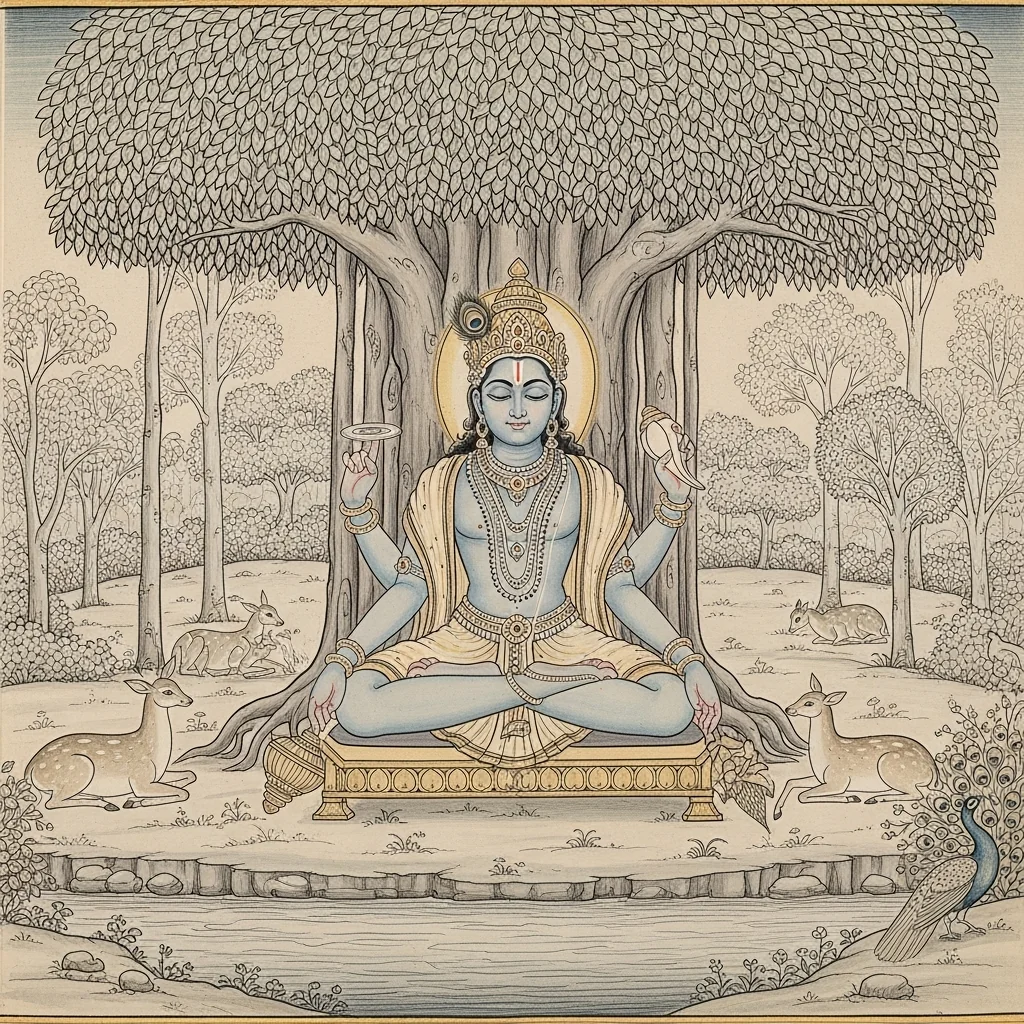
Adhyāya 15 unfolds in two linked movements. First, a divine crisis arises when the gods cannot locate a “head” (śiras), and Brahmā commissions Viśvakarman to fashion a workable form connected with ritual fulfillment. In a scene involving the Sun’s chariot, a horse-head appears and is affixed to Viṣṇu, bringing forth the Hayagrīva manifestation. The gods then offer a formal stuti, praising Hayagrīva/Viṣṇu as oṃkāra, yajña, time, the guṇas, and the deities of the elements; Viṣṇu grants boons and affirms this form as auspicious and worthy of worship. Next, through the Vyāsa–Yudhiṣṭhira dialogue, the chapter explains the cause: Brahmā’s pride in the assembly and a curse-like consequence concerning Viṣṇu’s head, followed by Viṣṇu’s tapas in Dharmāraṇya. The narrative turns to sacred geography, proclaiming Dharmāraṇya a great kṣetra and extolling Mukteśa/Mokṣeśvara and associated tīrthas, especially Devasaras/Devakhāta. Recommended observances include bathing, worship (notably in Kārttika with Kṛttikā-yoga), tarpaṇa/śrāddha, japa, and dāna, with promised fruits of sin-removal, ancestral uplift, longevity, well-being, flourishing lineage, and attainment of higher worlds.
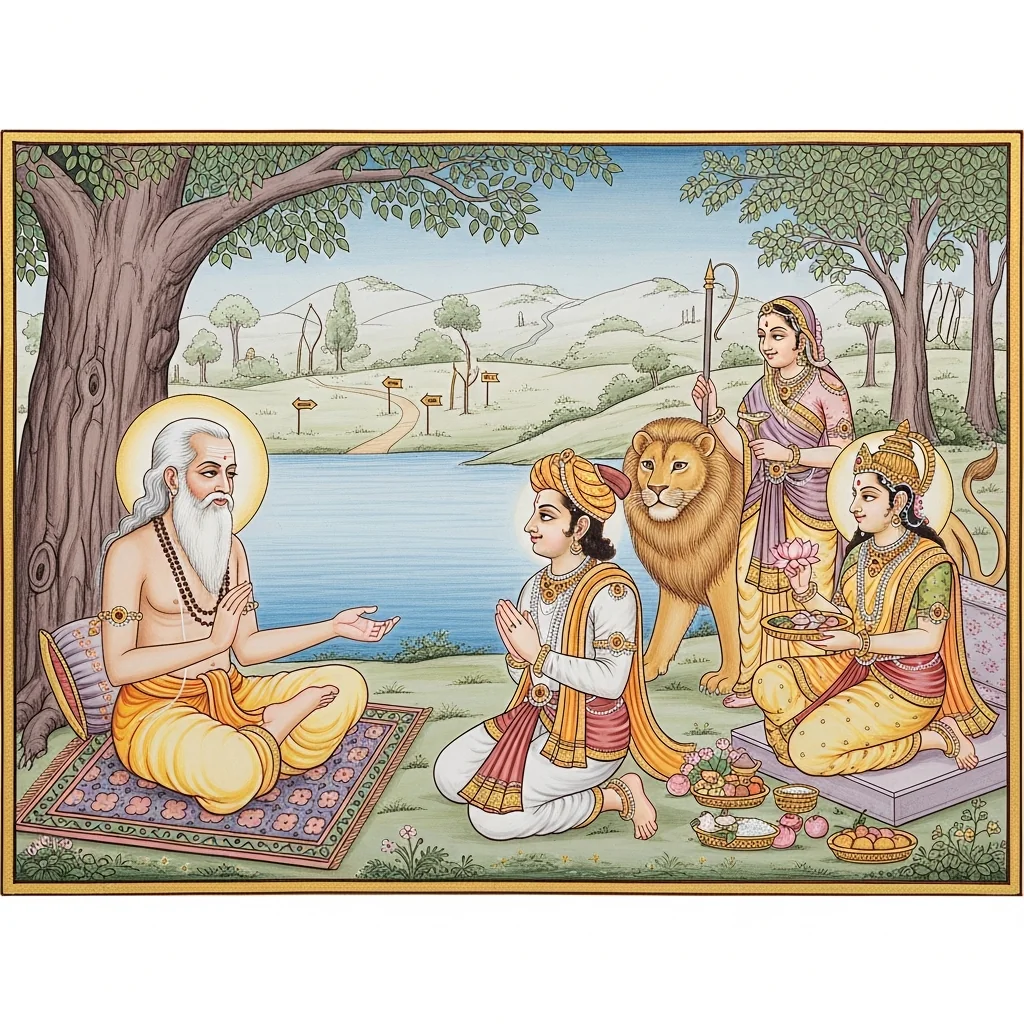
Adhyaya 16
Śakti-Sthāpana in Dharmāraṇya: Directional Guardianship, Sacred Lake, and Akṣaya Merit (अध्याय १६)
Chapter 16 unfolds as a theological question-and-answer between Yudhiṣṭhira and Vyāsa. Yudhiṣṭhira asks for an indexed account of the protective śaktis installed in Dharmāraṇya to dispel fear caused by rākṣasas, daityas, yakṣas, and other disruptive beings, requesting their names and precise locations. Vyāsa explains that these powers were established by divine authorities and stationed in the four directions to safeguard the dvijas and the wider community. The chapter lists several goddess-forms and epithets—Śrīmātā, Śāntā, Sāvitrī, Gātrāyī, Chatrājā, and Ānandā—describing their martial iconography, including weapons and mounts such as Garuḍa and the lion, and presenting them as guardians of sacred space and ritual order. A key ritual geography is introduced: a sacred lake before Chatrājā’s locale, where snāna, tarpaṇa, and piṇḍadāna are said to yield akṣaya (imperishable) merit. The discourse then expands into a theology of merit with practical assurances—relief from disease and enemies, prosperity, and victory—culminating in praise of Ānandā as a sāttvikī śakti whose worship, with specified offerings, grants enduring results and supports learning and well-being.
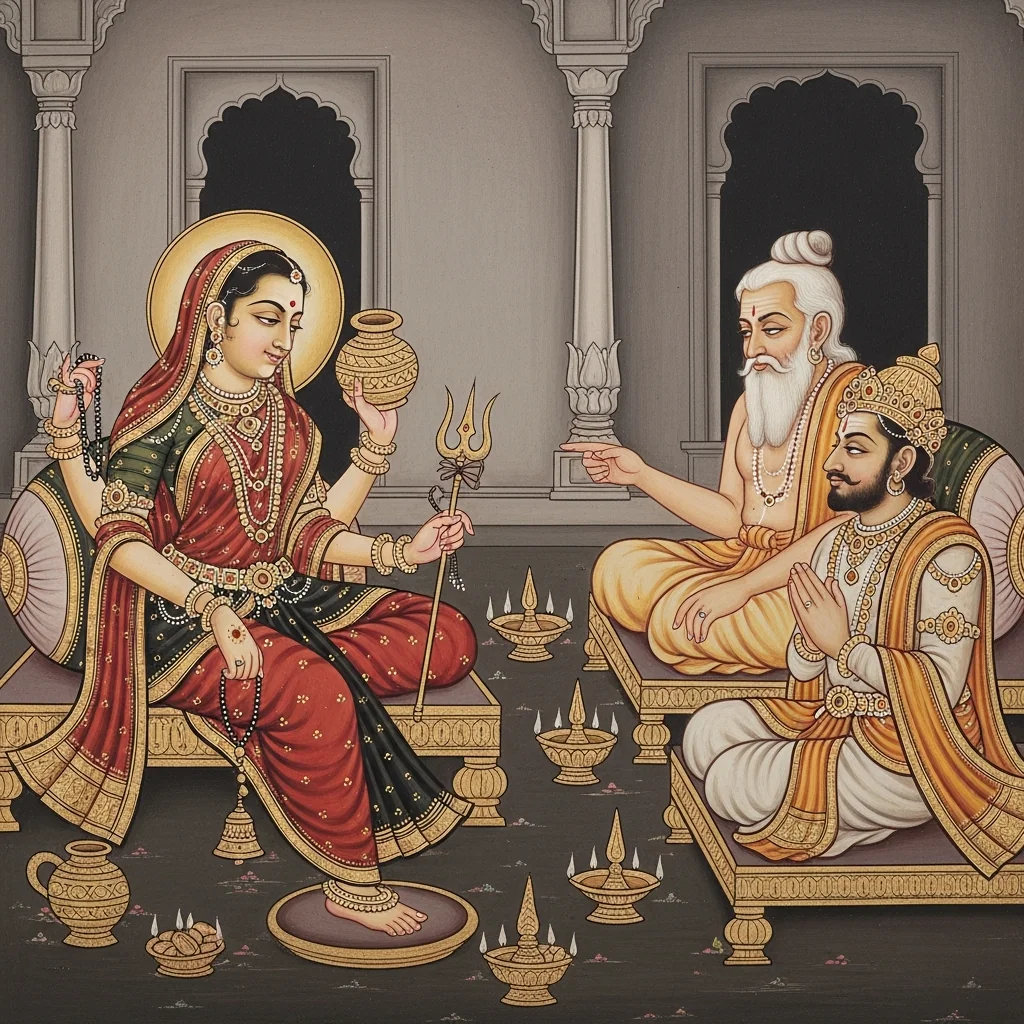
Adhyaya 17
Śrīmātā-Kulamātā-Stuti and Pūjāvidhi (Protective Śakti Discourse)
In this chapter, Vyāsa delivers to a king a theological discourse that both describes and prescribes the worship of a powerful Goddess installed in the southern direction, revered as a protective śakti for one’s lineage and settlement. She is praised under many names—Śāntā Devī, Śrīmātā, Kulamātā, and Sthānamātā—and is identified through iconographic signs: multi-armed forms bearing the bell (ghaṇṭā), trident (triśūla), rosary (akṣamālā), and water-pot (kamaṇḍalu), with animal-vāhana imagery and garments of black and red. The text further links her with Viṣṇu’s placement, the destruction of daityas, and explicitly affirms her as Sarasvatī-rūpa. The chapter then sets out a pūjāvidhi: offerings of flowers, fragrances (camphor, agaru, sandal), lamps and incense, and food offerings such as grains, sweets, payasa, and modaka. Feeding brāhmaṇas and kumārīs is enjoined, and proper nivedana is emphasized as a prerequisite before beginning any auspicious undertaking. Its phala teaching promises victory in conflicts and contests, removal of disturbances, success in rites (marriage, upanayana, sīmanta), prosperity, learning, and progeny, and finally an exalted posthumous state through Sarasvatī’s favor. Thus the chapter integrates iconography, ritual technology, and ethical guidance for initiating actions under divine protection.
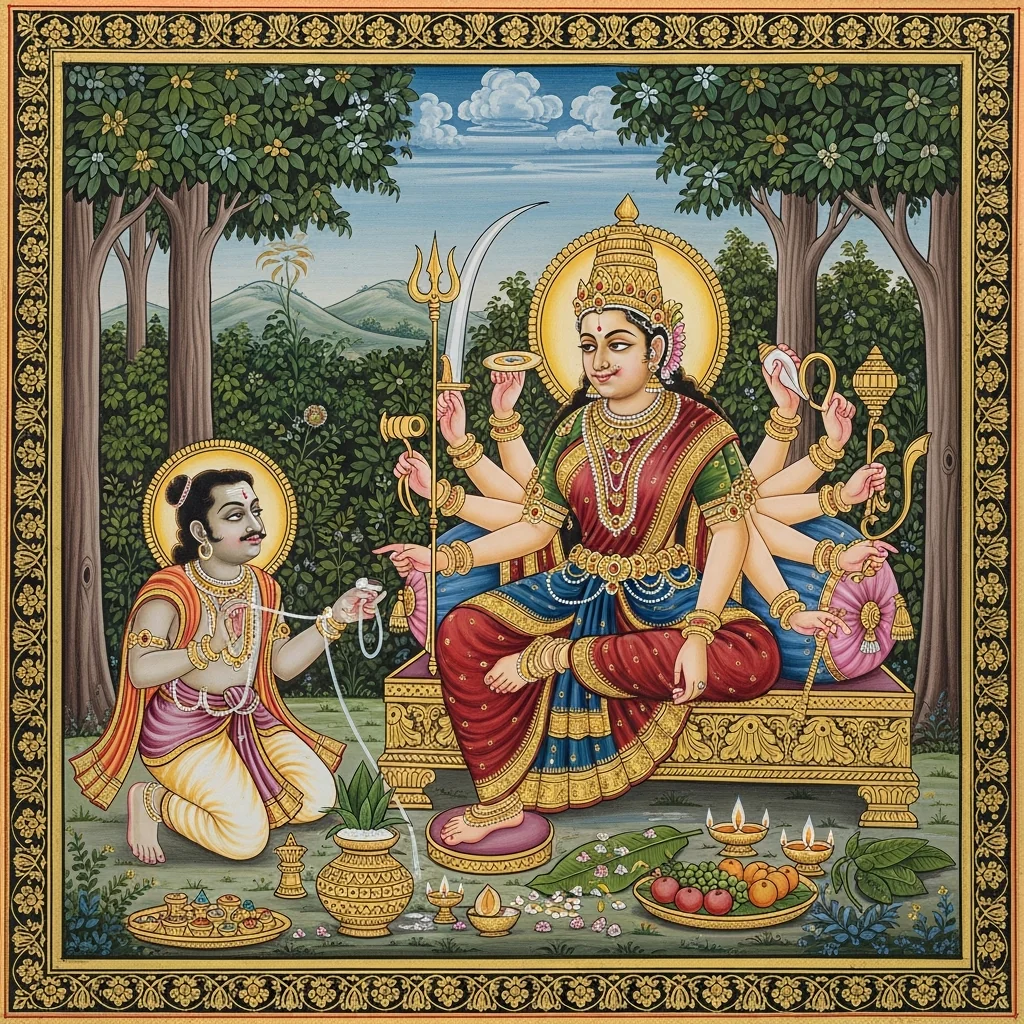
Adhyaya 18
Karṇāṭaka-Dānava-Vadhaḥ — The Slaying of Karṇāṭaka and the Institution of Śrīmātā Worship
This adhyāya weaves two narrative frames: (1) Rudra tells Skanda of an earlier episode in Dharmāraṇya, where the demon Karṇāṭaka relentlessly created obstacles—especially afflicting married couples and disrupting Vedic discipline—until Śrīmātā, taking the form of Mātaṅgī/Bhuvaneśvarī, destroyed him; and (2) Vyāsa answers Yudhiṣṭhira by describing Karṇāṭaka’s nature, his anti-Vedic violence, and the ritual response of the brāhmaṇas and the local community (including merchants). A coordinated worship protocol is set forth: bathing with pañcāmṛta, sprinkling gandhodaka (perfumed water), offering dhūpa-dīpa, naivedya, and many gifts—milk-products, sweets, grains, lamps, and festival foods. Śrīmātā appears, grants protection, and manifests a fierce, many-armed martial form bearing eighteen weapons. A dramatic battle follows: the demon employs deception and weaponry, while the Goddess counters with divine restraints and decisive power, ending in Karṇāṭaka’s defeat. The chapter closes with guidance: worship of Śrīmātā at the beginning of auspicious rites—especially marriage—prevents vighna (hindrances). Its phala is stated plainly: progeny for the childless, wealth for the poor, and health and longevity for the household, tied to continued observance.
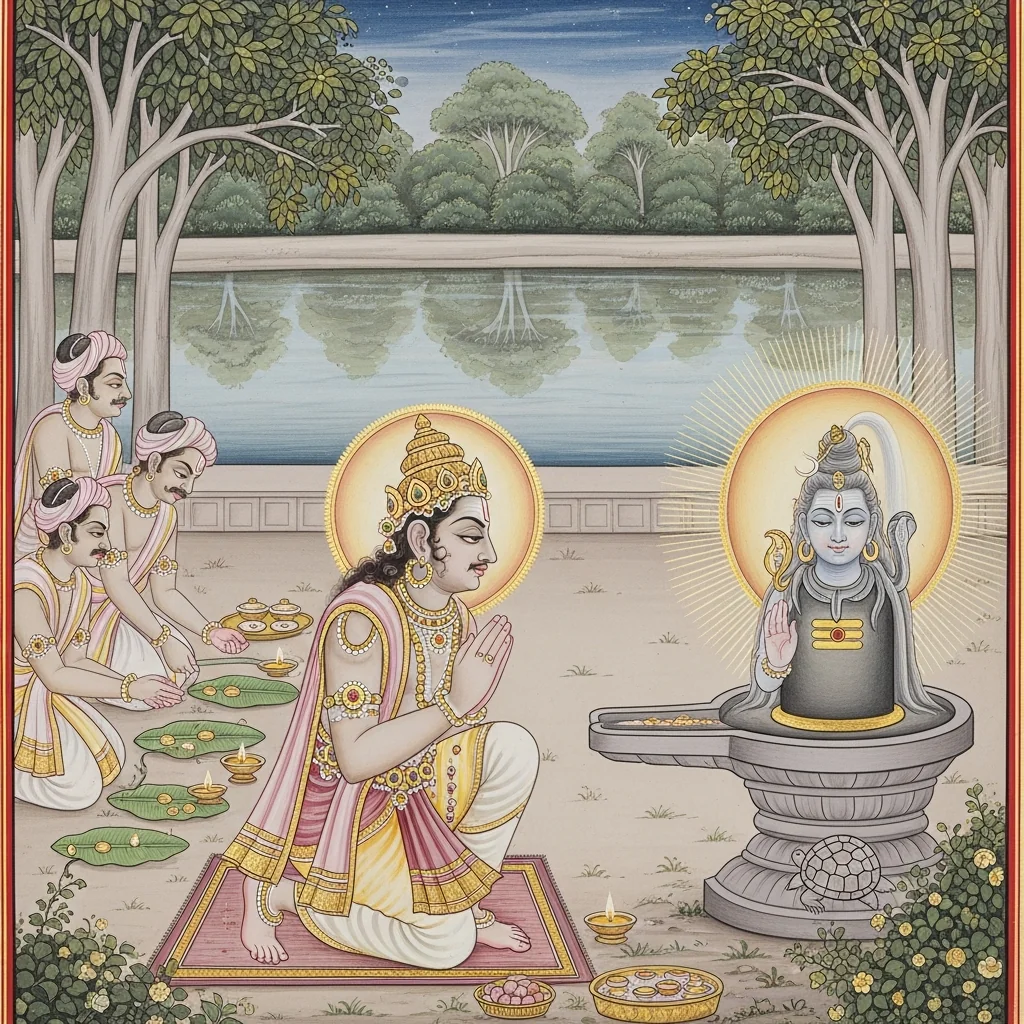
Adhyaya 19
इन्द्रतीर्थ-माहात्म्य एवं इन्द्रेश्वरलिङ्गप्रादुर्भावः (Indra Tīrtha Māhātmya and the Manifestation of the Indreśvara Liṅga)
This adhyāya unfolds as a dialogue between Vyāsa and Yudhiṣṭhira. Vyāsa proclaims the saving power of bathing at Indrasara and of beholding and worshipping Śiva as Indreśvara, declaring that sins accumulated over long ages are washed away. When Yudhiṣṭhira asks for the origin, Vyāsa recounts Indra’s severe tapas to the north of a settlement, undertaken to neutralize the grievous taint incurred by slaying Vṛtra, described as a brahmahatyā-like affliction. Śiva appears in a formidable, awe-inspiring form and assures Indra that within Dharmāraṇya such defilements do not endure, instructing him to enter and bathe. Indra then requests that Śiva be established under his name; Śiva reveals a sin-destroying liṅga, said to have manifested through yogic power and linked with a tortoise motif, and abides in Dharmāraṇya as Indreśvara for the welfare of all beings. The chapter enumerates ritual merits: regular worship with offerings; special observances on aṣṭamī and caturdaśī in the month of Māgha; nīlotsarga performed before the deity; rudra-japa on caturdaśī; specific dāna such as gifting a gold-and-gem eye-image to dvijas; pitṛ-tarpaṇa after bathing; and promised relief from diseases and misfortunes. It closes with Jayanta’s related devotion, Indra’s periodic worship, and a phalaśruti promising purification and the attainment of desired aims to attentive listeners.
Adhyaya 20
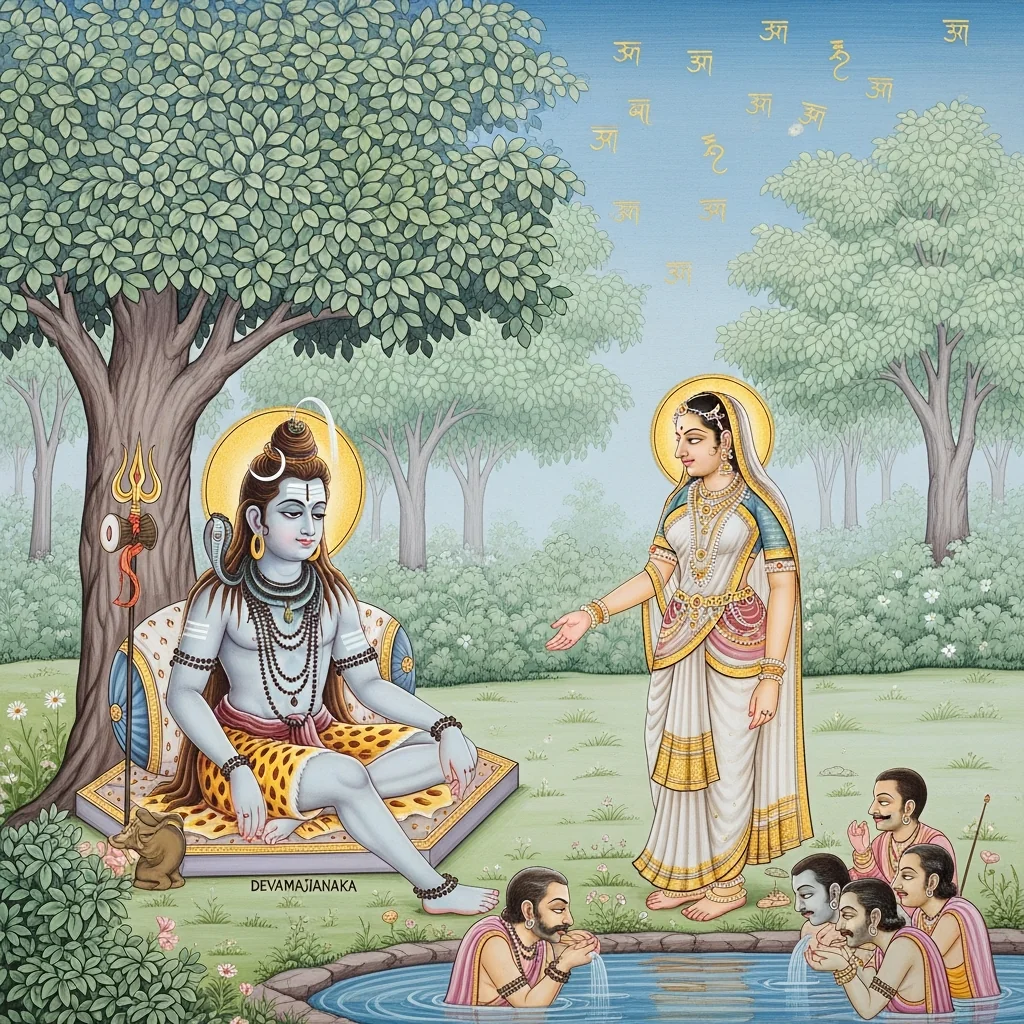
देवमज्जनकतीर्थमाहात्म्यं तथा मन्त्रकूटोपदेशः (Devamajjanaka Tīrtha-Māhātmya and Instruction on Mantra ‘Kūṭa’ Structures)
This chapter unfolds as a Vyāsa–Yudhiṣṭhira dialogue introducing an “unsurpassed” Śiva-tīrtha where Śaṅkara is said to have undergone an extraordinary state of immobilization and disorientation. From this narrative frame, the text turns to a technical theological teaching. Pārvatī questions Śiva about differentiated mantra-forms and “sixfold” powers, and Śiva replies guardedly on seed-syllables (bīja) and kūṭa-combinations, citing māyā-bīja, vahni-bīja, brahma-bīja, kāla-bīja, and pārthiva-bīja. These mantra-structures are portrayed as immensely potent yet ethically weighty—warning against misuse even while noting claimed functions such as influence, attraction, and delusion. The chapter culminates in the tīrtha-māhātmya of Devamajjanaka in Dharmāraṇya: bathing (and drinking the water), observing Aśvina kṛṣṇa caturdaśī, worship with fasting, and rudra-japa are praised as purifying, protective from afflictions, and conducive to welfare. The closing phalaśruti declares that hearing and transmitting this account yields merit equal to great sacrifices and grants prosperity, health, and continuity of lineage.
Adhyaya 21
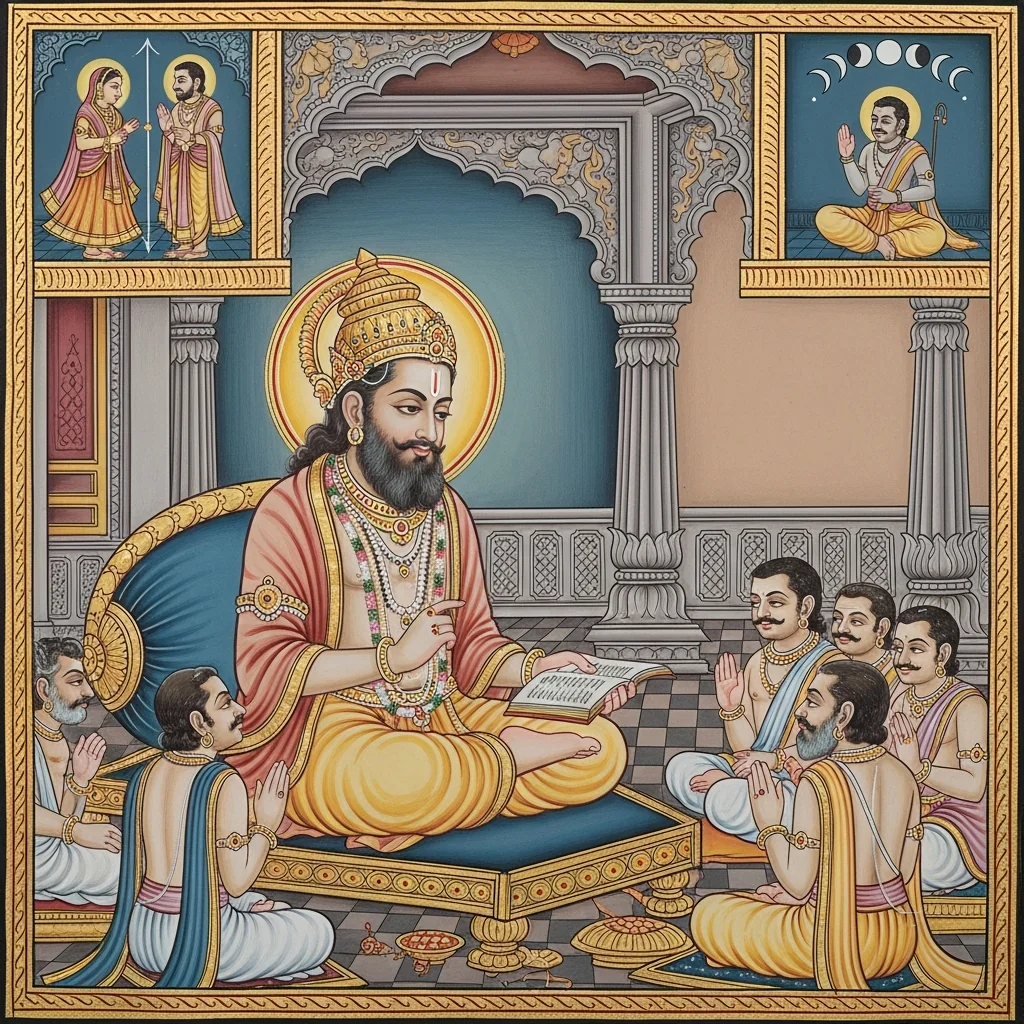
गोत्र–प्रवर-विवाहनिषेधः तथा प्रायश्चित्तविधानम् (Gotra–Pravara Marriage Prohibitions and Expiatory Regulations)
This adhyāya compiles dharma-based guidance on lineage regulation and marriage eligibility. Speaking in Vyāsa’s voice, it first presents dense enumerations of the deities and śaktis connected with the setting, including many named goddesses and their proliferated forms. It then lays out technical gotra–pravara details with examples of shared or distinct pravaras, and states clear prohibitions: marriage within the same gotra/pravara is forbidden, as are unions with certain categories of maternal kin. The chapter describes the social and ritual consequences of such prohibited marriages—loss of brāhmaṇya standing and offspring regarded as socially degraded—and prescribes expiations (prāyaścitta), especially the Cāndrāyaṇa vow, for those who have entered them. Echoing classical dharma-legal authorities such as Kātyāyana, Yājñavalkya, and Gautama, it defines acceptable degrees of separation through paternal and maternal lines. It also adds related household-ethics categories, including marriage precedence between elder and younger brothers and the classification of “punarbhū” conditions. Overall, it serves as an archival rule-set for dharmic household formation and for remediation when norms are violated.
Adhyaya 22
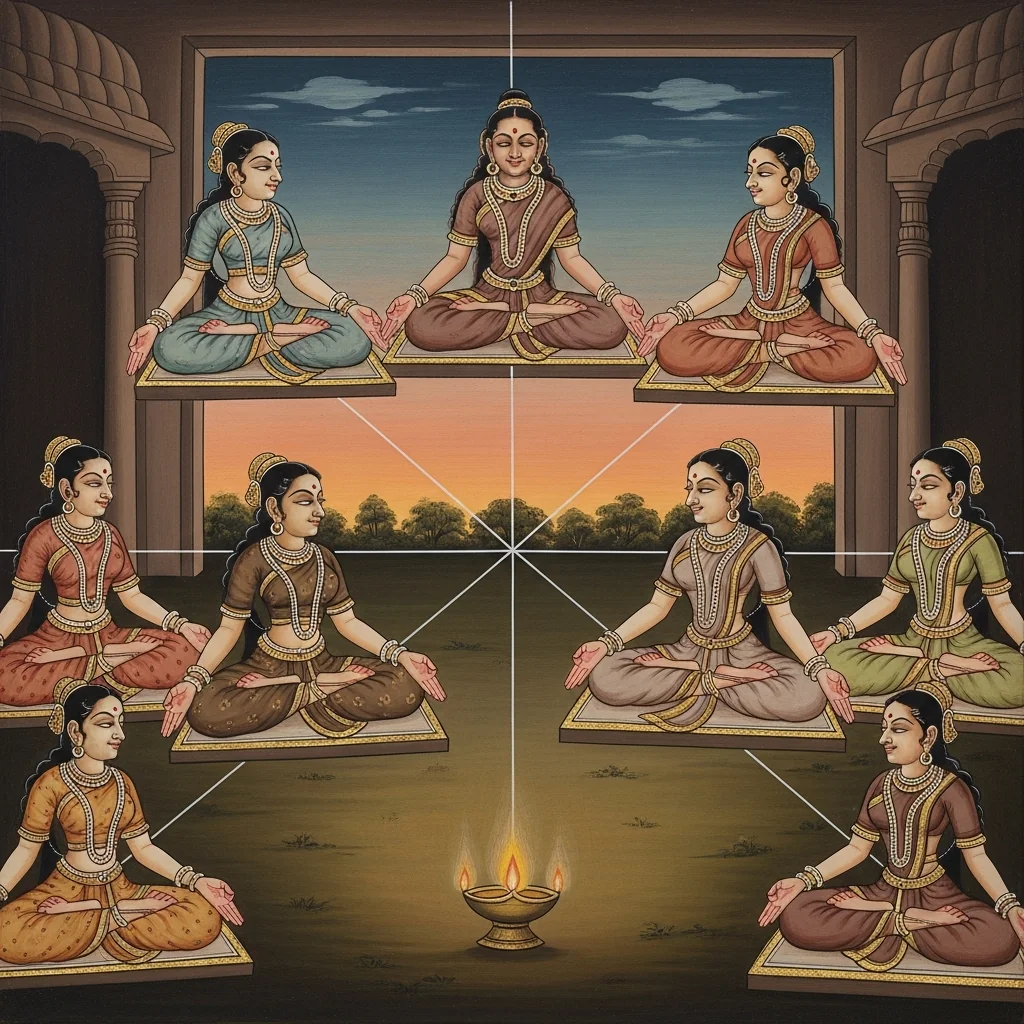
यॊगिनीनां स्थानविन्यासः (Placement of the Yoginīs and Directional Śaktis)
The chapter unfolds as a question-and-answer dialogue: Yudhiṣṭhira asks Vyāsa to identify the yoginīs said to have been established by Kājeśa—who they are, what they are like, and where they dwell. Vyāsa replies with a descriptive catalogue: the yoginīs are adorned with diverse ornaments, garments, vehicles, and sounds, and their stated role is protective, removing fear for vipras (ritual specialists) and devotees. The narration then becomes a sacred spatial register, placing these divinities in the four cardinal directions and the intermediate quarters (Agni, Nairṛta, Vāyu, Īśāna). Many names are recited—Āśāpurī, Chatrā, Jñānajā, Pippalāmbā, Śāntā, Siddhā, Bhaṭṭārikā, Kadambā, Vikaṭā, Supaṇā, Vasujā, Mātaṅgī, Vārāhī, Mukuṭeśvarī, Bhadrā, Mahāśakti, Siṃhārā—while noting that countless others exist beyond enumeration. Further details specify locations and worship: some are near Āśāpūrṇā; particular goddesses are assigned to east/north/south/west; offerings such as water-libations and bali are mentioned. One śakti is lion-seated and four-armed, granting boons; another bestows siddhi when contemplated; another grants bhukti and mukti; and certain forms are said to be perceptible at the three sandhyā times. The chapter closes by indicating additional groups (such as Brahmāṇī and the ‘jala-mātaraḥ’) in the Nairṛta quarter, confirming its purpose as a sacred-geographical index of protective feminine powers.
Adhyaya 23
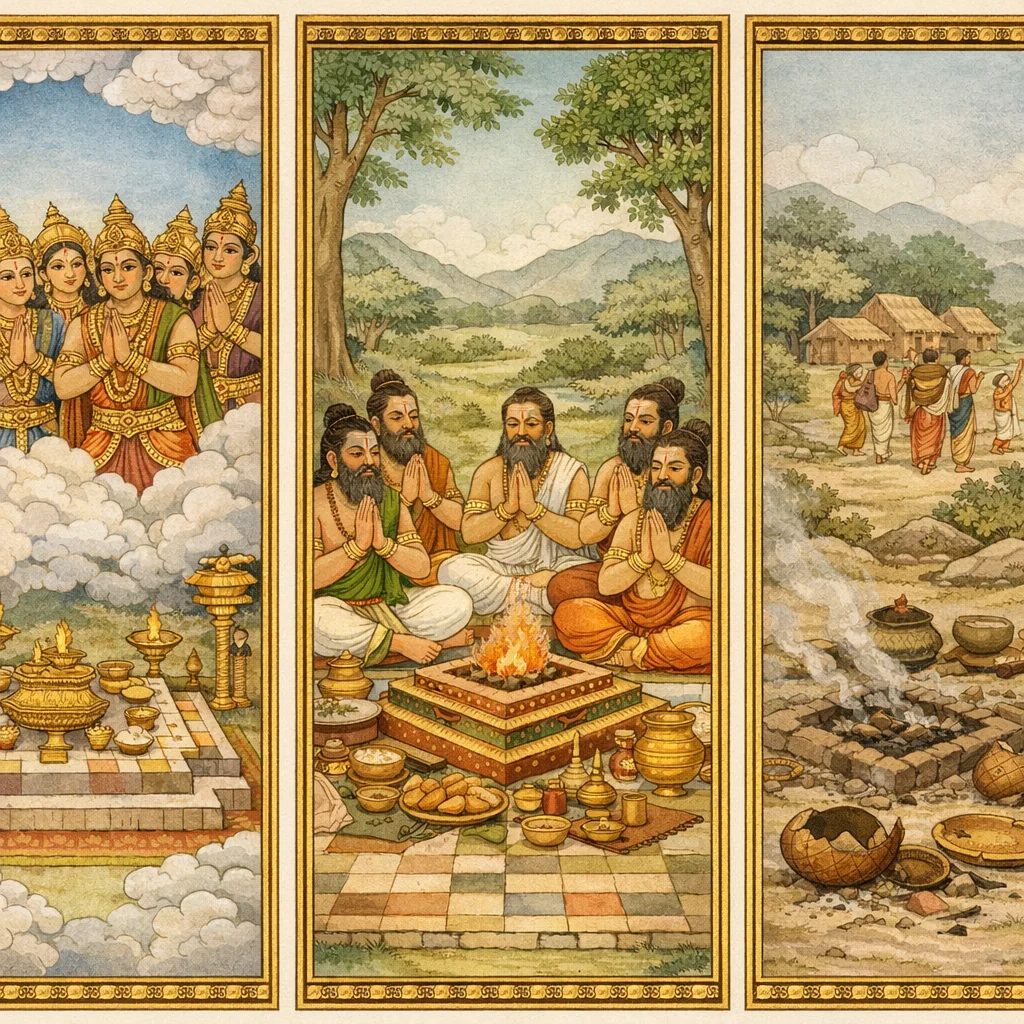
धर्मारण्ये देवसत्र-प्रवर्तनं लोहासुरोपद्रवश्च | The Devas’ Satra in Dharmāraṇya and the Disruption by Lohāsura
Vyāsa relates that the devas, distressed by their conflict with the daityas, approach Brahmā for refuge and ask for a swift means to secure victory. Brahmā explains that Dharmāraṇya was formerly established through divine collaboration of Brahmā, Śaṅkara, and Viṣṇu, with Yama’s tapas as a supporting cause, and he teaches a rule of ritual geography: whatever dāna, yajña, or tapas is performed there becomes “koṭi-guṇita” (multiplied manyfold), with both puṇya and pāpa likewise magnified in their results. The devas then go to Dharmāraṇya and arrange a grand satra lasting a thousand years, appointing eminent ṛṣis to specialized sacrificial offices, setting up a vast altar-ground, and offering oblations by mantraic procedure, while extending generous hospitality and anna-dāna to resident dvijas and dependents. In a later age, Lohāsura, disguised in a Brahmā-like form, harasses ritualists and communities, destroys yajña materials, and defiles sacred structures, causing widespread dispersal. The displaced found new villages named to memorialize fear, confusion, and diverging routes, while Dharmāraṇya becomes hard to inhabit and its tīrtha-status is impaired by desecration, until the asura departs satisfied.
Adhyaya 24
धर्मारण्य-माहात्म्य-वर्णनम् | Description of the Glory of Dharmāraṇya (Dharmāraṇya Māhātmya)
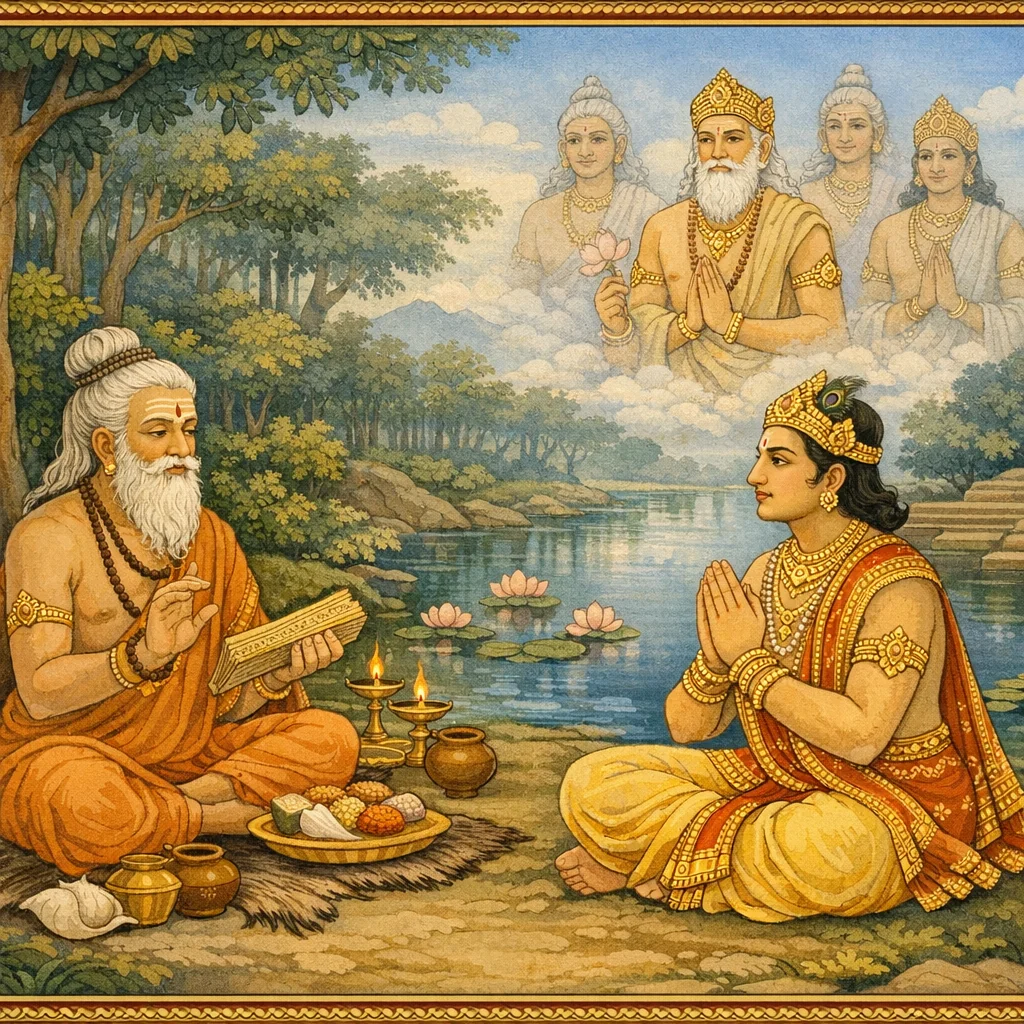
Vyāsa concludes by reaffirming the māhātmya of the foremost tīrtha-region known as Dharmāraṇya, praising it as supremely auspicious and capable of purifying sins amassed over many births. He teaches that bathing there frees one from transgressions, and thus Yudhiṣṭhira (Dharmarāja) enters the forest to remove great sins and to protect the virtuous. The chapter then sets out the site’s ritual life: immersion in its tīrthas, visits to deity-shrines, and the performance of iṣṭa-pūrta—sacrificial rites and charitable works—according to one’s intention. A phalāśruti follows, declaring that those who reach the place, or even merely hear of it, gain both worldly enjoyment and liberation, culminating in nirvāṇa after their worldly experience. Special emphasis is placed on recitation at śrāddha-time by the twice-born, said to bring enduring uplift to the ancestors. Dharmavāpī is singled out: even water alone, without any ancillary ritual materials, is proclaimed to destroy vast accumulated demerit and to yield fruits comparable to Gayā-śrāddha and repeated piṇḍa offerings, presenting a minimalist yet potent theology of water and sacred remembrance.
Adhyaya 25
सत्यलोकात्सरस्वती-आनयनं तथा द्वारावतीतीर्थे पिण्डदानफलम् | Bringing Sarasvatī from Satyaloka and the Merit of Piṇḍa-dāna at Dvāravatī Tīrtha
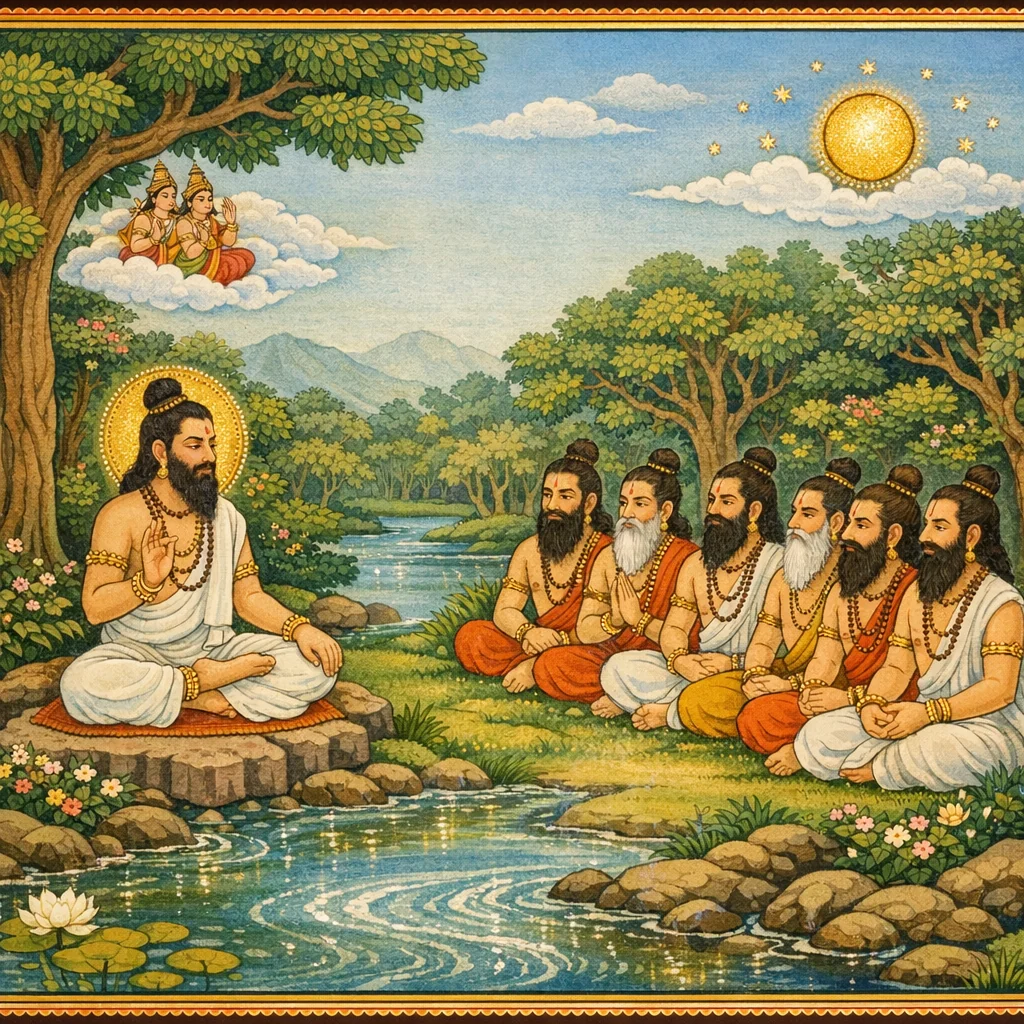
This adhyāya is framed as Sūta’s transmission of an excellent tīrtha-māhātmya, praising Sarasvatī’s sacred role in Dharmāraṇya. It introduces the sage Mārkaṇḍeya—serene, learned, yogically disciplined, bearing a kamaṇḍalu and rosary—whom assembled ṛṣis approach with reverence. Recalling earlier traditions connected with Naimiṣāraṇya and the descents of holy rivers, they ask him to clarify Sarasvatī’s advent and its ritual meaning. Mārkaṇḍeya declares that Sarasvatī was brought from Satyaloka to Dharmāraṇya (near Suredrādri), emphasizing her nature as a giver of refuge and protection. The chapter then prescribes a calendrical rite: in Bhādrapada, during the bright fortnight, on the auspicious Dvādaśī, at Dvāravatī-tīrtha (served by sages and gandharvas), one should perform piṇḍa-dāna and other ancestral offerings. The fruit is described as imperishable benefit for the pitṛs, while Sarasvatī’s water is extolled as supremely auspicious, able to remove even grave demerit in the text’s idiom. The phala teaching culminates by presenting Sarasvatī as a wish-fulfilling cause of both svarga-merit and apavarga-oriented good, aligning ritual action with higher liberative aims.
Adhyaya 26
द्वारवती-तीर्थमाहात्म्य (Dvāravatī Tīrtha Māhātmya: Merit of Viṣṇu’s Abiding Sacred Ford)
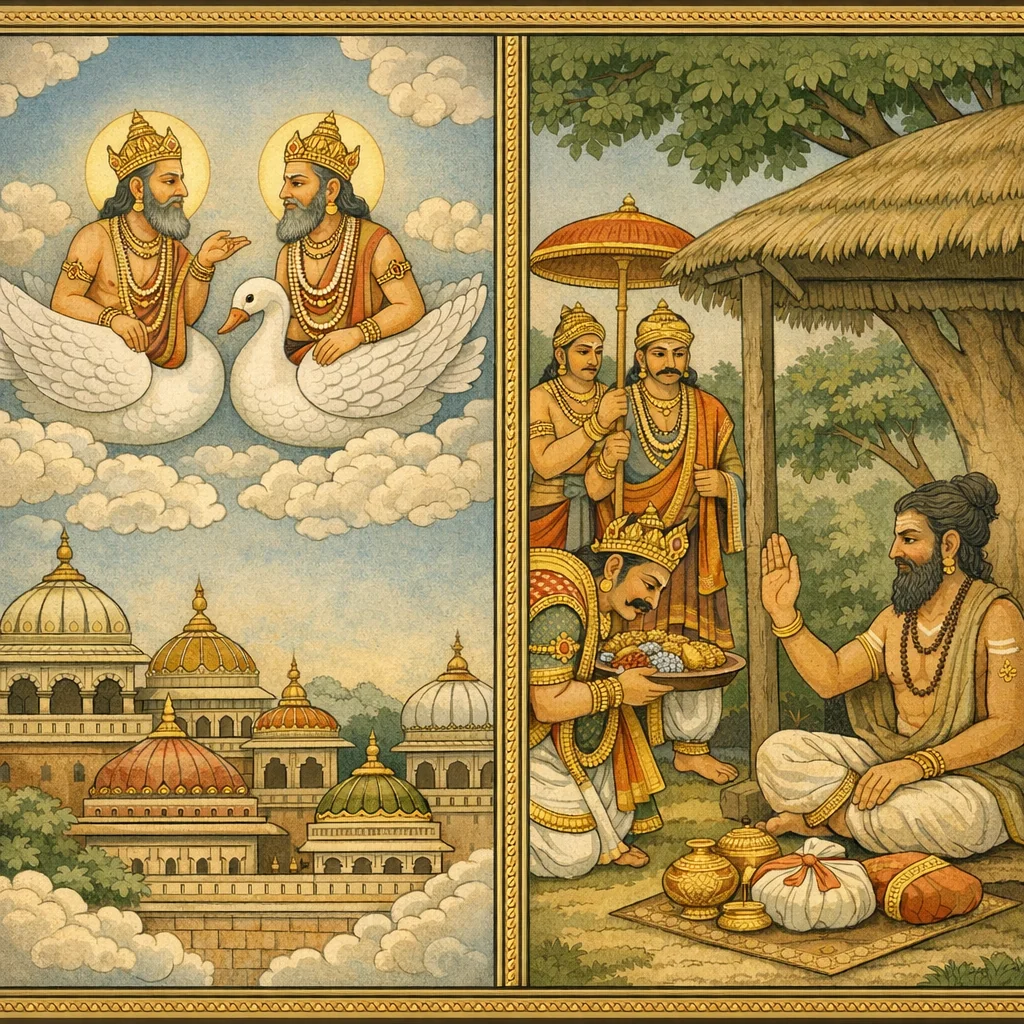
Vyāsa describes a sacred economy of merit centered on a Viṣṇu-linked tīrtha associated with Dvāravatī. The chapter opens by declaring that Mārkaṇḍeya has “opened the gate of heaven,” and that those who relinquish the body with the aim of attaining Viṣṇu reach His proximity, attaining sāyujya. It then sets forth disciplines of self-restraint—above all fasting (anāśana/upavāsa)—as exceptionally powerful tapas. Bathing at the tīrtha, worshiping Keśava, and performing śrāddha with piṇḍa and water-offerings are praised as rites that satisfy the ancestors for a long duration measured on a cosmic scale. Because Hari is said to be “present there,” the tīrtha is proclaimed a remover of sin and a complete bestower of aims: liberation for seekers of mokṣa, wealth for those seeking prosperity, and longevity and happiness for devotees. Finally, gifts made there in faith are declared imperishable (akṣaya), and the fruits of great sacrifices, charities, and austerities are equated with what is gained by merely bathing at this place—even by socially humble yet devoted practitioners—thus emphasizing both accessibility and divinely grounded efficacy.
Adhyaya 27
Govatsa-tīrtha Māhātmya and the Self-Manifolding Liṅga (गोवत्सतीर्थमाहात्म्यं)
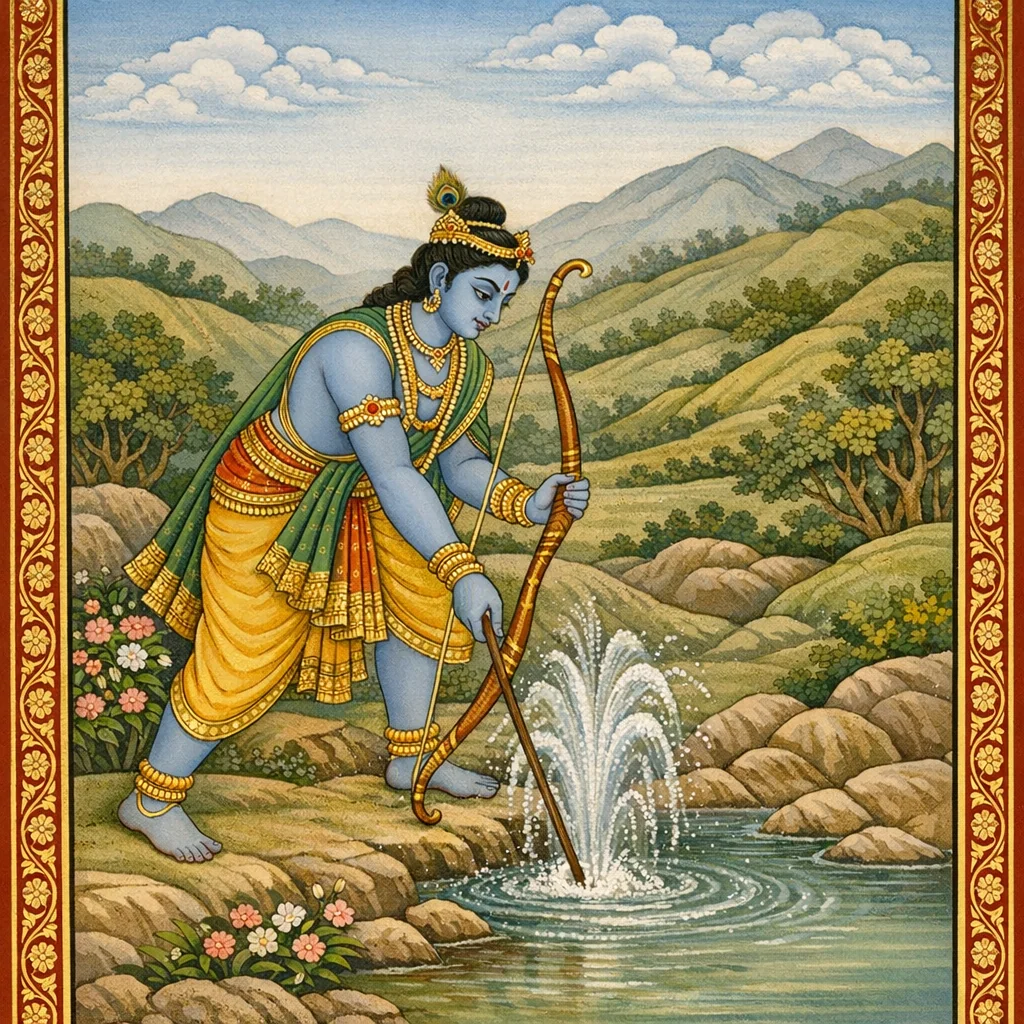
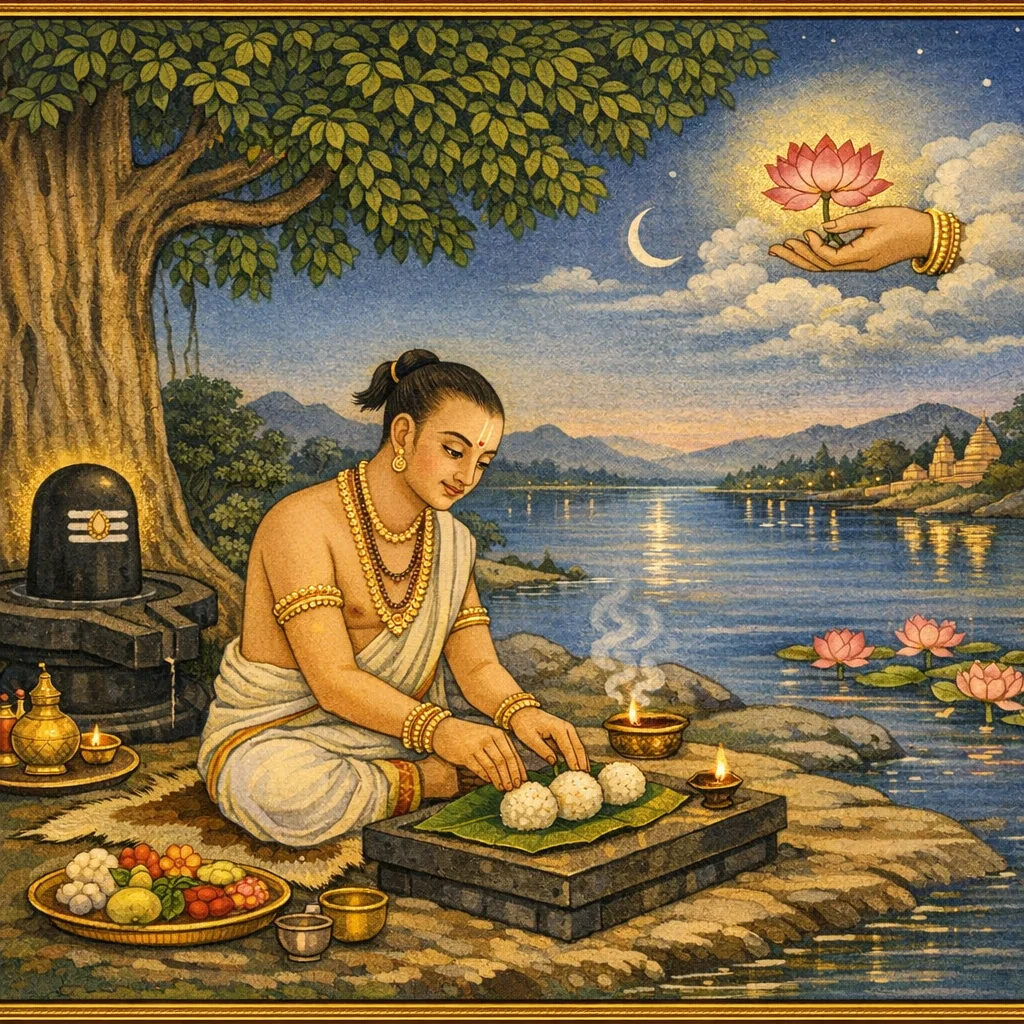
Sūta recounts the glory of a famed tīrtha called Govatsa, near a place associated with Markandeya. There Ambikāpati (Śiva) is said to dwell both in the form of a wondrous calf and as a self-manifest, radiant liṅga. King Balāhaka—a hunter yet a Rudra-devotee—chases the calf into the forest; when he tries to seize it, a blazing liṅga appears. Overwhelmed, the king reflects, relinquishes his body, and celestial cries with a rain of flowers mark his immediate ascent to Śiva’s realm. The gods petition Śiva to remain there as a bright liṅga for the welfare of the worlds; Śiva grants abiding presence and prescribes observances in Bhādrapada, during the dark fortnight on the day of Kuhū, promising fearlessness and merit to worshippers. The chapter then teaches ritual-ethics: piṇḍadāna and tarpaṇa are praised as highly efficacious for ancestors—even those in difficult states—especially at the Gaṅgā-kūpaka near Govatsa. An origin tale explains “Caṇḍāla-sthala” through a moral vignette about one deemed caṇḍāla by conduct; the liṅga’s abnormal growth is ritually addressed and the site’s sanctity stabilized. It concludes with a strong phalaśruti: liṅga-darśana and service to the tīrtha purify even grave transgressions, presenting a theology of sacred place, ritual power, and ethical transformation.
Adhyaya 28
लोहोयष्टिका-तीर्थमाहात्म्य (Lohayaṣṭikā Tīrtha-Māhātmya: Ritual Efficacy of Ancestral Offerings)
Chapter 28 extols the tīrtha of Lohayaṣṭikā, situated in the south‑western (nairṛta) quarter and sanctified by Rudra’s presence as a svayaṃbhu-liṅga. Framed as a dialogue between Vyāsa and Mārkaṇḍeya, it specifies auspicious ritual times—especially amāvāsyā and the waning moon in the Nabhasya/Bhādrapada setting—and prescribes śrāddha and tarpaṇa rites connected with the waters of Sarasvatī. The chapter declares that repeated piṇḍa offerings here yield fruit equal to the famed Gayā paradigm, so that ancestral satisfaction may be attained locally through disciplined observance. It further recommends ancillary gifts at named tīrthas—cow-gift at Rudra-tīrtha and gold-gift at Viṣṇu-tīrtha—for those intent on mokṣa. A devotional formula is given for placing the piṇḍa into the “hand of Hari (Janārdana),” linking pitṛ-rites to Vaiṣṇava theism and to release from ṛṇa-traya, the three debts. Its phala statements promise liberation of ancestors from preta states, enduring merit, and blessings for descendants such as health and protection, while emphasizing that even modest donations, righteously earned, are magnified in efficacy at this tīrtha.
Adhyaya 29
लोहासुरविचेष्टितम् (The Deeds of Lohāsura) — Dharmāraṇya Pitṛ-Tīrtha Māhātmya
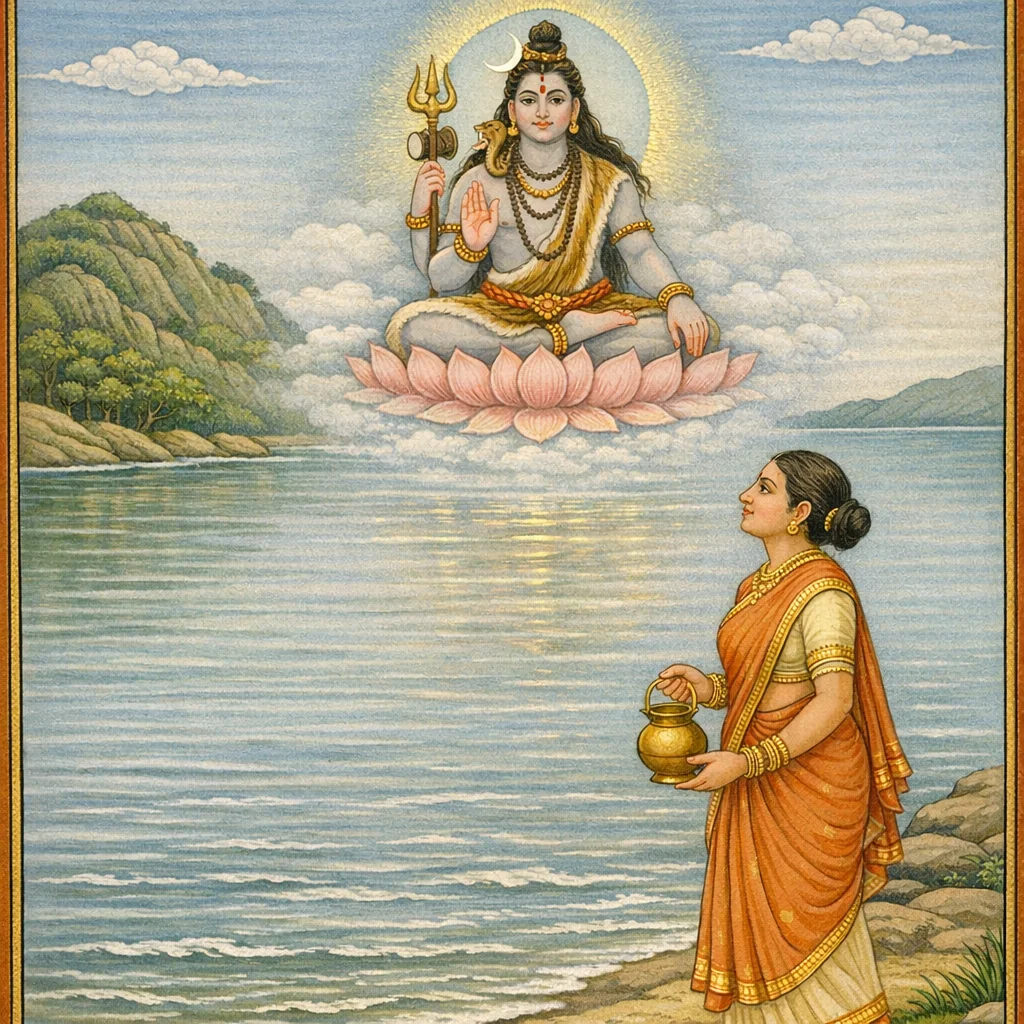
Sūta recounts the career of Lohāsura, a daitya who, stirred to renunciation after witnessing the lofty attainments of elders, seeks an unsurpassed place of tapas and adopts an inward form of devotion: Gaṅgā upon his head, lotuses in his eyes, Nārāyaṇa in his heart, Brahmā at his waist, and the gods reflected in his body like the sun in water. He performs fierce austerities for a divine century, gains from Śiva the boon of bodily non-decay and freedom from fear of death, and then continues his tapas on the bank of the Sarasvatī. Indra, alarmed, tries to break his austerities; conflict ensues and stretches into a prolonged struggle, where even Keśava is described as overcome by the boon’s force. The triad (Brahmā, Viṣṇu, Rudra) deliberates and restrains the daitya through the moral-legal power of satya and vākpāśa, the “bond of speech,” charging him to protect the dharma of truthful utterance and not disturb the gods. In return, the deities promise to abide in his body until cosmic dissolution, and his embodied presence becomes a tīrtha in Dharmāraṇya near Dharmēśvara. The chapter then sets forth pitṛ-rite benefits: tarpaṇa and piṇḍadāna at the local well and on specified lunar dates (notably caturdaśī/amāvāsyā in Bhādrapada) are said to yield multiplied ancestral satisfaction, sometimes likened to or exceeding Gayā/Prayāga. A pitṛ-gāthā supports this, along with a practical mantra for offerings to known and unknown lineages. The phalaśruti concludes that hearing this account removes major sins and grants merit equal to repeated Gayā rites and abundant cow-gifts.
Adhyaya 30
रामचरित-संक्षेपः (Condensed Rāma Narrative and the Ideal of Rāma-rājya)
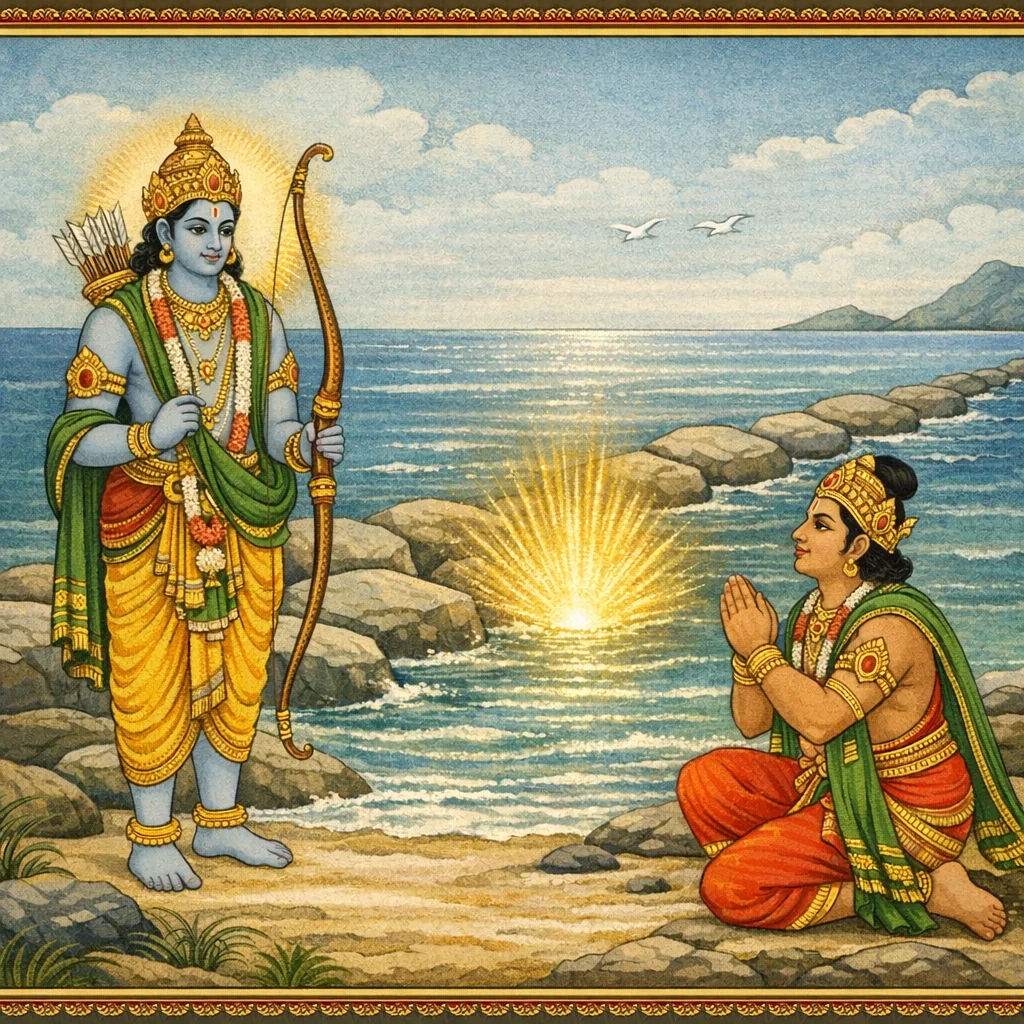
This adhyāya gives a condensed, chronological theological account of Śrī Rāma as a Vaiṣṇava aṃśa born in the Sūryavaṃśa. It begins with his dharma-formed youth: accompanying Viśvāmitra, protecting the yajña, slaying Tāḍakā, receiving dhanurveda, and restoring Ahalyā. It then establishes royal and marital legitimacy: at Janaka’s court Rāma breaks Śiva’s bow and weds Sītā. Through Kaikeyī’s boons he accepts fourteen years of forest exile; Daśaratha dies, and Bharata returns to rule in regency with Rāma’s pādūkā as the emblem of the throne. The narrative moves through crisis and recovery: the Śūrpaṇakhā episode, Sītā’s abduction, Jatāyu’s fall, alliance with Hanumat and Sugrīva, and missions of reconnaissance and message-bearing. The campaign follows—bridge-building, the siege of Laṅkā, tithi-marked phases of battle, the episodes of Indrajit and Kumbhakarṇa, and Rāvaṇa’s defeat. It closes with Vibhīṣaṇa’s consecration, the motif of Sītā’s purification, and the return to Ayodhyā, followed by an extended portrayal of Rāma-rājya as an ethical ideal of welfare, prosperity, freedom from crime, and reverence for elders and dvijas. Finally, Rāma inquires into tīrtha-māhātmya, linking epic remembrance to the meaning of pilgrimage.
Adhyaya 31
Dharmāraṇya as Supreme Tīrtha: River-Māhātmya, Phalāśruti, and Rāma’s Pilgrimage Movement (धर्मारण्य-माहात्म्य-प्रकरणम्)
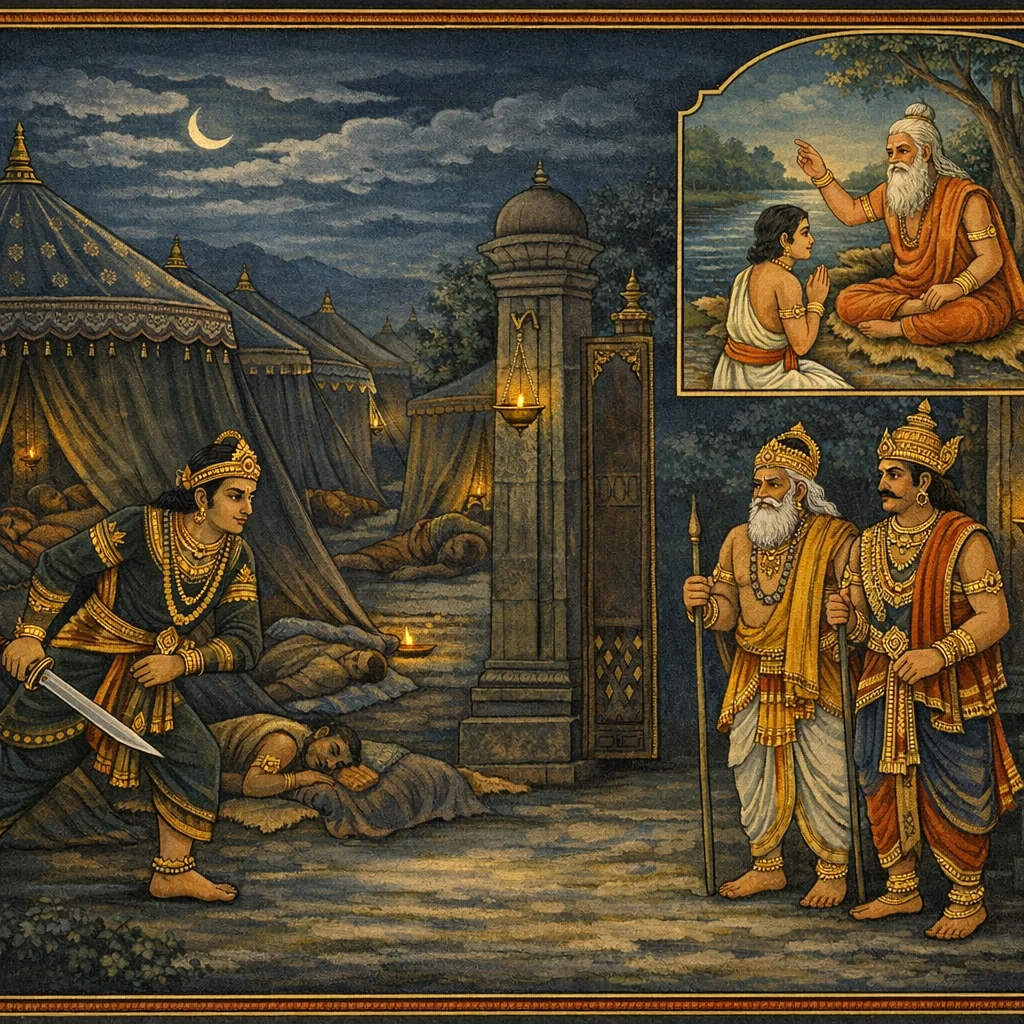
Chapter 31 unfolds as an instructive dialogue: Śrī Rāma asks Vasiṣṭha to name the highest tīrtha for purification, prompted by a dharmic concern to expiate the sin connected with killing brahma-rākṣasas during the Sītā-abduction episode. Vasiṣṭha replies by listing and ranking major sacred rivers—Gaṅgā, Narmadā/Reva, Tāpī, Yamunā, Sarasvatī, Gaṇḍakī, Gomati, and others—assigning distinct merits to seeing them, remembering them, bathing in them, and performing seasonal and lunar observances (such as Karttika and the Māgha bath at Prayāga). The teaching expands into a phalāśruti-style catalogue of tīrtha-phalas: release from sins, avoidance of hells, uplift of ancestors, and attainment of Viṣṇu’s realm. It culminates in a superlative declaration that Dharmāraṇya, founded in ancient times and praised by the devas, is the paramount tīrtha—able to dissolve even grave transgressions and to grant desired aims to varied seekers (kāmin, yati, siddha). In Brahmā’s framing narration, Rāma rejoices and resolves to go; he departs with Sītā, his brothers, Hanumān, the queens, and a great retinue, observing the prescribed approach to the ancient tīrtha on foot. At night he hears a woman’s lament and sends messengers to inquire, setting the stage for the next development.
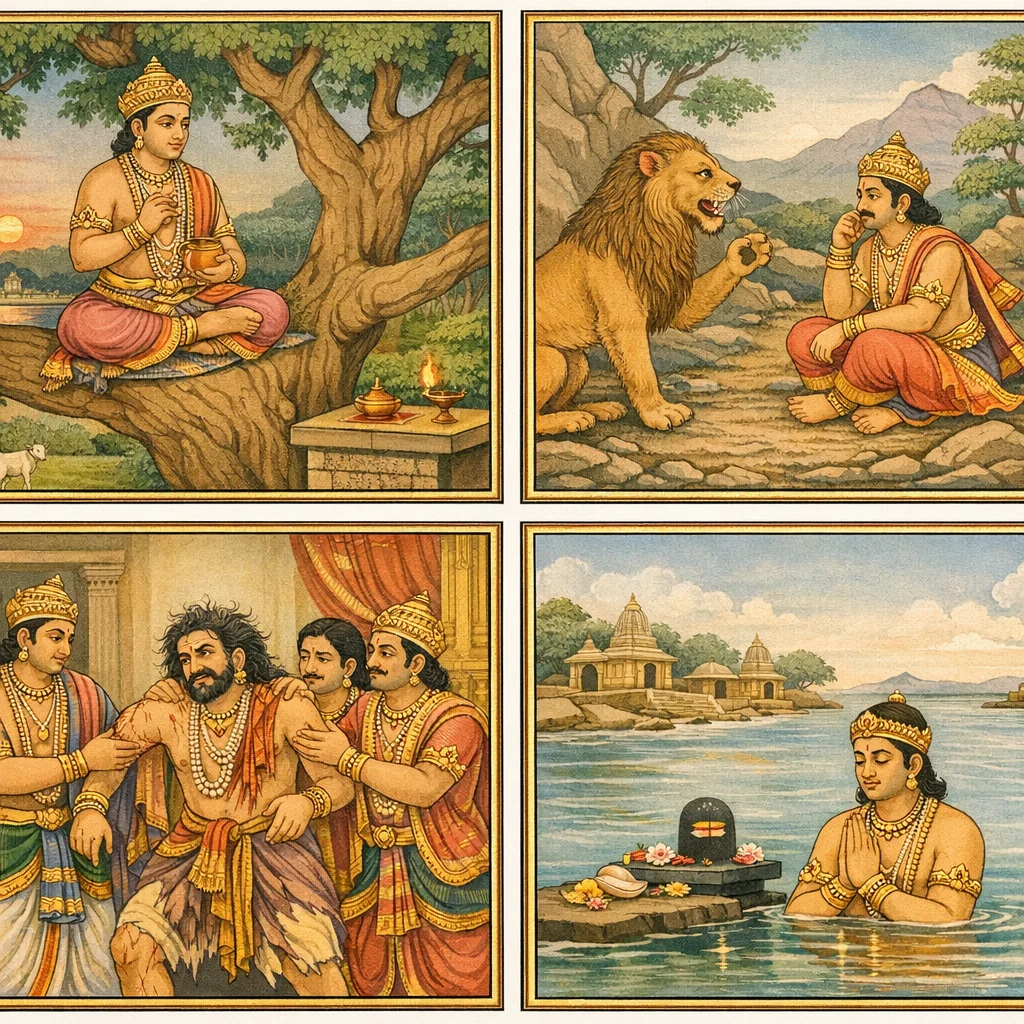
Adhyaya 32
Dharmāraṇya-adhidevatā’s Lament and Śrī Rāma’s Restoration of the Vedic Settlement (Satya-Mandira)
The chapter begins in a Vyāsa-framed narration: Rāma’s messengers meet a solitary divine woman, richly adorned yet sorrowful, and report her to Śrī Rāma. Rāma approaches with humility, asks her identity and the reason for her abandonment, and offers protection. She replies with a formal stuti, praising Rāma as the supreme and eternal remover of suffering, and extolling his cosmic greatness and victories over rākṣasas. She then discloses her role: she is the adhidevatā, presiding deity of Dharmāraṇya-kṣetra. For twelve years the land has been deserted from fear of a powerful asura; Brahmins and merchants have fled, ritual life has collapsed, and former signs of prosperity—bathing at the dīrghikā, communal play, flowers, yajña-vedīs, and household agnihotra—have given way to thorns, wild beasts, and ominous portents. Rāma promises to seek out the displaced Brahmins in every direction and resettle them. The goddess specifies the traditional social-religious order: great numbers of Veda-versed Brahmins of many gotras and dharma-minded Vaiśyas, and she names herself Bhattārikā, the local protectress. Rāma affirms her truth, proclaims a city to be founded and famed as Satya-mandira, and dispatches attendants to bring the Brahmins with honor (arghya-pādya), issuing a governance decree that refusal to receive them brings punishment and exile. The Brahmins are found, honored, and brought to Rāma; he declares his own stature rests on vipra-prasāda (the favor of Brahmins), then performs ritual reception (pādya, arghya, āsana), prostration, and lavish gifting—ornaments, garments, sacred threads, and many cows—thereby restoring Dharmāraṇya’s sacred settlement and order.
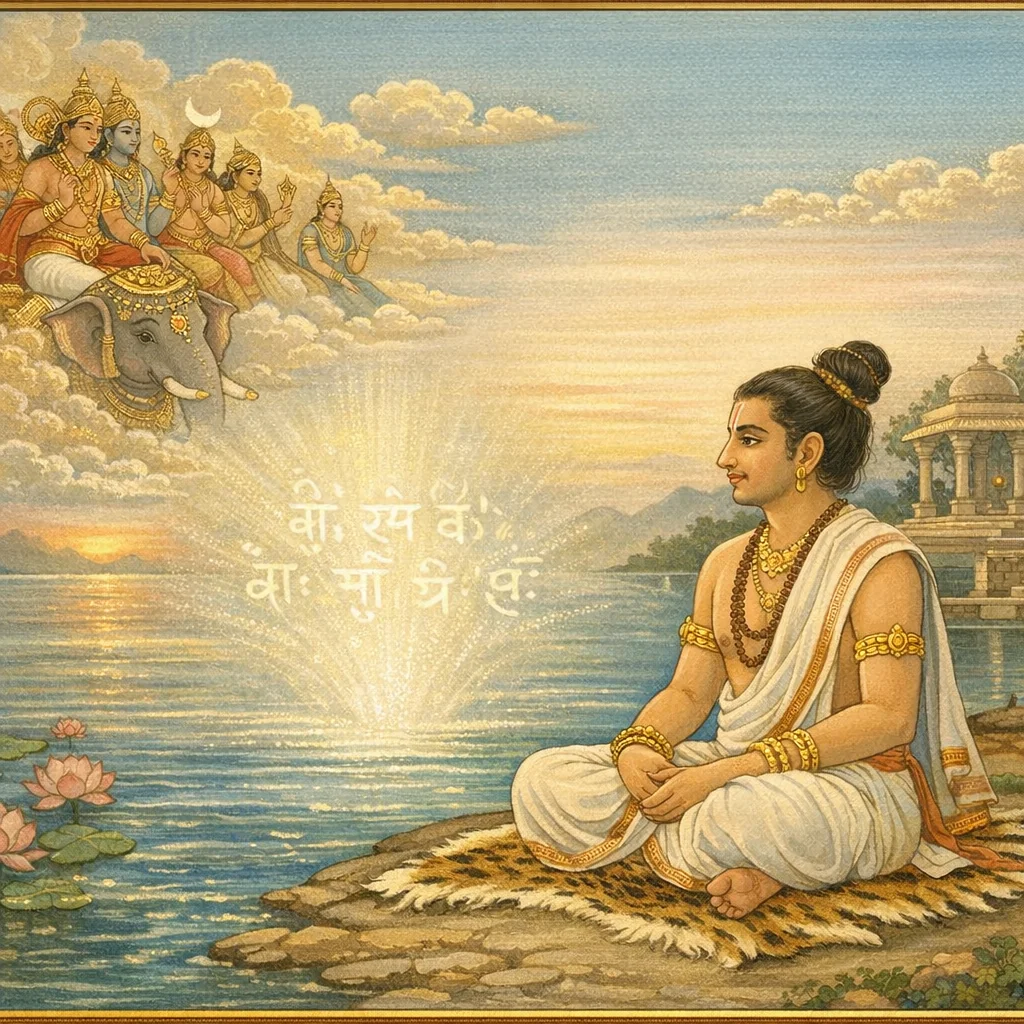
Adhyaya 33
जीर्णोद्धार-दानधर्मः | Jīrṇoddhāra and the Ethics of Dāna (Qualified Giving)
This chapter offers a theological and ethical teaching on jīrṇoddhāra (restoration) and the proper discipline of dāna (giving) in Dharmāraṇya. Rāma, acting on Śrīmātā’s command, declares his resolve to restore the sacred site and seeks permission to distribute gifts rightly. The text insists that gifts must be given to a worthy recipient (pātra), not an unworthy one (apātra): the worthy is like a boat that carries both giver and receiver across, while the unworthy is ruinous like a lump of iron. Brāhmaṇahood is not treated as mere birth; kriyā—effective ritual action and right conduct—is presented as the decisive measure of spiritual fruit. A group of brāhmaṇas describes austere, restrained livelihoods and confesses fear of accepting royal gifts, calling royal patronage perilous. Rāma consults Vasiṣṭha and invokes the Trimūrti, who appear, approve the restoration, and praise Rāma for his earlier defense of divine order. Rāma then begins construction and endowment, donating halls, residences, storerooms, wealth, cattle, and villages to learned priests, including the establishment of Trāyīvidyā specialists. The deities bestow insignia such as the cāmara and sword and lay down continuing norms: worship of guru and kuladevatā, charity at appointed times (e.g., Ekādaśī and Saturdays), support for the vulnerable, and first offerings to Śrīmātā and associated deities for unobstructed success. The chapter concludes with expanded tīrtha infrastructure (tanks, wells, moats, gates), protective injunctions against erasing royal edicts, Hanumān’s appointment as guardian, and divine benediction.
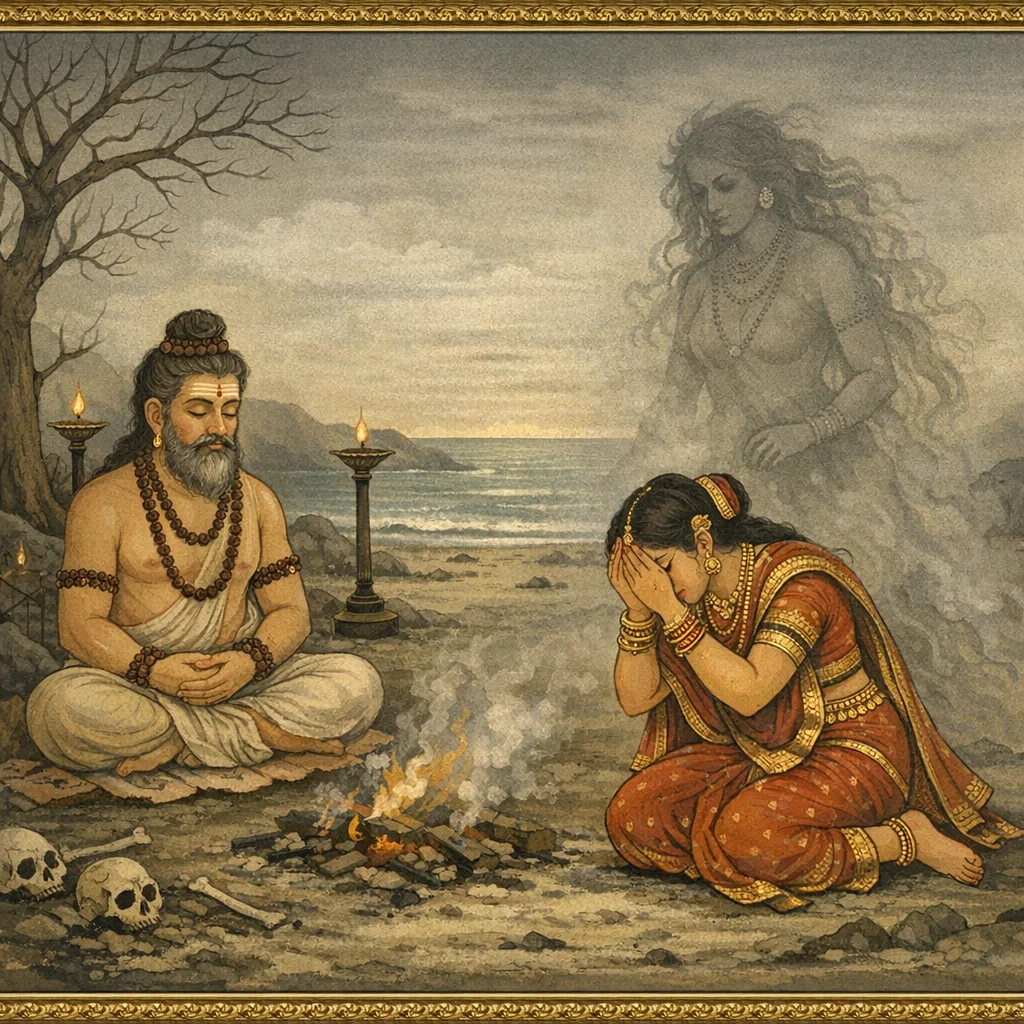
Adhyaya 34
Rāma-śāsana on Dharmāraṇya: Protection of Land Grants and the Dharma of Endowments (रामशासन-भूमिदानधर्मः)
The chapter is cast as a dialogue: Yudhiṣṭhira asks Vyāsa about an ancient “śāsana” (royal charter/inscription) issued by Rāma in the Tretā age at Satya-mandira, and Vyāsa recounts its setting and contents. Placed in Dharmāraṇya, the narrative highlights divine guardianship—Nārāyaṇa as Lord, and a yoginī as a saving power—and stresses the durability of the medium, praising copper as an enduring support for records of dharma. Vyāsa then affirms Viṣṇu as a theological constant across Veda, Purāṇa, and dharmaśāstra, and presents Rāma as an avatāra who protects dharma and destroys hostile forces. The charter follows an epigraphic-dharma template: it extols the land-donor, threatens severe penalties for confiscators and their assenters, and promises vast merit to protectors. It details the karmic results of land theft—naraka torments and degraded rebirths—contrasting them with the rewards of donating even small measures of land, and declares that land gifted to Brahmins is not to be transferred or seized. The chapter also records custodial practice: learned Brahmins preserve the copper plate, ritually honor it, and worship it daily, while constant recitation of the Name “Rāma” is taught as a protective devotional discipline. In conclusion, Rāma commands that the charter remain safeguarded through cosmic durations, invokes Hanumān as protector-enforcer against violators, and ends with Rāma’s return to Ayodhyā and his long reign.
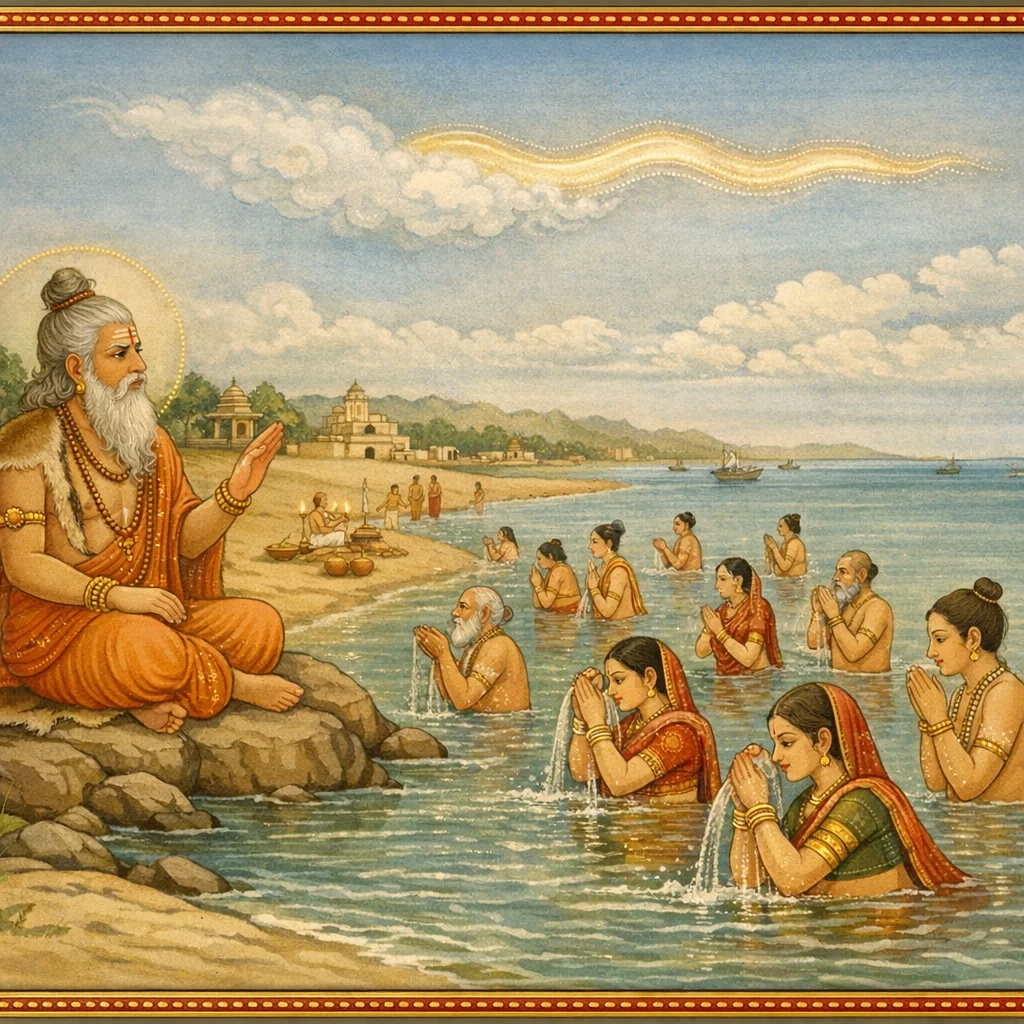
Adhyaya 35
धर्मारण्ये रामयज्ञः, सीतापुरस्थापनं च (Rāma’s Sacrifice in Dharmāraṇya and the Founding of Sītāpura)
This adhyāya unfolds as a dialogue begun by Nārada and narrated by Brahmā, describing Śrī Rāma’s ritual and administrative deeds in Dharmāraṇya. After hearing extensive tīrtha-māhātmya comparisons—Prayāga/Triveṇī, Śukla-tīrtha, Kāśī, the Gaṅgā, Harikṣetra, and Dharmāraṇya—Rāma resolves to renew his pilgrimage and arrives with Sītā, Lakṣmaṇa, Bharata, and Śatrughna, seeking Vasiṣṭha’s guidance on proper procedure. Rāma asks which practice in the “mahākṣetra” best removes grave sins, including brahmahatyā: dāna, niyama, snāna, tapas, dhyāna, yajña, homa, or japa. Vasiṣṭha prescribes a yajña in Dharmāraṇya, praised as yielding merit that multiplies over time. Sītā advises that the officiants should be Veda-proficient brāhmaṇas long associated with Dharmāraṇya. Eighteen named ritual experts are summoned; the sacrifice is completed with the avabhṛtha bath and with honorific worship of the priests. At the close, Sītā requests that the ritual prosperity be made enduring through a settlement bearing her name; Rāma grants the brāhmaṇas a secure abode and establishes “Sītāpura,” linked with auspicious protective tutelaries (Śāntā and Sumaṅgalā). The chapter then expands into an administrative-ritual charter: many villages (in a long enumeration) are created and granted for brāhmaṇa residence; supporting communities (vaiśyas and śūdras) and material gifts—cattle, horses, textiles, gold, silver, and copper—are assigned. Rāma emphasizes dharmic governance: brāhmaṇa requests must be honored, service to them brings prosperity, and obstruction by hostile outsiders is condemned. The narrative ends with Rāma’s return to Ayodhyā amid public rejoicing, the continuation of righteous rule, and a brief note on Sītā’s pregnancy, joining ritual order with dynastic continuity.
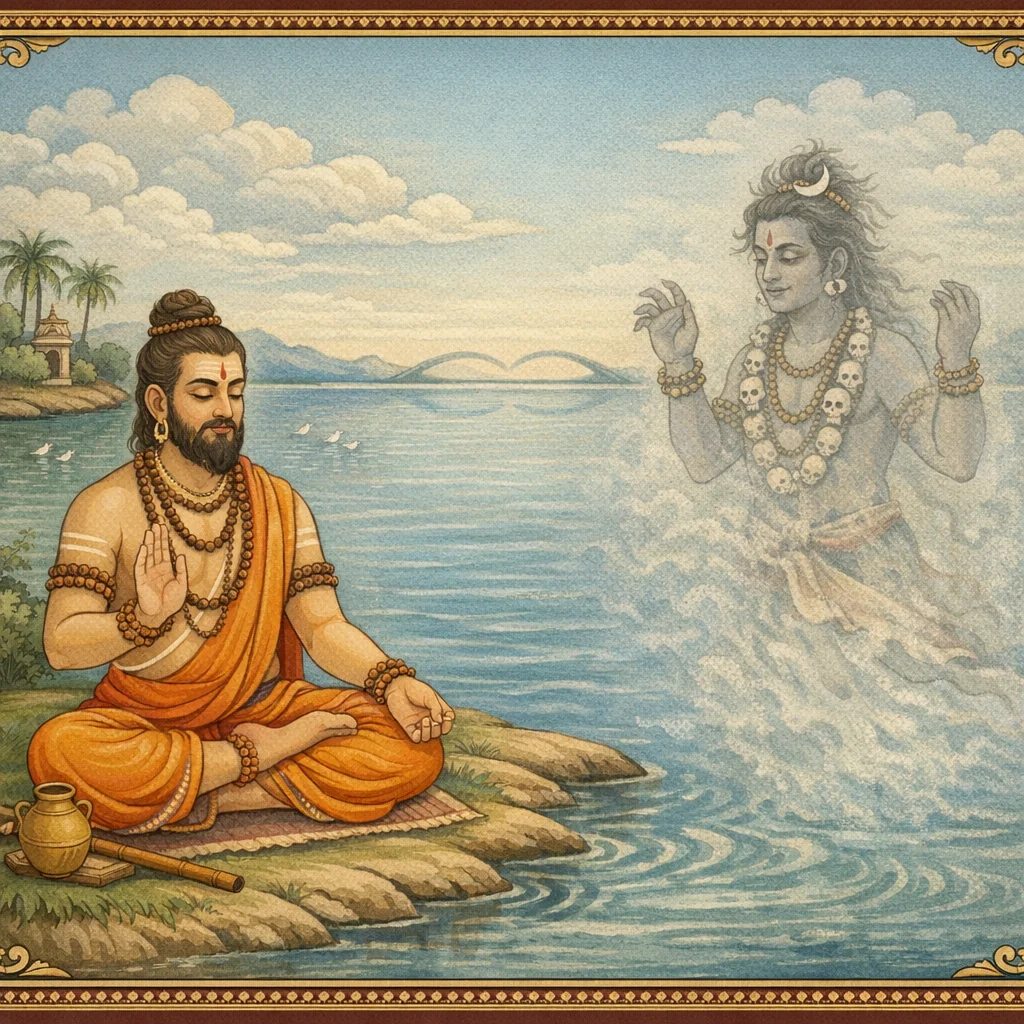
Adhyaya 36
Adhyāya 36: Hanumān’s Guardianship, Kali-yuga Portents, and the Contest over Śāsana (Rāma’s Ordinance)
The chapter unfolds through layered dialogue. Nārada asks Brahmā what happened next—how long the sacred site remained stable, who protected it, and under whose command it operated. Brahmā replies that from Tretā through Dvāpara until the coming of Kali-yuga, Hanumān, the son of the Wind, alone is able to guard the place, acting explicitly under Rāma’s ordinance; the people live in shared joy amid unbroken recitation of the four Vedas (Ṛg, Yajus, Sāman, Atharvan), with festivals and many kinds of yajñas flourishing in the settlements. The scene then shifts as Yudhiṣṭhira asks Vyāsa whether the site was ever shattered or conquered by hostile beings. Vyāsa describes the early Kali-yuga and lists signs of dharmic decline—falsehood, enmity toward sages, loss of filial reverence, ritual neglect, corruption, and the inversion of varṇa roles—offering a diagnostic portrait of social and moral decay. A historical episode follows: the righteous king of Kānyakubja (Āma) is introduced, and in Dharmāraṇya a Jain-leaning governance arises through the influence of the teacher Indrasūri and royal marriage alliances, pushing Vedic institutions and brāhmaṇa privileges to the margins. A delegation of brāhmaṇas petitions the king, leading to a debate with Kumārapāla (the ruling son-in-law) over ahimsā versus Veda-sanctioned ritual violence. The brāhmaṇas argue that violence prescribed by the Veda is not adharma when performed without weapons, with mantra, for sacrificial order rather than cruelty. Kumārapāla demands tangible proof that Rāma/Hanumān still guard the holy place; the community therefore resolves to undertake disciplined pilgrimage and austerity to Rāmeśvara/Setubandha to obtain Hanumān’s darśana and restore the former dharmic standing. The closing verses gesture toward Hanumān’s compassionate response, the reaffirmation of Rāma’s ordinance, and material endowments that sustain communal life.
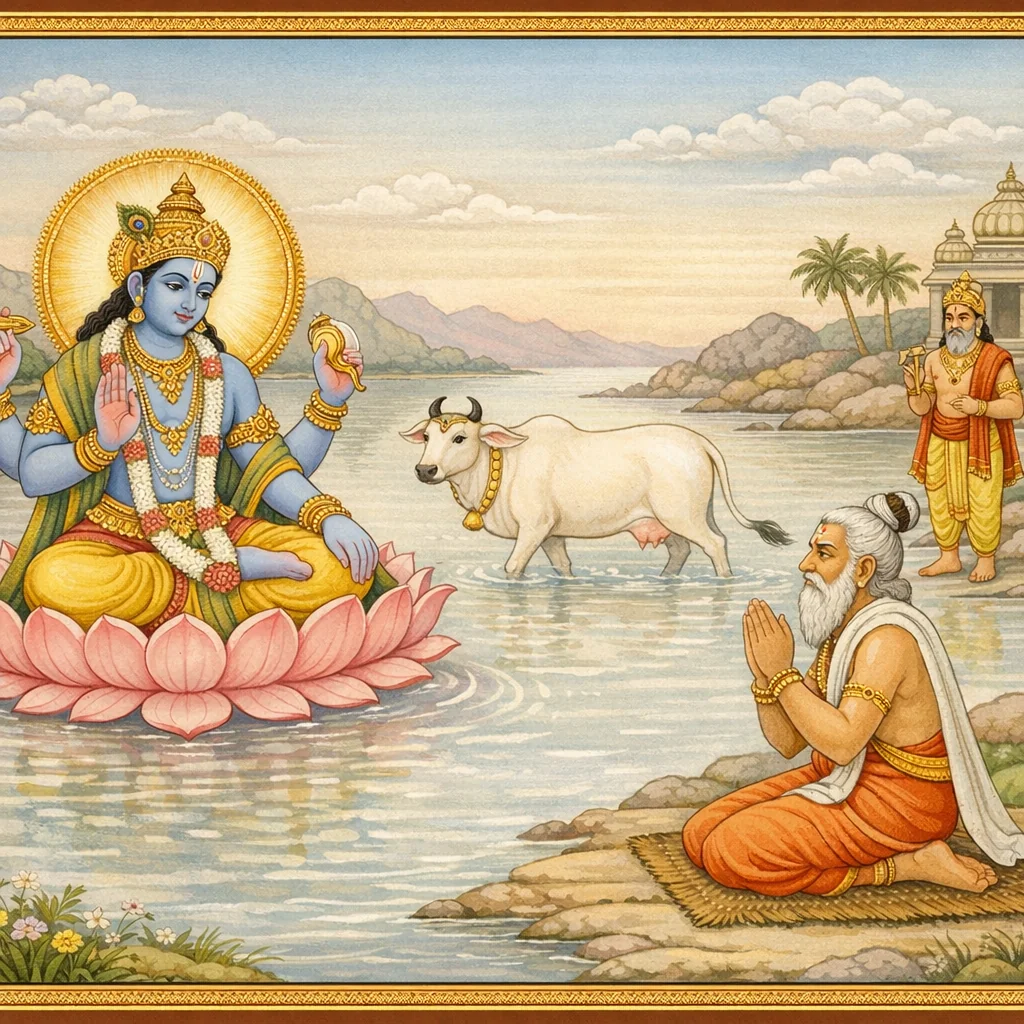
Adhyaya 37
Hanumān’s Epiphany, Authentication Tokens, and the Protection of Brāhmaṇas in Dharmāraṇya (अञ्जनीसूनोः स्वरूपदर्शनम् अभिज्ञानपुटिकाप्रदानं च)
Chapter 37 presents a structured theological exchange: a community of brāhmaṇas offers Hanumān, Pavana’s son, an extended stotra praising his devotion to Śrī Rāma, his protective might, and his commitment to the welfare of cows and brāhmaṇas. Pleased, Hanumān grants a boon; they ask for (i) a visible showing of his Laṅkā exploit and (ii) corrective action against a sinful king whose policies harm livelihoods and disrupt dharmic order. Hanumān explains that his true form is not ordinarily seen in Kali-yuga, yet, moved by bhakti, he reveals a mediated form that inspires awe and confirms what the Purāṇas describe. He also gives a fruit that brings extraordinary satiation, marking Dharmāraṇya as a place where hunger is ritually and miraculously pacified. An authentication token (abhijñāna) is then established: Hanumān plucks hairs from his body, seals them into two packets (pūṭikā), and prescribes conditional use—one grants boons to a Rāma-devotee king, while the other serves as punitive proof, able to ignite military and treasury assets until dharmic restitution is made (restoring village dues, merchants’ taxes, and prior arrangements). After three nights of brahma-yajña and powerful Vedic recitation, Hanumān guards the brāhmaṇas’ sleep on a vast stone platform and, through wind-force like a father’s agency, swiftly carries them to Dharmāraṇya, compressing a six-month journey into a few muhūrtas. The next morning’s wonder spreads widely, reaffirming the chapter’s theme: dharma is upheld through devotion, verifiable signs, and the protection of learned communities, reorienting governance toward ethical obligation.
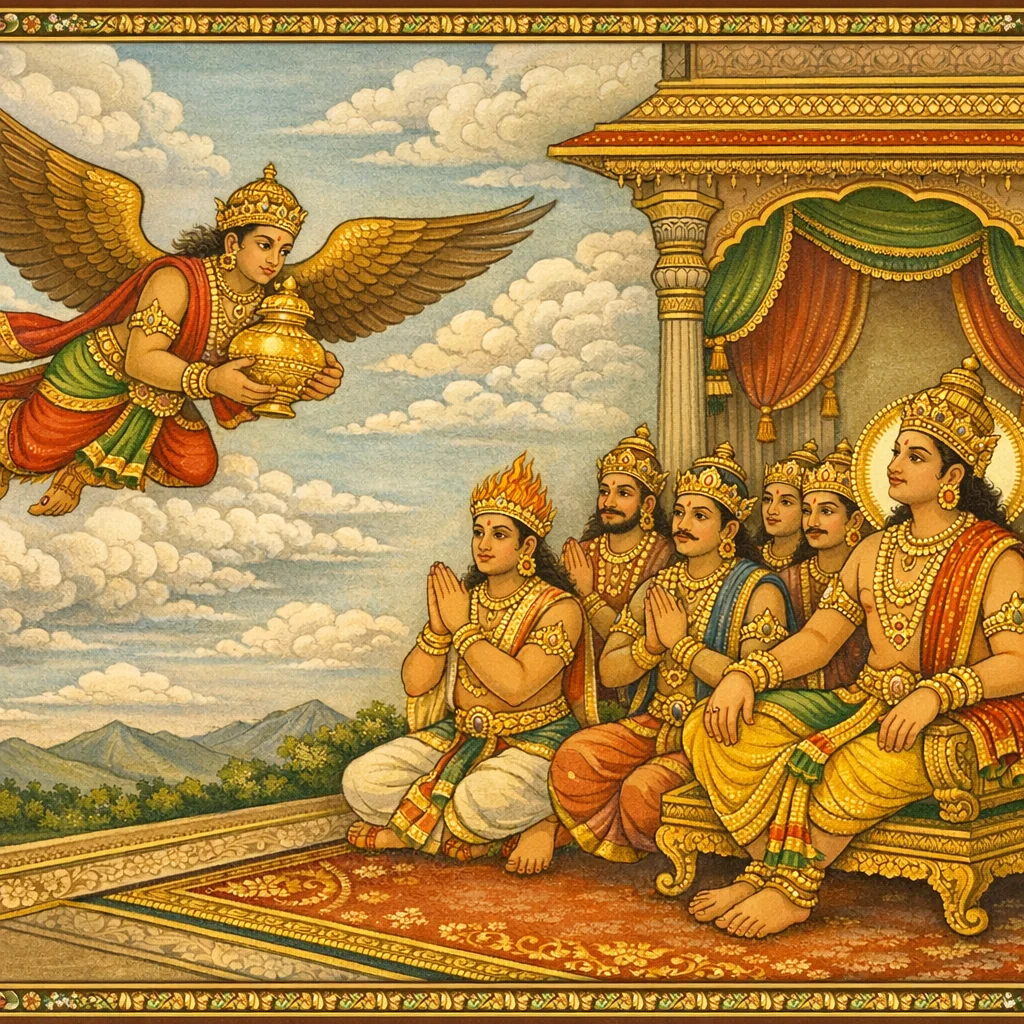
Adhyaya 38
Rājā Kumarapālakaḥ—Vipra-saṃvādaḥ, Agni-upadravaḥ, Rāma-nāma-prāyaścittaṃ ca (King Kumarapālaka’s dialogue with Brahmins, the fire-crisis, and expiation through Rāma’s Name)
Vyāsa recounts how Brahmin leaders, adorned and bearing fruits, gather at the palace gate and are received by the king’s son, Kumarapālaka. The prince proclaims a syncretic ethical code—reverence for the Jina/Arhat, compassion for living beings, attendance at a yoga-hall, veneration of the guru, constant mantra-japa, and observance of the ascetic season (pañcūṣaṇa)—which unsettles the Brahmins. Citing Rāma and Hanumān’s counsel, they urge that the ruler grant vipra-vṛtti (support for Brahmins) and uphold dharma, but he refuses even minimal alms. A punitive turn follows: a pouch linked with Hanumān is hurled into the palace, and a conflagration spreads through royal stores, vehicles, and insignia; human measures fail. Terrified, the king seeks the Brahmins, prostrates, confesses ignorance, and repeatedly invokes Rāma’s Name, declaring devotion to Rāma and reverence for Brahmins to be salvific, and begging for the fire’s pacification. The Brahmins relent; the curse is appeased, order returns, and a new settlement is instituted—learned groups are reorganized, communal boundaries defined, and annual rites and gifts prescribed (including Pauṣa śukla trayodaśī observances). The chapter ends with society stabilized under a renewed dharmic charter, reaffirming devotional orientation as the ethical foundation of governance.
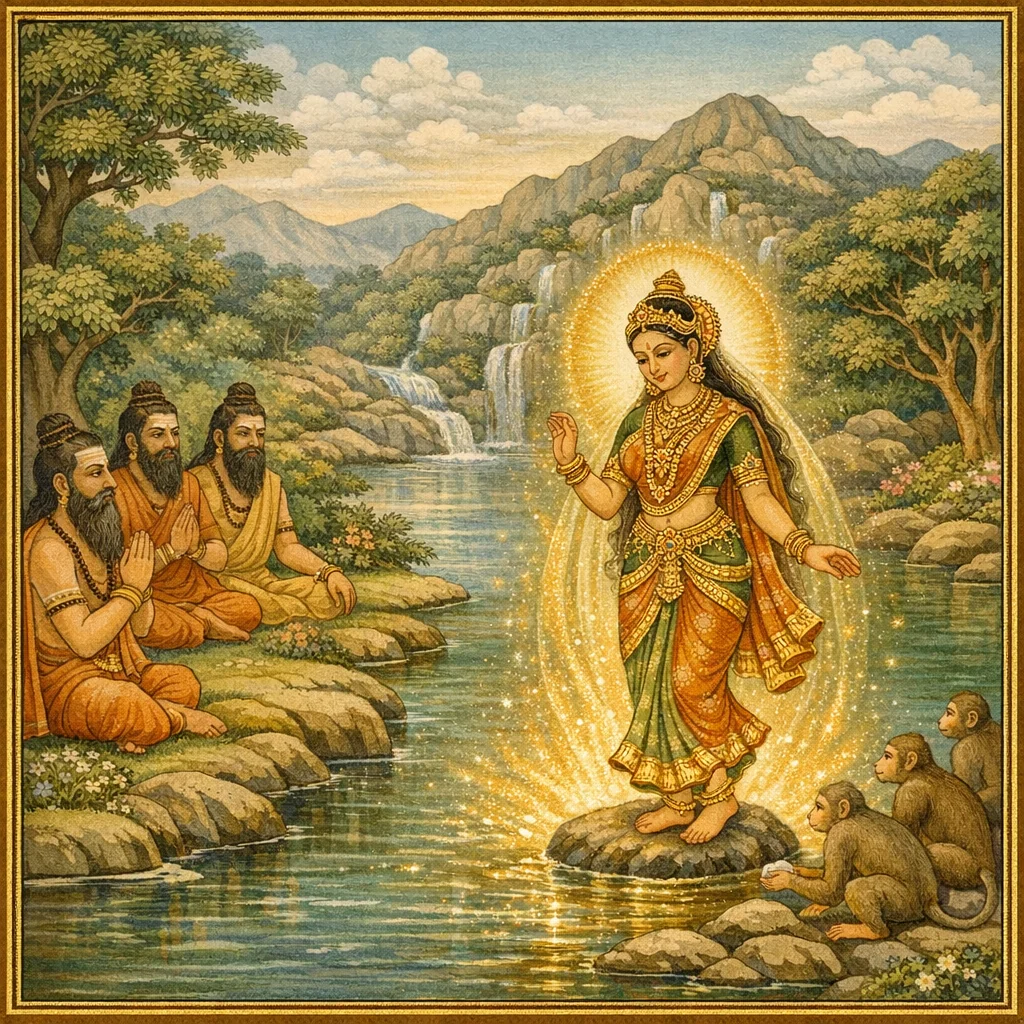
Adhyaya 39
Cāturvidya–Traividya Organization, Gotra–Pravara Mapping, and Dharmāraṇya Settlement Register (अध्याय ३९)
This chapter unfolds as an instructive dialogue in which Brahmā describes communities of eminent dvijas, marked by disciplined Vedic study and exact recitation methods (saṃhitā, pada, krama, ghana). The devas, led by Brahmā and Viṣṇu, visit these Brahmins, witness their ritual soundscape and ethical order, and read it as a sign of Tretā-yuga-like dharma. Foreseeing Kali-yuga’s disruption, the devas establish a regulated economic-ritual arrangement: livelihood shares and professional boundaries between cāturvidyas and traividyas, with restrictions on intermarriage and a formal kin-division attributed to a regulating authority named Kājeśa. The chapter then becomes an extensive register, listing fifty-five settlements (grāmas) and systematically assigning gotras, pravara sets, and village-specific identifications of the “gotra-devī,” the protective lineage goddess. Prompted by Nārada’s questions, Brahmā clarifies how gotra, kula, and devī are recognized and provides a sequential mapping of places to lineages, pravaras, and community traits. The closing acknowledges later social mixing and decline as yuga-conditioned change, while preserving the register as a reference framework.
Adhyaya 40
Dharmāraṇya: Community Dharma, Adjudication Norms, and Phalaśruti
This chapter presents a layered theological and ethical teaching. Nārada asks Brahmā how the learned in the threefold Vedic knowledge (trai-vidyā) should respond when kinship divisions arise in Moheraka-pura. Brahmā describes disciplined Brahmin communities that uphold agnihotra, yajña, smārta observances, and śāstric reasoning, and he recounts how leading Vāḍavas articulate inherited dharma (paramparāgata) grounded in dharmaśāstra, local custom (sthāna-ācāra), and clan practice (kula-ācāra). A normative “charter” then follows: reverence for Rāma-associated insignia and a hand-seal (mudrā), regulated penalties for lapses from good conduct, and rules of eligibility, social sanction, and communal avoidance of offenders. The chapter also details birth-related offerings (including sixth-day rites), the distribution of livelihood shares (vṛtti-bhāga) and allotments to clan deities, and ideals of fair adjudication—warning against bias, bribery, and unjust verdicts. Vyāsa introduces Kali-yuga decline—loss of Vedic adherence and partisan behavior—yet reaffirms identity markers such as gotra, pravara, and avataṅka. The narrative culminates in Hanumān’s unseen guardianship of justice: partiality and neglect of rightful service bring loss, while righteous conduct is upheld. The concluding phalaśruti praises hearing and honoring the Dharmāraṇya account as purifying and prosperity-bestowing, and it prescribes respectful conduct in Purāṇic recitation and gifting.
FAQs about Dharmaranya Mahatmya
Dharmāraṇya is portrayed as a concentrated tīrtha-zone where divine beings continually 'serve' the place, making it inherently merit-generating and spiritually protective for residents and pilgrims.
The text highlights enduring salvific outcomes for beings who die there, and emphasizes śrāddha/pinda-style offerings as mechanisms for uplifting multiple ancestral generations and extended lineages.
The section foregrounds aetiological questioning about how Dharmāraṇya became established among the gods, why it is tīrtha-like on earth, and how large communities of brāhmaṇas were instituted there.