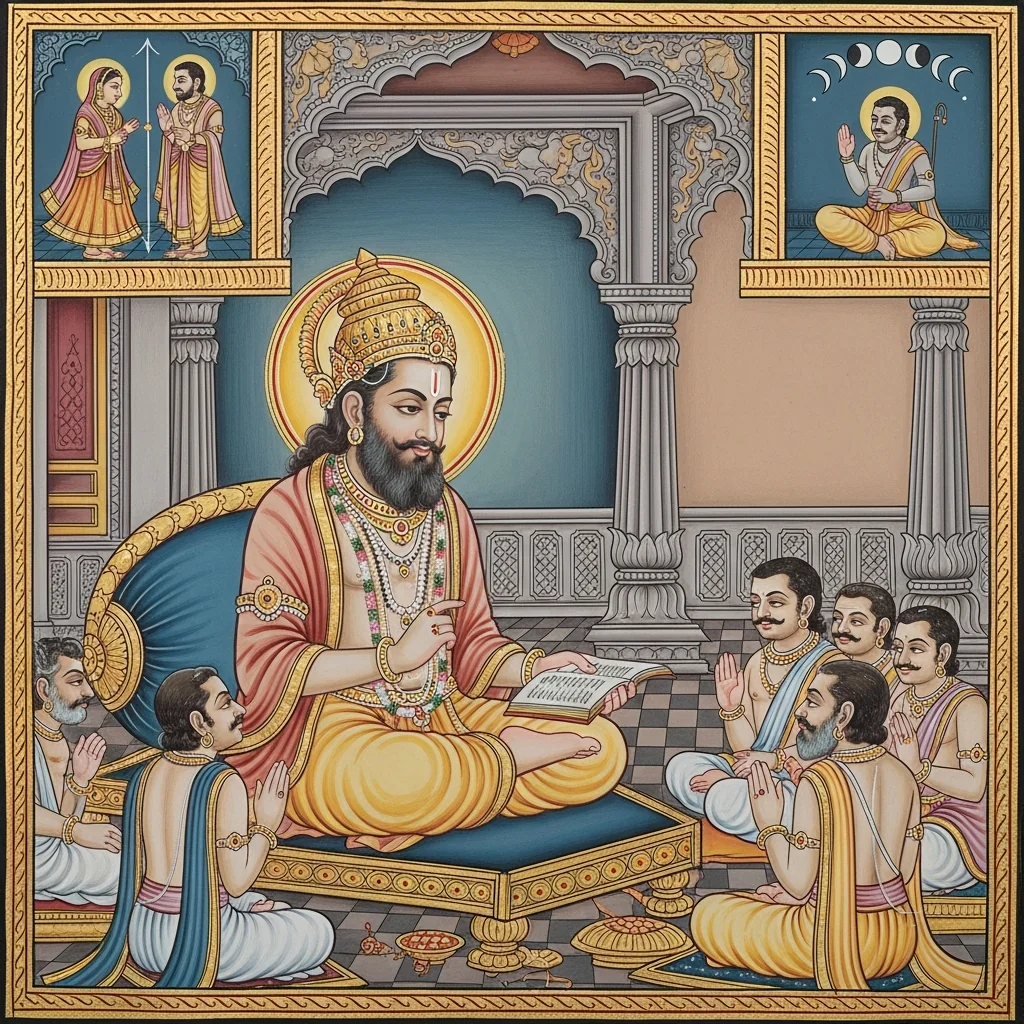
Adhyaya 21
This adhyāya compiles dharma-based guidance on lineage regulation and marriage eligibility. Speaking in Vyāsa’s voice, it first presents dense enumerations of the deities and śaktis connected with the setting, including many named goddesses and their proliferated forms. It then lays out technical gotra–pravara details with examples of shared or distinct pravaras, and states clear prohibitions: marriage within the same gotra/pravara is forbidden, as are unions with certain categories of maternal kin. The chapter describes the social and ritual consequences of such prohibited marriages—loss of brāhmaṇya standing and offspring regarded as socially degraded—and prescribes expiations (prāyaścitta), especially the Cāndrāyaṇa vow, for those who have entered them. Echoing classical dharma-legal authorities such as Kātyāyana, Yājñavalkya, and Gautama, it defines acceptable degrees of separation through paternal and maternal lines. It also adds related household-ethics categories, including marriage precedence between elder and younger brothers and the classification of “punarbhū” conditions. Overall, it serves as an archival rule-set for dharmic household formation and for remediation when norms are violated.
Shlokas
Verse 1
व्यास उवाच । तया चोत्पादिता राजञ्छरीरा त्कुलदेवताः
Vyāsa said: O King, from her body as well the kuladevatās, the clan-protecting deities, were brought forth.
Verse 2
गात्रा ९ शांता १० शेषदेवी ११ वाराही १२ भद्रयोगिनी १३
They are listed as: Gātrā (9), Śāntā (10), Śeṣa-devī (11), Vārāhī (12), and Bhadrayoginī (13).
Verse 3
तारणी १८ वन कानंदा १९ चामुंडा २० च सुरेश्वरी २१
Also (they are): Tāraṇī (18), Vana-kānandā (19), Cāmuṇḍā (20), and Sureśvarī (21).
Verse 4
दारभट्टारिकेत्या २२ द्या प्रत्येका शतधा पुनः । उत्पन्नाः शक्तयस्तस्मिन्नानारूपान्विताः शुभाः । अतः परं प्रवक्ष्यामि प्रवरण्यथ देवताः
Thus, (another) was named Dāra-bhaṭṭārikā (22). Then each of them again manifested a hundredfold—auspicious śaktis endowed with many forms arose there. Henceforth I shall describe, in due order, the foremost among those deities.
Verse 5
आंगिरसबार्हस्पत्यभारद्वाज २२ मांडव्यसगोत्रस्य वत्ससवात्स्यसवात्स्यायनस ४ सामान्यलौगाक्षसगोत्रस्य गोत्रजा भद्रयोगिनी प्रवर ३ काश्यपवसिष्ठ अवत्सार २० कौशिकसगोत्रस्य गोत्रजा पक्षिणी प्रवर ३ विश्वामित्र अथर्व भारद्वाज २१ सामान्यप्रवर १ पैमग्यसभरद्वाज २ समानप्रवरा २ लौगाक्षसगार्ग्यायनसकाश्यपकश्यप ४ समानप्रवर ३ कौशिककुशिकसाः २ समानप्रवरः ४ औपमन्युलोगाक्षस २ समानप्रवराः
A catalog is set forth of various pravara-sets (lineages of ancestral ṛṣis) attached to particular gotras—such as the Āṅgirasa–Bārhaspatya–Bhāradvāja group and others—together with their numbers and sub-branches. This enumeration stands as a dharmic reference for discerning sameness or difference of pravara and gotra in matters of lawful marriage.
Verse 6
त्यजेत्समानप्रवरां सगोत्रां मातुः सपिंडामचिकित्स्यरोगाम् । अजातलोम्नीं च तथान्यपूर्वां सुतेन हीनस्य सुतां सुकृष्णाम्
One should reject as a bride a girl of the same pravara and the same gotra; likewise one who is a sapinda relation through the mother; one afflicted with an incurable disease; one not yet bodily mature (in whom body-hair has not arisen); and also one previously married, and the daughter of a man who has no son, even if she is fair and attractive.
Verse 7
एक एव ऋषिर्यत्र प्रवरेष्वनुवर्तते । तावत्समानगोत्रत्वमृते भृग्वंगिरोगणात्
Where, within the pravaras, even a single ṛṣi-name is shared, to that extent there is sameness of gotra—except in the Bhṛgu and Aṅgiras groups, where special traditional distinctions apply.
Verse 8
भद्रकाली च ५ माहेशी ६ सिंहोरी ७ धनमर्द्दनी
Also, the names are given: Bhadrakālī (5), Māheśī (6), Siṃhorī (7), and Dhanamardanī.
Verse 9
समानगोत्रप्रवरां कन्यामूढ्वोपगम्य च । तस्यामुत्पाद्य चांडालं ब्राह्मण्यादेव हीयते
If a man marries and cohabits with a maiden of the same gotra and the same pravara, and begets offspring in her, that child becomes a caṇḍāla; and he himself falls away from brahminhood, losing his brahmin status.
Verse 10
कात्यायनः । परिणीय सगोत्रा तु समानप्रवरां तथा । त्यागं कृत्वा द्विजस्तस्यास्ततश्चांद्रायणं चरेत्
Kātyāyana says: If a twice-born man has married a woman of the same gotra and likewise the same pravara, he should renounce her; and thereafter he should perform the Cāndrāyaṇa expiation.
Verse 11
उत्सृज्य तां ततो भार्यां मातृवत्परिपालयेत्
Having thus set aside that wife, he should thereafter maintain and protect her as one would a mother.
Verse 12
याज्ञवल्क्यः । अरोगिणीं भ्रातृमतीमसमानार्षगोत्रजाम् । पंचमात्सप्तमार्दूर्ध्वं मातृतः पितृत स्तथा
Yājñavalkya says: One should marry a healthy girl, who has brothers, and who is born in a different ṛṣi-lineage (ārṣa-gotra). The marriage is permitted beyond the fifth and up to the seventh degree—counting both on the mother’s side and on the father’s side, as taught.
Verse 13
असमानप्रवरैर्विवाह इति गौतमः । यद्येकं प्रवरं भिन्नं मातृगोत्रवरस्य च । तत्रोद्वाहो न कर्तव्यः सा कन्या भगिनी भवेत्
Gautama declares: marriage is to be contracted with one of a different pravara. If even one pravara overlaps with that of the mother’s gotra-line, then marriage should not be performed there; that girl is to be regarded as a sister.
Verse 14
दाराग्निहोत्रसंयोगं कुरुते योऽग्रजे स्थिते । परिवेत्ता स विज्ञेयः परिवित्तिस्तु पूर्वजः
He who enters into marriage and assumes the household fire-rites while his elder brother is still unmarried is known as a parivettā; and the elder brother (left behind) is called parivitti.
Verse 15
सदा पौनर्भवा कन्या वर्ज नीया कुलाधमा । वाचा दत्ता मनोदत्ता कृतकौतुकमंगला
A maiden who is repeatedly “returned” and given again in marriage should always be avoided as a bride by one who upholds the dharma of the family. Likewise, a girl already given by word (promised), given in mind (accepted inwardly), or for whom auspicious betrothal rites have been performed, should not be taken by another.
Verse 16
उदकस्पर्शिता याच याच पाणिगृहीतका । अग्निं परिगता या च पुनर्भूः प्रसवा च या
Also to be avoided is a girl for whom the water-touch rite has been performed, or whose hand has been formally taken (pāṇigrahaṇa), or who has circumambulated the sacred fire. So too, one who is a punarbhū (a woman returning to marriage) and one who has already borne a child.
Verse 17
योगेश्वरी १४ मोहलज्जा १५ कुलेशी १६ शकुलाचिता
“Yogeśvarī,” “Mohalajjā,” “Kuleśī,” and “Śakulācitā”—these are enumerated in the list as names/epithets (items 14–17).
Verse 18
अथावटंकाः कथ्यंते गोत्र १ पात्र २ दात्र ३ त्राशयत्र ४ लडकात्र १५ मंडकीयात्र १६ विडलात्र १७ रहिला १८ भादिल १९ वालूआ २० पोकीया २१ वाकीया २२ मकाल्या २३ लाडआ २४ माणवेदा २५ कालीया २६ ताली २७ वेलीया २८ पांवलन्डीया २९ मूडा ३० पीतूला ३१ धिगमघ ३२ भूतपादवादी ३४ होफोया ३५ शेवार्दत ३६ वपार ३७ वथार ३८ साधका ३९ बहुधिया ४०
Now the “avaṭaṃkāḥ” are stated—a numbered list: Gotra, Pātra, Dātra, Trāśayatra, Laḍakātra, Maṃḍakīyātra, Viḍalātra, Rahilā, Bhādila, Vālūā, Pokīyā, Vākīyā, Makālyā, Lāḍaā, Māṇavedā, Kālīyā, Tālī, Velīyā, Pāṃvalanḍīyā, Mūḍā, Pītūlā, Dhigamagha, Bhūtapādavādī, Hophoyā, Śevārdata, Vapāra, Vathāra, Sādhakā, Bahudhiyā—thus, as transmitted, up to item 40.
Verse 19
मातुलस्य सुतामूढ्वा मातृगोत्रां तथैव च । समानप्रवरां चैव त्यक्त्वा चांद्रायणं चरेत्
If one has married the daughter of one’s maternal uncle, or a woman belonging to one’s mother’s gotra, or one of the same pravara, then, having given her up, one should perform the Cāndrāyaṇa expiation.