Adhyaya 24
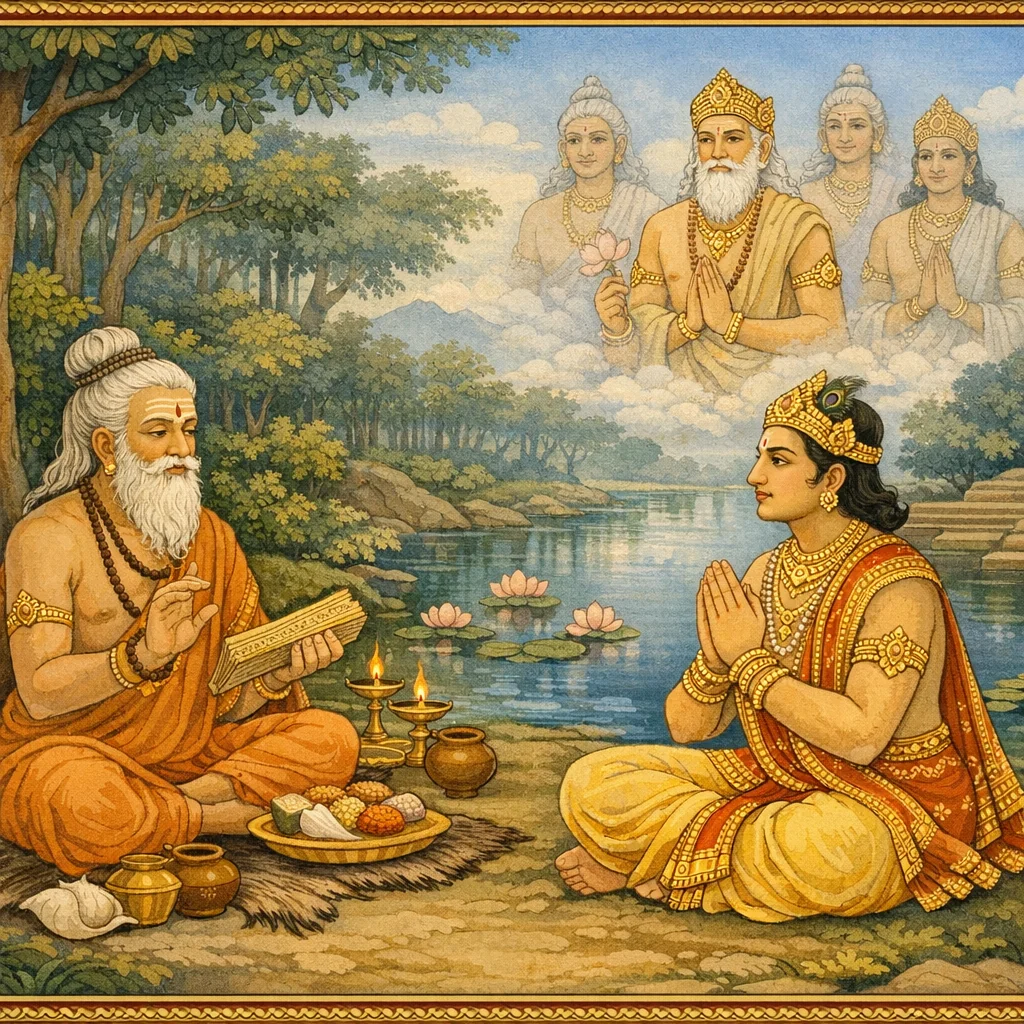
Vyāsa concludes by reaffirming the māhātmya of the foremost tīrtha-region known as Dharmāraṇya, praising it as supremely auspicious and capable of purifying sins amassed over many births. He teaches that bathing there frees one from transgressions, and thus Yudhiṣṭhira (Dharmarāja) enters the forest to remove great sins and to protect the virtuous. The chapter then sets out the site’s ritual life: immersion in its tīrthas, visits to deity-shrines, and the performance of iṣṭa-pūrta—sacrificial rites and charitable works—according to one’s intention. A phalāśruti follows, declaring that those who reach the place, or even merely hear of it, gain both worldly enjoyment and liberation, culminating in nirvāṇa after their worldly experience. Special emphasis is placed on recitation at śrāddha-time by the twice-born, said to bring enduring uplift to the ancestors. Dharmavāpī is singled out: even water alone, without any ancillary ritual materials, is proclaimed to destroy vast accumulated demerit and to yield fruits comparable to Gayā-śrāddha and repeated piṇḍa offerings, presenting a minimalist yet potent theology of water and sacred remembrance.
Shlokas
Verse 1
व्यास उवाच । एतत्तीर्थस्य माहात्म्यं मया प्रोक्तं तवाग्रतः । अनेकपूर्वजन्मोत्थपातकघ्नं महीपते
Vyāsa said: “Before you, O lord of the earth, I have declared the greatness of this tīrtha—one that destroys sins arising from many former births.”
Verse 2
स्थानानामुत्तमं स्थानं परं स्वस्त्ययनं महत् । स्कंदस्याग्रे पुरा प्रोक्तं महारुद्रेण धीमता
It is the best of all sacred places—supreme, a great source of auspicious well-being. Long ago the wise Mahārudra proclaimed it in the presence of Skanda.
Verse 3
त्वं पार्थ तत्र स्नात्वा हि मोक्ष्यसे सर्वपात कात् । तच्छ्रुत्वा व्यासवाक्यं हि धर्म्मराजो युधिष्ठिरः
“O Pārtha, by bathing there you shall be freed from all sins.” Hearing these words of Vyāsa, Dharmarāja Yudhiṣṭhira responded.
Verse 4
धर्मात्मजस्तदा तात धर्मारण्यं समाविशत् । महापातकनाशाय साधुपालनत त्परः
Then, O dear one, the son of Dharma entered the holy Dharmāraṇya, intent on destroying great sins and devoted to the protection of the righteous.
Verse 5
विगाह्य तत्र तीर्थानि देवतायतनानि च । इष्टापूर्तादिकं सर्वं कृतं तेन यथेप्सितम्
Bathing there in the tīrthas and visiting the sanctuaries of the deities, he performed, as he wished, every meritorious act—such as iṣṭa and pūrta.
Verse 6
ततः पापविनिर्मुक्तः पुनर्गत्वा स्वकं पुरम् । इद्रप्रस्थं महासेन शशास वसुधातलम्
Thereafter, freed from sin, he returned again to his own city; and from Indraprastha, O mighty-armed one, he governed the earth.
Verse 7
इदं हि स्थानमासाद्य ये शृण्वंति नरोत्तमाः । तेषां भुक्तिश्च मुक्तिश्च भविष्यति न संशयः
Indeed, those best of men who come to this place and listen to its glorification will gain both worldly enjoyment and liberation—of this there is no doubt.
Verse 8
भुक्त्वा भोगान्पार्थिवांश्च परं निर्वाणमाप्नुयुः । श्राद्धकाले च संप्राप्ते ये पठंति द्विजातयः
After enjoying earthly pleasures, they attain the supreme nirvāṇa. And when the time of śrāddha arrives, those twice-born who recite (this māhātmya)…
Verse 9
उद्धृताः पितरस्तैस्तु यावच्चंद्रार्क्कमेदिनि । द्वापरे च युगे भूत्वा व्यासेनोक्तं महात्मना
By them indeed, their ancestors are uplifted for as long as the moon and the sun endure upon the earth. Thus spoke the great-souled Vyāsa, manifested in the Dvāpara age.
Verse 10
वारिमात्रे धर्मवाप्यां गयाश्राद्धफलं लभेत् । अत्रागतस्य मर्त्यस्य पापं यमपदे स्थितम्
With merely a handful of water at the Dharma-vāpī, one gains the fruit of performing śrāddha at Gayā. For the mortal who comes here, the sin lodged in Yama’s realm is undone.
Verse 11
कथितं धर्मपुत्रेण लोकानां हितकाम्यया । विना अन्नैर्विना दर्भैर्विना चासनमेव वा
This was proclaimed by Dharmaputra, out of a desire for the welfare of the people—effective even without food-offerings, without darbha grass, and even without a seat.
Verse 12
तोयेन नाशमायाति कोटिजन्मकृतं त्व घम् । सहस्रमुरुशृंगीणां धेनूनां कुरुजांगले । दत्त्वा सूर्यग्रहे पुण्यं धर्मवाप्यां च तर्पणाम्
By water alone, sin accumulated over ten million births comes to destruction. The merit of giving a thousand broad-horned cows in Kuru-jāṅgala, and the merit gained at the time of a solar eclipse, are also obtained by performing tarpaṇa at the Dharma-vāpī.
Verse 13
एतद्वः कथितं सर्वं धर्मारण्यस्य चेष्टितम् । यच्छ्रुत्वा ब्रह्महा गोघ्नो मुच्यते सर्वपातकैः
Thus have I told you all the greatness and sacred account of Dharmāraṇya. Hearing it, even a slayer of a brāhmaṇa or a killer of a cow is released from all sins.
Verse 14
एकविंशतिवारैस्तु गयायां पिंडपातने । तत्फलं समवाप्नोति सकृदस्मिञ्छ्रुते सति
By offering the piṇḍa—rice-balls of oblation—at Gayā twenty-one times, one attains its fruit; yet that very fruit is gained even by hearing this sacred account but once.