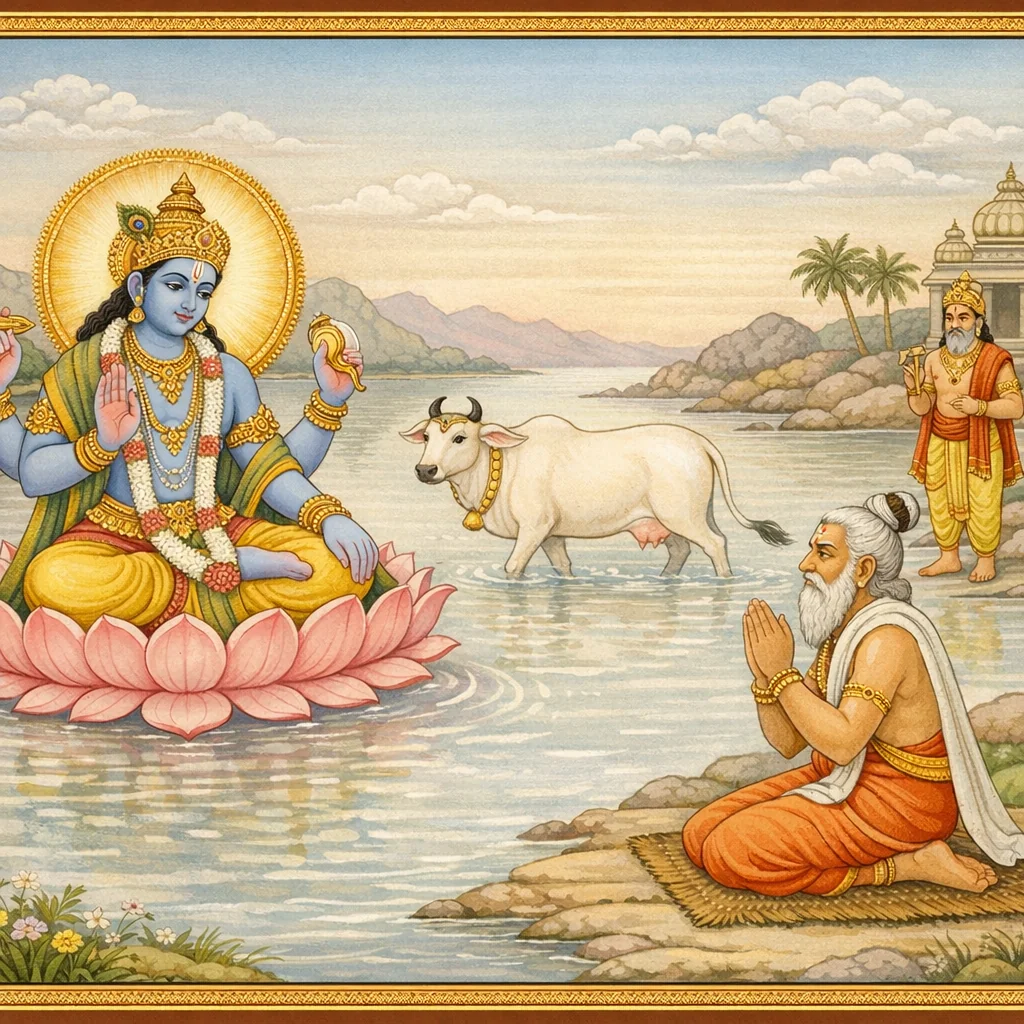
Adhyaya 37
Chapter 37 presents a structured theological exchange: a community of brāhmaṇas offers Hanumān, Pavana’s son, an extended stotra praising his devotion to Śrī Rāma, his protective might, and his commitment to the welfare of cows and brāhmaṇas. Pleased, Hanumān grants a boon; they ask for (i) a visible showing of his Laṅkā exploit and (ii) corrective action against a sinful king whose policies harm livelihoods and disrupt dharmic order. Hanumān explains that his true form is not ordinarily seen in Kali-yuga, yet, moved by bhakti, he reveals a mediated form that inspires awe and confirms what the Purāṇas describe. He also gives a fruit that brings extraordinary satiation, marking Dharmāraṇya as a place where hunger is ritually and miraculously pacified. An authentication token (abhijñāna) is then established: Hanumān plucks hairs from his body, seals them into two packets (pūṭikā), and prescribes conditional use—one grants boons to a Rāma-devotee king, while the other serves as punitive proof, able to ignite military and treasury assets until dharmic restitution is made (restoring village dues, merchants’ taxes, and prior arrangements). After three nights of brahma-yajña and powerful Vedic recitation, Hanumān guards the brāhmaṇas’ sleep on a vast stone platform and, through wind-force like a father’s agency, swiftly carries them to Dharmāraṇya, compressing a six-month journey into a few muhūrtas. The next morning’s wonder spreads widely, reaffirming the chapter’s theme: dharma is upheld through devotion, verifiable signs, and the protection of learned communities, reorienting governance toward ethical obligation.
Shlokas
Verse 1
व्यास उवाच । ततस्ते ब्राह्मणाः सर्वे प्रत्यूचुः पवनात्मजम् । अधुना सफलं जन्म जीवितं च सुजीवितम्
Vyāsa said: Then all those brāhmaṇas replied to the son of the Wind-god: “Now our birth has borne fruit, and our life has truly been well lived.”
Verse 2
अद्य नो मोढलोकानां धन्यो धर्मश्च वै गृहाः । धन्या च सकला पृथ्वी यज्ञधर्मा ह्यनेकशः
Today, for us people of Moḍha, blessed is dharma, and blessed indeed are our homes. Blessed too is the whole earth, for in many ways the duties of yajña and righteousness are upheld.
Verse 3
नमः श्रीराम भक्ताय अक्षविध्वंसनाय च । नमो रक्षःपुरीदाहकारिणे वज्रधारिणे
Salutations to the devotee of Śrī Rāma, the destroyer of Akṣa; salutations to him who burned the city of the rākṣasas, the bearer of thunderbolt-like might.
Verse 4
जानकीहृदयत्राणकारिणे करुणात्मने । सीताविरह तप्तस्य श्रीरामस्य प्रियाय च
Salutations to the compassionate one who became the refuge of Jānakī’s heart; and to the beloved of Śrī Rāma, scorched by separation from Sītā.
Verse 5
नमोऽस्तु ते महावीर रक्षास्मान्मज्जतः क्षितौ । नमो ब्राह्मणदेवाय वायुपुत्राय ते नमः
Homage to you, O great hero—protect us as we sink upon the earth. Homage to you, the god of brāhmaṇas; homage to you, O son of Vāyu.
Verse 6
नमोऽस्तु राम भक्ताय गोब्राह्मणहिताय च । नमोस्तु रुद्ररूपाय कृष्णवक्त्राय ते तमः
Homage to you, devotee of Rāma, and benefactor of cows and brāhmaṇas. Homage to you of Rudra-like form, dark-faced one—homage to you.
Verse 7
अंजनीसूनवे नित्यं सर्वव्याधिहराय च । नागयज्ञोपवीताय प्रबलाय नमोऽस्तु ते
Homage to you always, O son of Añjanī, remover of all diseases. Homage to you, mighty one, who bears the serpent as a sacrificial thread.
Verse 8
स्वयं समुद्रतीर्णाय सेतुबंधनकारिणे
Salutations to the one who himself crossed the ocean, and who brought about the binding and building of the bridge (setu).
Verse 9
व्यास उवाच । स्तोत्रेणैवामुना तुष्टो वायुपुत्रोऽब्रवीद्वचः । शृणुध्वं हि वरं विप्रा यद्वो मनसि रोचते
Vyāsa said: Pleased by this very hymn of praise, the Son of Vāyu spoke these words: “Listen, O brāhmaṇas—choose a boon, whatever is pleasing to your hearts.”
Verse 10
विप्रा ऊचुः । यदि तुष्टोऽसि देवेश रामाज्ञापालक प्रभो । स्वरूपं दर्शयस्वाद्य लंकायां यत्कृतं हरे
The brāhmaṇas said: “If you are pleased, O Lord of gods—O master who carried out Rāma’s command—show us today that very form, O Hari, by which the deed in Laṅkā was accomplished.”
Verse 11
तथा विध्वंसवाद्य त्वं राजानं पापकारिणम् । दुष्टं कुमारपालं हि आमं चैव न संशयः
“And likewise, destroy that sinful-doing king—indeed the wicked Kumārapāla—together with his allies; of this there is no doubt.”
Verse 12
वृत्तिलोपफलं सद्यः प्राप्नुयात्त्वं तथा कुरु । प्रतीत्यर्थं महाबाहो किं विलंबं वदस्व नः
“Let him immediately obtain the fruit of losing his wrongful livelihood—do so. And for the sake of certainty, O mighty-armed one, why delay? Tell us (and show us) now.”
Verse 13
त्वयि चित्तेन दत्तेन स राजा पुण्यभाग्भवेत् । प्रत्यये दर्शिते वीर शासनं पालयिष्यति
“If his mind is given over to you, that king will become a sharer in merit. When convincing proof is shown, O hero, he will uphold the sacred injunction.”
Verse 14
त्रयीधर्म्मः पृथिव्यां तु विस्तारं प्रापयिष्यति । धर्मधीर महावीर स्वरूपं दर्शयस्व नः
Then the dharma rooted in the three Vedas will spread across the earth. O steadfast in dharma, O great hero—show us your true form.
Verse 15
हनुमानुवाच । मत्स्वरूपं महाकायं न चक्षुर्विषयं कलौ । तेजोराशिमयं दिव्यमिति जानंतु वाडवाः
Hanumān said: My true form is vast; in the Kali age it is not an object for ordinary sight. Let the wise know it as divine—made of a mass of radiant splendor.
Verse 16
तथापि परया भक्त्या प्रसन्नोऽहं स्तवादिभिः । वसनांतरितं रूपं दर्शयिष्यामि पश्यत
Yet, pleased by your supreme devotion and by your hymns, I shall show you a form veiled by garments—behold!
Verse 17
एवमुक्तास्तदा विप्राः सर्वकार्यसमुत्सुकाः । महारूपं महाकायं महापुच्छसमाकुलम्
Thus addressed, the brāhmaṇas—eager for the fulfillment of every purpose—beheld a colossal form: a vast-bodied manifestation, crowded with a mighty tail.
Verse 18
दृष्ट्वा दिव्यस्वरूपं तं हनुमंतं जहर्षिरे । कथंचिद्धैर्यमालंब्य विप्राः प्रोचुः शनैः शनैः
Seeing that divine true form of Hanumān, they rejoiced. Then, gathering composure with difficulty, the brāhmaṇas spoke—slowly, softly.
Verse 19
यथोक्तं तु पुराणेषु तत्तथैव हि दृश्यते । उवाच स हि तान्सर्वांश्चक्षुः प्रच्छाद्य संस्थितान्
Indeed, just as it is declared in the Purāṇas, so it is seen to come to pass. Then he addressed all of them, who stood there with their eyes veiled.
Verse 20
फलानीमानि गृह्णीध्वं भक्षणार्थमृषीश्वराः । एभिस्तु भक्षितैर्विप्रा ह्यतितृप्तिर्भविष्यति
“Take these fruits, O lords among the ṛṣis, for eating. By partaking of them, O brāhmaṇas, you will surely become exceedingly satisfied.”
Verse 21
धर्मारण्यं विना वाद्य क्षुधा वः शाम्यति धुवम्
“Without leaving Dharmāraṇya—indeed—your hunger will certainly be quenched.”
Verse 22
व्यास उवाच । क्षुधाक्रांतैस्तदा विप्रैः कृतं वै फलभक्षणम् । अमृतप्राशनमिव तृप्तिस्तेषामजायत
Vyāsa said: Then the brāhmaṇas, overcome by hunger, ate the fruits. Satisfaction arose in them as though they had drunk amṛta, the nectar of immortality.
Verse 23
न तृषा नैव क्षुच्चैव विप्राः संक्लिष्टमानसाः । अभवन्सहसा राजन्विस्मयाविष्टचेतसः
Neither thirst nor hunger remained for the brāhmaṇas whose minds had been troubled; suddenly, O King, their hearts became absorbed in wonder.
Verse 24
ततः प्राहांजनीपुत्रः संप्राप्ते हि कलौ द्विजाः । नागमिष्याम्यहं तत्र मुक्त्वा रामेश्वरं शिवम्
Then Añjanī’s son said: “O twice-born ones, when the Kali age arrives, I will not go there, having left behind Śiva at Rāmeśvara.”
Verse 25
अभिज्ञानं मया दत्तं गृहीत्वा तत्र गच्छत । तथ्यमेतत्प्रतीयेत तस्य राज्ञो न संशयः
“Taking the token of recognition given by me, go there. Then this truth will be accepted by that king—there is no doubt.”
Verse 26
इत्युक्त्वा बाहुमुद्धृत्य भुजयोरुभयोरपि । पृथग्रोमाणि संगृह्य चकार पुटिकाद्वयम्
Having spoken thus, he lifted up his arm; from both arms he gathered hairs separately and made a pair of small packets.
Verse 27
भूर्जपत्रेण संवेष्ट्य ते अदाद्विप्रकक्षयोः । वामे तु वामकक्षोत्थां दक्षिणोत्थां तु दक्षिणे
Wrapping them in birch-bark, he gave them to the sages’ armpits—placing the one from the left on the left side, and the one from the right on the right.
Verse 28
कामदां रामभक्तस्य अन्येषां क्षयकारिणीम् । उवाच च यदा राजा ब्रूते चिह्नं प्रदीयताम्
He described it as wish-fulfilling for a devotee of Rāma, but as causing ruin for others. And he said: “When the king asks, the sign should be presented.”
Verse 29
तदा प्रदीयतां शीघ्रं वामकक्षोद्भवा पुटी । अथवा तस्य राज्ञस्तु द्वारे तु पुटिकां क्षिप
Then quickly hand over that little pouch that arose from the left armpit; otherwise, cast the pouch at the very gate of that king.
Verse 30
ज्वालयति च तत्सैन्यं गृहं कोशं तथैव च । महिष्यः पुत्रकाः सर्वं ज्वलमानं भविष्यति
It will set ablaze that army, and likewise the houses and the treasury; the queens and the sons—everything will be burning.
Verse 31
यदा तु वृत्तिं ग्रामांश्च वणिजानां बलिं तथा । पूर्वं स्थितं तु यत्किंचित्तत्तद्दास्यति वाडवाः
But when (the king) grants livelihood-allowances, villages, and also the customary dues from merchants—whatever had earlier been fixed—he will give precisely that, O Vāḍavāḥ.
Verse 32
लिखित्वा निश्चयं कृत्वाप्यथ दद्यात्स पूर्ववत् । करसंपुटकं कृत्वा प्रणमेच्च यदा नृपः
Having put it in writing and having made the decision firm, he should then grant it as before; and when the king, with hands folded in reverence, bows down…
Verse 33
संप्राप्य च पुरा वृत्तिं रामदत्तां द्विजोत्तमाः । ततो दक्षिणकक्षास्थकेशानां पुटिका त्वियम्
O best of Brahmins, having formerly received the livelihood-grant given by Rāma, then know: this very pouch is of hairs from the right armpit.
Verse 34
प्रक्षिप्यतां तदा सैन्यं पुरावच्च भविष्यति । गृहाणि च तथा कोशः पुत्रपौत्रादयस्तथा
“Cast it there then; the army will become as it was before. Likewise the houses and the treasury, and so too the sons, grandsons, and the rest will be restored.”
Verse 35
वह्निना मुच्यमानास्ते दृश्यंते तत्क्षणादिति । श्रुत्वाऽमृतमयं वाक्यं हनुमंतोदितं परम्
“‘They are seen to be freed from the fire that very instant!’—hearing these supreme words spoken by Hanumān, nectar-like in their saving power…”
Verse 36
अलभन्त मुदं विप्रा ननृतुः प्रजगुर्भृशम् । जयं चोदैरयन्केऽपि प्रहसन्ति परस्परम्
The Brahmins were filled with great joy; they danced and sang loudly. Some cried out “Victory!” and laughed together with one another.
Verse 37
पुलकांकितसर्वाङ्गाः स्तुवन्ति च मुहुर्मुहुः । पुच्छं तस्य च संगृह्य चुचुंबुः केचिदुत्सुकाः
With their whole bodies thrilled with horripilation, they praised him again and again. Some, eager, even seized his tail and kissed it.
Verse 39
ततः प्रोवाच हनुमांस्त्रिरात्रं स्थीयतामिह । रामतीर्थस्य च फलं यथा प्राप्स्यथ वाडवाः
Then Hanumān said: “Stay here for three nights, so that you, O Vāḍavāḥ, may obtain the fruit of Rāmatīrtha.”
Verse 40
तथेत्युक्त्वाथ ते विप्रा ब्रह्मयज्ञं प्रचक्रिरे । ब्रह्मघोषेण महता तद्वनं बधिरं कृतम्
Saying, “So be it,” those Brāhmaṇas then began the Brahma-yajña. With their mighty Vedic chant, they filled that forest with the thunder of sacred sound, as though it were deafened.
Verse 41
स्थित्वा त्रिरात्रं ते विप्रा गमने कृतबुद्धयः । रात्रौ हनुमतोऽग्रे त इदमूचुः सुभक्तितः
After staying for three nights, those Brāhmaṇas resolved to depart. Then, at night, standing before Hanumān, they spoke these words with deep devotion.
Verse 42
ब्राह्मणा ऊचुः । वयं प्रातर्गमिष्यामो धर्मारण्यं सुनिर्मलम् । न विस्मार्या वयं तात क्षम्यतां क्षम्यतामिति
The Brāhmaṇas said: “At dawn we shall go to Dharmāraṇya, the supremely pure sacred forest. O dear one, do not forget us; forgive us, forgive us.”
Verse 43
ततो वायुसुतो राजन्पर्वतान्महतीं शिलाम् । बृहतीं च चतुःशालां दशयोजनमायतीम्
Then, O King, the son of Vāyu brought from the mountain a massive slab of stone—broad, four-sided, stretching to a length of ten yojanas.
Verse 44
आस्तीर्य प्राह तान्विप्राञ्छिलायां द्विजसत्तमाः । रक्ष्यमाणा मया विप्राः शयीध्वं विगतज्वराः
Spreading it out, he said to those Brāhmaṇas upon the stone, “O best of the twice-born, protected by me, O Brāhmaṇas, lie down and sleep—free from fever and fear.”
Verse 45
इति श्रुत्वा ततः सर्वे निद्रामापुः सुखप्रदाम् । एवं ते कृतकृत्यास्तु भूत्वा सुप्ता निशामुखे
Hearing these words, all of them then fell into a sleep that bestowed comfort. Thus, as those whose duty was fulfilled, they slept at the beginning of the night.
Verse 46
कृपालुः स च रुद्रात्मा रामशासनपालकः । रक्षणार्थं हि विप्राणामतिष्ठच्च धरातले
Compassionate, and of Rudra’s very nature, he—guardian of Rāma’s command—stood upon the earth for the protection of the Brāhmaṇas.
Verse 47
व्यास उवाच । अर्द्धरात्रे तु संप्राप्ते सर्वे निद्रामुपागताः । तातं संप्रार्थयामास कृतानुग्रहको भवान्
Vyāsa said: When midnight had arrived and all had fallen asleep, he then entreated his father: “You have already shown your favor—(now do this as well).”
Verse 48
समीरण द्विजानेतान्स्थानं स्वं प्रापयस्व भोः । ततो निद्राभिभूतांस्तान्वायुपुत्रप्रणोदितः
“O Samīraṇa (Wind), please convey these Brāhmaṇas to their own place. Then those overcome by sleep—urged on by the son of Vāyu—were carried onward.”
Verse 49
समुद्धृत्य शिलां तां तु पिता पुत्रेण भारत । विशिष्टो यापयामास स्वस्थानं द्विजसत्तमान्
Lifting up that stone slab, the Father—assisted by the Son, O Bhārata—powerfully conveyed those excellent Brāhmaṇas to their own abode.
Verse 50
षड्भिर्मासैश्च यः पन्था अतिक्रांतो द्विजातिभिः । त्रिभिरेव मुहूर्त्तैस्तु धर्मारण्यमवाप्तवान्
The journey that the twice-born would ordinarily traverse in six months—he, however, reached Dharmāraṇya in only three muhūrtas.
Verse 51
भ्रममाणां शिलां ज्ञात्वा विप्र एको द्विजाग्रतः । वात्स्यगोत्रसमुत्पन्नो लोकान्संगीतवान्कलम्
Recognizing the revolving stone, one brāhmaṇa—foremost among the twice-born, born in the Vātsya lineage—enchanted the people with melodious song.
Verse 52
गीतानि गायनोक्तानि श्रुत्वा विस्मयमाययुः । प्रभाते सुप्रसन्ने तु उदतिष्ठन्परस्परम्
Hearing those songs sung by the singer, they were filled with astonishment; and at dawn, when all was serene and auspicious, they rose and spoke among themselves.
Verse 53
ऊचुस्ते विस्मिताः सर्वे स्वप्नोऽयं वाथ विभ्रमः । ससंभ्रमाः समुत्थाय ददृशुः सत्यमंदिरम्
All of them, amazed, said, “Is this a dream, or some illusion?” Then, rising in agitation, they beheld the true shrine—the temple of reality.
Verse 54
अंतर्बुद्ध्या समालोक्य प्रभावो वायुजस्य च । श्रुत्वा वेदध्वनिं विप्राः परं हर्षमुपागताः
Perceiving inwardly the majesty of the son of Vāyu, and hearing the resonance of Vedic chanting, the brāhmaṇas were filled with supreme joy.
Verse 55
ग्रामीणाश्च ततो लोका दृष्ट्वा तु महतीं शिलाम् । अद्भुतं मेनिरे सर्वे किमिदं किमिदं त्विति
Then the village folk, seeing that great stone, all took it to be a marvel, repeatedly asking, “What is this—what indeed is this?”
Verse 56
गृहेगृहे हि ते लोकाः प्रवदंति तथाद्भुतम् । ब्राह्मणैः पूर्यमाणा सा शिला च महती शुभा
From house to house the people spoke of that very marvel; and that great stone—auspicious—was being thronged and filled with brāhmaṇas.
Verse 57
अशुभा वा शुभा वापि न जानीमो वयं किल । संवदंते ततो लोकाः परस्परमिदं वचः
“Whether it is inauspicious or auspicious—we truly do not know,” said the people, conversing with one another in these words.
Verse 58
व्यास उवाच । ततो द्विजानां ते पुत्राः पौत्राश्चैव समागताः । ऊचुस्ते दिष्ट्या भो विप्रा आगताः पथिका द्विजाः
Vyāsa said: Then the sons and grandsons of those brāhmaṇas gathered and said, “By good fortune, O venerable brāhmaṇas—O twice-born travelers—you have arrived!”
Verse 59
ते तु संतुष्टमनसा सन्मुखाः प्रययुर्मुदा । प्रत्युत्थानाभिवादाभ्यां परिरंभणकं तथा
Then, with delighted hearts, they approached face-to-face with joy—rising in welcome, offering salutations, and likewise embracing.
Verse 60
आघ्राणकादींश्च कृत्वा यथायोग्यं प्रपूज्य च । सर्वं विस्तार्य कथितं शीघ्रमागममात्मनः
Having duly performed the rites beginning with the āghrāṇa and having worshipped as was proper, he explained everything in full, and then hastened to return to his own abode.
Verse 61
ततः संपूज्य तत्सर्वान्गंधतांबूलकुंकुमैः । शांतिपाठं पठंतस्ते हृष्टा निजगृहान्ययुः
Then, having fully honored them all with perfumes, betel, and kunkuma, they recited the Śānti-pāṭha; and, delighted at heart, they went to their own homes.
Verse 63
आश्चर्यं परमं प्रापुः किमेतत्स्थानमुत्तमम् । अयं तु दक्षिण द्वारे शांतिपाठोऽत्र पठ्यते
They were seized by the greatest wonder: “What is this supremely excellent place? And why is the Śānti-pāṭha recited here, at the southern gate?”
Verse 64
गृहा रम्याः प्रदृश्यंते शचीपतिगृहोपमाः । प्रासादाः कुलमातॄणां दृश्यंते चाग्निशोभनाः
Charming houses came into view, resembling the dwelling of Śacī’s lord (Indra). And the mansions of the clan-mothers (kula-mātṛs) were also seen—resplendent like sacred fire.
Verse 65
एवं ब्रुवत्सु विप्रेषु महाशक्तिप्रपूजने । आगतो ब्राह्मणोऽपश्यत्तत्र विप्रकदंबकम्
While the brāhmaṇas were speaking thus, in the course of the great worship of Śakti, a brāhmaṇa arrived there and saw a whole cluster of brāhmaṇas assembled.
Verse 66
हर्षितो भावितस्तत्र यत्र विप्राः सभासदः । उवाव दिष्ट्या भो विप्रा ह्यागताः पथिका द्विजाः
Rejoicing and deeply moved on seeing the brāhmaṇas seated in the assembly, he said: “By good fortune, O brāhmaṇas—indeed you travelling twice-born have arrived!”
Verse 67
प्रत्युत्तस्थुस्ततो विप्राः पूजां गृहीत्वा समागताः । प्रत्युत्थानाभिवादौ चाकुर्वंस्ते च परस्परम्
Then the brāhmaṇas rose up in response, came forward bearing the articles of honor, and mutually performed the courtesies of standing up and respectful salutations.
Verse 68
ब्रूतेऽन्यो मम यत्नेन कार्यं नियतमेव हि । अन्यो ब्रूते महाभाग मयेदं कृतमित्युत
One said, “By my effort this task has certainly been set in order.” Another said, “O greatly fortunate one, this was done by me,” indeed.
Verse 69
पथिकानां वचः श्रुत्वा हर्षपूर्णा द्विजोत्तमाः । शांतिपाठं पठन्तस्ते हृष्टा निजगृहान्ययुः
Hearing the words of the travellers, the best of the twice-born were filled with joy. Reciting the Śānti-pāṭha, they gladly departed to their own homes.
Verse 70
विमृश्य मिलिताः प्रातर्ज्योतिर्विद्भिः प्रतिष्ठिताः । ब्राह्मे मूहूर्ते चोत्थाय कान्यकुब्जं गता द्विजाः
After deliberating, they gathered in the morning and—guided by those who knew the auspicious timings—rose at Brahma-muhūrta and the twice-born set out for Kānyakubja.
Verse 71
दोलाभिर्वाहिताः केचित्केचिदश्वै रथैस्तथा । केचित्तु शिबिकारूढा नानावाहनगाश्च ते
Some were borne in palanquins; some came on horses and in chariots; others rode in litters—thus they moved along by many kinds of conveyances.
Verse 72
तत्पुरं तु समासाद्य गंगायाः शोभने तटे । अकुर्वन्वसतिं वीराः स्नानदानादिकर्म्म च
Reaching that city, on the beautiful bank of the Gaṅgā, those valiant men set up their dwelling and performed rites such as bathing and charitable giving.
Verse 73
चरेण केनचिद्दृष्टाः कथिता नृपसन्निधौ । अश्वाश्च बहुशो दोला रथाश्च बहुशो वृषाः
Seen by a certain scout, they were reported in the king’s presence—many horses, many palanquins, many chariots, and many bulls as well.
Verse 74
विप्राणामिह दृश्यंते धर्मारण्यनिवासिनाम् । नूनं ते च समायाता नृपेणोक्तं ममाग्रतः
Here are seen the brāhmaṇas who dwell in Dharmāraṇya. Surely they have arrived—just as the king had spoken before me.
Verse 75
अभिज्ञापय मे पूर्वं प्रेषिताः कपिसंनिधौ
Inform me first about those who were earlier dispatched to Kapisaṃnidhi.