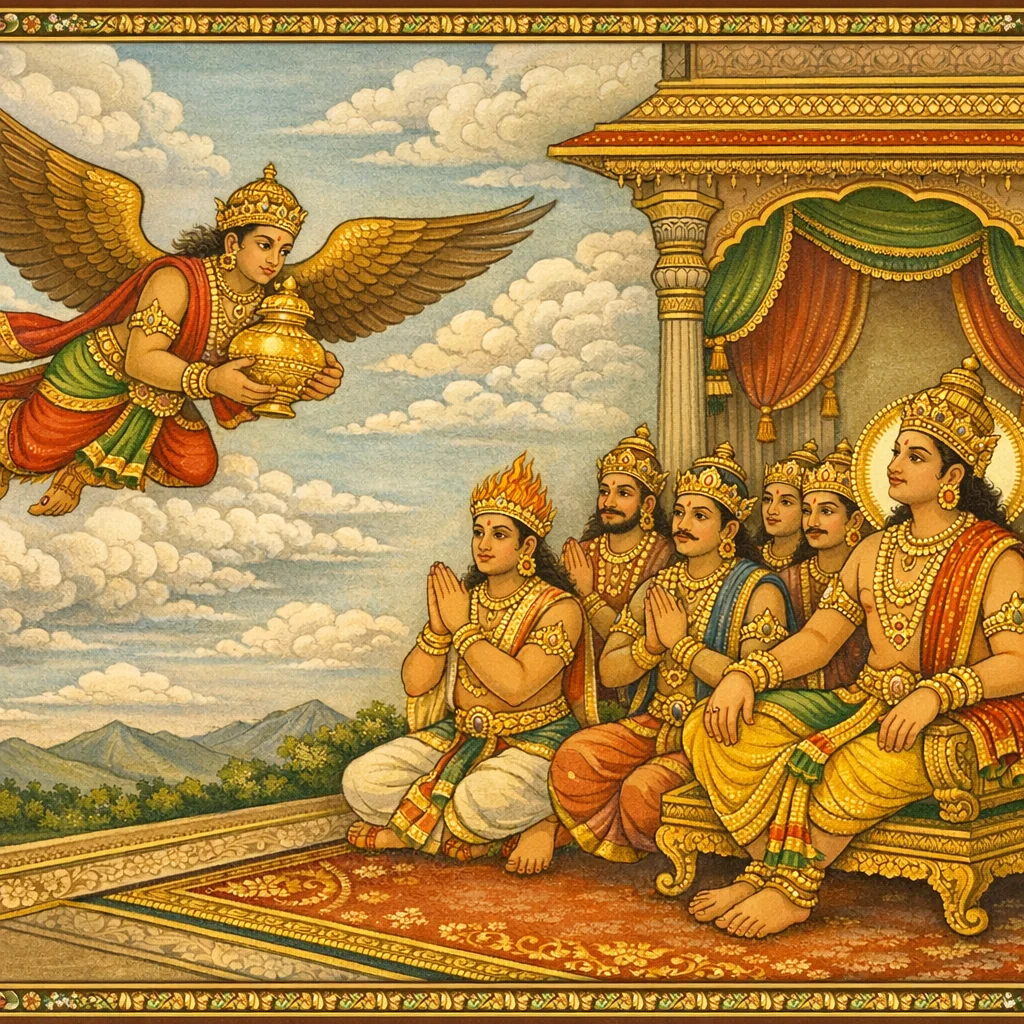
Adhyaya 38
Vyāsa recounts how Brahmin leaders, adorned and bearing fruits, gather at the palace gate and are received by the king’s son, Kumarapālaka. The prince proclaims a syncretic ethical code—reverence for the Jina/Arhat, compassion for living beings, attendance at a yoga-hall, veneration of the guru, constant mantra-japa, and observance of the ascetic season (pañcūṣaṇa)—which unsettles the Brahmins. Citing Rāma and Hanumān’s counsel, they urge that the ruler grant vipra-vṛtti (support for Brahmins) and uphold dharma, but he refuses even minimal alms. A punitive turn follows: a pouch linked with Hanumān is hurled into the palace, and a conflagration spreads through royal stores, vehicles, and insignia; human measures fail. Terrified, the king seeks the Brahmins, prostrates, confesses ignorance, and repeatedly invokes Rāma’s Name, declaring devotion to Rāma and reverence for Brahmins to be salvific, and begging for the fire’s pacification. The Brahmins relent; the curse is appeased, order returns, and a new settlement is instituted—learned groups are reorganized, communal boundaries defined, and annual rites and gifts prescribed (including Pauṣa śukla trayodaśī observances). The chapter ends with society stabilized under a renewed dharmic charter, reaffirming devotional orientation as the ethical foundation of governance.
Shlokas
Verse 1
व्यास उवाच । ततः प्रभाते विमले कृतपूर्वाह्निकक्रियाः । शुभवस्त्रपरीधानाः फल हस्ताः पृथक्पृथक्
Vyāsa said: Then, in the pure morning, having completed their morning rites, clad in auspicious garments and holding fruits in their hands—each separately—they set forth.
Verse 2
रत्नांगदाढ्यदोर्दंडा अंगुलीयकभूषिताः । कर्णाभरणसंयुक्ताः समाजग्मुः प्रहर्षिताः
Their arms were richly adorned with jeweled armlets, their fingers ornamented with rings, and their ears fitted with earrings; delighted, they assembled and came forward.
Verse 3
राजद्वारं तु संप्राप्य संत स्थुर्ब्रह्मवादिनः । तान्दृष्ट्वा राजपुत्रस्तु ईषत्प्रहसितो बली
Reaching the royal gate, those expounders of Brahman stood calmly. Seeing them, the mighty prince smiled slightly.
Verse 4
रामं च हनुमंतं च गत्वा विप्राः समागताः । श्रूयतां मंत्रिणः सर्वे दृश्यंतो द्विज सत्तमान्
The brāhmaṇas, having gone to Rāma and to Hanumān, arrived together. “Let all the ministers listen—here are to be seen the foremost of the dvijas, the best of the twice-born.”
Verse 5
एतदुक्त्वा तु वचनं तूष्णीं भूत्वा स्थितो नृपः । ततो द्वित्रा द्विजाः सर्वे उपविष्टाः क्रमात्ततः
Having spoken these words, the king remained silent. Then, in due order, all the brāhmaṇas sat down—two or three at a time.
Verse 6
क्षेमं पप्रच्छुर्नृपतिं हस्तिरथपदातिषु । ततः प्रोवाच नृपतिर्विप्रान्प्रति महामनाः
They asked the king about the welfare of his forces—elephants, chariots, and foot-soldiers. Then the great-minded king addressed the brāhmaṇas.
Verse 7
अरिहंतप्रसादेन सर्वत्र कुशलं मम । सा जिह्वा या जिनं स्तौ ति तौ करौ यौ जिनार्चनौ
By the grace of the Arihant, all is well with me everywhere. Blessed is that tongue which praises the Jina, and blessed are those two hands which worship the Jina.
Verse 8
सा दृष्टिर्या जिने लीना तन्मनो यज्जिने रतम् । दया सर्वत्र कर्तव्या जीवात्मा पूज्यते सदा
Blessed is that gaze which is absorbed in the Jina, and that mind which delights in the Jina. Compassion should be practiced everywhere; the living soul is always to be revered.
Verse 9
योगशाला हि गंतव्या कर्त्तव्यं गुरुवंदनम् । न चकारं महामंत्रं जपितव्यमहर्निशम्
One should indeed go to the yogaśālā and should offer reverence to the guru. The great mantra—‘na-cakāra’—is to be recited day and night.
Verse 10
पंचूषणं हि कर्त्तव्यं दातव्यं श्रमणे सदा । श्रुत्वा वाक्यं ततो विप्रास्तस्य दंतानपीडयन्
The Pañcūṣaṇa observance should indeed be performed, and gifts should always be given to the śramaṇa. Hearing these words, the brāhmaṇas then ground their teeth in agitation.
Verse 11
विमुच्य दीर्घनिश्वासमूचुस्ते नृपतिं प्रति । रामेण कथितं राजन्धीमता च हनूमता
Letting out a long sigh, they said to the king: “O King, this has been spoken by Rāma, and also by the wise Hanūmān.”
Verse 12
दीयतां विप्रवृत्तिं च धर्मिष्ठोऽसि धरातले । ज्ञायते तव द्दत्ता स्यान्मदत्ता नैव नैव च
“Grant also a livelihood for the brāhmaṇas; you are righteous upon the earth. It will be known that it was given by you—never, never as though it were given by me.”
Verse 13
रक्षस्व रामवाक्यं त्वं यत्कृत्वा त्वं सुखी भव
“Uphold the word of Rāma; by doing so, you will become happy.”
Verse 14
राजोवाच । यत्र रामहनूमंतौ यांतु सर्वेऽपि तत्र वै । रामो दास्यति सर्वस्वं किं प्राप्ता इह वै द्विजाः
The king said: “Wherever Rāma and Hanūmān are, let all of you go there indeed. Rāma will give everything—what have you brāhmaṇas come to obtain here?”
Verse 15
न दास्यामि न दास्यामि एकां चैव वराटिकाम् । न ग्रामं नैव वृत्तिं च गच्छध्वं यत्र रोचते
“I will not give—indeed I will not give—even a single coin; neither a village nor even a livelihood. Go wherever you please.”
Verse 16
तच्छ्रुत्वा दारुणं वाक्यं द्विजाः कोपाकुलास्तदा । सहस्व रामकोपं हि साम्प्रतञ्च हनूमतः
Hearing those dreadful words, the brāhmaṇas were shaken with wrath. They said, “Now endure the anger of Rāma—and at this very moment, the anger of Hanūmān as well.”
Verse 17
इत्युक्त्वा हनुमद्दत्ता वामकक्षोद्भवा पुटी । प्रक्षिप्ता चास्य निलये व्यावृत्ता द्विजसत्तमाः
Having spoken thus, the best of the brāhmaṇas took a small bundle given by Hanūmān, produced from his left armpit, cast it into that man’s dwelling, and then withdrew.
Verse 18
गते तदा विप्रसंघे ज्वालामालाकुलं त्वभूत् । अग्निज्वालाकुलं सर्वं संजातं चैव तत्र हि
When the company of brāhmaṇas had departed, the place at once became crowded with garlands of flames. Indeed, everything there turned into a mass of blazing fire.
Verse 19
दह्यंते राजवस्तूनिच्छत्राणि चामराणि च । कोशागाराणि सर्वाणि आयुधागारमेव च
Royal possessions were burning—umbrellas and yak-tail fans as well. All the treasuries and even the armories were consumed by fire.
Verse 20
महिष्यो राजपुत्राश्च गजा अश्वा ह्यनेकशः । विमानानि च दह्यंते दह्यंते वाहनानि च
Buffaloes, princes, elephants, and many horses were burning. Even the palatial conveyances and all vehicles were aflame.
Verse 21
शिबिकाश्च विचित्रा वै रथाश्चैव सहस्रशः । सर्वत्र दह्यमानं च दृष्ट्वा राजापि विव्यथे
Ornate palanquins and thousands of chariots too were burning. Seeing flames everywhere, even the king was struck with anguish and fear.
Verse 22
न कोपि त्राता तस्यास्ति मानवा भयविक्लवाः । न मंत्रयंत्रैर्वह्निः स साध्यते न च मूलिकैः
There was no protector for him; the people were undone by fear. That fire could not be controlled by mantras or devices, nor even by medicinal remedies.
Verse 23
कौटिल्यकोटिनाशी च यत्र रामः प्रकुप्यते । तत्र सर्वे प्रणश्यंति किं तत्कुमारपालकः
Where Rāma becomes enraged, he destroys even millions of stratagems and crooked policies; there, all perish—what then could a mere guardian of a prince accomplish?
Verse 24
सर्वं तज्जवलितं दृष्ट्वा नग्नक्षपणकास्तदा । धृत्वा करेण पात्राणि नीत्वा दंडाञ्छुभानपि
Seeing all of that ablaze, the naked ascetics (kṣapaṇakas) at that time, taking their bowls in their hands and even carrying their staffs, hurried away.
Verse 26
रक्तकंबलिका गृह्य वेपमाना मुहुर्मुहुः । अनुपानहिकाश्चैव नष्टाः सर्वे दिशो दश
Grasping their red blankets, trembling again and again, and even without footwear, they all vanished—scattering into the ten directions.
Verse 27
केचिच्च भग्नपात्रास्ते भग्नदं ण्डास्तथापरे । प्रनष्टाश्च विवस्त्रास्ते वीतरागमिति ब्रुवन्
Some had broken begging-bowls; others had broken staffs. Some were lost and even stripped of clothing—yet they kept declaring, “We are vītarāga, free from attachment.”
Verse 28
अर्हतमेव केचिच्च पलायनपरायणाः । ततो वायुः समभवद्वह्निमांदोलयन्निव
Some, devoted only to flight, cried out, “Only the Arhat!” Then a wind arose, as though it were shaking and swaying the fire itself.
Verse 29
प्रेषितो वै हनुमता विप्राणां प्रियकाम्यया । धावन्स नृपतिः पश्चादितश्चेतश्च वै तदा
He was indeed sent by Hanumān, wishing to do what would please the brāhmaṇas; and so the king ran after them then, darting this way and that.
Verse 30
पदातिरेकः प्ररुदन्क्व विप्रा इति जल्पकः । लोकाच्छ्रुत्वा ततो राजा गतस्तत्र यतो द्विजाः
With only his foot-soldiers remaining, he wept and muttered, “Where are the brāhmaṇas?” Hearing this from the people, the king went to the place where the dvijas, the twice-born, had gone.
Verse 31
गत्वा तु सहसा राजन्गृहीत्वा चरणौ तदा । विप्राणां नृपतिर्भूमौ मूर्च्छितो न्यपत त्तदा
Rushing there, O king, and seizing the brāhmaṇas’ feet, the ruler fell to the ground at once, fainting away.
Verse 32
उवाच वचनं राजा विप्रान्विनयतत्परः । जपन्दाशरथिं रामं रामरामेति वै पुनः
The king spoke to the brāhmaṇas with devoted humility, all the while chanting Rāma, Daśaratha’s son—again and again: “Rāma, Rāma.”
Verse 33
तस्य दासस्य दासोहं रामस्य च द्विज स्य च । अज्ञानतिमिरांधेन जातोस्म्यंधो हि संप्रति
“I am the servant of that servant—of Rāma and of the brāhmaṇa as well. Blinded by the darkness of ignorance, I have truly become blind even now.”
Verse 34
अंजनं च मया लब्धं रामनाममहौषधम् । रामं मुक्त्वा हि ये मर्त्या ह्यन्यं देव मुपासते । दह्यंते तेऽग्निना स्वामिन्यथाहं मूढचेतनः
“I have obtained collyrium indeed—the great medicine of the Holy Name of Rāma. Mortals who abandon Rāma and worship another deity are burned by fire, O master—just as I was, with my foolish mind.”
Verse 35
हरिर्भागीरथी विप्रा विप्रा भागीरथी हरिः । भागीरथी हरिर्विप्राः सारमेकं जगत्त्रये
“Hari is Bhāgīrathī, O brāhmaṇas; and the brāhmaṇas are Bhāgīrathī; Bhāgīrathī is Hari. O brāhmaṇas, this alone is the one essence in the three worlds.”
Verse 36
स्वर्गस्य चैत्र सोपानं विप्रा भागीरथी हरिः । रामनाममहारज्ज्वा वैकुंठे येन नीयते
“O brāhmaṇas, Bhāgīrathī and Hari are the auspicious staircase to heaven. By the great rope of Rāma’s Name, one is led to Vaikuṇṭha.”
Verse 37
इत्येवं प्रणमन्राजा प्रांजलिर्वाक्यमब्रवीत् । वह्निः प्रशाम्यतां विप्राः शासनं वो ददाम्यहम्
Thus, having bowed down, the king, with folded hands, spoke: “O brāhmaṇas, let the fire be pacified. I place myself under your command and grant you authority.”
Verse 38
दासोऽस्मि सांप्रतं विप्रा न मे वागन्यथा भवेत् । यत्पापं ब्रह्महत्यायाः पर दाराभिगामिनाम्
“O brāhmaṇas, from this moment I am your servant; my word shall not be otherwise. If I break this vow, may the sin of brahmin-slaying and of violating another’s wife fall upon me.”
Verse 39
यत्पापं मद्यपानां च सुवर्णस्तेयिनां तथा । यत्पापं गुरुघातानां तत्पापं वा भवेन्मम
“And may the sin of drinkers of intoxicants, of stealers of gold, and the sin of slayers of one’s teacher—may that very sin come upon me (if I act otherwise).”
Verse 40
यंयं चिंतयते कामं तं तं दास्याम्यहं पुनः । विप्रभक्तिः सदा कार्या रामभक्तिस्तथैव च
“Whatever desire you may think of, that I shall grant again and again. Devotion to brāhmaṇas must always be practiced—and devotion to Rāma likewise.”
Verse 41
अन्यथा करणीयं मे न कदाचि द्द्विजोत्तमाः
“O best of the twice-born, I must never act otherwise—at any time.”
Verse 42
व्यास उवाच । तस्मिन्नवसरे विप्रा जाता भूप दयालवः । अन्या या पुटिका चासीत्सा दत्ता शापशांतये
Vyāsa said: At that moment, O king, the brāhmaṇas were moved by compassion. And the other little bundle (puṭikā) that was there was given, so that the curse might be brought to peace.
Verse 43
जीवितं चैव तत्सैन्यं जातं क्षिप्तेषु रोमसु । दिशः प्रसन्नाः संजाताः शांता दिग्जनितस्वनाः
And that army returned to life when the hairs were cast away; the directions became clear and gracious, and the tumult that had arisen from the quarters grew calm.
Verse 44
प्रजा स्वस्था ऽभवत्तत्र हर्षनिर्भरमानसा । अवतस्थे यथापूर्वं पुत्रपौत्रादिकं तथा
There the people became well and secure, their minds filled with joy; and sons, grandsons, and the rest were established again just as before.
Verse 45
विप्राज्ञाकारिणो लोकाः संजाताश्च यथा पुरा । विष्णुधर्मं परित्यज्य नान्यं जानंति ते वृषम्
The people again became, as before, obedient to the commands of the brāhmaṇas; and, not abandoning Viṣṇu’s dharma, they recognized no other “bull”—no other standard of righteousness—than that.
Verse 46
नवीनं शासनं कृत्वा पूर्ववद्विधिपूर्वकम् । निष्कासितास्तु पाषंडाः कृतशास्त्रप्रयोजकाः
Having instituted a new governance, duly and as in former times, the pāṣaṇḍas—heretics who misused fabricated doctrines—were driven out.
Verse 47
वेदबाह्याः प्रनष्टास्ते उत्तमाधममध्यमाः । षट्त्रिंशच्च सहस्राणि येऽभूवन्गोभुजाः पुरा
Those who had strayed beyond the Veda and thus fell into ruin—whether deemed high, low, or middling—were once, in former times, thirty-six thousand, living as cattle-herdsmen.
Verse 48
तेषां मध्यात्तु संजाता अढवीजा वणिग्जनाः । शुश्रूषार्थं ब्राह्मणानां राज्ञा सर्वे निरूपिताः
From among them arose the Aḍhavīja merchant-folk; and the king appointed them all for the purpose of serving the Brāhmaṇas.
Verse 49
सदाचाराः सुनिपुणा देवब्राह्मणपूजकाः । त्यक्त्वा पाखण्डमार्गं तु विष्णुभक्तिपरास्तु ते
They were people of good conduct, highly capable, worshippers of the gods and reverers of the Brāhmaṇas; abandoning the path of heresy, they became devoted to Viṣṇu-bhakti.
Verse 50
जाह्नवीतीरमासाद्य त्रैविद्येभ्यो ददौ नृपः । शासनं तु यदा दत्तं तेषां वै भक्तिपूर्वकम्
Reaching the bank of the Jāhnavī (Gaṅgā), the king made a grant to the learned in the three Vedas; and when he issued the royal charter to them, he did so with devotion.
Verse 51
स्थानधर्मात्प्रचलिता वाडवास्ते समागताः । नृपो विज्ञापितो विप्रैस्तैरेवं क्लेशकारिभिः
Those Vāḍavas, having deviated from the proper dharma of their place, gathered together; and the king was informed by the Brāhmaṇas about them—those who were causing such troubles.
Verse 52
ये त्यक्तवाचो विप्रेंद्रास्तान्निःसारय भूपते । परस्परं विवादास्तु संजाता दत्तवृत्तये
“O best of Brāhmaṇas, O king—expel those who have broken their pledged word, for mutual disputes have arisen concerning the livelihood that was granted.”
Verse 53
न्याय प्रदशनार्थं च कारितास्तु सभासदः । हस्ताक्षरेषु दृष्टेषु पृथक्पृथक्प्रपादितम्
And to demonstrate justice, the members of the assembly were convened; when the signatures were examined, the matter was set forth distinctly, case by case.
Verse 54
एतच्छ्रुत्वा ततो राजा तुलादानं चकार ह । दीयमाने तदा दाने चातुर्विद्या बभाषिरे
Hearing this, the king then performed tulādāna, the gift made by weighing. And as that donation was being given, the learned masters of the fourfold knowledge spoke out.
Verse 55
अस्माभिर्हारिता जातिः कथं कुर्मः प्रतिग्रहम् । निवारितास्तु ते सर्वे स्थानान्मोहेरका द्विजाः
“Our lineage has been impaired—how can we accept gifts?” Thus all those Moheraka Brāhmaṇas were restrained and barred from their positions.
Verse 56
दशपंच सहस्राणि वेदवेदांगपारगाः । ततस्तेन तदा राजन्राज्ञा रामानुवर्तिना
Fifteen thousand—masters who had crossed to the far shore of the Vedas and the Vedāṅgas—were then supported and honored by that king, a follower of Rāma.
Verse 57
आहूता वाडवांस्तास्तु ज्ञातिभेदं चकार सः । त्रयीविद्या वाडवा ये सेतुबंधं प्रति प्रभुम्
Having summoned those Vāḍavas, he established a clear division among the kin-groups. Those Vāḍavas learned in the threefold Vedic lore were directed toward the Lord at Setubandha, Rāma’s sacred causeway.
Verse 58
गतास्ते वृत्तिभाजः स्युर्नान्ये वृत्त्यभिभागिनः । तत्र नैव गता ये वै चातुर्विद्यत्वमागताः
Those who went there became the rightful holders of the allotted means of livelihood; no others were to share those entitlements. But those who had attained the status of ‘cāturvidya’ did not go there at all.
Verse 59
वणिग्भिर्न च संबंधो न विवाहश्च तैः सह । ग्रामवृत्तौ न संबंधो ज्ञातिभेदे कृते सति
There was to be no association with merchants, nor marriage with them. In matters of village livelihood as well, there was to be no interlinking once the division of kin-groups had been established.
Verse 60
द्विजभक्तिपराः शूद्राः ये पाखंडैर्न लोपिताः । जैन धर्मात्परावृत्तास्ते गोभूजास्तथोत्तमाः
Those Śūdras devoted to serving the twice-born, who had not been led astray by heretical paths, and who had turned back from the Jaina religion—such people were regarded as ‘gobhūjas’ and as excellent.
Verse 61
ये च पाखंडनिरता रामशासनलोपकाः । सर्वे विप्रास्तथा शूद्रा प्रतिबंधेन योजिताः
And those who were devoted to heretical ways and who undermined Rāma’s righteous rule—whether brāhmaṇas or Śūdras—all were subjected to restriction and restraint.
Verse 62
सत्यप्रतिज्ञां कुर्वाणास्तत्रस्थाः सुखिनोऽभवन् । चातुर्विद्या बहिर्ग्रामे राज्ञा तेन निवासिताः
Making a vow of truth, those who remained there became happy; and that king settled the cāturvidyas outside the village.
Verse 63
यथा रामो न कुप्येत तथा कार्यं मया ध्रुवम । पराङ्मुखा ये रामस्य सन्मुखानुगताः किल
“Surely I must act in such a way that Rāma does not become angered. Those who had turned away from Rāma were indeed brought to follow him, facing toward him.”
Verse 64
चातुर्विद्यास्ते विज्ञेया वृत्तिबाह्याः कृतास्तदा । कृतकृत्यस्तदा जातो राजा कुमारपालकः
Those cāturvidyas are to be understood as having then been excluded from livelihood entitlements. At that time King Kumārapāla became one who had accomplished his duty.
Verse 65
विप्राणां पुरतः प्राह प्रश्रयेण वचस्तदा । ग्रामवृत्तिर्न मे लुप्ता एतद्वै देवनिर्मितम्
Then, speaking humbly in the presence of the brāhmaṇas, he said: “The village livelihood has not been destroyed by me; this arrangement is indeed fashioned by divine ordinance.”
Verse 66
स्वयं कृतापराधानां दोषो कस्य न दीयते । यथा वने काष्ठवर्षाद्वह्निः स्याद्दैवयोगतः
For those who commit offenses by their own doing, upon whom is blame not placed? Just as in a forest, from a shower of dry wood, a fire may arise through the conjunction of fate.
Verse 67
भवद्भिस्तु पणः प्रोक्तो ह्यभिज्ञानस्य हेतवे । रामस्य शासनं कृत्वा वायुपुत्रस्य हेतवे
You yourselves declared this stake as the means of recognition. Therefore, fulfilling Rāma’s command for the sake of the Son of Vāyu (Hanumān), I have acted accordingly.
Verse 68
व्यावृत्ता वाडवा यूयं स दोषः कस्य दीयते । अवसाने हरिं स्मृत्वा महापापयुतोऽपि वा
You have turned back, O brāhmaṇas; upon whom, then, can that fault be laid? Even one burdened with great sins—if, at the end, he remembers Hari—(is redeemed).
Verse 69
विष्णुलोकं व्रजत्याशु संशयस्तु कथं भवेत् । महत्पुण्योदये नॄणां बुद्धिः श्रेयसि जायते
He swiftly goes to Viṣṇu’s world—how could there be any doubt? When great merit dawns, a person’s understanding turns toward the highest good.
Verse 70
पापस्योदयकाले च विपरीता हि सा भवेत् । सकृत्पालयते यस्तु धर्मेणैतज्जगत्त्रयम्
But when sin rises, that (understanding) indeed becomes perverse. Yet he who even once upholds this threefold world by dharma—(his greatness is proclaimed).
Verse 71
योंतरात्मा च भूतानां संशयस्तत्र नो हितः । इंद्रादयोऽमराः सर्वे सनकाद्यास्तपोधनाः
He who is the inner Self of beings—doubt there is not beneficial. Indra and all the other gods, and the ascetics rich in tapas such as Sanaka and the rest—(hold this as true).
Verse 72
मुक्त्यर्थमर्चयंतीह संशयस्तत्र नो हितः । सहस्रनाम तत्तुल्यं रामनामेति गीयते
Those who worship here for the sake of liberation (mokṣa)—doubt is of no benefit in this matter. The Name “Rāma” is sung as equal to the thousand names of the Lord.
Verse 73
तस्मिन्ननिश्चयं कृत्वा कथं सिद्धिर्भवेदिह । मम जन्मकृतात्पुण्यादभिज्ञानं ददौ हरिः
If one harbors uncertainty about that, how could attainment arise here? By the merit gained from my very birth, Hari granted me true recognition—right discernment.
Verse 74
पाखंडाद्यत्कृतं पापं मृष्टं तद्वः प्रणामतः । प्रसीदंतु भवंतश्च त्यक्त्वा क्रोधं ममाधुना
Whatever sin was committed through hypocrisy and the like—may it be wiped away by my prostration before you. Be gracious now, setting aside your anger toward me.
Verse 75
ब्राह्मणा ऊचुः । राजन्धर्मो विलुप्तस्ते प्रापितानां तथा पुनः । अवश्यं भाविनो भावा भवंति महतामपि
The brāhmaṇas said: “O King, your dharma has been eclipsed; such things befall even those who have attained greatness, again amid the world’s turns. What is destined inevitably comes to pass—even for the great.”
Verse 76
नग्नत्वं नीलकण्ठस्य महाहिशयनं हरेः । एतद्दैवकृतं सर्वं प्रभुर्यः सुखदुःखयोः
The naked ascetic state of Nīlakaṇṭha (Śiva) and Hari’s couch upon the great serpent—this whole condition is fashioned by destiny. He is the Lord over pleasure and pain.
Verse 77
सत्यप्रतिज्ञास्त्रैविद्या भजंतु रामशासनम् । अस्माकं तु परं देहि स्थानं यत्र वसामहे
“Let the truthful, the keepers of their vow, the knowers of the threefold Veda, abide by Rāma’s righteous royal ordinance. But for us, grant a higher dwelling-place—a settled abode where we may live.”
Verse 78
तेषां तु वचनं श्रुत्वा सुखमिच्छुर्द्विजन्मनाम् । तेषां स्थानं तु दत्तं वै सुखवासं तु नामतः
Hearing their request, and desiring the welfare of the twice-born, he indeed granted them a dwelling-place—known by name as ‘Sukhavāsa’ (Abode of Ease).
Verse 79
हिरण्यं पुष्पवासांसि गावः कामदुघा नृप । स्वर्णालंकरणं सर्वं नानावस्तुचयं तथा
Gold, flower-garments, wish-fulfilling cows, O king—every kind of golden ornament, and heaps of various goods as well.
Verse 80
श्रद्धया परया दत्त्वा मुदं लेभे नराधिपः । त्रयीविद्यास्तु ते ज्ञेयाः स्थापिता ये त्रिमूर्तिभिः
Having given with supreme faith, the king attained great joy. Know that those ‘knowers of the three Vedas’ were established by the Trimūrtis themselves.
Verse 81
चतुर्थेनैव भूपेन स्थापिताः सुखवासने । ते बभूबुर्द्विजश्रेष्ठाश्चातुर्विद्याः कलौ युगे
Established at Sukhavāsa by a fourth king, those best of the twice-born became masters of the fourfold learning, even in the age of Kali.
Verse 82
चातुर्विद्याश्च ते सर्वे धर्मारण्ये प्रतिष्ठिताः । वेदोक्ता आशिषो दत्त्वा तस्मै राज्ञे महात्मने
All those masters of fourfold learning were firmly established in Dharmāraṇya; and, bestowing blessings spoken in the Veda, they blessed that great-souled king.
Verse 83
रथैरश्वैरुह्यमानाः कृतकृत्या द्विजातयः । महत्प्रमोदयुक्तास्ते प्रापुर्मोहेरकं महत्
Carried in chariots and on horses, those twice-born—having fulfilled their purpose—rejoicing greatly, reached the great Moheraka.
Verse 84
पौषशुक्लत्रयोदश्यां लब्धं शासनकं द्विजैः । बलिप्रदानं तु कृतमुद्दिश्य कुलदेवताम्
On the thirteenth day of the bright fortnight of Pauṣa, the Brāhmaṇas received the royal charter; and an offering (bali) was duly made, dedicated to the family deity.
Verse 85
वर्षेवर्षे प्रकर्त्तव्यं बलिदानं यथाविधि । कार्यं च मंगलस्नानं पुरुषेण महात्मना
Year after year, the bali-offering should be performed according to rule; and the great-souled man should also undertake the auspicious bath (maṅgala-snana).
Verse 86
गीतं नृत्यं तथा वाद्यं कुर्वीत तद्दिने धुवम् । तन्मासे तद्दिने नैव वृत्तिनाशो भवेद्यथा
On that day, one should certainly arrange singing, dancing, and music; so that in that month, on that very day, there may not arise any decline of livelihood and well-being.
Verse 87
दैवादतीतकाले चेत्वृद्धिरापद्यते यदा । तदा प्रथमतः कृत्वा पश्चाद्वृद्धिर्विधीयते
If, by the decree of fate, an increase (in rite, offering, or measure) becomes necessary after the prescribed time has passed, one should first perform what was due as originally ordained; only thereafter should the increased portion be carried out.
Verse 88
ये च भिन्नप्रपाप्रायास्त्रैविद्या मोढवंशजाः । तथा चातुर्वेदिनश्च कुर्वंति गोत्रपूजनम्
And those devoted to distinct lineages and customs—learned in the three Vedas, born in the Moḍha line—as well as the Cāturvedins, knowers of all four Vedas, perform worship of the gotra, honoring the ancestral ṛṣi-line.
Verse 89
वर्षमध्ये प्रकुर्वीत तथा सुप्ते जनार्द्दने । पौषे च लुप्तं कृत्वा च श्रौतं स्मार्त्तं करोति यः
Whoever performs such rites in the midst of the rainy season, or while Janārdana (Viṣṇu) is ‘asleep’, and who in the month of Pauṣa deems the observance lapsed yet still proceeds to perform Śrauta and Smārta rites—acts contrary to proper timing and rule.
Verse 90
तत्र क्रोधसमाविष्टा निघ्नंति कुलदेवताः । विवाहोत्सवकाले च मौंजीबंधादिकर्मणि
In such cases, the family deities (kuladevatās), seized by anger, bring harm—especially at the time of marriage festivities and during rites such as the mauñjī-bandha, the tying of the sacred girdle, and related ceremonies.
Verse 91
मुहूर्तं गणनाथस्य ततः प्रभृति शोभनम्
The muhūrta belonging to Gaṇanātha (Gaṇeśa) is auspicious; from that point onward, all becomes favorable.
Verse 92
निर्वासितास्तु ये विप्रा आमराज्ञा स्वशासनात् । पंचदशसहस्राणि ययुस्ते सुखवासकन्
Those brāhmaṇas whom King Āma had banished from his realm—fifteen thousand in number—departed and came to dwell in a place of peaceful, comfortable abode.
Verse 93
पंचपञ्चाशतो ग्रामान्ददौ रामः पुरा स्वयम् । तत्रस्था वणिजश्चैव तेषां वृत्तिमकल्पयन्
Long ago, Rāma himself bestowed fifty-five villages; and the merchants settled there arranged the means of livelihood for them.
Verse 94
अडालजा माण्डलीया गोभूजाश्च पवित्रकाः । ब्राह्मणानां वृत्तिदास्ते ब्रह्मसेवासु तत्पराः
The Aḍālajas, the Māṇḍalīyas, the Gobhūjas, and the Pavitrakas—these provided livelihoods for the brāhmaṇas and were intent upon the service of Brahman, in sacred duty and worship.