Adhyaya 8
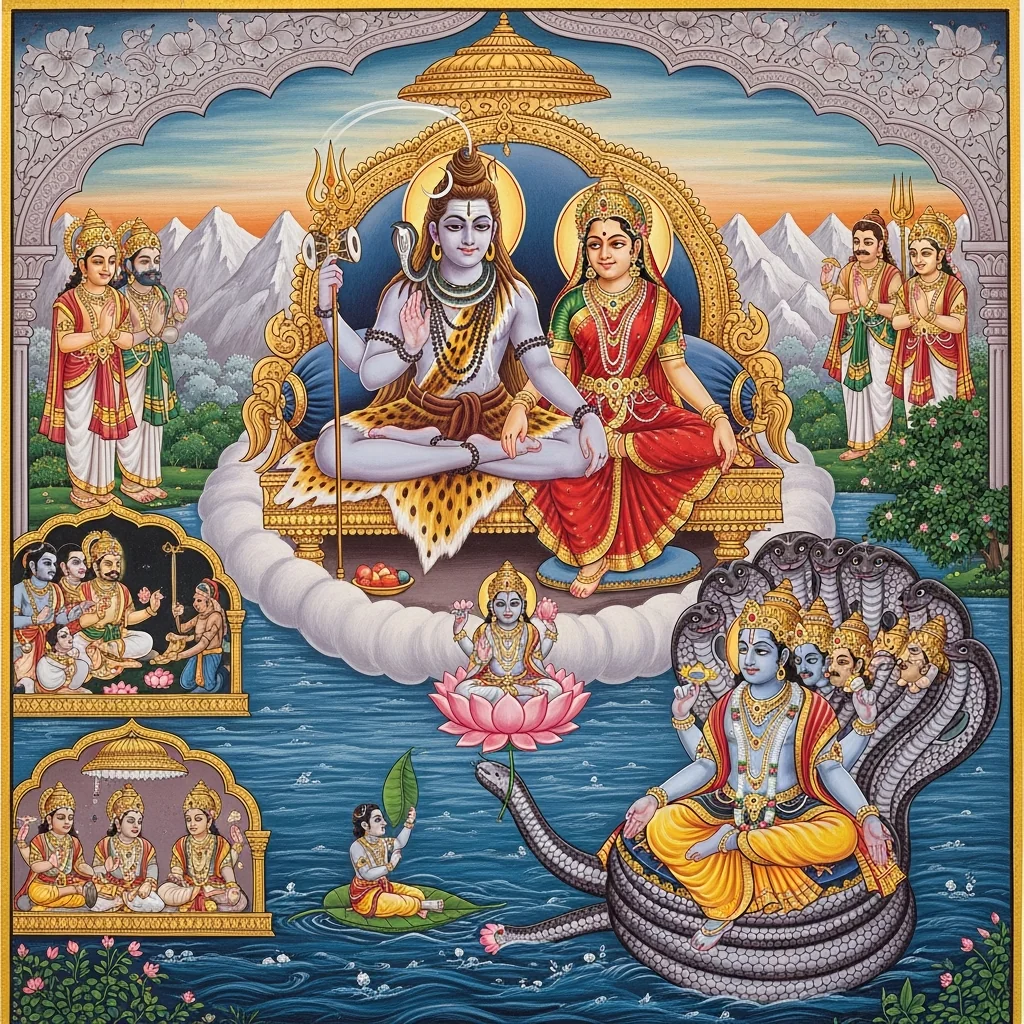
Chapter 8 begins with Yudhiṣṭhira asking Vyāsa to continue, showing how the account of Dharmāraṇya sustains curiosity and deepens devotion. Vyāsa introduces the episode as a Skanda Purāṇa narrative first spoken by Sthāṇu (Śiva) to Skanda, praised for granting the merit of many tīrthas and for removing obstacles. The scene shifts to Kailāsa, where Śiva is portrayed in iconic form—five-faced, ten-armed, three-eyed, bearing the trident, with kapāla and khaṭvāṅga—attended by gaṇas and lauded by sages and celestial musicians. Skanda reports that gods and exalted divinities wait at Śiva’s gate for audience; as Śiva rises to depart, Skanda asks the urgent purpose. Śiva declares his intent to go to Dharmāraṇya with the gods and then delivers a cosmogonic teaching: primordial brahman during pralaya, the emergence of the great substance, Viṣṇu’s play upon the waters, the banyan and the child-form reclining on a leaf, Brahmā’s birth from the navel-lotus, and the command to create the cosmic sphere with its realms and beings (including the classification of yonis). The narrative continues with genealogical ordering—Brahmā’s mind-born sons, Kaśyapa and his wives, the Ādityas, and the derivation of “Dharmāraṇya” from Dharma’s role—followed by a grand assembly of gods, siddhas, gandharvas, nāgas, planets, and others. It culminates in Brahmā’s approach to Vaikuṇṭha and his formal praise of Viṣṇu, who appears in iconic form, linking cosmogony, sacred geography, and divine counsel.
Shlokas
Verse 1
युधिष्ठिर उवाच । धर्मारण्यकथां पुण्यां श्रुत्वा तृप्तिर्न मे विभो । यदायदा कथयसि तदा प्रोत्सहते मनः । अतः परं किमभवत्परं कौतूहलं हि मे
Yudhiṣṭhira said: O mighty one, even after hearing the sacred account of Dharmāraṇya, I am not satisfied. Each time you narrate it, my mind grows ever more eager. Therefore, what happened after that? Great indeed is my curiosity.
Verse 2
व्यास उवाच । शृणु पार्थ महापुण्यां कथां स्कंदपुराणजाम् । स्थाणुनोक्तां च स्कंदाय धर्मारण्योद्भवां शुभाम्
Vyāsa said: Listen, O Pārtha, to this supremely meritorious account born of the Skanda Purāṇa—an auspicious narrative that arose in Dharmāraṇya, spoken by Sthāṇu (Śiva) to Skanda.
Verse 3
सर्वतीर्थस्य फलदां सर्वोपद्रवनाशिनीम् । कैलासशिखरासीनं देवदेवं जगद्गुरुम् । पंचवक्त्रं दशभुजं त्रिनेत्रं शूलपाणिनम्
—(That sacred account) bestows the fruit of all tīrthas and destroys every calamity. (It describes) the God of gods, the world-teacher, seated upon the summit of Kailāsa—five-faced, ten-armed, three-eyed, bearing the trident in His hand.
Verse 4
कपालखटवांगकरं नागयज्ञोपवीतिनम् । गणैः परिवृतं तत्र सुरासुरनमस्कृतम्
Holding a skull and a khaṭvāṅga-staff, wearing a serpent as the sacred thread, He was there surrounded by His gaṇas, revered with salutations by gods and asuras alike.
Verse 5
नानारूपगुणैर्गीतं नारदप्रमुखैर्युतम् । गंधर्वैश्चाप्सरोभिश्च सेवितं तमुमापतिम् । तत्रस्थं च महादेवं प्रणिपत्याब्रवीत्सुतः
That Lord of Umā was sung with hymns of many forms and excellences, attended by Nārada and others, and served by Gandharvas and Apsarases. Then Skanda, bowing to Mahādeva who was present there, spoke.
Verse 6
स्कंद उवाच । स्वामिन्निंद्रादयो देवा ब्रह्माद्याश्चैव सर्वशः । तव द्वारे समायातान्त्वद्दर्शनैकलालसाः । किमाज्ञापयसे देव करवाणि तवाग्रतः
Skanda said: O Master, Indra and the other gods—Brahmā and all the rest as well—have come to Your door, longing only for Your sacred darśana. O Lord, what do You command? What shall I do before You?
Verse 7
व्यास उवाच । स्कंदस्य वचनं श्रुत्वा आसनादुत्थितो हरः । वृषभं न समारूढो गंतुकामोऽभवत्तदा
Vyāsa said: Hearing Skanda’s words, Hara rose from His seat. Without mounting the bull, He then became intent on going forth.
Verse 8
गतुकामं शिवं दृष्ट्वा स्कंदो वाक्यमथाब्रवीत्
Seeing Śiva ready to depart, Skanda then spoke these words.
Verse 9
स्कंद उवाच । किं कार्यं देव देवानां यत्त्वमाहूयसे त्वरम् । वृषं त्यक्त्वा कृपासिंधो कृपास्ति यदि मे वद
Skanda said: What task of the gods is it, O Lord, that You are being summoned with such urgency? Leaving aside even the bull, O ocean of compassion—if You have grace for me, then tell me.
Verse 10
देवदानव युद्धं वा किं कार्यं वा महत्तरम्
Is it a war between the gods and the dānavas—or some other, even greater undertaking?
Verse 11
शिव उवाच । शृणुष्वैकाग्रमनसा येनाहं व्यग्रचेतसः । अस्ति स्थानं महापुण्यं धर्म्मारण्यं च भूतले
Śiva said: “Listen with a single-pointed mind, for my heart is eager. Upon the earth there exists a supremely meritorious holy place—Dharmāraṇya, the Forest of Dharma.”
Verse 12
तत्रापि गंतुकामोऽहं देवैः सह षडाननः
“To that very place I too wish to go—together with the gods, O Six-faced One (Ṣaḍānana).”
Verse 13
स्कंद उवाच । तत्र गत्वा महादेव किं करिष्यसि सांप्रतम् । तन्मे ब्रूहि जगन्नाथ कृत्यं सर्वमशेषतः
Skanda said: “O Mahādeva, having gone there, what will you do now? Tell me, O Lord of the universe, your entire purpose and intended acts—without leaving anything out.”
Verse 14
शिव उवाच । श्रूयतां वचनं पुत्र मनसोल्हादकारणम् । आदितः सर्व्ववृत्तानां सृष्टि स्थितिकरं महत्
Śiva said: “O son, let my words be heard—words that bring delight to the mind—as I speak from the beginning the great account that is the cause of creation and sustenance of all events.”
Verse 15
परंतु प्रलये जाते सर्वतस्तमसा वृतम् । आसीदेकं तदा ब्रह्म निर्गुणं बीजमव्ययम्
“But when dissolution (pralaya) occurred and everything was covered on all sides by darkness, then there was only Brahman—without qualities—an imperishable seed.”
Verse 16
निर्मितं वै गुणैरादौ मह द्द्रव्यं प्रचक्ष्यते
In the beginning, indeed from the guṇas, the great principle called “mahat” is said to be brought forth.
Verse 17
महाकल्पे च संप्राप्ते चराचरे क्षयं गते । जलरूपी जगन्नाथो रममाणस्तु लीलया
And when the great aeon arrived and all that moves and does not move had perished, the Lord of the universe, taking the form of water, remained playfully, abiding in His līlā.
Verse 18
चिरकाले गते सोपि पृथिव्यादिसुतत्त्वकैः । वृक्षमुत्पादयामासायुतशाखामनोरमम्
After a long time had passed, He too—by means of the subtle principles beginning with earth—brought forth a delightful tree with ten thousand branches.
Verse 19
फलैर्विशालैराकीर्णं स्कंधकांडादिशोभितम् । फलौघाढ्यो जटायुक्तो न्यग्रो धो विटपो महान्
It was filled with great fruits and beautified by trunk, branches, and the like; rich with clusters of fruits and furnished with hanging roots—this was a mighty Nyagrodha, the banyan tree.
Verse 20
बालभावं ततः कृत्वा वासुदेवो जनार्द्दनः । शेतेऽसौ वटपत्रेषु विश्वं निर्मातुमुत्सुकः
Then Vāsudeva, Janārdana—assuming the form of a child—lay upon the banyan leaves, eager to bring the universe into creation.
Verse 21
सनाभिकमले विष्णो र्जातो ब्रह्मा हि लोककृत् । सर्वं जलमयं पश्यन्नानाकारमरूपकम्
From the lotus that arose from Viṣṇu’s navel, Brahmā—the maker of worlds—was born. Looking about, he beheld all as water-made, without fixed form, yet able to assume manifold appearances.
Verse 22
तं दृष्ट्वा सहसोद्वेगाद्ब्रह्मा लोकपितामहः । इदमाह तदा पुत्र किं करो मीति निश्चितम्
Seeing that, Brahmā—the Pitāmaha, grandsire of the worlds—was suddenly seized by agitation. Then he spoke: “O son, what indeed should I do?”—thus he resolved within his mind.
Verse 23
खे जजान ततो वाणी देवात्सा चाशरीरिणी । तपस्तप विधे धातर्यथा मे दर्शनं भवेत्
Then, in the sky, there arose a divine, bodiless voice from the devas: “Perform tapas, O Vidhātṛ, O Dhātṛ, so that My darśana—My vision—may be granted to you.”
Verse 24
तच्छ्रुत्वा वचनं तत्र ब्रह्मा लोकपितामहः । प्रातप्यत तपो घोरं परमं दुष्करं महत्
Hearing those words, Brahmā—the Pitāmaha, grandsire of the worlds—thereupon undertook fierce tapas: supreme, exceedingly difficult, and vast in its power.
Verse 25
प्रहसन्स तदा बालरूपेण कमलापतिः । उवाच मधुरां वाचं कृपालुर्बाल लीलया
Then Kamalāpati, the Lord of Lakṣmī, smiling and appearing in the form of a child, spoke sweet words—compassionate, as though in a playful, childlike līlā.
Verse 26
श्रीविष्णुरुवाच । पुत्र त्वं विधिना चाद्य कुरु ब्रह्मांडगोलके । पातालं भूतलं चैव सिंधुसागरकाननम्
Śrī Viṣṇu said: “O son, now create, according to the ordained method, within the sphere of the cosmic egg—Pātāla (the netherworlds), the earth-plane, and the regions of rivers, oceans, and forests.”
Verse 27
वृक्षाश्च गिरयो द्विपदाः पशवस्तथा । पक्षिणश्चैव गंधर्वाः सिद्धा यक्षाश्च राक्षसाः
“(Create) trees and mountains; bipeds and beasts as well; and also birds—together with Gandharvas, Siddhas, Yakṣas, and Rākṣasas.”
Verse 28
श्वापदाद्याश्च ये जीवाश्चतुराशीतियोनयः । उद्भिज्जाः स्वेदजाश्चैव जरायुजास्तथांडजाः
“And the living beings beginning with wild creatures—(all) the eighty-four categories of birth: those sprouting from the earth, those born of sweat, those born from the womb, and those born from eggs.”
Verse 29
एकविंशतिलक्षाणि एकैकस्य च योनयः । कुरु त्वं सकलं चाशु इत्युक्त्वांतरधीयत । ब्रह्मणा निर्मितं सर्वं ब्रह्मांडं च यथोदितम्
“For each (group) there are twenty-one lakhs of births. Create all of this quickly.” Having said so, the Lord disappeared. Thus Brahmā fashioned everything, and the cosmic egg came to be, just as had been declared.
Verse 30
यस्मिन्पितामहो जज्ञे प्रभुरेकः प्रजापतिः । स्थाणुः सुरगुरुर्भानुः प्रचेताः परमेष्ठिनः
In that cosmic order, the Grandsire was born—the one sovereign Lord, the Prajāpati: known as Sthāṇu, the guru of the gods, Bhānu, Pracetas, and Parameṣṭhin.
Verse 31
यथा दक्षो दक्षपुत्रा स्तथा सप्तर्षयश्च ये । ततः प्रजानां पतयः प्राभवन्नेकविंशतिः
Just as Dakṣa and the sons of Dakṣa became progenitors, so too did the Saptarṣis. From them arose twenty-one lords of created beings (Prajāpatis), who governed the unfolding of progeny.
Verse 32
पुरुषश्चाप्रमेयश्च एवं वंश्यर्षयो विदुः । विश्वेदेवास्तथादित्या वसव श्चाश्विनावपि
The sages who know the lines of descent understand thus: the Cosmic Person (Puruṣa) and the Immeasurable (Aprameya); and likewise the Viśvedevas, the Ādityas, the Vasus, and also the twin Aśvins arose in the divine order.
Verse 33
यक्षाः पिशाचाः साध्याश्च पितरो गुह्यकास्तथा । ततः प्रसूता विद्वांसो ह्यष्टौ ब्रह्मर्षयोऽमलाः
Yakṣas, Piśācas, the Sādhyas, the Pitṛs, and likewise the Guhyakas came forth. From that same unfolding were born eight stainless Brahmarṣis—wise seers established in pure knowledge.
Verse 34
राजर्षयश्च बहवः सर्वे समुदिता गुणैः । द्यौरापः पृथिवी वायुरंतरिक्षं दिशस्तथा
Many royal seers (rājarṣis) too arose, all endowed with virtues. And there manifested heaven, the waters, the earth, the wind, the mid-space, and likewise the directions.
Verse 35
संवत्सरार्तवो मासाः पक्षाहोरात्रयः क्रमात् । कलाकाष्ठामुहूर्तादि निमे षादि लवास्तथा
In due sequence came forth the year, the seasons, the months, the fortnights, and the days and nights; and also measures of time such as kalā, kāṣṭhā, muhūrta, and the like—down to nimeṣa and lava.
Verse 36
ग्रहचक्रं सनक्षत्रं युगा मन्वन्तरादयः । यच्चान्यदपि तत्सर्वं संभूतं लोकसाक्षिकम्
The cycle of the planets with the constellations, the yugas, the manvantaras, and all else besides—whatever there is—came into being as the witness and very framework of the worlds.
Verse 37
यदिदं दृश्यते चक्रं किंचि त्स्थावरजंगमम् । पुनः संक्षिप्यते पुत्र जगत्प्राप्ते युगक्षये
This revolving order that is seen—whatever is stationary or moving—is drawn back again, O son, when the world reaches the end of a yuga.
Verse 38
यथर्तावृतुलिंगानि नामरूपाणि पर्यये । दृश्यन्ते तानि तान्येव तथा वत्स युगादिकम्
Just as, in the turning of the seasons, their characteristic signs—and the same names and forms—appear again and again in succession, so too, dear child, do the yugas and related cycles recur.
Verse 39
शिव उवाच । अतः परं प्रवक्ष्यामि कथां पौराणिकीं शुभाम् । ब्रह्मणश्च तथा पुत्र वंशस्यैवानुकीर्तनम्
Śiva said: Next I shall proclaim an auspicious purāṇic account; and also, O son, the orderly recitation of Brahmā’s lineage.
Verse 40
ब्रह्मणो मानसाः पुत्रा विदिताः षण्महर्षयः । मरीचिरत्र्यंगिरसौ पुलस्त्यः पुलहः क्रतुः
Brahmā’s mind-born sons are known as six great ṛṣis: Marīci, Atri, Aṅgiras, Pulastya, Pulaha, and Kratu.
Verse 41
मरीचेः कश्यपः पुत्रः कश्यपाच्चरमाः प्रजाः । प्रजज्ञिरे महाभागा दक्षकन्यास्त्रयोदश
Kaśyapa was the son of Marīci. From Kaśyapa arose the later generations of beings—thirteen illustrious daughters of Dakṣa.
Verse 42
अदितिर्दितिर्दनुः काला दनायुः सिंहिका तथा । क्रोधा प्रोवा वसिष्ठा च विनता कपिला तथा
Aditi, Diti, Danu, Kālā, Danāyu, and likewise Siṃhikā; also Krodhā, Provā, Vasiṣṭhā, and Vinatā, as well as Kapilā—these are named among Dakṣa’s daughters.
Verse 43
कण्डूश्चैव सुनेत्रा च कश्यपाय ददौ तदा । अदित्यां द्वादशादित्याः संजाता हि शुभाननाः
And Kaṇḍū and also Sunetrā were then given to Kaśyapa. From Aditi were born the twelve Ādityas, radiant and auspicious-faced.
Verse 44
सूर्याद्वै धर्मराड् जज्ञे ते नेदं निर्मितं पुरा । धर्मेण निर्मितं दृष्ट्वा धर्मारण्यमनुत्तमम् । धर्मारण्यमिति प्रोक्तं यन्मया स्कन्द पुण्यदम्
From Sūrya indeed was born Dharmarāṭ; by him this sacred place was fashioned in ancient times. Seeing this unsurpassed forest made by Dharma, it was therefore called ‘Dharmāraṇya’—as I declare to you, O Skanda—bestowing merit (puṇya).
Verse 45
स्कन्द उवाच । धर्मारण्यस्य चाख्यानं परमं पावनं तथा । श्रोतुमिच्छामि तत्सर्वं कथयस्व महेश्वर
Skanda said: “I wish to hear in full that supremely purifying account of Dharmāraṇya. Tell me everything, O Maheśvara.”
Verse 46
ईश्वर उवाच । इन्द्राद्याः सकला देवा अन्वयुर्ब्रह्मणा सह । अहं वै तत्र यास्यामि क्षेत्रं पापनिषूदनम्
Īśvara said: “All the gods, beginning with Indra, followed on together with Brahmā. I too shall go there—to that holy kṣetra that destroys sin.”
Verse 47
स्कन्द उवाच । अहमप्यागमिष्यामि तं द्रष्टुं शशिशे खर
Skanda said: “I too shall come, to behold that sacred place.”
Verse 48
सूत उवाच । ततः स्कन्दस्तथा रुद्रः सूर्यश्चैवानिलोऽनलः । सिद्धाश्चैव सगन्धर्वास्तथैवाप्सरसः शुभाः
Sūta said: Then Skanda, and likewise Rudra and Sūrya, together with Vāyu and Agni; the Siddhas with the Gandharvas, and also the auspicious Apsarases, assembled and set forth.
Verse 49
पिशाचा गुह्यकाः सर्व इन्द्रो वरुण एव च । नागाः सर्वाः समाजग्मुः शुक्रो वाचस्पतिस्तथा
All the Piśācas and the Guhyakas came; Indra and Varuṇa as well. All the Nāgas assembled there—Śukra and Bṛhaspati likewise.
Verse 50
ग्रहाः सर्वे सनक्षत्रा वसवोऽष्टौ ध्रुवा दयः । अंतरिक्षचराः सर्वे ये चान्ये नगवासिनः
All the Grahas, together with the Nakṣatras, came; the eight Vasus and the steadfast Dhruvas as well. All who move through the mid-air, and also others who dwell upon the mountains, assembled there.
Verse 51
ब्रह्मादयः सुराः सर्वे वैकुण्ठं परया मुदा । मन्त्रणार्थं तदा ब्रह्मा विष्णवेऽमितते जसे
Then Brahmā and all the gods, filled with supreme joy, went to Vaikuṇṭha. There, for the sake of counsel, Brahmā approached Viṣṇu of immeasurable splendor.
Verse 52
गत्वा तस्मिंश्च वैकुण्ठे ब्रह्मा लोकपितामहः । ध्यात्वा मुहूर्तमाचष्ट विष्णुं प्रति सुहर्षितः
Having reached that Vaikuṇṭha, Brahmā—the grandsire of the worlds—meditated for a moment, and then, filled with delight, addressed Viṣṇu.
Verse 53
ब्रह्मोवाच । कृष्ण कृष्ण महाबाहो कृपालो परमेश्वर । स्रष्टा त्वं चैव हर्ता त्वं त्वमेव जगतः पिता
Brahmā said: “Kṛṣṇa, Kṛṣṇa—O mighty-armed One, compassionate Supreme Lord! You are the creator, You are the withdrawer; You alone are the Father of the universe.”
Verse 54
नमस्ते विष्णवे सौम्य नमस्ते गरुडध्वज । नमस्ते कम लाकांत नमस्तेब्रह्मरूपिणे
Salutations to You, gentle Viṣṇu; salutations to You whose banner is Garuḍa. Salutations to You, beloved of Kamalā (Lakṣmī); salutations to You who assume the form of Brahmā.
Verse 55
नमस्ते मत्स्यरूपाय विश्वरूपाय वै नमः । नमस्ते दैत्यनाशाय भक्तानामभयाय च
Salutations to You in the form of the Fish; salutations indeed to Your universal form. Salutations to You, the destroyer of demons, and to You who grant fearlessness to devotees.
Verse 56
कंसघ्नाय नमस्तेस्तु बलदैत्यजिते नमः । ब्रह्मणैवं स्तुतश्चासीत्प्रत्यक्षोऽसौ जनार्द्दनः
Salutations to You, slayer of Kaṃsa; salutations to You, conqueror of the demon Bala. Thus praised by Brahmā, that Janārdana became manifest before him.
Verse 57
पीतांबरो घनश्यामो नागारिकृतवाहनः । चतुर्भुजो महा तेजाः शंखचक्रगदाधरः
He wore yellow garments, dark as a rain-cloud, with a serpent as his conveyance; four-armed, of great brilliance, bearing the conch, discus, and mace.
Verse 58
स्तूयमानः सुरैः सर्वैः स देवोऽमितविक्रमः । विद्याधरैस्तथा नागैः स्तूयमानश्च सर्वशः
That god of boundless valor was praised by all the gods; and likewise by the Vidyādharas and the Nāgas—praised everywhere on all sides.
Verse 59
उत्तस्थौ स तदा देवो भास्करामितदीप्तिमान् । कोटिरत्नप्रभाभास्वन्मुकुटादिविभूषितः
Then that god arose, radiant with a brilliance like countless suns, adorned with a crown and other ornaments blazing with the luster of millions of jewels.