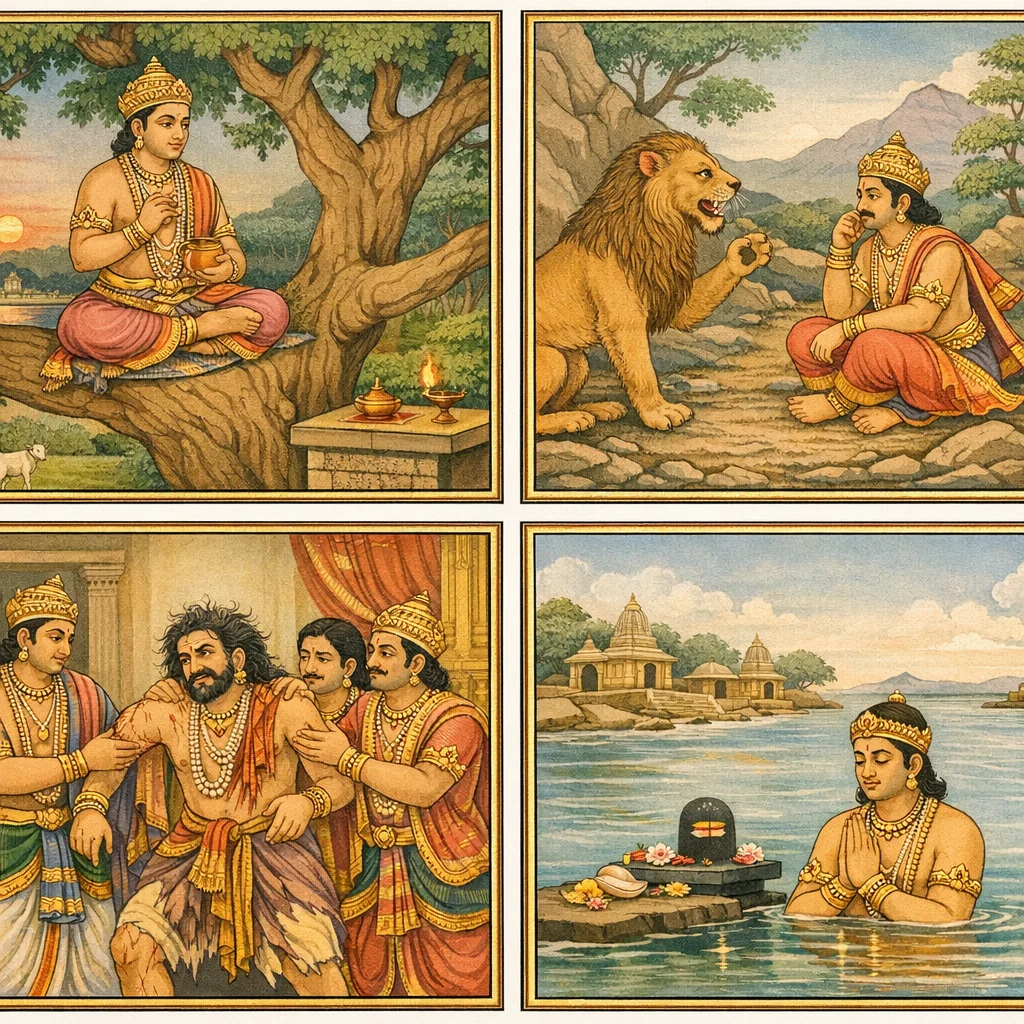
Adhyaya 32
The chapter begins in a Vyāsa-framed narration: Rāma’s messengers meet a solitary divine woman, richly adorned yet sorrowful, and report her to Śrī Rāma. Rāma approaches with humility, asks her identity and the reason for her abandonment, and offers protection. She replies with a formal stuti, praising Rāma as the supreme and eternal remover of suffering, and extolling his cosmic greatness and victories over rākṣasas. She then discloses her role: she is the adhidevatā, presiding deity of Dharmāraṇya-kṣetra. For twelve years the land has been deserted from fear of a powerful asura; Brahmins and merchants have fled, ritual life has collapsed, and former signs of prosperity—bathing at the dīrghikā, communal play, flowers, yajña-vedīs, and household agnihotra—have given way to thorns, wild beasts, and ominous portents. Rāma promises to seek out the displaced Brahmins in every direction and resettle them. The goddess specifies the traditional social-religious order: great numbers of Veda-versed Brahmins of many gotras and dharma-minded Vaiśyas, and she names herself Bhattārikā, the local protectress. Rāma affirms her truth, proclaims a city to be founded and famed as Satya-mandira, and dispatches attendants to bring the Brahmins with honor (arghya-pādya), issuing a governance decree that refusal to receive them brings punishment and exile. The Brahmins are found, honored, and brought to Rāma; he declares his own stature rests on vipra-prasāda (the favor of Brahmins), then performs ritual reception (pādya, arghya, āsana), prostration, and lavish gifting—ornaments, garments, sacred threads, and many cows—thereby restoring Dharmāraṇya’s sacred settlement and order.
Shlokas
Verse 1
व्यास उवाच । ततश्च रामदूतास्ते नत्वा राममथाब्रुवन् । रामराम महाबाहो वरनारी शुभानना
Vyāsa said: Then those messengers of Rāma, having bowed to Rāma, spoke: “O Rāma, O Rāma, mighty-armed one—(we saw) an excellent woman, fair-faced and auspicious…”
Verse 2
सुवस्त्रभूषाभरणां मृदुवाक्यपरायणाम् । एकाकिनीं क्रदमानाम दृष्ट्वा तां विस्मिता वयम्
(They said:) “We saw her—adorned with fine garments and ornaments, devoted to gentle speech—yet alone and weeping; seeing her, we were astonished.”
Verse 3
समीपवर्तिनो भूत्वा पृष्टा सा सुरसुन्दरी । का त्वं देवि वरारोहे देवी वा दानवी नु किम्
Drawing near, they questioned that heavenly-beautiful lady: “Who are you, O Devī, fair-limbed one? Are you a goddess—or are you a dānavī, a demoness?”
Verse 4
रामः पृच्छति देवि त्वां ब्रूहि सर्वं यथातथम् । तच्छ्रुत्वा वचनं रामा सोवाच मधुरं वचः
“O lady, Rāma is questioning you—tell everything exactly as it is.” Hearing these words, that lady then spoke sweetly.
Verse 5
रामं प्रेषयत भद्रं वो मम दुःखापहं परम्
“Send Rāma to me. Blessings upon you—he is supremely able to remove my sorrow.”
Verse 6
तदाकर्ण्य ततो रामः संभ्रमात्त्वरितो ययौ । दृष्ट्वा तां दुःखसंतप्तां स्वयं दुःखमवाप सः । उवाच वचनं रामः कृतांजलिपुटस्तदा
Hearing that, Rāma hurried at once, driven by anxious haste. Seeing her tormented by sorrow, he too was overcome with grief. Then Rāma spoke, his hands joined in reverence.
Verse 7
श्रीराम उवाच । का त्वं शुभे कस्य परिग्रहो वा केनावधूता विजने निरस्ता । मुष्टं धनं केन च तावकीनमाचक्ष्व मातः सकलं ममाग्रे
Śrī Rāma said: “O auspicious lady, who are you, and whose wife are you? By whom have you been cast off and abandoned in this lonely place? And by whom has your handful of wealth been taken? Tell me, O mother—declare everything before me.”
Verse 8
इत्युक्त्वा चातिदुःखार्तो रामो मतिमतां वरः । प्रणामं दंडवच्चक्रे चक्रपाणिरिवापरः
Having spoken thus, Rāma—best among the wise and afflicted with deep sorrow—performed a full prostration, straight as a staff, like another bearer of the discus (Viṣṇu) himself.
Verse 9
तयाभिवंदितो रामः प्रगम्य च पुनःपुनः । तुष्टया परया प्रीत्या स्तुतो मधुरया गिरा
Rāma, repeatedly saluted by her as she came forward again and again, was praised in sweet words, with supreme delight and love.
Verse 10
परमात्मन्परेशान दुःखहारिन्सनातन । यदर्थमवतारस्ते तच्च कार्यं त्वया कृतम्
O Supreme Self, O Lord of lords, O remover of sorrow, O Eternal One—whatever purpose your descent as an avatāra had, that very task has been accomplished by you.
Verse 11
रावणः कुम्भकर्णश्च शक्रजित्प्रमुखास्तथा । खरदूषणत्रिशिरोमारीचाक्षकुमारकाः
Rāvaṇa, Kumbhakarṇa, and others headed by Indrajit, as well as Khara, Dūṣaṇa, Triśiras, Mārīca, Akṣa, and the princes—
Verse 12
असंख्या निर्जिता रौद्रा राक्षसाः समरांगणे
Countless fierce rākṣasas have been conquered on the battlefield.
Verse 13
किं वच्मि लोकेश सुकीर्त्तिमद्य ते वेधास्त्वदीयांगजपद्मसंभवः । विश्वं निविष्टं च ततो ददर्श वटस्य पत्रे हि यथो वटो मतः
What can I say today of your noble fame, O Lord of the worlds? Even Brahmā—born from the lotus that sprang from your body—beheld the entire universe contained within you, as though the banyan tree itself were seen within a single banyan leaf.
Verse 14
धन्यो दशरथो लोके कौशल्या जननी तव । ययोर्जातोसि गोविंद जगदीश परः पुमान्
Blessed in this world is Daśaratha, and blessed is Kauśalyā, your mother—since to them you were born, O Govinda, O Lord of the universe, the Supreme Person.
Verse 15
धन्यं च तत्कुलं राम यत्र त्वमागतः स्वयम् । धन्याऽयोध्यापुरी राम धन्यो लोकस्त्वदाश्रयः
Blessed is that dynasty, O Rāma, into which you yourself have come. Blessed is the city of Ayodhyā, O Rāma; blessed is the world that takes refuge in you.
Verse 16
धन्यः सोऽपि हि वाल्मीकिर्येन रामायणं कृतम् । कविना विप्रमुख्येभ्य आत्मबुद्ध्या ह्यनागतम्
Blessed indeed is Vālmīki as well, by whom the Rāmāyaṇa was composed—by the poet, through his own inspired insight, even before it was fully known to the foremost of the learned.
Verse 17
त्वत्तोऽभवत्कुलं चेदं त्वया देव सुपावितम्
From you this lineage has arisen, and by you, O Divine One, it has been wholly purified.
Verse 18
नरपतिरिति लोकैः स्मर्यते वैष्णवांशः स्वयमसि रमणीयैस्त्वं गुणैर्विष्णुरेव । किमपि भुवनकार्यं यद्विचिंत्यावतीर्य तदिह घटयतस्ते वत्स निर्विघ्नमस्तु
People remember you as a king who is a portion of Viṣṇu; indeed, by your delightful virtues you are Viṣṇu himself. Whatever work for the welfare of the worlds you have contemplated and descended to accomplish—may it be fulfilled here without obstacle, dear child.
Verse 19
स्तुत्वा वाचाथ रामं हि त्वयि नाथे नु सांप्रतम् । शून्या वर्ते चिरं कालं यथा दोषस्तथैव हि
Having thus praised, (the deity) spoke to Rāma: “Now that you are my lord, even so, I have long remained empty and desolate—just as before, in the very same afflicted state.”
Verse 20
धर्मारण्यस्य क्षेत्रस्य विद्धि मामधिदेवताम् । वर्षाणि द्वादशेहैव जातानि दुःखि तास्म्यहम्
Know me as the presiding deity of the sacred field of Dharmāraṇya. For twelve years here I have been in sorrow.
Verse 21
निर्जनत्वं ममाद्य त्वमुद्धरस्व महामते । लोहासुरभयाद्राम विप्राः सर्वे दिशो दश
O great-minded one, rescue me today from this abandonment. O Rāma, out of fear of Lohāsura, all the brāhmaṇas have fled in the ten directions.
Verse 22
गताश्च वणिजः सर्वे यथास्थानं सुदुःखिताः । स दैत्यो घातितो राम देवैः सुरभयंकरः
All the merchants too have departed to their own places, deeply distressed. That Daitya, O Rāma—who was a terror even to the devas—has been slain by the devas.
Verse 23
आक्रम्यात्र महामायो दुराधर्षो दुरत्ययः । न ते जनाः समायांति तद्भयादति शंकिताः
Having overrun this place, that great sorcerer—hard to assail and hard to overcome—has made it so that your people do not come here, extremely anxious out of fear of him.
Verse 24
अद्य वै द्वादश समाः शून्यागारमनाथवत् । यस्माच्च दीर्घिकायां मे स्नानदानोद्यतो जनः
Today it is twelve full years that this place has been like an empty house, as if without a protector—because the people who once came to my long tank intent on bathing and giving charity no longer come.
Verse 25
राम तस्यां दीर्घिकायां निपतंति च शूकराः । यत्रांगना भर्तृयुता जलक्रीडापरायणाः
O Rāma, now boars fall into that very Dīrghikā—where once women, accompanied by their husbands, delighted in water-play.
Verse 26
चिक्रीडुस्तत्र महिषा निपतंति जलाशये । यत्र स्थाने सुपुष्पाणां प्रकरः प्रचुरोऽभवत्
There buffaloes now sport and plunge into the water-reservoir—at the very spot where once there was an abundant profusion of beautiful flowers.
Verse 27
तद्रुद्धं कंटकैर्वृक्षैः सिंहव्याघ्रसमाकुलैः । संचिक्रीडुः कुमाराश्च यस्यां भूमौ निरंतरम्
That region was choked with thorny trees and thronged with lions and tigers; yet upon that ground the boys would roam and play there continually.
Verse 28
कुमार्यश्चित्रकाणां च तत्र क्रीडं ति हर्षिताः । अकुर्वन्वाडवा यत्र वेदगानं तिरंतरम्
There, delighted girls would play with colorful toys; and in that place the youths would keep up the chanting of the Vedas without interruption.
Verse 29
शिवानां तत्र फेत्काराः श्रूयंतेऽतिभयंकराः । यत्र धूमोऽग्निहोत्राणां दृश्यते वै गृहेगृहे
There, the terrifying yelps of jackals were heard; yet in that very place, the smoke of household Agnihotra rites could be seen rising from house after house.
Verse 30
तत्र दावाः सधूमाश्च दृश्यंतेऽत्युल्बणा भृशम् । नृत्यंते नर्त्तका यत्र हर्षिता हि द्विजाग्रतः
There, fierce forest-fires with billowing smoke were seen; and in that same place, dancers would dance joyfully before the foremost of the twice-born.
Verse 31
तत्रैव भूतवेताला प्रेताः नृत्यंति मोहिताः । नृपा यत्र सभायां तु न्यषीदन्मंत्रतत्पराः
There itself, ghosts, vetālas, and pretas—bewildered—would dance about; while in that place the kings sat in the assembly, intent upon counsel and deliberation.
Verse 32
तस्मिन्स्थाने निषीदंति गवया ऋक्षशल्लकाः । आवासा यत्र दृश्यन्ते द्विजानां वणिजां तथा
In that place gaurs, bears, and porcupines would settle and rest; and there could be seen the dwellings of the twice-born (dvija) and of merchants as well.
Verse 33
कुट्टिमप्रतिमा राम दृश्यंतेत्र बिलानि वै । कोटराणीह वृक्षाणां गवाक्षाणीह सर्वतः
O Rāma, here one sees burrows like paved chambers; here are hollows in the trees, and openings like windows everywhere.
Verse 34
चतुष्का यज्ञवेदिर्हि सोच्छ्राया ह्यभवत्पुरा । तेऽत्र वल्मीकनिचयैर्दृश्यंते परिवेष्टिताः
Formerly, the four-cornered sacrificial altars (yajña-vedī) stood here, raised up and prominent; now they are seen here encircled by heaps of anthills.
Verse 35
एवंविधं निवासं मे विद्धि राम नृपोत्तम । शून्यं तु सर्वतो यस्मान्निवासाय द्विजा गताः
Know, O Rāma, best of kings, that such is my dwelling—now empty on every side, since the twice-born (dvija) have departed to find abode elsewhere.
Verse 36
तेन मे सुमहद्दुःखं तस्मात्त्राहि नरेश्वर । एतच्छ्रुत्वा वचो राम उवाच वदतां वरः
Because of that, great sorrow has come upon me—therefore protect me, O lord of men. Hearing these words, Rāma, the best of speakers, replied.
Verse 37
श्रीराम उवाच । न जाने तावकान्विप्रांश्चतुर्दिक्षु समाश्रितान् । न तेषां वेद्म्यहं संख्यां नामगोत्रे द्विजन्मनाम्
Śrī Rāma said: “I do not know your Brāhmaṇas who have taken refuge in the four directions. I do not know their number, nor the names and lineages (gotras) of those twice-born.”
Verse 38
यथा ज्ञातिर्यथा गोत्रं याथातथ्यं निवेदय । तत आनीय तान्सर्वान्स्वस्थाने वासयाम्यहम्
“Report accurately—just as it is—their kin-relations and their gotras. Then, having brought them all, I shall settle them each in their proper place.”
Verse 39
श्रीमातोवाच । ब्रह्मविष्णुमहेशैश्च स्थापिता ये नरेश्वर । अष्टादश सहस्राणि ब्राह्मणा वेदपारगाः
The Blessed Mother said: “O lord of men, those who were established by Brahmā, Viṣṇu, and Maheśa—eighteen thousand Brāhmaṇas, accomplished in the Vedas.”
Verse 40
त्रयीविद्यासु विख्याता लोकेऽस्मिन्नमितद्युते । चतुष्षष्टिकगोत्राणां वाडवा ये प्रतिष्ठिताः
“They are renowned in this world, O you of immeasurable splendor, in the threefold Vedic lore; and they are established as the Vāḍavas belonging to sixty-four gotras.”
Verse 41
श्रीमातादात्त्रयीविद्यां लोके सर्वे द्विजोत्तमाः । षट्त्रिंशच्च सहस्राणि वैश्या धर्मपरायणाः
“The Blessed Mother bestowed the threefold Vedic knowledge; and in the world all those best of twice-born are known. And there are thirty-six thousand Vaiśyas devoted to dharma.”
Verse 42
आर्यवृत्तास्तु विज्ञेया द्विजशुश्रूषणे रताः । बहुलार्को नृपो यत्र संज्ञया सह राजते
Know them to be of noble conduct, delighting in service to the twice-born. In that place a king named Bahulārka reigns in splendor.
Verse 43
कुमारावश्विनौ देवौ धनदो व्ययपूरकः । अधिष्ठात्री त्वहं राम नाम्ना भट्टारिका स्मृता
The Kumāras and the Aśvin twins are the deities; Dhanada (Kubera) replenishes what is spent. And I, O Rāma, am the presiding goddess here, remembered by the name Bhaṭṭārikā.
Verse 44
श्रीसूत उवाच । स्थानाचाराश्च ये केचित्कुलाचारास्तथैव च । श्रीमात्रा कथितं सर्वं रामस्याग्रे पुरातनम्
Śrī Sūta said: “Whatever local customs (sthānācāras) and likewise family traditions (kulācāras) there are—all of that ancient lore was explained by the Blessed Mother in Rāma’s presence.”
Verse 45
तस्यास्तु वचनं श्रुत्वा रामो मुदमवाप ह । सत्यंसत्यं पुनः सत्यं सत्यं हि भाषितं त्वया
Having heard her words, Rāma attained great joy. “True—true—again true! Indeed, you have spoken the truth.”
Verse 46
यस्मात्सत्यं त्वया प्रोक्तं तन्नाम्ना नगरं शुभम् । वासयामि जगन्मातः सत्यमंदिरमेव च
“Since you have spoken the truth, O Mother of the world, I shall establish a blessed city bearing that very name—and also a temple called Satyamandira, the Abode of Truth.”
Verse 47
त्रैलोक्ये ख्यातिमाप्नोतु सत्यमंदिरमु त्तमम्
May this supreme Temple of Truth attain renown throughout the three worlds.
Verse 48
एतदुक्त्वा ततो रामः सहस्रशतसंख्यया । स्वभृत्यान्प्रेषयामास विप्रानयनहेतवे
Having said this, Rāma then dispatched his own attendants—by the thousands and hundreds—so that the brāhmaṇas might be brought in.
Verse 49
यस्मिन्देशे प्रदेशे वा वने वा सरि तस्तटे । पर्यंते वा यथास्थाने ग्रामे वा तत्रतत्र च
In whatever land or region—whether in a forest, on a riverbank, at the borderlands, in their proper dwelling-places, or in villages here and there—
Verse 50
धर्मारण्यनिवासाश्च याता यत्र द्विजोत्तमाः । अर्घपाद्यैः पूजयित्वा शीघ्रमानयतात्र तान्
Wherever those foremost brāhmaṇas—residents of Dharmāraṇya—have gone, honor them with arghya and water for the feet, and quickly bring them here.
Verse 51
अहमत्र तदा भोक्ष्ये यदा द्रक्ष्ये द्विजोत्तमान्
I shall eat here only then, when I have seen the foremost brāhmaṇas.
Verse 52
विमान्य च द्विजानेतानागमिष्यति यो नरः । स मे वध्यश्च दंड्यश्च निर्वास्यो विषयाद्बहिः
Any man who, showing contempt for these brāhmaṇas, fails to come—he shall be liable to death and punishment, and shall be banished outside my realm.
Verse 53
तच्छ्रुत्वा दारुणं वाक्यं दुःसहं दुःप्रधर्षणम् । रामाज्ञाकारिणो दूता गताः सर्वे दिशो दश
Hearing that harsh command—hard to endure and hard to transgress—the messengers who carried out Rāma’s orders went forth in all the ten directions.
Verse 54
शोधिता वाडवाः सर्वे लब्धाः सर्वे सुहर्षिताः । यथोक्तेन विधानेन अर्घपाद्यैरपूजयन्
All those brāhmaṇas were sought out and found, and all were greatly delighted; and, in the manner prescribed, they were honored with arghya and water for the feet.
Verse 55
स्तुतिं चक्रुश्च विधिवद्विनयाचारपूर्वकम् । आमंत्र्य च द्विजान्सर्वान्रामवाक्यं प्रकाशयन्
They offered praises in due form, with humility and proper conduct; and, having formally invited all the brāhmaṇas, they conveyed Rāma’s message.
Verse 56
ततस्ते वाडवाः सर्वे द्विजाः सेवकसंयुताः । गमनायोद्यताः सर्वे वेदशास्त्रपरायणाः
Then all those brāhmaṇas, accompanied by attendants, all prepared to depart—each devoted to the Vedas and the śāstras.
Verse 57
आगता रामपार्श्वं च बहुमानपुरःसराः । समागतान्द्विजान्दृष्ट्वा रोमांचिततनूरुहः
He drew near to Rāma’s side, led by reverence; and beholding the Brāhmaṇas assembled, his body thrilled in sacred rapture and his hairs stood on end.
Verse 58
कृतकृत्यमिवात्मानं मेने दाशरथिर्नृपः । स संभ्रमात्समुत्थाय पदातिः प्रययौ पुरः
Daśaratha’s son, the king, felt as though the duty of his life had been fulfilled. Rising at once in eager haste, he went forward on foot to welcome them.
Verse 59
करसंपुटकं कृत्वा हर्षाश्रु प्रतिमुञ्चयन् । जानुभ्यामवनिं गत्वा इदं वचनमब्रवीत्
Folding his hands in supplication and shedding tears of joy, he knelt down to the earth and spoke these words.
Verse 60
विप्रप्रसादात्कमलावरोऽहं विप्रप्रसादाद्धरणीधरोऽहम् । विप्रप्रसादाज्जगतीपतिश्च विप्रप्रसादान्मम रामनाम
“By the grace of the Brāhmaṇas I am beloved of Lakṣmī; by the grace of the Brāhmaṇas I bear the earth as a true ruler. By the grace of the Brāhmaṇas I am lord of the world; and by the grace of the Brāhmaṇas, mine is the very name ‘Rāma.’”
Verse 61
इत्येवमुक्ता रामेण वाड वास्ते प्रहर्षिताः । जयाशीर्भिः प्रपूज्याथ दीर्घायुरिति चाब्रुवन्
Thus addressed by Rāma, they rejoiced as they stayed there. Honoring him with blessings of victory, they also said, “May you be long-lived.”
Verse 62
आवर्जितास्ते रामेण पाद्यार्घ्यविष्टरादिभिः । स्तुतिं चकार विप्राणां दण्डवत्प्रणिपत्य च
Rāma welcomed them with the customary offerings—water for the feet, arghya, seats, and the like. He praised the Brāhmaṇas and, prostrating himself like a staff, bowed down in full reverence.
Verse 63
कृतांजलिपुटः स्थित्वा चक्रे पादाभिवंदनम् । आसनानि विचित्राणि हैमान्याभरणानि च
Standing with hands folded in añjali, he bowed at their feet. He also arranged splendid seats and golden ornaments.
Verse 64
समर्पयामास ततो रामो दशरथात्मजः । अंगुलीयकवासांसि उपवीतानि कर्णकान्
Then Rāma, Daśaratha’s son, presented them with rings and garments, sacred threads (upavīta), and earrings.
Verse 65
प्रददौ विप्रमुख्येभ्यो नानावर्णाश्च धेनवः । एकैकशत संख्याका घटोध्नीश्च सवत्सकाः
He gave to the foremost Brāhmaṇas cows of many colors—each gift numbering a hundred—milch-cows with full udders, together with their calves.
Verse 66
सवस्त्रा बद्धघंटाश्च हेमशृंगविभूषिताः । रूप्यखुरास्ताम्रपृष्ठीः कांस्यपात्रसमन्विताः
They were adorned with cloth coverings and fitted with bells; ornamented with golden horns, with silvered hooves and copper-toned backs, and accompanied by bronze vessels.