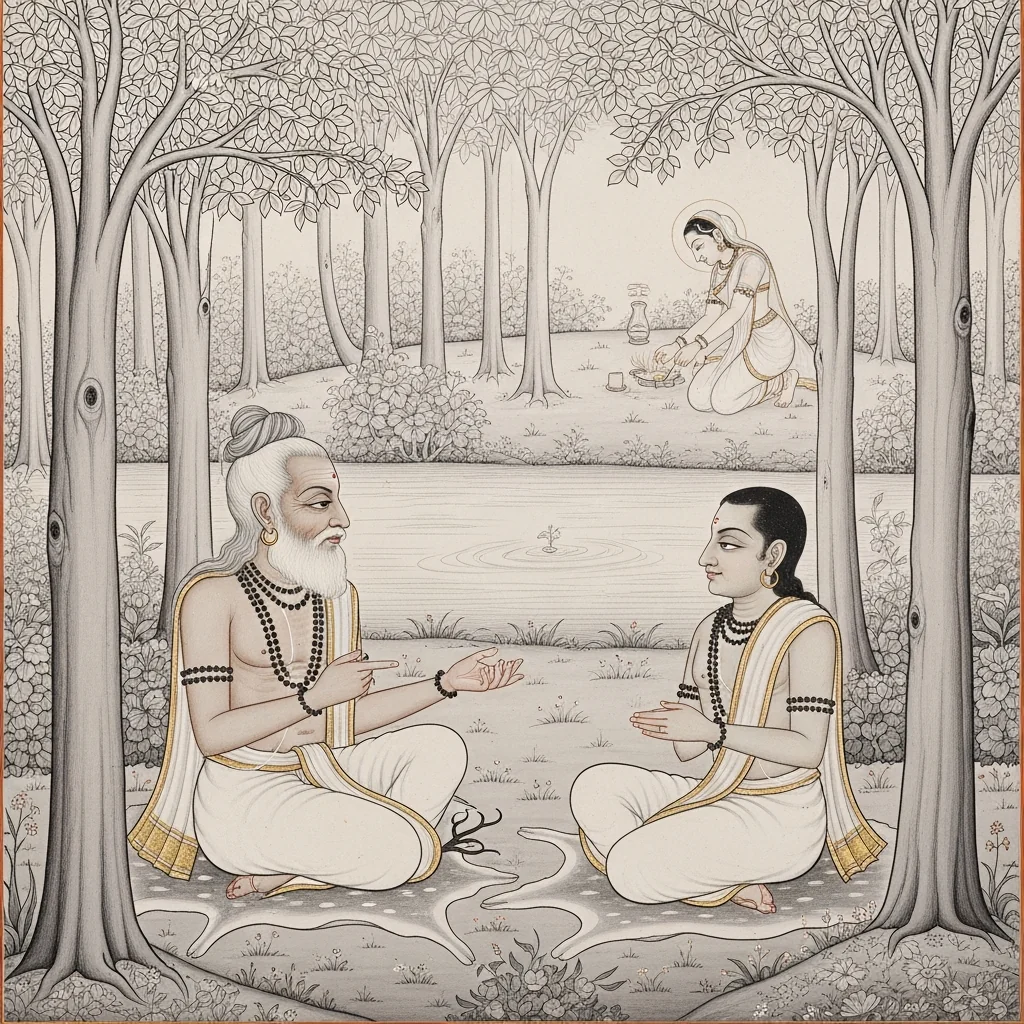
Adhyaya 7
This adhyāya weaves tīrtha-based ritual teaching together with household ethics in a dialogic frame. Vyāsa first proclaims the special potency of performing pitṛ-tarpaṇa and offering piṇḍas upon reaching the dharma-linked water-site, Dharmavāpī: the ancestors gain enduring satisfaction, and the merit extends even to departed beings in diverse post-mortem conditions. The discourse then portrays Kali-yuga as an age of moral volatility—greed, hostility, slander, and social discord—yet affirms that purification remains attainable through disciplined conduct: purity of speech, mind, and body; non-harm; restraint; reverence for parents; generosity; and dharma-knowledge. When Śaunaka asks for the lakṣaṇas of pativratā women, Sūta replies with a detailed normative catalogue: self-restraint, prioritizing the husband’s welfare, avoiding compromising situations, regulated speech and demeanor, and ritualized domestic piety. The chapter adds consequential warnings through imagery of unfavorable rebirth for transgression, and concludes by reiterating the praise of dharma-field śrāddha and dāna: even modest offerings made with devotion protect the lineage, while wealth gained unethically and used for śrāddha is treated as problematic. It ends by reaffirming Dharmāraṇya as ever wish-fulfilling, liberation-oriented for yogins, and success-conferring for accomplished beings.
Shlokas
Verse 1
व्यास उवाच । संप्राप्य धर्मवाप्यां च यः कुर्यात्पितृतर्पणम् । तृप्तिं प्रयांति पितरो यावदिंद्राश्चतुर्दश
Vyāsa said: Whoever, upon reaching Dharmavāpī, performs tarpaṇa—libations—for the Pitṛs, those ancestors attain satisfaction for as long as the fourteen Indras endure.
Verse 2
पितरश्चात्र पूज्याश्च स्वर्गता ये च पूर्वजाः । पिंडांश्च निर्वपेत्तेषां प्राप्येमां मुक्तिदायिकाम्
Here the Pitṛs are to be revered—the forefathers who have gone to heaven; and, having reached this liberation-bestowing place, one should duly offer piṇḍas to them.
Verse 3
त्रेतायां पंच दिवसैर्द्वापरे त्रिदिनेन तु । एकचित्तेन यो विप्राः पिंडं दद्यात्कलौ युगे
In the Tretā age it takes five days, and in Dvāpara three; but in the Kali age, O brāhmaṇas, whoever offers the piṇḍa with single-pointed mind gains the fruit swiftly.
Verse 4
लोलुपा मानवा लोके संप्राप्ते तु कलौ युगे । परदाररता लोकाः स्त्रियोऽतिचपलाः पुनः
When the age of Kali arrives, people in the world become greedy; men grow attached to others’ wives, and women again become exceedingly fickle.
Verse 5
परद्रोहरताः सर्वे नरनारीनपुंसकाः । परनिन्दापरा नित्यं परच्छिद्रोपदर्शकाः
All—men, women, and those of neutral nature—become devoted to harming others; they are ever intent on slandering others and constantly pointing out others’ faults.
Verse 6
परोद्वेगकरा नूनं कलहा मित्रभेदिनः । सर्वे ते शुद्धतां यांति काजेशाः स्वयमब्रुवन्
Indeed, they become makers of distress to others—quarrelsome and breakers of friendships; yet all of them attain purity through this sacred power, as the Lord himself declared.
Verse 7
एतदुक्तं महाभाग धर्मारण्यस्य वर्णनम् । फलं चैवात्र सर्वं हि यदुक्तं शूलपाणिना
Thus, O noble one, the description of Dharmāraṇya has been spoken; and all the fruits of its worship and observances here are exactly as declared by the Trident-bearing Lord.
Verse 8
वाङ्मनः कायशुद्धाश्च परदारपराङ्मुखाः । अद्रोहाश्च समाः क्रुद्धा मातापितृपरायणाः
They become pure in speech, mind, and body; they turn away from others’ spouses; they are free from malice, even-minded even when angered, and devoted to their mother and father.
Verse 9
अलौल्या लोभरहिता दानधर्मपरायणाः । आस्तिकाश्चैव धर्मज्ञाः स्वामिभक्तिरताश्च ये
Those who are not fickle, free from greed, devoted to dāna and dharma—who are āstika, discerning in dharma, and steadfast in devotion to their lord—such people are praised here.
Verse 10
पतिव्रता तु या नारी पतिशुश्रूषणे रता । अहिंसका आतिथेयाः स्वधर्मनिरताः सदा
That woman is truly pativratā who delights in serving her husband—who is non-violent (ahiṃsā), devoted to honoring guests, and ever engaged in her own dharma.
Verse 11
शौनक उवाच । शृणु सूत महाभाग सर्वधर्मविदांवर । गृहस्थानां सदाचारः श्रुतश्च त्वन्मुखान्मया
Śaunaka said: “Listen, O Sūta, greatly fortunate one, best among the knowers of all dharmas. From your own mouth I have heard the noble conduct of householders.”
Verse 12
एकं मनेप्सितं मेद्य तत्कथयस्व सूतज । पतिव्रतानां सर्वासां लक्षणं कीदृशं वद
“One point is dear to my mind—tell me that, O son of Sūta. Describe what the defining characteristics of all pativratā women are like.”
Verse 13
सूत उवाच । पतिव्रता गृहे यस्य सफलं तस्य जीवनम् । यस्यांगच्छायया तुल्या यत्कथा पुण्यकारिणी
Sūta said: “He in whose home a pativratā dwells—his life is fulfilled. Her very presence is like a protecting shadow, and the telling of her story becomes a cause of merit (puṇya).”
Verse 14
पतिव्रतास्त्वरुंधत्या सावित्र्याप्यनसूयया । शांडिल्या चैव सत्या च लक्ष्म्या च शतरूपया
The pativratā ideal is embodied by Arundhatī, by Sāvitrī, and by Anasūyā; likewise by Śāṇḍilyā, Satyā, Lakṣmī, and Śatarūpā.
Verse 15
मेनया च सुनीत्या च संज्ञया स्वाहया समाः । पतिव्रतानां धर्मा हि मुनिना च प्रकीर्तिताः
They are comparable also to Menā, Sunīti, Saṃjñā, and Svāhā. Indeed, the dharmas of pativratā women have been proclaimed by the sage.
Verse 16
भुंक्ते भुक्ते स्वामिनि च तिष्ठ ति त्वनुतिष्ठति । विनिद्रिते या निद्राति प्रथमं परिबुध्यति
When her lord eats, she eats; when he stands, she follows his standing. When he sleeps, she sleeps—yet she is the first to awaken.
Verse 17
अनलंकृतमात्मानं देशांते भर्तरि स्थिते । कार्यार्थं प्रोषिते क्वापि सर्व्वमंड नवर्जिता
When her husband is away in another place—having departed somewhere for the sake of duties—she keeps herself unadorned, abandoning all forms of embellishment and finery.
Verse 18
भर्तुर्नाम न गृह्णाति ह्यायुषोऽस्य हि वृद्धये । पुरुषांतरनामापि न गृह्णति कदाचन
She does not utter her husband’s name—for, it is said, this is for the increase of his longevity. Nor does she ever take up the name of another man.
Verse 19
आकृष्टापि च नाक्रोशेत्ताडितापि प्रसीदति । इदं कुरु कृतं स्वामिन्मन्यतामिति वक्ति च
Even if she is pulled or dragged, she should not cry out; even if struck, she should remain gentle and composed. She should say, “My lord, do this—consider it done,” thus speaking in a way that seeks harmony.
Verse 20
आहूता गृहकार्याणि त्यक्त्वा गच्छति सत्वरम् । किमर्थं व्याहृता नाथ स प्रसादो विधीयताम्
When called, she should come quickly, setting aside household tasks. And she should ask, “For what purpose have I been summoned, my lord? Please command—grant your instruction.”
Verse 21
न चिरं तिष्ठति द्वारि न द्वारमुपसेवते । अदातव्यं स्वयं किंचित्कर्हिचिन्न ददात्यपि
She should not linger long at the doorway, nor idle about the entrance. And she should never give anything away on her own—especially what ought not to be given—at any time.
Verse 22
पूजोपकरणं सर्वम नुक्ता साधयेत्स्वयम् । नियमोदकबर्हींषि यत्र पुष्पाक्षतादिकम्
All the requisites for worship she should prepare herself, without being prompted—such as the water set aside for observance, sacred grass (barhis), and items like flowers and unbroken rice (akṣata).
Verse 23
प्रतीक्षमाणा च वरं यथाकालोचितं हि यत् । तदुपस्थापयेत्सर्वमनुद्वि ग्नातिहृष्टवत्
Waiting attentively, she should present everything that is timely and appropriate. She should do so without agitation and without excessive excitement—steady in mind.
Verse 24
सेवते भर्त्तुरुच्छिष्टमिष्टमन्नं फलादिकम् । दूरतो वर्ज्जयेदेषा समाजोत्सवदर्शनम्
She partakes of what remains after her husband—beloved food, fruits, and the like. And she should keep far away from viewing public gatherings and festive entertainments.
Verse 25
न गच्छेत्तीर्थयात्रादिविवाहप्रेक्षणा दिषु । सुखसुप्तं सुखासीनं रममाणं यदृच्छया
She should not go out to pilgrimages and the like, nor to watch weddings and similar events. Even if her husband happens to be sleeping comfortably, seated at ease, or enjoying himself, she should not act independently in disregard of him.
Verse 26
अंतरायेऽपि कार्येषु पतिं नोत्थापयेत्क्वचित् । स्त्रीधर्मिणी त्रिरात्रं तु स्वमुखं नैव दर्शयेत्
Even when there is some interruption in tasks, she should never wake her husband. And a woman observing the discipline of strī-dharma should not show her face for three nights.
Verse 27
स्ववाक्यं श्रावयेन्नापि यावत्स्नात्वा न शुध्यति । सुस्नाता भर्तृवदनमीक्षेतान्यस्य न क्वचित् । अथवा मनसि ध्यात्वा पतिं भानुं विलोकयेत्
She should not even speak her own words until she has bathed and become pure. After bathing well, she should look upon her husband’s face, and never upon another man’s. Or else, having meditated upon her husband in her mind, she should look at the Sun.
Verse 28
हरिद्रां कुकुमं चैव सिंदूरं कज्जलं तथा । कूर्पासकं च तांबूलं मांगल्याभरणं शुभम्
Turmeric and saffron, vermilion and collyrium; also cotton and betel; and auspicious ornaments of marital blessedness—these are declared favorable.
Verse 29
केशसंस्कारकं चैव करकर्णादिभूषणम् । भर्तुरायुष्यमिच्छंती दूरयेन्न पतिव्रता
A devoted wife, desiring her husband’s long life, should refrain from excessive hair-adornment and from ornaments for the hands, ears, and the like.
Verse 30
भर्तृविद्वेषिणीं नारीं नैषा संभाषते क्वचित् । नैकाकिनी क्वचिद्भूयान्न नग्ना स्नाति च क्वचित्
She should never converse with a woman who hates her husband. She should not remain anywhere all alone, and she should never bathe unclothed.
Verse 31
नोलूखले न मुशले न वर्द्धन्यां दृषद्यपि । न यंत्रके न देहल्यां सती चोपविशेत्क्वचित्
A virtuous wife should not sit upon a mortar, a pestle, a winnowing basket, nor even upon a grinding stone; nor should she sit upon a pressing device or upon the threshold.
Verse 32
विना व्यवायसमयात्प्रागल्भ्यं न क्वचिच्चरेत । यत्रयत्र रुचिर्भर्तुस्तत्र प्रेमवती सदा
Except at the proper time for conjugal union, she should not behave with forwardness anywhere. Wherever her husband’s preference lies, there she should always be loving and agreeable.
Verse 33
इदमेव व्रतं स्त्रीणामयमेव परो वृषः । इयमेव च पूजा च भर्तुर्वाक्यं न लंघयेत्
This alone is the vow for women; this alone is the highest righteousness. This alone is their worship as well: she should not transgress her husband’s word.
Verse 34
क्लीबं वा दुरवस्थं वा व्याधितं वृद्धमेव वा । सुस्थिरं दुःस्थिरं वापि पतिमेकं न लंघयेत्
Whether he is impotent, in wretched circumstances, diseased, or aged—whether steady or unsteady—she should not forsake or oppose her one husband.
Verse 35
सर्पिर्लव णहिंग्वादिक्षयेऽपि व पति व्रता । पतिं नास्तीति न ब्रूयादायसीषु न भोजयेत्
Even if ghee, salt, asafoetida, and the like are exhausted, a wife devoted to her vow should not say, “There is nothing for my husband,” nor should she serve him food in an iron vessel.
Verse 36
तीर्थस्नानार्थिनी चैव पतिपादोदकं पिबेत् । शंकरादपि वा विष्णोः पतिरेवाधि कः स्त्रियः
And if she seeks the merit of bathing at a sacred ford, she should drink the water that has washed her husband’s feet; for to a woman, her husband is held to be even greater than Śaṅkara or Viṣṇu.
Verse 37
व्रतोपवामनियमं पतिमुल्लंघ्य या चरेत् । आयुष्यं हरते भर्तुर्मृता निरयमृच्छति
A woman who undertakes vows, fasts, or observances while disregarding her husband is said to diminish her husband’s lifespan; and after death, she goes to hell.
Verse 38
उक्ता प्रत्युत्तरं दद्यान्नारी या क्रोधत त्परा । सरमा जायते ग्रामे शृगाली निर्जने वने
A woman who, when instructed, answers back in anger is said to be born as a dog in a village, or as a jackal in a lonely forest.
Verse 39
स्त्रीणां हि परमश्चैको नियमः समुदाहृतः । अभ्यर्च्य चरणौ भतुर्भो क्तव्यं कृतनिश्चया
For women, one supreme rule is declared: with steadfast resolve, she should worship her husband’s feet and then partake of her meal.
Verse 40
उच्चासनं न सेवेत न व्रजेत्परवेश्मसु । तत्र पारुष्यवाक्यानि ब्रूयान्नैव कदाचन
She should not take an elevated seat, nor enter others’ houses; and there she should never utter harsh words.
Verse 41
गुरूणां सन्निधौ वापि नोच्चैर्ब्रु यान्नवाहयेत्
Even in the presence of elders and teachers, one should not speak loudly, nor behave in a forward or improper manner.
Verse 42
या भर्तारं परित्यज्य रहश्चरति दुर्मतिः । उलूकी जायते क्रूरा वृक्षकोटरशायिनी
A misguided woman who abandons her husband and moves about in secret is said to be reborn as a cruel she-owl, sleeping within hollows of trees.
Verse 43
ताडिता ताडयेच्चेत्तं सा व्याघ्री वृषदंशिका । कटाक्षयति याऽन्यं वै केकराक्षी तु सा भवेत्
If, when struck, she strikes him back, she becomes a tigress that bites bulls. And she who casts side-long looks at another is said to become a squint-eyed woman.
Verse 44
या भर्तारं परित्यज्य मिष्टमश्नाति केवलम् । ग्रामे सा सूकरी भूयाद्वल्गुली वाथ विङ्भुजा
She who abandons her husband and eats only delicacies is reborn in a village as a sow—or as a lizard, or as a dung-eating creature.
Verse 45
हुन्त्वंकृत्याप्रियं ब्रूते मूका सा जायते खलु । या सपत्नीं सदैर्ष्येत दुर्भगा सा पुनःपुनः । दृष्टिं विलुप्य भर्तुर्या कंचिदन्यं समीक्षते
She who, after doing harm, speaks what is displeasing becomes mute indeed. She who constantly envies a co-wife becomes unfortunate again and again. And she who, turning her gaze away from her husband, looks upon some other man with intent suffers loss and blemish.
Verse 46
काणा च विमुखा वापि कुरूपापि च जायते । बाह्यादायांतमालोक्य त्वरिता च जलासनैः । तांबूलैर्व्यजनैश्चैव पादसंवाहनादिभिः
She becomes one-eyed, or averted in manner, or even ugly. But seeing her husband arrive from outside, she should hasten with water and a seat, with betel, with a fan, and with services such as massaging the feet.
Verse 47
तथैव चारुवचनैः स्वेदसंनोदनैः परैः । या प्रियं प्रीणयेत्प्रीता त्रिलोकी प्रीणिता तया । मितं ददाति हि पिता मितं भ्राता सुतं सुतः
Likewise, with sweet words and other acts—such as easing fatigue and perspiration—she who gladly delights her beloved gladdens the three worlds by that. For a father gives only in measure, a brother in measure, and a son gives only in measure.
Verse 48
अमितस्य हि दातारं भर्तारं का न पूजयेत् । भर्ता देवो गुरुर्भर्ता धर्मतीर्थव्रतानि च । तस्मात्सर्वं परित्यज्य पतिमेकं समर्चयेत्
Who would not honor the husband, the giver of abundant support? The husband is as a deity; the husband is as a guru; and the husband is as dharma, tīrthas, and vows. Therefore, setting aside all else, one should worship the husband alone as one’s foremost duty.
Verse 49
जीवहीनो यथा देही क्षणादशुचितां व्रजेत् । भर्तृहीना तथा योषित्सुस्नाताप्य शुचिः सदा
Just as a body, bereft of life, at once becomes impure, so too a woman without her husband is deemed impure—though she may have bathed well—at all times, according to this dharma-assertion.
Verse 50
अमंगलेभ्यः सर्वेभ्यो विधवा स्यादमंगला । विधवादर्शनात्सिद्धिः क्वापि जातु न जायते
Among all inauspicious things, a widow is declared inauspicious; by merely seeing a widow, success is said never to arise anywhere (so claims this passage).
Verse 51
विहाय मातरं चैकां सर्वा मंगलवर्जिताः । तदाशिषमपि प्राज्ञस्त्यजेदाशीविषोपमाम्
Except for one’s mother alone, all (such persons) are said to be devoid of auspiciousness; therefore even their blessing a wise person should avoid, deeming it like a venomous serpent.
Verse 52
कन्याविवाहसमये वाचयेयुरिति द्विजाः । भर्तुः सहचरी भूयाज्जीवतो ऽजीवतोपि वा
At the time of a maiden’s marriage, the twice-born should have her recite a vow to this effect: “May I be my husband’s companion—whether he be living or not.”
Verse 53
अनुव्रजन्ती भर्तारं गृहात्पितृवनं मुदा । पदेपदेश्वमेधस्य फलं प्राप्नोत्यसंशयम्
A wife who joyfully follows her husband from home to the “forest of the ancestors” attains, at every step, the fruit of an Aśvamedha sacrifice—without doubt, as the text proclaims.
Verse 54
व्यालग्राही यथा व्यालं बलादुद्धरते बिलात् । एवमुत्क्रम्य दूतेभ्यः पतिं स्वर्गं व्रजेत्सती
As a snake-catcher forcibly draws a serpent from its burrow, so the satī, the devoted pativratā wife, rising beyond Yama’s messengers, leads her husband and goes to heaven.
Verse 55
यमदूताः पलायंते तामालोक्य पतिव्रताम् । तपनस्तप्यते नूनं दहनोपि च दह्यते
Seeing that devoted pativratā wife, Yama’s messengers flee; surely the Sun feels scorched, and even Fire is burned by the radiance of her chastity.
Verse 56
कंपंते सर्वतेजांसि दृष्ट्वा पातिव्रतं महः । यावत्स्वलोमसंख्यास्ति तावत्कोट्ययुतानि च
All radiant powers tremble on beholding the great splendor born of wifely fidelity; and as many as are the hairs upon the body, so many crores and tens of thousands of merits accrue.
Verse 57
भर्त्रा स्वर्गसुखं भुंक्ते रममाणा पतिव्रता । धन्या सा जननी लोके धन्योऽसौ जनकः पुनः
That devoted pativratā wife, rejoicing, enjoys the joys of heaven together with her husband; blessed in the world is her mother, and blessed again is her father.
Verse 58
धन्यः स च पतिः श्रीमान्येषां गेहे पतिव्रता । पितृवंश्या मातृवंश्याः पतिवंश्यास्त्रयस्त्रयः । पतिव्रतायाः पुण्येन स्वर्गसौख्यानि भुंजते
Blessed and prosperous is that husband in whose house there is a pativratā. Three and three generations of the father’s line, the mother’s line, and the husband’s line, by the merit of that pativratā, enjoy the pleasures of heaven.
Verse 59
शीलभंगेन दुर्वृत्ताः पातयंति कुलत्रयम् । पितुर्मातुस्तथा पत्युरिहारमुत्र च दुःखिताः
By breaking righteous conduct, the ill-behaved bring down the threefold family line; and they become a cause of sorrow to father, mother, and husband—both in this world and in the next.
Verse 60
पतिव्रतायाश्चरणो यत्रयत्र स्पृशेद्भुवम् । सा तीर्थभूमिर्म्मान्येति नात्र भारोऽस्ति पावनः
Wherever the foot of a devoted pativratā wife touches the ground, that very place is honored as tīrtha-land; there is no doubt—its purifying power is weighty and real.
Verse 61
बिभ्यत्पतिव्रतास्पर्शं कुरुते भानुमानपि । सोमो गन्धर्व एवापि स्वपावित्र्याय नान्यथा
Even the radiant Sun, in awe, seeks the touch of a pativratā; and the Moon and the Gandharva as well do so only for their own purification—and for no other reason.
Verse 62
आपः पतिव्रतास्पर्शमभिलष्यंति सर्वदा । गायत्र्याघविनाशो नो पातिव्रत्येन साऽघनुत्
The waters ever long for the touch of a pativratā. Even the sin-destroying power associated with Gāyatrī is, for us, accomplished by her pativratā—she dispels sin through that devotion.
Verse 63
गृहेगृहे न किं नार्य्यो रूपलावण्यगर्विताः । परं विश्वेशभक्त्यैव लभ्यते स्त्री पति व्रता
In every house there are women proud of beauty and charm; but a true pativratā wife is attained only through supreme devotion to Viśveśa, the Lord of the Universe.
Verse 64
भार्या मूलं गृहस्थस्य भार्या मूलं सुखस्य च । भार्या धर्मफलायैव भार्या संतानवृद्धये
The wife is the very root of the householder’s life, and the root of happiness as well. The wife is for the fruition of dharma, and the wife is for the increase of progeny.
Verse 65
परलोकस्त्वयं लोको जीयते भार्यया द्वयम् । देवपित्रतिथीनां च तृप्तिः स्याद्भार्यया गृहे । गृहस्थः स तु विज्ञेयो गृहे यस्य पतिव्रता
Through the wife, both this world and the next are sustained. In the home, the satisfaction of the devas, the ancestors, and the guests is brought about through her. Indeed, only he is to be known as a true householder whose home contains a pativratā wife.
Verse 66
यथा गंगावगाहेन शरीरं पावनं भवेत् । तथा पतिव्रतां दृष्ट्वा सदनं पावनं भवेत्
Just as bathing in the Gaṅgā purifies the body, so too, by merely seeing a pativratā, a dwelling becomes purified.
Verse 67
पर्यंकशायिनी नारी विधवा पातयेत्पतिम् । तस्माद्भूशयनं कार्य्यं पतिसौख्यसमीहया
A woman who sleeps on a raised bed may cause her husband to fall into misfortune and become widowed; therefore, desiring her husband’s welfare, she should sleep upon the ground.
Verse 68
नैवांगोद्वर्त्तनं कार्य्यं स्त्रिया विधवया क्वचित् । गन्धद्रव्यस्य संभोगो नैव कार्य्यस्तया क्वचित्
A widowed woman should never, at any time, anoint or massage the limbs; nor should she ever indulge in the use of perfumes and fragrant substances.
Verse 69
तर्प्पणं प्रत्यहं कार्यं भर्तुः कुशतिलोदकैः । तत्पितुस्तत्पितुश्चापि नामगोत्रादिपूर्वकम्
Each day one should perform tarpaṇa, the water-offering, for one’s husband with water mixed with kuśa grass and sesame; and likewise for his father and his grandfather, preceded by the proper recitation of their names, gotra, and other identifiers.
Verse 70
विष्णोः संपूजनं कार्यं पतिबुद्ध्या न चान्यथा । पतिमेव सदा ध्यायेद्विष्णुरूपधरं हरिम्
One should worship Viṣṇu with the understanding that He is one’s Lord and husband (pati), and not otherwise. One should ever meditate upon one’s husband as Hari, the bearer of Viṣṇu’s form.
Verse 71
यद्यदिष्टतमं लोके यद्यत्पत्युः समीहितम् । तत्तद्गुणवते देयं पतिप्रीणनकाम्यया
Whatever is most cherished in the world, and whatever the husband longs for—those very things should be given as dāna to the worthy, with the intention of pleasing one’s husband.
Verse 72
वैशाखे कार्त्तिके मासे विशेषनियमांश्चरेत् । स्नानं दानं तीर्थयात्रां पुराणश्रवणं मुहुः
In the months of Vaiśākha and Kārttika, one should undertake special observances—repeatedly performing sacred bathing, giving dāna, making pilgrimage to tīrthas, and often listening to the Purāṇas.
Verse 73
वैशाखे जलकुम्भाश्च कार्त्तिके घृतदीपिकाः । माघे धान्यतिलोत्सर्गः स्वर्गलोके विशिष्यते
In Vaiśākha, the gifting of water-pots; in Kārttika, the offering of ghee lamps; and in Māgha, the donation of grains and sesame—these are especially exalted, bestowing distinguished merit in the heavenly realm.
Verse 74
प्रपा कार्या च वैशाखे देवे देया गलंतिका । उशीरं व्यजनं छत्रं सूक्ष्मवासांसि चंदनम्
In the month of Vaiśākha, one should establish a prapā, a public water-shelter, and offer a galaṃtikā, a water-strainer, for divine service. One should also give fragrant uśīra, fans, umbrellas, fine garments, and sandalwood.
Verse 75
सकर्पूरं च तांबूलं पुष्पदानं तथैव च । जलपात्राण्यनेकानि तथा पुष्पगृहाणि च
One should also offer tāmbūla, betel with camphor, and likewise make gifts of flowers. One should donate many water vessels, as well as flower-houses or stands for flower offerings.
Verse 76
पानानि च विचित्राणि द्राक्षारंभाफलानि च । देयानि द्विजमुख्येभ्यः पतिर्मे प्रीयतामिति
One should give various refreshing drinks, along with grapes, bananas, and fruits, to eminent brāhmaṇas, saying: “May my husband be pleased.”
Verse 77
ऊर्ज्जे यवान्नमश्नीयादेकान्नमथवा पुनः । वृन्ताकं सूरणं चैव शूकशिंबीं च वर्जयेत्
In Ūrja (the Kārttika season/month), one should eat barley-food, or else take a single daily meal; and one should avoid eggplant, sūraṇa (elephant-foot yam), and beans or pulses in pods.
Verse 78
कार्त्तिके वर्जयेत्तैलं कांस्यं चापि विवर्जयेत् । कार्त्तिके मौननियमे चारुघण्टां प्रदापयेत्
In Kārttika, one should avoid oil and also refrain from using kāṃsya, bell-metal or brass. During the Kārttika observance of silence (mauna-niyama), one should donate a beautiful bell.
Verse 79
पत्रभोजी कांस्यपात्रं घृतपूर्णं प्रयच्छति । भूमिशय्याव्रते देया शय्या श्लक्ष्णा सतूलिका
One who eats from leaf-plates should offer a bronze vessel filled with ghee. And for the vow of sleeping on the ground, one should donate a smooth bed furnished with a mattress—this is the fitting gift for that observance.
Verse 80
फलत्यागे फलं देयं रसत्यागे च तद्रसः । धान्यत्यागे च तद्धान्यमथवा शालयः स्मृताः । धेनुं दद्यात्प्रयत्ने न सालंकारा सकांचनाम्
When one renounces fruits, one should give fruits; when one renounces juices, one should give the corresponding juices. When one renounces grain, one should give that grain—or, as tradition remembers, even a storehouse of grain. And with special care one should also donate a cow, adorned and accompanied by gold, an offering of great merit.
Verse 82
इत्यादिविधवानां च नियमाः संप्रकीर्तिताः । तेषां फलमिदं राजन्नान्येषां च कदाचन
Thus the disciplines for these and similar observances have been fully declared. This is the fruit of those vows, O King—and never that of others who do not follow them.
Verse 83
धर्मवापीं समासाद्य दानं दद्याद्विचक्षणः । कोटिधा वर्द्धते नित्यं ब्रह्मणो वचनं यथा
Having approached the Dharmavāpī, the sacred well of Dharma, the wise person should give charity. That gift increases continually a crore-fold—so it is, according to Brahmā’s word.
Verse 85
धर्मक्षेत्रे तु संप्राप्य श्राद्धं कुर्यादतंद्रितः । तस्य संवत्सरं यावत्तृप्ताः स्युः पितरो धुवम्
Upon reaching the Dharmakṣetra, the holy field of Dharma, one should perform Śrāddha without negligence. By that act, the Pitṛs, the ancestral spirits, are surely satisfied for a full year.
Verse 86
ये चान्ये पूर्वजाः स्वर्गे ये चान्ये नरकौकसः । ये च तिर्यक्त्वमापन्ना ये च भूतादिसंस्थिताः
And those other ancestors who are in heaven, and those who dwell in hell; those who have fallen into animal birth, and those who abide among beings such as spirits and the like—
Verse 87
तान्सर्वान्धर्मकूपे वै श्राद्धं कुर्याद्यथाविधि । अत्र प्रकिरणं यत्तु मनुष्यैः क्रियते भुवि । तेन ते तृप्तिमायांति ये पिशाचत्वमागताः
For all of them, indeed, one should perform Śrāddha at the Dharmakūpa according to rule. Whatever scattering of offerings people do here upon the earth—by that, those who have become piśācas, restless spirits, attain satisfaction.
Verse 88
येषां तु स्नानवस्त्रोत्थं भूमौ पतति पुत्रक । तेन ये तरुतां प्राप्तास्तेषां तृप्तिः प्रजायते
But, dear son, for those whose bathing-cloth drippings fall upon the ground—by that merit, those ancestors who have attained the state of trees come to satisfaction.
Verse 89
या वै यवानां कणिकाः पतंति धरणीतले । ताभिराप्यायनं तेषां ये तु देवत्वमागताः
And whatever grains of barley (yava) fall upon the earth—by those, there is nourishment and strengthening for those ancestors who have attained the state of gods.
Verse 90
उद्धृतेष्यथ पिंडेषु यावान्नकणिका भुवि । ताभिराप्यायनं तेषां ये च पातालमागताः
And when the piṇḍas, the rice-balls of offering, are lifted up, whatever tiny particle of food remains upon the earth—by those, there is nourishment for those ancestors who have gone to Pātāla, the nether regions.
Verse 91
ये वा वर्णाश्रमाचारक्रियालोपा ह्यसंस्कृताः । विपन्नास्ते भवंत्यत्र संमार्जनजलाशिनः
Those who abandon the prescribed duties and rites of varṇa and āśrama, remaining unrefined by proper saṃskāras—when they fall from their path, they become here beings who subsist on the water used for cleansing and sweeping.
Verse 92
भुक्त्वा वाचमनं यच्च जलं पतति भूतले । ब्राह्मणानां तथैवान्ये तेन तृप्तिं प्रयांति वै
After eating, whatever water from ācamana falls upon the ground—by that, the Brāhmaṇas and likewise others attain satisfaction in the unseen world.
Verse 93
एवं यो यजमानश्च यच्च तेषां द्विजन्मनाम् । क्वचिज्जलान्नविक्षेपः शुचिरस्पृष्ट एव च
Thus, for the sacrificer (yajamāna) and for the twice-born who partake in the rite, there should be no careless scattering of water or food anywhere; one should remain pure, untouched by defilement.
Verse 94
ये चान्ये नरके जातास्तत्र योन्यंतरं गताः । प्रयांत्याप्यायनं वत्स सम्यक्छ्राद्धक्रियावताम्
And those others who were born in hell and have passed there into other wombs—through the properly performed śrāddha of dutiful performers, they attain nourishment and relief, dear one.
Verse 95
अन्यायोपार्जितैर्द्रव्यैः श्राद्धं यत्क्रियते नरैः । तृप्यंति तेन चण्डालपुल्कसादिषु योनिषु
If men perform śrāddha using wealth acquired unjustly, then by that offering, beings dwelling in births such as Caṇḍālas, Pulkaśas, and the like become satisfied.
Verse 96
एवमाप्यायिता वत्स तेन चानेक । बांधवाः श्राद्धं कर्तुमशक्तिश्चेच्छाकैरपि हि जायते
Thus, dear child, many relatives are nourished by it; and truly, even when one cannot perform śrāddha (śrāddha) in full, the devout intention to do so may still arise and bears merit.
Verse 97
तस्माच्छ्राद्धं नरो भक्त्या शाकैरपि यथाविधि । कुरुते कुर्वतः श्राद्धं कुलं क्वचिन्न सीदति
Therefore a man should perform śrāddha with devotion, even with simple vegetables, according to the prescribed rite; for the family line of one who performs śrāddha never falls into ruin.
Verse 98
पापं यदि कृतं सर्वं पापं च वर्द्धते ध्रुवम् । कुर्वाणो नरके घोरे पच्यते नात्र संशयः
If sin is committed, that sin surely increases; and persisting in it, one is cooked in a dreadful hell—of this there is no doubt.
Verse 99
यथा पुण्यं तथा पापं कृतं कर्म शुभाशुभम् । तत्सर्वं वर्द्धते नूनं धर्मारण्ये नृपोत्तम
As merit, so too sin: whatever action is done, auspicious or inauspicious—all of it surely grows in Dharmāraṇya, O best of kings.
Verse 100
कामिकं कामदं देवं योगिनां मुक्तिदायकम् । सिद्धानां सिद्धिदं प्रोक्तं धर्मारण्यं तु सर्वदा
Dharmāraṇya is always declared to be this: for those with worldly desires, a divine power that grants wishes; for yogins, a giver of mokṣa (liberation); and for siddhas, a bestower of siddhis (spiritual attainments).