Adhyaya 4
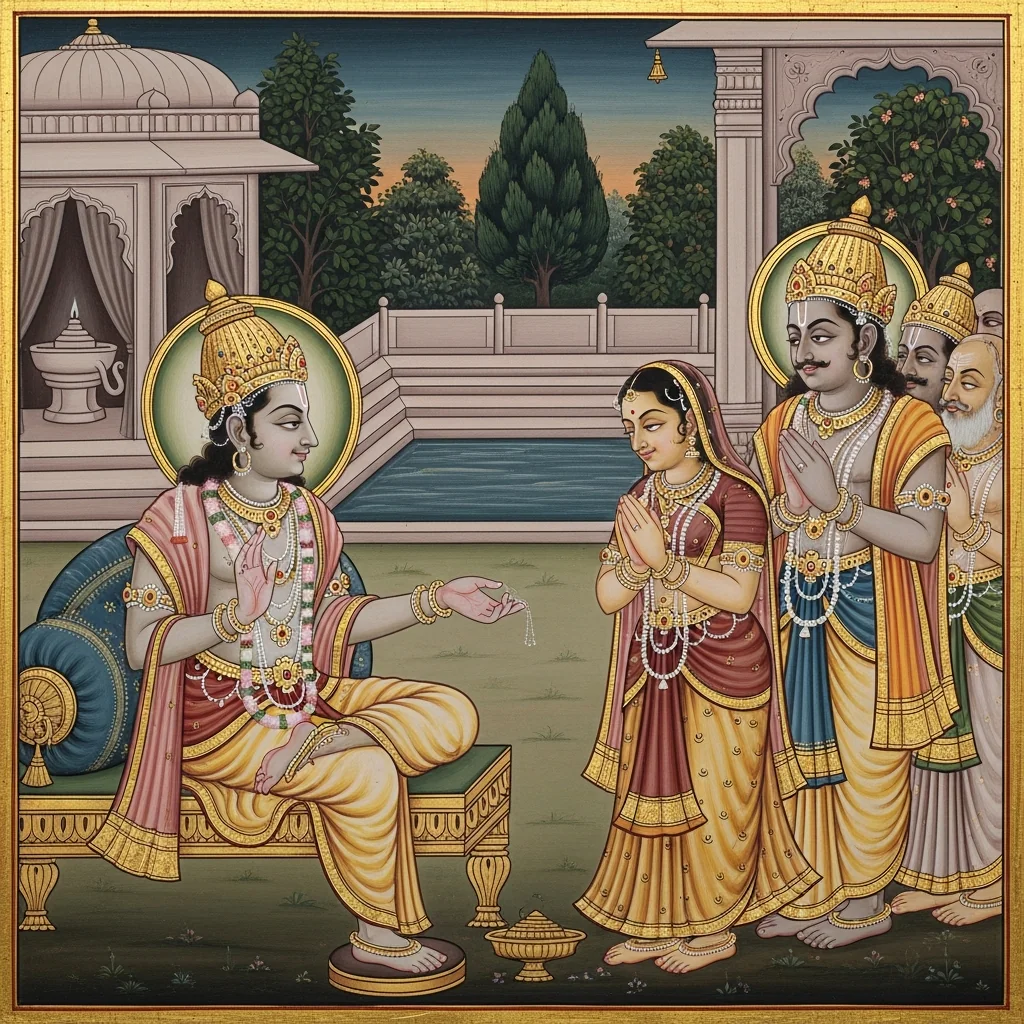
This adhyāya unfolds a multi-voiced theological reflection on tapas (austerity), divine anxiety, and the sanctification of place. Vyāsa introduces the episode as a fear-dispelling narrative, clarifying Dharma/Yama’s dharmic intent so that dread of Yama’s messengers is removed. In the forest, Dharma/Yama meets the apsaras Varddhanī, questions her identity, and offers boons; she confesses she was sent because Indra feared Dharma’s tapas might unsettle the cosmic order. Pleased by her truthfulness and devotion, Dharma grants her stability in Indra’s realm and establishes a tīrtha in her name, prescribing observances such as a five-night practice and declaring inexhaustible merit for offerings and recitation there. Dharma then undertakes extreme tapas, prompting the gods to seek Śiva’s intervention. Śiva arrives, praises the austerity, and offers boons; Dharma asks that the region be renowned across the three worlds as Dharmāraṇya and that a liberation-bestowing tīrtha be founded for all beings, including non-human life. Śiva confirms the name, promises a liṅga presence (Viśveśvara/Mahāliṅga), and the chapter expands into ritual guidance: the power of remembering and worshiping Dharmeśvara, the institution of Dharmavāpī, bathing and tarpaṇa formulas for Yama, claims of healing and protection from afflictions, śrāddha timings (amāvāsyā, saṅkrānti, eclipses, etc.), comparative tīrtha hierarchy, and a concluding phalaśruti promising great merit and auspicious ascent after death.
Shlokas
Verse 1
व्यास उवाच । अतः परं प्रवक्ष्यामि धर्मराजस्य चेष्टितम् । यच्छ्रुत्वा यमदूतानां न भयं विद्यते क्वचित्
Vyāsa said: Next I shall recount the deeds of Dharmarāja; upon hearing them, fear of Yama’s messengers does not arise anywhere, in any circumstance.
Verse 2
धर्मराजेन सा दृष्टा वर्द्धनी च वराप्सरा । महत्यरण्ये का ह्येषा सुन्दरांग्यतिसुन्दरी
Dharmarāja beheld her—Varddhanī, a most excellent apsaras. In that vast forest he wondered: “Who is this exquisitely beautiful woman, so fair of limb?”
Verse 3
निर्मानुषवनं चेदं सिंहव्याघ्रभयानकम् । आश्चर्यं परमं ज्ञात्वा धर्मराजोऽब्रवीदिदम्
“This forest is devoid of people and terrifying with the danger of lions and tigers.” Realizing this as a great wonder, Dharmarāja spoke as follows.
Verse 4
धर्मराज उवाच । कस्मात्त्वं मानिनि ह्येका वने चरसि निर्जने । कस्मात्स्थानात्समायाता कस्य पत्नी सुशोभने
Dharmarāja said: “Why, proud lady, do you wander alone in this lonely forest? From what place have you come, O radiant one? Whose wife are you?”
Verse 5
सुता त्वं कस्य वामोरु अतिरूपवती शुभा । मानुषी वाथ गंधर्वी अमरी वाथ किंनरी
“Whose daughter are you, O fair-thighed one—so auspicious and strikingly beautiful? Are you human, or a Gandharvī, or a goddess, or a Kinnarī?”
Verse 6
अप्सरा पक्षिणी वाथ अथवा वनदेवता । राक्षसी वा खेचरी वा कस्य भार्या च तद्वद
“Are you an apsaras, or a bird-maiden, or perhaps a deity of the forest? Or are you a rākṣasī, or a sky-roamer? Tell me—whose wife are you?”
Verse 7
सत्यं च वद मे सुभ्रूरित्याहार्कसुतस्तदा । किमिच्छसि त्वया भद्रे किं कार्यं वा वदात्र वै
Then Arka’s son (Dharmarāja) said: “O fair-browed lady, tell me the truth. What do you desire, O noble one? What is your purpose here—tell me plainly.”
Verse 8
यदिच्छसि त्वं वामोरु ददामि तव वांछितम्
“Whatever you wish, O fair-thighed one, I shall grant you the desire you seek.”
Verse 9
वर्द्धन्युवाच । धर्मे तिष्ठति सर्वं वै स्थावरं जंगमं विभो । स धर्मो दुष्करं कर्म कस्मात्त्वं कुरुषेऽनघ
Varddhanī said: “O mighty one, truly all—both the immovable and the moving—stands established in Dharma. Since Dharma itself is a hard path of action, why, O sinless one, do you undertake so difficult an endeavor?”
Verse 10
यम उवाच । ईशानस्य च यद्रूपं द्रष्टुमिच्छामि भामिनि । तेनाहं तपसा युक्तः शिवया सह शंकरम्
Yama said: “O fair one, I long to behold that very form of Īśāna. Therefore I am engaged in austerity—together with Śivā—seeking Śaṅkara.”
Verse 11
यशः प्राप्स्ये सुखं प्राप्स्ये करोमि च सुदुष्करम् । युगेयुगे मम ख्यातिर्भवेदिति मतिर्मम
“I shall gain fame; I shall gain happiness; and I shall accomplish what is exceedingly difficult. Let my renown endure from age to age”—such is my resolve.
Verse 12
कल्पे कल्पे महाकल्पे भूयः ख्यातिर्भवेदिति । एतस्मात्कारणात्सुभ्रूस्तप्यते परमं तपः
“In each kalpa—indeed in the great cycles again and again—may my fame arise anew.” For this reason, O fair-browed lady, I perform the highest austerity.
Verse 13
कस्मात्त्वमागता भद्रे कथयस्व यथातथा । किं कार्यं कस्य हेतुश्च सत्यमाख्यातुमर्हसि
“Why have you come, O good lady? Tell it truly, just as it is. What is to be done, and for whose purpose? You ought to declare the truth.”
Verse 14
वर्द्धन्युवाच । तपसैव त्वया धर्म भयभीतो दिवस्पतिः । तेनाहं नोदिता चात्र तपोवि घ्नस्य कांक्षया
Varddhanī said: “By your austerity, O Dharma, the lord of heaven has grown afraid. Therefore I have been urged to come here, wishing to hinder your tapas.”
Verse 15
इन्द्रासनभयाद्भीता हरिणा हरिसन्निधौ । प्रेषिताहं महाभाग सत्यं हि प्रवदाम्यहम्
“Frightened by fear for Indra’s throne, I was sent by Hari, in Hari’s very presence. O greatly blessed one, I speak the truth indeed.”
Verse 16
सूत उवाच । सत्यवाक्येन च तदा तोषितो रविनंदनः । उवाचैनां महाभाग्यो वरदोहं प्रयच्छ मे
Sūta said: Then, pleased by her truthful words, the son of Ravi (Yama), that greatly fortunate one, said to her: “I am a giver of boons—ask of me.”
Verse 17
यमोऽहं सर्वभूतानां दुष्टानां कर्मकारिणाम् । धर्म रूपो हि सर्वेषां मनुजानां जितात्मनाम्
“I am Yama for all beings—for the wicked who perform sinful deeds. Yet for all men who are self-controlled, I am truly the very form of Dharma.”
Verse 18
स धर्मोऽहं वरारोहे ददामि तव दुर्लभम् । तत्सर्वं प्रार्थय त्वं मे शीघ्रं चाप्सरसां वरे
“I am that Dharma, O lady of lovely ascent. I grant you what is hard to obtain. Therefore, O best of apsarases, quickly ask of me whatever you desire.”
Verse 19
वर्द्धन्युवाच । इन्द्रस्थाने सदा रम्ये सुस्थिरत्वं प्रयच्छ मे । स्वामिन्धर्मभृतां श्रेष्ठ लोकानां च हिताय वै
Varddhanī said: “In this ever-delightful seat of Indra, grant me steadfast abiding, O Lord—O best among the upholders of Dharma—so that it may be for the welfare of the worlds.”
Verse 20
यम उवाच । एवमस्त्विति तां प्राह चान्यं वरय सत्वरम् । ददामि वरमुत्कृष्टं गानेन तोषितोस्म्यहम्
Yama said: “So be it,” and he told her, “Choose another boon quickly. I shall grant an excellent boon, for I have been pleased by your song.”
Verse 21
वर्द्धन्युवाच । अस्मिन्स्थाने महाक्षेत्रे मम तीर्थं महामते । भूयाच्च सर्वपापघ्नं मन्नाम्नेति च विश्रुतम्
Varddhanī said: “In this place—this great sacred kṣetra—may there be a tīrtha in my name, O great-minded one; and may it be renowned, bearing my name, as the destroyer of all sins.”
Verse 22
तत्र दत्तं हुतं तप्तं पठितं वाऽक्षयं भवेत् । पञ्चरात्रं निषेवेत वर्द्धमानं सरोवर म्
Whatever is given there in charity, offered into the sacred fire, undertaken as tapas, or recited in prayer—becomes imperishable. One should resort to Varddhamāna Lake for five nights.
Verse 23
पूर्वजास्तस्य तुष्येरंस्तर्प्यमाणा दिनेदिने । तथेत्युक्त्वा तु तां धर्मो मौनमाचष्ट संस्थितः । त्रिःपरिक्रम्य तं धर्मं नमस्कृत्य दिवं ययौ
His ancestors would be satisfied, being duly offered libations (tarpana) day after day. Having said, “So be it,” Dharma stood in silence. Then she circumambulated that Dharma three times, bowed in reverence, and departed for heaven.
Verse 24
वर्द्धन्युवाच । मा भयं कुरु देवेश यमस्यार्कसुतस्य च । अयं स्वार्थपरो धर्म यशसे च समाचरेत्
Varddhanī said: “Do not fear, O Lord of the gods—neither Yama, the Sun’s son, nor anything else. This dharma is pursued for one’s rightful aim, and it should also be practiced for good repute.”
Verse 25
व्यास उवाच । वर्द्धनी पूजिता तेन शक्रेण च शुभानना । साधुसाधु महाभागे देवकार्य कृतं त्वया
Vyāsa said: Varddhanī, radiant-faced, was honored by Śakra as well. “Well done, well done, O greatly fortunate one—by you a work benefiting the gods has been accomplished.”
Verse 26
निर्भयत्वं वरागेहे सुखवासश्च ते सदा । यशः सौख्यं श्रियं रम्यां प्राप्स्यसि त्वं शुभानने
“You shall have fearlessness, an excellent home, and a life of comfort always. You will attain good fame, happiness, and delightful prosperity, O fair-faced one.”
Verse 27
तथेति देवास्तामूचुर्निर्भयानंदचेतसा । नमस्कृत्य च शक्रं सा गता स्थानं स्वकं शुभम्
The gods, their minds filled with fearless joy, said to her, “So be it.” And she, having bowed to Śakra, went to her own auspicious abode.
Verse 28
सूत उवाच । गतेप्सरसि राजेन्द्र धर्मस्तस्थौ यथाविधि । तपस्तेपे महाघोरं विश्वस्योद्वेगदायकम्
Sūta said: When the apsaras had departed, O king, Dharma remained there in the prescribed manner and undertook a most terrible austerity (tapas), one that caused agitation throughout the world.
Verse 29
पंचाग्निसा धनं शुक्रे मासि सूर्येण तापिते । चक्रे सुदुःसहं राजन्देवैरपि दुरासदम्
In the month of Śukra, scorched by the sun, he undertook the severe austerity of the “five fires”—an ordeal unbearable, O King, and hard to approach even for the devas.
Verse 30
ततो वर्षशते पूर्णे अन्तको मौनमास्थितः । काष्ठभूत इभवातस्थौ वल्मीकशतसंवृतः
Then, when a full hundred years had passed, Antaka maintained silence; motionless like a piece of wood, he stood there, covered over by hundreds of anthills.
Verse 31
नानापक्षिगणैस्तत्र कृतनीडैः स धर्मराट् । उपविष्टे व्रतं राजन्दृश्यते नैव कुत्रचित्
There, with many flocks of birds having built their nests upon him, that “king of dharma” remained seated; O King, his vow could not be perceived anywhere as wavering—utterly unwavering and unbroken.
Verse 32
संस्मरंतोऽथ देवेश मुमापतिमनिंदितम् । ततो देवाः सगन्धर्वा यक्षाश्चोद्विग्नमानसाः । कैलासशिखरं भूय आजग्मुः शिवसन्निधौ
Then, remembering the blameless Lord—the husband of Umā—O Lord of gods, the devas, together with the Gandharvas and the Yakṣas, their minds troubled with fear, went again to the peak of Kailāsa, into Śiva’s presence.
Verse 33
देवा ऊचुः । त्राहित्राहि महादेव श्रीकण्ठ जगतः पते । त्राहि नो भूतभव्येश त्राहि नो वृषभध्वज । दयालुस्त्वं कृपानाथ निर्विघ्नं कुरु शंकर
The gods said: “Save us, save us, O Mahādeva—O Śrīkaṇṭha, Lord of the world! Save us, O Lord of past and future; save us, O Bull-bannered One! You are compassionate, O master of grace—O Śaṅkara, make all free from obstacles for us.”
Verse 34
ईश्वर उवाच । केनापराधिता देवाः केन वा मानमर्द्दिताः । मर्त्ये स्वर्गेऽथवा नागे शीघ्रं कथय ताचिरम्
Īśvara said: “By whom have you gods been wronged, or by whom has your pride been crushed—on earth, in heaven, or among the Nāgas? Tell me quickly; do not delay.”
Verse 35
अनेनैव त्रिशूलेन खट्वांगेनाथवा पुनः । अथ पाशुपतेनैव निहनिष्यामि तं रणे । शीघ्रं वै वदतास्माक मत्रागमनकारणम्
“With this very trident—or else with the khaṭvāṅga—or indeed with the Pāśupata weapon itself, I shall strike him down in battle. Tell me quickly, truly, the reason for your coming here.”
Verse 36
देवा ऊचुः । कृपासिन्धो हि देवेश जगदानन्दकारक । न भयं मानुषादद्य न ना गाद्देवदानवात्
The gods said: “O Lord of gods, ocean of compassion, bringer of joy to the world—today we have no fear from humans, nor from Nāgas, nor from gods or Dānavas.”
Verse 37
मर्त्यलोके महादेव प्रेतनाथो महाकृतिः । आत्मकार्यं महाघोरं क्लेशयेदिति निश्चयः
“In the mortal world, O Mahādeva, the lord of the Pretas—of immense form—has resolved to carry out a most dreadful purpose of his own, and to afflict the worlds.”
Verse 38
उग्रेण तपसा कृत्वा क्लिश्यदात्मानमात्मना । तेनात्र वयमुद्विग्ना देवाः सर्वे सदाशिव । शरणं त्वामनुप्राप्ता यदिच्छसि कुरुष्व तत्
“Having performed fierce austerity, tormenting himself by his own will, he has made us all anxious here, O Sadāśiva. Therefore we gods have come to you for refuge—do whatever you deem fit.”
Verse 39
सूत उवाच । देवानां वचनं श्रुत्वा वृषारूढो वृषध्वजः । आयुधान्परिसंगृह्य कवचं सुमनोहरम् । गतवानथ तं देशं यत्र धर्मो व्यवस्थितः
Sūta said: Hearing the words of the gods, the bull-mounted Lord—whose banner bears the bull—gathered his weapons and donned a most lovely armour. Then he went to that land where Dharma stood firmly established.
Verse 40
ईश्वर उवाच । अनेन तपसा धर्म संतुष्टं मम मानसम् । वरं ब्रूहि वरं ब्रूहि वरं ब्रूहीत्युवाच ह
Īśvara said: “O Dharma, by this austerity my heart is wholly satisfied. Speak your boon—speak your boon; declare the boon you desire,” thus he said.
Verse 41
इच्छसे त्वं यथा कामा न्यथा ते मनसि स्थितान् । यंयं प्रार्थयसे भद्र ददामि तव सांप्रतम्
“Whatever desires you wish for, whatever lies within your mind—whatever you ask, O noble one, I grant to you at once.”
Verse 42
सूत उवाच । एवं संभाषमाणं तु दृष्ट्वा देवं महेश्वरम् । वल्मीकादुत्थितो राजन्गृहीत्वा करसंपुटम् । तुष्टाव वचनैः शुद्धैर्लोकनाथमरिंदम्
Sūta said: Seeing the great Lord Maheśvara speaking thus, O King, Dharma rose from the anthill and joined his palms in reverence. With pure words he praised the World-Lord, the subduer of foes.
Verse 43
धर्म उवाच । ईश्वराय नमस्तुभ्यं नमस्ते योगरूपिणे । नमस्ते तेजोरूपाय नीलकंठ नमोऽस्तु ते
Dharma said: “Salutations to you, O Īśvara; salutations to you whose very form is Yoga. Salutations to you whose form is Splendour; O Nīlakaṇṭha, homage be to you.”
Verse 44
ध्यातॄणामनुरूपाय भक्तिगम्याय ते नमः । नमस्ते ब्रह्मरूपाय विष्णुरूप नमोऽ स्तु ते
Homage to You who appear in forms befitting the meditators, and who are attained through devotion. Salutations to You in the form of Brahmā; O You of Viṣṇu-form, homage be to You.
Verse 45
नमः स्थूलाय सूक्ष्माय अणुरूपाय वै नमः । नमस्ते कामरूपाय सृष्टिस्थित्यंतकारिणे
Homage to You as the gross and the subtle, and indeed as the atomic in form. Salutations to You who assume whatever form is desired, and who bring about creation, preservation, and dissolution.
Verse 46
नमो नित्याय सौम्याय मृडाय हरये नमः । आतपाय नमस्तुभ्यं नमः शीतकराय च
Homage to the Eternal, the Gentle, the Gracious; homage to Hara. Salutations to You as heat and radiance; and homage also to You as the giver of coolness.
Verse 47
सृष्टिरूप नमस्तुभ्यं लोकपाल नमोऽस्तु ते । नम उग्राय भीमाय शांत रूपाय ते नमः
Homage to You whose very form is creation; O Protector of the worlds, homage be to You. Homage to You as the Fierce and the Terrible; homage also to You as the Peaceful-formed.
Verse 48
नमश्चानंतरूपाय विश्वरूपाय ते नमः । नमो भस्मांगलिप्ताय नमस्ते चंद्रशेखर । नमोऽस्तु पंचवक्त्राय त्रिनेत्राय नमोऽस्तु ते
Homage to You of endless forms; homage to You of the universal form. Homage to You whose body is adorned with sacred ash; salutations to You, O Candraśekhara. Homage be to You, O Five-faced One; homage be to You, O Three-eyed One.
Verse 49
नमस्ते व्यालभूषाय कक्षापटधराय च । नमोंऽधकविनाशाय दक्षपापापहारिणे । कामनिर्द्दाहिने तुभ्यं त्रिपुरारे नमोऽस्तु ते
Salutations to You, adorned with serpents and wearing the sash at Your side. Salutations to the slayer of Andhaka, the remover of Dakṣa’s sin. To You who burned Kāma to ashes, O foe of Tripura—may my homage be to You.
Verse 50
चत्वारिंशच्च नामानि मयोक्तानि च यः पठेत् । शुचिर्भूत्वा त्रिकालं तु पठेद्वा शृणुयादपि
Whoever recites these forty names spoken by me—having become purified—and recites them at the three times of day, or even merely listens to them, attains the intended merit.
Verse 51
गोघ्नश्चैव कृतघ्नश्च सुरापो गुरुत ल्पगः । ब्रह्महा हेमहारी च ह्यथवा वृषलीपतिः
Even a cow-slayer, an ingrate, a drinker of liquor, one who violates the teacher’s bed, a slayer of a brāhmaṇa, a stealer of gold—or even one who consorts with the fallen—is purified by that recitation.
Verse 53
स्त्रीबालघातकश्चैव पापी चानृतभाषणः । अनाचारी तथा स्तेयी परदाराभिगस्तथा । अकार्यकारी कृत्यघ्नो ब्रह्मद्विड्वाडवाधमः
Even one who kills women or children, a sinner who speaks falsehood, one of corrupt conduct, a thief, one who violates another’s wife; one who does what ought not be done, one who destroys sacred duties, a hater of brāhmaṇas, and the vilest of men—he too is purified by that devotion.
Verse 54
सूत उवाच । इत्येवं बहुभिर्वाक्यैर्धर्मराजेन वै मुहुः । ईडितोऽपि महद्भक्त्या प्रणम्य शिरसा स्वयम्
Sūta said: Thus, with many utterances, Dharma-rāja repeatedly praised him. And though already lauded, Śiva, with great devotion, bowed of his own accord, lowering his head.
Verse 55
तुष्टः शंभुस्तदा तस्मा उवाचेदं वचः शुभम् । वरं वृणु महाभाग यत्ते मनसि वर्त्तते
Then Śambhu, well pleased, spoke to him these auspicious words: “Choose a boon, O greatly fortunate one—whatever abides in your mind.”
Verse 56
यम उवाच । यदि तुष्टोऽसि देवेश दयां कृत्वा ममोपरि । तं कुरुष्व महाभाग त्रैलोक्यं सचराचरम्
Yama said: “If you are pleased, O Lord of the gods, and show compassion toward me—O great one—make this prevail throughout the three worlds, with all that moves and does not move.”
Verse 57
मन्नाम्ना स्थानमेतद्धि ख्यातं लोके भवेदिति । अच्छेद्यं चाप्यभेद्यं च पुण्यं पापप्रणाशनम्
“May this place indeed become renowned in the world by my name. May it be uncuttable and unbreakable—holy, and a destroyer of sin.”
Verse 58
स्थानं कुरु महादेव यदि तुष्टोऽसि मे भव । शिवेन स्थानकं दत्तं काशीतुल्यं तदा नृप । तद्दत्त्वा च पुनः प्राह अन्यं वरय सत्तम
“Establish a sacred place, O Mahādeva, if you are pleased with me.” Then Śiva granted a holy station equal to Kāśī, O king; and having granted it, he again said, “Choose another boon, O best of men.”
Verse 59
धर्म उवाच । यदि तुष्टोऽसि देवेश दयां कृत्वा ममोपरि । तं कुरुष्व महाभाग त्रैलोक्यं सचराचरम् । वरेणैवं यथा ख्यातिं गमिष्यामि युगेयुगे
Dharma said: “If you are pleased, O Lord of the gods, and show compassion toward me—O great one—make this boon effective throughout the three worlds, with all that moves and does not move, so that by this gift I may attain renown age after age.”
Verse 60
ईश्वर उवाच । ब्रूहि कीनाश तत्सर्वं प्रकरोमि तवेप्सितम् । तपसा तोषितोऽहं वै ददामि वरमीप्सितम्
Īśvara said: “Speak, O Kīnāśa—tell Me all that you desire. I shall accomplish it for you. Pleased by your tapas (austerity), I indeed grant the boon you seek.”
Verse 61
यम उवाच । यदि मे वांछितं देव ददासि तर्हि शंकर । अस्मिन्स्थाने महाक्षेत्रे मन्नामा भव सर्वदा
Yama said: “If You grant my cherished wish, O God—O Śaṅkara—then in this place, this great sacred kṣetra, let my name abide forever.”
Verse 62
धर्मारण्यमिति ख्यातिस्त्रैलोक्ये सचराचरे । यथा संजायते देव तथा कुरु महेश्वर
“Let the renown ‘Dharmāraṇya’ arise throughout the three worlds, among all moving and unmoving beings. O God, O Maheśvara—make it so.”
Verse 63
ईश्वर उवाच । धर्मारण्यमिदं ख्यातं सदा भूयाद्युगेयुगे । त्वन्नाम्ना स्थापितं देव ख्यातिमेतद्गमिष्यति । अथान्यदपि यत्किंचित्करोम्येष वदस्व तत
Īśvara said: “This place shall indeed be renowned as Dharmāraṇya, age after age. Established in your name, O Deva, it will attain that fame. And if there is anything else at all you wish Me to do—speak it.”
Verse 64
यम उवाच । योजनद्वयविस्तीर्णं मन्नाम्ना तीर्थमुत्तमम् । मुक्तेश्च शाश्वतं स्थानं पावनं सर्वदेहिनाम्
Yama said: “Let there be, in my name, an excellent tīrtha extending for two yojanas—a timeless abode of mokṣa, purifying for all embodied beings.”
Verse 65
मक्षिकाः कीटकाश्चैव पशुपक्षिमृगादयः । पतंगा भूतवेताला पिशाचोरगराक्षसाः
Flies and insects as well; cattle, birds, beasts and the like; moths; bhūtas and vetālas; piśācas, serpents, and rākṣasas—
Verse 66
नारी वाथ नरो वाथ मत्क्षेत्रे धर्मसंज्ञके । त्यजते यः प्रियान्प्राणान्मुक्तिर्भवतु शाश्वती
Whether woman or man, whoever in my domain—known as Dharmāraṇya—gives up the beloved life-breath, let that person attain everlasting liberation.
Verse 67
एवमस्त्विति सर्वोपि देवा ब्रह्मादयस्तथा । पुष्पवृष्टिं प्रकुर्वाणाः परं हर्षमवा्प्नुयुः
“So be it!”—thus all the gods, with Brahmā and the others, agreed; and, showering flowers, they attained supreme joy.
Verse 68
देवदुंदुभयो नेदुर्गंधर्वपतयो जगुः । ववुः पुण्यास्तथा वाता ननृतुश्चाप्सरो गणाः
Divine kettledrums resounded; the leaders of the Gandharvas sang. Auspicious winds blew, and the hosts of Apsarases danced.
Verse 69
सूत उवाच । यमेन तपसा भक्त्या तोषितो हि सदाशिवः । उवाच वचनं देवं रम्यं साधुमनोरमम्
Sūta said: Indeed, Sadāśiva—pleased by Yama’s austerity and devotion—spoke divine words, beautiful, virtuous, and delightful to the heart.
Verse 70
अनुज्ञां देहि मे तात यथा गच्छामि सत्वरम् । कैलासं पर्वतश्रेष्ठं देवानां हितकाम्यया
O dear father, grant me leave, that I may swiftly depart for Kailāsa, the foremost of mountains, seeking the welfare of the Devas.
Verse 71
यम उवाच । न मे स्थानं परित्यक्तुं त्वया युक्तं महेश्वर । कैलासादधिकं देव जायते वचनादिदम्
Yama said: O Maheśvara, it is not fitting for you to abandon my abode. O Deva, by your very word this place becomes greater even than Kailāsa.
Verse 72
शिव उवाच । साधु प्रोक्तं त्वया युक्तमेकांशेनात्र मे स्थितिः । न मया त्यजितं साधु स्थानं तव सुनिर्मलम्
Śiva said: Well spoken—your words are fitting. Here I shall remain with a portion of myself. Noble one, I have not abandoned your supremely pure abode.
Verse 73
विश्वेश्वरं महालिंगं मन्नाम्नात्र भविष्यति । एवमुक्त्वा महादेवस्तत्रैवांतरधीयत
“Here there shall be a great Liṅga named Viśveśvara, bearing my name.” Having spoken thus, Mahādeva vanished from that very spot.
Verse 74
शिवस्य वचनात्तत्र तदा लिंगं तदद्भुतम् । तं दृष्ट्वा च सुरैस्तत्र यथानामानुकीर्त्तनम्
By Śiva’s word, that wondrous Liṅga then manifested there. Seeing it, the Devas praised it, duly reciting its name in reverent acclaim.
Verse 75
स्वंस्वं लिंगं तदा सृष्टं धर्मारण्ये सुरोत्तमैः । यस्य देवस्य यल्लिंगं तन्नाम्ना परिकीर्तितम्
Then, in Dharmāraṇya, the foremost gods manifested their own respective Liṅgas; each Liṅga was celebrated by the name of the deity to whom it belonged.
Verse 76
सूत उवाच । धर्मेण स्थापितं लिंगं धर्मेश्वरमुपस्थितम् । स्मरणात्पूजनात्तस्य सर्वपापैः प्रमुच्यते
Sūta said: The Liṅga established by Dharma, known as Dharmeśvara, is present there. By remembering it and by worshipping it, one is freed from all sins.
Verse 77
यद्ब्रह्म योगिनां गम्यं सर्वेषां हृदये स्थितम् । तिष्ठते यस्य लिंगं तु स्वयंभुवमिति स्थितम्
That Brahman which is attainable to yogins and abides in the heart of all—its Liṅga stands here, established as ‘Svayaṃbhu’ (self-manifest).
Verse 78
भूतनाथं च संपूज्य व्याधिभिर्मुच्यते जनः । धर्मवापीं ततश्चैव चक्रे तत्र मनोरमाम्
By duly worshipping Bhūtanātha, a person is freed from diseases. Then, there he also fashioned the delightful ‘Dharmavāpī’ (the well/pond of Dharma).
Verse 79
आहत्य कोटितीर्थानां जलं वाप्यां मुमोच ह । यमतीर्थस्वरूपं च स्नानं कृत्वा मनोरमम्
Gathering together the waters of crores of tīrthas, he released them into that pond. And there, in the delightful form of Yama-tīrtha, he performed the sacred bath.
Verse 80
स्नानार्थं देवतानां च ऋषीणां भावितात्मनाम् । तत्र स्नात्वा च पीत्वा च सर्वपापैः प्रमुच्यते
That sacred place is meant for the bathing of the Devas and of the Ṛṣis whose selves are purified. Having bathed there and also drunk its water, one is released from all sins.
Verse 81
धर्मवाप्यां नरः स्नात्वा दृष्ट्वा धर्मेश्वरं शिवम् । मुच्यते सर्वपापेभ्यो न मातुर्गर्भमाविशेत्
A man who bathes in Dharmavāpī and beholds Śiva as Dharmeśvara is freed from all sins; he does not enter his mother’s womb again, that is, he is not reborn.
Verse 82
तत्र स्नात्वा नरो यस्तु करोति यमतर्पणम् । व्याधिदोषविनाशार्थं क्लेशदोषोप शांतये । यमाय धर्मराजाय मृत्यवे चांतकाय च । वैवस्वताय कालाय दध्नाय परमेष्ठिने
Having bathed there, the person who performs tarpaṇa for Yama—for the destruction of the faults of disease and for the pacification of afflictive impurities—offers it to Yama, to Dharmarāja, to Mṛtyu, to Antaka, to Vaivasvata, to Kāla, to Dadhna, and to Parameṣṭhin.
Verse 83
वृकोदराय वृकाय दक्षिणेशाय ते नमः । नीलाय चित्रगुप्ताय चित्र वैचित्र ते नमः
Salutations to you as Vṛkodara, as Vṛka, and as Dakṣiṇeśa. Salutations to you as Nīla, as Citragupta, and as Citra–Vaicitra, wondrously manifold.
Verse 84
यमार्थं तर्पणं यो वै धर्मवाप्यां करिष्यति । साक्षतैर्नामभिश्चैतैस्तस्य नोपद्रवो भवेत्
Whoever indeed performs tarpaṇa for Yama in Dharmavāpī—using these names and offering with unbroken grains—will have no affliction or harm.
Verse 85
एकांतरस्तृतीयस्तु ज्वरश्चातुर्थिकस्तथा । वेलायां जायते यस्तु ज्वरः शीतज्वरस्तथा
Intermittent fever, the tertian fever, and likewise the quartan fever; also the fever that arises at appointed times, and the cold-fever with chills—these are spoken of here.
Verse 87
धनधान्यसमृद्धिः स्यात्संततिर्वर्धते सदा । भूतेश्वरं तु संपूज्य सुस्नातो विजितेंद्रियः
There will be prosperity in wealth and grain, and one’s lineage will ever increase—when, having bathed well and restrained the senses, one duly worships Bhūteśvara.
Verse 88
सांगं रुद्रजपं कृत्वा व्याधिदोषात्प्रमुच्यते । अमावास्यां सोमदिने व्यतीपाते च वैधृतौ । संक्रांतौ ग्रहणे चैव तत्र श्राद्धं स्मृतं नृणाम्
Having performed the complete Rudra-japa with its auxiliaries, one is freed from the faults of disease. On the new-moon day (amāvasyā), on a Monday, at Vyatīpāta and Vaidhṛti (inauspicious yogas), at saṅkrānti, and during an eclipse—on such occasions śrāddha is prescribed for people.
Verse 89
श्राद्धं कृतं तेन समाः सहस्रं निरस्य चैतत्पितरस्त्वदंति । पानीयमेवापि तिलैर्विमिश्रितं ददाति यो वै प्रथितो मनुष्यः
When he performs śrāddha, its merit endures for a thousand years; the Pitṛs partake of it, and their want is removed. Even the renowned person who offers merely water mixed with sesame is credited with śrāddha’s efficacy.
Verse 90
एकविंशतिवारैस्तु गयायां पिंडदानतः । धर्मेश्वरे सकृद्दत्तं पितॄणां चाक्षयं भवेत्
What is gained by offering piṇḍas at Gayā twenty-one times—that same result becomes inexhaustible for the ancestors when a single offering is made at Dharmeśvara.
Verse 91
धर्मेशात्पश्चिमे भागे विश्वेश्वरांतरेपि वा । धर्मवापीति विख्याता स्वर्गसोपानदायिनी
To the west of Dharmeśa—or else within the precincts of Viśveśvara—lies the famed sacred pool called Dharmavāpī, bestowing a stairway to heaven.
Verse 92
धर्मेण निर्मिता पूर्वं शिवार्थं धर्मबुद्धिना । तत्र स्नात्वा च पीत्वा च तर्पिताः पितृदेवताः
Formerly Dharma, with a righteous mind, built it for Śiva’s sake. By bathing there and drinking its water, one satisfies the Pitṛs and the gods.
Verse 93
शमीपत्रप्रमाणं तु पिंडं दद्याच्च यो नरः । धर्मवाप्यां महापुण्यां गर्भवासं न चाप्नुयात्
Whoever offers there a piṇḍa for the ancestors—even if only the size of a śamī leaf—at the greatly meritorious Dharmavāpī does not again attain “dwelling in the womb,” that is, repeated rebirth.
Verse 94
कुम्भीपाकान्महारौद्राद्रौरवान्नरकात्पुनः । अंधतामिस्रकाद्राजन्मुच्यते नात्र संशयः
O King, without doubt one is freed from the hells called Kumbhīpāka, Mahāraudra, Raurava, and Andhatāmisra.
Verse 95
सूत उवाच । एकवर्षं तर्पणीयं धर्मवाप्यां नरोत्तमः । ऋतौ मासे च पक्षे च विपरीतं च जायते
Sūta said: “O best of men, at Dharmavāpī the tarpaṇa offering should be performed for a full year; and even if there is irregularity of season, month, or fortnight, the rite does not become adverse.”
Verse 96
बर्हिषदोऽग्निष्वात्ताश्च आज्यपाः सोमपास्तथा । तृप्तिं प्रयांति परमां वाप्यां वै तर्पणेन तु
Indeed, by tarpaṇa at the sacred pool, the classes of ancestors—Barhiṣads, Agniṣvāttas, Ājyapas, and Somapas—attain supreme satisfaction.
Verse 97
कुरुक्षेत्रादि क्षेत्राणि अयोध्यादिपुरस्तथा । पुष्कराद्यानि सर्वाणि मुक्तिनामानि संति वै
Kurukṣetra and other sacred fields, Ayodhyā and other holy cities, and Puṣkara and the rest—all indeed are famed as “names of liberation,” renowned as deliverance-giving tīrthas.
Verse 98
तानि सर्वाणि तुल्यानि धर्मकूपोऽधिको भवेत् । मन्त्रो वेदास्तथा यज्ञा दानानि च व्रतानि च
All those are comparable in merit, yet Dharmakūpa is superior; there, mantras, the Vedas, sacrifices, charities, and vows attain heightened fruition.
Verse 99
अक्षयाणि प्रजायंते दत्त्वा जप्त्वा नरेश्वर । अभिचाराश्च ये चान्ये सुसिद्धाथर्ववेदजाः
O lord of men, by giving and by reciting there, imperishable results arise; even the other rites known as abhichāra, well-established and Atharvavedic in origin, become effective.
Verse 100
ते सर्वे सिद्धिमायांति तस्मिन्स्थाने कृता अपि । आदितीर्थं नृपश्रेष्ठ काजेशैरुपसेवितम्
All of those attain success when performed in that place. O best of kings, it is Āditīrtha, the primordial tīrtha, frequented and revered by the lordly beings (kājeśas).
Verse 109
एतदाख्यानकं पुण्यं धर्मेण कथितं पुरा । यः शृणोति नरो भक्त्या नारी वा श्रावयेत्तु यः । गोसहस्रफलं तस्य अंते हरिपुरं ब्रजेत्
This holy tale was once proclaimed in accord with Dharma. Whoever—man or woman—hears it with devotion, or causes it to be recited, gains merit equal to the gift of a thousand cows; and at life’s end goes to Hari’s abode.