Adhyaya 13
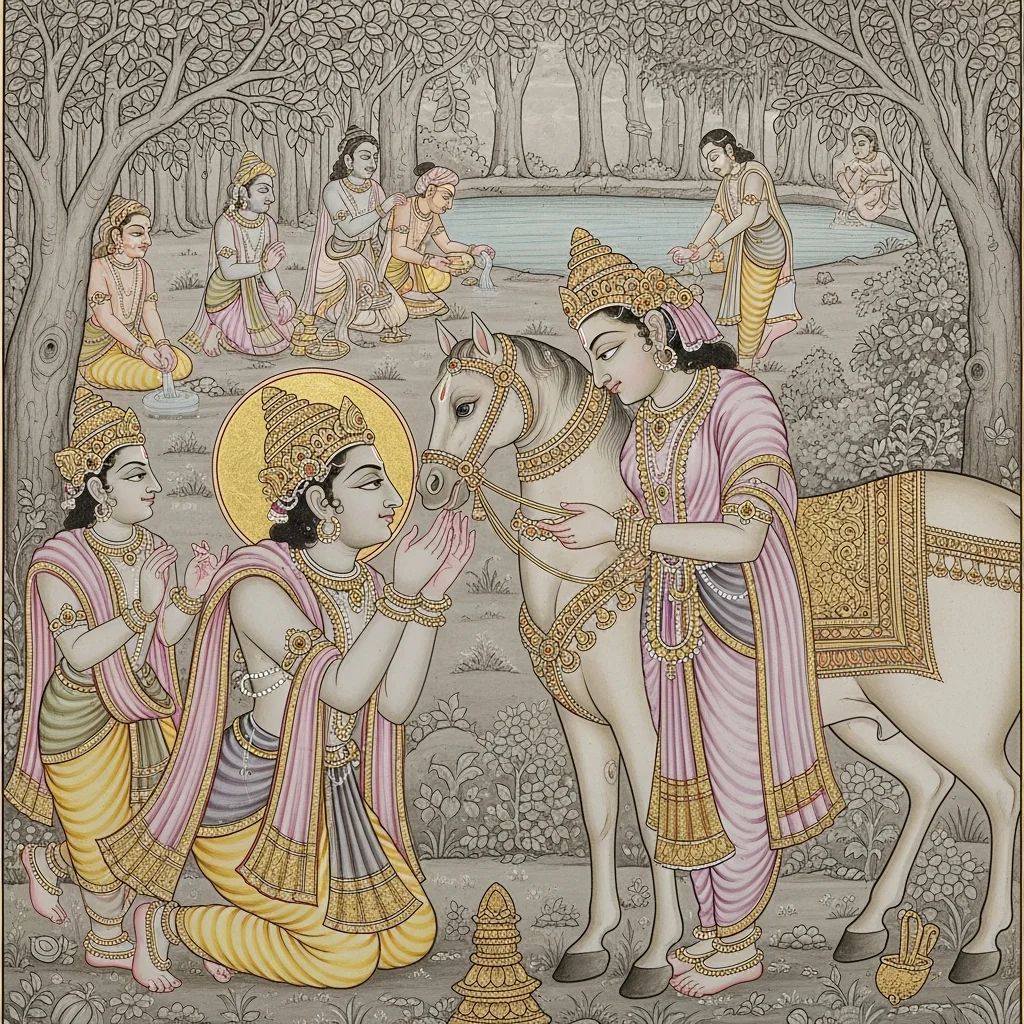
This chapter unfolds as a dialogue in which Yudhiṣṭhira asks Vyāsa to explain the origin of the Aśvin twins and the manifestation of the Sun’s presence upon the earth. Vyāsa recounts the Saṃjñā–Sūrya episode: unable to endure Sūrya’s blazing radiance, Saṃjñā departs after installing Chāyā as her substitute, instructing her to uphold proper household conduct and to conceal the substitution. From the ensuing marital strain and its consequences arise Yama and Yamunā; later, a conflict involving Yama leads to the disclosure of Chāyā’s true identity. Sūrya then seeks Saṃjñā and finds her performing severe tapas in Dharmāraṇya in the form of a mare (vaḍavā). Through a distinctive union motif in the narrative, associated with the nasal region, the divine twins Nāsatya and Dasra—the Aśvinau—are born. The text then anchors the myth in sacred geography: Ravikuṇḍa(s) manifest, and a detailed phalaśruti proclaims the merits of bathing, offerings, ancestral rites, and worship of Bakulārka, promising purification, health, protection, prosperity, and enhanced ritual fruit. Special emphasis is placed on observances at Saptamī, Sundays, eclipses, saṅkrānti, vyatīpāta, and vaidhṛti.
Shlokas
Verse 1
व्यास उवाच । शंभोश्च पश्चिमे भागे स्थापितः कश्यपात्मजः । तत्रास्ति तन्महाभाग रविक्षेत्रं तदुच्यते
Vyāsa said: “On the western side of Śambhu stands the son of Kaśyapa, established there. In that place, O noble one, is the sacred region known as Ravikṣetra.”
Verse 2
तत्रोत्पन्नौ महादिव्यौ रूपयौवनसंयुतौ । नासत्यावश्विनौ देवौ विख्यातौ गदनाशनौ
There were born the two supremely divine Aśvin twins—Nāsatya and the Aśvin—endowed with radiant beauty and youthful vigor, renowned among the devas as destroyers of disease.
Verse 3
युधिष्ठिर उवाच । पितामह महाभाग कथयस्व प्रसादतः । उत्पत्तिरश्विनोश्चैव मृत्युलोके च तत्कथम्
Yudhiṣṭhira said: O revered Grandfather, O most fortunate one—out of compassion, please tell me: how did the Aśvin twins originate, and how did this come to be in the world of mortals?
Verse 4
रविलोकात्कथं सूर्यो धरायामवतारितः । एतत्सर्वं प्रयत्नेन कथयस्व प्रसादतः
How was Sūrya brought down from the Sun’s realm to the earth? Please narrate all of this carefully and graciously.
Verse 5
यच्छ्रुत्वा हि महाभाग सर्वपापैः प्रमुच्यते
For, O noble one, by hearing this, one is indeed released from all sins.
Verse 6
व्यास उवाच । साधु पृष्टं त्वया भूप ऊर्ध्वलोककथानकम् । यच्छ्रुत्वा नरशार्दूल सर्वरोगात्प्रमुच्यते । विश्वकर्म्मसुता संज्ञा अंशुमद्रविणा वृता
Vyāsa said: O king, you have asked well about this account of the higher worlds; upon hearing it, O tiger among men, one is freed from every disease. Saṃjñā, the daughter of Viśvakarman, was wedded to Aṃśumān (the Sun).
Verse 8
सूर्य उवाच । मयि दृष्टे सदा यस्मात्कुरुषे स्वाक्षिसंयमम् । तस्माज्जनिष्यते मूढे प्रजासंयमनो यमः
The Sun said: Since, whenever you behold me, you continually restrain your own eyes, therefore, O deluded one, Yama shall be born—the restrainer and ruler of creatures.
Verse 9
ततः सा चपलं देवी ददर्श च भयाकुलम् । विलोलितदृशं दृष्ट्वा पुनराह च तां रविः
Then the goddess saw him restless and overcome with fear; and seeing his unsteady eyes, Ravi (the Sun) spoke to her again.
Verse 10
यस्माद्विलोलिता दृष्टिर्मयि दृष्टे त्वया धुना । तस्माद्विलोलितां संज्ञे तनयां प्रसविष्यसि
Because your gaze has become unsteady upon looking at me now, therefore, O Saṃjñā, you shall give birth to a daughter named Vilolitā, “the Unsteady”.
Verse 11
व्यास उवाच । ततस्तस्यास्तु संजज्ञे भर्तृशापेन तेन वै । यमश्च यमुना येयं विख्याता सुमहानदी
Vyāsa said: Thereafter, by that very curse of her husband, Yama was born—and also Yamunā, this celebrated and exceedingly great river.
Verse 12
सा च संज्ञा रवेस्तेजो महद्दुःखेन भामिनी । असहंतीव सा चित्ते चिंतयामास वै तदा
And Saṃjñā, the radiant lady, suffered great sorrow at Ravi’s blazing splendor; as though unable to endure it, she then pondered deeply within her heart.
Verse 13
किं करोमि क्व गच्छामि क्व गतायाश्च निर्वृतिः । भवेन्मम कथं भर्तुः कोपमर्कस्य नश्यति
“What shall I do? Where shall I go? And once I have gone, where shall I find peace? How can my husband’s anger—the wrath of Sūrya—ever be calmed and made to subside?”
Verse 14
इति संचिंत्य बहुधा प्रजापतिसुता तदा । साधु मेने महाभागा पितृसंश्रयमापसा
Thus, after thinking in many ways, that noble daughter of Prajāpati concluded that it was best to seek her father’s protection and refuge.
Verse 15
ततः पितृगृहं गंतुं कृतबुद्धिर्यशस्विनी । छायामाहूयात्मनस्तु सा देवी दयिता रवेः
Then, resolved to go to her father’s house, that renowned goddess—beloved of Sūrya—summoned Chāyā as her own substitute.
Verse 16
तां चोवाच त्वया स्थेयमत्र भानोर्यथा मया । तथा सम्यगपत्येषु वर्तितव्यं तथा रवौ
And she said to her: “You must remain here in my place with Bhānu (the Sun), and you must conduct yourself properly toward the children—and likewise toward Ravi himself.”
Verse 17
दुष्टमपि न वाच्यं ते यथा बहुमतं मम । सैवास्मि संज्ञाहमिति वाच्यमेवं त्वयानघे
“Even if something improper occurs, you must not speak of it, for this is my firm decision. You must say, ‘I am Saṃjñā herself’—so must you speak, O blameless one.”
Verse 18
छायासंज्ञोवाच । आकेशग्रहणाच्चाहमाशापाच्च वचस्तथा । करिष्ये कथयिष्यामि यावत्केशापकर्षणा त्
Chāyā said: “Since you have seized me by the hair, and by your command, I shall do as you say and speak accordingly—until the moment this pulling of hair bears its consequence.”
Verse 19
इत्युक्ता सा तदा देवी जगाम भवनं पितुः । ददर्श तत्र त्वष्टारं तपसा धूतकिल्बिषम्
Thus addressed, the goddess then went to her father’s dwelling. There she beheld Tvaṣṭṛ (Viśvakarmā), whose austerities had washed away every impurity.
Verse 20
बहुमानाच्च तेनापि पूजिता विश्व कर्म्मणा । तत्स्थौ पितृगृहे सा तु किंचित्कालमनिंदिता
Out of great regard, she too was honored and worshipfully received by Viśvakarmā. She stayed for some time in her father’s house, blameless and without reproach.
Verse 21
ततः प्राह स धर्मज्ञः पिता नातिचिरोषिताम् । विश्वकर्मा सुतां प्रेम्णा बहुमा नपुरस्सरम्
Then her father Viśvakarmā, knower of dharma, spoke to his daughter, who had not stayed long, with affectionate words, preceded by honor and regard.
Verse 22
त्वां तु मे पश्यतो वत्से दिनानि सुबहून्यपि । मुहूर्तेन समानि स्युः किंतु धर्मो विलुप्यते
“But, my dear child, as I gaze upon you, even many days pass as though they were but a moment; yet in this situation dharma is diminished and slipping away.”
Verse 23
बांधवेषु चिरं वासो न नारीणां यशस्करः । मनोरथो बांधवानां भार्या पितृगृहे स्थिता
To dwell long among one’s own kin is not held to enhance a married woman’s good name; rather, it becomes the fond expectation of her relatives when the wife remains settled in her father’s house.
Verse 24
स त्वं त्रैलोक्यनाथेन भर्त्रा सूर्येण संगता । पितुर्गृहे चिरं कालं वस्तुं नार्हसि पुत्रिके
You, who are joined in wedlock to Sūrya—the Lord of the three worlds as your husband—should not remain long in your father’s house, dear daughter.
Verse 25
अतो भर्तृगृहं गच्छ दृष्टोऽहं पूजिता च मे । पुनरागमनं कार्यं दर्शनाय शुभेक्षणे
Therefore go now to your husband’s house. You have seen me and honored me duly; yet return again, O fair‑eyed one, for another visit and darśana.
Verse 26
व्यास उवाच । इत्युक्ता सा तदा क्षिप्रं तथेत्युक्ता च वै मुने । पूजयित्वा तु पितरं सा जगामोत्तरान्कुरून्
Vyāsa said: Thus addressed, she swiftly replied, “So be it,” O sage. After honoring her father, she went to the Northern Kurus.
Verse 27
सूर्यतापमनिच्छती तेजसस्तस्य बिभ्यती । तपश्चचार तत्रापि वडवारूपधारिणी
Unwilling to endure the Sun’s scorching heat and fearing his blazing radiance, she practiced tapas there as well, having assumed the form of a mare.
Verse 28
संज्ञामित्येव मन्वानो द्वितीयायां दिवस्पतिः । जनयामास तनयौ कन्यां चैकां मनोरमाम्
Thinking, “This is indeed Saṃjñā,” the Lord of the Day, Sūrya, by his second wife begot two sons and also one exceedingly charming daughter.
Verse 29
छाया स्वतनयेष्वेव यथा प्रेष्णाध्यवर्तत । तथा न संज्ञाकन्यायां पुत्रयोश्चाप्यवर्तत । लालनासु च भोज्येषु विशेषमनुवासरम्
Chāyā showed affectionate preference toward her own children; but she did not behave the same way toward Saṃjñā’s daughter and her sons. Day after day, she made distinctions in caresses and in food.
Verse 30
मनुस्तत्क्षांतवानस्या यमस्तस्या न चाक्षमत् । ताडनाय ततः कोपात्पादस्तेन समुद्यतः । तस्याः पुनः क्षांतमना न तु देहे न्यपातयत्
Manu endured it, but Yama could not bear it. In anger he raised his foot to strike her; yet, restraining himself again, he did not bring it down upon her body.
Verse 31
ततः शशाप तं कोपाच्छायासंज्ञा यमं नृप । किंचित्प्रस्फुरमाणोष्ठी विचलत्पाणिपल्लवा
Then, in anger, Chāyā—known as Saṃjñā—cursed Yama, O king, her lips quivering and her tender hands trembling.
Verse 32
पत्न्यां पितुर्मयि यदि पादमुद्यच्छसे बलात् । भुवि तस्मादयं पादस्तवाद्यैव भविष्यति
“If you forcibly raise your foot against me—your father’s wife—then, because of that, this very foot of yours shall from today be upon the earth (fall to the ground).”
Verse 33
इत्याकर्ण्य यमः शापं मातर्यतिविशंकितः । अभ्येत्य पितरं प्राह प्रणिपातपुरस्सरम्
Hearing that curse, Yama grew deeply anxious for his mother. He went to his father and spoke, first bowing down in reverent prostration.
Verse 34
तातैतन्महदाश्चर्यमदृष्टमिति च क्वचित् । माता वात्सल्यरूपेण शापं पुत्रे प्रयच्छति
“Father, this is a great wonder—indeed something rarely seen: that a mother, even in the guise of affection, should lay a curse upon her son.”
Verse 35
यथा माता ममाचष्ट नेयं माता तथा मम । निर्गुणेष्वपि पुत्रेषु न माता निर्गुणा भवेत्
“As my mother has spoken, in that manner she is not truly my mother. Even if sons are without virtues, a mother should not become devoid of virtue.”
Verse 36
यमस्यैतद्वचः श्रुत्वा भगवांस्तिमिरापहः । छायासंज्ञामथाहूय पप्रच्छ क्वगतेति च
Hearing these words of Yama, the Blessed One, dispeller of darkness, summoned the one named Chāyā and asked, “Where has she gone?”
Verse 37
सा चाह तनया त्वष्टुरहं संज्ञा विभावसो । पत्नी तव त्वयापत्यान्येतानि जनितानि मे
She said: “I am Saṃjñā, daughter of Tvaṣṭṛ, O Vibhāvasu. I am your wife, and these children have been born to me through you.”
Verse 38
इत्थं विवस्वतस्तां तु बहुशः पृच्छतो यदा । नाचचक्षे तदा क्रुद्धो भास्वांस्तां शप्तुमुद्यतः
Thus, when Vivasvān questioned her again and again and she did not disclose it, the radiant one grew angry and prepared to curse her.
Verse 39
ततः सा कथयामास यथावृत्तं विवस्वते । विदितार्थश्च भगवाञ्जगाम त्वष्टु रालयम्
Then she related the entire matter as it had happened to Vivasvān. Understanding the truth, the Lord went to the abode of Tvaṣṭṛ.
Verse 40
ततः संपूजयामास त्वष्टा त्रैलोक्यपूजितम् । भास्वन्किं रहिता शक्त्या निजगेहमुपागतः
Then Tvaṣṭṛ duly honored the radiant one who is worshipped in the three worlds, and asked: “O Bhāsvān, why have you come to your own house as though bereft of strength?”
Verse 41
संज्ञां पप्रच्छ तं तस्मै कथयामास तत्त्ववित् । आगता सेह मे वेश्म भवतः प्रेषिता रवे
He asked him about Saṃjñā, and the knower of truth explained: “She has come here to my house, O Ravi—sent by you.”
Verse 42
दिवाकरः समाधिस्थो वडवारूपधारिणीम् । तपश्चरंतीं ददृशे उत्तरेषु कुरुष्वथ
The Sun-god, entering deep contemplation, beheld her performing austerities—having assumed the form of a mare—in the northern regions among the Kurus.
Verse 43
असह्यमाना सूर्यस्य तेजस्तेनातिपीडिता । वह्न्याभनिजरूपं तु च्छायारूपं विमुच्य च
Unable to endure the Sun’s blazing radiance, and sorely oppressed by that splendour, she cast off her shadow-form and assumed her own true form, radiant like fire.
Verse 44
धर्मारण्ये समागत्य तप स्तेपे सुदुष्करम् । छायापुत्रं शनिं दृष्ट्वा यमं चान्यं च भूपते
Having come to Dharmāraṇya, she undertook exceedingly difficult austerities. Seeing Śani, the son of Chāyā, and also Yama and another offspring, O king, the matter became evident.
Verse 45
तदैव विस्मितः सूर्यो दुष्टपुत्रौ समीक्ष्य च । ज्ञातुं दध्यौ क्षणं ध्यात्वा विदित्वा तच्च कारणम्
At that very moment the Sun, astonished on seeing those troublesome sons, reflected to understand. Meditating for an instant, he came to know the cause of it.
Verse 46
घृण्यौष्ण्याद्दग्धदेहा सा तपस्तेपे पतिव्रता । येन मां तेजसा सह्यं द्रष्टुं नैव शशाक ह
Scorched in body by the fierce heat, that devoted wife performed austerities, for she had not been able to behold me, unbearable in my radiance.
Verse 47
पञ्चाशद्धायनेतीते गत्वा कौ तप आचरत् । प्रद्योतनो विचार्यैवं गत्वा शीघ्रं मनोजवः
When fifty years had passed, he went to where she was practicing austerity. Thus considering, the radiant one, swift as the mind, went quickly.
Verse 48
धर्मारण्ये वरे पुण्ये यत्र संज्ञास्थिता तपः । आगतं तं रविं दृष्ट्वा वडवा समजायत
In the excellent and holy Dharmāraṇya, where Saṃjñā was established in austerity, on seeing Ravi—the Sun—arrive, she became a mare (vaḍavā).
Verse 49
सूर्यपत्नी सदा संज्ञा सूर्यश्चाश्वस्ततोऽभवत् । ताभ्यां सहाभूत्संयोगो घ्राणे लिंगं निवेश्य च
Saṃjñā was ever the Sun’s wife, and the Sun thereupon became reassured. Then union occurred with her—after he placed his liṅga in her nostril.
Verse 50
तदा तौ च समुत्पन्नौ युगलावश्विनौ भुवि । प्रादुर्भूतं जलं तत्र दक्षिणेन खुरेण च
Then, upon the earth, the twin Aśvins were born. And there, water sprang forth, brought out by the right hoof.
Verse 51
विदलिते भूमिभागे तत्र कुंडं समुद्बभौ । द्वितीयं तु पुनः कुंडं पश्चार्धचरणोद्भवम्
When that portion of the earth split open, a sacred pool (kuṇḍa) arose there. And again, a second kuṇḍa arose, born from the back half of the hoof/foot.
Verse 52
उत्तरवाहिन्याः काश्या कुरुक्षेत्रादि वै तथा । गंगापुरीसमफलं कुण्डेऽत्र मुनिनोदितम्
The sage declares that the merit at this kuṇḍa is equal to that of Kāśī where the river flows northward, and also of Kurukṣetra and the like—indeed, equal to that of Gaṅgāpurī.
Verse 53
तत्फलं समवाप्नोति तप्तकुण्डे न संशयः । स्नानं विधाय तत्रैव सर्वपापैः प्रमुच्यते
In the Taptakuṇḍa he surely attains that very fruit, without any doubt. Having bathed there itself, he is released from all sins.
Verse 54
न पुनर्जायते देहः कुष्ठादिव्याधिपीडितः । एतत्ते कथितं भूप दस्रांशोत्पत्तिकारणम्
One is not born again with a body afflicted by leprosy and other diseases. O King, thus have I told you the cause of the manifestation of the Daśrāṃśa.
Verse 55
तदा ब्रह्मादयो देवा आगतास्तत्र भूपते । दत्त्वा संज्ञावरं शुभ्रं चिंतितादधिकं हि तैः
Then Brahmā and the other gods came there, O King. They granted the auspicious boon to Saṃjñā—indeed, even more than what had been wished for by them.
Verse 56
स्थापयित्वा रविं तत्र बकुलाख्यवनाधिपम् । आनर्चुस्ते तदा संज्ञां पूर्वरूपाऽभवत्तदा
Having established Ravi there—lord of the forest called Bakula—the gods then worshipped Saṃjñā; and at that time she regained her former form.
Verse 57
स्थापिता तत्र राज्ञी च कुमारौ युगलौ तदा । एतत्तीर्थफलं वक्ष्ये शृणु राजन्महामते
There the queen and the pair of princes were also established. Now I shall declare the fruit of this tīrtha—listen, O wise King.
Verse 58
आदिस्थानं कुरुश्रेष्ठ देवैरपि सुदुर्लभम् । रविकुण्डे नरः स्नात्वा श्रद्धायुक्तो जितेंद्रियः
This primal sacred station, O best of the Kurus, is exceedingly hard to attain even for the devas. A man who bathes in Ravikuṇḍa with faith, having mastered his senses,
Verse 59
तारयेत्स पितॄन्सर्वान्महानरकगानपि । श्रद्धया यः पिबेत्तोयं संतर्प्य पितृदेवताः
delivers all his ancestors—even those who have fallen into the great hells. Whoever, with faith, drinks this water after satisfying and honoring the Pitṛ-deities,
Verse 60
स्वल्पं वापि बहुवापि सर्वं कोटिगुणं भवेत् । सप्तम्यां रविवारेण ग्रहणं चंद्रसूर्ययोः
Whether little or much, all becomes multiplied a crore-fold. On the seventh lunar day, on a Sunday, and during eclipses of the Moon and the Sun,
Verse 61
रविकुण्डे च ये स्नाताः न ते वै गर्भगामिनः । सक्रांतौ च व्यतीपाते वैधृतेषु च पर्वसु
Those who have bathed in Ravikuṇḍa do not again enter the womb (that is, they are not subject to rebirth). This is especially so at Saṅkrānti, at Vyatīpāta, at Vaidhṛti, and on festival junctures (parvans),
Verse 62
पूर्णमास्याममावास्यां चतुर्द्दश्यां सितासिते । रविकुंडे च यः स्नातः क्रतुकोटिफलं लभेत्
On the full-moon day, on the new-moon day, and on the fourteenth day of both the bright and dark fortnights—whoever bathes in Ravikuṇḍa gains the fruit of ten million sacrifices (kratu).
Verse 63
पूजयेद्बकुलार्कं च एकचित्तेन मानवः । स याति परमं धाम स यावत्तपते रविः
One who worships Bakulārka with a single-pointed mind attains the supreme abode, enduring for as long as the Sun continues to shine.
Verse 64
तस्य लक्ष्मीः स्थिरा नूनं लभते संततिं सुखम् । अरिवर्गः क्षयं याति प्रसादाच्च दिवस्पतेः
For him, prosperity (Lakṣmī) surely becomes steady; he gains offspring and happiness. His host of enemies goes to destruction by the grace of the Lord of Day, the Sun.
Verse 65
नाग्नेर्भयं हि तस्य स्यान्न व्याघ्रान्न च दंतिनः । न च सर्प्पभयं क्वापि भूतप्रेतादिभीर्नहि
For him there will be no fear of fire, nor of tigers, nor of elephants; nowhere will there be fear of snakes, nor indeed from bhūtas, pretas, and the like.
Verse 66
बालग्रहाश्च सर्वेऽपि रेवती वृद्धरेवती । ते सर्वे नाशमायांति बकुलार्क नमोस्तु ते
All child-seizing afflictions—Revatī and Vṛddha-Revatī as well—are destroyed; they all meet their end. O Bakulārka, salutations to you!
Verse 67
गावस्तस्य विवर्द्धंते धनं धान्यं तथैव च । अविच्छेदो भवेद्वंशो बकुलार्के नमस्कृते
His cattle increase, and so too his wealth and grain. His lineage becomes unbroken when Bakulārka is saluted.
Verse 68
काकवन्ध्या च या नारी अनपत्या मृतप्रजा । वन्ध्या विरूपिता चैव विषकन्याश्च याः स्त्रियः
Women who are called kāka-vandhyā (bearing only stillborn children), those without offspring, those whose children have died, those barren, those disfigured, and those known as viṣa-kanyā—such women...
Verse 69
एवं दोषैः प्रमुच्यंते स्नात्वा कुण्डे च भूपते । सौभाग्यस्त्रीसुतांश्चैव रूपं चाप्नोति सर्वशः
Thus, O king, by bathing in the kuṇḍa they are freed from such defects. They obtain good fortune, a husband, children, and beauty in every way.
Verse 70
व्याधिग्रस्तोपि यो मर्त्यः षण्मासाच्चैव मानवः । रविकुण्डे च सुस्नातः सर्वरोगात्प्रमुच्यते
Even a mortal afflicted by disease—if for six months that person bathes well in Ravikuṇḍa—he is released from all illnesses.
Verse 71
नीलोत्सर्गविधिं यस्तु रविक्षेत्रे करोति वै । पितरस्तृप्तिमायांति यावदाभूतसंप्लवम्
Whoever performs the rite of nīlotsarga in the Sun’s sacred field, Ravikṣetra, the ancestors attain satisfaction—lasting until the cosmic dissolution.
Verse 72
कन्यादानं च यः कुर्यादस्मिन्क्षेत्रे च पुत्रक । उद्वाहपरिपूतात्मा ब्रह्मलोके महीयते
And whoever performs kanyādāna—the gift of a daughter—in this holy field, dear child, his soul purified by the marriage rite, he is honored in Brahmaloka.
Verse 73
धेनुदानं च शय्यां च विद्रुमं च हयं तथा । दासीमहिषीघण्टाश्च तिलं कांचनसंयुतम्
The gifting of a cow and a bed, of coral and a horse; likewise a female servant, a buffalo, bells, and sesame mingled with gold—these are here enjoined as acts of charity rich in merit.
Verse 74
धेनुं तिलमयीं दद्यादस्मि न्क्षेत्रे च भारत । उपानहौ च छत्रं च शीतत्राणादिकं तथा
O Bhārata, in this sacred field one should offer a cow fashioned of sesame; and also give footwear, an umbrella, and other protections against the cold.
Verse 75
लक्षहोमं तथा रुद्रं रुद्रातिरुद्रमेव च । तस्मिन्स्थाने च यत्किंचिद्ददाति श्रद्धयान्वितः
Whether it be a lakṣa-homa, a Rudra rite, or the Rudrātirudra—the great worship of Rudra—whatever one gives in that place with faith becomes supremely meritorious.
Verse 76
एकैकस्य फलं तात वक्ष्यामि शृणु तत्त्वतः । दानेन लभते भोगानिह लोके परत्र च
Dear one, I shall declare the true fruit of each act—listen in truth: through charity one gains enjoyments in this world and in the world beyond.
Verse 77
राज्यं च लभते मर्त्यः कृत्वोद्वाहं तु मानुषाः । जायातो धर्मकामार्थाः प्राप्यंते नात्र संशयः
A mortal who enters the householder’s life through marriage attains sovereignty and stability; and through a wife, dharma, kāma, and artha are obtained—of this there is no doubt.
Verse 78
पूजाया लभते सौख्यं भवेज्जन्मनिजन्मनि । सप्तम्यां रवियुक्तायां बकुलार्कं स्मरेत्तु यः
From worship one attains happiness, birth after birth. And whoever, on the seventh lunar day when it coincides with Sunday, remembers the sacred form called Bakulārka, gains special merit.
Verse 79
ज्वरादेः शत्रुतश्चैव व्याधेस्तस्य भयं नहि
For him there is no fear from fever and the like, nor from enemies, nor from disease.
Verse 80
युधिष्ठिर उवाच । बकुलार्केति वै नाम कथं जातं रवेर्मुने । एतन्मे वदतां श्रेष्ठ तत्त्वमाख्यातुमर्हसि
Yudhiṣṭhira said: O sage, how did the Sun come to bear the name ‘Bakulārka’? O best of speakers, please reveal this truth to me.
Verse 81
व्यास उवाच । यदा संज्ञा च राजेंद्र सूर्यार्थंं चैकचेतसा । तेपे बकुलवृक्षाधः पत्युस्तेजः प्रशां तये
Vyāsa said: O king, when Saṃjñā, with single-minded intent for the sake of the Sun, performed tapas beneath a bakula tree, it was to soothe and calm her husband’s burning radiance.
Verse 82
प्रादुर्भावं रवेर्दृष्ट्वा वडवा समजायत । अत्यंतं गोपतिः शांतो बकुलस्य समीपतः
Seeing the manifestation of the Sun, she became a mare (vaḍavā). And near the bakula tree, the Lord of cattle—the Sun—became exceedingly calm and tranquil.
Verse 83
सुषुवे च तदा राज्ञी सुतौ दिव्यौ मनोहरौ । तेनास्य प्रथितं नाम बकुलार्केति वै रवेः
Then the queen gave birth to two sons, divine and enchanting. From that event the Sun (Ravi) became renowned there by the celebrated name “Bakūlārka.”
Verse 84
यस्तत्र कुरुते स्नानं व्याधिस्तस्य न पीडयेत् । धर्ममर्थं च कामं च लभते नात्र संशयः
Whoever bathes there, disease does not afflict him. He attains dharma, prosperity, and rightful enjoyment—of this there is no doubt.
Verse 85
षण्मासात्सिद्धिमाप्नोति मोक्षं च लभते नरः । एतदुक्तं महाराज बकुलार्कस्य वैभवम्
Within six months a man attains spiritual accomplishment (siddhi), and he also gains liberation (moksha). Thus, O great king, has the glory of Bakūlārka been declared.
Verse 97
सूर्यं दृष्ट्वा सदा संज्ञा स्वाक्षिसंयमनं व्यधात् । यतस्ततः सरोषोऽर्कः संज्ञां वचनमब्रवीत्
Whenever Saṃjñā beheld the Sun, she would continually restrain her eyes. Seeing this, the Sun, angered, addressed Saṃjñā with words.