Adhyaya 23
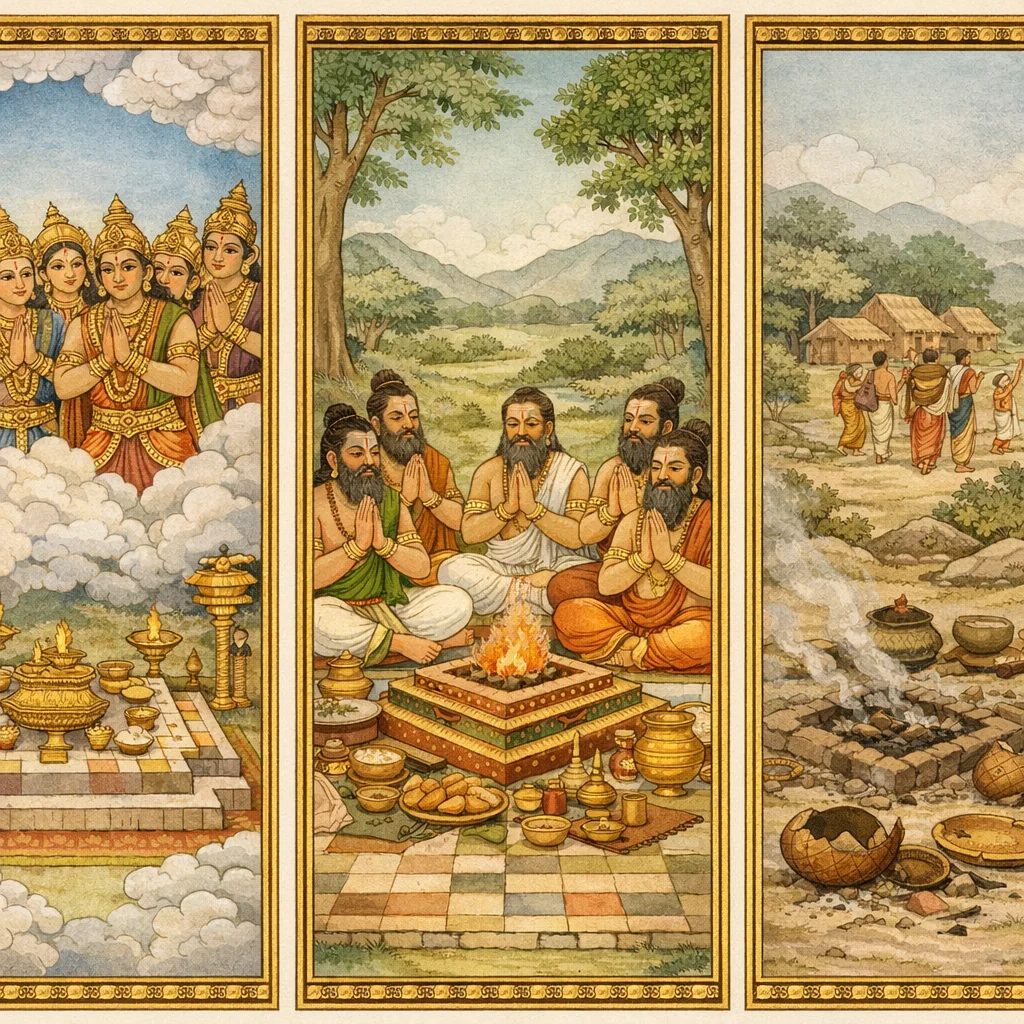
Vyāsa relates that the devas, distressed by their conflict with the daityas, approach Brahmā for refuge and ask for a swift means to secure victory. Brahmā explains that Dharmāraṇya was formerly established through divine collaboration of Brahmā, Śaṅkara, and Viṣṇu, with Yama’s tapas as a supporting cause, and he teaches a rule of ritual geography: whatever dāna, yajña, or tapas is performed there becomes “koṭi-guṇita” (multiplied manyfold), with both puṇya and pāpa likewise magnified in their results. The devas then go to Dharmāraṇya and arrange a grand satra lasting a thousand years, appointing eminent ṛṣis to specialized sacrificial offices, setting up a vast altar-ground, and offering oblations by mantraic procedure, while extending generous hospitality and anna-dāna to resident dvijas and dependents. In a later age, Lohāsura, disguised in a Brahmā-like form, harasses ritualists and communities, destroys yajña materials, and defiles sacred structures, causing widespread dispersal. The displaced found new villages named to memorialize fear, confusion, and diverging routes, while Dharmāraṇya becomes hard to inhabit and its tīrtha-status is impaired by desecration, until the asura departs satisfied.
Shlokas
Verse 1
व्यास उवाच । अतः परं प्रवक्ष्यामि ब्रह्मणा यत्कृतं पुरा । तत्सर्वं कथयाम्यद्य शृणुष्वैकाग्रमानसः
Vyāsa said: Now I shall explain what Brahmā accomplished in ancient times. I will recount it all today—listen with a mind made one-pointed.
Verse 2
देवानां दानवानां च वैराद्युद्धं बभूव ह । तस्मिन्युद्धे महादुष्टे देवाः संक्लिष्टमानसाः
Through enmity there arose a war between the Devas and the Dānavas. In that terribly wicked conflict, the Devas became inwardly distressed.
Verse 3
बभूवुस्तत्र सोद्वेगा ब्रह्माणं शरणं ययुः
There, shaken with anxiety, they went to Brahmā for refuge.
Verse 4
देवा ऊचुः । ब्रह्मन्केन प्रकारेण दैत्यानां वधमेव च । करोम्यद्य उपायं हि कथ्यतां शीघ्रमेव मे
The Devas said: O Brahman, by what method may we accomplish the slaying of the Daityas? Tell me quickly the means by which I may act today.
Verse 5
ब्रह्मोवाच । मया हि शंकरेणैव विष्णुना हि तथा पुरा । यमस्य तपसा तुष्टैर्धर्मारण्यं विनिर्मितम्
Brahmā said: Formerly, I—together with Śaṅkara and also Viṣṇu—being pleased by Yama’s austerities, brought into being the sacred forest called Dharmāraṇya.
Verse 6
तत्र यद्दीयते दानं यज्ञं वा तप उत्तमम् । तत्सर्वं कोटिगुणितं भवेदिति न संशयः
Whatever charity is given there, or sacrifice performed, or excellent austerity undertaken—every such act becomes multiplied a crore-fold; of this there is no doubt.
Verse 7
पापं वा यदि वा पुण्यं सर्वं कोटि गुणं भवेत् । तस्माद्दैत्यैर्न धर्षितं कदाचिदपि भोः सुराः
Whether it be sin or merit, everything becomes a crore-fold there. Therefore, O gods, it has never been violated by the Dānavas at any time.
Verse 8
श्रुत्वा तु ब्रह्मणो वाक्यं देवाः सर्वे सविस्मयाः । ब्रह्माणं त्वग्रतः कृत्वा धर्मार ण्यमुपाययुः
Hearing Brahmā’s words, all the gods—filled with wonder—placed Brahmā at their head and set out toward Dharmāraṇya.
Verse 9
सत्रं तत्र समारभ्य सहस्राब्दमनुत्तमम् । वृत्वाऽचार्यं चांगिरसं मार्कंण्डेयं तथैव च
There they commenced an unsurpassed satra-sacrifice lasting a thousand years, appointing as teachers the Āṅgirasa sage and likewise Mārkaṇḍeya.
Verse 10
अत्रिं च कश्यपं चैव होता कृत्वा महामतिः । जमदग्निं गौतमं च अध्वर्युत्वं न्यवेदयन्
The great-minded ones appointed Atri and Kaśyapa as Hotṛ priests, and assigned Jamadagni and Gautama to the office of Adhvaryu.
Verse 11
भरद्वाजं वसिष्ठं तु प्रत्यध्वर्युत्वमादिशन् । नारदं चैव वाल्मीकिं नोदना याकरोत्तदा
They appointed Bharadvāja and Vasiṣṭha to the office of Pratyadhvaryu; and at that time they assigned Nārada and Vālmīki to the role of Nodanā, the ritual prompters and chanters.
Verse 12
ब्रह्मासने च ब्रह्माणं स्थापयामासुरादरात् । क्रोशचतुष्कमात्रां च वेदिं कृत्वा सुरैस्ततः
With reverence they seated Brahmā upon the Brahmā-seat; then the gods prepared a vedī, an altar, measuring four krośas in extent.
Verse 13
द्विजाः सर्वे समाहूता यज्ञस्यार्थे हि जापकाः । ऋग्यजुःसामाथर्वान्वै वेदानुद्गिरयंति ये
All the twice-born were summoned for the sacrifice as japa-chanters—those who recite aloud the Vedas: Ṛg, Yajus, Sāman, and Atharvan.
Verse 14
गणनाथं शंभुसुतं कार्त्तिकेयं तथैव च । इन्द्रं वज्रधरं चैव जयंतं चन्द्रसूनुकम्
They also invoked Gaṇanātha, the son of Śambhu—Kārttikeya as well—and Indra the wielder of the thunderbolt, and Jayanta, the son of Candra.
Verse 15
चत्वारो द्वारपालाश्च देवाः शूरा विनिर्मिताः । ततो राक्षोघ्नमंत्रेण हूयते हव्यवाहनः
Four heroic deities were appointed as guardians at the gates. Then, by the rākṣasa-destroying mantra, oblations were offered into Havyavāhana (Agni).
Verse 16
तिलांश्च यवमिश्रांश्च मध्वाज्येन च मिश्रितान् । जुहुवुस्ते तदा देवा वेदमंत्रैर्नरेश्वर
O king, then those gods, accompanied by Vedic mantras, offered into the fire sesame and barley mixed together, blended with honey and ghee.
Verse 17
आघारावाज्यभागौ च हुत्वा चैव ततः परम् । द्राक्षेक्षुपूगनारिंग जंबीरं बीजपूरकम्
After offering the āghāras and the allotted portions of ghee, they then offered grapes, sugarcane, areca-nut, citron, lemon, and pomegranate.
Verse 18
उत्तरतो नालिकेरं दाडिमं च यथाक्रमम् । मध्वाज्यं पयसा युक्तं कृशरशर्करायुतम्
To the north, in due order, they offered coconut and pomegranate; and honey and ghee combined with milk, along with kṛśara (a rice dish) mixed with sugar.
Verse 19
तंडुलैः शतपत्रैश्च यज्ञे वाचं नियम्य च । विचिंत्य च महाभागाः कृत्वा यज्ञं सदक्षिणम्
With rice-grains and hundred-petalled flowers, restraining their speech in the sacrifice and meditating, those noble ones performed the yajña together with the due dakṣiṇā (sacrificial fee).
Verse 20
उत्तमं च शुभं स्तोमं कृत्वा हर्षमुपाययुः । अवारितान्नमददन्दीनांधकृपणेष्वपि
Having offered an excellent and auspicious hymn of praise, they were filled with great joy. They gave food without hindrance—even to the poor, the blind, and even the miserly.
Verse 21
ब्राह्मणेभ्यो विशेषेण दत्तमन्नं यथेप्सितम् । पायसं शर्करायुक्तं साज्यशाकसमन्वितम्
Food was given especially to the brāhmaṇas, as they wished—sweet pāyasa (milk-rice) with sugar, together with vegetables prepared in ghee.
Verse 22
मंडका वटकाः पूपास्तथा वै वेष्टिकाः शुभाः । सहस्रमोदकाश्चापि फेणिका घुर्घुरादयः
There were maṇḍakas, vaṭakas, pūpas, and auspicious veṣṭikas; and also thousands of modakas, along with pheṇikās, ghurghurās, and other such sweets.
Verse 23
ओदनश्च तथा दाली आढकीसंभवा शुभा । तथा वै मुद्गदाली च पर्पटा वटिका तथा
There was odana, cooked rice, and auspicious lentil preparations made from āḍhakī; likewise dishes of mudga (mung), and also preparations of parpaṭa and vaṭikā.
Verse 24
प्रलेह्यानि विचित्राणि युक्तास्त्र्यूषणसंचयैः । कुल्माषा वेल्लकाश्चैव कोमला वालकाः शुभाः
There were various pralehyas—lickable delicacies—blended with the collection of the three pungent spices; and also kulmāṣas, vellakas, and soft, auspicious vālakā preparations.
Verse 25
कर्कटिकाश्चार्द्रयुता मरिचेन समन्विताः । एवंविधानि चान्नानि शाकानि विविधानि च
There were also karkaṭikā vegetables—moist and well-prepared, seasoned with black pepper—together with such foods and many kinds of leafy greens and side-dishes.
Verse 26
भोजयित्वा द्विजान्सर्वान्धर्मारण्य निवासिनः । अष्टादशसहस्राणि सपुत्रांश्च तदा नृप
O king, having fed all the twice-born who dwelt in Dharmāraṇya—eighteen thousand of them, along with their sons—
Verse 27
प्रतिदिनं तदा देवा भोजयंति स्म वाडवान् । एवं वर्षसहस्रं वै कृत्वा यज्ञं तदामराः
Then the gods fed the vāḍavas each day. In this manner, the immortals performed that sacrifice (yajña) for a full thousand years.
Verse 28
कृत्वा दैत्यवधं राजन्निर्भयत्वमवाप्नुयुः । स्वर्गं जग्मुस्ते सहसा देवाः सर्वे मरुद्गणाः
O king, after slaying the daityas they attained fearlessness; and all those gods—together with the hosts of the Maruts—swiftly went to heaven.
Verse 29
तथैवाप्सरसः सर्वा ब्रह्मवि ष्णुमहेश्वराः । कैलासशिखरं रम्यं वैकुंठं विष्णुवल्लभम्
Likewise all the Apsarases, and Brahmā, Viṣṇu, and Maheśvara, went to the lovely peak of Kailāsa and to Vaikuṇṭha, beloved of Viṣṇu.
Verse 30
ब्रह्मलोकं महापुण्यं प्राप्य सर्वे दिवौकसः । परं हर्षमुपाजग्मुः प्राप्य नंदनमुत्तम्
Reaching the supremely meritorious Brahmaloka, all the celestial dwellers attained highest joy, having arrived at the excellent Nandana grove.
Verse 31
स्वेस्वे स्थाने स्थिरीभूत्वा तस्थुः सर्वे हि निर्भयाः
Firmly established in their own respective stations, they all remained—indeed—without fear.
Verse 32
ततः कालेन महता कृताख्ययुगपर्यये । लोहासुरो मदोन्मत्तो ब्रह्मवेषधरः सदा
Then, after a long time, at the close of the age called Kṛta, Lohāsura—maddened with pride—would always assume the guise of a brāhmaṇa.
Verse 33
आगत्य सर्वान्विप्रांश्च धर्षयेद्धर्मवित्तमान् । शूद्रांश्च वणिजश्चैव दंडघातेन ताडयेत्
Coming there, he would harass all the brāhmaṇas who knew dharma; and he would also strike śūdras and merchants with blows of a staff.
Verse 34
विध्वंसयेच्च यज्ञादीन्होमद्रव्याणि भक्षयेत् । वेदिका दीर्घिका दृष्ट्वा कश्मलेन प्रदूषयेत्
He would even destroy sacrifices and the like, devour the materials meant for homa oblations, and—on seeing altars and sacred tanks—defile them with impurity.
Verse 35
मूत्रोत्सर्गपुरीषेण दूषयेत्पुण्यभूमिकाः । गहनेन तथा राजन्स्त्रियो दूषयते हि सः
By urinating and defecating in improper places one defiles holy ground; likewise, O King, by secret (illicit) consorting a man indeed brings defilement upon women and their honor.
Verse 36
ततस्ते वाडवाः सर्वे लोहासुरभयातुराः । प्रनष्टाः सपरीवारा गतास्ते वै दिशो दश
Then all those people, distressed by fear of the Loha-asura, vanished; with their families they indeed departed to the ten directions.
Verse 37
वणिजस्ते भयोद्विग्ना विप्राननुययुर्नृप । महाभयेन संभीता दूरं गत्वा विमृश्य च
Those merchants, shaken by fear, followed after the brāhmaṇas, O King; terrified by great dread, they went far away and then deliberated.
Verse 38
सह शूद्रैद्विजैः सर्व एकीभूत्वा गतास्तदा । मुक्तारण्यं पुण्यतमं निर्जनं हि ययुश्च ते
Then all of them—together with śūdras and the twice-born—went as one united group; and they proceeded to Muktāraṇya, most sacred and truly solitary.
Verse 39
निवासं कारयामासुर्नातिदूरे नरेश्वर । वजिङ्नाम्ना हि तद्ग्रामं वासयामासुरेव ते
Not far away, O Lord of men, they had dwellings built; and indeed they established that village under the name Vajiṅ.
Verse 40
लोहासुरभयाद्राजन्विप्र नाम्ना विनिर्मितम् । शंभुना वणिजा यस्मात्तस्मात्तन्नामधारणम्
Out of fear of the Loha-asura, O King, it was built and given the name “Vipra”; and since it was founded by the merchant Śambhu, it also bore the name associated with him.
Verse 41
शंभुग्राममिति ख्यातं लोके विख्यातिमागतम् । अथ केचिद्भयान्नष्टा वणिजः प्रथमं तदा
It came to be known as “Śambhu-grāma” and attained renown in the world. Then, at that time, some merchants—first of all—were scattered and lost through fear.
Verse 42
ते नातिदूरे गत्वा वै मंडलं चक्रुरुत्तमम् । विप्रागमनकांक्षास्ते तत्र वासमकल्पयन्
Having gone not very far, they formed an excellent encampment, a noble maṇḍala. Longing for the arrival of the brāhmaṇas, they arranged their dwelling there.
Verse 43
मंडलेति च नाम्ना वै ग्रामं कृत्वा न्यवीवसन् । विप्रसार्थपरिभ्रष्टाः केचित्तु वणिजस्तदा
They founded a village there and, giving it the name “Maṇḍala,” dwelt in it. But at that time some merchants, separated from the brāhmaṇa caravan, remained apart.
Verse 44
अन्यमार्गे गता ये वै लोहासुरभयार्दिताः । धर्मारण्यान्नाति दूरे गत्वा चिंतामुपाययुः
Those who had taken another route, afflicted by fear of the Loha-asura, went not far from Dharmāraṇya, and there they fell into anxious thought.
Verse 45
कस्मिन्मार्गे वयं प्राप्ताः कस्मिन्प्राप्ता द्विजातयः । इति चिंतां परं प्राप्ता वासं तत्र त्वकारयन्
“By what road have we arrived? By what route have we, the twice-born, come here?”—thus, seized by deep anxiety, they had a dwelling made there and stayed in that place.
Verse 46
अन्यमार्गे गता यस्मात्तस्मात्तन्नामसंभवम् । ग्रामं निवासयामासुरडालंजमिति क्षितौ
Since they had gone by a different path, a name arose from that circumstance; and upon the earth they established a village called “Aḍālaṃja.”
Verse 47
यस्मिन्ग्रामे निवासी यो यत्संज्ञश्च वणिग्भवेत् । तस्य ग्रामस्य तन्नाम ह्यभवत्पृथिवीपते
O lord of the earth, whatever name a resident merchant bore in a given village—by that very designation the village itself came to be known.
Verse 48
वणिजश्च तथा विप्रा मोहं प्राप्ता भयार्दिताः । तस्मान्मोहेतिसंज्ञास्ते राजन्सर्वे निरब्रुवन्
The merchants and the Brāhmaṇas alike, stricken by fear, fell into delusion; therefore, O king, they all declared themselves to bear the designation “Moha” (Bewildered).
Verse 49
एवं प्रनषणं नष्टास्ते गताश्च दिशो दिश । धर्मारण्ये न तिष्ठंति वाडवा वणिजोऽपि वा
Thus, utterly confounded and lost, they went off in every direction. In Dharmāraṇya, neither the horse-traders nor even the merchants remained.
Verse 50
उद्वसं हि तदा जातं धर्मारण्यं च दुर्लभम् । भूषणं सर्वतीर्थानां कृतं लोहासुरेण तत्
Then Dharmāraṇya became desolate and hard to reach. That very ornament of all tīrthas was thus perverted by Lohāsura.
Verse 51
नष्टद्विजं नष्टतीर्थं स्थानं कृत्वा हि दानवः । परां मुदमवाप्यैव जगाम स्वालयं ततः
Having made the place bereft of the twice-born and having ruined the efficacy of the tīrtha, the Dānava, filled with utmost delight, departed from there to his own abode.