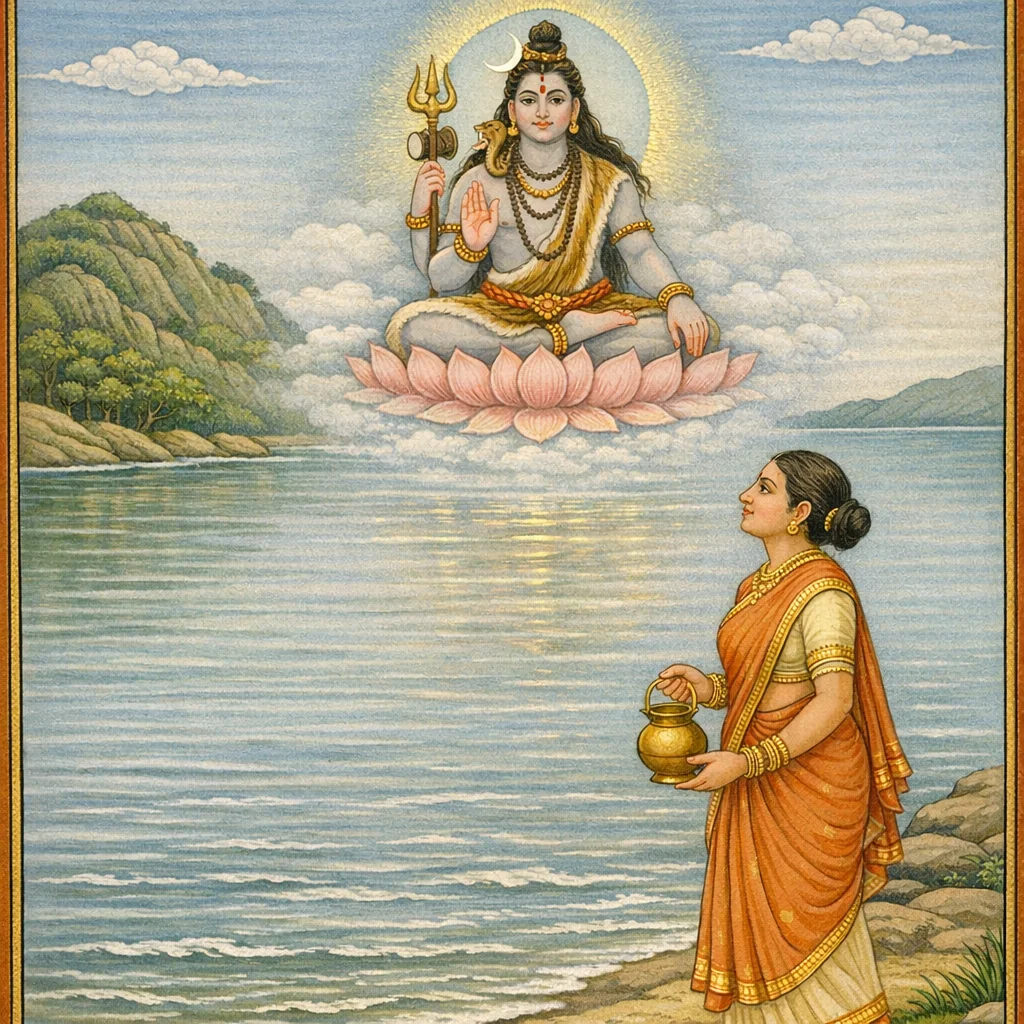
Adhyaya 29
Sūta recounts the career of Lohāsura, a daitya who, stirred to renunciation after witnessing the lofty attainments of elders, seeks an unsurpassed place of tapas and adopts an inward form of devotion: Gaṅgā upon his head, lotuses in his eyes, Nārāyaṇa in his heart, Brahmā at his waist, and the gods reflected in his body like the sun in water. He performs fierce austerities for a divine century, gains from Śiva the boon of bodily non-decay and freedom from fear of death, and then continues his tapas on the bank of the Sarasvatī. Indra, alarmed, tries to break his austerities; conflict ensues and stretches into a prolonged struggle, where even Keśava is described as overcome by the boon’s force. The triad (Brahmā, Viṣṇu, Rudra) deliberates and restrains the daitya through the moral-legal power of satya and vākpāśa, the “bond of speech,” charging him to protect the dharma of truthful utterance and not disturb the gods. In return, the deities promise to abide in his body until cosmic dissolution, and his embodied presence becomes a tīrtha in Dharmāraṇya near Dharmēśvara. The chapter then sets forth pitṛ-rite benefits: tarpaṇa and piṇḍadāna at the local well and on specified lunar dates (notably caturdaśī/amāvāsyā in Bhādrapada) are said to yield multiplied ancestral satisfaction, sometimes likened to or exceeding Gayā/Prayāga. A pitṛ-gāthā supports this, along with a practical mantra for offerings to known and unknown lineages. The phalaśruti concludes that hearing this account removes major sins and grants merit equal to repeated Gayā rites and abundant cow-gifts.
Shlokas
Verse 1
सूत उवाच । अतः परं शृणुध्वं हि लोहासुरविचेष्टितम् । बलेः पुत्रशतस्यापि कथयिष्यामि विश्रुतम्
Sūta said: Now listen further to the famed deeds of Lohāsura. I shall also recount the well-known account of Bali’s hundred sons.
Verse 2
यथा तौ भ्रातरौ वृद्धौ प्रापतुः स्थानमुत्तमम् । तदा प्रभृति वैराग्यं दैत्यो लोहासुरे दधौ
When those two elder brothers attained the supreme state, from that very time the Daitya Lohāsura took to dispassion.
Verse 3
किं करोमि क्व गच्छामि तपसे स्थानमुत्तमम् । यस्य पारं न जानंति देवता मुनयो नराः
“What shall I do? Where shall I go—to what highest place for austerity—whose farthest limit even the gods, sages, and men do not know?”
Verse 4
को मयाऽराध्यतां देवो हृदि चिंतयते भृशम् । इति चिंतयतस्तस्य मतिर्जाता महात्मनः
“Which god should I worship?”—thus he pondered deeply within his heart; and as he reflected, a resolve arose in that great-souled one.
Verse 5
दधौ गंगां स्वशीर्षेण पुष्पवंतौ च नेत्रयोः । हृदा नारायणं देवं ब्रह्माणं कटिमंडले
He placed Gaṅgā upon his own head; he set blossoming flowers upon his eyes; within his heart he installed Nārāyaṇa, and at his waist-region he placed Brahmā, as in a consecrated maṇḍala.
Verse 6
इंद्राद्या देवताः सर्वे यद्देहे प्रतिबिंबिताः । प्रपश्यंति तदात्मानं भास्करः सलिले यथा
All the deities—beginning with Indra—seeing themselves reflected in his body, beheld their own forms there, just as the sun is seen reflected in water.
Verse 7
तमेवाराधयिष्यामि निरंजनमकल्मषः । एवं कृत्वा मतिं दैत्य स्तपस्तेपे सुदुष्करम् । भीतो जन्मभयाद्घोराद्दुष्करं यन्महात्मभिः
“Him alone shall I worship—the Stainless One, free from defilement.” Having thus fixed his resolve, the Daitya undertook an extremely difficult austerity, driven by dreadful fear of repeated birth—an ordeal hard even for great souls.
Verse 8
अंबुभक्षो वायुभक्षः शीर्णपर्णाशनस्तथा । दिव्यं वर्षशतं साग्रं यदा तेपे महत्तपः । ततस्तुतोष भगवांस्त्रिशूलवरधारकः
Living on water, then on air, and likewise on withered leaves, he performed great austerity for a full hundred divine years and more. Then the Blessed Lord—the bearer of the excellent trident—was pleased.
Verse 9
ईश्वर उवाच । वरं वृणीष्व भद्रं ते मनसा यदभीप्सितम् । लोहासुर मया देयं तव नास्ति तपोबलात्
Īśvara said: Choose a boon—may it be auspicious for you—whatever your mind desires. O Lohāsura, there is nothing that cannot be granted to you by me, through the power of your austerity.
Verse 10
इत्युक्तो दानवस्तत्र शंकराग्रे वचोऽब्रवीत्
Thus addressed there, the Dānava spoke his words before Śaṅkara.
Verse 11
लोहासुर उवाच । यदि तुष्टोसि देवेश वरमेकं वृणोम्यहम् । शरीरस्याजरत्वं च मा मृत्योरपि मे भयम्
Lohāsura said: “If You are pleased, O Lord of the gods, I choose a single boon: let my body be free from old age, and let there be no fear for me even of death.”
Verse 12
जन्मन्यस्मिन्प्रभो भूयात्स्थातव्यं हृदये मम । एवमस्तु शिवः प्राह तत्र तं दानवेश्वरम्
“In this very birth, O Lord, let it be so, and let it remain firmly set in my heart.” There Śiva replied to that lord of the Dānavas, “So be it.”
Verse 13
शर्वलब्धवरो दैवात्पुनस्तेपे महत्तपः । रम्ये सरस्वतीतीरे तरणाय भवार्णवात्
Having, by destiny, obtained a boon from Śarva (Śiva), he again undertook great austerity on the lovely bank of the Sarasvatī, seeking to cross the ocean of worldly becoming.
Verse 14
वत्सराणां सहस्राणि प्रयुतान्यर्बुदानि च । शंकते भगवानिंद्रो भीतस्तस्य तपोबलात्
For thousands of years—tens of thousands and even crores—he continued; and the venerable Indra grew anxious, frightened by the power born of that austerity.
Verse 15
मा मे पदच्युतिर्भूयाद्दैत्यल्लोहासुरात्क्वचित् । मघवान्गुप्तरूपेण समेत्याश्रमकाननम्
(Indra thought:) “May I never, at any time, fall from my station because of the demon Lohāsura.” Thus Maghavān (Indra), assuming a concealed form, went to the forest of the hermitage.
Verse 16
तपोभंगं प्रकुरुते कंपयित्वा महासुरम् । ताडयंति शरीरे तं मुष्टिभिस्तीक्ष्णकर्कशैः
He caused the breaking of the austerity, shaking the great Asura; and they struck his body with hard, harsh, sharp-fisted blows.
Verse 17
अथ तेन च दैत्येन ध्यानमुत्सृज्य वीक्षितम् । इंद्रेण तत्कृतं सर्वं तपोबलविनाशनम्
Then that Daitya, abandoning his meditation, looked around and perceived that all of it—the ruin of his ascetic power—had been brought about by Indra.
Verse 18
तस्य तैरभवद्युद्धमिंद्राद्यैरथ कर्क्कशैः । एकस्य बहुभिः सार्द्धं देवास्ते तेन संयुगे
Then a fierce battle arose between him and those harsh ones—Indra and the other gods; in that conflict, many devas fought together against the single warrior.
Verse 19
रुधिराक्लिन्नदेहा वै प्रहारैर्जर्जरीकृताः । केशवं शरणं प्राप्ता त्राहि त्राहीति भाषिणः
Their bodies drenched in blood and shattered by blows, they took refuge in Keśava, crying, “Save us! Save us!”
Verse 20
सूत उवाच । देवानां वाक्यमाकर्ण्य वासुदेवो जनार्दनः । युयुधे केशवस्तेन युद्धे वर्षशतं किल
Sūta said: Hearing the words of the gods, Vāsudeva Janārdana—Keśava—fought with him, and that battle, it is said, lasted a hundred years.
Verse 21
ततो नारायणं तत्र जिगाय स वरोर्जितः । अथ नारायणो देवो जितो लोहासुरेण तु
Then, empowered by the boon, he overcame Nārāyaṇa there; thus even the god Nārāyaṇa was vanquished by Lohāsura.
Verse 22
मंत्रयामास रुद्रेण ब्रह्मणा च पुनःपुनः । मीमांसित्वा त्रयो देवाः पुनर्युद्धसमुद्यमम्
Again and again he took counsel with Rudra and with Brahmā. After deliberating, the three gods prepared once more to undertake the battle.
Verse 23
लोहासुरस्य दैत्यस्य वपुर्दृष्ट्वा पुनर्नवम् । महदासीत्पुनर्युद्धं दैत्यकेशवयोस्ततः
Seeing the Daitya Lohāsura’s body become new again, a great battle broke out once more between the Daitya and Keśava.
Verse 24
न ममार यदा दैत्यो विष्णुना प्रभविष्णुना । तरसा तं केशवोऽपि पातयामास भूतले
When the Daitya did not die even by the power of mighty Viṣṇu, Keśava, with force, struck him down upon the earth.
Verse 25
उत्तानं पतितं दृष्ट्वा पिनाकी परमेश्वरः । दधार हृदये तस्य स्वरूपं रूपवर्जितः
Seeing him fallen on his back, Pinākī—Parameśvara—held within his heart that essential nature which is beyond form.
Verse 26
कण्ठे तस्थौ ततो ब्रह्मा तस्य लोहासुरस्य च । चरणौ पीडयामास स्वस्थित्या पुरुषोत्तमः
Then Brahmā stood upon the neck of that Lohāsura, and Puruṣottama, by his own steady stance, pressed down his feet.
Verse 27
अथ दैत्यः समुत्तस्थौ भृशं बद्धोपि भूतले । दृष्ट्वोत्थितं ततो दैत्यं पातयंतं सुरोत्तमान्
Then the Daitya rose up, though tightly bound upon the ground. Seeing the Daitya rise again and cast down the best of the gods,
Verse 28
उवाच दिव्यया वाचा विरंचिः कमलासनः
Virañci, the lotus-seated Brahmā, spoke with a divine voice.
Verse 29
ब्रह्मोवाच । लोहासुर सदा रक्ष वाचोधर्ममभीक्ष्णशः । त्वया यत्प्रार्थितं रुद्रात्तदेव समुपस्थितम्
Brahmā said: “O Lohāsura, always guard the dharma of your word—unceasingly. What you prayed for from Rudra, that very boon has now come to you.”
Verse 30
अहं विष्णुश्च रुद्रश्च त्रयोऽमी सुरसत्तमाः । त्वद्देहमुपवेक्ष्यामो यावदाभूतसंप्लवम्
“I, Viṣṇu, and Rudra—we three, the best among the gods—shall attend upon and guard your body until the final dissolution of beings.”
Verse 31
दानवेश शिवप्राप्तिर्भावभक्त्यैव जायते । शिवं चालयितुं बुद्धिः कथं तव भविष्यति
O lord of the Dānavas, attainment of Śiva arises only through heartfelt bhakti. How, then, could the thought arise in you to make Śiva waver?
Verse 32
अचलांश्चालयेद्यस्तु प्रासादान्ब्राह्मणान्पुरान् । अचिरेणैव कालेन पातकेनैव लिप्यते
But whoever tries to shake what should be immovable—temples, brāhmaṇas, and sacred cities—quickly becomes stained by sin.
Verse 33
श्मशानवत्परित्याज्यः सत्यधर्मबहिष्कृतः । सत्यवागसि भद्रं ते मा विचालय देवताः
One who is cast out from truth and dharma should be shunned like a cremation-ground. But you are truthful in speech—may welfare be yours; do not disturb the gods.
Verse 34
येन यातास्तु पितरो येन याताः पितामहाः । तेन मार्गेण गंतव्यं न चोल्लंघ्या सतां गतिः
The path by which the fathers and grandfathers have gone—by that very path one should proceed; the course of the righteous must not be transgressed.
Verse 35
दानवेश पिता ते हि ददौ लोकत्रयं हरेः । वाक्पाशबद्धः पाताले राज्यं चक्रे महीपतिः
O lord of the Dānavas, your father indeed gave away the three worlds belonging to Hari; bound by the noose of his own word, that king ruled in Pātāla.
Verse 36
तथा त्वमसि वाक्पाशाच्छिवभक्तिसमन्वितः । भूतले तिष्ठ दैत्येंद्र मा वाग्वैकल्प्यमाप्नुहि
So too are you bound by the noose of your own word and endowed with devotion to Śiva. Remain upon the earth, O lord of the Daityas; do not fall into wavering or contradiction of speech.
Verse 37
वरांस्ते च प्रदास्यामो मा विचाल्या हि देवताः
And we shall grant you boons; only do not disturb the gods.
Verse 38
व्यास उवाच । तच्छ्रुत्वा ब्रह्मणो वाक्यं संतुष्टो दानवेश्वरः । प्राह प्रसन्नया वाचा ब्रह्माणं केशवं हरम्
Vyāsa said: Hearing Brahmā’s words, the lord of the Dānavas was satisfied, and with a pleased voice he addressed Brahmā, Keśava, and Hara.
Verse 39
लोहासुर उवाच । वाक्पाशबद्धस्तिष्ठामि न पुनर्भवतां बले । ब्रह्मा विष्णुश्च रुद्रश्च त्रयोऽमी सुरसत्तमाः
Lohāsura said: Bound by the noose of my word, I shall remain—no longer by your force. Brahmā, Viṣṇu, and Rudra—these three are the foremost among the gods.
Verse 40
स्थास्यंति चेच्छरीरे मे किं न लब्धं मया ततः । इदं कलेवरं मे हि समारूढं त्रिभिः सुरैः
If you are to abide within my very body, what then would remain unattained by me? For this body of mine is indeed mounted—occupied—by the three gods.
Verse 41
भूम्यां भवतु विख्यातं मत्प्रभावात्सुरोत्तमाः
O best of the gods, by my power let this become renowned upon the earth.
Verse 42
लोहासुरस्य वाक्येन हर्षिता स्त्रिदशास्त्रयः । ददुः प्रत्युत्तरं तस्मै ब्रह्मविष्णुमहेश्वराः
Pleased by Lohāsura’s words, the threefold hosts of the gods rejoiced; and Brahmā, Viṣṇu, and Maheśvara gave him their reply.
Verse 43
सत्यवाक्पाशतो दैत्यो न सत्याच्चलितो यतः । तेन सत्येन संतुष्टा दास्या मस्ते मनीप्सितम्
Because you, O Daitya, have not swerved from truth—bound, as it were, by the noose of truthful speech—we are pleased by that truth. We shall grant you what you desire.
Verse 44
ब्रह्मोवाच । यथा स्नानं ब्रह्मज्ञानं देहत्यागो गयातले । धर्मारण्ये तथा दैत्य धर्म्मेश्वरपुरः स्थिते
Brahmā said: “Just as bathing, realization of Brahman, and even the giving up of the body at Gayā are supremely efficacious—so too, O Daitya, are the rites in Dharmāraṇya, in the presence of Dharmmeśvara-pura.”
Verse 45
कूपे तर्प्पणकं श्राद्धं शंसंति पितरो दिवि । संतुष्टा पिंडदानेन गयायां पितरो यथा
The Fathers (Pitṛs) in heaven praise the śrāddha, together with tarpaṇa, at the sacred well; just as at Gayā the Pitṛs are satisfied by offerings of piṇḍas.
Verse 46
वांछंति तर्प्पणं कूपे धर्मारण्ये विशुद्धये । दानवेन्द्र शरीरं तु तीर्थं तव भविष्यति
For purification, people will yearn to perform tarpaṇa at the well in Dharmāraṇya. And, O lord of the Dānavas, your very body shall become a tīrtha.
Verse 47
एकविंशतिवारांस्तु गयायां तर्प्पणे कृते । पितॄणां या परा तृप्तिर्जायते दानवाधिप
O lord of the Dānavas, the supreme satisfaction of the Pitṛs that arises from performing tarpaṇa at Gayā twenty-one times—
Verse 48
धर्मेश्वर पुरस्तात्सा त्वेकदा पितृतर्पणात् । स्याद्वै दशगुणा तृप्तिः सत्यमेव न संशयः
—that satisfaction, indeed, becomes tenfold from even a single act of pitṛ-tarpaṇa performed before Dharmmeśvara. This is truth—there is no doubt.
Verse 49
पितॄणां पिंडदानेन अक्षय्या तृप्तिरस्त्विह । शिवरूपांतराले वै धर्मारण्ये धरातले
Here, on earth in Dharmāraṇya—within the sacred interval marked by Śiva’s manifestation—by offering piṇḍas, let there be imperishable satisfaction for the Pitṛs.
Verse 50
श्रद्धयैव हि कर्त्तव्याः श्राद्धपिंडोदकक्रियाः । तथांतराले चास्माकं श्राद्धपिंडौ विशेषतः
Indeed, the rites of śrāddha—piṇḍa offerings and water-libations—must be performed with faith. And in that sacred interval here, our śrāddha and piṇḍa offerings are especially distinguished in fruit.
Verse 51
तथा शरीरे क्वापिस्तांचिंता सत्योऽसि सुव्रत । त्रिषु लोकेषु दुष्प्रापं सत्यं ते दिवि संस्थितम्
So too, within your body let there be no anxiety at all, O truthful one of good vows. In the three worlds such Truth is hard to attain; your truthfulness stands established even in heaven.
Verse 52
अस्मद्वाक्येन सत्येन तत्तथाऽसुरसत्तम । गयासमधिकं तीर्थं तव जातं धरातले
By the truth of our spoken word, so indeed shall it be, O best of Asuras: upon the earth there has arisen for you a sacred ford (tīrtha) equal to—or greater than—Gayā.
Verse 53
अस्माकं स्थितिरव्यग्रा तव देहे न संशयः । सत्यपाशेन बद्धाः स्म दृढमेव त्वयाऽनघ
Our presence is steady and undisturbed within your body—of this there is no doubt. By the noose of Truth you have bound us firmly indeed, O sinless one.
Verse 54
विष्णुरुवाच । गयाप्रयाग कस्याऽपि फलं समधिकं स्मृतम् । चतुर्द्दश्याममावास्यां लोहयष्ट्यां पिंडदानतः
Viṣṇu said: The fruit of Gayā and Prayāga is remembered as surpassing that of other places—especially when, on the fourteenth day and on the new-moon day (amāvāsyā), one offers piṇḍas at Lohayaṣṭī.
Verse 55
बलिपुत्रस्य सत्येन महती तृप्तिरत्र हि । मा कुरुष्वात्र संदेहं तव देहे स्थिता स्वयम्
Indeed, by the truthfulness of Bali’s son there is great satisfaction here (for the ancestors). Do not entertain doubt in this matter—she, the sacred power of merit, abides of her own accord within your body.
Verse 56
सरस्वती पुण्यतोया ब्रह्मलोकात्प्रयात्युत । प्लावयिष्यंति देहांगं मया सह सुसंगता
Sarasvatī, whose waters are holy, will indeed come forth from Brahmaloka; united with me in harmony, she will bathe and flood the limbs of the body for purification.
Verse 57
यथो वै द्वारका वासो देवस्तत्र महेश्वरः । विरंचिर्यत्र तीर्थानि त्रीण्येतानि धरातले
Just as Dvārakā is a divine abode and there the Great Lord is worshipped, and where Virañci (Brahmā) is present—so on earth these three are renowned as tīrthas.
Verse 58
भविष्यति च पाताले स्वर्गलोके यमक्षये । विख्यातान्यसुरश्रेष्ठ पि तॄणां तृप्तिहेतवे
They will become famed in Pātāla, in Svarga, and in Yama’s realm as well, O best of Asuras—renowned as causes of the ancestors’ satisfaction.
Verse 59
अथान्यत्संप्रवक्ष्यामि गाथां पितृकृतां पराम् । आज्ञारूपां हि पुत्राणां तां शृणुष्व ममानघ
Now I shall proclaim another supreme gāthā composed by the Pitṛs—an instruction in the form of a command for sons. Listen to it, O blameless one.
Verse 60
पितर ऊचुः । शंकरस्याग्रतः स्थानं रुद्रलोकप्रदं नृणाम् । पापदेहविशुद्ध्यर्थं पापेनोपहतात्मनाम्
The Pitṛs said: In front of Śaṅkara there is a sacred station that grants Rudra’s world to men—meant for the purification of sinful embodiment, for those whose souls have been struck down by sin.
Verse 61
तस्मिंस्तिलोदकेनापि सद्गतिं यांति तर्पिताः । पितरो नरकाद्वा पि सुपुत्रेण सुमेधसा
There, even by offering sesame-water (tilodaka), the ancestors, once satisfied, attain a blessed course. Truly, through a virtuous and wise son, the Pitṛs are delivered even from hell.
Verse 62
गोप्रदानं प्रशंसंति तत्तत्र पितृमुक्तये । पित्रादिकान्समुद्दिश्य दृष्ट्वा रुद्रं च केशवम्
There they extol the gifting of a cow as a means for the liberation of the ancestors. Having invoked the Pitṛs and the rest, one should behold and worship both Rudra and Keśava.
Verse 63
तिलपिण्याकपिंडेन तृप्तिं यास्यामहे पराम् । चतुर्द्दश्याममावास्यां तथा च पितृतर्पणम्
With a piṇḍa made of sesame-cake (tilapiṇyāka), we shall attain the ancestors’ supreme satisfaction. Likewise, Pitṛ-tarpaṇa is to be performed on the fourteenth day and on the new-moon day.
Verse 64
अज्ञातगोत्रजन्मानस्तेभ्यः पिंडांस्तु निर्वपेत् । तेऽपि यांति दिवं सर्वे ये दत्त इति श्रुतिः
For those whose lineage (gotra) is unknown, one should still offer piṇḍas. Even they all attain heaven, so declares the sacred tradition: “those to whom offerings are given”.
Verse 65
सर्वकार्याणि संत्यज्य मानवैः पुण्यमीप्सुभिः । प्राप्ते भाद्रपदे मासे गंतव्या लोहयिष्टका । अज्ञातगोत्रनाम्ना तु पिंड मंत्रमिमं शृणु
Those who seek merit should set aside all other duties. When the month of Bhādrapada arrives, one should go to Lohayiṣṭakā. And now hear this piṇḍa-mantra to be used for one of unknown gotra and name.
Verse 66
पितृवंशे मृता ये च मातृवंशे तथैव च । अतीतगोत्रजास्तेभ्यः पिंडोऽयमुपतिष्ठतु
May this piṇḍa be offered to those who have died in the father’s line, and likewise in the mother’s line—those belonging to past and forgotten lineages.
Verse 67
विष्णुरुवाच । अनेनैव तु मंत्रेण ममाग्रे सुरसत्तम । क्षीणे चंद्रे चतुर्द्दश्यां नभस्ये पिंडमाहरेत्
Viṣṇu said: Using this very mantra, O best of the gods, in my presence one should offer the piṇḍa in the month of Nabhasya, on the fourteenth lunar day when the moon is waning.
Verse 68
पितॄणामक्षया तृप्तिर्भविष्यति न संशयः । तिलपिण्याकपिंडेन पितरो मोक्षमाप्नुयुः
The Pitṛs will gain inexhaustible satisfaction—of this there is no doubt. By a piṇḍa made of sesame-cake, the ancestors may attain liberation (mokṣa).
Verse 69
क्षणत्रयविनिर्मुक्ता मानवा जगतीतले । भविष्यंति न संदेहो लोहयष्ट्या तिलतर्पणे
Humans upon the earth will be freed in but three moments—there is no doubt—by sesame tarpaṇa performed at Lohayaṣṭī.
Verse 70
स्नात्वा यः कुरुते चात्र पितृपिंडोदकक्रियाः । पितरस्तस्य तृप्यंति यावद्ब्रह्मदिवानिशम्
Whoever bathes and then performs here the rites of piṇḍa and water-offerings for the ancestors—his Pitṛs remain satisfied for as long as Brahmā’s day and night endure.
Verse 71
अमावास्यादिनं प्राप्य मासि भाद्रपदे सरः । ब्रह्मणो यष्टिकायां तु यः कुर्यात्पितृतर्पणम्
On the day of Amāvasyā in the month of Bhādrapada, whoever performs tarpaṇa—offerings of water—to the Pitṛs at the sacred lake called Yaṣṭikā, Brahmā’s Staff, attains the special merit of that tīrtha.
Verse 72
पितरस्तस्य तृप्ताः स्युर्यावदाभूतसंप्लवम् । तेषां प्रसन्नो भगवानादिदेवो महेश्वरः
His ancestors remain satisfied until the cosmic dissolution; and for their sake the Blessed Lord—Maheśvara, the Primeval God—becomes gracious.
Verse 73
अस्य तीर्थस्य यात्रायां मतिर्येषां भविष्यति । गोक्षीरेण तिलैः श्वेतैः स्नात्वा सारस्वते जले
Those who set their hearts on pilgrimage to this tīrtha—having bathed in the Sarasvatī waters with cow’s milk and white sesame—become fit for the promised ancestral merit.
Verse 74
तर्पयेदक्षया तृप्तिः पितॄणां तस्य जायते । श्राद्धं चैव प्रकु र्वीत सक्तुभिः पयसा सह
Let him offer tarpaṇa; then an imperishable satisfaction arises for his Pitṛs. He should also perform śrāddha, using saktu—roasted barley-flour—together with milk.
Verse 75
अमावास्यादिनं प्राप्य पितॄणां मोदमिच्छुकः । रुद्रतीर्थे ततो धेनुं दयाद्वस्त्राणि यमतीर्थके
On the day of Amāvasyā, desiring the joy of his Pitṛs, he should donate a cow at Rudra-tīrtha; and at Yama-tīrtha he should give garments.
Verse 76
विष्णुतीर्थे हिरण्यं च पितॄणां मोक्षमिच्छुकः । विनाक्षतैर्विना दर्भैर्विना चासनमेव च । वारिमात्राल्लोहयष्ट्यां गयाश्राद्धफलं लभेत्
Seeking the liberation of his ancestors, he should also offer gold at Viṣṇu-tīrtha. At Lohayaṣṭī, even with water alone—without grains of rice, without darbha grass, and without even a seat—one attains the fruit of the śrāddha performed at Gayā.
Verse 77
सूत उवाच । एतद्वः कथितं विप्रा लोहासुरविचेष्टितम् । यच्छ्रुत्वा ब्रह्महा गोघ्नो मुच्यते सर्वपातकैः
Sūta said: O brāhmaṇas, thus have I recounted to you the deeds connected with Lohāsura. Hearing this, even one guilty of brahmin-slaying or cow-slaying is freed from all sins.
Verse 78
एकविंशतिवारन्तु गयायां पिंड पातने । तत्फलं समवाप्नोति सकृदस्मिञ्छ्रुते सति
The fruit gained by offering piṇḍas at Gayā twenty-one times is obtained simply by hearing this once.
Verse 79
चतुःष्कोटि द्विलक्षं च सहस्रं शतमेव च । धेनवस्तेन दत्ताः स्युर्माहात्म्यं शृणु यात्तु यः
Whoever listens to this māhātmya is regarded as having donated cows—four crores, two lakhs, one thousand, and one hundred in number.