Adhyaya 6
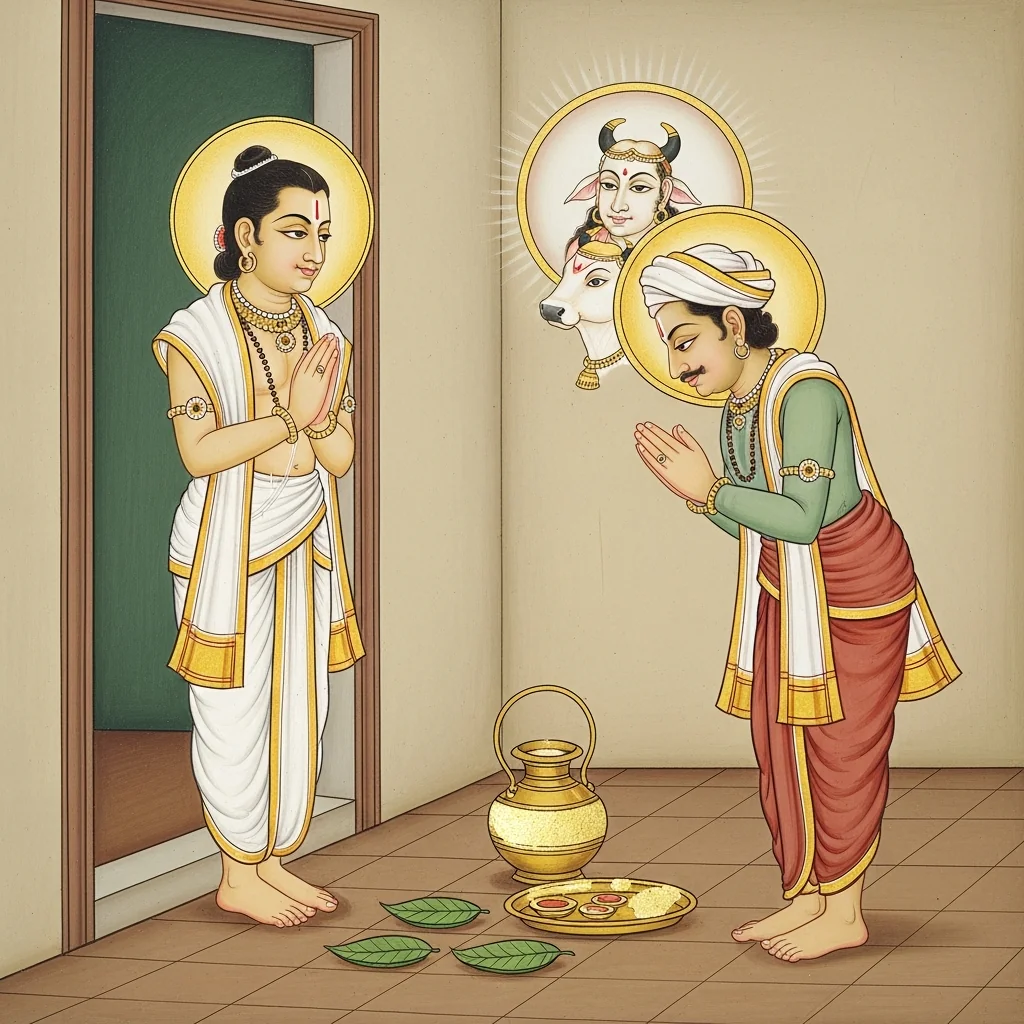
This chapter gives a technical instruction on gṛhastha-ācāra (householder discipline). Vyāsa establishes the householder as the sustaining base of society and the ritual economy: devas, pitṛs (ancestors), sages, humans, and even other creatures depend upon the gṛhastha’s support. A key metaphor describes the “Veda-cow” (trayi-mayī dhenu) with four ‘teats’—svāhā, svadhā, vaṣaṭ, hanta—signifying offerings to devas, ancestors, sages/ritual order, and human dependents, thus binding daily Vedic recitation to the duty of nourishment and care. The discourse then lays out daily observances in sequence: purification, tarpana, worship, bali offerings to beings, and formal atithi-satkāra (hospitality). “Atithi” is defined especially as a Brahmin guest, to be received without intrusion, honored, and fed. The dialogue shifts to Yudhiṣṭhira’s question on the eight forms of marriage (brāhma, daiva, ārṣa, prājāpatya, asura, gāndharva, rākṣasa, paiśāca), ranking them ethically and warning against bride-price as commodification. It further codifies pañcayajña (brahma-, pitṛ-, deva-, bhūta-, nṛ-yajña), condemns neglect of vaiśvadeva and hospitality, and lists extensive rules on purity, restraint, anadhyāya (study prohibitions), speech ethics, reverence for elders, and dāna-phala (the fruits of giving). It concludes that these are śruti-smṛti-aligned norms for residents of Dharmāraṇya.
Shlokas
Verse 1
व्यास उवाच । उपकाराय साधूनां गृहस्थाश्रमवासिनाम् । यथा च क्रियते धर्मो यथावत्कथयामि ते
Vyāsa said: For the benefit of the virtuous who dwell in the householder āśrama, I shall tell you properly how dharma is to be practiced and carried out.
Verse 2
वत्स गार्हस्थ्यमास्थाय नरः सर्वमिदं जगत् । पुष्णाति तेन लोकांश्च स जयत्यभिवांछितान्
O dear one, by taking refuge in the householder path, a person nourishes this entire world; and by that very support he attains the worlds and victories he longs for.
Verse 3
पितरो मुनयो देवा भूतानि मनुजास्तथा । क्रिमिकीटपतंगाश्च वयांसि पितरोऽसुराः
Ancestors, sages, gods, all beings, and human beings alike—worms, insects and winged creatures, birds, and even the hosts of the Pitṛs and the asuras—are all sustained by this sacred order.
Verse 4
गृहस्थमुपजीवंति ततस्तृप्तिं प्रयांति च । मुखं वास्य निरीक्षंते अपो नो दास्यतीति च
They live in dependence upon the householder, and from him they attain satisfaction; they watch his face, thinking, “Will he give us water, or not?”
Verse 5
सर्वस्याधारभूता ये वत्स धेनुस्त्रयीमयी । अस्यां प्रतिष्ठितं विश्वं विश्वहेतुश्च या मता
O child, this Cow—formed of the three Vedas—is the support of all. In her the whole universe stands established; she is regarded as the very cause of the world.
Verse 6
ऋक्पृष्ठासौ यजुःसंध्या सामकुक्षिपयोधरा । इष्टापूर्तविषाणा च साधुसूक्ततनूरुहा
Her back is the Ṛgveda; her twilight-joints are the Yajurveda; her belly and udders are the Sāmaveda. Her horns are iṣṭa and pūrta (sacrificial and charitable merits), and her body-hair is made of the praises uttered by the righteous.
Verse 7
शांति पुष्टिशकृन्मूत्रा वर्णपादप्रतिष्ठिता । उपजीव्यमाना जगतां पदक्रमजटाघनैः
Her dung and urine are peace and nourishment; she stands established upon the feet of the varṇas. All worlds live by her—by the steps of her hooves and by the thick, matted tufts of her hair.
Verse 8
स्वाहाकारस्वधाकारौ वषट्कारश्च पुत्रक । हन्तकारस्तथै वान्यस्तस्याः स्तनचतुष्टयम्
O dear child, her four teats are the sacred calls: “svāhā,” “svadhā,” “vaṣaṭ,” and likewise “hantā”—these are declared to be her four udders.
Verse 9
स्वाहाकारस्तनं देवाः पितरश्च स्वधामयम् । मुनयश्च वषट्कारं देवभूतसुरेश्वराः
The gods drink from the teat of “svāhā”; the ancestors (pitṛs) from that formed of “svadhā”; and the sages (munis) from the “vaṣaṭ” teat—thus do divine beings, spirits, and lordly powers draw their nourishment from her.
Verse 10
हन्तकारं मनुष्याश्च पिबंति सततं स्तनम् । एवमध्यापयेदेव वेदानां प्रत्यहं त्रयीम्
Human beings constantly drink from the teat called “hantā”. Therefore, O Lord, one should teach the Vedic triad each day, so that this sustaining order is preserved.
Verse 11
तेषामुच्छेदकर्त्ता यः पुरुषोऽनंतपापकृत् । स तमस्यंधतामिस्रे नरके हि निमज्जति
Whoever cuts off their sustenance—such a person commits endless sin; he surely sinks into the hell called Andhatāmisra, darkness upon darkness.
Verse 12
यस्त्वेनां मानवो धेनुं स्वर्वत्सैरमरादिभिः । पूजयत्युचिते काले स स्वर्गायोपपद्यते
But the human who worships this Cow at the proper time—together with her celestial calf and the hosts of the Immortals—becomes fit for heaven.
Verse 13
तस्मात्पुत्र मनुष्येण देवर्षि पितृमानवाः । भूतानि चानुदिवसं पोष्याणि स्वतनुर्यथा
Therefore, my son, a human being should nourish—day after day—the gods and seers, the ancestors, fellow humans, and all living beings, just as one sustains one’s own body.
Verse 14
तस्मात्स्नातः शुचिर्भूत्वा देवर्षिपितृतर्पणम् । यज्ञस्यांते तथैवाद्भिः काले कुर्यात्समाहितः
Therefore, having bathed and become pure, one should, at the proper time and with a composed mind, offer tarpaṇa—water-libations—to the gods, sages, and ancestors, especially at the conclusion of worship and sacrifice.
Verse 15
सुमनोगन्धपुष्पैश्च देवानभ्यर्च्य मानवः । ततोग्नेस्तर्पणं कुर्याद्द्याच्चापि बलींस्तथा
After worshipping the gods with pure-minded devotion and fragrant flowers, one should then offer satisfaction to Agni and also present the prescribed bali-offerings.
Verse 16
नक्तंचरेभ्यो भूतेभ्यो बलिमाकाशतो हरेत् । पितॄणां निर्वपेत्तद्वद्दक्षिणाभिमुखस्ततः
One should cast bali from an elevated place toward the beings that roam by night; and likewise, facing south, one should set down the offering for the ancestors.
Verse 17
गृहस्थस्तत्परो भूत्वा समाहितमानसः । ततस्तोयमुपादाय तेष्वेवार्पण सत्क्रियाम्
The householder, devoted to these duties and steady in mind, should then take water and duly make the proper offerings to them in the prescribed manner.
Verse 18
स्थानेषु निक्षिपेत्प्राज्ञो नाम्ना तूदिश्य देवताः । एवं बलिं गृहे दत्त्वा गृहे गृहपतिः शुचिः
The wise should place the offerings in their proper places, invoking the deities by name. Thus, having given bali within the home, the householder remains pure within his own dwelling.
Verse 19
आचम्य च ततः कुर्यात्प्राज्ञो द्वारावलोकनम् । मुहूर्तस्याष्टमं भागमुदीक्षेतातिथिं ततः
Having sipped water for purification (ācamana), the wise should then look toward the doorway, waiting for an eighth part of a muhūrta, watching for the arrival of a guest.
Verse 20
अतिथिं तत्र संप्राप्तमर्घ्यपाद्योदकेन च । बुभुक्षुमागतं श्रांतं याचमानमकिंचनम्
When a guest arrives there—hungry, weary, requesting help, and possessing nothing—one should receive him with arghya and water for washing the feet.
Verse 21
ब्राह्मणं प्राहुरतिथिं संपूज्य शक्तितो बुधैः । न पृछेत्तत्राचरणं स्वाध्यायं चापि पंडितः
The wise declare a brāhmaṇa to be an ‘atithi’; honoring him according to one’s capacity, the learned householder should not interrogate him there about his conduct or even about his Vedic study.
Verse 22
शोभनाशोभनाकारं तं मन्येत प्रजापतिम् । अनित्यं हि स्थितो यस्मात्तस्मादतिथिरुच्यते
Whether appearing pleasing or unpleasing, one should regard that guest as Prajāpati himself; for since he stays only briefly and is not permanent, he is therefore called ‘atithi’.
Verse 23
तस्मै दत्त्वा तु यो भुंक्ते स तु भुंक्तेऽमृतं नरः । अतिथिर्यस्य भग्नाशो गृहात्प्रति निवर्तते
The man who eats only after giving to the guest truly partakes of amṛta, the nectar of immortality. But he from whose house a guest turns back with hope broken—
Verse 24
स दत्त्वा दुष्कृतं तस्मै पुण्यमादाय गच्छति । अपि वा शाकदानेन यद्वा तोयप्रदानतः । पूजयेत्तं नरः भक्त्या तेनैवातो विमुच्यते
He departs taking away one’s merit and leaving behind one’s demerit. Therefore one should honor the guest with devotion—even by the gift of vegetables or even by offering water—for by that alone one is freed from this fault.
Verse 25
युधिष्ठिर उवाच । विवाहा ब्राह्मदैवार्षाः प्राजापत्यासुरौ तथा । गांधर्वो राक्षसश्चापि पैशाचोष्टम उच्यते
Yudhiṣṭhira said: “The forms of marriage are called Brāhma, Daiva, and Ārṣa; likewise Prājāpatya and Āsura; also Gāndharva and Rākṣasa, and the eighth is said to be Paiśāca.”
Verse 26
एतेषां च विधिं ब्रूहि तथा कार्यं च तत्त्वतः । गृहस्थानां तथा धर्मान्ब्रूहि मे त्वं विशेषतः
Explain to me the proper procedure for these (forms of marriage), and also what should truly be done. And explain to me, in particular, the duties of householders (gṛhastha).
Verse 27
पराशर उवाच । स ब्राह्मो वरमाहूय यत्र कन्या स्वलंकृता । दीयते तत्सुतः पूयात्पुरुषानेकविंशतिम्
Parāśara said: “That is called the Brāhma (form of marriage) in which, having invited the bridegroom, the maiden—adorned—is given in marriage. The son born of that union purifies twenty-one generations of men.”
Verse 28
यज्ञस्थायर्त्विजे दैवस्तज्जः पाति चतुर्दश । वरादादाय गोद्वन्द्वमार्षस्तज्जः पुनाति षट्
The Daiva marriage is that in which the bride is given to a priest officiating at a sacrifice (yajña); the offspring born of it protects fourteen generations. The Ārṣa marriage is that in which a pair of cows is accepted from the groom; the offspring born of it purifies six generations.
Verse 29
सहोभौ चरतां धर्मं प्राजापत्यः स ईरितः । वरवध्वोः स्वेच्छय्रा च गांधर्वोऽन्योन्यमैत्रतः । प्रसह्य कन्याहरणाद्राक्षसो निन्दितः सताम्
The Prājāpatya marriage is declared to be that in which both bride and groom pursue dharma together. The Gāndharva marriage arises from mutual affection and the free choice of the two. The Rākṣasa marriage, involving the forcible abduction of the maiden, is condemned by the virtuous.
Verse 30
छलेन कन्याहरणात्पैशाचो गर्हितोऽष्टमः । प्रायः क्षत्रविशोरुक्ता गांधर्वासुरराक्षसाः
The eighth, called Paiśāca, is censured as reprehensible, for it arises from the deceitful taking away of a maiden. Moreover, the Gāndharva, Āsura, and Rākṣasa forms are said to be mostly associated with Kṣatriyas and Vaiśyas.
Verse 31
अष्टमस्त्वेष पापिष्ठः पापिष्ठानां च संभवः । सवर्णया करो ग्राह्यो धार्यः क्षत्रियया शरः
This eighth (Paiśāca) is the most sinful, and a source from which further sins arise. For a woman of one’s own varṇa, the penalty is said to be the taking of the hand; for a Kṣatriya woman, the bearing of the arrow is prescribed as the penalty.
Verse 32
प्रतोदो वैश्यया धार्यो वासोंतः शूद्रया तथा । असवर्णा स्वेष विधिः स्मृतौ दृष्टश्च वेदने
For a Vaiśya woman, the goad is to be borne as the penalty; likewise, for a Śūdra woman, the prescribed ‘vāsoṃta’ is to be borne. For a woman of a different varṇa, a distinct rule is seen in the Smṛtis and also in the Veda’s legal understanding.
Verse 33
सवर्णाभिस्तु सर्वाभिः पाणिर्ग्राह्यस्त्वयं विधिः । धर्म्ये विवाहे जायंते धर्म्याः पुत्राः शतायुषः
This rite of taking the bride’s hand in marriage is to be performed with women of one’s own varṇa. From a dharmic marriage are born righteous sons, blessed with the full span of a hundred years.
Verse 34
अधर्म्याद्धर्म्मरहिता मंदभाग्यधनायुषः । कृतकालाभिगमने धर्मोयं गृहिणः परः
From an unrighteous union arise offspring devoid of dharma—weak in fortune, wealth, and lifespan. Therefore, approaching one’s wife only at the proper time is declared the highest duty of a householder.
Verse 35
स्त्रीणां वरमनुस्मृत्य यथाकाम्यथवा भवेत् । दिवाभिगमनं पुंसामनायुष्यं परं मतम्
Keeping in mind what is best for women—whether according to proper desire or as may be fitting—daytime intercourse for men is regarded as gravely harmful to longevity.
Verse 36
श्राद्धार्हः सर्वपर्वाणि न गंतव्यानि धीमता । तत्र गछन्स्त्रियं मोहार्द्धर्मात्प्रच्यवते परात्
A wise man who is obligated to perform śrāddha should not go to women on festival or sacred observance days. Going then, out of delusion, he falls away from the higher dharma.
Verse 37
ऋतुकालाभिगामी यः स्वदारनिरतश्च यः । स सदा ब्रह्मचारी हि विज्ञेयः स गृहाश्रमी
He who approaches (his wife) only in the proper season, and who is devoted to his own lawful spouse—such a householder should be known as ever a brahmacārī, a lifelong practitioner of continence.
Verse 38
आर्षे विवाहे गोद्वंद्वं यदुक्तं तत्र शस्यते । शुल्कमण्वपि कन्यायाः कन्याविक्रयपापकृत्
In the Ārṣa form of marriage, the pair of cows spoken of there is deemed proper. But to take even the slightest bride-price for a maiden incurs the sin of selling one’s daughter.
Verse 39
अपत्यविक्रयात्कल्पं वसेद्विट्कृमिभोजने । अतो नाण्वपि कन्याया उपजीव्यं नरैर्धनम्
By selling one’s offspring, a man would dwell for a whole kalpa in the realm where worms feed on filth. Therefore, one should not live even on the smallest wealth gained as the “price” of a daughter.
Verse 40
तत्र तुष्टा महालक्ष्मीर्निवसेद्दानवारिणा । वाणिज्यं नीचसेवा च वेदानध्ययनं तथा
There, Mahālakṣmī—well pleased—abides with one who turns away from such “gifts” born of wrongdoing. In that same spirit, trade, service under the base, and even the study of the Vedas when done for livelihood are also to be avoided.
Verse 41
कुविवाहः क्रियालोपः कुले पतनहेतवः । कुर्याद्वैवाहिके चाग्नौ गृह्यकर्म्मान्वहं गृही
A bad marriage and the neglect of prescribed rites become causes of a family’s downfall. Therefore the householder should continually perform the domestic rites (gṛhya-karman) in the sacred marriage-fire.
Verse 42
पञ्चयज्ञक्रियां चापि पक्तिं दैनंदिनीमपि । गृहस्थाश्रमिणः पञ्चसूनाकर्म दिनेदिने
The householder should perform the rites of the five great sacrifices (pañca-yajña), and also the daily cooking. Day by day, through ordinary living, the gṛhastha inevitably incurs the five ‘slaughter-like’ burdens (pañca-sūnā).
Verse 43
कुण्डनी पेषणी चुल्ली ह्युदकुम्भी तु मार्जनी । तासां च पंचसूनानां निराकरणहेतवः । क्रतवः पंच निर्द्दिष्टा गृहिश्रेयोभिवर्द्धनाः
The mortar, the grinding-stone, the hearth, the water-pot, and the broom—these are declared to be the five “slaughter-places” (sources of inadvertent harm) in a house. To remove the fault arising from these five, five daily yajñas are prescribed, which increase the welfare and blessedness of the householder.
Verse 44
पठनं ब्रह्मयज्ञः स्यात्तर्पणं च पितृक्रतुः । होमो दैवो बलिर्भौत आतिथ्यं नृक्रतुः क्रमात्
Study and recitation are the Brahma-yajña; tarpaṇa, the offering of water, is the rite for the ancestors; oblation into fire is the Deva-yajña; the food-offering (bali) is the Bhūta-yajña; and hospitality to guests is the Nṛ (Manuṣya)-yajña—thus, in due order.
Verse 45
वैश्वदेवांतरे प्राप्तः सूर्योढो वातिथिः स्मृतः । अतिथेरादितोप्येते भोज्या नात्र विचारणा
One who arrives in the interval of the Vaiśvadeva offering—whether before sunrise or at sunrise—is remembered as an ‘atithi’ (guest). Such persons, beginning with the guest, are to be fed; in this there is no deliberation.
Verse 46
पितृदेवमनुष्येभ्यो दत्त्वाश्नात्यमृतं गृही । अदत्त्वान्नं च यो भुंक्ते केवलं स्वोदरंभरिः
After giving to the ancestors, the devas, and human beings, the householder eats what is like amṛta, nectar. But one who eats food without first giving is merely one who fills his own belly.
Verse 47
वैश्वदेवेन ये हीना आतिथ्येन विवर्जिताः । सर्वे ते वृषला ज्ञेयाः प्राप्तवेदा अपि द्विजाः
Those who are devoid of the Vaiśvadeva rite and who neglect hospitality—know them all to be vṛṣalas, fallen in conduct, even if they are twice-born and have studied the Veda.
Verse 48
अकृत्वा वैश्वदेवं तु भुञ्जते ये द्विजाधमाः । इह लोकेन्नहीनाः स्युः काकयोनिं व्रजंत्यथो
But those base twice-born who eat without first performing the Vaiśvadeva—here in this world they become bereft of food, and thereafter they pass into birth among the race of crows.
Verse 49
वेदोक्तं विदितं कर्म्म नित्यं कुर्यादतंद्रितः । यदि कुर्याद्यथाशक्ति प्राप्नुयात्सद्गतिं पराम्
One should ever perform, without negligence, the duties known and enjoined by the Veda. If one carries them out according to one’s capacity, one attains the supreme noble course, the highest good destiny.
Verse 50
षष्ठ्यष्टम्योर्वसेत्पापं तैले मांसे सदैव हि । चतुर्दश्यां पञ्चदश्यां तथैव च क्षुरे भगे
On the sixth and the eighth lunar days, sin is said to dwell in oil and in meat. Likewise, on the fourteenth and the fifteenth, it is said to dwell in the razor and in sexual indulgence.
Verse 51
उदयन्तं न वीक्षेत नास्तं यंतं न मस्तके । न राहुणोपस्पृष्टं च नांडस्थं वीक्षयेद्रविम्
One should not stare at the sun as it rises, nor as it sets, nor when it stands overhead. Nor should one look at the sun when it is seized by Rāhu (during an eclipse), nor when it is reflected in water.
Verse 52
न वीक्षेतात्मनो रूपमप्सु धावेन्न कर्दमे । न नग्नां स्त्रियमीक्षेत न नग्नो जलमाविशेत्
One should not look upon one’s own reflection in water; one should not run in mud. One should not gaze at a naked woman, and one should not enter water while naked.
Verse 53
देवतायतनं विप्रं धेनुं मधु मृदं तथा । जातिवृद्धं वयोवृद्धं विद्यावृद्धं तथैव च
One should offer due reverence to the abode of the gods, to a brāhmaṇa, to the cow, and likewise to honey and to sacred earth; and also to those eminent in lineage, advanced in years, and advanced in learning.
Verse 54
अश्वत्थं चैत्यवृक्षं च गुरुं जलभृतं घटम् । सिद्धान्नं दधिसिद्धार्थं गच्छन्कुर्यात्प्रदक्षिणम्
While walking, one should perform pradakṣiṇā (clockwise circumambulation) of the aśvattha tree, the sacred caitya-tree, one’s guru, a water-filled pot, cooked food offered as ‘siddhānna’, and curd mixed with white mustard—honouring these as auspicious supports of dharma.
Verse 55
रजस्वलां न सेवेत नाश्नीयात्सह भार्यया । एकवासा न भुञ्जीत न भुञ्जीतोत्कटासने
One should not consort with a menstruating woman, nor should one eat together with one’s wife. One should not take food while wearing only a single garment, and one should not eat while seated on a high or improper seat.
Verse 56
नाशुचिं स्त्रियमीक्षेत तेज स्कामो द्विजोत्तमः । असंतर्प्य पितॄन्देवान्नाद्यादन्नं च कुत्रचित्
O best of the twice-born, one who seeks to preserve tejas, spiritual lustre, should not look upon an impure woman. And without first duly satisfying the Pitṛs and the Devas, he should never partake of food anywhere.
Verse 57
पक्वान्नं चापि नो मांसं दीर्घकालं जिजीविषुः । न मूत्रणं व्रजे कुर्यान्न वल्मी के न भस्मनि
One who wishes to live long should eat only cooked food and should not eat meat. One should not urinate in a cow-pen, nor upon an anthill, nor upon ashes.
Verse 58
न गत्तेंषु ससत्त्वेषु न तिष्ठन्न व्रजन्नपि । ब्राह्मणं सूर्यमग्निं च चंद्रऋक्षगुरूनपि
Whether walking among living beings, standing still, or moving about, one should never show disrespect toward a Brāhmaṇa, the Sun, the sacred Fire, the Moon and the constellations, and one’s teachers; such reverence is declared righteous conduct in the holy Dharmāraṇya.
Verse 59
अभिपश्यन्न कुर्वीत मलमूत्रविसर्ज नम् । मुखेनोपधमेन्नाग्निं नग्नां नेक्षेत योषितम्
One should not relieve oneself while looking about. One should not blow upon the fire with the mouth. One should not look upon a naked woman.
Verse 60
नांघ्री प्रतापयेदग्नौ न वस्तु अशुचि क्षिपेत् । प्राणिहिंसां न कुर्वीत नाश्नीयात्संध्य योर्द्वयोः
One should not warm one’s feet at the sacred fire, nor throw any impure thing into it. One should not commit violence toward living beings, and one should not eat during either of the two twilight junctions (morning and evening saṃdhyā).
Verse 61
न संविशेच्च संध्यायां प्रातः सायं क्वचिद्बुधः । नाचक्षीत धयंतीं गां नेंद्रचापं प्रदर्शयेत्
A wise person should not lie down at twilight—whether at dawn or in the evening—anywhere. Nor should one look at a cow while she is suckling her calf, and one should not point out or display the rainbow (Indra’s bow).
Verse 62
नैकः सुप्यात्क्वचिच्छून्ये न शयानं प्रबोधयेत् । पंथानं नैकलो यायान्न वार्य्यंजलिना पिबेत्
One should not sleep alone in a deserted place, nor awaken a person who is asleep. One should not travel the road alone, and one should not drink water by cupping it in the hands.
Verse 63
न दिवोद्धृतसारं च भक्षयेद्दधि नो निशि । स्त्रीधर्मिणी नाभिवदेन्नाद्यादातृप्ति रात्रिषु
One should not eat by day curd whose cream has been removed, nor should one eat curd at night. A woman during her monthly course should not offer salutations, and at night one should not eat to the point of complete satiation.
Verse 64
तौर्यत्रिकप्रियो न स्यात्कांस्ये पादौ न धावयेत् । श्राद्धं कृत्वा परश्राद्धे योऽश्नीयाज्ज्ञानवर्जितः
One should not become attached to the three entertainments—song, dance, and instrumental performance—nor wash one’s feet in a bronze vessel. And after performing a śrāddha, whoever, lacking discernment, eats at another’s śrāddha acts improperly.
Verse 65
दातुः श्राद्धफलं नास्ति भोक्ता किल्बिषभुग्भवेत् । न धारयेदन्यभुक्तं वासश्चोपानहावपि
If what is offered is consumed improperly, the giver loses the fruit of the śrāddha, and the eater becomes a sharer in sin. One should not wear clothing—or even footwear—that has been used by another.
Verse 66
न भिन्नभाजनेऽश्नीयान्नासीताग्न्यादिदूषिते । आरोहणं गवां पृष्ठे प्रेतधूमं सरित्तटम्
One should not eat from a broken vessel, nor sit in a place defiled by fire and the like. One should avoid climbing onto the backs of cows, contact with smoke from funerary rites, and lingering on the riverbank in an inauspicious manner.
Verse 67
बालातपं दिवास्वापं त्यजेद्दीर्घं जिजीविषुः । स्नात्वा न मार्जयेद्गात्रं विसृजेन्न शिखां पथि
One who seeks long life should avoid the harsh sun and sleeping by day. After bathing, one should not rub the body excessively, and while on the road one should not let the sacred topknot (śikhā) fall loose.
Verse 68
हस्तौ शिरो न धुनुयान्नाकर्षेदासनं पदा । करेण नो मृजेद्गात्रं स्नानवस्त्रेण वा पुनः
One should not shake the hands above the head, nor drag one’s seat with the foot. One should not rub the body with the hand, nor again with the bathing cloth, in an improper manner.
Verse 69
शुनोच्छिष्टं भवेद्गात्रं पुनः स्नानेन शुध्यति । नोत्पाटयेल्लोमनखं दशनेन कदाचन
If a dog’s saliva touches the body, it becomes impure and is purified again by bathing. One should never pull out hairs or bite the nails with the teeth.
Verse 70
करजैः करजच्छेदं विवर्जयेच्छुभाय तु । यदायत्यां त्यजेत्तन्न कुर्यात्कर्म प्रयत्नतः
For auspiciousness, one should avoid cutting or tearing the nails with the nails. Whatever one would later regret and abandon—one should not do that act at all, even with effort.
Verse 71
अद्वारेण न गन्तव्यं स्ववेश्मापि कदाचन । क्रीडेन्नाज्ञैः सहासीत न धर्म्मघ्नैर्न रोगिभिः
One should never enter—even one’s own house—by any way other than the door. One should not play with the ignorant, nor keep company with those who destroy dharma, nor with the chronically sick in ways that compromise purity and discipline.
Verse 72
न शयीत क्वचिन्नग्नः पाणौ भुंजीत नैव च । आर्द्रपादकरास्योऽश्नन्दीर्घकालं न जीवति
One should not sleep naked anywhere, nor should one eat with food placed in the hand (without proper vessel and order). One who eats with wet feet, wet hands, and a wet mouth does not live long.
Verse 73
संविशेन्नार्द्रचरणो नोच्छिष्टः क्वचिदाव्रजेत् । शयनस्थो न चाश्नीयान्न पिबेच्च जलं द्विजः
A twice-born should not lie down with wet feet, nor go anywhere while impure from food remnants (ucchiṣṭa). Nor should he eat while lying on the bed, and he should not drink water in that posture.
Verse 74
सोपानत्को नोपविशेन्न जलं चोत्थितः पिबेत् । सर्व्वमम्लमयं नाद्यादारोग्यस्याभिलाषुकः
One should not sit down while wearing footwear, and one should not drink water while standing. A person who desires good health should not eat foods that are wholly sour in nature.
Verse 75
न निरीक्षेत विण्मूत्रे नोच्छिष्टः संस्पृशेच्छिरः । नाधितिष्ठेत्तुषांगार भस्मकेशकपालिकाः
One should not look upon feces and urine, and while still in a state of ucchiṣṭa one should not touch one’s head. One should not step upon husks, live coals, ash, hair, or broken shards of pots.
Verse 76
पतितैः सह संवासः पतनायैव जायते । दद्यादासनं मंचं न शूद्राय कदाचन
Living in close association with the fallen (patita) leads indeed to one’s own downfall. One should never offer a seat or a cot to a Śūdra.
Verse 77
ब्राह्मण्याद्धीयते विप्रः शूद्रो धर्माच्च हीयते । धर्मोपदेशः शूद्राणां स्वश्रेयः प्रतिघातयेत्
A vipra declines when he falls away from brāhmaṇya, the proper Brahmin conduct, and a Śūdra declines when he departs from his dharma. It is said that instructing Śūdras in dharma hinders one’s own spiritual welfare.
Verse 78
द्विजशुश्रूषणं धर्म्मः शूद्राणां हि परो मतः । कण्डूयनं हि शिरसः पाणिभ्यां न शुभं मतम्
Service to the twice-born (dvija) is held to be the highest dharma for Śūdras. And scratching the head with one’s own hands is deemed inauspicious.
Verse 79
आदिशेद्वैदिकं मंत्रं न शूद्राय कदाचन । ब्राह्मण्या दीयते विप्रः शूद्रो धर्म्माच्च हीयते
One should never impart a Vedic mantra to a Śūdra. A brāhmaṇa is sustained by brahminhood—by proper brahmin conduct—while a Śūdra declines when he departs from his dharma.
Verse 80
आताडनं कराभ्यां च क्रोशनं केशलुंचनम् । अशास्त्रवर्तनं भूयो लुब्धात्कृत्वा प्रतिग्रहम्
Striking with the hands, shouting, pulling out the hair, and repeatedly acting contrary to śāstra—especially after accepting gifts from the greedy—are condemned behaviors.
Verse 81
ब्राह्मणः स च वै याति नरकानेकविंशतिम् । अकालमेघस्तनिते वर्षर्तौ पांसुवर्षणे
Such a brāhmaṇa indeed goes to twenty-one hells. Likewise, thunder roaring from out-of-season clouds, in the rainy season, and the falling of dust-rain are regarded as ominous conditions.
Verse 82
महाबालध्वनौ रात्रावनध्यायाः प्रकीर्तिताः । उल्कापाते च भूकंपे दिग्दाहे मध्यरात्रिषु
At night, when a great and dreadful roaring sound arises, anadhyāya—suspension of recitation and study—is prescribed. Likewise during a meteor-fall, an earthquake, or a burning of the quarters, especially at midnight.
Verse 83
मध्ययोर्वृषलोपान्ते राज्यहारे च सूतके । दशाष्टकासु भूतायां श्राद्धाहे प्रतिपद्यपि
At the twilight junctions (sandhyā), when contact with an outcaste has ended, in the loss of a kingdom, and during impurity from birth or death; likewise on the eighth and tenth days, on the inauspicious Bhūtā observance, on days of śrāddha, and even on pratipadā (the first lunar day)—on all these occasions sacred study is to be suspended.
Verse 84
पूर्णिमायां तथाष्टम्यां विड्वरे राष्ट्रविप्लवे । उपाकर्मणि चोत्सर्गे कल्पादिषु युगादिषु
On the full-moon day and on the eighth lunar day; in times of calamity and upheaval in the realm; at the rites of upākarman and utsarga; and at the beginnings of kalpas and yugas—on all such occasions sacred study is to be set aside.
Verse 85
आरण्यकमधीत्यापि बाणसाम्नोरपि ध्वनौ । अनध्यायेषु चैतेषु चाधीयीत न वै क्वचित्
Even if one is studying the Āraṇyaka portions, and even if the sounds of arrows and battle are heard—on these anadhyāya occasions one should not study anywhere at all.
Verse 86
भूताष्टम्योः पञ्चदश्योर्ब्रह्मचारी सदा भवेत् । अनायुष्यकरं चेह परदारोपसर्पणम् । तस्मात्तद्दूरतस्त्याज्य वैरिणां चोपसेवनम्
On Bhūtāṣṭamī and on the fifteenth day (pañcadaśī), one should remain firmly established in brahmacarya. In this world, approaching another’s wife diminishes longevity; therefore it must be cast away from afar—along with the company and service of enemies.
Verse 87
पूर्वर्द्धिभिः परित्यक्तमात्मानं नावमानयेत् । सदोद्यमवतां यस्माच्छ्रियो विद्या न दुर्लभाः
Even if former prosperities have abandoned one, one should not despise oneself; for to those who are ever diligent, prosperity and knowledge are not hard to attain.
Verse 88
सत्यं ब्रूयात्प्रियं बूयान्न ब्रूयात्सत्यमप्रियम् । प्रियं च नानृतं ब्रूयादेष धर्मो विधीयते
Speak the truth; speak what is pleasing. Do not speak a truth that is harsh, and do not speak a pleasing falsehood. This is the dharma that is enjoined.
Verse 89
वाचोवेगं मनावेगं जिह्वावेगं च वर्ज येत् । गुह्यजान्यपि लोमानि तत्स्पर्शादशुचिर्भवेत
One should restrain the impulsiveness of speech, the impulsiveness of the mind, and the impulsiveness of the tongue. Even the hairs born in the secret parts—by touching them one becomes impure.
Verse 90
पादधौतोदकं मूत्रमुच्छिष्टान्युदकानि च । निष्ठीवनं च श्लेष्माणं दूराद्दूरं विनिः क्षिपेत
Water used for washing the feet, urine, leftover water, spittle, and phlegm—one should cast all these far away, at a great distance.
Verse 91
अहर्न्निशं श्रुतेर्जाप्याच्छौचाचारनिषेवणात । अद्रोहवत्या बुद्ध्या च पूर्वजन्म म्मरेद्द्विजः
By day and night, through recitation of revealed śruti, through the practice of purity and right conduct, and with a mind free from malice, a twice-born person may remember the impressions of a former birth.
Verse 92
वृद्धान्प्रयत्नाद्वंदेत दद्यात्तेषां स्वमासनम । विनम्रकन्धरो भूयादनुयायात्ततश्च तान्
One should diligently bow to the elders and offer them one’s own seat. One should keep the neck bowed in humility, and thereafter accompany them respectfully.
Verse 93
श्रुतिभूदेवदेवानां नृपसाधुतपस्विनाम् । पतिव्रतानां नारीणां निन्दां कुर्यान्न कर्हि चित
At no time should one utter slander against those revered by the Veda—the Devas, the brāhmaṇas (gods upon earth), righteous kings, saints and ascetics, nor devoted and chaste women, the pativratās.
Verse 94
उद्धृत्य पञ्चमृत्पिंडान्स्नायात्परजलाशये । श्रद्धया पात्रमासाद्य यत्किंचिद्दीयते वसु
Having taken up five lumps of earth for ritual purification, one should bathe in another water-reservoir; then, approaching a worthy recipient with faith, whatever wealth is given becomes a truly meritorious dāna.
Verse 95
देशे काले च विधिना तदानंत्याय कल्पते । भूप्रदो मण्डलाधीशः सर्वत्र सुखितोऽन्नदः
When a gift is made according to rule, with due regard to place and time, its result becomes inexhaustible. The giver of land becomes a lord of provinces; the giver of food remains happy everywhere.
Verse 96
तोयदाता सुरूपः स्यात्पुष्टश्चान्नप्रदो भवेत । प्रदीपदो निर्मलाक्षो गोदातार्यमलोक भाक्
The giver of water becomes fair in form; the giver of food becomes well-nourished. The giver of a lamp gains clear and pure sight; the giver of cows attains the world of Aryaman.
Verse 97
स्वर्णदाता च दीर्घायुस्तिलदः स्याच्च सुप्रजः । वेश्मदोऽत्युच्चसौधेशो वस्त्रदश्चन्द्रलोकभाक्
The giver of gold gains long life; the giver of sesame is blessed with worthy offspring. The giver of a dwelling attains lofty mansions; the giver of garments reaches the world of the Moon.
Verse 98
हयप्रदो दिव्यदेहो लक्ष्मीवान्वृषभ प्रदः । सुभार्यः शिबिकादाता सुपर्यंकप्रदोऽपि च
The giver of a horse attains a radiant, divine body; the giver of a bull becomes endowed with prosperity. The giver of a palanquin gains an excellent spouse; and the giver of a fine bed likewise receives corresponding comforts.
Verse 99
श्रद्धया प्रतिगृह्णाति श्रद्धया यः प्रयच्छति । स्वर्गिणौ तावुभौ स्यातां पततोऽश्रद्रया त्वधः
He who accepts with faith, and he who gives with faith—both are destined for heaven; but when faith is absent, they fall downward.
Verse 100
अनृतेन क्षरेद्यज्ञस्तपो विस्मयतः क्षरेत् । क्षरेत्कीर्तिर्विनादानमायुर्विप्रापमानतः
By falsehood, yajña (sacrifice) is drained away; by vanity, tapas (austerity) is drained away. Without dāna (charity), fame is drained away; and by dishonoring brāhmaṇas, one’s lifespan is drained away.
Verse 101
गंधं पुष्पं कुशा गावः शाकं मांसं पयो दधि । मणिमत्स्यगहं धान्यं ग्राह्यमेतदुपस्थितम्
Fragrance, flowers, kuśa grass, cows, vegetables, meat, milk, curd, gems, fish, and grain—when duly presented, may be accepted as fitting offerings.
Verse 102
मधूदकं फलं मूलमेधांस्यभयदक्षिणा । अभ्युद्यतानि ग्राह्याणि त्वेतान्यपि निकृष्टतः
Honey-water, fruits, roots, firewood, and even a dakṣiṇā given as “fearlessness” (protection and assurance)—when offered forth, may also be accepted, though regarded as gifts of a lower grade.
Verse 103
दासनापितगोपालकुलमित्रार्द्धसीरिणः । भोज्यान्नाः शूद्रवर्गेमी तथात्मविनिवेदकः
Servants, barbers, cowherds, friends of the household, and even humble tillers of “half a plough”; and those of the śūdra order who partake of food offered in hospitality—these too, through self-surrender and devoted service, are counted among the residents who follow the dharma of Dharmāraṇya.
Verse 104
इत्थमाचारधर्मोयं धर्मारण्यनिवासिनाम् । श्रुतिस्मृत्युक्तधर्मोऽयं युधिष्ठिर निवेदितः
Thus has the rule of conduct of the inhabitants of Dharmāraṇya been set forth; this dharma, grounded in Śruti and Smṛti, has been declared to you, O Yudhiṣṭhira.