Adhyaya 15
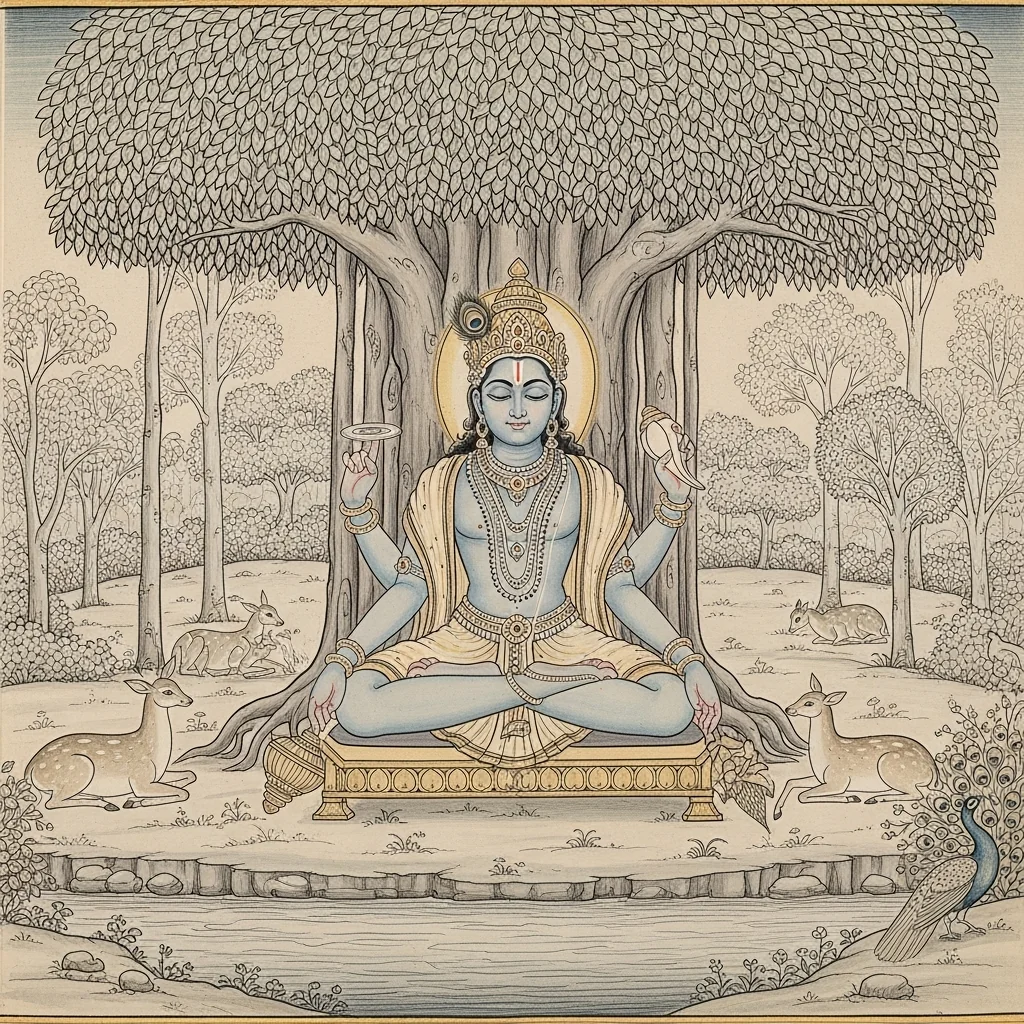
Adhyāya 15 unfolds in two linked movements. First, a divine crisis arises when the gods cannot locate a “head” (śiras), and Brahmā commissions Viśvakarman to fashion a workable form connected with ritual fulfillment. In a scene involving the Sun’s chariot, a horse-head appears and is affixed to Viṣṇu, bringing forth the Hayagrīva manifestation. The gods then offer a formal stuti, praising Hayagrīva/Viṣṇu as oṃkāra, yajña, time, the guṇas, and the deities of the elements; Viṣṇu grants boons and affirms this form as auspicious and worthy of worship. Next, through the Vyāsa–Yudhiṣṭhira dialogue, the chapter explains the cause: Brahmā’s pride in the assembly and a curse-like consequence concerning Viṣṇu’s head, followed by Viṣṇu’s tapas in Dharmāraṇya. The narrative turns to sacred geography, proclaiming Dharmāraṇya a great kṣetra and extolling Mukteśa/Mokṣeśvara and associated tīrthas, especially Devasaras/Devakhāta. Recommended observances include bathing, worship (notably in Kārttika with Kṛttikā-yoga), tarpaṇa/śrāddha, japa, and dāna, with promised fruits of sin-removal, ancestral uplift, longevity, well-being, flourishing lineage, and attainment of higher worlds.
Shlokas
Verse 1
व्यास उवाच । न पश्यंति तदा शीर्षं ब्रह्माद्यास्तु सुरास्तदा । किं कुर्म इति हेत्युक्त्वा ज्ञानिनस्ते व्यचिन्तयन्
Vyāsa said: “Then the gods, beginning with Brahmā, could not see the head. Saying, ‘What shall we do?’, those wise ones reflected.”
Verse 2
उवाच विश्वकर्माणं तदा ब्रह्मा सुरान्वितः
Then Brahmā, accompanied by the gods, spoke to Viśvakarmā.
Verse 3
ब्रह्मोवाच । विश्वकर्मस्त्वमेवासि कार्यकर्ता सदा विभो । शीघ्रमेव कुरु त्वं वै वक्त्रं सांद्रं च धन्विनः
Brahmā said: “O mighty Viśvakarmā, you indeed are ever the accomplisher of tasks. Quickly, then—fashion a firm, substantial head (face) for the archer.”
Verse 4
यज्ञकार्यं निवृत्याशु वदंति विविधाः सुराः
Having quickly halted the sacrificial proceedings, the various gods spoke among themselves.
Verse 5
यज्ञभागविहीनं मां किं पुनर्वच्मि ते ऽग्रतः । यज्ञभागमहं देव लभेयैवं सुरैः सह
“Deprived of my share in the sacrifice, what more can I say before you? O God, may I thus obtain my sacrificial portion, together with the gods.”
Verse 6
ब्रह्मोवाच । दास्यामि सर्वयज्ञेषु विभागं सुरवर्द्धके । सोमे त्वं प्रथमं वीर पूज्यसे श्रुतिकोविदैः
Brahmā said: “O increaser of the devas, I shall grant you your rightful share in all sacrifices. O Soma, O hero—among those learned in the Śruti, you shall be worshipped first.”
Verse 7
तद्विष्णोश्च शिरस्तावत्संधत्स्वामरवर्द्धक । विश्वकर्माब्रवीद्देवानानयध्वं शिरस्त्विति
“Then, O increaser of the devas, join that head to Viṣṇu’s body at once.” Viśvakarmā said to the gods: “Bring the head, indeed.”
Verse 8
तन्नास्तीति सुराः सर्वे वदंति नृपसत्तम । मध्याह्ने तु समुद्भूते रथस्थो दिवि चांशुमान्
All the devas said, “It is not there,” O best of kings. But when midday arose, the radiant Aṃśumān (the Sun), stationed in his chariot, appeared in the sky.
Verse 9
दृष्टं तदा सुरैः सर्वै रथादश्वमथानयन् । छित्त्वा शीर्षं महीपाल कबंधाद्वाजिनो हरेः
Then all the devas saw it; they brought the horse from the chariot. O king, having cut off the head of Hari’s horse from its trunk, they took it.
Verse 10
कबंधे योजयामास विश्वकर्मातिचातुरः । दृष्ट्वा तं देवदेवेशं सुराः स्तुतिमकुर्वत
The exceedingly skilful Viśvakarmā joined it to the trunk. Seeing that Lord, the God of gods, the devas then offered hymns of praise.
Verse 11
देवा ऊचुः । नमस्तेऽस्तु जगद्बीज नमस्ते कमलापते । नमस्तेऽस्तु सुरेशान नमस्ते कमलेक्षण
The gods said: “Homage to You, Seed of the universe! Homage to You, Lord of Lakṣmī! Homage to You, Sovereign of the gods! Homage to You, O lotus-eyed One!”
Verse 12
त्वं स्थितिः सर्वभूतानां त्वमेव शरणं सताम् । त्वं हंता सर्वदुष्टानां हयग्रीव नमोऽस्तु ते
“You are the sustaining power of all beings; You alone are the refuge of the righteous. You are the destroyer of all the wicked—O Hayagrīva, homage to You!”
Verse 13
त्वमोंकारो वषट्कारः स्वाहा स्वधा चतुर्विधा । आद्यस्त्वं च सुरेशान त्वमेव शरणं सदा
“You are the syllable Oṃ; You are the vaṣaṭ-call; You are svāhā and svadhā in their fourfold forms. You are the Primordial One, O Lord of the gods—indeed, You alone are the eternal refuge.”
Verse 14
यज्ञो यज्ञपतिर्यज्वा द्रव्यं होता हुतस्तथा । त्वदर्थं हूयते देव त्वमेव शरणं सखा
“You are the sacrifice, the Lord of sacrifice, the sacrificer; You are the offering-substance, the Hotṛ priest, and the oblation as well. For Your sake, O God, the offering is poured—yet You alone are the refuge, O friend.”
Verse 15
कालः करालरूपस्त्वं त्वं वार्क्कः शीतदीधितिः । त्वमग्निर्वरुणश्चैव त्वं च कालक्षयंकरः
“You are Time, formidable in form; You are the Sun, with cool-rayed brilliance. You are Agni and Varuṇa as well; and You are the one who brings about the ending of Time itself.”
Verse 16
गुणत्रयं त्वमेवेह गुणहीनस्त्वमेव हि । गुणानामालयस्त्वं च गोप्ता सर्वेषु जंतुषु
You alone are here the three guṇas—sattva, rajas, and tamas—yet You alone are truly beyond all guṇas. You are the abode where the guṇas rest, and the Protector dwelling within all living beings.
Verse 17
स्त्रीपुंसोश्च द्विधा त्वं च पशुपक्ष्यादिमानवैः । चतुर्विधं कुलं त्वं हि चतुराशीतिलक्षणः
You exist in the twofold form of female and male. Through beasts, birds, and humankind, You comprise the fourfold assemblage of life. Indeed, You are the embodiment of the eighty-four lakh (8.4 million) kinds of living beings.
Verse 18
दिनांतश्चैव पक्षांतो मासांतो हायनं युगम् । कल्पांतश्च महांतश्च कालांतस्त्वं च वै हरे
O Hari, You are the end of the day, the end of the fortnight, the end of the month, and the turning of the year and the ages. You are the end of a kalpa, the end of the great cycles, and indeed the very end of Time itself.
Verse 19
एवंविधैर्महादिव्यैः स्तूयमानः सुरैर्नृप । संतुष्टः प्राह सर्वेषां देवानां पुरतः प्रभुः
O King, thus praised by the gods with such supremely divine hymns, the Lord—well pleased—spoke before the assembled deities.
Verse 20
श्रीभगवानुवाच । किमर्थमिह संप्राप्ताः सर्वे देवगणा भुवि । किमेतत्कारणं देवाः कि नु दैत्यप्रपीडिताः
The Blessed Lord said: “For what reason have all the hosts of gods come here upon the earth? What is the cause of this, O Devas—have you been afflicted and oppressed by the Dānavas (Daityas)?”
Verse 21
देवा ऊचुः । न दैत्यस्य भयं जातं यज्ञ कर्मोत्सुका वयम् । त्वद्दर्शनपराः सर्वे पश्यामो वै दिशो दश
The Devas said: "We harbor no fear of the Daitya, for we are eager to perform the sacrificial rites. Intent on beholding You alone, we gaze anxiously in all ten directions."
Verse 22
त्वन्मायामोहिताः सर्वे व्यग्रचित्ता भयातुराः । योगारूढस्वरूपं च दृष्टं तेऽस्माभिरुत्तमम्
Deluded by Your Maya, we were all restless in mind and tormented by fear. Yet now, O Supreme One, we have beheld Your transcendental form established in Yoga.
Verse 23
वम्री च नोदितास्माभिर्जागराय तवेश्वर । ततश्चापूर्वमभवच्छिरश्छिन्नं बभूव ते
"And the ant, urged by us to awaken You, O Lord, did so. Then an unprecedented event occurred—Your head was severed; indeed, it was cut off."
Verse 24
सूर्याश्वशीर्षमानीय विश्व कर्मातिचातुरः । समधत्त शिरो विष्णो हयग्रीवोऽस्यतः प्रभो
Then the mighty Lord Hayagriva brought the head of the Sun's horse; and Vishvakarman, supremely skilled, attached that head to Vishnu.
Verse 25
विष्णुरुवाच । तुष्टोऽहं नाकिनः सर्वे ददाम्रि वरमीप्सितम् । हयग्रीवोऽस्म्यहं जातो देवदेवो जगत्पतिः
Vishnu said: "I am pleased. O dwellers of heaven, I grant the boon you desire. I have manifested as Hayagriva, the God of gods, the Lord of the universe."
Verse 26
न रौद्रं न विरूपं च सुरैरपि च सेवितम् । जातोऽहं वरदो देवा हयाननेति तोषितः
“I am neither fierce nor misshapen, nor am I one merely attended upon even by the Devas. I have manifested as a bestower of boons, O Devas—pleased by the name ‘Hayānana’ (Horse-faced).”
Verse 27
व्यास उवाच । कृते सत्रे ततो वेधा धीमान्सन्तुष्टचेतसा । यज्ञभागं ततो दत्त्वा वम्रीभ्यो विश्वकर्मणे
Vyāsa said: When the sacrificial session (satra) was completed, the wise Creator (Vedhā/Brahmā), with a heart made glad, allotted the sacrificial portion—giving it to the Vamrīs for Viśvakarman.
Verse 28
यज्ञांते च सुरश्रेष्ठं नमस्कृत्य दिवं ययौ । एतच्च कारणं विद्धि हयाननो यतो हरिः
And at the conclusion of the sacrifice, having bowed to the foremost of the Devas, he went to heaven. Know this as the reason why Hari is called Hayānana.
Verse 29
युधिष्ठिर उवाच । येनाक्रांता मही सर्वा क्रमेणैकेन तत्त्वतः । विवरे विवरे रोम्णां वर्तंते च पृथक्पृथक्
Yudhiṣṭhira said: He by whom the entire earth was truly pervaded with a single stride—within each and every pore of His hair, in every tiny opening, they exist separately, each distinct (worlds within worlds).
Verse 30
ब्रह्मांडानि सहस्राणि दृश्यंते च महाद्युते । न वेत्ति वेदो यत्पारं शीर्षघातो हि वै कथम्
Thousands of brahmāṇḍas (cosmic eggs, universes) are seen, O greatly radiant one. Even the Veda does not know His farthest limit—how then could there be any “striking of the head,” as though a final end could be reached?
Verse 31
व्यास उवाच । शृणु त्वं पांडवश्रेष्ठ कथां पौराणिकीं शुभाम् । ईश्वरस्य चरित्रं हि नैव वेत्ति चराचरे
Vyāsa said: Listen, O best of the Pāṇḍavas, to this auspicious Purāṇic account. Truly, the deeds of the Lord are not fully known even among all moving and unmoving beings.
Verse 32
एकदा ब्रह्मसभायां गता देवाः सवासवाः । भूर्लोकाद्याश्च सर्वे हि स्थावराणि चराणि च
Once, the gods—along with Indra—went to the assembly hall of Brahmā. Indeed, all beings beginning from Bhūrloka were there as well: both the immovable and the movable.
Verse 33
देवा ब्रह्मर्षयः सर्वे नमस्कर्तुं पितामहम् । विष्णुरप्यागतस्तत्र सभायां मंत्रकारणात्
All the gods and the Brahmarṣis came to bow to Pitāmaha (Brahmā). Viṣṇu too arrived there in the assembly, due to the cause of a divine deliberation and mandate (mantra).
Verse 34
ब्रह्मा चापि विगर्विष्ठ उवाचेदं वचस्तदा । भोभो देवाः शृणुध्वं कस्त्रयाणां कारणं महत्
Then Brahmā too—proud at heart—spoke these words: ‘Ho, Devas, listen: who is the great cause of the three (worlds)?’
Verse 35
सत्यं ब्रुवंतु वै देवा ब्रह्मेशविष्णुमध्यतः । तां वाचं च समाकर्ण्य देवा विस्मयमागताः
‘Let the gods indeed speak the truth—here, in the presence of Brahmā, Īśa (Śiva), and Viṣṇu.’ Hearing that statement, the gods were filled with astonishment.
Verse 36
ऊचुश्चैव ततो देवा न जानीमो वयं सुराः । ब्रह्मपत्नी तदोवाच विष्णुं प्रति सुरेश्वरम् । त्रयाणामपि देवानां महांतं च वदस्व मे
Then the gods said, “We devas do not know.” Thereupon Brahmā’s consort addressed Viṣṇu, Lord of the gods: “Tell me—among the three deities, who is truly the greatest?”
Verse 37
विष्णुरुवाच । विष्णुमायाबलेनैव मोहितं भुवनत्रयम् । ततो ब्रह्मोवाच चेदं न त्वं जानासि भो विभोः
Viṣṇu said: “By the power of Viṣṇu’s own māyā, the three worlds have been deluded.” Then Brahmā spoke: “O all-pervading one—do you not know the truth?”
Verse 38
नैव मुह्यति ते मायाबलेन नैवमेव च । गर्वहिंसापरो देवो जगद्भर्ता जगत्प्रभुः
“He is not deluded by your māyā-power—certainly not. That deity, given to pride and violence, (claims to be) the sustainer of the world and the lord of the universe.”
Verse 39
ज्येष्ठं त्वां न विदुः सर्वे विष्णुमायावृताः खिलाः । ततो ब्रह्मा स रोषेण क्रुद्धः प्रस्फुरिताननः
“All of them, covered by Viṣṇu’s māyā, do not recognize you as the eldest, the highest.” Then Brahmā, inflamed with anger, became wrathful—his face trembling.
Verse 40
उवाच वचनं कोपाद्धे विष्णो शृणु मे वचः । येन वक्त्रेण सभायां वचनं समुदीरितम्
In anger he spoke: “O Viṣṇu, listen to my words. The mouth by which that statement was uttered in the assembly—”
Verse 41
तच्छीर्षं पततादाशु चाल्पकालेन वै पुनः । ततो हाहाकृतं सर्वं सेंद्राः सर्षिपुरोगमाः
“May that head fall swiftly—indeed, within a short time!” Then all cried out in alarm—Indra and the devas, with the rishis at their forefront.
Verse 42
ब्रह्माणं क्षमयामासुर्विष्णुं प्रति सुरोत्तमाः । विष्णुश्च तद्वचः श्रुत्वा सत्यंसत्यं भविष्यति
The foremost of the gods sought to appease Brahmā, turning toward Viṣṇu. And Viṣṇu, hearing those words, said: “It shall indeed come to pass—truly, truly.”
Verse 43
ततो विष्णुर्महातेजास्तीर्थस्योत्पादनेन च । तपस्तेपे तु वै तत्र धर्मारण्ये सुरेश्वरः । अश्वशीर्ष मुखं दृष्ट्वा हयग्रीवो जनार्द्दनः
Then mighty, radiant Viṣṇu—also to bring forth a tīrtha, a sacred ford—performed austerity there in Dharmāraṇya, the Lord of the gods. And seeing a horse-headed face, Janārdana manifested as Hayagrīva.
Verse 44
तपस्तेपे महाभाग विधिना सह भारत । न शक्यं केनचित्कर्त्तुमात्मनात्मैव तुष्टवान्
O fortunate Bhārata, he performed austerity together with Vidhātṛ (Brahmā), according to due ordinance. None other can accomplish it; by his own Self alone he became satisfied, self-fulfilled.
Verse 45
ब्रह्मापि तपसा युक्तस्तेपे वर्षशतत्रयम् । तिष्ठन्नेव पुरो विष्णोर्विष्णुमायाविमोहितः
Brahmā too, endowed with austerity, performed tapas for three hundred years—standing before Viṣṇu, yet still bewildered by Viṣṇu’s māyā.
Verse 46
यज्ञार्थमवदत्तुष्टो देवदेवो जगत्पतिः । ब्रह्मंस्ते मुक्तताद्यास्ति मम मायाप्यदुःसहा
Pleased by what was offered for the sake of the sacrifice, the God of gods, the Lord of the universe, said: “O Brahmā, for you there is liberation (mokṣa) and the like; yet even My Māyā is hard to endure.”
Verse 47
ततो लब्धवरो ब्रह्मा हृष्टचित्तो जनार्द्दनः । उवाच मधुरां वाचं सर्वेषां हितकारणात्
Then Brahmā, having obtained the boon, and Janārdana, delighted at heart, spoke sweet words for the welfare of all.
Verse 48
अत्राभवन्महाक्षेत्रं पुण्यं पापप्रणाशनम् । विधिविष्णुमयं चैतद्भवत्वेतन्न संशयः
“Here let there arise a great sacred region (kṣetra)—holy and destroying sin. Let this place be pervaded by both Vidhi (Brahmā) and Viṣṇu; of this there is no doubt.”
Verse 49
तीर्थस्य महिमा राजन्हयशीर्षस्तदा हरिः । शुभाननो हि संजातः पूर्वेणैवा ननेन तु
“O King, such is the greatness of this tīrtha: Hari then became Hayagrīva (Horse-headed), indeed appearing with an auspicious face—by that former cause and by this tīrtha as well.”
Verse 50
कंदर्पकोटिलावण्यो जातः कृष्णस्तदा नृप । ब्रह्मापि तपसा युक्तो दिव्यं वर्षशतत्रयम्
“O King, then Kṛṣṇa was born with the beauty of ten million Kāmas; and Brahmā too, engaged in tapas (austerity), performed it for three hundred divine years.”
Verse 51
सावित्र्या च कृतं यत्र विष्णुमाया न बाधते । मायया तु कृतं शीर्षं पंचमं शार्दुलस्य वा
And where the rite was performed together with Sāvitrī, Viṣṇu’s Māyā brings no affliction. Yet by Māyā a head was fashioned—like a fifth one, as though a tiger bore an added head.
Verse 52
धर्मारण्ये कृतं रम्यं हरेण च्छेदितं पुरा । तस्मै दत्त्वा वरं विष्णुर्जगामादर्शनं ततः
In Dharmāraṇya, something delightful that had been made was once cut down by Hari. Having granted him a boon, Viṣṇu then departed and vanished from sight.
Verse 53
स्थापयित्वा विधिस्तत्र तीर्थं चैव त्रिलोचनम् । मुक्तेशं नाम देवस्य मोक्षतीर्थमरिंदम
Then Vidhi (Brahmā) established there a tīrtha and also a shrine of Trilocana. It became the ‘Mokṣa-tīrtha’ of the deity named Mukteśa, O subduer of foes.
Verse 54
गतः सोऽपि सुरश्रेष्ठः स्वस्थानं सुरसेवितम् । तत्र प्रेता दिवं यांति तर्पणेन प्रतर्पिताः
That best of gods too went to his own abode, attended by the gods. There, departed spirits attain heaven when satisfied through tarpaṇa, the offering of water.
Verse 55
अश्वमेधफलं स्नाने पाने गोदानजं फलम् । पुष्कराद्यानि तीर्थानि गंगाद्याः सरितस्तथा
Here, bathing yields the fruit of the Aśvamedha sacrifice; drinking its water yields the fruit born of gifting cows. It is comparable to tīrthas beginning with Puṣkara, and to rivers beginning with the Gaṅgā.
Verse 56
स्नानार्थमत्रागच्छंति देवताः पितरस्तथा । कार्त्तिक्यां कृत्तिकायोगे मुक्तेशं पूजयेत्तु यः
For sacred bathing the gods and the ancestral Fathers (Pitṛs) also come here. Whoever, in the month of Kārttika, at the conjunction with the Kṛttikā asterism, worships Mukteśa—the Lord of liberation—receives the tīrtha’s special sanctity.
Verse 57
स्नात्वा देवसरे रम्ये नत्वा देवं जनार्द्दनम् । यः करोति नरो भक्त्या सर्वपापैः प्रमुच्यते
Having bathed in the delightful Devasaras and bowed to the Lord Janārdana, the person who worships with devotion is freed from all sins.
Verse 58
भुक्त्वा भोगा न्यथाकामं विष्णुलोकं स गच्छति । अपुत्रा काकवंध्या च मृतवत्सा मृतप्रजा
Having enjoyed the pleasures he desires as he wills, he goes to the world of Viṣṇu. Even for a woman without a son, or barren, or whose child has died, or whose offspring perish, the rite of this tīrtha is taught as a remover of such afflictions.
Verse 59
एकांबरेण सुस्नातौ पतिपत्न्यौ यथाविधि । तद्दोषं नाशयेन्नूनं प्रजाप्तिप्रतिबन्धकम्
When husband and wife bathe properly according to rule, wearing a single garment, that rite surely destroys the fault that obstructs the gaining of progeny.
Verse 60
मोक्षेश्वरप्रसादेन पुत्रपौत्रादि वर्द्धयेत् । दद्याद्वैकेन चित्तेन फलानि सत्यसंयुता
By the grace of Mokṣeśvara, one’s line—sons, grandsons, and the rest—will flourish. With a single-pointed mind, joined to truthfulness, one should give fruits in charity.
Verse 61
निधाय वंशपात्रेऽपि नारी दोषात्प्रमुच्यते । प्राप्नुवंति च देवाश्च अग्निष्टोमफलं नृप
Even by placing (that offering) into the vessel of the lineage, the woman is freed from the defect; and the gods too obtain the fruit of the Agniṣṭoma sacrifice, O King.
Verse 62
वेधा हरिर्हरश्चैव तप्यंते परमं तपः । धर्मारण्ये त्रिसंध्यं च स्नात्वा देवसरस्यथ
Brahmā, Hari, and Hara themselves perform supreme austerity. In Dharmāraṇya, having bathed at the Devasaras at the three sandhyās—dawn, noon, and dusk—(one partakes in that sanctifying discipline).
Verse 63
तत्र मोक्षेश्वरः शंभुः स्थापितो वै ततः सुरैः । तत्र सांगं जपं कृत्वा न भूयः स्तनपो भवेत्
There, Śambhu as Mokṣeśvara was indeed installed by the gods. Having performed japa there along with its proper auxiliaries and observances, one will not again become a suckling—i.e., one will not be reborn.
Verse 64
एवं क्षेत्रं महाराज प्रसिद्धं भुवनत्रये । यस्तत्र कुरुते श्राद्धं पितॄणां श्रद्धयान्वितः
Thus this sacred region, O great king, is renowned in the three worlds. Whoever performs śrāddha there for the ancestors with faith—
Verse 65
उद्धरेत्सप्त गोत्राणि कुलमेकोत्तरं शतम् । देवसरो महारम्यं नानापुष्पैः समन्वितम् । श्यामं सकलकल्हारैर्विविधैर्जलजंतुभिः
He uplifts seven lineages and a hundred-and-one families. The Devasaras is exceedingly beautiful, adorned with many kinds of flowers—dark-hued with clusters of all sorts of kalhāra lotuses, and teeming with diverse aquatic creatures.
Verse 66
ब्रह्मविष्णुमहेशाद्यैः सेवितं सुरमानुषैः । सिद्धैर्यक्षैश्च मुनिभिः सेवितं सर्वतः शुभम्
It is revered by Brahmā, Viṣṇu, Maheśa, and the other gods, and is frequented by celestials and humans alike. Siddhas, Yakṣas, and sages also visit it—auspicious in every way.
Verse 67
युधिष्ठिर उवाच । कीदृशं तत्सरः ख्यातं तस्मि न्स्थाने द्विजोत्तम । तस्य रूपं प्रकारं च कथयस्व यथातथम्
Yudhiṣṭhira said: “O best of the twice-born, what is that renowned lake in that place like? Tell me its form and its nature exactly as they are.”
Verse 68
व्यास उवाच । साधुसाधु महाप्राज्ञ धर्मपुत्र युधिष्ठिर । यस्य संकीर्तनान्नूनं सर्वपापैः प्रमुच्यते
Vyāsa said: “Well asked, well asked, O great-minded Yudhiṣṭhira, son of Dharma. Indeed, by its very glorification one is surely released from all sins.”
Verse 69
अतिस्वछतरं शीतं गंगोदकसमप्रभम् । पवित्रं मधुरं स्वादु जलं तस्य नृपोत्तम
O best of kings, its water is exceedingly clear and cool, radiant like the waters of the Gaṅgā—pure, sweet, and delightful to taste.
Verse 70
महाविशालं गंभीरं देवखातं मनोरमम् । लहर्यादिभिर्गंभीरः फेनावर्तसमाकुलम्
It is vast and deep, a delightful basin as though excavated by the gods—profound with its waves and filled with foaming whirlpools.
Verse 71
झषमंडूककमठैर्मकरैश्च समाकुलम् । शंखशुक्त्यादि भिर्युक्तं राजहंसैः सुशोभितम्
It teems with fish, frogs, turtles, and even makaras; it is rich with conches, shells, and the like, and is splendidly adorned by royal swans.
Verse 72
वटप्लक्षैः समायुक्तमश्वत्थाम्रैश्च वेष्टितम् । चक्रवाकसमोपतं बकसारसटिट्टिभैः
It is furnished with banyan and plakṣa trees, encircled by aśvattha and mango trees, and graced by cakravāka birds, herons, cranes, and sandpipers.
Verse 73
कमनीय प्रगन्धाच्छच्छत्रपत्रैः सुशोभितम् । सेव्यमानं द्विजैः सर्वैः सारसाद्यैः सुशोभितम्
Charming with lovely fragrance, it is beautified by broad, umbrella-like leaves. It is resorted to by all the twice-born, and further adorned by cranes and other birds.
Verse 74
सदेवैर्मुनिभिश्चैव विप्रैर्मत्यैश्च भूमिप । सेवितं दुःखहं चैव सर्वपापप्रणाशनम्
O king, it is visited by gods, sages, brāhmaṇas, and also by mortals. It dispels sorrow and destroys all sins.
Verse 75
अनादिनिधनोदंतं सेवितं सिद्धमंडलैः । स्नानादिभिः सर्वदैव तत्सरो नृपसत्तम
O best of kings, that lake—ancient and undying in its glory—is attended by circles of Siddhas, and is ever approached for bathing and other sacred observances.
Verse 76
विधिना कुरुते यस्तु नीलोत्सर्गं च तत्तटे । प्रेता नैव कुले तस्य यावदिंद्राश्चतुर्दश
Whoever, according to the prescribed rite, performs the offering called nīlotsarga upon that riverbank—no preta (departed spirit) will arise in his lineage for as long as the fourteen Indras endure.
Verse 77
कन्यादानं च ये कुर्युर्विधिना तत्र भूपते । ते तिष्ठन्ति ब्रह्मलोके यावदाभूतसंप्लवम्
O king, those who perform kanyādāna there in accordance with proper rites dwell in Brahmaloka until the dissolution of created beings, the cosmic deluge.
Verse 78
महिषीं गृहदासीं च सुरभीं सुतसंयुताम् । हेम विद्यां तथा भूमिं रथांश्च गजवाससी
A buffalo, a household maidservant, a milch-cow (surabhī) together with her calf, gold, learning, land, chariots, elephants, and garments—these are the gifts spoken of.
Verse 79
ददाति श्रद्धया तत्र सोऽक्षयं स्वर्गमश्नुते । देवखातस्य माहात्म्यं यः पठेच्छिवसन्निधौ । दीर्घमायुस्तथा सौख्यं लभते नात्र संशयः
Whoever gives there with faith attains an imperishable heaven. And whoever recites the greatness of Devakhāta in Śiva’s presence gains long life and happiness—of this there is no doubt.
Verse 80
यः शृणोति नरो भक्त्या नारी वा त्विदमद्भुतम् । कुले तस्य भवेच्छ्रेयः कल्पांतेऽपि युधिष्ठिर
Whether man or woman, whoever hears this wondrous account with devotion—good fortune and spiritual welfare will arise in that person’s lineage even until the end of the aeon, O Yudhiṣṭhira.
Verse 81
एतत्सर्वं मयाख्यातं हयग्रीवस्य कारणम् । प्रभास्तस्य तीर्थस्य सर्वपापायनुत्तये
All this I have declared—the cause concerning Hayagrīva—so that, through the radiance and excellence of that sacred ford (tīrtha), all sins may be removed in the highest way.