Adhyaya 20
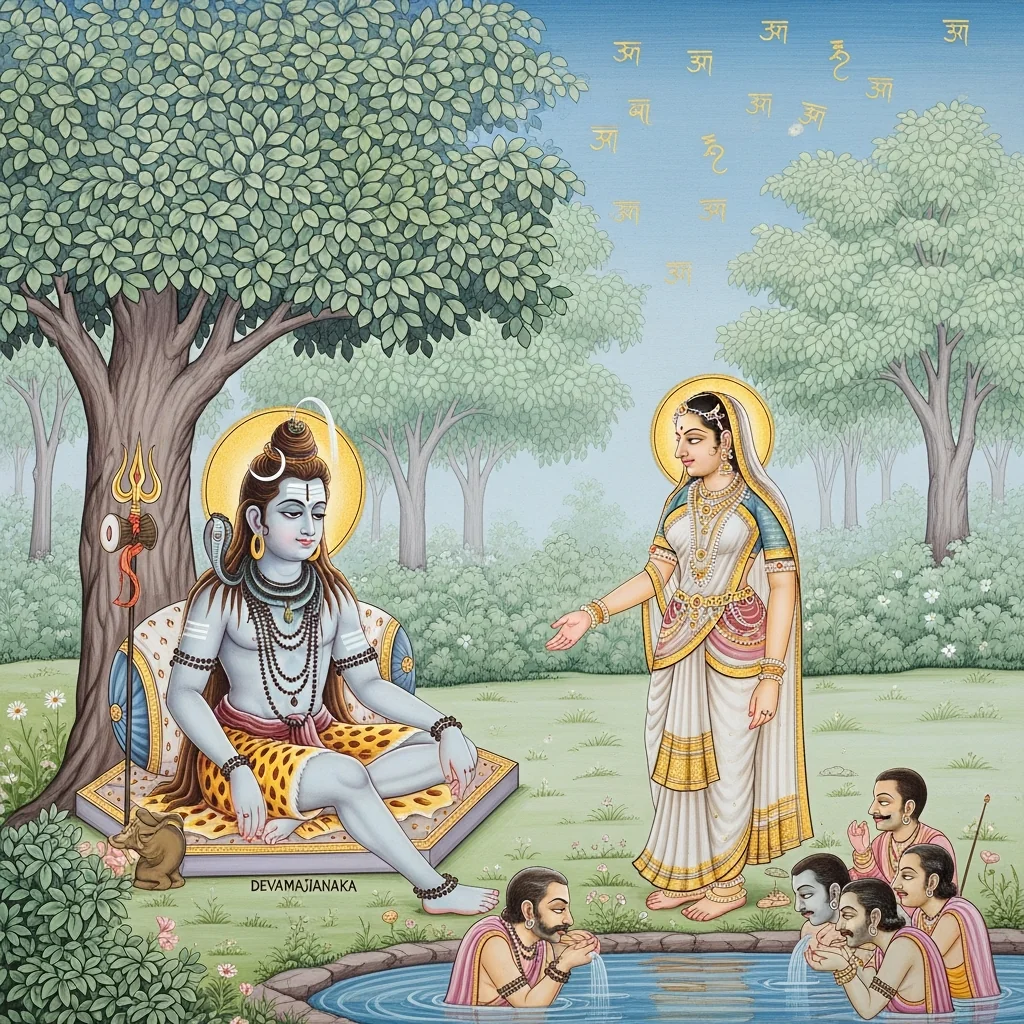
This chapter unfolds as a Vyāsa–Yudhiṣṭhira dialogue introducing an “unsurpassed” Śiva-tīrtha where Śaṅkara is said to have undergone an extraordinary state of immobilization and disorientation. From this narrative frame, the text turns to a technical theological teaching. Pārvatī questions Śiva about differentiated mantra-forms and “sixfold” powers, and Śiva replies guardedly on seed-syllables (bīja) and kūṭa-combinations, citing māyā-bīja, vahni-bīja, brahma-bīja, kāla-bīja, and pārthiva-bīja. These mantra-structures are portrayed as immensely potent yet ethically weighty—warning against misuse even while noting claimed functions such as influence, attraction, and delusion. The chapter culminates in the tīrtha-māhātmya of Devamajjanaka in Dharmāraṇya: bathing (and drinking the water), observing Aśvina kṛṣṇa caturdaśī, worship with fasting, and rudra-japa are praised as purifying, protective from afflictions, and conducive to welfare. The closing phalaśruti declares that hearing and transmitting this account yields merit equal to great sacrifices and grants prosperity, health, and continuity of lineage.
Shlokas
Verse 1
व्यास उवाच । अतः परं प्रवक्ष्यामि शिवतीर्थमनुत्तमम् । यत्रासौ शंकरो देवः पुनर्जन्मधरोऽभवत्
Vyāsa said: Next I shall describe the unsurpassed Śiva-tīrtha, where the Lord Śaṅkara himself took on the condition of renewed birth.
Verse 2
कीलितो देवदेवेशः शंकरश्च त्रिलोचनः । गिरिजया महाभाग पातितो भूमिमंडले
The Lord of the gods, Śaṅkara the Three-eyed, was as though ‘pinned’ and subdued; and by Girijā, O great one, he was cast down upon the earth’s surface.
Verse 3
छलितो मुह्यमानस्तु दिवारात्रिं न वेत्ति च । पुंस्त्रीनपुंसकाश्चैव जडीभूतस्त्रिलोचनः
Deluded and bewildered, he no longer knew day from night; and the Three-eyed One, stupefied, could not distinguish male, female, or neuter.
Verse 4
कल्पांतमिव संजातं तदा तस्मिंश्च कीलिते । पार्वत्या सहसा तस्य कृत कीलनकं तदा
When he had thus been immobilized, it seemed as though the end of an aeon had arrived. Then Pārvatī suddenly performed upon him that act of ‘pinning’.
Verse 5
युधिष्ठिर उवाच । एतदाश्चर्यमतुलं वचनं यत्त्वयोदितम् । यो गुरुः सर्वदेवानां योगिनां चैव सर्वदा
Yudhiṣṭhira said: Wondrous and unparalleled is this statement you have spoken—that He who is ever the Guru of all the devas and of the yogins could be so affected.
Verse 6
पार्वत्या कीलितः कस्मा न्नष्टवृत्तिः शिवः कथम् । कारणं कथ्यतां तत्र परं कौतूहलं हि मे
Why was Śiva immobilized by Pārvatī, and how did he lose his normal awareness? Please tell the cause of it, for my curiosity is great.
Verse 7
व्यास उवाच । मन्त्रौघा विविधा राजञ्छंकरेण प्रकाशिताः । पार्वत्यग्रे महाराज अथर्वणोपवेदजाः
Vyāsa said: O King, many streams of diverse mantras—born of the Atharvaṇa upaveda—were revealed by Śaṅkara before Pārvatī, O great king.
Verse 9
बीजान्युद्धृत्य वै ताभ्यो माला चैकवृता कृता । शंभुना कथिता चैव पार्वत्यग्रे नृपोत्तम
O best of kings, having extracted the seed-syllables (bīja) from them, a single-stranded rosary-formula was fashioned; and Śambhu taught it before Pārvatī.
Verse 10
तैश्चैव अष्टा भवति मंत्रोद्धारः कृतस्तु सा । साधयेत्सा महादुष्टा शाकिनी प्रमदानघे
And by those (seed-syllables), an eightfold extraction of the mantra was made. Then that exceedingly wicked Śākinī would seek to ‘accomplish’ it (to master it)—O sinless lady.
Verse 11
श्रीपार्वत्युवाच । प्रकाशितास्त्वया नाथ भेदा ह्येते षडेव हि । षड्विधाः शक्तयो नाथ अगम्यायोगमालिनीः । षड्विधोक्तं त्वयैकेन कूटात्कृतं वदस्व माम्
Śrī Pārvatī said: O Lord, you have already revealed these distinctions—indeed they are six. O Master, the powers are sixfold, hard to comprehend, and adorned with a garland of yoga. Since you alone have taught this sixfold doctrine, tell me how it is fashioned from the ‘kūṭa’, the esoteric clusters and structures.
Verse 12
श्रीमहादेव उवाच । अप्रकाशो महादेवि देवासुरैस्तु मानवैः
Śrī Mahādeva said: O great Goddess, this is not easily disclosed; it remains unrevealed to gods, to asuras, and to human beings.
Verse 13
पार्वत्युवाच । नमस्ते सर्वरूपाय नमस्ते वृषभध्वज । जटिलेश नमस्तुभ्यं नीलकण्ठ नमोस्तुते
Pārvatī said: Salutations to you who are of every form; salutations to you whose banner is the Bull. O Lord of the matted locks, salutations to you; O Nīlakaṇṭha, homage to you.
Verse 14
कृपासिंधो नमस्तुभ्यं नमस्ते कालरूपिणे । एतैश्च बहुभिर्वाक्यैः कोमलैः करुणानिधिम्
Salutations to you, ocean of compassion; salutations to you whose form is Time. With these many gentle words, she praised the treasure-house of mercy.
Verse 15
तोषयित्वाद्रितनया दण्डवत्प्रणिपत्य च । जग्राह पादयुगलं तां प्रोवाच दयापरः
Having thus pleased him, the Daughter of the Mountain bowed down full-length; and taking hold of his pair of feet, she stood before him. Then the compassionate Lord spoke to her.
Verse 16
किमर्थं स्तूयसे भद्रे याच्यतां मनसीप्सितम्
Why do you praise me so, O gentle one? Ask for what your heart desires.
Verse 17
पार्वत्युवाच । समाहारं च सध्यानं कथयस्व सविस्तरम् । असंदेहमशेषं च यद्यहं वल्लभा तव
Pārvatī said: Tell me in detail the complete compendium, together with its meditation. Explain it fully and without doubt—if indeed I am dear to you.
Verse 19
मायाबीजं तु सर्वेषां कूटानां हि वरानने । सर्वेषां मध्यमो वर्णो बिंदुना दादिशोभितः
O fair-faced one, the māyā-bīja is indeed present in all the kūṭas. In each of them, the middle letter—adorned with a bindu—shines forth.
Verse 20
वह्निबीजं सवातं च कूर्मबीजसमन्वितम् । आदित्यप्रभवं बीजं शक्तिबीजोद्भवं सदा
The fire-seed, together with the principle of wind, is joined with the tortoise-seed. The seed born of the Sun—ever arising from the Śakti-seed as its source—is thus taught.
Verse 21
एतत्कूटं चाद्यबीजं द्वितीयं च विभोर्मतम् । तृतीयं चाग्निबीजं तु संयुक्तं बिंदुनेंदुना
This kūṭa is the first seed; the second is held to be the Lord’s. The third is the fire-seed, joined with bindu and with the moon-mark.
Verse 22
चतुर्थं युक्तं शेषेण ब्रह्मबीजमृषिस्तथा । पंचमं कालबीजं च षष्ठं पार्थिव बीजकम्
The fourth (member) is to be joined with the remaining letters; and the seer (ṛṣi) is likewise to be stated with the Brahmā-seed. The fifth is the seed of Time, and the sixth is the earthly seed.
Verse 23
सप्तमे चाष्टमे बाह्यं नृसिंहेन समन्वितम् । नवमे द्वितीयमेकं च दशमे चाष्टकूटकम्
In the seventh and the eighth, the outer portion is to be used, conjoined with Narasiṃha. In the ninth, the second element alone is taken; and in the tenth, there is the eightfold kūṭa (coded grouping).
Verse 24
विपरीतं तयोर्बीजं रुद्राक्षे वर चारिणि । चतुर्दशे चतुर्थ्यर्थं पृथ्वीबीजेन संयुतम्
Their seed-syllable is to be taken in reverse order, O noble ascetic who wears rudrākṣa. In the fourteenth (member), for the purpose of the fourth step, it is joined with the earth-seed.
Verse 25
कूटाः शेषाक्षराः केचिद्रक्षिता मेनकात्मजे । सा पपात यदोर्व्यां हि शिवपत्नी तदा नृप
Some remaining syllables were kept back as kūṭas, O daughter of Menakā. Then, O King, the consort of Śiva fell upon the earth at that time.
Verse 26
रामेणाश्वासिता तत्र प्रहसंस्त्रिपुरांतकः । भद्रे यस्मात्त्वया पन्नं जंवशक्तिर्भविष्यति
There, consoled by Rāma, Tripurāntaka (Śiva) smiled and said: “O auspicious lady, since you have obtained it, the power called Jaṃva will arise for you.”
Verse 27
मारणे मोहने वश्ये आकर्षणे च क्षोभणे । यंयं कामयते नूनं ततत्सिद्धिर्भविष्यति
In harming, deluding, subjugating, attracting, and agitating—whatever aim one desires, surely its corresponding accomplishment will come to pass.
Verse 28
इति श्रुत्वा तदा देवी दुष्टचित्ता शुचिस्मिता । कूटशेषास्ततो वीराः प्रोक्तास्तस्यै तु शंभु ना
Hearing this, the goddess—wicked in intent yet smiling with seeming purity—then had the remaining coded portions (kūṭa) declared to her by Śambhu.
Verse 29
उवाच च कृपासिंधुः साधयस्व यथाविधि । कैलासात्तु हरस्तत्र धर्मारण्यं गतो भृशम्
And the Ocean of Compassion said, “Accomplish it according to the proper rule.” Then Hara, departing from Kailāsa, went there to Dharmāraṇya with great resolve.
Verse 30
ज्ञात्वा देवी ययौ तत्र यत्रासौ वृषभध्वजः । तत्क्षणात्पतितो भूमौ धर्मारण्ये नृपोत्तम
Knowing this, the goddess went to the place where the Bull-bannered Lord was. In that very instant, he fell upon the ground in Dharmāraṇya, O best of kings.
Verse 31
मुंडमाला च कौपीनं कपालं ब्रह्मणस्तु वै
And there were a garland of skulls, a loincloth, and a skull-bowl—indeed, belonging to Brahmā.
Verse 32
गता गणाश्च सर्वत्र भूतप्रेता दिशो दश । विसंज्ञं च स्वमात्मानं ज्ञात्वा देवो महेश्वरः
When the gaṇas had dispersed everywhere, and hosts of spirits and departed beings had spread through the ten directions, the Lord Mahādeva, realizing that his own being had fallen into unconsciousness, then acted accordingly.
Verse 33
स्वेदजास्तु समुत्पन्ना गणाः कूटादयस्तथा । पंचकूटान्समुत्पाद्य तस्मात्तदाधमूलिने
From the sweat-born generation arose gaṇas such as Kūṭa and others; and from that very source they brought forth the five ‘Kūṭas’, becoming established from that same root and origin.
Verse 34
साधकास्ते महाराज जपहोमपरायणाः । प्रेतासनास्तु ते सर्वे कालकूटोपरि स्थिताः
Those sādhakas, O great king, were devoted to japa and to fire-offerings. All of them, seated upon pretas, were stationed upon Kālākūṭa.
Verse 35
कथयंति स्वमात्मानं येन मोक्षः पिनाकिनः । ततः कष्टसमाविष्टा गौरी वह्निभयातुरा
They spoke of their own inner state, by which the Pināka-bearing Lord grants liberation. Thereupon Gaurī, overwhelmed by hardship and distressed by fear of fire, responded.
Verse 36
सभाजितः शिवस्तैश्च गौरी ह्रीणा त्वधोमुखी । तपस्तेपे च तत्रस्था शंकरादेशकारिणी
Śiva was honored by them, and Gaurī—bashful, with her face downcast—performed tapas there, abiding in that place and carrying out Śaṅkara’s command.
Verse 37
पंचाग्निसेवनं कृत्वा धूम्रपानमधोमुखी । कूटाक्षरैः स्तुतस्तैस्तु तोषितो वृषभध्वजः
Having undertaken the observance of the five fires and drinking smoke with her face turned downward, she praised Him with enigmatic syllables; by those praises the Bull-bannered Lord (Śiva) was pleased.
Verse 38
धराक्षेत्रमिदं राजन्पापघ्नं सर्वकामदम् । देवमज्जनकं शुभ्रं स्थानकेऽस्मिन्विराजते
O king, this sacred field destroys sins and bestows all desires. Here, in this radiant spot, shines the pure ‘Deva-majjana’—the holy bathing place of the gods.
Verse 39
आश्विने कृष्णपक्षे च चतुर्दश्या दिने नृप । तत्र स्नात्वा च पीत्वा च सर्वपापैः प्रमुच्यते
O king, on the fourteenth lunar day in the dark fortnight of Āśvina, by bathing there and also drinking that water, one is released from all sins.
Verse 40
पूजयित्वा च देवेशमुपोष्य च विधानतः । शाकिनी डाकिनी चैव वेतालाः पितरो ग्रहाः
And having worshipped the Lord of gods and fasted according to rule, the śākinīs, ḍākinīs, vetālas, the ancestors, and the planetary forces are brought into harmony and cease to trouble.
Verse 41
ग्रहा धिष्ण्या न पीड्यंते सत्यंसत्यं वरानने । सांगं रुद्रजपं तत्र कृत्वा पापैः प्रमुच्यते
The planets and their stations do not afflict—truth, truth, O fair-faced one. Having performed the complete Rudra-japa there, inclusive of its aṅgas, one is freed from sins.
Verse 42
नश्यंति त्रिविधा रोगाः सत्यंसत्यं च भूपते । एतत्सर्वं मया ख्यातं देवमज्जनकं शृणु
Truly—most truly, O King—the threefold diseases are destroyed. All this I have declared; now listen to the account of Deva-majjānaka, the sacred bathing rite/place.
Verse 43
अश्वमेधसहस्रैस्तु कृतैस्तु भूरिदक्षिणैः । तत्फलं समवाप्नोति श्रोता श्रावयिता नरः
The listener—and the one who causes it to be recited—attains that very fruit, as though a thousand Aśvamedha sacrifices had been performed with abundant priestly gifts.
Verse 44
अपुत्रो लभते पुत्रान्निर्धनो धनमाप्नुयात् । आयुरारोग्यमैश्वर्यं लभते नात्र संशयः
The childless gains children; the poor obtains wealth. One attains long life, health, and prosperity—of this there is no doubt.
Verse 45
मनोवाक्कायजनितं पातकं त्रिविधं च यत् । तत्सर्वं नाशमायाति स्मरणात्कीर्तनान्नृप
All threefold sin—born of mind, speech, and body—entirely perishes through remembrance and through praising this sacred greatness, O King.
Verse 46
धन्यं यशस्यमायुष्यं सुखसंतानदायकम् । माहात्म्यं शृणुयाद्वत्स सर्वसौख्यान्वितो भवेत्
This māhātmya is auspicious, fame-giving, life-enhancing, and a bestower of a happy lineage. Dear one, whoever hears it becomes endowed with every happiness.
Verse 47
सर्वतीर्थेषु यत्पुण्यं सर्वदानेषु यत्फलम् । सर्वयज्ञैश्च यत्पुण्यं जायते श्रवणान्नृप
Whatever merit is found in all tīrthas, whatever fruit in all gifts, and whatever merit in all yajñas—arises from this hearing, O King.