Adhyaya 18
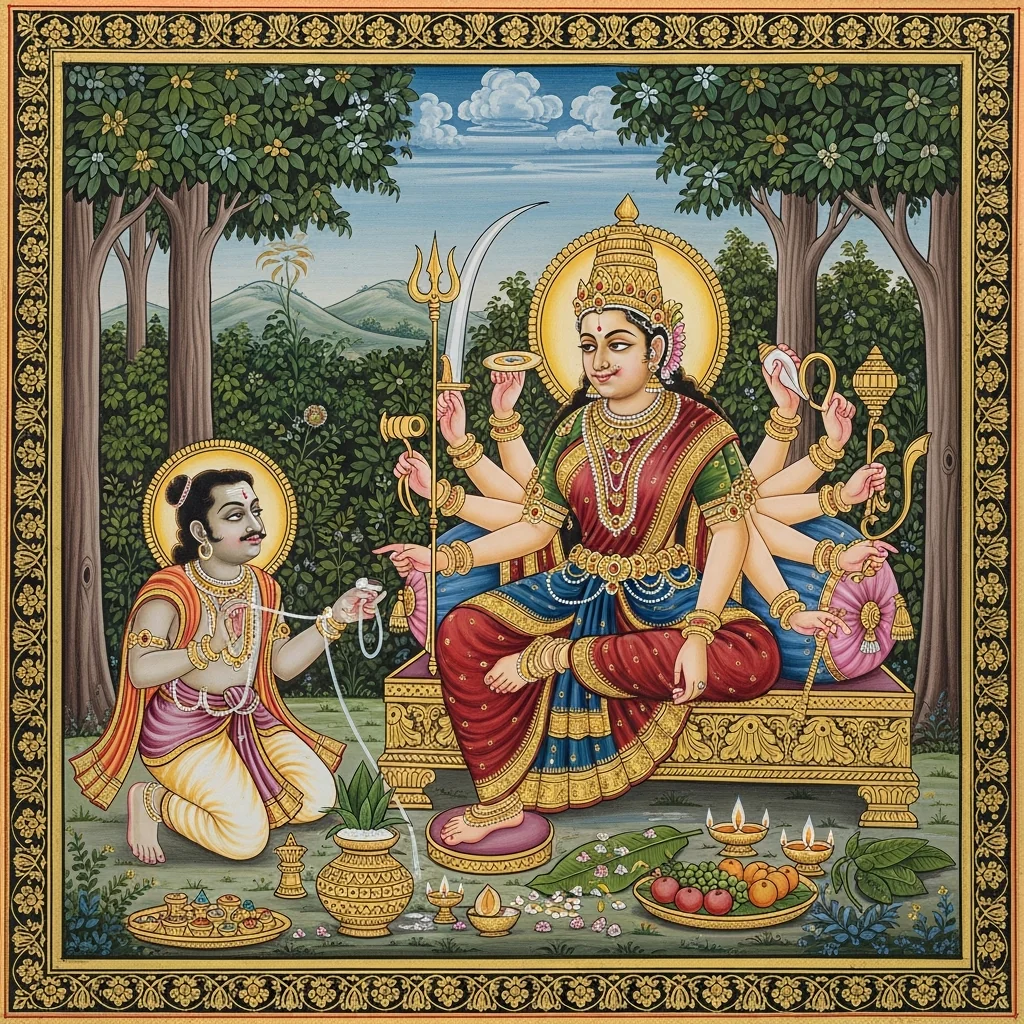
This adhyāya weaves two narrative frames: (1) Rudra tells Skanda of an earlier episode in Dharmāraṇya, where the demon Karṇāṭaka relentlessly created obstacles—especially afflicting married couples and disrupting Vedic discipline—until Śrīmātā, taking the form of Mātaṅgī/Bhuvaneśvarī, destroyed him; and (2) Vyāsa answers Yudhiṣṭhira by describing Karṇāṭaka’s nature, his anti-Vedic violence, and the ritual response of the brāhmaṇas and the local community (including merchants). A coordinated worship protocol is set forth: bathing with pañcāmṛta, sprinkling gandhodaka (perfumed water), offering dhūpa-dīpa, naivedya, and many gifts—milk-products, sweets, grains, lamps, and festival foods. Śrīmātā appears, grants protection, and manifests a fierce, many-armed martial form bearing eighteen weapons. A dramatic battle follows: the demon employs deception and weaponry, while the Goddess counters with divine restraints and decisive power, ending in Karṇāṭaka’s defeat. The chapter closes with guidance: worship of Śrīmātā at the beginning of auspicious rites—especially marriage—prevents vighna (hindrances). Its phala is stated plainly: progeny for the childless, wealth for the poor, and health and longevity for the household, tied to continued observance.
Shlokas
Verse 1
रुद्र उवाच । शृणु स्कन्द महाप्राज्ञ ह्यद्भुतं यत्कृतं मया । धर्मारण्ये महादुष्टो दैत्यः कर्णाटकाभिधः
Rudra said: Listen, O Skanda, great sage, to the wondrous deed performed by me. In Dharmāraṇya there was a most wicked Daitya named Karṇāṭaka.
Verse 2
निभृतं हि समागत्य दंपत्योर्विघ्नमाचरत् । तं दृष्ट्वा तद्भयाल्लोकः प्रदुद्राव निरन्तरम्
Coming stealthily, he set obstacles in the path of couples. Seeing him, people—stricken with fear—fled without pause.
Verse 3
त्यक्त्वा स्थानं गताः सर्वे वणिजो वाडवादयः । मातंगीरूपमास्थाय श्रीमात्रा त्वनया सुत
Abandoning their place, all—merchants and others—departed. Then Śrīmātā, assuming the form of Mātaṅgī, acted by this means, O son.
Verse 4
हतः कर्णाटको नाम राक्षसो द्विजघातकः । तदा सर्वेऽपि वै विप्रा हृष्टास्ते तेन कर्मणा
Karṇāṭaka by name—the rākṣasa, a slayer of brāhmaṇas—was killed. Then indeed all the brāhmaṇas rejoiced at that deed.
Verse 5
स्तुवंति पूजयंति स्म वणिजो भक्तितत्पराः । वर्षेवर्षे प्रकुर्वंति श्रीमातापूजनं शुभम्
The merchants, steadfast in devotion, praised and worshipped her. Year after year they performed the auspicious worship of Śrīmātā.
Verse 6
शुभकार्येषु सर्वेषु प्रथमं पूजयेत्तु ताम् । न स विघ्नं प्रपश्येत तदाप्रभृति पुत्रक
In all auspicious undertakings, one should worship her first. From that time onward, O son, he will not encounter obstacles.
Verse 7
युधिष्ठिर उवाच । कोऽसौ दुष्टो महादैत्यः कस्मिन्वंशे समुद्भवः । किं किं तेन कृतं तात सर्वंं कथय सुव्रत
Yudhiṣṭhira said: “Who is this wicked great Asura? From what lineage did he arise? What deeds, in detail, did he commit? O dear one, O keeper of virtuous vows, tell me everything.”
Verse 8
व्यास उवाच । शृणु राजन्प्रवक्ष्यामि कर्णाटकविचेष्टितम् । देवानां दानवानां यो दुःसहो वीर्यदर्पितः
Vyāsa said: “Listen, O King; I shall now recount the exploit of Karṇāṭaka—he who, swollen with pride in his own might, became unbearable to both the gods and the Dānavas.”
Verse 9
दुष्टकर्मा दुराचारो महाराष्ट्रो महाभुजः । जित्वा च सकलांल्लोकांस्त्रैलोक्ये च गतागतः
Mahārāṣṭra, mighty-armed, was a doer of wicked deeds and of corrupt conduct. Having conquered all realms, he moved to and fro throughout the three worlds.
Verse 10
यत्र देवाश्च ऋषयस्तत्र गत्वा महासुरः । छद्मना वा बलेनैव विघ्नं प्रकुरुते नृप
O King, wherever the gods and sages gather, that mighty Asura goes there as well and creates obstacles—either by deception or by sheer force.
Verse 11
न वेदाध्ययनं लोके भवेत्तस्य भयेन च । कुर्वते वाडवा देवा न च संध्याद्युपासनम्
Out of fear of him, Vedic study no longer prevailed in the world; and even the gods, brought low to a wretched state, did not perform the worship that begins with the Sandhyā rites.
Verse 12
न क्रतुर्वर्तते तत्र न चैव सुरपूजनम् । देशेदेशे च सर्वत्र ग्रामेग्रामे पुरेपुरे
There, no Vedic sacrifice is performed, nor is the worship of the Devas upheld. In every region—everywhere—through village after village and city after city, this neglect is seen.
Verse 13
तीर्थेतीर्थे च सर्वत्र विघ्नं प्रकुरुतेऽसुरः । परंतु शक्यते नैव धर्मारण्ये प्रवेशितुम्
At every tīrtha and in every place, the asura contrives obstacles; yet he is utterly unable to gain entry into Dharmāraṇya.
Verse 14
भयाच्छक्त्याश्च श्रीमातुर्दानवो विक्लवस्तदा । केनोपायेन तत्रैव गम्यते त्विति चिंतयन्
Then the Dānava, shaken and bewildered by fear of the revered Mother’s power, began to ponder: “By what means can one reach that very place?”
Verse 15
विघ्नं करिष्ये हि कथं ब्राह्मणानां महात्मनाम् । वेदाध्ययनकर्तॄणां यज्ञे कर्माधितिष्ठताम्
“How could I possibly create an obstacle for those great-souled Brāhmaṇas—devoted to the study of the Vedas—who are firmly engaged in their sacred duties within the yajña?”
Verse 16
वेदाध्ययनजं शब्दं श्रुत्वा दूरात्स दानवः । विव्यथे स यथा राजन्वज्राहत इव द्विपः
Hearing from afar the sound born of Vedic study and recitation, that Dānava was shaken and pained—O King—like an elephant struck by a thunderbolt.
Verse 17
निःश्वासान्मुमुचे रोषाद्दंतैर्दंतांश्च घर्षयन् । दशमानो निजावोष्ठौ पेषयंश्च करावुभौ
In wrath he heaved heavy sighs, grinding tooth against tooth; biting his own lips, he clenched and crushed both his hands in rage.
Verse 18
उन्मत्तवद्विचरत इतश्चेतश्च मारिष । सन्निपातस्य दोषेण यथा भवति मानवः
He wandered about like a madman, here and there, O venerable one—just as a man behaves when afflicted by the disorder of sannipāta.
Verse 19
तथैव दानवो घोरो धर्मारण्यसमीपगः । भ्रमते दहते चैव दूरादेव भयान्वितः
So too that dreadful dānava, coming near Dharmāraṇya, roamed about and set things ablaze—spreading fear even from afar.
Verse 20
विवाहकाले विप्राणां रूपं कृत्वा द्विजन्मनः । तत्रागत्य दुराधर्षो नीत्वा दांपत्यमुत्तमम्
At the time of weddings, taking on the appearance of brāhmaṇas and assuming a twice-born’s demeanor, that unassailable one would come there and carry off the finest married couples.
Verse 21
उत्पपात महीपृष्ठाद्गगने सोऽसुराधमः । स्वयं च रमते पापो द्वेषाज्जातिस्वभावतः
That vilest of asuras sprang up from the earth into the sky; and that sinner delighted in it himself—out of hatred, true to his inborn nature.
Verse 22
एवं च बहुशः सोऽथ धर्मारण्याच्च दंपती । गृहीत्वा कुरुते पापं देवानामपि दुःसहम्
Thus, again and again, he would seize married couples even from Dharmāraṇya and commit a sin unbearable even for the devas.
Verse 23
विघ्नं करोति दुष्टोऽसौ दंपत्योः सततं भुवि । महाघोरतरं कर्म कुर्वंस्तस्मिन्पुरे वरे
That wicked one constantly created obstacles for married couples on earth, committing deeds most dreadful in that excellent city.
Verse 24
तत्रोद्विग्ना द्विजाः सर्वे पलायंते दिशो दश । गताः सर्वे भूमिदेवा स्त्यक्त्वा स्थानं मनोरमम्
There, all the twice-born, distressed, fled in the ten directions; all those ‘gods upon the earth’ departed, abandoning that delightful place.
Verse 25
यत्रयत्र महत्तीर्थं तत्रतत्र गता द्विजाः । उद्वसं तत्पुरं जातं तस्मिन्काले नृपोत्तम
Wherever there was a great tīrtha, there the twice-born went; and in that time, O best of kings, that city became deserted.
Verse 26
न वेदाध्ययनं तत्र न च यज्ञः प्रवर्तते । मनुजास्तत्र तिष्ठंति न कर्णाटभयार्दिताः
There, Vedic study did not continue, nor did sacrifice proceed; people remained there—no longer tormented by fear of the Karṇāṭas.
Verse 27
द्विजाः सर्वे ततो राजन्वणिजश्च महायशाः । एकत्र मिलिताः सर्वे वक्तुं मंत्रं यथोचितम्
Then, O King, all the twice-born (Dvijas) and the illustrious merchants assembled in one place, to deliberate and speak the proper counsel, as was fitting.
Verse 28
कर्णाटस्य वधोपायं मंत्रयंति द्विजर्षभाः । विचार्यमाणे तैर्दैवाद्वाग्जाता चाशरीरिणी
The bull-like sages among the twice-born deliberated on the means to slay Karṇāṭa. As they considered it, by providence a bodiless voice arose and spoke.
Verse 29
आराधयत श्रीमातां सर्वदुःखापहारिणीम् । सर्वदैत्यक्षयकरीं सर्वोपद्रवनाशनीम्
“Worship Śrīmātā, the remover of all sorrow—she who brings ruin to all Daityas and destroys every calamity.”
Verse 30
तच्छ्रुत्वा वाडवाः सर्वे हर्षव्याकुललोचनाः । श्रीमातां तु समागत्य गृहीत्वा बलिमुत्तमम्
Hearing this, all the Vāḍavas, their eyes trembling with joy, approached Śrīmātā and took up the finest offerings for her worship.
Verse 31
मधु क्षीरं दधि घृतं शर्करा पञ्चधारया । धूपं दीपं तथा चैव चंदनं कुसुमानि च
They brought honey, milk, curd, ghee, and sugar—fivefold streams for the rite—and also incense, lamps, sandalwood, and flowers.
Verse 32
फलानि विविधान्येव गृहीत्वा वाडवा नृप । धान्यं तु विविधं राजन्भक्तापूपा घृताचिताः
O King, the Vāḍavas brought many kinds of fruits and various grains as well; and they offered cooked rice and sweet cakes, richly prepared with ghee.
Verse 33
कुल्माषा वटकाश्चैव पायसं घृतमिश्रितम् । सोहालिका दीपिकाश्च सार्द्राश्च वटकास्तथा
They also brought kulmāṣa (boiled pulses), vaṭakas (fried cakes), and sweet milk-rice mixed with ghee; and other delicacies—sohālikā, dīpikā, and moist vaṭakas as well.
Verse 34
राजिकाभिश्च संलिप्ता नवच्छिद्रसमन्विताः । चंद्रबिंबप्रतीकाशा मण्डकास्तत्र कल्पिताः
There they prepared maṇḍakas (cakes), smeared with rājikā (mustard), marked with fresh perforations, and shining like the disk of the moon.
Verse 35
पञ्चामृतेन स्नपनं कृत्वा गन्धोदकेन च । धूपैर्दीपैश्च नैवेद्यैस्तोषयामासुरीश्वरीम्
After bathing the Goddess with pañcāmṛta and with scented water, they pleased the Sovereign Lady with incense, lamps, and offerings of food (naivedya).
Verse 36
नीराजनैः सकपूरैः पुष्पैर्दीपैः सुचंदनैः । श्रीमाता तोषिता राजन्सर्वोपद्रवनाशनी
O King, Śrīmātā—the destroyer of all calamities—was satisfied by their ārati, with camphor, flowers, lamps, and fine sandalwood.
Verse 37
श्रीमाता च जगन्माता ब्राह्मी सौम्या वरप्रदा । रूपत्रयं समास्थाय पालयेत्सा जगत्त्रयम्
She is the Auspicious Mother, the Mother of the universe—Brahmī, gentle and bestowing boons. Assuming a threefold form, she protects the three worlds.
Verse 38
त्रयीरूपेण धर्मात्मन्रक्षते सत्यमंदिरम् । जितेद्रिया जितात्मानो मिलितास्ते द्विजोत्तमाः
O righteous one, in the form of the Trayī—the three Vedas—she guards the temple of Truth. There stood assembled the best of the twice-born, having conquered their senses and mastered themselves.
Verse 39
तैः सर्वेरर्चिता माता चंदनाद्येन तोषिता । स्तुतिमारेभिरे तत्र वाङ्मनःकायकर्मभिः । एकचित्तेन भावेन ब्रह्मपुत्र्याः पुरः स्थिताः
Worshipped by them all, the Mother was pleased with sandal and other offerings. There they began hymns of praise with speech, mind, and bodily acts, standing before Brahmā’s Daughter with one-pointed devotion.
Verse 40
विप्रा ऊचुः । नमस्ते ब्रह्मपुत्र्यास्तु नमस्ते ब्रह्मचारिणि । नमस्ते जगतां मातर्नमस्ते सर्वगे सदा
The brahmins said: Salutations to you, O Daughter of Brahmā; salutations to you, O brahmacāriṇī, chaste ascetic. Salutations to you, O Mother of worlds; salutations to you, ever all-pervading.
Verse 41
क्षुन्निद्रा त्वं तृषा त्वं च क्रोधतंद्रादयस्तथा । त्वं शांतिस्त्वं रतिश्चैव त्वं जया विजया तथा
You are hunger and sleep; you are thirst as well; and likewise anger, sloth, and the rest. You are peace; you are delight; you are victory and also triumph.
Verse 42
ब्रह्मविष्णुमहेशाद्यैस्त्वं प्रपन्ना सुरेश्वरि । सावित्री श्रीरुमा चैव त्वं च माता व्यवस्थिता
O Sovereign of the gods, Brahmā, Viṣṇu, Maheśa and the rest take refuge in you. You abide as Sāvitrī, as Śrī, as Umā—indeed, as the Mother herself.
Verse 43
ब्रह्मविष्णु सुरेशानास्त्वदाधारे व्यवस्थिताः । नमस्तुभ्यं जगन्मातर्धृतिपुष्टिस्वरूपिणि
Brahmā, Viṣṇu, and the lords of the gods are established upon your support. Salutations to you, O Mother of the universe, whose very form is steadfastness and nourishment.
Verse 44
रतिः क्रोधा महामाया छाया ज्योतिःस्वरूपिणि । सृष्टि स्थित्यंतकृद्देवि कार्यकारणदा सदा
You are delight and anger; you are the Great Māyā; you are shadow, and you are of the nature of light. O Goddess, you accomplish creation, preservation, and dissolution, ever granting both cause and effect.
Verse 45
धरा तेजस्तथा वायुः सलिलाकाशमेव च । नमस्तेऽस्तु महाविद्ये महाज्ञानमयेऽनघे
You are earth, and fire; you are wind; you are water and also space. Salutations to you, O Great Knowledge (Mahāvidyā), O stainless one, filled with supreme wisdom.
Verse 46
ह्रींकारी देवरूपा त्वं क्लींकारी त्वं महाद्युते । आदिमध्यावसाना त्वं त्राहि चास्मान्महाभयात्
You are Hrīṃ in form, appearing as the divine; you are Klīṃ, O greatly radiant one. You are the beginning, the middle, and the end—save us also from great fear.
Verse 47
महापापो हि दुष्टात्मा दैत्योऽयं बाधतेऽधुना । त्राणरूपा त्वमेका च अस्माकं कुलदेवता
This demon, wicked at heart and burdened with great sin, afflicts us even now. You alone are our saving refuge—truly the guardian deity of our lineage.
Verse 48
त्राहित्राहि महादेवि रक्षरक्ष महेश्वरि । हनहन दानवं दुष्टं द्विजातीनां विघ्नकारकम्
Save us, save us, O Mahādevī! Protect us, protect us, O Mahēśvarī! Strike down—strike down—this wicked dānava who brings obstacles upon the dvijas!
Verse 49
एवं स्तुता तदा देवी महामाया द्विजन्मभिः । कर्णाटस्य वधार्थाय द्विजातीनां हिताय च । प्रत्यक्षा साऽभवत्तत्र वरं ब्रूहीत्युवाच ह
Thus praised by the dvijas, the Goddess Mahāmāyā—intent on slaying Karṇāṭa and securing the welfare of the dvijas—appeared there in visible form and said, “Speak the boon you seek.”
Verse 50
श्रीमातोवाच । केन वै त्रासिता विप्राः केन वोद्वेजिताः पुनः । तस्याहं कुपिता विप्रा नयिष्ये यमसादनम्
Śrīmātā said: “By whom have you brāhmaṇas been terrorized, and by whom have you been distressed again? Enraged at him, O vipras, I shall send him to Yama’s abode.”
Verse 51
क्षीणायुषं नरं वित्त येन यूयं निपीडिताः । ददामि वो द्विजातिभ्यो यथेष्टं वक्तुमर्हथ
Recognize the man whose lifespan is waning, by whom you have been oppressed. To you dvijas I grant my aid—speak freely according to your wish.
Verse 52
भक्त्या हि भवतां विप्राः करिष्ये नात्र संशयः
Because of your devotion, O vipras, I shall act—of this there is no doubt.
Verse 53
द्विजा ऊचुः । कर्णाटाख्यो महारौद्रो दानवो मदगर्वितः । विघ्नं प्रकुरुते नित्यं सत्यमंदिरवासिनाम्
The dvijas said: “A dānava named Karṇāṭa—terribly fierce and swollen with intoxicated pride—constantly creates obstacles for those dwelling at the Temple of Satya.”
Verse 54
ब्राह्मणान्सत्यशीलांश्च वेदाध्ययनतत्परान् । द्वेषाद्द्वेष्टि द्वेषणस्तान्नित्यमेव महामते । वेदविद्वेषणो दुष्टो घातयैनं महाद्युते
Out of sheer malice he hates those brāhmaṇas who are truthful in conduct and devoted to Vedic study—ever intent on harming them, O wise one. That wicked hater of the Veda—O radiant Lady—have him slain.
Verse 55
व्यास उवाच । तथेत्युक्त्वा तु सा देवी प्रहस्य कुलदेवता । वधोपायं विचिंत्यास्य भक्तानां रक्षणाय वै
Vyāsa said: “Saying ‘So be it,’ that Goddess—the lineage-deity—smiled, and devised a means for his destruction, for the protection of her devotees.”
Verse 56
ततः कोपपरा जाता श्रीमाता नृपसत्तम । कोपेन भृकुटीं कृत्वा रक्तनेत्रांतलोचनाम्
Then Śrīmātā became wholly intent on wrath, O best of kings; in anger she knit her brows, her eyes reddened at the corners.
Verse 57
कोपेन महताऽविष्टा वसंती पावकं यथा । महाज्वाला मुखान्नेत्रान्नासाकर्णाच्च भारत
Overpowered by fierce wrath, she blazed like fire fanned by the wind. Great flames burst forth from her mouth, eyes, nose, and ears, O Bhārata.
Verse 58
तत्तेजसा समुद्भूता मातंगी कामरूपिणी । काली करा लवदना दुर्दर्शवदनोज्ज्वला
From that blazing energy arose Mātaṅgī, able to assume forms at will—dark-hued, fierce-handed, with a dreadful face, shining with an unapproachable splendor.
Verse 59
रक्तमाल्यांबरधरा मदाघूर्णितलोचना । न्यग्रोधस्य समीपे सा श्रीमाता संश्रिता तदा
Wearing red garlands and red garments, her eyes rolling with divine intoxication, that auspicious Mother then took her station near a banyan tree.
Verse 60
अष्टादशभुजा सा तु शुभा माता सुशोभना । धनुर्बाणधरा देवी खड्गखेटकधारिणी
That auspicious, radiant Mother had eighteen arms, beautiful and splendid. The Goddess bore bow and arrows, and she carried sword and shield.
Verse 61
कुठारं क्षुरिकां बिभ्रत्त्रिशूलं पानपात्रकम् । गदां सर्पं च परिघं पिनाकं चैव पाशकम्
She bore an axe and a dagger, a trident and a drinking-cup; a mace, a serpent, and an iron club; and also the Pināka bow and a noose.
Verse 62
अक्षमालाधरा राजन्मद्यकुंभानुधारिणी । शक्तिं च मुशलं चोग्रं कर्तरीं खर्परं तथा
Wearing a rosary, O King, and bearing a wine-jar, she also carried a śakti-spear, a fierce pestle, scissors, and a skull-bowl as well.
Verse 63
कंटकाढ्यां च बदरीं बिभ्रती तु महानना । तत्राभवन्महायुद्धं तुमुलं लोमहर्षणम्
That great-faced Goddess, bearing a thorn-filled badarī branch, caused a mighty battle to arise there—tumultuous and hair-raising.
Verse 64
मातंग्याः सह कर्णाटदानवेन नृपोत्तम
With Mātaṅgī, O best of kings, there was combat with the Karṇāṭa demon.
Verse 65
युधिष्ठिर उवाच । कथं युद्धं समभवत्कथं चैवापवर्तत । जितं केनैव धर्मज्ञ तन्ममाचक्ष्व मारिष
Yudhiṣṭhira said: How did the battle arise, and how did it come to an end? By whom was victory attained? O knower of dharma, venerable sir—tell me that.
Verse 66
व्यास उवाच । एकदा शृणु राजेंद्र यज्जातं दैत्यसंगरे । तत्सर्वं कथयाम्याशु यथावृत्तं हि तत्पुरा
Vyāsa said: Listen, O lord of kings, to what once occurred in the battle with the daityas. I shall quickly recount it all, exactly as it happened long ago.
Verse 67
प्रणष्टयोषा ये विप्रा वणिजश्चैव भारत । चैत्रमासे तु संप्राप्ते धर्मारण्ये नृपोत्तम
O Bhārata, those brāhmaṇas and merchants whose wives had been lost, when the month of Caitra arrived, came to Dharmāraṇya, O best of kings.
Verse 68
गौरीमुद्वाहयामासुर्विप्रास्ते संशितव्रताः । स्वस्थानं सुशुभं ज्ञात्वा तीर्थराजं तथोत्तमम्
Those brāhmaṇas of steadfast vows then solemnized the marriage of Gaurī, recognizing that place as supremely auspicious—indeed the excellent ‘king of tīrthas’.
Verse 69
विवाहं तत्र कुर्वंतो मिलितास्ते द्विजोत्तमाः । कोटिकन्याकुलं तत्र एकत्रासीन्महोत्सवे । धर्मारण्ये महाप्राज्ञ सत्यं सत्यं वदाम्यहम्
As those best of twice-born gathered there to perform marriages, at that great festival in Dharmāraṇya there was, in one place, a multitude of maidens—numbering in crores. O great wise one, I speak the truth, the truth.
Verse 70
चतुर्थ्यामपररात्रेऽभ्यंतरतोऽग्निमादधुः । आसनं ब्रह्मणे दत्त्वा अग्निं कृत्वा प्रदक्षिणम्
On the fourth tithi, in the latter part of the night, they kindled the sacred fire within the enclosure. Having offered a seat to the priest, they circumambulated the fire.
Verse 71
स्थालीपाकं च कृत्वाथ कृत्वा वेदीः शुभास्तदा । चतुर्हस्ताः सकलशा नागपाश समन्विताः
Then, having performed the sthālīpāka offering and having prepared auspicious altars, they made them four hastas in measure, well-arranged, and furnished with ‘nāgapāśa’ bindings.
Verse 72
वेदमंत्रेण शुभ्रेण मंत्रयंते ततो द्विजाः । चरतां दंपतीनां हि परिवेश्य यथोचितम्
Thereafter the twice-born recited pure Vedic mantras, and, as was proper, duly served the offerings and food to the couples as they proceeded with the rite.
Verse 73
ब्रह्मणा सहितास्तत्र वाडवा स्ते सुहर्षिताः । कुर्वते वेदनिर्घोषं तारस्वरनिनादितम्
There, together with the priest, the joyful vāḍavas raised a resounding chant of the Veda, ringing out in high tones.
Verse 74
तेन शब्देन महता कृत्स्नमापूरितं नभः । तं श्रुत्वा दानवो घोरो वेदध्वनिं द्विजे रितम्
By that mighty sound the entire sky was filled. Hearing that Vedic reverberation uttered by the twice-born, a dreadful dānava was stirred.
Verse 75
उत्पपातासनात्तूर्णं ससैन्यो गतचेतनः । धावतः सर्वभृत्यास्तं ये चान्ये तानुवाच सः
He sprang up swiftly from his seat, along with his troops, his mind thrown into agitation. As all his attendants ran after him, and others too, he spoke to them.
Verse 76
श्रूयतां कुत्र शब्दोऽयं वाडवानां समुत्थितः । तस्य तद्वचनं श्रुत्वा दैतेयाः सत्वरं ययुः
“Listen—where has this sound arisen from, raised by the vāḍavas?” Hearing his words, the Daityas hurried forth at once.
Verse 77
विभ्रांतचेतसः सर्वे इतश्चेतश्च धाविताः । धर्मारण्ये गताः केचित्तत्र दृष्टा द्विजा तयः
All of them, their minds bewildered, ran here and there. Some went into the sacred Dharmāraṇya, and there those brāhmaṇas were seen.
Verse 78
उद्गिरंतो हि निगमान्विवाहसमये नृप । सर्वं निवेदयामासुः कर्णाटाय दुरात्मने
O King, reciting the Vedic hymns at the time of the wedding, they reported everything to the wicked Karṇāṭa.
Verse 79
तच्छ्रुत्वा रक्तताम्राक्षो द्विजद्विट् कोपपू रितः । अभ्यधावन्महाभाग यत्र ते दंपती नृप
Hearing that, the brāhmaṇa-hating one—red and copper-eyed, filled with rage—rushed forth, O noble one, to the place where that couple was, O King.
Verse 80
खमाश्रित्य तदा दैत्यमायां कुर्वन्स राक्षसः । अहरद्दंपती राजन्सर्वालंकारसंयुतान्
Then that rākṣasa, taking to the sky and employing demonic illusion, abducted the couple, O King—adorned with all their ornaments.
Verse 81
ततस्ते वाडवाः सर्वे संगता भुवनेश्वरीम् । बुंबारवं प्रकुर्वाणास्त्राहित्राहीति चोचिरे
Then all those women gathered before Bhuvaneśvarī; raising a loud, tumultuous cry, they called out, “Save us, save us!”
Verse 82
तच्छ्रुत्वा विश्वजननी मातंगी भुवनेश्वरी । सिंहनादं प्रकुर्वाणा त्रिशूलवरधारिणी
Hearing their cry, the Mother of the world—Mātaṅgī Bhuvaneśvarī—roared like a lioness, bearing the trident and bestowing boons.
Verse 83
ततः प्रववृते युद्धं देवीकर्णाटयोस्तथा । ऋषीणां पश्यतां तत्र वणिजां च द्विजन्मनाम्
Then battle commenced between the Goddess and Karṇāṭa, while the sages looked on there—along with merchants and the twice-born.
Verse 84
पश्यतामभवयुद्धं तुमुलं लोमहर्षणम् । अस्त्रैश्चिच्छेद मातगी मदविह्वलितं रिपुम्
As they looked on, the battle grew furious and hair-raising. With her weapons Mātaṅgī cut down the foe, maddened and unsteady with arrogance.
Verse 85
सोऽपि दैत्यस्ततस्तस्या बाणेनैकेन वक्षसि । असावपि त्रिशूलेन घातितः कश्मलं गतः
That daitya struck her in the chest with a single arrow; but he in turn was felled by the Goddess’s trident and fell into ruin and dread.
Verse 86
मुष्टिभिश्चैव तां देवीं सोऽपि ताडयतेऽसुरः । सोऽपि देव्या ततः शीघ्रं नागपाशेन यंत्रितः
That asura too struck the Goddess with his fists; but swiftly the Goddess bound and restrained him with the serpent-noose (nāgapāśa).
Verse 87
ततस्तेनैव दैत्येन गरुडास्त्रं समादधे । तया नारायणास्त्रं तु संदधे शरपातनम्
Then that very Daitya deployed the Garuḍa-weapon; and she, in reply, fitted the Nārāyaṇa-weapon, releasing a rain of arrows.
Verse 88
एवमन्योन्यमाकृष्य युध्यमानौ जयेच्छया । ततः परिघमादाय आयसं दैत्यपुंगवः
Thus, dragging one another and fighting with the desire for victory, the bull among Daityas then seized an iron club.
Verse 89
मातंगीं प्रति संकुद्धो जघान परवीरहा । देवी क्रुद्धा मुष्टिपातैश्चूर्णयामास दानवम्
Enraged against Mātaṅgī, that slayer of enemy-heroes struck. The Goddess, angered in turn, pulverized the Dānava with blows of her fists.
Verse 90
तेन मुष्टिप्रहारेण मूर्च्छितो निपपात ह । ततस्तु सहसोत्थाय शक्तिं धृत्वा करे मुदा
Stunned by that blow of the fist, he fell down unconscious. Then, suddenly rising again, he gladly took a spear in his hand.
Verse 91
शतघ्नीं पातयामास तस्या उपरि दानवः । शक्तिं चिच्छेद सा देवी मातंगी च शुभानना
The Dānava hurled a śataghnī down upon her. But that Goddess Mātaṅgī, of auspicious face, cut the spear to pieces.
Verse 92
जहासोच्चैस्तु सा सुभ्रः शतघ्नीं वज्रसन्निभा । एव मन्योन्यशस्त्रौघैरर्दयंतौ परस्परम्
Then the radiant Goddess—whose śataghnī was like a thunderbolt—laughed aloud. Thus they battered one another with torrents of weapons.
Verse 93
ततस्त्रिशूलेन हतो हृदये निपपात ह । मूर्छां विहाय दैत्योऽसौ मायां कृत्वा च राक्षसीम्
Then, struck in the heart by a trident, he fell down. Casting off his swoon, that Daitya fashioned a rākṣasī-like māyā, an illusion.
Verse 94
पश्यतां तत्र तेषां तु अदृश्योऽभून्महासुरः । पपौ पानं ततो देवी जहासारुणलोचना
Even as they watched, the great Asura became invisible. Then the red-eyed Goddess laughed and drank her drink.
Verse 95
सर्वत्रगं तं सा देवी त्रैलोक्ये सचराचरे
That Goddess sought him who moves everywhere, throughout the three worlds, with all that moves and does not move.
Verse 96
क्व पास्यस्तीति ब्रूते सा ब्रूहि त्वं सांप्रतं हि मे । कर्णाटक महादुष्ट एहि शीघ्रं हि युध्यताम्
She said, “Where will you flee? Tell me—tell me now! O Karṇāṭaka, great villain, come quickly; let battle be joined!”
Verse 97
ततोऽभवन्महायुद्धं दारुणं च भयानकम् । पपौ देवी तु मैरेयं वधार्थं सुमहाबला
Then a great battle arose—fierce and terrifying. The Goddess, of immense power, drank maireya with the intent of slaying the foe.
Verse 98
मातंगी च ततः क्रुद्धा वक्त्रे चिक्षेप दानवम् । ततोऽपि दानवो रौद्रो नासारंध्रेण निर्गतः
Then Matangi, enraged, hurled the demon into her mouth. Even so, that furious danava came out through her nostril.
Verse 99
युध्यते स पुनर्दैत्यः कर्णाटो मदपूरितः । ततो देवी प्रकुपिता मातंगी मदपूरिता
That daitya, Karnata, again fought on, swollen with intoxication. Then the Goddess Matangi, herself aroused to fierce wrath, surged with power.
Verse 100
दशनैर्मथयित्वा च चर्वयित्वा पुनःपुनः । शवास्थि मे दसा युक्तं मज्जामांसादिपूरितम्
Grinding with her teeth and chewing again and again, she reduced it to a state like corpse-bone—stuffed with marrow and flesh and the like.
Verse 110
पित्रा मे स्थापिता दैत्य रक्षार्थं हि द्विजन्मनाम् । केवलं श्यामलांगी सा सर्वलोकहितावहा
‘My father appointed me, O demon, specifically for the protection of the twice-born. That dark-limbed Goddess exists solely as the benefactress of all worlds.’
Verse 120
जगुर्गन्धर्वपतयो ननृतुश्चाप्सरोगणाः । ततोत्सवं प्रकुर्वन्तो गीतं नृत्यं शुभप्रदम्
The lords of the Gandharvas sang, and the hosts of Apsarases danced. Then, celebrating the festival, they performed auspicious song and dance that bestow blessing.
Verse 130
देव्युवाच । स्वस्थाः संतु द्विजाः सर्वे न च पीडा भविष्यति । मयि स्थितायां दुर्धर्षा दैत्या येऽन्ये च राक्षसाः
The Goddess said: “Let all the twice-born remain safe and well; no affliction shall arise. While I am established here, the hard-to-subdue Daityas and other Rākṣasas shall not prevail.”
Verse 131
शाकिनीभूतप्रेताश्च जंभाद्याश्च ग्रहास्तथा । शाकिन्यादिग्रहाश्चैव सर्पा व्याघ्रादयस्तथा
“Śākinīs, bhūtas, and pretas, and likewise the grahas beginning with Jambha; and also grahas of the śākinī-type; and serpents and tigers and other such threats as well—here they shall not cause harm.”
Verse 140
खट्वांगं बदरीं चैव अंकुशं च मनोरमम् । अष्टादशायुधैरेभिः संयुता भुवनेश्वरी
Bearing a khaṭvāṅga staff, a badarī club, and a beautiful aṅkuśa goad, the Sovereign Lady of the worlds was equipped with these eighteen weapons.
Verse 150
बल्लाकरं वरं यूपा क्षिप्तकुल्माषकं तथा । सोहालिका भिन्नवटा लाप्सिका पद्मचूर्णकम्
“Ballākara, Vara, Yūpā, and also Kṣiptakulmāṣaka; Sohālikā, Bhinnavaṭā, Lāpsikā, and Padmacūrṇaka—these are the named food-offerings prepared for the auspicious occasion.”
Verse 160
मदीयवचनं श्रुत्वा तथा कुरुत वै विधिम् । विवाहकाले संप्राप्ते दंपत्योः सौख्यहेतवे
Having heard my instruction, you should indeed perform the prescribed rite accordingly. When the time of marriage arrives, do it for the sake of the husband and wife’s happiness and well-being.
Verse 170
तिल तैलेन वा कुर्यात्पुरुषो नियतव्रतः । एकाशनं हि कुरुते यक्ष्मप्रीत्यै निरंतरम्
A man, steadfast in his vowed observance, should perform it with sesame or with sesame-oil. Indeed, he should continuously keep the discipline of taking only one meal, for the propitiation of Yakṣma.
Verse 179
तेषां कुले कदा चित्तु अरिष्टं नैव जायते । अपुत्रो लभते पुत्रान्धनहीनस्तु संपदः । आयुरारोग्यमैश्वर्यं श्रीमातुश्च प्रसादतः
In their lineage, misfortune never arises at any time. The childless obtain sons, and the poor obtain prosperity. Longevity, health, and lordly fortune come by the grace of the auspicious Mother, Śrī.