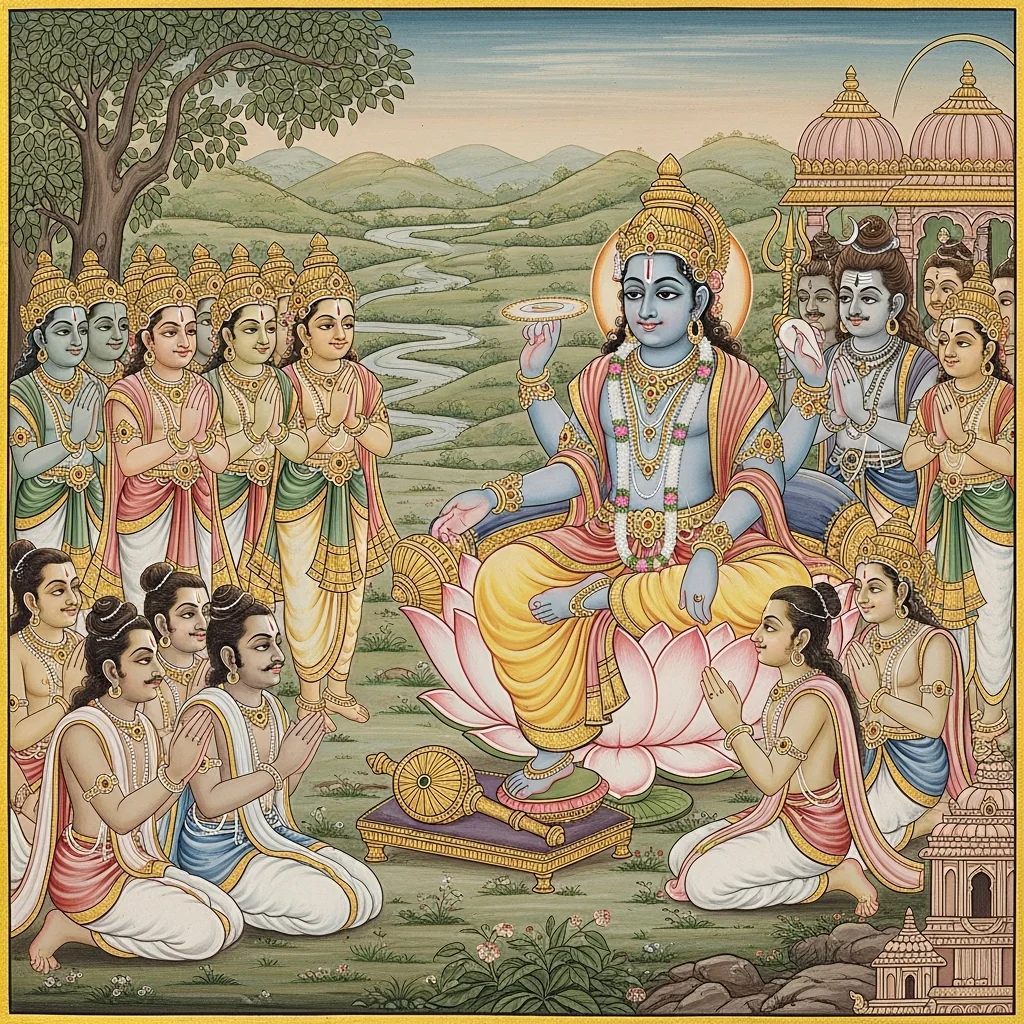
Adhyaya 11
The chapter unfolds as a dialogue between Vyāsa and Yudhiṣṭhira. Yudhiṣṭhira asks to hear more, saying the “nectar” of Vyāsa’s words never satisfies him. Vyāsa then describes a late-age calamity: the rākṣasa lord Lolajihva rises, terrifies the three worlds, comes to Dharmāraṇya, conquers the regions, and burns a beautiful sanctified settlement, driving its resident brāhmins into flight. To protect the brāhmins and destroy the rākṣasa, a vast host of goddesses manifests, led by Śrīmātā, bearing many divine weapons—triśūla, śaṅkha-cakra-gadā, pāśa-aṅkuśa, khaḍga, paraśu, and more. Lolajihva’s roar shakes the directions and the seas; Indra (Vāsava) sends Nalakūbara to reconnoiter, and the battle is reported back. Indra informs Viṣṇu, who descends (here said to come from Satyaloka), releases the Sudarśana, and renders Lolajihva powerless; amid the goddesses’ assault the rākṣasa is slain. Devas and gandharvas praise Viṣṇu; he inquires after the displaced brāhmins, who are found and reassured that Vāsudeva’s cakra has destroyed the foe. The brāhmins return with their families and resume tapas, yajña, and study. The restored settlement receives its etiological name: in Kṛta Yuga it is Dharmāraṇya, while in Tretā it becomes renowned as Satya Mandira. The chapter closes by affirming the continuity of dharma through divine protection and communal restoration.
Shlokas
Verse 1
युधिष्ठिर उवाच । अतः परं किमभवद्ब्रवीतु द्विजसत्तम । त्वद्वचनामृतं पीत्वा तृप्तिर्नास्ति मम प्रभो
Yudhiṣṭhira said: “What happened after that? Tell me, O best among the twice-born. Having drunk the nectar of your words, O Lord, I still do not feel satisfied.”
Verse 2
व्यास उवाच । अथ किंचिद्गते काले युगांतसमये सति । त्रेतादौ लोलजिह्वाक्ष अभवद्राक्षसेश्वरः
Vyāsa said: “Then, when some time had passed and the end of the age drew near, at the beginning of the Tretā-yuga there arose Lolajihvākṣa, a lord among the rākṣasas.”
Verse 3
तेन विद्रावितं सर्वं त्रैलोक्यं सचराचरम् । जित्वा स सकलांल्लोकान्धर्मारण्ये समागतः
By him the entire three worlds—moving and unmoving—were driven into flight. Having conquered all the realms, he came to Dharmāraṇya.
Verse 4
तद्दृष्ट्वा सकलं पुण्यं रम्यं द्विजनिषे वितम् । ब्रह्मद्वेषाच्च तेनैव दाहितं च पुरं शुभम्
Seeing that place—wholly sacred, delightful, and frequented by brāhmaṇas—he, out of hatred for Brahman and the sacred order, burned down the auspicious city.
Verse 5
दह्यमानं पुरं दृष्ट्वा प्रणष्टा द्विजसत्तमाः । यथागतं प्रजग्मुस्ते धर्मारण्यनिवासिनः
Seeing the city burning, the foremost brāhmaṇas fled; the residents of Dharmāraṇya departed, returning by the very way they had come.
Verse 6
श्रीमाताद्यास्तदा देव्यः कोपिता राक्षसेन वै । घातयंत्येव शब्देन तर्जयित्वा च राक्षसम्
Then the goddesses—Śrīmātā and the rest—were inflamed with wrath at that rākṣasa. With thunderous cries they rebuked and threatened him, as though to strike him down.
Verse 7
समुच्छ्रितास्तदा देव्यः शतशोऽथ सह स्रशः । त्रिशूलवरधारिण्यः शंखचक्रगदाधराः
Then the goddesses rose up—by hundreds, indeed by thousands—some bearing the trident and bestowing boons, others holding conch, discus, and mace.
Verse 8
कमंडलुधराः काश्चित्कशाखङ्गधराः पराः । पाशांकुशधरा काचित्खड्गखेटकधारिणी
Some bore the water-pot (kamandalu); others carried whips and swords. One held a noose and goad; another bore sword and shield.
Verse 9
काचित्परशुहस्ता च दिव्यायुधधरा परा । नानाभरणभूषाढ्या नानारत्नाभिशोभिता
One held an axe; another bore celestial weapons. Adorned with many ornaments, they shone with many kinds of jewels.
Verse 10
राक्षसानां विनाशाय ब्राह्मणानां हिताय च । आजग्मुस्तत्र यत्रास्ते लोलजिह्वो हि राक्षसः
For the destruction of the rākṣasas and for the welfare of the brāhmaṇas, they went to the very place where Lolajihva, the rākṣasa with the restless tongue, was staying.
Verse 11
महादंष्ट्रो महाकायो विद्युज्जिह्वो भयंकरः । दृष्ट्वा ता राक्षसो घोरं सिंहनादमथाकरोत्
That terrifying rākṣasa—huge-tusked, vast-bodied, with a lightning-like tongue—on seeing her, let out a dreadful lion-roar.
Verse 12
तेन नादेन महता त्रासितं भुवनत्रयम् । आपूरिता दिशः सर्वाः क्षुभितानेकसागराः
By that mighty roar, the three worlds were shaken with fear; all the directions were filled with its sound, and many oceans were churned into turmoil.
Verse 13
कोलाहलो महानासीद्धर्मारण्ये तदा नृप । तच्छ्रुत्वा वासवेनाथ प्रेषितो नलकूबरः
O King, a great uproar arose in Dharmāraṇya. Hearing of it, Vāsava (Indra) then dispatched Nalakūbara.
Verse 14
किमिदं पश्य गत्वा त्वं दृष्ट्वा मह्यं निवेदय । तत्तस्य वचनं श्रुत्वा गतो वै नलकूबरः
“Go and see what this is; having seen it, report it to me.” Hearing his command, Nalakūbara indeed went.
Verse 15
दृष्ट्वा तत्र महायुद्धं श्रीमातालोलजिह्वयोः । यथादृष्टं यथाजातं शक्राग्रे स न्यवेदयत्
Seeing there the great battle between Śrīmātā and Lolajihva, he reported to Śakra (Indra) exactly what he had seen and what had occurred.
Verse 16
उद्वेजयति लोकांस्त्रीन्धर्मारण्यमितो गतः । तच्छ्रुत्वा वासवो विष्णुं निवेद्य क्षितिमागमत्
“Having gone from here to Dharmāraṇya, he is terrifying the three worlds.” Hearing this, Vāsava informed Viṣṇu and came down to the earth.
Verse 17
दाहितं तत्पुरं रम्यं देवानामपि दुर्लभम् । न दृष्टा वाडवास्तत्र गताः सर्वे दिशो दश
That lovely city—hard to attain even for the gods—was burned. The mares (vāḍavāḥ) were not seen there; all had gone off into the ten directions.
Verse 18
श्रीमाता योगिनी तत्र कुरुते युद्धमुत्तमम् । हाहाभूता प्रजा सर्वा इतश्चेतश्च धावति
There, Śrīmātā the Yoginī waged an excellent battle. All the people, crying ‘Alas, alas!’, ran here and there in panic.
Verse 19
तच्छ्रुत्वा वासुदेवो हि गृहीत्वा च सुदर्शनम् । सत्यलोकात्तदा राजन्समागच्छन्महीतले
Hearing this, Vāsudeva took up Sudarśana and, O King, came then from Satyaloka down to the earth.
Verse 20
धर्मारण्यं ततो गत्वा तच्चक्रं प्रमुमोच ह । लोलजिह्वस्तदा रक्षो मूर्च्छितो निपपात ह
Then, going to Dharmāraṇya, he released that discus. At that moment Lolajihva, the rākṣasa, fell down unconscious.
Verse 21
त्रिशूलेन ततो भिन्नः शक्तिभिः क्रोधमूर्च्छितः । हन्यमानस्तदा रक्षः प्राणांस्त्यक्त्वा दिवं गतः
Then that rākṣasa, pierced by the trident and struck by spears, maddened with fury as he was being beaten down, abandoned his life-breath and went to heaven.
Verse 22
ततो देवाः सगंधर्वा हर्षनिर्भरमानसाः । तुष्टुवुस्तं जगन्नाथं सत्यलोकात्समागताः
Then the gods, together with the Gandharvas—hearts brimming with joy—came from Satyaloka and praised that Lord of the universe.
Verse 23
उद्वसं तत्समालोक्य विष्णुर्वचनमब्रवीत् । क्व च ते ब्राह्मणाः सर्वे ऋषीणामाश्रमे पुनः
Seeing that the place had become deserted, Viṣṇu spoke: “And where are all those brāhmaṇas now—back in the sages’ hermitages?”
Verse 24
ततो देवाः सगं धर्वा इतस्ततः पलायितान् । संशोध्य तरसा राजन्ब्राह्मणानिदमब्रुवन्
Then the gods, together with the Gandharvas, quickly searched for the brāhmaṇas who had fled here and there, and said this to them, O King.
Verse 25
श्रूयतां नो वचो विप्रा निहतो राक्षसाधमः । वासुदेवेन देवेन चक्रेण निरकृंतत
“Hear our words, O brāhmaṇas: the vilest of rākṣasas has been slain—cut down by the divine Vāsudeva with his discus.”
Verse 26
तच्छ्रुत्वा वाडवाः सर्वे प्रहर्षोत्फुल्ललोचनाः । समाजग्मुस्तदा राजन्स्वस्वस्थाने समाविशन्
Hearing this, all those vāḍavā people, their eyes blossoming with delight, gathered together; and, O King, they returned to their respective places and settled once more.
Verse 27
श्रीकांताय तदा राजन्वाक्यमुक्तं मनोरमम् । यस्मात्त्वं सत्यलोकाच्च आगतोऽसि जगत्प्रभुः । स्थापितं च पुरं चेदं हिताय च द्विजात्मनाम्
Then, O King, a delightful statement was addressed to Śrīkānta: “Since you, the Lord of the world, have come from Satyaloka, this city has been established for the welfare of the dvija, the twice-born.”
Verse 28
सत्यमंदिरमिति ख्यातं तदा लोके भविष्यति । कृते युगे धर्मारण्यं त्रेतायां सत्यमंदिरम्
It will then become renowned in the world as “Satyamandira.” In the Kṛta Yuga it is called Dharmāraṇya; in the Tretā Yuga, Satyamandira.
Verse 29
तच्छ्रुत्वा वासुदेवेन तथेति प्रतिपद्य च । ततस्ते वाडवाः सर्वे पुत्रपौत्रसमन्विताः
Hearing this, Vāsudeva assented, saying, “So be it.” Then all those vāḍavā people, together with their sons and grandsons,
Verse 30
सपत्नीकाः सानुचरा यथापूर्वं न्यवात्सिषुः । तपोयज्ञक्रियाद्येषु वर्तंतेऽध्ययनादिषु
With their wives and attendants, they dwelt again as before, engaging in tapas (austerity), yajña (sacrifice), and other sacred observances, and continuing in study and related disciplines.
Verse 31
एवं ते सर्वमाख्यातं धर्म वै सत्यमंदिरे
Thus, O Dharma, everything has been fully narrated to you concerning Satyamaṃdira—the holy abode of Truth.