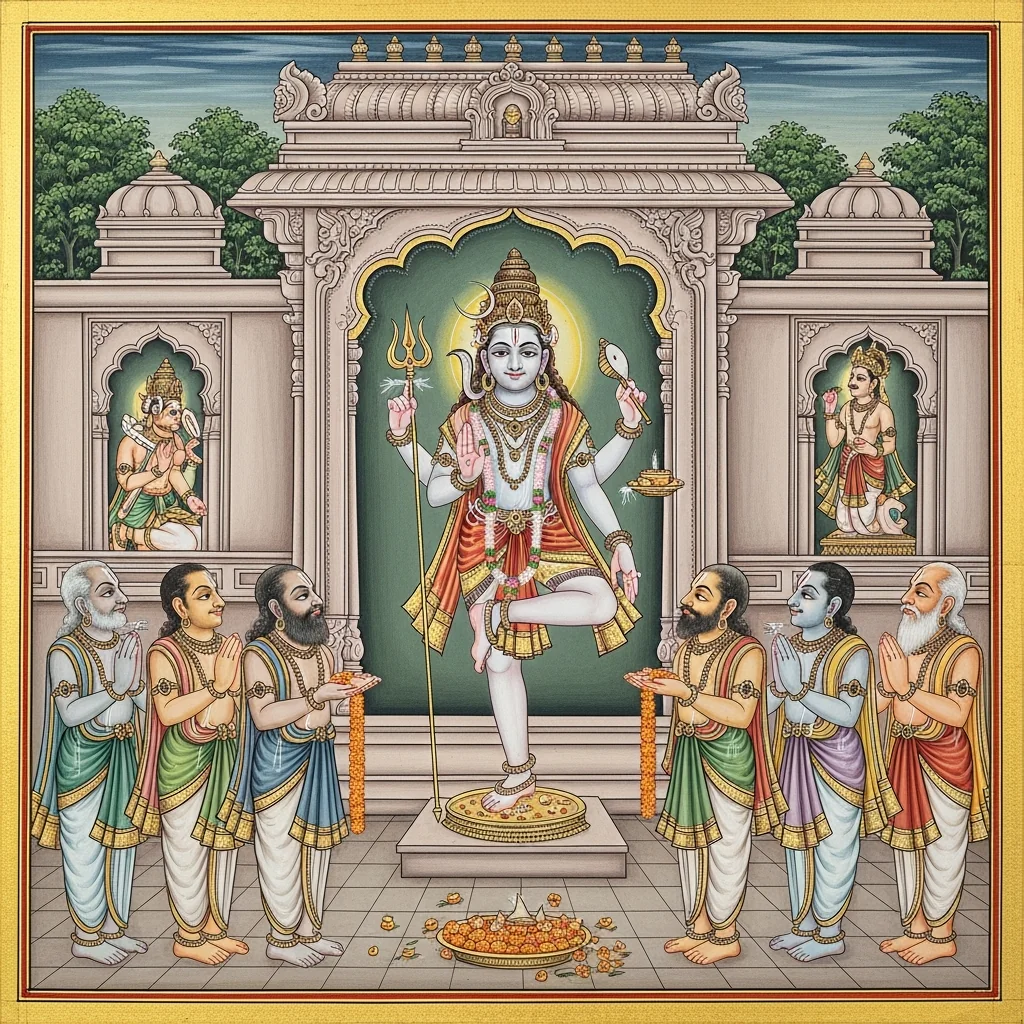
Adhyaya 12
Vyāsa tells Yudhiṣṭhira of a settlement called “Satyamandira” being ritually sacralized for protection. Its precinct is laid out with a banner-adorned enclosure wall (prākāra), a central pedestal (pīṭha) set within a Brahmin-associated space, and four purified gateways (pratolī). Directional guardians are installed—Dharmēśvara in the east, Gaṇanāyaka (Gaṇeśa) in the south, Bhānu (the Sun) in the west, and Svayambhū in the north—forming a sacred map of safeguarding. The chapter then recounts Gaṇeśa’s origin: Pārvatī fashions a child from the substance of her bodily cleansing, gives him life, and appoints him as door-guardian. When Mahādeva is barred, a battle ensues and the child is beheaded; to soothe Pārvatī’s grief, Mahādeva restores him with an elephant head (gaja-śiras) and names him Gajānana. Praised by devas and sages, Gaṇeśa grants a boon to dwell in Dharmāraṇya as an eternal protector of religious practitioners, householders, and merchant communities—removing obstacles, bestowing welfare, and receiving first worship in weddings, festivals, and sacrifices.
Shlokas
Verse 1
व्यास उवाच । ततो देवैर्नृपश्रेष्ठ रक्षार्थं सत्यमंदिरम् । स्थापितं तत्तदाद्यैव सत्याभिख्या हि सा पुरी
Vyāsa said: Then, O best of kings, the gods established Satyamaṃdira for its protection; from that very time the city indeed became renowned by the name ‘Satyā’.
Verse 2
पूर्वं धर्मेश्वरो देवो दक्षिणेन गणाधिपः । पश्चिमे स्थापितो भानुरुत्तरे च स्वयंभुवः
In the east was placed Lord Dharmeśvara; to the south, Gaṇādhipa (Gaṇeśa); in the west, Bhānu (the Sun); and to the north, Svayaṃbhu (the Self-born).
Verse 3
युधिष्ठिर उवाच । गणेशः स्थापितः केन कस्मात्स्थापितवानसौ । किं नामासौ महाभाग तन्मे कथय मा चिरम्
Yudhiṣṭhira said: By whom was Gaṇeśa installed, and for what reason did he install him? What is his name, O great one? Tell me that without delay.
Verse 4
व्यास उवाच । अधुनाहं प्रवक्ष्यामि गणेशोत्पत्तिकारणम्
Vyāsa said: Now I shall explain the cause behind Gaṇeśa’s manifestation.
Verse 5
समये मिलिताः सर्वे देवता मातरस्तथा । धर्मारण्ये महाराज स्थापितश्चंडिकासुतः
At that time all the Devas assembled, and the Mother-goddesses as well; and in Dharmāraṇya, O great king, Caṇḍikā’s son was duly installed.
Verse 6
आदौ देवैर्नृपश्रेष्ठ भूमौ वै सत्ययोषिताम् । प्राकारश्चाभवत्तत्र पताकाध्वजशोभितः
First, O best of kings, the Devas raised an enclosing wall there upon the ground of Satya’s women, made splendid with banners and flags.
Verse 7
ब्राह्मणायतने तत्र प्राकारमण्डलान्तरे । तन्मध्ये रचितं पीठमिष्टकाभिः सुशोभितम्
There, in the Brahmin precinct within the circuit of the enclosure, a pedestal was fashioned at the center, splendidly adorned with bricks.
Verse 8
प्रतोल्यश्च चतस्रो वै शुद्धा एव सतोरणाः । पूर्वे धर्मेश्वरो देवो दक्षिणे गणनायकः
Indeed there were four pure gateways, each crowned with a fine arch; in the east was Lord Dharmeśvara, and in the south the leader of the Gaṇas, Gaṇeśa.
Verse 9
पश्चिमे स्थापितो भानुरुत्तरे च स्वयंभुवः । धर्मेश्वरोत्पत्तिवृत्तमाख्यातं तत्तवाग्रतः
In the west Bhānu, the Sun, was installed, and in the north Svayaṃbhu; and the account of Dharmeśvara’s origin has already been narrated before you.
Verse 10
अधुनाहं प्रवक्ष्यामि गणेशोत्पत्तिहेतुकम् । कदाचित्पार्वती गात्रोद्वर्त्तनं कृतवत्यभूत्
Now I shall declare the cause of Gaṇeśa’s manifestation. Once, Pārvatī performed a purifying unction, rubbing and anointing her body.
Verse 11
मलं तज्जनितं दृष्ट्वा हस्ते धृत्वा स्वगात्रजम् । प्रतिमां च ततः कृत्वा सुरूपं च ददर्श ह
Seeing the impurity produced thereby—born from her own body—she took it into her hand; then she fashioned an image from it and beheld a beautiful form.
Verse 12
जीवं तस्यां च संचार्य उदतिष्ठत्तदग्रतः । मातरं स तदोवाच कि करोमि तवाज्ञया
Infusing life into that form, he rose up before her. Then he said to his mother, “What shall I do by your command?”
Verse 13
पार्वत्युवाच । यावत्स्नानं करिष्यामि तावत्त्वं द्वारि तिष्ठ मे । आयुधानि च सर्वाणि परश्वादीनि यानि तु
Pārvatī said: “So long as I perform my bath, you must stand at my door. And take up all the weapons—such as the axe and the rest.”
Verse 14
त्वयि तिष्ठति मद्द्वारे कोऽपि विघ्नं करोतु न । एवमुक्तो महादेव्या द्वारेऽतिष्ठत्स सायुधः
“While you stand at my door, let no one create any obstruction.” Thus instructed by the Great Goddess, he stood at the doorway, armed.
Verse 16
द्वारस्थेन गणेशेन प्रवेशोदायि तस्य न । ततः क्रुद्धो महादेवः परस्परमयुध्यत
Because Gaṇeśa stood at the doorway, entry was not granted. Then Mahādeva, inflamed with wrath, engaged him in battle.
Verse 17
युद्धं कृत्वा ततश्चोभौ परस्परवधैषिणौ । परशुं जघ्निवान्देव ललाटे परमे शुभम्
After they fought, both, intent on each other’s downfall, sought to strike the other down. The God smote with the axe upon the forehead—most auspicious in sign, though dreadful in consequence.
Verse 18
ततो देवो महादेवः शूलमुद्यम्य चाहनत् । शिरश्चिच्छेद शूलेन तद्भूमौ निपपात ह
Then the God Mahādeva, raising his trident, struck; with the trident he severed the head, and it fell upon the earth.
Verse 19
एतस्मिन्नंतरे देवो महादेवो जगाम ह । आभ्यंतरे प्रवेष्टुं च मतिं दध्रे महेश्वरः
Meanwhile the God Mahādeva went on; Maheśvara then set his mind upon entering within.
Verse 20
पार्वतीं विकलां दृष्ट्वा देवदेवो महेश्वरः । चिंतयामास देवोऽपि किं कृतं वा मुधा मया
Seeing Pārvatī stricken with distress, Maheśvara—the God of gods—reflected: “What have I done, and why have I done it in vain?”
Verse 21
एतस्मिन्नंतरे तत्र गजासुरमपश्यत । तं दृष्ट्वा च महादैत्यं सर्वलोकैकपूजितः
Just then, there he beheld Gajāsura; and on seeing that mighty asura, the Lord worshipped by all the worlds prepared to act.
Verse 22
जघ्निवांस्तच्छिरो गृह्य पार्वत्या कृतमर्भकम् । उत्तस्थौ सगणस्तत्र महादेवस्य सन्निधौ
Having slain him and taking that head, the child fashioned by Pārvatī rose there together with the gaṇas, in the very presence of Mahādeva.
Verse 23
ततो नाम चकारास्य गजानन इति स्फुटम् । सुराः सर्वे च संपृक्ता हर्षिता मुनयस्तथा
Then he clearly bestowed upon him the name “Gajānana”. All the gods gathered together, and the sages too rejoiced.
Verse 24
स्तुवंति स्तुतिभिः शश्वत्कुटुम्बकुशलंकरम् । विक्रीणाति कुटुम्बं यो मोदकार्थं समर्चके
They ever praise him with hymns—the maker of a family’s welfare. But one who, even while worshipping, would “sell off” his household merely for the sake of modakas acts wrongly.
Verse 25
दक्षिणस्यां प्रतोल्यां तमेकदंतं च पीवरम् । आर्चयच्च महादेवं स्वयंभूः सुरपूजितम्
At the southern gateway he worshipped that stout, single-tusked One; and he also worshipped Mahādeva—the Self-born (Svayambhū), adored by the gods.
Verse 26
जटिलं वामनं चैव नागयज्ञोपवीतकम् । त्र्यक्षं चैव महाकायं करध्वजकुठारकम्
Matted-haired and dwarf-like, wearing a serpent as the sacred thread; three-eyed, of vast form, bearing in his hand a banner and an axe—thus was the Lord described.
Verse 27
दधानं कमलं हस्ते सर्वविप्रविनाशनम् । रक्षणाय च लोकानां नगराद्दक्षिणाश्रितम्
Holding a lotus in his hand, destroying all that brings ruin upon the brāhmaṇas; and for the protection of the worlds, stationed to the south of the city—so he abides.
Verse 28
सुप्रसन्नं गणाध्यक्षं सिद्धिबुद्धिनमस्कृतम् । सिंदूराभं सुरश्रेष्ठं तीव्रांकुशधरं शुभम्
Serene and gracious, the Lord of the gaṇas—revered by Siddhi and Buddhi—vermilion-hued, the best among the gods, auspicious, bearing a sharp goad.
Verse 29
शतपुष्पैः शुभैः पुष्पैरर्चितं ह्यमराधिपः । प्रणम्य च महाभक्त्या तुष्टुवु स्तं सुरास्ततः
The Lord of the immortals worshipped him with a hundred auspicious flowers. Then the gods, bowing with great devotion, praised him.
Verse 30
देवा ऊचुः । नमस्तेस्तु सुरेशाय गणानां पतये नमः । गजानन नमस्तुभ्यं महादेवाधिदैवत
The gods said: “Salutations to you, O Lord of the gods; salutations to the Lord of the gaṇas. O Gajānana, salutations to you—the supreme divine power belonging to Mahādeva.”
Verse 31
भक्तिप्रियाय देवाय गणाध्यक्ष नमोस्तु ते । इत्येतैश्च शुभैः स्तोत्रैः स्तूयमानो गणाधिपः । सुप्रीतश्च गणाध्यक्षः तदाऽसौ वाक्यमब्रवीत्
“Obeisance to You, O divine Lord who is dear to bhakti, O Superintendent of the Gaṇas!” Thus praised with these auspicious hymns, Gaṇādhipa—the Lord of the Gaṇas—was greatly pleased; and then Gaṇādhyakṣa spoke these words.
Verse 32
गणाध्यक्ष उवाच । तुष्टोऽहं वो सुरा ब्रूत वांछितं च ददामि वः
Gaṇādhyakṣa said: “I am pleased with you, O gods. Speak—whatever you desire, that I shall grant you.”
Verse 33
देवा ऊचुः । त्वमत्रस्थो महाभाग कुरु कार्यं च नः प्रभो । धर्मारण्ये च विप्राणां वणिग्जननिवासिनाम्
The gods said: “O greatly fortunate Lord, abiding here, accomplish our purpose, O Master: in Dharmāraṇya, be the benefactor and guardian of the brāhmaṇas and of the merchant folk who dwell here.”
Verse 34
ब्रह्मचर्यादियुक्तानां धार्मिकाणां गणेश्वर । वर्णाश्रमेतराणां च रक्षिता भव सर्वदा
O Gaṇeśvara, be forever the protector of the righteous—those devoted to brahmacarya and other disciplines—and also of those outside the customary varṇa and āśrama orders.
Verse 35
त्वत्प्रसादान्महाभाग धनसौख्ययुता द्विजाः । भवंतु सर्वे सततं वणिजश्च महाबलाः
By your grace, O greatly fortunate one, may the twice-born (dvija) always be endowed with wealth and well-being; and may the merchants too ever be strong and prosperous.
Verse 36
रक्षितव्यास्त्वया देव यावच्चंद्रार्कमेदिनी । एवमस्त्विति सोवादीद्गणनाथो महेश्वरः
“They must be protected by you, O God, for as long as the earth endures with moon and sun.” Saying, “So be it,” Gaṇanātha, the great Lord, assented.
Verse 37
देवाश्च हर्षमापन्नाः पूजयंति गणाधिपम् । ततो देवा मुदा युक्ताः पुष्पधूपादितर्पणैः
The gods, filled with joy, worshipped Gaṇādhipa. Then, rejoicing, the devas offered gratifications with flowers, incense, and other offerings.
Verse 38
ये चान्ये मनुजा लोके निर्विघ्नार्थं च पूजयन्
And those other human beings in the world who worship him for the sake of becoming free from obstacles—
Verse 39
विवाहोत्सवयज्ञेषु पूर्वमाराधितो भवेत् । धर्मारण्योद्भवानां च प्रसन्नो भव सर्वदा
In weddings, festivals, and sacrifices (yajñas), he should be propitiated first. And for those born in Dharmāraṇya, be ever gracious.