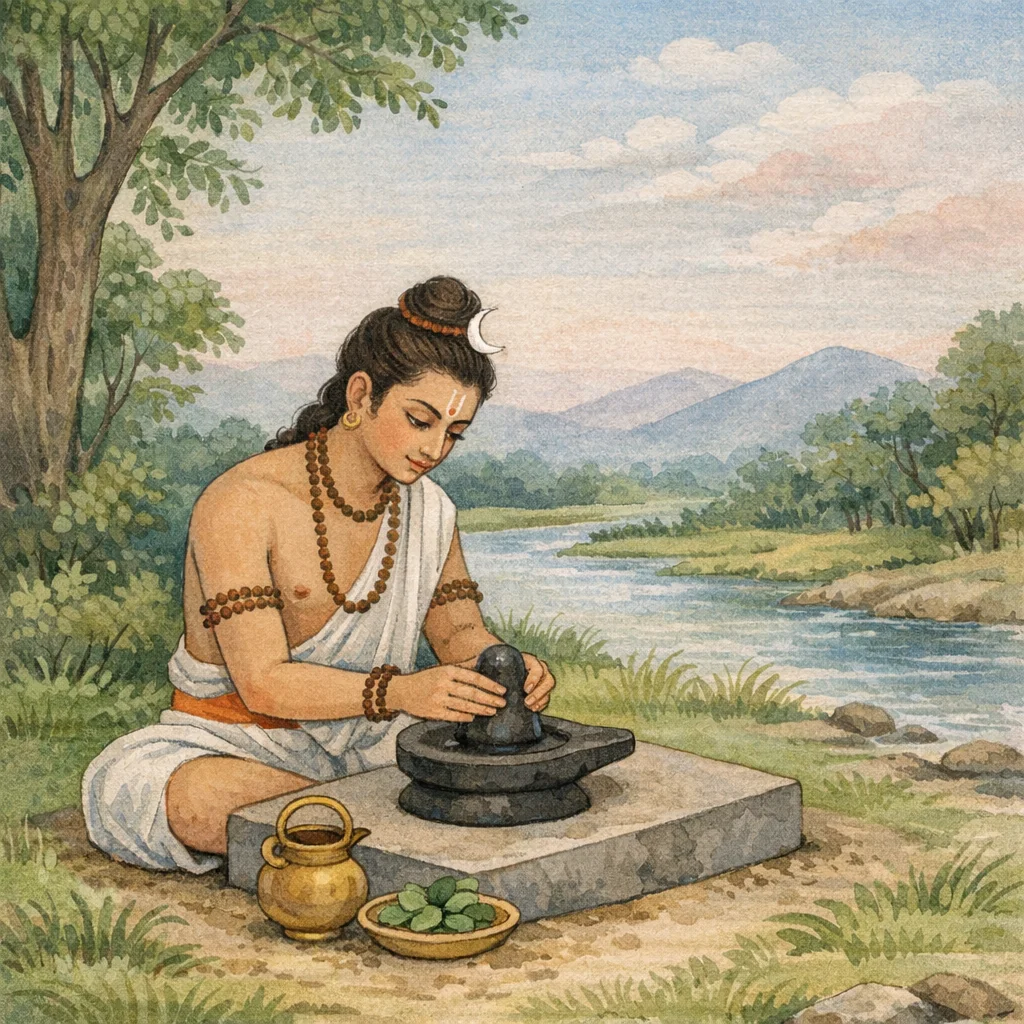
पार्थिवार्चाविधिः | Pārthivārcā-vidhi (Procedure for the Earthen Liṅga Worship)
This adhyāya records Sūta’s instruction on pārthivārcā—worship of a liṅga formed from purified earth—presented as a Vaidika, Veda-compliant practice that bestows both bhukti (worldly enjoyment and welfare) and mukti (liberation). It begins with proper preparation: bathing as enjoined in the sūtras, performing sandhyā, brahmayajña, and tarpaṇa, and completing one’s daily duties; worship then commences with remembrance of Śiva, along with Śaiva observances such as bhasma and rudrākṣa. The chapter affirms that vedokta procedure, joined with intense devotion, yields complete fruition. Suitable places are listed—riverbank, pond, mountain, forest, temple, or any clean spot. It then gives the material protocol: carefully gather earth from a pure place, prepare the liṅga attentively, note soil colors described in relation to varṇa while also allowing what is locally available, place the earth in an auspicious location, purify it with water, knead it gradually, and form a proper earthen liṅga according to Vedic method. It concludes by directing devotees to worship with bhakti for the promised twofold fruits, with Sūta indicating further details beyond these verses.
Shlokas
Verse 1
सूत उवाच । अथ वैदिकभक्तानां पार्थिवार्चां निगद्यते । वैदिकेनैव मार्गेण भुक्तिमुक्तिप्रदायिनी
Sūta said: Now the earthen (clay) worship of the Liṅga for devotees devoted to the Vedic path is described; performed solely by the Vedic method, it bestows both worldly enjoyment and liberation (mokṣa).
Verse 2
सूत्रोक्तविधिना स्नात्वा संध्यां कृत्वा यथाविधि । ब्रह्मयज्ञं विधायादौ ततस्तर्प्पणमाचरेत्
Having bathed in the manner prescribed in the sūtras and duly performed the Sandhyā rites, one should first complete the Brahma-yajña; thereafter, one should perform tarpaṇa, the reverent libations of water.
Verse 3
नैत्यिकं सकलं कामं विधायानंतरं पुमान् । शिवस्मरणपूर्वं हि भस्मरुद्रा क्षधारकः
After completing all his daily duties, a man—first remembering Lord Śiva—should then wear the sacred ash (bhasma) and the Rudrākṣa beads.
Verse 4
वेदोक्ताविधिना सम्यक्संपूर्णफलसिद्धये । पूजयेत्परया भक्त्या पार्थिवं लिंगमुत्तमम्
To attain the complete and perfect fruition of the rite enjoined in the Vedas, one should worship the excellent earthen Liṅga with supreme devotion.
Verse 5
नदीतीरे तडागे च पर्वते काननेऽपि च । शिवालये शुचौ देशे पार्थिवार्चा विधीयते
The worship of Śiva through an earthen liṅga is enjoined on the bank of a river, at a pond, on a mountain, in a forest, in a Śiva-temple, or in any pure and clean place.
Verse 6
शुद्धप्रदेशसंभूतां मृदमाहृत्य यत्नतः । शिवलिंगं प्रकल्पेत सावधानतया द्विजाः
O twice-born ones, carefully bring clay obtained from a pure place with due effort, and with attentive care fashion a Śiva-liṅga for worship.
Verse 7
विप्रे गौरा स्मृता शोणा बाहुजे पीतवर्णका । वैश्ये कृष्णा पादजाते ह्यथवा यत्र या भवेत्
For a Brāhmaṇa it is remembered as fair (gaurā); for a Kṣatriya as red (śoṇā); for one born of the arms (the Vaiśya) as yellow; and for one born of the feet (the Śūdra) as black—indeed, it should be understood according to whatever form it assumes in that case.
Verse 8
संगृह्य मृत्तिकां लिंगनिर्माणार्थं प्रयत्नतः । अतीव शुभदेशे च स्थापयेत्तां मृदं शुभाम्
Gathering clay with careful effort for the making of the Śiva-liṅga, one should place that auspicious earth in a supremely sacred and favorable spot.
Verse 9
संशोध्य च जलेनापि पिंडीकृत्य शनैः शनैः । विधीयेत शुभं लिंगं पार्थिवं वेदमार्गतः
After cleansing it with water and slowly kneading it into a firm lump, one should fashion an auspicious earthen Liṅga in accordance with the Vedic procedure.
Verse 10
ततः संपूजयेद्भक्त्या भुक्तिमुक्तिफलाप्तये । तत्प्रकारमहं वच्मि शृणुध्वं संविधानतः
Thereafter, one should worship with devotion to attain the fruits of worldly enjoyment and liberation. I shall now describe that method—listen in due and proper order.
Verse 11
नमः शिवाय मंत्रेणार्चनद्र व्यं च प्रोक्षयेत् । भूरसीति च मंत्रेण क्षेत्रसिद्धिं प्रकारयेत्
With the mantra “Namaḥ Śivāya,” one should sprinkle and consecrate the articles of worship. Then, with the mantra “Bhūr asī,” one should duly accomplish the sanctification and effective potency of the sacred worship-space.
Verse 12
आपोस्मानिति मंत्रेण जलसंस्कारमाचरेत् । नमस्ते रुद्र मंत्रेण फाटिकाबंधमुच्यते
With the mantra beginning “Āpo ’smān…,” one should perform the consecration of the water. And with the mantra “Namaste Rudra,” the rite called the “phāṭikā-bandha” (a protective sealing/binding) is prescribed.
Verse 13
शंभवायेति मंत्रेण क्षेत्रशुद्धिं प्रकारयेत् । नमः पूर्वेण कुर्यात्पंचामृतस्यापि प्रोक्षणम्
With the mantra “Śaṃbhavāya,” one should perform the purification of the sacred space. Then, by the mantra beginning with “Namaḥ,” one should also sprinkle (consecrate) the pañcāmṛta.
Verse 14
नीलग्रीवाय मंत्रेण नमःपूर्वेण भक्तिमान् । चरेच्छंकरलिंगस्य प्रतिष्ठापनमुत्तमम्
With devotion, one should first offer obeisance and then, by the mantra “(Salutations) to Nīlagrīva,” perform the excellent rite of establishing the Śaṅkara-liṅga.
Verse 15
भक्तितस्तत एतत्ते रुद्रा येति च मंत्रतः । आसनं रमणीयं वै दद्याद्वैदिकमार्गकृत्
Then, with devotion, reciting the mantra “Rudrāya” (“unto Rudra/Śiva”), the follower of the Vedic path should indeed offer a beautiful seat (āsana) in worship.
Verse 16
मानो महन्तमिति च मंत्रेणावाहनं चरेत् । याते रुद्रे ण मंत्रेण संचरेदुपवेशनम्
With the mantra beginning “māno mahantam…”, one should perform the invocation (āvāhana) of the Great Lord. Then, with the mantra beginning “yāte rudreṇa…”, one should perform the rite of offering Him a seat (upaveśana), establishing Śiva’s gracious, manifest presence for worship.
Verse 17
मंत्रेण यामिषुमिति न्यासं कुर्य्याच्छिवस्य च । अध्यवोचदिति प्रेम्णाधिवासं मनुनाचरेत्
With the mantra beginning “yāmiṣum…”, one should perform the nyāsa for Lord Śiva. Then, with loving devotion, one should carry out the consecratory invocation (adhivāsa) using the mantra beginning “adhyavocad…”.
Verse 18
मनुना सौजीव इति देवतान्यासमाचरेत् । असौ योवसर्पतीति चाचरेदपसर्पणम्
With the mantra beginning “saujīva” (taught by Manu), one should perform devatā-nyāsa, placing the deities upon one’s body. Then, with the formula “asau yo ’vasarpatī…”, one should perform apasarpaṇa, dismissing and driving away obstructive forces, so that Śiva’s worship may proceed without hindrance.
Verse 19
नमोस्तु नीलग्रीवायेति पाद्यं मनुनाहरेत् । अर्घ्यं च रुद्र गायत्र् याऽचमनं त्र् यंबकेण च
Reciting the mantra “namo’stu nīlagrīvāya”—salutations to the Blue-necked Lord—one should offer pādya, water for washing the feet. With the Rudra-Gāyatrī one should offer arghya, the oblation of reverence, and with the Tryambaka mantra one should offer ācamanīya, water for ritual sipping.
Verse 20
इति श्रीशिवमहापुराणे विद्येश्वरसंहितायां साध्यसाधनखण्डे पार्थिवशिवलिंगपूजाविधिवर्णनं नाम विंशोऽध्यायः
Thus, in the Śrī Śiva Mahāpurāṇa, within the Vidyeśvara Saṃhitā, in the Sādhyasādhana section, ends the twentieth chapter entitled “Description of the method of worship of the earthen Śiva-liṅga.”
Verse 21
घृटं स्नाने खलु घृतं घृतं यावेति मंत्रतः । मधुवाता मधुनक्तं मधुमान्न इति त्र् यृचा
Indeed, at the time of bathing one should ritually invoke “ghee—ghee,” reciting the mantra ‘ghṛtaṃ yāva’ and, with the three ṛks beginning ‘madhuvātā’, ‘madhunaktam’, and ‘madhumān naḥ’, consecrate the bath—so that the body becomes fit for Śiva’s worship through Vedic sweetness and purity.
Verse 22
मधुखंडस्नपनं प्रोक्तमिति पंचामृतं स्मृतम् । अथवा पाद्यमंत्रेण स्नानं पंचामृतेन च
Here the bath with honey and sugar is declared; this is remembered as pañcāmṛta, the fivefold nectar. Or else, let the sacred bath be performed with the pādya-mantra, and also with pañcāmṛta.
Verse 23
मानस्तोके इति प्रेम्णा मंत्रेण कटिबंधनम् । नमो धृष्णवे इति वा उत्तरीयं च धापयेत्
With loving devotion, he should tie the waist-band while reciting the mantra “mānastoke”; then, reciting “namo dhṛṣṇave” (or that mantra), he should properly place the upper cloth (uttarīya) upon himself.
Verse 24
या ते हेतिरिति प्रेम्णा ऋक्चतुष्केण वैदिकः । शिवाय विधिना भक्तश्चरेद्वस्त्रसमर्पणम्
With loving devotion, the Vedic worshipper should, in the prescribed manner, offer cloth to Lord Śiva while reciting the four Vedic verses beginning with “yā te hetiḥ”.
Verse 25
नमः श्वभ्य इति प्रेम्णा गंधं दद्यादृचा सुधीः । नमस्तक्षभ्य इति चाक्षतान्मंत्रेण चार्पयेत्
With loving devotion, the wise worshipper should offer fragrant sandal-paste (or perfume) while reciting, “Namaḥ śvabhyaḥ.” Then, reciting the mantra “Namastakṣabhyaḥ,” he should also present akṣata—unbroken grains—as an offering.
Verse 26
नमः पार्याय इति वा पुष्प मंत्रेण चार्पयेत् । नमः पर्ण्याय इति वा बिल्बपत्रसमर्पणम्
With the mantra “Namaḥ Pāryāya,” one should offer flowers; and with the mantra “Namaḥ Parṇyāya,” one should offer bilva leaves to Lord Śiva.
Verse 27
नमः कपर्दिने चेति धूपं दद्याद्यथाविधि । दीपं दद्याद्यथोक्तं तु नम आशव इत्यृचा
Reciting, “Salutations to Kapardin (the Lord of matted locks),” one should duly offer incense according to the rite. Then, as prescribed, one should offer a lamp while uttering the ṛc, “Salutations to Āśava,” a name of Śiva.
Verse 28
नमो ज्येष्ठाय मंत्रेण दद्यान्नैवेद्यमुत्तमम् । मनुना त्र् यम्बकमिति पुनराचमनं स्मृतम्
With the mantra “Namo Jyeṣṭhāya,” one should offer to Śiva the finest naivedya, the food-offering. Then, reciting the Vedic formula “Tryambakam…,” one is enjoined to perform ācamana, the ritual sipping of water, once again.
Verse 29
इमा रुद्रा येति ऋचा कुर्यात्फलसमर्पणम् । नमो व्रज्यायेति ऋचा सकलं शंभवेर्पयेत्
Reciting the Vedic ṛc that begins “imā rudrā…,” one should offer the fruit-offering. Then, reciting the ṛc that begins “namo vrajyāya…,” one should dedicate everything wholly to Śambhu, Lord Śiva.
Verse 30
मानो महांतमिति च मानस्तोके इति ततः । मंत्रद्वयेनैकदशाक्षतै रुद्रा न्प्रपूजयेत्
Then, reciting the two mantras beginning with “mā no mahāntam” and “mā nas toke,” one should duly worship the Rudras by offering eleven unbroken grains of rice (akṣata).
Verse 31
हिरण्यगर्भ इति त्र् यृचा दक्षिणां हि समर्पयेत् । देवस्य त्वेति मंत्रेण ह्यभिषेकं चरेद्बुधः
Reciting the three-verse hymn beginning with “Hiraṇyagarbha,” the wise devotee should duly offer the dakṣiṇā. Then, with the mantra “devasya tvā…,” he should perform the abhiṣeka, the ritual ablution, for the Deity—Śiva—established in worship.
Verse 32
दीपमंत्रेण वा शंभोर्नीराजनविधिं चरेत् । पुष्पांजलिं चरेद्भक्त्या इमा रुद्रा य च त्र् यृचा
Or else, using the lamp-mantra, one should perform the nīrājana rite of waving lights before Śambhu. Then, with devotion, one should offer a handful of flowers and recite this sacred triad of Ṛk-verses addressed to Rudra.
Verse 33
मानो महान्तमिति च चरेत्प्राज्ञः प्रदक्षिणाम् । मानस्तोकेति मंत्रेण साष्टाण्गं प्रणमेत्सुधीः
The wise devotee should perform pradakṣiṇā, circumambulation, while reciting “māno mahāntam.” Then, with the mantra “mānas toke,” the discerning one should bow in sāsṭāṅga, the full eight-limbed prostration, offering the entire self to Śiva in reverent surrender.
Verse 34
एषते इति मंत्रेण शिवमुद्रा ं प्रदर्शयेत् । यतोयत इत्यभयां ज्ञानाख्यां त्र् यंबकेण च
With the mantra beginning “eṣate,” one should display the Śiva-mudrā. With the mantra “yato-yata,” one should show the Abhayā-mudrā (the seal of fearlessness); and with “tryambaka,” one should also show the mudrā called Jñāna, the seal of spiritual knowledge.
Verse 35
नमःसेनेति मंत्रेण महामुद्रा ं प्रदर्शयेत् । दर्शयेद्धेनुमुद्रा ं च नमो गोभ्य ऋचानया
Reciting the mantra beginning “namaḥsena…,” one should display the Mahāmudrā. And with the Ṛk-verse “namo gobhyaḥ” (“salutations to the cows”), one should also display the Dhenumudrā.
Verse 36
पंचमुद्रा ः प्रदर्श्याथ शिवमंत्रजपं चरेत् । शतरुद्रि यमंत्रेण जपेद्वेदविचक्षणः
Then, having displayed the five ritual mudrās, one should undertake the japa of Śiva’s mantra. The knower of the Veda should perform the repetition using the Śatarudrīya mantra.
Verse 37
ततः पंचाण्गपाठं च कुर्य्याद्वेदविचक्षणः । देवागात्विति मंत्रेण कुर्याच्छंभोर्विसर्जनम्
Thereafter, the Veda-knowing worshipper should perform the pañcāṅga-pāṭha, the recitation of the five auxiliaries. Then, with the mantra beginning “devāgāt…”, he should duly perform the visarjana, the formal dismissal of Lord Śambhu.
Verse 38
इत्युक्तः शिवपूजाया व्यासतो वैदिकोविधिः । समासतश्च शृणुत वैदिकं विधिमुत्तमम्
Thus the Vedic procedure for the worship of Śiva has been explained in detail. Now listen also, in brief, to that excellent Vedic method.
Verse 39
ऋचा सद्योजातमिति मृदाहरणमाचरेत् । वामदेवाय इति च जलप्रक्षेपमाचरेत्
With the ṛc beginning “Sadyojāta…”, one should perform the taking up of the sacred earth (for preparing vibhūti). And with the mantra “Vāmadevāya”, one should likewise perform the sprinkling of water.
Verse 40
अघोरेण च मंत्रेण लिंगनिर्माणमाचरेत् । तत्पुरुषाय मंत्रेणाह्वानं कुर्याद्यथाविधि
With the Aghora mantra one should perform the making and consecrated formation of the Śiva-liṅga; and with the Tatpuruṣa mantra one should invoke the Lord in the prescribed manner.
Verse 41
संयोजयेद्वेदिकायामीशानमनुना हरम् । अन्यत्सर्वं विधानं च कुर्य्यात्संक्षेपतः सुधीः
The wise worshipper should install (unite and seat) Hara upon the altar (vedikā) by means of the Īśāna-mantra; and then, in brief, he should perform all the remaining ritual procedures as prescribed.
Verse 42
पंचाक्षरेण मंत्रेण गुरुदत्तेन वा तथा । कुर्यात्पूजां षोडशोपचारेण विधिवत्सुधीः
Using the five-syllabled mantra (pañcākṣara)—or likewise one bestowed by the Guru—the wise devotee should perform the worship properly with the sixteen ritual offerings (ṣoḍaśopacāra).
Verse 43
भवाय भवनाशाय महादेवाय धीमहि । उग्राय उग्रनाशाय शर्वाय शशिमौलिने
We meditate upon Bhava—He who brings beings into existence and who also dissolves worldly becoming; upon Mahādeva, the Supreme God. We meditate upon Ugra, the awe-inspiring Lord who destroys all fierceness and evil; upon Śarva, and upon Him whose crest is adorned with the moon.
Verse 44
अनेन मनुना वापि पूजयेच्छंकरं सुधीः । सुभक्त्या च भ्रमं त्यक्त्वा भक्त्यैव फलदः शिवः
By this mantra as well, the wise should worship Śaṅkara. Casting off delusion through noble devotion, one realizes that Śiva grants results solely through bhakti.
Verse 45
इत्यपि प्रोक्तमादृत्य वैदिकक्रमपूजनम् । प्रोच्यतेन्यविधिः सम्यक्साधारणतया द्विजः
Thus, having respectfully accepted what has been stated regarding worship in the Vedic sequence, O twice-born one, I shall now explain another procedure—clearly and in a general form—for proper practice.
Verse 46
पूजा पार्थिवलिंगस्य संप्रोक्ता शिवनामभिः । तां शृणुध्वं मुनिश्रेष्ठाः सर्वकामप्रदायिनीम्
The worship of the earthen (Pārthiva) Liṅga, performed through the names of Śiva, has been taught. O best of sages, listen to it—for it is the giver of all desired aims.
Verse 47
हरो महेश्वरः शंभुः शूलपाणिः पिनाकधृक् । शिवः पशुपतिश्चैव महादेव इति क्रमात्
In due order He is called Hara, Maheśvara, Śambhu, the Trident-bearer, the wielder of Pināka, Śiva, Paśupati, and indeed Mahādeva.
Verse 48
मृदाहरणसंघट्टप्रतिष्ठाह्वानमेव च । स्नपनं पूजनं चैव क्षमस्वेति विसर्जनम्
“(These are the rites:) collecting the sacred clay, preparing and shaping (the emblem), establishing it and invoking (the Lord into it); then bathing it and worshipping it; and finally the dismissal with the prayer, ‘Forgive (any faults),’ and the respectful sending-off.”
Verse 49
ओंकारादिचतुर्थ्यंतैर्नमोन्तैर्नामभिः क्रमात् । कर्तव्या च क्रिया सर्वा भक्त्या परमया मुदा
Beginning with the sacred syllable Oṁ, and proceeding in due order with names that end in “namaḥ”, one should perform every act of worship—joyfully, and with supreme devotion.
Verse 50
कृत्वा न्यासविधिं सम्यक्षडण्गकरयोस्तथा । षडक्षरेण मंत्रेण ततो ध्यानं समाचरेत्
Having properly performed the rite of nyāsa—placing the mantra upon the six limbs and upon the hands—one should then undertake meditation using the six-syllabled mantra.
Verse 51
कैलासपीठासनमध्यसंस्थं भक्तैः सनंदादिभिरर्च्यमानम् । भक्तार्तिदावानलमप्रमेयं ध्यायेदुमालिंगितविश्वभूषणम्
One should meditate on the immeasurable Lord—the Ornament of the universe—seated in the midst of the throne on Kailāsa, worshipped by devotees such as Sananda and the other sages, and embracing Umā; He is the blazing fire that consumes the forest of His devotees’ afflictions.
Verse 52
ध्यायेन्नित्यं महेशं रजतगिरिनिभं चारुचंद्रा वतंसं रत्नाकल्पोज्ज्वलांगं परशुमृगवराभीतिहस्तं प्रसन्नम् । पद्मासीनं समंतात्स्थितममरगणैर्व्याघ्रकृत्तिं वसानं विश्वाद्यं विश्वबीजं निखिलभयहरं पंचवक्त्रं त्रिनेत्रम्
One should meditate daily on Maheśa—shining like a silver mountain, adorned with the lovely crescent moon, His limbs radiant with jeweled ornaments; serene, with hands bearing the axe and the deer, and showing the boon-giving and fear-dispelling gestures. Seated upon a lotus, surrounded on every side by hosts of devas, clad in a tiger-skin—He who is the primordial Lord of the universe, the very seed of the universe, the remover of all fear, five-faced and three-eyed.
Verse 53
इति ध्यात्वा च संपूज्य पार्थिवं लिंगमुत्तमम् । जपेत्पंचाक्षरं मंत्रं गुरुदत्तं यथाविधि
Thus, having meditated and duly worshipped the excellent earthen Liṅga, one should, in the prescribed manner, repeat the five-syllabled mantra bestowed by the Guru.
Verse 54
स्तुतिभिश्चैव देवेशं स्तुवीत प्रणमन्सुधीः । नानाभिधाभिर्विप्रेन्द्रा ः पठेद्वै शतरुद्रि यम्
Bowing down, the wise devotee should praise the Lord of the gods with hymns. And, O best of Brahmins, he should indeed recite the Śatarudrīya, invoking Him by His many sacred names.
Verse 55
ततः साक्षतपुष्पाणि गृहीत्वांजलिना मुदा । प्रार्थयेच्छंकरं भक्त्या मंत्रैरेभिः सुभक्तितः
Then, joyfully taking flowers together with unbroken rice in cupped hands, one should pray to Śaṅkara with devotion, using these mantras, with sincere and excellent bhakti.
Verse 56
तावकस्त्वद्गुणप्राणस्त्वच्चित्तोहं सदा मृड । कृपानिध इति ज्ञात्वा भूतनाथ प्रसीद मे
O Mṛḍa (the Benevolent One), I am Yours—my very life is sustained by Your virtues, and my mind is always fixed on You. Knowing You as the ocean of compassion, O Lord of beings (Bhūtanātha), be gracious to me.
Verse 57
अज्ञानाद्यदि वा ज्ञानाज्जप पूजादिकं मया । कृतं तदस्तु सफलं कृपया तव शंकर
O Śaṅkara, whether from ignorance or with true understanding I have performed japa, pūjā, and other acts of worship—by Your compassion, let all that I have done become fruitful and fulfilled.
Verse 58
अहं पापी महानद्य पावनश्च भवान्महान् । इति विज्ञाय गौरीश यदिच्छसि तथा कुरु
“I am a great sinner; yet You are the great purifier. Knowing this, O Lord of Gaurī, do as You wish.”
Verse 59
वेदैः पुराणैः सिद्धान्तैरृषिभिर्विविधैरपि । न ज्ञातोसि महादेव कुतोहं त्वं महाशिव
Even through the Vedas, the Purāṇas, the established doctrines, and the many kinds of sages, You are not truly known, O Mahādeva. Then how could I comprehend You—You who are Mahāśiva?
Verse 60
यथा तथा त्वदीयोस्मि सर्वभावैर्महेश्वर । रक्षणीयस्त्वयाहं वै प्रसीद परमेश्वर
O Maheśvara, in every way and with all my inner dispositions, I am Yours alone. Indeed, I am to be protected by You—be gracious to me, O Parameśvara.
Verse 61
इत्येवं चाक्षतान्पुष्पानारोप्य च शिवोपरि । प्रणमेद्भक्तितश्शंभुं साष्टांगं विधिवन्मुने
Thus, having duly offered unbroken grains of rice and flowers upon Śiva, one should bow to Śambhu with devotion, performing the full eight-limbed prostration (sāṣṭāṅga) according to the prescribed rite, O sage.
Verse 62
ततः प्रदक्षिणां कुर्याद्यथोक्तविधिना सुधीः । पुनः स्तुवीत देवेशं स्तुतिभिः श्रद्धयान्वितः
Thereafter, the wise devotee should perform circumambulation (pradakṣiṇā) in the prescribed manner; and again, endowed with faith, he should praise the Lord of the gods with hymns.
Verse 63
ततो गलरवं कृत्वा प्रणमेच्छुचिनम्रधीः । कुर्याद्विज्ञप्तिमादृत्य विसर्जनमथाचरेत्
Then, making a reverential throat-sound (galarava), the pure-minded devotee—humble in understanding—should bow down. With due earnestness he should submit his respectful request, and thereafter perform the formal leave-taking (visarjana) of the worship.
Verse 64
इत्युक्ता मुनिशार्दूलाः पार्थिवार्चा विधानतः । भुक्तिदा मुक्तिदा चैव शिवभक्तिविवर्धिनी
Thus instructed, O tiger-like sages, the Pārthiva worship—the rite of adoring Śiva through an earthen Liṅga—performed according to proper ordinance bestows worldly enjoyments and also liberation, and it ever increases devotion to Lord Śiva.
Verse 65
इत्यध्यायं सुचित्तेन यः पठेच्छृणुयादपि । सर्वपापविशुद्धात्मासर्वान्कामानवाप्नुयात्
Thus, whoever recites this chapter with a well-composed mind—or even listens to it—becomes purified of all sins, and attains the fulfilment of all rightful desires.
Verse 66
आयुरायोग्यदं चैव यशस्यं स्वर्ग्यमेव च । पुत्रपौत्रादिसुखदमाख्यानमिदमुत्तमम्
This sublime sacred narrative bestows long life and health; it grants fame and leads to heaven, and it also gives the happiness that comes through sons, grandsons, and the blessings of family.
Frequently Asked Questions
It outlines a stepwise pārthivārcā protocol: Vaidika bathing and sandhyā, brahmayajña and tarpaṇa; completion of daily duties; Śiva-smaraṇa with bhasma/rudrākṣa observance; selection of a clean or sacred site; collection and water-purification of earth; gradual kneading and formation of a proper earthen liṅga; and devotional worship aimed at bhukti–mukti.
The earthen liṅga functions as a deliberately transient embodiment of the eternal: matter is purified, shaped, and worshiped to disclose Śiva’s immanent accessibility, while the Vaidika ordering of acts signals that liberation is pursued through disciplined embodiment rather than abstraction—ritual becomes a pedagogy of non-dual orientation toward Śiva.
Śiva is highlighted primarily through the liṅga form (liṅga-svarūpa) as the normative ritual icon, with Viśveśvara implied as the cosmic lord approached via vedokta worship; the emphasis is less on a named anthropomorphic form and more on liṅga-centered theology and practice.