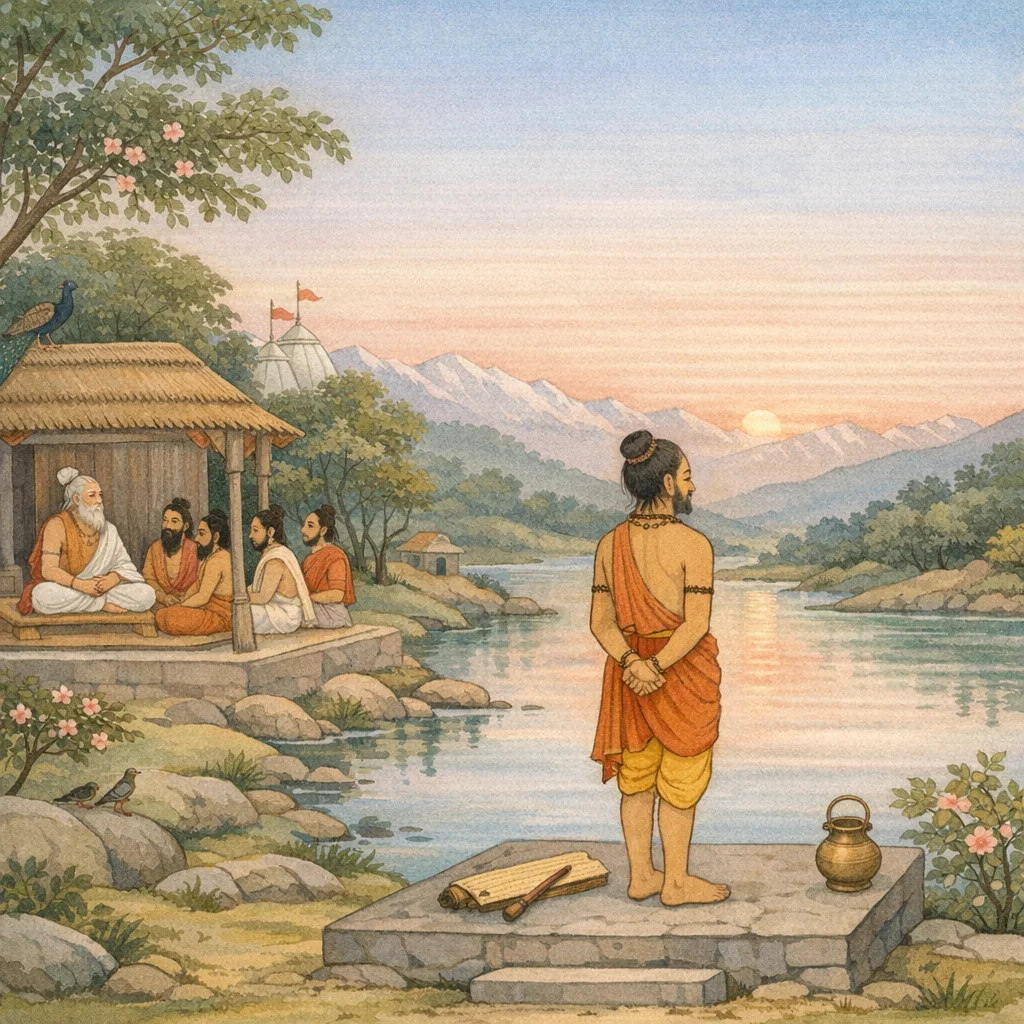
Sadācāra–Varṇa-lakṣaṇa and Prātaḥkṛtya (Right Conduct, Social Typologies, and Morning Purification)
Adhyāya 13 unfolds as a didactic dialogue: the ṛṣis ask for a swift account of sadācāra—right conduct by which the wise harmonize society—along with the dharma/adharma paths that yield heavenly or hellish results. Sūta replies by defining social‑religious identities through behavioral and Vedic markers: the brāhmaṇa is distinguished by learning and sadācāra, while other groups are described by degrees of conduct, livelihood, and service. The chapter then turns from classification to daily discipline, enjoining one to rise in the liminal time before dawn, face east, remember the divinities, and reflect on the day’s ethical‑economic reckoning (dharma, artha, expected hardships, income and expenditure). It lists the fruits of early rising—longevity, strength, prosperity/fortune, and avoidance of misfortune—placing bodily routine within a moral‑cosmic order. Finally, it details purification practice, prescribing proper timing and spatial etiquette for evacuation away from the home, with directional rules and contingencies when obstructed. Overall, it reads as a normative manual that makes metaphysical accountability practical through conduct, schedule, and purity management.
Shlokas
Verse 1
ऋषय ऊचुः । सदाचारं श्रावयाशु येन लोकाञ्जयेद्बुधः । धर्माधर्ममयान्ब्रूहि स्वर्गनारकदांस्तथा
The sages said: “Teach us swiftly sadācāra, the code of right conduct by which a wise person conquers the worlds. Also explain actions that are of the nature of dharma and adharma, and those that bestow heaven and hell respectively.”
Verse 2
सूत उवाच । सदाचारयुतो विद्वान्ब्राह्मणो नाम नामतः । वेदाचारयुतो विप्रो ह्येतैरेकैकवान्द्विजः
Sūta said: “A learned man endowed with sadācāra is called a ‘Brāhmaṇa’—that is his designation. One whose conduct is grounded in the Vedas is called a ‘Vipra’. By possessing these qualities—each in its own way—a twice-born becomes truly worthy of the name.”
Verse 3
अल्पाचारोल्पवेदश्च क्षत्रियो राजसेवकः । किंचिदाचारवान्वैश्यः कृषिवाणिज्यकृत्तया
A kṣatriya is described as one of limited ritual discipline and limited Vedic study, devoted to the service of the king. A vaiśya is said to possess some measure of right conduct, earning his livelihood through agriculture and trade.
Verse 4
शूद्र ब्राह्मण इत्युक्तः स्वयमेव हि कर्षकः । असूयालुः परद्रो ही चंडालद्विज उच्यते
A brāhmaṇa who lives like a śūdra is, in truth, merely a tiller of the soil. But a twice-born who is envious and hostile to others is called a caṇḍāla among the dvijas.
Verse 5
पृथिवीपालको राजा इतरेक्षत्रिया मताः । धान्यादिक्रयवान्वैश्य इतरो वणिगुच्यते
The king is the protector of the earth; the others are regarded as kṣatriyas. The one who trades in grains and the like is called a vaiśya; the other is termed a merchant (vaṇik).
Verse 6
ब्रह्मक्षत्रियवैश्यानां शुश्रूषुः शूद्र उच्यते । कर्षको वृषलो ज्ञेय इतरे चैव दस्यवः
One devoted to service (śuśrūṣā) of the Brāhmaṇa, Kṣatriya, and Vaiśya is called a Śūdra. A cultivator is to be understood as a vṛṣala; and the others, indeed, are called dasyus.
Verse 7
सर्वो ह्युषःप्राचीमुखश्चिन्तयेद्देवपूर्वकान् । धर्मानर्थांश्च तत्क्लेशानायं च व्ययमेव च
Indeed, at dawn, facing the east, every person should reflect—placing the Deity first—upon dharma and rightful aims, upon the hardships that follow their opposites, and also upon one’s gains and one’s expenditures.
Verse 8
आयुर्द्वेषश्च मरणं पापं भाग्यं तथैव च । व्याधिः पुष्टिस्तथा शक्तिः प्रातरुत्थानदिक्फलम्
Longevity, enmity, death, sin, and likewise good fortune; disease, nourishment (well-being), and strength—these are declared to be the resulting effects connected with rising at dawn and with one’s orientation toward the directions.
Verse 9
निशांत्यायामोषा ज्ञेया यामार्धं संधिरुच्यते । तत्काले तु समुत्थाय विण्मूत्रे विसृजेद्द्विजः
The time at the end of the night is known as uṣā, the dawn; it is called the sandhi, the junction lasting half a yāma. At that time, having risen, the dvija (twice-born) should void feces and urine, performing natural purification.
Verse 10
गृहाद्दूरं ततो गत्वा बाह्यतः प्रवृतस्तथा । उदण्मुखः समाविश्य प्रतिबंधेऽन्यदिण्मुखः
Then, having gone far from the house and proceeding outside, one should sit facing north; but if there is an obstruction, one may face another direction.
Verse 11
जलाग्निब्राह्मणादीनां देवानां नाभिमुख्यतः । लिंगं पिधाय वामेन मुखमन्येन पाणिना
While worshipping Śiva, one should not face toward water, fire, Brāhmaṇas, or the Devas. Therefore, covering the Liṅga with the left hand, one should cover one’s own face with the other hand.
Verse 12
मलमुत्सृज्य चोत्थाय न पश्येच्चैव तन्मलम् । उद्धृतेन जलेनैव शौचं कुर्याज्जलाद्बहिः
After evacuating and then rising, one should not look at that excrement. Using only water drawn out (in the hand or a vessel), one should perform purification outside the water, not while standing within the water-source.
Verse 13
अथवा देवपित्रार्षतीर्थावतरणं विना । सप्त वा पंच वा त्रीन्वा गुदं संशोधयेन्मृदा
Or else, even without resorting to the sacred waters (tīrthas) associated with the Devas, the Pitṛs, or the Ṛṣis, one should purify the anal region by cleansing it with earth—seven times, or five times, or three times.
Verse 14
लिंगे कर्कोटमात्रं तु गुदे प्रसृतिरिष्यते । तत उत्थाय पद्धस्तशौचं गण्डूषमष्टकम्
For cleansing, the measure is said to be only as much as the tip of a finger for the genital organ, but a full hand-span for the anus. Then, rising up, one should wash the feet and hands and perform eight mouth-rinses (gandūṣa) as a purificatory act.
Verse 15
येन केन च पत्रेण काष्ठेन च जलाद्बहिः । कार्यं संत्यज्य तर्ज्जनीं दंतधावनमीरितम्
For cleaning the teeth, it is prescribed that one should go outside the water source and, setting aside all other activities, brush the teeth using any suitable leaf or a piece of wood; the index finger (tarjanī) should be avoided for this act.
Verse 16
जलदेवान्नमस्कृत्य मंत्रेण स्नानमाचरेत् । अशक्तः कंठदघ्नं वा कटिदघ्नमथापि वा
Having first bowed to the deities presiding over the waters, one should perform the bath while reciting the mantra. If one is unable to do a full bath, one may bathe up to the neck, or even up to the waist.
Verse 17
आजानु जलमाविश्य मंत्रस्नानं समाचरेत् । देवादींस्तर्पयेद्विद्वांस्तत्र तीर्थजलेन च
Entering the water up to the knees, the wise devotee should perform the mantra-bath; and there, with that sacred tīrtha-water, he should also offer tarpaṇa (ritual satisfaction) to the Devas and the other divine recipients.
Verse 18
धौतवस्त्रं समादाय पंचकच्छेन धारयेत् । उत्तरीयं च किं चैव धार्यं सर्वेषु कर्मसु
Having taken clean, well-washed garments, one should wear them in the five-fold tucked manner (pañcakaccha). One should also don an upper cloth (uttarīya), for such proper attire is to be maintained in all sacred rites.
Verse 19
नद्यादितीर्थस्नाने तु स्नानवस्त्रं न शोधयेत् । वापीकूपगृहादौ तु स्नानादूर्ध्वं नयेद्बुधः
When bathing at sacred tīrthas such as river fords, one should not wash or cleanse the bathing cloth there. But after bathing in places like a stepwell (vāpī), a well, or a bathing-house, the wise person should take the cloth away and deal with it elsewhere.
Verse 20
शिलादार्वादिके वापि जले वापि स्थलेपि वा । संशोध्य पीडयेद्वस्त्रं पितृणां तृप्तये द्विजाः
Whether on stone, wood, and the like, or in water, or on dry ground—having purified it, the twice-born should wring out the cloth, for the satisfaction of the Pitṛs (ancestral spirits).
Verse 21
जाबालकोक्तमंत्रेण भस्मना च त्रिपुंड्रकम् । अन्यथा चेज्जले पात इतस्तन्नरकमृच्छति
One should apply the Tripuṇḍra (three horizontal lines) with sacred ash (bhasma), using the mantra taught in the Jābāla tradition. If one does otherwise, then after death he falls into the infernal waters; by this very fault he goes to hell.
Verse 22
आपोहिष्ठेति शिरसि प्रोक्षयेत्पापशांतये । यस्येति मंत्रं पादे तु संधिप्रोक्षणमुच्यते
For the pacification of sin, one should sprinkle purifying water upon the head while reciting the mantra beginning with “Āpo hi ṣṭhā…”. And the mantra beginning with “Yasya…” is to be applied at the feet—this is called the sprinkling at the joints (limbs) as part of the rite.
Verse 23
पादे मूर्ध्नि हृदि चैव मूर्ध्नि हृत्पाद एव च । हृत्पादमूर्ध्नि संप्रोक्ष्य मंत्रस्नानं विदुर्बुधाः
Having sprinkled purifying water upon the feet, the head, and the heart—and again upon the head, the heart, and the feet—thus consecrating in due order the heart, the feet, and the head, the wise know this rite as “mantra-bath” (mantra-snāna), the inner purification accomplished through sacred mantra in Śiva’s worship.
Verse 24
ईषत्स्पर्शे च दौः स्वास्थ्ये राजराष्ट्रभयेऽपि च । अत्यागतिकाले च मंत्रस्नानं समाचरेत्
When there has been even slight impure contact, when health is afflicted, when there is fear from the king or the realm, and also when danger is imminent—one should duly perform the “mantra-bath” (mantra-snāna), the purification accompanied by Śiva-mantras.
Verse 25
प्रातः सूर्यानुवाकेन सायमग्न्यनुवाकतः । अपः पीत्वा तथामध्ये पुनः प्रोक्षणमाचरेत्
In the morning one should perform purification with the Sūrya-anuvāka, and in the evening with the Agni-anuvāka. Having sipped water (ācamana), and likewise at midday, one should again perform the sprinkling rite of purification (prokṣaṇa).
Verse 26
गायत्र् या जपमंत्रांते त्रिरूर्ध्वं प्राग्विनिक्षिपेत् । मंत्रेण सह चैकं वै मध्येऽर्घ्यं तु रवेर्द्विजा
At the conclusion of japa, the twice-born should, with the Gāyatrī, offer water thrice upward toward the east; and then, together with the mantra, he should offer one arghya in the middle to the Sun, O brāhmaṇas.
Verse 27
अथ जाते च सायाह्ने भुवि पश्चिमदिण्मुखः । उद्धृत्य दद्यात्प्रातस्तु मध्याह्नेंगुलिभिस्तथा
Then, when evening has come, seated upon the ground and facing west, he should lift up the sacred substance and offer or apply it. In the morning likewise, and at midday as well, he should do so with the fingers in the prescribed manner.
Verse 28
अंगुलीनां च रंध्रेण लंबं पश्येद्दिवाकरम् । आत्मप्रदक्षिणं कृत्वा शुद्धाचमनमाचरेत्
Gazing at the Sun through the gap between the fingers, one should then perform pradakṣiṇā of oneself—an inner circumambulation—and thereafter observe pure ācamana, the ritual sipping of sanctified water.
Verse 29
सायं मुहूर्तादर्वाक्तु कृता संध्या वृथा भवेत् । अकालात्काल इत्युक्तो दिनेऽतीते यथाक्रमम्
If the evening Sandhyā is performed before the proper evening muhūrta, it becomes fruitless. But when it is done after the due time has passed, it is called “performed at an improper time,” in the order as the day moves on.
Verse 30
दिवाऽतीते च गायत्रीं शतं नित्ये क्रमाज्जपेत् । आदर्शाहात्पराऽतीते गायत्रीं लक्षमभ्यसेत्
When the day has passed (at the proper time after daytime duties), one should regularly recite the Gāyatrī one hundred times, in due order. And when the prescribed period has further elapsed, one should undertake the disciplined practice of reciting the Gāyatrī up to one hundred thousand times.
Verse 31
मासातीते तु नित्ये हि पुनश्चोपनयं चरेत् । ईशो गौरीगुहो विष्णुर्ब्रह्मा चेंद्र श्च वै यमः
When a month has passed, one should again perform the regular rite of upanayana (investiture with the sacred thread) as prescribed. In this observance, the presiding deities are Īśa (Śiva), Gaurī, Guha (Kārttikeya), Viṣṇu, Brahmā, Indra, and Yama.
Verse 32
एवं रूपांश्च वै देवांस्तर्पयेदर्थसिद्धये । ब्रह्मार्पणं ततः कृत्वा शुद्धाचमनमाचरेत्
Thus, in these prescribed forms, one should offer tarpaṇa (water-oblations of satisfaction) to the deities for the attainment of one’s intended purpose. Then, having performed it as brahmārpaṇa—an offering to Brahman (the Supreme)—one should undertake pure ācamana (ritual sipping of water for inner and outer purification).
Verse 33
तीर्थदक्षिणतः शस्ते मठे मंत्रालये बुधः । तत्र देवालये वापि गृहे वा नियतस्थले
The wise declare it commendable to perform the practice on the southern side of a tīrtha (sacred place), in a maṭha (monastery), or in a hall dedicated to mantra. There—whether in a temple or even at home—one should undertake it in a fixed place, with discipline.
Verse 34
सर्वान्देवान्नमस्कृत्य स्थिरबुद्धिः स्थिरासनः । प्रणवं पूर्वमभ्यस्य गायत्रीमभ्यसेत्ततः
Having first bowed to all the gods, let the practitioner—steady in mind and seated firmly—practice the Praṇava (Oṁ) first; thereafter, he should practice the Gāyatrī.
Verse 35
जीवब्रह्मैक्यविषयं बुद्ध्वा प्रणवमभ्यसेत् । त्रैलोक्यसृष्टिकर्त्तारं स्थितिकर्तारमच्युतम्
Having understood the purport of the oneness of the individual self and the Supreme Reality, one should practise the Pranava (Oṁ), meditating upon the Imperishable One, Acyuta, who creates the three worlds and also upholds them in preservation.
Verse 36
संहर्तारं तथा रुद्रं स्वप्रकाशमुपास्महे । ज्ञानकर्मेंद्रि याणां च मनोवृत्तीर्धियस्तथा
We worship Rudra—the Dissolver of all—who is self-luminous. From Him arise and are governed the organs of knowledge and action, and likewise the movements of the mind and the functions of the intellect.
Verse 37
भोगमोक्षप्रदे धर्मे ज्ञाने च प्रेरयेत्सदा । इत्थमर्थं धियाध्यायन्ब्रह्मप्राप्नोति निश्चयः
One should always inspire others toward dharma and toward liberating knowledge—both of which bestow worldly well-being and final liberation. Meditating with clear understanding on this very principle, one surely attains Brahman (Śiva), without doubt.
Verse 38
केवलं वा जपेन्नित्यं ब्राह्मण्यस्य च पूर्तये । सहस्रमभ्यसेन्नित्यं प्रातर्ब्राह्मणपुंगवः
Or else, for the very fulfillment of true brahminhood, he should practise japa daily in solitude with single-mindedness. The best of Brahmins should regularly repeat it a thousand times every morning.
Verse 39
अन्येषां च यथा शक्तिमध्याह्ने च शतं जपेत् । सायं द्विदशकं ज्ञेयं शिखाष्टकसमन्वितम्
Others, according to their capacity, should perform japa—one hundred repetitions at midday. In the evening, it is prescribed as twelve repetitions, accompanied by the eightfold śikhā (the śikhā-mantras/appendages) as part of the rite.
Verse 40
मूलाधारं समारभ्य द्वादशांतस्थितांस्तथा । विद्येशब्रह्मविष्ण्वीशजीवात्मपरमेश्वरान्
Beginning from the Mūlādhāra and likewise those stationed at the Dvādaśānta, one should contemplate Vidyeśa, Brahmā, Viṣṇu, Īśa, the individual self (jīvātman), and the Supreme Lord (Parameśvara).
Verse 41
ब्रह्मबुद्ध्या तदैक्यं च सोहं भावनया जपेत् । तानेव ब्रह्मरंध्रादौ कायाद्बाह्ये च भावयेत्
With the understanding that (Śiva is) Brahman, one should contemplate one’s identity with That and mentally repeat the ‘So’ham’ awareness. One should visualize That very Reality at the brahmarandhra (the crown aperture) and also within the body and beyond it.
Verse 42
महत्तत्त्वं समारभ्य शरीरं तु सहस्रकम् । एकैकस्माज्जपादेकमतिक्रम्य शनैः शनैः
Beginning with Mahat-tattva (the cosmic principle of intelligence), one should mentally traverse the ‘thousandfold body’ step by step—passing beyond each level by a single repetition of japa, gradually and with steady patience.
Verse 43
परस्मिन्योजयेज्जीवं जपतत्त्वमुदाहृतम् । शतद्विदशकं देहं शिखाष्टकसमन्वितम्
Uniting the individual soul (jīva) with the Supreme (Para)—this is declared to be the true principle of japa. The body is taught as consisting of one hundred and twenty constituents, and as endowed with the eightfold śikhā (crest/peak).
Verse 44
मंत्राणां जप एवं हि जपमादिक्रमाद्विदुः । सहस्रं ब्राह्मदं विद्याच्छतमैंद्र प्रदं विदुः
Thus the wise know the proper gradation of mantra-repetition (japa) and its fruits: a thousand repetitions are understood to bestow the fruit pertaining to Brahmā, while a hundred repetitions are known to grant the fruit pertaining to Indra.
Verse 45
इतरत्त्वात्मरक्षार्थं ब्रह्मयोनिषु जायते । दिवाकरमुपस्थाय नित्यमित्थं समाचरेत्
To safeguard the embodied self from falling into inferior states of existence, one should be born among the Brahma-born (noble, dharmic lineages). Therefore, having worshipped the Sun (Divākara) each day, one should always practice in this manner.
Verse 46
लक्षद्वादशयुक्तस्तु पूर्णब्राह्मण ईरितः । गायत्र् या लक्षहीनं तु वेदकार्येन योजयेत्
He who is endowed with twelve lakṣas (i.e., has completed the prescribed count of recitation) is declared to be a “complete Brāhmaṇa.” But one who is deficient by a lakṣa should be engaged in Vedic duties through the recitation of the Gāyatrī.
Verse 47
आसप्ततेस्तु नियमं पश्चात्प्रव्राजनं चरेत् । प्रातर्द्वादशसाहस्रं प्रव्राजीप्रणवं जपेत्
Until the age of seventy, one should uphold disciplined observances; thereafter one should enter the life of renunciation (sannyāsa). Each morning the renunciate should repeat the Praṇava “Oṁ” in japa twelve thousand times.
Verse 48
दिने दिने त्वतिक्रांते नित्यमेवं क्रमाज्जपेत् । मासादौ क्रमशोऽतीते सार्धलक्षजपेन हि
As each day passes, one should perform japa daily in this very manner, step by step. And when the month (and other prescribed periods) have duly passed in order, the practice is completed through one hundred and fifty thousand repetitions of the mantra.
Verse 49
अत ऊर्ध्वमतिक्रांते पुनः प्रैषं समाचरेत् । एवं कृत्वा दोषशांतिरन्यथा रौरवं व्रजेत्
If the prescribed time has passed, one should again perform the expiatory rite (prāyaścitta) as enjoined. By doing so, the fault is pacified; otherwise, one would go to Raurava, a hellish state of suffering.
Verse 50
धर्मार्थयोस्ततो यत्नं कुर्यात्कामी न चेतरः । ब्राह्मणो मुक्तिकामः स्याद्ब्रह्मज्ञानं सदाभ्यसेत्
Therefore, one driven by desire should strive chiefly for dharma and artha, and not for mere indulgence. But a brāhmaṇa should be intent on liberation; he should constantly practice the knowledge of Brahman, culminating in the realization of Śiva as Pati, the Lord who grants mokṣa.
Verse 51
धर्मादर्थोऽर्थतो भोगो भोगाद्वैराग्यसंभवः । धर्मार्जितार्थभोगेन वैराग्यमुपजायते
From dharma arises rightful prosperity; from prosperity come the enjoyments of life; and from mature enjoyment arises vairāgya (holy dispassion). Indeed, by enjoying prosperity earned through dharma, detachment is born.
Verse 52
विपरीतार्थभोगेन राग एव प्रजायते । धर्मश्च द्विविधः प्रोक्तो द्र व्यदेहद्वयेन च
By indulging in objects contrary to right understanding, attachment (rāga) alone arises. And dharma is declared to be of two kinds: through outward substances and through the discipline of the body—inner practice.
Verse 53
द्र व्यमिज्यादिरूपं स्यात्तीर्थस्नानादि दैहिकम् । धनेन धनमाप्नोति तपसा दिव्यरूपताम्
Material offerings and sacrificial worship are accomplished through substances; bodily rites such as bathing at tīrthas (sacred fords) are accomplished through the body itself. By wealth one gains wealth, while by tapas (austerity) one attains a divine, refined, luminous state of form—fit for higher realization of Śiva.
Verse 54
निष्कामः शुद्धिमाप्नोति शुद्ध्या ज्ञानं न संशयः । कृतादौ हि तपःश्लोघ्यं द्र व्यधर्मः कलौ युगे
One who is free from desire attains purity; and from purity arises true knowledge—of this there is no doubt. In the Kṛta and earlier yugas, tapas is praised as the chief means; but in the Kali age, dharma is chiefly fulfilled through offerings and acts of dāna (giving), supported by material means.
Verse 55
कृतेध्यानाज्ज्ञानसिद्धिस्त्रेतायां तपसा तथा । द्वापरे यजनाज्ज्ञानं प्रतिमापूजया कलौ
In the Kṛta Yuga, spiritual knowledge is attained through meditation; in the Tretā Yuga, likewise through austerity. In the Dvāpara Yuga, knowledge is gained through sacrificial worship (yajña); and in the Kali Yuga, it is gained through the worship of the Lord’s sacred image (pratimā).
Verse 56
यादृशं पुण्यं पापं वा तादृशं फलमेव हि । द्र व्यदेहांगभेदेन न्यूनवृद्धिक्षयादिकम्
Whatever the merit or the sin may be, its result is of the very same kind. Indeed, according to differences in one’s resources, body, and limbs, there arise conditions such as deficiency, increase, decline, and the like—under the just dispensation of Lord Śiva’s karmic order.
Verse 57
अधर्मो हिंसिकारूपो धर्मस्तु सुखरूपकः । अधर्माद्दुःखमाप्नोति धर्माद्वै सुखमेधते
Adharma is of the nature of injury and cruelty, whereas dharma is of the nature of well-being and joy. From adharma one surely attains suffering; from dharma, happiness truly increases and prospers.
Verse 58
विद्यादुर्वृत्तितो दुःखं सुखं विद्यात्सुवृत्तितः । धर्मार्जनमतः कुर्याद्भोगमोक्षप्रसिद्धये
Know that suffering arises from bad conduct, and happiness from good conduct. Therefore, one should resolve to earn Dharma, so that both righteous enjoyment in the world and the well-known attainment of liberation (mokṣa) may be fulfilled.
Verse 59
सकुटुंबस्य विप्रस्य चतुर्जनयुतस्य च । शतवर्षस्य वृत्तिं तु दद्यात्तद्ब्रह्मलोकदम्
One should grant the livelihood of a Brahmin together with his household—four persons in all—for a full hundred years; such a gift becomes a bestower of Brahmaloka.
Verse 60
चांद्रा यणसहस्रं तु ब्रह्मलोकप्रदं विदुः । सहस्रस्य कुटुंबस्य प्रतिष्ठां क्षत्रियश्चरेत्
They declare that performing a thousand Cāndrāyaṇa observances bestows attainment of Brahmaloka. A Kṣatriya should undertake it to establish the honour and stability of a lineage of a thousand families.
Verse 61
इंद्र लोकप्रदं विद्यादयुतं ब्रह्मलोकदम् । यां देवतां पुरस्कृत्य दानमाचरते नरः
Know that charity performed with Indra as the presiding deity bestows Indra’s world; performed with the Lord of knowledge as presiding deity, it yields countless rewards; and performed with Brahmā as presiding deity, it grants Brahmā’s world. Whatever deity a person places foremost in mind while giving—toward that deity’s realm the fruit of the gift is directed.
Verse 62
तत्तल्लोकमवाप्नोति इति वेदविदो विदुः । अर्थहीनः सदा कुर्यात्तपसा मार्जनं तथा
The knowers of the Veda declare: “He attains that respective world (in accordance with his acts).” Therefore, one who is devoid of true spiritual purpose should continually undertake purification through austerity (tapas) as well.
Verse 63
तीर्थाच्च तपसा प्राप्यं सुखमक्षय्यमश्नुते । अर्थार्जनमथो वक्ष्ये न्यायतः सुसमाहितः
From pilgrimage to the sacred tīrthas and from disciplined tapas, one attains imperishable happiness. Now, composed and attentive, I shall explain the righteous, dharmic means of acquiring wealth.
Verse 64
कृतात्प्रतिग्रहाच्चैव याजनाच्च विशुद्धितः । अदैन्यादनतिक्लेशाद्ब्राह्मणो धनमर्जयेत्
A brāhmaṇa should acquire wealth through honest labour, through accepting gifts (pratigraha), and through officiating sacrifices (yājana)—only by pure means; and he should do so without servility and without excessive hardship.
Verse 65
क्षत्रियो बाहुवीर्येण कृषिगोरक्षणाद्विशः । न्यायार्जितस्य वित्तस्य दानात्सिद्धिं समश्नुते
A Kshatriya attains siddhi through the strength of his arms—through righteous protection and governance. A Vaishya attains it through agriculture and the protection of cows. And by giving in charity wealth earned through justice and right means, one indeed reaches siddhi—success that upholds dharma and leads the soul toward Shiva’s grace.
Verse 66
ज्ञानसिद्ध्या मोक्षसिद्धिः सर्वेषां गुर्वनुग्रहात् । मोक्षात्स्वरूपसिद्धिः स्यात्परानन्दं समश्नुते
Through the attainment of true knowledge, liberation (mokṣa) is attained by all—by the grace of the Guru. From liberation arises the realization of one’s own true nature, and one comes to partake of the Supreme Bliss (Paramānanda).
Verse 67
सत्संगात्सर्वमेतद्वै नराणां जायते द्विजाः । धनधान्यादिकं सर्वं देयं वै गृहमेधिना
O twice-born ones, through sat-saṅga—the company of the virtuous—all these auspicious attainments arise for human beings. Therefore, a householder should indeed give in charity: wealth, grains, and all such resources.
Verse 68
यद्यत्काले वस्तुजातं फलं वा धान्यमेव च । तत्तत्सर्वं ब्राह्मणेभ्यो देयं वै हितमिच्छता
Whatever goods arise in their proper season—whether produce, fruits, or grains—one who seeks true welfare should indeed give all such timely yield as a gift to the brāhmaṇas.
Verse 69
जलं चैव सदा देयमन्नं क्षुद्व्याधिशांतये । क्षेत्रं धान्यं तथाऽऽमान्नमन्नमेवं चतुर्विधम्
Water should always be given; and food should be given to pacify hunger and disease. Likewise, land, grain, and uncooked provisions are also to be offered—thus, the ‘gift of food’ is fourfold in form.
Verse 70
यावत्कालं यदन्नं वै भुक्त्वा श्रवणमेधते । तावत्कृतस्य पुण्यस्य त्वर्धं दातुर्न संशयः
For as long as the food that has been eaten continues to nourish one’s power to hear and understand the sacred teaching, for that very duration, half of the merit thereby produced belongs, without doubt, to the giver of that food.
Verse 71
ग्रहीताहिगृहीतस्य दानाद्वै तपसा तथा । पापसंशोधनं कुर्यादन्यथा रौरवं व्रजेत्
One who has seized what is forbidden, or one who has been seized by a serpent, should cleanse sin through charitable giving (dāna) and also through austerity (tapas); otherwise, he would go to Raurava, a hellish realm.
Verse 72
आत्मवित्तं त्रिधा कुर्याद्धर्मवृद्ध्यात्मभोगतः । नित्यं नैमित्तकं काम्यं कर्म कुर्यात्तु धर्मतः
One should divide one’s own wealth into three parts: for the increase of dharma, for livelihood and rightful enjoyment, and for personal needs. In accordance with dharma, one should perform the obligatory daily rites, the occasional rites, and also rites undertaken for a desired aim.
Verse 73
वित्तस्य वर्धनं कुर्याद्वृद्ध्यंशेन हि साधकः । हितेन मितमे ध्येन भोगं भोगांशतश्चरेत्
A spiritual aspirant (sādhaka) should increase his wealth only by a rightful and moderate gain. With what is beneficial and measured he should sustain himself, and he should partake of enjoyments only in due proportion.
Verse 74
कृष्यर्जिते दशांशं हि देयं पापस्य शुद्धये । शेषेण कुर्याद्धर्मादि अन्यथा रौरवं व्रजेत्
From wealth earned through agriculture, a tenth part should indeed be given away for the purification of sin. With the remainder one should perform dharma and related duties; otherwise, one would go to Raurava, a hellish state.
Verse 75
अथवा पापबुद्धिः स्यात्क्षयं वा सत्यमेष्यति । वृद्धिवाणिज्यके देयष्षडंशो हि विचक्षणैः
Otherwise a sinful intention may arise, or indeed ruin will surely follow. Therefore, in trade and profit-bearing dealings, the discerning should give a sixth part as a rightful share, so that wealth remains aligned with dharma and does not become a cause of downfall.
Verse 76
शुद्धप्रतिग्रहे देयश्चतुर्थांशो द्विजोत्तमैः । अकस्मादुत्थितेऽर्थे हि देयमर्धं द्विजोत्तमैः
When a gift is received in a pure and lawful manner, the foremost brāhmaṇas should be given one-fourth as their due. But when wealth arises unexpectedly, then indeed one-half should be given to those eminent brāhmaṇas.
Verse 77
असत्प्रतिग्रहसर्वं दुर्दानं सागरे क्षिपेत् । आहूय दानं कर्तव्यमात्मभोगसमृद्धये
One should cast into the ocean every improper gift and all wealth gained through unworthy acceptance. Giving should be done only after duly inviting a worthy recipient, for the true enrichment of one’s rightful enjoyments and well-being.
Verse 78
पृष्टं सर्वं सदा देयमात्मशक्त्यनुसारतः । जन्मांतरे ऋणी हि स्याददत्ते पृष्टवस्तुनि
Whatever is asked of one should always be given, according to one’s own capacity. For if the requested thing is not given, one indeed becomes a debtor in a future birth.
Verse 79
परेषां च तथा दोषं न प्रशंसेद्विचक्षणः । विशेषेण तथा ब्रह्मञ्छ्रुतं दृष्टं च नो वदेत्
A discerning person should not delight in, or advertise, the faults of others. Most especially, O Brahman, he should not speak out what he has merely heard or even personally seen, when it would only spread blame.
Verse 80
न वदेत्सर्वजंतूनां हृदि रोषकरं बुधः । संध्ययोरग्निकार्यं च कुर्यादैश्वर्यसिद्धये
A wise person should not speak words that stir anger in the hearts of any living beings. And at both twilight junctions (dawn and dusk) he should perform the sacred fire-rite, for the attainment of divine prosperity and spiritual accomplishment.
Verse 81
अशक्तस्त्वेककाले वा सूर्याग्नी च यथाविधि । तंडुलं धान्यमाज्यं वा फलं कंदं हविस्तथा
But if one is unable (to perform the full observance), then one may do it even once (in a day). In due manner, with the Sun and the sacred fire as witnesses, one should offer as oblation rice-grains, other grains, ghee, or else fruits and edible roots—these too become proper havis (offerings).
Verse 82
स्थालीपाकं तथा कुर्याद्यथान्यायं यथाविधि । प्रधानहोममात्रं वा हव्याभावे समाचरेत्
One should also prepare the sthālīpāka offering according to the proper rule and prescribed rite. Or, if sacrificial oblations are unavailable, one should duly perform only the principal homa—offering what is possible with devotion.
Verse 83
नित्यसंधानमित्युक्तं तमजस्रं विदुर्बुधाः । अथवा जपमात्रं वा सूर्यवंदनमेव च
The wise know that continuous, unbroken practice is what is called “daily disciplined observance.” Or it may be fulfilled simply by japa alone—the repetition of mantra—and also by offering reverence to Sūrya, the Sun, as part of one’s daily rite.
Verse 84
एवमात्मार्थिनः कुर्युरर्थार्थी च यथाविधि । ब्रह्मयज्ञरता नित्यं देवपूजारतास्तथा
Thus, those who seek the welfare of the Self—and likewise those who seek worldly prosperity—should act in the prescribed manner. They should ever remain devoted to the Brahma-yajña, Vedic study and sacred recitation, and likewise be constantly engaged in the worship of the Deity, Śiva.
Verse 85
अग्निपूजापरा नित्यं गुरुपूजारतास्तथा । ब्राह्मणानां तृप्तिकराः सर्वे स्वर्गस्य भागिनः
Those who are ever devoted to the worship of the sacred fire, who likewise delight in honoring the Guru, and who bring satisfaction to the brāhmaṇas—all such people become rightful sharers of heaven’s merit.
Frequently Asked Questions
It argues that ethical discipline (sadācāra) is not optional social etiquette but a causally binding religious technology: dharma/adharma directly determine svarga–nāraka outcomes, and daily routines (especially dawn practices and purity) are integral to that moral economy.
The liminal pre-dawn interval is treated as a threshold where intention-setting and recollection of the divine reorder the mind; facing east symbolically aligns the practitioner with light/awakening and functions as a ritualized orientation of consciousness toward auspiciousness and disciplined agency.
No specific iconic form (e.g., a named avatāra or mūrti) is foregrounded in the sampled material; the chapter instead emphasizes Śaiva normativity indirectly by embedding Śiva-oriented religiosity in conduct, purity, and accountability (karma-phala) rather than in a discrete theophany narrative.