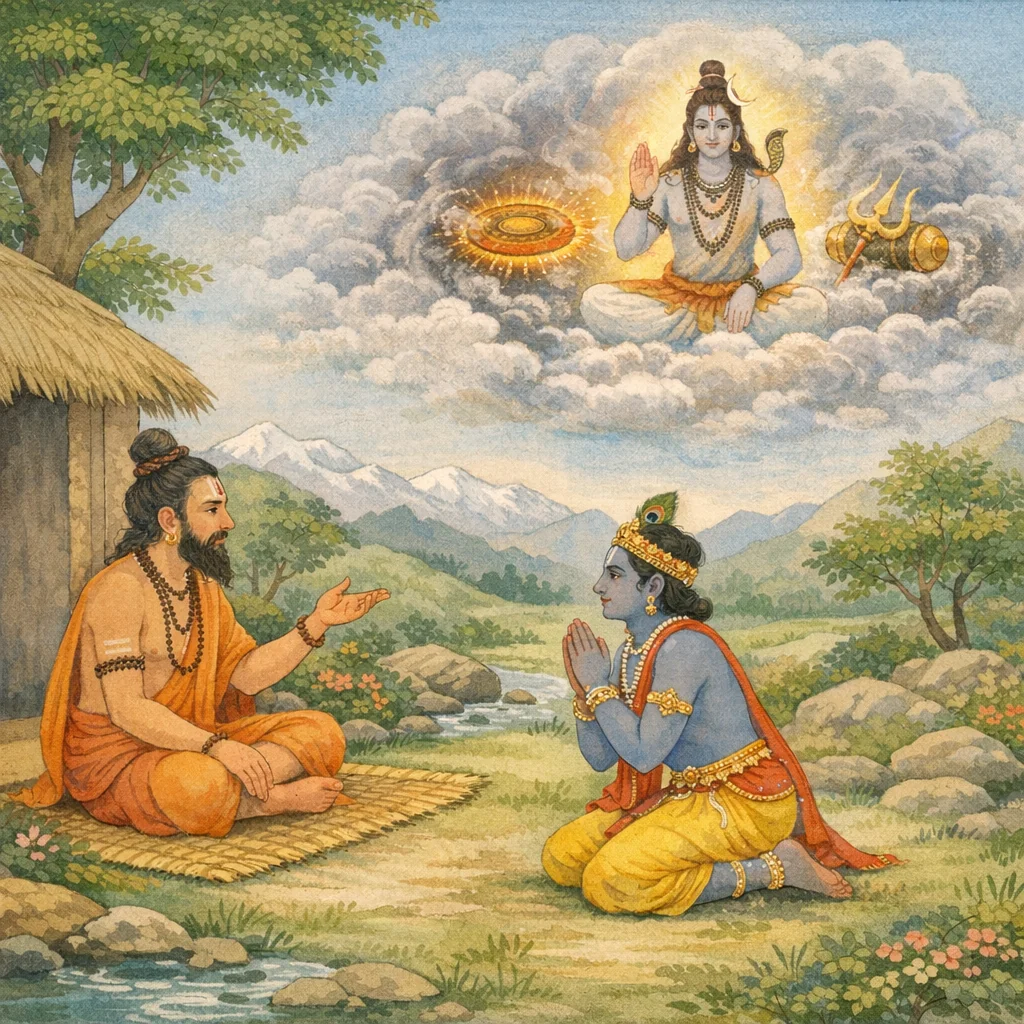
उपमन्यूपदेशः (Upamanyu’s Instruction)
Adhyāya 2 unfolds as an instructional dialogue set within the Sanatkumāra–Vyāsa frame. Sanatkumāra recounts how Kṛṣṇa, after hearing the great sage Upamanyu, awakens devotion to Mahādeva and begs the rishi for guidance. Kṛṣṇa asks for an account of those who attained their desired ends by propitiating Śiva, and Upamanyu replies as an authoritative Śaiva teacher. A series of exempla follows: Hiraṇyakaśipu and his son Nandana are named as recipients of extraordinary power through Śiva’s grace, and martial episodes are cited in which even Viṣṇu’s cakra and Indra’s vajra become ineffective, showing that Śiva-bestowed dharmic force can surpass the highest divine weapons. The chapter’s didactic purpose is to establish a theology of efficacy: Śiva-ārādhana is portrayed as a supra-cosmic causal principle governing victory, protection, and sovereignty, inspiring disciplined devotion and reverence for Śiva as the ultimate source of power and refuge.
Shlokas
Verse 1
सनत्कुमार उवाच । इत्याकर्ण्य मुनेर्वाक्यमुपमन्योर्महात्मनः । जातभक्तिर्महादेवे कृष्णः प्रोवाच तं मुनिम्
Sanatkumāra said: Thus hearing the words of the great-souled sage Upamanyu, Kṛṣṇa—whose devotion to Mahādeva had arisen—then spoke to that sage.
Verse 2
इति श्रीशिवमहापुराणे पंचम्यामुमासंहितायां सनत्कुमारव्याससंवादे उपमन्यूपदेशो नाम द्वितीयोऽध्यायः
Thus, in the Śrī Śiva Mahāpurāṇa—within the Fifth Book, the Umāsaṃhitā—during the dialogue between Sanatkumāra and Vyāsa, ends the second chapter entitled “Upamanyu-Upadeśa” (Instruction to Upamanyu).
Verse 3
सनत्कुमार उवाच । इत्याकर्ण्योपमन्युस्स मुनिश्शैववरो महान् । कृष्णवाक्यं सुप्रशस्य प्रत्युवाच कृपानिधिः
Sanatkumāra said: Having thus heard, the great sage Upamanyu—foremost among Śaiva devotees—highly praised Kṛṣṇa’s words and, an ocean of compassion, replied in return.
Verse 4
उपमन्युरुवाच । यैर्यैर्भवाराधनतः प्राप्तो हृत्काम एव हि । तांस्तान्भक्तान्प्रवक्ष्यामि शृणु त्वं वै यदूद्वह
Upamanyu said: “By whatever modes of worship of Bhava (Lord Śiva) one truly attains the heart’s desire, I shall describe those very devotees and their ways—listen, O best of the Yadus.”
Verse 5
शर्वात्सर्वामरैश्वर्य्यं हिरण्यकशिपुः पुरा । वर्षाणां दशलक्षाणि सोऽलभच्चन्द्रशेखरात्
In ancient times, Hiraṇyakaśipu obtained from Śarva—Candraśekhara Himself—sovereignty over all the gods, along with a lifespan of ten million years.
Verse 6
तस्याऽथ पुत्रप्रवरो नन्दनो नाम विश्रुतः । स च शर्ववरादिन्द्रं वर्षायुतमधोनयत्
Then he had an excellent son, renowned by the name Nandana. And, by the boon of Śarva (Lord Śiva), he humbled Indra and cast him down for ten thousand years.
Verse 7
विष्णुचक्रं च तद्धोरं वज्रमाखण्डलस्य च । शीर्णं पुराऽभवत्कृष्ण तदंगेषु महाहवे
O Kṛṣṇa, in that great battle, Viṣṇu’s fierce discus and Indra’s vajra were once shattered upon the Lord’s very limbs—so inviolable is Śiva, whom none can truly wound.
Verse 8
न शस्त्राणि वहंत्यंगे धर्मतस्तस्य धीमतः । ग्रहस्यातिबलस्याजौ चक्रवज्रमुखान्यपि
For the wise one who stands firm in dharma, weapons do not cling to his body. In battle against the exceedingly powerful Graha, even discuses and vajra-like arms prove futile.
Verse 9
अर्द्यमानाश्च विबुधा ग्रहेण सुबलीयसा । देवदत्तवरा जघ्नुरसुरेन्द्रास्सुरान्भृशम्
Overpowered and seized by the mightier Graha, the Devas were tormented; then the Asura-lords, strengthened by boons bestowed upon them, struck down the gods with fierce violence.
Verse 10
तुष्टो विद्युत्प्रभस्यापि त्रैलोक्येश्वरता मदात् । शतवर्षसहस्राणि सर्वलोकेश्वरो भवः
Pleased with him, I granted Vidyutprabha sovereignty over the three worlds. For a hundred thousand years, be Bhava—the lord of all the worlds.
Verse 11
तथा पुत्रसहस्राणामयुतं च ददौ शिवः । मम चानुचरो नित्यं भविष्यस्यब्रवीदिति
“Likewise, Śiva granted him ten thousand sons; and He also declared, ‘In the future he shall ever remain My attendant and servant.’”
Verse 12
कुशद्वीपे शुभं राज्यमददाद्भगवान्भवः । स तस्मै शङ्करः प्रीत्या वासुदेव प्रहृष्टधीः
In Kuśadvīpa, the Blessed Lord Bhava (Śiva) granted him an auspicious kingdom. That Śaṅkara, delighted in mind, lovingly bestowed it upon him, O Vāsudeva.
Verse 13
धात्रा सृष्टश्शतमखो दैत्यो वर्षशतं पुरा । तपः कृत्वा सहस्रं तु पुत्राणामलभद्भवात्
In former times, the Daitya named Śatamakha—created by Dhātṛ (Brahmā)—performed austerities for a hundred years; and by that tapas he obtained a thousand sons from Bhava (Lord Śiva).
Verse 14
याज्ञवल्क्य इति ख्यातो गीतो वेदेषु वै मुनिः । आराध्य स महादेवं प्राप्तवाञ्ज्ञानमुत्तमम्
The sage renowned as Yājñavalkya—celebrated indeed in the Vedas—having worshipped Mahādeva, attained the supreme spiritual knowledge.
Verse 15
वेदव्यासस्तु यो नाम्ना प्राप्तवानतुलं यशः । सोऽपि शंकरमाराध्य त्रिकालज्ञानमाप्तवान्
He who is renowned by the name Vedavyāsa attained incomparable fame; and even he, having duly worshipped Śaṅkara, obtained knowledge of the three times—past, present, and future.
Verse 16
इन्द्रेण वालखिल्यास्ते परिभूतास्तु शङ्करात् । लेभिरे सोमहर्तारं गरुडं सर्वदुर्जयम्
The Vālakhilya sages, humiliated by Indra, sought refuge in Śaṅkara. Through Śaṅkara’s support they obtained Garuḍa—invincible to all—as the one who would seize the Soma.
Verse 17
आपः प्रनष्टाः सर्वाश्च पूर्वरोषात्कपर्द्दिनः । शर्वं समकपालेन देवैरिष्ट्वा प्रवर्तितम्
All the waters had vanished because of the earlier wrath of Kapardin (Śiva). Then the gods worshipped Śarva with a complete skull-bowl offering, and by that rite the sacred flow was set in motion again.
Verse 18
अत्रेर्भार्य्या चानसूया त्रीणि वर्षशतानि च । मुशलेषु निराहारा सुप्त्वा शर्वात्ततस्सुतान्
Atri’s wife, the chaste Anasūyā, lay upon pestles for three hundred years, fasting without food; and then, by the grace of Śarva (Lord Śiva), she obtained sons.
Verse 19
दत्तात्रेयं मुनिं लेभे चन्द्रं दुर्वाससं तथा । गंगां प्रवर्तयामास चित्रकूटे पतिव्रता
That devoted wife (pativratā) obtained the sage Dattātreya, and also Candra and Durvāsas; and at Citrakūṭa she caused the Gaṅgā to flow forth.
Verse 20
विकर्णश्च महादेवं तथा भक्तसुखावहम् । प्रसाद्य महतीं सिद्धिमाप्तवान्मधुसूदन
Vikarṇa too, having pleased Mahādeva—who bestows joy upon His devotees—attained a great spiritual siddhi; thus did Madhusūdana (Viṣṇu) declare.
Verse 21
चित्रसेनो नृपश्शंभुं प्रसाद्य दृढभक्तिमान् । समस्तनृपभीतिभ्योऽभयं प्रापातुलं च कम्
King Citrasena, steadfast in unwavering devotion, pleased Śambhu (Lord Shiva) and attained incomparable fearlessness—freedom from all fears arising from other kings.
Verse 22
श्रीकरो गोपिकासूनुर्नृपपूजाविलोकनात् । जातभक्तिर्महादेवे परमां सिद्धिमाप्तवान्
Śrīkara, the son of a cowherd woman, upon witnessing the king’s worship, awakened devotion to Mahādeva and attained the supreme spiritual accomplishment (siddhi).
Verse 23
चित्राङ्गदो नृपसुतस्सीमन्तिन्याः पतिर्हरे । शिवानुग्रहतो मग्नो यमुनायां मृतो न हि
O Hari, Citrāṅgada—the king’s son and the husband of Sīmantinī—though submerged in the Yamunā by the grace of Śiva, did not truly die.
Verse 24
स च तक्षालयं गत्वा तन्मैत्रीं प्राप्य सुव्रतः । आयातः स्वगृहं प्रीतो नानाधनसमन्वितः
And he, steadfast in holy vows, went to the carpenter’s workshop; gaining their friendship, he returned to his own home joyful, furnished with many kinds of wealth.
Verse 25
सीमंतिनी प्रिया तस्य सोमव्रतपरायणा । शिवानुग्रहतः कृष्ण लेभे सौभाग्यमुत्तमम्
O Kṛṣṇa, his beloved Sīmantinī—steadfast in the Soma-vrata—by Lord Śiva’s grace attained the highest good fortune.
Verse 26
तत्प्रभावाद्व्रते तस्मिन्नेको द्विजसुतः पुरा । कश्चित्स्त्रीत्वं गतो लोभात्कृतदाराकृतिश्छलात्
By the power of that observance (vrata), long ago a certain son of a brāhmaṇa—out of greed—came to assume a woman’s state, through deceit by taking on the guise of a wife.
Verse 27
चंचुका पुंश्चली दुष्टा गोकर्णे द्विजतः पुरा । श्रुत्वा धर्मकथां शंभोर्भक्त्या प्राप परां गतिम्
Formerly at Gokarṇa, a wicked and wayward woman named Caṃcukā heard from a brāhmaṇa the sacred discourse on dharma concerning Śambhu (Lord Śiva); and through devotion she attained the supreme state (liberation).
Verse 28
स्वस्त्र्यनुग्रहतः पापी बिंदुगो चंचुकापतिः । श्रुत्वा शिवपुराणं स सद्गतिं प्राप शांकरीम्
By the grace of his own wife, the sinful Binduga, the husband of Caṃcukā, on hearing the Śiva Purāṇa attained the true blessed state—Śaṅkara’s (Śiva’s) auspicious liberation.
Verse 29
पिंगला गणिका ख्याता मदराह्वो द्विजाधमः । शैवमृषभमभ्यर्च्य लेभाते सद्गतिं च तौ
Piṅgalā, famed as a courtesan, and Madarāhva, the most fallen among the twice-born—having worshipped the Śaiva bull (Nandin), both of them attained the blessed state.
Verse 30
महानन्दाभिधा कश्चिद्वेश्या शिवपदादृता । दृढात्पणात्सुप्रसाद्य शिवं लेभे च सद्गतिम्
There was a courtesan named Mahānandā who took refuge at the feet of Lord Śiva. With steadfast resolve she greatly pleased Śiva, and thus attained the true blessed state—the liberating destiny.
Verse 31
कैकेयी द्विजबालाः च सादराह्वा शिवव्रता । परमं हि सुखं प्राप शिवेशव्रतधारणात्
Kaikeyī, the young brahmin maidens, and Sādarāhvā—steadfast in Śiva’s vow—indeed attained the highest bliss by undertaking and firmly observing the vow dedicated to Lord Śiveśa (Śiva).
Verse 32
विमर्षणश्च नृपतिश्शिवभक्तिं विधाय वै । गतिं लेभे परां कृष्ण शिवानुग्रहतः पुरा
O Kṛṣṇa, that king Vimarṣaṇa, having duly established devotion to Śiva, attained the supreme state in ancient times—through Śiva’s grace.
Verse 33
दुर्जनश्च नृपः पापी बहुस्त्रीलंपटः खलः । शिवभक्त्या शिवं प्राप निर्लिप्तः सर्वकर्मसु
Even a wicked man—a sinful king, a depraved villain given to lust for many women—through devotion to Śiva attained Śiva, becoming unstained with regard to all actions.
Verse 34
सस्त्रीकश्शबरो नाम्ना शंकरश्च शिवव्रती । चिताभस्मरतो भक्त्या लेभे तद्गतिमुत्तमाम्
A Śabara (forest-dweller) named Śaṅkara, together with his wife, steadfast in Śiva’s vows, devoutly smeared himself with the ash of the funeral pyre; through that bhakti he attained the supreme state—union with Śiva’s own goal.
Verse 35
सौमिनी नाम चाण्डाली संपूज्याज्ञानतो हि सा । लेभे शैवीं गतिं कृष्ण शंकरानुग्रहात्परात्
A Caṇḍāla woman named Sauminī, though she once worshiped without full understanding, nevertheless attained the Śaiva state—O Kṛṣṇa—through the supreme grace of Śaṅkara.
Verse 36
कौशिकश्च समाराध्य शंकरं लोक शंकरम् । ब्राह्मणोऽभूत्क्षत्रियश्च द्वितीय इव पद्मभूः
Kauśika, having duly propitiated Śaṅkara—the benefactor of the worlds—became both a brāhmaṇa and a kṣatriya, resplendent like a second Padmabhū (Brahmā).
Verse 37
दुर्वासा मुनिशार्दूलश्शिवानुग्रहतः पुरा । तस्तार स्वमतं लोके शिवभक्तिं विमुक्तिदाम्
Long ago, Durvāsā, the tiger among sages, by Śiva’s grace established his teaching in the world: devotion to Śiva, which bestows liberation.
Verse 39
शिवमभ्यर्च्य सद्भक्त्या विरंचिश्शैवसत्तमः । अभूत्सर्गकरः कृष्ण सर्वलोकपितामहः
Having worshipped Lord Śiva with true devotion, Virañci (Brahmā)—foremost among Śaivas—became the agent of creation, the revered Pitāmaha, father of all the worlds.
Verse 40
मार्कण्डेयो मुनिवरश्चिरंजीवी महाप्रभुः । शिवभक्तवरः श्रीमाञ्शिवानुग्रहतो हरे
Mārkaṇḍeya, foremost of sages, became chiranjīvi—long-lived and greatly glorious. That illustrious best of Śiva’s devotees attained this by Śiva’s grace, O Hari.
Verse 41
देवेन्द्रो हि महाशैवस्त्रैलोक्यं बुभुजे पुरा । शिवानुग्रहतः कृष्ण सर्वदेवाधिपः प्रभुः
Indeed, Devendra (Indra), being a great devotee of Śiva, formerly enjoyed sovereignty over the three worlds. O Kṛṣṇa, it was by Śiva’s grace that he became the powerful lord and overlord of all the gods.
Verse 42
बलिपुत्रो महाशैवश्शिवानुग्रहतो वशी । बाणो बभूव ब्रह्माण्डनायकस्सकलेश्वरः
Bāṇa, the son of Bali, a great devotee of Śiva, became powerful through Śiva’s grace; he became a ruler of the cosmic realm, a lord over all.
Verse 43
हरिश्शक्तिश्च सद्भक्त्या दधीचश्च महेश्वरः । शिवानुग्रहतोऽभूवंस्तथा रामो हि शांकरः
Through true devotion, Hari became endowed with divine power; Dadhīci became a great lordly sage; and likewise Rāma became a devotee of Śaṅkara—all of them attaining these states by the gracious favor of Śiva.
Verse 44
कणादो भार्गवश्चैव गुरुर्गौतम एव च । शिवभक्त्या बभूवुस्ते महाप्रभव ईश्वरा
Kaṇāda, Bhārgava, Guru (Bṛhaspati), and Gautama as well—by devotion to Lord Śiva they became greatly empowered, illustrious masters.
Verse 45
शाकल्यश्शंसितात्मा च नववर्षशातान्यपि । भवमाराधयामास मनोयज्ञेन माधव
Śākalya, of praised and noble spirit, worshipped Bhava (Lord Śiva) for even nine hundred years—Mādhava adoring Him through the inner sacrifice, offering the mind as the oblation.
Verse 46
तुतोष भगवानाह ग्रंथकर्ता भविष्यसि । वत्साक्षय्या च ते कीर्तिस्त्रैलोक्ये प्रभविष्यति
Pleased, the Blessed Lord said: “My child, you shall become a composer of sacred scripture, and your fame shall be imperishable, spreading throughout the three worlds.”
Verse 47
अक्षयं च कुलं तेऽस्तु महर्षिभिरलंकृतम् । भविष्यसि ऋषिश्रेष्ठ सूत्रकर्ता ततस्ततः
May your lineage be imperishable, adorned by great seers. O best of sages, in due course you shall become a composer of sūtras, again and again.
Verse 48
इत्येवं शंकरात्प्राप वरं मुनिवरस्स वै । त्रैलोक्ये विततश्चासीत्पूज्यश्च यदुनन्दन
Thus that best of sages indeed obtained the boon from Śaṅkara. And, O dear scion of the Yadus, his fame spread throughout the three worlds, and he became worthy of reverence.
Verse 49
सावर्णिरिति विख्यात ऋषिरासीत्कृते युगे । इह तेन तपस्तप्तं षष्टिवर्षशतानि च
In the Kṛta Yuga there lived a sage renowned by the name Sāvarṇi. In this very place he practiced austere tapas for six thousand years.
Verse 50
तमाह भगवान्रुद्रस्साक्षात्तुष्टोस्मि तेऽनघ । ग्रंथकृल्लोकविख्यातो भवितास्यजरामरः
Then the Blessed Lord Rudra Himself said: “O sinless one, I am truly pleased with you. You shall become the author of a sacred work, renowned throughout the worlds, and you shall be free from old age and death.”
Verse 51
एवंविधो महादेवः पुण्यपूर्वतरैस्ततः । समर्च्चितश्शुभान्कामान्प्रददाति यथेप्सितान्
Thus is Mahādeva: when worshipped by those whose merit is exceedingly abundant, He grants auspicious desires—exactly as they are wished for.
Verse 52
एकेनैव मुखेनाहं वक्तुं भगवतो गुणाः । ये संति तान्न शक्नोमि ह्यपि वर्षशतैरपि
With only one mouth, I am not able to describe the Lord’s qualities as they truly are—not even if I were to speak for hundreds of years.
Frequently Asked Questions
The chapter advances an argument-by-exempla: Upamanyu begins enumerating devotees/figures who gained extraordinary outcomes through Śiva’s worship, including cases where even Viṣṇu’s cakra and Indra’s vajra prove ineffective—demonstrating that Śiva’s boon-power is causally prior to conventional divine or martial supremacy.
The failure of iconic weapons (cakra, vajra) functions as a symbolic claim about ontology and authority: ritual merit and divine favor derived from Śiva-ārādhana represent a higher-order protection (adhidaivika sanction) that can neutralize lower-order instruments of force, reframing victory as a theological outcome rather than merely a tactical one.
Śiva is explicitly invoked as Mahādeva and Candraśekhara, emphasizing his role as the personal bestower of boons and supreme protector; Gaurī/Umā is not foregrounded in the sampled opening verses, but the Samhitā context positions her theology as the broader interpretive horizon for Śaiva instruction.