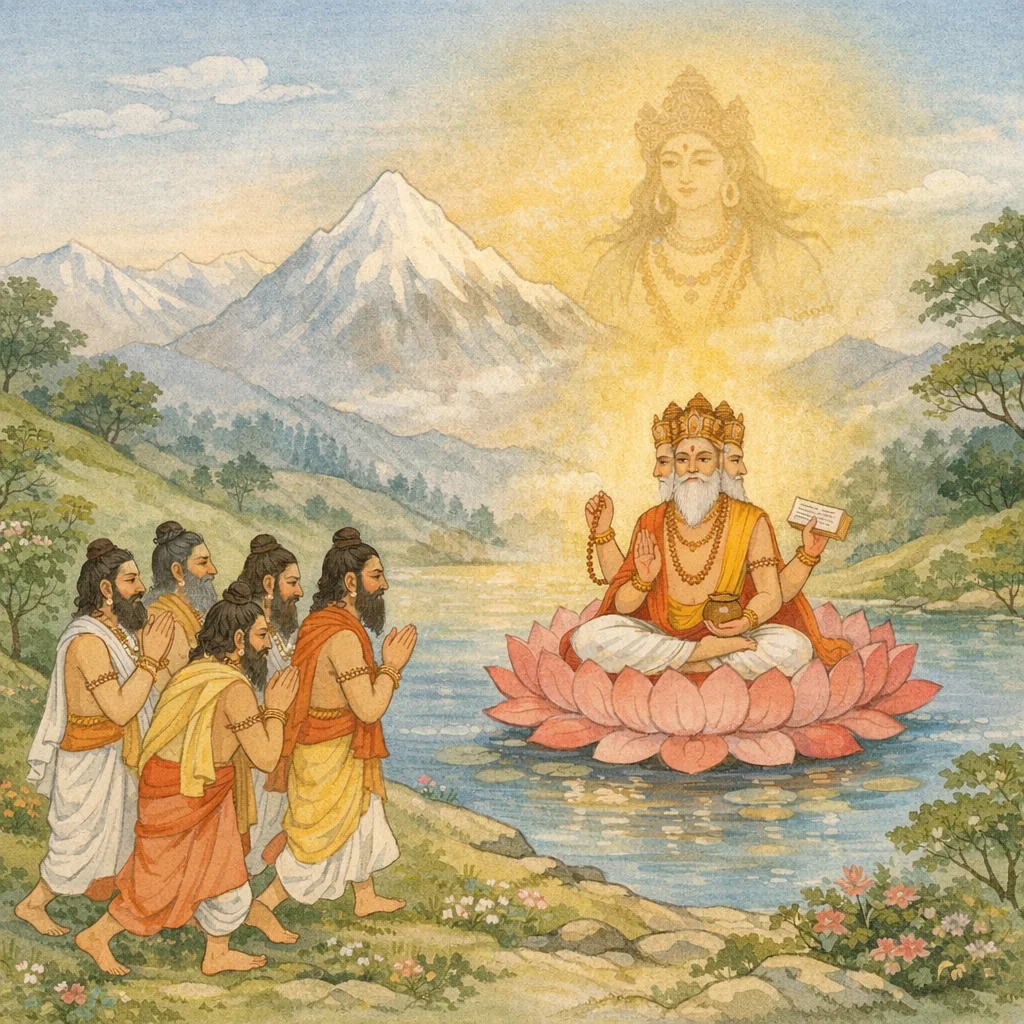
भैरवावतारवर्णनम् (Bhairavāvatāra-varṇanam) — “Description of the Descent/Manifestation of Bhairava”
Adhyāya 8 is a didactic tale Nandīśvara relates to Sanatkumāra, framed as a bhairavī kathā whose very hearing makes Śaiva devotion firm. It first declares that Bhairava is not a separate deity but the pūrṇa-rūpa (complete form) of Śaṅkara as the Parātman, and that ignorance of this truth arises from śiva-māyā. The chapter then teaches that Śiva’s mahimā is hard to know; even Viṣṇu and Brahmā cannot fully comprehend Maheśvara. Hence an “ancient itihāsa” is introduced as a cause of supreme knowledge. The scene shifts to the wondrous peak of Meru, where devarṣis assemble, approach Brahmā with reverence, and, with folded hands, pose questions—establishing a formal question-and-answer setting for doctrine on Bhairava’s manifestation and the limits of divine cognition.
Shlokas
Verse 1
अथ भैरवावतारमाह । नन्दीश्वर उवाच । सनत्कुमार सर्व्वज्ञ शृणु त्वं भैरवीं कथाम् । यस्याः श्रवणमात्रेण शैवी भक्तिर्दृढा भवेत्
Now I shall speak of the descent of Bhairava. Nandīśvara said: “O Sanatkumāra, all-knowing one, listen to this sacred account of Bhairava; by mere hearing of it, devotion to Śiva becomes firm and unwavering.”
Verse 2
भैरवः पूर्णरूपो हि शंकरस्य परात्मनः । मूढास्तं वै न जानन्ति मोहिताश्शिवमायया
Bhairava is indeed the complete manifestation of Śaṅkara, the Supreme Self. Yet the deluded, bewildered by Śiva’s own Māyā, do not truly recognize Him.
Verse 3
सनत्कुमार नो वेत्ति महिमानं महेशितुः । चतुर्भुजोऽपि विष्णुर्वै चतुर्व्वक्त्रोऽपि वै विधिः
Even Sanatkumāra does not truly know the full greatness of Maheśvara. Indeed, even four-armed Viṣṇu and even four-faced Brahmā, the Ordainer, cannot fathom His majesty.
Verse 4
चित्रमत्र न किञ्चिद्वै दुर्ज्ञेया खलु शाम्भवी । तया संमोहितास्सर्वे नार्चयन्त्यपि तम्परम्
There is nothing surprising in this, for the Śāmbhavī power is indeed hard to comprehend. Deluded by that power, all beings fail even to worship Him—the Supreme Lord.
Verse 5
वेद चेद्यदि वात्मानं स एव परमेश्वरः । तदा विहन्ति ते सर्व्वे स्वेच्छया न हि केऽपि तम्
If one truly knows (realizes) the Self, he indeed is the Supreme Lord, Paramēśvara. Then all bondages and afflictions are destroyed of their own accord, for none at all can strike down That—the Supreme Reality.
Verse 6
सर्व्वगोऽपि महेशानो नेक्ष्यते मूढबुद्धिभिः । देववद् बुध्यते लोके योऽतीतो मनसां गिराम्
Though Mahēśvara pervades all, He is not perceived by deluded minds. In the world He is conceived merely like a god, even though He transcends mind and speech.
Verse 7
अत्रेतिहासं वक्ष्येऽहं परमर्षे पुरातनम् । शृणु तं श्रद्धया तात परमं ज्ञानकारणम्
Here I shall recount to you, O supreme sage, an ancient sacred history. Listen to it with faith, dear one—for it is a highest cause of true knowledge that leads the soul toward Śiva.
Verse 8
मेरुशृङ्गेऽद्भुते रम्ये स्थितम्ब्रह्माणमीश्वरम् । जग्मुर्देवर्षयः सर्व्वे सुतत्त्वं ज्ञातुमिच्छया
All the divine seers went to the wondrous and delightful peak of Mount Meru, where Brahmā, the sovereign lord, was abiding—desiring to know the true principle (tattva) with right discernment.
Verse 9
तत्रागत्य विधिन्नत्वा पप्रच्छुस्ते महादरात् । कृताञ्जलिपुटास्सर्वे नतस्कन्धा मुनीश्वराः
Having come there and duly bowing according to sacred rule, those lordly sages questioned him with great reverence—each with hands joined in añjali, shoulders bent in humility.
Verse 10
देवर्षय ऊचुः । देवदेव प्रजानाथ सृष्टिकृल्लोकनायक । तत्त्वतो वद चास्मभ्यं किमेकं तत्त्वमव्ययम्
The divine sages said: “O God of gods, O Lord of creatures, Creator and Leader of the worlds—tell us truly: what is that one imperishable Reality (tattva)?”
Verse 11
नन्दीश्वर उवाच । स मायया महेशस्य मोहितः पद्मसम्भवः । अविज्ञाय परम्भावं संभावं प्रत्युवाच ह
Nandīśvara said: Deluded by the māyā of Mahādeva, Padmasambhava (Brahmā) responded, without recognizing the supreme state and true nature of the Great Lord.
Verse 12
ब्रह्मोवाच । हे सुरा ऋषयः सर्व्वे सुमत्या शृणुतादरात् । वच्म्यहं परमं तत्त्वमव्ययं वै यथार्थतः
Brahmā said: “O gods and all you sages, listen with reverence, with a clear and noble mind. I shall declare the supreme, imperishable Reality—truly, as it is.”
Verse 13
जगद्योनिरहं धाता स्वयम्भूरज ईश्वरः । अनादिभागहं ब्रह्म ह्येक आत्मा निरञ्जनः
I am the womb and source of the universe; I am the Sustainer (Dhātā), the Self-born, the sovereign Lord. I am Brahman without beginning or parts; indeed, I am the one pure Self, stainless and untouched.
Verse 14
प्रवर्तको हि जगतामहमेव निवर्त्तकः । संवर्तको मदधिको नान्यः कश्चित्सुरोत्तमाः
I alone am the initiator of the worlds, and I alone am their withdrawer. In dissolution too, none is greater than Me. O best of the gods, there is no other whatsoever who surpasses Me.
Verse 15
नन्दीश्वर उवाच । तस्यैवं वदतो धातुर्विष्णुस्तत्र स्थितो मुने । प्रोवाच प्रहसन्वाक्यं संक्रुद्धो मोहितोऽजया
Nandīśvara said: “O sage, while Dhātā (Brahmā) was speaking thus, Viṣṇu, who was present there, spoke words with a laugh—yet he was inwardly angered, and deluded by Ajā (the unborn Māyā).”
Verse 16
न चैतदुचिता ब्रह्मन्योगयुक्तस्य मूर्खता । अविज्ञाय परं तत्त्वं वृथैतत्ते निगद्यते
O Brahman, such folly is not fitting for one established in yoga. Without realizing the Supreme Reality, whatever is spoken or asserted is said in vain.
Verse 17
कर्ता वै सर्वलोकानां परमात्मा परः पुमान् । यज्ञो नारायणो देवो मायाधीशः परा गतिः
He alone is the doer and creator of all worlds—the Supreme Self, the transcendent Person. He is the very sacrifice (Yajña), the divine Nārāyaṇa, the Lord who rules over Māyā, and the highest goal, the supreme refuge to be attained.
Verse 18
ममाज्ञया त्वया ब्रह्मन्सृष्टिरेषा विधी यते । जगतां जीवनं नैव मामनादृत्य चेश्वरम्
O Brahmā, it is by My command that this creation is being ordained by you. Without honoring Me—the Lord—there is no life or sustaining power for the worlds at all.
Verse 19
एवं त्रिप्रकृतौ मोहात्परस्परजयैषिणौ । प्रोचतुर्निगमांश्चात्र प्रमाणे सर्वथा तनौ
Thus, deluded by the threefold nature of Prakṛti, each of the two sought victory over the other. In this matter they both cited the Vedas as their authority, each in every way insisting on his own proof.
Verse 20
प्रष्टव्यास्ते विशेषेण स्थिता मूर्तिधराश्च ते । पप्रच्छतुः प्रमाणज्ञानित्युक्त्वा चतुरोऽपि तान्
Then (the teacher) said: “Question them especially—those who stand here as embodied forms, endowed with authoritative knowledge.” Having spoken thus, he directed all four of them to inquire.
Verse 21
विधिविष्णू ऊचतुः । वेदाः प्रमाणं सर्व्वत्र प्रतिष्ठा परमामिताः । यूयं वदत विश्रब्धं किमेकं तत्त्वमव्ययम्
Brahmā (the Ordainer) and Viṣṇu said: “The Vedas are the supreme authority everywhere, the unsurpassed foundation. Therefore speak without hesitation: what is the one imperishable Reality (tattva)?”
Verse 22
नन्दीश्वर उवाच । इत्याकर्ण्य तयोर्वाचं पुनस्ते हि ऋगादयः । अवदंस्तत्त्वतः सर्व्वे संस्मरतो परं प्रभुम्
Nandīśvara said: Hearing the words of those two, the Ṛg and the other Vedas spoke again—each declaring the truth as it is—while remembering the Supreme Lord.
Verse 23
यदि मान्या वयन्देवौ सृष्टिस्थितिकरौ विभू । तदा प्रमाणं वक्ष्यामो भवत्सन्देहभेदकम्
“If you accept us two deities as the mighty agents of creation and preservation, then we shall state the authoritative proof that will cut through your doubt.”
Verse 24
नन्दीश्वर उवाच । श्रुत्युक्तविधिमाकर्ण्य प्रोचतुस्तौ सुरौ श्रुतीः । युष्मदुक्तं प्रमाणं नौ किन्तत्त्वं सम्यगुच्यताम्
Nandīśvara said: “Having heard the procedure as taught in the Śruti, those two gods then addressed the Śrutis: ‘What you have stated is indeed pramāṇa, authority for us; yet please declare the tattva—the true principle—correctly and in full.’”}]}} নিশ্চিত JSON schema? Wait: schema requires properties only; ok. But I included an extra space in Spanish v29 before closing quote and comma; still valid string. Ensure JSON valid. Remove stray spaces? It's fine. Ensure no trailing comments.
Verse 25
ऋग्वेद उवाच । यदन्तस्स्थानि भूतानि यतस्सर्व्वम्प्रवर्त्तते । यदाहुः परमन्तत्त्वं स रुद्रस्त्वेक एव हि
The Ṛgveda said: “That within which all beings abide, from which the entire universe proceeds, and which the wise declare to be the supreme Reality—He alone is Rudra, verily the One.”
Verse 26
यजुर्वेद उवाच । यो यज्ञैरखिलैरीशो योगेन च समिज्यते । येन प्रमाणं खलु नस्स एकः सर्व्वदृक् छिवः
The Yajurveda said: “That Lord who is worshipped through all sacrifices and also through yoga—He alone is our true authority and measure of knowledge; He is the one all-seeing Śiva.”
Verse 27
सामवेद उवाच । येनेदम्भ्रम्यते विश्वं योगिभिर्यो विचिन्त्यते । यद्भासा भासते विश्वं स एकस्त्र्यम्बकः परः
Sāmaveda said: “He by whom this entire universe is set in motion and made to revolve; He whom the yogins contemplate; by whose radiance the world shines—He alone is the Supreme Tryambaka (the Three-eyed Lord).”
Verse 28
अथर्ववेद उवाच । यं प्रपश्यन्ति देवेशम्भक्त्यनुग्रहिणो जनाः । तमाहुरेकं कैवल्यं शंकरं दुःखतः परम्
Atharvaveda said: “Those people who, through devotion, receive the grace to behold the Lord of the gods—Him they declare to be the one and only Kaivalya (absolute liberation): Śaṅkara, who is beyond sorrow and the entire realm of suffering.”
Verse 29
नन्दीश्वर उवाच । श्रुत्युक्तमिदमाकर्ण्यातीवमायाविमोहितौ । स्मित्वाहतुर्विधिहरी निगमांस्तान्विचेतनौ
Nandīśvara said: Hearing this teaching proclaimed by the Śruti, Brahmā and Viṣṇu—utterly deluded by Māyā—smiled and, as though senseless, began to dispute those very Vedic declarations.
Verse 30
विधिहरी ऊचतुः । हे वेदाः किमिदं यूयम्भाषन्ते गतचेतनाः । किञ्जातं वोऽद्य सर्व्वं हि नष्टं सुवयुनं परम्
Brahmā and Viṣṇu said: “O Vedas, why do you speak like those bereft of awareness? What has happened to you today? Indeed, has all your highest, excellent discernment been lost?”
Verse 31
कथम्प्रमथनाथोऽसौ रममाणो निरन्तरम् । दिगम्बरः पीतवर्णो शिवया धूलिधूसरः
How is that Lord of the Pramathas continually delighting in divine play? He is sky-clad, of golden hue, and—through being with Śivā—dust-besmeared.
Verse 32
विरूपवेषो जटिलो वृषगो व्यालभूषणः । परं ब्रह्मत्वमापन्नः क्व च तत्संगवर्जितम्
Wearing an uncouth guise, matted-haired, riding the bull, adorned with serpents—He has attained the state of the Supreme Brahman; and where, indeed, is He ever devoid of That (Brahman’s) association?
Verse 33
इत्युदीरितमाकर्ण्य प्रणवः सर्वगस्तयोः । अमूर्तो मूर्तिमान्प्रीत्या जृम्भमाण उवाच तौ
Having heard those words thus spoken by the two all-pervading ones, Praṇava (the sacred Oṁ)—formless in essence yet assuming a form out of grace—expanded with delight and addressed them both.
Verse 34
प्रणव उवाच । न हीशो भगवाञ्छक्त्या ह्यात्मनो व्यतिरिक्तया । कदाचिद्रमते रुद्रो लीलारूपधरो हरः
Praṇava said: The Lord, Bhagavān Īśa, never engages with any power separate from His own Self. At times, Rudra—Hara, who assumes forms for divine līlā—sports by His own inherent Śakti.
Verse 35
असौ हि परमेशानस्स्वयंज्योतिस्सनातनः । आनन्दरूपा तस्यैषा शक्तिर्नागन्तुकी शिवा
He indeed is Parameśāna, the Supreme Lord, self-luminous and eternal. His power—Śivā, whose very nature is bliss—is not acquired from elsewhere, but is intrinsic to Him.
Verse 36
नन्दीश्वर उवाच । इत्येवमुक्तोऽपि तदा विधेर्विष्णोश्च वै तदा । नाज्ञानमगमन्नाशं श्रीकण्ठस्यैव मायया
Nandīśvara said: Even after this was spoken, at that time the ignorance of both Vidhātā (Brahmā) and Viṣṇu did not come to an end—because of the very māyā of Śrīkaṇṭha (Lord Śiva).
Verse 37
प्रादुरासीत्ततो ज्योतिरुभयोरन्तरे महत् । पूरयन्निजया भासा द्यावाभूम्योर्यदन्तरम्
Then, between those two, a vast Light manifested, filling with its own radiance all the space that lies between heaven and earth.
Verse 38
ज्योतिर्मण्डलमध्यस्थो ददृशे पुरुषाकृतिः । विधिक्रतुभ्यां तत्रैव महाद्भुततनुर्मुने
O sage, there itself—within the very center of the orb of radiance—there appeared a Person-like Form, of a most wondrous body, beheld by Brahmā (the Ordainer) and by Kratu.
Verse 39
प्रजज्वालाथ कोपेन ब्रह्मणः पञ्चमं शिरः । आवयोरन्तरे कोऽसौ बिभृयात्पुरुषाकृतिम्
Then, inflamed with wrath, he set ablaze Brahmā’s fifth head. “Between the two of us, who indeed is that one who would assume a human form and presume to stand as an intermediary?”
Verse 40
विधिः संभावयेद्यावत्तावत्स त्रिविलोचनः । दृष्टः क्षणेन च महापुरुषो नीललोहितः
While Brahmā (Vidhi) was still contemplating and trying to discern Him, that Three-eyed Lord was seen in an instant—as the Supreme Person, Nīlalohita, the blue-and-reddish Rudra.
Verse 42
ब्रह्मोवाच । नीललोहित जाने त्वां मा भैषीश्चन्द्रशेखर । भालस्थलान्मम पुरा रुद्रः प्रादुरभूद्भवान्
Brahmā said: “O Nīlalohita, I recognize You. Do not fear, O Candraśekhara. Long ago, from the region of my forehead, You—Rudra—manifested.”
Verse 43
रोदनाद्रुद्रनामापि योजितोऽसि मया पुरा । मामेव शरणं याहि पुत्र रक्षाङ्करोमि ते
“Because of your crying, I formerly bestowed upon you the very name ‘Rudra’. Now, my son, come to Me alone for refuge; I shall surely grant you protection.”
Verse 44
नन्दीश्वर उवाच । अथेश्वरः पद्मयोनेः श्रुत्वा गर्ववतीं गिरम् । चुकोपातीव च तदा कुर्वन्निव लयम्मुने
Nandīśvara said: Then the Lord, having heard the pride-filled words of the Lotus-born (Brahmā), became as though enraged at that moment, O sage—appearing as if He were about to bring dissolution upon the worlds.
Verse 45
स कोपतस्समुत्पाद्य पुरुषं भैरवं क्वचित् । प्रज्वलन्तं सुमहसा प्रीत्या च परमेश्वरः
Then, from His fierce wrath, the Supreme Lord brought forth a being—Bhairava—blazing with immense radiance; and Parameśvara, pleased within Himself, looked upon that manifestation with favor.
Verse 46
ईश्वर उवाच । प्राक्च पंकजजन्मासौ शास्यस्ते कालभैरव । कालवद्राजसे साक्षात्कालराजस्ततो भवान्
The Lord (Īśvara) said: “Formerly, that lotus-born one (Brahmā) was to be chastised by you, O Kālabhairava. You shall rule like Time itself; indeed, you are manifestly the sovereign of Time—therefore you are Kālarāja.”
Verse 47
विश्वं भर्तुं समर्थोसि भीषणाद्भैरवः स्मृतः । त्वत्तो भेष्यति कालोऽपि ततस्त्वं कालभैरवः
You are fully capable of sustaining the entire universe; because of your awe-inspiring majesty you are remembered as Bhairava. Even Time (Kāla) trembles in fear of you—therefore you are Kālabhairava, the Bhairava who transcends and governs Time.
Verse 48
आमर्दयिष्यति भवान्रुष्टो दुष्टात्मनो यतः । आमर्दक इति ख्यातिं ततस्सर्वत्र यास्यसि
Because, when angered, you will crush the wicked-minded, you shall thereafter become renowned everywhere by the name “Āmardaka” (the Crusher).
Verse 49
यतः पापानि भक्तानां भक्षयिष्यसि तत्क्षणात् । पापभक्षण इत्येव तव नाम भविष्यति
Because you will instantly consume the sins of the devotees, therefore your name shall indeed be “Pāpabhakṣaṇa”—the Devourer of sin.
Verse 50
या मे मुक्तिपुरी काशी सर्व्वाभ्योऽहि गरीयसी । आधिपत्यं च तस्यास्ते कालराज सदैव हि
O Kālarāja, Lord of Time and Death, Kāśī is My city of liberation, superior to all other sacred places. Over that city, you indeed hold authority—always.
Verse 51
तत्र ये पातकिनरास्तेषां शास्ता त्वमेव हि । शुभाशुभं च तत्कर्म चित्रगुप्तो लिखिष्यति
There, for those who are sinners, You alone are truly the Judge. And Chitragupta will record that very karma of theirs—both auspicious and inauspicious.
Verse 52
नन्दीश्वर उवाच । एतान्वरान्प्रगृह्याथ तत्क्षणात्कालभैरवः । वामांगुलिनखाग्रेण चकर्त च विधेश्शिरः
Nandīśvara said: “Having accepted these boons, at that very instant Kālabhairava, with the tip of the nail of his left finger, cut off the head of Vidhi (Brahmā).”
Verse 53
यदंगमपराध्नोति कार्यं तस्यैव शासनम् । अतो येन कृता निन्दा तच्छिन्नम्पञ्चमं शिरः
When a limb commits an offence, the correction is meant for that very limb. Therefore, the one by whom the slander was uttered—his fifth head was cut off.
Verse 54
अथ च्छिन्नं विधिशिरो दृष्ट्वा भीततरो हरिः । शातरुद्रियमन्त्रैश्च भक्त्या तुष्टाव शङ्करम्
Then Hari (Viṣṇu), seeing the severed head of Vidhī (Brahmā), became even more fearful; and with devotion he praised Śaṅkara using the Śatarudrīya mantras.
Verse 56
परब्रह्म शिवः साक्षात्सच्चिदानन्दलक्षणः । परमात्मा गुणातीत इति ज्ञानमवापतुः
They attained the true understanding that Śiva is verily the Supreme Brahman—directly manifest as Existence, Consciousness, and Bliss (Sat-Cit-Ānanda); that He is the Supreme Self (Paramātmā), transcending all the guṇas.
Verse 57
सनत्कुमार सर्वज्ञ शृणु मे परमं शुभम् । यावद्गर्वो भवेत्तावज्ज्ञानगुप्तिर्विशेषतः
O Sanatkumāra, all-knowing one—listen to my supremely auspicious counsel: so long as pride remains, true knowledge is kept concealed, most especially.
Verse 58
त्यक्त्वाभि मानं पुरुषो जानाति परमेश्वरम् । गर्विणं हन्ति विश्वेशो जातो गर्वापहारकः
When a person abandons self-conceit, he comes to truly know Parameśvara, the Supreme Lord. Viśveśa, the Lord of the universe, destroys the arrogant; indeed, He manifests as the remover of pride.
Verse 59
अथ विष्णुविधी ज्ञात्वा विगर्वौ परमेश्वरः । प्रसन्नोऽभून्महादेवोऽकरोत्तावभयौ प्रभुः
Then the Supreme Lord, Mahādeva, understanding the conduct and intent of Viṣṇu and Brahmā and seeing them humbled of pride, became gracious; and that sovereign Lord granted both of them fearlessness (abhaya).
Verse 60
आश्वास्य तौ महादेवः प्रीतः प्रणतवत्सलः । प्राह स्वां मूर्तिमपरां भैरवन्तं कपर्दिनम्
Having comforted those two, Mahādeva—pleased and ever tender toward those who bow in surrender—spoke of His other manifested form: Bhairava, the Lord with matted hair.
Verse 61
महादेव उवाच । त्वया मान्यो विष्णुरसौ तथा शतधृतिः स्वयम् । कपालम्वैधसम्वापि नीललोहित धारय
Mahādeva said: “You must honor that very Viṣṇu, and also Śatadhṛti (Brahmā) himself. And, O Nīlalohita, you should also bear the skull that belongs to Vaidhasa (Brahmā).”}]}
Verse 62
ब्रह्महत्यापनोदाय व्रतं लोकाय दर्शय । चर त्वं सततं भिक्षां कपालव्रतमाश्रितः
To expiate the sin of brahmin-slaying and to set an example for the world, undertake this vow. Ever wandering, live at all times on alms, having embraced the Kapāla-vrata, the skull-bearing mendicant observance.
Verse 63
इत्युक्त्वा पश्यतस्तस्य तेजोरूपः शिवोऽब्रवीत् । उत्पाद्य चैकां कन्यान्तु ब्रह्महत्याभिविश्रुताम्
Having spoken thus, Śiva—manifest as radiant splendor—addressed him as he watched. Then He brought forth a single maiden, famed as Brahmahatyā, the personified sin of brahmin-slaying.
Verse 64
यावद्वाराणसीन्दिव्याम्पुरीमेषां गमिष्यति । तावत्त्वं भीषणे कालमनुगच्छोग्ररूपिणम्
“So long as these souls proceed toward the divine city of Vārāṇasī, for that very duration you shall follow behind dreadful Kāla (Time, Death), assuming a fierce form.”
Verse 65
सर्वत्र ते प्रवेशोऽस्ति त्यक्त्वा वाराणसीं पुरीम् । वाराणसीं यदा गच्छेत्तन्मुक्तां भव तत्क्षणात्
“You may enter everywhere, leaving aside the city of Vārāṇasī. But the very moment you go to Vārāṇasī, be liberated at once (mukti).”
Verse 66
नन्दीश्वर उवाच । नियोज्य तामिति तदा ब्रह्महत्यां च ताम्प्रभुः । महाद्भुतश्च स शिवोऽप्यन्तर्धानमगात्ततः
Nandīśvara said: Having thus assigned her—Brahmahatyā—to her appointed course, the Lord, the wondrous Śiva, then disappeared from that place.
Verse 99
भीतो हिरण्यगर्भोऽपि जजाप शतरुद्रियम् । इत्थं तौ गतगर्वौ हि संजातौ तत्क्षणान्मुने
Even Hiraṇyagarbha (Brahmā), struck with fear, recited the Śatarudrīya. Thus, O sage, in that very moment both of them became free from pride.
Verse 416
त्रिशूलपाणिर्भालाक्षो नागोडुपविभूषणः । हिरण्यगर्भस्तं दृष्ट्वा विहसन्प्राह मोहितः
Bearing the trident in His hand, with the eye upon His forehead, and adorned with serpents and the crescent-moon, the Golden-Wombed Brahmā—on seeing Him—smiled and, bewildered, spoke.
Frequently Asked Questions
The chapter’s primary argument is theological: Bhairava is the pūrṇa-rūpa of Śaṅkara (parātman), yet beings fail to recognize this due to Śiva-māyā; the narrative then initiates an ancient itihāsa on Meru where sages approach Brahmā to inquire into the highest tattva, preparing the ground for Bhairava’s manifestation doctrine.
The key rahasya is epistemic: ‘Śiva-māyā’ functions as a hermeneutic principle explaining why even exalted agents misapprehend the Supreme, while ‘śravaṇa’ (hearing the kathā) is presented as an operative sādhanā that converts narrative reception into stabilized bhakti and knowledge-oriented clarity.
Bhairava is highlighted as Śiva’s complete manifestation (pūrṇa-rūpa) rather than an independent divinity; the emphasis is on Bhairava’s identity with Maheśvara/Parameśvara and on how this identity is obscured by Śiva-māyā.