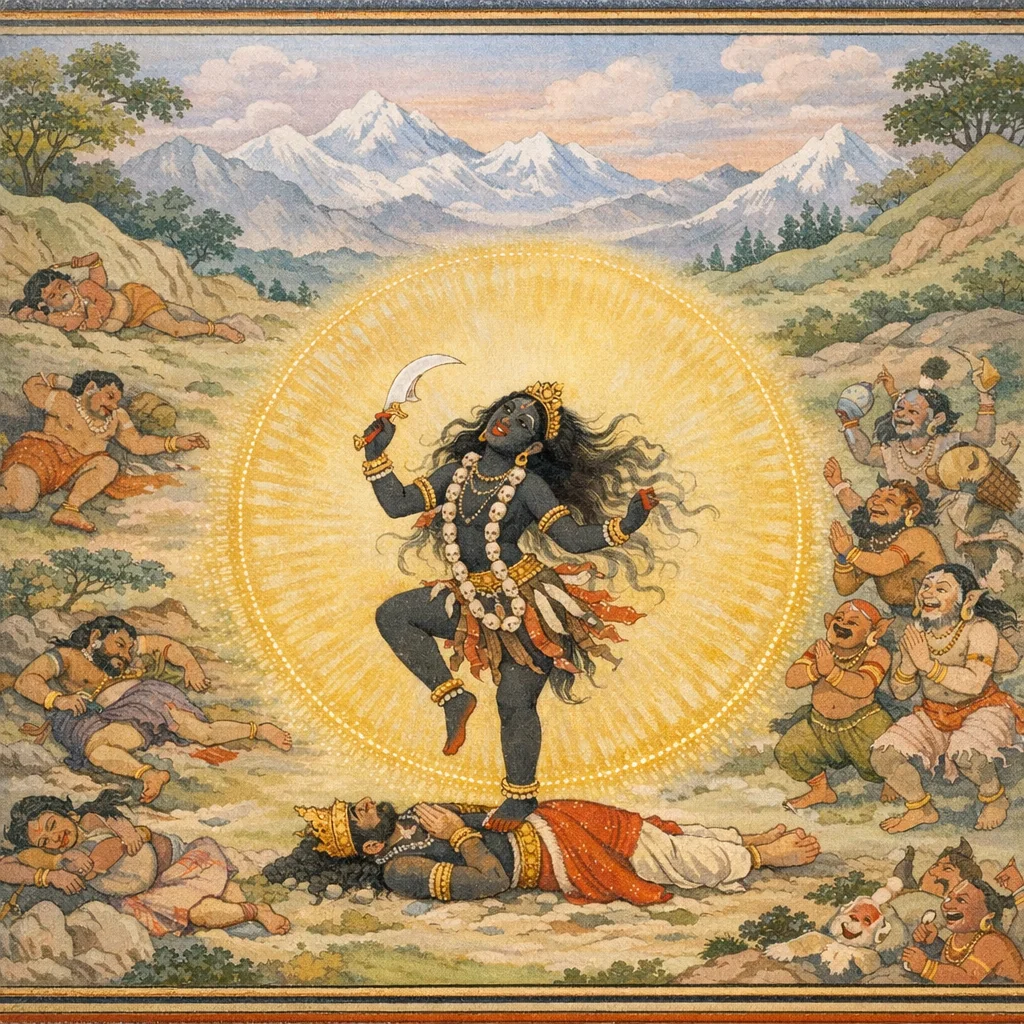
अध्याय ३८ — काली-शंखचूड-युद्धे अस्त्रप्रयोगः (Kālī and Śaṅkhacūḍa: Mantra-Weapons and Surrender in Battle)
This chapter portrays the battlefield as the awe-inspiring arena of Śakti’s power. Sanatkumāra describes the fierce clash as Kālī enters the war-zone and roars like a lion, stunning the dānavas while the gaṇas and deva-hosts cry out in exhilaration. Kālī and her terrifying attendants—Ugradaṃṣṭrā, Ugradaṇḍā, Koṭavī and others—laugh in ecstasy, dance upon the field, and drink madhu/madhvīka, signaling world-shaking, unrestrained might. Śaṅkhacūḍa confronts Kālī; she hurls a fire like the flame of pralaya, which he checks by a Viṣṇu-marked stratagem. Kālī then releases the Nārāyaṇāstra; as it expands, Śaṅkhacūḍa is forced into daṇḍavat prostration and repeated homage, and the astra withdraws—showing the moral law that surrender neutralizes catastrophic force. The goddess next casts the Brahmāstra with mantra; the dānava-king answers with a counter-Brahmāstra, framing the battle as an exchange of sanctioned cosmic powers governed by ritual-mantric order and the ethic of humility.
Shlokas
Verse 1
सनत्कुमार उवाच । सा च गत्वा हि संग्रामं सिंहनादं चकार ह । देव्याश्च तेन नादेन मूर्च्छामापुश्च दानवाः
Sanatkumāra said: She went to the battlefield and uttered a lion-like roar. By that roar of the Devī, the Dānavas were seized by faintness and fell into a swoon.
Verse 2
अट्टाट्टहासमशिवं चकार च पुनः पुनः । तदा पपौ च माध्वीकं ननर्त रणमूर्द्धनि
Again and again he unleashed a fierce, terrifying peal of laughter; then he drank the honey-wine and danced upon the very crest of the battlefield, revealing amid the combat the awe-inspiring, world-shaking power of Rudra.
Verse 3
उग्रदंष्ट्रा चोग्रदंडा कोटवी च पपौ मधु । अन्याश्च देव्यस्तत्राजौ ननृतुर्मधु संपपुः
Ugradaṃṣṭrā, Ugradaṇḍā, and Koṭavī drank the intoxicating madhu (mead); and other goddesses there, upon that battlefield, danced and drank the madhu again and again.
Verse 4
महान् कोलाहलो जातो गणदेवदले तदा । जहृषुर्बहुगर्जंतस्सर्वे सुरगणादयः
Then a great tumult arose in the host of the Gaṇas and the gods; and all the companies of devas, roaring loudly again and again, were filled with exhilaration.
Verse 5
दृष्ट्वा कालीं शंखचूडश्शीघ्रमाजौ समाययौ । दानवाश्च भयं प्राप्ता राजा तेभ्योऽभयं ददौ
Seeing Kāḷī, Śaṅkhacūḍa quickly rushed into the battlefield. The dānavas were seized by fear, but their king granted them reassurance and fearlessness.
Verse 6
काली चिक्षेप वह्निं च प्रलयाग्निशिखोपमम् । राजा जघान तं शीघ्रं वैष्णवांकितलीलया
Kālī hurled forth a fire, blazing like the flames of the cosmic dissolution. Yet the king swiftly struck it down, by a wondrous feat marked with Vaiṣṇava power.
Verse 7
नारायणास्त्रं सा देवी चिक्षेप तदुपर्यरम् । वृद्धिं जगाम तच्छस्त्रं दृष्ट्वा वामं च दानवम्
Then the Goddess hurled the Nārāyaṇāstra against him. Seeing the wicked demon before it, that divine missile swelled and grew in power.
Verse 8
तं दृष्ट्वा शंखचूडश्च प्रलयाग्निशिखोपमम् । पपात दंडवद्भूमौ प्रणनाम पुनःपुनः
Seeing Him, blazing like the flame of the fire of pralaya, Śaṅkhacūḍa fell to the ground like a staff and again and again bowed in reverent prostration.
Verse 9
निवृत्तिं प्राप तच्छ्स्त्रं दृष्ट्वा नम्रं च दानवम् । ब्रह्मास्त्रमथ सा देवी चिक्षेप मंत्रपूर्वकम्
Seeing the demon humbled, that weapon was withdrawn. Then the Goddess, having first sanctified the act with mantra, hurled the Brahmāstra—the sacred weapon of Brahmā that subdues hostile force by divine authority.
Verse 10
तं दृष्ट्वा प्रज्ज्वलंतं च प्रणम्य भुवि संस्थितः । ब्रह्मास्त्रेण दानवेन्द्रो विनिवारं चकार ह
Seeing him blazing with radiance, the lord of the Dānavas stood upon the earth and bowed down; then, employing the Brahmāstra, he sought to check and ward him off.
Verse 11
अथ क्रुद्धो दानवेन्द्रो धनुराकृष्य रंहसा । चिक्षेप दिव्यान्यस्त्राणि देव्यै वै मंत्रपूर्वकम्
Then the lord of the Dānavas, enraged, swiftly drew his bow and, after empowering them with mantras, hurled celestial missiles at the Goddess.
Verse 12
आहारं समरे चक्रे प्रसार्य मुखमायतम् । जगर्ज साट्टहासं च दानवा भयमाययुः
In the midst of battle, he prepared to devour them, stretching wide his elongated mouth. Then he roared with a loud, terrifying laugh, and the Dānavas were seized by fear.
Verse 13
काल्यै चिक्षेप शक्तिं स शतयोजनमायताम् । देवी दिव्यास्त्रजालेन शतखंडं चकार सा
He hurled at Kālī a spear-weapon stretching a hundred yojanas; but the Goddess, with a net of divine missiles, shattered it into a hundred fragments.
Verse 14
स च वैष्णवमस्त्रं च चिक्षेप चंडिकोपरि । माहेश्वरेण काली च विनिवारं चकार सा
He hurled the Vaiṣṇava missile against Caṇḍikā; but Kālī, by the Māheśvara power, restrained it and rendered it powerless.
Verse 15
एवं चिरतरं युद्धमन्योन्यं संबभूव ह । प्रेक्षका अभवन्सर्वे देवाश्च दानवा अपि
Thus for a long time the battle continued between them, each against the other; and all—both the Devas and the Dānavas—became mere spectators.
Verse 16
अथ कुद्धा महादेवी काली कालसमा रणे । जग्राह मन्त्रपूतं च शरं पाशुपतं रुषा
Then the Great Goddess Kālī—wrathful, and in that battle like Time itself—took up in anger the Pāśupata arrow, purified and empowered by mantra.
Verse 17
क्षेपात्पूर्वं तन्निषेद्धुं वाग्बभूवाशरीरिणी । न क्षिपास्त्रमिदं देवि शंखचूडाय वै रुषा
Before the weapon was cast, an incorporeal divine voice arose to restrain her: “O Goddess, do not hurl this missile at Śaṅkhacūḍa in anger.”
Verse 18
मृत्युः पाशुपतान्नास्त्यमोघादपि च चंडिके । शंखचूडस्य वीरस्योपायमन्यं विचारय
O Caṇḍikā, the hero Śaṅkhacūḍa will not meet his death by the Pāśupata weapon—nor even by the unfailing Amogha missile. Therefore, consider some other means to overcome him.
Verse 19
इत्याकर्ण्य भद्रकाली न चिक्षेप तदस्त्रकम् । शतलक्षं दानवानां जघास लीलया क्षुधा
Hearing this, Bhadrakālī did not even cast that weapon; instead, stirred by hunger, she playfully devoured a hundred thousand Dānavas.
Verse 20
अत्तुं जगाम वेगेन शंखचूडं भयंकरी । दिव्यास्त्रेण च रौद्रेण वारयामास दानवः
The fearsome Śakti rushed swiftly to devour Śaṅkhacūḍa, but the Dānava checked her with a divine weapon, fierce like Rudra.
Verse 21
अथ क्रुद्धो दानवेन्द्रः खड्गं चिक्षेप सत्वरम् । ग्रीष्मसूर्योपमं तीक्ष्णधारमत्यंतभीकरम्
Then the enraged lord of the Dānavas swiftly hurled his sword—blazing like the summer sun, its edge exceedingly sharp, and its appearance utterly terrifying.
Verse 22
सा काली तं समालोक्यायांतं प्रज्वलितं रुषा । प्रसार्य मुखमाहारं चक्रे तस्य च पश्यतः
That Kāḷī, seeing him approach—blazing with wrath—opened her mouth wide and, even as he looked on, made him her food (devoured him).
Verse 23
दिव्यान्यस्त्राणि चान्यानि चिच्छेद दानवेश्वरः । प्राप्तानि पूर्वतश्चक्रे शतखंडानि तानि च
The lord of the Dānavas severed those divine weapons and other missiles. And as they came toward him, he made them—then and there—into a hundred fragments.
Verse 24
पुनरत्तुं महादेवी वेगतस्तं जगाम ह । सर्वसिद्धेश्वरः श्रीमानंतर्धानं चकार सः
Then Mahādevī hurried after him at great speed to seize him again; but that glorious Lord, the Master of all Siddhas, vanished from sight.
Verse 25
वेगेन मुष्टिना काली तमदृष्ट्वा च दानवम् । बभंज च रथं तस्य जघान किल सारथिम्
Then Kālī, not even looking upon that demon, struck with a swift fist; she shattered his chariot and indeed struck down his charioteer.
Verse 26
अथागत्य द्रुतं मायी चक्रं चिक्षेप वेगतः । भद्रकाल्यै शंखचूडः प्रलयाग्निशिखो पमम्
Then the sorcerous Śaṅkhacūḍa swiftly came forward and, with great force, hurled a discus at Bhadrakālī—blazing like the flame of the fire of dissolution.
Verse 27
सा देवी तं तदा चक्रं वामहस्तेन लीलया । जग्राह स्वमुखेनैवाहारं चक्रे रुषा द्रुतम्
Then the Goddess, playfully with her left hand, seized that discus; and in a swift surge of wrath she brought it to her own mouth, as if to consume it.
Verse 28
मुष्ट्या जघान तं देवी महाकोपेन वेगतः । बभ्राम दानवेन्द्रोपि क्षणं मूर्च्छामवाप सः
Then the Devī, driven by mighty wrath, struck him with her fist at great speed. Even that lord of the Dānavas reeled and for a moment fell into a swoon.
Verse 29
क्षणेन चेतनां प्राप्य स चोत्तस्थौ प्रतापवान् । न चक्रे बाहु युद्धं च मातृबुद्ध्या तया सह
In a moment he regained consciousness, and the mighty one rose up. Yet, regarding her with the feeling of a mother, he did not engage in hand-to-hand combat with her.
Verse 30
गृहीत्वा दानवं देवी भ्रामयित्वा पुनःपुनः । ऊर्द्ध्वं च प्रापयामास महाकोपेन वेगतः
Seizing the demon, the Goddess whirled him around again and again, and then—driven by her great wrath—she hurled him upward with tremendous force.
Verse 31
उत्पपात च वेगेन शंखचूडः प्रतापवान् । निपत्य च समुत्तस्था प्रणम्य भद्रकालिकाम्
Then the mighty and valorous Śaṅkhacūḍa sprang up with great speed. Falling down (in reverence) and rising again, he bowed to Bhadrakālī.
Verse 32
रत्नेन्द्रसारनिर्माणविमानं सुमनो हरम् । आरुरोह स हृष्टात्मा न भ्रान्तोपि महारणे
With a joyful heart he mounted that aerial vimāna—crafted from the very essence of the Lord of jewels and enchanting to behold—and even amid the great battle he did not become bewildered.
Verse 33
दानवानां हि क्षतजं सा पपौ कालिका क्षुधा । एतस्मिन्नंतरे तत्र वाग्वभूवाशरीरिणी
Out of hunger, Kālikā drank the blood flowing from the wounds of the Dānavas. Just then, in that very place, an incorporeal voice arose.
Verse 34
लक्षं च दानवेन्द्राणामवशिष्टं रणेऽधुना । उद्धतं गुञ्जतां सार्द्धं ततस्त्वं भुंक्ष्व चेश्वरि
“Even now, in this battle, a hundred thousand of the lordly Dānavas remain—arrogant and roaring aloud. Therefore, O Sovereign Goddess, consume them (destroy them) along with their clamorous hosts.”
Verse 35
संग्रामे दानवेन्द्रं च हंतुं न कुरु मानसम् । अवध्योयं शंखचूडस्तव देवीति निश्चयम्
“In battle, do not set your mind on slaying the lord of the Dānavas. This Śaṅkhacūḍa is certainly invulnerable to you, O Goddess—of this there is no doubt.”
Verse 36
तच्छुत्वा वचनं देवी निःसृतं व्योममंडलात् । दानवानां बहूनां च मांसं च रुधिरं तथा
Hearing that utterance which had issued forth from the sphere of the sky, the Goddess (Devī) also beheld the flesh and blood of many Dānavas scattered about.
Verse 37
भुक्त्वा पीत्वा भद्रकाली शंकरांतिकमाययौ । उवाच रणवृत्तांतं पौर्वापर्येण सक्रमम्
After eating and drinking, Bhadrakālī went to Lord Śaṅkara. She then narrated the full account of the battle, in proper sequence, from beginning to end.
Verse 38
इति श्रीशिवमहापुराणे द्वि० रुद्रसं०पं०युद्धखंडे शंखचूडवधे कालीयुद्धवर्णनं नामाष्टत्रिंशोऽध्यायः
Thus, in the Śrī Śiva Mahāpurāṇa—within the Second Book, in the Rudra-saṃhitā, in the Yuddha-khaṇḍa, in the account of the slaying of Śaṅkhacūḍa—ends the thirty-eighth chapter, titled “The Description of Kālī’s Battle.”
Frequently Asked Questions
Sanatkumāra narrates a battlefield episode where Kālī confronts Śaṅkhacūḍa; astras such as Nārāyaṇāstra and Brahmāstra are deployed, prompting Śaṅkhacūḍa’s prostration and tactical countermeasures.
The chapter frames astras as mantra-governed cosmic forces and teaches that humility/surrender can cause even catastrophic powers to withdraw, implying an ethical-metaphysical law higher than mere strength.
Kālī is foregrounded as the fierce Devī, alongside attendant fierce goddesses (Ugradaṃṣṭrā, Ugradaṇḍā, Koṭavī), with motifs of roar, laughter, dance, and intoxicant-drinking signaling overwhelming śakti.