देवर्षि-प्रश्नः तथा असुर-वध-हेतुनिवेदनम् | The Devas’ Petition and the Cause for Slaying Asuras
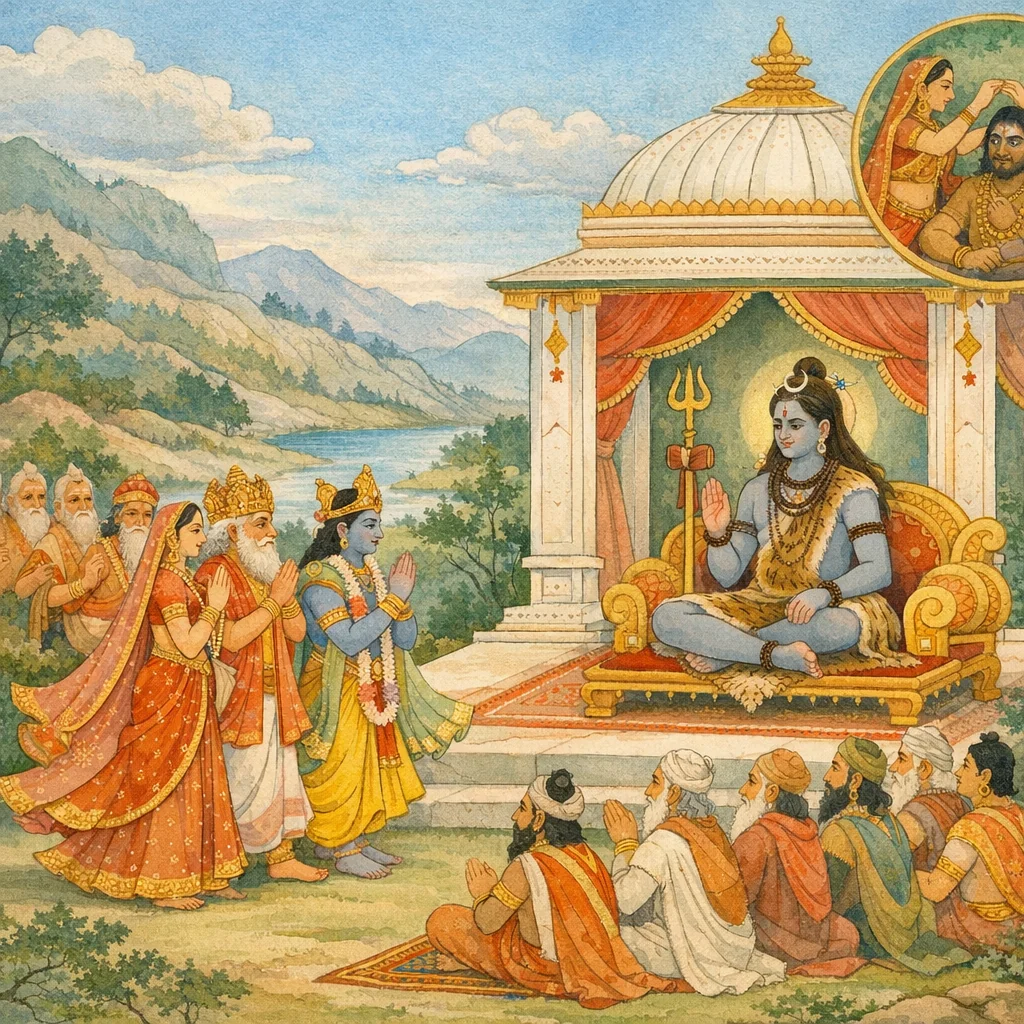
Adhyāya 16 begins with Brahmā recounting that, after hearing the stuti offered by Hari (Viṣṇu) and others, Śaṅkara is greatly pleased and responds with gentle laughter. When Brahmā and Viṣṇu arrive together with their consorts, Śiva receives them with due honor and asks the purpose of their visit. Rudra then addresses the gathered devas and sages, urging them to state truthfully why they have come and what work is to be done, noting that their praise has made him receptive. Prompted by Viṣṇu, Brahmā explains the mission: in the future asuras will arise who must be slain by different divine agencies—some by Brahmā, some by Viṣṇu, some by Śiva, and some especially by a son born from Śiva’s own vīrya (potency). Brahmā adds that certain asuras are “māyā-vadhya,” to be overcome through divine māyā or strategy rather than ordinary force. The chapter frames the devas’ welfare and the world’s stability (jagat-svāsthya, abhaya) as dependent on Śiva’s compassion, by which terrifying asuras are destroyed and the cosmos returns to fearless equilibrium. Thus it functions as a formal petition scene: praise → divine pleasure → inquiry → disclosure of cosmic threat → request for protection, establishing Śiva as the guarantor of order.
Shlokas
Verse 1
ब्रह्मोवाच । इति स्तुतिं च हर्यादिकृतामाकर्ण्य शंकरः । बभूवातिप्रसन्नो हि विजहास च सूतिकृत्
Brahmā said: Having thus heard the hymn of praise offered by Hari (Viṣṇu) and the others, Śaṅkara became exceedingly pleased; and the auspicious Lord, the well-wisher of all beings, smiled.
Verse 2
ब्रह्मविष्णू तु दृष्ट्वा तौ सस्त्रीकौ संगतौ हरः । यथोचितं समाभाष्य पप्रच्छागमनं तयोः
Seeing Brahmā and Viṣṇu arrive there together with their consorts, Hara (Lord Śiva) greeted them in a fitting manner and then asked them the reason for their coming.
Verse 3
रुद्र उवाच । हहर हावध देवा मुनयश्चाद्य निर्भयाः । निजागमनहेतुं हि कथयस्व सुतत्त्वतः
Rudra said: “Ha ha! Enough—do not fear, O Devas and primordial sages. Tell Me, in accordance with the true principle, the real cause for your coming here.”
Verse 4
किमर्थमागता यूयं किं कार्यं चेह विद्यते । तत्सर्वं श्रोतुमिच्छामि भवत्स्तुत्या प्रसन्नधीः
For what purpose have you all come, and what task is to be accomplished here? I wish to hear all of it. By your hymn of praise my mind has become serene and graciously disposed.
Verse 5
ब्रह्मोवाच । इति पृष्टे हरेणाहं सर्वलोकपितामहः । मुनेऽवोचं महादेवं विष्णुना परिचोदितः
Brahmā said: When Hari (Viṣṇu) questioned me thus, I—the grandsire of all the worlds—O sage, spoke to Mahādeva, urged on by Viṣṇu.
Verse 6
देवदेव महादेव करुणासागर प्रभो । यदर्थमागतावावां तच्छृणु त्वं सुरर्षिभिः
O God of gods, O Mahādeva, O Lord who is an ocean of compassion—please hear, in the presence of the Devas and the seer-sages, the purpose for which we have come here.
Verse 7
विशेषतस्तवैवार्थमागता वृपभध्वज । सहार्थिनस्सदायोग्यमन्यथा न जगद्भवेत्
O Bannered-with-the-Bull (Lord Śiva), I have come especially for Your sake alone. Those who share the same sacred purpose are ever fit to unite; otherwise, the order of the world itself would not endure.
Verse 8
केचिद्भविष्यंत्यसुरा मम वध्या महेश्वर । हरेर्वध्यास्तथा केचिद्भवंतश्चापि केचन
O Maheśvara, some asuras will arise who are destined to be slain by me; likewise, some will be slain by Hari (Viṣṇu), and some, indeed, by you as well.
Verse 9
केचित्त्वद्वीर्यजातस्य तनयस्य महाप्रभो । मायावध्याः प्रभो केचिद्भविष्यंत्यसुरास्सदा
O great Lord, among the sons born of Your divine potency, some will ever be asuras, to be slain only through stratagem and māyā; and, O Lord, others too will always arise in that very way.
Verse 10
तवैव कृपया शंभोस्सुराणां सुखमुत्तमम् । नाशयित्वाऽसुरान् घोराञ्जगत्स्वास्थ्यं सदाभयम्
O Śambhu, by Your grace alone the gods attain the highest well-being. Having destroyed the dreadful asuras, You establish for the world health and harmony—ever free from fear.
Verse 11
योगयुक्ते त्वयि सदा राग द्वेषविवर्जिते । दयापात्रैकनिरते न वध्या ह्यथवा तव
Since you are ever established in Yoga—free from attachment and aversion, and devoted solely to being a vessel of compassion—there is truly no question of your being slain; for you, such “killing” does not apply at all.
Verse 12
अराधितेषु तेष्वीश कथं सृष्टिस्तथा स्थितिः । अतश्च भविता युक्तं नित्यंनित्यं वृषध्वज
O Lord, if those deities are already worshipped, how could creation and sustenance truly proceed? Therefore it is fitting that You—O Bull-bannered One (Vṛṣadhvaja)—be worshipped always, at all times.
Verse 13
सृष्टिस्थित्यंतकर्माणि न कार्याणि यदा तदा । शरीरभेदश्चास्माकं मायायाश्च न युज्यते
At that time, the functions of creation, preservation, and dissolution are not to be carried out. Nor is any distinction of bodies appropriate for us, and not for Māyā either—since in truth such difference does not apply.
Verse 14
एकस्वरूपा हि वयं भिन्नाः कार्यस्य भेदतः । कार्यभेदो न सिद्धश्चेद्रूपभेदाऽप्रयोजनः
Indeed, we are of one essential nature; any appearance of difference arises only from differences of function. But if no real difference of function can be established, then positing a difference of forms becomes purposeless.
Verse 15
एक एव त्रिधा भिन्नः परमात्मा महेश्वरः । मायास्वाकारणादेव स्वतंत्रो लीलया प्रभुः
The Supreme Self, Maheśvara, is indeed one alone, yet He appears as threefold. Through His own māyā, without any external cause, that Lord remains absolutely independent and manifests the universe as His divine play.
Verse 16
इति श्रीशिवमहापुणे द्वितीयायां रुद्रसंहितायां द्वितीये सतीखंडे विष्णुब्रह्मकृतशिव प्रार्थनावर्णनं नाम षोडशोऽध्यायः
Thus ends the sixteenth chapter, called “The Description of the Prayer to Lord Śiva offered by Viṣṇu and Brahmā,” in the second section (Rudra-saṃhitā) of the most holy Śiva Purāṇa, within the second subdivision known as the Satī-khaṇḍa.
Verse 17
इत्थं वयं त्रिधा भूताः प्रभाभिन्नस्वरूपिणः । शिवाशिवसुतास्तत्त्वं हृदा विद्धि सनातन
Thus, we have become threefold, our very forms distinguished only by radiance. Know in your heart the eternal truth: we are the sons of Śiva and Aśivā.
Verse 18
अहं विष्णुश्च सस्त्रीकौ संजातौ कार्यहेतुतः । लोककार्यकरौ प्रीत्या तव शासनतः प्रभो
O Lord, Viṣṇu and I have manifested—together with our consorts—for the sake of fulfilling Your divine purpose. Joyfully we carry out the works of the worlds in obedience to Your command, O Master.
Verse 19
तस्माद्विश्वहितार्थाय सुराणां सुखहेतवे । परिगृह्णीष्व भार्यार्थे रामामेकां सुशोभनाम्
Therefore, for the welfare of the whole world and for the happiness of the gods, accept as your wife this one splendid and beautiful maiden, Ramā.
Verse 20
अन्यच्छृणु महेशान पूर्ववृत्तं स्मृतं मया । यन्नौ पुरःपुरा प्रोक्तं त्वयैव शिवरूपिणा
O Maheśāna, listen to something else—the former account as I remember it: that which, long ago, was spoken to us by you yourself, in your very form as Śiva.
Verse 21
मद्रूपं परमं ब्रह्मन्नीदृशं भवदंगतः । प्रकटी भविता लोके नाम्ना रुद्रः प्रकीर्तितः
O Brahmā, My own form is the Supreme Brahman. From your body, a being of this very nature will manifest in the world and will be celebrated by the name “Rudra.”
Verse 22
सृष्टिकर्ताऽभवद्ब्रह्मा हरिः पालनकारकः । लयकारी भविष्यामि रुद्ररूपो गुणाकृतिः
Brahmā became the maker of creation; Hari (Viṣṇu) became the sustainer. I shall become the dissolver—Rudra in form—assuming the manifested modes (guṇas) for the cosmic function.
Verse 23
स्त्रियं विवाह्य लोकस्य करिष्ये कार्यमुत्तमम् । इति संस्मृत्य स्वप्रोक्तं पूर्णं कुरु निजं पणम्
“Having married a woman, I shall accomplish the highest good for the world.” Thus recalling his own declaration, he resolved to fulfill his personal vow in full.
Verse 24
निदेशस्तव च स्वामिन्नहं सृष्टिकरो हरिः । पालको लयहेतुस्त्वमाविर्भूतस्स्वयं शिवः
O Lord and Master, I act in accordance with Your command. Hari (Viṣṇu) is the agent of creation and the sustainer, while You are the very cause of dissolution (laya); indeed, You have manifested here as Śiva Himself.
Verse 25
त्वां विना न समर्थौ हि आवां च स्वस्वकर्मणि । लोककार्यरतो तस्मादेकां गृह्णीष्व कामिनीम्
Without You, we are truly not capable in our respective duties. Therefore, devoted to the welfare of the worlds, accept one beloved maiden as Your consort.
Verse 26
यथा पद्मालया विष्णोस्सावित्री च यथा मम । तथा सहचरीं शंभो कांतां गृह्णीष्व संप्रति
“Just as Padmālayā (Lakṣmī) is to Viṣṇu, and just as Sāvitrī is to me (Brahmā), so too—O Śambhu—accept now a beloved consort, a constant companion for Yourself.”
Verse 27
ब्रह्मोवाच । इति श्रुत्वा वचो मे हि ब्रह्मणः पुरतो हरेः । स मां जगाद लोकेशः स्मेराननमुखो हरः
Brahmā said: “Having thus heard my words, in the presence of Hari, Lord Hara—the sovereign of the worlds—addressed me, his face turned toward me with a gentle, smiling countenance.”
Verse 28
ईश्वर उवाच । हे ब्रह्मन् हे हरे मे हि युवां प्रियतरौ सदा । दृष्ट्वा त्वां च ममानंदो भवत्यतितरां खलु
Īśvara said: “O Brahmā, O Hari—truly, you two are ever most dear to Me. Indeed, upon seeing you, My bliss becomes exceedingly great.”
Verse 29
युवां सुरविशिष्टौ हि त्रिभव स्वामिनौ किल । कथनं वां गरिष्ठेति भवकार्यरतात्मनोः
“You two are indeed foremost among the gods, and truly the lords of the three worlds. Therefore, for you—whose minds are intent on the work of upholding worldly order—your counsel and instruction are weighty and authoritative.”
Verse 30
उचितं न सुरश्रेष्ठौ विवाहकरणं मम । तपोरतविरक्तस्य सदा विदितयोगिनः
“O best of the gods, it is not proper for you to arrange My marriage—for I am ever devoted to austerity, detached from worldly aims, and a yogin whose path is always known as renunciation and inner discipline.”
Verse 31
यो निवृत्तिसुमार्गस्थः स्वात्मारामो निरंजनः । अवधूततनुर्ज्ञानी स्वद्रष्टा कामवर्जितः
“He who abides on the excellent path of renunciation, who rejoices in the Self, stainless and untainted; who, though bearing the body like an avadhūta, is a knower; who is the witness of his own Self, and is free from desire—such is the true ascetic described here, fit for Śiva’s highest grace and liberation.”
Verse 32
अविकारी ह्यभोगी च सदाशुचिरमंगलः । तस्य प्रयोजनं लोके कामिन्या किं वदाधुना
He is changeless and untouched by worldly enjoyment—ever pure and auspicious. What purpose in this world could such a Lord have, that a desire-driven woman should speak of it now?
Verse 33
केवलं योगलग्नस्य ममानंदस्सदास्ति वै । ज्ञानहीनस्तु पुरुषो मनुते बहु कामकम्
For one who is solely absorbed in Yoga, My bliss is indeed ever-present. But the man devoid of true knowledge imagines and pursues many aims born of desire.
Verse 34
विवाहकरणं लोके विज्ञेयं परबंधनम् । तस्मात्तस्य रुचिर्नो मे सत्यं सत्यं वदाम्यहम्
In this world, marriage is to be understood as a supreme bond, a binding tie. Therefore I have no inclination for it—truth, truth indeed, I declare.
Verse 35
न स्वार्थं मे प्रवृत्तिर्हि सम्यक्स्वार्थविचिंतनात् । तथापि तत्करिष्यामि भवदुक्तं जगद्धितम्
My actions are not impelled by personal gain, for I have rightly reflected on what true self-interest is. Even so, I shall do what you have said, since it is for the welfare of the whole world.
Verse 36
मत्त्वा वचो गरिष्ठं वा नियोक्तिपरिपूर्त्तये । करिष्यामि विवाहं वै भक्तवश्यस्सदा ह्यहम्
Considering the given word to be truly weighty, and in order to fulfill the divine injunction, I shall certainly perform the marriage—for I am ever governed by devotion to My devotee.
Verse 37
परंतु यादृशीं कांतां ग्रहीष्यामि तथापणम् । तच्छृणुष्व हरे ब्रह्मन् युक्तमेव वचो मम
However, I shall accept as my beloved only such a consort as I have envisioned. Therefore, O Hari, O Brahmā—listen: my words are indeed reasonable.
Verse 38
या मे तेजस्समर्था हि ग्रहीतुं स्याद्विभागशः । तां निदेशय भार्यार्थे योगिनीं कामरूपिणीम्
“O Father, please point out to me—so that I may take her in due measure—that Yoginī, the shape-shifting maiden, who is truly capable of receiving my divine energy, as a wife.”
Verse 39
योगयुक्ते मयि तथा योगिन्येव भविष्यति । कामासक्ते मयि तथा कामिन्येव भविष्यति
If her mind is joined to Me through yoga, then she will indeed become a yoginī. And if she is attached to Me with desire, then she will indeed become a passionate lover.
Verse 40
यमक्षरं वेदविदो निगदंति मनीषिणः । ज्योतीरूपं शिवं ते च चिंतयिष्ये सनातनम्
That imperishable supreme syllable proclaimed by the knowers of the Vedas and the wise—I shall contemplate the eternal Śiva, whose very form is Light.
Verse 41
तच्चिंतायां यदा सक्तो ब्रह्मन् गच्छामि भाविनीम् । तत्र या विघ्नजननी न भवित्री हतास्तु मे
O Brahmā, whenever I am absorbed in that contemplation and go to my beloved (Satī), may she who would become the source of obstacles there never arise; let her be destroyed for my sake.
Verse 42
त्वं वा विष्णुरहं वापि शिवस्य ब्रह्मरूपिणः । अंशभूता महाभागा योग्यं तदनुचिंतनम्
Whether you are Viṣṇu or I am Viṣṇu—O greatly fortunate one, both of us are but portions of Śiva, whose nature is Brahman. Therefore it is fitting to contemplate that truth again and again.
Verse 43
तच्चिंतया विनोद्वाहं स्थास्यामि कमलासन । तस्माज्जायां प्रादिश त्वं मत्कर्मानुगतां सदा
“By contemplating that, I shall remain free from distress, O Lotus-seated one. Therefore, bestow upon me a wife—one who will always follow and support my ordained duties and actions.”
Verse 44
तत्राप्येकं पणं मे त्वं वृणु ब्रह्मंश्च मां प्रति । अविश्वासो मदुक्ते चेन्मया त्यक्ता भविष्यति
“Even so, O Brahmā, choose one pledge to make with me. If you distrust what I have spoken, then know that I shall abandon you.”
Verse 45
ब्रह्मोवाच । इति तस्य वचश्श्रुत्वाहं स विष्णुर्हरस्य च । सस्मितं मोदितमनोऽवोचं चेति विनम्रकः
Brahmā said: “Having thus heard his words, I—together with Viṣṇu, in the presence of Hara (Śiva)—with a gentle smile and a heart made glad, spoke in a humble manner.”
Verse 46
शृणु नाथ महेशान मार्गिता यादृशी त्वया । निवेदयामि सुप्रीत्या तां स्त्रियं तादृशीं प्रभो
“Listen, O Lord, O Maheśāna. With deep gladness I shall tell you about that woman, just as you have sought her, O Master.”
Verse 47
उमा सा भिन्नरूपेण संजाता कार्यसाधिनी । सरस्वती तथा लक्ष्मीर्द्विधा रूपा पुरा प्रभो
“O Lord, that Umā manifested in differentiated forms as the accomplisher of divine purposes; and in former times Sarasvatī as well as Lakṣmī too became of twofold form.”
Verse 48
पाद्मा कांताऽभवद्विष्णोस्तथा मम सरस्वती । तृतीयरूपा सा नाभूल्लोककार्यहितैषिणी
Padmā became the beloved consort of Viṣṇu, and likewise Sarasvatī became mine. That third manifestation did not remain idle; she was intent on the welfare and the ordained work of the worlds.
Verse 49
दक्षस्य तनया याभूत्सती नाम्ना तु सा विभो । सैवेदृशी भवेद्भार्या भवेद्धि हितकारिणी
O Lord, the daughter of Dakṣa who became known as Satī—she alone is truly fit to be such a wife, for she indeed brings welfare and good to her husband.
Verse 50
सा तपस्यति देवेश त्वदर्थं हि दृढव्रता । त्वां पतिं प्राप्तुकामा वै महातेजोवती सती
O Lord of the gods, she performs austerities for Your sake alone, steadfast in her vow. Indeed, radiant Satī longs to attain You as her husband.
Verse 51
दातुं गच्छ वरं तस्यै कृपां कुरु महेश्वर । तां विवाहय सुप्रीत्या वरं दत्त्वा च तादृशम्
“Go and grant her the boon; show compassion, O Maheśvara. Marry her with gladness, and bestow a boon of that very kind, befitting her wish.”
Verse 52
हरेर्मम च देवानामियं वाञ्छास्ति शंकर । परिपूरय सद्दृष्ट्या पश्यामोत्सवमादरात्
O Śaṅkara, this is the heartfelt wish of Hari, of me, and of the devas: fulfill it with Your gracious, auspicious glance, so that we may behold the sacred festival with reverent joy.
Verse 53
मङ्गलं परमं भूयात्त्रिलोकेषु सुखावहम् । सर्वज्वरो विनश्येद्वै सर्वेषां नात्र संशयः
May the highest auspiciousness prevail, bringing well-being throughout the three worlds. Indeed, every kind of feverish affliction is destroyed for all—of this there is no doubt.
Verse 54
अथवास्मद्वचश्शेषे वदंत मधुसूदनः । लीलाजाकृतिमीशानं भक्तवत्सलमच्युतः
Or else, when our words had come to an end, Madhusūdana (Viṣṇu), the infallible Acyuta, began to speak—praising Īśāna (Śiva), whose manifestation is divine līlā, and who is ever tenderly devoted to His devotees.
Verse 55
विष्णुरुवाच । देवदेव महादेव करुणाकर शंकर । यदुक्तं ब्रह्मणा सर्वं मदुक्तं तन्न संशयः
Viṣṇu said: “O God of gods, O Mahādeva, O compassionate Śaṅkara—whatever Brahmā has spoken in full is the very same as what I have spoken; of this there is no doubt.”
Verse 56
तत्कुरुष्व महेशान कृपां कृत्वा ममोपरि । सनाथं कुरु सद्दृष्ट्या त्रिलोकं सुविवाह्यताम्
O Maheśāna, do that—showing compassion toward me. By Your gracious and auspicious glance, make the three worlds protected and well guided, and let my marriage be duly accomplished in blessedness.
Verse 57
ब्रह्मोवाच । इत्युक्त्वा भगवान् विष्णुस्तूष्णीमास मुने सुधीः । तथा स्तुतिं विहस्याह स प्रभुर्भक्तवत्सलः
Brahmā said: Having spoken thus, the blessed Lord Viṣṇu, the wise one, fell silent, O sage. Then that mighty Lord, ever affectionate to His devotees, smiled and spoke again, continuing the hymn of praise.
Verse 58
ततस्त्वावां च संप्राप्य चाज्ञां स मुनिभिस्सुरैः । अगच्छावस्वेष्टदेशं सस्त्रीकौ परहर्षितौ
Then, approaching you both and receiving permission from the sages and the gods, the two—together with their wives—departed for their desired place, filled with supreme joy.
Frequently Asked Questions
Brahmā and Viṣṇu (with their consorts) approach Śiva after offering stuti; Śiva, pleased, asks their purpose, and Brahmā discloses the impending rise of asuras and the need for divine action to restore cosmic safety.
It signals that not all adharma is removed by direct force; some threats require divine strategy or māyā as an upāya, integrating metaphysical power with pragmatic cosmic governance.
Śiva is highlighted as Vṛṣabhadhvaja, Devadeva, and Karuṇāsāgara—supreme lord whose grace secures devas’ welfare and whose agency (including through a son born of his potency) ensures the destruction of specific asuric forces.