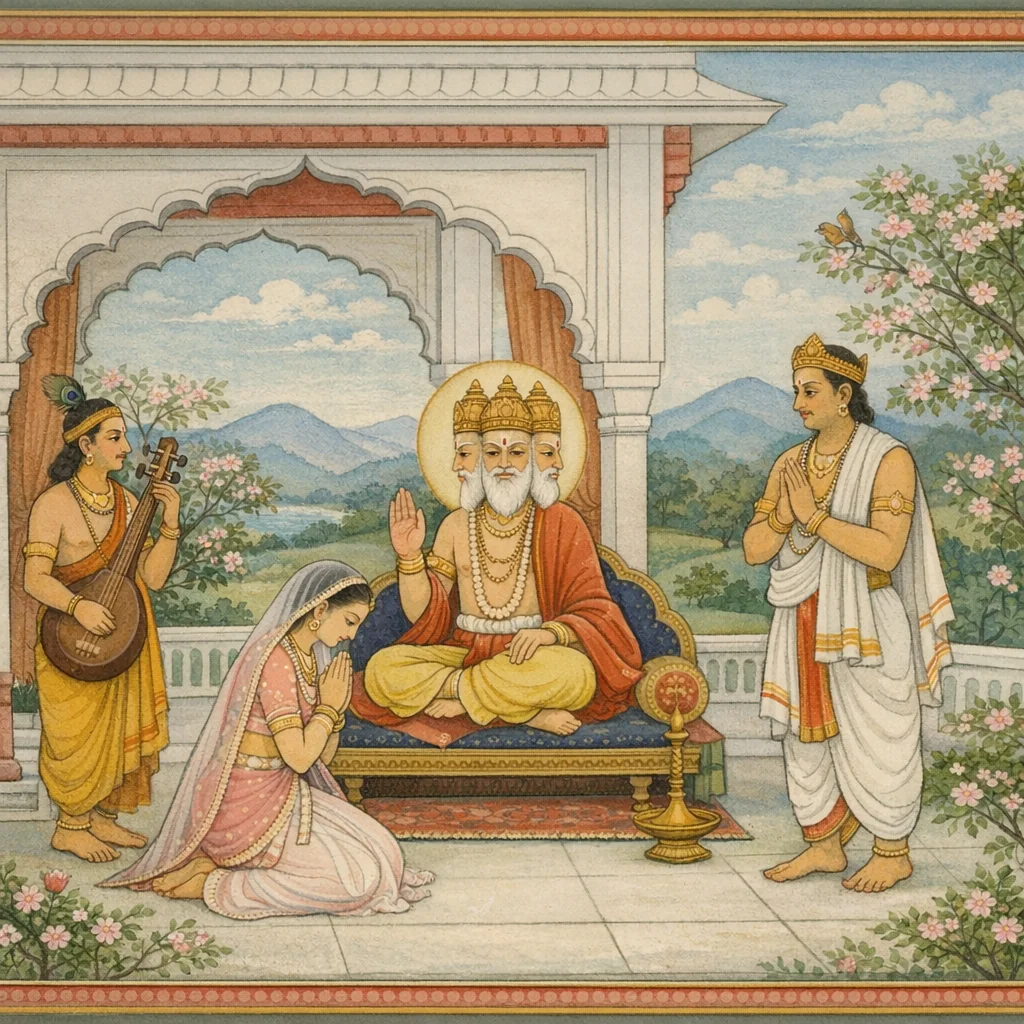
सतीचरिते पितृगृहे आशीर्वाद-वचनम् तथा यौवनारम्भः — Satī at her father’s house: blessings and the onset of youth
Adhyāya 15 continues Satī’s story in Dakṣa’s household through Brahmā’s testimony. Brahmā recalls seeing Satī standing near her father and praises her as the essence of the three worlds. When Dakṣa offers namaskāra to Brahmā (and Nārada), Satī too—outwardly following worldly decorum (lokalīlā)—bows with devotion. After her prostration, she is seated on an auspicious seat arranged by Dakṣa, with Brahmā and Nārada still present. Brahmā then bestows a benediction: the one Satī desires, and who desires her, shall be her husband—the omniscient Lord and ruler of the universe (sarvajña, jagadīśvara), implicitly Śiva—who has not taken, does not take, and will not take another wife, and is thus uniquely suited to her. After some time Brahmā and Nārada depart with Dakṣa’s permission. Dakṣa is delighted and relieved, accepting his daughter in intent and understanding as the supreme Goddess. The chapter then turns to Satī’s embodied life: through charming youthful pastimes she leaves childhood, enters early youth, and grows ever more beautiful, her radiance linked to tapas and inner spiritual excellence. Thus social narration and sacred destiny—her ordained union with Śiva—are woven together with a portrayal of Satī’s maturation.
Shlokas
Verse 1
ब्रह्मोवाच । अथैकदा पितुः पार्श्वे तिष्ठंतीं तां सतीमहम् । त्वया सह मुनेद्राक्षं सारभूतां त्रिलोकके
Brahmā said: “Once, O best of sages, I saw that Satī standing by her father’s side—she who is the very essence within the three worlds—together with you.”
Verse 2
पित्रा नमस्कृतं वीक्ष्य सत्कृतं त्वां च मां सती । प्रणनाम मुदा भक्त्या लोकलीलानुसारिणी
Seeing that her father had bowed in reverence and that you and I had been duly honoured, Satī—conforming to worldly propriety as part of the Lord’s divine play—bowed down with joy and devotion.
Verse 3
प्रणामांते सतीं वीक्ष्य दक्षदत्तशुभासने । स्थितोहं नारद त्वं च विनतामहमागदम्
At the end of the salutations, seeing Satī seated upon the auspicious seat given by Dakṣa, I stood there—O Nārada—and you as well; then I approached her with reverence.
Verse 4
त्वामेव यः कामयते यन्तु कामयसे सति । तमाप्नुहि पतिं देवं सर्वज्ञं जगदीश्वरम्
O Satī, the one who longs for you—and whom you yourself desire—attain Him alone as your husband: the divine Lord, the all-knowing Pati, the Sovereign of the entire world.
Verse 5
यो नान्यां जगृहे नापि गृह्णाति न ग्रहीष्यति । जायां स ते पतिर्भूयादनन्यसदृशश्शुभे
O auspicious one, may he who has not accepted another woman, who does not accept another, and who will never accept another—may that very one become your husband, and may you be his wedded wife.
Verse 6
इत्युक्त्वा सुचिरं तां वै स्थित्वा दक्षालये पुनः । विसृष्टौ तेन संयातौ स्वस्थानं तौ च नारद
Having spoken thus, he remained for a long while in Dakṣa’s abode. Then, being respectfully dismissed by him, the two departed and returned to their own place—O Nārada.
Verse 7
दक्षोभवच्च सुप्रीतः तदाकर्ण्य गतज्वरः । आददे तनयां स्वां तां मत्वा हि परमेश्वरीम्
Hearing this, Dakṣa became greatly pleased and free from his agitation. Considering that very daughter of his to be none other than the Supreme Goddess, Parameśvarī, he accepted her in due course for her destined sacred union.
Verse 8
इत्थं विहारै रुचिरैः कौमारैर्भक्तवत्सला । जहाववस्थां कौमारीं स्वेच्छाधृतनराकृतिः
Thus, by engaging in charming, youthful pastimes, the devotee-loving Goddess—who had assumed a human form by her own will—gradually set aside her maiden state.
Verse 9
अतीव तपसांगेन सर्वांगेषु मनोहरा
Through the splendour born of intense austerity, she became captivating in every limb—radiant and beautiful throughout her entire form.
Verse 10
दक्षस्तां वीक्ष्य लोकेशः प्रोद्भिन्नांतर्वयस्थिताम् । चिंतयामास भर्गाय कथं दास्य इमां सुताम्
Seeing her—now come of age and dwelling in the bloom of youth—Dakṣa, the lord among men, began to ponder: “How shall I give this daughter of mine in marriage to Bharga (Śiva)?”
Verse 11
अथ सापि स्वयं भर्गं प्राप्तुमैच्छत्तदान्वहम् । पितुर्मनोगतिं ज्ञात्वा मातुर्निकटमागमत्
Then she too, of her own accord, desired to attain Bharga (Lord Śiva) at that very time. Knowing the intention in her father’s mind, she went near her mother.
Verse 12
पप्रच्छाज्ञां तपोहेतोश्शंकरस्य विनीतधीः । मातुश्शिवाथ वैरिण्यास्सा सखी परमेश्वरी
With a humble mind, she sought Śaṅkara’s permission in order to undertake austerities; that Supreme Goddess—though regarded as an enemy by her mother Śivā—was nevertheless her close companion.
Verse 13
ततस्सती महेशानं पतिं प्राप्तुं दृढव्रता । सा तमाराधयामास गृहे मातुरनुज्ञया
Then Satī, firm in her vow to attain Maheśāna as her husband, worshipped Him with devotion in her mother’s house, having obtained her mother’s permission.
Verse 14
आश्विने मासि नन्दायां तिथावानर्च भक्तितः । गुडौदनैस्सलवणैर्हरं नत्वा निनाय तम्
In the month of Āśvina, on the auspicious Nandā tithi, she worshipped with devotion. Then, bowing to Hara (Lord Śiva), she offered sweet rice with jaggery along with salted food, and thus fulfilled that rite.
Verse 15
इति श्रीशिवमहापुराणे द्वितीयायां रुद्रसंहितायां द्वितीये सतीखंडे नंदाव्रतविधानशिवस्तुति वर्णनं नाम पंचदशोऽध्यायः
Thus ends the Fifteenth Chapter, titled “The Description of the Observance of the Nandā‑vrata and the Hymn of Praise to Lord Śiva,” in the second Saṃhitā (Rudra Saṃhitā) of the Śrī Śiva Mahāpurāṇa, in the second section, the Satī Khaṇḍa.
Verse 16
मार्गशीर्षेऽसिताष्टम्यां सतिलैस्सयवौदनैः । पूजयित्वा हरं कीलैर्निनाय दिवसान् सती
On the dark eighth lunar day (Kṛṣṇāṣṭamī) in the month of Mārgaśīrṣa, Satī worshipped Lord Hara with offerings of sesame and rice cooked with barley; and, with firm vows (vrata) and disciplined restraint, she passed her days in devoted observance.
Verse 17
पौषे तु शुक्लसप्तम्यां कृत्वा जागरणं निशि । अपूजयच्छिवं प्रातः कृशरान्नेन सा सती
On the seventh lunar day of the bright fortnight in the month of Pauṣa, Satī kept a night-long vigil; and at dawn she worshipped Lord Śiva, offering Him kṛśara, a simple sacred food.
Verse 18
माघे तु पौर्णमास्यां स कृत्वा जागरणं निशि । आर्द्रवस्त्रा नदीतीरेऽकरोच्छंकरपूजनम्
On the full-moon day in the month of Māgha, he kept vigil through the night; clad in damp garments on the riverbank, he performed worship of Śaṅkara, Lord Śiva.
Verse 19
तपस्यसितभूतायां कृत्वा जागरणं निशि । विशेषतस्समानर्च शैलूषैस्सर्वयामसु
On that night of austere observance—when spirits and goblins are said to be especially active—one should keep vigil through the night; and in every watch of the night, one should worship Lord Śiva with special care, together with musicians and performers, offering reverent praise.
Verse 20
चैत्रे शुक्लचतुर्दश्यां पलाशैर्दमनैश्शिवम् । अपूजयद्दिवारात्रौ संस्मरन् सा निनाय तम्
On the fourteenth lunar day of the bright fortnight in the month of Caitra, she worshipped Lord Śiva with palāśa blossoms and damana leaves. Remembering Him unceasingly, she spent that time in devotion—by day and by night.
Verse 21
राधशुक्लतृतीयायां तिलाहारयवौदनैः । पूजयित्वा सती रुद्रं नव्यैर्मासं निनाय तम्
On the third lunar day (tṛtīyā) of the bright fortnight in the month of Rādha, Satī worshipped Rudra with offerings of sesame-based food and a barley-rice preparation, and thus she passed that month in renewed, pure observances.
Verse 22
ज्येष्ठस्य पूर्णिमायां वै रात्रै संपूज्य शंकरम् । वसनैर्बृहतीपुष्पैर्निराहारा निनाय तम्
Indeed, on the full-moon night of Jyeṣṭha, she worshipped Śaṅkara throughout the night; offering garments and large blossoms, and remaining without food, she spent that night in devoted observance for Him.
Verse 23
आषाढस्य चतुर्दश्यां शुक्लायां कृष्णवाससा । बृहतीकुसुमैः पूजा रुद्रस्याकारि वै तया
On the fourteenth lunar day of the bright fortnight in the month of Āṣāḍha, she—clad in dark garments—indeed performed the worship of Lord Rudra, offering large bṛhatī-flowers.
Verse 24
श्रावणस्य सिताष्टम्यां चतुर्दश्यां च सा शिवम् । यज्ञोपवीतैर्वासोभिः पवित्रैरप्यपूजयत्
On the bright eighth day and also on the fourteenth day of the month of Śrāvaṇa, she worshipped Lord Śiva, offering sacred threads and pure garments as holy gifts.
Verse 25
भाद्रे कृष्णत्रयोदश्यां पुष्पैर्नानाविधैः फलैः । संपूज्य च चतुर्दश्यां चकार जलभो जनम्
On the thirteenth lunar day of the dark fortnight in the month of Bhādrapada, he worshipped (Śiva) with many kinds of flowers and fruits; and on the fourteenth day, Jalabha performed the rite of janabhojana, the “giving of life,” to beget progeny.
Verse 26
नानाविधैः फलैः पुष्पैस्सस्यैस्तत्कालसंभवैः । चक्रे सुनियताहारा जपन्मासे शिवार्चनम्
With many kinds of fruits, flowers, and grains produced in that season, she—maintaining a strictly regulated diet—performed the worship of Lord Śiva for a month, continually engaged in japa.
Verse 27
सर्वमासे सर्वदिने शिवार्चनरता सती । दृढव्रताभवद्देवी स्वेच्छाधृतनराकृतिः
In every month and on every day, Satī remained devoted to the worship of Lord Śiva. The Goddess became steadfast in her vow, having, by her own will, assumed a human form.
Verse 28
इत्थं नंदाव्रतं कृत्स्नं समाप्य सुसमाहिता । दध्यौ शिवं सती प्रेम्णा निश्चलाभूदनन्यधीः
Thus, having completely concluded the Nandā-vrata, Satī—well-composed and deeply collected—meditated upon Lord Śiva with love; her mind became unwavering, fixed on Him alone.
Verse 29
एतस्मिन्नंतरे देवा मुनयश्चाखिला मुने । विष्णुं मां च पुरस्कृत्य ययुर्द्रष्टुं सतीतपः
O sage, in the meantime all the gods and the sages—placing Viṣṇu and me at their forefront—went to behold Satī’s austerity.
Verse 30
दृष्टागत्य सती देवैर्मूर्ता सिद्धिरिवापरा । शिवध्यानमहामग्ना सिद्धावस्थां गता तदा
When the gods saw Satī arrive, she appeared like the very embodiment of another Siddhi. Deeply absorbed in the great meditation on Śiva, she then entered the state of spiritual perfection (siddhāvasthā).
Verse 31
चक्रुः सर्वे सुरास्सत्ये मुदा सांजलयो नतिम् । मुनयश्च नतस्कंधा विष्ण्वाद्याः प्रीतमानसाः
Then all the devas, filled with joy, bowed to Satī with folded hands. The sages too, in humility, offered reverent obeisance; and Viṣṇu and the other gods, their hearts delighted, paid homage as well.
Verse 32
अथ सर्वे सुप्रसन्ना विष्ण्वाद्याश्च सुरर्षयः । प्रशशंसुस्तपस्तस्यास्सत्यास्तस्मात्सविस्मयाः
Then all of them—highly delighted—Viṣṇu and the other gods and divine seers, marveling at it, praised Satī’s austerity, for it was true and unwavering.
Verse 33
ततः प्रणम्य तां देवीं पुनस्ते मुनयस्सुराः । जग्मुर्गिरिवरं सद्यः कैलासं शिववल्लभम्
Then, bowing once more to that Goddess, those sages and gods departed at once for the foremost of mountains—Kailāsa, beloved abode of Lord Śiva.
Verse 34
सावित्रीसहितश्चाहं सह लक्ष्म्या मुदान्वितः । वासुदेवोपि भगवाञ्जगामाथ हरांतिकम्
Accompanied by Sāvitrī, I too—together with Lakṣmī and filled with joy—went into the presence of Lord Hara; and the Blessed Lord Vāsudeva likewise proceeded to Śiva’s abode.
Verse 35
गत्वा तत्र प्रभुं दृष्ट्वा सुप्रणम्य सुसंभ्रमाः । तुष्टुवुर्विविधैः स्तोत्रैः करौ बद्ध्वा विनम्रकाः
Having gone there and beholding the Lord, they bowed down deeply with reverent awe. With hands joined and hearts made humble, they praised Him with various hymns.
Verse 36
देवा ऊचुः । नमो भगवते तुभ्यं यत एतच्चराचरम् । पुरुषाय महेशाय परेशाय महात्मने
The gods said: “Salutations to You, O Blessed Lord—You from whom this entire world of the moving and the unmoving arises. Salutations to the Supreme Person, to Maheśa, to the Lord beyond all, to the Great Self.”
Verse 37
आदिबीजाय सर्वेषां चिद्रूपाय पराय च । ब्रह्मणे निर्विकाराय प्रकृतेः पुरुषस्य च
Salutations to Him who is the primal seed of all, whose very nature is pure Consciousness, who is the Supreme; to that Brahman—unchanging and without modification—who transcends both Prakṛti (Nature) and Puruṣa (the individual conscious principle).
Verse 38
य इदं प्रतिपंच्येदं येनेदं विचकास्ति हि । यस्मादिदं यतश्चेदं यस्येदं त्वं च यत्नतः
He who manifests this universe in manifold ways; by whom indeed this world shines forth; from whom this arises and from whom it proceeds; to whom this belongs—and you too—know that Reality with earnest effort.
Verse 39
योस्मात्परस्माच्च परो निर्विकारी महाप्रभुः । ईक्षते यस्स्वात्मनीदं तं नताः स्म स्वयंभुवम्
We bow to that Self-born Lord—supreme even beyond the highest, changeless and the Great Sovereign—who beholds this entire universe within His own Self.
Verse 40
अविद्धदृक् परः साक्षी सर्वात्मा ऽनेकरूपधृक् । आत्मभूतः परब्रह्म तपंतं शरणं गताः
He is the unclouded Seer, the Supreme Witness—the indwelling Self of all, assuming countless forms. He is the very essence of the soul, the Supreme Brahman. Therefore they sought refuge in Him, the Lord who is ever absorbed in austere tapas.
Verse 41
न यस्य देवा ऋषयः सिद्धाश्च न विदुः पदम् । कः पुनर्जंतुरपरो ज्ञातुमर्हति वेदितुम्
Whose true state the gods, the seers, and even the perfected beings do not know—how then could any other ordinary creature be fit to know or fully comprehend Him?
Verse 42
दिदृक्षवो यस्य पदं मुक्तसंगास्सुसाधवः । चरितं सुगतिर्नस्त्वं सलोकव्रतमव्रणम्
Auspicious and fully detached holy ones—free from worldly ties—long to behold His supreme abode. For us, His sacred conduct itself is the true path to blessed attainment; it is a stainless vow that leads to sharing His world (salokya).
Verse 43
त्वज्जन्मादिविकारा नो विद्यंते केपि दुःखदा । तथापि मायया त्वं हि गृह्णासि कृपया च तान्
In You there are no modifications such as birth and the rest—none at all that could cause suffering. Yet, through Your own Māyā, You indeed assume those conditions, and out of compassion You accept them.
Verse 44
तस्मै नमः परेशाय तुभ्यमाश्चर्यकर्मणे । नमो गिरां विदूराय ब्रह्मणे परमात्मने
Salutations to that Supreme Lord—unto You, whose deeds are wondrous. Salutations to the Brahman, the Supreme Self, who is beyond the reach of speech and words.
Verse 45
अरूपायोरुरूपाय परायानंतशक्तये । त्रिलोकपतये सर्वसाक्षिणे सर्वगाय च
Salutations to Him who is formless, yet of vast and manifold forms; to the Supreme One of infinite power; to the Lord of the three worlds; to the all-witnessing Consciousness, and to Him who pervades all.
Verse 46
नम आत्मप्रदीपाय निर्वाणसुखसंपदे । ज्ञानात्मने नमस्तेऽस्तु व्यापकायेश्वराय च
Salutations to You, the Lamp of the Self, the very treasure of nirvāṇa’s bliss. Salutations to You whose essence is pure knowledge, and also to You—the all-pervading Lord, Īśvara.
Verse 47
नैष्कर्म्येण सुलभ्याय कैवल्यपतये नमः । पुरुषाय परेशाय नमस्ते सर्वदाय च
Salutations to You, who are easily attained through naiṣkarmya—actionless purity—the Lord of Kaivalya, absolute Liberation. Salutations to You, the Supreme Puruṣa, the highest Lord, who ever bestows all blessings.
Verse 48
क्षेत्रज्ञायात्मरूपाय सर्वप्रत्ययहेतवे
Salutations to Him—the Knower of the field, the inner Witness—whose very nature is the Self, and who is the cause of all cognition and certainty.
Verse 49
सर्वाध्यक्षाय महते मूलप्रकृतये नमः । पुरुषाय परेशाय नमस्ते सर्वदाय च
Salutations to the Great One—the Overseer of all—and to the Root Prakṛti. Salutations to You, the Supreme Puruṣa, the highest Lord, ever bestowing all boons and all support.
Verse 50
त्रिनेत्रायेषुवक्त्राय सदाभासाय ते नमः । सर्वेन्द्रियगुणद्रष्ट्रे निष्कारण नमोस्तु ते
Salutations to You—the Three‑eyed Lord, whose face is like an arrow, ever-radiant. Salutations to You, witness of the qualities and workings of all the senses, the causeless, self-existent One.
Verse 51
त्रिलोककारणायाथापवर्गाय नमोनमः । अपवर्गप्रदायाशु शरणागततारिणे
Repeated salutations to Śiva—the very cause of the three worlds and the embodiment of liberation. Swift is He to bestow mokṣa, and He ferries across all who take refuge in Him.
Verse 52
सर्वाम्नायागमानां चोदधये परमेष्ठिने । परायणाय भक्तानां गुणानां च नमोस्तु ते
Salutations to You—the Supreme Lord, the ocean of all revealed traditions and Āgamas; the highest refuge of devotees, and the very source and fullness of all divine excellences.
Verse 53
नमो गुणारणिच्छन्न चिदूष्माय महेश्वर । मूढदुष्प्राप्तरूपाय ज्ञानिहृद्वासिने सदा
Salutations to Mahādeva, Maheśvara—whose blazing Consciousness is veiled by the kindling-sticks of the guṇas; whose true form is hard for the deluded to attain; and who ever dwells in the heart of the wise.
Verse 54
पशुपाशविमोक्षाय भक्तसन्मुक्तिदाय च । स्वप्रकाशाय नित्यायाऽव्ययायाजस्रसंविदे
Salutations to the Lord who liberates the bound soul (paśu) from the fetters (pāśa), who bestows true liberation upon His devotees, who is self-luminous, eternal, imperishable, and the unceasing Consciousness itself.
Verse 55
प्रत्यग्द्रष्ट्रैऽविकाराय परमैश्वर्य धारिणे । यं भजन्ति चतुर्वर्गे कामयंतीष्टसद्गतिम् । सोऽभूदकरुणस्त्वं नः प्रसन्नो भव ते नमः
Salutations to You—the inward Witness, changeless, and bearer of the supreme Lordship. Those who seek the four human aims worship You, desiring their chosen noble destiny. Yet for us You have appeared without compassion; be gracious—be pleased with us, obeisance to You.
Verse 56
एकांतिनः कंचनार्थं भक्ता वांछंति यस्य न । केवलं चरितं ते ते गायंति परमंगलम्
Those one-pointed devotees, in whom there is no desire for gold or worldly gain, sing only His deeds—deeds that are supremely auspicious.
Verse 57
अक्षरं परमं ब्रह्मतमव्यक्ताकृतिं विभुम् । अध्यात्मयोगगम्यं त्वां परिपूर्णं स्तुमो वयम्
We praise You—the Imperishable, the Supreme Brahman: the all-pervading Lord whose form is unmanifest, attainable through the yoga of inner realization, and ever complete in fullness.
Verse 58
अतींद्रियमनाधारं सर्वाधारमहेतुकम् । अनंतमाद्यं सूक्ष्मं त्वां प्रणमामोऽखिलेश्वरम्
O Akhileśvara, Lord of all—beyond the senses, without support yet the support of all, causeless and self-existent; infinite, primordial, and supremely subtle—unto You we bow in reverence.
Verse 59
हर्यादयोऽखिला देवास्तथा लोकाश्चराचराः । नामरूपविभेदेन फल्ग्व्या च कलया कृताः
Hari (Viṣṇu) and all the other gods, and likewise all the worlds—moving and unmoving—were brought forth only as distinctions of name and form, fashioned by a mere minute portion of His power.
Verse 60
यथार्चिषोग्नेस्सवितुर्यांति निर्यांति वासकृत् । गभस्तयस्तथायं वै प्रवाहो गौण उच्यते
Just as the flames of fire and the rays of the Sun appear to go forth and return again—as if driven by the movements of the wind—so too this ‘flow’ (pravāha) is spoken of only in a secondary, figurative sense. In truth, the Supreme Lord Śiva remains unmoving, while appearances arise within His power.
Verse 61
न त्वं देवो ऽसुरो मर्त्यो न तिर्यङ् न द्विजः प्रभो । न स्त्री न षंढो न पुमान्सदसन्न च किंचन
O Lord, You are neither god nor asura, neither mortal nor beast, nor even a twice-born. You are neither woman, nor eunuch, nor man; You are neither being nor non-being—indeed, You are not any “thing” whatsoever.
Verse 62
निषेधशेषस्सर्वं त्वं विश्वकृद्विश्व पालकः । विश्वलयकृद्विश्वात्मा प्रणतास्स्मस्तमीश्वरम्
You alone are the All that remains when everything is negated—beyond every limiting description. You are the maker of the universe, its protector, its dissolver, and the very Self within it. O Lord, we bow to You, the Supreme Īśvara.
Verse 63
योगरंधितकर्माणो यं प्रपश्यन्ति योगिनः । योगसंभाविते चित्ते योगेशं त्वां नता वयम्
We bow to You, the Lord of Yoga—You whom yogins, having restrained karmic activity through yoga, directly behold within a mind made pure and steady by yogic contemplation.
Verse 64
नमोस्तु तेऽसह्यवेग शक्तित्रय त्रयीमय । नमः प्रसन्नपालाय नमस्ते भूरिशक्तये
Salutations to You, O One of irresistible force—You who embody the three powers and who are the very essence of the Vedic triad. Salutations to You, the gracious Protector; salutations to You, O Lord of abundant, limitless power.
Verse 65
कदिंद्रियाणां दुर्गेशानवाप्य परवर्त्मने । भक्तोद्धाररतायाथ नमस्ते गूढवर्चसे
Salutations to You—difficult for the senses to reach, Lord of all strongholds, unattainable by any other path—yet ever intent on lifting up Your devotees; obeisance to You whose splendour remains hidden and unfathomable.
Verse 66
यच्छक्त्याहं धियात्मानं हंत वेद न मूढधी । तं दुरत्ययमाहात्म्यं त्वां नतः स्मो महाप्रभुम्
By whatever power I am able, with my understanding, I know the Self (Ātman); indeed, I am not of deluded intellect. Yet Your greatness is unfathomable and impossible to overstep. Therefore we bow to You, O Mahāprabhu.
Verse 67
ब्रह्मोवाच । इति स्तुत्वा महादेवं सर्वे विष्ण्वादिकास्सुराः । तूष्णीमासन्प्रभोरग्रे सद्भक्तिनतकंधराः
Brahmā said: Having thus praised Mahādeva, all the gods—headed by Viṣṇu—became silent before the Lord, their necks bowed down in true devotion.
Frequently Asked Questions
Brahmā’s encounter with Satī in Dakṣa’s house and his benediction that her destined husband is the omniscient Jagadīśvara (Śiva implied), framed alongside Dakṣa’s honoring of the sages.
It signals that Satī’s outward conformity to social etiquette is a mode of divine play: she participates in worldly forms while directing the narrative toward a higher metaphysical truth (Śiva as supreme spouse and lord).
Her embodied beauty is linked to tapas (austerity) and inner spiritual potency, indicating that her physical form expresses ascetic radiance and divine intentionality rather than mere worldly attractiveness.