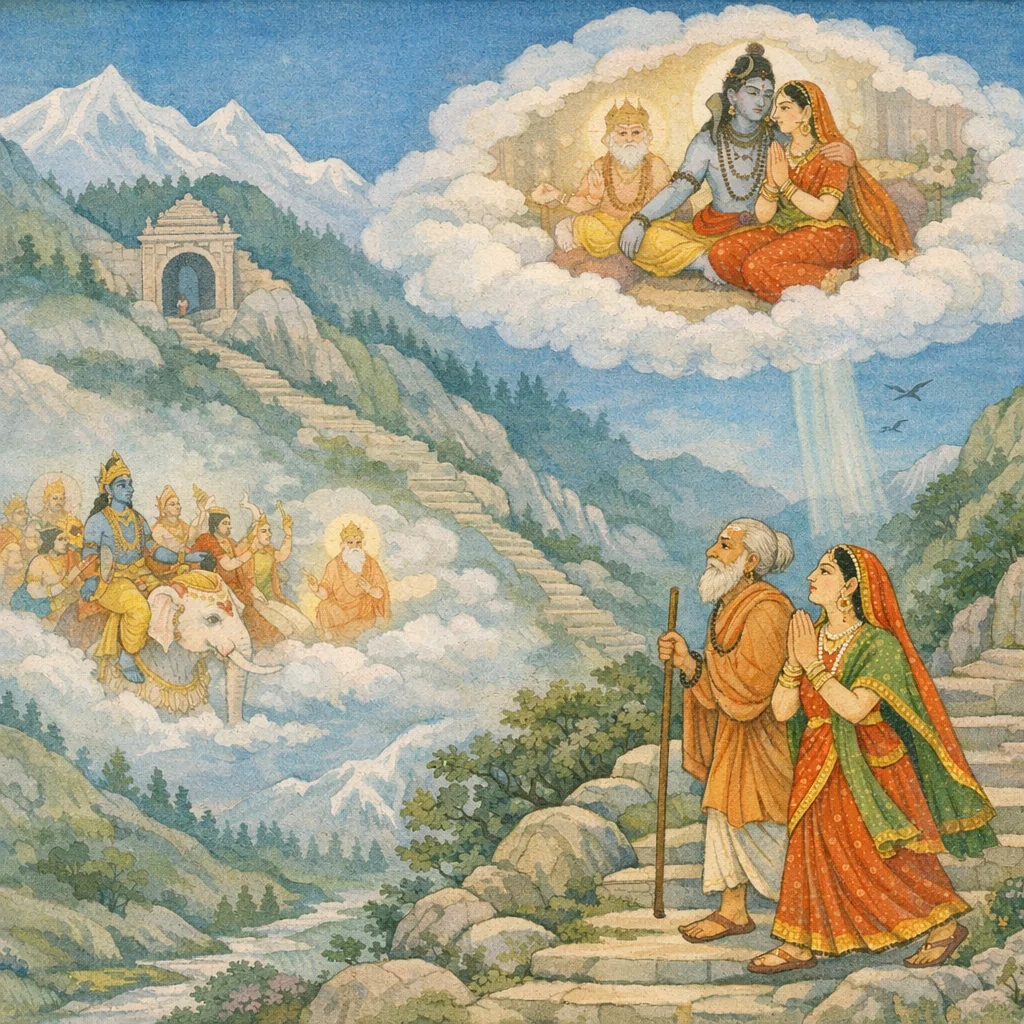
मेना-शिवदर्शन-प्रस्थानम् | Menā’s Quest to Behold Śiva (Departure for Śiva’s Darśana)
Adhyāya 43 begins with Menā declaring her wish to behold Śiva, Girijā’s Lord, with her own eyes and to know what Śiva-form could warrant such supreme tapas. Brahmā relates that, through limited understanding, she at once sets out with the sage interlocutor toward Candrasālā to obtain Śiva’s darśana. Śiva, perceiving the subtle ego-pride (ahaṃkāra) within her, initiates a wondrous līlā and addresses Viṣṇu; Brahmā too arrives in radiant splendor. Śiva instructs the two gods to proceed separately to the mountain-gate (giridvāra), with Śiva following afterward. Viṣṇu then summons the devas, and the gods eagerly prepare to depart. Menā is next made to perceive a scene in the upper chamber (śirogṛha), arranged to unsettle the heart, signaling the episode’s teaching against superficial valuation. When the time comes, she sees a splendid, auspicious army/retinue and delights in its seemingly “ordinary” magnificence. The procession opens with beautifully adorned Gandharvas, followed by varied vehicles, instruments, banners, and groups of Apsarases—pageantry that sets up the later contrast between celestial pomp and the transcendent truth of Śiva’s nature.
Shlokas
Verse 1
मेनोवाच । निरीक्षिष्यामि प्रथमं मुने तं गिरिजापतिम् । कीदृशं शिवरूपं हि यदर्थे तप उत्तमम्
Mena said: “O sage, I wish first to behold the Lord of Girijā (Pārvatī). What is the form of Śiva—He for whose sake this supreme austerity is being undertaken?”
Verse 2
ब्रह्मोवाच । इत्यज्ञानपरा सा च दर्शनार्थं शिवस्य च । त्वया मुने समं सद्यश्चन्द्रशालां समागता
Brahmā said: Thus, though she was still under the sway of ignorance, she came at once together with you, O sage, to the Candraśālā, desiring the vision (darśana) of Lord Śiva.
Verse 3
तावद्ब्रह्मा समायातस्तेजसां गशिरुत्तमः । सर्षिवर्य्यसुतस्साक्षाद्धर्मपुंज इव स्तुतः
Just then Brahmā arrived—supreme among the radiant ones, foremost in splendour—praised as though he were Dharma itself gathered into a single form, manifest in person, like the illustrious son of the best of sages.
Verse 4
शिव उवाच । मदाज्ञया युवान्तातौ सदेवौ च पृथक्पृथक् । गच्छतं हि गिरिद्वारं वयं पश्चाद्व्रजेमहि
Śiva said: “By My command, you two—together with the gods—go separately to the mountain-gate. We shall follow after you.”
Verse 5
ब्रह्मोवाच । इत्याकर्ण्य हरिस्सर्वानाहूयोवाच तन्मयाः । सुरास्सर्वे तथैवाशु गमनं चक्रुरुत्सुकाः
Brahmā said: Hearing this, Hari (Viṣṇu) summoned everyone and spoke, wholly intent upon that purpose. Then all the devas likewise, eager at heart, quickly set out on their journey.
Verse 6
स्थितां शिरोगृहे मेनां मुने विश्वेश्वर त्वया । तथैव दर्शयामास हृद्विभ्रंशो यथा भवेत्
O sage, you—Viśveśvara—showed Menā as she stood in her inner chamber, in such a way that her heart was shaken and her composure was broken.
Verse 7
एतस्मिन्समये मेना सेनां च परमां शुभाम् । निरीक्षन्ती मुने दृष्ट्वा सामान्यं हर्षिताऽभवत्
At that time, O sage, Menā, while observing that exceedingly auspicious and excellent army, saw that everything was proceeding in an orderly and proper manner, and she became delighted.
Verse 8
प्रथमं चैव गन्धर्वास्सुन्दरास्सुभगास्तदा । आयाताश्शुभवस्त्राढ्या नानालंकारभूषिताः
First, the Gandharvas—beautiful and auspicious in appearance—arrived. They were richly clad in fine garments and adorned with many kinds of ornaments.
Verse 9
नानावाहनसंयुक्ता नानावाद्यपरा यणा । पताकाभिर्विचित्राभिरप्सरोगणसंयुताः
They were furnished with many kinds of vehicles, delighting in many varieties of musical instruments; adorned with wonderfully diverse banners, and accompanied by hosts of Apsarās.
Verse 10
अथ दृष्ट्वा वसुं तत्र तत्पतिं परमप्रभुम् । मेना प्रहर्षिता ह्यासीच्छिवोयमिति चाब्रवीत्
Then, seeing Vasu there—her lord, the supreme and radiant Master—Menā became filled with joy and said, “This indeed is Śiva.”
Verse 11
शिवस्य गणका एते न शिवोयं शिवापतिः । इत्येवं त्वं ततस्तां वै अवोच ऋषिसत्तम
“These are only Śiva’s gaṇas, His attendants; this is not Śiva Himself, but Śivapati, the Lord of Śivā (Pārvatī).” Having said so, O best of sages, you then spoke those words to her.
Verse 12
एवं श्रुत्वा तदा मेना विचारे तत्पराऽभवत् । इतश्चाभ्यधिको यो वै स च कीदृग्भविष्यति
Hearing this, Menā became wholly intent on reflection. “If there is indeed someone even greater than him,” she thought, “what kind of being will that one be?”
Verse 13
एतस्मिन्नन्तरे यक्षा मणिग्रीवादयश्च ये । तेषां सेना तया दृष्टा शोभादिद्विगुणीकृता
Meanwhile, the Yakṣas—beginning with Maṇigrīva and the rest—beheld her; and their army, upon seeing her, became doubly enhanced in splendour and ardour.
Verse 14
तत्पतिं च मणिग्रीवं दृष्ट्वा शोभान्वितं हि सा । अयं रुद्रश्शिवास्वामी मेना प्राहेति हर्षिता
Seeing her lord Maṇigrīva, radiant with splendor, she became delighted. Then Menā, rejoicing, said: “This is Rudra—Shiva Himself, the Supreme Lord.”
Verse 15
नायं रुद्रश्शिवास्वामी सेवकोयं शिवस्य वै । इत्यवोचोगपत्न्यै त्वं तावद्वह्निस्स आगतः
“He is not Rudra, nor is he a master like Śiva; he is indeed only a servant of Śiva.” Having said this to the wife of the sage, at that very moment Agni (the Fire-god) arrived there.
Verse 16
ततोऽपि द्विगुणां शोभां दृष्ट्वा तस्य च साब्रवीत् । रुद्रोऽयं गिरिजास्वामी तदा नेति त्वमब्रवीः
Seeing in him a splendour doubled yet again, she said: “This is Rudra, the Lord of Girijā.” But at that time you replied, “No, it is not so.”
Verse 17
तावद्यमस्समायातस्ततोऽपि द्विगुणप्रभः । तं दृष्ट्वा प्राह सा मेना रुद्रोऽयमिति हर्षिता
Just then Yama arrived, his radiance doubled. Seeing him, Menā joyfully exclaimed, “This is Rudra (Śiva)!”
Verse 18
नेति त्वमब्रवीस्तां वै तावन्निरृतिरागतः । बिभ्राणो द्विगुणां शोभां शुभः पुण्यजनप्रभुः
As you were saying to her, “No, no,” at that very moment Nirṛti arrived—auspicious, lord of the hosts of the blessed—bearing a beauty doubled in splendour.
Verse 19
तं दृष्ट्वा प्राह सा मेना रुद्रोऽयमिति हर्षिता । नेति त्वमब्रवीस्तां वै तावद्वरुण आगतः
Seeing him, Menā joyfully exclaimed, “This is Rudra (Śiva)!” But you replied to her, “No.” Just then, Varuṇa arrived.
Verse 20
ततोऽपि द्विगुणां शोभां दृष्ट्वा तस्य च साब्रवीत् । रुद्रोऽयं गिरिजास्वामी तद्वा नेति त्वमब्रवीः
Seeing his splendor become twice as radiant, she said, “This indeed is Rudra, the Lord of Girijā (Pārvatī).” But you replied, “Is it so—or is it not?”
Verse 21
तावद्वायुस्समायातस्ततोऽपि द्विगुणप्रभः । तं दृष्ट्वा प्राह सा मेना रुद्रोयमिति हर्षिता
Just then Vāyu arrived, shining with a splendour twice as great as before. Seeing him, Menā—filled with joy—declared, “This indeed is Rudra.”
Verse 22
नेति त्वमब्रवीस्तां वै तावद्धनद आगतः । ततोऽपि द्विगुणां शोभां बिभ्राणो गुह्यकाधिपः
When you said to her, “No,” at that very moment Dhanada (Kubera) arrived; and the Lord of the Guhyakas appeared, bearing a splendour twice as radiant as before.
Verse 23
तं दृष्ट्वा प्राह सा मेना रुद्रोऽयमिति हर्षिता । नेति त्वमब्रवीस्तां वै तावदीशान आगतः
Seeing him, Menā spoke with delight, “This indeed is Rudra (Śiva).” But you replied to her, “No.” At that very moment, Īśāna (Lord Śiva, the Supreme Lord) arrived.
Verse 24
ततोऽपि द्विगुणां शोभां दृष्ट्वा तस्य च साब्रवीत् । रुद्रोऽयं गिरिजास्वामी तदा नेति त्वमब्रवीः
Then, seeing in him a splendour twice greater still, she said, “This is Rudra, the Lord of Girijā.” But at that time you replied, “No, he is not.”
Verse 25
तावदिन्द्रस्समायातस्ततोऽपि द्विगुणप्रभः । सर्वामरवरो नानादिव्यभस्त्रिदिवेश्वरः
Just then Indra arrived—his radiance doubled yet again. Foremost among the immortals, lord of the three worlds, he came adorned with many kinds of divine splendour and with sacred ash (vibhūti).
Verse 26
तं दृष्ट्वा शंकरस्सोऽयमिति सा प्राह मेनका । शक्रस्सुरपतिश्चायं नेति त्वं तदाब्रवीः
Seeing him, Menakā said, “This indeed is Śaṅkara.” But you replied then, “No—this is Śakra, the lord of the gods.”
Verse 27
तावच्चन्द्रस्समायातश्शोभा तद्द्विगुणा दधत । दृष्ट्वा तं प्राह रुद्रोऽयं तां तु नेति त्वमब्रवीः
Just then the Moon arrived, bearing a splendor twice as great. Seeing him, Rudra said, “This is the one,” but you replied of her, “No—not this.”
Verse 28
तावत्सूर्यस्समायातश्शोभा तद्द्विगुणा दधत् । दृष्ट्वा तं प्राह सा सोयन्तांतु नेति त्वमब्रवीः
Just then the Sun arrived, bearing a splendor twice as radiant as before. Seeing him, she spoke; but you replied, “No—do not let him come here.”
Verse 29
तावत्समागतास्तत्र भृग्वाद्याश्च मुनीश्वराः । तेजसो राशयस्सर्वे स्वशिष्यगणसंयुताः
Just then the lordly sages—Bhṛgu and others—arrived there, all of them radiant masses of tejas (spiritual splendor), accompanied by their own companies of disciples.
Verse 30
तन्मध्ये चैव वागीशं दृष्ट्वा सा प्राह मेनका । रुद्रोऽयं गिरिजास्वामी तदा नेति त्वमब्रवीः
Seeing Vāgīśa there among them, Menakā said, “This is Rudra, the Lord of Girijā (Pārvatī).” But at that time you replied, “No, he is not.”
Verse 32
दृष्ट्वा सा तं तदा मेना महाहर्षवती मुने । सोऽयं शिवापतिः प्राह तां तु नेति त्वमब्रवीः
O sage, when Menā saw him then, she was filled with great joy and said, “This indeed is Śiva, the Lord and husband of our daughter.” But you replied to her, “No, it is not so.”
Verse 33
एतस्मिन्नन्तरे तत्र विष्णुर्देवस्समागतः । सर्वशोभान्वितः श्रीमान्मेघश्यामश्चतुर्भुजः
Just then, in that very place, Lord Viṣṇu arrived—radiant with every kind of splendor, illustrious and glorious, cloud-dark in hue, and four-armed.
Verse 34
कोटिकन्दर्प्यलावण्यः पीताम्बरधरस्स्वराट् । राजीवलोचनश्शान्तः पक्षीन्द्रवरवाहनः
He bears a beauty that outshines millions of Kāma-devas; clad in yellow garments, self-sovereign and radiant. Lotus-eyed and perfectly tranquil, He is borne upon the supreme lord of birds.
Verse 35
शंखादिलक्षणैर्युक्तो मुकुटादिविभूषितः । श्रीवत्सवक्षा लक्ष्मीशो ह्यप्रमेय प्रभान्वितः
He is endowed with auspicious marks such as the conch and others, adorned with a crown and divine ornaments; upon His chest shines the Śrīvatsa. He is the Lord of Lakṣmī—immeasurable, and filled with unbounded radiance.
Verse 36
तं दृष्ट्वा चकिताक्ष्यासीन्महाहर्षेण साब्रवीत् । सोऽयं शिवापतिः साक्षाच्छिवो वै नात्र संशयः
Seeing Him, she became wide-eyed with astonishment and, filled with great joy, spoke: “This indeed is Śivā’s Lord and consort—Śiva Himself in person; of this there is no doubt.”
Verse 37
अथ त्वं मेनकावाक्यमाकर्ण्योवाच ऊतिकृत् । नायं शिवापतिरयं किन्त्वयं केशवो हरिः
Then, hearing Menakā’s words, the messenger spoke: “This is not the Lord (pati) of Śivā; rather, this is Keśava—Hari (Viṣṇu) himself.”
Verse 38
शंकरोखिलकार्य्यस्य ह्यधिकारी च तत्प्रियः । अतोऽधिको वरो ज्ञेयस्स शिवः पार्वतीपतिः
Śaṅkara is the rightful Lord over all undertakings, and He is the beloved of that Supreme Reality. Therefore know: the higher and foremost boon is this—Śiva, the Lord of Pārvatī.
Verse 39
तच्छोभां वर्णितुं मेने मया नैव हि शक्यते । स एवाखिलब्रह्माण्डपतिस्सर्वेश्वरः स्वराट्
I considered that it is truly not possible for me to describe that radiance. He alone is the Lord of all the universes—the Sovereign, the Supreme Ruler of all, self-governing and independent.
Verse 40
ब्रह्मोवाच । इत्याकर्ण्य वचस्तस्य मेना मेने च तां शुभाम् । महाधनां भाग्यवती कुलत्रयसुखावहाम्
Brahmā said: Hearing his words, Menā considered that auspicious maiden to be truly worthy—rich in prosperity, blessed with good fortune, and destined to bring happiness to the three families (her natal house, her husband’s house, and the line of her offspring).
Verse 41
उवाच च प्रसन्नास्या प्रीतियुक्तेन चेतसा । स्वभाग्यमधिकं चापि वर्णयन्ती मुहुर्मुहुः
With a radiant, delighted face, and a mind filled with loving joy, she spoke—again and again extolling her own surpassing good fortune.
Verse 42
मेनोवाच । धन्याहं सर्वथा जाता पार्वत्या जन्मनाधुना । धन्यो गिरीश्वरोप्यद्य सर्वं धन्यतमं मम
Menā said: “In every way I am blessed today, now that Pārvatī has been born. Blessed too is Girīśvara (Lord Śiva) this very day. Everything that is mine has become most blessed.”
Verse 43
इति श्रीशिवमहापुराणे द्वितीयायां रुद्रसंहितायां तृतीये पार्वतीखण्डे शिवाद्भुतलीलावर्णनं नाम त्रिचत्वारिंशोऽध्यायः
Thus ends the forty-third chapter, titled “The Description of Shiva’s Wondrous Divine Play,” in the Pārvatī-khaṇḍa (third section) of the Rudra-saṃhitā (second division) of the Śrī Śiva Mahāpurāṇa.
Verse 44
अस्याः किं वर्ण्यते भाग्यमपि वर्षशतैरपि । वर्णितुं शक्यते नैव तत्प्रभुप्राप्तिदर्शनात
What can be said of her good fortune—even over hundreds of years? It cannot truly be described at all, for it is evident in her attainment of that Lord and the direct vision of Him.
Verse 45
ब्रह्मोवाच । इत्यवादीच्च सा मेना प्रेमनिर्भरमानसा । तावत्समागतो रुद्रोऽद्भुतोतिकारकः प्रभुः
Brahmā said: Having spoken thus, Menā—her mind overflowing with love—continued; and just then the Lord Rudra arrived, the sovereign whose wondrous presence surpasses all measure.
Verse 47
तमागतमभिप्रेत्य नारद त्वं मुने तदा । मेनामवोचः सुप्रीत्या दर्शयंस्तं शिवापतिम्
O sage Nārada, when you arrived and understood the purpose of your coming, you then spoke to Menā with great delight, revealing to her that very Lord Śiva—the supreme Husband and Protector of Śivā (Pārvatī).
Verse 48
नारद उवाच । अयं स शंकरस्साक्षाद्दृश्यतां सुन्दरि त्वया । यदर्थे शिवया तप्तं तपोऽति विपिने महत्
Nārada said: “O fair one, behold—this is Śaṅkara Himself, directly before you. For His sake, Śivā performed great austerity in the deep forest.”
Verse 49
ब्रह्मोवाच । इत्युक्त्वा हर्षिता मेना तं ददर्श मुदा प्रभुम् । अद्भुताकृतिमीशानमद्भुतानुगमद्भुतम्
Brahmā said: Having spoken thus, Menā—filled with joy—beheld with delight that Lord, Īśāna, of wondrous form, wondrous in His retinue, altogether marvellous.
Verse 50
तावदेव समायाता रुद्रसेना महाद्भुता । भूतप्रेतादिसंयुक्ता नानागणसमन्विता
Just then, the wondrous army of Rudra arrived—accompanied by hosts of bhūtas, pretas, and the like, and filled with many kinds of gaṇas, Śiva’s attendant troops.
Verse 51
वात्यारूपधराः केचित्पताकामर्मरस्वना । वक्रतुंडास्तत्र केचिद्विरूपाश्चापरे तथा
Some assumed the form of whirling wind; others, bearing banners, made a rustling, murmuring sound. There too were some with crooked beaks, and others likewise of distorted appearance.
Verse 52
करालाः श्मश्रुलाः केचित्केचित्खञ्जा ह्यलोचनाः । दण्डपाशधराः केचित्केचिन्मुद्गरपाणयः
Some were grim and terrifying, some were bearded; some were lame, and some were without eyes. Some bore staffs and nooses, and some held maces in their hands.
Verse 53
विरुद्धवाहनाः केचिच्छृंगनादविवादिनः । डमरोर्वादिनः केचित्केचिद्गोमुखवादिनः
Some bore strange and contrary mounts; some were quarrelsome, disputing amid blaring horn-calls. Some kept sounding the ḍamaru drum, and others played the gomukha horn—each raising a tumult in the retinue gathered around the Lord.
Verse 54
अमुखा विमुखाः केचित्केचिद्बहुमुखा गणाः । अकरा विकराः केचित्केचिद्बहुकरा गणाः
Among Śiva’s gaṇas, some were without faces; some were turned away; some had many faces. Some were without hands; some had distorted hands; and some had many hands.
Verse 55
अनेत्रा बहुनेत्राश्च विशिराः कुशिरास्तथा । अकर्णा बहुकर्णाश्च नानावेषधरा गणाः
The gaṇas appeared in countless strange forms—some without eyes, some with many eyes; some misshapen, some well-formed; some without ears, some with many ears—each bearing a different guise.
Verse 56
इत्यादिविकृताकारा अनेके प्रबला गणाः । असंख्यातास्तथा तात महावीरा भयंकराः
Thus, in many distorted and fearsome forms, there were numerous mighty gaṇas—countless indeed, dear one—great heroes, terrifying in their power.
Verse 57
अंगुल्या दर्शयंस्त्वं तां मुने रुद्रगणांस्ततः । हरस्य सेवकान्पश्य हरं चापि वरानने
Pointing with her finger, the fair-faced lady said: “O sage, look there—see the hosts of Rudras. Behold also the attendants of Hara, and see Hara Himself.”
Verse 58
असंख्यातान् गणान् दृष्ट्वा भूतप्रेतादिकान् मुने । तत्क्षणादभवत्सा वै मेनका त्राससंकुला
O sage, on seeing innumerable gaṇas—attended by beings such as bhūtas and pretas—Menakā, at that very moment, became overwhelmed with fear.
Verse 59
तन्मध्ये शंकरं चैव निर्गुणं गुणवत्तरम् । वृषभस्थं पञ्चवक्त्रं त्रिनेत्रं भूतिभूषितम्
In the midst of that, she beheld Śaṅkara Himself—transcending the guṇas, yet also manifest as the supreme Lord with attributes—seated upon the bull, five-faced, three-eyed, and adorned with sacred ash (bhasma).
Verse 60
कपर्दिनं चन्द्रमौलिं दशहस्तं कपालि नम् । व्याघ्रचर्मोत्तरीयञ्च पिनाकवरपाणिनम्
I bow to the Lord with matted locks, crowned by the moon; to Kapālī who bears the skull-bowl; to Him of ten hands, clad in a tiger-skin garment, holding in His hand the excellent Pināka bow.
Verse 61
शूलयुक्तं विरूपाक्षं विकृताकारमाकुलम् । गजचर्म वसानं हि वीक्ष्य त्रेसे शिवाप्रसूः
Seeing him bearing a trident, with strange-looking eyes, of a distorted and agitating appearance, and clad in an elephant-hide, the Mother of Śivā (Menā) became terrified.
Verse 62
चकितां कम्पसंयुक्तां विह्वलां विभ्रमद्धियम् । शिवोऽयमिति चांगुल्या दर्शयंस्तां त्वमब्रवीः
Seeing her startled, trembling, overwhelmed, and her mind thrown into confusion, you pointed with your finger, saying, “This is Śiva,” and then spoke to her.
Verse 63
त्वदीयं तद्वचः श्रुत्वा वाताहतलता इव । सा पपात द्रुतम्भूमौ मेना दुःखभरा सती
Hearing those words spoken by you, Menā—chaste and burdened with sorrow—fell swiftly to the ground, like a creeper struck down by a violent wind.
Verse 64
किमिदं विकृतं दृष्ट्वा वञ्चिताहं दुराग्रहे । इत्युक्त्वा मूर्च्छिता तत्र मेनका साऽभवत्क्षणात्
Seeing this strange and distorted turn of events, she cried, “What is this? In my stubborn folly I have been deceived!” Having spoken thus, Menakā instantly fainted on the spot.
Verse 65
अथ प्रयत्नैर्विविधैस्सखीभिरुपसेविता । लेभे संज्ञां शनै मेना गिरीश्वरप्रिया तदा
Then, attended by her companions with many careful efforts, Menā—beloved of the lord of mountains—gradually regained her consciousness.
Verse 446
अद्भुतात्मागणास्तात मेनागर्वापहारकाः । आत्मानं दर्शयन् मायानिर्लिप्तं निर्विकारकम्
O dear one, those wondrous hosts of spiritual beings—who remove Menā’s pride—revealed their true nature: the Self (Ātman) that remains untouched by Māyā and utterly free from change.
Frequently Asked Questions
Menā’s attempt to behold Girijā’s पति (Śiva) directly, triggering a divine arrangement in which Brahmā, Viṣṇu, and the devas move toward the mountain-gate amid a staged celestial procession.
The chapter frames darśana as a test of perception: pride and ignorance are exposed through spectacle, while Śiva’s līlā guides the viewer from external grandeur to inner recognition of Śiva-tattva.
Not Śiva’s final form yet (in the provided verses), but preparatory manifestations: the devas’ retinue (surāḥ), Gandharvas, Apsarases, banners, vehicles, and music—devices that foreshadow a revelatory contrast.