कामदाहोत्तरवृत्तान्तः / Aftermath of Kāma’s Burning (Pārvatī’s Fear and Himavān’s Consolation)
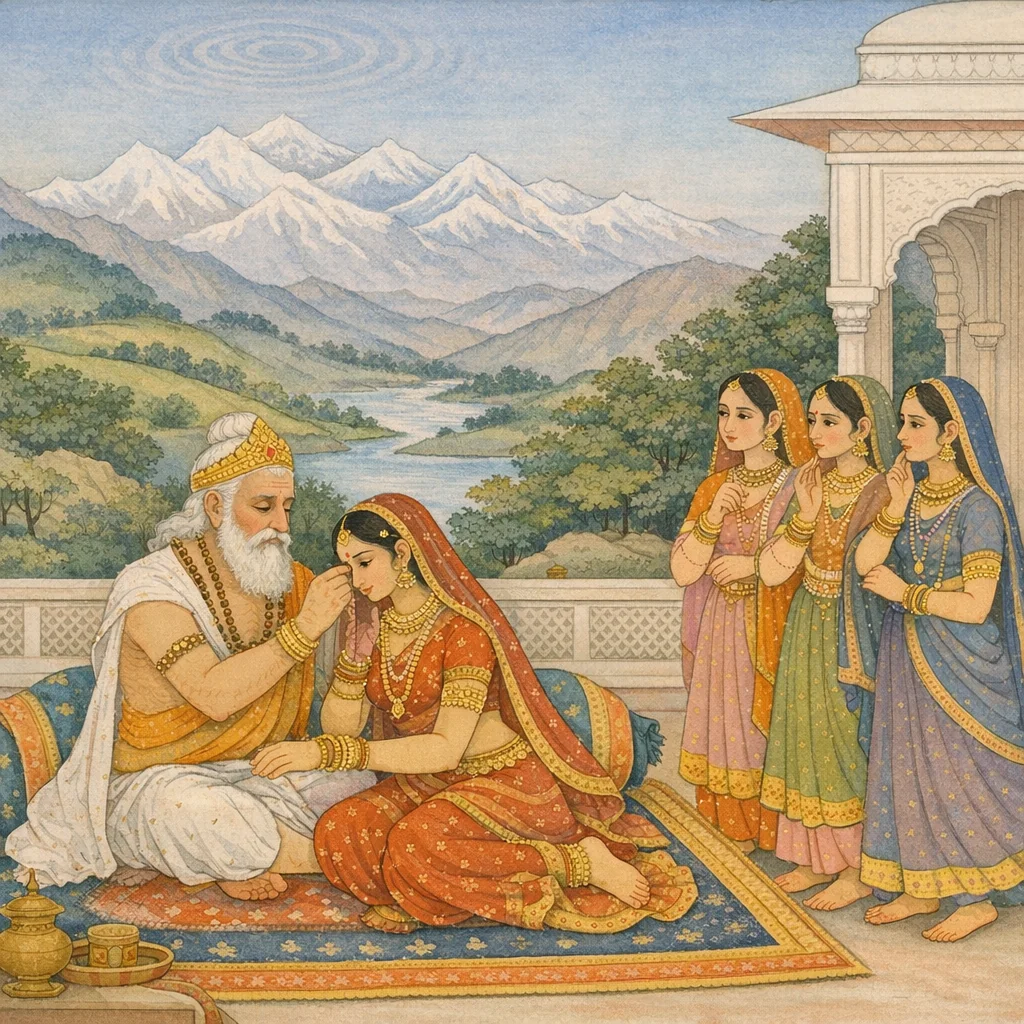
This adhyāya is taught as a question–answer dialogue between Nārada and Brahmā. Nārada asks what happened after Smara (Kāma) was burned to ashes by the fire of Śiva’s third eye and entered the ocean, and what Pārvatī did next—where she went with her companions and how events unfolded. Brahmā explains that at the very moment of Kāma’s incineration a vast, wondrous sound filled the sky, an immediate cosmic sign of Śiva’s fiery, supra-human power. Seeing this and hearing the sound, Pārvatī becomes frightened and disturbed; with her sakhīs she quickly returns home. The same sound astonishes Himavān, king of mountains; remembering his daughter, he grows anxious and goes to find her. Finding Pārvatī overwhelmed and weeping from separation, or felt distance, from Śambhu (Śiva), Himavān consoles her, wipes her tears, urges her not to fear, takes her onto his lap, and brings her into the palace, soothing her agitation. The chapter continues the post-Kāmadahana consequences: emotional aftershock, family mediation, and the steadying of Pārvatī’s resolve within dharma as the narrative moves toward eventual union.
Shlokas
Verse 1
नारद उवाच । विधे तात महाप्राज्ञ विष्णुशिष्य त्रिलोककृत् । अद्भुतेयं कथा प्रोक्ता शंकरस्य महात्मनः
Narada said: “O Vidhātr (Brahmā), revered father—O greatly wise one, disciple of Viṣṇu, creator of the three worlds—this wondrous narrative of the great-souled Śaṅkara has been narrated.”
Verse 2
भस्मीभूते स्मरे शंभुतृतीयनयनाग्निना । तस्मिन्प्रविष्टे जलधौ वद त्वं किमभूत्ततः
When Kāma was reduced to ashes by the fire of Śambhu’s third eye, and then entered the ocean, tell me—what happened thereafter?
Verse 3
किं चकार ततो देवी पार्वती कुधरात्मजः । गता कुत्र सखीभ्यां सा तद्वदाद्य दयानिधे
Then what did the Goddess Pārvatī, the mountain’s daughter, do? Where did she go with her companions? O ocean of compassion, tell us that today.
Verse 4
ब्रह्मोवाच । शृणु तात महाप्राज्ञ चरितं शशिमौलिनः । महोतिकारकस्यैव स्वामिनो मम चादरात्
Brahmā said: “Listen, dear child—O greatly wise one—to the sacred account of the Moon-crested Lord (Śiva). Out of reverence for that great benefactor—my own Master as well—I narrate it with devotion.”
Verse 5
यदाहच्छंभुनेत्रोद्भवो हि मदनं शुचिः । महाशब्दोऽद्भुतोऽभूद्वै येनाकाशः प्रपूरितः
When the pure fire born from Śambhu’s eye struck Madana (Kāma), a wondrous, mighty sound arose—so great that it filled the whole sky.
Verse 6
तेन शब्देन महता कामं दग्धं समीक्ष्य च । सखीभ्यां सह भीता सा ययौ स्वगृहमाकुला
Startled by that mighty sound, she beheld Kāma burnt to ashes; and, frightened, she departed with her two companions, returning to her own home in agitation.
Verse 7
तेन शब्देन हिमवान्परिवारसमन्वितः । विस्मितोऽभूदतिक्लिष्टस्सुतां स्मृत्वा गतां ततः
Hearing that sound, Himavān—accompanied by his attendants—was struck with astonishment; and, remembering his daughter who had gone away, he became exceedingly distressed.
Verse 8
जगाम शोकं शैलेशो सुतां दृष्ट्वातिविह्वलाम् । रुदतीं शंभुविरहादाससादाचलेश्वरः
Seeing his daughter utterly overwhelmed—weeping from separation from Śambhu—the Lord of the mountains (Himālaya) was overcome with grief and, distressed at heart, approached her.
Verse 9
आसाद्य पाणिना तस्या मार्जयन्नयनद्वयम् । मा बिभीहि शिवेऽरोदीरित्युक्त्वा तां तदाग्रहीत्
Approaching her, he gently wiped both her eyes with his hand and said, “Do not fear, O Śivā; do not weep.” Having spoken thus, he then held her.
Verse 10
क्रोडे कृत्वा सुतां शीघ्रं हिम वानचलेश्वरः । स्वमालयमथानिन्ये सांत्वयन्नतिविह्वलाम्
At once Himavān, the lord of the mountain, placed his daughter upon his lap; and consoling her, who was greatly overwhelmed, he then led her to his own palace.
Verse 11
अंतर्हिते स्मरं दग्ध्वा हरे तद्विरहाच्छिवा । विकलाभूद् भृशं सा वै लेभे शर्म न कुत्रचित्
After Hari had vanished—having burnt Kāma (the god of desire)—Śivā (Pārvatī), tormented by separation from him, became utterly distraught, and nowhere at all could she find peace.
Verse 12
पितुर्गृहं तदा गत्वा मिलित्वा मातरं शिवा । पुनर्जातं तदा मेने स्वात्मानं सा धरात्मजा
Then Śivā (Pārvatī) went to her father’s house and met her mother. The daughter of the Earth felt as though she herself had been born anew.
Verse 13
निनिंद च स्वरूपं सा हा हतास्मीत्यथाब्रवीत् । सखीभिर्बोधिता चापि न बुबोध गिरीन्द्रजा
She began to disparage her own appearance and cried, “Alas, I am ruined!” Though her companions consoled and instructed her, the daughter of the Lord of Mountains could not regain clarity of mind.
Verse 14
स्वपती च पिबंती च सा स्नाती गच्छती शिवा । तिष्ठंती च सखीमध्ये न किंचित्सुखमाप ह
Whether she slept or drank, whether she bathed or walked about, and even while standing amid her companions, the auspicious goddess (Pārvatī) found not the slightest happiness—her mind remained fixed on Śiva alone.
Verse 15
धिक्स्वरूपं मदीयं च तथा जन्म च कर्म च । इति ब्रुवंती सततं स्मरंती हरचेष्टितम्
“Fie upon my very form, and likewise upon my birth and my deeds!”—speaking thus again and again, she continually remembered the acts and intent of Hara (Śiva).
Verse 16
एवं सा पार्वती शंभुविरहोत्क्लिष्टमानसा । सुखं न लेभे किंचिद्राऽब्रवीच्छिवशिवेति च
Thus Pārvatī, her mind afflicted by separation from Śambhu (Śiva), found no happiness at all; she continually uttered, “Śiva, Śiva.”
Verse 17
निवसंती पितुर्ग्गेहे पिनाकिगतचेतना । शुशोचाथ शिवा तात मुमोह च मुहुर्मुहुः
While dwelling in her father’s house, Śivā’s mind remained wholly absorbed in the Bearer of the Pināka, Lord Śiva. She grieved deeply, dear one, and again and again she fainted, overcome by bewilderment.
Verse 18
शैलाधिराजोप्यथ मेनकापि मैनाकमुख्यास्तनयाश्च सर्वे । तां सांत्वयामासुरदीनसत्त्वा हरं विसस्मार तथापि नो सा
Then the Lord of Mountains, Himālaya, and Menakā, along with all their sons—Maināka and the rest—sought to console her with steadfast hearts. Yet even so, she did not forget Hara (Śiva) at all.
Verse 19
अथ देवमुने धीमन्हिमव त्प्रस्तरे तदा । नियोजितो बलभिदागमस्त्वं कामचारतः
Then, O divine sage, O wise one—at that time, upon the slopes of Himavān, you were commissioned by Balabhid (Indra) to go there, moving freely according to your own will.
Verse 20
ततस्त्वं पूजितस्तेन भूधरेण महात्मना । कुशलं पृष्टवांस्तं वै तदाविष्टो वरासने
Then that great-souled Mountain duly worshipped you. Seated upon an excellent seat, in divine composure, you indeed asked him about his welfare.
Verse 21
इति श्रीशिवमहापुराणे द्वितीयायां रुद्रसंहितायां तृतीये पार्वतीखण्डे नारदोपदेशो नामैकविंशोऽध्यायः
Thus, in the Śrī Śiva Mahāpurāṇa—within the Second division, the Rudra Saṃhitā, and in its Third section, the Pārvatīkhaṇḍa—concludes the twenty-first chapter, entitled “Nārada’s Instruction.”
Verse 22
श्रुत्वावोचो मुने त्वं तु तं शैलेशं शिवं भज । तमामंत्र्योदतिष्ठस्त्वं संस्मृत्य मनसा शिवम्
Hearing these words, O sage, you then said: “Worship that Lord of the mountain—Śiva.” Having thus taken leave of him, you rose, remembering Śiva inwardly in your mind.
Verse 23
तं समुत्सृज्य रहसि कालीं तामगमंस्त्वरा । लोकोपकारको ज्ञानी त्वं मुने शिववल्लभः
Leaving him aside in secret, you swiftly went to that Kālī. O sage, you are wise and devoted to the welfare of the world; you are indeed beloved of Śiva.
Verse 24
आसाद्य कालीं संबोध्य तद्धिते स्थित आदरात् । अवोचस्त्वं वचस्तथ्यं सर्वेषां ज्ञानिनां वरः
Approaching Kālī and respectfully addressing her, remaining intent on her welfare, you spoke words that were true and beneficial—O best among all the wise.
Verse 25
नारद उवाच । शृणु कालि वचो मे हि सत्यं वच्मि दयारतः । सर्वथा ते हितकरं निर्विकारं सुकामदम्
Nārada said: “O Kālī, listen to my words. Out of compassion I speak the truth. In every way it is for your welfare—untainted, without defect, and able to grant the fulfillment of noble desires.”
Verse 26
सेवितश्च महादेवस्त्वयेह तपसा विना । गर्ववत्या यदध्वंसीद्दीनानुग्रहकारकः
Here, you truly worshipped Mahādeva even without austerities; for He—the compassionate bestower of grace upon the distressed—shattered the pride of the arrogant.
Verse 27
विरक्तश्च स ते स्वामी महायोगी महेश्वरः । विसृष्टवान्स्मरं दग्ध्वा त्वां शिवे भक्तवत्सलः
O Śivā, your Lord—Maheśvara, the great Yogin—is truly detached. Having burned Kāma, the god of desire, he has freed you from the compulsion of passion, for he is tenderly compassionate to his devotees.
Verse 28
तस्मात्त्वं सुतपोयुक्ता चिरमाराधयेश्वरम् । तपसा संस्कृतां रुद्रस्स द्वितीयां करिष्यति
Therefore, endowed with noble austerity, worship the Lord for a long time. When you are purified and perfected by tapas, Rudra will make you his second lawful consort.
Verse 29
त्वं चापि शंकरं शम्भुं न त्यक्ष्यसि कदाचन । नान्यं पतिं हठाद्देवि ग्रहीष्यसि शिवादृते
You too will never abandon Śaṅkara, Śambhu, at any time. O Goddess, apart from Śiva, you will not accept any other husband, no matter what force is applied.
Verse 30
ब्रह्मोवाच । इत्याकर्ण्यवचस्ते हि मुने सा भूधरात्मजा । किंचिदुच्छ्वसिता काली प्राह त्वां सांजलिर्मुदा
Brahmā said: “O sage, having thus heard your words, that daughter of the Mountain—Kālī—after breathing a little more freely, addressed you with joined palms, joyfully.”
Verse 31
शिवोवाच । त्वं तु सर्वज्ञ जगतामुपकारकर प्रभो । रुद्रस्याराधनार्थाय मंत्रं देहि मुने हि मे
Śiva said: “You are omniscient, O Lord, and a benefactor of the worlds. Therefore, O sage, grant me a mantra for the purpose of worshipping Rudra.”
Verse 32
न सिद्यति क्रिया कापि सर्वेषां सद्गुरुं विना । मया श्रुता पुरा सत्यं श्रुतिरेषा सनातनी
Without the true Sadguru, no spiritual practice succeeds for anyone. This truth I heard long ago; it is an eternal teaching of the Śruti, revealed wisdom.
Verse 33
ब्रह्मोवाच । इति श्रुत्वा वचस्तस्याः पार्वत्या मुनिसत्तमः । पंचाक्षरं शम्भुमन्त्रं विधिपूर्वमुपादिशः
Brahmā said: Having thus heard the words of Pārvatī, that best of sages instructed her—according to the prescribed rite—in the five-syllabled Śambhu-mantra.
Verse 34
अवोचश्च वचस्तां त्वं श्रद्धामुत्पादयन्मुने । प्रभावं मन्त्रराजस्य तस्य सर्वाधिकं मुने
O sage, you spoke those words in a way that awakened faith. You then declared—O muni—the supreme and unsurpassed greatness of that Mantra-king.
Verse 35
नारद उवाच । शृणु देवि मनोरस्य प्रभावं परमाद्भुतम् । यस्य श्रवणमात्रेण शंकरस्तु प्रसीदति
Narada said: “O Goddess, listen to the supremely wondrous power of Manora; by merely hearing of it, Shankara (Lord Shiva) becomes gracious and pleased.”
Verse 36
मंत्रोयं सर्वमंत्राणामधिराजश्च कामदः । भुक्तिमुक्तिप्रदोऽत्यंतं शंकरस्य महाप्रियः
This mantra is the sovereign lord of all mantras and the fulfiller of cherished aims. It bestows both worldly enjoyment and final liberation, and it is exceedingly dear to Śaṅkara, Lord Śiva.
Verse 37
सुभगे येन जप्तेन विधिना सोऽचिराद् द्रुतम् । आराधितस्ते प्रत्यक्षो भविष्यति शिवो ध्रुवम्
O auspicious one, by japa performed in the prescribed manner by which He is invoked, Śiva will surely be pleased; and very soon, swiftly, the Lord will manifest to you directly—this is certain.
Verse 38
चिंतयती च तद्रूपं नियमस्था शराक्षरम् । जप मन्त्रं शिवे त्वं हि संतुष्यति शिवो द्रुतम्
Steadfast in disciplined observance, meditate upon His very form and repeat the mantra of the six syllables. O Devī, by this japa alone, Śiva becomes pleased swiftly.
Verse 39
एवं कुरु तप साध्वि तपस्साध्यो महेश्वरः । तपस्येव फलं सर्वैः प्राप्यते नान्यथा क्वचित्
So do this, O virtuous one—undertake tapas, disciplined austerity. Mahēśvara is attained through tapas. Indeed, the fruit is obtained by all only through tapas; it is not gained otherwise, at any time.
Verse 40
ब्रह्मोवाच । एवमुक्त्वा तदा कालीं नारद त्वं शिवप्रियः । यादृच्छिकोऽगमस्त्वं तु स्वर्गं देवहिते रतः
Brahmā said: “Having thus addressed Kālī at that time, you—O Nārada, beloved of Śiva—came here by chance; and you, devoted to the welfare of the gods, then went on to heaven.”
Verse 41
पार्वती च तदा श्रुत्वा वचनं तव नारद । सुप्रसन्ना तदा प्राप पंचाक्षरमनूत्तमम्
O Nārada, then Pārvatī, having heard your words, became greatly pleased and thereupon received the unsurpassed five-syllabled mantra—the Pañcākṣarī, the very essence of devotion to Lord Śiva.
Frequently Asked Questions
The immediate aftermath of Kāmadahana—Kāma being burned to ashes by the fire from Śiva’s third eye—and the resulting cosmic sign (a great sound filling the sky).
It functions as a Purāṇic marker of a reality-shifting act: Śiva’s jñāna-agni (fire of higher awareness) subduing desire, with the cosmos audibly registering the transformation.
Śiva appears as the ascetic Lord whose third eye purifies; Pārvatī as the emotionally affected yet destined śakti; Himavān as the dharmic guardian mediating fear and restoring composure.