Sukta 19
Sukta 8.19
Agni (implied as carrier/leader of the oblation), supported by the gods
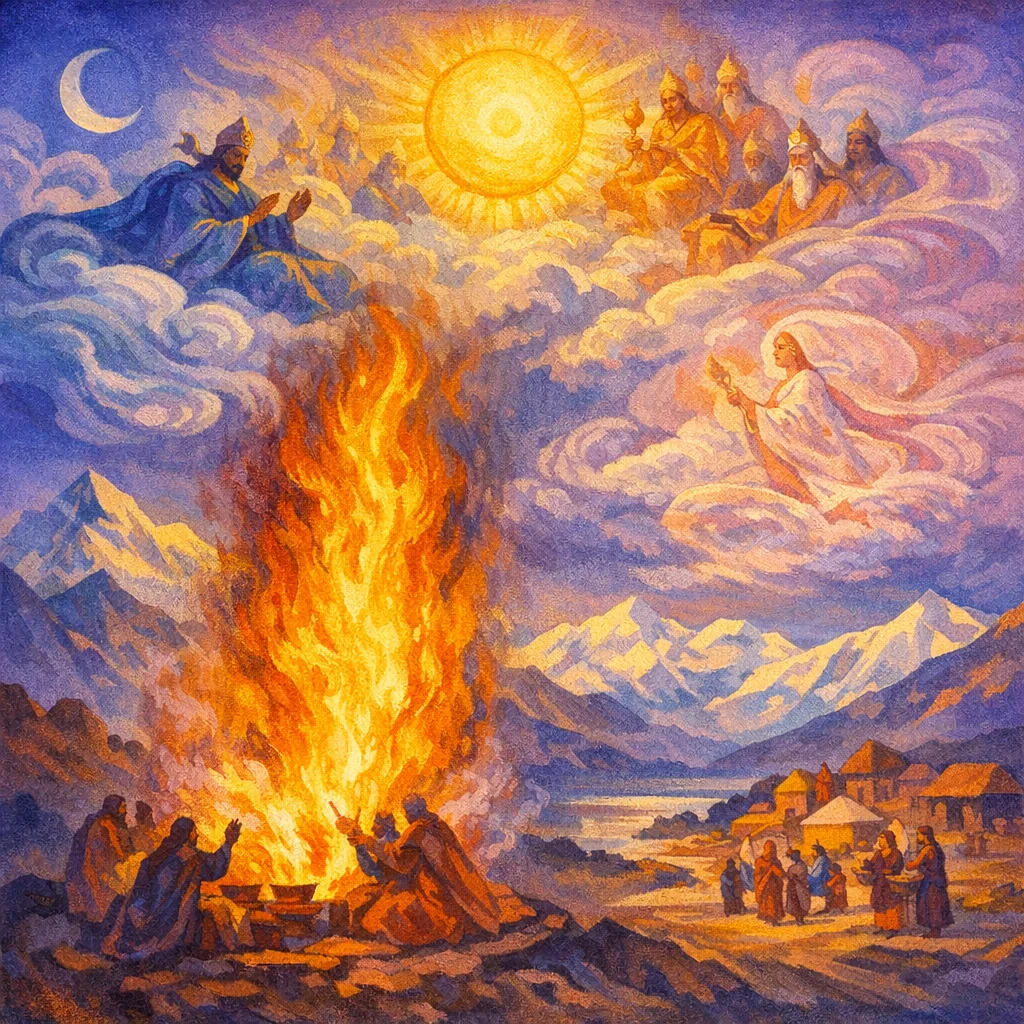
This hymn centers on Agni as the rightly-moving leader and carrier of the oblation, whom the gods themselves “set in motion” so the offering rises into the divine sphere. It repeatedly blesses the sacrifice as bhadra—auspicious in fire, gift, rite, and praise—linking correct ritual movement with well-being. Toward the end it shifts into a dānastuti-like register, recalling patrons and social rewards that accompany successful sacrifice and generosity.
Mantras
Mantra 1
तं गूर्धया स्वर्णरं देवासो देवमरतिं दधन्विरे । देवत्रा हव्यमोहिरे ॥
Him the gods set in motion with uplifted force—the divine bearer of the offering, the leader who moves in the right way; and they bring the oblation upward into the godward world.
Mantra 2
विभूतरातिं विप्र चित्रशोचिषमग्निमीळिष्व यन्तुरम् । अस्य मेधस्य सोम्यस्य सोभरे प्रेमध्वराय पूर्व्यम् ॥
O seer, adore Agni—wide in giving, of many-colored flame, the sure guide and controller of the journey. For this inspired offering, for this Soma-rite, O Sobharī, bring forward the ancient power for the sacrifice.
Mantra 3
यजिष्ठं त्वा ववृमहे देवं देवत्रा होतारममर्त्यम् । अस्य यज्ञस्य सुक्रतुम् ॥
We choose thee, the most fit for sacrifice—Agni, the divine and immortal priest who leads godward; make effective the right power of will for this our yajña.
Mantra 4
ऊर्जो नपातं सुभगं सुदीदितिमग्निं श्रेष्ठशोचिषम् । स नो मित्रस्य वरुणस्य सो अपामा सुम्नं यक्षते दिवि ॥
Agni, the child of energy, fortunate and brightly kindled, with the best flame—may he win for us in the heaven the grace of Mitra and Varuṇa, and the favour of the Waters, a blessing that descends as peace and fullness.
Mantra 5
यः समिधा य आहुती यो वेदेन ददाश मर्तो अग्नये । यो नमसा स्वध्वरः ॥
The mortal who serves Agni with kindling, with offering, with knowledge, and who gives with reverence—he whose sacrifice is self-ruled and straight—he enters the right protection of the Fire within.
Mantra 6
तस्येदर्वन्तो रंहयन्त आशवस्तस्य द्युम्नितमं यशः । न तमंहो देवकृतं कुतश्चन न मर्त्यकृतं नशत् ॥
For him the swift steeds hasten; his glory becomes most luminous. No evil, whether shaped by divine forces or by human making, can reach and strike the one who stands in the Fire’s right power.
Mantra 7
स्वग्नयो वो अग्निभिः स्याम सूनो सहस ऊर्जां पते । सुवीरस्त्वमस्मयुः ॥
May we be full of the right fires with thy fires, O Son of Force, Lord of energy. Be thou for us the giver of heroic strength, the one who is wholly turned to us with help.
Mantra 8
प्रशंसमानो अतिथिर्न मित्रियोऽग्नी रथो न वेद्यः । त्वे क्षेमासो अपि सन्ति साधवस्त्वं राजा रयीणाम् ॥
When he is praised, Agni becomes like a welcome guest, like a friend; like a chariot he is to be known as the carrier of our progress. In you are the sure safeties and the right fulfillments; you are the king of the rayi—our plenitude of being.
Mantra 9
सो अद्धा दाश्वध्वरोऽग्ने मर्तः सुभग स प्रशंस्यः । स धीभिरस्तु सनिता ॥
Truly, O Agni, that mortal who gives and offers the sacrifice becomes fortunate; he is worthy of praise. Let him, by his illumined thoughts, be a winner—one who attains.
Mantra 10
यस्य त्वमूर्ध्वो अध्वराय तिष्ठसि क्षयद्वीरः स साधते । सो अर्वद्भिः सनिता स विपन्युभिः स शूरैः सनिता कृतम् ॥
He for whom you stand upright for the sacrifice—he whose house grows in heroic strength—he achieves. With his steeds of force he becomes an attainer; with his aspiring energies, with his heroes, he wins what is to be done and made real.
Mantra 11
यस्याग्निर्वपुर्गृहे स्तोमं चनो दधीत विश्ववार्यः । हव्या वा वेविषद्विषः ॥
In whose home Agni sets his luminous form and places the hymn—he who holds all desirable boons—he makes the offerings vibrant and drives away the poison of division.
Mantra 12
विप्रस्य वा स्तुवतः सहसो यहो मक्षूतमस्य रातिषु । अवोदेवमुपरिमर्त्यं कृधि वसो विविदुषो वचः ॥
For the seer who praises you, O mighty one, be the swiftest in your gifts. Make the help divine and above the mortal measure; O Vasu, fulfil the word of the knower.
Mantra 13
यो अग्निं हव्यदातिभिर्नमोभिर्वा सुदक्षमाविवासति । गिरा वाजिरशोचिषम् ॥
He who serves Agni with offerings, or with acts of reverence—Agni the perfectly capable—who invokes him with the word, the swift flaming power: he calls down the victorious light.
Mantra 14
समिधा यो निशिती दाशददितिं धामभिरस्य मर्त्यः । विश्वेत्स धीभिः सुभगो जनाँ अति द्युम्नैरुद्न इव तारिषत् ॥
The mortal who gives with kindling and with keen intensity, who offers Aditi by the powers of his ordered states—he, fortunate through illumined thought, crosses beyond the peoples with his lights, as one passes over the waters.
Mantra 15
तदग्ने द्युम्नमा भर यत्सासहत्सदने कं चिदत्रिणम् । मन्युं जनस्य दूढ्यः ॥
Bring us that luminous power, O Agni, by which you overpower in the seat even the devourer—any hostile one—and the hard-held wrath of the people.
Mantra 16
येन चष्टे वरुणो मित्रो अर्यमा येन नासत्या भगः । वयं तत्ते शवसा गातुवित्तमा इन्द्रत्वोता विधेमहि ॥
By that power by which Varuṇa sees, and Mitra, and Aryaman, by which the Nāsatyas and Bhaga move in their right working—by that strength of yours, we who seek the best path-finding, upheld by Indrahood, would serve and build the rite.
Mantra 17
ते घेदग्ने स्वाध्यो ये त्वा विप्र निदधिरे नृचक्षसम् । विप्रासो देव सुक्रतुम् ॥
Those indeed are self-mastered, O Agni—those seers who have set you within them as the seer of men. The inspired ones establish the god of good will and right skill.
Mantra 18
त इद्वेदिं सुभग त आहुतिं ते सोतुं चक्रिरे दिवि । त इद्वाजेभिर्जिग्युर्महद्धनं ये त्वे कामं न्येरिरे ॥
They, O Beautifully Fortunate Fire, have indeed prepared for thee the altar and the offering; they have established for thee the pressing of the delight in the luminous worlds. They indeed by the powers of plenitude win a vast wealth—those who set their soul’s desire into thee.
Mantra 19
भद्रो नो अग्निराहुतो भद्रा रातिः सुभग भद्रो अध्वरः । भद्रा उत प्रशस्तयः ॥
A gracious good is our Agni when offered to; gracious is the giving, O Fortunate One; gracious is the movement of the sacrifice, and gracious too are the words of praise.
Mantra 20
भद्रं मनः कृणुष्व वृत्रतूर्ये येना समत्सु सासहः । अव स्थिरा तनुहि भूरि शर्धतां वनेमा ते अभिष्टिभिः ॥
Make our mind a gracious good for the battle with the coverer, by which in the clashes we may prevail. Cast down and stretch firm the many hostile masses, so that by thy succours we may win.
Mantra 21
ईळे गिरा मनुर्हितं यं देवा दूतमरतिं न्येरिरे । यजिष्ठं हव्यवाहनम् ॥
I adore with the word the Fire placed by Manu, whom the gods have set in motion as the messenger, the tireless goer—most puissant in sacrifice, the carrier of the offering.
Mantra 22
तिग्मजम्भाय तरुणाय राजते प्रयो गायस्यग्नये । यः पिंशते सूनृताभिः सुवीर्यमग्निर्घृतेभिराहुतः ॥
For the sharp-jawed, the ever-young who shines, you sing the offering-impulse to Agni—he who with true words fashions a noble hero-force, Agni invoked with clarified richness.
Mantra 23
यदी घृतेभिराहुतो वाशीमग्निर्भरत उच्चाव च । असुर इव निर्णिजम् ॥
When invoked with clarified richness, Agni bears aloft and also downward his resounding might, like a lordly power displaying his radiant garment.
Mantra 24
यो हव्यान्यैरयता मनुर्हितो देव आसा सुगन्धिना । विवासते वार्याणि स्वध्वरो होता देवो अमर्त्यः ॥
He who sets the offerings in motion, placed by Manu—the god with fragrant mouth—he illumines the precious boons; the well-guided sacrificer, the priest of offering, the immortal god.
Mantra 25
यदग्ने मर्त्यस्त्वं स्यामहं मित्रमहो अमर्त्यः । सहसः सूनवाहुत ॥
If, O Agni, thou shouldst become mortal and I immortal, O friend of might—O son of Force, invoked with offering—(even then) may our bond of mutual aid stand firm.
Mantra 26
न त्वा रासीयाभिशस्तये वसो न पापत्वाय सन्त्य । न मे स्तोतामतीवा न दुर्हितः स्यादग्ने न पापया ॥
I would not give thee over to hostile accusation, O good one, nor to the state of evil; let not my praiser fall into bewilderment, let him not be ill-placed—O Agni, not by sin.
Mantra 27
पितुर्न पुत्रः सुभृतो दुरोण आ देवाँ एतु प्र णो हविः ॥
Like a son of the father, well-supported in the home, may our offering go forth to the gods.
Mantra 28
तवाहमग्न ऊतिभिर्नेदिष्ठाभिः सचेय जोषमा वसो । सदा देवस्य मर्त्यः ॥
O Agni, by thy helps that are nearest and most intimate, may I cleave to thee in glad consent, O Vasu (power of plenitude). Always the mortal can live in the presence of the divine.
Mantra 29
तव क्रत्वा सनेयं तव रातिभिरग्ने तव प्रशस्तिभिः । त्वामिदाहुः प्रमतिं वसो ममाग्ने हर्षस्व दातवे ॥
By thy will of luminous action, O Agni, may I win; by thy gifts and by thy affirming praises. They indeed call thee the fore-thought and right counsel, O Vasu; O Agni, take joy in giving to me.
Mantra 30
प्र सो अग्ने तवोतिभिः सुवीराभिस्तिरते वाजभर्मभिः । यस्य त्वं सख्यमावरः ॥
Forward he goes, O Agni, by thy helps that bring heroic power; he overpasses by bearers of plenitude-force, he whose friendship thou hast accepted and covered with thy protection.
Mantra 31
तव द्रप्सो नीलवान्वाश ऋत्विय इन्धानः सिष्णवा ददे । त्वं महीनामुषसामसि प्रियः क्षपो वस्तुषु राजसि ॥
Thy flame-drop is blue-dark and resounding; the priestly power kindled sets its force into the work. Thou art dear to the great Dawns; through the nights, in the resting-places, thou reignest as their beloved light.
Mantra 32
तमागन्म सोभरयः सहस्रमुष्कं स्वभिष्टिमवसे । सम्राजं त्रासदस्यवम् ॥
To him we have come, O Sobharis, for help—Trāsadasyu, the overlord, of a thousandfold potency, of good and self-sustaining conquest.
Mantra 33
यस्य ते अग्ने अन्ये अग्नय उपक्षितो वया इव । विपो न द्युम्ना नि युवे जनानां तव क्षत्राणि वर्धयन् ॥
He in whom, O Agni, the other fires are lodged as birds in their nest—like inspired seers, his luminous powers are set within the peoples, increasing thy dominions of mastery.
Mantra 34
यमादित्यासो अद्रुहः पारं नयथ मर्त्यम् । मघोनां विश्वेषां सुदानवः ॥
Whom you, O Adityas, without deceit, lead across to the farther shore—the mortal—(him you uphold), O good givers, for all the mighty ones who seek the largeness.
Mantra 35
यूयं राजानः कं चिच्चर्षणीसहः क्षयन्तं मानुषाँ अनु । वयं ते वो वरुण मित्रार्यमन्त्स्यामेदृतस्य रथ्यः ॥
You are the kings, O mighty ones who uphold the peoples, abiding with the human race. May we be indeed your companions—O Varuṇa, Mitra, Aryaman—moving on the chariot-path of ṛta (the Truth-Order).
Mantra 36
अदान्मे पौरुकुत्स्यः पञ्चाशतं त्रसदस्युर्वधूनाम् । मंहिष्ठो अर्यः सत्पतिः ॥
Trāsadasyu of the Paurukutsa line has given me fifty maidens—he, most bounteous, the noble one, lord of the true.
Mantra 37
उत मे प्रयियोर्वयियोः सुवास्त्वा अधि तुग्वनि । तिसॄणां सप्ततीनां श्यावः प्रणेता भुवद्वसुर्दियानां पतिः ॥
And for me, upon Tugvan, for my two dear ones, (he has set) fair dwelling. Śyāva became the leader of the three seventies; a Vasu, the lord of the shining gifts.
Frequently Asked Questions
Agni is the main focus—especially as the carrier and leader of the oblation—though the hymn also assumes the supportive presence of other gods who receive the offering through him.
“Bhadra” means auspicious, gracious, and beneficial. The hymn blesses the whole sacrificial process—fire, giving, the rite’s movement, and the praises—so the ritual becomes a channel of well-being.
Parts of Mandala 8 often include dānastuti, praising patrons and recalling gifts. This reflects how Vedic ritual linked divine worship with communal support, generosity, and remembered benefactors.