Sarga 114
रावणस्य अन्त्येष्टिः — Ravana’s Funeral Rites and the Ethics of Post-War Conduct
युद्धकाण्ड
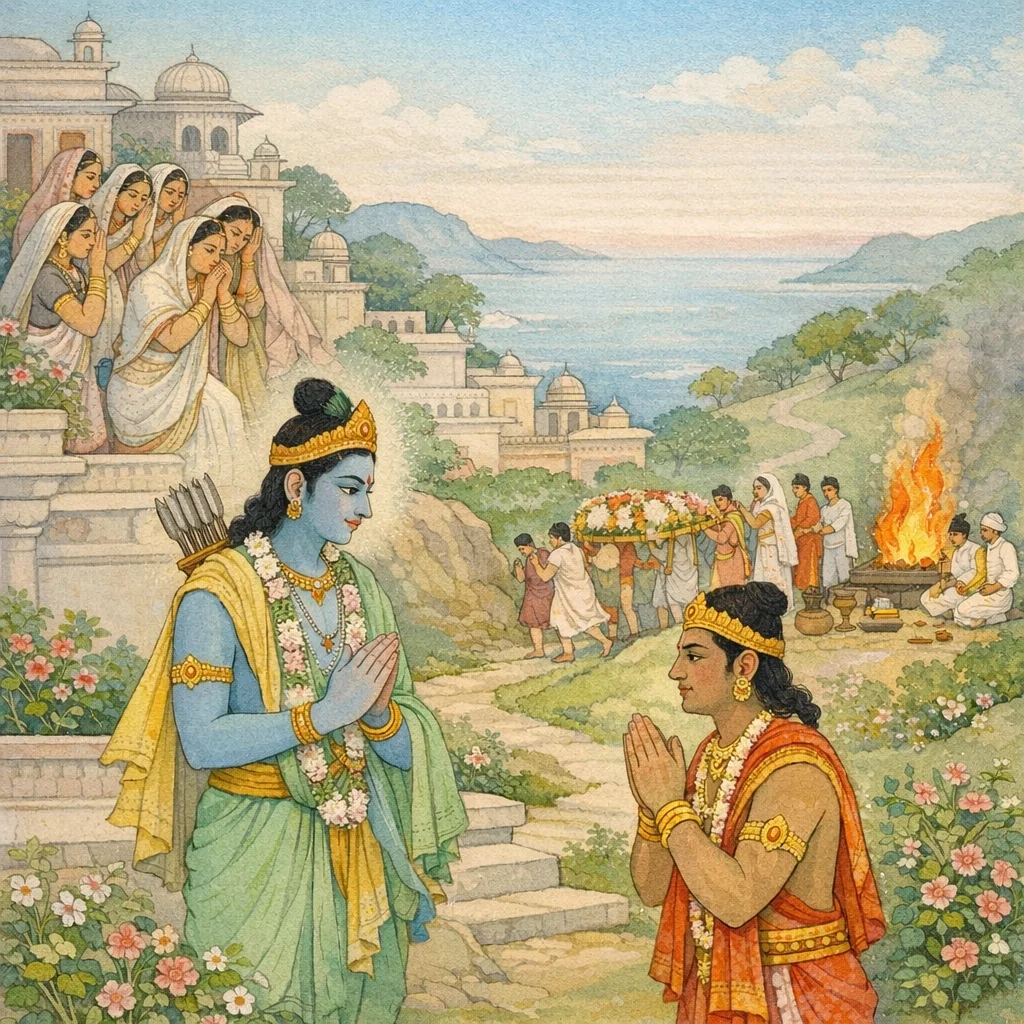
Sarga 114 turns from battle to aftermath. It opens with the lament of the rākṣasī women; Mandodarī and the chief queen grieve deeply, rereading earlier omens—Hanumān’s entry into “hard-to-enter” Laṅkā and the Vānara bridge across the ocean—as signs that Rāma surpasses ordinary humanity. Rāvaṇa’s fall is framed as the consequence of adharma, above all the abduction of Sītā, and as the ripening of moral causality (karma-phala). A decisive ethical turn follows: Rāma declares that enmity should not endure beyond death and commands that proper funeral rites be given to the fallen king. Vibhīṣaṇa obeys, enters Laṅkā, gathers priests, ritual fires, sandalwood and fragrances, and arranges a funerary procession with a decorated bier. The rākṣasas perform Veda-aligned last rites—pitr̥medha sequence, altar placement, offerings, and cremation—after which Vibhīṣaṇa consoles the widows and returns to Rāma in humble submission. The sarga closes with Rāma’s emotional transition: having subdued the enemy and laid aside divine weapons, he relinquishes wrath and returns to gentleness, affirming maryādā in victory.
Shlokas
Verse 1
तासांविलपमानानांतदाराक्षसयोषिताम् ।ज्येष्ठापत्नीप्रियाजीनाभर्तारंसमुदैक्षत ।।।।
As those rākṣasa women lamented, the elder wife—beloved and wretched with sorrow—looked upon her husband.
Verse 2
दशग्रीवंहतंदृष्टवारामेणाचिन्त्यकर्मणा ।पतिंमण्डोदरीतत्रकृपणापर्यदेवयत् ।।।।
Seeing her husband Daśagrīva (Rāvaṇa) slain by Rāma—whose deeds are beyond measure—Mandodarī, overcome with grief, lamented there.
Verse 3
ननुनाममहाबाहोतववैश्रवणानुज ।क्रुद्धस्यप्रमुखेस्थातुंत्रस्यत्यपिपुरन्दरः ।।।।
Surely it is well known, O mighty-armed one—O younger brother of Vaiśravaṇa—that when you were enraged, even Purandara (Indra) feared to stand before you.
Verse 4
ऋषयश्चमहान्तोऽपिगन्धर्वाश्चयशस्विनः ।ननुनामतवोद्वेगाच्चारणाश्चदिशोगताः ।।।।
It is well known that, out of fear of you, even great seers, illustrious Gandharvas, and the Cāraṇas fled away in every direction.
Verse 5
स त्वंमानुषमात्रेणरामेणयुधिनिर्जितः ।न व्यपत्रपसेराजन् किमिदंराक्षसेश्वर ।।।।
You—defeated in battle by Rāma, a mere man! O king, lord of the rākṣasas—are you not ashamed? What is this?
Verse 6
कथंत्रैलोक्यमाक्रम्यश्रियावीर्येणचान्वितम् ।अविषह्यंजघानत्वांमानुषोवनगोचरः ।।।।
How could a mere human—one who ranged the forests—strike you down, you who had overrun the three worlds, endowed with splendor and valor, seemingly impossible to withstand?
Verse 7
मानुषाणामविषयेचरतःकामरूपिणः ।विनाशस्तवरामेणसम्युगेनोपपद्यते ।।।।
Dwelling beyond the reach of men and able to assume forms at will, your destruction at Rāma’s hands in battle seems almost unbelievable.
Verse 8
न चैतत्कर्मरामस्यश्रद्धधामिचमूमुखे ।सर्वतस्समुपेतस्यतवतेनाभिमर्षणम् ।।।।
O leader of armies, I cannot believe this to be Rāma’s deed—this overpowering of you, who were fully prepared on every side.
Verse 9
यदैव च जनस्थानेराक्षसैर्भहुनिर्ववृतः ।खरस्तवहतोभ्रातातदैवासौ न मानुषः ।।।।
When, in Janasthāna, your brother Khara—surrounded by many rākṣasas—was slain, even then it was clear: that foe (Rāma) was no mere mortal.
Verse 10
यदैवनगरींलङ्कांदुष्प्रवेशांसुरैरपि ।प्रविष्टोहनुमान्वीर्यात्तदैवव्यथितावयम् ।।।।
When Hanumān, by the sheer might of his valor, entered the city of Laṅkā—hard to enter even for the gods—at that very moment we were seized by fear and anxiety.
Verse 11
यदैववानरैर्घोरैर्बद्धस्सेतुर्महार्णवे ।तदैवहृदयेनाहंशङ्केरामममानुषम् ।।।।
When those formidable vānaras built a bridge across the great ocean, from that very moment I felt within my heart that Rāma was no mere mortal.
Verse 12
अथवारामरूपेणकृतान्तस्स्वयमागतः ।मायांतवविनाशायविधायाप्रतितर्किताम् ।।।।
This verse repeats the prior scene: grieving rākṣasas, aided by Vibhīṣaṇa, adorned Rāvaṇa with perfumes and garlands, covered him in various garments, and sprinkled him with parched grain, their faces wet with tears.
Verse 13
अथवावासवेनत्वंधर्षितोऽपिमहाबल ।वासवस्यतुकाशक्तिस्त्वांद्रष्टुमपिसंयुगे ।।।।
Or else, O mighty one—though you may claim to have been challenged even by Indra—what power has Indra to face you, even to look upon you, in battle?
Verse 14
व्यक्तमेषमहायोगीपरमात्मासनातनः ।अनादिमध्यनिधनोमहतंपरमोमहान् ।।।।तमसःपरमोधाताशङ्खचक्रगदाधरः ।श्रीवत्सवक्षानित्यश्रीरजय्यश्शाश्वतोध्रुवः ।।।।मानुषंरूपमास्थायविष्णुस्सत्यपराक्रमः ।सर्वैःपरिवृतोदेवैर्वानरत्वमुपागतैः ।।।।सर्वलोकेश्वर्श्रीमान्लोकानांहितकाम्यया ।सराक्षसरपरीवारंहतवांस्त्वांमहाद्युतिः ।।।।
It is manifest that this Rama is the great yogin, the eternal Supreme Self, bearing conch, discus, and mace, marked with Srivatsa, who assumed human form to destroy you for the welfare of the worlds.
Verse 15
व्यक्तमेषमहायोगीपरमात्मासनातनः ।अनादिमध्यनिधनोमहतंपरमोमहान् ।।6.114.14।।तमसःपरमोधाताशङ्खचक्रगदाधरः ।श्रीवत्सवक्षानित्यश्रीरजय्यश्शाश्वतोध्रुवः ।।6.114.15।।मानुषंरूपमास्थायविष्णुस्सत्यपराक्रमः ।सर्वैःपरिवृतोदेवैर्वानरत्वमुपागतैः ।।6.114.16।।सर्वलोकेश्वर्श्रीमान्लोकानांहितकाम्यया ।सराक्षसरपरीवारंहतवांस्त्वांमहाद्युतिः ।।6.114.17।।
Formerly, by conquering your senses, you won the three worlds; but now—as though those very senses remembered their old hostility—you have been overcome by the senses themselves.
Verse 16
व्यक्तमेषमहायोगीपरमात्मासनातनः ।अनादिमध्यनिधनोमहतंपरमोमहान् ।।6.114.14।।तमसःपरमोधाताशङ्खचक्रगदाधरः ।श्रीवत्सवक्षानित्यश्रीरजय्यश्शाश्वतोध्रुवः ।।6.114.15।।मानुषंरूपमास्थायविष्णुस्सत्यपराक्रमः ।सर्वैःपरिवृतोदेवैर्वानरत्वमुपागतैः ।।6.114.16।।सर्वलोकेश्वर्श्रीमान्लोकानांहितकाम्यया ।सराक्षसरपरीवारंहतवांस्त्वांमहाद्युतिः ।।6.114.17।।
Indeed, when your brother Khara was slain in Janasthana, it was clear then that Rama was no mere man. And when Hanuman entered Lanka, we were shaken with fear.
Verse 17
व्यक्तमेषमहायोगीपरमात्मासनातनः ।अनादिमध्यनिधनोमहतंपरमोमहान् ।।6.114.14।।तमसःपरमोधाताशङ्खचक्रगदाधरः ।श्रीवत्सवक्षानित्यश्रीरजय्यश्शाश्वतोध्रुवः ।।6.114.15।।मानुषंरूपमास्थायविष्णुस्सत्यपराक्रमः ।सर्वैःपरिवृतोदेवैर्वानरत्वमुपागतैः ।।6.114.16।।सर्वलोकेश्वर्श्रीमान्लोकानांहितकाम्यया ।सराक्षसरपरीवारंहतवांस्त्वांमहाद्युतिः ।।6.114.17।।
That glorious Lord of all worlds, for the welfare of all beings, has slain you together with your host and retinue of Rakshasas.
Verse 18
इन्द्रियाणिपुराजित्वाजितंत्रिभुवनंत्वया ।स्मरद्भिरिवतद्वैरमिन्द्रियैरेवनिर्जितः ।।।।
Formerly, by conquering your senses, you won the three worlds; but now—as though those very senses remembered their old hostility—you have been overcome by the senses themselves.
Verse 19
यदैवहिजनस्थानेराक्षसैर्भहुभिर्वृतः ।खरस्तुनिहतोभ्रातातदारामो न मानुषः ।।।।यदैवनगरींलङ्कांदुष्प्रवेशांसुरैरपि ।प्रविष्टोहनुमान्वीर्यात्तदैवव्यथितावयम् ।।।।
Indeed, when your brother Khara was slain in Janasthana, it was clear then that Rama was no mere man. And when Hanuman entered Lanka, we were shaken with fear.
Verse 20
यदैवहिजनस्थानेराक्षसैर्भहुभिर्वृतः ।खरस्तुनिहतोभ्रातातदारामो न मानुषः ।।6.114.19।।यदैवनगरींलङ्कांदुष्प्रवेशांसुरैरपि ।प्रविष्टोहनुमान्वीर्यात्तदैवव्यथितावयम् ।।6.114.20।।
“From the very time, at Jana-sthāna, when your brother Khara—though surrounded by many rākṣasas—was slain, it was clear that Rāma was no mere mortal. And when Hanumān, by sheer valor, entered Laṅkā—hard to enter even for the gods—then indeed we became deeply shaken.”
Verse 21
क्रियतामविरोधश्चराघवेणेतियन्मया ।उच्यमानं न गृह्णासितस्येयंव्युष्टिरागता ।।।।
“I urged you, ‘Do not act in hostility toward Rāghava.’ You did not accept that counsel—this calamity is the outcome of it.”
Verse 22
अकस्माच्छाभिकामोऽसिसीतांराक्षसपुङ्गवः ।ऐश्वर्यस्यविनाशायदेहस्यस्वजनस्य च ।।।।
O foremost among rākṣasas! All at once you were seized by desire for Sītā—bringing ruin upon your sovereignty, your very life, and your own people.
Verse 23
अरुन्धत्याविशिष्टांतांरोहिण्याश्चापिदुर्मते ।सीतांधर्षयतामान्यांत्वयाह्यसदृशंकृतम् ।।।।
O wicked-minded one! Sītā—worthy of honor, more exalted even than Arundhatī and Rohiṇī—was violated through your arrogance; that deed was utterly unbefitting of you.
Verse 24
वसुधायाहिवसुधांश्रियःश्रींभर्तृवत्सलाम् ।सीतांसर्वानवद्याङ्गीमरण्येविजनेशुभाम् ।।।।आनयित्वातुतांदीनांछद्मनात्मस्वदूषण ।अप्राप्यतंचैवकामंमैथिलीसङ्गमेकृतम् ।।।।पतिव्रतायास्तपसानूनंदग्धोऽसिमेप्रभो ।
By deceit—bringing disgrace upon your own house—you carried off the helpless Sītā: auspicious, alone in the lonely forest; blameless in every limb; forbearing like the earth; radiant like Śrī-Lakṣmī; and devoted to her husband. Yet you did not attain your desire for union with the Maithilī. Surely, my lord, you were burned by the ascetic power (tapas) of that chaste wife.
Verse 25
वसुधायाहिवसुधांश्रियःश्रींभर्तृवत्सलाम् ।सीतांसर्वानवद्याङ्गीमरण्येविजनेशुभाम् ।।6.114.24।।आनयित्वातुतांदीनांछद्मनात्मस्वदूषण ।अप्राप्यतंचैवकामंमैथिलीसङ्गमेकृतम् ।।6.114.25।।पतिव्रतायास्तपसानूनंदग्धोऽसिमेप्रभो ।
That you were not burned at once when you violated the slender-waisted lady is for this reason: now all the gods have risen against you, with Indra and Agni at their head.
Verse 26
तदैवयन्नदग्धगद्धस्त्वंधर्षयंस्तनुममध्यमाम् ।देवाभिभ्यतेतेसर्वेसेन्द्राःसानाग्नीपुरोगमाः ।।।।
That you were not burned at once when you violated the slender-waisted lady is for this reason: now all the gods have risen against you, with Indra and Agni at their head.
Verse 27
अवश्यमेवलभतेफलंपापस्यकर्मणः ।घोरंपर्यागतेकालेकर्तानास्त्यत्रसंशयः ।।।।
A sinner surely reaps the fruit of sinful deeds; when the time ripens, the doer of dreadful acts is destroyed—of this there is no doubt.
Verse 28
न कुलेन न रूपेण न दाक्षिण्येनमैथिली ।मयाधिकावातुल्यावातत्त्वंमोहान्नबुध्यसे ।।।।
Maithilī is not superior to me by lineage, nor by beauty, nor by courtesy—nor even my equal; yet, deluded, you failed to understand this.
Verse 29
सर्वदासर्वभूतानांनास्तिमुत्युरलक्षणः ।तवतावदयंमृत्युर्मैथिलीकृतलक्षणः ।।।।
For all beings, death never comes without a cause. For you, this death bears the mark of Maithilī—it is death brought about by what you did to her.
Verse 30
सीतानिमित्तजोमृत्युस्त्वयादूरादुपाहृतः ।मैथिलीसहरामेणविशोकाविहरिष्यति ।।।।
The death that arose on Sītā’s account was brought by you from far away, as though summoned. Maithilī, freed from sorrow, will live in joy together with Rāma.
Verse 31
अल्पपुण्यात्वहंघोरेपतिताशोकसागरे ।कैलासेमन्दरेमेरौतथाचैत्ररथेवने ।।।।देवोद्यानेषुसर्वेषुविहृत्यसहितात्वया ।विमानेनानुरूपेणयायाम्यतुलयाश्रिया ।।।।पश्यन्तिविविधान्देशांस्तांस्तांश्चित्रस्रगम्बरा ।भ्रम्शिताकामभोगेभ्यःसास्मिवीरवधात्तव ।।।।सैवान्येवास्मिसम्वृत्ताधिग्राज्ञांचञ्चलाःश्रियः ।
I, with only scant merit, have fallen into this dreadful ocean of grief. Once, together with you, I roamed Kailāsa, Mandara, and Meru, and the forest of Caitraratha; we enjoyed every divine garden, traveling in a fitting aerial car with incomparable splendor. Wearing wondrous garlands and garments, I beheld many lands—yet now, because you have been slain, O hero, I have been cast down from pleasures. Alas! Royal fortunes are fickle; I am no longer the same as before.
Verse 32
अल्पपुण्यात्वहंघोरेपतिताशोकसागरे ।कैलासेमन्दरेमेरौतथाचैत्ररथेवने ।।6.114.31।।देवोद्यानेषुसर्वेषुविहृत्यसहितात्वया ।विमानेनानुरूपेणयायाम्यतुलयाश्रिया ।।6.114.32।।पश्यन्तिविविधान्देशांस्तांस्तांश्चित्रस्रगम्बरा ।भ्रम्शिताकामभोगेभ्यःसास्मिवीरवधात्तव ।।6.114.33।।सैवान्येवास्मिसम्वृत्ताधिग्राज्ञांचञ्चलाःश्रियः ।
Alas, O king, my lord—your face once so delicate, with beautiful brows, shining skin and a prominent nose, radiant like the moon, the lotus, and the sun; crowned with brilliance, with coppery lips and glowing earrings; with eyes unsteady from wine in the drinking halls; lovely, adorned with many garlands, auspicious, and full of charming smiles and speech—today that very face does not shine. It is pierced by Rāma’s arrows, smeared with flowing blood; marrow and brain are scattered, and it is dulled and dirtied by the dust of chariots.
Verse 33
अल्पपुण्यात्वहंघोरेपतिताशोकसागरे ।कैलासेमन्दरेमेरौतथाचैत्ररथेवने ।।6.114.31।।देवोद्यानेषुसर्वेषुविहृत्यसहितात्वया ।विमानेनानुरूपेणयायाम्यतुलयाश्रिया ।।6.114.32।।पश्यन्तिविविधान्देशांस्तांस्तांश्चित्रस्रगम्बरा ।भ्रम्शिताकामभोगेभ्यःसास्मिवीरवधात्तव ।।6.114.33।।सैवान्येवास्मिसम्वृत्ताधिग्राज्ञांचञ्चलाःश्रियः ।
Seeing those many and various lands, adorned with wondrous garlands and garments, I have fallen away from the enjoyments of love—because of your death, O hero.
Verse 34
हाराजन् सुकुमारंतेसुभ्रुसुत्वक्समुन्नसम् ।।।।कान्तिश्रीद्युतिभिस्तुल्यमिन्दुपद्मदिवाकरैः ।किरीटकूटोज्ज्वलितंताम्रास्यंदीप्तकुण्डलम् ।।।।मदव्याकुललोलाक्षंभूत्वायत्पानभूमिषु ।विविधस्रग्धरंचारुवल्गुस्मितकथंशुभम् ।।।।तदेवाद्यतवैवंहिवक्त्रं न भ्राजतेप्रभो ।रामसायकनिर्भिन्नंरक्तंरुधिरविस्रवैः ।।।।वीशीर्णमेदोमस्तिष्कंरूक्षस्यन्दनरेणुभिः ।
Alas, O king, my lord—your face once so delicate, with beautiful brows, shining skin and a prominent nose, radiant like the moon, the lotus, and the sun; crowned with brilliance, with coppery lips and glowing earrings; with eyes unsteady from wine in the drinking halls; lovely, adorned with many garlands, auspicious, and full of charming smiles and speech—today that very face does not shine. It is pierced by Rāma’s arrows, smeared with flowing blood; marrow and brain are scattered, and it is dulled and dirtied by the dust of chariots.
Verse 35
हाराजन् सुकुमारंतेसुभ्रुसुत्वक्समुन्नसम् ।।6.114.34।।कान्तिश्रीद्युतिभिस्तुल्यमिन्दुपद्मदिवाकरैः ।किरीटकूटोज्ज्वलितंताम्रास्यंदीप्तकुण्डलम् ।।6.114.35।।मदव्याकुललोलाक्षंभूत्वायत्पानभूमिषु ।विविधस्रग्धरंचारुवल्गुस्मितकथंशुभम् ।।6.114.36।।तदेवाद्यतवैवंहिवक्त्रं न भ्राजतेप्रभो ।रामसायकनिर्भिन्नंरक्तंरुधिरविस्रवैः ।।6.114.37।।वीशीर्णमेदोमस्तिष्कंरूक्षस्यन्दनरेणुभिः ।
O king, your face—once comparable in beauty, splendor, and radiance to the moon, the lotus, and the sun—shone with a blazing crown, coppery lips, and glowing earrings.
Verse 36
हाराजन् सुकुमारंतेसुभ्रुसुत्वक्समुन्नसम् ।।6.114.34।।कान्तिश्रीद्युतिभिस्तुल्यमिन्दुपद्मदिवाकरैः ।किरीटकूटोज्ज्वलितंताम्रास्यंदीप्तकुण्डलम् ।।6.114.35।।मदव्याकुललोलाक्षंभूत्वायत्पानभूमिषु ।विविधस्रग्धरंचारुवल्गुस्मितकथंशुभम् ।।6.114.36।।तदेवाद्यतवैवंहिवक्त्रं न भ्राजतेप्रभो ।रामसायकनिर्भिन्नंरक्तंरुधिरविस्रवैः ।।6.114.37।।वीशीर्णमेदोमस्तिष्कंरूक्षस्यन्दनरेणुभिः ।
O king, that face of yours—once charming and auspicious, wearing many garlands, and in drinking-halls made lively with eyes unsteady from intoxication and with gentle smiles and pleasing speech—
Verse 37
हाराजन् सुकुमारंतेसुभ्रुसुत्वक्समुन्नसम् ।।6.114.34।।कान्तिश्रीद्युतिभिस्तुल्यमिन्दुपद्मदिवाकरैः ।किरीटकूटोज्ज्वलितंताम्रास्यंदीप्तकुण्डलम् ।।6.114.35।।मदव्याकुललोलाक्षंभूत्वायत्पानभूमिषु ।विविधस्रग्धरंचारुवल्गुस्मितकथंशुभम् ।।6.114.36।।तदेवाद्यतवैवंहिवक्त्रं न भ्राजतेप्रभो ।रामसायकनिर्भिन्नंरक्तंरुधिरविस्रवैः ।।6.114.37।।वीशीर्णमेदोमस्तिष्कंरूक्षस्यन्दनरेणुभिः ।
Yet today, O lord, that very face of yours no longer shines—pierced by Rāma’s arrows, red with streaming blood; with fat and brain-matter scattered, and made rough and grimy with the dust raised by chariots.
Verse 38
हापश्चिमामेसम्प्राप्तादशावैधव्यदायिनी ।।।।यामयासीन्नसुम्बद्धाकदाचिदपिमन्दया ।
Alas—this final condition has come upon me, the state that makes me a widow. Foolish as I was, I never once understood that such a time would arrive.
Verse 39
पतादानवराजोमेभर्तामेराक्षसेश्वरः ।।।।पुत्रोमेशक्रनिर्जेताइत्यहंगर्विताभृशम् ।
“My father is a king among Dānavas; my husband is the lord of the Rākṣasas; my son has conquered even Śakra (Indra)”—thinking thus, I grew exceedingly proud.
Verse 40
दृप्तामर्दनाःशूराःप्रख्यातबलपौरुषाः ।।।।अकुतश्चिद्भयानाथाममेत्यासीन्मतिर्दृढा ।
“My protectors are heroes who crush the proud, renowned for strength and manly valor, fearing no quarter”—such was the firm conviction I held.
Verse 41
तेषामेवंप्रभावाणांयुष्माकंराक्षसर्षभाः ।।।।कथंभयमसम्बुद्धंमानुषादिदमागतम् ।
O bulls among the Rākṣasas—when your power was of such a kind, how has this unforeseen fear come to you from a mere human?
Verse 42
स्निग्धेन्द्रनीलनीलंतुप्रांशुशैलोपमंमहत् ।।।।केयूराङ्गदवैडूर्यमुक्ताहारस्रगुज्ज्वलम् ।कान्तंविहारेष्वधिकंदीप्तांसङ्ग्रामभूमिषु ।।।।भात्याभरणभाभिर्यद्विद्युद्भिरिवतोयदः ।तदेवाद्यशरीरंतेतीक्ष्णैर्नैकशरैश्चितम् ।।।।पुनर्दुर्लभसम्पर्शंपरिष्वक्तुं न शक्यते ।श्वाविधःशलकैर्यद्वद्भाणैर्लग्नैर्निरन्तरम् ।।।।स्वर्पितैर्मर्मसुभृशंसञ्छिन्नस्नायुबन्धनम् ।क्षितौनिपतितंराजन् श्यामंवैरुधिरच्छवि ।।।।वज्रप्रहाराभिहतोविकीर्णइवपर्वतः ।
O king, your body—vast as a lofty mountain, dark and glossy like indranīla sapphire—once shone with armlets, ornaments, cat’s-eye gems, pearls, and garlands, charming in leisure and blazing in battle, like a rain-cloud lit by lightning. That very body is today packed with countless sharp arrows; it is hard even to touch, and cannot be embraced again. Like a porcupine bristling with spikes, it is covered everywhere with darts and arrows driven into the vital parts, with sinews and joints torn apart. Fallen upon the earth, dark and blood-stained, it lies shattered like a mountain struck by a thunderbolt.
Verse 43
स्निग्धेन्द्रनीलनीलंतुप्रांशुशैलोपमंमहत् ।।6.114.42।।केयूराङ्गदवैडूर्यमुक्ताहारस्रगुज्ज्वलम् ।कान्तंविहारेष्वधिकंदीप्तांसङ्ग्रामभूमिषु ।।6.114.43।।भात्याभरणभाभिर्यद्विद्युद्भिरिवतोयदः ।तदेवाद्यशरीरंतेतीक्ष्णैर्नैकशरैश्चितम् ।।6.114.44।।पुनर्दुर्लभसम्पर्शंपरिष्वक्तुं न शक्यते ।श्वाविधःशलकैर्यद्वद्भाणैर्लग्नैर्निरन्तरम् ।।6.114.45।।स्वर्पितैर्मर्मसुभृशंसञ्छिन्नस्नायुबन्धनम् ।क्षितौनिपतितंराजन् श्यामंवैरुधिरच्छवि ।।6.114.46।।वज्रप्रहाराभिहतोविकीर्णइवपर्वतः ।
O king, your body—bright with armlets and bracelets, with cat’s-eye gems, pearl-necklaces, and garlands—was exceedingly charming in moments of ease, and it blazed with splendor upon the battlefield.
Verse 44
स्निग्धेन्द्रनीलनीलंतुप्रांशुशैलोपमंमहत् ।।6.114.42।।केयूराङ्गदवैडूर्यमुक्ताहारस्रगुज्ज्वलम् ।कान्तंविहारेष्वधिकंदीप्तांसङ्ग्रामभूमिषु ।।6.114.43।।भात्याभरणभाभिर्यद्विद्युद्भिरिवतोयदः ।तदेवाद्यशरीरंतेतीक्ष्णैर्नैकशरैश्चितम् ।।6.114.44।।पुनर्दुर्लभसम्पर्शंपरिष्वक्तुं न शक्यते ।श्वाविधःशलकैर्यद्वद्भाणैर्लग्नैर्निरन्तरम् ।।6.114.45।।स्वर्पितैर्मर्मसुभृशंसञ्छिन्नस्नायुबन्धनम् ।क्षितौनिपतितंराजन् श्यामंवैरुधिरच्छवि ।।6.114.46।।वज्रप्रहाराभिहतोविकीर्णइवपर्वतः ।
That body of yours—once resplendent with the radiance of ornaments like a rain-cloud lit by lightning—today is the very same body, now packed with countless sharp arrows.
Verse 45
स्निग्धेन्द्रनीलनीलंतुप्रांशुशैलोपमंमहत् ।।6.114.42।।केयूराङ्गदवैडूर्यमुक्ताहारस्रगुज्ज्वलम् ।कान्तंविहारेष्वधिकंदीप्तांसङ्ग्रामभूमिषु ।।6.114.43।।भात्याभरणभाभिर्यद्विद्युद्भिरिवतोयदः ।तदेवाद्यशरीरंतेतीक्ष्णैर्नैकशरैश्चितम् ।।6.114.44।।पुनर्दुर्लभसम्पर्शंपरिष्वक्तुं न शक्यते ।श्वाविधःशलकैर्यद्वद्भाणैर्लग्नैर्निरन्तरम् ।।6.114.45।।स्वर्पितैर्मर्मसुभृशंसञ्छिन्नस्नायुबन्धनम् ।क्षितौनिपतितंराजन् श्यामंवैरुधिरच्छवि ।।6.114.46।।वज्रप्रहाराभिहतोविकीर्णइवपर्वतः ।
Now again, your body has become hard even to touch; it cannot be embraced—like a porcupine bristling everywhere with quills, so it is densely stuck all over with arrows.
Verse 46
स्निग्धेन्द्रनीलनीलंतुप्रांशुशैलोपमंमहत् ।।6.114.42।।केयूराङ्गदवैडूर्यमुक्ताहारस्रगुज्ज्वलम् ।कान्तंविहारेष्वधिकंदीप्तांसङ्ग्रामभूमिषु ।।6.114.43।।भात्याभरणभाभिर्यद्विद्युद्भिरिवतोयदः ।तदेवाद्यशरीरंतेतीक्ष्णैर्नैकशरैश्चितम् ।।6.114.44।।पुनर्दुर्लभसम्पर्शंपरिष्वक्तुं न शक्यते ।श्वाविधःशलकैर्यद्वद्भाणैर्लग्नैर्निरन्तरम् ।।6.114.45।।स्वर्पितैर्मर्मसुभृशंसञ्छिन्नस्नायुबन्धनम् ।क्षितौनिपतितंराजन् श्यामंवैरुधिरच्छवि ।।6.114.46।।वज्रप्रहाराभिहतोविकीर्णइवपर्वतः ।
O King, with arrows driven deep into the vital parts, the sinew-bonds are grievously severed; your dark body, its hue turned to blood, lies fallen upon the earth—like a mountain shattered when struck by a thunderbolt.
Verse 47
हास्वप्नस्सत्यमेवेदंत्वंरामेणकथंहतः ।।।।त्वंमृत्योरपिमृत्युस्स्याःकथंमृत्युवशंगत:
Alas—could this be a dream, or is it truly so? How were you slain by Rama? You who could have been death even to Death—how did you come under death’s dominion?
Verse 48
त्रैलोक्यवसुभोक्तारंत्रैलोक्योद्वेगदंमहत् ।।।।जेतारंलोकपालानांक्षेप्तारांशङ्करस्य च ।
You who enjoyed the treasures of the three worlds; you, the great cause of terror to the three worlds; the conqueror of the world-guardians—yes, even the one who cast down Shankara.
Verse 49
दृप्तानांनिग्रहीतारमाविष्कृतपराक्रमम् ।।।।लोकक्षोभयितारं च नादैर्भूतविराविणम् ।
The chastiser of the proud, whose prowess stood revealed; the disturber of the world, who by his roaring cries made beings wail.
Verse 50
ओजसादृप्तवाक्यानांवक्तारंरिपुसन्निधौ ।।।।स्वयूथभृत्यगोप्तारंहन्तारंभीमकर्मणाम् ।
He who, in the pride of his might, spoke haughty words even in the enemy’s presence; protector of his own troop and servants; slayer of those who wrought dreadful deeds.
Verse 51
हन्तारंदानवेन्द्राणांयक्षाणां च सहस्रशः ।।।।निवातकवचानां च सङ्ग्रहीतारमाहवे ।
The slayer of thousands of yakṣas and of the lords of the dānavas; and in battle, the subduer of the Nivātakavacas as well.
Verse 52
नैकयज्ञविलोप्तारंत्रातारंस्वजनस्य च ।।।।धर्मव्यवस्थाभेत्तारंमायास्रष्टारमाहवे ।
He who disrupted many yajñas, yet was the protector of his own; who broke the established order of Dharma, and in battle devised māyā—illusions and stratagems.
Verse 53
देवासुरनृकन्यानामाहर्तारंततस्ततः ।।।।शत्रुस्त्रीशोकदातारं नेतारं स्वजनस्य च ।
He who seized, from place to place, maidens of devas, asuras, and humans; who gave grief to the women of his enemies; yet was a leader to his own people.
Verse 54
लङ्काद्वीपस्यगोप्तारंकर्तारंभीमकर्मणाम् ।।।।अस्माकंकामभोगानांदातारंरथिनांवरम् ।
Protector of the island of Laṅkā, doer of dreadful deeds; giver to us of pleasures—foremost among chariot-warriors.
Verse 55
एवंप्रभावंभर्तारंदृष्टवारामेणपातितम् ।।।।स्थिरास्मियादेहमिमंधारयामिहतप्रिया ।
Seeing my husband—of such might—struck down by Rāma, I still stand, though my beloved is lost, sustaining this body here.
Verse 56
शयनेषुमहार्हेषुशयित्वाराक्षसेश्वर ।।।।इहकर्मात्प्रसुप्तोऽसिधरण्यांरेणुगुण्ठितः ।
O lord of the Rākṣasas! After resting upon the most splendid beds, you now lie here, as if asleep because of your own deeds—on the bare earth, your body covered with dust.
Verse 57
यदातेतनयश्शस्तोलक्ष्मणेनेन्द्रजिद्युधि ।।।।तदात्वभिहतातीव्रमद्यत्वस्मिनिपातिता ।
When your son Indrajit was struck down by Lakṣmaṇa in battle, then I was intensely wounded by grief; and today you too have fallen here, laid low.
Verse 58
साहंबन्धुजनैर्हीनाहीनानाथेन च त्वया ।।।।विहीनाकामभोगैश्चशोचिष्येशाश्वतीस्समाः ।
Bereft of kinsmen, and bereft of you—my lord and protector—deprived also of all enjoyments, I shall grieve for long, unending years.
Verse 59
प्रपन्नोदीर्घमध्वानंराजन्नद्यसुदुर्गमम् ।।।।नयमामपिदुःखार्तां न वर्तिष्येत्वयाविना ।
O king, today you have set forth upon a long road, terribly hard to traverse. Lead me also, though stricken with sorrow—for I cannot live without you.
Verse 60
कस्मात्त्वंमांविहायेहकृपणांगन्तुमिच्छसि ।।।।दीनांविलपतींमन्दांकिंवामांनाभिभाषसे ।
Why do you wish to go, leaving me here—wretched and helpless—poor, weeping, and broken? Why do you not speak even a word to me?
Verse 61
दृष्टवा न खल्वभिक्रुद्धोमामिहानवकुण्ठिताम् ।।।।निर्गतांनगरद्वारात्पद्भ्यामेवागतांप्रभो ।
O lord, seeing me here—unabashed—having come out through the city gate and arrived on foot, how is it that you are not angered?
Verse 62
पश्येष्टदारदारांस्तेभ्रष्टलज्जावकुण्ठितान् ।।।।बहिर्निष्पतितान्सर्वान्कथंदृष्टवा न कुप्यसि ।
See all your beloved wives—casting off shame and hesitation—rushing out into the open. How, on seeing this, are you not angered?
Verse 63
अयंक्रीडासहायस्तेऽनाथेलालप्यतेजनः ।।।।न चैवमाश्वासयसिकिंवा न बहुमन्यसे ।
These people—your companions in sport—now call out helplessly, as to one without a protector. Why do you not comfort them? Or why do you not show them regard?
Verse 64
याःस्त्वयाविधवाराजन्कृतानैकाःकुलस्त्रियः ।।।।पतिव्रताधर्मरतागुरुशुश्रूषणेरताः ।ताभिश्शोकाभितप्ताभिश्शप्तःपरवशंगतः ।।।।त्वयाविप्रकृताभिर्यत्तदाशप्तंतदागतम् ।
O king, by you many noble women were made widows—women faithful to their husbands, devoted to dharma, and intent on serving their elders. Scorched by grief, they cursed you; and thus you fell under the power of your enemy. The curse once spoken by those you wronged has now come upon you.
Verse 65
याःस्त्वयाविधवाराजन्कृतानैकाःकुलस्त्रियः ।।6.114.64।।पतिव्रताधर्मरतागुरुशुश्रूषणेरताः ।ताभिश्शोकाभितप्ताभिश्शप्तःपरवशंगतः ।।6.114.65।।त्वयाविप्रकृताभिर्यत्तदाशप्तंतदागतम् ।
Those women—faithful to their husbands, steadfast in dharma, and diligent in serving elders—were wronged by you and burned with grief. Cursed by them, you came under an enemy’s power; the very curse uttered then has now returned upon you.
Verse 66
प्रवादस्सत्यएवायंत्वांप्रतिप्रायशोनृप ।।।।प्रतिव्रतानांनाकस्मात्सपत्नत्यश्रूणिभूतले ।
O king, the common saying has proved true in your case: the tears of devoted, faithful women do not fall to the ground without effect—this calamity has returned upon you as its consequence.
Verse 67
कथं च नामतेराजन् लोकानाक्रम्यतेजसा ।।।।नारीचौर्यमिदंक्षुद्रंकृतंशौण्डीर्यमानिना ।
O king, how could you—who overran the worlds by your splendor—commit this petty deed of “woman-stealing,” all while priding yourself on heroism?
Verse 68
अपनीयाश्रमाद्रामंयन्मृगच्छद्मनात्वया ।।।।आनीतारामपनतीसातत्तेकातर्यलक्षणम् ।
With the deer-disguise you lured Rāma away from the āśrama, and thus carried off Sītā, Rāma’s wife—this is the very mark of your cowardice.
Verse 69
कातर्यं न च तेयुद्धेकदाचित्संस्मराम्यहम् ।।।।तत्तुभाग्यविपर्यासान्नूनंतेपक्वलक्षणम् ।
I do not recall you ever being timid in battle. Yet this cowardice has appeared—surely from a reversal of fate—and it is a ripened sign foretelling your ruin.
Verse 70
अतीतानागतार्थज्ञोवर्तमानविचक्षणः ।।।।मैथिलीमाहृतांदृष्टवाध्यात्वानिःश्वस्यचायतम् ।सत्यवाक्यमहाबाहो देवरोमेयदब्रवीत् ।।।।अयंराक्षसमुख्यानांविनाशःपर्युपस्थितः ।कामक्रोधसमुत्थेनव्यसनेनप्रसङ्गिना ।।।।
Mighty-armed one, my brother-in-law—truthful in speech, discerning in the present, and knowing past and future—on seeing Maithilī carried off, reflected for a while and sighed deeply, then said: “This is the imminent destruction of the foremost Rākṣasas, brought on by the calamity that arises from desire and anger.”
Verse 71
अतीतानागतार्थज्ञोवर्तमानविचक्षणः ।।6.114.70।।मैथिलीमाहृतांदृष्टवाध्यात्वानिःश्वस्यचायतम् ।सत्यवाक्यमहाबाहो देवरोमेयदब्रवीत् ।।6.114.71।।अयंराक्षसमुख्यानांविनाशःपर्युपस्थितः ।कामक्रोधसमुत्थेनव्यसनेनप्रसङ्गिना ।।6.114.72।।
Because of your deed, this great calamity has come to pass, tearing up everything by the root. By you all this has been done: the entire Rākṣasa lineage has been left without protector or refuge.
Verse 72
अतीतानागतार्थज्ञोवर्तमानविचक्षणः ।।6.114.70।।मैथिलीमाहृतांदृष्टवाध्यात्वानिःश्वस्यचायतम् ।सत्यवाक्यमहाबाहो देवरोमेयदब्रवीत् ।।6.114.71।।अयंराक्षसमुख्यानांविनाशःपर्युपस्थितः ।कामक्रोधसमुत्थेनव्यसनेनप्रसङ्गिना ।।6.114.72।।
Now the destruction of the foremost among the Rākṣasas has drawn near. It has arisen from a ruinous calamity—an attachment born of lust and anger.
Verse 73
निर्वृत्तस्त्वत्कृतेऽनर्थःसोऽयंमूलहरोमहान् ।त्वयाकृतमिदंसर्वमनाधंराक्षसंकुलम् ।।।।
Because of your deed, this great calamity has come to pass, tearing up everything by the root. By you all this has been done: the entire Rākṣasa lineage has been left without protector or refuge.
Verse 74
हित्वंशोचितव्योमेप्रख्यातबलपौरुषः ।स्त्रीस्वभावात्तुमेबुद्धिःकारुण्येपरिवर्तते ।।।।
You are renowned for strength and valor; you are not one for whom I ought to wail. Yet, by a woman’s nature, my mind turns toward compassion and grief.
Verse 75
सुकृतंदुष्कृतं च त्वंगृहीत्वास्वांगतिंगतः ।आत्मानमनुशोचामित्वद्विनाशेनदुःखिताम् ।।।।
Taking with you your good deeds and your evil deeds, you have gone to your own end. Distressed by your destruction, I lament for myself.
Verse 76
सुहृदांहितकामानां न श्रुतंवचनंत्वया ।भ्रात्रूणांचैवकार्त्न्सनहितमुक्तंदशानन ।।।।
O Ten-faced one, you did not heed the counsel of well-wishing friends; nor did you fully accept the beneficial words spoken by your brothers.
Verse 77
हेत्वर्थयुक्तंविधिवच्छ्रेयस्करमदारुणम् ।विभीषणेनाभिहितं न कृतंहेतुमत्त्वया ।।।।
Though Vibhīṣaṇa spoke what was reasoned and meaningful, proper in form, beneficial, and not harsh, you did not act upon that sound counsel.
Verse 78
मारीचकुम्भकर्णाभ्यांवाक्यंममपितुस्तथा ।न श्रुतंवीर्यमत्तेनतस्येदंफलमीदृशम् ।।।।
You did not heed the words of Mārīca and Kumbhakarṇa, nor likewise the counsel of my father; intoxicated by your valor, you ignored them—and this is the result of that.
Verse 79
नीलजीमूतसङ्काश पीताम्बरशुभाङ्गद ।स्वगात्राणिविनिक्षिप्यकिंशेषेरुधिराप्लुतः ।।।।
O you who looked like a dark rain-cloud, adorned with bright armlets and clad in yellow silk—why do you lie here, your own limbs cast down, drenched in blood?
Verse 80
प्रसुप्तइवशोकार्तांकिंमां न प्रतिभाषसे ।महावीर्यस्यदक्षस्यसम्युगेष्वपलायिनः ।।।।यातुधानस्यदौहित्रींकिंमां न प्रतिभाषसे ।
You lie as if asleep, while I am torn by grief—why do you not answer me? Why do you ignore me, the granddaughter of that mighty hero Dakṣa, unyielding in battles?
Verse 81
उत्तिष्ठोत्तिष्ठकिंशेषेनवेपरिभवेकृते ।।।।अद्यवैनिर्भयालङ्कांप्रविष्टांसूर्यरश्मयः ।
Rise, rise—why do you lie there, when a fresh humiliation has been wrought? Today, the sun’s rays have entered Laṅkā without fear.
Verse 82
येनसूदयसेशत्रून् समरेसूर्यवर्चसा ।।।।वज्रंवज्रधरस्येवसोऽयंतेसततार्चितः ।रणेबहुप्रहरणोहेमजापरिष्कृतः ।।।।परिघोव्यवकीर्णस्तेबाणैश्चिन्नैःसहस्रधा ।
That iron club of yours—sun-bright in battle, like Indra’s thunderbolt, ever honored by you, adorned with a net of gold, with which you struck down many foes—has been shattered by arrows into a thousand fragments and lies scattered.
Verse 83
येनसूदयसेशत्रून् समरेसूर्यवर्चसा ।।6.114.82।।वज्रंवज्रधरस्येवसोऽयंतेसततार्चितः ।रणेबहुप्रहरणोहेमजापरिष्कृतः ।।6.114.83।।परिघोव्यवकीर्णस्तेबाणैश्चिन्नैःसहस्रधा ।
This iron club of yours—ever honoured by you, fashioned like Indra’s thunderbolt, splendid in battle and adorned with a net-work of gold—has now been shattered by arrows into a thousand fragments and lies scattered.
Verse 84
अप्रियामिवोपसंगृह्यकिंशेषेरणमेदिनीम् ।।।।अप्रियामिवकस्माच्छमांनेच्छस्यभिभाषितुम् ।
Why do you lie upon the battlefield, embracing the earth as though it were a beloved? And why, as if I were no dear one to you, do you not wish to answer me?
Verse 85
धिगस्तुहृदयंयस्याममेदं न सहस्रधा ।।।।त्वयिपञ्चत्वमापन्नेफलतेशोकपीडितम् ।
Shame upon this heart of mine—grief-stricken—that does not split into a thousand pieces, even when you have gone to the state of the five elements.
Verse 86
इत्येवंविलपन्तिसाबाष्पपर्याकुलेक्षणा ।।।।स्नेहोपस्कन्नहृदया तदा मोहामुपागमत् ।
Thus wailing, her eyes choked with tears and her heart overwhelmed by love, she then fell into a swoon of delusion.
Verse 87
कश्मलाभिहतासन्नाबभौसारावणोरसि ।।।।स्नध्यानुरक्तेजलदेदीप्ताविद्युदिवोज्ज्वला ।
Struck by faintness and slackened in her limbs, she lay upon Rāvaṇa’s chest, shining like a bright flash of lightning upon a rain-cloud tinged with twilight-red.
Verse 88
तथागतंसमुत्थाप्यसपत्नयस्तांभृशातुराः ।।।।पर्यवस्थापयामासूरुदन्त्योरुदतींभृशम् ।
Then her co-wives, greatly distressed, lifted her up as she sobbed and wailed loudly, and they steadied and supported her.
Verse 89
न तेसुविदितादेविलोकानांस्थितिरध्रुवा ।।।।दशाविभागपर्यायेराज्ञांवैचञ्चलाःश्रियः ।
O Devi, surely you know: the condition of the world is unstable. When the turns of circumstance shift, the fortunes of kings are indeed fickle.
Verse 90
इत्येवमुच्यमानासासशब्दंप्ररुरोद ह ।।।।स्नापयन्तीतदास्रेणस्तनौवक्रंसुनिर्मलम् ।
Though thus counselled, she again burst into loud weeping, bathing her bosom and her fair, most pure face with tears.
Verse 91
एतस्मिन्नन्तरेरामोविभीषणमुवाच ह ।।।।संस्कारःक्रियतांभ्रातुःस्त्रीगणःपरिसान्त्व्यताम् ।
Meanwhile, Rāma said to Vibhīṣaṇa: “Let the funeral rites for your brother be performed, and let the women be comforted and reassured.”
Verse 92
तमुवाचततोधीमान् विभीषणइदंवचः ।।।।विमृश्यबुद्ध्याधर्मज्ञोधर्मार्थसहितंहितम् ।
Then the wise Vibhīṣaṇa, knower of dharma, reflected carefully and spoke these beneficial words, aligned with righteousness and proper purpose.
Verse 93
त्यक्तधर्मव्रतंशूरंनृशंसमनृतंतथा ।।।।नाहमर्होऽस्मिसंस्कर्तुंपरदाराभिमर्शिनम् ।
“He abandoned dharma and sacred vows; he was violent, merciless, and false, and he violated others’ wives. I am not fit to perform the funeral rites for such a man.”
Verse 94
भ्रातृरूपःहिमेशत्रुरेषसर्वाहितेरतः ।।।।रावणोनार्हतेपूजांपूज्योऽपिगुरुगौरवात् ।
“Though he bears the form of a brother, he is my enemy, devoted to harming all. This Rāvaṇa does not deserve honor, even if an elder brother is ordinarily respected out of reverence due to a guru.”
Verse 95
नृशंसइतिमांराम वक्ष्यन्तिमनुजाभुवि ।।।।श्रुत्वातस्यागुणान्सर्वेवक्ष्यन्तिसुकृतंपुनः ।
O Rāma, people in the world will call me “merciless.” Yet when all hear of his faults, they will again say it was a good deed not to honor him.
Verse 96
तच्छ्रुत्वापरमप्रीतोरामोधर्मभृतांवरः ।।।।विभीषणमुवाचेदंवाक्यज्ञंवाक्यकोविदः ।
Hearing this, Rāma—foremost among upholders of dharma and skilled in speech—addressed Vibhīṣaṇa with great affection.
Verse 97
तवापिमेप्रियंकार्यंत्वत्प्रभावान्मयाजितम् ।।।।अवश्यंतुक्षमंवाच्योमयात्वांराक्षसेश्वर ।
O lord of the Rākṣasas, you are dear to me. By your power I have gained victory; therefore I must speak to you what is proper and fitting.
Verse 98
अधर्मानृतसंयुक्तःकामंत्वेषनिशाचरः ।।।।तेजस्वीबलवान् शूरःसङ्ग्रामेषु च नित्यशः ।
Granted, this night-roamer was steeped in adharma and falsehood; yet he was radiant, strong, and ever a hero in battle.
Verse 99
शतक्रतुमुखैर्वीरैःश्रूयते न पराजितः ।।।।महात्माबलसम्पन्नोरावणोलोकरावणः ।
It is said that, even by heroes like Śatakratu (Indra), he was not defeated. Great-souled and mighty was Rāvaṇa—yet a tormentor of the world.
Verse 100
मरणानान्तिवैराणिनिर्वृत्तंनःप्रयोजनम् ।।।।क्रियतामस्यसंस्कारोममाप्येषयथातव ।
Enmities do not endure after death; our purpose is fulfilled. Let his funerary rites be performed—this is my wish as well, as it is yours.
Verse 101
त्वत्सत्सकाशाद्धशग्रीवस्संस्कारंविधिपूर्वकम् ।।।।क्षिप्रमर्हतिधर्मेणत्वंयशोभाग्भविष्यसि ।
Daśagrīva deserves, from your own hands, the due rites performed according to rule and righteousness; by doing so, you will swiftly gain honorable fame.
Verse 102
राघवस्यवच्श्रुत्वात्वरमाणोविभीषण: ।।।।संस्कारयितुमारेभेभ्रातरंरावणंहतम् ।
Hearing Rāghava’s words, Vibhīṣaṇa hastened and began to perform the funerary rites for his slain brother Rāvaṇa.
Verse 103
सप्रविश्यपुरींलङ्कांराक्षसेन्द्रोविभीषणः ।।।।रावणस्याअग्निहोत्रंतुनिर्यापयतिसत्वरम् ।
Entering the city of Laṅkā, Vibhīṣaṇa, lord of the rākṣasas, promptly made the arrangements for Rāvaṇa’s agnihotra rites.
Verse 104
शकटान् दारुरूपाणिअग्नीनवैयाजकांस्तथा ।।।।तथाचन्दनकाष्ठानिकाष्ठानिविविधानि च ।अगरूणिसुगधनीनिगन्धांश्चसुरभींस्तथा ।।।।मणिमुक्ताप्रवाळानिनिर्यापयतिराक्षसः ।
That rākṣasa made ready carts and choice timber, the sacred fires and the priests; sandalwood and many kinds of fuel-wood; agaru and other fragrant substances and sweet perfumes; and also gems, pearls, and corals—preparing the materials for the rites.
Verse 105
शकटान् दारुरूपाणिअग्नीनवैयाजकांस्तथा ।।6.114.104।।तथाचन्दनकाष्ठानिकाष्ठानिविविधानि च ।अगरूणिसुगधनीनिगन्धांश्चसुरभींस्तथा ।।6.114.105।।मणिमुक्ताप्रवाळानिनिर्यापयतिराक्षसः ।
The rākṣasa likewise made ready carts and fine timber, the ritual fires and priests, sandalwood and many kinds of wood, agaru and fragrant perfumes, and gems, pearls, and corals—preparing fully for the obsequies.
Verse 106
आजगाममुहूर्तेनराक्षसैःपरिवारितः ।।।।ततोमाल्यवतासार्थंक्रियामेवचकारसः ।
Within a short while he returned, surrounded by the rākṣasas; then, together with Mālyavān, he set about performing the prescribed rites.
Verse 107
सौवर्णींशिबिकांदिव्यामारोप्यक्षौमवासनम् ।।।।रावणंराक्षसाधीशमश्रुपूर्यमुखाद्विजाः ।तूर्यघोषैश्चविविधैस्स्तुवद्भिश्चाभिनन्दितम् ।।।।प्ताकाभिश्चचित्राभिस्सुमनोभिश्चचित्रिताम् ।उत्क्षिप्यशिबिकांतांतुविभीषणपुरोगमाः ।।।।दक्षिणाभिमुखास्सर्वेगृह्यकाष्ठानिभेजिरे ।
The priests, their faces filled with tears, placed Rāvaṇa—the lord of the rākṣasas—clad in fine linen upon a splendid golden bier. With varied music of instruments and words of praise they honored him; the bier was adorned with many-colored banners and flowers. Lifting it up, with Vibhīṣaṇa at the front, all proceeded southward, carrying the funeral wood.
Verse 108
सौवर्णींशिबिकांदिव्यामारोप्यक्षौमवासनम् ।।6.114.107।।रावणंराक्षसाधीशमश्रुपूर्यमुखाद्विजाः ।तूर्यघोषैश्चविविधैस्स्तुवद्भिश्चाभिनन्दितम् ।।6.114.108।।प्ताकाभिश्चचित्राभिस्सुमनोभिश्चचित्रिताम् ।उत्क्षिप्यशिबिकांतांतुविभीषणपुरोगमाः ।।6.114.109।।दक्षिणाभिमुखास्सर्वेगृह्यकाष्ठानिभेजिरे ।
Having placed Rāvaṇa, clothed in linen, upon a splendid golden bier, the priests—tear-faced—honored him with varied instrumental music and praises.
Verse 109
सौवर्णींशिबिकांदिव्यामारोप्यक्षौमवासनम् ।।6.114.107।।रावणंराक्षसाधीशमश्रुपूर्यमुखाद्विजाः ।तूर्यघोषैश्चविविधैस्स्तुवद्भिश्चाभिनन्दितम् ।।6.114.108।।प्ताकाभिश्चचित्राभिस्सुमनोभिश्चचित्रिताम् ।उत्क्षिप्यशिबिकांतांतुविभीषणपुरोगमाः ।।6.114.109।।दक्षिणाभिमुखास्सर्वेगृह्यकाष्ठानिभेजिरे ।
Adorned with many-colored banners and flowers, they lifted that bier; with Vibhīṣaṇa leading, all turned southward and proceeded, carrying the funeral wood.
Verse 110
अग्नयोदीप्यमानास्तेतदाध्वर्युसमीरिताः ।।।।शरणाभिगताःसर्वेपुरस्तात्तस्यतेययुः ।
Then the fires, kindled by the adhvaryu priest, blazed brightly; and all those who sought protection went forward before him.
Verse 111
अन्तःपुराणिसर्वाणिरुदमानानिसत्वरम् ।।।।पृष्ठतोऽनुययुस्तानिप्लवमानानिसर्वतः ।
All the women of the inner palace, weeping, hurried from every side and followed behind, moving in agitation and grief.
Verse 112
रावणंप्रयतेदेशेस्थाप्यतेभृशदुःखिताः ।।।।चितांचन्दनकाष्ठैश्चपद्मकोशीसंवृताम् ।ब्राह्म्यासम्वर्तयामासूराङ्कवास्तरणावृताम् ।।।।वर्ततेवेदविहितोराज्ञोवैपश्चिमःक्रतुः ।
Placing Rāvaṇa in a duly consecrated spot, they—deeply afflicted—prepared the pyre with sandalwood and padmaka-wood, arranged it with sacred grasses and coverings; thus the king’s final rite, prescribed by the Veda, was carried out.
Verse 113
रावणंप्रयतेदेशेस्थाप्यतेभृशदुःखिताः ।।6.114.112।।चितांचन्दनकाष्ठैश्चपद्मकोशीसंवृताम् ।ब्राह्म्यासम्वर्तयामासूराङ्कवास्तरणावृताम् ।।6.114.113।।वर्ततेवेदविहितोराज्ञोवैपश्चिमःक्रतुः ।
In the consecrated place they laid Rāvaṇa down; though stricken with grievous sorrow, they built the pyre of sandalwood and padmaka, covered it with ritual grasses and cloth, and thus fulfilled the king’s final rite as ordained by the Veda.
Verse 114
प्रचक्रुःराक्षसेन्द्रस्यपितृमेधमनुक्रमम् ।।।।वेदिं च दक्षिणप्राच्यांयथास्थानं च पावकम् ।
Then, in proper sequence, they proceeded with the pitṛmedha rites for the lord of the rākṣasas—setting the altar to the southeast and placing the sacred fire in its rightful position.
Verse 115
पृषदाज्येनसम्पूर्णंस्रुवंसर्वेप्रचिक्षिपुः ।।।।पादयोश्शकटंप्रादुरन्तरूर्वोरुलूखलंतदा ।
Then they poured upon him a ladle brimming with curd mixed with ghee, and at that time they set a cart at his feet and a wooden mortar between his thighs.
Verse 116
दारुपात्राणिसर्वाणिआरणिंचोत्तारारणिम् ।।।।दत्त्वातुमुसलंचान्यथास्थानंविचक्षणा: ।
The knowledgeable ones then arranged all the wooden vessels, the fire-kindling sticks (āraṇi and upper-āraṇi), the pestle, and the other implements—each in its proper place.
Verse 117
शास्त्रादृष्टेनविधिनामहर्षिविहितेन च ।।।।तत्रमेध्यंपशुंहत्वाराक्षसेन्द्रस्यराक्षसाः ।परिस्तरणिकांराज्ञोघृताक्तांसमवेशयन् ।।।।
Thereafter, following the procedure taught in the śāstras and enjoined by the great seers, the rākṣasas slew a consecrated sacrificial animal and set in place for their king a spreading-cloth anointed with ghee.
Verse 118
शास्त्रादृष्टेनविधिनामहर्षिविहितेन च ।।6.114.117।।तत्रमेध्यंपशुंहत्वाराक्षसेन्द्रस्यराक्षसाः ।परिस्तरणिकांराज्ञोघृताक्तांसमवेशयन् ।।6.114.118।।
In the manner enjoined by the śāstras and ordained by the great seers, the rākṣasas there slew a consecrated sacrificial beast and, for their king—the lord of the rākṣasas—set in place a spreading-cloth anointed with ghee.
Verse 119
गन्धैर्माल्यैरलङ्कृत्यरावणंदीनमानसाः ।।।।विभीषणसहायास्तेवस्त्रैश्चविविधैरपि ।लाजैरश्चावकिरन्तिस्मबाष्पपूर्णमुखास्तदा ।।।।
Then, their hearts sunk in grief, they adorned Rāvaṇa with perfumes and garlands; aided by Vibhīṣaṇa, they also covered him with various garments and sprinkled him with parched grains, their faces brimming with tears.
Verse 120
गन्धैर्माल्यैरलङ्कृत्यरावणंदीनमानसाः ।।6.114.119।।विभीषणसहायास्तेवस्त्रैश्चविविधैरपि ।लाजैरश्चावकिरन्तिस्मबाष्पपूर्णमुखास्तदा ।।6.114.120।।
This verse repeats the prior scene: grieving rākṣasas, aided by Vibhīṣaṇa, adorned Rāvaṇa with perfumes and garlands, covered him in various garments, and sprinkled him with parched grain, their faces wet with tears.
Verse 121
ददौ च पावकंतस्यविधियुक्तंविभीषणः ।स्नात्वाचैवार्द्रवस्त्रेणतिलान्दूर्वाभिमिश्रितान् ।।।।उदकेन च सम्मिश्रान्प्रदायविधिपूर्वकम् ।प्रदायचोदकंतस्मैमूर्ध्नाचैनंनमस्य च ।।।।ताःस्त्रियोऽनुनयामाससान्तमुक्त्वापुनःपुनः ।गम्यतामितितास्सर्वाविविशुर्नगरीतदा ।।।।
And Vibhīṣaṇa, in accordance with the prescribed rite, kindled the funeral fire for him. Having bathed and donned a damp garment, he duly offered sesame seeds mixed with dūrvā grass and water, and then offered water as well; bowing his head, he paid reverence. He consoled the women again and again, saying, “Return,” and then they all entered the city.
Verse 122
ददौ च पावकंतस्यविधियुक्तंविभीषणः ।स्नात्वाचैवार्द्रवस्त्रेणतिलान्दूर्वाभिमिश्रितान् ।।6.114.121।।उदकेन च सम्मिश्रान्प्रदायविधिपूर्वकम् ।प्रदायचोदकंतस्मैमूर्ध्नाचैनंनमस्य च ।।6.114.122।।ताःस्त्रियोऽनुनयामाससान्तमुक्त्वापुनःपुनः ।गम्यतामितितास्सर्वाविविशुर्नगरीतदा ।।6.114.123।।
This portion reiterates the ritual acts: Vibhīṣaṇa, following due rule, lit the fire, bathed and wore a damp garment, offered sesame mixed with dūrvā and water, offered water, and bowed his head in reverence.
Verse 123
ददौ च पावकंतस्यविधियुक्तंविभीषणः ।स्नात्वाचैवार्द्रवस्त्रेणतिलान्दूर्वाभिमिश्रितान् ।।6.114.121।।उदकेन च सम्मिश्रान्प्रदायविधिपूर्वकम् ।प्रदायचोदकंतस्मैमूर्ध्नाचैनंनमस्य च ।।6.114.122।।ताःस्त्रियोऽनुनयामाससान्तमुक्त्वापुनःपुनः ।गम्यतामितितास्सर्वाविविशुर्नगरीतदा ।।6.114.123।।
Again and again he soothed the women with consoling words, saying, “Return,” and then all of them entered the city.
Verse 124
प्रविष्टासुसर्वासुराक्षसीषुविभीषणः ।रामपार्श्वमुपागम्यतदातिष्ठद्विनीतवत् ।।।।
When all the rākṣasī women had entered, Vibhīṣaṇa approached Rāma and stood by his side in humble restraint.
Verse 125
रामोऽपिसहसैन्येनससुग्रीवस्सलक्ष्मणः ।हर्षंलेभेरिपुंहत्वायथावृत्रंशतक्रतु: ।।।।
Rāma too—together with the army, with Sugrīva and Lakṣmaṇa—rejoiced upon slaying the enemy, as Śatakratu (Indra) rejoiced after killing Vṛtra.
Verse 126
ततोविमुक्त्वासशरंशरासनंमहेन्द्रदत्तंकवचं च तन्महत् ।विम्युचरोषंरिपुनिग्रहात्ततोरामःसुसौम्यत्वमुपागतोऽरिहा ।।।।
Then he laid aside his arrows and bow, and also the great armor bestowed by Mahendra. Having subdued the foe, Rāma—slayer of enemies—released his anger and returned to gentle composure.
Frequently Asked Questions
The key action is Rāma’s directive to perform Rāvaṇa’s last rites: despite a life-and-death conflict, the sarga asserts that hostility ends with death and that proper funerary duty (antyeṣṭi) must be upheld for a fallen ruler.
The sarga teaches that dharma governs both war and its aftermath: moral causality explains downfall, while righteous conduct demands compassion, ritual propriety, and the relinquishing of anger once justice is accomplished.
Laṅkā is foregrounded as the ritual and political center; culturally, the chapter emphasizes Vedic funerary procedure (altar placement, agnihotra, offerings of sesame-water and kuśa, fragrant woods, procession protocols), mapping the transition from battlefield to sanctioned rites.
Read Valmiki Ramayana in the Vedapath app
Scan the QR code to open this directly in the app, with audio, word-by-word meanings, and more.