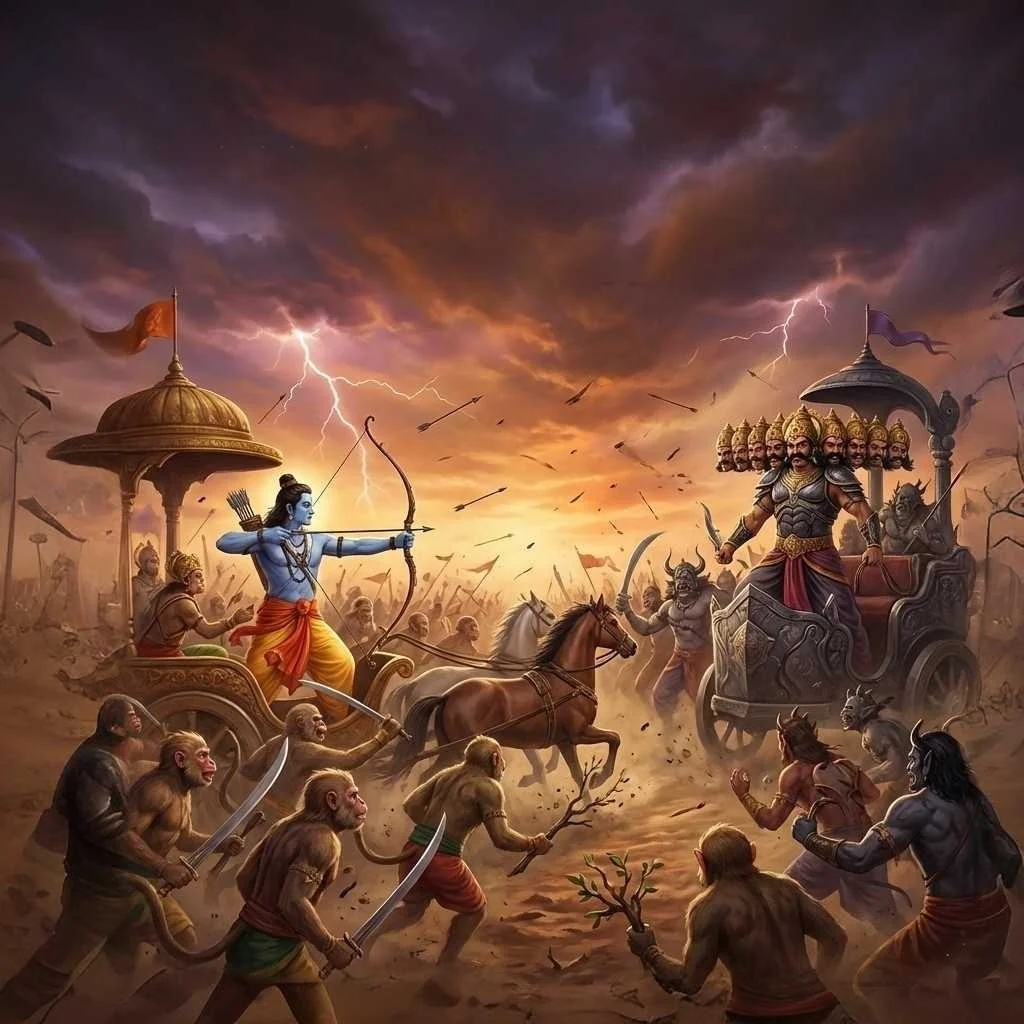
Yuddha Kanda - (Book of War/Battle)
युद्धकाण्ड
Yuddhakāṇḍa forms the martial and theological climax of Vālmīki’s Ādikāvya, recounting the campaign in Laṅkā that culminates in Sītā’s recovery and Rāvaṇa’s fall. It opens with Hanumān’s successful report and the strategic consolidation of the vānaras under Rāma and Sugrīva. The narrative then moves to the oceanic threshold—Rāma’s ritual appeal to Sāgara, the ensuing cosmic turbulence, and the building of the setu—before entering the fortified, opulent, and ominous cityscape of Laṅkā. A distinctive feature of this kāṇḍa is its sustained alternation between counsel (mantra) and combat (yuddha): debates in Rāvaṇa’s court, Vibhīṣaṇa’s dharmic admonitions and defection, and catalogues of heroes and formations are set beside escalating battle set-pieces. Major antagonists arrive in successive “waves” (Dhumrākṣa, Vajradaṃṣṭra, Prahasta, Kumbhakarṇa, and Indrajit), each defeat sharpening the moral logic that adharma breeds strategic blindness and isolating ruin. The poetry repeatedly expands to cosmic scale—portents, tempest imagery, rivers of blood, and end-of-age similes—while preserving intimate registers of śoka, especially in Sītā’s laments and Rāma’s vulnerability. Within the epic’s 24,000-verse architecture, Yuddhakāṇḍa serves as the decisive proving-ground of rājadharma: disciplined force is legitimate only when governed by truth, restraint, alliance-ethics, and protection of the innocent. War is thus framed not as conquest, but as the sacred restoration of dharma and rightful order. This overview follows the IIT Kanpur Southern Recension tradition, which preserves additional conventional verses and amplifies certain battle descriptions and courtly deliberations beyond some critical reconstructions. In that fuller light, the book’s union of rite and strategy, compassion and firmness, becomes especially vivid within the holy narrative of the Rāmāyaṇa.
Sargas in Yuddha Kanda
Sarga 1
प्रथमः सर्गः — Rama Praises Hanuman; Anxiety over Crossing the Ocean
This sarga opens with Rāma hearing Hanumān’s report and responding with visible affection and formal praise. Rāma proclaims Hanumān’s deed as nearly unparalleled—crossing the great ocean and entering the heavily guarded city of Laṅkā—and holds it up as an exemplar of ideal service (bhṛtya-dharma). He then sets forth a graded ethic of servants: the best accomplishes difficult tasks with devotion; the mediocre does not anticipate what is dear to the king; the base fails even in the duty entrusted to him. Rāma acknowledges that Hanumān’s success safeguards the Raghu line by confirming the whereabouts of Vaidehī, yet he poignantly admits he cannot repay such pleasing words and faithful service as they deserve, offering an embrace as “all he can give” at that moment. The discourse turns from celebration to strategy: despite the intelligence gained, Rāma’s mind grows agitated by the practical and existential challenge of crossing the vast, difficult-to-ford ocean with the assembled vānaras. The chapter closes with Rāma—sorrow-stirred yet resolute—entering reflection and consultation centered on Hanumān and the impending problem of the ocean crossing.
Sarga 2
युद्धकाण्डे द्वितीयः सर्गः — Sugriva’s Counsel: From Grief to Strategy (Bridge to Lanka)
This sarga unfolds as Sugrīva’s sustained upadeśa to Rāma, who is weighed down by grief. He rebukes such sorrow as unfit for a kṣatriya leader, declaring that grief corrodes śaurya and destroys the fruits of action. He urges Rāma to cast off despondency, regain resolute energy, and, when needed, take up controlled and righteous wrath. Sugrīva then turns to practical reasoning: Sītā’s whereabouts are known, and Laṅkā has been identified upon the summit of Trikūṭa, so there is no rational ground for paralysis. He stresses the strength of the coalition—Vānara leaders are able and eager, ready even to enter fire for Rāma’s cause. His central logistical thesis follows: Laṅkā cannot be subdued without first building a setu across the dreadful ocean, Varuṇa’s abode. He repeats the victory-criterion—once the bridge is built and the army has crossed, victory should be regarded as virtually secured. The chapter closes with auspicious nimitta and the assurance that no foe in the three worlds can stand against Rāma when he takes up the bow.
Sarga 3
लङ्कादुर्गवर्णनम् (Description of Lanka’s Fortifications and Forces)
Sarga 3 is a structured intelligence briefing cast as dialogue. After hearing Sugriva’s sound counsel, Rama turns to Hanuman and asks for a precise report: the strength of the enemy host, the number and nature of the hard-to-enter gateways, the protective measures, and the dwellings of the rakshasas. Hanuman, praised as foremost among skilled speakers, agrees to describe the fortification system in due order. He portrays Lanka as prosperous and ever on warlike alert—chariots, rutting elephants, and innumerable rakshasas; lofty, wide gates with metal-fastened doors and iron bars; defensive engines that hurl darts and stones; and guards ready with spiked weapons (śataghnī). The city is encircled by a high golden wall studded with gems and by deep moats of cold water filled with fish and crocodiles; movable bridges are raised by mechanisms to deny entry. Hanuman further notes Ravana’s constant vigilance and details the garrisons assigned to each gate, concluding with a strategic inference: if the ocean crossing is achieved, Lanka’s fall is assured. The chapter ends with Hanuman urging swift mobilization at an auspicious time.
Sarga 4
समुद्रतट-प्रयाणम् तथा वेलावन-निवेशः (March to the Seacoast and Encampment at the Shore)
Sarga 4 opens with Rāma answering Hanumān’s report on Laṅkā, declaring his immediate resolve to destroy the rākṣasa stronghold and recover Sītā. Calling the departure auspicious through stellar alignments and favorable omens, he issues firm operational orders: Nīla is appointed to lead the vanguard, secure a route abundant in water, fruits, and roots, and prevent rākṣasa sabotage of provisions; vānaras are also directed to reconnoiter difficult ground—lowlands, forest-forts, and concealed positions. The vānaras march in immense yet disciplined formations, with named commanders guarding flanks and rear, while Lakṣmaṇa reads celestial signs as portents of success. Crossing the Sahya and Malaya ranges, they reach Mahendra and finally arrive at the varuṇālaya, the ocean. Confronted by the vast and perilous sea—poetically described as indistinguishable from the sky and inhabited by makaras, serpents, and timingila fish—Rāma orders a coastal encampment and calls for counsel on how to cross. Thus the chapter marks a strategic pause before the later engineering and diplomatic means to overcome the ocean barrier.
Sarga 5
सेनानिवेशः रामविलापश्च (Encampment on the Northern Shore; Rama’s Lament and Sandhyā)
In Sarga 5, disciplined order prevails: Nīla establishes the Vānara host on the sea’s northern shore according to customary camp procedure, while Mainda and Dvivida patrol in every direction to secure the encampment. When the army is settled, Rāma turns to Lakṣmaṇa and pours forth a sustained lament of separation (vipralambha). He reflects that ordinary grief may lessen with time, yet his sorrow only deepens because Sītā remains unseen. His words carry dharmic anxiety—her youth passing, her helplessness among the rākṣasas—and unfold in vivid similes: he lives on the news of her life as a dry field is moistened by water from a neighboring irrigated field; and he envisions Sītā emerging from the rākṣasas like the crescent moon from autumn clouds. As day ends, Lakṣmaṇa consoles him. Rāma, grief-stricken yet self-controlled, performs evening worship (sandhyā-upāsanā) in remembrance of Sītā, and renews his resolve to defeat the rākṣasa king and bring her back.
Sarga 6
रावणस्य मन्त्रविचारः — Ravana’s Council on Strategy
This sarga opens with Rāvaṇa weighing the terrifying consequences of Hanumān’s deeds in Laṅkā—his intrusion, the devastation he caused, the slaying of leading rākṣasas, and his successful sighting of Sītā. With a rare sense of shame and his head bowed, the rākṣasa king turns to collective deliberation, declaring that victory is mantra-mūla, rooted in counsel. He sets forth a threefold typology of human action and advisory worth—uttama, madhyama, adhama—linking competence to disciplined consultation and to reliance on daiva (trust in a higher moral order). The best consults able ministers and allies and proceeds with faith; the mediocre acts alone; the lowly ignores merit and demerit and, in ego, insists “I will do it,” without daiva. Extending this into political teaching, he ranks counsel itself: unanimous agreement guided by śāstra is supreme; consensus reached after differing views is middling; stubborn factional speech without unity is condemned. The chapter ends in urgent strategy: Rāma, surrounded by thousands of valorous Vānaras, is approaching to besiege Laṅkā, and Rāvaṇa asks for a plan that will benefit both city and army.
Sarga 7
राक्षसपरिषद्वाक्यम् — Counsel of the Rakshasa Court to Ravana
In this chapter, the rākṣasa elders and warriors approach Rāvaṇa with folded hands, seeking to steady his resolve through courtly reassurance and martial boasting. They insist that the danger comes from merely “ordinary” foes and should not trouble the king’s mind, even as their assessment betrays a lack of subtle political intelligence about the enemy. Their speech becomes a catalog of Rāvaṇa’s former conquests: the subjugation of the nāgas in Rasātala, including Vāsuki and Takṣaka; the humiliation of Kubera and the seizure of the Puṣpaka vimāna from Kailāsa; and the fear-born alliance that brought him Mandodarī, daughter of the dānava Maya, as queen. They further praise victories over dānavas such as Madhu, and invoke mythic battle imagery—like plunging into an “ocean of Yama-loka” filled with death-like perils—to magnify Rāvaṇa’s fame for overcoming existential threats. The counsel culminates in a strategic recommendation: dispatch Indrajit—said to have gained rare boons from Maheśvara through sacrifice, and famed for once capturing Indra and entering Laṅkā with him—to annihilate the vānar forces and even Rāma.
Sarga 8
युद्धकाण्डे अष्टमः सर्गः — राक्षससभा-युद्धपरामर्शः (War-Council Boasts and Stratagems)
Sarga 8 portrays a war-council in Laṅkā’s court, where several Rākṣasa leaders vie to define the danger and propose responses after Hanumān’s earlier disruptions. Prahasta—cloud-dark, speaking with folded palms—voices contempt for Hanumān and urges victory through upāya (cunning stratagem) and vigilance rather than empty bravado: thousands of kāmarūpa Rākṣasas should approach Rāma in human guise and, with deceptive speech, unsettle Rāma and Lakṣmaṇa. The counsel then swells into escalating vows of single-handed slaughter. Durmukha decries the humiliation as unforgivable; Vajradaṃṣṭra grips a blood-stained iron bludgeon; Vajrahanu and others boast of devouring or killing the Vānara leaders—Sugrīva, Aṅgada, and Hanumān—and even Rāma with Lakṣmaṇa. Another ruse is voiced as well: to claim that Bharata is coming with an army, sowing confusion. Thus the sarga records the court’s psychology—strategic deception is articulated, yet repeatedly eclipsed by performative martial arrogance—highlighting the ethical contrast between dharmic resolve and adharmic manipulation.
Sarga 9
विभीषणोपदेशः — Vibhishana’s Counsel to Ravana
This sarga opens with a catalogue-like mobilization: prominent rākṣasa leaders, including Indrajit and other named commanders, rise in fury, bearing heavy weapons—parigha (iron club), paṭṭiśa, prāsa, śakti, śūla, paraśu, bows, arrows, and sharp swords—and declare their intent to kill Rāma, Lakṣmaṇa, Sugrīva, and Hanumān. Vibhīṣaṇa intervenes, halts the armed assembly, and delivers a structured nīti discourse: deeds unattainable through the three diplomatic means—sāma, dāna, bheda—should be attempted only after due deliberation and then by valor; success rests on methodical assessment, not rash contempt. He reframes the conflict ethically and strategically, warning against underestimating the enemy and citing Hanumān’s ocean-crossing as proof of extraordinary capability. Questioning the justice of Rāvaṇa’s original offence—the abduction of Sītā—Vibhīṣaṇa urges de-escalation: abandon anger, avoid purposeless enmity with the steadfast, dharma-aligned Rāma, and restore Maithilī/Sītā before Laṅkā and its rākṣasas face ruin. Rāvaṇa hears the counsel, dismisses the assembly, and withdraws into his palace—formally concluding the matter while leaving the warning unheeded in spirit.
Sarga 10
विभीषणोपदेशः — Vibhishana’s Counsel to Ravana and the Catalogue of Omens
At dawn, Vibhīṣaṇa goes to Rāvaṇa’s fortified residence, portrayed in lofty courtly and architectural splendor—gold-adorned seats, Vedic recitations, and ritual preparations. Entering with proper decorum, he greets Rāvaṇa seated in royal majesty and speaks with guarded intimacy in the presence of the ministers. He frames his words as hita, counsel for welfare, suited to time and place and grounded in practical statecraft. Vibhīṣaṇa reports a chain of aśubha-nimitta (inauspicious omens) seen since Vaidehī’s arrival in Laṅkā: sacrificial fires burning poorly with smoke and sparks; serpents and ants appearing in ritual spaces and offerings; livestock and war-animals distressed and abnormal; harsh cries of crows, eagles gathering over the city, and thunder-like sounds of carnivorous beasts at the gates. From these signs he draws a political and ethical remedy: the fitting “atonement” is to return Vaidehī to Rāghava. He clarifies that he is moved by neither delusion nor greed, and that the ministers have stayed silent out of fear. Rāvaṇa, seized by anger, rejects the counsel with boasts of invulnerability and dismisses Vibhīṣaṇa—an essential turning point where reason is refused and war becomes inevitable.
Sarga 11
रावणस्य सभाप्रवेशः (Ravana Enters the Royal Assembly and Summons Counsel)
Sarga 11 marks a shift from courtly display to war counsel. Rāvaṇa, weakened by passion for Maithilī and by the social consequences of sinful action, realizes how much time has passed and deems consultation on war urgent. He mounts a magnificently ornamented chariot and proceeds toward the sabhā amid the tumult of instruments and conch (śaṅkha) sounds, escorted by armed rākṣasas in varied dress and weaponry. The scene becomes ceremonial spectacle—royal road, canopy, cāmara fans, salutations, and praise—until Rāvaṇa enters Viśvakarmā’s ever-shining assembly hall, with gold-and-silver pillars, a crystal-like interior, golden silk hangings, and heavy guard. Seated on a gem-inlaid throne, he commands swift messengers to muster rākṣasas throughout Laṅkā for a great undertaking against the enemies. The mustering fills the capital: leaders arrive by chariot, horse, elephant, and on foot; they park their vehicles and enter like lions into a mountain cave, observing protocol in seating and silence. Ministers and warriors assemble, and finally Vibhīṣaṇa arrives; sandal and incense fragrance pervades the hall. Rāvaṇa shines among armed heroes like Indra among the Vasus—political radiance set against moral fragility.
Sarga 12
युद्धकाण्डे द्वादशः सर्गः — रावणस्य परिषद्-सम्बोधनं कुम्भकर्णस्य नीत्युपदेशश्च (Ravana’s Council Address and Kumbhakarna’s Counsel)
Sarga 12 of the Yuddha Kāṇḍa depicts a royal strategy council in Laṅkā. Rāvaṇa surveys the full rākṣasa assembly and commands Prahasta, the army chief, to tighten the city’s defense by deploying the fourfold divisions within and beyond the fortifications. When Prahasta reports that all is ready, Rāvaṇa speaks to his intimates, claiming his undertakings are always guided by counsel and never fail, and explains that Kumbhakarṇa had not been informed because of his long sleep. Rāvaṇa then justifies his seizure of Sītā from Daṇḍakāraṇya and lays bare his desire and frustration at her refusal, revealing a crisis of rule in which kāma (passion) distorts judgment. He voices anxieties about the ocean crossing, yet boasts of invulnerability to humans, even as he acknowledges that Rāma and Lakṣmaṇa have reached the shore with Sugrīva and the Vānara host to reclaim Sītā. Hearing this passion-laden lament, Kumbhakarṇa rebukes the lack of prior deliberation and expounds nīti: deeds without proper means and right sequence come to ruin, and hasty decisions disregard an enemy’s strength. Still, he offers to set matters right by force, vowing to slay Rāma and Lakṣmaṇa and crush the Vānara leaders, urging Rāvaṇa to regain confidence and pleasures while he prosecutes the war.
Sarga 13
महापार्श्वस्य परामर्शः — Mahāpārśva’s Counsel and Rāvaṇa’s Confession of Brahmā’s Curse
In this sarga, Mahāpārśva approaches Rāvaṇa with folded palms and offers hardline counsel, advising the King to abandon conciliatory measures and rely solely on *daṇḍa* (force). He urges Rāvaṇa to forcibly enjoy Sītā, asserting that their warriors, such as Kumbhakarṇa and Indrajit, possess the might to repel even Indra. Rāvaṇa, though pleased by this display of loyalty and aggression, reveals a secret history that necessitates his restraint: a divine curse imposed by Lord Brahmā. Rāvaṇa confesses that in the past, upon seeing the celestial nymph Puñjikāsthā glowing like a flame, he violated her and incurred the Creator's wrath. Brahmā’s *śāpa* (curse) decrees that if Rāvaṇa ever forces himself upon another woman against her will, his head will shatter into a hundred pieces. The chapter concludes with Rāvaṇa boasting of his martial prowess, comparing his speed to the wind and ocean, and threatening to disperse Rāma’s army just as the rising sun outshines the stars.
Sarga 14
विभीषणोपदेशः (Vibhīṣaṇa’s Counsel to Rāvaṇa and the Rākṣasa Court)
Sarga 14 unfolds as a court debate in Laṅkā on feasibility, ethics, and statecraft at the brink of military disaster. After Rāvaṇa’s position is heard and Kumbhakarṇa roars, Vibhīṣaṇa offers nīti-grounded counsel: the aim of opposing Rāma is impossible, and an adharma-driven intent cannot yield “svarga-like” success. By analogy—one who cannot swim cannot cross the ocean—and by weighing relative strength, he highlights Rāma’s dharma-centered might and supremacy in battle. Vibhīṣaṇa repeatedly urges the immediate return of Sītā to Rāma, before Laṅkā’s leaders are beheaded by thunderbolt-like arrows. Prahasta answers with bravado, claiming fear of neither gods nor any being; Vibhīṣaṇa replies with sharper warnings, naming rākṣasa champions who cannot withstand Rāghava. The discourse then turns to political pathology: Rāvaṇa is portrayed as vice-driven and impulsive, as if “entwined by a thousand-hooded serpent,” a bondage of his own making. The chapter closes with a ministerial maxim: prudent counsel must assess enemy strength, one’s own capacity, and the kingdom’s prospects for rise or decline, aiming solely at the king’s welfare.
Sarga 15
विभीषण–इन्द्रजित् संवादः (Vibhishana and Indrajit: Counsel, Boast, and Rebuttal)
Sarga 15 presents a sharp rhetorical contest between Indrajit (Meghanāda), commander of the Rākṣasa host, and Vibhīṣaṇa, whose counsel is praised as Brihaspati-like in wisdom. Indrajit dismisses Vibhīṣaṇa’s warnings as fearful and unbecoming, derides him as lacking valor within the clan, and claims that even an ordinary Rākṣasa could slay the human princes Rāma and Lakṣmaṇa in battle. He then magnifies his standing through martial boasting—declaring that he once cast down Indra and subdued Airāvata—thereby framing Rāma and Lakṣmaṇa as merely “ordinary humans.” Vibhīṣaṇa replies with nīti-grounded correction: Indrajit is immature in judgment, self-destructive in speech, and deluded in approving Rāvaṇa’s course despite having heard the signs of impending ruin. The exchange rises into moral indictment—false friendship and harmful counsel—and culminates in a pragmatic proposal: surrender Sītā to Rāma, with wealth and ornaments, to end sorrow and avert annihilation. Thus the chapter sets prideful militarism against ethical statecraft and realistic assessment of danger.
Sarga 16
विभीषणोपदेशे रावणस्य परुषवाक्यम् (Ravana’s Harsh Reply to Vibhishana’s Counsel)
Sarga 16 depicts a rupture in the royal court as an episode on the ethics of counsel. Vibhīṣaṇa offers hit—wholesome, well-meant advice for Rāvaṇa’s welfare—but Rāvaṇa, described as kāla-codita (impelled by fate/death), answers with parūṣa-vākya, harsh speech. Rāvaṇa’s retort unfolds through didactic similes on the futility of friendship with an anārya (unworthy, unrighteous person): water on lotus leaves that will not cling, bees that show no gratitude after tasting sweetness, an elephant that soils itself after bathing, and autumn clouds that thunder yet do not moisten. He thus asserts moral barrenness where virtue is absent, and he threatens Vibhīṣaṇa, implying that another would have been punished at once. Vibhīṣaṇa, a nyāya-vādī (speaker of just reasoning), rises with a mace and four rākṣasas, ascends into the sky, and rebukes Rāvaṇa: an elder brother deserves honor, yet you have strayed from dharma. He states a core political-ethical maxim—pleasant speakers are many, but those who speak and those who hear unpleasant yet beneficial truth are rare. He warns that Rāvaṇa is bound by death’s noose and will be struck by Rāma’s fiery arrows; even the mighty fall when seized by kāla. Taking formal leave, he asks pardon for speaking as an elder’s well-wisher, urges Rāvaṇa to safeguard himself and Laṅkā, and departs. The narrator concludes that those nearing death do not accept the good counsel of friends.
Sarga 17
विभीषणागमनम् (Vibhīṣaṇa’s Arrival and the Debate on Refuge)
Sarga 17 is a counsel-driven episode that weighs the dharma of granting refuge against the danger of deception. After rebuking Rāvaṇa and urging him to return Sītā, Vibhīṣaṇa leaves Laṅkā with four companions and reaches Rāma’s vicinity, hovering near the northern shore. He introduces himself as Rāvaṇa’s younger brother, recounts Sītā’s abduction and confinement, and asks that Rāghava be told he has come seeking protection. Sugrīva views the arrival through the lens of statecraft: shape-shifting Rākṣasas may be spies, so he urges strict measures—even execution—and vigilance in council, formations, and intelligence. Rāma acknowledges the sound warning and seeks the views of leading Vānara ministers; Aṅgada, Śarabha, Jāmbavān, and Mainda advise suspicion, surveillance, and careful interrogation. Hanumān counters by reading conduct and speech: intent is not known at once, and Vibhīṣaṇa’s words, bearing, and composure show no sign of malice, for tone and demeanor often betray hidden motives. The chapter thus serves as a practical lesson in political prudence joined to an ethical inquiry into when and how refuge should be granted.
Sarga 18
शरणागति-धर्मनिर्णयः (Decision on Refuge and Dharma) / Rama’s Vow of Protection and the Acceptance of Vibhishana
Sarga 18 unfolds as a dialogue on statecraft and dharma at a decisive moment: Vibhīṣaṇa’s approach and the allies’ uncertainty. After hearing Hanumān, Rāma is pleased and declares he will speak about Vibhīṣaṇa, inviting his well-wishers to listen. Sugrīva voices suspicion, fearing Vibhīṣaṇa may be Rāvaṇa’s agent, and advises caution or even detention. Rāma replies that he is beyond harm, then grounds his judgment in dharma: citing traditional exempla—such as the dove that offers hospitality even to an enemy—and recalling dharma-verses attributed to the sage Kandu, he affirms that a suppliant who comes with folded hands must not be injured. The teaching culminates in a solemn vow: whoever seeks refuge even once—Vibhīṣaṇa, Sugrīva, or even Rāvaṇa—will receive fearlessness (abhaya) from Rāma. Moved by this dharmic resolve and convinced of Vibhīṣaṇa’s purity, Sugrīva endorses accepting him and urges immediate friendship. The chapter ends with Rāma going forth to meet Vibhīṣaṇa, establishing the episode as a doctrinal anchor for śaraṇāgati in royal conduct.
Sarga 19
विभीषणाभिषेकः — The Consecration of Vibhishana and Counsel on Crossing the Ocean
This sarga presents a decisive alliance as a public, ritual act of political legitimacy. After Rāma grants abhaya (assured protection), Vibhīṣaṇa descends, prostrates, and formally seeks refuge, renouncing his former ties to Laṅkā and placing life and sovereignty at Rāma’s disposal. Rāma reassures him with calm restraint and asks for an intelligence account of rākṣasa strengths and weaknesses. Vibhīṣaṇa lists the chief dangers: Rāvaṇa’s near-invulnerability through boons, Kumbhakarṇa’s warlike might, Prahasta’s earlier victory over Maṇibhadra, Indrajit’s invisibility gained by fire-rites, and other commanders, along with the vast and fierce forces of Laṅkā. Rāma then makes a binding promise: after Rāvaṇa’s defeat, Vibhīṣaṇa will be installed as king. The promise is immediately enacted through abhiṣeka: Lakṣmaṇa brings ocean-water and, amid the Vānara chiefs, anoints Vibhīṣaṇa as rākṣasa-rāja, to jubilant acclaim. The chapter ends with planning—Hanūmān and Sugrīva ask how to cross the unshaken ocean; Vibhīṣaṇa advises seeking refuge with Sāgara, citing dynastic ties to Sagara. Sugrīva conveys this counsel; Rāma approves and sits upon kuśa grass on the shore, poised for the next ritual-strategic step toward Laṅkā.
Sarga 20
दूत-नीति, शुक-प्रसङ्गः (Envoy-Ethics and the Episode of Śuka)
Sarga 20 presents a tight sequence of reconnaissance, diplomacy, and a public test of wartime dharma. The rākṣasa spy Śārdūla slips into Sugrīva’s camp, surveys the bannered host, and reports to Rāvaṇa that the vānaras and bears advance on Laṅkā like a second, immeasurable ocean; he also notes Rāma and Lakṣmaṇa stationed by the seashore and the vast spread of forces. Rāvaṇa then commissions Śuka to deliver a calculated message to Sugrīva—praising his lineage and strength while downplaying Rāvaṇa’s fault and proclaiming Laṅkā’s invincibility, aiming to intimidate and fracture alliances. Śuka becomes a bird and speaks from the sky, but enraged vānaras assault him; he invokes the rule that envoys must not be slain and distinguishes a faithful messenger from one who adds unauthorized speech. Rāma intervenes to uphold dūta-dharma and orders Śuka released. From safety, Śuka resumes, and Sugrīva sends back a firm reply for Rāvaṇa: defeat is inevitable, there is no escape by concealment or even divine refuge, and a moral indictment stands for Sītā’s abduction and Jaṭāyu’s killing. Though Aṅgada suspects Śuka is a spy who has assessed the army and urges capture, the episode balances security with restraint, making envoy-protection its central lesson amid war.
Sarga 21
सागरप्रतीक्षा-क्रोधप्रादुर्भावः (Rama’s Vigil at the Ocean and the Rise of Wrath)
At the seashore, Rāma undertakes a disciplined approach: he spreads kuśa grass, faces east, offers añjali to the Ocean, and lies down in a vigil bound by vow. Three nights pass as he waits upon Sāgara, “lord of rivers,” yet the sea does not manifest any responsive “form,” though duly honored. This silence turns self-restraint into righteous wrath. Rāma voices a political-ethical warning: calmness, forbearance, straightforwardness, and courteous speech can be mistaken for weakness before the “attribute-less” (nirguṇa) or the proud. He cautions Lakṣmaṇa that fame and victory are not won by conciliation alone, and resolves to dry up or torment the ocean with serpent-like arrows so the Vānara host may cross on foot. As he bends the terrible bow, the narrative swells to cosmic consequence—blazing arrows strike the waters, waves surge like mountains, conchs and shells churn, smoke rises, and underworld nāgas and dānavas are distressed—until Saumitrī restrains him, seizing the bow and urging, “Enough.”
Sarga 22
सागरप्रशमनम् / The Pacification of the Ocean and the Building of Nala’s Bridge
Sarga 22 turns an impasse into a made passage. Angered that the ocean blocks his way, Rāma vows to dry the sea down to the underworld with Brahmā-astra-charged power; cosmic turmoil follows—winds, clouds, lightning, darkness—and visible and invisible beings tremble in fear. The Ocean-lord (Sāgara/Varuṇālaya) rises in regal theophany and teaches that the svabhāva, the inherent nature, of the five elements cannot be violated. He offers a lawful remedy: a stable crossing by a bridge, and asks that Rāma redirect his unfailing arrow to punish sinful marauders at Drumakūlya. Rāma releases the missile there, bringing forth the famed desert tract (Marukāntāra), the “Vrana” well with brackish upwelling, and—by boon—a new auspicious route. The Ocean then names Nala, son of Viśvakarmā, as the divinely capable architect; Nala accepts. The Vānara hosts gather trees, boulders, and mountains, and the bridge is swiftly built over successive days, admired by gods and sages who bless Rāma. The chapter weaves together dharmic restraint of anger, cosmological doctrine of svabhāva, and statecraft through infrastructure as instruments of righteousness.
Sarga 23
निमित्तदर्शनम् (Portents Before the March to Laṅkā)
Sarga 23 unfolds as a discourse of command and omens. Śrī Rāma, portrayed as one who perceives nimittas, embraces Saumitri (Lakṣmaṇa) and issues clear instructions: prepare a secure forest halt with cool water and fruit, divide the battalions, and stand in vigilant battle formation (vyūha). He then interprets a cascade of dreadful signs—dust-laden winds, trembling earth and mountains, falling trees, flesh-hued clouds raining blood-like drops, a terrifying twilight, fiery masses seeming to fall from the sun, distressed animals crying toward the sun, and the sun and moon showing abnormal colors and halos. These portents are not to induce paralysis, but to forewarn of heavy casualties among bears, Vānara, and Rākṣasas, and of imminent, decisive violence. The chapter closes with immediate mobilization: the Vānara host turns toward Rāvaṇa’s city; Rāma advances at the front with bow in hand; Sugrīva and Vibhīṣaṇa proceed roaring; and the Vānara warriors perform exuberant acts to hearten Rāma, joining morale with dharmic resolve in war.
Sarga 24
लङ्कानिरीक्षणं व्यूहविन्यासश्च (Survey of Lanka and Deployment of the Battle Formation)
Sarga 24 stands at the threshold of open war. At Rāma’s command the Vanara host settles, likened to an autumn full moon amid auspicious stars, and then surges forward with oceanic force, shaking the earth. From Laṅkā come terrifying drum-resonances; the Vanaras answer with louder roars, and the Rākṣasas are thrown into alarm. Sorrowing for Sītā, Rāma points out Laṅkā’s sky-clasping architecture and garden splendor—vimānas like white clouds, Chaitraratha-like groves, and trees alive with birds, cuckoos, and bees. He then orders a śāstra-aligned battle formation (vyūha): Angada with Nīla at the center, Ṛṣabha on the southern flank, Gandhamādana on the right flank, while Rāma and Lakṣmaṇa hold the head; Jāmbavān and Suṣeṇa with bear chiefs guard the “belly,” and Sugrīva protects the rear. The organized army shines like cloud-masses in heaven, and the Vanaras arm themselves with mountain-peaks and trees to pulverize Laṅkā. With the formation complete, the envoy Śuka is released and returns terrified to Rāvaṇa. He reports the Vanaras’ fury, Rāma’s arrival after bridge-building, and urges an immediate choice: return Sītā or prepare for war. Rāvaṇa replies with red-eyed wrath and boasts that he will not yield Sītā even against the gods, proclaiming the irresistible “fire” of his arrows—thus sealing the inevitability of conflict.
Sarga 25
शुकसारण-चारप्रवेशः (Suka and Sāraṇa’s Espionage and Release)
Learning that Rāma, Daśaratha’s son, has crossed the ocean with the vānar host and that a sea-bridge has been completed, Rāvaṇa is stirred to action and sends his minister-spies, Śuka and Sāraṇa, to slip unseen into the enemy camp. They are charged to gauge the army’s strength, identify the foremost vānar chiefs and effective commanders, inspect the bridge’s construction, locate encampments across mountains, caves, shores, forests, and gardens, and assess the resolve, valor, and weapons of Rāma and Lakṣmaṇa. Disguised as vānaras, they enter the host but are overwhelmed by its seemingly countless numbers and thunderous war-cries. Vibhīṣaṇa detects the hidden spies, seizes them, and brings them before Rāma. Though they fear death, Rāma answers with calm, principled restraint: their reconnaissance is complete, so they may return freely; if anything remains unseen, Vibhīṣaṇa can show them the forces in full. Declaring a rule of war—that envoys and the unarmed must not be slain—he orders their release. Rāma instructs them to tell Rāvaṇa: let him display the strength by which he abducted Sītā, and at dawn witness how Laṅkā’s defenses and rākṣasa power will be shattered. Back in Laṅkā, Śuka and Sāraṇa testify to Rāma’s righteousness and to the terrifying capability of the four leaders—Rāma, Lakṣmaṇa, Vibhīṣaṇa, and Sugrīva—urging conciliation and the return of Maithilī as the prudent course.
Sarga 26
वानरमुख्य-परिचयः (Catalogue of Principal Vānara Leaders)
Sarga 26 presents an intelligence exchange within Laṅkā. After Sāraṇa offers frank and beneficial counsel, Rāvaṇa answers with defiant resolve, refusing to surrender Sītā even against opposition of cosmic scope. Seeking a direct appraisal, Rāvaṇa ascends a lofty, snow-white palace with the spies Śuka and Sāraṇa and surveys the vast Vānara host spread along the coastal terrain. Confronted by an innumerable army, he questions Sāraṇa: who among the Vānaras are foremost, who are Sugrīva’s chief advisers, and which leaders are most to be feared. Sāraṇa then delivers a structured catalogue of prominent commanders and their martial traits: Nīla at the head of Sugrīva’s forces; Aṅgada, Vāli’s son and crowned heir, issuing a direct challenge; Nala, linked to the enterprise of the setu; and other troop-leaders—Śveta, Kumuda, Rambha, Śarabha, Panasa, Vinata, Krodhana, and Gavaya—each characterized by appearance, mountain or habitat associations, troop numbers, and fierce intent toward Laṅkā. The chapter functions as a strategic “enemy order of battle,” blending epic poetics with statecraft-minded threat assessment.
Sarga 27
वानर-ऋक्ष-सेना-प्रशंसा (Cataloguing the Vanara and Bear Forces)
This sarga serves as a martial catalogue and visual briefing: a speaker, addressing the rākṣasa king as “rājan,” describes the allied vanara and ṛkṣa hosts gathered for Rāghava’s cause, ready to stake their lives for him (rāghavārthe parākrāntāḥ). Prominent leaders and troop-types are identified with vivid similes and notes of lineage. Hara is marked by a radiant, multicolored tail; the fierce bears are likened to dark storm-clouds; and their lord Dhūmra dwells at Ṛkṣavān and drinks the Narmadā. Jāmbavān, mountain-like and foremost among leaders, is famed for aiding Indra in the deva–asura war and receiving boons. Dhamba appears as a fearsome harīśvara surrounded like Indra; Sannadana, called the vanara “grandfather,” is of colossal measure and once fought Indra without defeat; Krōdhana/Krathana resides on Kailāsa near Kubera’s Jambū tree; Pramathi leads a swift, dust-whirling army; Gavākṣa is ringed by Golāṅgūla troops after seeing the bridge; Kesarin revels on a golden mountain amid unending fruits and honey; and Śatabalī, a sun-worshipper, is intent on crushing Laṅkā. The chapter closes by stressing the incalculable scale of the allied forces and their power to reshape even the earth’s mountains—epic rhetoric meant to deter the foe and strengthen righteous resolve.
Sarga 28
शुकवाक्यं (Śuka’s Report on the Vānara Host) / Śuka Describes the Allied Forces to Rāvaṇa
After Sāraṇa’s briefing, Śuka continues his orderly intelligence report to Rāvaṇa, portraying the advancing Vānara coalition as hard to withstand—shape-shifters of near-divine might, firmly grounded in dharma. He identifies the chief leaders: Mainda and Dvivida as almost deathless warriors; Hanumān as the Wind-born, able to leap the ocean and change form, his power already proven by his earlier mission in Laṅkā, including the burning of his tail. He then turns to the human principals: Rāma, an Ikṣvāku atiratha unwavering in dharma, whose Brahmā-astras and archery are said to pierce the worlds; and Lakṣmaṇa, Rāma’s indispensable “right hand,” skilled in statecraft and war. On Rāma’s left stands Vibhīṣaṇa, the consecrated king aligned against Rāvaṇa. Śuka further employs a numerical lexicon (śaṅkhu, mahāśaṅkhu, bṛnda, padma, kharva, samudra, ogha, mahaugha) to magnify the army’s vastness. He ends with a warning: seeing this host “like a blazing planet,” Rāvaṇa must exert supreme effort to avoid defeat.
Sarga 29
शुकसारणनिग्रहः / Ravana Rebukes Suka and Sārana; Spies Reconnoiter Rama’s Camp
Sarga 29 unfolds a court-to-camp intelligence cycle central to cāra-nīti. Hearing Śuka’s report on the assembled vānaras and Rāma’s chief allies—Lakṣmaṇa as Rāma’s “right arm,” along with Sugrīva, Aṅgada, Hanūmān, Jāmbavān, and other commanders—Rāvaṇa is inwardly shaken yet outwardly wrathful. He rebukes Śuka and Sārana for praising the enemy before battle, calling it a lapse in rājanīti and ministerial loyalty; though he threatens punishment, he restrains himself in remembrance of their past service and dismisses them rather than executing them. Turning to operations, Rāvaṇa orders Mahodara to summon expert spies and commands them to learn Rāma’s intentions, routines, and inner circle. Led by Śārdūla, the spies go in disguise to the Suvela region, but the righteous Vibhīṣaṇa recognizes them and Śārdūla is seized. As the vānaras move to kill the intruders, Rāma’s compassion intervenes and he releases Śārdūla and the others. Harried and terrified, they return to Laṅkā and report to Daśagrīva the formidable force encamped near Suvela, closing the sarga with a strategic assessment.
Sarga 30
शार्दूलचरवृत्तान्तः (Saardula’s Spy-Report on Rama’s Camp and the Vanara Host)
In this sarga, Laṅkā’s spies report that Rāghava has encamped on Suvela with an “unshakable” army. Rāvaṇa, briefly unsettled, questions his agent Śārdūla; the fear on Śārdūla’s face itself testifies to the vānaras’ tight security. Śārdūla recounts how he was detected at once, beaten, paraded publicly, and finally released—revealing Rāma’s camp as disciplined and well-guarded. He adds that after the ocean was filled with rocks and stones (the bridgework already accomplished), Rāma has taken position at Laṅkā’s gateway, and the vānaras stand arrayed in a battle formation likened to a garuḍa-vyūha. Śārdūla urges a stark choice: return Sītā, or accept war before Rāma reaches the walls. Rāvaṇa refuses outright, declaring he will not yield Sītā even against divine coalitions, and demands an intelligence catalogue of the vānaras’ strength, lineages, and numbers. Śārdūla lists leading figures—Sugrīva, Jāmbavān, Hanumān, Nīla, Aṅgada, Mainda, Dvivida, and others—notes many as of divine descent, and emphasizes the host’s vast scale (ten crores), concluding that the remaining particulars exceed what can be reported. The chapter thus serves as a tactical inventory and a moral-psychological portrait: disciplined alliance versus obstinate kingship.
Sarga 31
मायाशिरोप्रदर्शनम् (The Display of the Illusory Head of Rāma)
Sarga 31 opens with Laṅkā’s spies reporting to Rāvaṇa that Rāma’s “unshakeable” host is stationed on Suvela, ready to strike. Disturbed, Rāvaṇa convenes counsel, yet chooses psychological warfare over open battle. He summons the māyā-skilled rākṣasa Vidyujjihva and commands him to fashion an illusory head of Rāghava, along with his bow. Rāvaṇa then goes to Aśokavanikā, intent on breaking Sītā’s resolve. He finds her seated on the ground, head bowed, absorbed in thought of her husband amid rākṣasī guards. With coercive speech he claims that Rāma and the leading vānaras were slain in a night assault led by Prahasta, and he deepens the deception by placing the counterfeit head before her, followed by the famed bow as “proof.” The chapter highlights propaganda as a weapon—intimidation, misinformation, and staged evidence—set against Sītā’s implied steadfastness and single-minded devotion.
Sarga 32
सीताविलापः (Sītā’s Lament over the Illusory Head and Bow)
This sarga interweaves two movements: Sītā’s piercing grief before a contrived spectacle, and Rāvaṇa’s turn to governance and war-counsel. In the Aśoka-vatikā, Sītā is shown what seems to be Rāma’s severed head and his famed bow. Recognizing the marks—eyes, complexion, hair-curls—and recalling the auspicious cūḍāmaṇi association, she collapses and then pours forth a sustained lament. Her speech moves through blame (especially toward Kaikeyī), self-reproach, and reflection on kāla (Time) as the force that dissolves wisdom and brings down protectors. She voices a dharmic paradox: Rāma, skilled in polity and in avoiding calamity, has nonetheless been overtaken by death. She imagines Kausalyā’s devastation when Lakṣmaṇa returns alone, and mourns the social-religious rupture of a hero’s body left to scavengers, deprived of proper saṃskāra. Her lament culminates in appeals to Rāvaṇa to unite her with her husband in death. As soon as Rāvaṇa departs to meet his ministers, the head and bow vanish, revealing the episode’s illusory and coercive design. The scene then pivots to statecraft: a guard reports Prahasta’s arrival; Rāvaṇa convenes the ministers, orders drum-signals to assemble the troops without disclosing the reason, and begins formal deliberation on action against Rāma.
Sarga 33
सरमा-सीता संवादः (Saramā Consoles Sītā; Preparations in Laṅkā)
Sarga 33 presents a consoling, intelligence-bearing dialogue in Sītā’s Aśoka-like captivity. The rākṣasī Saramā, compassionate and friendly to Vaidehī, approaches Sītā when she is overwhelmed with grief and nearly faints. Having overheard Sītā’s exchange with Rāvaṇa, Saramā explains Rāvaṇa’s agitation: Rāma cannot be slain by a stealth attack in sleep, and his death is deemed implausible. Saramā stresses the tactical reality that the tree-wielding Vānara fighters are hard to kill because they are “protected by Rāma,” like the devas protected by Indra. The chapter repeatedly magnifies Rāma’s stature—righteous, renowned, bow-bearing, broad-chested, and unconquerable—together with Lakṣmaṇa as co-protector. She then gives situational updates: Rāma has crossed the ocean and is stationed on the southern shore with his forces; scouts have informed Laṅkā; and Rāvaṇa is consulting his ministers. The scene culminates in an auditory panorama of Laṅkā’s mobilization—drums, bells, chariots, horses, elephants, weapons, and armor—signaling imminent battle. The sarga closes with ritual-ethical counsel, urging Sītā to seek refuge in the Sun (Divasakara), the cosmic regulator of beings’ fortunes.
Sarga 34
सरमायाḥ सीतासान्त्वनम् तथा रावणनिश्चयश्रवणम् (Saarana Consoles Sita and Reports Ravana’s Resolve)
This sarga, set within the war book, becomes a pastoral-ethical interlude: through intimate dialogue it clarifies political intent and steadies Sita’s inner resolve. Saarana, speaking with timely tact and a gentle smile, consoles Sita until her grief recedes like parched earth revived by rain. Sita voices her anxiety and asks for verified intelligence. She fears Ravana’s māyā, his repeated threats, and the coercive watch of the rākṣasīs in Aśoka-vāṭikā, and she urges Saarana to learn Ravana’s settled decision. Saarana accepts, approaches Ravana, listens to his counsel with ministers, and returns swiftly. Embraced by Sita, offered a seat, and pressed to speak truthfully, Saarana reports that Ravana’s mother Kaikasi and the aged minister Aviddha advise releasing Maithili with honor, citing proofs of Rama’s power—Janasthāna’s destruction and Hanuman’s ocean-crossing and deeds. Yet Ravana, like a miser clinging to treasure, refuses to yield unless death in battle compels him. The chapter ends with the ominous roar of drums, conches, and Vanara clamour shaking the earth, casting down the rākṣasa retainers and signaling an approaching strategic collapse born of their king’s faults.
Sarga 35
माल्यवानुपदेशः — Malyavan’s Counsel, Portents in Laṅkā, and the Proposal of Alliance
Sarga 35 begins with Rāma’s martial advance, resounding with conches and drums. The scene then shifts to Laṅkā’s court: hearing the ominous din, Rāvaṇa consults his ministers and rebukes them for their silence despite their famed valor. A series of adverse nimittas (portents) is described—unnatural confusions, disrupted household rites, terrifying dreams, hostile cries of birds and beasts, and even blood-rain—signs of a kingdom sliding into ruin. Amid these omens, the elder counsellor Mālyavān, Rāvaṇa’s maternal grandsire, delivers a measured nīti discourse: a ruler grounded in learning and justice preserves sovereignty; when strength wanes, the prudent seek sandhi (alliance) rather than scornful vigraha (hostility). He urges the return of Sītā, the cause of the war, and declares that cosmic powers favor Rāma, identifying him as Viṣṇu in human form, evidenced by the wondrous bridge across the ocean. Seeing Rāvaṇa’s refusal, Mālyavān falls silent, sealing the tragic theme of rejected counsel.
Sarga 36
माल्यवानुपदेशः—रावणक्रोधः तथा लङ्काद्वाररक्षा-व्यवस्था (Malyavan’s Counsel, Ravana’s Anger, and the Fortification of Lanka)
Sarga 36 presents a compact political-ethical drama. Ravana, as though already under the sway of Kāla (death and destiny), will not endure Malyavan’s wholesome counsel. With anger plain to see—knitted brows and rolling eyes—he accuses the elder counselor of speaking harshly out of partisanship for the enemy or by another’s instigation. Ravana proclaims his inviolable pride: he would rather break than bow, calling stubbornness an inborn trait hard to overcome. He belittles the bridge-building as mere chance and declares that Rama will not return alive after crossing with the vānaras. Seeing Ravana’s fury, Malyavan withdraws without reply, offering customary blessings and departing. The narrative then turns from words to preparations: Ravana consults his ministers and establishes “unequalled” security for Lanka—posting Prahasta at the eastern gate, Mahaparsva and Mahodara at the southern gate, Indrajit (with Mahamaya) at the western gate, and Suka-Sarana at the northern gate, while Virupaksa stands in the city’s center as a strong reserve. Having ordered these defenses, Ravana, driven by destiny, deems his task complete and enters the inner palace after dismissing the ministers who bless him.
Sarga 37
लङ्काद्वारव्यूहवर्णनम् / Disposition at the Gates of Lanka
Sarga 37 lays out the tactical disposition of Laṅkā on the eve of assault. The vānaras and allied leaders—Sugrīva, Hanumān, Jāmbavān, Aṅgada, Nala, and others—reach the enemy city and deliberate on the means of success. Vibhīṣaṇa delivers reconnaissance: his envoys infiltrated Laṅkā in the form of birds, observed Rāvaṇa’s fortifications and troop formations, and returned with ordered intelligence. The rākṣasa defense is distributed—Prahasta at the eastern gate; Mahāpārśva and Mahodara at the southern; Indrajit at the western with varied weapon-bearers; Rāvaṇa himself at the northern gate, restless yet heavily guarded; and Virūpākṣa in the city’s midst. Numbers of elephants, chariots, cavalry, and vast infantry are then recounted, revealing the scale of the coming war. Śrī Rāma assigns the operations: Nīla to meet Prahasta in the east; Aṅgada to engage the southern commanders; Hanumān to press the west; Rāma with Lakṣmaṇa to force entry at the north where Rāvaṇa stands; and Sugrīva, Jāmbavān, and Vibhīṣaṇa to hold the center. A recognition protocol is proclaimed—vānaras must not assume human guise; only seven, including Rāma, Lakṣmaṇa, and chosen allies such as Vibhīṣaṇa, fight in human form. At last Rāma resolves to ascend Suvela and advance with the army toward Laṅkā.
Sarga 38
सुवेलारोहणम् (The Ascent of Suvela and the First Full View of Laṅkā)
In Sarga 38, Rāma resolves to climb Suvela mountain and to halt there for the night so that Laṅkā—the rākṣasas’ fortified abode—may be clearly observed. Speaking to Sugrīva, he acknowledges Vibhīṣaṇa as dharma-jña, mantra-jña, and vidhi-jña: one who knows righteousness, is skilled in counsel, and understands proper procedure. Rāma frames the campaign as a dharmic answer to Sītā’s abduction and to Rāvaṇa’s moral inversion; his anger is shown as principled wrath, stirred by the very name “rākṣasādhama,” and he warns that a single person’s wrongdoing can endanger an entire lineage. The ascent proceeds in coordinated order: Lakṣmaṇa follows with bow and arrows; Sugrīva, the ministers, and Vibhīṣaṇa accompany; and the Vānara leaders—Hanumān, Aṅgada, Nīla, Mainda, Dvivida, Jāmbavān, Suṣeṇa, Ṛṣabha, and others—climb in hundreds with wind-like speed. From Suvela’s summit they behold Laṅkā as if suspended against the sky, adorned with splendid gates and walls, and lined with ranks of dark rākṣasas standing like a second living rampart. Eager for battle, the Vānara host raises varied cries in Rāma’s presence. As sunset yields to a moonlit night, Rāma rests upon Suvela’s ridge, ritually honored by Vibhīṣaṇa and attended by Lakṣmaṇa and the assembled yūthapas—ending the chapter in a calm before war, grounded in watchfulness, alliance, and moral purpose.
Sarga 39
लङ्कादर्शनम् (Viewing Laṅkā and its Forest-Gardens)
Sarga 39 shifts the narrative from the vigil on Suvela to a direct beholding of Laṅkā. The Vānara leaders, having kept watch through the night, gaze upon Laṅkā’s forests and pleasure-gardens, alive with the calls of cuckoos, cranes, and peacocks, the hum of bees, and breezes fragrant with blossoms. Form-changing Vānaras enter the groves in exhilaration; other troop-leaders, permitted by Sugrīva, surge toward the banner-decked city, their roars startling birds and great animals and raising clouds of dust. The gaze then rises to the radiant, flower-covered summit of Trikūṭa, nearly unreachable, upon which Laṅkā is set, with its breadth and length described. The city’s skyline is surveyed through tall gopuras, gold-and-silver fortifications, and palaces like masses of cloud; a central structure is likened to a Vaiṣṇava abode. A thousand-pillared palace, guarded by a hundred Rākṣasas, is singled out as Laṅkā’s ornament. At last, Śrī Rāma, with Lakṣmaṇa and the Vānara host, beholds the prosperous, gem-adorned city with its ingeniously wrought gates, marveling at its grandeur as the tale readies for siege and war.
Sarga 40
सुवेलारोहणं रावण-सुग्रीव-नियुद्धम् (Ascent of Suvela and the Ravana–Sugriva Duel)
In Sarga 40, Rāma, with Sugrīva and the vānaras, ascends the peak of Suvelā and from that strategic height surveys Laṅkā on Trikūṭa, famed as a work of Viśvakarmā. Rāma beholds Rāvaṇa stationed upon a lofty gopura, marked by royal insignia—white cāmaras, a victory parasol, red sandal paste, ornaments, and scar-marks linked to Airāvata—so that the rākṣasa king appears both sovereign and a formidable target. Stirred by the sight, Sugrīva rises in restrained anger, addresses Rāvaṇa, and declares his loyal service to the “lord of the world,” Rāma. He launches a direct assault, seizes Rāvaṇa’s diadem, and casts it down as a symbolic humiliation of kingship. A close-quarters wrestling contest follows—throws and counters, grappling embraces, circular footwork, feints, and the named “war-paths” (yuddha-mārga)—displaying technical mastery and the intensity of vīra-rasa. Rāvaṇa threatens deadly retaliation and seeks advantage through māyā, but Sugrīva anticipates the ploy; after exhausting him, he disengages and returns through the vānaras to Rāma, heightening Rāma’s battle-ardor and allied morale. Thus the chapter binds geography (Suvelā/Laṅkā), ethics (service and restraint), and the signs of sovereignty (the fallen crown) into a narrative map of contested power.
Sarga 41
युद्धलक्षण-निमित्तदर्शनं तथा लङ्काद्वारव्यूहः (War Omens and the Encirclement of Lanka’s Gates)
Sarga 41 turns anticipation into open siege. Seeing ominous portents of war, Rāma embraces Sugrīva and instructs Lakṣmaṇa to secure a well-supplied position—cool water and fruit-bearing woods—then divide the host and array it in disciplined formations. A sequence of dreadful omens follows: violent winds, trembling earth and mountains, blood-tinged rain, inauspicious animal cries, and darkened heavenly bodies, casting the coming battle as a cosmic and moral crisis. The vānaras advance swiftly toward Laṅkā; its beauty and formidable fortifications are described, stressing near-impregnability. Rāma blocks the northern gate; Nīla holds the east, Aṅgada the south, Hanumān the west, while Sugrīva anchors the center and Lakṣmaṇa with Vibhīṣaṇa stations immense numbers of troops. Diplomacy then serves strategy: Rāma sends Aṅgada as envoy with a stern, dharma-grounded message to Daśagrīva—return Vaidehī or face lawful destruction and Vibhīṣaṇa’s rightful rule. Aṅgada delivers the warning, is seized to test his strength, shatters part of the palace with his foot, and returns—stoking Rāvaṇa’s fury and confirming the siege’s irreversible momentum.
Sarga 42
लङ्काप्राकारारोहणम् / Assault on Lanka’s Ramparts and the Opening Clash
This sarga marks the shift from siege to open battle. Rākṣasa scouts report to Rāvaṇa that Rāma and the Vānara host have effectively seized Laṅkā’s approaches; Rāvaṇa, enraged, orders immediate mobilization. Rāma, pained by thoughts of Sītā’s suffering, commands swift action, and the Vānaras answer with lion-like roars, wielding trees, rocks, and even mountain-peaks as improvised siege weapons. Tactical assaults follow: scaling walls and gates, filling water-filled moats with earth, timber, and debris, and breaking through golden toranas and lofty gopuras likened to Kailāsa. The encampment is then set in ordered fashion at the city gates—Kumuda in the east, Śatabalī in the south, Suṣeṇa in the west, and Rāma with Lakṣmaṇa and Sugrīva in the north—while elite allies (Gavākṣa, Dhūmra, and Vibhīṣaṇa with ministers) are placed for support and protection. Rāvaṇa commands a general sortie; drums and conches burst forth, their roar spreading across mountains, earth, sky, and ocean. The chapter culminates in a dreadful mêlée: Rākṣasas strike with maces, javelins, tridents, swords, and bhindipālas, while Vānaras counter with trees, rocks, nails, and teeth, turning the field into an astonishing mire of blood and flesh.
Sarga 43
द्वन्द्वयुद्धप्रवृत्तिः (Dvandva-Yuddha: The Onset of Single Combats)
In Sarga 43, the battlefield of Laṅkā grows fiercer and takes on the form of ordered single combats (dvandva-yuddha), as vānaras and rākṣasas pair off one after another. Enraged beyond bearing at the vānaras’ advance, Rāvaṇa’s victory-seeking forces surge forth with a roar, while chariots, horses, and war-gear resound in every direction. Named duels unfold: Sugrīva meets Praghasa/Praghana, and Lakṣmaṇa confronts Virūpākṣa. Rāma is assailed by Agniketu, Raśmiket(u), Suptaghna/Mitraghna, and Yajñakopa, and He answers by severing their heads with blazing, razor-sharp arrows. Hanumān is pierced in the chest by Jambumālī’s ratha-śakti, yet he counters decisively—mounting the chariot and killing him with a single palm-strike. Nala duels Pratapana and gouges out his eyes; Mainda fells Vajramuṣṭi with a fist; and Dwivida, though wounded by lightning-like arrows, kills Aśaniprabha with a sāla tree. Nīla withstands Nikumbha’s arrow-storm and then kills him and the charioteer with a chariot wheel, while Suṣeṇa crushes Vidyunmālī with a great rock after enduring a mace blow. The sarga closes on a grim topography of war—broken weapons, shattered chariots, dead elephants and horses, severed bodies, blood-streams, and jackals—casting the conflict as deva-asura-like in scale and moral intensity.
Sarga 44
चतुश्चत्वारिंशः सर्गः (Sarga 44): निशायुद्धम्, धूलिरुधिरप्रवाहः, इन्द्रजितो मायायुद्धम्
As vānaras and rākṣasas clash, sunset ushers in a deadly night battle that collapses into a confused melee. Dust raised by horses and chariot wheels blinds sight and hearing; the field is pictured as blood-mud amid terrifying sounds—drums, conches, flutes, roars, and the echoes of Trikūṭa’s caves. In the darkness, misrecognition spreads, and fighters strike their own, mistaking friend for foe. Rāma’s arrows shine like light through the directions and cut down rākṣasas who rush at him; several named rākṣasas are wounded and withdraw with life barely remaining. Angada decisively cripples Indrajit’s chariot by killing his horses and charioteer, drawing praise from allies and celestial beings. Enraged, Indrajit turns from open combat to covert warfare: he becomes invisible, shoots serpent-like arrows, wounds Rāma and Lakṣmaṇa, and finally binds the brothers in a net of arrows—an escalation into māyā-driven tactics that unsettle the mind and the battle itself.
Sarga 45
इन्द्रजितः अन्तर्धानयुद्धं — Indrajit’s Concealed Assault and the Fall of Rama and Lakshmana
This sarga turns the battle through Indrajit’s concealment (antardhāna) and relentless missile volleys. Seeking his location, Rama sends ten Vanara leaders in different directions to scout. The Vanaras leap into the sky with uprooted trees as makeshift weapons, yet Indrajit’s swift, expertly loosed arrows check them; darkness and concealment prevent any clear sight of the attacker, like the sun hidden by clouds. Speaking from invisibility, Indrajit taunts Rama and Lakshmana, claiming that even Indra cannot discern him in war, and vows to send the brothers to Yama’s abode. He then unleashes sustained barrages—varied arrowheads and serpent-like missiles—striking vital points (marma), binding and exhausting them so quickly that they cannot retaliate. Rama falls first; Lakshmana, seeing Rama down, collapses in grief. The Vanaras gather around the fallen princes, lamenting together. The text stresses the body’s total saturation with wounds—no fingerbreadth left unpierced—offering a grim meditation on vulnerability, endurance, and the ethical weight of warfare conducted through deception.
Sarga 46
शरबन्धनम् (The Binding by Arrows) / Indrajit’s Illusory Assault and the Vanaras’ Consolation
Sarga 46 portrays a critical reversal in the war at Laṅkā. The Vanara leaders search sky and ground and discover Rāma and Lakṣmaṇa lying motionless, their bodies pierced and bound by a dense net of arrows (śara-bandha). Grief and tactical shock spread through the host. Indrajit, concealed by māyā, is unseen by all; only Vibhīṣaṇa, through boon-born insight, perceives him. Indrajit exults, proclaiming that the brothers—slayers of Khara and Dūṣaṇa—have been struck and, in his proud rhetoric, are beyond rescue even by sages and gods. He deepens the panic by wounding leading Vanaras—Nīla, Mainda, Dvivida, Jāmbavān, Hanumān, Gavākṣa, Śarabha, and Aṅgada—and publicly calls the Rākṣasas to behold the princes bound by arrows; loud celebration erupts under the mistaken belief that Rāma is dead. After Indrajit withdraws to Laṅkā, fear overtakes Sugrīva. Vibhīṣaṇa performs a calming, quasi-ritual act with consecrated water, counsels against faint-heartedness, and insists that Rāma is not destined to die, urging the army to steady its morale. The chapter closes with Indrajit reporting “victory” to Rāvaṇa, who embraces him and hears how the princes’ splendor has been dimmed beneath the arrow-net.
Sarga 47
पुष्पकविमानेन सीताया युद्धभूमिदर्शनम् (Sita Shown the Battlefield in the Pushpaka)
This sarga depicts a psychological and informational stratagem set in motion by Rāvaṇa after Indrajit’s apparent success. As Indrajit returns to Laṅkā “having accomplished the task,” the Vānara leaders keep a vigilant protective ring around Rāghava, treating even slight movement as a possible rākṣasa intrusion. Rejoicing, Rāvaṇa commands Sītā’s rākṣasī attendants—among them Trijaṭā—to bring her from Aśokavanikā in the Puṣpaka vimāna, intending to shatter her resolve by showing Rāma and Lakṣmaṇa as though slain. Laṅkā is adorned, and proclamations are made that the brothers have been killed in battle. With Trijaṭā, Sītā beholds the fallen Vānara forces and the rākṣasas’ celebratory mood, then sees Rāma and Lakṣmaṇa unconscious upon a “bed of arrows,” their armor and bows broken. Taking this for death, she collapses into intense lament, voicing grief and uncertainty. The chapter contrasts deceptive triumphalism with steadfast loyalty, and reveals the ethical cost of manipulating a captive’s hope.
Sarga 48
सीताविलापः—त्रिजटासान्त्वनं च (Sita’s Lament and Trijata’s Consolation)
In Sarga 48, Sītā is brought to witness what appears to be the fall of Rāma and Lakṣmaṇa under Indrajit’s māyā. She collapses into lamentation and stern self-audit, reading the sight as widowhood and declaring false the earlier predictions of brāhmaṇas, astrologers, and ritual experts who had foretold prosperity, motherhood, and royal consecration beside her husband. In a distinctive catalogue of auspicious female marks (strī-lakṣaṇa)—lotus signs on the feet, gem-like radiance of complexion, well-proportioned limbs, and more—she argues that such signs should not coincide with calamity, exposing the tension between omen-science and lived suffering. Her grief then turns to Kauśalyā, her mother-in-law, whose ascetic life and hope of reunion sharpen Sītā’s moral anguish. Trijaṭā, a rākṣasī sympathetic to Sītā, counters despair with observational reasoning: the brothers’ faces and bodily splendor do not resemble death, the army shows none of the collapse typical after a leader’s fall, and the auspicious Puṣpaka-vimāna would not carry Sītā if they were truly dead. Trijaṭā affirms her truthfulness and urges Sītā to abandon moha and śoka. At the close, Sītā is returned by Puṣpaka to Laṅkā and re-enters the Aśoka grove. There, renewed contemplation of the “king’s sons” (Rāma and Lakṣmaṇa) awakens profound sorrow again, even amid consolation.
Sarga 49
शरबन्धनविलापः (The Lament under the Net of Arrows)
This sarga portrays the aftermath of a devastating astra-attack: Rāma and Lakṣmaṇa lie on the battlefield bound by the dreadful śarabandha, a “network of arrows,” bleeding and sighing like serpents. Sugrīva and the vānaras gather around them in grief. Rāma, by fortitude and disciplined resolve, regains consciousness. Seeing Lakṣmaṇa’s condition, he breaks into sustained lamentation—questioning the worth of life, and even Sītā’s recovery, without his brother—and foresees the unbearable duty of speaking to Kausalyā, Kaikeyī, and Sumitrā. He condemns himself as ignoble and sinful, praises Lakṣmaṇa’s unwavering gentleness even when provoked, and recalls his martial excellence with lofty comparisons to Kārtavīrya and even Indra’s weaponry. Rāma instructs Sugrīva to withdraw across the ocean with the army, placing Aṅgada, Nīla, and Nala in the lead. He frames the calamity as daiva, beyond human power to overturn, while affirming that the allies have fulfilled their duty. The vānaras weep at his words. Vibhīṣaṇa then arrives mace in hand; for a moment the vānaras panic, mistaking him for Indrajit, revealing the confusion of war and the fragility of morale.
Sarga 50
सुपर्णागमनम् (Garuda’s Arrival and the Release from the Serpent-Arrow Bond)
Sarga 50 portrays a battlefield crisis and its resolution through counsel, healing lore, and divine intervention. Sugrīva sees the vānaras panic and asks the cause; Aṅgada explains that Rāma and Lakṣmaṇa lie upon a “bed of arrows,” bound by Indrajit’s māyā manifesting as serpents. Vibhīṣaṇa arrives and is first suspected, but on seeing the wounded princes he laments, condemns the deceitful stratagem of Rāvaṇa’s side, and reveals his own anguish. Sugrīva consoles Vibhīṣaṇa, foretells Rāvaṇa’s defeat, and consults Suṣeṇa, who recalls remedies from the deva–asura wars and proposes fetching rare herbs—Sañjīvakaraṇī and Viśalyakaraṇī—from the Kṣīroda ocean region, from the Chandra and Droṇa mountains, recommending Hanumān. Before the plan proceeds, the sky churns and island trees fall, heralding Garuḍa’s approach; the serpents flee, and Garuḍa’s touch purifies the princes, instantly healing their wounds and restoring brilliance, strength, memory, and resolve. Garuḍa declares himself Rāma’s friend, warns against trusting rākṣasas in war, and foretells victory and Sītā’s recovery; after circumambulation he departs. The vānar host rejoices with lion-roars, drums, and conches, and advances again toward Laṅkā’s gates.
Sarga 51
धूम्राक्षप्रेषणम् (The Dispatch of Dhūmrākṣa)
Sarga 51 marks a strategic and psychological turn in Laṅkā’s command. Rāvaṇa hears the tumultuous, celebratory roar of the Vanaras and infers an unexpected reversal. He orders reconnaissance; distressed rākṣasas climb the ramparts, observe Sugrīva’s forces well protected, and confirm the crucial intelligence: Rāma and Lakṣmaṇa—previously bound by Indrajit’s formidable arrow-bondage—are now visibly freed, like elephants snapping ropes. Though fearful, the messengers report with controlled speech, stirring in Rāvaṇa an anxious anger and doubt about his army’s security and his weapons’ efficacy. He summons Dhūmrākṣa and commands an immediate sortie to strike Rāma and the Vanaras. The army mobilizes with weapons, chariots, horses, and elephants; Dhūmrākṣa mounts a gold-adorned donkey-yoked chariot and advances toward the western gate where Hanumān stands. On the way, ominous portents—vultures, blood imagery, adverse winds, darkness, and earth-tremors—foretell impending catastrophe. Yet the sortie presses on until Dhūmrākṣa beholds the vast Vanara host guarded by Rāghava.
Sarga 52
धूम्राक्षवधः (The Slaying of Dhumrākṣa)
Sarga 52 presents a concentrated battle episode as the rākṣasa commander Dhumrākṣa returns to the front, drawing forth the vānaras’ war-cry and igniting a tumult of close combat and massed missile fire. The narrative alternates between rākṣasa weapons—arrows, tridents, clubs, iron bars, and maces—and the vānaras’ improvised might—trees, rocks, mountain fragments, and the force of fists, feet, teeth, and nails. Even the din of war is shaped into epic beauty: the twang of bowstrings, neighing, and elephant calls are likened to a “battle-gāndharva,” as though chaos becomes a martial symphony. Dhumrākṣa briefly gains advantage by scattering the vānaras with showers of arrows; seeing the allied host harried, Hanumān intervenes with resolve. Hanumān hurls a massive rock at Dhumrākṣa’s chariot, forcing the rākṣasa to leap down, and the chariot is crushed. The duel sharpens: Dhumrākṣa strikes Hanumān with a spiked mace, yet the Son of the Wind remains undeterred and drops a mountain peak upon Dhumrākṣa’s head, slaying him. The surviving rākṣasas retreat in fear into Laṅkā, while the vānaras honor Hanumān, marking a shift in morale and command within the wider course of the war.
Sarga 53
युद्धकाण्डे त्रिपञ्चाशः सर्गः — धूम्राक्षवधश्रवणं, वज्रदंष्ट्रप्रेषणं, अङ्गद-राक्षसयुद्धम् (Ravana Dispatches Vajradamshtra; Portents and Angada’s Assault)
This sarga turns from intelligence to mobilization. Hearing of Dhūmrākṣa’s death, Rāvaṇa is portrayed in compressed images of wrath—hissing like a serpent and breathing out long, hot breaths—then he directly commands the Rākṣasa warrior Vajradaṃṣṭra to advance and slay Rāma and Sugrīva along with the Vānara host. The narrative shifts to martial logistics and display: Rākṣasa leaders appear in ornate attire; troops mount elephants and other conveyances; and a fully armed column marches out through the southern gate where Aṅgada is stationed. As they depart, ominous signs intrude—meteors fall, jackals cry, and fierce beasts foretell Rākṣasa deaths—setting cosmic warning against human confidence. Undeterred, Vajradaṃṣṭra steels his courage and enters battle. The Vānaras answer with victory-cries filling the ten directions, and the fight surges into close combat where trees, rocks, fists, and knees become weapons. Vajradaṃṣṭra’s archery terrifies the Vānara ranks until Aṅgada, enraged, seizes a tree and shatters the Rākṣasa formations; the field is strewn with bodies, ornaments, and arms, and the shaken host is likened to a rain cloud buffeted by wind.
Sarga 54
वज्रदंष्ट्रवधः — The Slaying of Vajradaṃṣṭra (Angada’s Duel)
Sarga 54 of the Yuddha Kāṇḍa depicts a concentrated episode of battle in the war for Laṅkā. The rākṣasa Vajradaṃṣṭra, enraged by the ruin of his forces and by Aṅgada’s victories, intensifies the fight by raining accurate arrows upon the Vānara ranks. The field is shown in stark detail—severed limbs, headless bodies, and routed troops—revealing the cost of war and the breaking of morale. As frightened Vānaras flee to Aṅgada for refuge, Vāli’s son stands forth with the bearing of a commander and confronts Vajradaṃṣṭra directly. Their duel rises through successive phases: volleys of missiles, the hurling of trees and rocky peaks as improvised weapons, the destruction of the chariot, and finally close combat with mace-blows and a fierce exchange of fists. At the climax, Aṅgada, though exhausted, springs up and with a clean sword-stroke beheads Vajradaṃṣṭra. Seeing their champion fall, the rākṣasas flee toward Laṅkā in fear and shame, while Aṅgada is honored among the Vānara host—an episode that upholds leadership as protective courage and decisive restraint amid the brutal theater of war.
Sarga 55
अकम्पन-प्रेषणम् तथा कपि-राक्षस-रणवर्णनम् (Akampana Dispatched; The Vanara–Rakshasa Battle and Omens)
Hearing that Vajradaṃṣṭra has been slain by Aṅgada, son of Vāli, Rāvaṇa addresses the army chief and commands that Akampana be dispatched at once. He praises Akampana as a disciplined commander and protector, a war-loving strategist skilled in every weapon. The rākṣasa host surges forth under his charge, and Akampana advances on a gold-adorned chariot, evoked through images of cloud and thunder that heighten the martial mood. As he rides out, ominous utpātas appear: though the weather is fair, the day turns overcast; harsh winds rise; birds and beasts cry out in fearful tones. Akampana disregards these portents and enters the battlefield. The clash swells into a deafening tumult; dust reddens the sky and hides banners, weapons, horses, and even the fighters’ forms. In the confusion, blows fall on friend and foe alike, until blood dampens the dust and the ground is strewn with bodies and severed limbs. The sarga culminates in close-quarters fury with trees, rocks, maces, darts, and bar-like arms. Akampana rallies the rākṣasas, but the Vānara leaders—Kumuda, Nala, and Mainda—countercharge and crush the enemy ranks.
Sarga 56
अकम्पनवधः — The Slaying of Akampana (Hanuman’s rout of the Rakshasa host)
In this sarga, Akampana beholds the vānaras’ “great accomplishment,” flares up in wrath, and orders his charioteer to drive to the forefront where the rākṣasas are being cut down. From his swift chariot he casts a dense net of arrows upon the vānaras, and many fall while others break and flee. Seeing his kin and allies overwhelmed and near death, Hanumān advances as a steadying refuge. The vānar leaders gather around him and regain strength by taking shelter under his command. A duel takes shape: Akampana pours forth arrow-showers, while Hanumān endures them, intent on a single aim—the destruction of Akampana. Weaponless, Hanumān uproots a mountain and then an Aśvakarṇa tree as improvised arms; Akampana cleaves the mountain-peak in midair with half-moon arrows, further kindling Hanumān’s righteous fury. Hanumān charges, shatters the enemy ranks, and strikes Akampana on the head with the uprooted tree, slaying him. Panic seizes the rākṣasa host; they cast away their weapons and flee into Laṅkā, while the vānaras rejoice and honor Hanumān, and praise rises also to Rāma, Lakṣmaṇa, Sugrīva, and Vibhīṣaṇa—affirming the power of “shelter” (āśraya) and of a single champion as the very support of an army’s heart.
Sarga 57
प्रहस्तनिर्याणम् — Prahasta’s Departure and the Muster of the Rakshasa Host
Sarga 57 turns from the shock of Akampana’s death to a formal rākṣasa counteroffensive. Rāvaṇa, enraged yet pallid, consults his ministers, inspects Laṅkā’s defenses, and appoints Prahasta—renowned as a war-expert—to relieve the suddenly hard-pressed city. Though he names other possible burden-bearers (himself, Kumbhakarṇa, Indrajit, Nikumbha), he commands Prahasta to mobilize at once. Prahasta answers with counsel: recalling earlier deliberations, he declares that returning Sītā would be the beneficial course, and that refusal makes war inevitable. Yet he affirms loyalty, acknowledges the honors received, and offers his life in battle. He orders the chiefs to assemble the great host; Laṅkā quickly fills with heavily armed warriors, and rites are performed—fire offerings, honoring brāhmaṇas, and consecrated garlands. Prahasta mounts a splendid chariot (serpent-banner, gold netting, thunderous roar) and departs amid drums, conches, and terrifying cries. Then ominous signs crowd in—carrion birds circling counterwise, meteors, violent winds, jackals, blood-rain, a vulture on the banner, the charioteer’s whip slipping—foretelling ruin despite outward splendor. The vānaras brace with trees and rocks; challenges swell, and Prahasta, like a moth entering flame, plunges into the monkey host seeking victory, underscoring the sarga’s lesson on hubris, ill-omened aggression, and the tragic momentum of war.
Sarga 58
प्रहस्तवधः (The Slaying of Prahasta)
Sarga 58 opens with Śrī Rāma seeing the formidable rākṣasa Prahasta advancing with a great force and, with calm confidence, asking Vibhīṣaṇa to identify him. Vibhīṣaṇa replies that Prahasta is Rāvaṇa’s senāpati, renowned for valor and mastery of weapons, commanding a substantial portion of Laṅkā’s army. A vast mêlée erupts as both sides close amid showers of rocks and arrows; the battlefield bristles with swords, spears, pikes, mallets, and iron bars, and with countless fallen. The narration deepens into a grim extended simile, portraying the war-ground as a “river” of blood, bodies, and severed arms, revealing the terrible cost of battle. Prahasta then fights directly, wreaking havoc among the vānaras with storms of arrows. Nīla confronts him; though pierced by arrows, he strikes back with uprooted trees, breaks Prahasta’s bow, and forces him into close combat with a heavy mallet. In the final exchange, Nīla drops a massive rock upon Prahasta’s head, shattering it and killing him. With their commander slain, the rākṣasa troops lose heart and withdraw toward Laṅkā, struck speechless by grief. Rāma and Lakṣmaṇa praise Nīla, and the vānaras rejoice in this decisive, strategic victory.
Sarga 59
युद्धकाण्डे एकोनषष्टितमः सर्गः — Rāvaṇa’s Assault on Nīla and Lakṣmaṇa; Hanumān Bears Rāma
In Sarga 59, the war’s focus shifts from general battle to direct royal confrontation. After news spreads that Nīla has slain the Rakṣasa commander-in-chief, Rāvaṇa comes forth from Laṅkā and surveys the Vānara host massed like an ocean of clouds, wielding trees and rocks. Tactical exchanges follow: Sugrīva’s mountain-like assault is checked, and several Vānara leaders, driven back, seek refuge beside Rāma. Rāvaṇa then concentrates on Nīla; Nīla’s agility—even standing upon the enemy’s bow—briefly unsettles the king, who answers with a fire-charged missile that strikes Nīla down without taking his life. The narrative turns to a perilous duel between Rāvaṇa and Lakṣmaṇa: volleys of arrows are cut away, Rāvaṇa wounds Lakṣmaṇa with a Brahmā-gifted arrow, and at last hurls a formidable śakti (javelin) that pierces Lakṣmaṇa’s chest. As Lakṣmaṇa falters, Rāvaṇa tries to seize him but cannot lift him; Hanumān intervenes with a thunderbolt-like fist, rescues Lakṣmaṇa to Rāma, and offers his back as a mount. Rāma accepts, advances upon Hanumān, shatters Rāvaṇa’s chariot and crown, yet—declaring him exhausted—refrains from killing him and commands him to return rested for a renewed encounter. Thus the sarga sets ferocity beside restraint, illuminating war-ethics, protection of allies, and the disciplined use of power.
Sarga 60
कुम्भकर्णविबोधनम् (The Awakening of Kumbhakarna)
In Sarga 60, Rāvaṇa returns to Laṅkā humiliated by Rāma’s arrows and interprets his peril through remembered curses and prophecies: his violation of Vedavatī, maledictions connected with Umā, Nandīśvara, Rambhā, and Varuṇa’s daughter, and Brahmā’s warning that danger would arise from humans. He commands heightened defense at the gates and orders the urgent awakening of Kumbhakarṇa, whose long sleep is attributed to Brahmā’s curse and whose martial renown is invoked as a final counterweight. A great host of rākṣasas strives to rouse him by ever stronger means—food offerings and perfumes, conches and drums, blows with clubs and trees, dousing with water, binding and striking, even driving elephants over his body—until hunger and impact finally shatter the trance. Kumbhakarṇa awakens in apocalyptic aspect (mouth like the underworld, eyes like blazing planets), consumes vast quantities of meat, blood, fat, and wine, and demands to know the cause of the emergency. Minister Yūpākṣa reports that the threat is not divine but human—Rāma and the Vānara host—citing the damage already done to Laṅkā and Rāvaṇa’s narrow escape. Kumbhakarṇa vows immediate conquest and advances, shaking the earth; his emergence terrifies the Vānara leaders, many fleeing or seeking refuge in Rāma, marking a psychological turning point before the next phase of battle.
Sarga 61
कुम्भकर्णदर्शनम् — The Appearance of Kumbhakarna and the Account of His Might
This sarga opens with Rāma taking up his bow and beholding Kumbhakarṇa—crowned and mountain-like—whose sheer magnitude throws the vānaras into panic. When Rāma asks Vibhīṣaṇa about this unprecedented figure, Vibhīṣaṇa identifies him as Viśravas’s son, who once defeated Indra and even Yama’s forces, and whose innate strength surpasses other rākṣasa-lords who depend on boons. Vibhīṣaṇa then recounts Kumbhakarṇa’s past: from birth his ravenous appetite was ruinous, devouring beings and terrifying peoples, until Indra struck him with the thunderbolt; yet Kumbhakarṇa wounded Indra with a tusk of Airāvata. The devas and other beings appealed to Brahmā, reporting his violences—devouring, assaulting devas, destroying āśramas, and abducting others’ wives. Brahmā cursed him to sleep like the dead; Rāvaṇa protested on grounds of lineage and fairness, and Brahmā set a compromise of six months’ sleep and one day awake—though that single day is portrayed as a world-threatening hunger. Returning to the present battlefield, Vibhīṣaṇa urges careful management of morale. Rāma orders Nīla to deploy the troops and hold Laṅkā’s gates, roads, and crossings, arming the vānaras with trees, rocks, and mountain-peaks, as the army forms a dense battle array like a mass of clouds.
Sarga 62
कुम्भकर्णस्य प्रबोधनम् — The Awakening and Commissioning of Kumbhakarna
Sarga 62 portrays Kumbhakarṇa’s awakening and mobilization within Laṅkā as a political and psychological turning point. Drowsy and intoxicated yet hailed as a fearsome rākṣasa “tiger,” he proceeds along the splendid royal road, escorted by thousands and honored with showers of flowers. He enters the sun-bright, gold-latticed residence of the rākṣasa-king and strides so mightily that the earth seems to tremble. Rāvaṇa, seated in the Puṣpaka and visibly disturbed, rises in joy at the sight of his brother, embraces him, and seats him with honor. Kumbhakarṇa, now furious and blood-eyed, demands to know why he has been awakened and whom Rāvaṇa fears. Rāvaṇa confesses fear of Rāma: Rāma and Sugrīva have crossed the ocean with an army; Laṅkā’s groves are devastated; many rākṣasas have fallen, while the vānaras appear unbroken in battle. Rāvaṇa pleads for the protection of an exhausted city where mostly children and elders remain. Praising Kumbhakarṇa’s former victories over devas and asuras, he commissions him to scatter the enemy host like the wind disperses rain-clouds.
Sarga 63
कुम्भकर्णोपदेशः — Kumbhakarna’s Counsel and War-Boast to Ravana
Sarga 63 unfolds a pivotal counsel-scene within Laṅkā. Hearing Rāvaṇa’s lament, Kumbhakarṇa first answers with derisive laughter, then turns to a formal nīti discourse: a king must discern the best course among policies and act with his ministers, mindful of right timing and consequences. He sets forth the classical means—conciliation (sāntva), gifting (dāna), dissension (bheda), and valorous force (vikrama)—to be used singly or in combination according to kāla, while pursuing dharma, artha, and kāma in ordered balance. He warns against ignorant, impudent advisers and against ministers who collude with enemies, urging scrutiny of conduct during deliberation. Stung by the admonition, Rāvaṇa rejects retrospection and demands immediate, actionable counsel. Kumbhakarṇa softens, assures Rāvaṇa of protection, and offers himself as the decisive instrument of war, rising into hyperbolic martial vows to destroy Rāma, Lakṣmaṇa, Sugrīva, and Hanumān, and even to challenge the gods. Thus the chapter juxtaposes sober statecraft with performative bravado, showing counsel transformed into mobilizing rhetoric on the eve of battle.
Sarga 64
महोदर-वाक्यं कुम्भकर्ण-प्रतिषेधः (Mahodara’s Counsel and the Critique of Kumbhakarna’s Solo Assault)
Sarga 64 of the Yuddha Kāṇḍa unfolds as a debate in Laṅkā’s royal council. After hearing Kumbhakarṇa’s view, Mahodara rebukes him sharply, declaring that a solitary assault is ill-judged. Citing Rāma’s earlier destruction of the rākṣasas at Janasthāna, he underscores Rāma’s proven might and the fear it still inspires, likening Rāma to an enraged lion and to a sleeping serpent that should not be roused. Mahodara then advances a concrete yet morally tainted plan: a five-warrior sortie—Mahodara, Dvijihva, Samhrādi, Kumbhakarṇa, and Vitardana—should confront Rāma; whatever the outcome, the city must be filled with the report that Rāma and Lakṣmaṇa have been “devoured,” to create psychological shock. Using that rumor, Rāvaṇa is advised to approach Sītā in private, console her, and entice her with wealth, grain, and jewels, seeking to coerce submission through fear, grief, and isolation. The chapter thus sets nīti-style reasoning about risk, resources, and timing alongside a manipulative information strategy, revealing counsel that is technically shrewd yet ethically compromised.
Sarga 65
कुम्भकर्णप्रस्थानम् — Kumbhakarna’s Departure for Battle
Sarga 65 portrays Kumbhakarṇa’s mobilization as a courtly counsel that turns into a ritualized arming and sortie. He rebukes Mahodara’s discouraging speech and upholds the warrior’s dharma: valor is proven by deeds, not by self-praise; he declares he will go to the battlefield to set right their collective strategic failures. Rāvaṇa answers with persuasion and reassurance—reading Mahodara’s fear of Rāma, praising Kumbhakarṇa’s unmatched strength and goodwill, and urging him to destroy the Vānara host and the two princes. Kumbhakarṇa vows to remove Rāvaṇa’s dread by killing Rāma and proposes advancing alone while the army stays back, but Rāvaṇa warns against solitary overconfidence and commands a guarded advance. A ceremonial investiture follows: garlands, armlets, rings, ornaments, crown, earrings, girdle, and armor are placed upon him, and he is likened to fire, the moon, and Nārāyaṇa/Trivikrama. As he sets out amid drums, conches, chariots, elephants, and diverse mounts, ominous portents arise—dark clouds with lightning, jackals, circling birds, a vulture on his weapon, meteors, a dimmed sun, and still wind—yet he proceeds, driven by destiny. Crossing the rampart, he terrifies the Vānara ranks; their dispersal under his roar marks the chapter’s hinge: royal pageantry and rhetorical confidence weighed against ill omens and impending mortality.
Sarga 66
कुम्भकर्णप्रस्थानम् तथा अङ्गदप्रेरणा (Kumbhakarna’s sortie and Angada’s rallying of the Vanaras)
Sarga 66 portrays a collapse of morale and its recovery. Kumbhakarṇa, vast as a mountain peak, swiftly crosses Laṅkā’s boundary and roars until the ocean echoes, asserting terrifying psychological dominance. The Vānara host, deeming him “unassailable” even by great deities, breaks in panic: some flee without looking back, some tumble into the sea, others hide in caves, mountains, or trees, and some fall senseless as if dead. Aṅgada, Vāli’s son, then stands forth as a battlefield leader. He commands the troops to return, declaring that flight without weapons brings shame, while death in dharmic combat is higher—victory yields fame, and if slain one attains Brahmaloka. He also rebukes their earlier boasts now contradicted by fear. Though the routed Vānaras protest that Kumbhakarṇa has wrought dreadful havoc and that life is dear, Aṅgada—supported by Hanumān’s persuasive counsel and exempla—restores their unity. Re-formed, the commanders Ṛṣabha, Śarabha, Mainda, Dhūmra, Nīla, Kumuda, Suṣeṇa, Gavākṣa, Rambha, Tārā, Dvivida, Panasa, and Hanumān rush back to the रण, the field of battle. Rocks and blossoming trees hurled at Kumbhakarṇa shatter upon his limbs, underscoring his fearsome durability as the fight resumes.
Sarga 67
कुम्भकर्णवधः — The Slaying of Kumbhakarna
Sarga 67 heightens the Lanka battle through Kumbhakarna’s overwhelming, almost cosmic violence. When the Vanaras falter, Angada’s exhortation restores their resolve, and champions—Angada, Sugriva, Hanuman, Nīla, Ṛṣabha, Śarabha, Gavākṣa, and Gandhamādana—assail the Rakshasa with trees, rocks, and mountain-peaks. Yet many blows prove futile, revealing his near-invulnerability and the stark imbalance of force. Kumbhakarna retaliates by devouring fighters, scattering formations, and hurling disdainful, boastful challenges, as though the contest were against death itself. Then Rāma intervenes directly: he reassures the Vanaras, advances with bow and quiver, and releases divine missiles—first the Vāyavya and later weapons charged with Indra’s might. A decisive turn comes when Rāma severs Kumbhakarna’s arm; the fallen limb, likened to a mountain peak, crashes into the Vanara ranks and causes casualties, showing war’s tragic spillover even upon the righteous. Though maimed, Kumbhakarna fights on, and Rāma escalates methodically—cutting further arms and feet, disabling him, and finally beheading him with a radiant arrow. Earth and mountains tremble, celestial beings rejoice, and the Vanaras regain confidence, marking Kumbhakarna’s death as a strategic and moral inflection in the war.
Sarga 68
कुम्भकर्णवधश्रवणेन रावणविलापः (Ravana’s Lament on Hearing of Kumbhakarna’s Slaying)
This sarga shifts from the battlefield’s outcome to its psychological aftermath in the court. Rākṣasa messengers report that the glorious Rāghava has slain Kumbhakarṇa, though Kumbhakarṇa briefly wrought terrible havoc, scattering and devouring vānaras. They linger on the dreadful, colossal sight of the body: Rāma’s arrows reduce the mountain-like frame to a mutilated trunk, bleeding profusely and even blocking a gate of Laṅkā, turning martial defeat into a civic omen. Hearing this, Rāvaṇa collapses into stupor and then awakens to a long vilāpa. He calls Kumbhakarṇa his “right arm,” wonders how one who crushed the pride of devas and dānavas could fall to Rāma, and reads the event as kāla (fate/time) overruling prowess. He foresees devas and ṛṣis rejoicing in the sky and a strategic crisis, as the vānaras will now be emboldened to scale Laṅkā’s defenses. The lament turns inward as self-indictment: Rāvaṇa recognizes the calamity as vipāka, the ripening of earlier adharma—above all, the expulsion of righteous Vibhīṣaṇa and the scorn of his counsel. He resolves that life is worthless unless he kills Rāghava, and then collapses again in grief, marking a transition from heroic resistance to desperate, fate-shadowed determination.
Sarga 69
त्रिशिरा-प्रबोधनम् तथा नरान्तक-वधः (Trisira’s Counsel and the Slaying of Naranthaka)
Sarga 69 turns from courtly grief to the driving force of battle. Trisira rebukes Rāvaṇa for lamenting Kumbhakarṇa, reminding him that kingship demands disciplined composure and recalling his boons and weapons. Stirred by this counsel, Rāvaṇa dispatches six elite Rākṣasa leaders—Trisira, Atikāya, Devāntaka, Narāntaka, Mahodara, and Mahāpārśva—ritually anointed and splendidly armed, with elephant, chariots, horses, and heavy weapons. On the battlefield their advance is likened to storm-clouds, while the Vānara chiefs answer with roars, uprooted trees, and lifted mountains. In the chaos Narāntaka becomes the chief menace, cutting through Vānara ranks with a blazing spear. Seeing panic spread, Sugrīva commands Aṅgada to stop the mounted attacker. Aṅgada confronts Narāntaka unarmed, using nails and teeth as his natural weapons, and dares him to hurl the thunderbolt-like spear. He endures its shattering impact, strikes down Narāntaka’s horse with a palm-blow, withstands a retaliatory fist, and then delivers a death-dealing punch that splits Narāntaka’s chest and kills him. The sky rings with acclaim from devas and vānaras alike, and Aṅgada’s feat is hailed as a hard-won victory that restores morale amid the greater war.
Sarga 70
त्रिशिरा–देवान्तक–महोदर–मत्त (महापार्श्व) वधः | Slaying of Trisira, Devantaka, Mahodara, and Matta (Mahaparsva)
In Sarga 70, the battle turns through the successive fall of leading rākṣasa champions. Seeing Narāntaka, Devāntaka, Triśirā (Trimūrdha), Mahodara and others slain, the rākṣasas lament. Mahodara, mounted on a cloud-like war-elephant, charges Aṅgada, while Devāntaka strikes with a parigha; though assailed at once by three famed foes, Aṅgada stands firm, smites the elephant, tears out its tusk, and with it wounds Devāntaka. Perceiving Aṅgada’s peril, Hanumān and Nīla rush in. Nīla hurls a mountain-peak at Triśirā, and when Devāntaka rushes Hanumān with his iron club, Hanumān fells him with a thunderbolt-like blow. Triśirā pours arrows upon Nīla, and Mahodara again pins him down with a storm of shafts; yet Nīla recovers, uproots a tree-clad mountain, and crushes Mahodara, who falls dead with his elephant. At last, after fierce exchanges, Hanumān severs Triśirā’s three heads with a sword—likened to Indra’s slaying of Viśvarūpa. In the latter half, Matta/Mattānīka (Mahāpārśva), enraged at the deaths of Triśirā, Mahodara, Devāntaka, and Narāntaka, seizes a dreadful gold-banded mace and scatters the vānaras. Ṛṣabha withstands the blow upon his chest, then wrests away the mace and strikes Mahāpārśva again and again until he collapses grievously wounded. The rākṣasa host, casting aside weapons, flees for life—revealing the shift of morale and the decisive power, in dharma-yuddha, of bringing down the enemy’s leaders.
Sarga 71
अतिकायवधः (The Slaying of Atikāya)
Sarga 71 introduces Atikāya, Rāvaṇa’s son—mountain-like in stature and protected by a boon of Brahmā—who enters the battlefield in fury after seeing the rākṣasa host and his kin struck down. Rāma sights the immense chariot-warrior from afar and asks Vibhīṣaṇa, who identifies him as Dhānyamālinī’s son, skilled in astravidyā, and shielded by a boon and armor that make him effectively invulnerable to ordinary weapons. Atikāya ravages the Vānara ranks and calls for a worthy duel; Lakṣmaṇa answers, and their formal exchange on honor and dharma declares that valor is proved by deeds, not words. The fight escalates through successive astras—Agni, Sūrya, Indra, Vāyu, Yama, and Tvaṣṭṛ/Iṣīka—yet the arrows clash in the sky and fail against Atikāya’s impenetrable kavaca. Though briefly stunned by a serpent-like shaft, Lakṣmaṇa regains composure and destroys Atikāya’s chariot—horses, charioteer, and pole. Vāyu then reveals the decisive constraint: only the Brāhma weapon can break the boon-protected armor. Lakṣmaṇa invokes the Brāhma astra; as it is charged the cosmos trembles, and the missile overrides Atikāya’s countermeasures and severs his crowned head. The surviving rākṣasas panic and flee toward Laṅkā, while the Vānara host rejoices and Lakṣmaṇa swiftly returns to Rāma’s side.
Sarga 72
अतिकायवधश्रवणं रावणस्य लङ्कारक्षाविधानम् (Ravana’s Reaction to Atikaya’s Death and the Fortification Orders for Lanka)
This sarga opens with Rāvaṇa hearing that Atikāya has been slain by the highly energetic Lakṣmaṇa. The report visibly unsettles him, stirring grief and wrath. Reflecting, Rāvaṇa reckons the steady attrition of Laṅkā’s elite: earlier commanders and famed warriors have fallen to Rāma and the vānaras, weakening the claim of rākṣasa invincibility. He recalls how Indrajit once bound the two brothers with divinely empowered arrows, and marvels that a bond thought unbreakable even by gods and celestial beings was nevertheless undone—an admission that the opposing side’s power exceeds his understanding. The lament then turns to command. Rāvaṇa orders comprehensive vigilance throughout the city, explicitly including the Aśoka grove where Sītā is guarded, and mandates repeated checks of exits, entrances, and troop postings. He instructs night-rangers to watch the vānaras’ movements at dusk, midnight, and dawn, insisting on unbroken readiness whether the army stands still or advances. The sarga ends with the rākṣasa forces rising to carry out these directives, while Rāvaṇa withdraws to his abode bearing the “thorn of wrath,” repeatedly sighing as he broods over the personal calamity of his son’s death.
Sarga 73
इन्द्रजितः ब्रह्मास्त्र-यागः तथा वानरसेनाविध्वंसः (Indrajit’s Brahmastra Rite and the Crushing of the Vanara Host)
Sarga 73 opens with surviving rākṣasas reporting to Rāvaṇa the deaths of great champions—Devanṭaka, Triśiras, and Atikāya. Stricken with grief and anxious over the war, Rāvaṇa is consoled by Indrajit, who vows to bring down Rāma and Lakṣmaṇa. Indrajit departs in loud royal pageantry—conchs, drums, parasols, and ceremonial fans. On the battlefield he marks out a protective precinct and performs a homa, using martial substitutions in the rite, with weapons serving as ritual elements. The fire blazes smokelessly and auspicious signs of victory appear; the fire-deity accepts the offering. Indrajit then invokes the Brahmāstra, empowering his chariot and bow, and the heavens seem to tremble among stars and planets. Hidden by māyā, he unleashes a net-like rain of arrows and weapons that devastates the vānaras and wounds their leaders—Hanūmān, Sugrīva, Aṅgada, Jāmbavān, Nala, and others. Rāma recognizes the Brahmāstra’s source and counsels Lakṣmaṇa to endure its hail with composure. Seeing Rāma and Lakṣmaṇa struck amid a demoralized host, Indrajit roars in triumph and returns to Laṅkā to report success to his father.
Sarga 74
औषधिपर्वताहरणम् / The Retrieval of the Herb-Bearing Mountain
Sarga 74 records a grave crisis after Indrajit’s Brahmāstra-network strikes: Rāma and Lakṣmaṇa fall unconscious, and the vānara host is left shattered with many wounded and slain. Command falters in confusion, but Vibhīṣaṇa—the wisest strategist—steadies the leaders, explaining that such an outcome is the unavoidable force of a creator-bestowed weapon that must be honored. With Hanumān he surveys the field and finds the aged Jāmbavān pierced by arrows. In a brief, pointed exchange, Jāmbavān, unable to see, recognizes Vibhīṣaṇa by voice and declares that hope of survival rests upon Hanumān’s life and action. Hanumān approaches with formal reverence and restores his resolve. Jāmbavān then issues a precise directive: fly beyond the sea to Himavat, find the herb-bearing mountain between Ṛṣabha and Kailāsa, and bring four medicines—Mṛtasañjīvanī, Viśalyakaraṇī, Suvarṇakaraṇī, and Sandhānakaraṇī. Hanumān’s takeoff is portrayed in cosmic scale: earth and ocean tremble, mountains are pressed and shattered. Reaching the Himalayas, the herbs conceal themselves; so he uproots the entire peak and returns. The fragrance of the herbs revives the princes and instantly restores the vānara warriors, reconstituting the coalition’s fighting strength.
Sarga 75
लङ्कादाह-प्रचोदनं तथा वानर-राक्षस-समरारम्भः (The Burning of Lanka and the Outbreak of Battle)
In this sarga, Sugriva instructs Hanuman and the Vanara heroes on carrying out the mission, reasoning that after Kumbhakarna’s fall and the destruction of key warriors, Ravana’s renewed defenses have grown weak. At sunset the Vanaras march toward Lanka with blazing torches, setting fire to gateways, corridors, towers, and palaces. Countless treasures are consumed—aguru and fragrant sandalwood, linen and silk garments, pearls, gems, diamonds and coral, horses, elephants, chariots and stores, leather armor and heaps of weapons. Houses collapse like mountain peaks struck by thunder; toranas shine like lightning, and by night Lanka appears as if covered in blooming kimshuka. Women’s cries of anguish carry far with the smoke, and the city churns with loose horses and elephants like a storm-tossed sea. Meanwhile Rama and Lakshmana, freed from their wounds, take up their bows; the roar of Rama’s bowstring rises above the clamor of Vanaras and Rakshasas, and Rama’s arrows shatter the great gate-tower of Lanka so that it falls. The Rakshasa lords arm themselves; Ravana, enraged, sends forth Kumbha and Nikumbha, sons of Kumbhakarna, along with Yupaksha, Shonitaksha, Prajangha, Kampana, and others. The sky is lit by the gleam of ornaments like moon and stars, and a dreadful Vanara–Rakshasa battle erupts—trees, rocks, and fists against swords, spears, maces, prasa and tomara, amid mutual war-cries. The gains and losses of both sides are described in the proportion of “ten and seven.”
Sarga 76
युद्धे अङ्गद-मैन्द-द्विविद-राक्षसयुद्धम्; कुम्भस्य प्रादुर्भावः तथा सुग्रीवेण पराभवः (Sarga 76: Angada and the Vanara chiefs battle Kampana, Prajaṅgha, Yūpākṣa, Śoṇitākṣa; Kumbha enters and is checked by Sugrīva)
In Sarga 76, the battle intensifies through a chain of decisive duels within the wider melee. Aṅgada, eager to fight amid the “destruction of heroes,” confronts Kampana; though struck and shaken, he regains his composure and kills Kampana with a mountain-peak-like blow. Śoṇitākṣa then advances with Prajaṅgha and Yūpākṣa. Aṅgada’s maternal uncles, Mainda and Dvivida, form a protective screen, and a three-on-three clash erupts, using trees and rocks as improvised weapons and ending in close-quarters disarmaments. Prajaṅgha is felled; Yūpākṣa is seized and ultimately slain by Mainda, while Dvivida savages Śoṇitākṣa. The focus shifts to Kumbha, son of Kumbhakarṇa, who restores Rākṣasa morale and turns to archery, wounding Aṅgada and prompting Rāma to order reinforcements—Jāmbavān, Suṣeṇa, and Vegadarśī. Kumbha’s arrow-volley checks the Vānara advance until Sugrīva engages personally: he breaks Kumbha’s bow, provokes him with measured praise, and grapples him in an elephant-like clinch. After a dramatic throw toward the ocean and a counterblow, Sugrīva’s thunderous fist drops Kumbha, shaking the earth and deepening fear in the Rākṣasa host. The chapter teaches leadership under crisis—shielding allies, repairing morale, and wielding speech and force with discernment as instruments of war.
Sarga 77
निकुम्भवधः — The Slaying of Nikumbha (Hanuman’s Duel)
In Sarga 77, Nikumbha, enraged on seeing his brother slain by Sugrīva, confronts the vanara leaders with a dreadful display of arms and ornamented martial splendor. He takes up an auspicious parigha (iron club), likened to the peak of Mahendra, and whirls it with such roaring force that the sky is said to seem to revolve. For a moment both armies freeze in fear, revealing how morale itself shapes the battle. Hanumān alone stands unmoved and offers his chest. Nikumbha’s club shatters into splinters upon striking him, proclaiming Hanumān’s superhuman steadiness and the futility of brute force against disciplined strength. Hanumān answers with a decisive fist-blow; even when seized and carried off, he strikes again while restrained. Regaining freedom, he hurls Nikumbha down, leaps upon his chest, and with a powerful twist breaks his neck, ending the duel. The vanaras rejoice, while fear spreads through the rākṣasa ranks. With the commander fallen, the narrative turns toward a sharper escalation involving Rāma and a rākṣasa champion named Makara, signaling the intensifying war.
Sarga 78
मकराक्षस्य निर्गमनम् — The Deployment of Makaraksha and Ravana’s Fury
In Sarga 78, the war escalates after severe Rakshasa losses. Hearing of Nikumbha and Kumbha’s deaths, Ravana burns with rage and grief and summons Makarākṣa, the broad-eyed son of Khara, commanding him directly to slay Rama, Lakshmana, and the Vanara host. Makarākṣa accepts with martial confidence, offers formal obeisance and performs pradakṣiṇa, orders his chariot and troops readied, and mounts the chariot. He instructs the Rakshasas to advance before him and begin the fight. The host is portrayed as terrifying and shape-shifting, massed like elephants, surrounding their commander and shaking the earth, while drums, conches, and hand-clapping raise the din of war. As they depart, ominous nimitta appear: the charioteer’s whip falls, the standard collapses, the horses lose vigor and weep, and a harsh dust-laden wind blows. Yet the warriors disregard these signs and press on toward Rama and Lakshmana, as the chapter’s ritualized mobilization and portents foreshadow the defeat to come.
Sarga 79
मकराक्षवधः (The Slaying of Makarākṣa)
In Sarga 79, amid the war at Laṅkā, a focused duel unfolds. Makarākṣa, identified as Khara’s son, appears; the Vānara leaders rally as a wider Vānara–Rākṣasa battle erupts with trees, rocks, and volleys of weapons. Makarākṣa challenges Śrī Rāma to single combat, invoking the inherited grievance of Daṇḍakāraṇya and threatening to send Rāma to Yama’s realm. Rāma rejects victory by speech, recalls the earlier destruction of Khara’s host, and insists that proof lies in action. A fierce exchange of arrows follows, resounding through the sky as celestial beings look on. Rāma shatters Makarākṣa’s chariot and forces him to fight on foot; the Rākṣasa then seizes a terrifying, flaming śūla granted by Rudra, like a weapon of cosmic ruin that alarms even the gods. Rāma splits the flying śūla with three arrows, is praised from the heavens, and then fixes the Pāvaka-astra to strike Makarākṣa down, his heart cleft. Seeing their commander fall, the Rākṣasas retreat toward Laṅkā in fear of Rāma’s arrows.
Sarga 80
इन्द्रजितो यज्ञानुष्ठानं अन्तर्धानं च (Indrajit’s Rite and the Invisible Assault)
Sarga 80 opens with Rāvaṇa’s response to Makarākṣa’s death: a battle-hardened victor, he rages, grinds his teeth, and resolves on immediate counteraction, commanding his son Indrajit (Rāvaṇi) to enter the fight. Indrajit first performs a rākṣasa fire rite (yajña/homa). The rite is described with its implements and substitutions—weapons treated as sacrificial adjuncts, red garments, iron ladles—and a dark goat is seized for offering. Omens of victory appear as the fire receives oblations smokelessly and flares with golden brilliance; having gratified devas, dānavas, and rākṣasas, he mounts a splendidly ornamented chariot. He then becomes invisible (antardhāna) and boasts that he will secure his father’s victory by killing Rāma, Lakṣmaṇa, and the vānaras. Striking from the sky while unseen, he spreads smoke-and-fog darkness that erases direction and conceals sound and form; hundreds of vānaras fall. Rāma and Lakṣmaṇa answer with divine astras, yet cannot touch the hidden foe. Lakṣmaṇa urges the broad use of the Brahmāstra, but Rāma restrains him by the dharmic rule of war: one must not destroy many for the sake of one, nor kill those who are non-combatant, hidden, surrendering, fleeing, or inattentive. Rāma resolves instead to aim precisely against the māyin Indrajit and seeks swift means to bring about his defeat, as the vānaras stand ready.
Sarga 81
इन्द्रजितो मायासीतावधः — Indrajit’s Illusory Sita Episode and Hanuman’s Rebuke
Sarga 81 depicts a psychological and ethical crisis engineered by Indrajit. Having discerned Rāghava’s intent, he withdraws into Laṅkā and, remembering the fallen Rākṣasas, emerges in fury through the western gate. Seeing Rāma and Lakṣmaṇa poised for battle, he employs māyā: an illusory Sītā is set upon a chariot under Rākṣasa guard, and he advances toward the Vānara host to bewilder their minds. The Vānaras surge forward, led by Hanumān bearing a mountain-peak as his weapon. He beholds the chariot-borne woman—ascetic in appearance, with a single braid and dust-covered limbs—and takes her to be Maithilī. Alarmed, Hanumān confronts Indrajit as Indrajit theatrically seizes her hair, strikes her, and argues that harming a woman is permissible as a means of afflicting the enemy. Hanumān condemns the deed as vile and dishonorable, foretelling Indrajit’s imminent death and the disgrace that will follow him. Indrajit then publicly ‘kills’ the illusory Sītā with his sword, proclaiming the Vānara effort futile. For a moment the Vānara ranks collapse into grief and flight while Indrajit exults and roars—revealing māyā as a weapon aimed at morale rather than battlefield necessity.
Sarga 82
इन्द्रजित्-हनूमद्-युद्धं तथा निकुम्भिलायां होमः (Indrajit vs Hanuman; Indrajit’s Nikumbhila rite)
Sarga 82 opens with a shock on the battlefield: hearing a thunder-like roar linked with Indrajit, the Vānara chiefs scatter in fear. Hanumān (Mārutātmaja) halts the rout, rebukes their loss of yuddhotsāha (martial resolve), and reforms the line, commanding them to return to the front. Re-energized, the Vānaras seize trees and mountain-peaks, surge forward roaring, and Hanumān cuts through the Rakṣasa host like fire, inflicting heavy losses. In a sharp exchange, he hurls a massive rock at Rāvaṇi’s chariot; the charioteer evades, and the rock misses Indrajit, instead cleaving the earth and crushing troops where it falls. The battle intensifies as Vānaras rain trees and stones, while Indrajit and his followers answer with volleys of arrows and close-combat weapons—tridents, swords, spears, and maces. After checking the enemy line, Hanumān orders a strategic withdrawal: their highest duty is Rāma’s purpose, so they must report the grave claim that Sītā has been killed and await the decision of Rāma and Sugrīva. Seeing Hanumān move toward Rāma, Indrajit departs for Nikumbhilā to perform a blood-oblation homa. The sacrificial fire blazes like the sun as ritual-skilled Rakṣasas witness the offering—closing the sarga at the meeting point of warfare and ritual power.
Sarga 83
त्र्यशीतितमः सर्गः (Sarga 83) — Hanumān Reports Sītā’s ‘Slaying’; Rāma Collapses; Lakṣmaṇa’s Counter-Discourse on Dharma and Artha
The sarga opens with Rāma hearing the fierce saṅgrāma-nirghoṣa, the war-roar between Rākṣasas and Vānaras, and directing Jāmbavān, the ṛkṣapati (bear-king), to reinforce Hanumān at the western gate. Hanumān returns with battle-worn Vānaras and delivers a shattering report: Indrajit, son of Rāvaṇa, has supposedly struck down the weeping Sītā before their very eyes. The claim breaks Rāma’s composure; seized by śoka, he collapses like a tree whose roots have been cut. The Vānara leaders rush to lift him and sprinkle him with fragrant water scented with lotus and lily, as though soothing the sudden flare of an inextinguishable fire. Lakṣmaṇa then embraces the distressed Rāma and offers a tightly reasoned counter-discourse, casting the moment as a dharma-sankat: if the virtuous and self-controlled suffer while the unrighteous prosper, dharma seems powerless. He raises skeptical questions—whether dharma yields visible recompense, whether destiny rather than human agency bears moral consequence, and whether “truth-speaking” as dharma always accords with royal conduct. Turning to artha-śāstra-like realism, he argues that prosperity sustains social bonds, purposeful action, and even virtues, while renouncing wealth can disrupt undertakings and invite error. Lakṣmaṇa ends with resolve to undo the sorrow caused by Indrajit through decisive action, urging Rāma to recognize his own stature as a mahātman. Thus the chapter juxtaposes battlefield intelligence, the management of grief, and a philosophically charged debate on dharma, artha, and effective kingship.
Sarga 84
निकुम्भिला-यज्ञविघ्नोपदेशः (Counsel to Disrupt the Nikumbhilā Rite)
Sarga 84 presents a crisis of battlefield morale and its correction through discerning counsel. Vibhīṣaṇa arrives after arranging the troop formations and finds Rāma overwhelmed—lying on Lakṣmaṇa’s lap—because Hanumān’s report has been misconstrued as news that Indrajit has killed Sītā. Lakṣmaṇa explains the cause of Rāma’s delusion. Vibhīṣaṇa restrains further agitation and reframes the report as implausible: Rāvaṇa would not kill Sītā. He identifies the episode as māyā, a deceptive stratagem meant to divert the Vānara forces. He then reveals the tactical heart of the matter: Indrajit is going to the Nikumbhilā sanctuary to perform a homa; if the rite is completed, he becomes extraordinarily hard to confront, as though “invisible” even to the devas in battle. Vibhīṣaṇa therefore urges immediate preemptive action—move the army before the ritual concludes, abandon false grief, and send Lakṣmaṇa as the decisive agent to break the yajña and render Indrajit vulnerable to death. The chapter thus links discernment (viveka) with time-sensitive strategy, showing counsel as the bridge from sorrow to dharmic action.
Sarga 85
निकुम्भिला-यज्ञविघ्नः — Vibhishana’s Counsel and Lakshmana’s March to Nikumbhila
In Sarga 85, Rāma, overwhelmed by grief, cannot at first take in Vibhīṣaṇa’s words; regaining composure, he asks him to restate them clearly. Vibhīṣaṇa reports that the Vānara forces have been properly divided and stationed, and urges Rāma to abandon crippling anxiety, for it only strengthens the enemy’s morale; he must renew his effort to recover Sītā and destroy the rākṣasas. He then delivers urgent intelligence: Indrajit (Rāvaṇi) has gone to Nikumbhilā to perform a sacrificial rite; if it is completed, the alliance will be as good as doomed. By a boon with a stated condition, Rāma can be slain unless the rite is reached in time and disrupted. Therefore he counsels a decisive command: dispatch Lakṣmaṇa, supported by the entire Vānara host under Hanumān, protected by Jāmbavān, with Vibhīṣaṇa following as a specialist in māyā. Rāma acknowledges Indrajit’s mastery of the Brahmāstra and of illusion, and orders the mission. Lakṣmaṇa arms himself, reverently salutes Rāma, vows immediate action, and swiftly advances toward the Nikumbhilā sanctuary, entering the formidable rākṣasa battle-array “like a veil of darkness.”
Sarga 86
इन्द्रजितः कर्माननुष्ठानात् उत्थाय हनूमन्तं प्रति प्रस्थानम् / Indrajit Abandons the Unfinished Rite and Moves Against Hanuman
Sarga 86 turns from counsel to swift battle. Vibhīṣaṇa, Rāvaṇa’s brother, gives Lakṣmaṇa a clear charge: quickly shatter the cloud-dark rākṣasa host so that Indrajit, Rāvaṇa’s son, is forced into view and can be struck before he completes his ritual act. A fierce mêlée erupts, as the sky seems covered with hurled weapons—arrows, trees, even mountain-peaks—while bears and vanaras press the assault with natural arms. Hearing his forces in distress, Indrajit—hard to overpower—rises without finishing the rite. He emerges from the wooded darkness, mounts his prepared chariot, and appears deathlike, radiant as a storm-cloud with red eyes. As rākṣasas close around Lakṣmaṇa, Hanūmān intensifies the fight, wielding massive trees and burning through enemy ranks like dissolution-fire. Thousands of rākṣasas converge on Hanūmān with every weapon—tridents, swords, javelins, iron bars, axes, hammers, bhindipālas. Indrajit orders his charioteer toward the vanara champion and rains down missiles. Hanūmān endures the assault and issues a direct challenge, while Vibhīṣaṇa warns Lakṣmaṇa of Indrajit’s intent and urges immediate lethal counteraction; Lakṣmaṇa recognizes Indrajit on the chariot and answers with a shower of arrows.
Sarga 87
न्यग्रोध-प्रवेश-निवारणम् (Preventing Indrajit’s Banyan-Tree Rite) / Indrajit Confronts Vibhishana
This sarga weaves a tactical warning and a dharma debate into the war. After instructing Lakṣmaṇa, Vibhīṣaṇa leads him into a wooded place and points out a भयङ्कर nyagrodha (banyan tree), dark as a mass of clouds. He explains that Indrajit, after making offerings, becomes invisible and gains a deadly advantage; therefore Lakṣmaṇa must strike before Indrajit enters beneath the nyagrodha, shattering his chariot, horses, and charioteer with flaming arrows. Lakṣmaṇa agrees and waits with bow drawn. Indrajit appears in a radiant chariot and is challenged to open combat. The scene then turns to a bitter exchange: Indrajit condemns Vibhīṣaṇa for abandoning his own kin and seeking refuge with “outsiders,” insisting that one should remain loyal to one’s side even when it is flawed. Vibhīṣaṇa replies from the standpoint of dharma: though born among rākṣasas, he renounced cruelty and rejects adharmic company, like shaking off a venomous serpent or fleeing a burning house. He lists ruinous faults—stealing, violating others’ spouses, distrusting friends, killing sages, hostility to the gods, pride, anger, and enmity—saying they veiled Rāvaṇa’s prospects like rainclouds hiding mountains, and he foretells Laṅkā’s imminent destruction. He ends by warning that Indrajit, already bound by death’s noose, will not return alive after facing Lakṣmaṇa’s arrows.
Sarga 88
इन्द्रजित्–लक्ष्मण संवादः तथा युद्धप्रवृत्तिः (Indrajit and Lakshmana: War-Boasts, Rebuke, and the Clash)
Sarga 88 turns a sharp exchange of words into immediate archery combat. Hearing Vibhīṣaṇa’s counsel, Indrajit (Rāvaṇi) is deluded by rage, mounts a richly adorned chariot drawn by dark horses, and appears on the battlefield like death itself. He taunts Lakṣmaṇa with boasts of the night-war, threatens to send him to Yama’s abode, and foretells scavengers descending upon his corpse, wielding intimidation as a weapon. Lakṣmaṇa, fearless and angered, replies in kṣātra-ethics: victory is proved by deeds, not by vāg-bala (mere speech), and invisibility in battle is the path of a thief, not a warrior. He challenges Indrajit to show, within arrow-range, the power he claims. Indrajit looses serpent-like, hissing shafts that pierce Lakṣmaṇa, yet Lakṣmaṇa shines “like smokeless fire.” Indrajit repeats his lethal intent; Lakṣmaṇa answers with restrained resolve, promising to strike without boasting. The volleys then clash at once: Lakṣmaṇa plants five arrows in Indrajit’s chest, and Indrajit retaliates with three well-aimed shafts. The chapter closes on a terrifying, evenly matched contest between two nearly unconquerable champions, likened to celestial bodies and mythic rivals, highlighting equal tejas and the contrast between boastful threat and disciplined action.
Sarga 89
इन्द्रजित्–लक्ष्मणयोर् घोरः शरयुद्धः (Indrajit and Lakshmana’s Fierce Exchange of Arrows)
Sarga 89 heightens the Lakṣmaṇa–Indrajit duel, shifting between taunting speech (vāk-yuddha) and fierce arrow-combat (śara-yuddha). Lakṣmaṇa begins with anger held in discipline and flawless aim; the crack of his bowstring unsettles the rākṣasa commander, and Vibhīṣaṇa reads Indrajit’s pallor as a breach in his resolve. Indrajit answers with provocation, recalling earlier moments of battlefield incapacitation and daring Lakṣmaṇa toward “Yama’s abode.” The fight then surges into mutual barrages: Lakṣmaṇa showers arrows; Indrajit wounds Lakṣmaṇa, Hanumān, and Vibhīṣaṇa; shields and standards are shattered, and the sky becomes a lattice of shafts like clouds at dissolution. Amid stylized, graphic imagery—blood falling like waterfalls, bodies shining like blossoming trees—neither warrior retreats or shows fatigue. The sarga teaches martial steadiness: composure, accuracy, and refusal to yield psychological ground. It closes with Vibhīṣaṇa stepping forward to support the invincible Lakṣmaṇa, affirming allied duty and care on the battlefield.
Sarga 90
इन्द्रजित्-लक्ष्मणयुद्धम् तथा वानरप्रोत्साहनम् (Indrajit–Lakshmana Battle and the Rallying of the Vanaras)
Sarga 90 marks a decisive turn in the war of Laṅkā through two interwoven movements: Vibhīṣaṇa’s strategic rallying of the Vānara leaders and the sharpening duel between Lakṣmaṇa and Indrajit (Rāvaṇi). Lakṣmaṇa and Indrajit, each intent on victory like battling elephants, meet in fierce contest as Vibhīṣaṇa stands at the battle-front to witness and direct. Vibhīṣaṇa recounts the chief Rākṣasa commanders already slain and narrows the aim of the war: Indrajit is now the foremost remaining pillar of Rākṣasa resistance (with Rāvaṇa as the final exception). He also voices his dharma-torn burden—raising his hand against his brother’s son for Rāma’s cause—revealing the moral cost of alliance and kin-strife. The Vānara chiefs answer with martial exhilaration. The fighting swells: Jāmbavān and the troops clash with weapon-bearing Rākṣasas, and Hanumān sets Lakṣmaṇa down and devastates enemy ranks with an uprooted sāla tree. The Lakṣmaṇa–Indrajit engagement becomes so swift that bow-hand motions cannot be seen; the sky is netted with arrows, darkness and ominous signs deepen, and the roar resembles the mythic Deva–Asura war. Then come tactical reversals: Saumitri pierces Indrajit’s four horses; the charioteer is beheaded by a bhalla shot; Indrajit briefly takes up the charioteer’s task himself; and Vānara leaders leap in and kill the horses, forcing him to fight on foot. Lakṣmaṇa checks him with concentrated volleys, and Vānara morale rises as Indrajit’s despondency becomes visible. The sarga ends with Indrajit advancing on foot and Lakṣmaṇa blocking his renewed arrow-rain, consolidating the momentum toward Indrajit’s eventual downfall.
Sarga 91
इन्द्रजित्-वधः (The Slaying of Indrajit)
Sarga 91 portrays the decisive duel between Lakṣmaṇa (Saumitrī) and Indrajit (Rāvaṇi), as the battle intensifies through escalating astras and unwavering moral resolve. Indrajit returns after readying a gold-adorned chariot and attacks Lakṣmaṇa and Vibhīṣaṇa, felling Vānara leaders with vast arrow-volley displays of lāghava (martial dexterity). Lakṣmaṇa counters by severing Indrajit’s bows, wounding him again and again, and shattering the chariot’s command—striking down even the charioteer—so the horses wheel without guidance. Vibhīṣaṇa engages directly, and Indrajit, driven by wrath and fate, unleashes ever more dreadful missiles: first fire-based astras, then an Asura missile appearing as a rain of weapons. Lakṣmaṇa repels them with Saurya and Māheśvara countermeasures, while celestial beings witness and protect him. At the climax, Lakṣmaṇa fits the undefeated Aindra missile and consecrates its power with a truth-bearing utterance; he releases it and severs Indrajit’s head. The terror of the worlds ends, cosmic acclaim resounds, flowers rain down, and the Rākṣasa forces break and flee.
Sarga 92
युद्धकाण्डे द्विनवतितमः सर्गः — Indrajit’s Fall, Rama’s Embrace, and Sushena’s Battlefield Healing
Sarga 92 recounts the immediate aftermath of Indrajit’s death, presenting it as a decisive strategic turn and as a moral-ritual vindication of Lakṣmaṇa’s devoted service. Blood-smeared and wounded, Lakṣmaṇa reports the dreadful slaying of Indrajit, and Vibhīṣaṇa confirms that the rākṣasa prince’s head has been severed. Rāma responds in two ways: with public praise that increases kīrti, and with intimate fraternal care. He draws Lakṣmaṇa onto his lap, repeatedly examines his body tormented by arrows, and consoles him. Rāma interprets the deed as a grave weakening of Rāvaṇa’s war-power, foresees the grieving rākṣasa-king emerging with a great host, and declares his readiness to bring the conflict to its end. The sarga then turns to battlefield healing and the welfare of the allied host. Rāma summons Suṣeṇa, commanding him to remove arrows and treat not only Lakṣmaṇa and Vibhīṣaṇa but also the wounded bear and vānara warriors. Suṣeṇa administers a supreme medicine by nasal inhalation; at once Lakṣmaṇa becomes viśalya—free of arrows, free of pain, and restored. The leaders rejoice, and the chapter closes by praising the near-impossible feat and the courage it rekindles in the army.
Sarga 93
Sarga 93: Rāvaṇa’s Grief and Fury after Indrajit’s Fall; Move to Slay Vaidehī and Ministerial Restraint
This sarga opens with Paulastya (Rāvaṇa)’s ministers reporting the grievous death of Indrajit/Meghanāda, slain by Lakṣmaṇa with Vibhīṣaṇa’s aid. Rāvaṇa first swoons, then laments, and then erupts in mounting fury, portrayed through cosmic similes—his brows like an apocalyptic ocean, fire and smoke bursting from his mouth, and tears falling like oil from blazing lamps. He proclaims the security of his boons and divine weapons—Brahmā’s gift of an unbreakable kavaca and a formidable bow—to harden the rākṣasa war-spirit and announce renewed aggression against Rāma and Lakṣmaṇa. Yet grief turns into misdirected retaliation: he resolves to kill Vaidehī (Sītā), draws his sword, and rushes toward Aśoka-vana, while the rākṣasas exult in his supposed invincibility. The narrative then shifts to Sītā’s fear and self-reproach for refusing Hanumān’s earlier rescue, and her anxiety for Rāma and Kausalyā. The moral counterweight comes through the upright minister Suparśva, who restrains Rāvaṇa: killing a woman violates dharma; anger must be spent in battle, not upon Sītā. Rāvaṇa accepts the counsel, turns back, and proceeds again to the assembly, temporarily realigning from private vengeance to public war conduct.
Sarga 94
रावणस्य सभाप्रवेशः — रामस्य शरवृष्ट्या राक्षससेनाविनाशः (Ravana Enters Council; Rama’s Arrow-Storm Destroys the Rakshasa Host)
Sarga 94 opens with Rāvaṇa entering the council, his grief and anger plain to see. With folded hands he addresses his commanders, urging a single, concentrated assault aimed only at Rāma, and orders the combined advance of elephants, horses, chariots, and infantry. At sunrise a dreadful battle erupts, with missiles, maces, swords, axes, trees, and rocks hurled back and forth. The field turns to dust and blood—like rivers of gore, bodies as driftwood, and war-engines as banks and trees. Struck down, the vānaras seek refuge in Rāma. Rāma then enters the rākṣasa host and releases an overwhelming rain of arrows. By his speed and the supreme Gandharva-linked missile, the rākṣasas’ sight is confounded: they seem to see many Rāmas, cannot perceive him directly, and in mistaken fury strike one another. In a brief fraction of the day the rākṣasa army is devastated and the survivors retreat to Laṅkā. Celestial beings praise Rāma, and he tells Sugrīva, Vibhīṣaṇa, Hanūmān, Jāmbavān, Mainda, and Dvivida that such divine astric power belongs only to him and to Tryambaka (Śiva).
Sarga 95
युद्धकाण्डे पञ्चनवतितमः सर्गः (Sarga 95: Lamentation in Laṅkā and the Causal Chain of Enmity)
This sarga takes stock of the war’s devastation and reflects on its causes. It opens with a sweeping catalogue of Rāvaṇa’s forces—fire-colored horses, bannered chariots with golden ornaments, iron-bar wielders, and shape-shifting rākṣasas—now cut down by Rāma’s sharp, radiant, gold-adorned arrows, revealing his tireless efficacy (akliṣṭa-karman). The narrative then turns to lament and interpretation: rākṣasī women and survivors gather to mourn husbands, sons, and kin, and to ask where the chain of enmity began—Śūrpaṇakhā’s ill-fated desire for Rāma and her condemned assault, leading to the destruction of Khara and Dūṣaṇa and, ultimately, the abduction of Sītā. As “sufficient proof” of Rāma’s prowess, they recall the slaying of Virādha, the Janasthāna campaign, the deaths of Khara, Dūṣaṇa, Triśiras, Kabandha, and Vāli, and Sugrīva’s restoration. Vibhīṣaṇa’s dharmic counsel is remembered as rejected by Rāvaṇa, and fear spreads: Laṅkā is envisioned as a cremation ground, omens arise, and Rāma is likened to Rudra, Viṣṇu, Indra, or even Antaka (Death). The boon granted by Brahmā—protection from devas, dānavas, and rākṣasas, but not from humans—explains why the human-born Rāma becomes the instrument of downfall. The sarga ends with the women embracing and crying out in despair, framing the war as both military defeat and moral reckoning.
Sarga 96
युद्धाय रावणस्य निर्याणं तथा उत्पातदर्शनम् (Ravana’s Mobilization for War and the ظهور of Fatal Portents)
Sarga 96 opens with Rāvaṇa hearing lamentation throughout Laṅkā, revealing the people’s distress and the war’s heavy toll within the city. He pauses briefly, then assumes a terrifying, wrathful aspect and swiftly commands Mahodara, Mahāpārśva, and Virūpākṣa to muster the remaining night-ranging rākṣasas for battle. In a sequence of boastful martial vows, Rāvaṇa declares he will send Rāghava and Lakṣmaṇa to Yama’s abode and avenge the fallen—Khara, Kumbhakarṇa, Prahasta, and Indrajit. He promises to destroy the Vānara battalions with cloudlike volleys of arrows. The rākṣasa host arms itself with many weapons, rides forth in chariots, and advances with roaring cries. As Rāvaṇa moves forward—radiant, bow raised—dire omens arise in sky and body: the sun dims, the quarters darken, meteors fall, blood rains, animals utter inauspicious cries, and his left eye and left arm twitch. Yet he presses on, and a tumultuous battle begins, in which his golden-feathered arrows grievously wound the Vānara ranks.
Sarga 97
सप्तनवतितमः सर्गः (Yuddha Kāṇḍa 97): Sugrīva’s Onslaught and the Fall of Virūpākṣa
This sarga marks a sharp turn from Rāvaṇa’s overwhelming barrage of blazing arrows to Sugrīva’s counteroffensive and a duel of named champions. Unable to endure the fiery hail, the Vanaras scatter, and the battlefield is strewn with severed bodies. Having wrought havoc among the forest-warriors, Rāvaṇa then advances toward Rāghava (Rāma), signaling a strategic shift in the wider war. Seeing his troops routed, Sugrīva acts as commander: he entrusts Suṣeṇa with steadying and protecting the formations, then marches forward himself wielding a tree, with other leaders carrying rocks and trees. Sugrīva crushes the Rākṣasa ranks with showers of stones, like hail falling from clouds. As the Rākṣasas falter, the champion Virūpākṣa proclaims himself, mounts a rutting elephant, and rallies his side by assailing Sugrīva and the Vanara front with arrows. The duel intensifies through shifting modes of combat—tree-blows, rock-hurls, sword-cuts, and strikes of fist and palm—displaying vīrya, martial energy, and tactical skill on both sides. At last, Sugrīva’s thunderbolt-like palm-strike fells Virūpākṣa; blood pours like a waterfall. The tide of morale turns: the Vanaras exult, while the Rākṣasa host stands stunned and falls into disorder.
Sarga 98
महोदरवधः (The Slaying of Mahodara)
Sarga 98 of the Yuddha Kanda sets a decisive single combat within the wider war of attrition. Enraged by the collapse of his forces and the fall of Virupaksha, Ravana names Mahodara his present “hope of victory” and commands him to repay royal favor with exemplary valor. Mahodara charges into the Vanara ranks like a moth into fire, dealing severe losses and scattering troops. Sugriva rallies the routed Vanaras and meets him in a duel that escalates through successive weapons—rocks, a sala tree wielded as a club, an iron parigha, maces, and finally sword-and-shield combat. Battlefield similes underscore exhaustion and intensification: armies like dried lakes in midsummer, and the fighters like thunderclouds shot with lightning. At the climax, as Mahodara struggles to extract a lodged sword, Sugriva severs his head. Panic grips the Rakshasas and they flee; the Vanaras rejoice, while Ravana’s fury deepens. The episode serves as both a tactical turning point and a moral display of steadfast leadership amid crisis.
Sarga 99
Mahāpārśva-vadhaḥ — The Slaying of Mahāpārśva (Angada’s Counterstrike)
In this sarga, after Sugrīva slays Mahodara, Mahāpārśva’s fury blazes forth. He lashes Aṅgada’s host with a punishing storm of arrows, cutting down and wounding many vānaras and briefly casting gloom upon the front line. Seeing the faltering spirit, Aṅgada surges ahead and hurls a heavy iron club-bar (parigha) at Mahāpārśva, knocking him from his chariot. At the same time Jāmbavān smashes the rākṣasa chariot formation with a massive rock, striking the horses and breaking the vehicle. Mahāpārśva regains consciousness and renews the assault, shooting Aṅgada and piercing Jāmbavān and Gavākṣa. Aṅgada then seizes a dreadful parigha, whirls it and strikes Mahāpārśva, closing in with a palm-blow; the rākṣasa retaliates by casting a battle-axe, which Aṅgada evades. Finally Aṅgada delivers a decisive, well-aimed fist-blow to the chest, shattering Mahāpārśva’s heart, and the rākṣasa falls dead. The vānaras roar in triumph, Laṅkā’s structures tremble, and Rāvaṇa—hearing the tumult—turns again toward renewed battle, as the struggle escalates in tactic and in spirit.
Sarga 100
रावण–रामयुद्धप्रारम्भः (The Intensification of the Rama–Ravana Duel)
Sarga 100 intensifies the central duel between Rāma and Rāvaṇa, tying battlefield losses to the ruler’s inner state and to the ritual power of astras. After Mahodara, Mahāpārśva, and the mighty Virūpākṣa fall, Rāvaṇa surges into fierce wrath and urges his charioteer onward. His advance seems to shake the world, and he unleashes the Tāmasa weapon—Brahmā’s boon, allied with darkness—burning and scattering the Vānara host and raising dust across the earth. Rāma, seeing the Vānaras routed and Rāvaṇa closing in, stands firm with Lakṣmaṇa, praised in lofty epic similes (like Viṣṇu and Indra, his bow as if scraping the sky). A sustained exchange of arrow-showers follows: midair interceptions, deft handwork, circling maneuvers, and visions of cosmic dissolution—Rāhu near sun and moon, the sky darkened like a lightning-streaked storm. Rāvaṇa targets Rāma’s forehead with volleys of nārāca; Rāma endures without distress and counters by invoking the Raudra astra, yet Rāvaṇa’s armor absorbs the blow. Rāvaṇa then releases a demon-presided illusory arsenal of animal-faced and five-headed serpent-like arrows, but Rāma answers with Agni-presided missiles in solar, lunar, cometary, planetary, and lightning-like forms, shattering the enemy weapons into thousands of fragments. The Vānara leaders rejoice at the neutralization of the hostile astras, and the sarga ends with Sugrīva’s exultant acclaim of Daśarathi’s unwearied prowess in battle.
Sarga 101
शक्तिप्रहारः (Ravana’s Shakti Javelin and Lakshmana’s Wounding)
In Sarga 101, the duel between Rama and Ravana intensifies into a contest of astras: Ravana’s missiles are repeatedly countered, his wrath doubles, and he unleashes ever more dreadful weapons. Rama neutralizes Ravana’s attacks—including discus-like and radiant projectiles—while Ravana tries to shake Rama with concentrated volleys of arrows. The focus then turns to allied defense: Lakshmana shatters Ravana’s chariot insignia, kills the charioteer, and breaks Ravana’s bow, while Vibhishana strikes down Ravana’s horses with a mace. In retaliation, Ravana hurls a flaming shakti (javelin) at Vibhishana, but Lakshmana intercepts and breaks it mid-flight, drawing Vanara acclaim. Ravana then seizes a more formidable shakti, crafted by Maya and hung with eight bells; after a direct threat he casts it at Lakshmana. It pierces Lakshmana’s chest and he collapses. Rama’s grief is acknowledged only briefly before it becomes resolve: he pulls out and breaks the embedded shakti, orders Hanuman and Sugriva to guard Lakshmana, and vows publicly that the world will soon be without Ravana—or without Rama. The sarga closes with a renewed, tumultuous exchange of arrows, revealing dharma-driven determination amid catastrophic injury.
Sarga 102
लक्ष्मण-प्राणरक्षा: (Lakshmana’s Revival by the Herb-Mountain)
This sarga centers on a battlefield medical crisis and its ethical reverberations. Rāma sees Lakṣmaṇa struck by Rāvaṇa’s śakti (javelin) and drenched in blood, and his composure collapses into grief: he questions the worth of victory, of life, and even the war’s purpose without his brother. Suṣeṇa consoles Rāma with calm diagnosis—Lakṣmaṇa’s face still holds radiance, and his heart and limbs show signs of life—urging him to abandon despair. Suṣeṇa then directs Hanumān to the Auṣadhi-parvata (herb mountain) to fetch four named mahauṣadhis: Savarṇakaraṇī, Sāvarṇyakaraṇī, Sañjīvakaraṇī, and Sandhānī. Unable to identify them, Hanumān resolves to carry the entire southern peak, uproots it, and swiftly brings it to the battlefield. Suṣeṇa extracts and crushes the herbs and administers them nasally to Lakṣmaṇa, who rises freed from the embedded weapon and pain. The Vānara leaders rejoice, and Rāma embraces Lakṣmaṇa with tears. Yet Lakṣmaṇa admonishes Rāma to uphold his vow and complete Rāvaṇa’s destruction, placing personal sorrow under the dharma of promise-keeping and public justice.
Sarga 103
ऐन्द्ररथप्रदानम् — Indra’s Chariot Offered to Rāma; The Duel Intensifies
Sarga 103 raises a critique of fairness in the duel: Rāma fights from the ground while Rāvaṇa battles from a chariot, and the Devas and celestial beings declare the contest unequal. Hearing these “nectar-like” words, Indra commands his charioteer Mātali to bring the divine chariot to the battlefield and invite Rāma to mount it. Mātali arrives in a splendid, gold-adorned chariot drawn by green horses, bearing Indra’s martial gifts: a mighty bow, fire-bright armor, sun-like arrows, and an auspicious stainless śakti. He salutes Rāma, announces Indra’s boon for victory, and offers himself as sārathi; Rāma reverently circumambulates and ascends, shining with splendor. The battle intensifies: Rāvaṇa hurls terrifying Rakṣasa missiles, and the arrows become venomous serpents filling the quarters; Rāma counters with the Garuḍa-weapon, turning the serpent-arrows into golden suparṇa forms that destroy the threat. Rāvaṇa retaliates with dense arrow-showers, strikes Mātali, cuts the chariot’s banner, and wounds Indra’s horses, stirring anxiety among gods, sages, and Vānara leaders. The sarga ends with omen-poetics—planetary conjunctions, a dimmed sun, and a turbulent ocean—mirroring the cosmic stakes of the Rāma–Rāvaṇa confrontation.
Sarga 104
रावणशूलप्रक्षेपः — Ravana Hurls the Trident; Rama Counters with Indra’s Javelin
Sarga 104 heightens the duel amid ominous signs and the poetry of weapons. Seeing Rama’s wrathful countenance, beings tremble, mountains shake, and the ocean churns, while portentous clouds circle the sky. Devas, gandharvas, nāgas, sages, daityas, and khecaras watch from the air, as if witnessing world-dissolution; opposing cries of victory rise—asuras for Daśagrīva (Ravana), devas for Rama. Ravana, red-eyed and roaring, seizes a terrifying trident, hard as a thunderbolt and spiked like mountain peaks. Declaring deadly intent against Rama (and his brother), he hurls it; it blazes with garlands of lightning and clangs like bells. Rama answers with volleys of arrows, but the trident burns them up like moths in fire, drawing forth Rama’s controlled fury. Rama then takes up the divine śakti (javelin) brought by Matali and cherished by Indra; its radiance lights the sky like an end-time meteor. The śakti strikes and breaks Ravana’s trident, which falls bereft of splendor. Rama follows with swift, straight arrows that shatter Ravana’s horses and pierce his chest and forehead; bleeding profusely, Ravana appears like a blossoming aśoka tree—sorrowful in aspect, yet violently enraged amid his assembly.
Sarga 105
रावणक्रोधः—रामस्य परुषवाक्यम् (Ravana’s Fury and Rama’s Harsh Admonition)
Sarga 105 marks a psychological turning point in the duel. Rāvaṇa, famed for his battlefield pride, is pained by Kakutstha’s arrows and surges into fierce wrath, unleashing a dense rain of shafts that briefly seems to darken the field. Rāma remains unshaken, like an immovable mountain, intercepting the arrow-net and enduring it as the sun endures its own rays. When blood marks Rāma’s body, the image shifts to a blossoming kiṃśuka tree, emphasizing endurance rather than defeat. Rāma’s anger then hardens into a moral indictment: he denies Rāvaṇa the status of true “vīryavān” (valiant), since Sītā was taken in helplessness “like a thief,” and such conduct violates maryādā and accepted cāritra. His speech rises into prophetic battlefield imagery—severed head, vultures, torn entrails—serving as psychological warfare and a judgment of dharma. Rāma’s martial power is said to double; astras “appear” to him through self-knowledge and auspicious signs, and he intensifies his assault. Under the combined pressure of Rāma’s arrow-showers and the Vānara volleys of stones, Rāvaṇa grows mentally confused, fails to respond effectively, and his charioteer withdraws him from the battlefield, signaling a temporary collapse in morale and agency.
Sarga 106
रावण-सारथि-संवादः (Ravana and the Charioteer: Counsel, Omens, and Battlefield Conduct)
Sarga 106 stages a high-stakes dialogue between Rāvaṇa and his sārathi (charioteer) at a moment of tactical withdrawal. Rāvaṇa, deluded and driven by destiny, his eyes reddened with anger, rebukes the charioteer for turning the chariot back before the enemy, accusing him of cowardice, incompetence, and even collusion with the opposing side. The charioteer replies with measured, conciliatory speech grounded in nīti: he denies fear or betrayal and presents his act as welfare-minded service to his lord. A charioteer, he says, must judge time and terrain, signs and omens, the warrior’s condition, and the relative strength of forces. He cites exhausted horses and inauspicious portents as practical reasons for retreat, emphasizing that repositioning can be both dharmic and strategically sound. Persuaded, Rāvaṇa praises the charioteer, gifts him an auspicious hand-ornament, and orders an immediate advance toward Rāghava (Rāma). The sarga closes with the chariot swiftly arriving before Rāma’s chariot, restoring direct confrontation and highlighting the tension between wrath-driven command and prudent counsel.
Sarga 107
आदित्यहृदयम् (Aditya Hridayam Upadeśa — Agastya’s Instruction to Rāma)
In Sarga 107, Rāma stands on the battlefield, momentarily weighed down by the ferocity of the struggle as Rāvaṇa faces him, poised for combat. The r̥ṣi Agastya arrives, with the assembled deities come to witness the decisive encounter, and imparts an “eternal secret” (guhyaṃ sanātanam): the Aditya-hṛdaya hymn. Agastya extols Sūrya/Āditya as the cosmic regulator and the inner principle sustaining gods, beings, and sacrificial order—creator and destroyer, dispeller of darkness and cold, lord of the luminaries, and the source and fruit of Vedic rites. He prescribes focused worship and thrice-daily recitation to dissolve grief, remove anxiety, and secure victory. Rāma performs ācamana, contemplates Āditya, and chants the hymn; clarity and joy return to him. Taking up his bow, he advances with renewed resolve to slay Rāvaṇa. The sarga ends with the Sun-god’s approving urgency, signaling imminent success in the war.
Sarga 108
रावणरथवैभव–निमित्तदर्शन–राममातलिसंवादः (Ravana’s Chariot, Portents, and Rama–Matali Instructions)
This sarga opens with an ornate, kinetic portrayal of Rāvaṇa’s chariot—like a Gandharva-city, laden with flags and standards, drawn by horses adorned with golden chains, and built to terrify the battlefield. As the duel sharpens, Rāma watches its aggressive advance and warns Mātali, Indra’s charioteer, that Rāvaṇa’s reversed, reckless driving is a sign of self-destruction. Rāma then gives clear operational counsel: stay vigilant, drive straight at the foe, keep the mind unconfused, and hold the reins with steady sight—disciplined action as a warrior’s dharma. Pleased, Mātali maneuvers expertly, turning so that dust from the wheels rises to unsettle Rāvaṇa. Rāvaṇa strikes Rāma with arrows; Rāma answers by taking up the mighty, Indra-like bow. They face one another like lions, each intent on the other’s death, while celestial beings gather to witness the combat. Ominous portents cluster around Rāvaṇa—rain of blood, circling winds, vultures and jackals, dust-darkened directions, meteors, and thunderbolts without clouds—while auspicious victory-signs appear for Rāma. Reading these nimittas, Rāma becomes confident of triumph and advances with heightened prowess to bring about the enemy’s end.
Sarga 109
राघव-रावणयोः घोर-द्वैरथ-युद्धम् (The Fierce Chariot-Duel of Rama and Ravana)
Sarga 109 dwells on the mounting chariot-duel (dvairatha-yuddha) between Rama and Ravana, a clash portrayed as fearsome to the whole world. For a time both armies halt their own fighting, standing motionless with weapons raised, absorbed in astonished witness, as the epic isolates this duel as the decisive moral and narrative axis. Ravana, enraged, shoots at Rama’s chariot-flag, yet his arrows cannot sever the emblem; they merely graze the chariot and fall. Rama, answering with controlled fury, strikes Ravana’s flagstaff (dhvaja/ketu) and cuts it down; it drops to the ground and kindles Ravana’s burning indignation. Ravana retaliates with volleys of arrows and, by māyā, unleashes a vast “weapon-rain” (śastra-varṣa)—maces, iron bars, discs, clubs, mountain-peaks, trees, tridents, and axes. The sky is thickly netted with missiles from both sides like a second firmament; none are wasted, for they hit their mark or collide midair and fall. Blow answers blow, even upon the horses, culminating in a brief yet hair-raising, tumultuous phase of the duel and Ravana’s heightened wrath over the loss of his standard.
Sarga 110
रामरावणयोर्युद्धवैषम्यं तथा रावणशिरश्छेदनम् (Rama–Ravana Duel Intensifies; Ravana’s Heads Severed and Reappear)
Sarga 110 portrays the duel between Rāma and Rāvaṇa swelling into a spectacle witnessed by all beings, as celestial hosts look on with astonishment and anxious concern. Their chariots wheel in swift patterns—circling, charging, withdrawing—displaying the charioteers’ skill and the balanced rhythm of blow answered by blow. Rāvaṇa hurls thunder-like arrows at Mātali, Rāma’s charioteer, yet Mātali stands unshaken. Rāma’s anger is shown as principled and dharmic, rising from the insult to his ally rather than from personal hurt. As arrows and heavy weapons—maces, mallets, iron bars—clash in a tumult, the cosmos is disturbed: seas churn, subterranean beings are distressed, the earth trembles, the sun grows dim, and the wind falls still. Devas and ṛṣis chant auspicious blessings for cows and brāhmaṇas and invoke Rāma’s victory, affirming the war’s righteous horizon. Rāma severs one of Rāvaṇa’s heads, but another immediately appears; repeated decapitations do not end the rākṣasa king. Rāma, master of all astras, reflects on why his once-decisive arrows now seem ineffective. The chapter closes with the battle continuing without pause, as Mātali prepares to speak—foreshadowing a strategic disclosure about Rāvaṇa’s life-force and the proper means to bring the conflict to its end.
Sarga 111
रावणवधः — The Slaying of Ravana (Brahmāstra Discharge)
Sarga 111 compresses the decisive moment into a solemn sequence. Mātali, charioteer and counsellor, urges Rāma to employ at the destined instant the Paitāmaha/Brahma-bestowed missile (Brahmāstra) for Rāvaṇa’s destruction. Rāma takes up the great arrow earlier conveyed through Agastya, and its cosmological making is recalled—wind, fire, sun, mountains, and sky as presiding principles—so that the weapon appears as a ritual-ethical power, not mere violence. Following Vedic procedure, Rāma deliberately charges the arrow and sets it to the bow; the earth trembles and beings are struck with fear, marking the act as world-significant. In controlled fury he releases the shaft: it smites Rāvaṇa’s chest like Indra’s thunderbolt, rends the vital core, steals the life-breath, and, its task complete, returns quietly to the quiver. Rāvaṇa’s bow falls; the rākṣasas scatter, and the vānaras surge in triumph. The heavens answer with drums, showers of flowers, fragrant winds, and cries of “sādhu.” The cosmos regains equilibrium—earth steadies, the quarters brighten, the sun stabilizes—and allies approach to honor Rāma, who shines like Indra among the gods.
Sarga 112
रावणवधोत्तरं विभीषणशोकः—क्षत्रधर्मोपदेशः (Vibhishana’s Lament after Ravana’s Fall; Instruction on Kshatriya-Dharma)
Sarga 112 depicts the immediate aftermath of Rāvaṇa’s death. Seeing his brother slain upon the battlefield, Vibhīṣaṇa breaks into lament, praising the fallen king through lofty metaphors: a mighty “rākṣasa-king tree” crushed by the “tempest of Rāghava,” an elephant in rut overthrown by the Ikṣvāku-lion, and a rākṣasa-fire quenched by Rāma’s rain-cloud. He grieves, too, the collapse of the order and vitality Rāvaṇa embodied for his people, as though the cosmos were inverted—sun fallen, moon darkened, fire extinguished. Rāma replies with a sober teaching on dharma: one who falls in battle fulfilling kṣatriya duty is not to be mourned; in war, victory is never absolute; and even those feared by the three worlds must submit to Time. Thus instructed, Vibhīṣaṇa asks leave to perform the funerary rites, affirming Rāvaṇa’s ritual standing and declaring that enmity ends with death. Rāma grants permission, guiding the passage from combat to saṃskāra (last rites) and to political-ritual stabilization.
Sarga 113
रावणवधदर्शनम् — Lament of the Rākṣasa Women upon Seeing Rāvaṇa Slain
This sarga portrays the immediate civic and domestic aftermath of Rāvaṇa’s death. Grief-stricken rākṣasī women rush out from the inner apartments (antaḥpura) onto the blood-mired battlefield, searching for husbands and kin amid severed trunks and fallen bodies. They behold Rāvaṇa’s immense corpse, likened to a dark heap of mountain, and collapse upon his limbs; their mourning is cataloged in vivid gestures—embracing, clinging to feet and neck, rolling on the ground, fainting, and bathing his face with tears, like a lotus wet with dew. Their lament turns reflective and didactic. They contrast Rāvaṇa’s former terror, which once overawed even Indra, Yama, Gandharvas, Ṛṣis, and Suras, with his present helplessness, slain by a mortal warrior. They name the causes: refusal to heed well-wishing counsel, especially Vibhīṣaṇa’s; the abduction and detention of Sītā; and the resulting “root-destruction” (mūlahara) of their community. Yet they also affirm the force of daiva—fate’s unstoppable course, which no wealth, will, prowess, or royal command can reverse. The chapter closes with their bird-like wailing, evoking krauncha and kurarī cries, sustaining an elegiac cadence within the martial frame of the war-book.
Sarga 114
रावणस्य अन्त्येष्टिः — Ravana’s Funeral Rites and the Ethics of Post-War Conduct
Sarga 114 turns from battle to aftermath. It opens with the lament of the rākṣasī women; Mandodarī and the chief queen grieve deeply, rereading earlier omens—Hanumān’s entry into “hard-to-enter” Laṅkā and the Vānara bridge across the ocean—as signs that Rāma surpasses ordinary humanity. Rāvaṇa’s fall is framed as the consequence of adharma, above all the abduction of Sītā, and as the ripening of moral causality (karma-phala). A decisive ethical turn follows: Rāma declares that enmity should not endure beyond death and commands that proper funeral rites be given to the fallen king. Vibhīṣaṇa obeys, enters Laṅkā, gathers priests, ritual fires, sandalwood and fragrances, and arranges a funerary procession with a decorated bier. The rākṣasas perform Veda-aligned last rites—pitr̥medha sequence, altar placement, offerings, and cremation—after which Vibhīṣaṇa consoles the widows and returns to Rāma in humble submission. The sarga closes with Rāma’s emotional transition: having subdued the enemy and laid aside divine weapons, he relinquishes wrath and returns to gentleness, affirming maryādā in victory.
Sarga 115
विभीषणाभिषेकः (Vibhīṣaṇa’s Consecration) and Hanumān’s Commission to Sītā
After Rāvaṇa’s fall, the celestial beings—Devas, Gandharvas, and Dānavas—depart in their vimānas, recounting the auspicious victory and the virtues revealed: Rāma’s might, the Vānara campaign, Sugrīva’s counsel, Lakṣmaṇa’s devotion and valor, Sītā’s fidelity, and Hanumān’s heroism. Rāma formally releases Indra’s charioteer Mātali, who returns to heaven with the divine chariot. Rāma embraces Sugrīva and returns to the camp. Rāma then commands Lakṣmaṇa to consecrate Vibhīṣaṇa as king of Laṅkā, honoring his bhakti, loyalty, and prior service. A golden vessel is procured, ocean-water is swiftly brought by Vānara leaders, and Vibhīṣaṇa is seated upon an excellent throne and anointed among the Rākṣasas in a mantra-guided rite according to śāstric procedure—explicitly “by Rāma’s command”—thus establishing legitimate sovereignty. Rākṣasas and Vānaras rejoice and pay homage to Rāma. Vibhīṣaṇa consoles the people, receives auspicious offerings (curds, akṣata, sweets, parched grain, flowers), and presents them to Rāma and Lakṣmaṇa; Rāma accepts them to honor Vibhīṣaṇa’s affection. Finally, Rāma instructs Hanumān—after obtaining Vibhīṣaṇa’s permission—to enter Laṅkā, convey the good news to Vaidehī (Sītā), and return with her message.
Sarga 116
सीतासान्त्वनम् / Hanuman Consoles Sita with the News of Victory
In Sarga 116, after the war’s outcome is settled, Hanumān—now instructed and welcomed in Laṅkā under the new order—enters the city with due courtesies and goes to the Aśoka-vāṭikā to meet Sītā. He finds her physically weakened and joyless, still surrounded by rākṣasī guards. Hanumān delivers Rāma’s message: Rāvaṇa has been slain, Laṅkā is secured under Vibhīṣaṇa, and there is no need for fear, for the very condition of captivity has dissolved. Sītā is overwhelmed with joy and momentarily cannot speak; then she offers thoughtful gratitude. She seeks a fitting gift for the messenger, yet declares that no material wealth can equal the worth of auspicious news. An ethical turning point follows: Hanumān proposes retaliation against the rākṣasīs who threatened her, but Sītā rejects vengeance, attributing her suffering to fate and prior conditions, and affirms a dharma-aligned maxim of restraint and compassion even toward wrongdoers acting under command. Hanumān accepts her moral authority, asks for a return message to Rāma, and Sītā expresses her longing to see her husband. The sarga ends with Hanumān’s swift return and his faithful relay to Rāghava of Sītā’s words in exact sequence, preserving the integrity of speech and intent.
Sarga 117
सीतासमीपगमनम् / Sītā Brought Near to Rāma (Public Witness and Protocol)
This sarga shifts from martial victory to moral adjudication through a carefully controlled meeting. Hanumān, praised as highly learned, reports to Rāma and urges him to see the grief-stricken Maithilī, for whose sake the entire campaign was waged. Rāma, tearful and contemplative, then commands Vibhīṣaṇa to present Sītā bathed, anointed, and adorned according to proper protocol. Sītā at first wishes to see Rāma without bathing, but Vibhīṣaṇa insists on obeying Rāma’s order, and she agrees. She is brought in a radiant palanquin guarded by many rākṣasas. Hearing of her arrival, Rāma feels joy, indignation, and anger together, revealing the ethical tension between private reunion and public legitimacy. Rāma asks that Sītā be brought near. When Vibhīṣaṇa tries to disperse the crowd, Rāma stops him, declaring them “his own people,” and states a norm: in crisis, conflict, or ritual contexts, a woman’s public appearance is not inherently blameworthy, and Sītā’s coming near bears no fault. He then has the palanquin set aside so she may approach on foot, visible to the vānaras, intensifying communal witnessing. Lakṣmaṇa, Sugrīva, and Hanumān are distressed by Rāma’s harsh demeanor, fearing displeasure toward Sītā. Sītā approaches modestly, gazes upon Rāma’s face, and her long-held sorrow is dispelled—ending the chapter in emotional release while foreshadowing further ethical scrutiny.
Sarga 118
सीताप्रत्याख्यानम् / Rama’s Post-Victory Address to Sītā (Public Opinion and Royal Duty)
In Sarga 118, after the war, Rāma sees Sītā standing near him and chooses to speak aloud, before others, the anger and anxiety long held in his heart. He first presents the campaign as the fulfillment of human duty: the insult has been erased by slaying Rāvaṇa, vows are completed, and the labors of allies have borne fruit—Hanumān’s leap over the ocean and devastation of Laṅkā, Sugrīva’s counsel and military toil, and Vibhīṣaṇa’s defection. The speech then turns to rājanīti and reputation. Rāma declares that the war’s labor was not undertaken “for Sītā’s sake,” but to safeguard righteous conduct and the fame of his lineage from scandal and slander. He describes his heart as divided between private affection and fear of janavāda, the talk of the people. With harsh reasoning, he cites the perceived impropriety of accepting a wife who lived in another’s house and was seen with lustful eyes, concluding that Sītā may go wherever she wishes, even naming alternative protectors. Sītā’s reply here is chiefly emotional: she trembles and weeps, like a creeper struck by an elephant, revealing the inner violence of public repudiation after physical rescue.
Sarga 119
सीताया अग्निप्रवेशः (Sita’s Ordeal by Fire / Agni-Pariksha)
This sarga unfolds a grave public-ethical crisis as Rama, before the assembled company, speaks harshly in a socially inflected judgment that wounds Vaidehi (Sita). Sita answers with measured self-defense: she refuses to be assessed by the conduct of “vulgar women,” distinguishes inner intention (mind and heart) from bodily coercion endured in captivity, and appeals to the long intimacy and trust of marriage. She argues that if suspicion is made decisive, then the rescue itself—and the allies’ toil—becomes purposeless. Turning from speech to sacred proof, she asks Lakshmana to prepare a pyre, declaring that when repudiated in open assembly, entering the fire is her only remaining dignified path. Lakshmana, indignant yet obedient to Rama’s silent indication, kindles the flames; none can remonstrate with Rama, whose resolve is described as death-like. Sita performs pradakshina, salutes the gods and brahmanas, and invokes the cosmic deities and Agni as witnesses to her unwavering fidelity in deed, word, and thought. Fearlessly she steps into the blazing fire, while humans, Vanaras, Rakshasas, and celestial beings respond with astonishment, lamentation, and acclaim—communal witnessing becoming the chapter’s mode of adjudication.
Sarga 120
रामस्तवः — ब्रह्मणा रामस्य नारायणत्वप्रकाशनम् (Rama-Stava: Brahma Reveals Rama’s Nārāyaṇa Identity)
Sarga 120 turns from post-war human grief to a theological unveiling. Hearing the people’s lamentation, Rāma pauses with tear-dimmed eyes, underscoring the epic’s concern for public feeling and royal responsibility. The great deities arrive at Laṅkā in sun-bright vimānas—Kubera (Vaiśravaṇa), Yama with the Pitṛs, Indra, Varuṇa, Maheśvara (six-eyed, bull-bannered), and Brahmā—forming a cosmic assembly. They ask how Rāma, hailed as creator and lord, could seem to allow Sītā’s ordeal in the fire, bringing out the tension between divine omniscience and conduct within a human role. Rāma replies that he understands himself as Daśaratha’s human son and requests Brahmā to clarify his true origin. Brahmā then offers an extended stava proclaiming Rāma as Nārāyaṇa/Viṣṇu: the sacrifice and the Oṃkāra, beginning and end, the sustaining principle present in all beings and directions, and Trivikrama/Vāmana who bound Bali. The chapter concludes that Rāvaṇa’s death fulfills the purpose of the incarnation, and that reciting this ancient hymn grants success and protection from dishonor, making the sarga both narrative resolution and liturgical warrant.
Sarga 121
अग्निपरीक्षासाक्ष्यं (Agni’s Testimony and Sītā’s Revalidation)
This sarga brings the war narrative to a juridical-theological close through witnessed testimony. After Brahmā’s address, Agni (Vibhāvasu/Havyavāhana/Pāvaka), as “loka-sākṣī” (witness of the world), rises from the fire bearing Vaidehī and restores her to Rāma, radiant and unchanged. Agni formally proclaims Sītā’s sinlessness and fidelity—in speech, mind, intellect, and even in her glance. He recounts her captivity under rākṣasī guard, amid temptations and threats, and affirms that she never swerved from devotion to Rāma. Rāma then states the ethical logic of public credibility: though Sītā’s purity is known in the three worlds, her long stay in Rāvaṇa’s inner chambers could provoke social suspicion; therefore, for the conviction of the worlds (loka-pratyaya) he permitted the fire-entry, not from personal doubt. He declares Sītā inviolable, like a flame unreachable even in thought by the wicked, and says he cannot renounce her any more than one can abandon one’s own fame or self. The chapter ends with Rāma accepting counsel, being praised, and enjoying rightful happiness reunited with his wife.
Sarga 122
दशरथदर्शनम् — Dasharatha’s Epiphany and Benedictions (Sarga 122)
After the war is settled, Maheśvara answers Rāghava’s auspicious words with a sacred directive: Rāma should return to Ayodhyā, console Bharata and the queens—Kauśalyā, Kaikeyī, and Sumitrā—stabilize the Ikṣvāku realm, perform royal rites including the aśvamedha, and practice dāna by giving to brāhmaṇas. Thus the dharma of the battlefield is completed in the dharma of kingship and civic order. Maheśvara then reveals Daśaratha seated in a radiant vimāna. Rāma and Lakṣmaṇa offer salutations; Daśaratha embraces Rāma, seats him upon his lap, and speaks with paternal assurance that heaven’s honors are joyless without him, and that today he is fulfilled seeing the exile ended and the enemies slain. Though he acknowledges the lingering pain caused by Kaikeyī’s demand for banishment, he urges grace toward Bharata and Kaikeyī, and Rāma prays that the dreadful curse not touch them. Daśaratha blesses Lakṣmaṇa for devoted service and gently counsels Sītā on endurance and marital dharma, naming Rāma her supreme refuge. He then departs in the vimāna to Indra’s world, ritually closing the father–son rupture and turning the narrative toward Ayodhyā’s restoration.
Sarga 123
इन्द्रवरदानम् / Indra Grants Boons: Restoration of the Vanara Host
Sarga 123 portrays a post-war restoration through a divine dialogue. Indra (Mahendra/Pākaśāsana/Sahasrākṣa) addresses Rāma, who stands with joined palms, and invites him to ask for a boon. Rāma’s wish is communal and reparative: that the vānaras and ṛkṣas who fought for his cause and reached Yama’s abode be restored to life, freed from wounds, and reunited with their kin; and that the vānaras’ lands flourish with unseasonal blossoms and fruits, while the rivers run pure and full. Indra grants the boon, affirming its greatness and certainty. At once the fallen and the wounded rise as if waking from sleep, their strength renewed and their hearts filled with wonder. The devas praise Rāma and Lakṣmaṇa and urge the return to Ayodhyā: release the vānaras, console Maithilī (Sītā), meet Bharata and Śatrughna, see the mothers, and receive consecration. Indra departs with the gods in sun-bright vimānas; Rāma formally dismisses the vānaras to rest, and the host shines in its restored splendor.
Sarga 124
पुष्पकविमान-प्रस्थानम् (The Pushpaka Vimāna Offered and the Return Prepared)
After a night of rest, Vibhīṣaṇa approaches Rāma with reverent salutations and asks after the state of victory. He offers ceremonial hospitality—bathing, unguents, garments, ornaments, sandal, and garlands—arranged by attendants skilled in adornment, and invites Rāma and the Vānara leaders to accept these rites of refreshment. Rāma replies with restrained urgency: his heart hastens to see Bharata, whose pleas at Citrakūṭa he had not accepted, and to heed the requests of the queens and the citizens. Vibhīṣaṇa then presents the Puṣpaka Vimāna, radiant like the sun and cloud-like in form, will-directed (kāmaga), inviolable, and swift as thought—Kubera’s vehicle once seized by Rāvaṇa in battle and now preserved for Rāma’s purpose. Rāma respectfully declines a prolonged stay, asks leave to depart, and requests that the vimāna be made ready. At Vibhīṣaṇa’s command it is brought forth, lavishly described with golden splendor, gem-set altars, flags, bells, pearl-inlaid apertures, and a Meru-like vastness attributed to Viśvakarmā. Rāma and Lakṣmaṇa then take their seats, astonished at its magnitude, as the tale turns from war’s end toward the homeward journey.
Sarga 125
पुष्पकारोहणम् (Boarding the Puṣpaka; Honoring the Allies and Departure for Ayodhyā)
This sarga marks the ceremonial passage from conquest to reconciliation and departure. Vibhīṣaṇa, standing at a respectful distance, presents to Rāma the Puṣpaka adorned with flowers and asks for instruction. After reflection, with Lakṣmaṇa listening, Rāma issues a ruler’s directive: the forest-ranging allies—Vānaras and others—who bore the burden of war must be honored with wealth and gems, for gratitude upholds rightful authority and prevents the moral decay by which armies forsake a virtue-less lord. Vibhīṣaṇa distributes the treasures, and Rāma, seeing the troops duly honored, ascends the excellent aerial car. Sītā, modest before the assembled hosts, is received into Rāma’s embrace as they board. Rāma then grants leave to the Vānaras—especially Sugrīva—to return to Kiṣkindhā with their forces, while blessing Vibhīṣaṇa with secure rule in Laṅkā. The allies ask to accompany Rāma to Ayodhyā to witness his consecration and to greet Kauśalyā; Rāma consents, and all embark. With Rāma’s permission the Kubera-owned Puṣpaka rises into the sky, and Rāma shines like Kubera—an image of radiant, rightful sovereignty after war.
Sarga 126
पुष्पकविमानयात्रा—सेतुबन्धादि-दर्शनम् (Pushpaka Aerial Journey and Survey of Sacred Landmarks)
Sarga 126 describes a post-war aerial journey in the Puṣpaka vimāna, shaped as Rāma’s guided recollection for Sītā. With Rāma’s leave, the swan-like, resonant Puṣpaka rises and becomes a moving vantage-point from which the places of battle and remembrance are identified. Rāma points out the blood-soaked battlefield and formally enumerates notable rākṣasa dead and their slayers, as a solemn register marking the war’s closure and accountability. The narration then turns to sacred geography: the seashore of the crossing, Nala’s bridge (Nalasetu), the roaring ocean as Varuṇa’s abode, the resting mountain linked with Hanumān’s passage, and the Sethubandha tīrtha, praised as revered in the three worlds and sin-destroying. The flight continues over Kiṣkindhā and Ṛṣyamūka, Pampa and Śabarī’s place, Janasthāna and Jatāyu’s fall, the hermitage region (Khara–Dūṣaṇa–Triśiras episode), Godāvarī and Agastya’s āśrama, Sutikṣṇa and Śarabhanga’s hermitages, Atri’s abode, Virādha’s region, Citrakūṭa, Yamunā and Bharadvāja’s āśrama, Gaṅgā, Śṛṅgibera (Guha), Sarayū, and finally Ayodhyā—seen like Amarāvatī—prompting Sītā’s reverent salutation. In parallel, Sītā asks that Tārā and other vānarī women accompany them to Ayodhyā; Rāma agrees. Sugrīva mobilizes the households, and the women ascend the vimāna, eager to behold Sītā.
Sarga 127
भरद्वाजाश्रम-समागमः / Meeting Bharadvaja at the Hermitage (Homeward Blessings)
After the exile term is fulfilled (marked by a precise lunar date), Rāma and Lakṣmaṇa arrive at the āśrama of Bharadvāja and bow in reverent salutation. Rāma asks about Ayodhyā—its public prosperity, Bharata’s rule, and the welfare of the queens—signaling the epic’s turn from war to civic restoration. Bharadvāja replies warmly: Bharata, ascetic in appearance, awaits Rāma with the pādukā (wooden sandals) set before him, a sign of delegated sovereignty and unwavering loyalty. The sage says that through tapas and the reports of disciples he knows Rāma’s whole course—Sītā’s abduction while protecting ascetics and brāhmaṇas, the encounters and alliances (Mārīca, Kabandha, Pampā, Sugrīva), Vāli’s death, Hanumān’s finding of Sītā and burning of Laṅkā, Nala’s bridge, Rāvaṇa’s fall, and the divine bestowals. Offering arghya and a boon, Bharadvāja invites a request; Rāma asks that the road to Ayodhyā abound in unseasonal fruits and blossoms fragrant like amṛta. With the sage’s assent, the land transforms for several yojanas: barren trees bear fruit, leafless trees regain foliage, and honeyed plenty appears—an auspicious sign of restored order accompanying the homeward return.
Sarga 128
अयोध्याप्रत्यागमन-सन्देशः (Hanuman Sent Ahead to Ayodhya)
From the Puṣpaka-vimāna, Rāma beholds Ayodhyā and reflects on the return-journey’s great milestones: reaching the ocean, the Ocean deity’s appearance, the building of the bridge, Rāvaṇa’s fall, and the divine boons received. He then appoints Hanumān to go ahead as a swift envoy. Rāma instructs Hanumān to discern Bharata’s inner intention through outward signs—facial color, gaze, and speech—since the abundance of an inherited kingdom can tempt even the virtuous; thus a careful protocol of verification is set before a sensitive succession. In human form Hanumān speeds across the Gaṅgā–Yamunā confluence, reaches Śṛṅgaberapura, and greets Guha, conveying Rāma’s welfare and the route of approach. Proceeding toward Nandigrāma, Hanumān witnesses Bharata’s austere regency: emaciated, clad like an ascetic, ruling only symbolically through Rāma’s pādukā while ministers, priests, and army chiefs stand in attendance. Hanumān proclaims Rāma’s victory, Sītā’s recovery, and the imminent reunion; Bharata collapses in joy, embraces Hanumān, and offers lavish gifts for the auspicious news, reaffirming steadfast loyalty and dharmic governance through the transition.
Frequently Asked Questions
Yuddhakāṇḍa frames war as a dharmic necessity rather than a celebration of violence: force becomes legitimate only when subordinated to truth, restraint, and the protection of the wronged. The narrative repeatedly contrasts Rāma’s disciplined adherence to counsel, alliance-ethics, and vows with Rāvaṇa’s pride-driven rejection of wise advice. Vibhīṣaṇa’s defection and Rāma’s granting of asylum further establish rājadharma as the capacity to recognize virtue even in an enemy camp. The book thus presents adharma not merely as “sin” but as strategic blindness that collapses sovereignty from within.
Key episodes include: Hanumān’s report and the march to the sea; Rāma’s observance and confrontation with Sāgara; construction and crossing of the setu; reconnaissance and the siege of Laṅkā; Vibhīṣaṇa’s counsel, rejection, and asylum; successive gate-battles and the fall of leading commanders (e.g., Dhumrākṣa, Vajradaṃṣṭra, Prahasta); Indrajit’s māyā that temporarily disables Rāma and Lakṣmaṇa and the counter-operation against his ritual power (Nikumbhilā); Kumbhakarṇa’s awakening, rampage, and death; and the tightening of the campaign toward the final confrontation with Rāvaṇa and the recovery of Sītā.
The central figures are Rāma and Lakṣmaṇa (leaders of the righteous campaign), Sītā (the moral and emotional center), Hanumān and Sugrīva (vānaras coalition leadership), and Vibhīṣaṇa (insider counselor who joins Rāma). The principal antagonists are Rāvaṇa (king of Laṅkā), Indrajit/Meghanāda (ritual and illusion warfare specialist), and Kumbhakarṇa (colossal champion). Aṅgada and Jāmbavān function as prominent vānaras leaders who stabilize morale and lead assaults.
Yuddhakāṇḍa is the epic’s decisive resolution-phase: it transforms the quest and alliance-building of earlier books into direct confrontation, adjudicating the moral claims established in Araṇya and Kiṣkindhā and operationalized in Sundara through Hanumān’s mission. It also prepares the ethical aftermath addressed in the concluding book (Uttarakāṇḍa), where questions of kingship, public scrutiny, and the costs of restoring order are explored. Structurally, it is the hinge where private suffering (Sītā’s captivity, Rāma’s grief) becomes a public test of sovereignty and dharma.
The book teaches that (1) power without counsel and humility becomes self-destructive; (2) perseverance and clarity can be restored even after catastrophic reversals; (3) righteous leadership includes ethical alliance-making and protection of those who seek refuge; (4) grief is real and voiced, yet duty demands action guided by principle; and (5) adharma ultimately erodes both personal judgment and political stability, leading to downfall despite material strength.