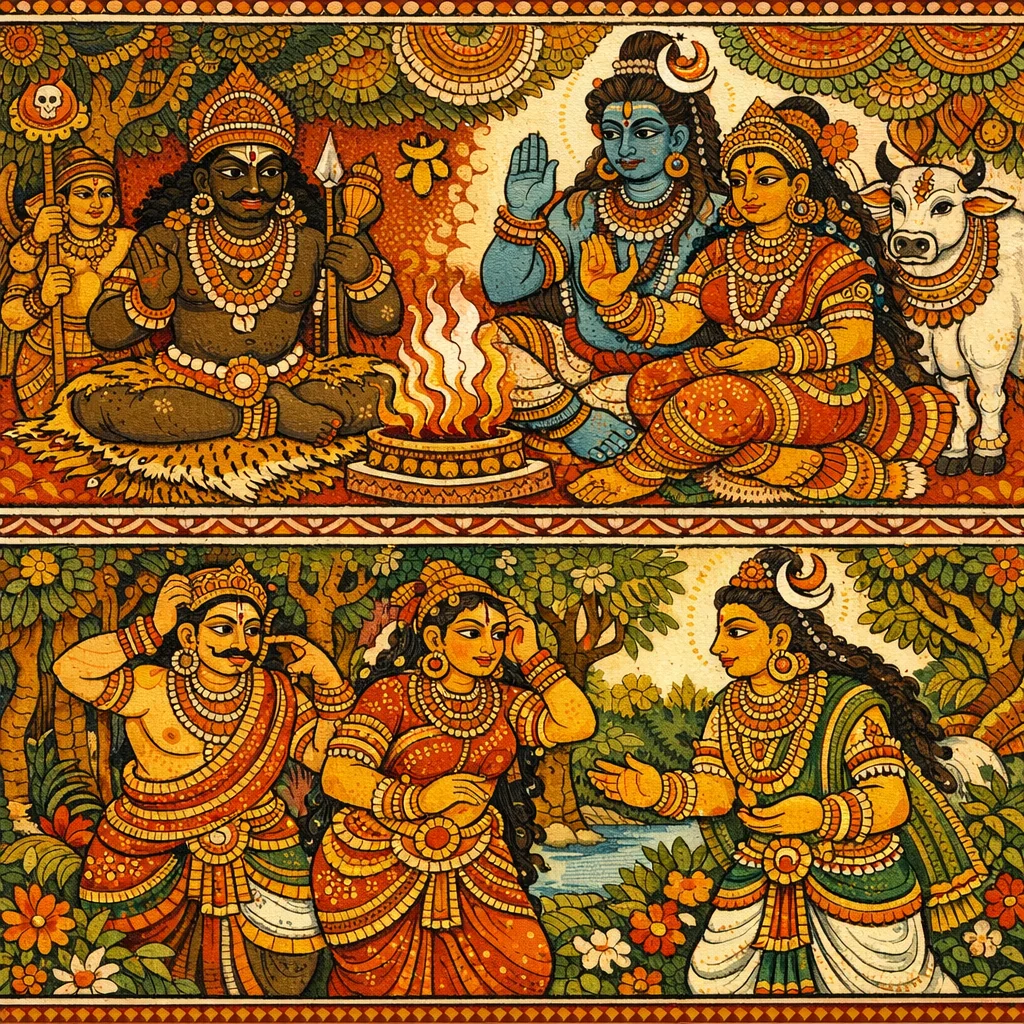
Adhyaya 11: Solar Dynasty Prelude: Vivasvān–Saṃjñā–Chāyā, Yama’s Boon, and the Ila Transformation (Start of the Ila-Upakhyana)
आदित्यवंशप्रसङ्गे वैवस्वतमन्वादिवृत्तान्तः (इला-उपाख्यानप्रारम्भः)
Speaker: Ṛṣis, Sūta
Adhyāya 11 opens with the ṛṣis requesting Sūta to narrate, in proper order, the lineages of Āditya (Solar dynasty) and Soma (Lunar dynasty). Sūta begins by detailing Vivasvān’s family: Saṃjñā’s withdrawal due to the Sun’s unbearable radiance, the creation of Chāyā as her substitute, and the ensuing tensions of unequal maternal affection. The chapter frames karma as inescapable, even for great beings, while showing how curses can be ritually and cosmically “managed” through prescribed remedies and tapas. Yama’s curse leads to austerities at Gokarṇa-tīrtha and a boon from Mahādeva—establishing Yama’s lokapāla role and authority over dharma/adharma scrutiny. Tvaṣṭṛ’s “tempering” of the Sun’s tejas produces divine weapons (Viṣṇu’s cakra, Rudra’s triśūla, Indra’s vajra) and gives a strong iconographic injunction: do not depict the Sun’s feet in worship images. The narrative then transitions into Vaivasvata Manu’s sons and the Ila episode, where entry into Śiva’s Śaravaṇa grove triggers a gender transformation and the Budha–Ilā union, setting up Lunar-dynasty continuities.
Key Concepts
Shlokas in Adhyaya 11
Verse 1
*ऋषय ऊचुः आदित्यवंशमखिलं वद सूत यथाक्रमम् सोमवंशं च तत्त्वज्ञ यथावद्वक्तुमर्हसि //
The sages said: “O Sūta, please narrate in due order the entire lineage of the descendants of Āditya, the Solar dynasty. And, O knower of truth, you should also properly relate the lineage of Soma, the Lunar dynasty, as is fitting.”
Verse 2
*सूत उवाच विवस्वान्कश्यपात् पूर्वम् अदित्यामभवत् सुतः तस्य पत्नीत्रयं तद्वत् संज्ञा राज्ञी प्रभा तथा //
Sūta said: “Earlier, Vivasvān was born as a son to Aditi from Kaśyapa. Likewise, he had three wives—Saṃjñā, the queen, and also Prabhā.”}]}}
Verse 3
रैवतस्य सुता राज्ञी रेवतं सुषुवे सुतम् प्रभा प्रभातं सुषुवे त्वाष्ट्री संज्ञा तथा मनुम् //
The queen, daughter of Raivata, bore a son named Revata. Prabhā gave birth to Prabhāta; and likewise Saṃjñā, the daughter of Tvaṣṭṛ, gave birth to Manu.
Verse 4
यमश्च यमुना चैव यमलौ तु बभूवतुः ततस्तेजोमयं रूपम् असहन्ती विवस्वतः //
Thus were born the twins—Yama and Yamunā. Thereafter, being unable to endure the blazing, radiant form of Vivasvān (the Sun), (she) withdrew in search of relief.
Verse 5
नारीमुत्पादयामास स्वशरीरादनिन्दिताम् त्वाष्ट्री स्वरूपरूपेण नाम्ना छायेति भामिनी //
From her own body she brought forth an irreproachable woman—Tvaṣṭrī in nature and in form—who was known by the name Chāyā, the radiant lady.
Verse 6
पुरतः संस्थितां दृष्ट्वा संज्ञा तां प्रत्यभाषत छाये तं भज भर्तारम् अस्मदीयं वरानने //
Seeing her standing before her, Saṃjñā spoke to her: “O Chāyā, O fair-faced one—go and attend upon that husband of ours.”
Verse 7
अपत्यानि मदीयानि मातृस्नेहेन पालय तथेत्युक्त्वा तु सा देवम् अगमत् क्वापि सुव्रता //
“Guard my children with a mother’s affection.” Having said, “So be it,” that virtuous lady then went to the god, departing to some place.
Verse 8
कामयामास देवो ऽपि संज्ञेयमिति चादरात् जनयामास तस्यां तु पुत्रं च मनुरूपिणम् //
The God, too, desired her, thinking with reverence, “She should be known and recognized.” And in her he begot a son who bore the very form and nature of Manu.
Verse 9
सवर्णत्वाच्च सावर्णिर् मनोर्वैवस्वतस्य च ततः शनिं च तपतीं विष्टिं चैव क्रमेण तु //
Because he was of the same lineage and class (savarṇa), in the line of Vaivasvata Manu he was known as Sāvarṇi; and from him, in due order, were born Śani, Tapatī, and Viṣṭi.
Verse 10
छायायां जनयामास संज्ञेयमिति भास्करः छाया स्वपुत्रे ऽभ्यधिकं स्नेहं चक्रे मनौ तथा //
In Chāyā, Bhāskara (the Sun) begot a son named Saṃjñeya. And Chāyā, likewise, showed greater affection toward her own son than toward Manu.
Verse 11
पूर्वो मनुस्तु चक्षाम न यमः क्रोधमूर्छितः संतर्जयामास तदा पादमुद्यम्य दक्षिणम् //
Then the ancient Manu, seeing that Yama was overcome by wrath, rebuked him; and, lifting up his right foot, threatened him in order to restrain him.
Verse 12
शशाप च यमं छाया सक्षतः कृमिसंयुतः पादो ऽयमेको भविता पूयशोणितविस्रवः //
Then Chāyā cursed Yama: “One of your feet shall become ulcerated and infested with worms, and it will ooze pus and blood.”
Verse 13
निवेदयामास पितुर् यमः शापादमर्षितः निष्कारणमहं शप्तो मात्रा देव सकोपया //
Enraged by that curse, Yama reported the matter to his father: “O Deva, though I am without fault, I have been cursed by my mother in her anger.”
Verse 14
बालभावान्मया किंचिद् उद्यतश् चरणः सकृत् मनुना वार्यमाणापि मम शापम् अदाद् विभो //
O Lord, out of childishness I once impulsively lifted my foot a little; though Manu tried to restrain me, I still uttered a curse—O Mighty One.
Verse 15
प्रायो न माता सास्माकं शापेनाहं यतो हतः देवो ऽप्याह यमं भूयः किं करोमि महामते //
Surely she is not truly our mother, for by her curse I have been struck down. Then the god himself spoke again to Yama: “What am I to do now, O great-minded one?”
Verse 16
मौर्ख्यात्कस्य न दुःखं स्याद् अथवा कर्मसंततिः अनिवार्या भवस्यापि का कथान्येषु जन्तुषु //
From folly, who would not fall into sorrow? Moreover, the continuing chain of karma is unavoidable—even for Śiva; what then can be said of other living beings?
Verse 17
कृकवाकुर्मया दत्तो यः कृमीन्भक्षयिष्यति क्लेदं च रुधिरं चैव वत्सायम् अपनेष्यति //
“Given by me in the form of the bird Kṛkavāku, this will devour the worms; and it will also remove the oozing moisture and the blood from the calf.”
Verse 18
एवमुक्तस्तपस्तेपे यमस्तीव्रं महायशाः गोकर्णतीर्थे वैराग्यात् फलपत्त्रानिलाशनः //
Thus instructed, the illustrious Yama undertook severe austerities at the sacred tīrtha of Gokarṇa; out of dispassion (vairāgya), he lived on fruits, leaves, and even on bare air.
Verse 19
आराधयन्महादेवं यावद्वर्षायुतायुतम् वरं प्रादान्महादेवः संतुष्टः शूलभृत्तदा //
He worshipped Mahādeva for ten-thousand times ten-thousand years; then Mahādeva—the Bearer of the trident—being pleased, granted him a boon.
Verse 20
वव्रे स लोकपालत्वं पितृलोके नृपालयम् धर्माधर्मात्मकस्यापि जगतस्तु परीक्षणम् //
He chose the office of a world-guardian (Lokapāla), and kingship in the realm of the Fathers (Pitṛloka), along with the charge of examining the world—though it is of the nature of both dharma and adharma.
Verse 21
एवं स लोकपालत्वम् अगमच्छूलपाणिनः पितॄणां चाधिपत्यं च धर्माधर्मस्य चानघ //
Thus, O sinless one, he attained the office of a guardian of the worlds under Śūlapāṇi (Śiva), and also the lordship over the Pitṛs, as well as authority concerning both dharma and adharma.
Verse 22
विवस्वानथ तज्ज्ञात्वा संज्ञायाः कर्मचेष्टितम् त्वष्टुः समीपमगमद् आचचक्षे च रोषवान् //
Then Vivasvān (the Sun), having understood Saṃjñā’s conduct and actions, went to Tvaṣṭṛ’s presence and, filled with anger, reported the matter to him.
Verse 23
तमुवाच ततस्त्वष्टा सान्त्वपूर्वं द्विजोत्तमाः तवासहन्ती भगवन् महस्तीव्रं तमोनुदम् //
Then Tvaṣṭṛ spoke to him, first with words of conciliation: “O best among the twice-born, O Lord—your radiance is unbearable, keen, and a dispeller of darkness; it is overwhelming.”
Verse 24
वडबारूपम् आस्थाय मत्सकाशम् इहागता निवारिता मया सा नु त्वया चैव दिवाकर //
Assuming the form of Vaḍabā—the mare-faced submarine fire—she came here into the presence of Matsya. I restrained her; yet, O Divākara (Sun), was she restrained by you as well?
Verse 25
यस्माद् अविज्ञाततया मत्सकाशम् इहागता तस्मान्मदीयं भवनं प्रवेष्टुं न त्वमर्हसि //
Since you have come here into my presence in ignorance—without recognition or proper understanding—therefore you are not fit to enter my dwelling.
Verse 26
एवमुक्ता जगामाथ मरुदेशमनिन्दिता वडबारूपम् आस्थाय भूतले सम्प्रतिष्ठिता //
Thus addressed, the blameless one then went to the desert region; assuming the form of a mare, she came to rest upon the surface of the earth.
Verse 27
तस्मात्प्रसादं कुरु मे यद्यनुग्रहभागहम् अपनेष्यामि ते तेजो यन्त्रे कृत्वा दिवाकर //
Therefore, be gracious to me, if I am indeed worthy of your favor. O Divākara (Sun), I shall draw away your radiance by fixing it within a yantra, a sacred device.
Verse 28
रूपं तव करिष्यामि लोकानन्दकरं प्रभो तथेत्युक्तः स रविणा भ्रमौ कृत्वा दिवाकरम् //
“O Lord, I shall fashion for you a form that brings delight to the worlds.” Thus addressed, Ravi (the Sun) assented, and—having made his two circuits—he became Divākara, the Maker of Day.
Verse 29
पृथक्चकार तत्तेजश् चक्रं विष्णोर् अकल्पयत् त्रिशूलं चापि रुद्रस्य वज्रमिन्द्रस्य चाधिकम् //
He then differentiated that radiant power and fashioned from it Viṣṇu’s discus (cakra), Rudra’s trident (triśūla), and also Indra’s supreme thunderbolt (vajra).
Verse 30
दैत्यदानवसंहर्तुः सहस्रकिरणात्मकम् रूपं चाप्रतिमं चक्रे त्वष्टा पद्भ्यामृते महत् //
Tvaṣṭṛ fashioned a vast and incomparable form of the slayer of the Daityas and Dānavas—radiant with a thousand rays—making it great in every limb, except for the feet.
Verse 31
न शशाकाथ तद्द्रष्टुं पादरूपं रवेः पुनः अर्चास्वपि ततः पादौ न कश्चित्कारयेत् क्वचित् //
He was not able to behold that foot-formed manifestation of Ravi (the Sun). Therefore, even in images made for worship, no one should ever have the feet fashioned in that particular form, anywhere.
Verse 32
यः करोति स पापिष्ठां गतिमाप्नोति निन्दिताम् कुष्ठरोगमवाप्नोति लोके ऽस्मिन्दुःखसंयुतः //
Whoever commits such an act attains a most sinful and condemned fate; in this very world he incurs leprosy (kuṣṭha) and lives bound to suffering.
Verse 33
तस्माच्च धर्मकामार्थी चित्रेष्वायतनेषु च न क्वचित्कारयेत्पादौ देवदेवस्य धीमतः //
Therefore, one who seeks dharma, pleasure, and prosperity should never have the feet of the wise Lord of Lords depicted anywhere—whether in paintings or within shrines and temple precincts.
Verse 34
ततः स भगवान्गत्वा भूर्लोकम् अमराधिपः कामयामास कामार्तो मुख एव दिवाकरः //
Then that blessed lord, sovereign of the immortals, went to the earthly world; and the Sun—his very face—was seized by longing and desired.
Verse 35
अश्वरूपेण महता तेजसा च समावृतः संज्ञा च मनसा क्षोभम् अगमद्भयविह्वला //
Enveloped in a great, blazing radiance, he appeared in the form of a horse; and Saṃjñā, terrified, became inwardly shaken and mentally agitated.
Verse 36
नासापुटाभ्यामुत्सृष्टं परो ऽयमिति शङ्कया तद्रेतसस् ततो जाताव् अश्विनाव् इति निश्चितम् //
Suspecting, “This is someone else (not my own),” he discharged that semen through the nostrils; from that seed, the two Aśvins were born—so it is firmly held.
Verse 37
दस्रौ सुतत्वात् संजातौ नासत्यौ नासिकाग्रतः ज्ञात्वा चिराच्च तं देवं संतोषम् अगमत् परम् //
Because they were born as sons, the two renowned ones—Dasra and Nāsatya—came forth from the tip of the nose. And, after a long time, having recognized that deity, he attained the highest contentment.
Verse 38
विमानेनागमत्स्वर्गं पत्या सह मुदान्विता सावर्णो ऽपि मनुर् मेराव् अद्याप्यास्ते तपोधनः शनिस्तपोबलादाप ग्रहसाम्यं ततः पुनः //
Joyfully accompanied by her husband, she went to heaven in a celestial vimāna. And Sāvarṇi Manu too—abounding in ascetic merit—still remains on Mount Meru even today. By the power of his austerities, Śani (Saturn) attained equality of rank among the planets; thereafter the cosmic order continued accordingly.
Verse 39
यमुना तपती चैव पुनर्नद्यौ बभूवतुः विष्टिर्घोरात्मिका तद्वत् कालत्वेन व्यवस्थिता //
Yamunā and Tapatī again became rivers; likewise Viṣṭi—of dreadful nature—was established in the same manner, as an embodiment of Time (Kāla).
Verse 40
मनोर् वैवस्वतस्यासन् दश पुत्रा महाबलाः इलस् तु प्रथमस्तेषां पुत्रेष्ट्यां समजायत //
Vaivasvata Manu had ten mighty sons; among them, Ila was the first, born through the Putreṣṭi sacrifice, the rite performed to obtain offspring.
Verse 41
इक्ष्वाकुः कुशनाभश्च अरिष्टो धृष्ट एव च नरिष्यन्तः करूषश्च शर्यातिश्च महाबलाः पृषध्रश्चाथ नाभागः सर्वे ते दिव्यमानुषाः //
Ikṣvāku, Kuśanābha, Ariṣṭa, and Dhṛṣṭa; Nariṣyanta, Karūṣa, and the mighty Śaryāti; and also Pṛṣadhra and Nābhāga—these all were men of divine stature.
Verse 42
अभिषिच्य मनुः पुत्रम् इलं ज्येष्ठं स धार्मिकः जगाम तपसे भूयः स महेन्द्रवनालयम् //
Having anointed his eldest son Ila as king, the righteous Manu departed once more for austerities, going to the forest-dwelling at Mahendra.
Verse 43
अथ दिग्जयसिद्ध्यर्थम् इलः प्रायान्महीम् इमाम् भ्रमन्द्वीपानि सर्वाणि क्ष्माभृतः सम्प्रधर्षयन् //
Then, to accomplish success in the conquest of the quarters, Ila set forth across this earth, roaming through all the continents and challenging the kings who bore the burden of the land.
Verse 44
जगामोपवनं शम्भोर् अश्वाकृष्टः प्रतापवान् कल्पद्रुमलताकीर्णं नाम्ना शरवणं महत् //
Drawn onward by his horse, the mighty and radiant one went to Śambhu’s sacred grove—an expansive woodland called Śaravaṇa, thickly overgrown with creepers of wish-fulfilling trees.
Verse 45
रमते यत्र देवेशः शम्भुः सोमार्धशेखरः उमया समयस्तत्र पुरा शरवणे कृतः //
There, in that place, the Lord of the gods—Śambhu, whose crest is adorned with the half-moon—takes delight; for long ago, in the Śaravaṇa grove, an appointed meeting was agreed upon there with Umā.
Verse 46
पुंनाम सत्त्वं यत्किंचिद् आगमिष्यति ते वने स्त्रीत्वमेष्यति तत्सर्वं दशयोजनमण्डले //
Whatever male creature, of any kind, comes into your forest—within a circuit of ten yojanas—all of it will become female.
Verse 47
अज्ञातसमयो राजा इलः शरवणे पुरा स्त्रीत्वमाप विशन्न् एव वडबात्वं हयस्तदा //
Unaware of the sacred restriction of time and place, King Ila once entered the Śaravaṇa grove; and at that very moment he attained womanhood, while his horse then became a mare.
Verse 48
पुरुषत्वं हृतं सर्वं स्त्रीरूपे विस्मितो नृपः इलेति साभवन्नारी पीनोन्नतघनस्तनी //
All his manhood was taken away; the king stood astonished in a woman’s form. She became a woman named Ilā, with full, high, and well-rounded breasts.
Verse 49
उन्नतश्रोणिजघना पद्मपत्त्रायतेक्षणा पूर्णेन्दुवदना तन्वी विलासोल्लासितेक्षणा //
Her hips and thighs are gracefully raised and well-formed; her eyes are elongated like lotus petals. Her face is like the full moon; she is slender, and her gaze is brightened with playful charm and graceful expression.
Verse 50
मूलोन्नतायतभुजा नीलकुञ्चितमूर्धजा तनुलोमा सुदशना मृदुगम्भीरभाषिणी //
Her arms are long and well-proportioned, raised nobly from the shoulders; her hair is dark and softly curled. She has fine body-hair, beautiful teeth, and a gentle yet deep and resonant manner of speech.
Verse 51
श्यामगौरेण वर्णेन हंसवारणगामिनी कार्मुकभ्रूयुगोपेता तनुताम्रनखाङ्कुरा //
She is of a complexion that blends dusky and fair hues; her gait is graceful like that of a swan or a noble elephant. She is adorned with a pair of eyebrows curved like a bow, and her slender nails have a delicate coppery-reddish tint.
Verse 52
भ्रमन्ती च वने तस्मिंश् चिन्तयामास भामिनी को मे पिताथवा भ्राता का मे माता भवेदिह //
Wandering in that forest, the distraught woman reflected: “Who here could be my father or my brother? Who here could be my mother?”
Verse 53
कस्य भर्तुरहं दत्ता कियद्वत्स्यामि भूतले चिन्तयन्तीति ददृशे सोमपुत्रेण साङ्गना //
“To which husband have I been given? How long shall I remain upon this earth?”—as she pondered thus, that lady was seen by Budha, Soma’s son, together with his attendants.
Verse 54
इला रूपसमाक्षिप्तमनसा वरवर्णिनी बुधस्तदाप्तये यत्नम् अकरोत्कामपीडितः //
Budha—his mind seized by the beauty of fair-complexioned Ilā—strove to win her, tormented by desire.
Verse 55
विशिष्टाकारवान्दण्डी सकमण्डलुपुस्तकः वेणुदण्डकृतानेकपवित्रकगणत्रिकः //
He is to be depicted with a distinctive form, bearing a staff and holding a kamaṇḍalu (water-pot) and a book; and with many sacred rings/amulets fashioned from a bamboo staff, arranged in three sets (triads).
Verse 56
द्विजरूपः शिखी ब्रह्मा निगदन्कर्णकुण्डलः बटुभिश्चान्वितो युक्तैः समित्पुष्पकुशोदकैः //
Brahmā, assuming the form of a twice-born Brahmin, wearing a topknot (śikhā) and ear-ornaments, arrived reciting sacred utterances, accompanied by disciplined brahmacārin youths carrying fuel-sticks, flowers, kuśa-grass, and water for ritual use.
Verse 57
किलान्विषन् वने तस्मिन् नाजुहाव स तामिलाम् बहिर् वनस्यान्तरितः किल पादपमण्डले //
While searching in that forest, he did not call out to Ilā. Remaining outside the forest, he stayed concealed, it is said, within a circle of trees.
Verse 58
ससंभ्रममकस्मात्तां सोपालम्भमिवावदत् त्यक्त्वाग्निहोत्रशुश्रूषां क्व गता मन्दिरान्मम //
Suddenly, in a rush of agitation, he spoke to her as if in reproach: “Having abandoned the attentive service of the Agnihotra, where have you gone from my house?”
Verse 59
इयं विहारवेला ते ह्य् अतिक्रामति साम्प्रतम् एह्येहि पृथुसुश्रोणि संभ्रान्ता केन हेतुना //
“Your hour for recreation is passing even now. Come, come, O broad-hipped, fair-thighed one—why are you so agitated; for what reason?”
Verse 60
इयं सायन्तनी वेला विहारस्येह वर्तते कृत्वोपलेपनं पुष्पैर् अलंकुरु गृहं मम //
“This is the evening hour appointed here for rest and recreation. Having smeared and purified the place, adorn my house with flowers.”
Verse 61
सा त्व् अब्रवीद् विरमृताहं सर्वमेतत्तपोधन आत्मानं त्वां च भर्तारं कुलं च वद मे ऽनघ //
Then she said: “O ascetic rich in austerity, I have now desisted from all this. O sinless one, tell me—who you are, who I am, who my husband is, and what lineage I belong to.”
Verse 62
बुधः प्रोवाच तां तन्वीम् इला त्वं वरवर्णिनी अहं च कामुको नाम बहुविद्यो बुधः स्मृतः //
Budha spoke to that slender maiden: “You are Ilā, O fair-complexioned one. And I am called Kāmuka; I am Budha, renowned as one learned in many branches of knowledge.”
Verse 63
तेजस्विनः कुले जातः पिता मे ब्राह्मणाधिपः इति सा तस्य वचनात् प्रविष्टा बुधमन्दिरम् //
“My father,” she said, “was born in a radiant lineage and was a foremost lord among Brahmins.” Thus, at his word, she entered the residence of Budha (the wise one).
Verse 64
रत्नस्तम्भसमायुक्तं दिव्यमायाविनिर्मितम् इला कृतार्थमात्मानं मेने तद्भवनस्थिता //
Set with jewel-like pillars and fashioned by divine illusion, that wondrous mansion made Ilā—dwelling within it—feel that her own purpose had been fulfilled.
Verse 65
अहो वृत्तमहो रूपम् अहो धनमहो कुलम् मम चास्य च मे भर्तुर् अहो लावण्यम् उत्तमम् //
Ah, what admirable conduct! Ah, what beauty! Ah, what wealth; ah, what noble lineage! And ah—both mine and his, and of my husband—what unsurpassed loveliness!
Verse 66
रेमे च सा तेन समम् अतिकालमिला ततः सर्वभोगमये गेहे यथेन्द्रभवने तथा //
Then Ilā, for a very long time, delighted together with him, dwelling in a house filled with every comfort—like the very palace of Indra.
Frequently Asked Questions
The chapter teaches that lineage narratives are not mere history but encode dharma: karma’s continuity (karma-santati) operates even among gods, curses function as moral-cosmic instruments, and tapas at a tīrtha can transform destiny and office (Yama becoming lokapāla and Pitṛloka ruler). It also gives a practical religious instruction in mūrti/temple-art: Surya’s feet should not be depicted in worship images, with consequences described for violating this injunction.
Genealogy dominates: Vivasvān, Saṃjñā, Chāyā, Vaivasvata Manu and his sons (including Ilā and Ikṣvāku) and the narrative bridge toward the Lunar line through Budha. Dharma appears through Yama’s judicial mandate over dharma/adharma and the ethics of action-and-result (karma). Vastu/architecture is not a construction manual here, but the chapter contributes to sacred art/temple practice via iconographic rules for Surya images (arca) and guidance about what should not be fashioned in shrines or paintings.
After Tvaṣṭṛ refashions Surya’s tejas and creates a worship-form, the text states that the Sun’s ‘foot-formed manifestation’ is not to be beheld and therefore feet should not be made in arca images. It further warns that making such feet leads to a condemned fate and affliction (kustha/leprosy), so a dharma-seeker should avoid depicting the Lord’s feet in paintings or temple precincts.
It begins with the Solar line through Vivasvān and Vaivasvata Manu, then introduces Ilā—Manu’s heir—whose transformation in Śiva’s Śaravaṇa grove leads to her union with Budha (son of Soma). This narrative pivot functions as a genealogical bridge, preparing the reader for Soma-vaṁśa continuities while still rooted in Vaivasvata Manu’s Solar framework.