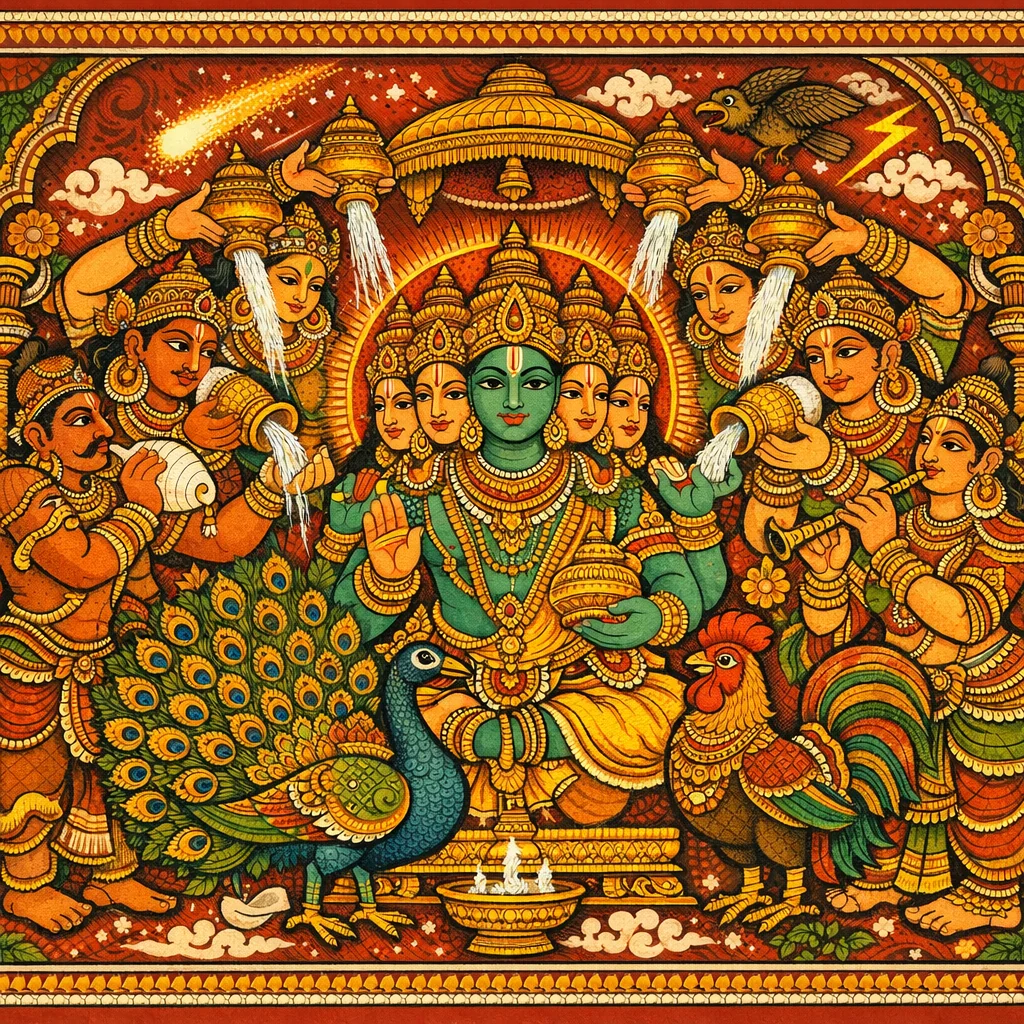
Adhyaya 159: Skanda’s Consecration, the Six‑Faced Hymn, and the Opening of the Tāraka Conflict
स्कन्दाभिषेकः षण्मुखस्तोत्रं तारकदूतसंवादश्च
Speaker: Sūta, Devas (collective hymn), Kumāra/Guha (Skanda), Tāraka, Dūta (envoy/messenger)
Sūta recounts Skanda’s manifestation and the Kṛttikā-linked reason for his six faces and names—Viśākha, Ṣaṇmukha, Ṣaḍvaktra, and Kārttikeya. On prescribed Caitra tithis the gods perform rites and consecrate (abhiṣeka) Guha; Indra bestows Devasenā, while other deities grant weapons, hosts, power, a vehicle, and a shape-shifting rooster, forming Skanda’s retinue. The devas kneel and chant a stotra praising his beauty, valor, peacock mount, banner, and fear-dispelling protection. Pleased, Skanda vows to destroy the foes and asks the gods to state their wish; they request the slaying of Tāraka, lord of the Dānavas. Skanda agrees and marches with the immortals. Indra then opens the campaign; an envoy delivers a challenge to Tāraka, who replies with scorn. Tāraka sees ominous portents and beholds the celestial army approaching amid music and victory-gāthās proclaiming Kumāra’s imminent triumph.
Key Concepts
Shlokas in Adhyaya 159
Verse 1
*सूत उवाच वामं विदार्य निष्क्रान्तः सुतो देव्याः पुनः शिशुः स्कन्दाच्च वदने वह्नेः शुक्रात्सुवदनो ऽरिहा //
Sūta said: “Having burst forth by splitting the left side, he became the Goddess’s son; again he became an infant. From Skanda’s mouth, from Agni’s mouth, and from the seed, he became ‘Suvadana’ (the fair-faced one), the slayer of enemies.”
Verse 2
कृत्तिकामेलनादेव शाखाभिः सविशेषतः शाखाभिधाः समाख्याताः षट्सु वक्त्रेषु विस्तृताः //
From the gathering of the Kṛttikās (the Pleiades) itself, these distinct ‘branches’ (śākhās) are specifically designated by their names, and they are set forth in detail with reference to the six faces.
Verse 3
यतस्ततो विशाखो ऽसौ ख्यातो लोकेषु षण्मुखः स्कन्दो विशाखः षड्वक्त्रः कार्तिकेयश्च विश्रुतः //
Therefore, he is celebrated in the worlds as Viśākha, as Ṣaṇmukha (the Six-faced), as Skanda, as Viśākha again, as Ṣaḍvaktra (the Six-mouthed), and as the renowned Kārttikeya.
Verse 4
चैत्रस्य बहुले पक्षे पञ्चदश्यां महाबलौ सम्भूतावर्कसदृशौ विशाले शरकानने //
On the fifteenth day (full-moon) of the dark fortnight of the month of Caitra, two exceedingly mighty ones were born—radiant like the sun—in the vast Śara forest.
Verse 5
चैत्रस्यैव सिते पक्षे पञ्चम्यां पाकशासनः बालकाभ्यां चकारैकं मत्वा चामरभूतये //
In the bright fortnight of Caitra, on the fifth lunar day, Pākaśāsana (Indra) performed a single rite with two young boys, considering it a means to attain the state of immortality among the gods.
Verse 6
तस्यामेव ततः षष्ठ्याम् अभिषिक्तो गुहः प्रभुः सर्वैरमरसंघातैर् ब्रह्मेन्द्रोपेन्द्रभास्करैः //
Then, on that very sixth (lunar day), the sovereign Guha was consecrated (as king), anointed by all the assembled hosts of the immortals—by Brahmā, Indra, Upendra (Vishnu), and Bhāskara (the Sun).
Verse 7
गन्धमाल्यैः शुभैर्धूपैस् तथा क्रीडनकैरपि छत्रैश्चामरजालैश्च भूषणैश्च विलेपनैः //
With perfumes and garlands, with auspicious incense, and also with playthings; with parasols and clusters of chowries, with ornaments, and with unguents—(one should honor the deity/recipient with such offerings).
Verse 8
अभिषिक्तो विधानेन यथावत्षण्मुखः प्रभुः सुतामस्मै ददौ शक्रो देवसेनेति विश्रुताम् //
When the Lord Ṣaṇmukha had been duly consecrated according to the prescribed rite, Śakra (Indra) gave him his daughter—renowned as Devasenā.
Verse 9
पत्न्यर्थं देवदेवस्य ददौ विष्णुस्तदायुधम् यक्षाणां दशलक्षाणि ददावस्मै धनाधिपः //
For the sake of obtaining a wife for the God of gods, Viṣṇu then bestowed his own weapon; and the Lord of wealth granted him ten million Yakṣas.
Verse 10
ददौ हुताशनस्तेजो ददौ वायुश्च वाहनम् ददौ क्रीडनकं त्वष्टा कुक्कुटं कामरूपिणम् एवं सुरास्तु ते सर्वे परिवारमनुत्तमम् //
Agni (Hutāśana) bestowed radiant energy; Vāyu bestowed a vehicle. Tvaṣṭṛ granted a plaything— a rooster capable of assuming any form. Thus did all those gods bestow upon him an unsurpassed retinue.
Verse 11
ददुर्मुदितचेतस्काः स्कन्दायादित्यवर्चसे //
With delighted hearts, they made offerings to Skanda, whose radiance is like that of the Sun.
Verse 12
जानुभ्यामवनौ स्थित्वा सुरसंघास्तमस्तुवन् स्तोत्रेणानेन वरदं षण्मुखं मुख्यशः सुराः //
Kneeling on the ground, the hosts of gods praised him; with this hymn, the foremost among the devas extolled the boon-giving Six-Faced Lord (Ṣaṇmukha).
Verse 13
*देवा ऊचुः नमः कुमाराय महाप्रभाय स्कन्दाय च स्कन्दितदानवाय नवार्कविद्युद्द्युतये नमो ऽस्तुते नमो ऽस्तु ते षण्मुख कामरूप //
The gods said: Salutations to Kumāra, the great and radiant Lord; salutations to Skanda, the one who has scattered the demons. Salutations to you whose splendor is like that of a newly risen sun and lightning. Salutations to you—salutations to you, O Six-faced one, who assumes forms at will.
Verse 14
पिनद्धनानाभरणाय भर्त्रे नमो रणे दानवदारणाय नमो ऽस्तु ते ऽर्कप्रतिमप्रभाय नमो ऽस्तु गुह्याय गुहाय तुभ्यम् //
Salutations to you, the Lord adorned with many fastened ornaments; salutations to you, the protector—who in battle rends the Dānavas. Salutations to you whose radiance is like the sun; salutations to you, the mysterious One—Guhya, and to you, Guha.
Verse 15
नमो ऽस्तु त्रैलोक्यभयापहाय नमो ऽस्तु ते बाल कृपापराय नमो विशालामललोचनाय नमो विशाखाय महाव्रताय //
Salutations to you, the remover of fear for the three worlds. Salutations to you, O gentle one, devoted to compassion. Salutations to you whose eyes are vast and spotless. Salutations to you, O Viśākha, the great-vowed one.
Verse 16
नमो नमस्ते ऽस्तु मनोहराय नमो नमस्ते ऽस्तु रणोत्कटाय नमो मयूरोज्ज्वलवाहनाय नमो ऽस्तु केयूरधराय तुभ्यम् //
Salutations, salutations to you, the enchanting one. Salutations, salutations to you, the formidable one in battle. Salutations to you whose radiant mount is the peacock. Salutations to you, the wearer of armlets.
Verse 17
नमो धृतोदग्रपताकिने नमस्ते नमः प्रभावप्रणताय ते ऽस्तु नमस्ते नमस्ते वरवीर्यशालिने कृपापरो नो भव भव्यमूर्ते //
Salutations to you who bear the lofty banner aloft! Homage to you—may my reverent bowing to your majesty be fulfilled. Salutations, salutations to you, endowed with supreme valor and power. O auspicious-formed Lord, be compassionate toward us; be our gracious protector.
Verse 18
क्रियापरा यज्ञपतिं च स्तुत्वा विनेमुरेवं त्वमराधिपाद्याः एवं तदा षड्वदनस्तु सेन्द्रान् उवाच तुष्टश्च गुहस्ततस्तान् निरीक्ष्य नेत्रैरमलैः सुरेशाञ् शत्रून्हनिष्यामि गतज्वराः स्थ //
Intent on sacred rites, the chiefs of the gods—having praised the Lord of sacrifice—bowed in this manner. Then the six-faced Guha (Skanda), pleased, looked upon Indra and the other lords of the gods with spotless eyes and said: “I shall slay the enemies; be free from fevered fear and stand firm.”
Verse 19
*कुमार उवाच कं वः कामं प्रयच्छामि देवता ब्रूत निर्वृताः यद्यप्यसाध्यं हृद्यं वो हृदये चिन्तितं परम् //
Kumāra said: “What desire shall I grant you? Speak, O gods, with glad hearts. Even if what you cherish is impossible to accomplish—whatever supreme wish you have conceived within your hearts.”
Verse 20
इत्युक्तास्तु सुरास्तेन प्रोचुः प्रणतमौलयः सर्व एव महात्मानं गुहं तद्गतमानसाः //
Thus addressed by him, all the gods—bowing their heads—spoke to the great-souled Guha, their minds wholly fixed upon him.
Verse 21
दैत्येन्द्रस्तारको नाम सर्वामरकुलान्तकृत् बलवान्दुर्जयो दुष्टो दुराचारो ऽतिकोपनः तमेव जहि हृद्यो ऽर्थ एषो ऽस्माकं भयापह //
There is a lord of the Dānavas named Tāraka, a bringer of ruin upon the entire lineage of the gods. He is mighty, hard to conquer—wicked, of corrupt conduct, and exceedingly wrathful. Slay him alone; this is the cherished purpose that will remove our fear.
Verse 22
एवमुक्तस्तथेत्युक्त्वा सर्वामरपदानुगः जगाम जगतां नाथः स्तूयमानो ऽमरेश्वरैः //
Thus addressed, he replied, “So be it,” and the Lord of the worlds departed—followed by all the immortals—while being praised by the divine lords.
Verse 23
तारकस्य वधार्थाय जगतः कण्टकस्य वै ततश्च प्रेषयामास शक्रो लब्धसमाश्रयः //
Then Śakra (Indra), having secured a firm refuge and support, dispatched (his emissaries/forces) for the purpose of slaying Tāraka—indeed that ‘thorn’ afflicting the worlds.
Verse 24
दूतं दानवसिंहस्य परुषाक्षरवादिनम् स तु गत्वाब्रवीद्दैत्यं निर्भयो भीमदर्शनः //
The envoy of the lion among the Dānavas—one who spoke in harsh words—went and delivered the message to the Daitya, fearless and formidable to behold.
Verse 25
*दूत उवाच शक्रस्त्वामाह देवेशो दैत्यकेतो दिवस्पतिः तारकासुर तच्छ्रुत्वा घटशक्त्या यथेच्छया //
The messenger said: “Śakra (Indra)—the Lord of the gods, the banner of the gods, the ruler of heaven—addresses you, O Tārakāsura, the standard-bearer of the Daityas. Having heard this, act as you wish, with your mace-like power.”
Verse 26
यज्जगद्दलनादाप्तं किल्बिषं दानव त्वया तस्याहं शासकस्ते ऽद्य राजास्मि भुवनत्रये //
O Dānava, the sin you incurred by crushing the world—of that I am your chastiser today; for I am the king across the three worlds.
Verse 27
श्रुत्वैतद्दूतवचनं कोपसंरक्तलोचनः उवाच दूतं दुष्टात्मा नष्टप्रायविभूतिकः //
Hearing these words of the envoy, his eyes reddened with anger; that wicked-souled man—whose power and prosperity were almost ruined—spoke to the messenger.
Verse 28
*तारक उवाच दृष्टं ते पौरुषं शक्र रणेषु शतशो मया निस्त्रपत्वान्न ते लज्जा विद्यते शक्र दुर्मते //
Tāraka said: “O Śakra (Indra), I have seen your ‘manliness’ a hundred times on battlefields. Being shameless, you have no sense of shame at all, O Śakra—fool of a mind!”
Verse 29
एवमुक्ते गते दूते चिन्तयामास दानवः नालब्धसंश्रयः शक्रो वक्तुमेवं हि चार्हति //
When the messenger had departed after speaking thus, the Daitya reflected: “Śakra (Indra), having found no support, is indeed compelled to speak in this manner.”
Verse 30
जितः स शक्रो नाकस्माज् जायते संश्रयाश्रयः निमित्तानि च दुष्टानि सो ऽपश्यद्दुष्टचेष्टितः //
That Śakra (Indra), having been defeated, did not become a refuge for others without cause; and, being of troubled conduct, he beheld evil portents and inauspicious signs.
Verse 31
पांशुवर्षमसृक्पातं गगनादवनीतले भुजनेत्रप्रकम्पं च वक्त्रशोषमनोभ्रमम् //
A rain of dust and a fall of blood from the sky onto the earth—trembling of the arms and eyes, dryness of the mouth, and a bewildering agitation of the mind—(these are seen as dreadful portents).
Verse 32
स्वकान्तावक्त्रपद्मानां म्लानतां च व्यलोकयत् दुष्टांश्च प्राणिनो रौद्रान् सो ऽपश्यद्दुष्टवेदिनः //
He observed the fading of the lotus-like faces of his beloved (women), and he also saw living beings who had become wicked and fierce—men of corrupted understanding who took delight in wrongdoing.
Verse 33
तदचिन्त्वैव दितिजो न्यस्तचिन्तो ऽभवत्क्षणात् यावद्गजघटाघण्टारणत्काररवोत्कटाम् //
Without giving it any further thought, the Daitya at once cast off his anxiety—until the fierce uproar arose: the resonant clang and ringing peals from the bells of the elephant-squadrons.
Verse 34
तद्वत्तुरगसंघातक्षुण्णभूरेणुपिञ्जराम् चञ्चलस्यन्दनोदग्रध्वजराजिविराजिताम् //
Likewise, it (the host/force) was tawny with the earth-dust pulverized by the mass of horses, and it shone with the wavering chariots and the lofty rows of banners rising above them.
Verse 35
विमानैश्चाद्भुताकारैश् चलितामरचामरैः तां भूषणनिबद्धां च किंनरोद्गतिनादिताम् //
She was accompanied by wondrously formed aerial chariots (vimānas), while yak-tail fans (cāmaras) waved in motion; adorned and fastened with ornaments, she resounded with the music and calls raised by the Kinnaras.
Verse 36
नानानाकतरूत्फुल्लकुसुमापीडधारिणीम् विकोशास्त्रपरिष्कारां वर्मनिर्मलदर्शनाम् //
She is adorned with a floral crest made of blossoms freshly opened on many kinds of trees; her weapons are displayed unsheathed and well-arranged; and her armour presents a spotless, radiant appearance.
Verse 37
बन्द्युद्घुष्टस्तुतिरवां नानावाद्यनिनादिताम् सेनां नाकसदां दैत्यः प्रासादस्थो व्यलोकयत् //
Standing upon his palace, the Daitya watched the army of the heaven-dwellers—resounding with the acclaim of bards and the roar of many kinds of musical instruments.
Verse 38
चिन्तयामास स तदा किंचिदुद्भ्रान्तमानसः अपूर्वः को भवेद्योद्धा यो मया न विनिर्जितः //
Then he reflected, his mind somewhat unsettled: “Who could that unprecedented warrior be—one whom I have not yet defeated?”
Verse 39
ततश्चिन्ताकुलो दैत्यः शुश्राव कटुकाक्षरम् सिद्धबन्दिभिरुद्घुष्टम् इदं हृदयदारणम् //
Then the Daitya, overwhelmed with anxiety, heard bitter, cutting words—proclaimed aloud by Siddhas and celestial bards—words that were heart-rending to hear.
Verse 40
अथ गाथा जयातुलशक्तिदीधितिपिञ्जर भुजदण्डचण्डरणरभस । सुरवदन / कुमुदकानन-विकासनेन्दो कुमार जय दितिजकुलमहोदधिवडवानल ॥
Now, a victory-song: Triumph, O Kumāra—whose arm is tawny with the blaze of the peerless spear’s radiance, whose battle-onrush is fierce in the shock of combat; whose face is like that of a god, a moon that makes the grove of night-lotuses bloom—victorious one, the submarine fire that dries up the vast ocean of the Daitya clans.
Verse 41
षण्मुख मधुररवमयूररथ सुरमुकुटकोटिघट्टितचरणनखाङ्कुरमहासन । / जय ललितचूडाकलापनवविमलदलकमलकान्त दैत्यवंशदुःसहदावानल ॥
Victory to you, O Six‑faced Lord—riding the peacock whose cry is sweet—seated upon a lofty throne, while the tips of your toenails are struck by the crowns of the gods as they bow. Victory to you, lovely as a lotus of freshly pure petals, adorned with charming crests and clusters of plumes—O unbearable forest‑fire to the lineage of demons!
Verse 42
जय विशाख विभो जय सकललोकतारक जय देवसेनानायक । स्कन्द जय गौरीनन्दन / घण्टाप्रिय प्रिय विशाख विभो धृतपताकप्रकीर्णपटल । कनकभूषण भासुरदिनकरच्छाय ॥
Victory to you, O Viśākha, O mighty Lord; victory to you, the savior of all worlds; victory to you, the commander of Devasenā. Victory to you, O Skanda, son of Gaurī—dear to the bell’s sound—O beloved Viśākha, whose banner and spreading pennants are unfurled; adorned with gold, radiant with a brilliance like the sun’s glow.
Verse 43
जय जनितसंभ्रम लीलालूनाखिलाराते जय सकललोकतारक / दितिजासुरवरतारकान्तक । स्कन्द जय बाल सप्तवासर जय भुवनावलिशोकविनाशन ॥
Victory to you, who stir awe and excitement, and who in sportive play have cut down all enemies. Victory to you, the savior of all the worlds, the destroyer of the mighty Tāraka among the Diti-born demons. O Skanda, victory to you—the wondrous child of but seven days—victory to you, the remover of the sorrow of the hosts of worlds.
Frequently Asked Questions
The chapter teaches Skanda’s theological identity (many origins yet one deity) and the ritual principle of legitimization through abhiṣeka and stotra. It frames divine leadership as dharmic protection: the devas consecrate Guha, empower him with gifts and allies, and commission him to remove the world’s “thorn” (Tāraka), showing how authority, worship, and righteous warfare interlock in Purāṇic ethics.
Primarily genealogy/theogony and dharma in the form of cosmic governance: Skanda’s names and six-faced identity (genealogical-theological mapping), ritual consecration and worship protocol (ritual dharma), and the opening diplomacy of the Deva–Asura war against Tāraka (protective duty of rulers/commanders). Vāstu/architecture is not a focus in this adhyāya.