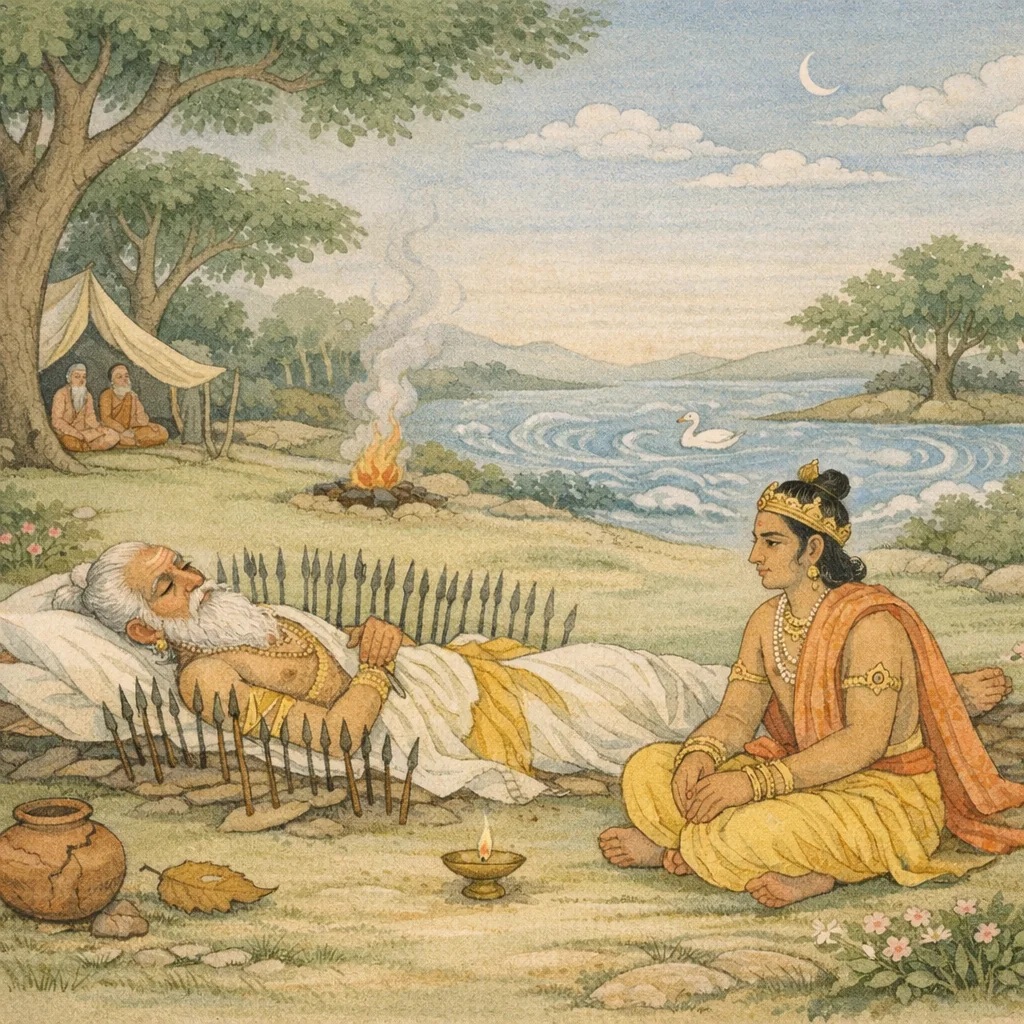
Adhyaya 301
Adhyātma–Adhibhūta–Adhidaivata Correspondences and the Triguṇa Lakṣaṇas (Śānti-parva 301)
Upa-parva: Mokṣa-dharma (Liberation Teachings) — Adhyātma/Guṇa Exposition Unit
Yājñavalkya enumerates correspondences linking bodily faculties to their experiential domains and presiding principles: feet with movement and Viṣṇu; anus with excretion and Mitra; genitals with pleasure and Prajāpati; hands with action and Indra; speech with utterance and Agni; eye with form and Sūrya; ear with sound and the directions; tongue with taste and waters; nose with smell and earth; skin with touch and wind; mind with thought and Candra; ego-function with self-assertion and Bhava; and intellect with knowability and the kṣetrajña as the presiding principle. He then states that prakṛti, through the guṇas, diversifies manifestations in innumerable ways, illustrated by the analogy of many lamps lit from one. The chapter proceeds to a classificatory ethics: sattva is characterized by clarity, joy, health, contentment, restraint, forgiveness, non-harm, truthfulness, humility, cleanliness, generosity, and compassion; rajas by acquisitiveness, contentiousness, anxiety, harshness, desire and anger, pride and hostility; and tamas by delusion, obscuration, lethargy, indulgence, inattentiveness, misplaced credulity born of ignorance, and aversion to dharma-specific disciplines. The net effect is an instructional map connecting cosmology, psychology, and conduct for discernment-oriented practice.
Chapter Arc: युधिष्ठिर, भीष्म से निवेदन करते हैं कि योग का वर्णन सुन लिया—अब वे सांख्य की सम्पूर्ण विधि, उसके सूक्ष्म तत्त्व और फल को विस्तार से जानना चाहते हैं। → भीष्म ‘सूक्ष्म’ सांख्य-मार्ग का प्रवचन आरम्भ करते हैं—देह के दोष, देहजन्य दुःख, और इन्द्रिय-मन की विक्लवता को यथार्थ रूप से पहचानने की कठोर साधना सामने आती है; गुण-दोष और कारणों की अनेक परतें खोलते हुए विवेक की परीक्षा बढ़ती जाती है। → सांख्य का शिखर-निष्कर्ष उद्घाटित होता है—समस्त गुणों (जल, पृथ्वी आदि तत्त्वों के गुण सहित) का क्षेत्र-क्षेत्रज्ञ में व्याप्त होना, और उस परम तत्त्व का बोध जिसके सामने यह समस्त विवेचन एक ही सत्य की ओर संकेत करता है; ‘इस ज्ञान के तुल्य अन्य ज्ञान नहीं’—यह निर्णायक घोषणा साधक को परमगति की ओर मोड़ देती है। → भीष्म निष्कर्ष देते हैं कि महाप्राज्ञ सांख्ययोगी इसी ज्ञान से परमगति को प्राप्त होते हैं; देह-दोषों का विवेक, गुणों का यथार्थ ज्ञान, और क्षेत्रज्ञ-बोध—ये मोक्षमार्ग के साधन हैं।
Shlokas
Verse 1
ऑपन--मा जल बछ। जज: एकाधिकंत्रेशततमो<ध्याय: सांख्ययोगके अनुसार साधन और उसके फलका वर्णन युधिछिर उवाच सम्यक् त्वया<यं नृपते वर्णित: शिष्टसम्मत: । योगमार्गो यथान्यायं शिष्यायेह हितैषिणा,युधिष्ठिरने कहा--महाराज! आप मेरे हितैषी हैं, आपने मुझ शिष्यके प्रति शिष्ट पुरुषोंके मतके अनुसार इस योगमार्गका यथोचितरूपसे वर्णन किया इस प्रकार श्रीमहाभारत शान्तिपर्वके अन्तर्गत गोक्षधर्मपर्वमें यांख्यतत््वका वर्णणविषयक तीन सौ एकवाँ अध्याय पूरा हुआ ॥// ३०१ ॥। $. ज्ञानशक्ति, वैराग्य, स्वामिभाव, तप, सत्य, क्षमा, थैर्य, स्वच्छता, आत्माका बोध और अधिष्ठातृत्व--ये दस सात्त्विक गुण बताये गये हैं। २. असंतोष, पश्चात्ताप, शोक, लोभ, अक्षमा, दमन करनेकी प्रवृत्ति, काम, क्रोध और ईर्ष्या-ये नौ राजस गुण बताये गये हैं। ३. अविवेक, मोह, प्रमाद, स्वप्न, निद्रा, अभिमान, विषाद और प्रीतिका अभाव-ये आठ तामस गुण हैं। ४. महत्, अहंकार, शब्दतन्मात्रा, स्पर्शतन्मात्रा, रूपतन्मात्रा, रसतन्मात्रा और गन्धतन्मात्रा-ये सात गुण बुद्धिके हैं। ३. श्रोत्र, त्वचा, नेत्र, रसना और प्राण-इन पाँच इन्द्रियोंसहित छठा मन-ये मनके छ: गुण हैं। २. आकाश, वायु, अग्नि, जल और पृथ्वी--ये आकाशके पाँच गुण हैं। ३. संशय, निश्चय, गर्व और स्मरण-ये बुद्धिके चार गुण हैं। ४. अप्रतिपत्ति, विप्रतिपत्ति और विपरीत प्रतिपत्ति-ये तीन गुण तमके हैं। ५. प्रवृत्ति तथा दुःख--ये दो गुण रजके हैं। ६. प्रकाश सत्त्वका एक प्रधान गुण है। द्र्याधिकत्रिशततमो<ध्याय: वसिष्ठ और करालजनकका संवाद--क्षर और अक्षरतत्त्वका निरूपण और इनके ज्ञानसे मुक्ति युधिछिर उवाच कि तदक्षरमित्युक्तं यस्मान्नावर्तते पुन: । कि च तत्क्षरमित्युक्त यस्मादावर्तते पुन:
Yudhiṣṭhira said: “What is that which is called the Imperishable—knowing which one does not return again? And what is that which is called the Perishable—because of which one returns again?”
Verse 2
सांख्ये त्विदानीं कार्त्स्न्येन विधि प्रब्रूहि पृच्छते । त्रिषु लोकेषु यज्ज्ञानं सर्व तद् विदितं हि ते,अब मैं सांख्यविषयक सम्पूर्ण विधि पूछ रहा हूँ। आप मुझे उसे बतानेकी कृपा करें; क्योंकि तीनों लोकोंमें जो ज्ञान है, वह सब आपको विदित है
Yudhiṣṭhira said: “Now I ask you to set forth, in full, the proper method and doctrine of Sāṅkhya. Please explain it to me, for all the knowledge that exists in the three worlds is indeed known to you.”
Verse 3
भीष्म उवाच शृणु मे त्वमिदं सूक्ष्मं सांख्यानां विदितात्मनाम् विहितं यतिभि: सर्वे: कपिलादिभिरी श्वरै:,भीष्मजीने कहा--युधिष्ठटिर! आत्मतत्त्वके जाननेवाले सांख्यशास्त्रके विद्वानोंका यह सूक्ष्म ज्ञान तुम मुझसे सुनो। इसे ईश्वरकोटिके कपिल आदि सम्पूर्ण यतियोंने प्रकाशित किया है
Bhishma said: “Listen to me, O Yudhishthira, to this subtle doctrine known to the Sāṅkhya sages who have realized the Self. It has been set forth by all the ascetics—by exalted seers such as Kapila—who are revered as godlike in spiritual authority.”
Verse 4
यस्मिन् न विभ्रमा: केचिद् दृश्यन्ते मनुजर्षभ । गुणाश्न यस्मिन् बहवो दोषहानिश्च केवला,नरश्रेष्ठ! इस मतमें किसी प्रकारकी भूल नहीं दिखायी देती। इसमें गुण तो बहुत-से हैं; किंतु दोषोंका सर्वथा अभाव है
Bhishma said: “O bull among men, in this view no confusion or error is seen at all. It contains many virtues, and its only ‘loss’ is the complete absence of faults.”
Verse 5
ज्ञानेन परिसंख्याय सदोषान् विषयान् नृप । मानुषान् दुर्जयान् कृत्स्नान् पैशाचान् विषयांस्तथा,वक्ताओंमें श्रेष्ठ नरेश्वर! जो ज्ञानके द्वारा मनुष्य, पिशाच, राक्षस, यक्ष, सर्प, गन्धर्व, पितर, तिर्यग्योनि, गरुड़, मरुदण, रार्जर्षि, ब्रह्मर्षि, असुर, विश्वेदेव, देवर्षि, योगी, प्रजापति तथा ब्रह्माजीके भी सम्पूर्ण दुर्जय विषयोंकों सदोष जानकर, संसारके मनुष्योंका परमायुकाल तथा सुखके परमतत्त्वका ठीक-ठीक ज्ञान प्राप्त कर लेते हैं और विषयोंकी इच्छा रखनेवाले पुरुषोंको समय-समयपर जो दु:ख प्राप्त होता है, उसको, तिर्यग्योनि और नरकमें पड़नेवाले जीवोंके दुःखको, स्वर्ग तथा वेदकी फल-श्रुतियोंके सम्पूर्ण गुण-दोषोंको जानकर ज्ञानयोग, सांख्यज्ञान और योगमार्गके गुण-दोषोंको भी समझ लेते हैं तथा भरतनन्दन! सत्त्वगुणके दस, रजोगुणके नौउ, तमोगुणके आठ, बुद्धिके सातरं, मनके छ:5 और आकाशके पाँचः गुणोंका ज्ञान प्राप्त करके बुद्धिके दूसरे चार, तमोगुणके दूसरे तीन, रजोगुणके दूसरे दो* और सत्त्वगुणके पुनः: एक* गुणको जानकर आत्माकी प्राप्ति करानेवाले मार्ग--प्राकृत प्रलय तथा आत्मविचारको ठीक-ठीक जान लेते हैं, वे ज्ञान- विज्ञानसे सम्पन्न तथा मोक्षोपयोगी साधनोंके अनुष्ठानसे शुद्धचित्त हुए कल्याणमय सांख्ययोगी परम आकाशको प्राप्त होनेवाले सूक्ष्म भूतोंक समान मंगलमय मोक्षको प्राप्त कर लेते हैं
Bhīṣma said: O king, by means of discriminative knowledge one should fully reckon with sense-objects as flawed—those hard-to-conquer objects that pertain to human life, and likewise those connected with piśācas. The teaching is that liberation-oriented discernment begins by seeing the defects inherent in all objects of enjoyment, however alluring or powerful their pull may be.
Verse 6
राक्षसान् विषयान ज्ञात्वा यक्षाणां विषयांस्तथा | विषयानौरगान ज्ञात्वा गान्धर्वविषयांस्तथा,वक्ताओंमें श्रेष्ठ नरेश्वर! जो ज्ञानके द्वारा मनुष्य, पिशाच, राक्षस, यक्ष, सर्प, गन्धर्व, पितर, तिर्यग्योनि, गरुड़, मरुदण, रार्जर्षि, ब्रह्मर्षि, असुर, विश्वेदेव, देवर्षि, योगी, प्रजापति तथा ब्रह्माजीके भी सम्पूर्ण दुर्जय विषयोंकों सदोष जानकर, संसारके मनुष्योंका परमायुकाल तथा सुखके परमतत्त्वका ठीक-ठीक ज्ञान प्राप्त कर लेते हैं और विषयोंकी इच्छा रखनेवाले पुरुषोंको समय-समयपर जो दु:ख प्राप्त होता है, उसको, तिर्यग्योनि और नरकमें पड़नेवाले जीवोंके दुःखको, स्वर्ग तथा वेदकी फल-श्रुतियोंके सम्पूर्ण गुण-दोषोंको जानकर ज्ञानयोग, सांख्यज्ञान और योगमार्गके गुण-दोषोंको भी समझ लेते हैं तथा भरतनन्दन! सत्त्वगुणके दस, रजोगुणके नौउ, तमोगुणके आठ, बुद्धिके सातरं, मनके छ:5 और आकाशके पाँचः गुणोंका ज्ञान प्राप्त करके बुद्धिके दूसरे चार, तमोगुणके दूसरे तीन, रजोगुणके दूसरे दो* और सत्त्वगुणके पुनः: एक* गुणको जानकर आत्माकी प्राप्ति करानेवाले मार्ग--प्राकृत प्रलय तथा आत्मविचारको ठीक-ठीक जान लेते हैं, वे ज्ञान- विज्ञानसे सम्पन्न तथा मोक्षोपयोगी साधनोंके अनुष्ठानसे शुद्धचित्त हुए कल्याणमय सांख्ययोगी परम आकाशको प्राप्त होनेवाले सूक्ष्म भूतोंक समान मंगलमय मोक्षको प्राप्त कर लेते हैं
Bhīṣma said: “O king, having rightly understood the ‘objects of experience’—the spheres of desire and enjoyment—belonging to the Rākṣasas, and likewise those of the Yakṣas; having also understood the objects proper to the serpent-kind (Nāgas) and those belonging to the Gandharvas—one becomes capable of judging the strengths and defects of such enjoyments. From that discernment arises dispassion and a clearer orientation toward the path that leads beyond the tyranny of sense-objects.”
Verse 7
पितृणां विषयान ज्ञात्वा तिर्यक्षु चरतां नूप । सुपर्णविषयान् ज्ञात्वा मरुतां विषयांस्तथा,वक्ताओंमें श्रेष्ठ नरेश्वर! जो ज्ञानके द्वारा मनुष्य, पिशाच, राक्षस, यक्ष, सर्प, गन्धर्व, पितर, तिर्यग्योनि, गरुड़, मरुदण, रार्जर्षि, ब्रह्मर्षि, असुर, विश्वेदेव, देवर्षि, योगी, प्रजापति तथा ब्रह्माजीके भी सम्पूर्ण दुर्जय विषयोंकों सदोष जानकर, संसारके मनुष्योंका परमायुकाल तथा सुखके परमतत्त्वका ठीक-ठीक ज्ञान प्राप्त कर लेते हैं और विषयोंकी इच्छा रखनेवाले पुरुषोंको समय-समयपर जो दु:ख प्राप्त होता है, उसको, तिर्यग्योनि और नरकमें पड़नेवाले जीवोंके दुःखको, स्वर्ग तथा वेदकी फल-श्रुतियोंके सम्पूर्ण गुण-दोषोंको जानकर ज्ञानयोग, सांख्यज्ञान और योगमार्गके गुण-दोषोंको भी समझ लेते हैं तथा भरतनन्दन! सत्त्वगुणके दस, रजोगुणके नौउ, तमोगुणके आठ, बुद्धिके सातरं, मनके छ:5 और आकाशके पाँचः गुणोंका ज्ञान प्राप्त करके बुद्धिके दूसरे चार, तमोगुणके दूसरे तीन, रजोगुणके दूसरे दो* और सत्त्वगुणके पुनः: एक* गुणको जानकर आत्माकी प्राप्ति करानेवाले मार्ग--प्राकृत प्रलय तथा आत्मविचारको ठीक-ठीक जान लेते हैं, वे ज्ञान- विज्ञानसे सम्पन्न तथा मोक्षोपयोगी साधनोंके अनुष्ठानसे शुद्धचित्त हुए कल्याणमय सांख्ययोगी परम आकाशको प्राप्त होनेवाले सूक्ष्म भूतोंक समान मंगलमय मोक्षको प्राप्त कर लेते हैं
Bhīṣma said: “O king, having understood the spheres of experience that belong to the Pitṛs, and likewise those of beings that move in the animal realms; having also understood the sphere of Suparṇa (Garuḍa) and, in the same way, the sphere of the Maruts—one gains a discerning vision of how different orders of beings are bound to their respective objects and conditions. Such knowledge supports ethical restraint: it reveals the limits and consequences of sense-driven desire across worlds, and turns the mind toward the path that leads beyond all conditioned ‘domains’ to liberation.”
Verse 8
राजर्षिविषयान ज्ञात्वा ब्रद्मर्षिविषयांस्तथा | आसुरान् विषयान ज्ञात्वा वैश्वदेवांस्तथैव च,वक्ताओंमें श्रेष्ठ नरेश्वर! जो ज्ञानके द्वारा मनुष्य, पिशाच, राक्षस, यक्ष, सर्प, गन्धर्व, पितर, तिर्यग्योनि, गरुड़, मरुदण, रार्जर्षि, ब्रह्मर्षि, असुर, विश्वेदेव, देवर्षि, योगी, प्रजापति तथा ब्रह्माजीके भी सम्पूर्ण दुर्जय विषयोंकों सदोष जानकर, संसारके मनुष्योंका परमायुकाल तथा सुखके परमतत्त्वका ठीक-ठीक ज्ञान प्राप्त कर लेते हैं और विषयोंकी इच्छा रखनेवाले पुरुषोंको समय-समयपर जो दु:ख प्राप्त होता है, उसको, तिर्यग्योनि और नरकमें पड़नेवाले जीवोंके दुःखको, स्वर्ग तथा वेदकी फल-श्रुतियोंके सम्पूर्ण गुण-दोषोंको जानकर ज्ञानयोग, सांख्यज्ञान और योगमार्गके गुण-दोषोंको भी समझ लेते हैं तथा भरतनन्दन! सत्त्वगुणके दस, रजोगुणके नौउ, तमोगुणके आठ, बुद्धिके सातरं, मनके छ:5 और आकाशके पाँचः गुणोंका ज्ञान प्राप्त करके बुद्धिके दूसरे चार, तमोगुणके दूसरे तीन, रजोगुणके दूसरे दो* और सत्त्वगुणके पुनः: एक* गुणको जानकर आत्माकी प्राप्ति करानेवाले मार्ग--प्राकृत प्रलय तथा आत्मविचारको ठीक-ठीक जान लेते हैं, वे ज्ञान- विज्ञानसे सम्पन्न तथा मोक्षोपयोगी साधनोंके अनुष्ठानसे शुद्धचित्त हुए कल्याणमय सांख्ययोगी परम आकाशको प्राप्त होनेवाले सूक्ष्म भूतोंक समान मंगलमय मोक्षको प्राप्त कर लेते हैं
Bhishma said: “O lord of men, having understood the spheres (and objects of experience) pertaining to royal seers, and likewise those pertaining to brahma-seers; having also understood the spheres pertaining to the Asuras and, in the same way, those pertaining to the Viśvedevas…” (He continues to describe the comprehensive discernment by which a knower evaluates the merits and defects of all such realms and attainments, and thereby turns toward liberating knowledge.)
Verse 9
देवर्षिविषयान् ज्ञात्वा योगानामपि चेश्वरान् | प्रजापतीनां विषयान् ब्रह्मणो विषयांस्तथा,वक्ताओंमें श्रेष्ठ नरेश्वर! जो ज्ञानके द्वारा मनुष्य, पिशाच, राक्षस, यक्ष, सर्प, गन्धर्व, पितर, तिर्यग्योनि, गरुड़, मरुदण, रार्जर्षि, ब्रह्मर्षि, असुर, विश्वेदेव, देवर्षि, योगी, प्रजापति तथा ब्रह्माजीके भी सम्पूर्ण दुर्जय विषयोंकों सदोष जानकर, संसारके मनुष्योंका परमायुकाल तथा सुखके परमतत्त्वका ठीक-ठीक ज्ञान प्राप्त कर लेते हैं और विषयोंकी इच्छा रखनेवाले पुरुषोंको समय-समयपर जो दु:ख प्राप्त होता है, उसको, तिर्यग्योनि और नरकमें पड़नेवाले जीवोंके दुःखको, स्वर्ग तथा वेदकी फल-श्रुतियोंके सम्पूर्ण गुण-दोषोंको जानकर ज्ञानयोग, सांख्यज्ञान और योगमार्गके गुण-दोषोंको भी समझ लेते हैं तथा भरतनन्दन! सत्त्वगुणके दस, रजोगुणके नौउ, तमोगुणके आठ, बुद्धिके सातरं, मनके छ:5 और आकाशके पाँचः गुणोंका ज्ञान प्राप्त करके बुद्धिके दूसरे चार, तमोगुणके दूसरे तीन, रजोगुणके दूसरे दो* और सत्त्वगुणके पुनः: एक* गुणको जानकर आत्माकी प्राप्ति करानेवाले मार्ग--प्राकृत प्रलय तथा आत्मविचारको ठीक-ठीक जान लेते हैं, वे ज्ञान- विज्ञानसे सम्पन्न तथा मोक्षोपयोगी साधनोंके अनुष्ठानसे शुद्धचित्त हुए कल्याणमय सांख्ययोगी परम आकाशको प्राप्त होनेवाले सूक्ष्म भूतोंक समान मंगलमय मोक्षको प्राप्त कर लेते हैं
Bhishma said: “O king among men, having understood the spheres and objects of the divine seers, and also the sovereign powers of the yogas, and likewise the domains of the Prajapatis and of Brahmā—one gains a clear discernment of the reach and limits of all such exalted states. Through this discriminative knowledge, a seeker becomes fit for the higher path that leads beyond attachment to sense-objects and toward liberation.”
Verse 10
आयुषश्नच परं कालं॑ लोके विज्ञाय तत्त्वत: । सुखस्य च परं तत्त्वं विज्ञाय वदतां वर,वक्ताओंमें श्रेष्ठ नरेश्वर! जो ज्ञानके द्वारा मनुष्य, पिशाच, राक्षस, यक्ष, सर्प, गन्धर्व, पितर, तिर्यग्योनि, गरुड़, मरुदण, रार्जर्षि, ब्रह्मर्षि, असुर, विश्वेदेव, देवर्षि, योगी, प्रजापति तथा ब्रह्माजीके भी सम्पूर्ण दुर्जय विषयोंकों सदोष जानकर, संसारके मनुष्योंका परमायुकाल तथा सुखके परमतत्त्वका ठीक-ठीक ज्ञान प्राप्त कर लेते हैं और विषयोंकी इच्छा रखनेवाले पुरुषोंको समय-समयपर जो दु:ख प्राप्त होता है, उसको, तिर्यग्योनि और नरकमें पड़नेवाले जीवोंके दुःखको, स्वर्ग तथा वेदकी फल-श्रुतियोंके सम्पूर्ण गुण-दोषोंको जानकर ज्ञानयोग, सांख्यज्ञान और योगमार्गके गुण-दोषोंको भी समझ लेते हैं तथा भरतनन्दन! सत्त्वगुणके दस, रजोगुणके नौउ, तमोगुणके आठ, बुद्धिके सातरं, मनके छ:5 और आकाशके पाँचः गुणोंका ज्ञान प्राप्त करके बुद्धिके दूसरे चार, तमोगुणके दूसरे तीन, रजोगुणके दूसरे दो* और सत्त्वगुणके पुनः: एक* गुणको जानकर आत्माकी प्राप्ति करानेवाले मार्ग--प्राकृत प्रलय तथा आत्मविचारको ठीक-ठीक जान लेते हैं, वे ज्ञान- विज्ञानसे सम्पन्न तथा मोक्षोपयोगी साधनोंके अनुष्ठानसे शुद्धचित्त हुए कल्याणमय सांख्ययोगी परम आकाशको प्राप्त होनेवाले सूक्ष्म भूतोंक समान मंगलमय मोक्षको प्राप्त कर लेते हैं
Bhīṣma said: O best of speakers, having truly discerned in this world the utmost limit of life and time, and having likewise understood the highest principle of happiness, one becomes capable of judging experience as it really is—seeing the reach and the limits of worldly enjoyments, and turning one’s intelligence toward the path that leads beyond suffering.
Verse 11
प्राप्त काले च यद् दुःखं सततं विषयैषिणाम् | तिर्यक्षु पततां दुःखं पततां नरके च यत्,वक्ताओंमें श्रेष्ठ नरेश्वर! जो ज्ञानके द्वारा मनुष्य, पिशाच, राक्षस, यक्ष, सर्प, गन्धर्व, पितर, तिर्यग्योनि, गरुड़, मरुदण, रार्जर्षि, ब्रह्मर्षि, असुर, विश्वेदेव, देवर्षि, योगी, प्रजापति तथा ब्रह्माजीके भी सम्पूर्ण दुर्जय विषयोंकों सदोष जानकर, संसारके मनुष्योंका परमायुकाल तथा सुखके परमतत्त्वका ठीक-ठीक ज्ञान प्राप्त कर लेते हैं और विषयोंकी इच्छा रखनेवाले पुरुषोंको समय-समयपर जो दु:ख प्राप्त होता है, उसको, तिर्यग्योनि और नरकमें पड़नेवाले जीवोंके दुःखको, स्वर्ग तथा वेदकी फल-श्रुतियोंके सम्पूर्ण गुण-दोषोंको जानकर ज्ञानयोग, सांख्यज्ञान और योगमार्गके गुण-दोषोंको भी समझ लेते हैं तथा भरतनन्दन! सत्त्वगुणके दस, रजोगुणके नौउ, तमोगुणके आठ, बुद्धिके सातरं, मनके छ:5 और आकाशके पाँचः गुणोंका ज्ञान प्राप्त करके बुद्धिके दूसरे चार, तमोगुणके दूसरे तीन, रजोगुणके दूसरे दो* और सत्त्वगुणके पुनः: एक* गुणको जानकर आत्माकी प्राप्ति करानेवाले मार्ग--प्राकृत प्रलय तथा आत्मविचारको ठीक-ठीक जान लेते हैं, वे ज्ञान- विज्ञानसे सम्पन्न तथा मोक्षोपयोगी साधनोंके अनुष्ठानसे शुद्धचित्त हुए कल्याणमय सांख्ययोगी परम आकाशको प्राप्त होनेवाले सूक्ष्म भूतोंक समान मंगलमय मोक्षको प्राप्त कर लेते हैं
Bhīṣma said: “Consider the suffering that repeatedly befalls those who are ever chasing sense-objects when the destined time arrives; and consider also the suffering of beings who fall into animal births, and the suffering of those who fall into hell.”
Verse 12
स्वर्गस्य च गुणान् कृत्स्नान् दोषान् सर्वाश्च भारत । वेदवादे5पि ये दोषा गुणा ये चापि वैदिका:,वक्ताओंमें श्रेष्ठ नरेश्वर! जो ज्ञानके द्वारा मनुष्य, पिशाच, राक्षस, यक्ष, सर्प, गन्धर्व, पितर, तिर्यग्योनि, गरुड़, मरुदण, रार्जर्षि, ब्रह्मर्षि, असुर, विश्वेदेव, देवर्षि, योगी, प्रजापति तथा ब्रह्माजीके भी सम्पूर्ण दुर्जय विषयोंकों सदोष जानकर, संसारके मनुष्योंका परमायुकाल तथा सुखके परमतत्त्वका ठीक-ठीक ज्ञान प्राप्त कर लेते हैं और विषयोंकी इच्छा रखनेवाले पुरुषोंको समय-समयपर जो दु:ख प्राप्त होता है, उसको, तिर्यग्योनि और नरकमें पड़नेवाले जीवोंके दुःखको, स्वर्ग तथा वेदकी फल-श्रुतियोंके सम्पूर्ण गुण-दोषोंको जानकर ज्ञानयोग, सांख्यज्ञान और योगमार्गके गुण-दोषोंको भी समझ लेते हैं तथा भरतनन्दन! सत्त्वगुणके दस, रजोगुणके नौउ, तमोगुणके आठ, बुद्धिके सातरं, मनके छ:5 और आकाशके पाँचः गुणोंका ज्ञान प्राप्त करके बुद्धिके दूसरे चार, तमोगुणके दूसरे तीन, रजोगुणके दूसरे दो* और सत्त्वगुणके पुनः: एक* गुणको जानकर आत्माकी प्राप्ति करानेवाले मार्ग--प्राकृत प्रलय तथा आत्मविचारको ठीक-ठीक जान लेते हैं, वे ज्ञान- विज्ञानसे सम्पन्न तथा मोक्षोपयोगी साधनोंके अनुष्ठानसे शुद्धचित्त हुए कल्याणमय सांख्ययोगी परम आकाशको प्राप्त होनेवाले सूक्ष्म भूतोंक समान मंगलमय मोक्षको प्राप्त कर लेते हैं
Bhīṣma said: O Bhārata, one should understand in full both the merits of heaven and all its defects; and likewise, even within Vedic discourse, one should discern what is faulty and what is truly meritorious according to the Veda. The teaching points to a discriminating wisdom that does not cling blindly to promised rewards, but weighs outcomes and limitations, so that one may choose the path that leads beyond transient pleasure toward lasting good.
Verse 13
ज्ञानयोगे च ये दोषा गुणा योगे च ये नृप । सांख्यज्ञाने च ये दोषास्तथैव च गुणा नृप,वक्ताओंमें श्रेष्ठ नरेश्वर! जो ज्ञानके द्वारा मनुष्य, पिशाच, राक्षस, यक्ष, सर्प, गन्धर्व, पितर, तिर्यग्योनि, गरुड़, मरुदण, रार्जर्षि, ब्रह्मर्षि, असुर, विश्वेदेव, देवर्षि, योगी, प्रजापति तथा ब्रह्माजीके भी सम्पूर्ण दुर्जय विषयोंकों सदोष जानकर, संसारके मनुष्योंका परमायुकाल तथा सुखके परमतत्त्वका ठीक-ठीक ज्ञान प्राप्त कर लेते हैं और विषयोंकी इच्छा रखनेवाले पुरुषोंको समय-समयपर जो दु:ख प्राप्त होता है, उसको, तिर्यग्योनि और नरकमें पड़नेवाले जीवोंके दुःखको, स्वर्ग तथा वेदकी फल-श्रुतियोंके सम्पूर्ण गुण-दोषोंको जानकर ज्ञानयोग, सांख्यज्ञान और योगमार्गके गुण-दोषोंको भी समझ लेते हैं तथा भरतनन्दन! सत्त्वगुणके दस, रजोगुणके नौउ, तमोगुणके आठ, बुद्धिके सातरं, मनके छ:5 और आकाशके पाँचः गुणोंका ज्ञान प्राप्त करके बुद्धिके दूसरे चार, तमोगुणके दूसरे तीन, रजोगुणके दूसरे दो* और सत्त्वगुणके पुनः: एक* गुणको जानकर आत्माकी प्राप्ति करानेवाले मार्ग--प्राकृत प्रलय तथा आत्मविचारको ठीक-ठीक जान लेते हैं, वे ज्ञान- विज्ञानसे सम्पन्न तथा मोक्षोपयोगी साधनोंके अनुष्ठानसे शुद्धचित्त हुए कल्याणमय सांख्ययोगी परम आकाशको प्राप्त होनेवाले सूक्ष्म भूतोंक समान मंगलमय मोक्षको प्राप्त कर लेते हैं
Bhishma said: O king, the faults and the excellences that belong to the discipline of the Yoga of knowledge, the faults and excellences that belong to Yoga, and likewise the faults and excellences that belong to Sāṅkhya-knowledge—these too, O king, are to be understood and distinguished. By discerning their strengths and limitations, one avoids confusion of paths and proceeds with clarity toward liberation.
Verse 14
सत्त्वं दशगुणं ज्ञात्वा रजो नवगुणं तथा । तमश्नाष्टगुणं ज्ञात्वा बुद्धिं सप्तगुणां तथा,वक्ताओंमें श्रेष्ठ नरेश्वर! जो ज्ञानके द्वारा मनुष्य, पिशाच, राक्षस, यक्ष, सर्प, गन्धर्व, पितर, तिर्यग्योनि, गरुड़, मरुदण, रार्जर्षि, ब्रह्मर्षि, असुर, विश्वेदेव, देवर्षि, योगी, प्रजापति तथा ब्रह्माजीके भी सम्पूर्ण दुर्जय विषयोंकों सदोष जानकर, संसारके मनुष्योंका परमायुकाल तथा सुखके परमतत्त्वका ठीक-ठीक ज्ञान प्राप्त कर लेते हैं और विषयोंकी इच्छा रखनेवाले पुरुषोंको समय-समयपर जो दु:ख प्राप्त होता है, उसको, तिर्यग्योनि और नरकमें पड़नेवाले जीवोंके दुःखको, स्वर्ग तथा वेदकी फल-श्रुतियोंके सम्पूर्ण गुण-दोषोंको जानकर ज्ञानयोग, सांख्यज्ञान और योगमार्गके गुण-दोषोंको भी समझ लेते हैं तथा भरतनन्दन! सत्त्वगुणके दस, रजोगुणके नौउ, तमोगुणके आठ, बुद्धिके सातरं, मनके छ:5 और आकाशके पाँचः गुणोंका ज्ञान प्राप्त करके बुद्धिके दूसरे चार, तमोगुणके दूसरे तीन, रजोगुणके दूसरे दो* और सत्त्वगुणके पुनः: एक* गुणको जानकर आत्माकी प्राप्ति करानेवाले मार्ग--प्राकृत प्रलय तथा आत्मविचारको ठीक-ठीक जान लेते हैं, वे ज्ञान- विज्ञानसे सम्पन्न तथा मोक्षोपयोगी साधनोंके अनुष्ठानसे शुद्धचित्त हुए कल्याणमय सांख्ययोगी परम आकाशको प्राप्त होनेवाले सूक्ष्म भूतोंक समान मंगलमय मोक्षको प्राप्त कर लेते हैं
Bhishma said: “Having understood that sattva is characterized by ten qualities, rajas by nine, tamas by eight, and the intellect (buddhi) by seven, a discerning person gains a graded knowledge of the constituents of experience. By such discrimination of the guṇas and the inner instrument, one becomes capable of judging the strengths and defects of sense-objects and the movements of desire, and thereby advances toward the path that leads beyond worldly suffering to liberation.”
Verse 15
षड्गुणं च मनो ज्ञात्वा नभ: पञ्चगुणं तथा । बुद्धि चतुर्गुणां ज्ञात्वा तमश्न त्रिगुणं तथा,वक्ताओंमें श्रेष्ठ नरेश्वर! जो ज्ञानके द्वारा मनुष्य, पिशाच, राक्षस, यक्ष, सर्प, गन्धर्व, पितर, तिर्यग्योनि, गरुड़, मरुदण, रार्जर्षि, ब्रह्मर्षि, असुर, विश्वेदेव, देवर्षि, योगी, प्रजापति तथा ब्रह्माजीके भी सम्पूर्ण दुर्जय विषयोंकों सदोष जानकर, संसारके मनुष्योंका परमायुकाल तथा सुखके परमतत्त्वका ठीक-ठीक ज्ञान प्राप्त कर लेते हैं और विषयोंकी इच्छा रखनेवाले पुरुषोंको समय-समयपर जो दु:ख प्राप्त होता है, उसको, तिर्यग्योनि और नरकमें पड़नेवाले जीवोंके दुःखको, स्वर्ग तथा वेदकी फल-श्रुतियोंके सम्पूर्ण गुण-दोषोंको जानकर ज्ञानयोग, सांख्यज्ञान और योगमार्गके गुण-दोषोंको भी समझ लेते हैं तथा भरतनन्दन! सत्त्वगुणके दस, रजोगुणके नौउ, तमोगुणके आठ, बुद्धिके सातरं, मनके छ:5 और आकाशके पाँचः गुणोंका ज्ञान प्राप्त करके बुद्धिके दूसरे चार, तमोगुणके दूसरे तीन, रजोगुणके दूसरे दो* और सत्त्वगुणके पुनः: एक* गुणको जानकर आत्माकी प्राप्ति करानेवाले मार्ग--प्राकृत प्रलय तथा आत्मविचारको ठीक-ठीक जान लेते हैं, वे ज्ञान- विज्ञानसे सम्पन्न तथा मोक्षोपयोगी साधनोंके अनुष्ठानसे शुद्धचित्त हुए कल्याणमय सांख्ययोगी परम आकाशको प्राप्त होनेवाले सूक्ष्म भूतोंक समान मंगलमय मोक्षको प्राप्त कर लेते हैं
Bhishma said: Having understood that the mind is characterized by six qualities, that space (ākāśa) has five, that the intellect has four, and that darkness/ignorance (tamas) has three—one who knows this graded structure of qualities gains a discriminating insight into the constituents of experience. Such discernment supports detachment from sense-objects and steadies the seeker on the path that leads beyond confusion toward liberation.
Verse 16
द्विगुणं च रजो ज्ञात्वा सत्त्वमेकगुणं पुन: । मार्ग विज्ञाय तत्त्वेन प्रलये प्रेक्षणे तथा,वक्ताओंमें श्रेष्ठ नरेश्वर! जो ज्ञानके द्वारा मनुष्य, पिशाच, राक्षस, यक्ष, सर्प, गन्धर्व, पितर, तिर्यग्योनि, गरुड़, मरुदण, रार्जर्षि, ब्रह्मर्षि, असुर, विश्वेदेव, देवर्षि, योगी, प्रजापति तथा ब्रह्माजीके भी सम्पूर्ण दुर्जय विषयोंकों सदोष जानकर, संसारके मनुष्योंका परमायुकाल तथा सुखके परमतत्त्वका ठीक-ठीक ज्ञान प्राप्त कर लेते हैं और विषयोंकी इच्छा रखनेवाले पुरुषोंको समय-समयपर जो दु:ख प्राप्त होता है, उसको, तिर्यग्योनि और नरकमें पड़नेवाले जीवोंके दुःखको, स्वर्ग तथा वेदकी फल-श्रुतियोंके सम्पूर्ण गुण-दोषोंको जानकर ज्ञानयोग, सांख्यज्ञान और योगमार्गके गुण-दोषोंको भी समझ लेते हैं तथा भरतनन्दन! सत्त्वगुणके दस, रजोगुणके नौउ, तमोगुणके आठ, बुद्धिके सातरं, मनके छ:5 और आकाशके पाँचः गुणोंका ज्ञान प्राप्त करके बुद्धिके दूसरे चार, तमोगुणके दूसरे तीन, रजोगुणके दूसरे दो* और सत्त्वगुणके पुनः: एक* गुणको जानकर आत्माकी प्राप्ति करानेवाले मार्ग--प्राकृत प्रलय तथा आत्मविचारको ठीक-ठीक जान लेते हैं, वे ज्ञान- विज्ञानसे सम्पन्न तथा मोक्षोपयोगी साधनोंके अनुष्ठानसे शुद्धचित्त हुए कल्याणमय सांख्ययोगी परम आकाशको प्राप्त होनेवाले सूक्ष्म भूतोंक समान मंगलमय मोक्षको प्राप्त कर लेते हैं
Bhishma said: Having understood that rajas is twofold and that sattva is again single in its essential character, and having discerned—according to reality—the true path, as well as the principles of dissolution (pralaya) and the discipline of inner seeing (contemplative examination), one becomes capable of judging the objects of sense along with their defects and of moving toward liberation through right knowledge.
Verse 17
ज्ञानविज्ञानसम्पन्ना: कारणैभाविता: शुभा: | प्राप्तुवन्ति शुभं मोक्ष सूक्ष्मा इव नभ: परम्,वक्ताओंमें श्रेष्ठ नरेश्वर! जो ज्ञानके द्वारा मनुष्य, पिशाच, राक्षस, यक्ष, सर्प, गन्धर्व, पितर, तिर्यग्योनि, गरुड़, मरुदण, रार्जर्षि, ब्रह्मर्षि, असुर, विश्वेदेव, देवर्षि, योगी, प्रजापति तथा ब्रह्माजीके भी सम्पूर्ण दुर्जय विषयोंकों सदोष जानकर, संसारके मनुष्योंका परमायुकाल तथा सुखके परमतत्त्वका ठीक-ठीक ज्ञान प्राप्त कर लेते हैं और विषयोंकी इच्छा रखनेवाले पुरुषोंको समय-समयपर जो दु:ख प्राप्त होता है, उसको, तिर्यग्योनि और नरकमें पड़नेवाले जीवोंके दुःखको, स्वर्ग तथा वेदकी फल-श्रुतियोंके सम्पूर्ण गुण-दोषोंको जानकर ज्ञानयोग, सांख्यज्ञान और योगमार्गके गुण-दोषोंको भी समझ लेते हैं तथा भरतनन्दन! सत्त्वगुणके दस, रजोगुणके नौउ, तमोगुणके आठ, बुद्धिके सातरं, मनके छ:5 और आकाशके पाँचः गुणोंका ज्ञान प्राप्त करके बुद्धिके दूसरे चार, तमोगुणके दूसरे तीन, रजोगुणके दूसरे दो* और सत्त्वगुणके पुनः: एक* गुणको जानकर आत्माकी प्राप्ति करानेवाले मार्ग--प्राकृत प्रलय तथा आत्मविचारको ठीक-ठीक जान लेते हैं, वे ज्ञान- विज्ञानसे सम्पन्न तथा मोक्षोपयोगी साधनोंके अनुष्ठानसे शुद्धचित्त हुए कल्याणमय सांख्ययोगी परम आकाशको प्राप्त होनेवाले सूक्ष्म भूतोंक समान मंगलमय मोक्षको प्राप्त कर लेते हैं
Bhīṣma said: Those who are endowed with both true knowledge and realized discernment, and whose inner being has been refined by the proper causes—pure disciplines and right understanding—attain the auspicious state of liberation. Becoming subtle, they reach the supreme expanse, like fine elements dissolving into the highest sky.
Verse 18
रूपेण दृष्टि संयुक्तां प्राणं गन्धगुणेन च | शब्दे सक्तं तथा श्रीत्र॑ जिह्ना रसगुणेषु च,नेत्र रूप-गुणसे संयुक्त हैं। प्राणेन्द्रिय ग्रन्थ नामक गुणसे सम्बन्ध रखती है। श्रोत्रेन्द्रिय शब्दमें आसक्त है और रसना रसगुणमें
Bhīṣma said: The faculty of sight is joined to form; the vital breath is connected with the quality of smell. The faculty of hearing is attached to sound, and the tongue is attached to the qualities of taste. Thus the senses naturally run toward their respective objects, and understanding this linkage is essential for self-restraint and right conduct.
Verse 19
तनु स्पर्शे तथा सक्तां वायुं नभसि चाश्रितम् | मोहं तमसि संयुक्त लोभमर्थेषु संश्रितम्,त्वचा स्पर्शनामक गुणमें आसक्त है। इसी प्रकार वायुका आश्रय आकाश, मोहका आश्रय तमोगुण और लोभका आश्रय इन्द्रियोंके विषय हैं
Bhishma said: “The body is attached to the sense of touch; likewise, wind depends upon space. Delusion is bound up with darkness (tamas), and greed takes refuge in objects of acquisition and enjoyment. Thus, each tendency clings to its own support, and from such attachments the mind’s bondage is sustained.”
Verse 20
विष्णु क्रान्ते बले शक्रं कोष्ठे सक्ते तथानलम् । अप्सु देवीं समासक्तामपस्तेजसि संश्रिता:,गतिका आधार विष्णु, बलका इन्द्र, उदरका अग्नि तथा पृथ्वीदेवीका आधार जल है। झलका तेज, तेजका वायु, वायुका आकाश, आकाशका आश्रय महत्तत्त्व अर्थात् महत्तत्त्वका कार्य अहंकार है और अहंकारका अधिष्ठान समष्टि बुद्धि है
Bhishma said: “In Viṣṇu is established movement and support; in strength is established Śakra (Indra); in the belly (the digestive cavity) is fixed Agni (fire). The Goddess is closely connected with the waters, and the waters are supported by fiery energy (tejas).” The teaching points to an ordered interdependence in creation: each power abides in a higher support, reminding the listener that worldly might and elemental forces are not independent but rest upon a deeper cosmic foundation.
Verse 21
तेजो वायौ तु संसक्त वायुं नभसि चाश्रितम् | नभो महति संयुक्त महद् बुद्धौ च संश्रितम्,गतिका आधार विष्णु, बलका इन्द्र, उदरका अग्नि तथा पृथ्वीदेवीका आधार जल है। झलका तेज, तेजका वायु, वायुका आकाश, आकाशका आश्रय महत्तत्त्व अर्थात् महत्तत्त्वका कार्य अहंकार है और अहंकारका अधिष्ठान समष्टि बुद्धि है
Bhishma said: “Radiance (tejas, fire) is bound up with wind; wind rests in space. Space is joined to the Great Principle (mahat), and mahat in turn is grounded in the cosmic intellect (buddhi).” Thus he traces the chain of support among subtle elements and inner principles, urging reflective insight into how the manifest world depends upon subtler causes and governance.
Verse 22
बुद्धि तमसि संसक्तां तमो रजसि संश्रितम् । रज: सत्त्वे तथा सक्तं सत्त्वं सक्ते तथा55त्मनि,बुद्धिका आश्रय तमोगुण, तमोगुणका आश्रय रजोगुण और रजोगुणका आश्रय सत्त्गगुण है। सत्त्वगगुण जीवात्माके आश्रित है। जीवात्माको भगवान् नारायण-देवके आश्रित समझो। भगवान् नारायणका आश्रय है मोक्ष (परब्रह्म), परंतु मोक्षका कोई भी आश्रय नहीं है (वह अपनी ही महिमामें प्रतिष्ठित है)
Bhishma said: “The intellect (buddhi) becomes entangled in darkness (tamas); darkness, in turn, rests upon passion (rajas). Passion is likewise bound to clarity (sattva), and clarity is bound to the Self (ātman).” Ethically, he shows how discernment is conditioned by the guṇas and points beyond them to the inner Self as the ground of steadiness and liberation-oriented understanding.
Verse 23
सक्तमात्मानमीशे च देवे नारायणो तथा । देवं मोक्षे च संसक्त मोक्ष सक्ते तु न क्वचित्,बुद्धिका आश्रय तमोगुण, तमोगुणका आश्रय रजोगुण और रजोगुणका आश्रय सत्त्गगुण है। सत्त्वगगुण जीवात्माके आश्रित है। जीवात्माको भगवान् नारायण-देवके आश्रित समझो। भगवान् नारायणका आश्रय है मोक्ष (परब्रह्म), परंतु मोक्षका कोई भी आश्रय नहीं है (वह अपनी ही महिमामें प्रतिष्ठित है)
Bhishma said: “The individual self depends upon the Lord; likewise the Lord depends upon Nārāyaṇa. Nārāyaṇa, in turn, is said to be connected with Mokṣa—the Supreme Release. But Mokṣa depends on nothing whatsoever; it stands established in its own nature.” Thus the teaching traces a hierarchy of support from the embodied self up to the unconditioned, showing liberation as the final, self-sufficient ground.
Verse 24
ज्ञात्वा सत्त्वगुणं देहं वृतं षोडशभिग्गुणै: । स्वभावं चेतनां चैव ज्ञात्वा देहसमाश्रिते
Bhīṣma said: Having understood the body as marked by sattva and as enveloped by the sixteen constituents, and having discerned innate disposition (svabhāva) and consciousness (cetanā) as residing in and dependent upon the body, one should proceed with right understanding about the Self and about conduct. The teaching urges ethical clarity: know what is conditioned and what is the light of awareness, so duty is done without confusing Self with body.
Verse 25
मध्यस्थमेकमात्मानं पाप॑ं यस्मिन् न विद्यते । द्वितीयं कर्म विज्ञाय नूपते विषयैषिणाम्,इन बातोंको भलीभाँति जानकर तथा सत्त्वगुणको, मनसहित ग्यारह इन्द्रिय, पाँच प्राण-इन सोलह गुणोंसे घिरे हुए सूक्ष्म शरीरको, शरीरके आश्रित रहनेवाले स्वभाव और चेतनाको जाने। नरेश्वर! जिसमें पापका लेश भी नहीं है, वह एकमात्र जीवात्मा शरीरके भीतर हृदयरूपी गुफामें उदासीन-भावसे विद्यमान है, इस बातको जाने। विषयकी अभिलाषा रखनेवाले मनुष्योंका जो कर्म है, वह शरीरके भीतर आत्माके अतिरिक्त दूसरा तत्त्व है। यह भी अच्छी तरह जान ले
Bhīṣma said: “Know the one Self that stands impartial within, in whom not even a trace of sin is found. And understand that the ‘second’ factor—distinct from the Self—is action (karma), which belongs to those who pursue sense-objects.”
Verse 26
इन्द्रियाणीन्द्रियार्थाश्व॒ सर्वानात्मनि संश्रितान् । दुर्लभत्वं च मोक्षस्य विज्ञाय श्रुतिपूर्वकम्
Bhīṣma said: Having understood—on the authority of the sacred teachings—that the senses and their objects all rest upon the Self, and realizing how difficult liberation is to attain, one should proceed with disciplined insight and restraint.
Verse 27
इन्द्रिय और इन्द्रियोंक विषय--ये सब-के-सब शरीरके भीतर स्थित हैं। मोक्ष परम दुर्लभ वस्तु है। इन सब बातोंको वेदोंके स्वाध्यायपूर्वक भलीभाँति समझ ले ।। प्राणापानौ समान॑ं च व्यानोदानौ च तत्त्वतः । अधश्वैवानिलं ज्ञात्वा प्रवहं चानिलं पुन:,प्राण, अपान, समान, व्यान और उदान--से पाँच प्राणवायु हैं। अधोगामी वायु छठा और ऊर्ध्वगामी प्रवह नामक वायु सातवाँ है। ये वायुके जो सात भेद हैं, इनमेंसे प्रत्येकके सात-सात भेद और हो जाते हैं। इस प्रकार कुल उनचास वायु होते हैं। अनेक प्रजापति, अनेक ऋषि तथा मुक्तिके अनेकानेक उत्तम मार्ग हैं। इन सबकी जानकारी प्राप्त करनी चाहिये
Bhīṣma said: The senses and the objects of the senses are all situated within the body. Liberation is exceedingly hard to attain. Therefore one should understand these matters thoroughly, supported by disciplined study of the Vedas. Know in truth the vital currents—prāṇa, apāna, samāna, vyāna, and udāna—and also the downward-moving wind, and again the upward-moving wind called pravaha. From these seven divisions of vāyu arise further subdivisions, and through such analysis one learns the many paths taught by seers toward release.
Verse 28
सप्त वातांस्तथा ज्ञात्वा सप्तधा विहितान् पुनः । प्रजापतीनृषींश्रैव मार्गाश्वेव बहून् वरान्,प्राण, अपान, समान, व्यान और उदान--से पाँच प्राणवायु हैं। अधोगामी वायु छठा और ऊर्ध्वगामी प्रवह नामक वायु सातवाँ है। ये वायुके जो सात भेद हैं, इनमेंसे प्रत्येकके सात-सात भेद और हो जाते हैं। इस प्रकार कुल उनचास वायु होते हैं। अनेक प्रजापति, अनेक ऋषि तथा मुक्तिके अनेकानेक उत्तम मार्ग हैं। इन सबकी जानकारी प्राप्त करनी चाहिये
Bhīṣma said: “Having understood the seven vital airs, and again their sevenfold arrangement, one should also come to know the many Prajāpatis, the seers, and the numerous excellent paths (leading toward liberation).”
Verse 29
सप्तर्षीश्न बहून् ज्ञात्वा राजर्षीश्व॒ परंतप । सुरर्षीन् महतत्चान्यान् ब्रद्मर्षीन् सूर्यससंनिभान्,परंतप! सप्तर्षियों, बहुसंख्यक राजर्षियों, देवर्षियों, अन्यान्य महापुरुषों तथा सूर्यके समान तेजस्वी ब्रह्मर्षियोंका भी ज्ञान प्राप्त करे
Bhīṣma said: “O scorcher of foes, having come to know the Seven Seers, and many royal seers as well—also the divine seers, other great sages, and brahmarṣis radiant like the sun—one gains a broadened vision of dharma through the testimony of the highest exemplars of wisdom and conduct.”
Verse 30
ऐश्वर्याच्च्यावितान् दृष्टवा कालेन महता नृप । महतां भूतसंघानां श्रुत्वा नाशं च पार्थिव
Bhishma said: O king, having seen how, in the course of long time, men are cast down from prosperity, and having heard as well of the destruction of great multitudes of beings, one should understand the instability of worldly power and turn one’s mind toward steadiness in dharma rather than pride in fortune.
Verse 31
गतिं चाप्यशुभां ज्ञात्वा नूपते पापकर्मिणाम् | वैतरण्यां च यद् दुःखं पतितानां यमक्षये,पृथ्वीनाथ! महान् कालकी प्रेरणासे मनुष्य ऐश्वर्यसे भ्रष्ट कर दिये जाते हैं। बड़े-बड़े जो भूत-समुदाय हैं, उनका भी कालके द्वारा नाश हो जाता है। यह सब देख-सुनकर पापकर्मी मनुष्योंको जो अशुभ गति प्राप्त होती है तथा यमलोकमें जाकर वैतरणी नदीमें गिरे हुए प्राणियोंको जो दुःख होता है, उसको भी जाने
Bhishma said: “O king, having understood the inauspicious destiny that awaits those who commit sinful deeds, and also the suffering endured by fallen beings in Yama’s realm—especially the torment in the Vaitaraṇī river—one should become vigilant about one’s conduct.”
Verse 32
योनीषु च विचित्रासु संसारानशुभांस्तथा । जठरे चाशुभे वासं शोणितोदकभाजने,प्राणियोंको विचित्र-विचित्र योनियोंमें अशुभ जन्म धारण करने पड़ते हैं। रक्त और मूत्रके पात्ररूप अपवित्र गर्भाशयमें निवास करना पड़ता है, जहाँ कफ, मूत्र और मल भरा होता है तथा तीव्र दुर्गन्ध व्याप्त रहती है, जो रज और वीर्यका समुदायमात्र है, मज्जा एवं स््नायुका संग्रह है, सैकड़ों नस-नाड़ियोंमें व्याप्त है तथा जिसमें नौ द्वार हैं; उस अपवित्र पुर अर्थात् शरीरमें जीवको रहना पड़ता है। नरेश्वर! इन सब बातोंको जानकर अपने परम हितस्वरूप आत्माको और उसकी प्राप्तिके लिये शास्त्रोंद्वारा बताये हुए नाना प्रकारके योगों (साधनों) की जानकारी प्राप्त करनी चाहिये
Bhishma said: “In manifold and diverse wombs, beings undergo repeated worldly births that are inauspicious; and they must dwell within the impure belly—a vessel of blood and fluid. By contemplating the foul conditions of embodied existence and the misery of rebirth, one should turn toward the highest good: seeking the Self and learning the disciplines taught by the śāstras that lead to its realization.”
Verse 33
श्लेष्ममूत्रपुरीषे च तीव्रगन्धसमन्विते । शुक्रशोणितसंघाते मज्जास्नायुपरिग्रहे,प्राणियोंको विचित्र-विचित्र योनियोंमें अशुभ जन्म धारण करने पड़ते हैं। रक्त और मूत्रके पात्ररूप अपवित्र गर्भाशयमें निवास करना पड़ता है, जहाँ कफ, मूत्र और मल भरा होता है तथा तीव्र दुर्गन्ध व्याप्त रहती है, जो रज और वीर्यका समुदायमात्र है, मज्जा एवं स््नायुका संग्रह है, सैकड़ों नस-नाड़ियोंमें व्याप्त है तथा जिसमें नौ द्वार हैं; उस अपवित्र पुर अर्थात् शरीरमें जीवको रहना पड़ता है। नरेश्वर! इन सब बातोंको जानकर अपने परम हितस्वरूप आत्माको और उसकी प्राप्तिके लिये शास्त्रोंद्वारा बताये हुए नाना प्रकारके योगों (साधनों) की जानकारी प्राप्त करनी चाहिये
Bhīṣma said: “The embodied being must dwell in an impure receptacle—filled with phlegm, urine, and feces, pervaded by a sharp stench—formed merely from the aggregation of semen and blood, and bound together by marrow and sinews. Knowing the repellent conditions of such embodied birth, one should seek one’s highest good by understanding the Self and by learning the disciplines of yoga taught in the śāstras for attaining it.”
Verse 34
शिराशतसमाकीर्णे नवद्वारे पुरेडशुचौ । विज्ञाय हितमात्मानं योगांश्व विविधान् नूप,प्राणियोंको विचित्र-विचित्र योनियोंमें अशुभ जन्म धारण करने पड़ते हैं। रक्त और मूत्रके पात्ररूप अपवित्र गर्भाशयमें निवास करना पड़ता है, जहाँ कफ, मूत्र और मल भरा होता है तथा तीव्र दुर्गन्ध व्याप्त रहती है, जो रज और वीर्यका समुदायमात्र है, मज्जा एवं स््नायुका संग्रह है, सैकड़ों नस-नाड़ियोंमें व्याप्त है तथा जिसमें नौ द्वार हैं; उस अपवित्र पुर अर्थात् शरीरमें जीवको रहना पड़ता है। नरेश्वर! इन सब बातोंको जानकर अपने परम हितस्वरूप आत्माको और उसकी प्राप्तिके लिये शास्त्रोंद्वारा बताये हुए नाना प्रकारके योगों (साधनों) की जानकारी प्राप्त करनी चाहिये
Bhishma said: “In this impure city (the body), filled with hundreds of channels and furnished with nine gates, one should recognize the Self as one’s highest good. Understanding the nature of this embodied condition—where the living being must dwell amid impurity and suffering—O king, one should learn the various disciplines of yoga taught in the scriptures, by which the Self is realized and true welfare is attained.”
Verse 35
तामसानां च जनन््तूनां रमणीयावृतात्मनाम् । सात््विकानां च जन््तूनां कुत्सितं भरतर्षभ
Bhīṣma said: “O bull among the Bharatas, what is deemed blameworthy is this: that beings of tamasic nature, their inner selves veiled by alluring pleasures, and even beings of sattvic nature, can be drawn into what is base. Therefore one must be vigilant about the mind’s coverings and the pull of delight, for they can corrupt discernment across temperaments.”
Verse 36
गर्हितं महतामर्थ सांख्यानां विदितात्मनाम् | भरतश्रेष्ठ] तामस, राजस और सात्त्विक--इन तीन प्रकारके प्राणियोंके जो तत्त्वज्ञानी महात्मा पुरुषोंद्वारा निन्दित मोक्षविरोधी व्यवहार हैं, उनको भी जानना चाहिये ।। उपप्लवांस्तथा घोरान् शशिनस्तेजसस्तथा,नरेश्वर! घोर उत्पात, चन्द्रग्रहण, सूर्यग्रहण, ताराओंका टूटकर गिरना, नक्षत्रोंकी गतिमें उलट-फेर होना तथा पति-पत्नियोंका दुःखदायक वियोग होना आदि बातें, जो इस जगतमें घटित होती हैं, उनको भी जानकर अपने कल्याणका उपाय करना चाहिये
Bhīṣma said: “O best of the Bharatas, you should also recognize those modes of conduct—arising from the three dispositions, tamas, rajas, and sattva—which are censured by great-souled knowers of truth, the Sāṅkhyas who have realized the Self, because such conduct obstructs liberation. And, O king, you should likewise take note of the fearful disturbances that occur in the world—terrible portents, eclipses of the moon and sun, the falling of stars, reversals in the courses of the constellations, and the sorrowful separation of husband and wife—and, having understood them, undertake the means for your own welfare.”
Verse 37
ताराणां पतन दृष्ट्वा नक्षत्राणां च पर्ययम् । द्न्द्धानां विप्रयोगं च विज्ञाय कृपणं नूप,नरेश्वर! घोर उत्पात, चन्द्रग्रहण, सूर्यग्रहण, ताराओंका टूटकर गिरना, नक्षत्रोंकी गतिमें उलट-फेर होना तथा पति-पत्नियोंका दुःखदायक वियोग होना आदि बातें, जो इस जगतमें घटित होती हैं, उनको भी जानकर अपने कल्याणका उपाय करना चाहिये
Bhīṣma said: “Seeing stars fall, observing the disorder in the courses of the constellations, and recognizing the painful sundering of paired bonds, O king—O lord of men—one should understand these dreadful portents that occur in the world: eclipses of the moon and sun, the breaking and falling of stars, reversals in the movement of the nakṣatras, and the sorrowful separation of husband and wife. Knowing such signs, one should take up the means to one’s own welfare.”
Verse 38
अन्योन्यभक्षणं दृष्टवा भूतानामपि चाशुभम् | बाल्ये मोहं च विज्ञाय क्षयं देहस्य चाशुभम्,संसारके प्राणी एक-दूसरेको खा जाते हैं, यह कैसी अशुभ घटना है। इसपर दृष्टिपात करो। बाल्यावस्थामें मनपर मोह छाया रहता है और वृद्धावस्थामें शरीरका अमंगलकारी विनाश उपस्थित होता है। राग और मोह प्राप्त होनेपर अनेक दोष उत्पन्न होते हैं, इन सबको जानकर कहीं किसी-किसीको ही सत्त्वगुणसे युक्त देखा जाता है। सहसरों मनुष्योंमेंसे कोई बिरला ही मोक्षविषयक बुद्धिका आश्रय लेता है
Bhishma said: “Seeing even living beings engaged in the inauspicious act of devouring one another, reflect on how grievous this is. Know too that in childhood the mind is veiled by delusion, and that in old age the body meets its inauspicious decline and destruction.”
Verse 39
रागे मोहे च सम्प्राप्ते क्वचित् सत्त्वं समाश्रितम् सहस्रेषु नर: वश्रिन्मोक्षबुद्धि समाश्रित:,संसारके प्राणी एक-दूसरेको खा जाते हैं, यह कैसी अशुभ घटना है। इसपर दृष्टिपात करो। बाल्यावस्थामें मनपर मोह छाया रहता है और वृद्धावस्थामें शरीरका अमंगलकारी विनाश उपस्थित होता है। राग और मोह प्राप्त होनेपर अनेक दोष उत्पन्न होते हैं, इन सबको जानकर कहीं किसी-किसीको ही सत्त्वगुणसे युक्त देखा जाता है। सहसरों मनुष्योंमेंसे कोई बिरला ही मोक्षविषयक बुद्धिका आश्रय लेता है
Bhishma said: When passion and delusion arise, only rarely does one take refuge in clarity and goodness (sattva). Among thousands of people, some exceptional person alone adopts an understanding oriented toward liberation. Seeing how living beings in the cycle of worldly existence prey upon one another, and how childhood is overshadowed by attachment while old age brings the ominous dissolution of the body, one should reflect: from passion and delusion many faults are born; knowing this, a wise person seeks the path that leads beyond bondage.
Verse 40
दुर्लभत्वं च मोक्षस्य विज्ञाय श्रुतिपूर्वकम् । बहुमानमलब्धेषु लब्धे मध्यस्थतां पुन:,वेद-वाक्योंके श्रवणद्वारा मुक्तिकी दुर्लभताको जानकर अभीष्ट वस्तुकी प्राप्ति न होनेपर भी उस परिस्थितिके प्रति अधिक आदर-बुद्धि रखे और मनोवांछित वस्तु प्राप्त हो जाय, तो भी उसकी ओरसे उदासीन ही रहे
Bhishma said: Having understood—on the basis of hearing the Vedic teachings—that liberation is difficult to attain, one should maintain reverence even when desired aims are not obtained; and even when they are obtained, one should again remain detached and even-minded toward them.
Verse 41
विषयाणां च दौरात्म्यं विज्ञाय नृपते पुनः । गतासूनां च कौन्तेय देहान् दृष्टवा तथाशुभान्,नरेश्वर! शब्द-स्पर्श आदि विषय दुःखरूप ही हैं, इस बातको जाने। कुन्तीनन्दन! जिनके प्राण चले जाते हैं, उन मनुष्योंके शरीरोंकी जो अशुभ एवं बीभत्स दशा होती है, उसपर भी दृष्टिपात करे
Bhishma said: “O king, having understood again the corrupting and harmful nature of the objects of sense—sound, touch, and the rest—and, O son of Kunti, having also looked upon the bodies of men after life has departed, how inauspicious and repulsive they become, let this insight turn your mind away from attachment. Know that what is pursued as pleasure ends in suffering and decay; therefore seek the higher good.”
Verse 42
वासं कुलेषु जन्तूनां दुःखं विज्ञाय भारत । ब्रह्मघ्नानां गति ज्ञात्वा पतितानां सुदारुणाम्,भरतनन्दन प्राणियोंका घरोंमें निवास करना भी दुःखरूप ही है, इस बातको अच्छी तरह समझे तथा ब्रह्मघाती और पतित मनुष्योंकी जो अत्यन्त भयंकर दुर्गति होती है, उसको भी जाने
Bhishma said: “O Bharata, understand well that even the dwelling of creatures within families and households is itself a form of suffering. And know too the exceedingly dreadful downfall that awaits those who commit brahma-hatya (the slaying of a Brahmin) and those who have fallen away from dharma.”
Verse 43
सुरापाने च सक्तानां ब्राह्मणानां दुरात्मनाम् । गुरुदारप्रसक्तानां गतिं विज्ञाय चाशुभाम्,मदिरापानमें आसक्त दुरात्मा ब्राह्मणोंकी तथा गुरुपत्नीगामी मनुष्योंकी जो अशुभ गति होती है, उसका भी विचार करे
Bhishma said: “One should reflect on the evil destiny that awaits those wicked Brahmins who are addicted to drinking liquor, and those who pursue the wives of their teachers—understanding clearly the inauspicious end that such conduct brings.”
Verse 44
जननीषु च वर्तन्ते ये न सम्यग् युधिष्ठिर । सदेवकेषु लोकेषु ये न वर्तन्ति मानवा:,युधिष्ठिर! जो मनुष्य माताओं, देवताओं तथा सम्पूर्ण लोकोंके प्रति उत्तम बर्ताव नहीं करते हैं, उनकी दुर्गतिका ज्ञान जिससे होता है, उसी ज्ञानसे पापाचारी पुरुषोंकी अधोगतिका ज्ञान प्राप्त करे तथा तिर्यग्योनिमें पड़े हुए प्राणियोंकी जो विभिन्न गतियाँ होती हैं, उनको भी जान ले
Bhishma said: “O Yudhishthira, those men who do not conduct themselves properly toward their mothers, and who likewise fail to behave rightly in the worlds that include the gods, fall into ruin. By the same discernment through which one understands the wretched fate of the wicked, one should also comprehend the downward destinies of sinners and recognize the many diverse courses of beings who have fallen into animal births.”
Verse 45
तेन ज्ञानेन विज्ञाय गतिं चाशुभकर्मणाम् | तिर्यग्योनिगतानां च विज्ञाय गतय: पृथक्,युधिष्ठिर! जो मनुष्य माताओं, देवताओं तथा सम्पूर्ण लोकोंके प्रति उत्तम बर्ताव नहीं करते हैं, उनकी दुर्गतिका ज्ञान जिससे होता है, उसी ज्ञानसे पापाचारी पुरुषोंकी अधोगतिका ज्ञान प्राप्त करे तथा तिर्यग्योनिमें पड़े हुए प्राणियोंकी जो विभिन्न गतियाँ होती हैं, उनको भी जान ले
Bhishma said: “With that very knowledge, understand the destinies that follow inauspicious deeds. And, O Yudhishthira, discern as well the distinct courses of beings born into animal wombs—how their various paths differ—so that the downward results of sinful conduct become clear.”
Verse 46
वेदवादांस्तथा चित्रानृतूनां पर्ययांस्तथा । क्षयं संवत्सराणां च मासानां च क्षयं तथा,वेदोंके भाँति-भाँतिके विचित्र वचन, ऋतुओंके परिवर्तन तथा दिन, पक्ष, मास और संवत्सर आदि काल जो प्रतिक्षण बीत रहा है, उसकी ओर भी ध्यान दे। चन्द्रमाकी हासवृद्धि तो प्रत्यक्ष दिखायी देती है। समुद्रोंका ज्वारभाटा भी प्रत्यक्ष ही है। धनवानोंके धनका नाश और नाशके बाद पुनः वृद्धिका क्रम भी दृष्टिगोचर होता ही रहता है। इन सबको देखकर अपने कर्तव्यका निश्चय करे
Bhīṣma said: “Reflect also on the manifold and wondrous utterances of the Vedas, on the turning of the seasons, and on the ceaseless passing away of time—years and months alike. Seeing how all things change and decline, one should determine one’s duty with clarity and steadiness.”
Verse 47
पक्षक्षयं तथा दृष्टवा दिवसानां च संक्षयम् । क्षयं वृद्धि च चन्द्रस्य दृष्टवा प्रत्यक्षतस्तथा,वेदोंके भाँति-भाँतिके विचित्र वचन, ऋतुओंके परिवर्तन तथा दिन, पक्ष, मास और संवत्सर आदि काल जो प्रतिक्षण बीत रहा है, उसकी ओर भी ध्यान दे। चन्द्रमाकी हासवृद्धि तो प्रत्यक्ष दिखायी देती है। समुद्रोंका ज्वारभाटा भी प्रत्यक्ष ही है। धनवानोंके धनका नाश और नाशके बाद पुनः वृद्धिका क्रम भी दृष्टिगोचर होता ही रहता है। इन सबको देखकर अपने कर्तव्यका निश्चय करे
Bhishma said: Having observed the waning of the fortnight and the passing away of days, and likewise having directly seen the moon’s decrease and increase, one should reflect on time’s ceaseless flow and, taking these visible signs of change to heart, determine one’s duty with clarity.
Verse 48
वृद्धि दृष्टवा समुद्राणां क्षयं तेषां तथा पुनः । क्षयं धनानां दृष्टवा च पुनर्वद्धिं तथैव च,वेदोंके भाँति-भाँतिके विचित्र वचन, ऋतुओंके परिवर्तन तथा दिन, पक्ष, मास और संवत्सर आदि काल जो प्रतिक्षण बीत रहा है, उसकी ओर भी ध्यान दे। चन्द्रमाकी हासवृद्धि तो प्रत्यक्ष दिखायी देती है। समुद्रोंका ज्वारभाटा भी प्रत्यक्ष ही है। धनवानोंके धनका नाश और नाशके बाद पुनः वृद्धिका क्रम भी दृष्टिगोचर होता ही रहता है। इन सबको देखकर अपने कर्तव्यका निश्चय करे
Bhīṣma said: Having observed the oceans’ increase and then their decrease again, and likewise having seen wealth diminish and, after its loss, grow once more—one should reflect on these recurring reversals and, learning from them, determine one’s duty with steadiness of mind.
Verse 49
संयोगानां क्षयं दृष्टवा युगानां च विशेषत: । क्षयं च दृष्टवा शैलानां क्षयं च सरितां तथा,संयोगोंका, युगोंका, पर्वतोंका और सरिताओंका जो क्षय होता है, उसपर दृष्टि डाले। वर्णोका क्षय और क्षयका अन्त भी बारंबार देखे। जन्म, मृत्यु और जरावस्थाके दु:खोंपर दृष्टिपात करे
Having seen the dissolution of associations, and especially the decline of the ages (yugas); and having seen the wasting away of mountains and likewise the dwindling of rivers—one should set one’s gaze upon the perishing of all such things.
Verse 50
वर्णानां च क्षयं दृष्टवा क्षयान्तं च पुन: पुन: । जरामृत्युं तथा जन्म दृष्टवा दुःखानि चैव ह,संयोगोंका, युगोंका, पर्वतोंका और सरिताओंका जो क्षय होता है, उसपर दृष्टि डाले। वर्णोका क्षय और क्षयका अन्त भी बारंबार देखे। जन्म, मृत्यु और जरावस्थाके दु:खोंपर दृष्टिपात करे
Having seen the decline of the varnas and, again and again, the ending of that decline; having seen old age, death, and birth, and the sufferings that attend them—one should contemplate these with deep attention.
Verse 51
देहदोषांस्तथा ज्ञात्वा तेषां दुःखं च तत्त्वतः । देहविक्लवतां चैव सम्यग विज्ञाय तत्त्वतः,देहके दोषोंको जानकर उनसे मिलनेवाले दुःखका भी यथार्थ ज्ञान प्राप्त करे। शरीरकी व्याकुलताको भी ठीक-ठीक जाननेका प्रयत्न करे
Bhishma said: Having recognized the faults inherent in the body, one should also understand, in truth, the suffering that arises from them. Likewise, one should correctly discern—just as it really is—the body’s frailty and agitation. In this instruction, Bhishma urges a clear-eyed, ethical detachment: by seeing bodily limitation and its consequent pain without self-deception, a person becomes fit for steadiness, restraint, and higher discernment.
Verse 52
आत्मदोषांश्व विज्ञाय सर्वानात्मनि संश्रितान् स्वदेहादुत्थितान् गन्धांस्तथा विज्ञाय चाशुभान्,अपने शरीरमें स्थित जो अपने ही दोष हैं, उन सबको जानकर शरीरसे जो निरन्तर दुर्गन्ध उठती रहती है, उसकी ओर भी ध्यान दे (तथा विरक्त होकर परमात्माका चिन्तन करते हुए भवबन्धनसे मुक्त होनेका प्रयत्न करे)
Bhīṣma said: Having clearly recognized all one’s own faults as lodged within oneself, and also discerning the impure, unpleasant odors that continually arise from one’s own body, one should turn away in dispassion and strive for release from bondage by contemplating the Supreme Self.
Verse 53
युधिछिर उवाच कान् स्वगात्रोद्धवान् दोषान् पश्यस्यमितविक्रम । एतन्मे संशयं कृत्स्नं वक्तुमहसि तत्त्वतः,युधिष्ठिरने पूछा--अमितपराक्रमी पितामह! आपके देखनेमें कौन-कौन-से दोष ऐसे हैं, जो अपने ही शरीरसे उत्पन्न होते हैं? आप मेरे इस सम्पूर्ण संदेहका यथार्थरूपसे समाधान करनेकी कृपा करें
Yudhiṣṭhira said: “O grandsire of immeasurable prowess, what faults do you discern as arising from one’s own body itself? Please explain to me, in truth and in full, so that my entire doubt may be resolved.”
Verse 54
भीष्म उवाच पज्च दोषानू् प्रभो देहे प्रवदन्ति मनीषिण: । मार्गज्ञा: कापिला: सांख्या: शृूणु तानरिसूदन,भीष्मजीने कहा--प्रभो! शत्रुसूदन! कपिल सांख्यमतके अनुसार चलनेवाले उत्तम मार्गोके ज्ञाता मनीषी पुरुष इस देहके भीतर पाँच दोष बतलाते हैं, उन्हें बताता हूँ, सुनो
Bhishma said: “O lord, O slayer of foes! The wise—those who know the true path and who follow Kapila’s Sāṅkhya—declare that within this body there are five defects. Listen as I describe them.”
Verse 55
कामक्रोधौ भयं निद्रा पञ्चम: श्वास उच्यते । एते दोषा: शरीरेषु दृश्यन्ते सर्वदेहिनाम्,काम, क्रोध, भय, निद्रा और श्वास--ये पाँच दोष समस्त देहधारियोंके शरीरोंमें देखे जाते हैं
Bhishma said: Desire and anger, fear and sleep—and as the fifth, the breath—these are called the bodily faults. They are seen in the bodies of all embodied beings, and thus must be understood and disciplined in the pursuit of self-mastery and dharma.
Verse 56
छिन्दन्ति क्षमया क्रोध॑ कामं संकल्पवर्जनात् । सत्त्वसंसेवनाज्निद्रामप्रमादाद् भयं तथा,सत्पुरुष क्षमासे क्रोधका, संकल्पके त्यागसे कामका, सत्त्वगुणके सेवनसे निद्राका, प्रमादके त्यागसे भयका तथा अल्पाहारके सेवनद्वारा पाँचवें श्वास-दोषका नाश करते हैं
Verse 57
छिन्दन्ति पञ्चमं श्वासमल्पाहारतया नृूप,सत्पुरुष क्षमासे क्रोधका, संकल्पके त्यागसे कामका, सत्त्वगुणके सेवनसे निद्राका, प्रमादके त्यागसे भयका तथा अल्पाहारके सेवनद्वारा पाँचवें श्वास-दोषका नाश करते हैं
Bhīṣma said: “O king, disciplined and virtuous persons cut off the ‘fifth’ fault connected with the breath by living on little food. By forbearance they subdue anger; by renouncing compulsive resolve they abandon desire; by cultivating the quality of sattva they overcome sleepiness; by giving up heedlessness they remove fear. Thus, through the practice of moderation in food, they destroy the fifth defect related to the breath.”
Verse 58
गुणान् गुणशतैरज्ञात्वा दोषान् दोषशतैरपि । हेतून हेतुशतैश्रित्रैछित्रान् विज्ञाय तत्त्वतः,राजन्! भरतनन्दन! महाबुद्धिमान् सांख्यके विद्वान् सैकड़ों गुणोंके द्वारा गुणोंको, सैकड़ों दोषोंके द्वारा दोषोंको तथा सैकड़ों विचित्र हेतुओंसे विचित्र हेतुओंको तत्त्वतः जानकर व्यापक ज्ञानके प्रभावसे संसारको पानीके फेनके समान नश्वर, विष्णुकी सैकड़ों मायाओंसे ढँका हुआ, दीवारपर बने हुए चित्रके समान, नरकुलके समान सारहीन, अन्धकारसे भरे हुए गड़्ढेकी भाँति भयंकर, वर्षाकालके पानीके बुलबुलोंके समान क्षणभंगुर, सुखहीन, पराधीन, नष्टप्राय तथा कीचड़में फँसे हुए हाथीकी तरह रजोगुण और तमोगुणमें मग्न समझते हैं। इसलिये वे संतान आदिकी आसक्तिको दूर करके तपरूप दण्डसे युक्त विवेकरूपी शस्त्रसे राजस-तामस अशुभ गन्धोंको और सुन्दर शोभनीय सात््विक गन्धोंको तथा स्पर्शेन्द्रियके देहाश्रित भोगोंकी आसक्तिको शीघ्र ही काट डालते हैं
Bhishma said: O king, delight of the Bharatas—having truly discerned, by hundreds of considerations, what counts as a ‘quality’ and what counts as a ‘fault,’ and having examined the many and varied causes through countless subtle reasonings, the great-minded knower of Sāṅkhya comes, by the power of all-pervading insight, to see worldly existence as perishable like foam upon water—covered over by the hundredfold illusions of Viṣṇu; like a painted picture on a wall, lacking substance; like a clump of reeds, hollow at the core; like a pit filled with darkness, frightening; like rain-season bubbles, momentary; joyless, dependent on others, on the verge of ruin; and sunk in rajas and tamas like an elephant trapped in mud. Therefore such a person, casting off attachment to progeny and the like, swiftly cuts away—by the rod of austerity and the sword of discernment—both the impure ‘scents’ born of rajas and tamas and even the attractive ‘scents’ of sattva, as well as attachment to bodily pleasures rooted in the sense of touch.
Verse 59
अपां फेनोपमं लोकं विष्णोर्मायाशतैर्वृतम् । चित्रभित्तिप्रतीकाशं नलसारमनर्थकम्,राजन्! भरतनन्दन! महाबुद्धिमान् सांख्यके विद्वान् सैकड़ों गुणोंके द्वारा गुणोंको, सैकड़ों दोषोंके द्वारा दोषोंको तथा सैकड़ों विचित्र हेतुओंसे विचित्र हेतुओंको तत्त्वतः जानकर व्यापक ज्ञानके प्रभावसे संसारको पानीके फेनके समान नश्वर, विष्णुकी सैकड़ों मायाओंसे ढँका हुआ, दीवारपर बने हुए चित्रके समान, नरकुलके समान सारहीन, अन्धकारसे भरे हुए गड़्ढेकी भाँति भयंकर, वर्षाकालके पानीके बुलबुलोंके समान क्षणभंगुर, सुखहीन, पराधीन, नष्टप्राय तथा कीचड़में फँसे हुए हाथीकी तरह रजोगुण और तमोगुणमें मग्न समझते हैं। इसलिये वे संतान आदिकी आसक्तिको दूर करके तपरूप दण्डसे युक्त विवेकरूपी शस्त्रसे राजस-तामस अशुभ गन्धोंको और सुन्दर शोभनीय सात््विक गन्धोंको तथा स्पर्शेन्द्रियके देहाश्रित भोगोंकी आसक्तिको शीघ्र ही काट डालते हैं
Bhīṣma said: “O King, delight of the Bharatas! This world is like foam upon water—perishable and insubstantial—covered over by hundreds of Viṣṇu’s māyās. It is like a painted picture on a wall: appearing real yet lacking true substance; like a hollow reed, it is ultimately without lasting purpose.”
Verse 60
तमः श्वभ्रनिभं दृष्टवा वर्षबुद्बुदसंनिभम् । नाशप्रायं सुखाद्धीनं नाशोत्तरमिहावशम्,राजन्! भरतनन्दन! महाबुद्धिमान् सांख्यके विद्वान् सैकड़ों गुणोंके द्वारा गुणोंको, सैकड़ों दोषोंके द्वारा दोषोंको तथा सैकड़ों विचित्र हेतुओंसे विचित्र हेतुओंको तत्त्वतः जानकर व्यापक ज्ञानके प्रभावसे संसारको पानीके फेनके समान नश्वर, विष्णुकी सैकड़ों मायाओंसे ढँका हुआ, दीवारपर बने हुए चित्रके समान, नरकुलके समान सारहीन, अन्धकारसे भरे हुए गड़्ढेकी भाँति भयंकर, वर्षाकालके पानीके बुलबुलोंके समान क्षणभंगुर, सुखहीन, पराधीन, नष्टप्राय तथा कीचड़में फँसे हुए हाथीकी तरह रजोगुण और तमोगुणमें मग्न समझते हैं। इसलिये वे संतान आदिकी आसक्तिको दूर करके तपरूप दण्डसे युक्त विवेकरूपी शस्त्रसे राजस-तामस अशुभ गन्धोंको और सुन्दर शोभनीय सात््विक गन्धोंको तथा स्पर्शेन्द्रियके देहाश्रित भोगोंकी आसक्तिको शीघ्र ही काट डालते हैं
Bhishma said: “O king, delight of the Bharatas—having beheld this world as darkness like a deep chasm, as fleeting as rain-bubbles, almost perishing, devoid of true happiness, and helplessly driven toward destruction, the wise Sāṅkhya-knowers discern reality as it is. By the power of comprehensive knowledge they recognize saṁsāra as perishable like foam on water, veiled by countless māyās of Viṣṇu, insubstantial like a painted image on a wall, terrifying like a pit filled with gloom, momentary like monsoon bubbles, joyless, dependent, and sinking into rajas and tamas like an elephant stuck in mire. Therefore, cutting off attachment to progeny and other bonds, they swiftly sever—by the rod of austerity and the sword of discernment—both the unwholesome rajasic-tamasic impulses and even the subtle attractions of pleasant sāttvic enjoyments rooted in bodily sense-contact.”
Verse 61
रजस्तमसि सम्मग्नं पड़के द्विपमिवावशम् | सांख्या राजन महाप्राज्ञास्त्यक्त्वा स्नेहं प्रजाकृतम्,राजन्! भरतनन्दन! महाबुद्धिमान् सांख्यके विद्वान् सैकड़ों गुणोंके द्वारा गुणोंको, सैकड़ों दोषोंके द्वारा दोषोंको तथा सैकड़ों विचित्र हेतुओंसे विचित्र हेतुओंको तत्त्वतः जानकर व्यापक ज्ञानके प्रभावसे संसारको पानीके फेनके समान नश्वर, विष्णुकी सैकड़ों मायाओंसे ढँका हुआ, दीवारपर बने हुए चित्रके समान, नरकुलके समान सारहीन, अन्धकारसे भरे हुए गड़्ढेकी भाँति भयंकर, वर्षाकालके पानीके बुलबुलोंके समान क्षणभंगुर, सुखहीन, पराधीन, नष्टप्राय तथा कीचड़में फँसे हुए हाथीकी तरह रजोगुण और तमोगुणमें मग्न समझते हैं। इसलिये वे संतान आदिकी आसक्तिको दूर करके तपरूप दण्डसे युक्त विवेकरूपी शस्त्रसे राजस-तामस अशुभ गन्धोंको और सुन्दर शोभनीय सात््विक गन्धोंको तथा स्पर्शेन्द्रियके देहाश्रित भोगोंकी आसक्तिको शीघ्र ही काट डालते हैं
Bhishma said: O king, the great sages devoted to Sāṅkhya, having abandoned the affection born of worldly ties, understand this world as helplessly sunk in rajas and tamas—like an elephant trapped in mire. By the power of comprehensive discernment they recognize saṁsāra as perishable like foam upon water, veiled by countless māyās of Viṣṇu, insubstantial like a painted image on a wall, hollow like a reed, dreadful like a dark pit, and momentary like rain-bubbles. Therefore, cutting off attachment to progeny and other bonds, they swiftly sever—by the rod of austerity and the sword of discrimination—both the unwholesome rajasic-tamasic impulses and even the subtle clinging to pleasing sāttvic refinements, as well as attachment to bodily pleasures arising through touch.
Verse 62
ज्ञानयोगेन सांख्येन व्यापिना महता नृप । राजसानशुभान् गन्धांस्तामसांश्व॒ तथाविधान्,राजन्! भरतनन्दन! महाबुद्धिमान् सांख्यके विद्वान् सैकड़ों गुणोंके द्वारा गुणोंको, सैकड़ों दोषोंके द्वारा दोषोंको तथा सैकड़ों विचित्र हेतुओंसे विचित्र हेतुओंको तत्त्वतः जानकर व्यापक ज्ञानके प्रभावसे संसारको पानीके फेनके समान नश्वर, विष्णुकी सैकड़ों मायाओंसे ढँका हुआ, दीवारपर बने हुए चित्रके समान, नरकुलके समान सारहीन, अन्धकारसे भरे हुए गड़्ढेकी भाँति भयंकर, वर्षाकालके पानीके बुलबुलोंके समान क्षणभंगुर, सुखहीन, पराधीन, नष्टप्राय तथा कीचड़में फँसे हुए हाथीकी तरह रजोगुण और तमोगुणमें मग्न समझते हैं। इसलिये वे संतान आदिकी आसक्तिको दूर करके तपरूप दण्डसे युक्त विवेकरूपी शस्त्रसे राजस-तामस अशुभ गन्धोंको और सुन्दर शोभनीय सात््विक गन्धोंको तथा स्पर्शेन्द्रियके देहाश्रित भोगोंकी आसक्तिको शीघ्र ही काट डालते हैं
Bhishma said: “O king, by the great, all-pervading Sāṅkhya grounded in the Yoga of knowledge, the wise discern in truth the unwholesome ‘scents’ (tendencies) born of rajas and the like-born tendencies of tamas. Seeing the world through the power of comprehensive insight as perishable like foam on water—veiled by countless māyās of Viṣṇu, insubstantial like a painted image on a wall, terrifying like a dark pit, momentary like rain-bubbles, joyless, dependent, near to ruin, and sunk in rajas and tamas like an elephant trapped in mire—they quickly cut off attachment to progeny and other bonds, severing both the inauspicious rajasic-tamasic impulses and even the attractive, refined sāttvic allurements, by the weapon of discrimination, supported by the discipline of austerity.”
Verse 63
पुण्यांश्व सात्त्विकान् गन्धान् स्पर्शजान् देहसंश्रितान् । छित्त्वा55शु ज्ञानशस्त्रेण तपोदण्डेन भारत,राजन्! भरतनन्दन! महाबुद्धिमान् सांख्यके विद्वान् सैकड़ों गुणोंके द्वारा गुणोंको, सैकड़ों दोषोंके द्वारा दोषोंको तथा सैकड़ों विचित्र हेतुओंसे विचित्र हेतुओंको तत्त्वतः जानकर व्यापक ज्ञानके प्रभावसे संसारको पानीके फेनके समान नश्वर, विष्णुकी सैकड़ों मायाओंसे ढँका हुआ, दीवारपर बने हुए चित्रके समान, नरकुलके समान सारहीन, अन्धकारसे भरे हुए गड़्ढेकी भाँति भयंकर, वर्षाकालके पानीके बुलबुलोंके समान क्षणभंगुर, सुखहीन, पराधीन, नष्टप्राय तथा कीचड़में फँसे हुए हाथीकी तरह रजोगुण और तमोगुणमें मग्न समझते हैं। इसलिये वे संतान आदिकी आसक्तिको दूर करके तपरूप दण्डसे युक्त विवेकरूपी शस्त्रसे राजस-तामस अशुभ गन्धोंको और सुन्दर शोभनीय सात््विक गन्धोंको तथा स्पर्शेन्द्रियके देहाश्रित भोगोंकी आसक्तिको शीघ्र ही काट डालते हैं
Bhishma said: “O Bharata, by swiftly cutting off—through the sword of true knowledge and the rod of austerity—the meritorious, sāttvic fragrances and the bodily, touch-born sensations that cling to the embodied state, the wise loosen their dependence on sense-experience. The ethical point is that even refined and ‘pure’ pleasures can bind when appropriated as ‘mine’; therefore the seeker disciplines both coarse and subtle attachments, using discernment and tapas to move toward freedom.”
Verse 64
ततो दुःखोदकं घोरं चिन्ताशोकमहाह्नदम् । व्याधिमृत्युमहाग्राहें महाभयमहोरगम्,शत्रुसूदन! तदनन्तर वे सिद्ध यति प्रज्ञारूपी नौकाके द्वारा उस संसाररूपी घोर सागरको तर जाते हैं, जिसमें दुःखरूपी जल भरा है। चिन्ता और शोकके बड़े-बड़े कुण्ड हैं। नाना प्रकारके रोग और मृत्यु विशाल ग्राहोंके समान हैं। महान् भय ही महानागोंके समान हैं। तमोगुण कछुए और रजोगुण मछलियाँ हैं। स्नेह ही कीचड़ है। बुढ़ापा ही उससे पार होनेमें कठिनाई है। ज्ञान ही उसका द्वीप है। नाना प्रकारके कर्मोद्वारा वह अगाध बना हुआ है। सत्य ही उसका तीर है। नियम-व्रत आदि स्थिरता है। हिंसा ही उसका शीघ्रगामी महान् वेग है। वह नाना प्रकारके रसोंका भण्डार है। अनेक प्रकारकी प्रीतियाँ ही उस भवसागरके महारत्न हैं। दुःख और संताप ही वहाँकी वायु है। शोक और तृष्णाकी बड़ी-बड़ी भँवरें उठती रहती हैं। तीव्र व्याधियाँ उसके भीतर रहनेवाले महान् जलहस्ती हैं। हड्डियाँ ही उसके घाट हैं। कफ फेन हैं। दान मोतियोंकी राशि हैं। रक्त उसके कुण्डमें रहनेवाले मूँगा हैं। हँसना और चिल्लाना ही उस सागरकी गम्भीर गर्जना है। अनेक प्रकारके अज्ञान ही इसे अत्यन्त दुस्तर बनाये हुए हैं। रोदनजनित आँसू ही उसमें मलिन खारे जलके समान हैं। आसक्तियोंका त्याग ही उसमें परम आश्रय या दूसरा तट है। स्त्री-पुत्र जोंकके समान हैं। मित्र और बन्धु-बान्धव तटवर्ती नगर हैं। अहिंसा और सत्य उसकी सीमा हैं। प्राणोंका परित्याग ही उसकी उत्ताल तरंगें हैं। वेदान्तज्ञान द्वीप है। समस्त प्राणियोंके प्रति दयाभाव इसकी जलराशि हैं। मोक्ष उसमें दुर्लभ विषय है और नाना प्रकारके संताप उस संसारसागरके बड़वानल हैं। भरतनन्दन! उससे पार होकर वे आकाशस्वरूप निर्मल परब्रह्ममें प्रवेश कर जाते हैं
Bhishma said: Thereafter, O slayer of foes, that dreadful ocean of worldly existence is seen as filled with the waters of sorrow. Its vast pools are anxiety and grief; its great crocodiles are disease and death; its mighty serpents are overwhelming fear. Yet the accomplished and disciplined—using the boat of wisdom—cross beyond this terrifying sea, and, having passed over it, enter the stainless, sky-like Supreme Brahman. The passage teaches that liberation is not gained by external supports but by insight, restraint, and the abandonment of attachment amid the inevitable conditions of embodied life.
Verse 65
तमःकूर्म रजोमीन प्रज्ञया संतरन्त्युत । स्नेहपड्कं जरादुर्ग ज्ञानद्वीपमरिंदम,शत्रुसूदन! तदनन्तर वे सिद्ध यति प्रज्ञारूपी नौकाके द्वारा उस संसाररूपी घोर सागरको तर जाते हैं, जिसमें दुःखरूपी जल भरा है। चिन्ता और शोकके बड़े-बड़े कुण्ड हैं। नाना प्रकारके रोग और मृत्यु विशाल ग्राहोंके समान हैं। महान् भय ही महानागोंके समान हैं। तमोगुण कछुए और रजोगुण मछलियाँ हैं। स्नेह ही कीचड़ है। बुढ़ापा ही उससे पार होनेमें कठिनाई है। ज्ञान ही उसका द्वीप है। नाना प्रकारके कर्मोद्वारा वह अगाध बना हुआ है। सत्य ही उसका तीर है। नियम-व्रत आदि स्थिरता है। हिंसा ही उसका शीघ्रगामी महान् वेग है। वह नाना प्रकारके रसोंका भण्डार है। अनेक प्रकारकी प्रीतियाँ ही उस भवसागरके महारत्न हैं। दुःख और संताप ही वहाँकी वायु है। शोक और तृष्णाकी बड़ी-बड़ी भँवरें उठती रहती हैं। तीव्र व्याधियाँ उसके भीतर रहनेवाले महान् जलहस्ती हैं। हड्डियाँ ही उसके घाट हैं। कफ फेन हैं। दान मोतियोंकी राशि हैं। रक्त उसके कुण्डमें रहनेवाले मूँगा हैं। हँसना और चिल्लाना ही उस सागरकी गम्भीर गर्जना है। अनेक प्रकारके अज्ञान ही इसे अत्यन्त दुस्तर बनाये हुए हैं। रोदनजनित आँसू ही उसमें मलिन खारे जलके समान हैं। आसक्तियोंका त्याग ही उसमें परम आश्रय या दूसरा तट है। स्त्री-पुत्र जोंकके समान हैं। मित्र और बन्धु-बान्धव तटवर्ती नगर हैं। अहिंसा और सत्य उसकी सीमा हैं। प्राणोंका परित्याग ही उसकी उत्ताल तरंगें हैं। वेदान्तज्ञान द्वीप है। समस्त प्राणियोंके प्रति दयाभाव इसकी जलराशि हैं। मोक्ष उसमें दुर्लभ विषय है और नाना प्रकारके संताप उस संसारसागरके बड़वानल हैं। भरतनन्दन! उससे पार होकर वे आकाशस्वरूप निर्मल परब्रह्ममें प्रवेश कर जाते हैं
Bhishma said: O tamer of foes, O slayer of enemies—by wisdom the accomplished cross over the world-ocean, where darkness is like a tortoise and passion like fish. Attachment is its mire, and old age is the hard-to-cross barrier; knowledge is the island. Thus, supported by insight, they pass beyond the dreadful sea of becoming and enter the stainless, sky-like Supreme Brahman.
Verse 66
कर्मागाध॑ सत्यतीरं स्थितव्रतमरिंदम । हिंसाशीघ्रमहावेगं नानारससमाकरम्,शत्रुसूदन! तदनन्तर वे सिद्ध यति प्रज्ञारूपी नौकाके द्वारा उस संसाररूपी घोर सागरको तर जाते हैं, जिसमें दुःखरूपी जल भरा है। चिन्ता और शोकके बड़े-बड़े कुण्ड हैं। नाना प्रकारके रोग और मृत्यु विशाल ग्राहोंके समान हैं। महान् भय ही महानागोंके समान हैं। तमोगुण कछुए और रजोगुण मछलियाँ हैं। स्नेह ही कीचड़ है। बुढ़ापा ही उससे पार होनेमें कठिनाई है। ज्ञान ही उसका द्वीप है। नाना प्रकारके कर्मोद्वारा वह अगाध बना हुआ है। सत्य ही उसका तीर है। नियम-व्रत आदि स्थिरता है। हिंसा ही उसका शीघ्रगामी महान् वेग है। वह नाना प्रकारके रसोंका भण्डार है। अनेक प्रकारकी प्रीतियाँ ही उस भवसागरके महारत्न हैं। दुःख और संताप ही वहाँकी वायु है। शोक और तृष्णाकी बड़ी-बड़ी भँवरें उठती रहती हैं। तीव्र व्याधियाँ उसके भीतर रहनेवाले महान् जलहस्ती हैं। हड्डियाँ ही उसके घाट हैं। कफ फेन हैं। दान मोतियोंकी राशि हैं। रक्त उसके कुण्डमें रहनेवाले मूँगा हैं। हँसना और चिल्लाना ही उस सागरकी गम्भीर गर्जना है। अनेक प्रकारके अज्ञान ही इसे अत्यन्त दुस्तर बनाये हुए हैं। रोदनजनित आँसू ही उसमें मलिन खारे जलके समान हैं। आसक्तियोंका त्याग ही उसमें परम आश्रय या दूसरा तट है। स्त्री-पुत्र जोंकके समान हैं। मित्र और बन्धु-बान्धव तटवर्ती नगर हैं। अहिंसा और सत्य उसकी सीमा हैं। प्राणोंका परित्याग ही उसकी उत्ताल तरंगें हैं। वेदान्तज्ञान द्वीप है। समस्त प्राणियोंके प्रति दयाभाव इसकी जलराशि हैं। मोक्ष उसमें दुर्लभ विषय है और नाना प्रकारके संताप उस संसारसागरके बड़वानल हैं। भरतनन्दन! उससे पार होकर वे आकाशस्वरूप निर्मल परब्रह्ममें प्रवेश कर जाते हैं
Bhishma said: O subduer of foes, this ocean of worldly existence is made unfathomable by actions; truth is its shore; steadfast observance of vows and disciplines is its firm foundation. Violence is its swift and mighty current, and it is a vast reservoir of many tastes and experiences. Thereafter, the accomplished ascetics cross that dreadful sea—filled with the waters of sorrow—by the boat of wisdom, and, having crossed beyond attachment, enter the stainless, sky-like Supreme Brahman.
Verse 67
नानाप्रीतिमहारत्नं दुः:खज्वरसमीरणम् | शोकतृष्णामहावर्त तीक्षणव्याधिमहागजम्,शत्रुसूदन! तदनन्तर वे सिद्ध यति प्रज्ञारूपी नौकाके द्वारा उस संसाररूपी घोर सागरको तर जाते हैं, जिसमें दुःखरूपी जल भरा है। चिन्ता और शोकके बड़े-बड़े कुण्ड हैं। नाना प्रकारके रोग और मृत्यु विशाल ग्राहोंके समान हैं। महान् भय ही महानागोंके समान हैं। तमोगुण कछुए और रजोगुण मछलियाँ हैं। स्नेह ही कीचड़ है। बुढ़ापा ही उससे पार होनेमें कठिनाई है। ज्ञान ही उसका द्वीप है। नाना प्रकारके कर्मोद्वारा वह अगाध बना हुआ है। सत्य ही उसका तीर है। नियम-व्रत आदि स्थिरता है। हिंसा ही उसका शीघ्रगामी महान् वेग है। वह नाना प्रकारके रसोंका भण्डार है। अनेक प्रकारकी प्रीतियाँ ही उस भवसागरके महारत्न हैं। दुःख और संताप ही वहाँकी वायु है। शोक और तृष्णाकी बड़ी-बड़ी भँवरें उठती रहती हैं। तीव्र व्याधियाँ उसके भीतर रहनेवाले महान् जलहस्ती हैं। हड्डियाँ ही उसके घाट हैं। कफ फेन हैं। दान मोतियोंकी राशि हैं। रक्त उसके कुण्डमें रहनेवाले मूँगा हैं। हँसना और चिल्लाना ही उस सागरकी गम्भीर गर्जना है। अनेक प्रकारके अज्ञान ही इसे अत्यन्त दुस्तर बनाये हुए हैं। रोदनजनित आँसू ही उसमें मलिन खारे जलके समान हैं। आसक्तियोंका त्याग ही उसमें परम आश्रय या दूसरा तट है। स्त्री-पुत्र जोंकके समान हैं। मित्र और बन्धु-बान्धव तटवर्ती नगर हैं। अहिंसा और सत्य उसकी सीमा हैं। प्राणोंका परित्याग ही उसकी उत्ताल तरंगें हैं। वेदान्तज्ञान द्वीप है। समस्त प्राणियोंके प्रति दयाभाव इसकी जलराशि हैं। मोक्ष उसमें दुर्लभ विषय है और नाना प्रकारके संताप उस संसारसागरके बड़वानल हैं। भरतनन्दन! उससे पार होकर वे आकाशस्वरूप निर्मल परब्रह्ममें प्रवेश कर जाते हैं
Bhīṣma said: “O slayer of foes, this ocean of worldly becoming is filled with many ‘great jewels’—the countless attachments and pleasures that people cherish. Yet its winds are the fever of suffering; its vast whirlpools are grief and craving; and within it move the great water-elephants of fierce diseases. After crossing such a dreadful sea—by the boat of wisdom—the accomplished and disciplined pass beyond and enter the stainless, sky-like Supreme Brahman.”
Verse 68
अस्थिसंघातसंघट्ट श्लेष्मफेनमरिंदम । दानमुक्ताकरं घोरं शोणितह्ददविद्रुमम्,शत्रुसूदन! तदनन्तर वे सिद्ध यति प्रज्ञारूपी नौकाके द्वारा उस संसाररूपी घोर सागरको तर जाते हैं, जिसमें दुःखरूपी जल भरा है। चिन्ता और शोकके बड़े-बड़े कुण्ड हैं। नाना प्रकारके रोग और मृत्यु विशाल ग्राहोंके समान हैं। महान् भय ही महानागोंके समान हैं। तमोगुण कछुए और रजोगुण मछलियाँ हैं। स्नेह ही कीचड़ है। बुढ़ापा ही उससे पार होनेमें कठिनाई है। ज्ञान ही उसका द्वीप है। नाना प्रकारके कर्मोद्वारा वह अगाध बना हुआ है। सत्य ही उसका तीर है। नियम-व्रत आदि स्थिरता है। हिंसा ही उसका शीघ्रगामी महान् वेग है। वह नाना प्रकारके रसोंका भण्डार है। अनेक प्रकारकी प्रीतियाँ ही उस भवसागरके महारत्न हैं। दुःख और संताप ही वहाँकी वायु है। शोक और तृष्णाकी बड़ी-बड़ी भँवरें उठती रहती हैं। तीव्र व्याधियाँ उसके भीतर रहनेवाले महान् जलहस्ती हैं। हड्डियाँ ही उसके घाट हैं। कफ फेन हैं। दान मोतियोंकी राशि हैं। रक्त उसके कुण्डमें रहनेवाले मूँगा हैं। हँसना और चिल्लाना ही उस सागरकी गम्भीर गर्जना है। अनेक प्रकारके अज्ञान ही इसे अत्यन्त दुस्तर बनाये हुए हैं। रोदनजनित आँसू ही उसमें मलिन खारे जलके समान हैं। आसक्तियोंका त्याग ही उसमें परम आश्रय या दूसरा तट है। स्त्री-पुत्र जोंकके समान हैं। मित्र और बन्धु-बान्धव तटवर्ती नगर हैं। अहिंसा और सत्य उसकी सीमा हैं। प्राणोंका परित्याग ही उसकी उत्ताल तरंगें हैं। वेदान्तज्ञान द्वीप है। समस्त प्राणियोंके प्रति दयाभाव इसकी जलराशि हैं। मोक्ष उसमें दुर्लभ विषय है और नाना प्रकारके संताप उस संसारसागरके बड़वानल हैं। भरतनन्दन! उससे पार होकर वे आकाशस्वरूप निर्मल परब्रह्ममें प्रवेश कर जाते हैं
Bhishma said: “O subduer of foes, this terrible ocean of worldly existence is like a mass of clashing bones; its foam is phlegm; its pearl-beds are gifts (dāna); and its coral is the blood that lies in its pools. After this, the accomplished sages cross that dreadful sea of the world—filled with the waters of suffering—by the boat of wisdom. In it are vast pits of anxiety and grief; diseases and death are like huge crocodiles; great fear is like great serpents; tamas is the turtle and rajas the fish; attachment is the mire; old age makes passage difficult; knowledge is its island; it is made unfathomable by countless actions; truth is its shore; vows and restraints are its steadiness; violence is its swift, overpowering current; it is a storehouse of many tastes; many kinds of affections are its great jewels; sorrow and torment are its winds; whirlpools of grief and craving continually rise; fierce ailments are the great water-elephants within it; bones are its landing-places; phlegm is its froth; gifts are heaps of pearls; blood is the coral in its pools; laughter and screaming are its deep roar; manifold ignorance makes it exceedingly hard to cross; tears born of lamentation are like its turbid, salty water. Renunciation of attachments is the supreme refuge—the farther shore. Wife and sons are like leeches; friends and kinsmen are like towns along the banks. Non-violence and truth mark its boundary; the giving up of life is its towering waves. Vedānta-knowledge is an island; compassion toward all beings is its water-mass. Liberation is a rare object there, and many kinds of burning afflictions are the submarine fire of that ocean of saṃsāra. Having crossed it, O descendant of Bharata, they enter the stainless, sky-like Supreme Brahman.”
Verse 69
हसितोत्क्ुष्टनिर्घोषं नानाज्ञानसुदुस्तरम् । रोदनाश्रुमलक्षारं संगत्यागपरायणम्,शत्रुसूदन! तदनन्तर वे सिद्ध यति प्रज्ञारूपी नौकाके द्वारा उस संसाररूपी घोर सागरको तर जाते हैं, जिसमें दुःखरूपी जल भरा है। चिन्ता और शोकके बड़े-बड़े कुण्ड हैं। नाना प्रकारके रोग और मृत्यु विशाल ग्राहोंके समान हैं। महान् भय ही महानागोंके समान हैं। तमोगुण कछुए और रजोगुण मछलियाँ हैं। स्नेह ही कीचड़ है। बुढ़ापा ही उससे पार होनेमें कठिनाई है। ज्ञान ही उसका द्वीप है। नाना प्रकारके कर्मोद्वारा वह अगाध बना हुआ है। सत्य ही उसका तीर है। नियम-व्रत आदि स्थिरता है। हिंसा ही उसका शीघ्रगामी महान् वेग है। वह नाना प्रकारके रसोंका भण्डार है। अनेक प्रकारकी प्रीतियाँ ही उस भवसागरके महारत्न हैं। दुःख और संताप ही वहाँकी वायु है। शोक और तृष्णाकी बड़ी-बड़ी भँवरें उठती रहती हैं। तीव्र व्याधियाँ उसके भीतर रहनेवाले महान् जलहस्ती हैं। हड्डियाँ ही उसके घाट हैं। कफ फेन हैं। दान मोतियोंकी राशि हैं। रक्त उसके कुण्डमें रहनेवाले मूँगा हैं। हँसना और चिल्लाना ही उस सागरकी गम्भीर गर्जना है। अनेक प्रकारके अज्ञान ही इसे अत्यन्त दुस्तर बनाये हुए हैं। रोदनजनित आँसू ही उसमें मलिन खारे जलके समान हैं। आसक्तियोंका त्याग ही उसमें परम आश्रय या दूसरा तट है। स्त्री-पुत्र जोंकके समान हैं। मित्र और बन्धु-बान्धव तटवर्ती नगर हैं। अहिंसा और सत्य उसकी सीमा हैं। प्राणोंका परित्याग ही उसकी उत्ताल तरंगें हैं। वेदान्तज्ञान द्वीप है। समस्त प्राणियोंके प्रति दयाभाव इसकी जलराशि हैं। मोक्ष उसमें दुर्लभ विषय है और नाना प्रकारके संताप उस संसारसागरके बड़वानल हैं। भरतनन्दन! उससे पार होकर वे आकाशस्वरूप निर्मल परब्रह्ममें प्रवेश कर जाते हैं
Bhīṣma said: “O Slayer of foes, this world-ocean resounds with deep roaring made of laughter and loud cries; it is rendered exceedingly hard to cross by manifold forms of ignorance; its briny, sullied waters are the tears born of lamentation; and the supreme refuge—its further shore—is wholehearted dedication to the abandonment of attachments.”
Verse 70
पुत्रदारजलौकीौघं मित्रबान्धवपत्तनम् | अहिंसासत्यमर्यादं प्राणत्यागमहोर्मिणम्,शत्रुसूदन! तदनन्तर वे सिद्ध यति प्रज्ञारूपी नौकाके द्वारा उस संसाररूपी घोर सागरको तर जाते हैं, जिसमें दुःखरूपी जल भरा है। चिन्ता और शोकके बड़े-बड़े कुण्ड हैं। नाना प्रकारके रोग और मृत्यु विशाल ग्राहोंके समान हैं। महान् भय ही महानागोंके समान हैं। तमोगुण कछुए और रजोगुण मछलियाँ हैं। स्नेह ही कीचड़ है। बुढ़ापा ही उससे पार होनेमें कठिनाई है। ज्ञान ही उसका द्वीप है। नाना प्रकारके कर्मोद्वारा वह अगाध बना हुआ है। सत्य ही उसका तीर है। नियम-व्रत आदि स्थिरता है। हिंसा ही उसका शीघ्रगामी महान् वेग है। वह नाना प्रकारके रसोंका भण्डार है। अनेक प्रकारकी प्रीतियाँ ही उस भवसागरके महारत्न हैं। दुःख और संताप ही वहाँकी वायु है। शोक और तृष्णाकी बड़ी-बड़ी भँवरें उठती रहती हैं। तीव्र व्याधियाँ उसके भीतर रहनेवाले महान् जलहस्ती हैं। हड्डियाँ ही उसके घाट हैं। कफ फेन हैं। दान मोतियोंकी राशि हैं। रक्त उसके कुण्डमें रहनेवाले मूँगा हैं। हँसना और चिल्लाना ही उस सागरकी गम्भीर गर्जना है। अनेक प्रकारके अज्ञान ही इसे अत्यन्त दुस्तर बनाये हुए हैं। रोदनजनित आँसू ही उसमें मलिन खारे जलके समान हैं। आसक्तियोंका त्याग ही उसमें परम आश्रय या दूसरा तट है। स्त्री-पुत्र जोंकके समान हैं। मित्र और बन्धु-बान्धव तटवर्ती नगर हैं। अहिंसा और सत्य उसकी सीमा हैं। प्राणोंका परित्याग ही उसकी उत्ताल तरंगें हैं। वेदान्तज्ञान द्वीप है। समस्त प्राणियोंके प्रति दयाभाव इसकी जलराशि हैं। मोक्ष उसमें दुर्लभ विषय है और नाना प्रकारके संताप उस संसारसागरके बड़वानल हैं। भरतनन्दन! उससे पार होकर वे आकाशस्वरूप निर्मल परब्रह्ममें प्रवेश कर जाते हैं
Bhishma said: “O Shatru-sudana (slayer of foes), this world is like a dreadful ocean. In it, sons and wives are like swarms of leeches clinging to one’s life; friends and kinsmen are like towns along the shore that tempt one to linger. Its boundary is marked by non-violence and truth, yet its great waves are the very abandonment of life. Knowing this, the accomplished ascetic crosses over by the boat of awakened discernment, and—having renounced attachment—reaches the far shore of peace.”
Verse 71
वेदान्तगमनद्दीपं सर्वभूतदयोदधिम् | मोक्षदुर्लाभविषयं वडवामुखसागरम्,शत्रुसूदन! तदनन्तर वे सिद्ध यति प्रज्ञारूपी नौकाके द्वारा उस संसाररूपी घोर सागरको तर जाते हैं, जिसमें दुःखरूपी जल भरा है। चिन्ता और शोकके बड़े-बड़े कुण्ड हैं। नाना प्रकारके रोग और मृत्यु विशाल ग्राहोंके समान हैं। महान् भय ही महानागोंके समान हैं। तमोगुण कछुए और रजोगुण मछलियाँ हैं। स्नेह ही कीचड़ है। बुढ़ापा ही उससे पार होनेमें कठिनाई है। ज्ञान ही उसका द्वीप है। नाना प्रकारके कर्मोद्वारा वह अगाध बना हुआ है। सत्य ही उसका तीर है। नियम-व्रत आदि स्थिरता है। हिंसा ही उसका शीघ्रगामी महान् वेग है। वह नाना प्रकारके रसोंका भण्डार है। अनेक प्रकारकी प्रीतियाँ ही उस भवसागरके महारत्न हैं। दुःख और संताप ही वहाँकी वायु है। शोक और तृष्णाकी बड़ी-बड़ी भँवरें उठती रहती हैं। तीव्र व्याधियाँ उसके भीतर रहनेवाले महान् जलहस्ती हैं। हड्डियाँ ही उसके घाट हैं। कफ फेन हैं। दान मोतियोंकी राशि हैं। रक्त उसके कुण्डमें रहनेवाले मूँगा हैं। हँसना और चिल्लाना ही उस सागरकी गम्भीर गर्जना है। अनेक प्रकारके अज्ञान ही इसे अत्यन्त दुस्तर बनाये हुए हैं। रोदनजनित आँसू ही उसमें मलिन खारे जलके समान हैं। आसक्तियोंका त्याग ही उसमें परम आश्रय या दूसरा तट है। स्त्री-पुत्र जोंकके समान हैं। मित्र और बन्धु-बान्धव तटवर्ती नगर हैं। अहिंसा और सत्य उसकी सीमा हैं। प्राणोंका परित्याग ही उसकी उत्ताल तरंगें हैं। वेदान्तज्ञान द्वीप है। समस्त प्राणियोंके प्रति दयाभाव इसकी जलराशि हैं। मोक्ष उसमें दुर्लभ विषय है और नाना प्रकारके संताप उस संसारसागरके बड़वानल हैं। भरतनन्दन! उससे पार होकर वे आकाशस्वरूप निर्मल परब्रह्ममें प्रवेश कर जाते हैं
Bhīṣma said: “O Śatrusūdana (Kṛṣṇa), that ocean of worldly existence is like a vast sea whose guiding lamp is the path of Vedānta, whose waters are compassion toward all beings, whose ‘object’—liberation—is exceedingly hard to obtain, and whose hidden submarine fire is the many kinds of burning afflictions. After this, the perfected sages—steadfast ascetics—cross that dreadful ocean by the boat of wisdom. It is filled with the waters of suffering; it has deep pools of anxiety and grief; diseases and death are like huge crocodiles; great fear is like mighty serpents; tamas is like turtles and rajas like fish; attachment is mud; old age makes passage difficult; knowledge is an island; countless actions make it unfathomable; truth is its shore; vows and restraints are firmness; violence is its swift, powerful current; it is a storehouse of many tastes; diverse loves are its great gems; sorrow and torment are its winds; whirlpools of grief and craving continually rise; fierce illnesses are like great water-elephants within it; bones are its landing-places; phlegm is foam; gifts are heaps of pearls; blood is coral in its pools; laughter and cries are its deep roar; many forms of ignorance make it extremely hard to cross; tears born of lamentation are like its foul, salty water. Renunciation of attachments is the supreme refuge—the other bank. Wife and sons are like leeches; friends and kinsmen are like towns along the shore; non-violence and truth are its boundary; the giving up of life is its towering waves. Having crossed it, they enter the stainless Supreme Brahman, pure like the sky.”
Verse 72
तरन्ति यतय: सिद्धा ज्ञानयानेन भारत । तीर्त्वातिदुस्तरं जन्म विशन्ति विमलं नभ:,शत्रुसूदन! तदनन्तर वे सिद्ध यति प्रज्ञारूपी नौकाके द्वारा उस संसाररूपी घोर सागरको तर जाते हैं, जिसमें दुःखरूपी जल भरा है। चिन्ता और शोकके बड़े-बड़े कुण्ड हैं। नाना प्रकारके रोग और मृत्यु विशाल ग्राहोंके समान हैं। महान् भय ही महानागोंके समान हैं। तमोगुण कछुए और रजोगुण मछलियाँ हैं। स्नेह ही कीचड़ है। बुढ़ापा ही उससे पार होनेमें कठिनाई है। ज्ञान ही उसका द्वीप है। नाना प्रकारके कर्मोद्वारा वह अगाध बना हुआ है। सत्य ही उसका तीर है। नियम-व्रत आदि स्थिरता है। हिंसा ही उसका शीघ्रगामी महान् वेग है। वह नाना प्रकारके रसोंका भण्डार है। अनेक प्रकारकी प्रीतियाँ ही उस भवसागरके महारत्न हैं। दुःख और संताप ही वहाँकी वायु है। शोक और तृष्णाकी बड़ी-बड़ी भँवरें उठती रहती हैं। तीव्र व्याधियाँ उसके भीतर रहनेवाले महान् जलहस्ती हैं। हड्डियाँ ही उसके घाट हैं। कफ फेन हैं। दान मोतियोंकी राशि हैं। रक्त उसके कुण्डमें रहनेवाले मूँगा हैं। हँसना और चिल्लाना ही उस सागरकी गम्भीर गर्जना है। अनेक प्रकारके अज्ञान ही इसे अत्यन्त दुस्तर बनाये हुए हैं। रोदनजनित आँसू ही उसमें मलिन खारे जलके समान हैं। आसक्तियोंका त्याग ही उसमें परम आश्रय या दूसरा तट है। स्त्री-पुत्र जोंकके समान हैं। मित्र और बन्धु-बान्धव तटवर्ती नगर हैं। अहिंसा और सत्य उसकी सीमा हैं। प्राणोंका परित्याग ही उसकी उत्ताल तरंगें हैं। वेदान्तज्ञान द्वीप है। समस्त प्राणियोंके प्रति दयाभाव इसकी जलराशि हैं। मोक्ष उसमें दुर्लभ विषय है और नाना प्रकारके संताप उस संसारसागरके बड़वानल हैं। भरतनन्दन! उससे पार होकर वे आकाशस्वरूप निर्मल परब्रह्ममें प्रवेश कर जाते हैं
Bhīṣma said: “O Bhārata, perfected ascetics cross over this exceedingly hard-to-cross condition of embodied birth by the vehicle of knowledge. Having traversed it, they enter the stainless expanse of the sky—i.e., the pure, untainted state of Brahman.”
Verse 73
तत्र तान् सुकृतीन् सांख्यान् सूर्यो बहति रश्मिभि: । पद्मतन्तुवदाविश्य प्रवहन् विषयान् नृप,राजन! उन पुण्यात्मा सांख्ययोगी सिद्ध पुरुषोंको अपनी रश्मियोंद्वारा उनमें प्रविष्ट हुआ सूर्य अर्चिर्मार्गसे उस ब्रह्मलोकमें ले जानेके लिये ऊपरके लोकोंमें उसी प्रकार वहन करता है, जैसे कमलकी नाल सरोवरके जलको खींच लेती है
Bhishma said: There, the Sun—entering those meritorious Sāṅkhya-yogins by means of his rays—bears them upward along the path of light toward the Brahma-world. O king, he carries them through the higher realms in the same way that a lotus-stalk draws up water from a lake: steadily and naturally, by an inner channel. The ethical point is that disciplined knowledge and purity of conduct mature into a luminous passage beyond ordinary worldly objects and attachments.
Verse 74
तत्र तान् प्रवहो वायु: प्रतिगृह्लाति भारत । वीतरागान् यतीन् सिद्धान् वीर्ययुक्तांस्तपोधनान्,वहाँ प्रवहनामक वायु-अभिमानी देवता उन वीतराग शक्तिसम्पन्न सिद्ध तपोधन महापुरुषोंको सूर्य-अभिमानी देवतासे अपने अधिकारमें ले लेता है
There, O Bhārata, the deity presiding over the ‘Pravaha’ wind receives them into his own sphere—those ascetics who are free from attachment, self-controlled, perfected, endowed with spiritual power, and rich in austerity. The sense is that such accomplished renouncers, having transcended passion, are guided by the cosmic order to a higher divine jurisdiction rather than remaining bound to lower realms.
Verse 75
सूक्ष्म: शीत: सुगन्धी च सुखस्पर्शश्व भारत । सप्तानां मरुतां श्रेष्ठो लोकान् गच्छति यः शुभान् | स तान् वहति कौन्तेय नभस: परमां गतिम्,भरतनन्दन! कुन्तीकुमार! सूक्ष्म, शीतल, सुगन्धित, सुखस्पर्श एवं सातों वायुओंमें श्रेष्ठ जो वायुदेव शुभ लोकोंमें जाते हैं, वे फिर उन कल्याणमय सांख्ययोगियोंको आकाशकी ऊँची स्थितिमें पहुँचा देते हैं
Bhīṣma said: “O Bhārata, the finest of the seven winds—subtle, cool, fragrant, and pleasant to the touch—moves toward auspicious worlds. O son of Kuntī, O joy of the Bharatas, that very wind bears those (accomplished seekers) onward to the highest state of the sky.”
Verse 76
नभो वहति लोकेश रजस: परमां गतिम् । रजो वहति राजेन्द्र सत्त्वस्य परमां गतिम्,लोकेश्वर! आकाशाभिमानी देवता उन योगियोंको रजोगुणकी परमागतितक वहन करता है। अर्थात् तेजोमय विद्युत-अभिमानी देवताओंके पास पहुँचा देता है। राजेन्द्र! वह रजोगुण अर्थात् विद्युदभिमानी देवता उनको सत्यकी परमगतितक अर्थात् जहाँ श्रीनारायणके पार्षदगण उनको लेनेके लिये प्रस्तुत रहते हैं, वहाँतक वहन करता है। शुद्धात्मन्! वहाँसे सत्त्वगुणयुक्त वे भगवानके पार्षद उनको परम प्रभु श्रीनारायणके पास पहुँचा देते हैं। समर्थ राजन! भगवान् नारायण स्वयं उनको विशुद्ध आत्मा परब्रह्म परमात्मामें प्रविष्ट कर देते हैं। परमात्माको पाकर तद्गूप हुए वे निर्मल योगीजन अमृतभावसम्पन्न हो जाते हैं, फिर नहीं लौटते
Bhishma explains the graded ascent of a yogin after death through successive cosmic principles. The deity presiding over space (ākāśa), O Lord of the worlds, carries the yogin to the highest reach of rajas; and rajas, O best of kings, carries him onward to the highest reach of sattva. The ethical point is that inner purification is not merely moral ornamentation but a real trajectory: as the mind is refined from agitation (rajas) into clarity (sattva), the seeker is borne toward the divine presence and final union, beyond return.
Verse 77
सत्त्वं वहति शुद्धात्मन् परं नारायण प्रभुम् प्रभुर्वहति शुद्धात्मा परमात्मानमात्मना,लोकेश्वर! आकाशाभिमानी देवता उन योगियोंको रजोगुणकी परमागतितक वहन करता है। अर्थात् तेजोमय विद्युत-अभिमानी देवताओंके पास पहुँचा देता है। राजेन्द्र! वह रजोगुण अर्थात् विद्युदभिमानी देवता उनको सत्यकी परमगतितक अर्थात् जहाँ श्रीनारायणके पार्षदगण उनको लेनेके लिये प्रस्तुत रहते हैं, वहाँतक वहन करता है। शुद्धात्मन्! वहाँसे सत्त्वगुणयुक्त वे भगवानके पार्षद उनको परम प्रभु श्रीनारायणके पास पहुँचा देते हैं। समर्थ राजन! भगवान् नारायण स्वयं उनको विशुद्ध आत्मा परब्रह्म परमात्मामें प्रविष्ट कर देते हैं। परमात्माको पाकर तद्गूप हुए वे निर्मल योगीजन अमृतभावसम्पन्न हो जाते हैं, फिर नहीं लौटते
Bhishma said: “O pure-souled one, the quality of sattva bears the yogin onward to the supreme Lord Nārāyaṇa. And that Lord, Himself of perfectly purified essence, by His own power bears the seeker into the Paramātman. Thus, through successive elevations—first by refinement of nature and finally by divine grace—the stainless yogin attains the deathless state and does not return again.”
Verse 78
परमात्मानमासाद्य तद्भूतायतनामला: । अमृतत्वाय कल्पन्ते न निवर्तन्ति वा विभो,लोकेश्वर! आकाशाभिमानी देवता उन योगियोंको रजोगुणकी परमागतितक वहन करता है। अर्थात् तेजोमय विद्युत-अभिमानी देवताओंके पास पहुँचा देता है। राजेन्द्र! वह रजोगुण अर्थात् विद्युदभिमानी देवता उनको सत्यकी परमगतितक अर्थात् जहाँ श्रीनारायणके पार्षदगण उनको लेनेके लिये प्रस्तुत रहते हैं, वहाँतक वहन करता है। शुद्धात्मन्! वहाँसे सत्त्वगुणयुक्त वे भगवानके पार्षद उनको परम प्रभु श्रीनारायणके पास पहुँचा देते हैं। समर्थ राजन! भगवान् नारायण स्वयं उनको विशुद्ध आत्मा परब्रह्म परमात्मामें प्रविष्ट कर देते हैं। परमात्माको पाकर तद्गूप हुए वे निर्मल योगीजन अमृतभावसम्पन्न हो जाते हैं, फिर नहीं लौटते
Bhishma said: Having attained the Supreme Self, those yogins—now purified and established in That as their very ground of being—become fit for immortality. O Mighty One, they do not return again (to worldly rebirth).
Verse 79
परमा सा गति: पार्थ निर्दधन्द्धानां महात्मनाम् । सत्यार्जवरतानां वै सर्वभूतदयावताम्,कुन्तीकुमार! जो सब प्रकारके द्वन्धोंसे रहित, सत्यवादी, सरल तथा सम्पूर्ण प्राणियोंपर दया करनेवाले हैं, उन महात्माओंको वही परमगति मिलती है
Bhishma said: O Partha, that is the highest destination for great-souled persons who are free from all inner conflicts, who are vowed to truth and straightforwardness, and who are compassionate toward every living being. O son of Kunti, such noble ones alone attain that supreme state.
Verse 80
युधिषछिर उवाच स्थानमुत्तममासाद्य भगवन्तं स्थिरव्रता: । आजन्ममरणं वा ते स्मरन्त्युत न वानघ,युधिष्ठिरने पूछा--निष्पाप पितामह! स्थिरतापूर्वक श्रेष्ठ वत्ररका पालन करनेवाले वे सांख्ययोगी महात्मा भगवान् नारायणको एवं उत्तम परमात्मपद (मोक्ष) को प्राप्त कर लेनेपर अपने जन्मसे लेकर मृत्युतकके बीते हुए वृत्तान्तको फिर कभी याद करते हैं या नहीं? (मोक्षावस्थामें विशेष-विशेष बातोंका ज्ञान रहता है या नहीं? यही मेरा प्रश्न है।) इस विषयमें जो तथ्य बात है, उसे आप यथार्थरूपसे बतानेकी कृपा करें। कुरुनन्दन! आपके सिवा दूसरे किसी पुरुषसे मैं ऐसा प्रश्न नहीं कर सकता
Yudhiṣṭhira said: “O sinless one, after reaching the supreme state and attaining the Blessed Lord, do those steadfast sages remember—or do they not remember—the course of their life from birth up to death? Please tell me the truth of this matter as it really is.”
Verse 81
यदत्र तथ्यं तन्मे त्वं यथावद् वक्तुमरहसि । त्वदृते पुरुष नान््यं प्रष्टमहामि कौरव,युधिष्ठिरने पूछा--निष्पाप पितामह! स्थिरतापूर्वक श्रेष्ठ वत्ररका पालन करनेवाले वे सांख्ययोगी महात्मा भगवान् नारायणको एवं उत्तम परमात्मपद (मोक्ष) को प्राप्त कर लेनेपर अपने जन्मसे लेकर मृत्युतकके बीते हुए वृत्तान्तको फिर कभी याद करते हैं या नहीं? (मोक्षावस्थामें विशेष-विशेष बातोंका ज्ञान रहता है या नहीं? यही मेरा प्रश्न है।) इस विषयमें जो तथ्य बात है, उसे आप यथार्थरूपसे बतानेकी कृपा करें। कुरुनन्दन! आपके सिवा दूसरे किसी पुरुषसे मैं ऐसा प्रश्न नहीं कर सकता
Whatever the truth is in this matter, you ought to tell it to me exactly as it is. Apart from you, O venerable sir, O Kaurava, I have no other person here whom I can properly question.
Verse 82
मोक्षे दोषो महानेष प्राप्य सिद्धि गतानृषीन् | यदि तत्रैव विज्ञाने वर्तन्ते यतय: परे,सिद्धावस्थाको प्राप्त ऋषियोंके लिये मोक्षमें यह एक बड़ा दोष प्रतीत होता है। वह यह कि यदि मोक्ष प्राप्त होनेपर भी वे यतिलोग विशेष ज्ञानमें ही विचरण करते हैं अर्थात् उनको पहलेकी स्मृति रहती है, तब तो मैं प्रवृत्तिरूप धर्मको ही सर्वश्रेष्ठ समझता हूँ। यदि कहें, मुक्तावस्थामें विशेष विज्ञानका अनुभव नहीं होता तब तो उस परम ज्ञानमें डूब जानेपर विशेष जानकारीका अभाव हो जाता है, इससे बढ़कर दुःख और क्या हो सकता सकता है?
Yudhiṣṭhira said: “In liberation, I see a grave difficulty with regard to sages who have attained perfection. If, even there, the supreme ascetics continue to move within distinct knowledge—if their awareness retains particularity and memory—then I would judge the path of righteous worldly engagement (pravṛtti-dharma) to be superior. But if it is claimed that, in the liberated state, no distinct knowing is experienced, then on being submerged in that highest knowledge there would be an absence of specific awareness; what sorrow could be greater than that?”
Verse 83
प्रवृत्तिलक्षणं धर्म पश्यामि परमं नूप । मग्नस्य हि परे ज्ञाने कि नु दुःखतरं भवेत्,सिद्धावस्थाको प्राप्त ऋषियोंके लिये मोक्षमें यह एक बड़ा दोष प्रतीत होता है। वह यह कि यदि मोक्ष प्राप्त होनेपर भी वे यतिलोग विशेष ज्ञानमें ही विचरण करते हैं अर्थात् उनको पहलेकी स्मृति रहती है, तब तो मैं प्रवृत्तिरूप धर्मको ही सर्वश्रेष्ठ समझता हूँ। यदि कहें, मुक्तावस्थामें विशेष विज्ञानका अनुभव नहीं होता तब तो उस परम ज्ञानमें डूब जानेपर विशेष जानकारीका अभाव हो जाता है, इससे बढ़कर दुःख और क्या हो सकता सकता है?
Yudhiṣṭhira said: “O king, I regard the dharma characterized by engagement in action (pravṛtti) as the highest. For one who is submerged in the supreme knowledge, what could be more painful than the loss of distinct awareness?”
Verse 84
भीष्म उवाच यथान्यायं त्वया तात प्रश्न: पृष्ट: सुसंकट: । बुधानामपि सम्मोह: प्रश्नेडस्मिन् भरतर्षभ,भीष्मजीने कहा--तात! भरतश्रेष्ठ! तुमने यथोचित रीतिसे यह बहुत ही जटिल प्रश्न उपस्थित किया। इस प्रश्नपर विचार करते समय बड़े-बड़े विद्वान् भी मोहित हो जाते हैं
Bhishma said: “Dear child, O bull among the Bharatas, you have asked this question in a manner fully in accord with propriety—and it is exceedingly difficult. Indeed, when reflecting on this very question, even the wise can fall into perplexity.”
Verse 85
अत्रापि तत्त्वं परमं शृणु सम्यड मयेरितम् । बुद्धिश्च॒ परमा यत्र कापिलानां महात्मनाम्,इस विषयमें भी जो परम तत्त्व है, उसे मैं भलीभाँति बता रहा हूँ, सुनो। यहाँ कपिलजीके द्वारा प्रतिपादित सांख्यमतका अनुसरण करनेवाले महात्मा पुरुषोंका जो उत्तम विचार है, वही प्रस्तुत किया जाता है
Bhishma said: “Here too, listen carefully as I state the highest truth. In this matter, I shall set forth that supreme discernment upheld by the great-souled followers of Kapila—an understanding that clarifies reality and guides right conduct.”
Verse 86
इन्द्रियाण्येव बुध्यन्ते स्वदेहे देहिनां नूप । कारणान्यात्मनस्तानि सूक्ष्म: पश्यति तैस्तु सः,नरेश्वर! देहधारियोंके अपने-अपने शरीरमें जो इन्द्रियाँ हैं, वे ही विशेष-विशेष विषयोंको देखती या अनुभव करती हैं; वे ही आत्माको विभिन्न ज्ञान करानेमें कारण हैं; क्योंकि वह सूक्ष्म आत्मा उन इन्द्रियोंद्वारा ही बाह्य विषयोंका दर्शन या प्रकाशन करता है (मुक्तावस्थामें मन और इन्द्रियोंसे सम्बन्ध न रहनेके कारण ही उसमें इन्द्रियजनित विशेष ज्ञानका अभाव देखा जाता है)
Bhīṣma said: “O king, it is the senses alone, situated in each embodied being’s own body, that apprehend their respective objects. Those very senses become the instruments that occasion the self’s diverse cognitions; for the subtle self ‘sees’ and makes manifest external objects only through them, O lord of men.”
Verse 87
आत्मना विप्रहीणानि काष्ठकुड्यसमानि तु । विनश्यन्ति न संदेह: फेना इव महार्णवे,जैसे महासागरमें उठे हुए फेन नष्ट हो जाते हैं, उसी प्रकार जीवात्मासे परित्यक्त होनेपर मनुष्यकी काठ और दीवारकी भाँति जड इन्द्रियाँ प्रकृतिमें विलीन हो जाती हैं, इसमें संदेह नहीं है
“When bereft of the self, the senses are like wood and walls—insentient. They perish without doubt and dissolve back into Nature, like foam that rises upon the vast ocean and vanishes.”
Verse 88
इन्द्रियेः सह सुप्तस्य देहिन: शत्रुतापन । सूक्ष्मश्वरति सर्वत्र नभसीव समीरण:,शत्रुओंको ताप देनेवाले नरेश! जब शरीरधारी प्राणी इन्द्रियोंसहित निद्रित हो जाता है, तब उसका सूक्ष्मशरीर आकाशमें वायुके समान सर्वत्र विचरण करने लगता है अर्थात् स्वप्न देखने लगता है
“O scorcher of foes, when the embodied being falls asleep together with the senses, his subtle body roams everywhere like the wind in the sky—that is, he begins to dream.”
Verse 89
स पश्यति यथान्यायं स्पर्शान् स्पृशति वा विभो | बुध्यमानो यथापूर्वमखिलेनेह भारत,प्रभो! भरतनन्दन! वह जाग्रत-अवस्थाकी भाँति स्वप्रमें भी यथोचित रीतिसे दृश्य वस्तुओंको देखता है तथा स्पृश्य पदार्थोंका स्पर्श करता है। सारांश यह कि सम्पूर्ण विषयोंका वह जाग्रत्के समान ही अनुभव करता है
Bhīṣma said: “O mighty one—O Bhārata, O lord, O delight of the Bharatas—he perceives forms in a fitting and orderly way, and he also touches tangible objects. Even while in dream, he understands and experiences all objects here just as before, as though he were in the waking state.”
Verse 90
इन्द्रियाणीह सर्वाणि स्वे स्वे स्थाने यथाविधि । अनीशत्वात् प्रलीयन्ते सर्पा हतविषा इव,फिर सुषुप्ति-अवस्था होनेपर विषय-ज्ञानमें असमर्थ हुई सम्पूर्ण इन्द्रियाँ अपने-अपने स्थानमें उसी प्रकार विधिवत् लीन हो जाती हैं, जैसे विषहीन सर्प (भयसे) छिपे रहते हैं
Bhīṣma said: “Here, all the senses, each in its own proper seat and in due order, subside and dissolve because they no longer have power to act—just as snakes whose venom has been destroyed lie hidden, unable to harm. In the state of deep sleep, the senses become incapable of grasping their objects and therefore withdraw into their respective bases.”
Verse 91
इन्द्रियाणां तु सर्वेषां स्वस्थानेष्वेव सर्वश: । आक्रम्य गतय: सूक्ष्माश्चरत्यात्मा न संशय:,स्वप्लावस्थामें अपने-अपने स्थानोंमें स्थित हुई सम्पूर्ण इन्द्रियोंकी समस्त गतियोंको आक्रान्त करके जीवात्मा सूक्ष्म विषयोंमें विचरण करता है, इसमें संदेह नहीं है
In the dream-state, though all the senses remain established each in its own seat, the individual self (ātman), having overmastered all their movements, ranges among subtle objects—of this there is no doubt.
Verse 92
सत्त्वस्य च गुणान् कृत्स्नान् रजसश्च गुणान् पुनः । गुणांश्न तमस: सर्वान् गुणान् बुद्धेश्न भारत,भरतनन्दन! धर्मात्मा राजा युधिष्ठिर! परब्रह्म परमात्मा सात््विक, राजस और तामस गुणोंको एवं बुद्धि, मन, आकाश, वायु, तेज, जल, और पृथ्वी-इन सबके सम्पूर्ण गुणोंको तथा अन्य सब वस्तुओंको भी अपने गुणोंद्वारा व्याप्त करके सभी क्षेत्रज्ञों (जीवात्माओं) में स्थित हैं, प्रभो! जैसे शिष्य अपने गुरुके पीछे चलते हैं, उसी प्रकार मन, इन्द्रियाँ और शुभाशुभ कर्म भी उस जीवात्माके पीछे-पीछे चलते हैं। जब जीवात्मा इन्द्रियों और प्रकृतिको भी लाँचकर जाता है, तब उस नारायणस्वरूप अविनाशी परमात्माको प्राप्त हो जाता है, जो द्वन्द्ररहित और मायासे अतीत है
Bhishma said: “O Bharata, delight of the Bharatas—O righteous King Yudhishthira—know that the Supreme Brahman, the Supreme Self, pervades by His own power all the qualities of sattva, rajas, and tamas, and likewise the full range of qualities belonging to intellect and mind, and to space, wind, fire, water, and earth, and indeed to all other things; and thus He abides within all knowers of the field (all living selves). Lord, just as a disciple follows behind his teacher, so do the mind, the senses, and one’s auspicious and inauspicious deeds follow behind the individual self. When the embodied self departs, leaving even the senses and Nature behind, it attains that imperishable Supreme Self of the form of Narayana—beyond dualities and beyond māyā.”
Verse 93
गुणांश्न मनसश्नापि नभसश्च गुणांश्व सः । गुणान् वायोश्व धर्मात्मंस्तेजस श्व गुणान् पुन:,भरतनन्दन! धर्मात्मा राजा युधिष्ठिर! परब्रह्म परमात्मा सात््विक, राजस और तामस गुणोंको एवं बुद्धि, मन, आकाश, वायु, तेज, जल, और पृथ्वी-इन सबके सम्पूर्ण गुणोंको तथा अन्य सब वस्तुओंको भी अपने गुणोंद्वारा व्याप्त करके सभी क्षेत्रज्ञों (जीवात्माओं) में स्थित हैं, प्रभो! जैसे शिष्य अपने गुरुके पीछे चलते हैं, उसी प्रकार मन, इन्द्रियाँ और शुभाशुभ कर्म भी उस जीवात्माके पीछे-पीछे चलते हैं। जब जीवात्मा इन्द्रियों और प्रकृतिको भी लाँचकर जाता है, तब उस नारायणस्वरूप अविनाशी परमात्माको प्राप्त हो जाता है, जो द्वन्द्ररहित और मायासे अतीत है
Bhishma said: “O Bharata’s joy, righteous King Yudhishthira—He, the Supreme Brahman and Supreme Self, pervades by His own power all the qualities of sattva, rajas, and tamas, and likewise the complete qualities of intellect and mind, and of space, wind, fire, water, and earth, as well as all other things. Abiding within all knowers of the field (individual selves), He remains the inner ruler. Just as a disciple follows behind his teacher, so too the mind, the senses, and one’s auspicious and inauspicious deeds follow behind the embodied self. When the individual self departs, leaving even the senses and material nature behind, it attains that imperishable Lord in the form of Narayana—beyond dualities and beyond māyā.”
Verse 94
अपां गुणांस्तथा पार्थ पार्थिवांश्व गुणानपि । सर्वाण्येव गुणैव्याप्य क्षेत्रज्ञेषु युधिष्ठिर,भरतनन्दन! धर्मात्मा राजा युधिष्ठिर! परब्रह्म परमात्मा सात््विक, राजस और तामस गुणोंको एवं बुद्धि, मन, आकाश, वायु, तेज, जल, और पृथ्वी-इन सबके सम्पूर्ण गुणोंको तथा अन्य सब वस्तुओंको भी अपने गुणोंद्वारा व्याप्त करके सभी क्षेत्रज्ञों (जीवात्माओं) में स्थित हैं, प्रभो! जैसे शिष्य अपने गुरुके पीछे चलते हैं, उसी प्रकार मन, इन्द्रियाँ और शुभाशुभ कर्म भी उस जीवात्माके पीछे-पीछे चलते हैं। जब जीवात्मा इन्द्रियों और प्रकृतिको भी लाँचकर जाता है, तब उस नारायणस्वरूप अविनाशी परमात्माको प्राप्त हो जाता है, जो द्वन्द्ररहित और मायासे अतीत है
Bhishma said: “O son of Pritha, O Yudhishthira, delight of the Bharatas—having pervaded by His own qualities the qualities of water and of earth, and indeed the qualities of all things—the Supreme Brahman, the Supreme Self, abides within all knowers of the field (all embodied selves). As a disciple follows behind his teacher, so too the mind, the senses, and one’s auspicious and inauspicious deeds follow behind the individual self. When the self departs, leaving even the senses and Nature behind, it attains that imperishable Supreme Self—Narayana in essence—free from dualities and beyond illusion.”
Verse 95
मनो<नु याति क्षेत्रज्ञ कर्मणी च शुभाशुभे । शिष्या इव महात्मानमिन्द्रियाणि च त॑ प्रभो,भरतनन्दन! धर्मात्मा राजा युधिष्ठिर! परब्रह्म परमात्मा सात््विक, राजस और तामस गुणोंको एवं बुद्धि, मन, आकाश, वायु, तेज, जल, और पृथ्वी-इन सबके सम्पूर्ण गुणोंको तथा अन्य सब वस्तुओंको भी अपने गुणोंद्वारा व्याप्त करके सभी क्षेत्रज्ञों (जीवात्माओं) में स्थित हैं, प्रभो! जैसे शिष्य अपने गुरुके पीछे चलते हैं, उसी प्रकार मन, इन्द्रियाँ और शुभाशुभ कर्म भी उस जीवात्माके पीछे-पीछे चलते हैं। जब जीवात्मा इन्द्रियों और प्रकृतिको भी लाँचकर जाता है, तब उस नारायणस्वरूप अविनाशी परमात्माको प्राप्त हो जाता है, जो द्वन्द्ररहित और मायासे अतीत है
Bhishma said: “O lord, O delight of the Bharatas—righteous King Yudhishthira—when the knower of the field (the embodied self) proceeds onward, the mind follows after it, and so too do the senses, along with deeds that are good and evil. Just as disciples walk behind a great-souled teacher, in the same way mind, senses, and the moral residue of action trail the living self.”
Verse 96
प्रकृतिं चाप्यतिक्रम्य गच्छत्यात्मानमव्ययम् | परं नारायणात्मान निर्दद प्रकृते: परम्,भरतनन्दन! धर्मात्मा राजा युधिष्ठिर! परब्रह्म परमात्मा सात््विक, राजस और तामस गुणोंको एवं बुद्धि, मन, आकाश, वायु, तेज, जल, और पृथ्वी-इन सबके सम्पूर्ण गुणोंको तथा अन्य सब वस्तुओंको भी अपने गुणोंद्वारा व्याप्त करके सभी क्षेत्रज्ञों (जीवात्माओं) में स्थित हैं, प्रभो! जैसे शिष्य अपने गुरुके पीछे चलते हैं, उसी प्रकार मन, इन्द्रियाँ और शुभाशुभ कर्म भी उस जीवात्माके पीछे-पीछे चलते हैं। जब जीवात्मा इन्द्रियों और प्रकृतिको भी लाँचकर जाता है, तब उस नारायणस्वरूप अविनाशी परमात्माको प्राप्त हो जाता है, जो द्वन्द्ररहित और मायासे अतीत है
Bhīṣma said: When the individual self transcends even Prakṛti (material nature), it proceeds to the imperishable Self—the Supreme, whose very essence is Nārāyaṇa—free from all dualities and beyond Prakṛti. O delight of the Bharatas, O righteous King Yudhiṣṭhira: that Supreme Brahman, the highest Self, pervades the sāttvika, rājasa, and tāmasa qualities, and also the totality of the qualities of intellect, mind, ether, wind, fire, water, and earth—indeed all things—by His own power, while abiding within all knowers of the field (living selves). Just as a disciple follows behind the teacher, so do the mind, the senses, and one’s auspicious and inauspicious deeds follow behind the embodied self. When the self departs, leaving behind the senses and Prakṛti, it attains that Nārāyaṇa-formed, imperishable Supreme Self, beyond māyā and untouched by the pairs of opposites.
Verse 97
विमुक्त: पुण्यपापे भ्य: प्रविष्टस्तमनामयम् | परमात्मानमगुणं न निवर्तति भारत,भारत! पुण्य-पापसे रहित हुआ सांख्ययोगी मुक्त होकर जब उन्हीं निर्मुण-निर्विकार नारायणस्वरूप परमात्मामें प्रविष्ट हो जाता है, फिर वह इस संसारमें नहीं लौटता है
Bhīṣma said: Freed from both merit and sin, the Sāṅkhya-yogin, once liberated, enters that stainless, sorrowless state—the attributeless Supreme Self. Having merged into that Supreme Reality, O Bhārata, he does not return again to this worldly round of birth and death.
Verse 98
शिष्टं तत्र मनस्तात इन्द्रियाणि च भारत । आगच्छन्ति यथाकालं गुरो: संदेशकारिण:,भरतनन्दन! इस प्रकार जीवन्मुक्त पुरुषका आत्मा तो परमात्मामें मिल जाता है, परंतु प्रारब्धवश जबतक शरीर रहता है, तबतक उसके मन और इन्द्रियाँ शेष रहते हैं और गुरुके आदेश पालन करनेवाले शिष्योंके समान यथासमय यहाँ गमनागमन करते हैं
Bhīṣma said: “Dear one, O Bhārata, there the mind and the senses remain as a residue. O descendant of Bharata, they come and go in due season—like disciples who act only in accordance with the teacher’s instruction.”
Verse 99
शक््यं चाल्पेन कालेन शान्तिं प्राप्तुं गुणार्थिना । एवमुक्तेन कौन्तेय युक्तज्ञानेन मोक्षिणा,कुन्तीनन्दन! इस प्रकार बताये हुए ज्ञानसे सम्पन्न मोक्षाधिकारी तथा आध्यात्मिक उन्नतिकी अभिलाषा रखनेवाला पुरुष थोड़े ही समयमें परम शान्ति प्राप्त कर सकता है
Bhīṣma said: For one who seeks true excellence, it is possible to attain peace in a short time. O son of Kuntī, a seeker qualified for liberation—endowed with the knowledge just explained and properly integrated into life—can quickly reach the highest tranquility.
Verse 100
सांख्या राजन् महाप्राज्ञा गच्छन्ति परमां गतिम् | ज्ञानेनानेन कौन्तेय तुल्यं ज्ञानं न विद्यते,राजन! कुन्तीकुमार! महाज्ञानी सांख्ययोगी ऊपर बताए हुए इसी परमगतिको प्राप्त होते हैं। इस ज्ञानके समान दूसरा कोई ज्ञान नहीं है
Bhīṣma said: “O King, the great wise ones devoted to Sāṅkhya attain the highest state. O son of Kuntī, no knowledge is equal to this knowledge.”
Verse 101
अत्र ते संशयो मा भूउज्ञानं सांख्यं परं मतम् । अक्षरं ध्रुवमेवोक्तं पूर्ण ब्रह्म सनातनम्,सांख्यज्ञान सबसे उत्कृष्ट माना गया है। इस विषयमें तुम्हें तनिक भी संशय नहीं होना चाहिये। इसमें अक्षर, ध्रुव एवं पूर्ण सनातन ब्रह्मका ही प्रतिपादन हुआ है
Bhīṣma said: “Let there be no doubt in you here. The highest doctrine is the wisdom of Sāṅkhya, which dispels ignorance. In it, the Imperishable and the Unchanging are declared—indeed, the complete, eternal Brahman itself.”
Verse 102
अनादिमध्यनिधन निर्दद्ध कर्त शाश्वतम् कूटस्थं चैव नित्यं च यद् वदन्ति मनीषिण:,वह ब्रह्म आदि, मध्य और अन्तसे रहित, निर्द्धन्द्ध, जगतकी उत्पत्तिका हेतुभूत, शाश्वत, कूटस्थ और नित्य है, ऐसा मनीषी पुरुष कहते हैं
Bhīṣma said: The wise declare Brahman to be without beginning, middle, or end—free from all dualities; the eternal ground that is the cause behind the world’s arising; unchanging, steadfast, and ever-existent. In this teaching, the highest ethical orientation is to recognize that the ultimate reality is not shaken by conflict or change, and to align one’s conduct with that steady truth rather than with transient oppositions.
Verse 103
यत: सर्वा: प्रवर्तन्ते सर्गप्रलयविक्रिया: । यच्च शंसन्ति शास्त्रेषु वदन्ति परमर्षय:,संसारकी सृष्टि और प्रलयरूप सारे विकार उसीसे सम्भव होते हैं। महर्षि अपने शास्त्रोंमें उसीकी प्रशंसा करते हैं
Bhīṣma said: From Him arise all transformations that take the form of creation and dissolution. It is He whom the scriptures extol, and whom the highest seers proclaim—pointing the listener toward the supreme source behind the changing cycle of saṃsāra.
Verse 104
सर्वे विप्राश्ष॒ देवाश्ष तथा शमविदो जना: । ब्रह्माणं परमं देवमनन्तं परमच्युतम्
Bhīṣma said: “All the brāhmaṇas, the gods as well, and likewise those people who are knowers of inner tranquillity—each of them venerates Brahman, the Supreme Deity: the Infinite, the highest ‘Acyuta’, the Unfailing One.”
Verse 105
प्रार्थयन्तश्न तं विप्रा वदन्ति गुणबुद्धय: । सम्यग्युक्तास्तथा योगा: सांख्याश्चञामितदर्शना:
The brahmin sages, seeking him, speak of him as one whose understanding is grounded in virtue. They also declare that the disciplines of Yoga—when rightly applied—and Sāṅkhya, whose vision is of true knowledge, lead to that same right discernment.
Verse 106
समस्त ब्राह्मण, देवता और शान्तिका अनुभव करनेवाले लोग उसी अनन्त, अच्युत, ब्राह्मणहितैषी तथा परमदेव परमात्माकी स्तुति-प्रार्थना करते हैं। उनके गुणोंका चिन्तन करते हुए उनकी महिमाका गान करते हैं। योगमें उत्तम सिद्धिको प्राप्त हुए योगी तथा अपार ज्ञानवाले सांख्यवेत्ता पुरुष भी उसीके गुण गाते हैं ।। अमूर्तेस्तस्य कौन्तेय सांख्य॑ मूर्तिरिति श्रुति: । अभिश्ञानानि तस्याहुर्मतं हि भरतर्षभ
Bhīṣma said: “O son of Kuntī, the tradition declares that for the Supreme—who is in truth formless—Sāṅkhya is spoken of as a ‘form’, a way by which He may be apprehended. The sages describe certain distinguishing marks by which He is to be recognized—this, O bull among the Bharatas, is the settled understanding. Thus Brahmins and gods, seekers of peace, accomplished yogins, and profound knowers of Sāṅkhya are all portrayed as united in praising and contemplating that infinite, unfailing Supreme Lord, grounding the spiritual life in reverence, insight, and inner discipline rather than in outward ritual alone.”
Verse 107
कुन्तीनन्दन! ऐसी प्रसिद्धि है कि यह सांख्यशास्त्र ही उस निराकार परमात्माका आकार है। भरतश्रेष्ठ! जितने ज्ञान हैं, वे सब सांख्यकी ही मान्यताका प्रतिपादन करते हैं ।। १०६ || द्विविधानीह भूतानि पृथिव्यां पृथिवीपते । जड़मागमसंज्ञानि जड़म॑ तु विशिष्यते,पृथ्वीनाथ! इस भूतलपर स्थावर और जंगम--दो प्रकारके प्राणी उपलब्ध होते हैं। उनमें भी जंगम ही श्रेष्ठ है
Bhishma said: “O son of Kuntī, it is well known that this Sāṅkhya teaching itself is the ‘form’ of the formless Supreme Self. O best of the Bharatas, all branches of knowledge affirm the standpoint of Sāṅkhya. And, O lord of the earth, on this earthly plane beings are found to be of two kinds—immobile and mobile, as taught by the tradition. Of these, the mobile beings are regarded as superior.”
Verse 108
ज्ञानं महद् यद्धि महत्सु राजन् वेदेषु सांख्येषु तथैव योगे । यच्चापि दृष्टं विविध॑ पुराणे सांख्यागतं तन्निखिल नरेन्द्र,राजन! नरेश्वर! महात्मा पुरुषोंमें, वेदोंमें, सांख्यों (दर्शनों) में, योगशास्त्रमें तथा पुराणोंमें जो नाना प्रकारका उत्तम ज्ञान देखा जाता है, वह सब सांख्यसे ही आया हुआ है
Bhīṣma said: “O king, the lofty wisdom found among the great sages—set forth in the Vedas, in the Sāṅkhya teachings, and likewise in Yoga—and whatever diverse insight is also seen in the Purāṇas: all of that, O ruler of men, has arisen from Sāṅkhya.”
Verse 109
यच्चेतिहासेषु महत्सु दृष्टं यच्चार्थशास्त्रे नृप शिष्टजुष्टे । ज्ञानं च लोके यदिहास्ति किंचित् सांख्यागतं तच्च महन्महात्मन्,नरेश! महात्मन! बड़े-बड़े इतिहासोंमें, सत्पुरुषों-द्वारा सेवित अर्थशास्त्रमें तथा इस संसारमें जो कुछ भी महान् ज्ञान देखा गया है, वह सब सांख्यसे ही प्राप्त हुआ है
Bhishma said: “O king, whatever has been observed in the great historical traditions, whatever is found in statecraft that is practiced and approved by the learned, and whatever profound knowledge exists anywhere in this world—all of it, O great-souled lord of men, is derived from Sāṅkhya.”
Verse 110
शमश्न दृष्ट: परमं बल॑ च ज्ञानं च सूक्ष्मं च यथावदुक्तम् | तपांसि सूक्ष्माणि सुखानि चैव सांख्ये यथावद् विहितानि राजन्,राजन! प्रत्यक्ष प्राप्त मन और इन्द्रियोंका संयम, उत्तम बल, सूक्ष्मज्ञान तथा परिणाममें सुख देनेवाले जो सूक्ष्म तप बतलाये गये हैं, उन सबका सांख्यशास्त्रमें यथावत् वर्णन किया गया है
Bhīṣma said: “O King, in the Sāṅkhya teaching there is a precise account of these: the attainment of direct inner clarity, the restraint of mind and senses, the highest strength, subtle discriminative knowledge, and the fine austerities that culminate in well-being. All of this has been set forth there in due order and with exactness.”
Verse 111
विपर्यये तस्य हि पार्थ देवान् गच्छन्ति सांख्या: सततं सुखेन । तांश्ानुसंचार्य ततः कृतार्था: पतन्ति विप्रेषु यतेषु भूख:,कुन्तीकुमार! यदि साधनमें कुछ त्रुटि रह जानेके कारण सांख्यका सम्यक् ज्ञान प्राप्त नहीं हुआ हो तो भी सांख्ययोगके साधक देवलोकमें अवश्य जाते हैं और वहाँ निरन्तर सुखसे रहते हुए देवताओंका आधिपत्य पाकर कृतार्थ हो जाते हैं। तदनन्तर पुण्यक्षयके पश्चात् वे इस लोकमें आकर पुनः साधनके लिये यत्नशील ब्राह्मणोंके यहाँ जन्म ग्रहण करते हैं
Bhishma said: O Partha, even if in his practice there is some reversal or deficiency and the full, correct knowledge of Sāṅkhya is not attained, the followers of the Sāṅkhya discipline still go to the world of the gods and dwell there continually in happiness. Having moved among those deities and attained their desired fruition, when their merit is exhausted they fall back to this world and are born again among striving, self-controlled Brahmins, to renew their effort toward the goal.
Verse 112
हित्वा च देहं प्रविशन्ति देव॑ दिवौकसो द्यामिव पार्थ सांख्या: । अतोड5धिकं ते5भिरता महारहें सांख्ये द्विजा: पार्थिव शिष्टजुष्टे,पार्थ! सांख्यज्ञानी शरीर-त्यागके पश्चात् परमदेव परमात्मामें उसी प्रकार प्रवेश कर जाते हैं, जैसे देवता स्वर्गमें। पृथ्वीनाथ! अतः शिष्ट पुरुषोंद्वारा सेवित परम पूजनीय सांख्यशास्त्रमें वे सभी द्विज अधिक अनुरक्त रहते हैं
Bhīṣma said: “O Pārtha, those who are established in Sāṅkhya, having abandoned the body, enter the Supreme Divine—just as the dwellers of heaven enter the sky. Therefore, O lord of the earth, in that most venerable Sāṅkhya, honored and practiced by the refined and disciplined, the twice-born are all the more deeply devoted.”
Verse 113
तेषां न तिर्यग्गमन हि दृष्टं नावग्गिति: पापकृताधिवास: । नवा प्रधाना अपि ते द्विजातयो ये ज्ञानमेतन्नपतेडनुरक्ता:,राजन! जो इस सांख्य-ज्ञानमें अनुरक्त हैं, वे ही ब्राह्मण प्रधान हैं, अतः उन्हें मृत्युके पश्चात् कभी पशु पक्षी आदिकी योनिमें जाना पड़ा हो, ऐसा नहीं देखा गया है। वे कभी नरकादि अधोगतिको भी नहीं प्राप्त होते हैं तथा उन्हें पापाचारियोंके बीचमें भी नहीं रहना पड़ता है
Bhīṣma said: Among those devoted to this Sāṅkhya knowledge, it has not been seen that they fall into an animal birth after death. Nor do they meet with downward destinies such as hell, nor are they made to dwell among habitual sinners. O king, even if they are not socially eminent, those twice-born who are attached to this knowledge are truly the foremost among brāhmaṇas.
Verse 114
सांख्यं विशालं परम॑ पुराणं महार्णवं विमलमुदारकान्तम् । कृत्स्नं च सांख्यं नूपते महात्मा नारायणो धारयते<प्रमेयम्,सांख्यका ज्ञान अत्यन्त विशाल और परम प्राचीन है। यह महासागरके समान अगाध, निर्मल, उदार भावोंसे परिपूर्ण और अतिसुन्दर है। नरनाथ! परमात्मा भगवान् नारायण इस सम्पूर्ण अप्रमेय सांख्य-ज्ञानको पूर्णरूपसे धारण करते हैं
Bhīṣma said: “Sāṅkhya is vast, supreme, and most ancient—like a great ocean: deep, pure, and filled with noble beauty. O king, the great-souled Nārāyaṇa bears within himself this entire, immeasurable Sāṅkhya-knowledge.”
Verse 115
एतन्मयोक्तं नरदेव तत्त्व॑ नारायणो विश्वमिदं पुराणम् स सर्गकाले च करोति सर्ग संहारकाले च तदत्ति भूय:,नरदेव! यह मैंने तुमसे सांख्यका तत्त्व बतलाया है। इस पुरातन विश्वके रूपमें साक्षात् भगवान् नारायण ही सर्वत्र विराजमान हैं। वे ही सृष्टिकि समय जगत्की सृष्टि और संहारकालमें उसको अपनेमें विलीन कर लेते हैं। इस प्रकार जगत्को अपने शरीरके भीतर ही स्थापित करके वे जगतके अन्तरात्मा भगवान् नारायण एकार्णवके जलमें शयन करते हैं
Bhishma said: O king, this is the true principle I have explained to you. This ancient universe is, in reality, Nārāyaṇa Himself pervading all. At the time of creation He brings forth the cosmos, and at the time of dissolution He draws it back into Himself again. Thus, having contained the world within His own being, the Lord Nārāyaṇa—inner Self of all—lies in repose upon the waters of the single cosmic ocean between cycles.
Verse 116
संहृत्य सर्व निजदेहसंस्थं कृत्वाप्सु शेते जगदन्तरात्मा,नरदेव! यह मैंने तुमसे सांख्यका तत्त्व बतलाया है। इस पुरातन विश्वके रूपमें साक्षात् भगवान् नारायण ही सर्वत्र विराजमान हैं। वे ही सृष्टिकि समय जगत्की सृष्टि और संहारकालमें उसको अपनेमें विलीन कर लेते हैं। इस प्रकार जगत्को अपने शरीरके भीतर ही स्थापित करके वे जगतके अन्तरात्मा भगवान् नारायण एकार्णवके जलमें शयन करते हैं
Bhishma said: “Having withdrawn the entire universe and placed it within His own body, the Inner Self of the world lies upon the waters. O king among men, this is the Sāṅkhya truth I have explained to you: in this ancient form of the cosmos, it is Bhagavān Nārāyaṇa Himself who pervades and presides everywhere. At the time of creation He brings forth the world, and at the time of dissolution He draws it back and merges it into Himself. Thus, holding the universe within His own being, Nārāyaṇa—the indwelling Self of all—reclines upon the waters of the single cosmic ocean.”
Verse 301
इति श्रीमहाभारते शान्तिपर्वणि मोक्षधर्मपर्वणि सांख्यकथने एकाधिकत्रिशततमो<5 ध्याय:
Thus ends, in the Śrī Mahābhārata, within the Śānti Parva—specifically the Mokṣadharma section—the chapter on the exposition of Sāṅkhya: the three-hundred-and-first chapter.
Frequently Asked Questions
It systematically maps inner faculties (adhyātma) to their objects/functions (adhibhūta) and presiding principles (adhidaivata), then uses the triguṇa schema to classify observable dispositions and behaviors.
Cultivate sattva-associated traits (clarity, restraint, compassion, truthfulness) and recognize rajas/tamas markers (agitation, delusion, indulgence) as diagnostic tools for self-regulation and ethical decision-making.
No explicit phalaśruti is stated in these verses; the implied benefit is discernment (viveka) about guṇas and the body–cosmos mapping, supporting mokṣa-oriented understanding within the Mokṣa-dharma continuum.